New Mars Forums
You are not logged in.
- Topics: Active | Unanswered
Announcement
#1 2025-09-02 09:20:47
- tahanson43206
- Moderator
- Registered: 2018-04-27
- Posts: 25,861
Three Sisters Triplet Space Plane Vertical 3 - 2 - 1
This topic is inspired by work ongoing by PhotonBytes and associates, and by discoveries of historical examples found by kbd512.
This post is reserved for a link to an article that kbd512 found about a design for a triplet launch combination.
Here is a sketch I did of the idea: http://40.75.112.55/phpBB3/download/file.php?id=4
PortedIt turns out this idea was seriously studied by NASA in the 1960's, before the final Space Shuttle design was decided upon.
To finish later >> kbd512 found two examples of multiple ship launcher configurations.
This one is a model that is in the US Air and Space Museum
https://airandspace.si.edu/collection-o … ad%20three
This one is a ship that was called "mustard" It was developed in the UK ca 1963
https://airandspace.si.edu/collection-o … 9900223000
(th)
This topic is dedicated to re-evaluation of the the Three Sisters launch concept, with nearly 50 years of experience and new knowledge available to designers in 2025.
Challenge: Design a Space Plane able to fly at the center of a stack, or on the outside as a booster, with minimal re-configuration between roles.
The inert fraction in play is 40%
Flight regime is:
Launch vertically with two outside boosters providing all lift. The fuel in the center element is saved for the second stage lift to LEO.
This means that existing planning software for two stage to orbit should be able to handle the flight plan.
(th)
Offline
Like button can go here
#2 2025-09-02 09:21:27
- tahanson43206
- Moderator
- Registered: 2018-04-27
- Posts: 25,861
Re: Three Sisters Triplet Space Plane Vertical 3 - 2 - 1
This post is reserved for an index to posts that may be contributed by NewMars members.
Index:
(th)
Offline
Like button can go here
#3 2025-09-02 15:36:31
- SpaceNut
- Administrator
- From: New Hampshire
- Registered: 2004-07-22
- Posts: 30,850
Re: Three Sisters Triplet Space Plane Vertical 3 - 2 - 1
Reminds me of the Space Launch Initiative (SLI)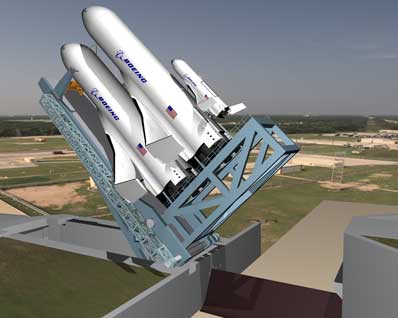
Offline
Like button can go here
#4 2025-09-02 15:37:21
- SpaceNut
- Administrator
- From: New Hampshire
- Registered: 2004-07-22
- Posts: 30,850
Re: Three Sisters Triplet Space Plane Vertical 3 - 2 - 1
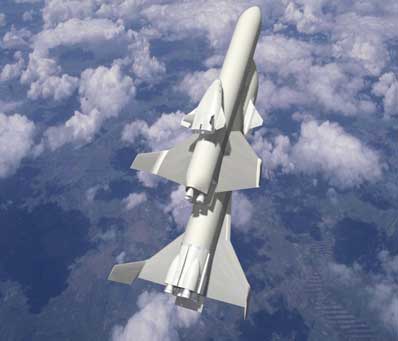
Offline
Like button can go here
#5 2025-09-02 17:46:46
- tahanson43206
- Moderator
- Registered: 2018-04-27
- Posts: 25,861
Re: Three Sisters Triplet Space Plane Vertical 3 - 2 - 1
This is one of the images that kbd512 found on Sunday August 31, 2025
https://airandspace.si.edu/collection-m … 27000_PS01
SpaceNut... do you know how to show this image on the forum? It is located at the Air and Space Museum web site.
Here is a link to the image via the NewMars phpBB3 test site: http://40.75.112.55/phpBB3/download/file.php?id=13
Ported
This is from the Air and Space Museum web site.
Update 2025/09/04 ... GW Johnson is working on a set of spreadsheets to support investigation of TSTO designs, including re-usable configurations.
As a preview, GW advises that staging for the side mounted boosters must occur before shock heating effects become a risk. That will occur around mach 5, and before the ideal time for staging. This means that the orbital stage will have to carry more of the burden than would be the case for a stacked in-line TSTO vehicle, such as Starship or Falcon 9 (or many other examples),
(th)
Offline
Like button can go here
#6 2026-05-04 12:52:55
- GW Johnson
- Member
- From: McGregor, Texas USA
- Registered: 2011-12-04
- Posts: 6,268
- Website
Re: Three Sisters Triplet Space Plane Vertical 3 - 2 - 1
Most 2-stagers today, stage down near 60-some km altitude and a speed near Mach 3 to 6 (which is 1 to at most 2 km/s). That's also near 60-some km downrange, with the trajectory bent over to around only 10 degrees above local horizontal. The bulk of the dV to orbit (the other 6 km/s) is best supplied by the second stage at its higher Isp with a real vacuum nozzle design on its engine(s). The first stage has to have sea level or at best compromise-ascent nozzles on its engines.
If there are SRB's, these are usually staged of a little before the first stage core, so they can give a higher thrust over a shorter time interval, at a fixed packaged total impulse (propellant mass times its ascent-averaged Isp = to the time integral of thrust). It would not make sense trying stage all that stuff away all ay once. Way too risky!
The regular rocket launcher can be made reusable by recovering its first stage for a rather slow re-entry at around Mach 3 to 6-ish. But, with a decelerating entry burn to hold entry to Mach 3 at most, that relieves you of needing a heat shield for it, even if it is made of aluminum alloys. It does a powered vertical landing, as both SpaceX and Blue Origin have demonstrated. That first stage can have a stage inert fraction of around 5%, without that heat shield, and restricted to hard pad landings with minimal landing legs.
The second stage must be a fully-qualified re-entry vehicle for 8 km/s entries at the least, which means you must cover half or more of its surface with heat shielding. That right there pushes you to an inert fraction in the 7-10% range. Then it must have some means to land: (1) vertical powered landing, (2) horizontal dry lake bed landing if a lifting body shape, or (3) horizontal runway landing with wings.
Choice (1) means you must add some sort of minimal landing legs, restricted to hard pad landings. That will push you to prey near 10% inert fraction, which is just about where SpaceX has been with its Starship test vehicles.
Choice (2) has more surface area and thus more surface to protect with heat shielding. It will also need suitable high-speed landing gear to land on that lake bed. That will drive to to inert fractions somewhere in the 12-15% range. And depending upon weight during the return (it may have payload aboard), touchdown speed for lifting bodies was demonstrated long ago to fall in the 250+ mph range, perhaps close to 300 mph if still loaded with payload. That's why you need a huge dry lakebed for your landing field! All such high-sped landings will be inherently hazardous! It is easy to lose control while rolling that fast, and tumble the vehicle.
Choice (3) has yet more surface area and the mass of the wings, which will also need heat shielding. It will also need landing gear, but with wings, your touchdown sped can fall in the 150-200 mph range, which is much less hazardous, and can be feasible at airports with runways longer than about 10,000 feet. That sort of buildout is going to put you in the 15-20% range of inert fraction.
Your second stage will not have to fight much in the way of losses, so that 6 km/s second stage is its required dV. You have to carry enough payload to be worthwhile, and you will have to deliver that dV at an Isp high enough for inert fractions in the 10-20% range. You'll do a lot better with the higher Isp of LOX-LH2, although SpaceX is sort-of making Starship work at about 10% inert and LOX-LCH4.
If instead you decide to do your stages as some kind of vertical-launched cluster of spaceplanes, there are 2 things you MUST deal with: (1) your first stage inert fraction is going to be in the 10-15% range, because you need very little heat shielding for it, but you must be a lifting body or have wings. It only shoulders 1-2 km/s of delivered dV, but it shoulders almost all of the 1-2+ km/s worth of losses (there will be more drag loss! So that's something like 2-4 km/s worth of ideal dV capability, where its payload is the second stage (much smaller) spaceplane. And its inert fraction is 10-15%, depending upon the details. The second stage spaceplane faces the same design values and choices as listed above for (2) lifting body or (3) winged spaceplane.
I see no value to attempting 3 stages as all spaceplanes.
The best choice might actually be a real spaceplane atop a Superheavy-like booster.
GW
Last edited by GW Johnson (2026-05-04 13:25:37)
GW Johnson
McGregor, Texas
"There is nothing as expensive as a dead crew, especially one dead from a bad management decision"
Offline
Like button can go here