You are not logged in.
- Topics: Active | Unanswered
Announcement
#276 2026-02-17 10:10:22
- Void
- Member
- Registered: 2011-12-29
- Posts: 9,549
Re: The Moon
This morning, I am thinking about additive and extractive activities on the Moon.
I think that the boring company may do well on most worlds, but perhaps not so much on the Moon as for the relative lack of things like water for it. I will be happy to be wrong about that if eventually method is proven available.
I can think of a number of extractives methods that have recently come into my view;
-Salt Mining with Chlorine and the distillation of the product.
-Laser Sublimation methods.
-I also think that the https://www.quaise.com/ geothermal methods.
I think that some of these could be improved, (Possibly) using chemicals such as Chlorine, in cycles of Oxidation/Chlorination and reduction, (Using Carbon and Hydrogen perhaps).
We will want chemicals on the Moon and at first some of them will be hard to find and process in bulk on the Moon.
While it is a good idea to try to use local resources, I think that also it would be good to figure out how to efficiently and at reasonable cost import ingredients that are easier to provide to the Moon by some effective/efficient methos with utility.
I have previously thought of things like Iron Oxide. But that is not needed for the Moon but is more likely to be taken from the Moon.
In an additive method(s), we may want Urea and Hydrocarbons, to get microbes to make large solids by including regolith and water.
Now I looked at Urea. I would like to crash it into the Moon. The idea of Moon creasing substances of value can be supported by "Space Startup News", as per crashing old space junk on the Moon.
https://www.spacestartupnews.com/
There is a claim from this source, that space junk could be crashed on the Moon using a lower expenditure of delta-v, and the scrap could be of value.
So, I will use that. I will try to produce a practical import method that saves propulsion energy and may provide for needs.
We are familiar with "Airbags". Some people have had trouble grasping the concept of a "Self-Purposed" Airbag in the past.
A "Self-Purposed" "Airbag" would be one that uses its cushioning properties to cushion it's own impact not to protect the impact of another device.
If we have made an Airbag to impact on the Moon at a reasonable speed, we might put Urea grains inside of it. I guess they would be a cargo, and also as likely to bounce around, could "Time Delay" an impact event.
A solid piece of rock can create only a limited, dissipation of impact energy over a limited time interval. Some of it's energy dissipation can dissapated by it's compressive and fracturing nature. If it makes regolith splash, then it provides to energy dissipation time delay by that method.
An Airbag might dissipate energy over an extended time interval, by various methods. But to describe that too much now is to lead attention away from the device I want to propagate in your mind.
I will establish the concept by saying, fill the air bag with Urea foam, and salt that foam with metal Chlorides. Chlorides of metals that are wanted on the Moon but hard to come by.
Quote:
Urea-formaldehyde foam insulation (UFFI) was widely used in the 1970s for its energy efficiency benefits, but it has since been associated with health concerns due to formaldehyde emissions.
What is UFFI?
Urea-formaldehyde foam insulation (UFFI) is a low-density foam insulation made from a mixture of urea and formaldehyde resin, compressed air, and a foaming agent. It was primarily used in the 1970s to insulate homes, particularly in Canada, where it was injected into wall cavities to fill gaps and improve energy efficiency. UFFI is characterized by its off-white or yellowish color and hardens quickly after application.
All Clear Environmental
+1
Historical Context
UFFI gained popularity during the energy crisis of the 1970s as a cost-effective solution for improving home insulation. However, concerns arose regarding the release of formaldehyde gas during the curing process, leading to health risks. By 1980, the Canadian government banned the use of UFFI in residential construction due to these concerns, although it continued to be present in many homes built or retrofitted during that time.
Beth and Ryan Waller
+1
Health Concerns
The primary health concern associated with UFFI is the gradual release of formaldehyde, a known irritant and potential carcinogen. While emissions decrease over time, certain conditions, such as high humidity or poor ventilation, can lead to increased levels of formaldehyde in the air. Symptoms of exposure may include respiratory issues, eye irritation, and allergic reactions.
All Clear Environmental
+1
Identifying UFFI in Homes
If you suspect that your home may contain UFFI, look for the following signs:
Injection Holes: Homes insulated with UFFI may have visible injection holes on the exterior walls.
Foam Appearance: UFFI can appear as crumbly, tan, or brown foam behind outlet covers or switch plates.
Unusual Odors: A musty or chemical smell in sealed rooms may indicate the presence of UFFI.
22 Sources
What to Do If UFFI is Present
If you suspect UFFI in your home, it is advisable to avoid DIY inspections or removal. Instead, hire a certified professional to conduct an inspection and air quality testing. They can safely assess the situation and recommend appropriate actions if necessary.
Beth and Ryan Waller
+1
Conclusion
While UFFI was once heralded as an innovative insulation solution, its association with health risks has led to its decline in use. Homeowners should be aware of the potential presence of UFFI in older homes and take appropriate measures to ensure safety and air quality.
https://en.wikipedia.org/wiki/Urea-formaldehyde
https://activerain.com/blogsview/140744 … on--part-1
Image Quote: 
I believe that this material has much of what is wanted on the Moon, especially if you salted it with metal chlorides.
https://en.wikipedia.org/wiki/Urea
Image Quote: 
https://en.wikipedia.org/wiki/Formaldehyde
Image Quote: 
Most of the atoms in the structure are of significant value on the Moon. The Oxygen is not, but it is needed for the structure of the foam, which is useful to the hoped for impact survival of the devices.
The impact results may be affected by the temperature of the impacting device and the temperature of the surface of the Moon where it impacts.
Also, the nature of the surface that it impacts onto.
For instance, it might hit a trampoline of some kind, or a net. Or a hill of fine dust, that has been provided. You might make a surface softened by feeding gas Oxygen into the pile of dust. A method of fluidization. Or you might fire an explosive device embedded in the pile of dust to fluidize it for a short period of time.
The device might be sent from LEO, with limited navigation and braking abilities. Or it might be dropped from the sides of a ship while the ship lands.
You might be able to shoot some kind of a particle beam at the device from the surface of the Moon to slow it down. Perhaps the output of a Mass Driver, or Magdrive(s), or Neumann Drive(s}.
And then finally you might use it as a landing legs substitute for hardware you wanted to land on the Moon.
What about the Chlorine Salts:
https://en.wikipedia.org/wiki/Chloride
Quote:
Chlorine salts, commonly known as chloride salts, are chemical compounds that contain the chloride ion (Cl⁻) and are formed through the reaction of chlorine with metals or other elements.
What are Chlorine Salts?
Chlorine salts are ionic compounds that consist of positively charged cations and negatively charged chloride anions. The most well-known example of a chlorine salt is sodium chloride (NaCl), commonly known as table salt. Chloride salts are typically soluble in water, although some, like silver chloride (AgCl) and lead(II) chloride (PbCl₂), have limited solubility.
Wikipedia
+1
Common Examples of Chlorine Salts
Sodium Chloride (NaCl): The most familiar chloride salt, used extensively in food seasoning and preservation.
Potassium Chloride (KCl): Often used as a salt substitute in food and as a potassium supplement in medicine.
Calcium Chloride (CaCl₂): Used for de-icing roads, as a drying agent, and in food preservation.
Ammonium Chloride (NH₄Cl): Used in fertilizers, as a food additive, and in some medicinal applications.
Properties and Uses
Solubility: Most chloride salts are soluble in water, making them useful in various applications, including food preservation and chemical processes. However, some chlorides, like silver chloride, are only slightly soluble.
1
Electrolyte Function: Chloride ions play a crucial role in maintaining fluid balance and are essential electrolytes in biological systems.
1
Industrial Applications: Chlorine salts are used in a variety of industries, including food processing, pharmaceuticals, and chemical manufacturing.1 Source
Formation of Chlorine Salts
Chlorine salts are typically formed through the reaction of chlorine with metals or through neutralization reactions involving hydrochloric acid. For example, when sodium reacts with chlorine gas, sodium chloride is produced as follows:
2 Na
+
Cl
2
→
2 NaCl
2 Na+Cl
2→2 NaCl
In summary, chlorine salts are vital compounds in both nature and industry, with sodium chloride being the most recognized example. Their properties and solubility make them essential in various applications, from food preservation to chemical manufacturing.
Wikipedia
+2
The substances received, might be used to 3D print regolith, or break it down, and get various products.
Microbes can use Urea and Water and some other organics to cement regolith.
Hydrocarbons might be used to grow Mycelium products.
Chlorine extracted can be used in salt mining.
Metals from the Chlorides can be used to makes alloys of Lunar metals.
Substances included might facilitate drilling into the Moon using Lasers and/or other power beams. Maybe "Our gyrotron-powered drilling".
If you add Chlorine, you might get a gas to flow out with Iron in it??? As in Salt mining.
If you add Hydrogen or Carbon/CO, you may get an extraction of Oxygen from the dril location a reduction of the rock.
If you then add these in alternation you may better drill the rock.
But of course, your process has to not eat your drilling equipment.
I think that is quite a lot for one morning.
Ending Pending 
Last edited by Void (2026-02-17 11:17:50)
Is it possible that the root of political science claims is to produce white collar jobs for people who paid for an education and do not want a real job?
Offline
Like button can go here
#277 2026-02-28 20:40:19
- Void
- Member
- Registered: 2011-12-29
- Posts: 9,549
Re: The Moon
https://www.youtube.com/@Anthrofuturism Put out a nice video: https://www.youtube.com/watch?v=8DUydTgyGQ0
Quote
The Lunar Mass Driver Orbital Supply Chain
ANTHROFUTURISM
Two of three possible purposes for this sort of thing are mentioned.
1) Orbital power beamed to Earth.
2) The Lunar Mass Driver Orbital Supply Chain (What this video is about)
A 3) Option which is data centers in space are not worked on.
But it is a very good video, and I learned a bit more about what is possible/practical and why.
Ending Pending
Last edited by Void (2026-02-28 20:45:07)
Is it possible that the root of political science claims is to produce white collar jobs for people who paid for an education and do not want a real job?
Offline
Like button can go here
#278 2026-03-13 09:03:01
- Void
- Member
- Registered: 2011-12-29
- Posts: 9,549
Re: The Moon
A video about power on the Moon: https://www.bing.com/videos/riverview/r … &FORM=VIRE Quote:
Lunar Power Grid: Cables, Lasers or Orbit?
YouTube
Space Startup News
6 views
3 hours ago
Nice to see that there are plans in the works.
Ending Pending
Is it possible that the root of political science claims is to produce white collar jobs for people who paid for an education and do not want a real job?
Offline
Like button can go here
#279 2026-04-09 09:16:59
- Void
- Member
- Registered: 2011-12-29
- Posts: 9,549
Re: The Moon
A thing I have been thinking about is a vertical melt cave for the Moon or other worlds.
Tunneling on the Moon may not be very easy. Boring machines need water and involve troublesome chemistry.
As always, it will be easier to say this than to do it. But the rewards from learning how to do it would be large: 
Cones without air pressurization with a induced lava floor will not suffer from convection as a method to bleed the induced heat away.
If a floating "Island" of refractory materials could be structured to float on the induced lava melt, then heat losses from radiation may be mini8mized, and then only the rock could bleed heat off from the induced lava melt.
Methods of heating might be microwave, or perhaps electric currents. Maybe some kind of a solar concentrator??? But then that conflicts with the floating island.
Finding methods for extracting the induced lava, and producing value assed products from it will require a lot of discovery.
Obviously, robots would be of a great help along with serious automation methods.
It could be observed that such caves heated during the Lunar Day would be useful in the Lunar night.
It can be supposed that if you do multiple cones, and keep going down, eventually they may connect with each other.
So, a potential for vast underground systems of connected chambers on the Moon and maybe Mars.
Ending Pending

Last edited by Void (2026-04-09 09:40:36)
Is it possible that the root of political science claims is to produce white collar jobs for people who paid for an education and do not want a real job?
Offline
Like button can go here
#280 2026-04-09 16:03:45
- Void
- Member
- Registered: 2011-12-29
- Posts: 9,549
Re: The Moon
Referring to the just prior post, I think that what I was reaching for is a "Melt-Method-of Drilling".
I now think that a "Lava Lake" with floating island could be replaced with more practical methods.
Perhaps a pond that could be moved around as the materials were extracted and converted into material good by a method similar to "Blue Alchemist".
https://www.blueorigin.com/news/blue-al … nar-future
A video:
https://www.bing.com/videos/riverview/r … &FORM=VIRE
Where they intend to work with the broken regolith, I would like to see a "Melt-Method-of Drilling", even into the bedrock of rocky worlds.
Various methods, of materials separation could be included, and I think that the reminder could be "Cast" into simulated stones to build structures on the surface of those worlds.
Mercury
Venus (Too Hot?)
Earth
Luna
Mars
Vesta
16 Psyche
Io (Too Radioactive?)
Where I have suggested a cone method, vertical and diagonal bedrock drilling extraction methods also might work.
So, then the process would be extractive to additive.
Ending Pending
On most of these worlds, a coolant such as CO2 might be used, to allow sensitive machines to work near the "Melt Pond".
Unfortunately for our Moon it may well be necessary to import the Carbon for that.
Mercury and Venus and Mars and Vesta are known to have Carbon, likely in large amounts.
So, eventually a world like Mercury might has tunnels and vaults that would go many Kilometers down. Perhaps some day it might be possible to drill all the way into the core of Vesta, or 16 Psyche.
Ending Pending
Last edited by Void (2026-04-09 16:30:34)
Is it possible that the root of political science claims is to produce white collar jobs for people who paid for an education and do not want a real job?
Offline
Like button can go here
#281 2026-04-10 09:42:14
- Void
- Member
- Registered: 2011-12-29
- Posts: 9,549
Re: The Moon
The process of carving cone or cylinder vertical or diagonal shafts into the Lunar bedrock may release Oxygen.
Query: "Including results for Heating some Lunar Regolith will release some oxygen?.
Do you want results only for Heating some Lunar Regoli9th will release some oxygen??
"
My "Puter" companion says, (quote):
Yes
Yes, heating lunar regolith to high temperatures can indeed release oxygen. This process is known as molten regolith electrolysis or vacuum pyrolysis. These methods involve heating the regolith to temperatures that dissociate its minerals into reduced oxides and gaseous oxygen. The released oxygen can then be isolated and stored for use in various applications, including life support systems and rocket propulsion.
NASA
+5
Here is some more support on that: https://hal.science/hal-05061241/file/R … ca2025.pdf
Quote:
Review of in-situ oxygen extraction from lunar regolith with
focus on solar thermal and laser vacuum pyrolysis
Jack Robinot, Sylvain Rodat, Stéphane Abanades, Alexis Paillet, Aidan Cowley
Tocitethis version:
Jack Robinot, Sylvain Rodat, Stéphane Abanades, Alexis Paillet, Aidan Cowley. Review of in-situ oxygen
extraction from lunar regolith with focus on solar thermal and laser vacuum pyrolysis. Acta Astronautica,
2025, 234, pp.242-259. ⟨10.1016/j.actaastro.2025.05.008⟩. ⟨hal-05061241
So, perhaps a artificial lava pool/lake might work or perhaps some work on geothermal might work.
Query: "drilling geothermal wells with microwaves"
Quote:
Gyrotron Technology Goes Deep For Geothermal Energy
Quaise Energy is at the forefront of developing gyrotron technology for deep geothermal drilling. Gyrotrons are powerful vacuum electronic devices that generate high-frequency electromagnetic waves in the microwave to terahertz range. They operate on the principle of electron cyclotron resonance in a strong magnetic field. Quaise Energy is developing technology to mine precious metals, create deep underground locations to store nuclear waste, and access geothermal resources within the Earth's crust. The company aims to harness the residual heat from the planet's formation and the decay of radioactive elements in the Earth's mantle and core to produce geothermal energy. This energy is regarded as a renewable source because the heat is constantly replenished within the Earth, following the geothermal gradient, which averages about 3°C per 100 meters. Quaise Energy's technology holds the potential to build geothermal wells at unprecedented depths and temperatures, providing clean electric generation and heat distribution plants within a short distance of major population and industrial centers on the planet.
The product for this would be a fine dust, I believe. However, the process would likely release volatiles into a vacuum as well. Oxygen, Chlorine, Hydrogen compounds and such.
So, then of course you might build an Oxygen atmosphere inside of the vault. It might be that if you placed Methane gas into that chamber then the process would capture the released Oxygen into CO2 and H20. Chlorine might bond to Iron as a somewhat high temperature vapor and then might condense upon cooling.
Dust produced by the process may be to some extent reduced, which might be favorable for separating some materials such as magnetic iron, using magnetism.
If instead the use of a more "Hard" vacuum would be used, in the vaults then produced Oxygen might be compressed into another vault which had been previously created.
A vaults rocks being composed of 40% to 45% Oxygen, I would presume the results will be a reduction of the total amounts of solids, but not necessarily a proportional result. Some solids could be removed to the Lunar surface. Alternately Lunar regolith on the surface might on occasion be dumped into these vaults on a periodic basis to do processing on the materials.
The process will of course require electrical power and will also produce heat.
I have suggested liquid CO2 as a coolant that could be piped down from the surface to then vaporize and carry heat away to a condensing process, perhaps also on the surface.
A ladder/ramp may be attached at the apex of the vault above, and might rotate about the chamber to give access to needed situations to address. Something like a librarian's ladder???
I guess it would be called a "Rolling Ladder": https://putnamrollingladder.com/
Image Quote: 
But the pitch of it would be inverted and probably a "Lift" would be included into it.
Perhaps this will help visualization of it: 
Three vertical sections are shown as a single vault. The rolling ladders are to the right on the top and bottom ones, and the middle rolling ladder has been rotated to the left in the depiction.
So, all surfaces of the vault can be accessed to patch cracks and to attach mechanisms into the surfaces.
I do wonder how deep the human race may be able to dig with this method into alien worlds such as our Moon.
100 km???
For Mars, of course not as deep and we also would have to be concerned about thawing permafrost in some situations.
For Vesta and 16 Psyche, I hope we could dig all the way into the center to get all the goodies.
Ending Pending
Last edited by Void (2026-04-10 10:23:39)
Is it possible that the root of political science claims is to produce white collar jobs for people who paid for an education and do not want a real job?
Offline
Like button can go here
#282 2026-04-11 10:41:21
- Void
- Member
- Registered: 2011-12-29
- Posts: 9,549
Re: The Moon
The Moon-Path that I have recently posted for suggests that the Moon can become something very important and not a ball of rock to ignore.
It may be possible that deeply buried rock on the Moon may some Carbon and Hydrogen, Chlorine and other minority substances, however if we are going to emerge into a Kardashev II solar system, I feel that importing more from other places in the solar system will not be out of reach.
Most other worlds in the solar system have substances that might be worth importing to the Moon.
In carving massive amounts of vaults into the Lunar Bedrock, much excess Oxygen will be produced. Much of that can be compressed into the vaults. But some would leak to make a thin atmosphere, I suspect.
If that became true, it would likely not be desired to let it go so far as to interfere with Mass Driver activities. (Presuming that Mass Drivers will be in use).
So, for Mars, it is said that 5.5 millibar may allow Mass Drivers, so I suspect that 11 millibars on the Moon would be a problem.
But it can be noted that a 1 millibar atmosphere might allow objects to aerobrake into the Moon, as the gravity is about 1/2 that of Mars and the very thin atmosphere might stack higher.
Cellulose and other organic structure might significantly comprise the body of such objects to aerobrake. Keep in mind that we are not going to try to land these things. If they burn up in an O2 Lunar atmosphere the results will largely be more Oxygen and also CO2 and H20.
The Moon has cold traps that could capture the CO2 and H20 from the atmosphere on a continuing basis.
So, giant cellulose mirrors constructed at another world would be receivable to the Moon by such a method as a delivered resource.
Obvious donor worlds could be Mars, The Asteroid Belt, and Callisto.
OK, here is a crude drawing: 
The object largely made of organic structure like cellulose and plastics, may have a thin aluminum surface for the mirror. If the object can be projected by some means like a chemical explosion or perhaps particle beams, it might start in that manner. Then as it drew near to the sun improved on-board power might allow it to use some electric propulsion method to intersect our Moon.
As I have said the intention is not to land it, so it can come in hot and fast to burn-up and break-up in a thin Lunar atmosphere.
If we presume robotic labor, these can be created in large quantities in regions of the solar system having the desired substances.
https://en.wikipedia.org/wiki/Cellulose
Quote:
Chemical formula (C6H10O5)n
Plastics might also provide useful structure, perhaps including other substances as well.
Query: "Plastics that contain Nitrogen"
Quote:
Plastics that contain nitrogen include:
Polyurethanes: These are versatile plastics used in various applications, including automotive parts and textiles.
Polyamides: Often referred to as nylon, these plastics are known for their strength and flexibility.
Nylon: Specifically, nylon is a nitrogen-containing polymer that is commonly used in various products due to its durability and resistance to wear.
Melamine resins: These are also nitrogen-containing plastics used in manufacturing and have applications in electrical and electronic components.
Nitrogen plays a crucial role in the manufacturing of these plastics by displacing oxygen, which helps prevent oxidation and maintains the integrity of the material during processing.
3
Example: https://en.wikipedia.org/wiki/Polyurethane
Image Quote: 
For a time the Moon could maintain both Mass Drivers in a very thin atmosphere and the reception of these objects. But eventually perhaps the asteroids will provide the rocky materials, and the Moon could be significantly more terraformed. But that will be a long time off, I expect.
Ending Pending
Last edited by Void (2026-04-11 11:27:32)
Is it possible that the root of political science claims is to produce white collar jobs for people who paid for an education and do not want a real job?
Offline
Like button can go here
#283 2026-04-12 07:39:50
- Void
- Member
- Registered: 2011-12-29
- Posts: 9,549
Re: The Moon
A device that I have hoping for is one that uses heat and some types of reactive gasses to modify a solid object.
A cutting torch does so but is not suitable for highly Oxidized Lunar regolith or bedrock. It can "Cut" metal with heat and Oxygen.
So, although I am still interested in the "Lava Pond" concept, it may be possible to use a heat source and a "Fuel" type to eat into highly Oxidized Lunar bedrock. (That is the hope).
Hydrogen might serve as the fuel or possibly Methane.
The source of the heat might be Microwave, Laser, or some sort of Gyrotron.
Query: "drilling geothermal wells with microwaves"
Quote:
Microwave drilling uses high-powered electromagnetic waves to melt and vaporize rock, enabling access to superhot geothermal energy at unprecedented depths.
How Microwave Drilling Works
Microwave drilling, also called millimeter wave drilling, employs high-frequency microwaves generated by a device called a gyrotron. These microwaves are transmitted down a borehole to the rock face, where they spall, melt, and vaporize the rock, creating a hole without the need for conventional mechanical drill bits or complex downhole equipment (Quaise Energy). The only downhole component is a guiding tube that directs the microwave beam to the target rock (Quaise Energy). This method is particularly suited for ultradeep wells in extremely hard basement rocks like granite and basalt, which are difficult to penetrate with traditional rotary drilling (JPT).
Society of Petroleum Engineers
+2
Advantages Over Conventional Drilling
Extreme Depths and Temperatures: Microwave drilling can reach depths of 10–20 km and temperatures up to 500°C, far beyond the limits of conventional geothermal drilling (Quaise Energy).
1
Faster Drilling Speeds: Field tests have demonstrated drilling speeds 10 times faster than prior lab demonstrations, significantly reducing project timelines (Quaise Energy).
1
Reduced Equipment Wear: Since the rock is melted rather than mechanically ground, there is minimal wear on drill bits and seals, which are typically destroyed at superhot conditions (JPT).
1
Access to Superhot Geothermal Energy: This technology enables the production of supercritical steam, which has a much higher energy density than conventional geothermal steam, making electricity generation more efficient (Quaise Energy).
13 Sources
Current Development and Field Testing
Quaise Energy, an MIT spinout, is leading the development of this technology. They have conducted field tests in a granite quarry near Austin, Texas, achieving a 100-meter milestone in millimeter wave drilling, demonstrating the feasibility of scaling the technology to commercial depths (Quaise Energy). The company plans to retrofit existing coal power plants into geothermal plants by drilling ultradeep wells beneath them, potentially providing carbon-free electricity at a global scale (MIT Energy).
quaise.com
+1
Technical Components
Gyrotron: A vacuum electronic device that generates high-power microwaves in the millimeter-wave range, previously used in nuclear fusion experiments (EEP).
1
Downhole Waveguide: A long tube that directs the microwave energy to the rock face, eliminating the need for complex mechanical components in extreme conditions (Quaise Energy).
1
Field Rig: Compact rigs are deployed to test and eventually scale the technology for commercial geothermal wells (Quaise Energy).
13 Sources
Potential Impact
Microwave drilling could unlock the world’s largest source of stored energy by making superhot geothermal energy accessible almost anywhere,
Quaise Energy: https://www.quaise.com/
Quote:
Unlocking the true power of clean geothermal energy.
Quote:
Our gyrotron-powered drilling platform vaporizes boreholes through rock and provides access to deep geothermal heat without complex downhole equipment.
Based on breakthrough fusion research and well-established drilling practices, we are developing a radical new approach to ultra-deep drilling. First, we use conventional rotary drilling to get to basement rock. Then, we switch to high-power millimeter waves to reach unprecedented depths.
I would like to modify the process to become a carving tool rather than a drilling tool.
In the Quaise drilling process drilling creates dust which then is forced up the bore-hole with a injected gas. (That is what I understand).
If the gas we used to blow the dust from the carving site were Hydrogen, I think it is likely that it would reduce the dust of Oxygen and create water vapor. To maintain a greater partial vacuum in the carving chamber, then I suppose that the water vapor will be collected and split into Hydrogen and Oxygen. The reduced dust could be collected an processed further. The result would then be a useful cavity in the bedrock of a world like the Moon.
Methane might be used instead of Hydrogen, but I anticipate that the Carbon may tend to bond with some part of the resulting dust. Then you would need a process to recover the Carbon.
In the dust should be some Iron. Various methods may be possible to recover that Iron. Beyond that then the remnant might be processed to get things like Aluminum and Silicon out of it.
The remainder might be re-Oxidized and converted into some sort of solid object like a brick.
Of course, I do not know for sure that my above speculations will work at all or by some modifications. Testing would tell, I expect.
>>>>>>>>>>>>>>>>>
It is a hope that some rocks submerged further down in the bedrock may hold more useful things like Carbon, Hydrogen, and Chlorine.
Soviet Drilling on the Moon suggested that it could be so.
https://www.dailymail.co.uk/sciencetech … overy.html
Quote:
In the rocks that it brought back, water made up around 0.1%.
I am not interested in the politics of the issue, just the water.
I think we might want to be interested in extinct volcanoes on the Moon: https://earthsky.org/space/fire-fountai … ry-solved/
Quote:
When the first astronauts went to the moon in the late 1960s and early ’70s, they found glass beads on the lunar surface that could only have been made in active volcanos. The beads are a sign that fire fountain eruptions took place on the moon, similar to the eruptions that occur frequently in Hawaii, for example. From that time, although we’ve known that the moon was once volcanically active, scientists have pondered the question of what volatile substances could have driven the lunar fire fountains. Scientists from Brown University and the Carnegie Institution for Science announced this week (August 24, 2015) that they’ve identified the volatile gas that drove those eruptions. They say carbon monoxide (CO) gas was responsible.
Quote:
For many years, the moon was thought to be devoid of volatiles like hydrogen and carbon. It wasn’t until the last decade or so that volatiles were definitively detected in lunar samples. In 2008, Saal and colleagues detected water in lunar volcanic beads. They followed that discovery with detections of sulfur, chlorine and fluorine. While it became apparent that the moon was not completely depleted of volatiles as was once thought, none of the volatiles that had been detected were consistent with fire fountain eruptions. For example, if water had been the driving force, there should be mineralogical signatures in recovered samples. There are none.
Although the quantities will likely be very low, they will still be valuable. And at the same time Iron, Aluminum, and Silicon might be recovered from the rocks in much larger amounts.
I suppose that fire fountains may either have had so much heat that the vented the vast majority of these volatiles before cooling down, or the volatiles kept coming up form the deeps until the rocks solidified, then perhaps trapping some of the volatiles at a depth but perhaps not out of reach.
So, from post #281, a carving-drilling method into a ancient Fire-Fountain might yield value:
Perhaps this will help visualization of it:
Both in the form of recovered materials and the vaults which in some cases could be rendered "Habitable" eventually.
Also from post #282 we also have the option to import volatiles to a world like our Moon: OK, here is a crude drawing:
Previously I have suggested that such devices could be crafted from the materials of Mars, Asteroid Belts, or Callisto.
I want to include that at some point in the future it might be possible to get such from Dwarf Planets such as Pluto and Eris.
This may particularly be true if it becomes possible to beam power to those locations from our sun's inner locations, or if fusion becomes practical as a power source.
So, the device largely made of organic substances and some metals, is intended to impact a very thin atmosphere created for the Moon. A good location for impact might be near the poles of the Moon. Presuming the craft burns and breaks up, on atmospheric entry, the desire is that the burned volatiles such as compounds of Hydrogen, Carbon, and Nitrogen will condense in the shadowed craters and any surviving wreckage may also crash into those craters.
So, the solar system does contain plenty of materials to turn the Moon into a garden. But that would take much effort and time and may or may not be a desire.
Ending Pending
Last edited by Void (2026-04-12 08:45:49)
Is it possible that the root of political science claims is to produce white collar jobs for people who paid for an education and do not want a real job?
Offline
Like button can go here
#284 2026-04-13 09:59:16
- Void
- Member
- Registered: 2011-12-29
- Posts: 9,549
Re: The Moon
I have often thought that the Asteroid Belt could be used to make our Moon more valuable. This would not bypass Deimos/Phobos/Mars, as these are between the two locations, Ceres<>Luna.
If as is expected the Starship technology matures into a high level of utility, then all of these worlds should become accessable.
From post #283:
Also from post #282 we also have the option to import volatiles to a world like our Moon: OK, here is a crude drawing:
Other asteroid materials may do, but for now I will suggest Ceres as it is thought that it will have Nitrogen to export along with Carbon, and Hydrogen.
In this scheme "Ceres" would be important as a place for humans and robots, not just our Moon. The substances of Ceres could be made into Biological Structure Materials and also Plastics. But metals and Silicon would be available.
The objective would be to make a device out of these materials and to transfer it to CIS-Lunar-Space, Mars Orbits, and possibly to inner solar system asteroids. It may also be possible to crash them into the Moon, if it could be done in a way that would deliver valuable materials.
I have suggested this elsewhere, but will review it again.
Ceres is still close enough to the sun that mirrors could provide lots of solar energy.
To transfer these devices to a more inner solar orbit than the orbit of "Ceres", a Mass driver might be considered, but that requires electric power to provide a large amount of inertia over a very short period of time.
A modification of T.A.R.S might be more suitable, as it can accumulate and store flywheel type energy over a long period of time.
Query: "T.A.R.S. space launch method"
Quote:
The T.A.R.S. (Torqued Accelerator using Radiation from the Sun) is a revolutionary space propulsion concept developed by David Kipping. It utilizes solar radiation to generate rotational energy, which is then converted into kinetic energy to accelerate small spacecraft to speeds greater than the escape velocity from the solar system.
TARS consists of two reflective paddles connected by a tether, with each paddle having a reflective side and a dark side.
The paddles spin due to solar radiation, accumulating energy over time.
Once sufficiently powered, a small spacecraft is released at high velocity, potentially reaching speeds of up to 7.5 miles per second.
This method does not require fusion reactors or gigawatt lasers, making it a simpler and more accessible approach to interstellar travel.
3The concept has been detailed in a study published on arXiv, showcasing its potential for launching microprobes into interstellar space.
1
The modifications desired would be;
1) Not for interstellar.
2) Accelerated by Electric Rocket Propulsion, not sunlight.
So then perhaps "Torqued Accelerator using Electric Propulsion."
It activities at Ceres occur, then it would be desirable to seek methods for Space Elevators there. If you have tethers for that you might then have tethers for "Torqued Accelerator using Electric Propulsion."
This spin and fling method is already understood: 
Electric Rockets would spin it up and at an appointed moment the tether would be cut. The "Outie" would be flung to a higher orbit in the sun's gravity well and the "Innie" would be flung to a lower orbit in the sun's gravity well.
So, far the "outie" is just a counterweight that we simply fling away and might not have any further use for.
But what if the "outie" was an explosive charge packed with water ice?

So, lets change the "outie" into a cannon, and modify the 'inie" to have "Pusher Plate" characteristics like for a nuclear Orion.

Of course, then the "innie" has to be rugged to survive the blast, and you lose the "Cannon" of the "outie" to the more outer solar system.
But the two methods flywheel and chemical allow the storage of large amounts of energy over a time period and the sudden release of much energy over a short time period.
A Mass Driver is the different. You have to apply energy (Electric) over a short time period and so inertia transfer to the projectile is made difficult.
What is left of the "outie" is probably abandoned and derelict.
The "Innie" then sent to a more inner sun orbit, might get to better sunlight and the "innie" then might use on-board propulsion such as electric rocket propulsion to get into some gravity assist situations such as with inner planets such as Mars and others.
At some point the hope would be to use methods akin to "Ballistic Capture" to bring the device into orbit of Mars or Earth/Moon or maybe Venus.
Well.....That was fun!
Ending Pending
Last edited by Void (2026-04-13 11:25:06)
Is it possible that the root of political science claims is to produce white collar jobs for people who paid for an education and do not want a real job?
Offline
Like button can go here
#285 2026-04-14 08:16:28
- Void
- Member
- Registered: 2011-12-29
- Posts: 9,549
Re: The Moon
So, matter that might compose a propulsion device could have stored energy by at least two methods.
1) Flywheel.
2) Chemical.
A "Cannon" as the "outie" could have a large mass of water ice mixed with nano aluminum, I suspect. Then you might want a core that is even more chemically active to ignite the mass. (It might work).
The "Cannon" shell itself would be for one time use and you may not care if it splits apart during that event.
A method like that for Cere may be practical but other options might exist.
For instance, just using Alice. https://en.wikipedia.org/wiki/ALICE_%28propellant%29
If the body of the rocket was largely made of Hydrocarbon Materials. You might want a collection of such rockets of various sizes connected, so that various trust events along with gravity events might bring the body of the rocket(s) into the desired location.
There would be other possible methds.
But when bases get set up on the Moon it might prove out that the deeper you dig on the Moon, the more water and Carbon there might be.
So, there is some concept of water inside of the Moon:
https://www.facebook.com/cnn/videos/moo … 579256509/
https://earthsky.org/space/fire-fountai … ry-solved/
Quote:
The volatile evidence suggests that either some of Earth’s volatiles survived that impact and were included in the accretion of the moon or that volatiles were delivered to both the Earth and moon at the same time from a common source — perhaps a bombardment of primitive meteorites.
So, at this point, I am supposed to enter into a team sports monkey battle and obsessively maintain that the Moon has useful substances like Carbon and Water in the remnants of it's fire fountains. But of course I do not know that..
So, the proper process instead is to find out.
So, the suspected history of the space program in America is that the religious conservative people of that time really did not want taxpayer money "Wasted" on space exploration. I was there, I knew how their thinking worked.
But the money flowing from taxes into space hardware could be funneled to preferred locations in the country by politics.
So, it was important to milk the space program while keeping humans Earth bound. This was done along with the time of Rust Bel/Sun Belt proclamations. (To some extent the revenge of the confederacy).
We were locked into a prison of OPEC oil.
But I do not hate the people from those locations, they in part created fracking. Even the confederacy took a dirt nap and became something better.
The above may have some amount of truth. Anyway, the idea of Mars and not the Moon was crafted to make sure that a space industry was a conduit for money flow to preferred locations by politics, but it would always be desired to make sure that the human race did not leave Earth. Letting humans leave Earth would be like letting your plantation slaves get out of your reach.
I think that we are in a north era now, it's infancy, so the plantation mentality is on the decline. I therefore have hopes that the human race will indeed be liberated into space. It appears that the Moon may be an early event for that.
Ending Pending
Last edited by Void (2026-04-14 09:04:45)
Is it possible that the root of political science claims is to produce white collar jobs for people who paid for an education and do not want a real job?
Offline
Like button can go here
#286 2026-04-14 18:18:41
- Void
- Member
- Registered: 2011-12-29
- Posts: 9,549
Re: The Moon
This is a value of having other nations work with us. Other dreams, in this case, a Japan dream: https://www.msn.com/en-us/news/technolo … r-AA20TzqC Quote:
apan wants to put a solar ring around the moon to power Earth
Story by Mary Dada • 2h •
2 min read
Ending Pending
Last edited by Void (2026-04-14 18:19:38)
Is it possible that the root of political science claims is to produce white collar jobs for people who paid for an education and do not want a real job?
Offline
Like button can go here
#287 2026-04-15 07:39:58
- Void
- Member
- Registered: 2011-12-29
- Posts: 9,549
Re: The Moon
I have developed the tether methods with (th) a bit more in another topic.
I will bring those here now.
https://newmars.com/forums/viewtopic.ph … 02#p238802
Quote:
But for your needs (th) I would like to try something else:
So, now your Outie and Innie have their own propulsion methods. I imagined that it could be Alice for both, as Ceres will have water ice for it and also Aluminum for Nano-Powder.
The assembly would be spun up using electric rockets for efficiency. Possibly using either Magdrive or Neumann Drive.

https://newmars.com/forums/viewtopic.ph … 14#p238814
Quote:
Interestingly the two disks could perhaps house human habitats.
The dumbbell can spin in either direction and the Innie/Outie in the other direction.
And so then you can release the Outie and the Innie, but then are left with a dumbbell that is spinning already.
If I could conjure up a new Outie and Inni, and have the tethers for it, then I need a means to attach them while it is still spnning.
So, the "Spin Collar" can be set to zero spin even if the "Dumbbell" retains spin from the last launch.


I currently am interested in this sort of thing in the Asteroid belt, but in that then delivering materials to our Moon, and to outer solar system worlds.
The Moon perhaps could use wood like substances and plastics delivered to it.
Jupiter and Saturn perhaps could use Fission Nuclear Reactors delivered to them.
I expect that the Asteroid Belt may provide fuel for such nuclear reactors, and also metals and other materials to build the nuclear reactors.
A Nuclear reactor delivered to Titan could have value.
Wood-Like materials and plastics delivered to the Moon and CIS-Lunar Space then.
But then within the Asteroid Belt itself to toss materials about to and from various worlds.
The asteroid belt will provide for various methods of propulsions.
In the pink and blue diagram above, I consider also that the "Disks" of the "Dumbbell" could include habitats for humans. The synthetic gravity will be variable though. People might have to migrate inside to get to proper g forces. The device will spin first in one direction and then the other.
While the Saturn System will not exclude the possibility of solar power in orbit, on Titan Nuclear Fission Reactors in large numbers could start up a new branch of civilization.
Starting with Nuclear Fission then beaming power to Titan from orbital solar and then we may hope developing Fusion power as well.
And for every reactor sent to Titan from the Asteroid Belt, similar mass of organic materials could be delivered to orbits of inner planets such as Mars and Earth.
Ending Pending
Last edited by Void (2026-04-15 07:59:08)
Is it possible that the root of political science claims is to produce white collar jobs for people who paid for an education and do not want a real job?
Offline
Like button can go here
#288 2026-04-15 09:23:05
- Void
- Member
- Registered: 2011-12-29
- Posts: 9,549
Re: The Moon
To elaborate a bit more on the previous post, a Fission Reactor created in the Asteroid belt could have the means of an electric propulsion system included into it. Perhaps Magdrive or Neumann Drive.
Sent then to Titan, it could use the method of heat shields and Parachutes to land on Titan.
Multiple reactors sent that way, then could foster robotic and human actions on the surface of Titan.
There are two interpretations of what the sand dunes of Titan may be composed of.
1) Hydrocarbon Particles.
2) Comet Dust.
https://phys.org/news/2024-04-titan-dunes-comet.html
Quote:
Are Titan's dunes made of comet dust?
by Allen Versfeld, Universe TodayEditors' notes
Quote:
During this period, Neptune passed through the Kuiper belt, nudging many comets into new orbits. Many of these comets passed close by Saturn and its moons, and some even collided with the moons. The researchers suggest that much of the sand making up Titan's dunes may be debris from all these comets.
In any case it is fair to ask what happened to the dust from comets that surely have impacted Titan over time. If not in the dunes then it may be in the crust.
So, with Nuclear Fission reactors, then Titan would have the ingredients for a Civilization to be built.
And with its resources that civilization might create both solar orbital power methods and Fusion power (If practical).
So, using Nuclear Fission reactors as ballast in an orbital spin launch system would open Titan, and I hope promote the sending of cargo to our Moon and CIS-Lunar Space from the Asteroid Belt.
Ending Pending
Last edited by Void (2026-04-15 09:35:44)
Is it possible that the root of political science claims is to produce white collar jobs for people who paid for an education and do not want a real job?
Offline
Like button can go here
#289 2026-04-16 10:59:35
- Void
- Member
- Registered: 2011-12-29
- Posts: 9,549
Re: The Moon
The idea of importing organics from other places to the Moon could be desired eventually, but of course prior to that if it is possible to get them more locally, that is probably a better path.
https://dailygalaxy.com/2026/02/japan-p … ound-moon/
Quote:
Science
Japan Plans to Create a Solar Ring Around the Moon to Power Earth for Eternity
Shimizu Corporation’s Luna Ring concept could transform global energy by harnessing the Moon’s solar power and beaming it back to Earth.Published on February 8, 2026 at 08:45
|
Lydia Amazouz
Written by Lydia Amazouz
|
Reading time : 4 minutes
Image Quote: 
https://www.youtube.com/@Anthrofuturism Has given me the impression that by heating Lunar Regolith, you can accumulate Hydrogen. But for Carbon you may lose mass where the Carbon may combine with the slag and be lost.
I don't consider that I am a source of original ideas, but maybe some modified ideas are more likely. In this case I don't what to interfere with Japan's dreaming too much, but I would like to modify there concept.
https://scitechdaily.com/moons-mystery- … nar-water/
Image Quote: 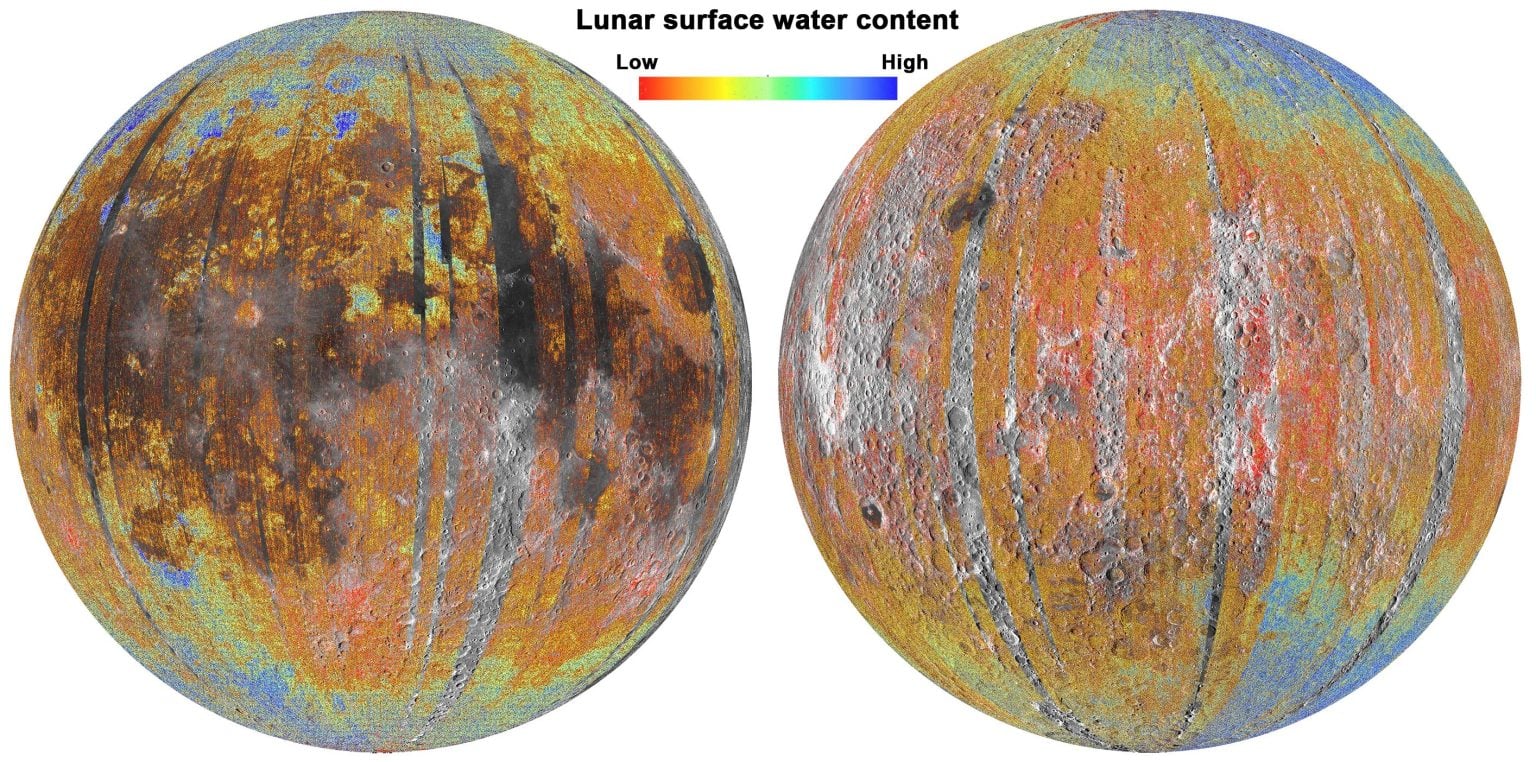
So, if we are going to start at the polar areas, I suggest modifying the Japan ring into a spiral. Volatiles are probably more prevalent at higher latitudes, and you do not have to travel nearly as far at high latitudes to encircle a portion of the Moon.
https://www.animalia-life.club/qa/pictu … oad-spiral
Image Quote: 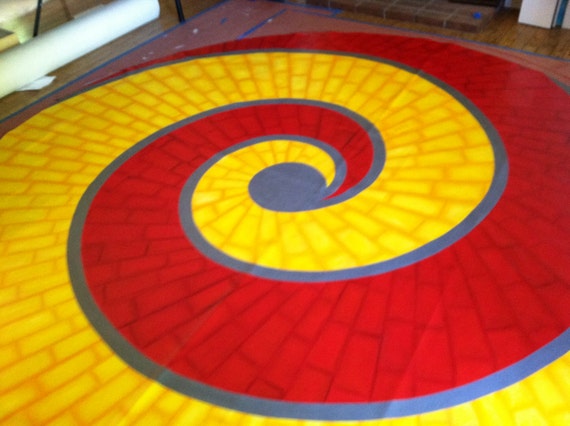
So, then if you started at one pole and spiral your way in one turn about the Moon down to the equator, then you could spiral one turn to the opposite pole. The Equator, it seems may offer less Hydrogen and Sulphur, as these seem to be retained better at high latitudes.
If you are making a spiral of solar panels, then I presume that you also do the roads and the power conductors, and this suggests melting a lot of regolith. The melting process may yield substances like Hydrogen, Sulphur, and Chlorine. So, you start out with more yield if you are at the high latitudes.
It seems as though some rocks on the Moon may have more Chlorine than others. In that case a spiral could include deviations so that the spiral may intercept a favorable mineral deposite.
https://www.nature.com/articles/s41598-019-42224-8
Quote:
Article
Open access
Published: 05 April 2019
An extremely heavy chlorine reservoir in the Moon: Insights from the apatite in lunar meteorites
Quote:
Copilot Search Branding
Like
Dislike
Images
Videos
Apatite, a phosphate mineral, has been found in lunar rocks and meteorites, revealing the Moon’s complex volatile history, including water and chlorine content.
Presence and Composition
Apatite on the Moon is primarily fluorapatite (Ca5(PO4)3F), though hydroxylapatite and chlorapatite have also been identified in some samples. It occurs in nearly all lunar rock types, including basalts and breccias, but is generally a trace mineral, ranging in size from sub-micron to 2 mm. Apatite serves as a key reservoir for phosphorus and rare earth elements on the Moon and is the most common volatile-bearing mineral in lunar rocks.
NASA
Insights into Lunar Volatiles
The discovery of apatite in lunar meteorites has provided evidence that the Moon’s early crust, over 4 billion years ago, was more water-rich than previously thought. Apatite contains hydrogen, fluorine, and chlorine, which allows scientists to study the volatile content and isotopic composition of lunar materials. Analyses show water contents ranging from 220 to 5200 ppm, with δD values from −100 to +550‰ and δ37Cl values from +3.8 to +81.1‰, indicating a heterogeneous distribution of volatiles and complex lunar formation processes.
Science Times
+2
Isotopic Significance
Lunar apatite exhibits a wide range of chlorine isotopic ratios (δ37Cl), much broader than terrestrial or chondritic values, suggesting the Moon contains an extremely heavy chlorine reservoir. This isotopic fractionation may result from volatile loss during the Moon-forming Giant Impact and subsequent differentiation of the lunar magma ocean, with late accretion of hydrous components contributing to the observed variability.
Nature
Debates on Water Content
While apatite has been used to infer water content in lunar rocks, some studies suggest it may overestimate water levels. Computer models indicate that hydrogen-rich apatite could form during crystallization from magma even in relatively dry conditions, meaning the high hydrogen content may not directly reflect a water-rich lunar environment. Nonetheless, the presence of water-bearing apatite in meteorites like AP 007 confirms that the Moon’s crust contained significant volatiles in its early history.
UCLA
+1
Scientific Importance
Studying apatite on the Moon helps scientists understand:
The volatile history of the Moon, including water, chlorine, and other elements.
2
The formation and differentiation of the lunar crust and magma ocean.
1
The distribution of phosphorus and rare earth elements, which are critical for understanding lunar geochemistry.
1In summary, lunar apatite is a crucial mineral for reconstructing the Moon’s early volatile inventory, providing insights into water content, chlorine isotopes, and the processes that shaped the Moon’s crust over 4 billion years ago.
My interest with Chlorine has to do with methods to extract things like Iron from Regolith at a low temperature.
In this other topic "Salt Electric Mining" is described: https://newmars.com/forums/viewtopic.php?id=11305
Removing Iron from regolith at a low temperature, then may reduce the amount of regolith you then have to process at a higher temperature. And in some cases, you might just want to extract the Iron at a low temperature and sinter the remainder into pavement or bricks.
Carbon:
Copilot Search Branding
Like
Dislike
Images
Videos
Carbon exists on the Moon in trace amounts, primarily in polar ices, regolith, and recently discovered graphene layers, but it is far less abundant than on Mars or Earth.
Forms and Sources of Lunar Carbon
Carbon on the Moon is present in several forms. Polar regions may contain subsurface carbon-bearing ices, which could provide a source of carbon, hydrogen, and oxygen for propellant production, though these deposits are limited and could be quickly exhausted on longer timescales. Lunar regolith and pyroclastic glasses also contain carbon, but at very low concentrations, making them less viable for large-scale resource extraction. Additionally, recent analysis of Chang’e-5 samples revealed thin layers of natural graphene in lunar dust, marking the first confirmation of few-layer graphene on the Moon.
arXiv.org
+1Trace gases in the lunar exosphere, including carbon dioxide (CO₂) and methane (CH₄), exist in extremely low concentrations and are unlikely to be useful for in-situ resource utilization. These gases may originate from solar wind interactions, cometary deposits, or outgassing from the Moon’s interior.
Wikipedia
+1
Potential Uses
Carbon is essential for supporting a sustained human presence on the Moon. It can be used to produce methalox propellant (methane and oxygen) for spacecraft refueling. NASA experiments have demonstrated that carbothermal reduction of lunar regolith can produce carbon monoxide, which can serve as a precursor for oxygen and fuel production, using solar energy to drive the reaction. The discovery of graphene also opens possibilities for advanced materials and electronics in lunar habitats.
arXiv.org
+2
Challenges
The Moon is extremely poor in carbon compared to Mars, and most accessible sources are concentrated in a few polar regions. Extraction would require careful site selection, energy input, and infrastructure to harvest and process the carbon efficiently. Bulk regolith and pyroclastic glasses are not practical sources due to low carbon content.
arXiv.org
Summary
While carbon is present on the Moon, it is scarce and unevenly distributed. Polar ices, regolith, and graphene layers represent the main sources, with polar ices being the most promising for near-term propellant production. Advances in extraction technologies, such as solar-driven carbothermal reduction, could enable sustainable lunar operations, but large-scale utilization will be limited by the Moon’s low carbon abundance.
Volatiles inside the Moon:
Carbon in the Moon
The presence of carbon in the Moon has been a topic of interest due to the detection of water and other volatile elements in lunar volcanic glasses. These glasses, formed from fire-fountain eruptions, contain hydrogen, fluorine, sulphur, and chlorine, indicating an origin from source magmas with similar volatile concentrations as parts of Earth’s upper mantle. This discovery challenges the long-held assumption of a volatile-free Moon and suggests that the Earth and Moon may share a common volatile source. The carbon content in these glasses is detectable, with similar abundances to those found in Earth’s mid-ocean ridge basalts, further supporting the idea of a Moon that contains at least some volatiles.
Wikipedia
So, this could be where a spiral of solar panels might intercept a location where a "Fire-Fountain" existed, and perhaps digging down would yield desired substances.
So, in my opinion a spiral of solar panels may satisfy the desire to export power from the Moon but also might facilitate power to specific mining locations as well. Adn while building the spiral valuable substances might be obtained at higher latitudes.
Ending Pending
Last edited by Void (2026-04-16 11:55:03)
Is it possible that the root of political science claims is to produce white collar jobs for people who paid for an education and do not want a real job?
Offline
Like button can go here
#290 2026-04-16 19:28:50
- Void
- Member
- Registered: 2011-12-29
- Posts: 9,549
Re: The Moon
Continuing on Fire Fountains on the Moon: https://www.nature.com/articles/s41467-026-69087-8
Image Quote: 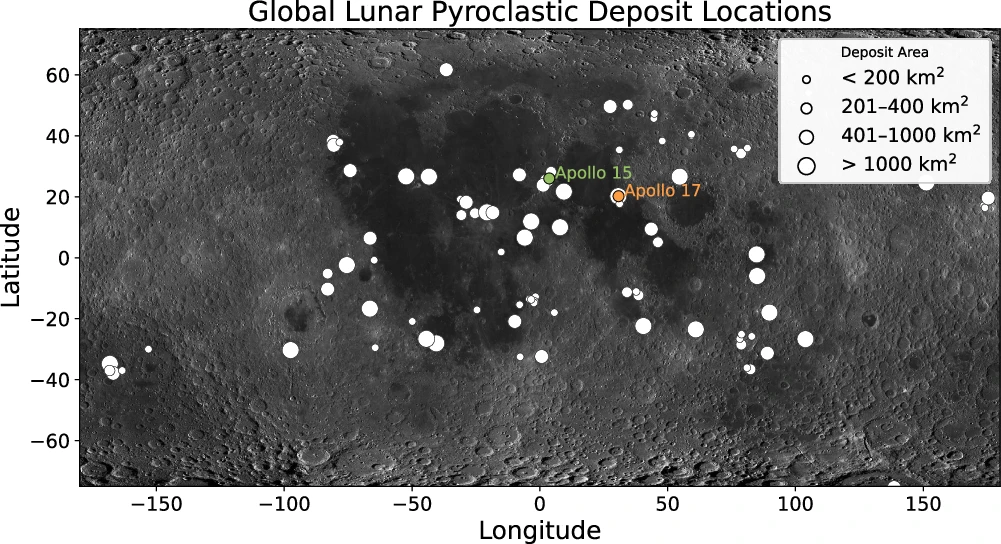
Isn't it interesting that the near side has the most, but there is inverse symmetry on the far side?
At -40 Latitude on the far side, some are to the left. At 20 to 40 Latitude, some are to the right. Probably not too important though.
Query: "How Thick were the Mare on the Moon?"
Quote:
500 meters to 1500 meters
The thickness of lunar maria typically ranges from 500 meters to 1500 meters. Individual lava flows within these maria can be about 10 to 20 meters thick, indicating that they are the result of several overlapping
Image Quote:
https://en.wikipedia.org/wiki/Lunar_mare
Quote:
Lunar mare
To get down 100-400 km is too deep, I think but to follow the "Pipe" down a distance may be possible.
The deepest mine on Earth is apparently 4 km deep. So on the Moon 4 * 6 = 24 km???
But I don't think that heat in the mine will be as much of a problem on the Moon.
I am guessing that the deeper parts of the Mare may have more volatiles than the surface also.
So if you could dig vaults 500 to 1500 meters deep in the Mare, perhaps desirable materials could be obtained.
So, back to post #283: https://newmars.com/forums/viewtopic.ph … 42#p238742
Quote:
So, from post #281, a carving-drilling method into a ancient Fire-Fountain might yield value:
Perhaps this will help visualization of it:
Both in the form of recovered materials and the vaults which in some cases could be rendered "Habitable" eventually.
So, I would modify the Japan concept of a equatorial ring into a spiral which might end at each pole and in connecting the poles intercept many of the fire fountains.
And then vaults where there might be a substance worth mining.
Ending Pending
Last edited by Void (2026-04-16 19:55:00)
Is it possible that the root of political science claims is to produce white collar jobs for people who paid for an education and do not want a real job?
Offline
Like button can go here
#291 2026-04-18 10:19:40
- Void
- Member
- Registered: 2011-12-29
- Posts: 9,549
Re: The Moon
It has occurred to me to wonder if the Moon is fracking itself while it cools.
Quote:
Transient lunar phenomena
Outgassing events on the Moon are associated with transient lunar phenomena (TLPs), which are short-lived changes in light, color, or appearance on the lunar surface. These phenomena can include brightenings, dimmings, and color changes, often described as "mists," "clouds," or "volcanoes." The physical mechanism responsible for creating TLPs is not fully understood, but theories suggest they are the outcome of lunar outgassing, where gases are released from the surface of the Moon. This outgassing can be influenced by seismic activities, such as moonquakes, which may release gases that reflect sunlight and cause luminous phenomena.
https://en.wikipedia.org/wiki/Transient … phenomenon
Image Quote: 
Quote:
This map, based on a survey of 300 TLPs by Barbara M. Middlehurst and Patrick Moore, shows the approximate distribution of observed events. Red-hued events are in red; the remainder are in yellow.
Mare events and fire fountain event partially drained the interior of the Moon. But I don't expect that it was 100% efficient. The Moon cooling would develop stresses. Seismic events might extend cracking. Fresh cracking may facilitate release of deep trapped gasses.
So, polar deposits and fire fountain rock may offer desired things, but main cracks in the deeps of the Moon might also offer something of value.
Ia a spiral path of solar power from pole to pole could intercept fossil fire fountains and major cracks. Perhaps this would be a resource of value.
Major outgassing events may be rare, but it might be that certain pathways might outgas at a low rate more often. Possibly to some extent continually.
Ending Pending
Last edited by Void (2026-04-18 10:31:52)
Is it possible that the root of political science claims is to produce white collar jobs for people who paid for an education and do not want a real job?
Offline
Like button can go here
#292 2026-04-20 08:47:39
- Void
- Member
- Registered: 2011-12-29
- Posts: 9,549
Re: The Moon
A thing that may be in reach early on would be an array of 2 or mare Starships, perhaps on their sides, that could be used to refine Lunar regolith.
The way I currently would like to see Moon method to develop would be where the Starships usually stay on the Moon, and to then have a smaller ship that could transport humans up a down to the Moons lower orbits.
A thing that seems apparent from some concepts of processing Lunar regolith is that heat in a vacuum may release Oxygen. But of course you have to capture the Oxygen, so the process needs to be in an enclosure. But you need to maintain the vacuum.
So with 2 or more starships, one ship could be in Vacuum, and one might then take the Oxygen produced as a pressurized gas.
So, perhaps a starship would be open door to be loaded with regolith, and the door then to be closed to process the regolith. The Vacuum processing might occur first, but later, after that is done perhaps the ship would be repressurized, and further processing.
Ultimately the regolith would be fully processed, and the Oxygen removed again, and then the products moved out of the ship to be put to a purpose.
And then repeat.
You may try for "Easy Oxygen" first, then perhaps Iron, and perhaps then the extraction of Aluminum and Silicon. The leftovers might be melted and cast into stone blocks.
This might be an early way to effectively extract wealth from the Lunar regolith.
Ending Pending
Last edited by Void (2026-04-20 08:56:58)
Is it possible that the root of political science claims is to produce white collar jobs for people who paid for an education and do not want a real job?
Offline
Like button can go here
#293 2026-04-21 09:35:51
- Void
- Member
- Registered: 2011-12-29
- Posts: 9,549
Re: The Moon
I think that with the hardware that seems to be possible to obtain, setting up regolith processing might involve:
1) The Orion or maybe an evolved Dragon.
2) Starship Freighters.
3) Blue Origins lander or a Stubby (Very Stubby) Starship.
Although the Lunar Starship is a very nice thing to have, the thing about the Moon is it has raw materials that can be developed into resources. If you can land a Starship Freighter(s), then you can use those resources to upgrade it to be habitat and factory. It does not make sense to expend the propellants to fly the Freighter Starship back up to orbit.
This is especially true if mass drivers can be made to work for the Moon.
So the idea of a "Stubby Starship" was proposed by Tim Dodd, I believe.
Here is a video about a similar idea: https://www.youtube.com/watch?v=V5_84O8rKSY
So, I don't see why a "Stuby Starship" should have to carry even 30 tons, just some people and a small amount of freight.
I would like to see a Hydro-Lox propulsion system as well, perhaps from Blue Origin.
IF the Earth might have to humanoid robots for each human, the for the Moon it might speculate 300 to 1, where not all robots might be humanoid.
Just some guessing.
So, full Lunar Starship is overkill, I think, but wonderful to have anyway.
Ending Pending
Last edited by Void (2026-04-21 09:51:52)
Is it possible that the root of political science claims is to produce white collar jobs for people who paid for an education and do not want a real job?
Offline
Like button can go here
#294 2026-04-27 07:40:50
- Void
- Member
- Registered: 2011-12-29
- Posts: 9,549
Re: The Moon
https://www.msn.com/en-us/news/opinion/ … i-AA1ZUCEd
Quote:
Why the moon is cracking and slowly drifting away from Earth
The Moon is slowly drifting away from Earth while internal forces continue to crack its surface revealing an evolving relationship between the two bodies
So, cracks that may go as deep as 19 km.
My hope is that there may be some outgassing from some of these fractures.
So, then perhaps a source of volatile materials of some value.
No certainty of that but maybe.
https://lunarpedia.org/w/Lunar_outgassi … atmosphere.
Quote:
Outgassing events in which volatiles are vented from deep in the lunar interior to the surface, specifically, radon, nitrogen, carbon monoxide, and carbon dioxide, may be the result of low level volcanic or tectonic events on the moon, and are hypothesized to be the source of the tenuous lunar atmosphere.
I expect that the Radon is to be useless, but Carbon and Nitrogen may have value from this.
My reading says that Radon might eventually decay towards lead, but I don't know if the cracks may have some lead in them from that.
Anyway, the cracks may be a source of needed materials.
Ending Pending
Last edited by Void (2026-04-27 07:49:58)
Is it possible that the root of political science claims is to produce white collar jobs for people who paid for an education and do not want a real job?
Offline
Like button can go here
#295 2026-04-27 16:38:34
- Void
- Member
- Registered: 2011-12-29
- Posts: 9,549
Re: The Moon
I have been thinking about gasses in the Moons Cracks. (See the just prior post).
Quote:
Approximately 60 miles
The Earth's atmosphere is approximately 60 miles (about 86 kilometers) thick from the surface to the edge of space. It consists of several layers, with the troposphere being the most active layer, where weather occurs, and the stratosphere above it, where ozone is abundant.
Wiki
It is not really a correct comparison 19 km to 86 km I know that the tenuous Earth's atmosphere extends much above 86 km.
Even so, 19 km deep on the Moon, I would not expect millibars of pressure, but maybe microbars 19 km down.
It is probably not down to Moon surface vacuum, but a bit more atmosphere than that.
So, then is this a reservoir that could be tapped.
Carbon and Nitrogen are expected, and I think that maybe some hydrogen and even water vapor might be possible.
For instance, OH and H20 molecules travel around on the Moons surface. If they get though the regolith and into a crack, do they then fall into it and accumulate?
Ending Pending
Is it possible that the root of political science claims is to produce white collar jobs for people who paid for an education and do not want a real job?
Offline
Like button can go here
#296 2026-04-28 19:07:52
- Void
- Member
- Registered: 2011-12-29
- Posts: 9,549
Re: The Moon
https://www.youtube.com/watch?v=SUMVT7Nddw8
Quote:
Elon Musk knows who will be the first to live on the Moon. And it won't be us
AstroScope
The Optimus will need an improved cooling method for its motors to work on the Moon.
Robots will not need much water, but it would be nice to have some.
Quote:
On the Moon, water molecules are observed to bounce around during the day due to their thermal desorption.
Using NASA's Lunar Reconnaissance Orbiter (LRO), scientists have found that water molecules remain bound to the lunar soil until surface temperatures peak near noon.
At that point, they thermally desorb and can migrate to cooler areas, where they can stick to the regolith or populate the Moon's atmosphere until temperatures drop again.
3
This phenomenon is crucial for understanding the lunar water cycle and its potential for future lunar exploration.
3Thus, the movement of water molecules is a significant aspect of lunar water dynamics.
So, my question is can mobile molecules collect in deep cracks on the Moon?
Query: "Lunar Cracks 19 km deep?"
Quote:
Yes, there are cracks on the Moon that are significant in depth.
The Moon has deep scars from billions of years of asteroid impacts, with some cracks penetrating up to 20 kilometers below the surface.
1
Additionally, there are grabens, which are long valleys formed by the Moon's crust dropping between diverging faults, indicating ancient tectonic activity.
2
These features are part of the Moon's geological history, showcasing the Moon's past and ongoing geological activity.
2Thus, the Moon is indeed characterized by deep cracks and significant geological features.
So, there may be gasses that accumulate in these cracks, perhaps sourced from broke rock in the cracks, perhaps Carbon. But might Hydrogen containing molecules fall into the cracks and accumulate?
The Moon will flex with the tide of Sun/Earth/Moon. Impacts also may disturb the cracks. Do gasses erupt from the cracks if the tide closes them a bit more than normal?
Is there a way to collect the presumed gas accumulations?
This resource if it exists would possibly be available at lower latitudes where you might want to have a mass driver system.
Ending Pending
Last edited by Void (2026-04-28 19:19:15)
Is it possible that the root of political science claims is to produce white collar jobs for people who paid for an education and do not want a real job?
Offline
Like button can go here
#297 2026-04-29 17:22:43
- tahanson43206
- Moderator
- Registered: 2018-04-27
- Posts: 24,836
Re: The Moon
This post is about a Falcon 9 upper stage that will hit the Moon.
This topic is about Terraformation of the Moon.
The Falcon 9 upper stage will create a small crater on the Moon, and it doing so it will deposit valuable materials in the lunar surface.
However, the impact will cause some of the material already present to lift up from the surface.
https://arstechnica.com/space/2026/04/a … in-august/
A Falcon 9 rocket will hit the Moon this summer at seven times the speed of sound
The object will be traveling at 2.43 km a second, or 5,400 mph, upon impact.
Eric Berger – Apr 29, 2026 8:39 AM | 130A Falcon 9 rocket launches the Blue Ghost mission on January 15, 2025. Credit: SpaceX
Astronomers say the upper stage of a Falcon 9 rocket that launched in early 2025 will strike the Moon later this summer, likely on the near side of the Moon.
Bill Gray, who writes the widely used Project Pluto software to track near-Earth objects, has published a comprehensive report on the impact expected to occur at 2:44 am ET (06:44 UTC) on August 5. The Falcon 9 rocket’s upper stage is 13.8 meters (45 feet) tall and has a 3.7-meter (12 feet) diameter. Since the Moon has no atmosphere, it will strike the lunar surface intact.
Although the Moon will be visible to the eastern half of the US and Canada, and in much of South America, Gray said he believes the impact will probably be too faint to be seen by Earth-based telescopes.
Highly confident in its origin
Gray said he and other astronomers are highly confident that this object is the second stage of the Falcon 9 rocket that launched two lunar landers, Firefly’s Blue Ghost and ispace’s Hakuto-R, on January 15, 2025. After the launch, the two landers, a payload fairing, and the upper stage were all tracked following their separation. The two landers reached the Moon (only Blue Ghost successfully touched down), and the fairing reentered Earth’s atmosphere.
How The Callisto Protocol's Team Designed Its Terrifying, Immersive Audio
“The upper stage, 2025-010D, also kept orbiting the Earth, but was a bit higher and didn’t re-enter,” Gray wrote. “It’s had a few close passes by the Moon and Earth, but nothing that was close enough to look like a possible impact. The asteroid surveys observed it whenever it wasn’t too close to the Sun or Moon to see. As of 2026 February 26, we had accumulated 1053 observations of it.”
Gray estimates the object will be traveling at 2.43 km a second, or 5,400 mph, when it strikes the Moon in or near the Einstein Crater. This is about seven times the speed of sound. It will create a small crater, but otherwise should do no damage.
Not the first time this has happened
Four years ago, Ars reported that astronomers believed another Falcon 9 upper stage would strike the Moon. However, subsequent analysis revealed that the object was, in fact, an upper stage from the Chinese Chang’e 5-T1 mission. Gray said there is no doubt that this object is the Falcon 9 upper stage because it has been tracked since launch.
There is no risk from its impact to anything on the Moon. It is a dead world, and there are no human-landed objects nearby.
However, both NASA and China are deep in the planning stages for establishing semi-permanent outposts near the South Pole of the Moon. As part of that, the cadence of launches on Falcon 9 and other rockets to the Moon is likely to increase by something like a factor of 10 due to the need to land rovers, supplies, habitats, communications equipment, and much more to support human activities.
There is a relatively easy fix for this: With some extra planning and sparing a little fuel, launch companies can put these stages into “disposal” orbits around the Sun and in a path that will avoid hitting Earth or the Moon in perpetuity. For the safety of future operations on the Moon, this probably should become standard operating procedure.
Photo of Eric Berger
Eric Berger Senior Space EditorEric Berger is the senior space editor at Ars Technica, covering everything from astronomy to private space to NASA policy, and author of two books: Liftoff, about the rise of SpaceX; and Reentry, on the development of the Falcon 9 rocket and Dragon. A certified meteorologist, Eric lives in Houston.
If anyone finds an announcement of live coverage of this event please post the news here.
My understanding is that the event will be insufficient in visibility to be seen with a small telescope.
I'd like to point out that tracking of this object has been a sustained effort since the initial launch of two lunar landers.
(th)
Offline
Like button can go here
#298 2026-05-01 08:44:17
- Void
- Member
- Registered: 2011-12-29
- Posts: 9,549
Re: The Moon
Space Startup News, has speculated that expended rocket stages can be crashed on the Moon, to recover their materials.
This is said to be propellant efficient as the speed of impact can be low enough that recoverable materials like Aluminum and Plastics are possible.
https://www.youtube.com/@SpaceStartupNews
https://www.michelegargiulo.com/blog/wh … ike-a-bell
Quote:
Michele Gargiulo
Blog
Bio Page
Author
Gallery
Contact
0
When the Moon Rang Like a Bell: NASA’s Apollo Mystery That Still Echoes
Jun 7
Written By Michele Edington (formerly Michele Gargiulo)
There are sounds we expect from the sky like thunder rolling across summer clouds, wind threading through bare branches, or the quiet breathlessness between stars, but when astronauts deliberately struck the Moon in 1969, they discovered something unexpected: vibration.It also lasted far longer than anyone could’ve possibly predicted, for nearly an hour. The Moon actually resonated.
Mission scientists later described it with a phrase that still is alive today throughout history: “the Moon rang like a bell.” Now, science is a curious thing, the moon didn’t chime like metal in space, but its seismic response behaved unlike anything seen on Earth.
This is the story of what really happened when Apollo instruments listened to the Moon, and what those echoes still teach us.
The process of impacting spent rocket stages on the moon might allow the greater discovery of the nature of the Moons interior.
Seismometers place about on the Moon could register the results of a planned impact, ant the nature of that impactor will help to understand that results.
For my part I am interested in Moon Cracks that may extend as deep as 20 km, and also the extinct volcano's that exist.
My intention is to seek these items as sources of materials that can become resources.
Ending Pending
Last edited by Void (2026-05-01 08:54:22)
Is it possible that the root of political science claims is to produce white collar jobs for people who paid for an education and do not want a real job?
Offline
Like button can go here
#299 2026-05-02 08:31:30
- Void
- Member
- Registered: 2011-12-29
- Posts: 9,549
Re: The Moon
In the question of Moon-Cracks 19 to 20 km deep in some cases.
I wonder if these are places where you could dig deep?
If they open and close with tides, do they develop their own propant?
That is fragments of rock and dust that may fill them?
The Moon shrinks by cooling, and so are these cracks expanding with materials wedged into them?
Then indeed I am hoping that there is an "Atmosphere" in those cracks. 19-20 km. This is for Americans (11.8060527 Miles)
Query: "How high is the air pressure in the deepest mines on Earth?"
Quote: "The air pressure in the deepest mines on Earth varies significantly based on depth and mine design.
At the Kidd mine, the pressure is approximately 1404 hPa (20.37 psi) at a depth of 2735 meters below sea level.
1
The Mponeng gold mine, which claims to be the deepest mine, operates at a pressure that is about 1.4 times higher than at the surface.
1
The Kola borehole is another deep mine, with a pressure estimated at around 3.6 atmospheres.
1
These variations are due to factors such as temperature gradients and the geological conditions within the mines."
I do understand that on the Moon we have an Exosphere, and whatever gasses are entrained in the Lunar Regolith.
The gravity is 1/6th, and we do not know for sure if the solar wind wicks molecules out of the cracks, Of if processes may fill the cracks with molecules.
It has been said by some that these cracks may be sources of Nitrogen and Carbon Compounds.
I have to wonder if on occasion Hydrogen and Helium bonded with Oxygen may also enter and accumulate.
If there are gas accumulations, I expect the maximum pressure to be well below one millibar. But still that might be a useful resource.
If it could be accessed.
Ending Pending
Last edited by Void (2026-05-02 08:40:57)
Is it possible that the root of political science claims is to produce white collar jobs for people who paid for an education and do not want a real job?
Offline
Like button can go here
#300 2026-05-12 08:50:21
- Void
- Member
- Registered: 2011-12-29
- Posts: 9,549
Re: The Moon
https://www.msn.com/en-us/news/technolo … r-AA1ZZIUw
Quote:
Morning Overview
46.9K Followers
Study argues Earth formed from inner solar system material, including its water
Story by BeckhamLangford • 1mo •
6 min read
The conversation in this article suggests that all the planets formed in the inner solar system had significant water.
Theia if it existed would have been similar.
Because of the CO driven fire fountains, I have to ask, if the Moon would not have had a Venus similar atmosphere.
We don't know if the Moon formed from a lava glob in hours or over a very long period if it was the result of a collision.
My point is that if slowing consolidating then without significant gravity, the subparts would form gas pockets inside the Lava sub globs.
If it were formed very fast, over hours, then it would suddenly have a gravity, and any gas bubbles would be compressed at any significant distance under the magma ocean. Much of it dissolving back into the magma solution.
But for the bubbles that did rise up, then an atmosphere resembling that of Venus would form, with a strong greenhouse effect.
It is possible that a red glow would keep the upper atmosphere hot enough for atmosphere to be swept away, but if not then the upper atmosphere would have been colder than that of Venus today. Venus has an almost red-light emissions but that does not seem to heat up the upper atmosphere so much that it would be blown off into space.
And the sun was colder then. There also may have been a cloud of residual debris in orbit of the new Earth/Moon, which may have blocked some of the light from the sun.
My point is that Venus does not lose too much of it's atmosphere, without a magnetic field. It does lose Hydrogen and Oxygen, but still has water and Sulfuric Acid clouds.
At least for a fast-formed Moon, I expect that for a time there would have been a significant atmosphere almost immediately. If it had greenhouse gasses in it, such as CO2 and H20, it may have also had an atmosphere with clouds, and perhaps winds and dust.
The heat of the surface would have been shielded, and the upper atmosphere would not be hot. We are led to imagine that hot lava was exposed to vacuum and the solar wind. But the Atmosphere of Venus is not like that.
An atmosphere that lasted for any significant time might have kept the lava from being exposed to Vacuum while being in a molten state.
A Lava Ocean with a grey crust floating on it's surface would have weighed down on the layers below it and tended to keep volatiles in solution.
At least that is how I see it.
If true then digging down may expose more volitiles.
Ending Pending
https://www.smithsonianmag.com/air-spac … 180965250/
Quote:
The thin atmosphere, so the scientists reason, was created by gases derived from lava outpourings that engulfed huge areas of the Moon about 3.5 billion years ago, at a time when life already existed on Earth. So much gas was produced that the lunar atmosphere was 1.5 times thicker than the current atmosphere on Mars. And it lasted for millions of years. That’s a far different picture from how we normally envision the Moon—as a dead, dry rock in space.
The released gas was mostly carbon dioxide, but it also included water, meaning that some liquid water could have been temporarily stable on the lunar surface. By this time the Moon was already tidally locked to Earth (showing always the same face to our planet), and any liquid water would have existed only in the relatively narrow—and benign—area between the hot side of the Moon facing the Sun and the shaded cold side. So forget about lunar lakes or oceans: any water would have either been ice or gas.
OK, so, if the polar shadowed craters existed, then the surface of the Moon was already cooled. So, the water might have collected there and the atmosphere might be mostly dry. But if the crust was still warm then some of that water might have flowed down and you could have had chemical reactions.
But I don't see why the Moon would not have had an immediate atmosphere when if formed. If the above situation occurred later then that means that that initial atmosphere would have contained CO2 and water. If the surface was a magma ocean, then, water could not exist as ice. It would have been in clouds in the initial atmosphere and dissolved into the deeper magma below.
So, conditions would be like that of Venus today, but not nearly as thick an atmosphere. And the suns light would be only 70% of what it is now, perhaps.
Granted the sun may have been more magnetically active.
Anyway, the CO2 and water cloud layer would have protected the upper atmosphere of the Moon from to glow of the magma ocean below.
We know an atmosphere should have existed, but it did not persist because it is not there now. But the idea of exposed glowing lava seas exposed to hard vacuum, does not make sense to me.
And if for any period of time liquid water existed even on the terminator, while on the surface outside of the terminator it would exist as either water vapor (And Clouds), or ice, the water flowing down into cracks could remain liquid for some period of time.
The truth is we do not know, but the ideas from the 70's seem to not be good enough.
Ending Pending
Last edited by Void (2026-05-12 09:36:38)
Is it possible that the root of political science claims is to produce white collar jobs for people who paid for an education and do not want a real job?
Offline
Like button can go here