New Mars Forums
You are not logged in.
- Topics: Active | Unanswered
Announcement
#2251 2026-02-24 11:35:28
- GW Johnson
- Member
- From: McGregor, Texas USA
- Registered: 2011-12-04
- Posts: 6,237
- Website
Re: Starship is Go...
The "standard" Block 2 (about to become Block 3) Starship does its deorbit burn and its flip-and-landing burn on the propellant in the header tanks, so SpaceX says. They also said that those were transferred to the main tanks in the Block 2 design to make the landing burn. (Note that there is really nothing "standard" about Starship until all the experimental flight testing is successfully done.)
That transfer from headers to main tanks may or may not still be true in Block 3, as I saw in some illustrations plumbing direct to the engines from the header tanks. Those header tanks hold something like 20-25 tons at most, not anything like 100 tons! The ship explodes upon toppling over in the Indian Ocean, because not all of that 20-25 tons was used to make the landing. There are still fuel and oxidizer aboard when it falls over and breaks open.
I do not know of any variants yet being seriously considered except the HLS and some sort of propellant tanker. And that will likely be true until after the next round of Block 3 flight tests are done! Then it gets bigger yet again in the Block 4 design, which must again be proven in test before it can be considered as a viable prototype for any sort of real mission work. Excepting maybe HLS and the tanker, any other variants must wait until everything through Block 4 has been tested and found adequate.
As for the ballistic coefficient of a Block 2 or Block 3 Starship, the hypersonic drag coefficient of a round cylinder dead broadside to the wind is about 1.20 based on the cylinder blockage area, coming from my old Hoerner "drag bible". The drag coefficient of a flat plate normal to the wind in hypersonic flow is about 1.84, based on its blockage area. Same data source. I took a good guess for the effects of the pointed nose, and for the relative blockage areas of body and flaps, and determined a CD = 1.22 on a blockage area of just about 462 sq.m normal to the wind.
Starship does NOT enter normal to the wind, it enters at a nominal angle of attack of 60 degrees, although that varies some about that nominal angle. Thus the normal blockage area is not actually normal (90 deg) to the wind, it is about 30 deg off. That's no big impact on CD, but the effective blockage area is 462 sq.m times a cosine factor of 0.866 for that angled entry.
I used Bob's numbers of 120, 160, and 40 metric tons for the inert mass of Starship, even though I thought (and still think) the 40 ton figure is ridiculously unrealistic. To that I added 20 tons landing propellant, and 100 tons payload at Mars, and I added the same 20 tons of propellant and 0 tons of payload at Earth. That puts mass-at-entry 240, 280, and 160 metric tons at Mars, and 140, 180, and 60 metric tons at Earth.
I did entries at Mars at 7.5 km/s off a fast trajectory, and 2 deg below horizontal. I did entries at Earth at 7.9 km/s out of low circular LEO and 2 degrees below horizontal.
That's where my numbers came from! They should be pretty good, as good as the masses at entry are. The whole thing turned into a sensitivity study with ballistic coefficient the independent variable. The low inerts are ballistic coefficient roughly half those of the heavier values.
GW
Last edited by GW Johnson (2026-02-24 11:44:45)
GW Johnson
McGregor, Texas
"There is nothing as expensive as a dead crew, especially one dead from a bad management decision"
Offline
Like button can go here
#2252 2026-02-24 15:17:47
- SpaceNut
- Administrator
- From: New Hampshire
- Registered: 2004-07-22
- Posts: 30,798
Re: Starship is Go...
Moving fuels from the compressed tanks to the near empty tanks creates boiling due to a much lower pressure. It would be better to use a tank in a tank and a control valve.
Offline
Like button can go here
#2253 2026-02-26 15:13:33
- GW Johnson
- Member
- From: McGregor, Texas USA
- Registered: 2011-12-04
- Posts: 6,237
- Website
Re: Starship is Go...
Spacenut:
I quite agree that nested headers inside main tanks is better. For one thing, the main tank around the header can become almost-a-thermos-bottle, limiting evaporation losses.
But, SpaceX had to put the headers in the nose to get acceptable cg position for entry and descent, especially if no payload was aboard far forward.
GW
GW Johnson
McGregor, Texas
"There is nothing as expensive as a dead crew, especially one dead from a bad management decision"
Offline
Like button can go here
#2254 2026-02-26 15:49:11
- SpaceNut
- Administrator
- From: New Hampshire
- Registered: 2004-07-22
- Posts: 30,798
Re: Starship is Go...
Even a load of bricks would be able to prove performance of its thrust path as well as return as we will not be coming back empty from any destination.
Offline
Like button can go here
#2255 2026-03-01 13:02:01
- SpaceNut
- Administrator
- From: New Hampshire
- Registered: 2004-07-22
- Posts: 30,798
Re: Starship is Go...
So far besides the landing legs for moon or mars is the tiles do not seem to be strong enough for mars use as the crewed ships will need them to be beefed up or we will fail.
Future earth landing may be in the Motzilla but what about mars?
Maybe an added inspection and other replacement tiles might make it possible but at this point is a gamble.
Offline
Like button can go here
#2256 2026-03-03 15:26:39
- GW Johnson
- Member
- From: McGregor, Texas USA
- Registered: 2011-12-04
- Posts: 6,237
- Website
Re: Starship is Go...
What I think I see for an object of the size and shape as Starship, is quite a difference in peak heating during 7.5 km/s entry at Mars (off a fast interplanetary trajectory), versus 7.9 km/s entry at Earth (from low circular Earth orbit). At Earth, convective heating is modest due to the large radius of the vehicle, while plasma radiation heating is virtually nil. At Mars, convective is comparable to Earth, but plasma radiation heating is an order of magnitude larger, again due to the large radius of the vehicle.
Now, you can resist such heating either by ablation, or by refractive thermal re-radiation, or some of both. You want to minimize conduction into the interior, in either case. Things that can resist the mechanical forces tend to be dense. That opens up the path for conduction inward. It puts you to looking at metallic or hard ceramic tiles, but with some sort of lower-thermal-conduction layer underneath, to re-limit the conduction inward. High density ALWAYS correlates with high thermal conductivity.
SpaceX attempted some metallic tiles (not all of them) on Flight 10. They did not like the fast oxidation rates that they saw, which stained that heat shield orange. They went back to ceramic tiles in Flight 11, which worked. I do not know what that ceramic was. But it is dense and hard, and requires a low-conductivity ablative layer underneath. The low conductivity stops the inward conduction. The ablation capability provides the backup burn-through protection for a lost tile.
I see nothing at all from SpaceX that would address what is needed to make rough-field landings on soft ground. Moon, Mars, both are dominated by both softness and roughness.
GW
Last edited by GW Johnson (2026-03-03 15:27:22)
GW Johnson
McGregor, Texas
"There is nothing as expensive as a dead crew, especially one dead from a bad management decision"
Offline
Like button can go here
#2257 2026-03-03 15:43:03
- SpaceNut
- Administrator
- From: New Hampshire
- Registered: 2004-07-22
- Posts: 30,798
Re: Starship is Go...
I see flight 10 had the white from the nose plus the coloring, while 11 had just the staining colors and evidence of burning still.
Offline
Like button can go here
#2258 2026-03-03 15:45:34
- GW Johnson
- Member
- From: McGregor, Texas USA
- Registered: 2011-12-04
- Posts: 6,237
- Website
Re: Starship is Go...
There was no orange staining on 11. It was flight 10 that had both the white near the nose, and the orange staining all over the heat shield.
GW
GW Johnson
McGregor, Texas
"There is nothing as expensive as a dead crew, especially one dead from a bad management decision"
Offline
Like button can go here
#2259 2026-03-03 15:48:40
- SpaceNut
- Administrator
- From: New Hampshire
- Registered: 2004-07-22
- Posts: 30,798
Re: Starship is Go...
here is the still for 11
here is the still for 10
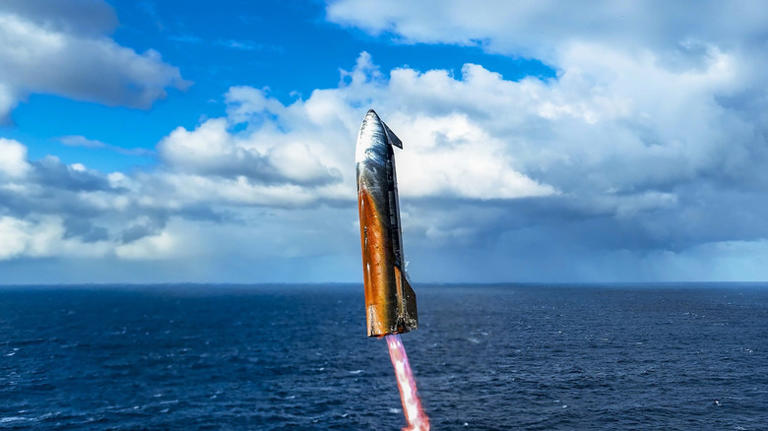
SpaceX's Flight 11 (Oct 2025) demonstrated improved structural integrity and less heat shield distress compared to Flight 10, despite both successfully achieving controlled ocean splashdowns. Flight 11 featured, for the second time, a V2 Starship that handled intense, intentional stress testing—including missing tiles in key areas—with less visible damage than Flight 10.
Flight 11 vs. Flight 10 Landing Breakdown:
Heat Shield/Damage: Flight 11 showed less, yet still significant, heat damage compared to Flight 10. Flight 11 lacked the metallic test tiles that caused excessive oxidation and orange coloring on Flight 10, though it still experienced high-heating, resulting in small flames and venting.Stress Testing: Both flights tested thermal protection, but Flight 11 intentionally left gaps in the heat shield without backup protection to test endurance, proving superior durability.
Performance: Both vehicles successfully executed the landing flip maneuver and soft splashdown. Flight 10 achieved a near-bullseye landing, and Flight 11 continued this precision.
Insights: Flight 10 was described as "charred" and "battered" due to its tests, while Flight 11 was in better condition, indicating progress toward full reusability
Both flights provided critical data, with Flight 11 demonstrating that the Starship could survive and maintain control despite severe, intentional damage to its thermal protection system.
here is the other view from space x
If you open the image in its own tab and zoom in on the image you will see the rust and holes still
Offline
Like button can go here
#2260 2026-03-04 16:04:09
- GW Johnson
- Member
- From: McGregor, Texas USA
- Registered: 2011-12-04
- Posts: 6,237
- Website
Re: Starship is Go...
I had not seen your Flight 11 photo with the reddish oxide stain before. I only ever saw the other one.
But there was a lot less of it than Flight 10. On both, it seemed to come from some locations on the belly, not so close to the nose. Where they deliberately left off tiles, perhaps?
GW
GW Johnson
McGregor, Texas
"There is nothing as expensive as a dead crew, especially one dead from a bad management decision"
Offline
Like button can go here
#2261 2026-03-06 19:55:13
- SpaceNut
- Administrator
- From: New Hampshire
- Registered: 2004-07-22
- Posts: 30,798
Re: Starship is Go...
The thickness of your jettisonable HIAD (Hypersonic Inflatable Aerodynamic Decelerator) shield is determined by the "thermal soak"—how much heat penetrates the layers before the ship slows down—rather than just the surface temperature.
On a Starship-scale Earth entry, you aren't just looking at a single layer; you’re looking at a layup (a multi-material sandwich). Based on NASA's LOFTID (Low-Earth Orbit Flight Test of an Inflatable Decelerator) data and current PICA-Flex performance, here is the "Turkey" on the thickness requirements:
The Total Layup Thickness: ~50mm to 75mm (2 to 3 inches)
To protect the ship's steel during a Mach 25 entry, the total stack height of the flexible shield would need to be roughly 50mm to 75mm. This is remarkably thin considering it replaces a 25–50mm rigid tile plus its mounting hardware.The Layer Breakdown:
Outer Ablative Layer (PICA-Flex): 15mm – 25mm
This is the "sacrificial" part. It is a 3D-woven carbon fabric impregnated with phenolic resin. During the peak 1500°C+ heat flux, this layer chars and "outgasses," creating a protective boundary layer of cool gas that pushes the plasma away.Insulation Mid-Layers (Carbon/Ceramic Felt): 30mm – 40mm
Beneath the PICA-Flex, you need several layers of "felt" (like Sigratherm or Pyrogel). This does the heavy lifting of stopping the heat from reaching the inflatable structure and the ship.Gas Barrier (Teflon/Zylon Laminate): ~2mm
A thin, gas-tight membrane that ensures the inflation gases don't leak out and the 10,000°C external plasma doesn't leak in.
Why so thin? (The Surface Area Advantage)
The reason this can be thinner than you'd expect is the Ballistic Coefficient.Starship (Standard): Falls like a heavy dart. It hits thick air while moving very fast, causing a "spike" in heat flux.
Starship (HIAD): If the centerline bag expands the width to 15 meters, the ship behaves like a "giant shuttlecock." It begins slowing down at 80km–90km altitude instead of 60km.
Because you are braking in thinner air, the peak heat flux (W/cm²) is lower. You are trading a "short, hot spike" for a "long, warm soak."
Mass Comparison: The "Turkey" on the Scale
Component — Hex-Tile System (Static) vs HIAD-PICA System (Jettisonable)
Areal Density: ∼15–20 kg/m² vs ∼8–12 kg/m²
Total Shield Mass: ∼8,000 kg vs ∼4,500 kg
Jettisonable Mass: 0 kg (Dead weight) vs ∼4,000 kg
By jettisoning the charred 4-ton shield before the landing flip, the Starship becomes significantly "lighter on its feet" for the final suicide burn.
The Centerline Airbag "Stand-off"
The airbag itself (the tori) would be inflated to a thickness of roughly 1 to 2 meters.This creates a literal dead-air space between the 1500°C heat shield and the 800°C structural steel.
This air gap is your "safety margin." If the PICA-Flex develops a small tear, the plasma has to travel through 2 meters of pressurized nitrogen before it can touch the ship's hull, giving the RCS (Reaction Control System) time to compensate or the ship to slow down.
The Bottom Line
You are looking at a 3-inch thick "blanket" supported by a 6-foot thick "air cushion." This is a much more resilient solution than a 1-inch thick "glass cracker" (the current tiles) glued directly to a flexing steel plate.Would you like to detail the "Trench Seal"—how the edges of this 15-meter wide blanket stay tucked into the ship's 9-meter body during the high-speed ascent?
For the monolithic PICA skin—the thin, rigid "shroud" that protects the ship before the HIAD/Airbag inflation—the thickness is optimized to survive only the first 300–400 seconds of peak reentry heating.
Because this shroud is jettisoned, we don't need the massive 50mm–80mm thickness of a permanent shield. Instead, we can use a "High-Flux, Low-Soak" strategy.
The Monolithic PICA Skin: 12mm to 18mm (0.5 – 0.7 inches)
This layer is essentially a "sacrificial veneer." Its job is to ablate and maintain the aerodynamic shape of the belly until the ship slows down to the deployment velocity (~Mach 10).Recession (Ablation): During Earth entry, PICA-X typically loses about 5mm to 8mm of material due to surface charring and recession.
Insulation Margin: You need an additional 7mm to 10mm of "virgin" material behind the char layer to ensure the heat doesn't melt the structural adhesive or the stowed HIAD fabric before the jettison event.
The "Clean Break" Attachment
Since this skin is monolithic (or made of 4–5 massive longitudinal panels), it doesn't use the thousands of individual studs like the current tiles.Linear Explosive Bolts ("Zip-Cord"): The skin is held in place by a perimeter of frangible joints.
Aerodynamic Overlap: The edges of the "fixed" tiles on the sides of the ship overlap the "jettisonable" shroud, forming a natural shingle that prevents high-pressure plasma from sneaking underneath.
Internal Standoffs: The skin is held 10mm–20mm away from the steel by ceramic spacers. This air gap provides a final layer of protection against heat soak before jettison.
The Sequence: From Shroud to Airbag
Entry Interface: 15mm Monolithic PICA — Hull Temp ~20°C (Ambient)
Peak Heating: 9mm PICA Remaining — Hull Temp ~150°C (Soaking)
Mach 10: JETTISONED — Hull Temp ~200°C
Mach 8: HIAD Airbag Inflated — COOLING (Radiative)
Why This Works
By using a thin monolithic skin first:You eliminate the Gap Heating failure point entirely during the most dangerous part of reentry.
You protect the HIAD fabric from the "initial punch" of Mach 25 plasma, which would be too hot for even the best carbon weaves to endure for long.
The total mass of a 15mm PICA skin over the windward belly is roughly 2,000 kg—less than half the weight of the current tile system.
The "Aero-Dynamic Push":
When the pneumatic latches fire, the high-pressure gas trapped in the stowage trench (and the beginning of the HIAD inflation) physically "kicks" the PICA skin away from the ship. This prevents debris from hovering near the hull and damaging the flaps.
Offline
Like button can go here
#2262 2026-03-10 12:06:40
- GW Johnson
- Member
- From: McGregor, Texas USA
- Registered: 2011-12-04
- Posts: 6,237
- Website
Re: Starship is Go...
From the AIAA "Daily Launch" email newsletter for 3-10-2026:
SpaceNews
First Starship V3 launch slips
SpaceX is pushing back the first launch of the latest version of its Starship vehicle even as NASA is asking the company to accelerate work on a lunar lander version of the vehicle. In a social media post early March 7, Elon Musk, founder and chief executive of SpaceX, announced that the first flight of version 3, or V3, of Starship would be “in about 4 weeks.” Four weeks from March 7 is April 4.
-----
GW
GW Johnson
McGregor, Texas
"There is nothing as expensive as a dead crew, especially one dead from a bad management decision"
Offline
Like button can go here
#2263 2026-03-13 09:13:03
Re: Starship is Go...
SpaceX has given a launch price for the Starship:
SpaceX Scores $90M Starship Contract to Launch Starlab Space Station.
https://www.basenor.com/blogs/news/spac … ce-station
Presumably this would be for the reusable version but that is still a stunning price for a Saturn V-class launcher. Remember, for all of Apollo, Constellation, and now SLS the cost of a launch was billions per launch.
Still, there are advantages to launching the expendable version. SpaceX has given the expendable payload of the Starship V3 as 300 tons. Industry experts estimated and Elon has confirmed a build cost, i.e., the cost to SpaceX, of ca. $90 million. This is a per kg cost of ca. $300/kg, nearly a tenth of the Falcon 9 cost.
This is why I disagree with the SpaceX decision not to field the Starship until it achieves full reusability. A large portion of the SpaceX revenue comes from Starlink. SpaceX could launch ten times the number of Starlinks at one-tenth the per kg cost using the Starship even as expendable now. Note that all the while SpaceX would still be investigating progressing to reusability just as it did with the Falcon 9.
Furthermore, 300 tons is about 3 times the payload of the Saturn V. SpaceX could launch a lunar mission in a single flight now by using the expendable Starship, no multiple refuelings, no problematical TPS required. With so many of the expendable Starship launches taking place, NASA would also get confidence in its reliability as a manned launcher to the Moon.
And not just the Moon. Robert Zubrin’s Mars Direct proposal could mount a manned Mars mission using two launches of a Saturn V-class rocket. Then the expendable Starship with its 300 ton capacity could do a manned Mars mission in a single launch now.
Here’s another way of thinking about it: the expendable Starship is so low cost at such high payload capacity, we could launch manned missions to both the Moon and Mars for less cost than we are now spending just to get to the ISS(!) And we can launch such manned missions both to the Moon and to Mars every month. And they would be so low cost we could send multiple unmanned full mission landed test flights before the manned flights. And this is a capability we have now.
Bob Clark
STARSHIP COST ANALYSIS.

Illustration Mars Direct.
Last edited by RGClark (2026-03-13 09:14:26)
Old Space rule of acquisition (with a nod to Star Trek - the Next Generation):
“Anything worth doing is worth doing for a billion dollars.”
Offline
Like button can go here
#2264 2026-03-13 12:47:01
- GW Johnson
- Member
- From: McGregor, Texas USA
- Registered: 2011-12-04
- Posts: 6,237
- Website
Re: Starship is Go...
They probably have enough on their plate trying to get Starship working acceptably well at all, plus they have a contract that is all-but-in-default for an expendable version that is to be a lunar lander. It's too early in the flight tests to be criticizing their decisions about what to spend their money and their efforts upon.
None of the projected numbers (masses, dollars, anything) are "real" until those tests are successfully completed, and they are actually still somewhat bogus, until actual operational experiences have been obtained. That's just real life!
My guess is that they will have at least another test loss or two, before Block 3 Starship and Block 3 Superheavy are actually flying into orbit and fully-recovering. That's what you get when you operate with youngsters under age 40 and no "old hands" to impart the engineering art.
The art is the undocumented knowledge passed-on, on-the-job, one-on-one, from old hand to newbie. It is about 50% of the essential knowledge in production work, and much more than that, in development work, which this Starship stuff is. Art is the stuff not documented in project reports, because nobody wanted to pay for all that writing. SpaceX's youngsters have to learn that art the hard way, by failing a lot, in tests. Their track record is not hard to understand, at all. It was the same with the Falcon series, starting with almost going bankrupt before they got Falcon-1 to fly.
GW
Last edited by GW Johnson (2026-03-13 12:49:09)
GW Johnson
McGregor, Texas
"There is nothing as expensive as a dead crew, especially one dead from a bad management decision"
Offline
Like button can go here
#2265 2026-03-15 00:42:51
Re: Starship is Go...
NASA just released a report critiquing the fact the lander proposals of SpaceX and Blue Origin don’t allow for rescue of astronauts during the Moon missions en route to the Moon or on the surface.
NASA Has No Plan to Rescue Lunar Astronauts in Case of Emergency
The agency's watchdog is not impressed.
By Victor Tangermann
Published Mar 14, 2026 1:30 PM EDT
https://futurism.com/space/nasa-oig-res … -emergency
But the expendable Starship is so low cost we could have a second one on a second launch pad ready to go if needed for a rescue mission.
Bob Clark
Old Space rule of acquisition (with a nod to Star Trek - the Next Generation):
“Anything worth doing is worth doing for a billion dollars.”
Offline
Like button can go here
#2266 2026-03-15 04:58:16
- tahanson43206
- Moderator
- Registered: 2018-04-27
- Posts: 24,992
Re: Starship is Go...
For RGClark re #2265
Your reminders of expendability as an option might be considered in the context of a business. A vehicle that is reusable can be reused 100 times or more. In the case of SpaceX the loss of a vehicle means loss of opportunity. Therefore, if SpaceX sells you a vehicle for an expendable mission, then they would be justified in charging you for the lost opportunity to reuse that vehicle. Your assumption is that SpaceX will sell you the vehicle for cost of manufacture plus some nominal markup. For SpaceX, loss of that vehicle means loss of revenue, and the lost revenue must be included in the price you pay.
Why not just backup your flight mission with a re-usable vehicle? If SpaceX doesn't throw valuable equipment away, it will be available for such applications as mission backup on a rental basis. You would pay for the time the vehicle sits on the pad of course, but if you don't have to use it then you won't have to pay for the fuel, and charges for wear and tear on the vehicle.
I asked Google to investigate, and it came up with some interesting examples. I liked the IBM 1401 example because I had the opportunity to operate one of those back in the day:
Here is a summary tailored for your forum’s specific BBCode limitations, framing your argument through the lens of economic "Opportunity Cost."
Pricing Models: Cost-of-Manufacture vs. Opportunity Cost
A central point of debate in our community is whether a rocket engine should be sold based on its build cost or its lifetime value. Below is a summary of why manufacturers rarely sell reusable assets for a "nominal profit" over the cost of parts and labor.
The "IBM 1401" Precedent
In the mid-20th century, IBM dominated the market by leasing systems like the 1401 rather than selling them.
IBM viewed the machine as a long-term revenue generator.
To IBM, the "value" was not the cost of the hardware, but the decade of monthly rental payments it would produce.
If a customer insisted on buying the hardware, the price was set high enough to compensate IBM for the years of lost rental income.
Why Reusability Changes the Math
If a manufacturer builds a rocket engine for $5M that is capable of 10 flights, the economics shift:
The Mathematician’s View (Cost-Plus): Build for $5M, sell for $6M. The manufacturer makes $1M profit once.
The Business View (Value-Based): The engine is a "money-making machine." If each flight is worth $10M in service fees, the engine’s total potential is $100M.
The Opportunity Cost: Selling that engine for $6M means the manufacturer "loses" the chance to earn the other $94M.
The "One-Time Use" Penalty
When an end-user insists on "discarding" or "consuming" a reusable asset, the manufacturer must charge a buyout price. This price includes:
The literal cost to manufacture the unit.
A "risk premium" for losing a specialized tool from their fleet.
The Net Present Value of the future missions that engine can no longer perform.
Summary for the Forum
In human history, from mainframe computers to modern "Power-by-the-Hour" jet engines, manufacturers do not sell high-utility assets for the price of the "metal." They sell them for the price of the lost opportunity. To do otherwise would be to subsidize the buyer's wastefulness at the expense of the manufacturer's survival.
(th)
Offline
Like button can go here
#2267 2026-03-16 09:24:53
Re: Starship is Go...
For RGClark re #2265
Your reminders of expendability as an option might be considered in the context of a business. A vehicle that is reusable can be reused 100 times or more. In the case of SpaceX the loss of a vehicle means loss of opportunity. Therefore, if SpaceX sells you a vehicle for an expendable mission, then they would be justified in charging you for the lost opportunity to reuse that vehicle. Your assumption is that SpaceX will sell you the vehicle for cost of manufacture plus some nominal markup. For SpaceX, loss of that vehicle means loss of revenue, and the lost revenue must be included in the price you pay.
…
I agree with you the price SpaceX charges to the customer, such as NASA, will likely be more than what its build cost is.
However, I’m focusing on three scenarios. Firstly, if you’ll recall Elon once emphasized to the SpaceX staff the importance of getting the Starship up and running because of its importance to maintaining the profitability of the Starlink system. The calculations I showed was it would be beneficial to use the Starship to launch the Starlinks even as expendable because the cost to SpaceX would be less than using the Falcon 9.
Secondly, Elon wants Starship to make his own flights to Mars, not NASA’s. In that case, SpaceX would be using their own build cost in their cost estimations. A flight to Mars at ca. $90 million per flight is absolutely stunning, when you consider that NASA was once considering a total cost of ca. $500 billion for a Mars program.
Thirdly, NASA used to be the only game in town in regards to flights to the Moon. But quite recently Elon has spoken of transitioning to a focus of lunar development first and in a quite rapid time frame, before Mars. Note this is purely for commercial reasons, not NASA’s. This means when SpaceX is making such flights their costs estimations will be their own build cost metrics. Then a $90 million flight to the Moon again is stunning when you consider that all of Apollo, Constellation, and now Artemis always costed several billions per flight.
Note, also SpaceX at such low internal cost could make multiple, operational landed flights to the Moon for their Moon development goals, even at once a month if they chose. This would have the added benefit of proving its reliability to be used for manned flights. I argue to further their Moon development goals SpaceX itself would want to do manned flights. But at an internal cost to SpaceX at ca. $90 million per flight any reasonable mark up for a NASA mission would be considered a bargain to NASA when it was expecting to pay $4 billion per flight.
And above all those considerations keep in mind this is a capability that SpaceX can do now.
Bob Clark
Last edited by RGClark (2026-06-08 14:10:31)
Old Space rule of acquisition (with a nod to Star Trek - the Next Generation):
“Anything worth doing is worth doing for a billion dollars.”
Offline
Like button can go here
#2268 2026-03-16 12:01:35
- tahanson43206
- Moderator
- Registered: 2018-04-27
- Posts: 24,992
Re: Starship is Go...
For RGClark re Post #2267
Thank you for your thoughtful reply about how SpaceX might best manage it's business to have the greatest return for the stake holders.
It seems possible to me that your advice on how best to allocate resources, and what timing will lead to the most favorable outcome will stand up well to the test of time.
The list of stakeholders that I can think of include
1) Stock holders (private entities at present)
2) Employees
3) The United States and the State of Texas in particular
4) The population of the Planet Earth
There may well be others.
As we watch SpaceX, we will be witnessing the results of decision making by Musk himself and countless advisors.
All decisions involve risk. It is possible that a decision to try something, or to execute an action at a specific time, may result in failure for reasons that have nothing to do with the decisions themselves.
I hope you (and other members of this forum) will continue to try to anticipate the optimum decision path for SpaceX, and for all the other entities in the space business.
(th)
Offline
Like button can go here
#2269 2026-04-09 10:27:30
- GW Johnson
- Member
- From: McGregor, Texas USA
- Registered: 2011-12-04
- Posts: 6,237
- Website
Re: Starship is Go...
I see that SpaceX has pushed the next Starship/Superheavy launch off into May. No reason has been given that I know of. But I suspect this one is different enough from the block 2 version that flew previously, that it is taking them longer to make sure they think it is ready to fly. THAT is why Musk time and real time differ by about a factor of 3.
GW
GW Johnson
McGregor, Texas
"There is nothing as expensive as a dead crew, especially one dead from a bad management decision"
Offline
Like button can go here
#2270 2026-04-09 15:10:39
- SpaceNut
- Administrator
- From: New Hampshire
- Registered: 2004-07-22
- Posts: 30,798
Re: Starship is Go...
I think that he is rethinking adapting what he has to be able to go smaller to the moon and back in 1 shot just like Apollo did.
Block 4 is projected to be a beast at lifting 300 mt while block 3 is aiming for the 100 to 200 mt payloads
Offline
Like button can go here
#2271 2026-04-09 15:28:39
- tahanson43206
- Moderator
- Registered: 2018-04-27
- Posts: 24,992
Re: Starship is Go...
For SpaceNut re #2270....
The difference ** might ** be that the operation would be ** all ** reusable.
Apollo was ** all ** expendable.
That would be a remarkable upgrade, if he and his team can pull it off.
Re-fueling on orbit would help!
Apollo didn't try anything that fancy.
(th)
Offline
Like button can go here
#2272 2026-04-09 17:28:58
- SpaceNut
- Administrator
- From: New Hampshire
- Registered: 2004-07-22
- Posts: 30,798
Re: Starship is Go...
Current lunar lander can not be reused as a result of the lunar gateway has no depot for methane and none can be made on the moon. Not to mention boil off problems for the use.
Offline
Like button can go here
#2273 2026-04-09 18:53:18
- tahanson43206
- Moderator
- Registered: 2018-04-27
- Posts: 24,992
Re: Starship is Go...
For SpaceNut re #2272
Could you be more specific?
To my knowledge, there is NO "current lunar lander".
However, you probably know more than I do so I'll be watching for your next post.
(th)
Offline
Like button can go here
#2274 2026-04-11 15:11:17
- GW Johnson
- Member
- From: McGregor, Texas USA
- Registered: 2011-12-04
- Posts: 6,237
- Website
Re: Starship is Go...
There are 2 "credible" lunar lander candidates, the SpaceX HLS, which is still nothing but a paper design, and the Blue Origin "Blue Moon" landers, the smaller uncrewed version being under construction. I do not know if the larger crewed form has seen any construction yet.
How those undeveloped statuses blend with some sort of Artemis-3 mission in LEO in 2027, is beyond me to understand! That mission is publicly said to be about docking with, and maneuvering with, one or the other or both landers, as prep for a landing mission (or two landing missions) in 2028.
Sounds like BS to me. I must conclude that there is no one left alive at NASA today, who is competent to distinguish between Musk time and real time, or Bezos time and real time.
GW
GW Johnson
McGregor, Texas
"There is nothing as expensive as a dead crew, especially one dead from a bad management decision"
Offline
Like button can go here
#2275 2026-04-11 16:42:17
- tahanson43206
- Moderator
- Registered: 2018-04-27
- Posts: 24,992
Re: Starship is Go...
For GW Johnson ....
During Apollo, we went by "John F. Kennedy" time.
There were NO vehicles of ANY kind when he set the goal.
Administrator Isaacman may be trying to set a goal for the contractors to meet.
I noticed during the recovery operations, when US Navy personnel were milling around and not doing anything useful, the folks in Mission Control announced that the contract called for the astronauts to be recovered and aboard ship within two hours of landing. Magically, the pace picked up shortly thereafter.
I don't think the target for Artemis III is a "projection".
I think it is an expectation.
We have two competitors and I expect them both to meet the deadline.
(th)
Offline
Like button can go here