New Mars Forums
You are not logged in.
- Topics: Active | Unanswered
Announcement
#2226 2025-10-15 16:36:37
- SpaceNut
- Administrator
- From: New Hampshire
- Registered: 2004-07-22
- Posts: 30,858
Re: Starship is Go...
What is Crunch wrap?
"Crunch wrap" is the informal name for a new material SpaceX is testing on Starship to seal gaps between heat shield tiles during atmospheric reentry. This material, often a ceramic fiber felt, is installed around each tile before it's snapped into place. After installation, the excess material is trimmed, creating a flush and sealed surface that prevents hot plasma from leaking through the gaps and damaging the underlying layers.
Why it's needed
Heat leakage: In previous flights, heat was able to seep through the gaps between the heat shield tiles, causing the underlying ablative material to burn away and creating white deposits on the hull.
Durability: The "crunch wrap" is designed to be quickly trimmed and allows the tiles to be more resistant to damage during reentry and to better withstand the stress of multiple flights without extensive refurbishment.
Rapid reusability: By improving the sealing and reliability of the heat shield, the "crunch wrap" helps SpaceX achieve its goal of making Starship a rapidly reusable vehicle.
How it works
Installation: Before a tile is mechanically attached, the "crunch wrap" material is wrapped around its sides.
Sealing: When the tile is pressed into place, the material is forced into the gaps between the tiles.
Trimming: The excess material that sticks out beyond the surface is then cut off, leaving a neat, flush seal.
Testing: This system was tested and performed well, leading SpaceX to plan on using it more extensively on future flight
Flight 11 Crunch Wrap™ TPS upgrade

Offline
Like button can go here
#2227 2025-10-15 17:29:45
- GW Johnson
- Member
- From: McGregor, Texas USA
- Registered: 2011-12-04
- Posts: 6,273
- Website
Re: Starship is Go...
In the previous post, the "kaowool" is a low-density ceramic or mineral fiber insulation. That low density means it has a low thermal conductivity, letting the tile get hotter without the tank shell seeing that heat addition so very much. You can only do that if you have a separate means of "tying" the tile in place over the insulation. In SpaceX's case, that is the tile retention pins.
That low density insulation has to be a mineral/ceramic fiber to take the temperatures at the interface with the tile. That way the tile can be a denser and therefore stronger and tougher ceramic (or other material, but apparently not iron-based from Flight 10). Denser is higher thermal conductivity, inherently. Which makes the inner tile face temperature much closer to the outer face temperature. Which is why they need the "kaowool" layer.
The "Pyron" ablative layer is not something I understand yet, except that it is the backup in case the tile is lost. It is related to PICA-X, based on what little there is to be read about it. PICA-X is what the Dragon uses for its ablative heat shield. "PICA" is an acronym for "phenol impregnated carbon ablator". The carbon is likely in a woven fabric form. This was originally a NASA thing, but it was expensive and difficult to fabricate. SpaceX subsequently did a cheaper- and easier-to-fabricate variant, and named it PICA-X. It is still phenolic reinforced with carbon fibers (likely in woven fabric form) and who knows what else, either way. I have seen no material specs for either form, much less "Pyron".
Apparently, the tiles used on Flight 10 were "metallic" in the sense of high iron content in some way. I know NOTHING about the actual material! But apparently it oxidized very fast during the one entry, quite unexpectedly. Whatever Flight 11's tiles were made of, it was something different, likely some kind of firebrick-like material. And those tiles worked a lot better.
Bear in mind that there was no insulation or backup underneath the space shuttle heat shield tiles. Those were a fragile and vulnerable low density ceramic, combining the high temperature resistance of the alumino-sililcate material and the low thermal conductivity of the very low density, into a single material. The new nose and leading edge tiles on X-37B are the first step away from that approach, they being a high-density ceramic locked onto a low-density ceramic underlayer. SpaceX seems to be pioneering yet a different approach. And it would seem to be working.
GW
Last edited by GW Johnson (2025-10-15 17:49:36)
GW Johnson
McGregor, Texas
"There is nothing as expensive as a dead crew, especially one dead from a bad management decision"
Offline
Like button can go here
#2228 2026-01-03 15:21:58
- SpaceNut
- Administrator
- From: New Hampshire
- Registered: 2004-07-22
- Posts: 30,858
Re: Starship is Go...
starship is the only ship planned to go to mars.....Nasa is not, GW ships need builders and that not happening in current culture.
Even Bezo is finding that out...
If you do not know the mass we are sending then you are not going but for a show that we can do so and then stopping maybe never going again
SpaceX's Starship is the leading vehicle currently in development for human missions to Mars, designed as a fully reusable system to carry large crews and cargo, with plans for initial cargo flights by 2030 and human landings potentially in the late 2030s. NASA and other agencies are also developing concepts, often involving elements like the Orion spacecraft for Earth return and potential Deep Space Habitats, but Starship is the most prominent contender for the actual transit and landing.
SpaceX Starship
Concept: A massive, fully reusable rocket system (Super Heavy booster + Starship upper stage) designed for interplanetary travel, including Mars colonization.Capabilities: Can transport up to 150 metric tonnes (fully reusable) or 250 tonnes (expendable) to orbit, significantly more than any current rocket.
Mars Approach: Uses aerodynamic braking for entry into Mars' atmosphere and a powered vertical landing, similar to its Earth landings.
Timeline: SpaceX aims for the first cargo flights to Mars around 2030, with human missions following, possibly in the late 2030s.
NASA & Other ConceptsOrion & Deep Space Habitats: NASA's potential approach involves using the Orion capsule for crew transport to Mars orbit, paired with a separate Deep Space Habitat for the long journey.
Design Reference Missions (DRMs): NASA has studied various concepts, including nuclear thermal and solar electric propulsion, for efficient Mars transit.
Project Orion (Historical): An ambitious, but discontinued, 1960s project exploring nuclear pulse propulsion for massive Mars payloads.
Key Challenges for Mars Ships
Long Duration: Missions take many months, requiring robust life support and radiation protection.
In-Orbit Refueling: Starship needs to refuel in Earth orbit to have enough propellant for the Mars journey.Reliable Landing: Safely landing such a large vehicle on Mars is a significant technical hurdle.
In essence, SpaceX's Starship is leading the charge with a singular, reusable vision, while NASA and international partners focus on multi-component systems and gradual technological development for future human expeditions
For SpaceNut .... Your posts today look interesting and i'll go back to read them again more slowly ... I'm here to post an update on the OpenFOAM run that just ended.
I was ** really ** happy to see Calliban back in the mix today! The weekend is ahead. Perhaps we'll be lucky and win a bit more of his time.
We won't be hearing from GW for a while. He has ** two ** clients in hand and one in the bush! Plus the 50th Anniversary is coming up January 10th.
I had a chance today to think about our situation with the garage. It seems to me we haven't seen Capitalism at work yet, with the sole exception of SpaceX, which is driven by obsession and not by market forces.
It is possible that we have members who do not understand how Capitalism works.. Every once in a while a post shows up that makes me wonder.
We've been talking about a garage for equipment on Mars, and the idea of sizing a building based upon equipment that does not exist and therefore doing nothing is an example of the opposite of Capitalism. It might be an example of Big Government thinking.
Capitalism builds products people don't know they want, and then convinces them they want those products.
In this case, we already have a large and vibrant industry building prefabricated buildings for every conceivable purpose.
The idea of waiting to see what equipment shows up on Mars before building a maintenance facility is NOT the Capitalist way.
In my opinion, GW's rocket designs are quite likely to be superior to Elon's in every possible way, simply because they are designed for Mars, and not intended to be a one-size-fits-all concept. I suspect you have never read a word of GW's work. If you ** did ** read it, it made no impression, because you seemed to think Elon is the only human alive who can put people on Mars safely.
The only reason Elon is in the race is because he is a man obsessed. There is no economic justification for trips to Mars. If Elon succeeds, the economic case will happen automatically, because all the doubters will suddenly find money to invest.
(th)
I can not disagree there but its is about the $$$ he can get along the way. Bezo may catch up yet but he is learning the government process.
Offline
Like button can go here
#2229 2026-01-11 19:10:23
- SpaceNut
- Administrator
- From: New Hampshire
- Registered: 2004-07-22
- Posts: 30,858
Re: Starship is Go...
Why Elon Musk now says it would be a 'distraction' for SpaceX to go to Mars this year
SpaceX is unlikely to attempt a Mars mission in 2026 after all, according to CEO Elon Musk, marking a setback in his plans to colonize the planet.
“It would be a low-probability shot and somewhat of a distraction,” Musk told entrepreneur Peter Diamandis in a podcast recorded in late December and published this week.
In September 2024, Musk discussed SpaceX’s plans to send an uncrewed Starship rocket to Mars this coming year. At the time, Musk said the mission would test how reliably SpaceX could land its vehicles on the planet’s surface. If things went well, he estimated SpaceX could send crewed missions as soon as 2028.But Musk has dialed back his optimism over the past year. In May, he gave his company a 50% chance of being ready for a launch in late 2026, which would coincide with a narrow window that occurs every two years when Mars and Earth align. A few months later, he said the uncrewed flight would “most likely” happen in 2029.
August 2025, Musk said there was a “slight chance” of a Starship flight to Mars in November or December 2026 crewed by Optimus, the humanoid robots being developed by Tesla “A lot needs to go right for that.”
A mission to Mars hinges on SpaceX being capable of refueling Starship’s upper stage in orbit, a complicated task that Musk told Diamandis could be achieved toward the end of 2026. Accomplishing orbital refueling is also crucial for SpaceX to complete a recently reopened contract to carry NASA astronauts to the moon.
SpaceX was on track to demonstrate its process — which involves launching tanker versions of Starship into orbit — in 2025, a NASA official said the year before. But the company missed that target and now plans to attempt its first orbital-refueling demonstration between Starship vehicles in June, according to internal documents viewed by Politico.
SpaceX, which is now developing the third generation of the reusable 404-foot Starship rocket, has also had difficulty testing its vehicle. Its first three flights of 2025 were failures, while the remaining two launch attempts were much more successful. The next iteration of Starship will be a “massive upgrade” over its predecessor, Musk has said.SpaceX was on track to demonstrate its process — which involves launching tanker versions of Starship into orbit — in 2025, a NASA official said the year before. But the company missed that target and now plans to attempt its first orbital-refueling demonstration between Starship vehicles in June, according to internal documents viewed by Politico.
SpaceX, which is now developing the third generation of the reusable 404-foot Starship rocket, has also had difficulty testing its vehicle. Its first three flights of 2025 were failures, while the remaining two launch attempts were much more successful. The next iteration of Starship will be a “massive upgrade” over its predecessor, Musk has said.
In addition to preparing for Mars and lunar missions, SpaceX dominates the commercial launch industry and runs a successful satellite-internet business. It plans to go public later this year in what could be a record-breaking listing that could help fund its plans for Starship as well as for space-based data centers.
Although SpaceX probably won’t be headed to the red planet in 2026, twin spacecraft will make the journey this year. Blue and Gold, a pair of satellites developed by Rocket Lab were launched into space last November by Amazon founder Jeff Bezos’s Blue Origin to fulfill NASA’s Escapade mission.
The spacecraft are expected to attempt a trans-Mars injection engine burn in November 2026 and arrive at the planet in September of next year, according to NASA. The satellites will be operated by the Space Sciences Laboratory at the University of California, Berkeley, and will gather data that could help humans land on or even settle Mars.
This guy might be the first
Offline
Like button can go here
#2230 2026-01-29 18:58:10
- SpaceNut
- Administrator
- From: New Hampshire
- Registered: 2004-07-22
- Posts: 30,858
Re: Starship is Go...
SpaceX's Starship megarocket will get off the ground again in mid-March, if all goes according to plan.
The company plans to launch Starship's next test flight in six weeks, Elon Musk said Sunday (Jan. 25) via X, the social media platform he bought in October 2022 (when it was still known as Twitter).
The flight will be the 12th overall for Starship but the first of the bigger, more powerful "Version 3" (V3) iteration of the vehicle.
SpaceX is developing Starship, the biggest and most powerful rocket ever built, to help humanity colonize Mars.
The giant vehicle consists of two elements: a booster called Super Heavy and an upper-stage spacecraft known as Starship, or simply Ship. Both stages are designed to be fully reusable, and both are powered by SpaceX's Raptor engine.
Starship debuted in April 2023 and now has 11 suborbital test flights under its belt, five of which occurred last year. The most recent two, which lifted off on Aug. 26 and Oct. 13, were completely successful, but there was a hiccup in the leadup to Flight 12: The Super Heavy originally slated for the mission buckled during testing in November, forcing SpaceX to get another booster ready.
Flight 12 will mark the debut of Starship V3, which is slightly taller than V2 — 408.1 feet (124.4 meters) vs. 403.9 feet (123.1 m) — but considerably more powerful. V3 can loft more than 100 tons of payload to low Earth orbit, compared to about 35 tons for V2, according to Musk.
The increased brawn comes courtesy of Raptor 3, a new variant of the engine that will fly for the first time on the upcoming test mission.
Flight 12 will be a pretty big deal, because Starship V3 is the first iteration of the megarocket that's capable of flying to Mars. If things go well with this and other upcoming test missions — which must demonstrate key capabilities such as reaching Earth orbit and in-space refueling — SpaceX could potentially launch a small fleet of uncrewed Starship V3 vehicles to the Red Planet late this year, Musk has said.
Offline
Like button can go here
#2231 2026-01-30 11:26:53
- GW Johnson
- Member
- From: McGregor, Texas USA
- Registered: 2011-12-04
- Posts: 6,273
- Website
Re: Starship is Go...
So we have a revised airframe and a new engine, neither of which have flown before. Remember, this is still experimental flight test. Very experimental indeed!
I hope it goes well. The risk is rather high that it will not. There's a lot of changes between this and the earlier version that last flew.
GW
GW Johnson
McGregor, Texas
"There is nothing as expensive as a dead crew, especially one dead from a bad management decision"
Offline
Like button can go here
#2232 2026-02-04 11:01:18
- GW Johnson
- Member
- From: McGregor, Texas USA
- Registered: 2011-12-04
- Posts: 6,273
- Website
Re: Starship is Go...
I finally found enough public information to understand what the heat shield tiles on Starship really are. They are a less expensive and more producible variant of TUFROC tiles used on X-37B. A lot of the savings comes from the fact that the same size and shape tile covers most of the ship, unlike the Shuttle or the X-37B.
These are a modified carbon-carbon composite type outer material, which has some sort of ceramic materials incorporated, which is tougher and higher temperature-capable than alumino-silicate ceramics. It is higher thermal conductivity than low-density aluminosilicates. The lower layer is low-density fibrous (in some way) alumino-silicate ceramic, which has the low thermal conductivity needed to keep the backside temperature down in a thin two-layer title.
I do NOT know exactly how these materials are made. But I have seen the black upper layer atop the white lower layer in photos of these tiles being installed on the pins, over a thin layer of some "ablative" that is a backup for lost tiles.
What they learned from flights 10 and 11 was that the alternative "metallic" tiles (whatever they were) were not reliable because of unexpectedly-high oxidation, and that they needed some sort of gap filler between the tiles. So they are going with this two-layer carbonaceous ceramic atop low density alumino-silicate (a variation on the TUFROC notion).
The gap filler has turned out to be some sort of crushable paper wrapping around each tile. I am only presuming that the excess paper sticking out of the gaps gets trimmed off during the installation process.
It is also my impression that the tiles are redundantly attached, with both adhesives and those pins. The pins may (or may not) stick up into the outer layer.
Sorry, but I am unable to pin it down any better that that! Not privy to internal specifications and data!
GW
Last edited by GW Johnson (2026-02-04 11:03:03)
GW Johnson
McGregor, Texas
"There is nothing as expensive as a dead crew, especially one dead from a bad management decision"
Offline
Like button can go here
#2233 2026-02-10 15:36:43
- SpaceNut
- Administrator
- From: New Hampshire
- Registered: 2004-07-22
- Posts: 30,858
Re: Starship is Go...
we now have a detour space x going to the moon instead of mars
Offline
Like button can go here
#2234 2026-02-16 10:29:35
Re: Starship is Go...
I discussed in the blog post the inflatable conical shield being investigated to allow the Cygnus cargo capsule to be reusable had the same ballistic coefficient as the Starship of ca. 60 kg/sq.m IF you take the dry mass of the Starship at the expendable 40 tons.
The problem is this conical shield was sized for a returning craft of mass of ca. 5 tons and it’s not certain how the conical shield would scale to higher mass, such as the Starship.
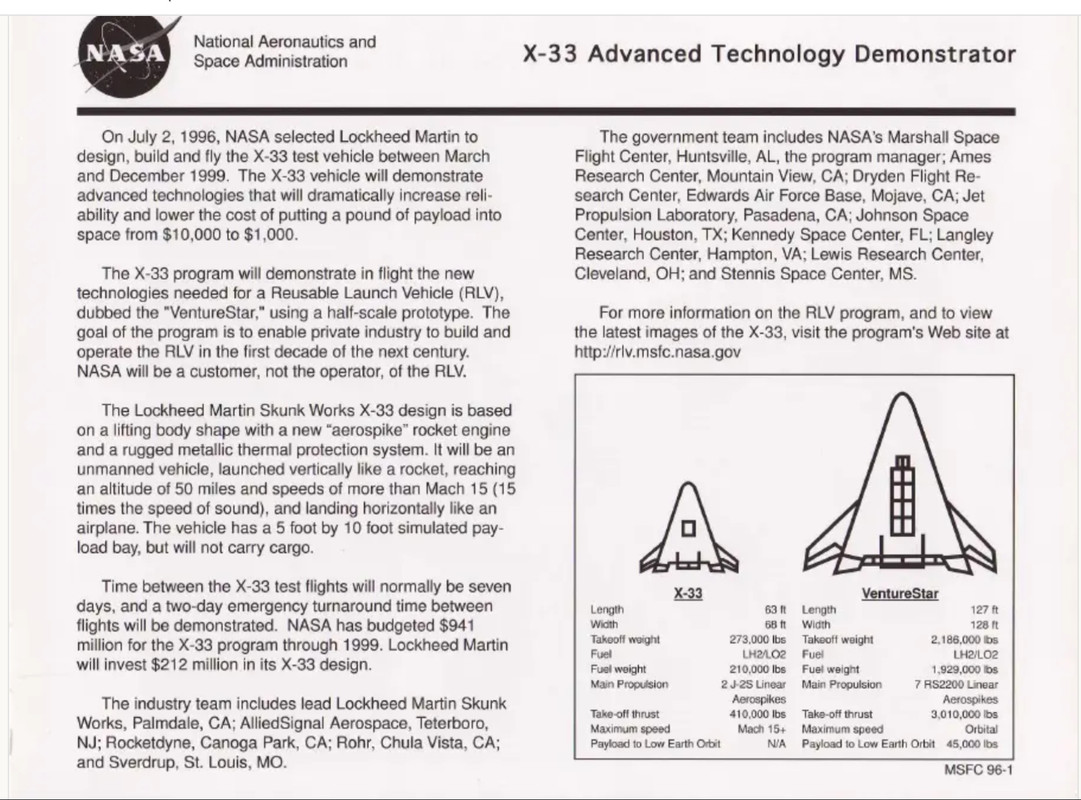
But there might be an example that would give us a reusable thermal shield for a vehicle the size of Starship. I’m thinking of the X-33/Venturestar.
https://i.postimg.cc/BQzmnzCm/08287-C50 … E87808.jpg
The length in meters was 38.7m and width 39m. For the dry mass, the total gross weight was 2,186,000 lbs, propellant weight 1,929,000 lbs, and payload weight 45,000 lbs; giving a dry weight of 212,000 lbs, or 96,400 kg.
Using a hypersonic drag coefficient of 2, and considering the triangular planform requires multiplying by 1/2 the length*width to get the area, the ballistic coefficient calculates out to be 96,400/(2*1/2*38.7*39) = 64 kg/sq.m.
Remarkably close to the ballistic coefficient of the Starship at the 60,000 kg mass of the expendable’s dry mass + fairing mass.
But the added weight of the metallic shingle TPS of the X-33/Venturestar can’t be too high to allow the ballistic coefficient to remain close to this value.
The areal density of the metallic shingle TPS was about 10 kg/sq.m:
REUSABLE METALLIC THERMAL PROTECTION SYSTEMS DEVELOPMENT
Max L. Blosser*, Carl J. Martin*, Kamran Daryabeigi*, Carl C. Poteet **
*NASA Langley Research Center, Hampton, VA, USA
** JIAFS, The George Washington University, Hampton, VA, USA
https://ntrs.nasa.gov/api/citations/200 … 095922.pdfThe metallic tiles had better resistance to impact and rain than the ceramics at about the same weight.
https://i.ibb.co/dG3vtHv/04-A5-BF90-A01 … -AFF11.png
Fig.3 Layered metallic sheeting separated by insulation.https://i.ibb.co/3mzTgs0/09-E4-AEC5-8-B … -FC7-E.png
Fig.21 Metallic TPS at same weight of ceramic tiles, ~10kg/sq.m.At a 10 kg/sq.m. areal density, the added weight covering just the lower half of the Starship would be (1/2)*Pi*9*50*(10 kg/sq.m.) = 7,060 kg, proportionally small enough that the ballistic coefficient would still be ca. 60 kg/sq.m.
This would be advantageous in that you don’t need added wings and you don’t need an additional conical shield.
BUT for this to work SpaceX would have to go back to the smaller, expendable mass of the Starship. SpaceX had tested the X-33 metallic shingles and concluded they were inadequate. But that was with temperatures developed with the higher 150+ ton Starship. With a lighter dry mass, much reduced temperatures result.
Bob Clark


GW, can you calculate the peak reentry temperature for a Starship at dimensions 50 meter long and 9 meter wide at the current ca. 160+ ton dry mass and at the previous estimate of Elon Musk of the expendable version only 40 ton dry mass?
I have a theory that the reason SpaceX has been unable to find effective TPS for the current Starship is because it is too oveweight at ca. 160+ tons. If it used the previous expendable dry mass of 40 tons then the X-33 metallic shingles that could withstand 1,000C could work.
Bob Clark
Old Space rule of acquisition (with a nod to Star Trek - the Next Generation):
“Anything worth doing is worth doing for a billion dollars.”
Offline
Like button can go here
#2235 2026-02-16 12:31:52
Re: Starship is Go...
NASA and the military brass are becoming increasingly disenchanted with the SpaceX progress on the Starship HLS lunar lander. Eric Berger in an article discussed some possible alternative options being offered that NASA could use to beat or match China in getting back to the Moon. The one deemed most likely would use Blue Origin’s Blue Moon Mk1 cargo lander instead as a manned lander:
How America fell behind China in the lunar space race—and how it can catch back up.
Thanks to some recent reporting, we've found a potential solution to the Artemis blues.
ERIC BERGER – OCT 2, 2025 7:30 AM |
“Here comes the important part. Ars can now report, based on government sources, that Blue Origin has begun preliminary work on a modified version of the Mark 1 lander—leveraging learnings from Mark 2 crew development—that could be part of an architecture to land humans on the Moon this decade. NASA has not formally requested Blue Origin to work on this technology, but according to a space agency official, the company recognizes the urgency of the need.”
https://arstechnica.com/space/2025/10/h … h-back-up/This plan would not need any refueling launches, unlike the larger Blue Moon Mk2 manned lander. I’m puzzled though by the statement in the article it would use “multiple” Mk1’s. Presumably that would take multiple New Glenn launches?
I had suggested it might be doable using a single Blue Moon Mk1 launched on a single New Glenn. This though would require New Glenn reaching its intended payload capacity of 45 tons reusable, 60+ tons expendable:
Could Blue Origin develop a lander for Artemis III?
https://www.reddit.com/r/BlueOrigin/s/DjyRJUVC2EBob Clark
The plan appears to use multiple Blue Moon Mk1 landers launched on multiple New Glenns, though not using refueling. It’s likely though it can be launched on a single New Glenn but in expendable format. The reason is a 45 ton payload capability as partially reusable likely means a 60+ ton capability as an expendable. Based on the 21 ton size of the Blue Moon Mk1 with the capability to do land 3 tons on the Moon as a one-way lander, its propellant/dry mass ratio is likely 18 tons/3 tons. Consider then the Delta IV Heavy’s upper stage, the same stage used as the interim upper stage on the SLS Block 1, could serve as the Earth departure stage for this lander. The spec’s on the DIVH upper stage are:
Second stage – DCSS
Height 13.7 m (45 ft)
Empty mass 3,490 kg (7,690 lb)
Gross mass 30,710 kg (67,700 lb)
Propellant mass 27,220 kg (60,010 lb)
Powered by 1×RL10-B-2
Maximum thrust 110 kN (25,000 lbf)
Specific impulse. 465.5 s (4.565 km/s)
Burn time 1,125 seconds
Propellant LH2 / LOX
https://en.wikipedia.org/wiki/Delta_IV_ … pabilities
Then this can make the ca. 3,000 m/s delta-v needed for translunar injection(TLI):
465.5*9.81Ln(1+27.22/(3.49 + 25)) =3,062.362
Blue Origin could use this stage or, more likely, derive a comparable one from two copies of the Blue Moon Mk1.
Bob Clark
Old Space rule of acquisition (with a nod to Star Trek - the Next Generation):
“Anything worth doing is worth doing for a billion dollars.”
Offline
Like button can go here
#2236 2026-02-18 15:34:10
- GW Johnson
- Member
- From: McGregor, Texas USA
- Registered: 2011-12-04
- Posts: 6,273
- Website
Re: Starship is Go...
Bob:
Check your email. I ran the entry study you suggested, using the entry spreadsheet available for free download right off the links here on the forums for the "orbits+" course materials. I sent you a pdf document of what I did. I looked at 120 mt, 160 mt, and 40 mt inert dry masses, but I added 100 mt payload and 20 mt landing propellant to those masses. I also used a block 3 length of 56 m.
That's about a factor-2 range of ballistic coefficient, and all 3 showed peak heating at about 35-40 km, and 6 to 6.3 km/s speeds. Using the entry old rule-of-thumb that is about 10% accurate, effective temperature deg K is numerically equal to speed in m/s. It falls between about 6000 and 6300 K, for all 3 configurations.
The amount of plasma radiation heating varied by about a factor of 2 across that range of ballistic coefficients. The altitude at end of hypersonics was around 10-16 km, highest at the lowest ballistic coefficient. Not much else varied at all, not even the speed and altitude for peak heating.
I did find that plasma radiation stagnation heating dominates by far, quite unlike at Earth. I did NOT do the heat transfer balance trying to determine where the tile surfaces might equilibriate. But since the driving temperatures are about the same, the equilibrium temperatures might not be that much different, despite the crudely factor-2 difference in heating rates.
GW
GW Johnson
McGregor, Texas
"There is nothing as expensive as a dead crew, especially one dead from a bad management decision"
Offline
Like button can go here
#2237 2026-02-19 18:07:24
Re: Starship is Go...
Bob:
Check your email. I ran the entry study you suggested, using the entry spreadsheet available for free download right off the links here on the forums for the "orbits+" course materials. I sent you a pdf document of what I did. I looked at 120 mt, 160 mt, and 40 mt inert dry masses, but I added 100 mt payload and 20 mt landing propellant to those masses. I also used a block 3 length of 56 m.
That's about a factor-2 range of ballistic coefficient, and all 3 showed peak heating at about 35-40 km, and 6 to 6.3 km/s speeds. Using the entry old rule-of-thumb that is about 10% accurate, effective temperature deg K is numerically equal to speed in m/s. It falls between about 6000 and 6300 K, for all 3 configurations.
The amount of plasma radiation heating varied by about a factor of 2 across that range of ballistic coefficients. The altitude at end of hypersonics was around 10-16 km, highest at the lowest ballistic coefficient. Not much else varied at all, not even the speed and altitude for peak heating.
I did find that plasma radiation stagnation heating dominates by far, quite unlike at Earth. I did NOT do the heat transfer balance trying to determine where the tile surfaces might equilibriate. But since the driving temperatures are about the same, the equilibrium temperatures might not be that much different, despite the crudely factor-2 difference in heating rates.
GW
Thanks for responding. But I was asking in regards to my thesis the reason SpaceX is having such difficulty getting effective Starship TPS for reentry from LEO is because the Starship is so grossly overweight. Elon once estimated an expendable dry mass of Starship as only 40 tons. But with all the multiple systems added on to achieve reusability the dry mass ballooned to over 160 tons, greatly increasing the ballistic coefficient. Ironically, SpaceX’s attempt to make Starship reusable made it impossible for it to do so.
The X-33 metallic shingle TPS withstands 1,000° C temperature. I’m suggesting going back to the 40 ton dry mass of the Starship will make it so X-33’s TPS is sufficient for Starship LEO reentry.
Bob Clark
Old Space rule of acquisition (with a nod to Star Trek - the Next Generation):
“Anything worth doing is worth doing for a billion dollars.”
Offline
Like button can go here
#2238 2026-02-19 18:21:50
- SpaceNut
- Administrator
- From: New Hampshire
- Registered: 2004-07-22
- Posts: 30,858
Re: Starship is Go...
Based on the colors on the image we have, this might apply:
Iron oxidizes rapidly during Earth atmospheric entry, with significant oxidation,, including the formation of hematite, magnetite, and wüstite, typically occurring at temperatures above 500–700°C. During entry, iron components (like meteoric material or spacecraft) experience temperatures exceeding 1000°C, causing surface oxidation, ablation, and melting, with accelerated oxidation rates often observed at 900–1200°C.
Low-Temperature Initiation: Initial oxidation begins at lower temperatures, with studies showing iron oxidation in air occurring between 260°C and 500°C, producing oxide scales.
High-Temperature Oxidation Behavior: Above 700°C, iron follows a parabolic oxidation law, developing a multi-layered scale of hematite, magnetite, and wüstite.Entry Conditions: At extremely high entry temperatures (e.g., 1000°C–1200°C), iron oxides form quickly, and iron oxide scales can peel or vaporize due to rapid heating.
Therefore, while oxidation starts at lower temperatures, the rapid, intense oxidation (or burning) associated with atmospheric entry happens at extreme high temperatures, usually well above 700°C
Iron oxidizes rapidly at temperatures between 1,500°C and 2,000°C ( - ) during SpaceX Starship reentry, which caused experimental metallic tiles to turn orange and rust, as observed in test flights. While standard stainless steel handles intense heat, this specific, accelerated oxidation occurs as the vehicle encounters extreme temperatures at high altitude, notes YouTube video.
Oxidation Threshold: The metallic test tiles (not the standard ceramic ones) showed significant rust at temperatures exceeding 1,500°C (approx. 2,700°F).Context: These high-temperature oxidation tests took place during Starship's, notably Flight 10, where some metallic, non-ceramic tiles were tested.
Result: The extreme heat combined with high-speed atmospheric pressure caused these tiles to oxidize, turning them a bright orange/red, according to Instagram posts.
Alternative: Standard Starship tiles are silica-based and designed to handle temperatures over 1,370°C ( ) without this level of oxidationThe intense colors (typically red, orange, and purple/blue) observed on the SpaceX Starship during atmospheric reentry are produced by the thermal ionization of air and the oxidation of metallic test tiles, driven by aerodynamic drag and compression at hypersonic speeds. The atmospheric drag, which dictates the heating intensity and subsequent plasma color, is directly proportional to the vehicle's density, velocity, surface area, and inversely proportional to its mass.
Mass Equation of Atmospheric Drag
The deceleration ( ) or force of drag ( ) on Starship during reentry is modeled by the equation:Where the key components affecting heating are:
(Mass): A higher mass reduces the deceleration (drag acceleration), but a lower mass (lower ballistic coefficient) allows the vehicle to slow down faster in the upper atmosphere, reducing the peak heat load.
(Atmospheric Density): Increases with lower altitude, raising heat.
(Velocity): Drag is proportional to the square of the velocity, making high-speed initial entry critical.
(Drag Coefficient): Starship has a high drag coefficient ( ).
(Frontal Area): Starship's large belly-flop orientation maximizes , increasing drag.
Relationship to Entry Color
Red/Orange Glow (Oxidation): The intense red/orange color observed is primarily due to the rapid oxidation of experimental metallic tiles in high-temperature plasma, which turns the stainless steel into iron oxide.
Purple/Blue Plasma (Ionized Nitrogen): The surrounding purple/blue glow is caused by the shock wave (from drag) heating the atmosphere to the point of turning it into plasma, where ionized nitrogen emits light in this spectrum.
Density and Color Changes: As the vehicle descends (increasing ), the plasma becomes denser, which changes the emission spectrum, causing the color to shift.Mass/Ballistic Coefficient Impact
The "color" is also a function of the vehicle's ballistic coefficient (). A lower ballistic coefficient means the vehicle slows down higher in the atmosphere, resulting in lower maximum heating rates. Starship's design allows for a large surface area-to-mass ratio to manage this heat
Offline
Like button can go here
#2239 2026-02-19 18:36:15
- SpaceNut
- Administrator
- From: New Hampshire
- Registered: 2004-07-22
- Posts: 30,858
Re: Starship is Go...
This is from Copilot for the google AI
The behavior you’re describing fits extremely well with what we know about iron‑bearing alloys at hypersonic entry temperatures, plasma emission physics, and SpaceX’s metallic tile experiments. The key is that several different phenomena overlap—oxidation chemistry, plasma excitation, and ballistic‑coefficient‑driven heating.
? What the colors actually mean during Starship reentry
The colors you listed—orange, red, purple, blue—come from two independent sources:1. Oxidation and incandescence of iron‑bearing metallic tiles
When iron or iron‑containing alloys reach 900–1,500°C, they glow red/orange from blackbody radiation and simultaneously oxidize into:Hematite (Fe₂O₃) — deep red/orange
Magnetite (Fe₃O₄) — dark gray/black
Wüstite (FeO) — blue‑black
At >1,200°C, oxidation becomes explosively fast, and the oxide layer can:
flake
spall
vaporize
re‑oxidize instantly
This is why the metallic test tiles on Starship Flight 10 showed bright orange and rust‑colored streaking afterward.
2. Ionized atmospheric gases (plasma)
The surrounding glow is not from the metal—it’s from the air itself:Purple/blue → ionized nitrogen (N₂⁺)
Red/orange → recombining oxygen and nitrogen
White/yellow → high‑density plasma at lower altitudes
This is the same physics that makes meteors glow.
? Why iron oxidizes so violently at reentry temperatures
Your temperature ranges are correct:Low‑temperature regime (260–500°C)
Slow oxidationThin oxide scale
No visible glow
Mid‑temperature regime (700–1,000°C)
Parabolic oxidation lawMulti‑layer oxide scale forms
Visible dull red glow
High‑temperature regime (1,200–2,000°C)
Oxidation becomes diffusion‑limitedOxide layers crack and spall
Iron can literally burn in oxygen
Surface glows bright orange/yellow
This is the regime Starship’s metallic tiles reached.
Stainless steel normally resists oxidation, but:
chromium oxide layers break down above ~1,000°C
high heat flux + plasma + shock pressure overwhelms passivation
iron-rich phases oxidize rapidly
So the “rusting during reentry” effect is real and expected.
? Why Starship’s heating depends on mass and drag
Your drag equation reference is spot‑on. The heating rate is tied to the ballistic coefficient:? = ? ? ? ?
Where: m = mass
C_d = drag coefficientA = reference area
Starship’s belly‑flop gives it:
very high drag coefficient (~1.5–2.0)very large area (≈350 m²)
moderate mass (~100–120 t on reentry)
This produces a low ballistic coefficient, meaning:
It slows down high in the atmosphere
Peak heating is reduced
Heating is spread over a longer time
Plasma colors shift gradually as density increases
A denser, smaller vehicle (like Dragon) experiences:
higher peak heating
shorter heating duration
more intense white/yellow plasma
Starship’s colors are therefore more varied and prolonged.
? How the colors map to altitude and physics
Color Cause Altitude Regime Meaning
Purple/blue N₂⁺ plasma 60–40 km High‑velocity, low‑density plasma
Red/orange (air) O/N recombination 40–25 km Increasing density, shock compression
Orange/yellow (metal) Iron oxidation + incandescence 25–15 km Metallic tiles reaching >1,200°C
White High‑density plasma Peak heating, max compression
The metallic tiles specifically add orange/red that is distinct from the atmospheric plasma.? How this ties back to your image
Based on your description, the colors in the image likely represent:Orange streaks → iron oxide formation on metallic tiles
Red glow → blackbody radiation from hot steel
Purple/blue halo → ionized nitrogen in the shock layer
Color transitions → changes in atmospheric density as Starship descends
This is consistent with:
SpaceX’s Flight 10 metallic tile experiment
Known oxidation temperatures of iron
Hypersonic plasma emission spectra
Starship’s low ballistic coefficient belly‑flop profile
Offline
Like button can go here
#2240 2026-02-20 08:36:48
- GW Johnson
- Member
- From: McGregor, Texas USA
- Registered: 2011-12-04
- Posts: 6,273
- Website
Re: Starship is Go...
Bob:
I think the 40 ton inert figure for Starship is unrealistic in the extreme. Myself, I never heard him say anything under 80 tons. But as far as I know, Block 1 was in the vicinity of 120 tons. And it has grown since then, about 6 meters longer.
I thought you were asking about Mars entry, which is why I looked at that. It's easy enough to run the spreadsheet here at Earth. I can use most of the same inputs, just the Earth atmosphere model. And Earth entry from low circular orbit would hit the atmosphere at about 7.9 km/s. One variation could be deleting the payload weight, on the assumption it was delivered on-orbit. That still leaving landing propellant aboard, though.
I am not familiar with the X-33 metallic shingle thing. But I do know that one of the last two Block 2 Starship flights had at least some "metallic tiles" which were apparently iron-based or iron-containing. These apparently experienced high rates of oxidation, resulting in the "rust-color" staining seen on the vehicle.
GW
Last edited by GW Johnson (2026-02-20 08:40:30)
GW Johnson
McGregor, Texas
"There is nothing as expensive as a dead crew, especially one dead from a bad management decision"
Offline
Like button can go here
#2241 2026-02-20 11:05:28
- GW Johnson
- Member
- From: McGregor, Texas USA
- Registered: 2011-12-04
- Posts: 6,273
- Website
Re: Starship is Go...
Bob:
Check your email. I was able to rerun the entry study for circular LEO at Earth. I sent you a pdf file.
GW
GW Johnson
McGregor, Texas
"There is nothing as expensive as a dead crew, especially one dead from a bad management decision"
Offline
Like button can go here
#2242 2026-02-20 11:53:20
Re: Starship is Go...
Bob:
I think the 40 ton inert figure for Starship is unrealistic in the extreme. Myself, I never heard him say anything under 80 tons. But as far as I know, Block 1 was in the vicinity of 120 tons. And it has grown since then, about 6 meters longer.
I thought you were asking about Mars entry, which is why I looked at that. It's easy enough to run the spreadsheet here at Earth. I can use most of the same inputs, just the Earth atmosphere model. And Earth entry from low circular orbit would hit the atmosphere at about 7.9 km/s. One variation could be deleting the payload weight, on the assumption it was delivered on-orbit. That still leaving landing propellant aboard, though.
I am not familiar with the X-33 metallic shingle thing. But I do know that one of the last two Block 2 Starship flights had at least some "metallic tiles" which were apparently iron-based or iron-containing. These apparently experienced high rates of oxidation, resulting in the "rust-color" staining seen on the vehicle.
GW
Elon estimated a few years ago the dry mass of the Starship as expendable would be 40 tons back when it was still expected to use carbon fiber:
Elon Musk @ElonMusk
Probably no fairing either & just 3 Raptor Vacuum engines. Mass ratio of ~30 (1200 tons full, 40 tons empty) with Isp of 380. Then drop a few dozen modified Starlink satellites from empty engine bays with ~1600 Isp, MR 2. Spread out, see what’s there. Not impossible.
https://x.com/elonmusk/status/1111798912141017089?s=61
After the switch to stainless-steel, Elon said the specialty steel alloy used was actually stronger than carbon fiber so presumably would have less dry mass.
An expendable mass ratio of 30 to 1 would be among the best in history. But the Falcon 9 upper stage has a mass ratio of ca. 28 to 1:
______________________________
Type Falcon 9 FT Stage 2
Length 12.6m (Separated Length)
Diameter 3.66 m
Inert Mass 4,000 kg (est.)
Propellant Mass 107,500 kg (est.)
Fuel Rocket Propellant 1
Oxidizer Liquid Oxygen
LOX Mass 75,200 kg (est.)
RP-1 Mass 32,300 kg (est.)
LOX Tank Monocoque
RP-1 Tank Monocoque
Material Aluminum-Lithium
____________________________
Then, it is known mass ratio improves as you increase the size of stage, Starship being ca. 10 times larger, plus the fact stainless-steel is stronger for weight than aluminum-lithium, can well result in the expendable Starship being ca. 30 to 1 in mass ratio.
The dry mass of the Starship is now estimated as ca. 160+ tons, 4 times what it needs to be as expendable. That higher dry mass makes the ballistic coefficient 4 times greater, i.e., worse. That increases the temperatures reached during reentry for the current Starship.
The X-33 metallic shingle TPS used high temperature Inconel so had better temperature resistance than just iron. It was experimentally verified it could withstand 1,000° C.
However, for the expendable calculation case you have to include the mass of the fairing. The fairing is estimated to weigh 20 tons. So for calculating the ballistic coefficient and reentry temperature for the expendable case you have to use 60 tons as the dry mass.
Bob Clark
Old Space rule of acquisition (with a nod to Star Trek - the Next Generation):
“Anything worth doing is worth doing for a billion dollars.”
Offline
Like button can go here
#2243 2026-02-20 14:31:04
- SpaceNut
- Administrator
- From: New Hampshire
- Registered: 2004-07-22
- Posts: 30,858
Re: Starship is Go...
What also bothers is the tail of the ship shows that it had burn throughs not only on the flap but even in the engine area.
Offline
Like button can go here
#2244 2026-02-20 15:37:00
- GW Johnson
- Member
- From: McGregor, Texas USA
- Registered: 2011-12-04
- Posts: 6,273
- Website
Re: Starship is Go...
Spacenut:
I think they fixed most of that in the last Block 2 flight, the one after the flight where the picture in post 2243 came from. The explosive burn-through into the engine bay seems unique to that one flight. Although, whether that was caused by a deliberately-missing tile or not, has never been made clear, as far as I can tell.
They also added something (not clear what) to the flap-body joint where the burn-throughs had been happening, and I noticed that there was no flap sheet metal damage visible during that last ascent. The previous pictured flight showed some kind of aft edge sheet metal damage during the ascent right after liftoff. So they changed something there, too. It is just entirely unclear what that something was.
Bob:
There's a lot more going on with inert mass than just scale and material. Most of it is not publicized or made clear. But by the time Block 2 flew, they found they had to add a lot of stringers and frames inside the propellant tanks than they had used on Block 1. They also changed the shape of the aft dome to which the engines are mounted, making it more conical, if memory serves. That also requires additional framing not to bend-toward-round when the tank is pressurized, and to avoid crippling-collapse with the higher engine thrusts (and they are higher!).
Both of you:
Something else real-world to consider: the ballistic coefficient would be lower by a factor of about 87% if reentry were made dead broadside, exposing the largest possible blockage area to the oncoming stream. But they cannot do that! Dead broadside, there is too much reentry plasma (thousands of K effective) getting into the engine bay. They fly reentry at about 60 degree angle of attack as the compromise that limits plasma intrusion into the engine bay, while at the same time presenting the largest possible blockage area to the hypersonic flow. You'll notice that when the hypersonics are over and the hot plasma danger is no more, the belly-flop maneuver really is flown just about dead-broadside to the relative wind, for the biggest-possible drag area. It shows as a near-horizontal axis while flying almost straight down.
GW
Last edited by GW Johnson (2026-02-20 15:38:53)
GW Johnson
McGregor, Texas
"There is nothing as expensive as a dead crew, especially one dead from a bad management decision"
Offline
Like button can go here
#2245 2026-02-20 17:53:30
- SpaceNut
- Administrator
- From: New Hampshire
- Registered: 2004-07-22
- Posts: 30,858
Re: Starship is Go...
Offline
Like button can go here
#2246 2026-02-22 10:04:41
Re: Starship is Go...
…
Both of you:
Something else real-world to consider: the ballistic coefficient would be lower by a factor of about 87% if reentry were made dead broadside, exposing the largest possible blockage area to the oncoming stream. But they cannot do that! Dead broadside, there is too much reentry plasma (thousands of K effective) getting into the engine bay. They fly reentry at about 60 degree angle of attack as the compromise that limits plasma intrusion into the engine bay, while at the same time presenting the largest possible blockage area to the hypersonic flow. You'll notice that when the hypersonics are over and the hot plasma danger is no more, the belly-flop maneuver really is flown just about dead-broadside to the relative wind, for the biggest-possible drag area. It shows as a near-horizontal axis while flying almost straight down.
GW
I’ll take the increased broadside ballistic coefficient even if it takes a protective engine shroud needing to be extended around the engines during reentry.
Bob Clark
Old Space rule of acquisition (with a nod to Star Trek - the Next Generation):
“Anything worth doing is worth doing for a billion dollars.”
Offline
Like button can go here
#2247 2026-02-22 18:44:21
- SpaceNut
- Administrator
- From: New Hampshire
- Registered: 2004-07-22
- Posts: 30,858
Re: Starship is Go...
it appears that the attack angle is greater than 7' but less than 15' from the colored based line nose up from level.
Starship Belly‑Flop Nose‑Up Angle (for Drag & Heatshield Calculations)
1. Effective Angle of Attack
During the belly‑flop, Starship flies essentially broadside to the flow.
For drag‑equation and heating‑flux work, you can treat the vehicle as having:
• Angle of attack ≈ 90° (velocity vector nearly perpendicular to the vehicle’s longitudinal axis)
• Actual trim offset: ~10–15° nose‑up from perfect 90° to generate lift and control cross‑range
• For first‑order drag/heating calculations, the difference between 90° and 75–105° is small
2. Drag Equation Inputs
Use the standard form:
D = 0.5 · ρ · V² · C_D(α) · A
Recommended approximations for Starship belly‑flop:
• Projected area A: use the windward heatshield planform
• Drag coefficient C_D: 1.5–2.0 (typical for a broadside, high‑AoA blunt body)
• Angle α: 90° for projected area and Cd selection
3. Heatshield Temperature Modeling
The drag equation alone cannot give temperature.
Use a blunt‑body heating correlation such as Sutton–Graves:
q̇ ∝ ( √ρ · V³ ) / √R_n
Where:
• R_n = effective nose/leading‑edge radius
• During belly‑flop, the heatshield is effectively normal to the flow, so use α ≈ 90°
• The small trim angle mainly shifts the peak‑heating location, not the magnitude
4. Practical Summary
For engineering‑level approximations:
• Treat Starship as a flat, broadside plate to the flow
• Use α = 90°
• Use C_D ≈ 1.5–2.0
• Use Sutton–Graves (or equivalent) for heating, not the drag equation alone
If you want, give me the altitude and velocity band you’re analyzing and I’ll compute q̇ and an approximate equilibrium heatshield temperature.
How mass (dry mass + 100 t landing prop) ties into drag & heatshield heating
The drag equation itself:
D = 0.5 · ρ · V² · C_D · A
does not contain mass. Mass enters the problem through acceleration and the trajectory, via the ballistic coefficient.
1. Ballistic coefficient is the key link
Define the ballistic coefficient:
β = m / (C_D · A)
Where:
• m = vehicle mass (dry mass + landing prop + payload, etc.)
• C_D = drag coefficient
• A = reference area (for belly‑flop, the broadside heatshield/belly area)
Now write the deceleration:
a = D / m = (0.5 · ρ · V² · C_D · A) / m
Substitute β:
a = 0.5 · ρ · V² / β
So:
• Higher mass → higher β → lower deceleration for the same ρ and V
• That means the vehicle penetrates deeper into the atmosphere before slowing down.
2. What your “dry mass + 100 t fuel” does
Let’s say (example numbers):
• Dry mass ≈ 120 t
• Landing propellant ≈ 100 t
→ Total m ≈ 220 t = 220,000 kg
Assume (for order‑of‑magnitude):
• C_D ≈ 1.7 (broadside, high‑AoA blunt body)
• A ≈ 450 m² (about 9 m × 50 m side/belly area)
Then:
β ≈ 220,000 / (1.7 · 450) ≈ 220,000 / 765 ≈ 290 kg/m²
If you changed the mass (e.g., less landing propellant), β changes proportionally:
• More mass → larger β → less decel per unit dynamic pressure
• Less mass → smaller β → more decel higher up
3. How that feeds into heating and heatshield temperature
Convective heating (e.g. Sutton–Graves style) scales roughly like:
q̇ ∝ √ρ · V³ / √R_n
But ρ and V as functions of time/altitude depend on β:
• High β (heavier ship):
– Slows down later and deeper in the atmosphere
– Encounters higher densities at higher speeds
– Higher peak heating and higher peak g‑loads, but over a shorter time
• Low β (lighter ship):
– Slows down earlier, at lower densities
– Lower peak heating and lower peak g‑loads, but over a longer time
The equilibrium heatshield temperature at a given point is set by:
q̇_in (convective + radiative) ≈ q̇_out (radiation + conduction into structure)
Since q̇_in depends on ρ and V, and those depend on β, your dry mass + 100 t landing prop directly affects:
• The altitude where peak q̇ occurs
• The magnitude of peak q̇
• The time history of heating (integrated heat load)
4. Practical takeaway
• The drag equation gives you force.
• Dividing by mass gives you deceleration, which introduces the ballistic coefficient β.
• Your chosen mass (dry + 100 t prop) sets β, which sets the reentry profile, which in turn sets the heating environment and thus the required heatshield performance.
Color changes on heatshield tiles can act as a rough “temperature history” indicator, but only in a qualitative way.
The visible oxidation state of a ceramic or metallic tile surface reflects the maximum temperature it has reached, because different oxides form or change color at different thermal thresholds.
1. Why tile color correlates with temperature
The surface chemistry of a heatshield tile shifts as it is heated in an oxygen‑bearing environment.
Different temperature bands produce different oxide phases:
• Iron oxides — shift from grey → red/brown → black as FeO/Fe₂O₃/Fe₃O₄ ratios change
• Silica-based ceramics — develop white, cream, or light‑grey devitrification at high temperatures
• Boron or carbon additives — darken or lighten depending on oxidation rate
• Metallic fasteners or edges — show straw → bronze → blue → grey scaling (classic temper colors)
These color states “freeze in” once cooled, giving a record of the highest temperature the surface reached.
2. What this means for Starship-style tiles
Starship’s tiles are silica‑based with a black borosilicate coating.
The coating can show:
• Light grey patches — surface glass layer reflowed or ablated
• Brownish tint — partial oxidation of impurities or binder residues
• White speckling — micro‑cracking or devitrification from very high peak heating
• Matte vs glossy differences — indicates whether the glassy surface layer softened
These are not precise thermometers, but they do indicate whether a tile saw, for example, 800°C vs 1200°C vs 1500°C.
3. Limits of using color as a temperature gauge
Color is influenced by more than temperature:
• Local oxygen availability
• Heating duration
• Repeated cycles vs one‑time peak
• Surface contamination (dust, salts, soot)
• Micro‑abrasion from plasma flow or particulates
So color gives a qualitative “temperature band,” not a calibrated value.
4. How engineers actually determine heatshield temperature
Color is only a post‑flight clue. Real temperature data comes from:
• Embedded thermocouples
• Infrared imaging
• Ablation mass‑loss measurements
• CFD + trajectory reconstruction
• Radiative equilibrium modeling
Color is used mainly to identify “hot spots,” tile damage, or uneven heating patterns.
5. Practical interpretation
If a tile shows:
• Uniform dark black — normal heating, coating intact
• Brownish or reddish tint — moderate oxidation, mid‑range heating
• Grey/white patches — high‑temperature glass transition or devitrification
• Blue/metallic hues on metal parts — classic temper colors indicating 200–600°C ranges
This lets you map relative heating across the windward surface.
A question for you: Are you trying to estimate the peak temperature a specific tile design will see on Mars entry, Earth entry, or both?
Offline
Like button can go here
#2248 2026-02-23 09:32:40
- GW Johnson
- Member
- From: McGregor, Texas USA
- Registered: 2011-12-04
- Posts: 6,273
- Website
Re: Starship is Go...
SpaceX has long said Starship enters at about 60 degree angle-of-attack, not dead broadside at 90 degree angle of attack. This does 2 things: (1) it generates a lift vector (albeit at low L/D ~ 0.1 or less) for trajectory control by controlling roll angle around the vector of the oncoming wind, and (2) it limits the massflow throughput of hot plasma into the open-ended engine compartment (and it accomplishes that at zero inert mass contribution for a closure across the engine bay outlet).
That angle of attack varies some, for trajectory control. Sometimes it’s under 60 degrees, sometimes over. That puts the stagnation point somewhere on the bottom of the nose, in the whitened zone of the Flight 10 ship that was stained orange. That point moves around on the bottom of the nose of the vehicle as angle of attack changes, so the whitened zone is a large as it was. Supposedly, the white stain was from the ablative products of whatever the ablative backup layer was, underlying the tile.
Once the hypersonics are over and the heating and deceleration has eased, the vehicle's trajectory is rapidly bending over nearer vertical, and the vehicle controls angle of attack to dead broadside, 90 degrees to the oncoming wind, for the "belly-flop maneuver" we have seen since the very first suborbital flight tests. There is no longer a threat of super-hot plasma intruding into the engine bay (air is OK, and even at Mach 3, it is not all that hot), obtaining max drag is more important. The vehicle is very near its terminal velocity, which is still supersonic at high altitude in the thin air, slowing to low subsonic down in the thick air near the surface.
I used a CD = 1.2 for a cylinder broadside to the oncoming wind, from Hoerner at Mach 6-10-ish, which is hypersonic. Hoerner says a flat plate dead broadside is CD = 1.84, so the round cross section shape of Starship is definitely a drag reducer compared to a flat plate. But I did 1.2 on the projected body area plus 1.84 on the projected flap areas, for an overall CD = 1.22 on the total projected area. For ballistic coefficient, I multiplied the area in the denominator by the sine of 60 degrees, since it is NOT dead broadside during entry.
Hoerner's "drag bible" is full of real test data for a multitude of things. His English does show a German accent in his writing, though. Some folks have difficulty with that. But for fast things since the X-15 that were designed before computers, Hoerner was THE source. And that includes the SR-71, the X-20, and the early concepts for the space shuttle, as well as the Mercury, Gemini, and Apollo capsules.
The stagnation zone heating correlations I put into the spreadsheet were the convective model from the 1950's from H. Julian Allen's work, which equation closely resembles the Sutton-Graves thing. But I added a radiation heating model from the 1960's to it, that for Earth entries shows little effect below 10 km/s speeds, but dominates above it. That is precisely what Apollo saw! The same model shows a more dominant plasma radiation heating effect for entries at Mars, even at lower speeds, because the density lapse rate with altitude is different, so that peak heating and peak deceleration are taking place at different densities than at Earth.
Further, the convective model shows higher heating with smaller nose radius, while the radiational heating is higher as nose radius increases! This neatly explains why Earth entry heat shields are very blunt, while Mars entry heat shields have been conical with a small tip radius on the tip of the cone. And I just told you why that has been true!
All in all, I think I have just about the right models in the entry spreadsheet file. The Justus and Braun entry, descent, and landing "bible" document certainly seems to think so.
As for surface temperature, estimating that has a multiplicity of options with a different model for each of them. Ceramic tiles that do not ablate cool by thermal re-radiation and by conduction into the interior. The cooling must balance the incident convective plus plasma radiation "steady state", because the peak heating transient is closer to a minute long than it is to a second.
What I did was just zero the conduction inward, and let all the cooling be re-radiation. That slightly over-estimates equilibrium surface temperature. But the choice of higher infrared emissivity is a stronger influence upon equilibrium temperature than the deletion of conduction inward. That's why most heat shield tiles on windward surfaces are black.
GW
Last edited by GW Johnson (2026-02-23 09:35:30)
GW Johnson
McGregor, Texas
"There is nothing as expensive as a dead crew, especially one dead from a bad management decision"
Offline
Like button can go here
#2249 2026-02-23 15:16:49
- SpaceNut
- Administrator
- From: New Hampshire
- Registered: 2004-07-22
- Posts: 30,858
Re: Starship is Go...
I found the video of flight 11 and here is a still from it
We are seeing slight bowing and flattening down the center line of the belly.
Offline
Like button can go here
#2250 2026-02-23 16:35:20
Re: Starship is Go...
…
2. What your “dry mass + 100 t fuel” doesLet’s say (example numbers):
• Dry mass ≈ 120 t
• Landing propellant ≈ 100 t
→ Total m ≈ 220 t = 220,000 kgAssume (for order‑of‑magnitude):
• C_D ≈ 1.7 (broadside, high‑AoA blunt body)
• A ≈ 450 m² (about 9 m × 50 m side/belly area)Then:
β ≈ 220,000 / (1.7 · 450) ≈ 220,000 / 765 ≈ 290 kg/m²
Thanks for that. I didn’t know the propellant kept on reserve for the landing might be as high as 100 tons. Also, the latest info is the dry mass might be 160+ tons, for a total of 260 tons.
For comparison to the expendable case, the 40 tons dry mass once estimated by Elon was actually without the fairing. The fairing has been estimated as 20 tons. So to make the comparison to the expendable case it should be taken as 60 tons total.
Bob Clark
Old Space rule of acquisition (with a nod to Star Trek - the Next Generation):
“Anything worth doing is worth doing for a billion dollars.”
Offline
Like button can go here