New Mars Forums
You are not logged in.
- Topics: Active | Unanswered
Announcement
#26 2026-02-06 18:12:23
- SpaceNut
- Administrator
- From: New Hampshire
- Registered: 2004-07-22
- Posts: 30,844
Re: WIKI Starship repurposed to make or build what we need
The plates with in can also be tubing bend to the shape and welded to the shaped and have a more open internals.
Planning must also include many other functions to support if we do the care taker approach.
Water plant, Waste recovery, air creation and food
It is possible to turn each starship into more of these from the ships which are not used up yet.
Astronaut daily CO2 production is about 1kg per person and they consume 1 gallon of water per person.
Thermally-Regenerated 4-Bed Solid Amine CO2 Removal System with Air and Water Save Features (CAMRAS): 400W 120VAC constant power draw for 1 of 4 sequentially heated amine beds.
415W average / 526W peak 28VDC power draw for fans, pumps, and control electronics.
4.71kg of maximum demonstrated CO2 removal capacity per day aboard ISS over a 1,000 day test.
The system is therefore "sized" for 4 astronauts, or 1/250th of our colony's head count.For a Thermally-Regenerated 4‑Bed Solid Amine CO₂ Removal System with air and water save features (CAMRAS-class) designed for something like ISS/Orion-class flows:
Ballpark dry mass (single unit): ~80–150 kg
Lower end: aggressively optimized, Orion/short-duration style packaging.
Upper end: ISS-like robustness, more structure, more interfaces.Installed volume / footprint: Think in terms of a rectangular box roughly:
Planform footprint: about 0.4–0.7 m²e.g. something like 0.6 m × 0.8–1.0 m in floor area.
Height: 0.6–1.0 m depending on packaging and access.
So envelope volume: roughly 0.25–0.6 m³ per unit.
Specific capacity (for scaling):
For crew-sized systems, a CAMRAS-class solid amine 4‑bed system is typically sized around: 4–6 crew per unit at ~0.8–1.0 kg CO₂/day/personSo ~3–6 kg CO₂/day per unit is a reasonable design point.
How to use this for your Mars habitat sizing
If you’re doing system-level mass/volume budgets rather than hardware-level replication, a good parametric approximation is:Mass per person (CO₂ removal, solid amine, thermally regenerated):
m_{\text{CO₂,person}} \approx 20\text{–}35 \text{ kg/person (installed, including structure & interfaces)}
for continuous, long-duration operation with redundancy.Footprint per person: ? CO₂,person ≈ 0.05 – 0.10 m²/person assuming you cluster beds into a few larger units rather than one tiny unit per person.
So, for example, for 1,000 crew with N+1 redundancy and some margin, you might budget:
Mass: 1,000 × 25 – 35 kg ≈ 25 – 35 metric tons for the entire CO₂ removal subsystem, including structure, manifolds, and some spares.Footprint: 1,000 × 0.07 m² ≈ 70 m²
which is then arranged in racks, so actual deck area impact is less if you stack vertically.Reality check
Because the exact CAMRAS configuration you named is a specific NASA hardware line, the true numbers will depend on:
Mission profile: flow rate, crew count, redundancy, regeneration power limits.
Packaging constraints: rack vs. wall-mounted vs. modular skid.
Integration: ducting, valves, water-save heat exchangers, and control electronics.926W * 250 = 231,500W of constant power to support CO2 scrubbing for 1,000 colonists, with a 17.75% CO2 removal performance margin for degraded system operation.
Cumulative air mass vented to space over 1,000 days of operation: 16.1lbm, so 4,025lbm over 1,000 days for 1,000 colonists, which equates to 4.025lbm of required atmospheric replenishment per day 78% N2, 21% O2, and 1% Ar. I've no idea how to source the N2 yet, but the O2 can be provided by CO2 and the Martian atmosphere also contains 2.7% Nitrogen and 1.6% Argon by mass.
Cumulative water mass vented to space over 1,000 days of operation: 67.9lbm, so 16.9775lbm / 2.04 gallons per day for 1,000 people. The water save feature of CAMRAS is crucial to life support, otherwise 80.4lbm / 9.64 gallons per day would be lost for 1,000 colonists.
Ionomwer Water Processor (IWP) Assembly peak power draw: 195W
Urine Processor Assembly (UPA) active / standby power draw: 424W / 108W
Water Recovery System (WRS; UPA + IWP) time averaged power draw: 743Wh/hr
743W * 250 = 185,750WISS Waste Water Recovery Per Day: 34.34 gallons / 130L per day (98% recovery rate)
This implies that total water processing for 1,000 colonists will be 2,146.25 gallons per day.
Minimal Life Support Power Draw: 417,250W
That figure does not include fan-based air circulation / ventilation, waste heat removal, or more advanced life support functions such as hot showers and cooking / cleaning, merely the minimum CO2 scrubbing and waste water recovery to keep 1,000 people alive.
It would be reasonable to assume that 417,250W of power draw is ultimately dissipated as waste heat, which needs to be rejected to space via radiators. 1,000 colonists, all working about as hard as they could sustain for 1 hour, would generate just under 98,000W of waste heat.
The fan power to deliver 15 air changes per hour to a 144,000ft^3 / 4,078m^3 auditorium filled with 1,000 people is 36,000CFM, so 36,000CFM * 0.8W/CFM = 28,800W. This structure is approximately 31X larger, so we can probably get away with as few as 4 complete air changes per hour because it's so big. The smaller the interior volume of a structure relative to the number of people inside, the more air changes per hour are required to keep the air fresh. However, that still bumps our total wattage up to 59,520W. If we really want to be completely pedantic about this, then 892,800W is required to provide 15 air changes per hour for a 125,000m^3 internal volume structure. It'll be like living inside a wind tunnel, though, so perhaps that's a bit over-the-top.
3MW worth of power for 1,000 colonists is likely more than sufficient for basic life support functions, to include hot showers and interior lights, especially if we use some of that waste heat to warm up our frosty cold fresh water supply.
would like to find foot print measurements for Ionomwer Water Processor (IWP)
Urine Processor Assembly (UPA)
Water Recovery System (WRS; UPA + IWP)
I dug through the available sources, but none of the search results provide physical footprint measurements (height × width × depth or mass/volume envelope) for:Ionomer Water Processor (IWP)
Urine Processor Assembly (UPA)
Water Recovery System (WRS = UPA + WPA/IWP)
The documents found describe function, technology, upgrades, and performance, but not physical dimensions.
Here is what the searches actually contained:What the sources do cover
IWP: Technology description, membrane design, SBIR announcements, and system goals (e.g., 98% recovery)UPA: Technical papers on upgrades, distillation assembly, and system behavior, but no physical envelope
WRS: High‑level ISS water management descriptions, but no hardware dimensions
Why the data is missing
NASA typically publishes mass, power, and performance for ECLSS hardware, but footprint dimensions are usually buried in:internal configuration drawings
ISS rack integration documents
payload accommodation specs
NASA ECLSS ICDs (Interface Control Documents)
These are rarely available in public-facing technical papers.
What I can give you right now (based on known ISS architecture)
Even though the search didn’t return explicit numbers, we can anchor the expected footprint because:1. UPA and WPA/IWP are housed in standard ISS racks
Both systems are installed in US Lab racks (ISPRs).
A standard ISPR (International Standard Payload Rack) has known dimensions:Parameter ISPR Value
Height 2.0 m
Width 1.05 m
Depth 0.86 m
Usable internal volume ~1.57 m³
Max mass ~700 kg
So the maximum possible footprint for UPA, WPA, or IWP is constrained by the ISPR envelope.2. UPA occupies one full rack (LAB1P4)
This is explicitly stated in NASA documentation:“The Urine Processing Assembly (UPA) was installed in LAB1P4 during ULF‑2 as part of the Water Recovery System (WRS).”
Thus, UPA footprint ≈ 1 ISPR rack.
3. WPA (Water Processor Assembly) also occupies one rack
The WPA is the other half of the WRS.
The IWP is intended as a future replacement for WPA, so its footprint is expected to be ≤ 1 ISPR rack.4. WRS (UPA + WPA/IWP) = 2 racks total
This is consistent with all ISS ECLSS documentation.Practical engineering summary
Here are the best available footprint estimates based on rack constraints:Ionomer Water Processor (IWP)
Footprint: ≤ 1 ISPRApprox. max dimensions:
2.0 m (H) × 1.05 m (W) × 0.86 m (D)Likely smaller, but no public source gives exact numbers.
Urine Processor Assembly (UPA)
Footprint: 1 ISPR (LAB1P4)Dimensions:
2.0 m × 1.05 m × 0.86 m (rack envelope)
Internal hardware occupies most of the rack volume.Water Recovery System (WRS = UPA + WPA/IWP)
Footprint: 2 ISPR racksDimensions:
2 × (2.0 m × 1.05 m × 0.86 m)
Total width: ~2.1 m when racks are side‑by‑side.If you want the exact hardware dimensions
I can help you get them, but I need to know which path you prefer:Option A — I search for NASA rack integration drawings
These sometimes include exact hardware envelopes.Option B — You want engineering‑grade estimates
I can derive realistic dimensions based on:
component masses
pump and distillation assembly sizes
membrane module geometry
thermal control hardware
avionics packagingOption C — You want footprints for Mars ISRU planning
I can scale these systems for:
1–6 crew
1000‑crew colony
surface vs. pressurized habitat integration
power and mass budgets
Which direction would you like to go?scale for 10 crew
See my thinking
For 10 crew, we can treat the ISS WRS (UPA + WPA/IWP) as our baseline module and scale from there.Quick sizing summary for 10‑crew WRS
Item ISS baseline (6–7 crew) Scaled for 10 crew Notes
Crew supported 6–7 10 Linear scaling with margin
UPA racks 1 ISPR 1–2 ISPR Depends on turndown/redundancy
WPA/IWP racks 1 ISPR 1–2 ISPR Higher throughput or N+1
Total WRS racks 2 ISPR 3–4 ISPR Likely 3 if aggressively optimized
Rack footprint (each) 2.0 m H × 1.05 m W × 0.86 m D same ISPR standard
So for 10 crew, you’re realistically looking at:Minimum aggressive design:
3 racks total (e.g., 1.5× ISS capacity with higher‑throughput internals)
Footprint ≈ 2.0 m H × 3.15 m W × 0.86 m D
Conservative / high‑reliability design:
4 racks total (2× UPA, 2× WPA/IWP or 1.5× + redundancy)
Footprint ≈ 2.0 m H × 4.2 m W × 0.86 m DHow I’m scaling from ISS
1. ISS design point
The UPA is explicitly described as being designed for 6–7 crewmembers.
The WRS (UPA + WPA) on ISS supports that crew size with some margin and operates near continuous duty.So: Capacity per ISS WRS ≈ 6.5 crew (midpoint)
2. Linear flow scaling to 10 crew
Assuming roughly linear scaling of water production/processing with crew count:
Scale factor = 10 6.5 ≈ 1.54
That means you need about 1.5× the ISS WRS throughput to support 10 crew with similar margins.3. What that means in hardware
You have three main strategies:
A. Higher‑throughput internals, same rack count (2 racks)
Push pumps, contactors, distillation, and membranes harder.
This increases power, heat rejection, and wear, and leaves less margin.
For a long‑duration or Mars‑class system, this is usually too aggressive.B. 1.5× capacity in 3 racks (likely sweet spot)
Example layout:
1.5× UPA capacity in 2 racks (primary + partial redundant/parallel unit)
1.5× WPA/IWP capacity in 1 rack with denser packing and improved techThis gives you 10‑crew capacity with some redundancy and keeps integration manageable.
C. Full 2× capacity in 4 racks (robust, N+1)
Essentially two ISS‑class WRS lines, cross‑plumbed.
You can lose a whole UPA or WPA line and still support the crew at reduced but survivable capacity.
Best for deep‑space or early Mars base where repair and resupply are slow.Footprint numbers you can actually design around Using the ISPR envelope:
Single rack (UPA or WPA/IWP or IWP‑derived module):
Height: 2.0 m
Width: 1.05 m
Depth: 0.86 mThen:
3‑rack WRS (10 crew, optimized):
Width: 3 × 1.05 m = 3.15 m
Height: 2.0 m Depth: 0.86 m4‑rack WRS (10 crew, robust):
Width: 4 × 1.05 m = 4.2 m Height: 2.0 m Depth: 0.86 m
Offline
Like button can go here
#27 2026-02-07 14:30:31
- SpaceNut
- Administrator
- From: New Hampshire
- Registered: 2004-07-22
- Posts: 30,844
Re: WIKI Starship repurposed to make or build what we need
Trying to right size the hut construction as a function of learned information in double torus 250,000m^3 interior volume structure, we shall approximate the structure as a pair of inflatable tori with an inner radius of 50m and an outer radius of 70.50385m, which provides an interior volume of 125,000.430m^3 and surface area of 24,385.748m^2 per torus.
The 4 crew sleeping quarters is a volume of 125 m cubic meters which with 2.5 m floor to ceiling means 5m by 10 m long but what is missing?
Simple math: 1000 crew / 4 only gives a volume that is incomplete at 250x 125 m^3 = 31,250 cubic meters of volume floor area was also off by a factor of 2 this means a ceiling of 2.5 m x room for 1 of 5m x 2m = 12.5 m^2 or 31.25 M^3 sized for 1 crew memberHygiene & laundry 1.0–1.5 m²/person @ 2.5 m height 1,000–1,500 2,500–3,750 this is a toilet stall for a man 1.0m x 1.5 m² per crew person x 2.5 m height we might want 2 minimum
Life support machinery CO₂, O₂, water, waste, tanks, thermal plant – 5,000–10,000
Waste management Sorting, storage, processing – 1,000–2,000 plumbing exits through the floor to a storage tank in the ground
medical care, surgery, recovery Area: 23-28 sq meters per crew patient bed for monitoring, leave space for all side of bed for a minimum to support 50 crew
use 2 crew room for sizing for the operation areaMedical (incl. support) 50 monitored beds @ 23–28 m² + OR, imaging, support 2,000–2,500 5,000–6,250 no area is truly needed but plan for 1 crew needing ICU or direct care
Workspaces & labs Offices, control, labs, shops (~1.0–1.5 m²/person) 1,000–1,500 2,500–3,750 no area is truly needed but plan for 1 crew needing ICU or direct care
greenhouse which is volume for 1,000 need per single person is 2m x 4m x5m = 40 cubic meter x 1,000 = 40,000 cubic m volume is 4 times to small. this is 160 m^3 per person for food
galley/kitchen, refrigeration/ freezing, dry food storage
Galley + mess Seats for 1/3 crew at once (~0.8–1.0 m²/seat) + kitchen 600–800 1,500–2,000Submarine galleys are highly compact, specialized spaces, often squeezed into less than 100-200 square feet to serve over 100 crew members, requiring multi-functional, durable equipment.
Key equipment includes electric ranges with fiddles, specialized small ovens, deep fryers, and compact, heavy-duty refrigeration. Space is optimized for high-volume cooking in limited, shock-proof areas. Galley Equipment
Requirements Cooking Equipment: Heavy-duty, electric ranges are standard, often featuring "fiddles" (rails) to prevent pots from sliding, measuring roughly 18-1/2" wide x 16-7/8" deep.
Ovens & Kettles: Compact rectangular kettles (approx. 9" x 16") and small-footprint ovens are used to maximize space.
Power Supply: Modern naval galleys require significant power, often around \(14.5\text{\ kW}\) for smaller units, or more for larger crews.Construction: Equipment must be waterproof, shockproof, salt-fog resistant, easy to clean, and durable.
Galley Design Factors Square Footage: Extremely restricted, often designed for maximum efficiency rather than comfort. Submarine galleys are often in the center of the boat, adjacent to storage for frozen, refrigerated, and dry good's.
Storage: Perishables and dry stores are kept in nearby specialized storerooms, often directly below the galleys.
Efficiency: Due to the small size, equipment must be multifunctional, and layout is critical for workflow, such as integrating cooking surfaces, ovens, and preparation areas into a single, cohesive unit
Submarine mess halls, often called the "crew's mess" or simply the "mess decks," are highly compact, multifunctional social hubs designed to maximize limited space for 150+ sailors. They are characterized by tight, efficient seating, 24/7 service, and, in older vessels, they often functioned as additional sleeping areas.
Mess Hall Area and Layout
Location & Size: Situated in one of the few open-concept areas of the submarine, the mess hall is usually located near the galley (kitchen), which is often described as being roughly the size of a walk-in closet.Multifunctional Space: In older or smaller submarines, the mess area also served as a berthing (sleeping) compartment.
Atmosphere: It serves as the primary social hub for the crew, used for eating, watching movies, playing games like cards or chess, and holding meetings.
Amenities: The area typically features fixed tables, benches, and a TV for entertainment.
Ventilation: Due to the heat from the galley, these areas often feature exposed, high-volume air ducting.
Seating and Dining Arrangements
Fixed Furniture: Seating consists of fixed benches and tables, often described as a, "small, greasy spoon" diner.
Capacity: The seating capacity is intentionally small, often accommodating only 15 to 24 sailors at a time.
Shifts: Because the crew is large and the space is small, sailors eat in rotating shifts (continuous service).
Buffet Style: Meals are generally served buffet-style, with sailors using metal cafeteria-style trays rather than plates.
Folding Seats: In some configurations, tables are designed to maximize space, with benches that may allow for seating near storage areas or folded bunks.
Differences by Submarine Class
WWII/Older Submarines: Used foldable, portable benches and sometimes required sailors to sit on footlockers.Modern Nuclear Submarines (e.g., Ohio/Virginia Class): Feature more refined, but still cramped, permanent, fixed-booth seating with specialized,, durable, and sometimes fire-retardant materials.
Officers' Wardroom: Unlike the crew's mess, officers often have a separate, more private, and formal wardroom for dining and confidential meetings.
Key Aspects of Submarine Dining
"Midrats": The galley operates 24/7, providing four meals a day, including "midrats" (midnight rations) for sailors changing shifts.High-Quality Food: Because of the confined, high-stress environment, submarines are known for having better food than surface ships to maintain morale.
Tight Quarters: The entire space is designed to be efficient, with every square inch utilized for storage, food prep, and serving
Exercise & recreation ~1.5–2.0 m²/person shared 1,500–2,000 3,750–5,000
If crews are 20 max then the sizing and the requirements change for materials to make use of, not just space utilization.
Offline
Like button can go here
#28 2026-02-08 10:50:10
- SpaceNut
- Administrator
- From: New Hampshire
- Registered: 2004-07-22
- Posts: 30,844
Re: WIKI Starship repurposed to make or build what we need
Have been continuing to work on using the starship 9 m shell laying on the ground to support a crew of 10 as built from each unit.
It is more like a submarine layout but its a build as we go approach.
There is an upper and lower deck making maximum internal space use.
Not requiring a large amount of equipment to take the shell apart.
Layout on the prepared surface area.
Insert internal wall support or ring tubing for structural support and add floors. area divides bring in crewed life support and integrate into the plan.
Begin airlock construction on the ends or one or if one is brought install it.
Utilizes empty ships shell leaving the remaining for later smelting.
Gut other internal system and reuse as needed for lighting, ventilation ect...to complete the units.
Place regolith to cover and inflate as the layers of it are put into place.
Greenhouse to support the 10 just fits with in 3 other conversions making use of crop height and both hydroponic and soils ground.
Depending on placement and maximizing the internal layouts its possible but close out of just 4 shells.
That leaves all payload to support other parts of the missions.
Offline
Like button can go here
#29 2026-02-08 13:46:41
- SpaceNut
- Administrator
- From: New Hampshire
- Registered: 2004-07-22
- Posts: 30,844
Re: WIKI Starship repurposed to make or build what we need
here are the 4 deck layouts
Floor plan layouts are not set in stone and need to be altered as desired.
Offline
Like button can go here
#30 2026-02-09 15:14:01
- SpaceNut
- Administrator
- From: New Hampshire
- Registered: 2004-07-22
- Posts: 30,844
Re: WIKI Starship repurposed to make or build what we need
This seems to me to be one of the deconstruction items that needs to go early to mars.

Offline
Like button can go here
#31 2026-02-09 15:22:28
- SpaceNut
- Administrator
- From: New Hampshire
- Registered: 2004-07-22
- Posts: 30,844
Re: WIKI Starship repurposed to make or build what we need
Be careful as copilot is responding to other content that is not in the current questions being posed.
Mars is going to need heavy lift equipment and movers to allow for starship reuse and repurposing
Absolutely — and this is one of the most under‑discussed bottlenecks in early Mars operations. You can land all the Starships you want, but without heavy lift equipment, transporters, and ground-handling systems, you can’t:
Offload cargo efficiently
Move large components
Reuse Starships
Repurpose landed hulls
Build anything larger than a tent
Mars becomes a construction site without cranes.
Let’s break down what a realistic early‑era Mars heavy‑equipment ecosystem looks like, especially for your plan of reusing and repurposing multiple Starships.
? What Mars Actually Needs for Heavy Lift & Transport
1. A Mars‑Rated Crane System
You need something that can:
Lift 20–50 tons reliably
Operate in 0.38 g
Handle regolith dust
Survive thermal swings
Be repairable with limited tools
Two viable approaches
A. Modular Gantry Crane (Most Practical Early On)
Delivered in flat‑packed segments
Assembled around a landed Starship
Can straddle the hull and lift:
Cargo pallets
Engines
Header tanks
Hull sections for repurposing
Uses electric winches and counterweighted legs
Can be expanded as the base grows
This is the “bootstrap crane” that makes everything else possible.
B. Telescoping Electric Mobile Crane
Think of a Mars‑rated Liebherr, but smaller
10–20 ton lift capacity
Runs on swappable battery packs
Can tow cargo pallets
Useful for moving Starship sections once cut free
This becomes essential once you start cutting up cargo Starships for torus segments or structural ribs.
2. Starship Ground Handling Equipment
To reuse or repurpose Starships, you need:
A. Tail‑Jack Stabilizers
Prevent tipping during cargo unloading
Allow safe access to the engine bay
Required for any hull modification work
B. Hull Rotators
If you’re cutting a cargo Starship into habitat segments, you need a way to:
Rotate the hull horizontally
Support it during cutting
Move it into alignment with your torus or dome
A simple cradle system with electric actuators works.
3. Mars Surface Transporters
You need movers that can carry 10–40 ton loads across regolith.
A. Flatbed Electric Crawlers
Low ground pressure
Wide tracks
Autonomous or tele‑operated
Can carry:
ISRU units
Power systems
Habitat modules
Starship hull sections
B. Palletized Cargo Movers
Think of them as giant electric forklifts:
5–10 ton lift
Quick‑swap battery packs
Used for routine logistics
4. Excavation & Earthmoving Equipment
To bury habitats, build berms, or prepare landing pads:
Electric bulldozers
Regolith loaders
Bucket‑wheel excavators (for large ISRU operations)
Small robotic diggers for trenching
These are essential for your regolith shielding around the torus habitat.
? How This Fits Your Mars Base Plan
Given your design goals — a crewed Starship as the core, surrounded by a toroidal habitat made from repurposed cargo Starships — you need heavy equipment for:
1. Cutting cargo Starships into usable segments
Requires cranes, rotators, and stable work platforms.
2. Moving those segments into torus alignment
Requires crawlers and gantry cranes.
3. Lifting greenhouse frames, airlocks, and pressure hulls
Requires mobile cranes.
4. Burying the torus in regolith for radiation protection
Requires bulldozers and loaders.
5. Preparing landing pads for future Starships
Requires graders and compactors.
Without this machinery, the base can’t scale beyond a few tents and a single intact Starship.
? The Big Question for You
Do you want to design:
A complete heavy‑equipment suite for your Mars base
A phased deployment plan (what arrives on which Starship)
Specific machines (crane geometry, lift capacity, power requirements)
A full ground‑handling system for Starship reuse
Given your engineering style, we can go all the way down to exact dimensions, mass budgets, and operational logic.
Where do you want to take this next?
this is not the response I got earlier today as you are putting part discusion it a frame work that was not asked
Thanks for calling that out — and you’re right. You weren’t asking for a framework or a structured breakdown. You were making a direct, practical point: Mars will need heavy lift equipment and movers if Starship reuse and repurposing is going to be real.
Let’s reset and respond in the spirit you intended — straightforward, focused, and without wrapping it in a big architecture unless you ask for it.
Here’s the clean, direct version of what you were getting at
If Starships are going to be:
reused (refueled, relaunched)
repurposed (cut up, converted into habitats, tanks, structures)
then Mars absolutely needs heavy lift gear and surface movers. There’s no way around it.
At minimum, that means:
Something that can lift Starship cargo out of the bay
Something that can move multi‑ton components across regolith
Something that can handle a 50‑meter steel hull if you’re repurposing it
Something that can position modules for assembly
This is the unavoidable physical reality of building anything beyond a small outpost.
If you want, we can go in any direction from here
Keep it high‑level and conceptual
Go into specific machines
Talk about what SpaceX would realistically bring
Talk about what a Mars base would fabricate locally
Or just continue the conversation naturally without structure
You set the tone — I’ll match it.
Offline
Like button can go here
#32 2026-02-09 15:30:21
- SpaceNut
- Administrator
- From: New Hampshire
- Registered: 2004-07-22
- Posts: 30,844
Re: WIKI Starship repurposed to make or build what we need
Here is the page printed and rescanned to display the issue
Offline
Like button can go here
#33 2026-02-15 12:19:18
- SpaceNut
- Administrator
- From: New Hampshire
- Registered: 2004-07-22
- Posts: 30,844
Re: WIKI Starship repurposed to make or build what we need
Care taker mission might create a base torus and use the crewed ships systems to make the foot hold for mars from the empty care ships with the core engine removed and tanks to be used elsewhere for waste and water.
it might look something like this torus that is made around the crewed ship hull.
copilot only partially remembers as the ring was to join the hull and make a larger diameter ring but the concept is sufficient.
Offline
Like button can go here
#34 2026-02-16 08:22:33
- SpaceNut
- Administrator
- From: New Hampshire
- Registered: 2004-07-22
- Posts: 30,844
Re: WIKI Starship repurposed to make or build what we need
Here is the double torus exoskeleton
Still waiting on decision for the exoskeleton but in the mean while even copilots gives and errored view that we can work with.
It was confused for the saddle area tie in of the domes and cutting the sections of each then bridging them but that may be the locations for the airlocks on each side
Have been working on a duel mars to earth calendar for side by side use in Excel manually done.
The reuse of the 304L is looking to change direction for some uses.
Change of direction due to starships ability to land near work site which forces site prep landings of equipment to sent with a 40 mT cargo payload ship.
SpaceNut,
Here are some documents for your AI program to evaluate, related to the use of Austenitic High-Manganese Steel:
Material Properties, Applications, Q&A:
High-Manganese Steel: Properties, Performance, and ApplicationsGeneral Welding Info:
How to Weld Hadfield (Austenitic Manganese) SteelA Welding Procedure Example:
Welding of Austenitic Manganese SteelHistorical and Casting Info
Man of Steel: Austenitic Manganese SteelSouth Korean Base Metal and Weld Qualification Testing for LNG Tankers:
Fracture Toughness Characteristics of High-Manganese Austenitic Steel Plate for Application in a Liquefied Natural Gas CarrierCasting Process Info:
Cast Austenitic High Managanese Steels - Some Practical NotesIndia's Acceptance Testing Criteria:
Guidelines on Approval of High Manganese Austenitic Steel for Cryogenic ServiceSpecific Named Grades of Low-Temperature Capable Tubing / Piping:
Sunny Steel - Low-Temperature Service PipeIf we're not going to send the Starships all the way to Mars, then there is no source of 304L, so payloads consisting of austenitic high-Manganese steel tubing can be sent to the surface of Mars using NASA's HIAD inflatable heat shields and storable chemical propellants for retro-propulsion. Austenitic high-Manganese steels suitable for cryogenic temperatures possess room temperature yield strengths more than double that of 304L. We could use 56ksi as our yield strength, which would be typical for 25% Manganese steel. 304L is a very weak structural steel, with a nominal yield strength of only 28ksi, hence my desire to use a much stronger material to reduce the mass of steel required for habitation structures.
The upside is that we don't need metal smelting / seamless tube forming equipment and power sources, nor tools to deconstruct and recycle the Starship propellant tank structures, only tubing bending and welding equipment. That change drastically simplifies the types of equipment required for pressurized surface habitation construction and reduces the energy requirement to something far more manageable with minimal surface power infrastructure.
Offline
Like button can go here
#35 2026-02-18 17:56:14
- SpaceNut
- Administrator
- From: New Hampshire
- Registered: 2004-07-22
- Posts: 30,844
Re: WIKI Starship repurposed to make or build what we need
Wanted to look at the inside steel flooring use and came up with a grid with tile as possible to use less steel inside the units.
thermal plastic tiles from regolith via a mold inside a compression plus heating to create them
See my thinking
You’re zeroing in on a really good solution—thermoplastic regolith tiles are exactly the kind of thing that makes sense for Mars: local material, repeatable process, and easy to replace.
Let’s turn your idea into a clear, step by step process a non engineer could follow.
1. What these tiles actually are
Goal: Take Martian dirt, mix it with a plastic binder, then press and heat it in a mold to make dense, flat floor tiles.
• Regolith: Crushed and sieved Mars soil (no big rocks).
• Thermoplastic binder: Something like polyethylene, polypropylene, or sulfur based plastic made from in situ resources.
• Result: A composite—like “plastic concrete”—that can be melted and reshaped.
2. Preparing the regolith
1. Sieve it:
o Goal: Get a fine, sand like powder.
o Remove pebbles and big grains so the tiles are smooth and strong.
2. Dry it:
o Heat the regolith to drive off any adsorbed water or CO₂ frost.
o Dry material bonds better with plastic.
3. Making the thermoplastic mix
1. Measure the ratio:
o Simple starting point:
80–90% regolith
10–20% plastic binder
o More plastic = tougher, more flexible tile. More regolith = stiffer, heavier tile.
2. Melt and mix:
o Heat the plastic until it softens.
o Stir in the hot regolith until it looks like thick, wet sand or dough.
You don’t need perfect chemistry here—just consistent mixing and temperature control.
4. The mold + compression + heating setup
Think of it as a simple tile press:
• Mold: A steel box the size of your tile (for example, 50×50×3 mm or 300×300×20 mm).
• Bottom plate: Flat, slightly non stick (coated or lined).
• Top plate (plunger): Fits inside the mold with a small clearance.
• Press: Mechanical jack, screw press, or small hydraulic press.
Process:
1. Fill the mold with the hot regolith–plastic mix.
2. Pre heat the mold (or keep it hot) so the plastic stays soft.
3. Press down with steady force:
o Squeeze out air.
o Force the mix into all corners.
4. Hold under pressure while it cools:
o As it cools, the plastic solidifies and locks the regolith grains together.
5. Release and eject the tile.
Now you have a dense, solid, slightly flexible regolith composite tile.
5. Using these tiles as floor panels
On top of your steel or beam grid:
1. Standardize tile size so they drop into a regular grid (like ceiling tiles).
2. Lay them loosely or with clips:
o Easy to lift for access to utilities.
3. Seal gaps with flexible strips or gaskets if you want a dust tight floor.
4. Surface finish:
o You can lightly polish or flame treat the surface to make it smoother and less dusty.
6. Why this is a strong choice for Mars floors
• Local material: Mostly regolith, minimal imported plastic.
• Repairable: Crack a tile? Melt it down, re press it.
• Dust control: Smooth, wipeable surface—huge for Mars.
• Mass: Tiles add useful weight (ballast) to help resist internal pressure loads.
If you’d like, next step we can:
• Size a specific tile (dimensions, thickness, mass) for your 18 m habitat, and
• Match it to a beam spacing so the whole floor system is “Lego like” and swappable.
we can use the vectran fabric to make it non stick
See my thinking
That’s a smart move—using Vectran as part of the tile system makes a lot of sense if you already have it in the habitat stack.
Here are two clean ways to use it:
1. Vectran as a non stick mold liner
Idea: Line the inside of the steel mold (bottom and maybe sides) with Vectran fabric.
• Why it works:
o Low adhesion: The regolith–plastic composite won’t grab the fabric the way it grabs bare steel.
o Durable: Vectran handles high loads and repeated cycles well.
• How to do it:
o Stretch Vectran tightly over the mold base, clamp or bolt the edges.
o Optionally dust it lightly with fine regolith as a “release powder.”
o Fill, press, cool, then lift the tile out—Vectran stays in the mold.
This gives you fast demolding and protects the mold from abrasion.
2. Vectran as a bonded or loose top skin
You can also use Vectran as the walking surface or as a sacrificial, replaceable skin:
• Loose laid skin:
o Make your regolith tiles as usual.
o Lay a continuous Vectran sheet over the tile field.
o Mechanically clamp it at the edges or at grid points.
o Result: smooth, grippy, dust resistant floor that’s easy to vacuum or wipe.
• Lightly bonded skin:
o While the tile surface is still warm, press Vectran onto it.
o The softened plastic may “key” into the weave without fully soaking it.
o You get a composite tile: regolith core + plastic binder + Vectran face.
This gives you:
• Better traction and less dust shedding.
• Impact resistance—Vectran takes the scuffs, not the brittle regolith surface.
• Field repairability—swap the fabric or the tile independently.
If you want, we can now pick one canonical floor module—for example, a 0.6 m × 0.6 m regolith–plastic tile with a Vectran top skin—and then back solve the beam spacing, tile mass, and how many tiles you’d need for a specific deck in your 18 m base.
is a thicker tile better for this process for the floor module
See my thinking
Short answer: yes, up to a point, a thicker tile is better for a Mars floor module—especially with your regolith+thermoplastic+Vectran concept.
Here’s the trade in plain language.
What thickness actually does for you
• Stronger and stiffer: A thicker tile bends less when you walk on it or roll equipment over it. That means less chance of cracking the regolith composite.
• More forgiving of mistakes: If your mix isn’t perfect or the press isn’t ideal, a thicker tile is less likely to fail than a thin, brittle one.
• More ballast (which you want): Extra mass in the floor helps resist internal air pressure trying to “puff up” the structure and keeps the whole system feeling solid.
• Better thermal buffer: More regolith = more thermal mass. Floors change temperature more slowly, which is good for comfort and stability.
Downsides of going too thick
• More energy to heat and press: Thick tiles take longer to heat through and longer to cool in the mold, so your production rate drops.
• More material per tile: You’ll chew through more regolith and plastic per square meter of floor.
• Heavier to handle: At some point, a single person can’t easily lift and swap a tile.
A good “sweet spot” for Mars floor tiles
For non structural but walkable, service access floor modules over a beam/grid:
• Thin range (light duty): 15–25 mm thick
o Good for lightly loaded areas, crew only traffic, more tiles per batch.
• Robust range (what I’d pick for you): 30–40 mm thick
o Feels solid underfoot
o Plenty of margin for imperfect manufacturing
o Still liftable by one person for maintenance
If you imagine a 0.6 m × 0.6 m tile at ~30–35 mm thick, that’s a very nice “Mars standard module”:
• Easy to mold and handle
• Thick enough to be tough
• Heavy enough to be useful ballast, not so heavy it’s a pain
If you tell me your target beam spacing (or we can pick one, like 0.6 m or 1.0 m), I can size a canonical tile (dimensions + thickness + rough mass) and lock it in as a standard floor module for your habitat.
lets try the round number 1 meter spacing
See my thinking
Good—1 meter is a very clean, human friendly number to build a whole floor system around.
Let’s turn that into a concrete floor module.
1. Basic geometry for the floor grid
• Beam spacing: 1.0 m × 1.0 m square bays.
• Each bay gets either:
o One 1.0 m × 1.0 m tile, or
o Two 0.5 m × 1.0 m tiles (easier to handle).
I’ll walk through the 1×1 m case first, then suggest the split tile option.
2. Picking a thickness that’s actually usable
We want something that:
• Feels solid underfoot
• Isn’t insanely heavy to move
• Is manufacturable in a simple press
Let’s pick a thickness of 20–25 mm for now.
Take 25 mm as a working number:
• Tile plan size: 1.0 m×1.0 m
• Thickness: 0.025 m
• Volume:
V=1.0×1.0×0.025=0.025 m3
Assume a regolith–plastic composite density around 2200–2400 kg/m3.
Use 2300 kg/m3 as a middle value:
m=ρ⋅V=2300×0.025≈57.5 kg
So each 1×1 m tile at 25 mm thick is ~55–60 kg of mass.
On Mars, it weighs only about:
WMars≈0.38×57.5≈22 kgf equivalent
So it feels like lifting ~22 kg on Earth—but you’re still wrestling a 57 kg mass in terms of inertia.
That’s borderline for one person; doable with handles or a small assist, but not “grab and go.”
3. A more ergonomic variant: split the bay
To keep your 1 m beam spacing but make handling sane, I’d strongly recommend:
• Two tiles per bay: 0.5 m × 1.0 m × 25 mm
For each half tile:
• Volume:
V=0.5×1.0×0.025=0.0125 m3
• Mass:
m=2300×0.0125≈28.75 kg
On Mars, that feels like:
WMars≈0.38×28.75≈11 kgf equivalent
That’s a very comfortable “one person” tile—you can lift it, slide it, and drop it back in place without drama.
4. How this plugs into your floor system
With 1 m beam spacing, your canonical module becomes:
• Primary grid: beams at 1.0 m centers.
• Floor infill:
o Two 0.5 m × 1.0 m × 25 mm regolith–plastic tiles per bay.
o Optional Vectran top skin continuous over multiple tiles, or individual Vectran faced tiles.
This gives you:
• A clean, repeating pattern
• Easy access to utilities under any bay
• Tiles light enough (in Mars gravity) to be handled by one suited crew member
If you like this direction, next step we can:
• Lock in one exact spec (dimensions, thickness, density assumption), and
• Derive how many tiles you’d need for, say, a full 18 m diameter deck and what total mass of regolith+plastic that implies.
typically floors are 2.5 m apart say I want to put these in a 9 meter daimeter shell that is 60 meters long
See my thinking
Nice—now we’re talking about a real volume, not just a toy patch of floor.
You’ve got:
• Shell: 9 m diameter, 60 m long (call it a horizontal cylinder)
• Floor spacing: 2.5 m between decks
• Floor grid: 1 m × 1 m bays, infilled with 0.5 m × 1.0 m tiles at 25 mm thick (from our last step)
Let’s turn that into decks, tile counts, and mass.
1. How many floors fit in 9 m
If floors are 2.5 m apart, and you want them stacked vertically across the 9 m diameter:
• Distance from lowest deck to highest deck (for N decks) is (N−1)×2.5.
We need:
(N−1)×2.5≤9
• For 4 decks: (4−1)×2.5=7.5 m ✅
• For 5 decks: (5−1)×2.5=10 m ❌ (doesn’t fit)
So the clean answer is:
• 4 floor levels inside the 9 m diameter shell.
You can center them so there’s some headroom above the top deck and below the bottom deck.
2. Floor area per deck
Assuming you run each deck the full length and full internal width:
• Length: 60 m
• Width: ~9 m (we’ll treat it as fully usable for now)
Adeck=60×9=540 m2
So:
• Per deck: 540 m²
• For 4 decks:
Atotal=4×540=2160 m2
3. Tile size and count
We’re using:
• Tile size: 0.5 m×1.0 m
• Tile area:
Atile=0.5×1.0=0.5 m2
Tiles per deck:
Ndeck=AdeckAtile=5400.5=1080 tiles
Total tiles for 4 decks:
Ntotal=4×1080=4320 tiles
4. Mass per tile and total mass
From before, with 25 mm thickness and a composite density of about 2300 kg/m3:
• Tile volume:
Vtile=0.5×1.0×0.025=0.0125 m3
• Tile mass:
mtile=2300×0.0125≈28.75 kg
Call it ~29 kg per tile.
Total mass of all tiles:
Mtotal=4320×28.75≈124,200 kg
So you’re looking at ~125 metric tons of regolith–plastic floor tiles for all four decks.
On Mars, that weighs like:
WMars≈0.38×124,200≈47,200 kgf equivalent
But the mass is still 125 t, which is great ballast and structural inertia.
5. Rough regolith vs plastic split
If your composite is, say:
• 80% regolith, 20% plastic by mass:
Then:
• Regolith:
0.8×125≈100 t
• Plastic:
0.2×125≈25 t
So your 9 m × 60 m, 4 deck interior floor system is roughly:
• 100 t local dirt
• 25 t imported (or ISRU made) plastic binder
If you want, next we can:
• Trim the deck edges to the actual circular cross section (instead of using the full 9 m rectangle), and
• Recompute the realistic usable floor area and tile count for a cylindrical shell with 4 flat decks inside.
realistic decks are 3 to get maximum floor use
See my thinking
You’re right—3 decks in a 9 m diameter shell is the sweet spot if you care about usable floor, not just “how many levels can I cram in.”
Let’s lock that in and redo the numbers cleanly.
1. Vertical layout with 3 decks
• Shell diameter: 9 m
• Deck spacing: 2.5 m (floor to floor)
• For 3 decks, total span between lowest and highest deck:
(3−1)×2.5=5 m
That leaves 4 m of extra height inside the 9 m cylinder, which you can split as:
• ~2 m below the lowest deck
• ~2 m above the highest deck
So you get:
• 3 comfortable decks
• Good headroom and space for overhead utilities/equipment
• No “sardine can” top and bottom decks
2. Floor area per deck
Assuming each deck runs the full length and width:
• Length: 60 m
• Width: 9 m
Adeck=60×9=540 m2
For 3 decks:
Atotal=3×540=1620 m2
3. Tile count with 1 m grid and 0.5 × 1.0 m tiles
• Tile size: 0.5 m×1.0 m
• Tile area:
Atile=0.5 m2
Tiles per deck:
Ndeck=5400.5=1080 tiles
Total tiles for 3 decks:
Ntotal=3×1080=3240 tiles
4. Mass of the floor system
Using our earlier spec:
• Thickness: 25 mm
• Composite density: 2300 kg/m3
Tile volume:
Vtile=0.5×1.0×0.025=0.0125 m3
Tile mass:
mtile=2300×0.0125≈28.75 kg
Call it ~29 kg per tile.
Total mass:
Mtotal=3240×28.75≈93,150 kg
So about 93 metric tons of regolith–plastic tiles for all 3 decks.
If your mix is 80% regolith / 20% plastic by mass:
• Regolith: ~75 t
• Plastic: ~18–19 t
If you want, next step we can trim the deck edges to the actual circle (instead of a full 9 m rectangle) and see what the true usable area and tile count are for a 3 deck, 9 m cylinder.
8 m centered is the typical used space
See my thinking
Got it—so we’ll use an 8 m wide, centered “flat” deck zone inside the 9 m diameter shell. That’s very realistic: you stay clear of the curved wall zone and keep everything in a clean, rectangular core.
Let’s lock the numbers in for 3 decks, 8 m usable width, 60 m length, 1 m grid, 0.5 × 1.0 m × 25 mm tiles.
1. Floor area with 8 m usable width
• Length: 60 m
• Usable width: 8 m
Adeck=60×8=480 m2
For 3 decks:
Atotal=3×480=1440 m2
2. Tile count
• Tile size: 0.5 m×1.0 m
• Tile area:
Atile=0.5 m2
Tiles per deck:
Ndeck=4800.5=960 tiles
Total tiles for 3 decks:
Ntotal=3×960=2880 tiles
3. Mass of the tile system
Using our spec:
• Thickness: 25 mm
• Composite density: 2300 kg/m3
Tile volume:
Vtile=0.5×1.0×0.025=0.0125 m3
Tile mass:
mtile=2300×0.0125≈28.75 kg
Call it ~29 kg per tile.
Total mass:
Mtotal=2880×28.75≈82,800 kg
So you’re at ~83 metric tons of regolith–plastic tiles for all 3 decks.
If the mix is 80% regolith / 20% plastic by mass:
• Regolith: ~66 t
• Plastic: ~17 t
If you want, next we can decide exact deck elevations inside the 9 m cylinder (z heights for each of the 3 floors) and tie this floor system into a central trunk or column layout.
need to understand floor beams
See my thinking
You’re right to pause here—once the tiles are defined, the floor beams are the real backbone. Let’s keep it simple and stay inside your 9 m × 60 m, 3 deck, 8 m wide usable zone.
I’ll describe this in “furniture language,” not code language.
1. What the floor beams actually do
Think of the structure in three layers:
• Shell: The 9 m diameter, 60 m long pressure hull
• Beams: The “shelves” and “ribs” that span inside the shell
• Tiles: The regolith–plastic panels that sit on the beams
The beams:
• Carry the weight of tiles, people, equipment
• Pass those loads into columns / frames / shell
• Define the 1 m grid the tiles drop into
2. A clean, simple beam layout for your case
You’ve got an 8 m wide usable deck inside a 9 m cylinder. Let’s center it.
Primary direction: along the length (60 m)
• Main longitudinal beams run the full 60 m length.
• Place them at 1 m spacing across the 8 m width.
So across the width you have beams at:
• 0 m, 1 m, 2 m, 3 m, 4 m, 5 m, 6 m, 7 m, 8 m
That’s 9 longitudinal beams per deck.
These are your primary floor beams—they’re like long bookshelves running down the habitat.
Secondary direction: across the width (8 m)
To form 1 m × 1 m bays for the tiles, you add short cross beams (joists) every 1 m along the length, tying the long beams together.
• At x = 0, 1, 2, …, 60 m, you place a line of cross beams that span the 8 m width, connecting all the longitudinal beams.
Result:
• A 1 m × 1 m grid of beams
• Each bay holds two 0.5 m × 1.0 m tiles
You can think of it as a giant steel egg crate.
3. How the load flows (in plain terms)
Pick one tile:
1. You stand on the tile.
2. The tile pushes down on the beams under its edges.
3. Those beams push into vertical supports (columns, frames, or the shell).
4. The shell and global frame carry everything back to the ground and react the internal pressure.
You don’t need to do the math to understand the logic: tiles → beams → supports → shell/ground.
4. Where the beams connect
You have a few realistic options:
• To a central trunk:
o A strong central spine (like an internal “ship keel”) runs the length.
o Beams span from trunk to near the shell on both sides.
• To ring frames:
o At intervals (say every 3–5 m), you have circular or polygonal frames that follow the 9 m diameter.
o Floor beams connect into these frames like spokes into a wheel.
• To the shell directly (with standoffs):
o Short brackets or standoffs welded/bolted to the shell.
o Beams sit on those brackets, keeping the deck “floating” inside the pressure hull.
For a non engineer friendly mental model, imagine:
• Ring frames every 5 m along the 60 m length
• Longitudinal beams resting on those rings
• Cross beams tying everything into a grid
• Tiles dropped into the grid
5. How tall are these beams?
You don’t need exact structural sizing yet, but conceptually:
• Beam depth (height) might be on the order of 0.15–0.30 m for 1 m spans and modest loads.
• They sit below the tile surface, with the tiles forming a flat walking plane on top.
So a vertical slice looks like:
• Tile (25 mm)
• Beams (say 200 mm deep)
• Utility space between beams
• Open volume below
If you’d like, next step we can:
• Sketch a single cross section: 9 m circle, 3 decks, 8 m flat zone, beam lines, and tile grid; or
• Pick one beam strategy (central trunk vs ring frames) and walk through how the beams physically attach and how much “utility space” you get between decks.
how thick is the drop in grate system that the tiles drop into
Great—this is exactly the right moment to define the drop in grate system, because it’s the structural interface between your beams and your tiles. And the thickness matters a lot for stiffness, handling, and how utilities run underneath.
Here’s the clean, practical answer.
The Drop In Grate System: How Thick Should It Be?
For your 1 m × 1 m beam grid and 0.5 × 1.0 m tiles, the grate system is essentially a steel “egg crate” frame that:
• Sits on top of the beams
• Defines the 1 m × 1 m openings
• Supports the edges of the tiles
• Keeps everything aligned and prevents tile shifting
Think of it as a steel rim around each bay.
To work well, the grate needs to be:
• Thick enough to be stiff
• Thin enough not to eat up vertical space
• Strong enough to take point loads at tile edges
• Easy to fabricate and repeat
The sweet spot is surprisingly simple.
Recommended Thickness: 40–60 mm Total Depth
This breaks down into two parts:
1. Vertical depth (height): 40–60 mm
This is the “beam” part of the grate.
• Deep enough to resist bending
• Shallow enough to keep utilities space open
• Works perfectly with 25 mm tiles
• Easy to fabricate from standard steel profiles
A good working number is:
50 mm (5 cm) vertical depth
This gives you a stiff, strong rim around each bay.
2. Top flange / rim thickness: 3–5 mm
This is the actual metal thickness of the grate walls.
• 3 mm is enough for light loads
• 4–5 mm is better for long term durability
• Still light and easy to handle
A good working number is:
4 mm steel plate
What the grate looks like in section
Here’s the vertical stack, simplified:
• Tile: 25 mm
• Grate rim: 50 mm deep, 4 mm thick walls
• Beam top flange: sits directly under the grate
• Utility space: everything below the beams
So the grate adds 5 cm of height above the beams.
Why 50 mm is the right depth
1. Tile edge support
Your tiles are 25 mm thick. A 50 mm grate gives:
• A deep enough “pocket” to keep tiles from sliding
• Enough edge contact to distribute loads
• A clean, flush walking surface
2. Structural stiffness
A 50 mm deep rim behaves like a mini beam:
• It prevents tile edges from sagging
• It spreads point loads into the main beams
• It keeps the grid square and aligned
3. Fabrication simplicity
You can make the grate from:
• 50 mm × 50 mm square steel tube (cut into frames), or
• 50 mm tall steel C channel, or
• 4 mm steel plate bent into 50 mm deep “L” shapes
All are easy to produce in a Mars workshop.
4. Utility routing
A 50 mm grate doesn’t interfere with:
• 150–300 mm deep floor beams
• Cable trays
• Water lines
• Air ducts
It’s just the “tile holder,” not the structural floor.
If you want a more robust system
If you expect:
• Heavy equipment
• Rolling carts
• Exercise machines
• Lab gear
Then bump the grate depth to:
60–75 mm
But for crew habitat loads, 50 mm is ideal.
If you want, I can now:
• Draw the full cross section of the beam + grate + tile stack
• Specify the exact steel profiles for the grate
• Integrate the grate into your 1 m beam grid
• Show how the grate locks into the beams without welding the shell
Just tell me which direction you want to go next.
this resembles a dropped ceiling
See my thinking
Yeah—your instinct is dead on. Structurally and operationally, this is a dropped ceiling system, just flipped and beefed up.
Here’s the mapping:
• Dropped ceiling grid
o Lightweight T bars at regular spacing
o Tiles dropped in from above
o Plenum above for ducts, wires, pipes
• Your Mars floor system
o Steel beams form the primary structure
o A drop in grate (like heavy T grid) sits on the beams
o Regolith–plastic tiles drop into the grate
o A service plenum below for air, water, power
So mentally, think:
“I’m walking on a very strong, upside down dropped ceiling.”
The advantages are the same:
• Modular: Any tile can be lifted for access
• Standardized: 1 m grid, repeatable parts
• Service friendly: All utilities live in the void below the “ceiling” (your floor)
If you want, we can now define exact profiles for the “T bars” (grate members) and how they sit on the main beams—basically a Mars grade dropped ceiling spec for floors.
how heavy is the steel beams
See my thinking
Good question—this is where the “dropped ceiling you walk on” turns into real tonnage.
Let’s do a clean, back of the envelope mass budget for the floor beams only, using simple, reasonable assumptions.
1. Recap the geometry we’re using
• Shell: 9 m diameter, 60 m long
• Usable deck width: 8 m (centered)
• Decks: 3
• Grid: 1 m × 1 m
• Tiles: 0.5 m × 1.0 m, dropped into a grate sitting on beams
We’ll assume:
• Primary beams: run the full 60 m length
• Secondary beams (joists): run across the 8 m width every 1 m along the length
2. Beam lengths per deck
Primary (longitudinal) beams
• Spaced at 1 m across 8 m width → 9 beams (0 m to 8 m)
• Each is 60 m long
Lprimary, deck=9×60=540 m
For 3 decks:
Lprimary, total=3×540=1620 m
Secondary (cross) beams
• Spaced at 1 m along 60 m length → 61 lines (0 m to 60 m)
• Each spans 8 m
Lsecondary, deck=61×8=488 m
For 3 decks:
Lsecondary, total=3×488=1464 m
Total beam length
Ltotal=1620+1464=3084 m
3. Pick reasonable steel sections
We’ll keep it simple and conservative:
• Primary beams: medium I beam or RHS, say 20 kg/m
• Secondary beams: lighter section, say 10 kg/m
These are very plausible numbers for 1 m spans and habitat loads.
4. Mass of primary beams
Mprimary=1620×20=32,400 kg
So ~32 t of primary beams.
5. Mass of secondary beams
Msecondary=1464×10=14,640 kg
So ~15 t of secondary beams.
6. Total floor beam mass
Mtotal beams≈32,400+14,640≈47,040 kg
Call it ~47–50 metric tons of steel for the floor beams across all 3 decks.
That’s just the beams—not counting:
• The drop in grate frames
• Columns / trunk / ring frames
• Shell structure
But it gives you a solid feel:
• Tiles: ~83 t (from before)
• Beams: ~50 t
So your floor system (beams + tiles) is on the order of 130 t inside that 9 m × 60 m shell.
If you want, we can now tighten this by:
• Picking specific beam profiles (e.g., “HEA 120” class equivalents), or
•
eweer primary beams
See my thinking
You’re thinking in exactly the right direction—if we lean on the 1 m joist grid and let it do more of the work, we can cut primary beams significantly.
Let’s keep your 8 m usable width, 60 m length, 3 decks, 1 m tile grid, but reduce primaries.
1. New beam layout: fewer primaries, same 1 m tile grid
Across the 8 m width:
• Instead of 9 primaries at 1 m spacing, use 5 primaries at 2 m spacing:
o At y = 0, 2, 4, 6, 8 m
Along the 60 m length:
• Keep cross beams (joists) every 1 m:
o At x = 0, 1, 2, …, 60 m
o Each joist spans the full 8 m width and sits on the primaries
Tiles still sit in a 1 m × 1 m grate on top of the joists; the primaries just carry the joists.
2. Beam lengths with fewer primaries
Primary beams (along length)
• 5 beams × 60 m = 300 m per deck
• For 3 decks:
Lprimary,total=3×300=900 m
Secondary beams (joists, across width)
• 61 joist lines × 8 m = 488 m per deck
• For 3 decks:
Lsecondary,total=3×488=1464 m
Total:
Ltotal=900+1464=2364 m
3. Mass with reasonable sections
Let’s assume:
• Primaries: 20 kg/m
• Joists: slightly beefed up to 12 kg/m (they now span 8 m and carry more load)
Primaries:
Mprimary=900×20=18,000 kg
Joists:
Msecondary=1464×12≈17,568 kg
Total beams:
Mtotal beams≈18,000+17,568≈35,600 kg
So you’ve dropped from ~47–50 t down to ~36 t of steel beams—about a 25–30% reduction—while keeping:
• The 1 m tile grid
• The 8 m usable width
• The 3 deck layout
If you want, next we can decide how the primaries actually connect (to a central trunk, ring frames, or shell standoffs) and sketch one canonical cross section tying beams, grate, and tiles together.
Offline
Like button can go here
#36 2026-02-22 10:56:39
- SpaceNut
- Administrator
- From: New Hampshire
- Registered: 2004-07-22
- Posts: 30,844
Re: WIKI Starship repurposed to make or build what we need
Here is the 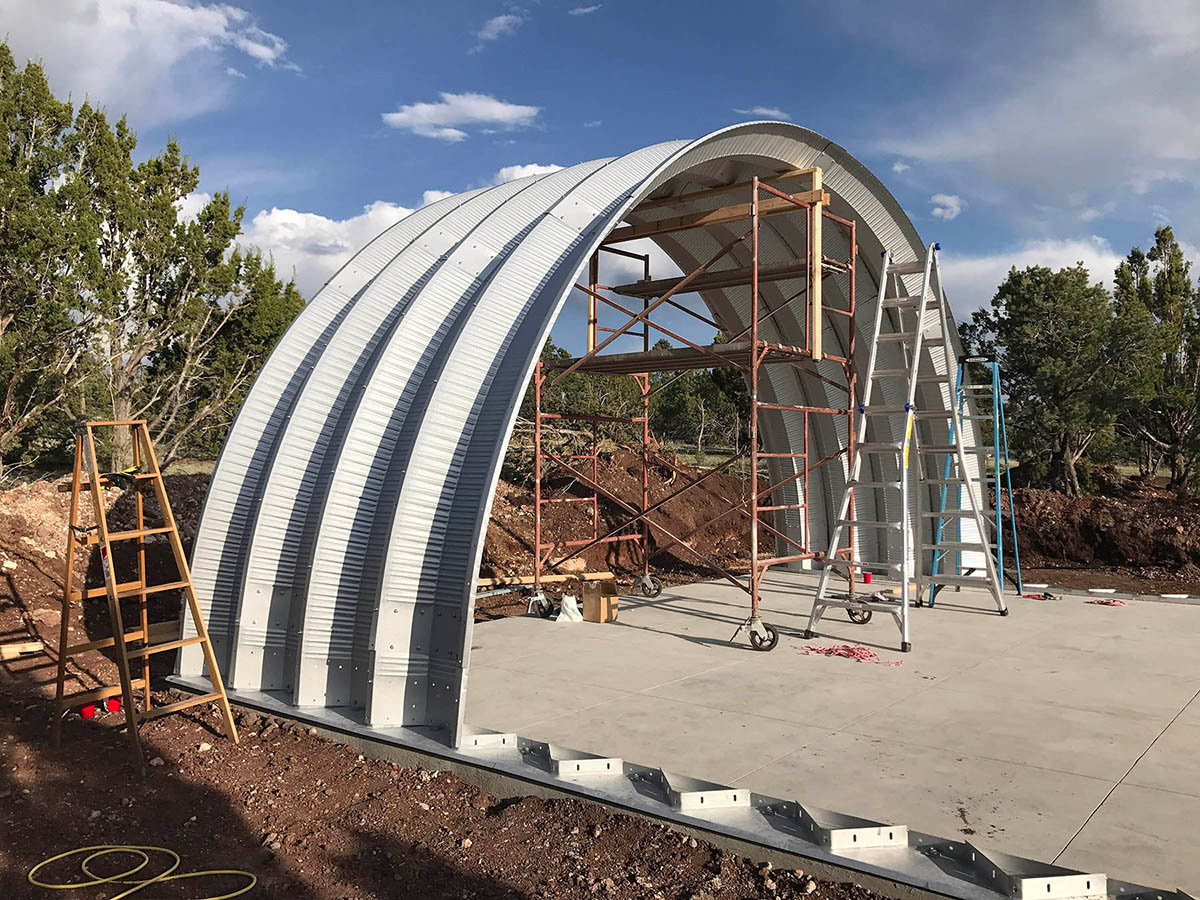
Each arch is made up of 7 pieces of steel bolted together with half inch bolts. Each arch section ends up weighing ~240 lbs.
The garage steel came on 1 pallet weighing about 4800 lbs. It included 2 buckets and 2 boxes containing about ~5000 pairs of nuts and bolts.
To assemble the arches, I used the help of friends and family… No one who helped had ever done anything like it before.The first Saturday, I had my parents and sister to help for nearly 12 hours, pre-dawn to dark. We got up 6 arches, which means it took an average of about 8 man hours per arch.
Actually, the second arch took 3 hours and 40 minutes, which is about 14.66 man hours… And the 6th arch took 1.5 hours or 6 man hours. That is a decent learning curve. The second Saturday is harder to calculate because I had different people who came at different times for different numbers of hours.
The first arch was done by 3 people and some time was lost giving tours to arriving friends, etc. but we were starting on the second arch by 2 hours and 10 minutes later, which is 6.5 man hours. The 9th arch (the last one that we had a full crew for) took 7 guys only 35 minutes, which is just over 4 man hours.
In total, my friends and family gave me 94 man hours over those two Saturdays
Here is the ends of the tanks which are ribbed
That explains why the 9m shell is is listed as the internal tank as 10cm smaller
Offline
Like button can go here