New Mars Forums
You are not logged in.
- Topics: Active | Unanswered
Announcement
#1 2026-02-01 20:19:17
- kbd512
- Administrator
- Registered: 2015-01-02
- Posts: 8,533
Cost-Effective Credible National Defense
In the same theme as the topic I posted related to reestablishment of manufacturing competence, I think reestablishment of national defense competence is of equal importance. As strange as this concept may seem to some people, a credible national defense procurement and force structure strategy for a nation with limited defense funding does not automatically mean that their military forces are significantly less combat capable than a nation such as the United States of America, which has a functionally unlimited ability to spend money on its national defense. In many ways, unlimited budgets invite highly questionable procurement strategies because one functional knowledge domain which has consistently proven to be a weak point across virtually all military services is development and refinement of realistic Concept of Operations (CONOPS) for execution of fighting doctrine and usage of defense assets and personnel.
Bright shining examples of this include employment of autonomous systems and beyond visual range (BVR) guided missile intercepts of enemy bombers, fighters, and missiles, many decades before any technology was mostly ready to do this with a better that 50/50 chance of success when all training and operational procedures were followed. An entire fighting doctrine was built around the false belief that all air combat would be conducted at extended ranges and dogfighting was therefore irrelevant because it would never happen. At the start, appropriate training to employ this then-new fighting doctrine in a realistic manner was never provided. The problem was so acute that fighter weapon schools were established to teach employment of weapon systems to both air and ground crews. The first missiles using tube-based electronics were so delicate that normal handling caused operational issues, to the point that a pilot squeezing the trigger was not even guaranteed to see the missile leap off the launch rail, much less guide to the target, or the warhead detonate when passing within lethal distance. Initial work began in the 1940s, but until the solid state electronics and improved seekers of the 1980s, merely having a chance at a successful engagement was almost entirely a result of the pilot positioning his aircraft and only taking missile shots from a near-ideal positions for the missiles to execute the intercept.
Needless to say, all these significant limitations did not describe typical positional advantage achievable during mock fighting, much less actual combat. In real air combat, prior to the improved generation of weapons fielded in the 1980s, all BVR missile shots had less than a 10% chance of intercepting their targets. All military forces which employed BVR radar-guided missiles in air combat quickly learned that it was a very expensive luxury capability, truly fantastic when it worked, which was not very often, but in no way could it assure the outcome of air combat engagements. An aware target would generally defeat BVR missiles fired at them, whether from the ground or other aircraft. Hundreds of billions of dollars were devoted to this technology across dozens of nations using fighter jets and air defense systems using air search radars and radar-guided BVR missiles. It took 40 years of development work before the odds of a successful intercept were better than a coin toss, because the tech simply wasn't ready to meet conceptual expectations of how it would be used. Worse than that, far too little realistic training and testing was conducted to "know" that what the military wanted to achieve wasn't even possible, let alone practical, absent dramatic improvements to computers, sensors, and institutionalized knowledge from continuous training for development and refinement of air combat fighting doctrine. There was either a refusal to accept the limitations or a lack of general awareness amongst people in development and procurement regarding realistic expectations for the weapon systems they were purchasing, with the anticipation of acquiring all-weather BVR radar-guided air intercept capabilities. In other words, everyone was heavily relying upon something to "just work as intended" that was in no way ready to do so.
We see AI-enhanced combat drones showing the same technological readiness limitations today. They look brilliant for a few moments, then do something completely ridiculous that requires human operator intervention, else they crash or otherwise fail to complete their assigned missions. While everyone is breathlessly proclaiming that combat drones are "the future of all warfare", we should probably use all historical military experience with development and employment of BVR radar-guided missiles as a very pointed "warning order" related to how relevant and effectual these AI-enhanced combat drones truly would be, if any nation relies upon them to "deliver victory" in the short term. In another 10 to 20 years, they'll probably complete missions successfully more often than not. Everything I've seen indicates they're a very promising future technology, but in no way ready for combat against a peer level adversary. A shrewd national defense strategist with a budget to adhere to would continue earnest AI combat drone and weapons development while refraining from making any large purchase orders for technologies that simply are not ready for combat.
Any budget-limited nation which wants to retain competitive military capabilities must be very shrewd about when and where it chooses to purchase or outsource procurement of systems with substantial acquisition and sustainment costs. There's no faster way to handicap your military than to spend large sums of money on doctrinally-disconnected "new capabilities" that you cannot capitalize on. The US military has proven highly susceptible to this problem. Most people would view purchase of a BVR radar guided missile without airframes equipped with powerful air search radars as a pointless waste of money, for example. AI-enhanced combat drones using today's tech would be similarly encumbered.
We'll first highlight what I consider to be non-negotiable defense systems, then explain how the associated core combat capabilities represented by those systems, or functionally equivalent capabilities, can be acquired without bankrupting a modern industrialized nation.
I. Artillery
This can include anything from 105mm or 155mm gun-launched shells, to artillery rockets, to ballistic missiles, to long range loitering munitions like the Iranian Shahed-136 drones. Modern 155mm gun-based artillery systems have become so expensive to purchase and maintain that it might be cheaper to build drones to carry those 155mm artillery shell-sized warheads to their targets. The difference is in marginal cost per successful engagement, which will be higher with a drone or rocket-based artillery systems than it is with gun-based artillery systems. The support infrastructure for drones vs cannons is also different, not eliminated. Drones and rockets / missile artillery require physically larger and more expensive vehicles to deploy and maintain them.
M777 towed howitzers have an initial purchase price of about $5M. The cost to fire the unguided / unassisted shells is fairly low, at around $3K per shell. If your loitering munitions cost around $25K per weapon to mass produce, then you can procure around 200 munitions for the same cost as the howitzer itself. Howitzer crews don't materialize out of thin air, either, which means an entire training and logistics pipeline is required to continue to have trained artillery operators and serviceable guns. As of today, drones still require operators and maintainers. If the total number of required attacks is low and the chance of success is high, there will be some kind of inflection point where beyond a certain number of munitions fired off to attack the enemy, conventional artillery makes more economic sense than drones / loitering munitions or artillery rockets / guided missiles. At the same time, long range drones like Shahed can provide the range to conduct deep strikes that far more expensive missile-based artillery systems would otherwise be required to execute. Shaheds are much slower than missile-based systems, but the number of attack opportunities is much greater because per-unit cost is far lower than that of ballistic weapons.
II. Integrated Air Defense Systems
The core of any modern integrated air defense system is a networked system of surveillance / tracking / missile mid-course guidance radars. These long range / high power radars are inevitably expensive, but vital to air defense. If there is no awareness of threats posed by incoming enemy missiles and aircraft, then there is no possibility of intercepting them.
There are 4 categories of air defense interceptor missiles:
hypersonic / ballistic missile and nuclear warhead threats - THAAD / SM3
long range high capability radar guided interceptors - Patriot / SM6
medium range radar guided - ESSM / NASAMS
short range infrared guided - Sidewinder / IRIS / MICA derivatives
man portable air defense systems - Stinger / Starstreak / Mistral
There are 3 categories of air defense guns:
35-76mm autocannons (some of these now have data-linked self-guided shells as ammo options)
20-30mm caliber autocannons (close-in weapon systems used to put a "Wall of Lead" in front of missiles or drones)
12.7-15mm heavy machine guns (typically used to kill drones and helicopters)
It's unreasonable to expect most nations to have the resources to locally design and produce their own version of THAAD or Patriot. As sophisticated as medium range radar guided missiles have become, even those may be a bridge too far. If you cannot produce your own IR guided missiles and autocannons, then you need to fix that.
The inability to purchase the components to create active radar guided missiles does not mean BVR radar-directed intercepts are impossible to effect. A missile's mid-course guidance is still provided by its launching platform, which means greatly improved modern IR seekers can still be used for terminal guidance to targets without indigenous or even acquired miniaturized onboard missile radars and guidance computers. Against stealthy targets, IR seekers typically out-range onboard missile radars, often by a considerable margin. The radar and guidance computer technology items represent a disproportionate percentage of a BVR radar-guided missile's total cost. A drastically lower cost option is use of modern IR seekers, which are also nearly impossible to distract or confuse because they cannot as easily be "jammed", unlike radar-based systems.
III. Off-Road Mobile Armored Transport Vehicles
The ability to effectively transport soldiers, food, water, equipment, fuel, and weapon systems around the battlefield has been a military requirement since armies existed. While the means of transport have varied greatly over time, all modern armies use motorized vehicles. Parts of civil vehicles can be adapted to battlefield use, or at least benefit from a domestic automotive industry that nominally makes vehicles for civil on-road and off-road use. Significant procurement cost increases tend to be driven by bespoke vs off-the-shelf solutions where the technology item in question is not shared with any civil motorized vehicle.
Tank engines used to be then-common automotive engines with bespoke transmissions / gearboxes. When there was no difference at all between a tank engine and a semi truck engine, the cost of the engine development and procurement was nominal. It's not written in stone anywhere that a tank absolutely requires a bespoke engine design which is not shared with any other civil vehicle. Unsustainable weight increases created the requirement for specialized tank engines. Advanced armor materials and uncrewed turrets with autoloaders will help return armored vehicle weights to the realm of sanity, as will resisting the temptation to load up every armored vehicle with "some of everything". A tank was originally intended to provide direct fire support to infantry assaults using a large caliber highly mobile cannon. We've since added anti-tank missiles, surface-to-air missiles, anti-drone machine guns or light cannons, active protection systems, lasers, and an array of sensors that would make Cold War era fighter pilots jealous.
It's still possible to cap vehicle weights at 40t (the GVWR of a fully loaded semi-truck) by using single crew compartment tank designs (uncrewed turrets) with adequate 360 degree protection to assure crew survival while accepting vehicle losses from modern anti-tank weapons. Even if all those other systems are added to armored vehicles, increasing their weight and cost to impractical figures, losses to enemy anti-tank weapons remain inevitable. There is still no active protection system against anti-tank mines, for example. That doesn't mean we should attempt to add one to the tank, either. There's no point to "gold plating" a direct fire artillery piece which immediately becomes the target of choice for everyone else on the battlefield. Save the crew and sacrifice the vehicle. You're going to do that irrespective of how many additional expensive protection systems you burden the tank with. If losing a tank or other armored fighting vehicle was not a multi-million dollar loss involving a collection of difficult-to-replace systems-based capabilities, then your military can afford to "eat" the vehicle loss and make more replacement vehicles. If you still require those other weapons and sensors, then put them in separate specialist vehicles instead of attempting to transform every armored vehicle into the land-based equivalent of a tactical fighter jet.
Combined arms maneuver warfare provides complementary protection of disparate forces by mixing the capabilities of tanks, artillery, other armored fighting vehicles armed with autocannons and missiles, infantry, air defense systems, and aircraft to achieve outcomes not possible using any specific type of weapon system alone. As important as establishing air superiority is to successful combat operations, aircraft alone cannot take ground from the enemy and hold it. Coordination of movements and sharing of positional data is far more effective than trying to use singular assets to operate in a vacuum.
Armored off-road capable motorized vehicles is the one category with the widest possible array of affordable, practical, and survivable solutions. It's also not clear that one vehicle type provides any kind of insurmountable technological advantage over another type. There is such a thing as appropriateness to task, but that's as far as it goes.
IV. Air Forces and Air Assault Vehicles
There's a persistent yet false interpretation of what turbine engines actually permitted military aircraft to do. Achieving faster flight speeds is the colloquially stated reason for their development, and turbine powered aircraft typically fly faster than piston engine aircraft. It seems obvious, and is in fact used that way by most aircraft designers, but that explanation is wrong from an engineering perspective. Simply put, turbine engines offered aircraft designers greater payload-to-distance by reducing the engine mass to deliver a given amount of thrust. Delivering more power per unit of engine weight allowed aircraft designers to design aircraft to choose between faster flight speeds or pushing more payload through the air. For military purposes, this significant design advantage was most frequently used to make aircraft fly faster.
Unfortunately, the instant you demand that an aircraft to fly at high subsonic speeds or faster, you run into a basic flight physics challenge. There's a very steep rise in aerodynamic drag which dictates airframe shaping and minimum wing loading to minimize lift-induced drag at higher flight speeds. In turn, wing loading dictates minimum takeoff and landing speeds. There's a very narrow range of reasonably efficient cruise flight speeds for turbofan and turbojet engines, coupled with an extreme cost increase.
It would be fair to say that manufacturing and maintaining turboprop and turboshaft engines, which are the least expensive types of turbine aircraft engines, are at least ten times more costly than equivalently powerful piston engines. Turbofan and turbojet engines are significantly more costly to make and operate than equivalently powerful turboprop engines. If you're not flying at high subsonic speeds at altitudes above 20,000ft or so, then even high-bypass turbofan engines tend to be horrendously inefficient, relative to piston engines, for the power generated. Propellers are more efficient "wings" than the much smaller fan blade "wings" in a turbofan or turbojet engine, until you reach a certain speed at higher altitudes. You're not "free" to travel at higher speeds and altitudes, you're effectively limited to exclusively operating in that narrowly defined flight regime because any deviation severely affects range, speed, and acceleration performance.
A modern computer-controlled 550hp spark-ignited and liquid-cooled automotive piston engine will cost about $25,000. A 550hp PT-6A turboprop engine costs around $1M, so it's 40 times more expensive for the same power generated. The PT-6A is about half the weight of the automotive engine, but it's fuel burn rate is significantly greater than the piston engine, especially at lower altitudes. Inside of 4 hours of flight time using onboard fuel, and perhaps as little as 2 hours at lower altitudes, the turbine engine's apparent weight advantage over the piston engine is gone. It does not matter to flight physics at all whether an airframe must carry additional fuel weight or engine weight to remain airborne. However, a significant change in fuel burn rate will at least partially dictate cost per flight hour. At 33,000ft, the PT-6A is only generating roughly 1/3rd of its sea level power output because its compressor section operates on ambient atmospheric pressure and must be driven by hot gas expansion through the expansion section. An appropriately turbocharged and intercooled piston engine, on the other hand, can maintain 100% of sea level power output at altitudes up to 36,000ft, which was achieved during WWII.
Early avionics, sensors, and weapons were very large and heavy because their electronics were large and heavy. 2025 electronics have been miniaturized to the point that a smart phone has more than sufficient computing power to operate every system and sensor aboard combat aircraft. The precision of modern missiles almost entirely negates the requirement for a massive warhead to eliminate a target. Modern composite airframe materials are meaningfully lighter than Aluminum or steel for the same strength and stiffness provided. The net effect has been to dramatically reduce the mass of sensors and weapons required to find, fix, and eliminate a target, thus the airframe they're attached to. It would be fair to say that piston engine aircraft could carry most of the sensors and weapon systems in a practical manner, at greatly reduced cost relative to any turbine engine aircraft, while flying at the same speeds that are typical of "best maneuvering speeds" for fighter jets.
Whenever fighter jets slow down to turn well enough to evade incoming missiles, best maneuvering speeds range between 350 and 550mph, with most tactical fighter jets exhibiting best maneuvering characteristics between 400 and 500mph. Oddly enough, we developed piston engine aircraft that could cruise between 400 and 450mph, at the same altitudes where modern fighter jets typically operate at (25,000 to 35,000ft), during WWII. The significant increase in cruising speeds of fighter jets does not alter flight physics to enable them to turn better at high subsonic or supersonic speeds, nor "get away with" cruising at high subsonic speeds without burning fuel at a much faster rate. The closest approximation to how modern tactical fighter jets actually operate is by economically cruising at speeds functionally unattainable by piston engine fighters, only to revert back to WWII flight speeds during evasive maneuvers. Even if some fighter jets are technically or functionally capable of out-running a missile, in actual practice air intercept missiles are at least twice as fast as the fighter jets they're fired at. In simple terms, you're never out-running a rocket engine missile in either a turbine or piston engine fighter, but if you can maneuver well, then you can use their speed against them by turning inside of them with a correctly timed evasive maneuver.
If you no longer require enormous carrying capacity provided by more powerful but drastically more expensive and difficult to produce turbine engines, per unit of engine weight, and you'll always need to evade inbound missiles and occasionally dogfight with other fighter type aircraft at flight speeds functionally identical to WWII era piston engine aircraft, is there still an insurmountable advantage offered by turbine engine aircraft and higher flight speeds?
If your air force can affordably field multiple squadrons of piston engine aircraft with identical sensor and weapons capabilities as any other modern tactical fighter jet, can a military that exclusively operates far fewer numbers of turbine engine fighter jets ever win a war of attrition, or do they get to shoot down a handful of your far less costly piston engine fighters, and then still lose the war on the first day after your remaining piston engine fighters bomb all of their much fancier fighter jets on the ground?
The F-15 is a fine flying and fighting machine, clearly much more capable than the P-51s that came before it, but it's also a $100M machine that cannot physically be in 100 different places at the same time. If we pit 100 P-51s against 1 F-15, then the P-51s still win every time, even if they loose 100% of their dogfights against F-15s. The F-15 still requires weapons, which means it still has to land somewhere to rearm. Let's assert that our lone F-15 can shoot down an entire squadron of P-51s. He'll be an "ace" for every bit of a half day, because the remaining 7 squadrons of P-51s will then proceed to strafe or bomb his F-15 on the ground. It no longer matters how individually capable the F-15 is. The problem it's run into is purely a numbers game, and the F-15 loses that fight every single time.
The US Air Force ran an entire series of war games under the moniker "Project J-CATCH" during the 1970s and 1980s using F-4s / F-15s / A-7s / A-10s to intercept helicopter gunships which could fly no faster than 200mph. Using BVR missile shots, the kill ratio in favor of the F-15s was 2.9:1. F-4s attempted to merge with and dogfight the gunships, using Sidewinders and Vulcan autocannons. At that point, both the F-4s and later the F-15s were killed as often or more often than they killed the gunships. WVR dogfights managed 0.7:1 to as high as 1:1 kill ratios in some instances. More maneuverable A-10s carrying minimal air-to-ground ordnance only achieved 1.3:1. The gunships were vulnerable to BVR missile shots because they initially had no radar warning receivers to let them know when they were being attacked. The most frequent problem reported by the fighter pilots who flew against the gunships was that gunships were difficult to find on radar and EO / IR sensors due to ground clutter. They were also much smaller than fighter jets, especially Huey Cobras, therefore difficult to visually acquire. The recommendation regarding combat tactics was that fighter jets should never attempt to dogfight a slower but more maneuverable opponents, because all the thrust and speed their engines could provide was insufficient to avoid 1:1 kill ratios, and to only engage them using BVR missiles when absolutely necessary. The conclusion reached was that fighter jets should use superior speed to avoid them altogether. This only works to a point. When those same opponents resolve to attack your airfield, then what?
MiG-19s are very maneuverable as fighter jets go, and able to turn inside a F-16 in a rate-fight, which is not easy to do. Several MiG-19s were lost attempting to shoot down A-1 Skyraiders during the Viet Nam War using IR guided missiles and cannon fire. The A-1s involved were laden with ordnance for use against ground targets, but had little difficulty turning inside the MiG-19s and hosing them down with 20mm cannon fire. The Vietnamese pilots attempted both high speed passes and maneuvering for positional advantage. Neither tactic proved effective against the A-1s when they were aware that they were being attacked. If A-1s were fabricated from composites to further reduce weight and increase maneuvering limits, and equipped with modern miniaturized air search radars, radar warning receivers, plus Sidewinder or Peregrine missiles, then attacking them using F-15s or F-16s or similar tactical fighter jets would most likely result in 1:1 kill/loss ratios at best. The problem, of course, is that a single F-15 or F-16 costs more than a squadron of A-1s, and a F-15 burns about as much fuel per hour as a squadron of A-1s.
During WWII, several nations made more piston engine fighters per month than the total number of modern fighter jets in existence. Fighter jets are awesome, and the little boy inside me still loves them to pieces, but my more rational adult brain tells me that they still cannot be in more places than we have flyable physical copies of them to fight with. Most of the time half of any given fighter jet squadron is down for maintenance. We don't have 100+ maintainers who work on 4-12 jets in a squadron because they work perfectly all of the time. You fly a fighter jet, something on it inevitably breaks, and then the rest of the day is spent diagnosing and fixing it. This is understood and accepted by people who have actually served in fighter squadrons in any capacity. If the jets are on the ground, then the maintainers are fixing whatever broke the last time they flew. There's also a major difference between flyable vs fully mission capable.
Many people remain completely convinced that speed alone confers an insurmountable technical advantage to turbojet / turbofan engine aircraft, despite all evidence to the contrary from actual and mock air combat engagements. The conclusion I reached is the one supported by my personal knowledge of flight physics from actually flying piston engine aircraft, my time spent supporting a carrier based squadron and air wing that flew combat missions over Afghanistan, and all available evidence collected over the decades on air combat tactics development to evaluate the limitations of jet powered tactical fighters flown against dissimilar adversaries. Speed matters when getting to a target area. Maneuverability then determines whether or not you come home alive. There are no free lunches in aeronautical engineering, so if you design an airframe and engine combination to deliver fantastic speed then you necessarily give up some maneuverability. Balance is what we should strive for. If you already know that all real world fighting will occur at flight speeds readily achievable using piston engines, then truck loads of money can be saved on engines and airframes, then redirected towards more capable sensors and weapons. The sensors do the finding and the weapons do the killing, not the aircraft itself, unless we're talking about kamikazes.
You can spend unlimited money on faster airframes and more powerful engines, but doing so doesn't change fundamental flight physics related to economical cruise flight speeds nor the ability to maneuver well enough to evade incoming missiles or gain positional advantage. You can't engage a turbine powered aircraft in a vertical fight using a piston powered aircraft but that's about it. In the real world you still fight using the strengths of your aircraft. If you pair modern lightweight / compact sensors and weapons with modern high-output automotive piston engines and composite materials for airframes, then you'll be able to manufacture and maintain several squadrons worth of aircraft for the same cost as a single tactical fighter jet. You do not need to bankrupt your nation's air forces with bespoke turbine power plants and functionally unusable speed due to fuel burn rates.
The individual piston engine aircraft are less capable than a singular turbofan powered aircraft, but collectively they deliver vastly more usable combat capability by virtue of at least some of them being fully mission capable and by sheer numbers allowing them to overwhelm enemy air defenses.
Offline
Like button can go here
#2 2026-02-04 06:02:17
- Terraformer
- Member
- From: The Fortunate Isles
- Registered: 2007-08-27
- Posts: 4,006
- Website
Re: Cost-Effective Credible National Defense
Sounds like piston aircraft work for defense, turbines for attack from a distance (need the speed)?
Another area where piston aircraft should be viable is close air support / counter insurgency. Jet powered aircraft are used currently, but the speeds aren't above what you say piston engines can do.
Use what is abundant and build to last
Offline
Like button can go here
#3 2026-02-05 23:14:24
- kbd512
- Administrator
- Registered: 2015-01-02
- Posts: 8,533
Re: Cost-Effective Credible National Defense
Terraformer,
The Proper Role of Turbine Powered Military Aviation Assets
There's a militarily justifiable argument for launching stealthy turbine powered cruise missiles to attack the enemy's network of integrated air defense system sensors and to destroy their tactical fighter jets on the ground. After that work is done, all further work should be accomplished using dramatically more cost-effective piston engine aircraft.
What makes a military aviation asset "modern"?
If we had a time machine and could send A-1 Skyraiders back to Viet Nam, re-equipped with the radar from the XQ-58A (a Super Hornet equivalent radar that only weighs 100lbs), an ample supply of AIM-9X and AIM-120D missiles, and tasked them with wiping out all American and North Vietnamese aircraft flying over Viet Nam, then within a month or two the only aircraft to be found in the skies over Viet Nam would be A-1s. I don't care if every American and Vietnamese pilot was a Top Gun valedictorian. There is only one possible result. Modern military aircraft aren't "modern" on the basis of engine type or cruising speeds. Their avionics, sensors, and weapons are what make them "modern" (and lethal). The speed is nice to have, but there are vanishingly few opportunities to exploit it to any significant degree.
Pure Speed vs Unsustainable Fuel Burn Rates, Cost Unimportant
During the actual Viet Nam War, not one American plane designed to achieve Mach 2 or faster, ever hit Mach 1.4. During 10 years of fighting, the highest achieved speed during a combat mission was Mach 1.3. The reason was quite simple. From Mach 0.95 to about Mach 3, the rise in aerodynamic drag is so sharp that your fuel burn rate increases so fast that your effective combat radius drops to less than 150 miles or so. At lower altitudes you can burn through all internal and external fuel in minutes. That's why every F-4 over Viet Nam was equipped with at least 2X 370 gallon wing tanks, and usually a centerline 600 gallon external tank as well.
Presume you came screaming in on the deck in your Phabulous Phantom, full 'burner, "flying under the radar", such as it were.
Let's do some fighter pilot math to illustrate how fast you'll run out of fuel:
While the example used here is America's Cold War Era "heavy fighter", the F-4E Phantom II, it's applicable to essentially every turbojet and turbofan engine powered fighter type aircraft ever made.
12,961lbs of internal fuel
5,032lbs for both 370 gallon wing tanks
4,080lbs for the 600 gallon centerline tank
You have 22,073lbs of total onboard fuel for your combat configured tactical fighter.
17,845lbf of thrust per GE J79 engine in full afterburner, so 35,690lbf from both engines
35,690lbf * 1.965lbs/lbf/hr (TSFC) = 70,130.85lbs of fuel burned per hour
70,130.85lbs / 60 minutes = 1,168.8475lbs of fuel burned per minute
22,073lbs / 1,168.8475lbs/min = 18.88 minutes
You're out of fuel in less than 20 minutes. You can meaningfully extend your time-of-flight by flying at 30,000ft vs sea level, but the additional flight time you get is less than you'd think. Flying at high altitudes in a non-stealthy aircraft also comes with significant tradeoffs in a combat zone.
A totally clean F-4 with no external anything (no fuel tanks, ordnance, or even pylons) could achieve 900mph at sea level. If you're carrying anything at all, especially those giant external fuel tanks, then you will never hit 900mph, but let's pretend to illustrate how utterly ridiculous its Mach 2.2 "top speed" truly is.
900mph = 15 miles per minute
15 miles per minute * 18.88 minutes = 283.2 miles
That's exactly how far your F-4 can travel at sea level in afterburner before it's completely out of fuel. You'd be lucky to achieve 200 miles if you had anything at all hung off the wings, especially those giant drag-inducing external fuel tanks. Regardless, you're going to have a very short flight if you stay in burner for very long.
Let's briefly pretend our Phantom was re-engined with very modern GE F414 engines, so 44,000lbf for both engines.
44,000lbf * 1.85lbs/lbf/hr (TSFC) = 81,400lbs of fuel burned per hour
81,400lbs / 60 minutes = 1,356.6667lbs of fuel burned per minute
22,073lbs / 1.356.6667 = 16.27 minutes
That means you're out of fuel even faster by using modern afterburning turbofan vs turbojet tactical fighter jet engines. Yes, you clearly get more thrust at all power settings and even low-bypass fighter jet turbofans burn a bit less fuel than turbojets, but at the end of the day making more thrust means burning more fuel, period. End of story. There never was any other story.
The Irrelevance of "Supercruise" to Air Combat
The F-22 has a meaningfully higher thrust-to-weight ratio than the F-4, so it can actually fly faster than Mach 1 without using afterburner, but that doesn't mean its fuel load lasts significantly longer when you try to "max out" flight speed at mil power or burner, because F-119s are still very thirsty engines which only generate a lot more thrust by burning a lot more fuel. TSFCs in afterburner for the F414 (a modern turbofan representing a J79-sized engine equivalent) are 1.85lbs/lbf/hr vs 1.965lbs/lbf/hr for "old smokey" (J79). Even without going into burner, J79 mil power TSFC was 0.81lbs/lbf/hr vs 0.84lbs/lbf/hr for the F414. That means fuel consumption to make more power is worse, not better. The primary benefit to the F414 is that you get as much mil power as a J79 produces in full burner, in an engine that weighs 2/3rds as much as the J79. At no throttle setting does a F414 actually burn less fuel than the J79, and the J79 was a gas guzzler.
If you try to fly just as fast as you can, then you still don't get much more air time, even if the F414 would allow the F-4 to "supercruise" above Mach 1 like the F-22. Older engines like the J79 also frequently had "burner time limits" of 15 minutes or so, but let's be completely honest with ourselves here, you're not going to fly much farther after 15 minutes in burner anyway. If you spend any significant time in burner or even at mil power, then you'd better have a tanker directly in front of you or a suitable landing spot picked out.
The Yankee Station Example: Closer to "The Action" than any Modern Forward Air Base
Yankee Station was located approximately 100 miles off the coast of Viet Nam, so 100 miles to "feet dry", and then another 100 miles back to the boat.
Do you plan on making it back to the boat after a mission that takes you 100+ miles inland?
If so, then you're going to be really stingy with the afterburner, and likely have second thoughts about moving the throttle up to the mil power setting after climb-out. You definitely won't want to "get low" unless forced to do so. You'll want to stay between 25,000 and 35,000ft whenever possible. Most of the time you're going to cruise around at 500mph in combat configuration, because that's what you must do to conserve enough gas to fight someone or evade missiles if you have to, and still make it back to Yankee Station. Best maneuvering speed in the F-4 is also around 500mph. By the time you're moving at Mach 1, an Iowa class battleship moving at 30 knots has a tighter turn radius than the F-4. F-4s moving at 500mph could turn inside SA-2 missiles fired at them. F-4s moving at Mach 1 couldn't turn inside of a ZIP code.
The Multi-Billion Dollar Question
Are we starting to understand why nobody ever went faster than Mach 1.3 during the entire Viet Nam War, despite the fact that we flew tens of thousands of sorties in Mach 2 capable tactical fighters like the F-4, F-8, F-105, and F-111?
Every time I hear someone tell me about how fast their fighter jet is, relative to someone else's fighter jet, my eyes roll harder than the A-4 with its rate limiter removed.
Even in "Fantasy Land", Speed Still Kills Life-Saving Evasive Maneuvering
If you were dropped into the cockpit of a combat jet so fuel efficient that you could economically fly faster than Mach 1, if you don't slow down in a hurry after someone launches a missile at you, you're probably going to D-I-E. You can pull hard enough to rip the wings off, but when you're flying much faster than 600mph (well below Mach 1), you still can't turn inside of an 80g capable heat seeker like the AIM-9X. This best maneuvering speed limit is dictated by both flight physics for a 9g capable combat jet and human physiology. Highly trained and conditioned humans can withstand 10g for very short periods of time, but not much more than that, and nearly all high time fighter pilots who routinely perform such maneuvers end up with severe spinal injuries later in life.
Max power output for a combat jet is therefore reserved for 3 events:
1. Short field takeoffs
2. Rapidly ascending to cruising altitude
3. Recovering energy (speed) following hard maneuvering
Throw a Nickel on the Grass
In fighter pilot training, they teach you to do the fuel math in your head, because if you can't then you're probably not making it home. Yes, modern fighter jets have fuel totalizers to do the math for you. If that nifty gadget ever breaks, then what? I trust my fuel flow rate meter and my ability to do math in my head. When the fuel totalizer gadget works, it's great. If not, I'm still not going to have my mother read my obituary because I can't do basic math. You can think of flight in a modern combat jet as "minutes of life remaining before you run out of fuel, crash, and die", because that is very close to the truth.
Parting Thoughts as to Why Speed Alone isn't a "Determining Factor"
Yes, I absolutely did have to spill that much ink to explain to a non-pilot why the impressive "paper speeds" of fighter jets aren't all that impressive to anyone who actually uses aircraft as weapons. You are not going to chase down an enemy bomber 500 miles away, which has 10X more fuel onboard than your fighter jet, simply because you're in a Mach 2.5 capable fighter jet, or any similar cockamamie nonsense. They're either coming to you, in which case you don't need to chase them down, or you're going to launch your own cruise missiles at their air base, because then you still don't need to chase them down. That is how real world air intercept and attack works. You send missiles after enemy aircraft, not fighter jets. The fighter jet is a mobile launch platform.
I think that horse is now well and truly "dead", although one can never be too sure.
Military Aircraft Applications for Modern Automotive Engines
Now let's talk about modern automotive piston engines, which are approximately twice as fuel efficient as a tactical fighter's turbojet or low-bypass turbofan engines across a much wider power output range, while still delivering enough power to "cruise" between 400 and 500mph at altitude, although 350mph is a better cruising speed for fuel economy, and quite similar to the actual cruising speed of a combat loaded A-10. For comparison, the V-22 Osprey tops out at 350mph and the A-1 Skyraider's top speed was 325mph.
Modern Big Block Automotive Engines as Military Aircraft Engines
Modern so-called "big block" pushrod V8 automotive engines with electronic fuel injection and electronic ignition can deliver 1,000hp, naturally aspirated. When equipped with a modern supercharger and intercooler located atop the lifter valley, they can continuously deliver 800hp. RPM kills piston engines, primarily because the pistons come apart. For extended duration piston life, 4,000fpm is about as fast as you want the piston to move an Aluminum piston. The most modern high performance heavy duty diesel truck pistons are high strength steel forgings, rather than Aluminum forgings, and do not have the same piston speed limitations. That said, for a spark-ignited big block, if you keep the RPM to about 4,500 or less, then the engine can run continuously, even using forged Aluminum pistons.
Big Block Definition
I define "big blocks" as V8s that can be configured to total displacement of over 500 cubic inches. Chrysler, Ford, and General Motors all made "big block" V8 engines. Ford and GM still offer updated versions of these block designs. Modern big blocks, whether factory-built or aftermarket, are substantially stronger than the blocks that rolled off the assembly lines in Detroit during America's "muscle car" era.
With a 4.5 inch bore and 4.5 inch stroke, you have a 572 cubic inch V8 engine, a so-called "square" (bore and stroke are the same) engine. That's a good configuration for fairly high-RPM operation. Over-square engines (bore larger than stroke) are better for higher-RPM operation, common in racing applications. Under-square engines (stroke longer than bore diameter), are better for lower-RPM operation, which is why nearly all diesels are under-square designs.
Hot Rod Magazine:
572-Inch Blown Big-Block Chevy Engine Makes 1,013 HP on the Dyno!
Notice from the dyno chart that the engine is making 1,000hp at 6,000rpm, and 800hp at 4,400rpm.
The engine in question has 8:1 compression and runs on 91 Octane motor gasoline using carbs, so no special AVGAS containing toxic Tetra-Ethyl-Lead is required. Removing TEL from the fuel greatly reduces spark plug fouling and doesn't plate-out on valve seats. Single vs dual plug ignition is acceptable. Larger bore engines like the Merlin engine, as well as the slightly newer air-cooled engines from Continental and Lycoming, use dual plugs in part because their bores are so large that the flame front would take longer to reach across the bore. This has not been an issue for American big block V8s.
The blower configuration used on the newer LS series engines, as found in the Cadillac V series and Corvette, can deliver more boost at lower temperatures, from far less blower displacement than the monster blower shown on the engine from the Hot Rod Magazine article. Harrop's TVS2650 blower can deliver up to 1,200hp on a big block. An EFI / EI motor could run 9:1 compression on 93 Octane motor gasoline, so the RPM of the engine could then be lowered to something very similar to the operating RPM range of the geared Continentals and Lycomings, which have even longer strokes. At that point, the big block is operating like a "real aircraft engine" (the air-cooled magneto-fired dinosaurs that Continental and Lycoming still produce).
Piston Tech, The Real Power Limiter
2618 is the Aluminum alloy of choice, which hasn't changed since it was first used for Merlin engine pistons by Rolls-Royce during WWII. The best steels for this application produce pistons that are very slightly lighter than 2618 for equal strength at room temperature, but much better strength than any Aluminum alloy at max operating temperature. Delivering enough splash lubrication to the bottom of the steel piston for adequate cooling is the only issue. Steel pistons require more cooling oil than Aluminum. Ceramic thermal barrier coatings on the piston crown help reflect heat back into the combustion chamber. This sort of tech simply didn't exist when the Merlin and Meteor engines were being developed by Rolls-Royce. For high-boost engines, thermal barrier coatings are piston savers. Modern motor oils that can completely remove Carbon deposits from piston ring lands have only existed for the past 10 years or so.
WWII Merlin / Meteor Engine Comparison
The 27 liter Rolls-Royce Meteor tank engine, effectively a Merlin without the supercharger, had a dry weight of 1,841lbs and a power output of made about 550-810hp between 2,600 and 2,800rpm. The 572 Big Block Chevy with an Iron block and cylinder heads, plus the supercharger and all accessories, weighs less than half as much as a Meteor, which was not equipped with the two-speed supercharger for high-altitude max effort power output. What is less obvious from looking at pictures is that even with a gearbox attached, the 572 Chevy is less than half the size of the Meteor and Merlin engines for roughly the same power output without boosting it to the moon the way they did the Merlin to produce 1,750 to 2,000hp. Merlin engines were famous for lifting heads and in war time use would see as little as 50 hours of operation before tear-down inspection and overhaul of select components. Modern automotive engines, even when used in aircraft applications, do not require nearly as much maintenance.
General Motors Engine Testing
General Motors is famous for running their LS series modern small block engines for over a month at wide-open throttle as part of their testing process. This manner of engine operation would cause any type-certificated air-cooled boxer-layout "real aircraft engine" from Continental or Lycoming to self-destruct, which is why max output for takeoff is limited to 5 minutes. You will typically find this admonishment in the POH (Pilot's Operating Handbook). A "throttle slam" (idle to max power as fast as you can jam the throttle into the firewall), is a better than average way to shear a crankshaft on a Continental or Lycoming. Maybe you can do it and get away with it, but if I'm flying the plane we're not doing that. This practice is accepted as "normal operation" for automotive V8 engines like the big block and small block V8 engines.
PSRU Reduction Gearbox Tech Improvements
Modern gearboxes can benefit from Austempered Ductile Iron gears which have a bit of "give" to them to help absorb the torque pulses from the engine. CAD-enhanced snouts to absorb thrust loads from the props or prop shafts. Torsional vibration evaluation and testing, which was a "black art" during WWII, is now something that can be readily evaluated almost entirely within a computer program. The design of the gearbox casings is also enhanced by CNC machining that can accurately machine Aluminum billets or castings. Substantial weight reduction relative to WWII era designs, for a given torque and rpm input range, is now possible.
Modern Piston Engine Military Aircraft Roles
All of these relatively new-ish but now exhaustively tested and proven technologies add up to the possibility of 1,000hp modified automotive engines for miniature versions of WWII style fighters / close air support / multi-engine bombers, enhanced with modern composite airframe materials, exceptionally powerful and capable miniaturized radars, and exceptionally precise guided munitions. WWII era aircraft ended the war with 2,000-ish horsepower engines because every bit of the tech from that era was less than half as capable as modern equivalents. Modern sensors and guided munitions are most certainly incomparably more advanced. We have self-guided 3 inch cannon shells now, which have shot down cruise missiles and drones at ranges of over 25 miles, for example. No such animal existed during WWII. CLGPs for artillery and tanks were 1970s tech, roughly speaking, but now quite practical / reliable / cost-effective. Palm-sized imaging sensors that can distinguish between two outwardly identical vehicles were the stuff of fantasy.
WWII bomber raids involved dozens of planes, dropping up to 10,000lbs worth of dumb bombs, because their accuracy was almost nonexistent and their sensors were barely adequate to find something resembling the target. A modernized 4 piston engine bomber equivalent would only need to launch 1 or 2 JSOW glide bombs or cruise missiles from a safe distance to inflict similar damage. It wouldn't carry 4 to 6 gunners, even if it was equipped with gun turrets for self-defense. Most likely, a tail turret with 2 to 4 rear-firing Peregrine missiles would be sufficient discourage pursuit.
For "gunship" missions we could replace the bombs or cruise missiles with a 50mm XM913 cannon turret or 40mm CTAS turret that the British use. The APFSDS rounds fired from the 40 or 50mm would go right through a MBT's turret, and possibly exit through the bottom of the vehicle. MBT turret top and hull bottom armor are very minimal. It'll stop 20mm most of the time. Armored vehicles engaged this way are very dead, for minimal cost. If that's too close for comfort, then it could also carry some Brimstone or Hellfire or Griffin missiles to plink at enemy vehicles from modest standoff ranges. Anduril is now making Brimstone / Hellfire weight and cost class miniature cruise missiles that can be fired at targets from 100+ miles away. That would put a low altitude piston engine "gunship" / "bomber" below the radar horizon, which means any effective defense against them would virtually require air assets. If the enemy has no IADS, then these are low-risk missions that don't require enormously expensive turbine powered gunships.
Even if this 4 engine bomber / gunship was "lost" in the fight, the weapons it's carrying are probably worth more than the plane itself. Aircrew are always expensive to lose, but a modern take on the WWII 4-engine strategic bomber won't risk losing 10 aircrew per aircraft. It will have at least 1 and possibly 2 crew members for most missions. We could have 1 human pilot and 9 Optimus robots if we decided that we absolutely had to replicate every last detail of the WWII model by assigning 10 aircrew per bomber, but even that doesn't make much sense these days.
When we can afford to put several squadrons worth of planes in the sky for every tactical fighter jet our enemies field, with better sensors and weapons, they're going to get massacred. Yes, we will lose some of these lower-capability planes in the process, and that's unfortunate. The difference will be that when all the shooting is over with, since we spent more of our money on better sensors and weapons instead of engines and heavier airframes, our planes will be the only planes still flying, because that's how attritional warfare works. We can afford to "eat" the losses, as painful as they may be. Our enemies won't be able to produce enough tactical fighter jets and well-trained pilots to offset their losses. We can "spam" tens of thousands of these things at our enemies, and eventually most of them won't even have human crew members aboard, only Optimus robots.
Suppose there was a surprise cruise and ballistic missile attack on one of our forward air bases. Do you want to lose 4 automotive engines and a bit of fiberglass, or an $85M F-35 that we only produce at the rate of 156 per year?
Think about how much money you're willing to risk by placing so much of it in so few tactical fighter jet "baskets". The US military currently has about 12,000 total aircraft across all types. Every nation involved in WWII typically made more aircraft of a single type than our entire aviation asset inventory. The US lost about 10,000 aircraft during the Viet Nam War, mostly rotary wing assets, but also a very significant number of tactical fighters. That would be an unrecoverable loss with today's turbine powered military aircraft costs. In WWII, we would call such losses "a bad quarter". Quantity still has a quality of its own.
Offline
Like button can go here
#4 2026-02-11 04:05:11
- kbd512
- Administrator
- Registered: 2015-01-02
- Posts: 8,533
Re: Cost-Effective Credible National Defense
During WWII, the British De Havilland Mosquito fighter-bomber was fabricated from birch and poplar aircraft grade plywoods with balsa wood cores. When compared to similar American / German / Japanese Aluminum alloy airframes, the Mosquito was substantially lighter and stronger for a given weight.
That was the real reason it was so difficult for the Germans to deal with it. A lighter natural composite airframe means more speed and maneuverability for a given engine power and combat loading. De Havilland's Mosquito was enough of a problem for Germany's Luftwaffe that Focke-Wulf built their own wooden fighter-bomber, the Ta-154 Moskito. The Ta-154's airframe relied upon a then-advanced phenolic resin film used to bond sheets of aircraft plywood together, so-called "Tego film".
De Havilland Mosquito B Mk.XVI
Crew: 2
Engines: 2X Rolls-Royce Merlin 76/77 liquid-cooled V12s; 1,750hp each (2,000hp w/higher Octane fuel)
Empty Weight: 14,300lbs
Max Takeoff Weight: 25,000lbs
Max Speed: 415mph at 28,000ft
Wing Area: 454ft^2
Internal Fuel: 450 gallons
Range on Normal Internal Fuel: 1,300 miles
Service Ceiling: 37,000ft
Normal Max Bomb Load: 4,000lbs
Normal Defensive Armament: 4X 20mm cannons
G Limits: +8G/-3G
Grumman XTSF-1 (Fighter-Bomber Derivative of Late War F7F Tigercat)
Crew: 2
Engines: 2X Pratty & Whitney R-2800-22W Double Wasp air-cooled radials; 2,400hp each
Empty Weight: 17,288lbs
Max Takeoff Weight: 26,171lbs
Max Speed: 414mph at 18,600ft
Wing Area: 500ft^2 (455ft^2 for the F7F Tigercat)
Internal Fuel: 400 gallons
Range on Normal Internal Fuel: 975 miles (1,200 miles for F7F Tigercat)
Service Ceiling: 36,500ft
Normal Max Bomb Load: 4,000lbs
Normal Defensive Armament: 4X 20mm cannons
G Limits: +6G/-2.5G (applicable to F7F Tigercat; 7.5G tested in a 525mph dive)
Notes:
Approximately 700lbs of XTSF-1's empty weight is directly attributable to its heavier R2800 radial engines. Merlin engine dry weight with radiators and fluids was near 2,000lbs, so the 1,640lb engine dry weight is a bit deceptive since ready-to-fly installations were much heavier. R2800s weighed in at 2,360lbs, without engine oil or exhaust piping, which varied between aircraft. However, XTSF-1's airframe weight, less engine dry weight, was still 12,568lbs. Mosquito's airframe weight, less engine dry weight, was 11,020lbs. That means XTSF-1's all-Aluminum airframe was 14% heavier and range was 75% of a wood composite Mosquito airframe. If you include radiators for the Merlins, then Mosquito's airframe weight is about 17% lower than XTSF-1.
Max takeoff weight for XTSF-1 is appreciably higher, but the F7F Tigercat's airframe it was based upon was 25,720lbs, very close to a Mosquito, and a Tigercat's normal max range was 1,200 miles, so 100 miles short. Equal internal fuel capacity for a F7F would increase range over a "standard" Mosquito, but Mosquito variants were built with larger wing tanks for increased max range. If XTSF-1 and Mosquito both carried 450 gallons of internal fuel, simple math says XTSF-1's range increases to 1,097 miles, still 15.6% short of a Mosquito.
Both Britain and the US used the same 20mm Hispano autocannons with very minor dimensional variations for a handful of internal parts, but they were outwardly identical weapons and weapon weight was almost identical. I can't speak to the weight of shells, propellants, and casings. In general, America paid more attention to the weights of casings and shells than other nations because we had spare engineers to do that.
How might we apply the lessons of WWII airframe design decisions to modern piston engine fighters?
For fabrication of airframes, we can still use natural composites made from light hardwoods, such as poplar and pine, combined with a brand new engineered fiber material known as Cellulose NanoFiber (CNF) film, which is derived from processed wood pulp. CNF is our modern day equivalent to Germany's Tego film. Tensile strength of CNF film ranges between 100MPa and 300MPa, dependent upon processing pressure. 1,700bar presses are required to make 300MPa films. CNF film can then be pressed or epoxied to thin wood veneers or plywood to dramatically increase the tensile strength of wooden structures. The strength-to-weight ratio of CNF film is about equal to the strongest Aramid fibers.
People who fabricate fiberglass composite boats for a living know that wood cores combined with a fiberglass overwrap for tensile strength results in multiple hundreds of pounds of weight savings, for equivalent strength, over pure fiberglass alone, which is much heavier per unit volume than any kind of wood. While GFRP is a superb material for tensile strength, adequate stiffness is achieved only by using thicker but much lighter core materials.
The key material property missing from CFRP and GFRP is stiffness, rather than tensile strength for a given weight, which is where they truly excel. It's fairly common to use Aramid honeycomb cores and various kinds of synthetic foams in conjunction with CFRP or GFRP to reduce weight. The problem with lower density foams and honeycomb cores has always been bond strength and the tendency of foam to buckle and crack under load. Low density hardwood or high density soft woods can minimize that problem while improving toughness.
Whereas CFRP combined with Aramid fiber honeycomb cores might have their place for very large and very high strength structures required by modern airliner and fighter jet wings / empennage / fuselage structures, they're also very expensive overkill for much lighter and smaller piston engine airframes. The performance increment they provide is marginal. They're most frequently applied to light civil aircraft to minimize engine power required for a given cruise speed and payload-to-distance. This is a less important design factor for much higher-horsepower military aircraft. A well-engineered natural composite structure is going to be strong and light enough to get the job done at greatly reduced cost, relative to metal and synthetic composites.
Composite Material Bulk Densities
Carbon Fiber Reinforced Plastic (CFRP): 1,500 to 1,700kg/m^3
Glass Fiber Reinforced Plastic (GFRP): 1,500 to 2,200kg/m^3
Poplar: 455kg/m^3
Shortleaf Pine: 570kg/m^3
Slash Pine: 655kg/m^3
The bulk density values for CFRP and GFRP are dependent upon fiberglass fabric type, resin matrix, and fiber fill ratios. The wood densities are industry average dried weights based upon 12% moisture content following kiln drying of the lumber. CFRP is about 3X heavier than wood, which means adequately stiffened structures will either be very heavy or use much lighter core materials.
Aircraft which are largely "wood and fabric" also possess another important material property for modern air warfare- they tend to have significantly reduced radar returns in comparison to CFRP, GFRP, and metals, even without special shaping to redirect the radiated energy away from the radar transceiver. This is not to suggest that a wood airframe is automatically better than all other stealth technologies, namely deliberately applied airframe shapings and special radar absorbent material coatings, but rather that without spending piles of cash on advanced stealth tech, you can still achieve a substantial radar return reduction with greatly reduced cost and effort. Radars provide stronger returns when directed against higher density metals and synthetic composite structures. This simple fact has been known since the inception of air search radar technology.
If your nation doesn't have an unlimited defense budget to spend on eye-wateringly expensive tactical fighters and various other turbine engine aviation assets, the alternative can still perform quite well in 90% of all real world air combat, at price points two orders of magnitude lower. Attacking integrated air defense systems and engaging stealth tactical fighters in air combat are the only notable exceptions.
A modern military still requires stealthy turbine powered aircraft or cruise missiles to destroy an enemy's integrated air defense systems and stealth tactical fighters on the ground, but once their irreplaceable air combat assets have been depleted, they cannot replace them fast enough to meaningfully affect the outcome of a war.
Consider how fast Russia's entire inventory of tens of thousands of armored vehicles were completely depleted during their war with Ukraine. Specific battles resulted in losses of over 100 units. They're actively making more T90s to replace the T54s / T55s / T62s / T64s / T72s / T90s lost in that war, but haven't kept pace with losses. Manufacturing modern or semi-modern main battle tanks is at least an order of magnitude less difficult and costly in comparison to a modern fighter jet, stealthy or not.
In a war where all aviation assets are in short supply, with a maximum replacement rate of perhaps one squadron per month, assuming the fighter jet factory hasn't been bombed or had its electricity cut off because the nearby power plant was bombed, you are never going to keep pace with a nation manufacturing an entire air wing per month. Tactical fighter jets are fantastic machines for air combat, but will never be in more than one place at one time. In a full strength squadron with 12 jets, 6 are merely flyable at any given time and 2 to 4 will be fully mission capable. 4 fighter jets are not going to win any air battles against an entire air wing of piston engine fighters equipped with the same sensors and weapons. Even if said fighter jets never suffer a loss in air combat, which is a statistical impossibility, eventually all aircraft must land, and then all their fantastic combat capabilities are meaningless while they're parked on the tarmac.
Piston engines powering wooden planes isn't such a crazy idea after you examine how fast all fighting machines get destroyed in modern wars. When individual aircraft have become so expensive and time consuming to manufacture so as to be treated as irreplaceable national assets, you lose less sleep over their inevitable loss in war when your nation still has available aviation assets rather than none.
There are vanishingly few "wunderwaffe" in real life. Nuclear weapons are outliers. No other singular technology has proven decisive, to include stealth. Air power alone has yet to win any war. Surprise can be decisive, and frequently is. Germany's V1s and V2s had zero effect on the outcome of their war. Germany's operational fighter jets had zero effect on the outcome of their war. Germany facing several squadrons of planes for every plane they could put in the air, and an entire brigade of armored vehicles for every vehicle they fielded, absolutely affected the outcome of their war. Logistics wins all modern wars, not technology alone. This has been the case since WWII and isn't likely to change in the near future.
Technology is important in many ways, but all the hypersonic weapons Russia fired at Ukraine haven't affected the outcome of the war in the slightest. The extreme cost of turbine engines and hypersonic weapons makes them useful tools only when they solve specific combat problems using additional speed. Speed alone has yet to render all other weapons and tactics obsolete or obsolescent. Despite the availability of large numbers of turbine powered aircraft and weapons, air superiority hasn't been established over Ukraine after 4 years of fighting. Future wars between peer level adversaries may never see establishment of air superiority by one side or the other. Any opponent that has defense-in-depth and realistic combat training is unlikely to "fold" after losing a major battle or even a string of major battles. When the will and means to continue fighting exists, we revert back to WWII style attritional warfare by default. Pouring incredible sums of money into dwindling numbers of exceptionally expensive weapon systems is not a good strategy for winning that kind of war.
Offline
Like button can go here
#5 2026-02-13 23:40:31
- kbd512
- Administrator
- Registered: 2015-01-02
- Posts: 8,533
Re: Cost-Effective Credible National Defense
This is only a collection of initial ideas about what a modern piston engine fighter might look like and some basic design characteristics.
ParkFlyer Plastics P-40E Warhawk model flipped upside down: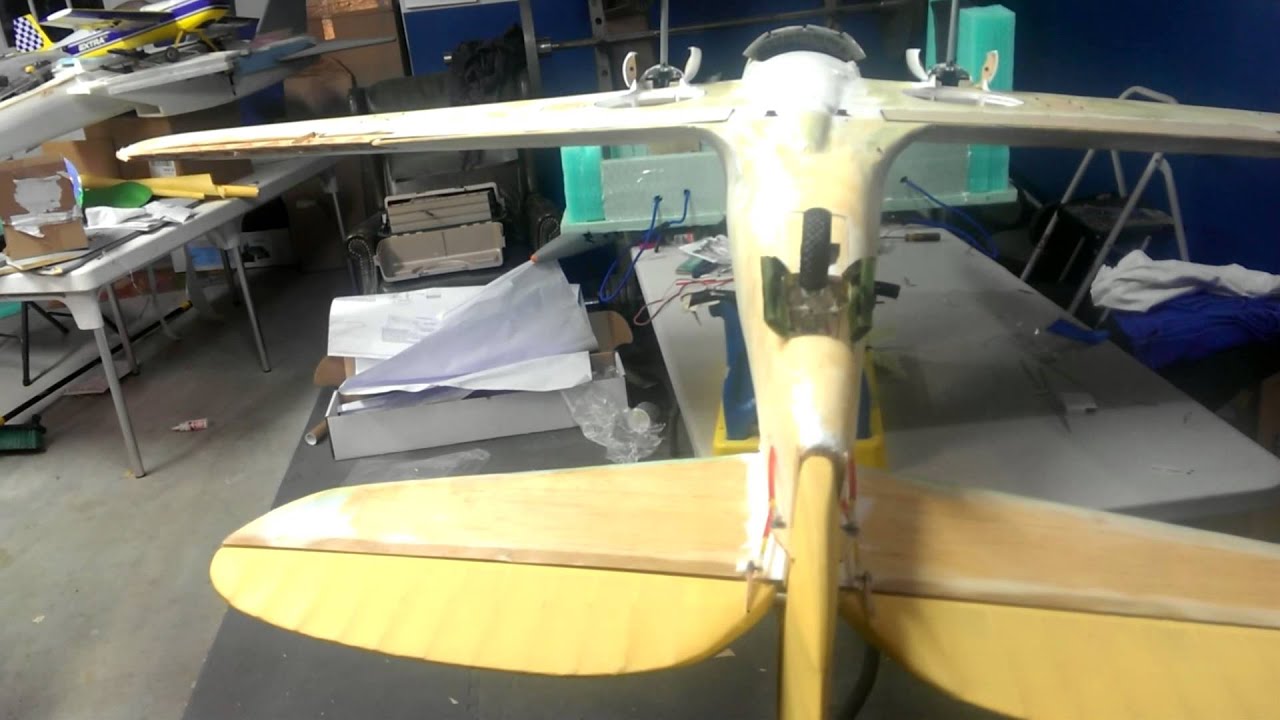
Attempt to visualize an airframe with shoulder-mounted anhedral wings for improved maneuverability and ground clearance, unlike the model shown above showing with its landing gear on what is actually the bottom of the P-40's low-wing configuration, a mid-mounted supercharged V8 engine, similar to Bell's P39 Airacobra, but with the prop shaft leading to a tail-mounted variable-pitch propeller so that a miniaturized radar can be mounted in its nose like any conventional fighter jet. Armaments might include a 20-30mm chain gun with 50-150 rounds of ammunition, 4 wing pylons for 4X Peregrine or Hellfire or Griffin missiles, or 4X Mk81 GPS guided bombs, or 4X 7-shot 70mm rocket pods, plus 2X AIM-92 Stinger missiles for self-defense.
WWII era fighters were typically low-wing monoplanes like the P-40, with conventional vs tricycle landing gear, because the heavy main gear could be mounted to the wing's main spar to absorb higher landing loads. The idea of attaching the gear to a mid-fuselage engine mount was not attempted. Tractor engine configurations permitted heavy engine / gearbox / propeller / autocannon combinations to be hung off the nose. Airborne radar was very new back then, so there was little thought given to mounting an air search radar in an ideal location. Twin engine night fighters did typically mount the radar antenna on or in the nose. Modern composite materials and aerodynamic drag reduction enables the use of shoulder-mounted cantilever wings. Stronger and more resilient modern steels enable the use of longer gear legs and tricycle gear configurations without excessive weight penalties.
A modern piston engine fighter should use tricycle gear to prevent ground loops. Any pusher engine configurations, such as the one I proposed, should always use a tricycle gear configuration to prevent prop strikes. Pusher engines eliminate prop wash effect over the empennage, which produces a more jet-like control response at low speeds. This can be viewed as a positive or negative. If the empennage is appropriately designed, then adequate control authority will be maintained right up to the stall, but the ability to induce a prop strike on takeoff will be greatly reduced.
Mini-IMP In Flight: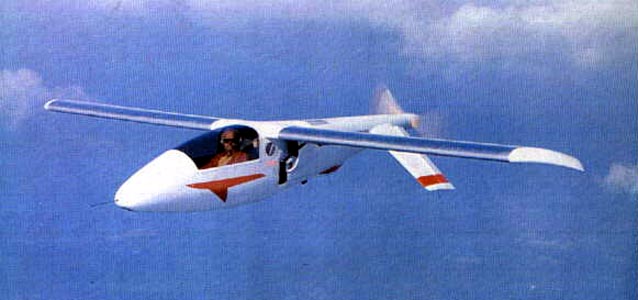
Fixed Gear Mini-Imp Variant on the Ground:
Even at 400mph, fixed vs retractable gear, with aerodynamic gear legs and wheel fairings, only results in a nominal speed increase of 5 to 10 knots.
Mini-Imp with Y-Tail and Variable Pitch Propeller:
Air-Cooled General Motors Corvair Mini-IMP Engine and Prop Shaft:
Testing the Mini-Imp, by M. B. "Molt" Taylor
Molt Taylor was an aeronautical engineer who worked for the US Navy during WWII. IIRC, he designed a drop tank for US Navy fighters operating in the Pacific and worked on weapons separation testing. He was the only aircraft designer to ever successfully achieve highway certification for a road-legal passenger car that was also a type-certificated light aircraft, and this work was performed during the 1950s, culminating in the so-called "AeroCar". While the project was technically dragged across the finish line, Taylor's company ran out of funding for series production. Following WWII, there was a thought process that middle class people living in the US would commute for work over longer distances using light aircraft and then drive said light aircraft's "fuselage" around town. In a certain sense, this is historically what happened, but the major airline services primarily provided city-to-city transportation using large turbine powered purpose-built hight speed aircraft, rather than slower but less costly owner-operator light aircraft seating 2 to 6 people. Some 20 years later, the Mini-IMP (Independently Made Plane) was Taylor's 1970s aviation cost reduction project undertaken to create a greatly simplified aircraft that could be made in a garage and required minimal numbers and types of different tools. Quite a bit of the design process revolved around airframe fabrication simplification. The "buy vs make" parts of the airframe were simplified to landing gear, engine mount, avionics, and radio.
Prior to designing and building the "Mini-IMP", Molt first designed and built a much larger and more expensive "IMP", similar in size to a modern piston engine fighter type aircraft, using a traditional aircraft engine with construction techniques and materials which were then-common in the aviation industry. This first pass at the cost and complexity problem was immediately deemed "too expensive / too complex" for a home builder. It was similar in cost and performance to early RV type aircraft. Following distribution of the Mini-IMP plans and key components such as landing gear and engine mounts, work on the "Micro-IMP" began, although never completed, which was an even smaller and more affordable plane. As far as lower cost materials were concerned, Molt also worked on "Taylor Paper-Glass" material, which combined a paper product with glass fiber, intended to be rolled and glued around a mold, similar to what modern fiber tape laying machines do for airliner fuselage and wing skin fabrication, to further reduce construction time and cost.
Anyway, that's the back story on the IMP / Mini-IMP / Micro-IMP and Taylor Paper-Glass... I never personally met Molt, but I did meet the man who eventually purchased his business and continued to distribute parts and plans after Molt retired and died in the 1990s. I never asked him about the AeroCar because it wasn't something I was interested in at the time. The new owner is / was himself a retired airline pilot and someone with a personal love of building light aircraft, and model aircraft as a child. He and his wife are as old as dust by now, too, if they're still alive.
The cockpit placement ahead of the engine was a deliberate design choice to provide superb visibility in all directions except directly behind the pilot. Since most other aircraft that might kill you during a mid-air collision are ahead (in front of), above (descending), or below (climbing) you. Nose-to-tail mid-air collisions do happen, but tend to be rarer. In any event, as can be seen in the photos, the wing and all other visual obstructions are located aft of the Mini-IMP's cockpit to maximize visibility. This is also an important design characteristic for all fighter-type aircraft to have.
The Mini-IMP uses NASA's GA(PC)-1 airfoil, which was a member of their "advanced technology" General Aviation (GA) airfoils designed during the 1970s. This was bleeding edge stuff when Molt included it in his designs. While they were primarily intended to reduce takeoff and landing speeds for light prop aircraft, they happen to perform decently at higher speeds, approaching the limit of what is legal below the flight levels, because the flaps in many implementations are reflexed upwards to reduce induced drag (from generating lift) at higher speeds. This is not the type of airfoil that should be used by higher speed fighter type aircraft, though. Between 75 and 275mph, though, they're pretty efficient. Back in the day, NASA worked on more projects to benefit GA. These days, they only seem to do gee-whiz projects for GA, and almost all of that is actually directed at commercial light aircraft, which makes sense in a way. EAA has pretty much taken over GA innovation where NACA and then NASA left off. There's no shortage of self-directed improvement projects that EAA members have undertaken, some of which ultimately ended up in the cockpits of commercial airliners.
The laminar flow NACA-66 series used on the P-51 were / are suitable for 200 to 450mph speeds, near-ideal for straight-line cruising, but weren't the greatest for maneuverability. Spitfires used modified NACA 2200 series airfoils, which provided a good mix of high speed drag reduction and maneuverability. Focke-Wulf's Ta-152H, a heavily modified variant of their famous FW-190, was ideal for straight-line speed at high altitudes, but again, not so great for maneuverability, nor use at lower altitudes for that matter. Wing loadings for 400mph sea level top speed fall between 40 and 50lbs/ft^2, which is 1/3 to 1/2 that of a supersonic tactical fighter jet, so takeoff speeds fall modestly below those of light biz jets, meaning 85 to 100mph. Biz jet takeoff speeds are 115 to 135mph. Initial climb rates are pretty spectacular for piston engines, meaning 5,000fpm+. This sort of sea level performance is suitable for turning inside highly maneuverable short-range IR-guided missiles and making aiming difficult for radar-guided autocannon air defense systems.
The Mini-IMP's control surface layout is modestly unconventional, but otherwise unremarkable. Various empennage arrangements were experimented with, including conventional, cruciform, butterfly, inverted butterfly, Y, and inverted Y. The inverted butterfly and Y tails were the ones which provided the best compromise between highest cruise speed and control near stall speeds during crosswind landings while making it difficult to deflect the control surfaces to the point of achieving a prop strike on takeoff. The airfoil chosen was a then-modern NASA design intended to both reduce stall speeds and achieve efficient cruise flight. Using a 65hp VW engine, the plane could achieve 175mph. Using the more powerful and ubiquitous 100hp Continental O-200 or 125hp GM Corvair engine, it could hit 200mph to 225mph. The airframe was relatively light yet strong, rated for aerobatic flight, and control forces remain light at higher speeds. The cockpit has lots of leg room, or at least the one I sat in did. The side-mounted control stick near the front of the right arm rest was comfortable to move in all directions. The ability to see out was much better than any Cessna I've flown, apart from directly behind. You really can see almost everything. It was possible to visually confirm that the main gear was down from the cockpit, but not the nose gear. Airflow into the cockpit in Texas heat? Not so great compared to the 152s and 172s because the prop is in the tail. I was baked after latching the canopy. It does feel like you're sitting on the ground, which you almost are. Entering was initially awkward, but exiting required no effort at all- open the canopy, stand straight up, and step over. Entering and exiting a scaled-up model with a V8 engine ought not require a ladder for most average height pilots, stepping on the wing, or other potentially dangerous gymnastics, a bonus for field operations.
Since "flying below the radar" will be necessary for survival of modern piston engine fighters, let's examine operating altitude ranges:
Radar Horizon vs Altitude
10m = 13-15km (8-9 miles)
100m = 40km (25 miles)
1,000m = 130km (80 miles)
10,000m = 400km (250 miles)
Anticipated operating altitudes for modern piston engine fighters should fall between treetop level and 3,000m to reduce or eliminate exposure to long range radar guided missiles associated with integrated air defense systems. Modern fighter jets fly at higher altitudes because they must, otherwise fuel economy suffers so greatly that combat radius and endurance are unacceptably affected. Piston engine aircraft can operate at significant altitudes, but a balanced approach to surprise / stealthiness / threat avoidance makes them more effective at lower altitudes where tactical fighter jets guzzle fuel and become more visible targets for shorter-range IR-guided missiles and autocannon fire.
The primary design criteria here are as follows:
1. Much lighter and less costly airframes and engines than turbine powered tactical fighters, with dramatically reduced fuel burn rates and consumption of less expensive gasoline vs kerosene fuel
Airframes fabricated from CNC machined lumber, plywood, and CNF from wood pulp are far less costly than synthetic composites and metals. Fuselages, wings, wing spars, empennage, and propeller blades will make use of wood and CNF laminate veneers that are pressed and heated to bond multiple layers of material together. CNC machines can then precisely mill wood parts. The use of plywood helps assure the average weight and strength of parts using these natural materials. To the extent practical, synthetic composites and metals won't be used. Certain fibers such as hemp and flax may be incorporated for specific use cases. Part of the crash structure for some Formula 1 cars now includes flax natural composites, specifically the seat. They're still working out how to make the entire survival cage built around the driver out of flax and hemp. The natural fibers are not as strong as higher grades of Carbon fiber, but other layers of materials such as Kevlar don't need to be bonded-in because natural fibers don't produce razor sharp shards of composite during a crash and do a better job of absorbing impact energy because they actually "crumble", sort of like tempered safety glass, rather than snapping like glass rods.
Amplitex Crash Box: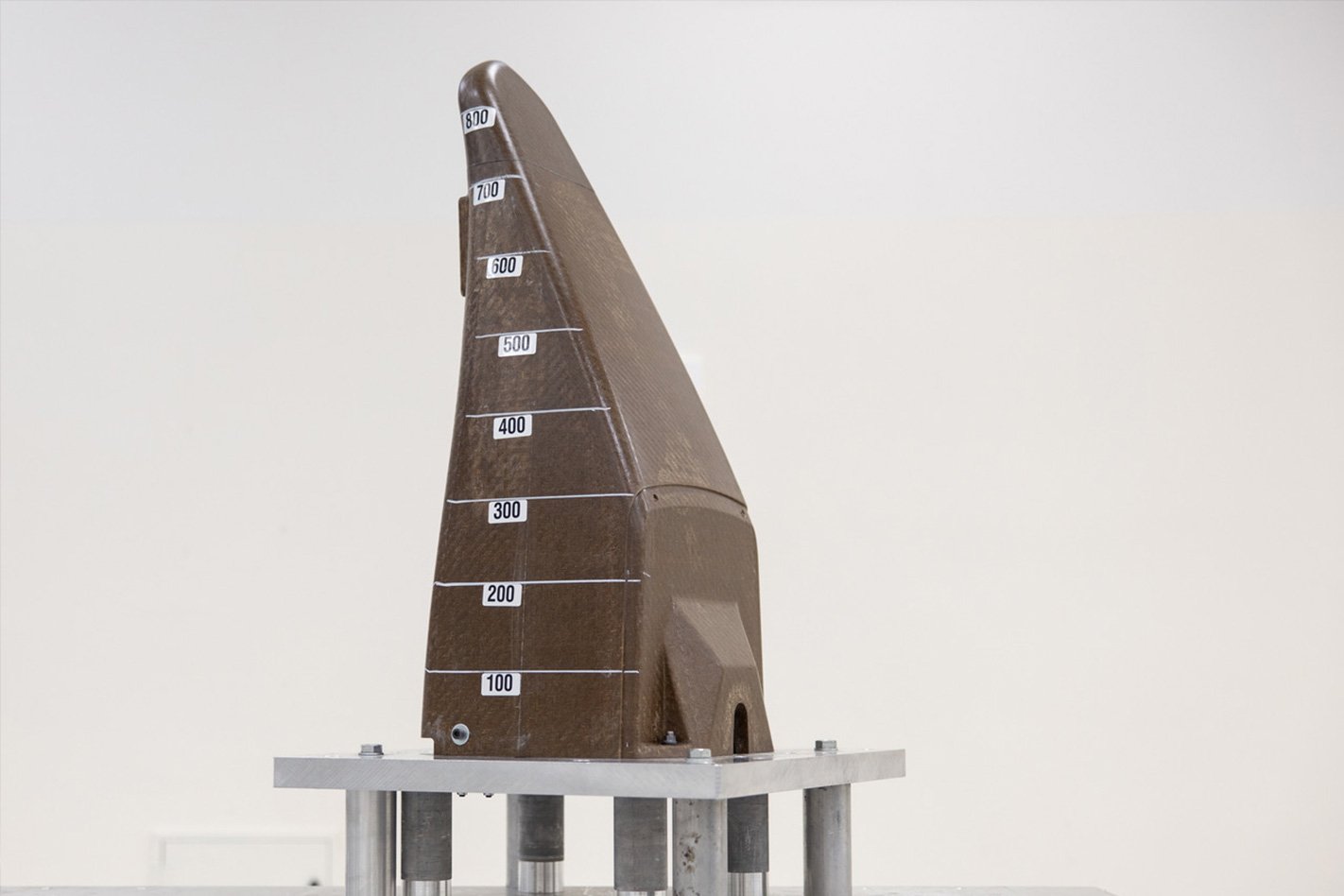
Amplitex Crash Box Testing: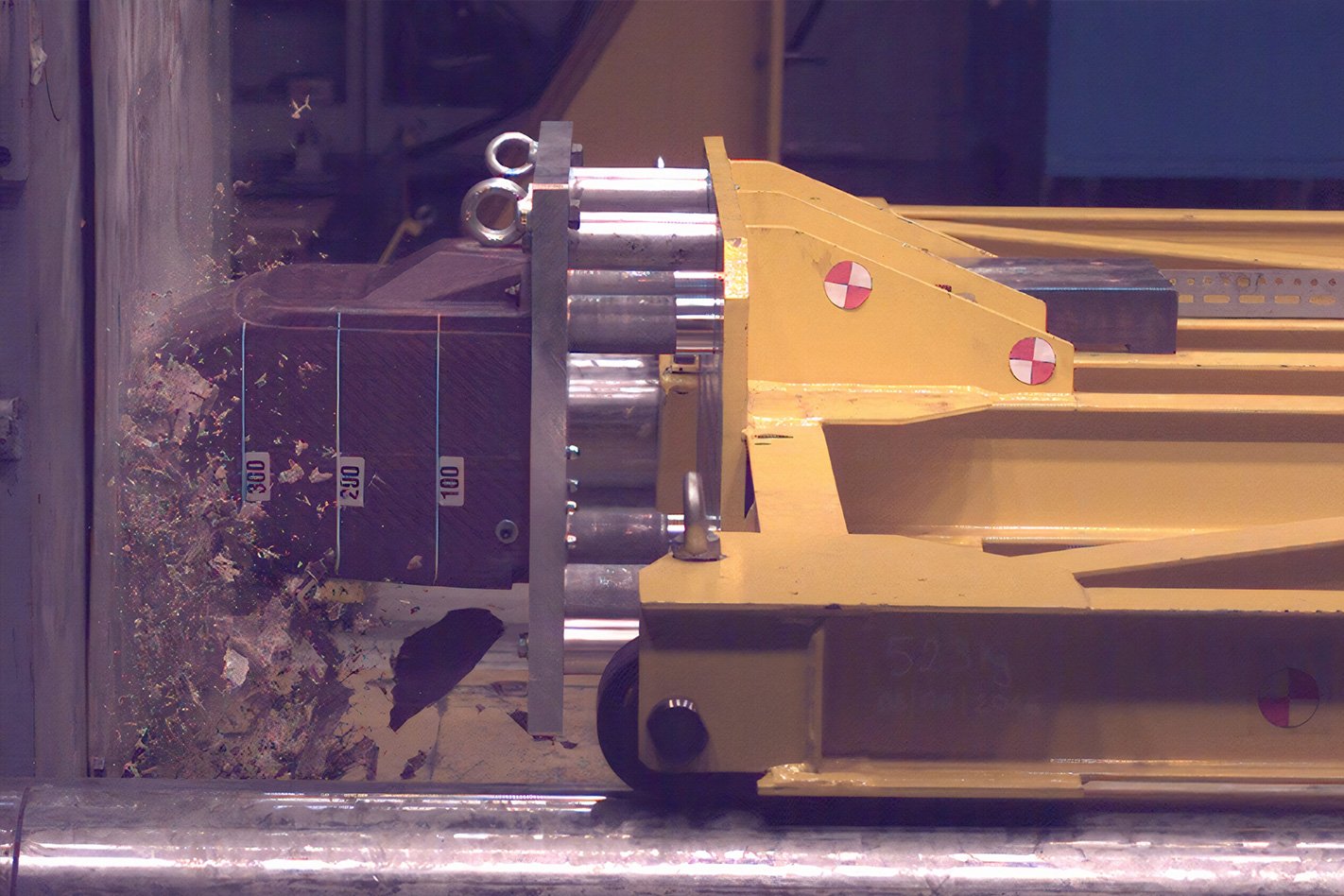
Amplitex Power Ribs:
The crash box shown above is still about 40% heavier than CFRP, but the seat is 9% lighter than an equivalent CFRP seat and 5X better at vibration dampening to reduce driver fatigue.
Synthetic spider silk is also nearing commercialization, and should be used for cockpit armor to capture shell and missile warhead splinters / fragments. Rather than some ridiculously expensive and ultimately futile attempt to armor the entire plane, it should instead be used to protect what matters- the aircrew. Any other use is questionable at best. The airframes and engines are nominal value expendable assets, as are all other weapons of war. Gold-plating any solution is counter-productive. On that note, any weapon system fielded against a competent enemy must be treated as a consumable, so technology must be applied only when it provides a meaningful advantage. If not, then there's no limit to the justification for sinking more money into any particular weapon or vehicle. You build to a standard which affords reasonably necessary mission capabilities and crew protection, then use better training, the element of surprise, and superior numbers to win.
2. Cruising speeds 100mph faster than the fastest helicopters and max speeds 200mph faster than the fastest helicopters
Ideal Speed Ranges
150 to 200mph: maximize range and endurance
300 to 350mph: evasive maneuvering
350 to 450mph: swift single passes against well-defended ground targets or engaging airborne targets
Higher flight speeds make more sense only for attacking integrated air defense systems, but all such attacks are executed with Mach 3 to 4 missiles with considerable standoff range. Autonomous combat drones already act as bait to force air defense system operators and tactical fighters to reveal themselves through defensive missile launches or face destruction.
3. More money is allocated to miniaturized sensors and armaments
Sensors illuminate targets, computers filter noise / clutter / jamming from true signal returns, and precise weapons efficiently dispatch them. This is where we should concentrate available funding.
4. Repair and complete replacement costs for the airframe and engine are nominal
The ability to lose an aircraft, or an entire squadron of aircraft, without that loss being unrecoverable, is a highly relevant advantage of turbine powered tactical fighters. If both Britain and Germany were only able to field a few squadrons of fighter jets, even if they did considerably more damage, the air war would've been over for both sides following the outcomes of singular daily battles.
5. Maneuverability is equal to or better than turbine powered tactical fighters
200 to 300mph of increased practical speed, at most, is utterly irrelevant to an inbound missile moving at Mach 2.5 to 4. We've already discussed why nobody flies faster than Mach 1.5 in air combat. Any speed over Mach 0.95 consumes fuel so fast as to be highly impractical in all but the most narrowly defined engagement scenarios, nearly all of them at high altitudes, even though it's technically possible to achieve using turbofan and turbojet engines. F-111s could and did fly at Mach 1.2 at treetop level, not using a phenomenal thrust-to-weight ratio typical of modern tactical fighters, only optimized aerodynamics in that speed range. Unfortunately, using this tactic rendered them highly vulnerable to air defense missile battery fire during the Viet Nam War, so several were lost to controlled flight into terrain attempting to evade missiles, a clear indicator of their inability to perform effective evasive maneuvers at such high flight speeds, despite a 7g maneuvering limit and generally excellent maneuverability.
Flying at high subsonic speeds near the ground to evade longer range radar tracking from integrated air defense systems precludes tight turns necessary for terrain and missile avoidance. Rapid downward altitude changes to capitalize on terrain masking to break radar locks are not possible. Rapid upward altitude changes only make the targeted aircraft more visible to threat radars. Whilst flying at higher altitudes renders both modern tactical fighter jets and WWII era propeller driven bombers functionally invulnerable to man portable IR-guided missiles and medium caliber radar-slaved autocannon air defense systems, they then become ideal targets for faster and potentially more lethal radar guided air defense missiles with significant ranges and powerful warheads. Stealth technology then made achieving a radar lock against a fighter jet operating at higher altitudes and high subsonic cruising speeds much less likely at extended ranges, but their IR signatures are unmistakable. If it ever becomes practical to perform volume search using powerful long range electro-optical sensors, then radar stealth becomes far less effective.
Maser-based radars will ultimately render existing radar stealth technologies ineffective. The stealthy features of the F-22 may reduce the radar return signal strength by 1,000X when compared to a similar non-stealthy airframe, but per unit area a maser also delivers at least 1,000X greater microwave radiation intensity. Deployment of maser-based air search radars implies that we revert back to using lower altitudes and flight speeds in conjunction with terrain or radar horizon masking to hide from vastly more powerful maser-based air search radars that can still lock-up a stealthy tactical fighter jet almost as easily as non-stealthy jets. Geometry provides most of the radar signature reduction (deflecting inbound radiation in any direction except directly back at the source emitter), not RAM, which mandates another 3 orders of magnitude in radar return strength reduction to maintain radar signature levels similar to those already achieved by the F-22. That's likely impossible, so a 0.001m^2 F-22 radar target is about as visible to maser-based air search radars as a 1m^2 radar target is to a conventional X-band air search radar today. Modern X-band radars can track 1m^2 targets from over 200km away, so existing radar stealth technologies won't sufficiently reduce tracking ranges against maser-based radars to remain militarily useful.
If radar and infrared signature reduction measures can't passively protect our military aircraft, then we must develop and deploy active protection systems to destroy inbound missiles. Our armored ground combat vehicles already use these technologies. Sufficiently accurate autocannon turrets should be able to reliably destroy inbound missiles, making the entire stealth vs non-stealth argument irrelevant on cost grounds, irrespective of future application of new radar and electro-optical tech improvements. Ground-based autocannon systems are already used to intercept inbound artillery shells and missiles. Using a moderately successful implementation, air defense system operators might expend far more money launching missiles at piston engine bombers flying at 20,000ft and 200mph than the aircraft are intrinsically worth, prior to achieving a kill. That makes everyone's near total reliance on defensive and offensive missiles an impossible math problem. We then revert back to using cannons and guided glide bombs to saturate a target area with weapons so that at least one shell or bomb will destroy the target. Glide bombs dropped 10 miles away keep the launching aircraft outside the engagement envelope of lower cost high powered cannons and shoulder-launched IR-guided missiles. Nominal cost kamikaze drones already capitalize on this missile math problem, but unmanned combat drones with similar size physical size / weight / payload-to-distance capabilities as crewed tactical fighters cost every bit as much as crewed fighter jets, frequently substantially more than crewed aircraft, which is why the US military has retired so many of their higher tier capability combat drones. All their supposed cost reductions never materialized. This was re-proof that airframe cruising speed, therefore engine cost, operating empty weight, therefore materials costs, plus sensor and weapons capabilities, drives procurement and operating costs, not the presence or absence of a crew member aboard the aircraft.
ATK's LW25 lightweight 25mm autocannon:
LW25 Dual-Feed Turret:
LW25 capabilities:
LW25 Integration on SAAB Trackfire RWS
The 68lb LW25 has a dual-feed system, so a single-feed system suitable for aircraft defensive turrets could be as light as the 63.5lb M3 .50 caliber aircraft machine guns used aboard US aircraft since WWII. LW25 cyclic rates are lower than M3s, but that might not matter as much when using programmable airburst munitions capable of high precision distance-based fusing in conjunction with low-cost / lightweight / short-range (5-25km) / high resolution imaging radars with AI-enhanced control software capable of automatically tracking and engaging inbound missiles. If the LW25 is insufficient, more powerful higher velocity autocannons are available, such as the M230, at the expensive of weight and cost. Single barrel chain guns like the M230 cost about $25K per copy, less for the smaller caliber models and more for the larger caliber models, more expensive than M3s but more effective with appropriate munitions and far less costly than Gatling autocannons like the M197 and M61, at $250K per copy.
If autocannons alone prove insufficient for stopping inbound missiles, then Stinger missiles are an alternative, much more costly than cannon shells though much less costly than large radar-guided air intercept missiles. Fiber lasers will eventually become viable, too. What likely won't become a more practical option is sinking ever-greater sums of money into individual airframes and engines for 200 to 400mph worth of usable speed difference while facing inbound weapons moving 2 to 4 times faster than a turbine powered tactical fighter can manage without rapidly exhausting its onboard fuel supply.
Offline
Like button can go here
#6 2026-02-16 15:17:06
- kbd512
- Administrator
- Registered: 2015-01-02
- Posts: 8,533
Re: Cost-Effective Credible National Defense
In the waning days of WWII, the Hütter Hü-211 design was created for high altitude recon and night fighting:
We no longer distinguish between day and night fighters, as virtually all military aircraft are all-weather capable due to advances in radar / radio / avionics, but this design could be a suitable successor to Grumman's S-2 Tracker. The primary use case for this aircraft is hunting the diesel-electric submarines of adversary nations, which still remain more numerous than nuclear powered attack submarines, and potentially quite lethal since all nuclear attack submarines are not as quiet as diesel-electric boats.
Lockheed's S-3 Viking was capable of a top speed at sea level of 493mph and cruising speed of 400mph, whereas a design such as the Hu-211 would only be capable of about 400mph at sea level with a 300mph economical cruising speed. That said, the Hu211's max range was modestly greater than the S-3, and endurance is what counts for sub hunting. Service ceiling for the Hu-211 design was significantly greater than that of the S-2 or S-3, not that high altitude capability matters much for sub and ship hunting. The Hu-211 wings and butterfly tail were to be constructed from wood for improved performance through reduced weight. This WWII design was also equipped with early ejection seats and a pressurized cockpit to enable high altitude operations, features now common on turbine powered aircraft.
In modern times, US aircraft carriers are deploying with far fewer aircraft because the Navy cannot afford to purchase and operate as many multi-role airframes as the single-role airframes they replaced. Aircraft carriers from the Forrestal / Enterprise / Kitty Hawk / Nimitz / Ford classes were designed to operate with up to 90 large aircraft aboard, but due to budgetary constraints and aging airframe maintenance-related unavailability, they now routinely operate with as few as 48 combat jets. At any given time half of those jets are down for maintenance while underway and perhaps 1 out 4 are fully mission capable. Irrespective of how individually capable they may be, the loss of numbers of airframes has greatly diminished the aircraft carrier battlegroup's striking power.
Executing an "Alpha Strike", wherein all mission capable aircraft aboard an aircraft carrier are launched in rapid succession to attack a target, a common naval aviation tactic from WWII through to the end of the Cold War era, is now virtually impossible with today's Carrier Air Wing complement and airframe availability rates. Sustainable sortie rates per carrier some 25 years ago, when I was still part of an Air Wing in Seventh Fleet, fell between 90 and 120 sorties per day, as-evidenced by the past 2 wars where aircraft carriers were extensively used due to issues with basing of land-based aviation assets close enough to their targets to be practical additions to strike packages. During Operation Enduring Freedom, which our carrier battlegroup deployed to support immediately after 9/11, our Air Wing had at least 60 combat jets to work with. During the critical initial phase of that war, naval aviation contributed the majority of all sorties generated.
Fast forward to today, and I've heard of recent deployments with as few as 36 jets, because the rest of the airframes were indefinitely grounded while awaiting replacement of timed-out major structures such as wing boxes, wings, and fuselage components subjected to the merciless pounding of landing on and taking off from a carrier. Concentrating so much money and capability into so few airframes has made each one a precious and irreplaceable asset, which can still only be in one place at one time. Fully mission capable rates have steadily deteriorated over time, rather than improved, despite the fact that squadron head count has not decreased. This is a natural consequence of over-working too few airframes. 3X squadrons of 12 F/A-18E/Fs and 1 squadron of only 4 EA-18Gs is not enough planes for an Alpha Strike against a well-defended target.
If we're not actually fighting a war against a peer level adversary like China, then the greatly reduced total number of combat jets may be sufficient to contend with the limited military forces of third world dictators, but that is not the stated military purpose behind maintaining a dozen aircraft carriers and almost as many air wings. We either have deployable naval aviation assets with fully mission capable rates over 50%, or we don't have a realistic carrier strike force.
P-3s and P-8s are primarily intended to shadow enemy fleet activities and submarines from significant standoff distances, particularly ballistic and cruise missile carrying submarines. While they also have significant attack capabilities, they were never intended to be front line attack jets, because they're essentially converted airliners with sensors and armaments. Using them against an enemy with real air defense capabilities would only result in their loss. The EP-3E Aries forced to land on Hainan by Chinese fighter jets is a good example of this. The Lockheed S-3 Vikings, earlier Grumman S-2 Trackers, and late WWII to early Cold War Grumman AF Guardians provided organic long range anti-submarine and anti-ship tracking and attack capabilities to aircraft carrier battlegroups. Whereas tactical fighters like the Super Hornet, or earlier purpose-built attack jets like the Intruder, would nominally attempt to attack enemy ships from higher altitudes and air speeds, Trackers and Vikings were intended to fly much lower and slower, using the radar horizon as a mask against enemy ships equipped with integrated air defense systems. Regardless of which flight path was selected, all attacks use subsonic anti-ship cruise missiles with significant standoff range to place the launching aircraft well outside the engagement envelope of the targeted ship's air defense missiles. The speed of the launching aircraft isn't much of a factor, and helicopters using offboard target tracking to send mid-course guidance updates to the missile have successfully attacked ships this way using smaller cruise missiles.
While it's true that supersonic anti-ship cruise missiles and hypersonic ballistic missiles can achieve much higher flight speeds, it's equally true that none of them, except nuclear warheads, are still hypersonic when they arrive at the target ship and existing air defense weapons seem to have little issue shooting them down because their heat and radar signatures make them very visible targets that cannot be confused with airliners or other non-military aircraft. The tradeoffs associated with using these higher flight speed / altitude weapons is that they either carry much smaller warheads or are substantially larger / heavier / more costly. The range or potential range of any such weapon is always limited by the ability to provide timely offboard mid-course guidance updates to the missile. If your giant shore-launched hypersonic glide missile can hit a target at 2,500km away but your shore-based radars can only track ships out to 250km, then you're not targeting anything father away and all that potential capability is wasted.
The anti-submarine helicopters attached to most surface combatants these days can be thought of as short range purely defensive anti-submarine air assets with extremely limited attack capability. They can launch one torpedo or small anti-ship cruise missile and can only scan the immediate area around the ship they're attached to, because fuel burn is so high that they lack the range to venture farther away. When these helicopters are down for maintenance, which is most of the time, the ship has no standoff anti-submarine capability at all, certainly nothing akin to the "waypoint ahead" route-clearing capability fixed wing anti-submarine aircraft provided to carrier battelgroups during the Cold War era.
The loss of this critical capability has been widely acknowledged as a serious deficiency by the US Navy, but nothing effective has been done to replace the Vikings because all available funding has been soaked up attempting to build new ships and to maintain the aircraft carrier's now-diminished strike capability. Worse than that, several drone programs also failed to produce a like-kind capability.
Converting all aircraft to turbine engines and driving up the max takeoff weight of individual combat jets to something in the same ballpark as a WWII strategic bomber has resulted in airframes and engines too expensive and complex to maintain in a practical way, in numbers that would affect the outcome of a war against a peer level adversary. That process took an entire human lifetime to achieve, helped along by a lot of questionable ship and aircraft projects that resulted in no usable combat hardware, but it's already happened. The loss of critical mission skills maintenance, since nobody is specifically training to hunt for and attack submarines, is an even greater hurdle to overcome. When you can only afford to provide perhaps 200 flight hours per aircrew per year, you cannot train your crews to fully develop their ability to successfully locate and attack elusive or well-defended targets.
Flying at 300mph (5 miles per minute) vs 400mph (6.66 miles per minute) vs 500mph (8.33 miles per minute) vs 600mph (10 miles per minute) is irrelevant to hunting for ships and submarines that top out around 0.5 miles per minute. Your attack aircraft require extreme range and endurance, not extreme flight speeds, because the target has no ability to escape and it's not evading modern sensors. Even the so-called "stealthy" ships show up quite well on radar and all ships are unmistakable IR targets. What would be relevant to the mission is being able to affordably launch an entire squadron of planes with a collective fuel burn rate approximately equal to a single tactical fighter. If you can put an entire squadron of planes in the air for every tactical fighter jet you can realistically operate, mere presence dictates how fast enemy ships and subs are found, as well as the intensity of a subsequent attack directed against them.
Where should your air defenses be directed if a carrier equipped with dozens of piston engine aircraft can attack an opposing battlegroup from a half dozen different angles at the same time?
That is the problem sheer numbers confers to an opposing naval air wing operating a strictly limited number of large / expensive / thirsty tactical fighter jets. They can and probably will shoot down some of your slower planes, but since they also have nowhere to land following a successful attack, their ability to do that more than once is very limited. By operating far greater numbers of planes, your own air wing can absorb inevitable combat losses, whereas they cannot. The tit-for-tat paradigm is broken, so they can no longer rely on superior speed or technology to prevent their destruction. They're forced to either redirect some funding to lower tier systems or risk complete loss at nominal cost to their enemy. As always, the radar finds the targets and a torpedo or anti-ship cruise missile does the killing, not the plane itself.
4 fully mission capable Super Hornets equipped with 4 Harpoons per jet is 16 total chances to successfully attack a ship. Nobody in the squadron is likely to recall the last time anyone carried a Harpoon or trained to attack ships, but it is at least possible to do so. 12 fully mission capable propeller driven planes only carrying 2 Harpoons per plane is 24 total chances to attack a ship. If you lose 4 planes attacking a ship or they turn back due to engine or avionics issues, then you still have the same number of weapons available as all 4 Super Hornets. If you lose 1 Super Hornet during an attack, then a quarter of your striking power is gone and likely won't be replaced any time soon. If you're fighting a naval power equipped with twice as many ships as the US Navy, protected by an extensive array of air defense systems, then attrition is going to happen regardless of how capable your tactical fighter jets are. The only question is whether or not you can afford that attrition, or not. We know what the answer is at the present time, which is why we need to alter our thinking about what is required vs what is nice to have if it doesn't come at an unaffordable cost in terms of dollars and maintenance to maintain a necessary combat capability.
I don't believe jet powered combat drones are the correct answer, either. Thus far, all programs initiated have failed to produce a maintainable solution at a price point below crewed combat jets and helicopters, which is why each new combat drone program is either cancelled outright or drastically curtailed after it fails to deliver promised results. Drones may provide other advantages related to very specific capabilities, but not without spending a lot more money. Airframe capabilities are forever tied to max takeoff weights. In a permissive environment devoid of integrated air defense systems and radar-directed AAA, smaller propeller-driven combat drones can reduce the cost of maintaining persistent air cover for ground and sea forces, relative to much larger and more capable tactical fighters, but in such an environment a piston engine aircraft would also be a perfectly acceptable solution, one which no amount of data link signal jamming can overcome, because a human has direct physical control over the aircraft. The best AI-enhanced combat drone is still dependent upon interpretation of sensor input and data links to issue requests to the drone to either attack or defend a given target. That's why the small drones used in Ukraine trail fiber-optic cables behind them. Nothing in the size and weight class of typical kamikaze drones can overcome the intense signal and sensor jamming those drones are subjected to, and many of them are already as large as a small Cessna. Nations with more sophisticated jamming suites would only further increase the minimum size and weight of a suitable combat drone to the same class as a tactical fighter equivalent.
I guess we're about to witness exactly how sheer numbers vs technological sophistication plays out if China proceeds to attack Taiwan. All war game scenarios, without exception, indicate that both sides run out of their high capability cruise / ballistic and air defense missiles in the first month or two of the war, with many scenarios showing both sides completely depleting their missile inventories inside of two weeks. There will be great loss of aircraft on the ground for both sides, even with multi-layer air defenses. A smaller-scale glimpse of this was showcased in Israel after they ran out of interceptor missiles and some of the combat drones and cruise / ballistic missiles fired by Iran struck Israeli air bases. Israeli and American integrated air defense systems and tactical fighter jets shot down approximately 95% of the weapons fired at Israel, and then the remaining 5% proceeded to impact their targets. If Iran had the weapons inventory to launch even one more such "Alpha Strike" using their missiles and drones, hundreds of weapons would've hit Israeli air bases and air defense systems.
Gun-based air defense systems have made a major comeback for a reason. There is not enough money or even manufacturing capacity to field enough air defense missiles to intercept the hordes of low cost EO/IR missiles and drones arrayed against them. The computing power required to reliably guide an EO/IR weapon to a target is far below that of a smart phone, which means it's not very costly to do. A reliable high power / high resolution / high scan rate radar set for a high speed air defense missile is at least 10X more costly, ignoring the cost of a high power air search and track radar. That is why US destroyers operating near Yemen resorted to engaging slower missiles and drones using their 20mm CIWS. They ran perilously short of air defense missiles. Yemen is very far from a peer level adversary to the US Navy, but the battlegroup we deployed to counter their attacks against Israel and civil shipping in the Persian Gulf resulted in a force that was incapable of more than point defense inside of a couple months. High capability SM6 air defense missiles were also accidentally fired at a pair of Super Hornets, scoring two blue-on-blue kills, which didn't help matters. Every mass drone / missile attack in Ukraine results in a few of the weapons finding their targets. You don't need to be a mathematician to figure out why we cannot continue to concentrate all available defense funding and manufacturing capacity into ever-dwindling numbers of supersonic tactical fighter jets and high capability air defense missiles.
Offline
Like button can go here
#7 2026-02-17 21:19:50
- kbd512
- Administrator
- Registered: 2015-01-02
- Posts: 8,533
Re: Cost-Effective Credible National Defense
One of the few future warfare armaments I think the US military has correctly pursued, and for the correct reasons, are inexpensive mass produced turbine powered cruise missiles for over-the-horizon standoff attacks. These so-called "cheap" weapons still cost at least several hundred thousand dollars per weapon, with warhead weights in the same range as traditional heavy anti-tank missiles, aptly illustrating the extreme price tag attached to any kind of turbine powered aircraft. Every part of the vehicle is relatively expensive, but this is what's required to deliver 25-50lb warheads to distances of 200+ miles, at flight speeds between 400 and 600mph, at treetop level.
While I would be cautious about "over-learning" any lessons drawn from the Ukraine War, it helped planners correctly evaluate how fast precision guided munitions would be expended in the absence of air superiority. The munition consumption rates to dispatch the sheer number of targets present was startlingly high, far higher than previous wars because Russia has high numbers of armored vehicles, artillery, and mobile air defense systems. China has far more equivalent systems than Russia presently does, and much greater numbers of ships and submarines. Our experiences from Desert Storm, Allied Force, Enduring Freedom, and Iraqi Freedom were that existing stockpiles of precision guided weapons were rapidly depleted against enemies with few effective air defense systems, in mere weeks.
The sensor and computer tech required to create 100 to 250lb "miniature cruise missiles" simply did not exist 25 years ago, but the Precision-Guided Munition (PGM) tech of that era was GPS and laser-guided glide bombs. Despite having much larger PGM stockpiles accumulated during the tail end of the Cold War, we ran short of PGMs after the first 2 weeks of fighting in Iraq (both times) and Afghanistan, to the point that dumb bombs had to be dropped whenever a target wasn't danger close to friendly forces.
We would be foolish in the extreme to think any war against China's military would not result in dramatically higher PGM consumption rates. We would be equally foolish to think successful air attacks which don't result in unacceptable losses to our own aviation assets won't also necessitate greater standoff distances to avoid exposing our aircraft to the most effective parts of integrated air defenses and mass counter-attacks using lower cost short range drones and PGMs. The more actively fielded military hardware any given country has, and the greater the sophistication and depth of their air defenses, the more standoff PGMs will be required to win battles.
If the US had the ASM-N-2 Bat, the active radar homing anti-ship PGM of its day, ready to deploy at the outset of WWII, then we would likely have abandoned overflights of ships and ground targets to bomb them. Shortly before WWII ended, several Japanese ships were successfully attacked and severely damaged or sunk by Bat PGMs, from just beyond the effective range of their anti-aircraft guns, with the end result that aircrew casualties were greatly reduced by virtue of not exposing themselves to air defenses. Entire squadrons of Avenger, Dauntless, and Helldiver aircraft might have been saved if Bats were available at the start of WWII. Vastly fewer strategic bombers would've been lost by not directly overflying their targets.
My assertion throughout this topic is not that we should attempt to use piston engine aircraft to re-fight WWII using WWII tactics and weapons, rather that to field the sheer numbers of combat aircraft and generate enough sorties per day to decisively win future air wars, we need much less costly airframes, engines, armaments, and greatly reduced fuel consumption rates so that we can indefinitely supply our military with the aircraft and munitions to prevail against adversaries who will otherwise have local numerical superiority if deploying their own land-based tactical fighter jets.
The opening hour of every battle will be fought almost exclusively by stealthy high performance turbine powered aircraft firing long range missiles used to destroy enemy air search radars and tactical fighters in the air or on the ground. The next hour of the battle will require many hundreds of lower performance piston engine aircraft to execute medium range strikes using low cost miniature cruise missiles, primarily against remaining air defense systems and aircraft, via offboard guidance delivered by high altitude turbine powered ISR drones that find, categorize, and prioritize targets. Every successive hour of battle will be fought almost exclusively by piston engine aircraft to economically target and engage enemy ground forces. One to two squadrons of piston engine aircraft can be fielded for the same purchase and operating cost as a single tactical fighter, so the inevitable losses from training accidents / engine failure / pilot error / enemy action, however painful, remain tolerable in the context of the overall war effort.
What I've been looking at, which I find highly disturbing, is that fully mission capable rates, meaning airframes with no outstanding squawks against them and thus presumably capable of performing any assigned mission, across all Western air forces, are typically below 50%, even though the aircraft may still be flyable and capable of performing some specific mission. Availability rates only appear artificially higher when the nation in question doesn't actually do much training with their aircraft, meaning lowers flight hours per year. If you don't fly very often, then your availability rates might appear stellar on paper, but that doesn't mean you could maintain those rates if forced to fly more frequently, as would be the case in combat. Ultimately, if you don't routinely fly your combat aircraft then you cannot train aircrews to use them as weapons of war.
Our pilots are now receiving 200 to 250 flight hours per year, on average, so they can only train for one mission type. The multi-role designation given to most tactical fighters is an inaccurate reflection of what types of missions their aircrews can competently perform. 300 to 350 flight hours per year is the minimum to competently perform two different missions, close air support and tactical strike, for example. While combat air patrol and close air support are reasonably self-explanatory, a tactical strike is a type of ground attack mission executed against a fixed defended target, such as a bridge or air base or munitions depot or oil refinery. The training and tactics used in close air support are very different from the tactics used to strike an air base, even if both missions use some of the same munitions.
Piston engine aircraft would enable us to provide 500 flight hours per aircrew per year, which means our aircrews understand how to fly and navigate, how to employ weapons against other aircraft in air-to-air engagements, they've simulated enough PGM drops / launches to attack ground targets for close air support missions, and could also perform a tertiary role against air defense systems or air bases or ships or jamming enemy radars and communications or using equipment for ISR missions. Merely having a multi-role tactical fighter does not mean the air and ground crews are multi-role trained. The EA-6B Prowlers in my squadron could technically drop bombs like any other A-6E Intruder, but no aircrew training was ever conducted to do that. It would be a mistake to think they could jam enemy radars and drop their own GPS guided bombs on defended targets. Our F-14Ds were technically designed for fleet air defense, but by the end Enduring Freedom the only missions they'd executed were guided bomb drops at night or in bad weather followed by immediate BDA using their TARPS pods. It would be a mistake to think they were prepared to intercept aircraft headed towards our carrier. We retired the A-6Es, F-14Ds, EA-6Bs, and S-3s, then pretended that Super Hornets were suitable for tactical strike, fleet air defense, jamming and electronic intelligence, ship / submarine hunting, and aerial refueling. This was, of course, an utterly preposterous assertion. In truth, apart from aerial refueling, most of those mission specialties received perhaps one or two familiarization training flights per year. The notion that your squadron is competent to attack enemy warships because you flew one training mission in a calendar year with a Harpoon would be laughable if senior officers didn't expect you to do that in a war where you were forced to because there are no other types of fixed wing naval aircraft on the flight deck.
In aircrew training, the first 175 to 200 hours are devoted purely to what we call "recurrent training", which encompasses all aspects of basic military airmanship. If you're carrier qualified, this includes practicing catapult launches, arrested recovery, pattern work with the LSOs and "meatball", cross-country navigation in all weather conditions, night operations qualification, formation flying with 1 to 3 other aircraft, aerial refueling, emergency procedures, coordination with other aircraft and ground units, and various other aspects of military flight operations. Some of this training is conducted concurrently, while other aspects require dedicated flight time.
Carrier Qualifications (CQ), for example, typically require their own dedicated training flights, not combined with any other training syllabus. 10 to 12 day landings with at least 10 arrested and 6 to 8 night landings, with at least 6 arrested, and simply "grabbing 1 of 4 wires" does not mean you'll receive a passing grade by the LSOs. It doesn't matter if you're a nugget fresh out of the RAG or the squadron's Skipper, you have to perform at least that many, but no more than 8 in a given day, which implies a minimum of 2 full days of flight operations will be dedicated to CQ. It's common for 3 to 4 days to be devoted to CQ. If you go one month during a transit without making another trap, guess what? It's time for a requalification. What I would call "actual recurrency training", for experienced fleet pilots, is only 6 day and 4 night traps. When the air wing comes aboard the carrier, they haven't trapped in 6 to 12 months. Most of the time you'll rack-up double the minimum number of traps before the LSOs grading your landings feel you're sufficiently practiced to do it at the end of a mission when you're fatigued and low on gas. Individual squadron training ashore is 3 months, followed by 3 months of integrated air wing training ashore, followed by a deployment with 1 month of realistic combat training, followed by either more comprehensive training or an actual combat deployment. Training timelines can be extended when deployment cycles are 18 vs 12 months, but this is not always an option.
The LSOs want your approaches to be as close to textbook as they can be, and you must nail your speeds / altitudes / turns, meaning within 1 to 3 knots, especially on short final, and no more than a couple hundred meters out of lateral position whenever you're in the pattern. That level of "perfection" is critical to your survival as a naval aviator. You're never more than a second or two from killing yourself and deck personnel during landing. Everything happens fast. A number of physiological studies have shown that the heart rates of naval pilots were never as high in combat as they were during a carrier landing. You might get killed in combat, but you probably won't. Death is the most probable outcome if you mess up a landing. 5m to the left or right is usually a fatal error. Your wings will strike other parked aircraft. 10m too low and you'll strike the ramp and die on impact. Ramp strikes are nearly always fatal. 10m too high and you won't snag any of the 4 wires. You're moving at a relative 120 to 130 knots to retain sufficient energy for a throttle-up and go-around if you bolter. The flight deck pitches and rolls. Try doing this at night in bad weather while you're low on fuel. Whenever you land following a mission, you're purposefully within 10 to 15 minutes of running out of fuel to reduce your trap weight, remain within ordnance "bring-back" capability, and to lower your stall speed as much as possible. The gist of CQ training is that you will either perform on-command or die.
All of this is to say that fully mission capable rates and flight hours for training will continue to decline as tactical fighter jets become more costly to purchase and operate, to the point that however supremely capable the next generation of stealthy combat jet might be, their aircrews will rarely acquire sufficient training to maximize their potential. The same limitations will apply to AI-enhanced combat drones, with the possible exception of one drone teaching many others without the other drones having to actually perform to "know" that they are competent to perform a specific mission. If they cannot test their programming in a realistic way, then they are not going to learn what works and what doesn't, either. Lots of things appear to "math" on computers that are also utterly impossible in the real world.
Offline
Like button can go here
#8 2026-03-02 15:59:19
- kbd512
- Administrator
- Registered: 2015-01-02
- Posts: 8,533
Re: Cost-Effective Credible National Defense
Advancements to fibers laser and room temperature maser based technologies are likely to provide the ability to intercept incoming missiles for mere pennies on the dollar. Whether aircraft carrying such defensive weapons are moving at Mach 0.5 or Mach 5 is largely irrelevant. The average flight speeds of inbound missiles fired at them to shoot them down is also likely to be irrelevant. Room temperature masers don't require another energy conversion step to convert electrical energy to photonic energy, unlike lasers. Dependent upon wavelength, they're also far less affected by local atmospheric conditions such as water vapor or dust, unlike lasers.
Let's presume we have a twin piston engine aircraft, about 6,000hp for both engines, equipped with a 500kg 100kWh Lithium-Polymer battery that can discharge at 120C for a few seconds at a time, so 12MWe over very brief periods of time. High power gyrotron masers developed for fusion applications operate at 50% electrical efficiency. 3MWe of input power can deliver 1.5MWe of highly directional microwave power output. Toshiba's 1.5MWe gyrotrons weigh 700-800kg and their overall electrical efficiency is around 50%. They've demonstrated stable output at 170GHz for multiple seconds. These devices are presently used for plasma heating in fusion experiments, but they are in fact the major electrical component of plasma-based masers. For sake of argument, let's assert that this entire offensive electronic warfare system would weigh 2,000kg. For a twin engine fighter-bomber equipped with 3,000hp piston engines, this is well within its payload capacity, because 2,000kg was well within the payload capacity of the A-1 Skyraider ground attack aircraft equipped with a single 2,700hp R-3350 radial.
An aircraft so-equipped could expect to survive a Suppression of Enemy Air Defenses (SEAD) mission by using its microwave weapon to fry the electronics of any air defense missiles fired at it, rather than using pure speed or stealth. If you can dump so much highly directional radiation into an inbound missile's onboard radar or data link antenna as to overwhelm any external radar signals provided by the air search and track radar used to find and launch missiles at your aircraft, then there is no point to trying to out-run the missiles or evade detection. The enemy could launch more missiles at your aircraft than it's intrinsically worth, but none of them are likely to guide.
I wouldn't even attempt to kill their radar at that point because they're squandering so much money and resources without effect, against a nominal cost piston engine aircraft equipped with a rechargeable electrical weapon able to either short-circuit their missile electronics in milliseconds, if equipped with any existing conventional microwave band radar, or completely overwhelm their ability to track if the enemy was also using maser-based radars. I'd do everything possible to keep them fixated on my aircraft, and to keep firing missiles at me, so that other nearby piston engine aircraft, likely smaller / cheaper / less capable, configured for either close air support or air combat can operate with limited risk of being shot down by incoming missiles.
Either fiber lasers or room temperature masers are likely to render conventional radar-guided and infrared-guided missiles impractically expensive to use against nominal cost piston engine aircraft equipped with "kinetic" electronic warfare equipment. The speed and power-to-weight advantage offered by turbine engines then has to be carefully weighed against their higher fuel burn rates, total cost of ownership, and loss of sheer numbers to overwhelm enemy air defenses. We'd revert back to using lower cost airframes, engines, and unguided or alternatively guided weapons if the lethality of air defense missiles was diminished to the point that they had to be reserved for use against targets without significant electronic warfare capabilities, primarily offensive missiles and loitering munitions. This kind of weapon greatly affects the viability of smaller combat drones, most of which have already proven to be easy prey for less capable electronic warfare suites.
This latest example only further illustrates how "weapons do the killing", not the aircraft itself, yet also imposes more reasonable limits on weight / speed / unit cost for any given combat aircraft. When sensor and electronics capabilities were still very crude for a given mass budget, we accepted additional weight, speed, and therefore cost penalties until existing tactical fighters and air defense missiles became intolerably expensive. This "next iteration" of electronic warfare, in response to the uncontrolled cost increases, appears to be the most viable "way forward" without doesn't bankrupt our nation.
A trio of F-15E Strike Eagles were recently accidentally shot down by friendly integrated air defense systems over Kuwait. They were misidentified as an inbound Iranian retaliation against Kuwait, since Kuwait was previously attacked by Iran. It did not matter that these Strike Eagles were Mach 2 capable because they were unaware of the severity of the inbound threat until it no longer mattered. They were lost to air defenses because their now-outdated onboard electronics could not provide situational awareness comparable to the F-35. When the pilot is aware, he or she can defeat a half dozen missile shots against their aircraft by slowing down and turning inside the inbound missile's minimum turn radius. Thankfully, all 6 air crew members ejected safely and were recovered. The humble ejection seat was therefore more important to continuing the current fight against Iran than how fast our jets were, or how theoretically capable they were.
This situational awareness issue was proven and recorded on video tape during Gulf War I when an aware F-16 pilot maneuvered to avoid 6 to 8 air defense missiles fired at his plane from at least 2 different air defense missile batteries. A fellow pilot in a different F-16, who was unaware he was being shot at until it was far too late, was shot down. The pilot who survived visually spotted the missiles fired at him, despite the bad weather, and defeated them using basic flight maneuvers in a combat loaded aircraft. All planes in question were cruising well below Mach 1 at mid-altitudes. They were intentionally too high to be easily hit by small caliber AAA and MANPADS but nowhere near maximum altitudes where their turn rates would suffer.
A-1 Skyraiders flown during the Viet Nam War on close air support missions were nowhere near as fast as the F-4 or F-15 or F-16, but arguably significantly more maneuverable when turn rate and radius are taken into account. Skyraiders also defeated multiple radar-guided missile shots fired at them by integrated air defense systems. If your combat plane can fly at 300mph or faster, then it's moving fast enough to displace far enough from the warhead of an inbound missile that an impractically large warhead would be required for a weapon that is simply not capable of out-maneuvering a piston engine aircraft flown by a situationally-aware pilot.
Modern integrated air defense systems and air defense missiles were deliberately designed to attack much faster / higher-flying / less maneuverable turbine engine aircraft with larger radar and thermal signatures. Within reason, modern air defense missiles obviously can shoot down most aerial targets, irrespective of target speed and altitude. However, they can only be optimized against one kind of target. The target said missiles have been optimized against is typically moving at 600 to 1,200mph, between 5,000 and 50,000ft. Outside of these general engagement parameters, they can have significant difficulties with tracking and/or maneuvering with the target. One well-known defensive tactic fighters can employ at low altitudes involves "running the missile into the ground" by using the missile's target-leading software control mechanism to cause the missile to over-correct into terrain obstructions. If the missile loses line-of-sight to the target aircraft by not leading it appropriately, then it may still lose its lock due to terrain obstructions masking the target. Either way, this fairly simple tactic works better when you're flying lower and slower. Doing this can render expensive air defense missiles impotent without offboard guidance radars providing external target track input up to the moment of impact. This might be impractical to provide, even with tactical fighter jets circling overhead or multiple distributed air defense radars.
As always, there is a tradeoff associated with lower and slower flight. You will be briefly exposed to AAA and IR-guided SAMs. The major difference is the duration of the engagement window. The faster you're in and out of an engagement window, the less reaction time your enemy has to successfully engage your aircraft. If you fly at high altitude, then even while moving at Mach 2, engagement windows for long range radar guided air defense systems can be measured in multiple minutes. I'd much rather be exposed to a Stinger shot for 5 seconds than a S-300 shot for a full minute. Stinger is equipped with a 3kg warhead that will blow a beachball-sized hole in my plane if it hits. S-300 is equipped with a 133kg warhead that will convert my entire plane into confetti. Both missiles are potentially lethal threats, but a direct hit from the S-300 is not survivable for any kind of aircraft. A near-miss from the S-300 is also likely to be vastly more effective than a near-miss from a Stinger.
When we have the electronic warfare equipment to fry missile electronics, we have the option to revert back to flying at higher altitudes, but by accepting more modest cruising speeds (300 to 450mph) we can operate far less costly piston engine aircraft equipped with the same cutting edge situational awareness sensors and defensive electronics. Numbers of aircraft we can devote to a battle matter a lot more than a handful of supremely capable aircraft, because numbers set the pace of the conflict. We use sheer numbers to overwhelm enemy air defenses and destroy dozens of different targets in single strikes. We can fly in so many different places at the same time that they're forced to adjust tactics, and likely allocation of resources, or risk destruction of their land and naval assets at rates they cannot possibly replace in a meaningful amount of time.
The imaging sensors, automatic target tracking and identification, electronic warfare systems, and extreme weapons precision were the pieces of mission hardware which were badly needed but highly primitive during WWII. Capitalizing on the greater speed of then-new jet engines mattered within the context of aircraft using unguided weapons to destroy targets and the targets mostly being defended by unguided manually-operated weapons.
The same advancements in electronics which made guided weapons carried by later jet aircraft so lethal will ultimately nullify the minor speed advantage offered by jet aircraft and rocket powered guided missiles. A jet moving 750 to 1,500mph faster (Mach 1 to 2) is relatively meaningless within the context of missiles moving at 2,300 to 3,800mph (Mach 3 to 5), and missiles moving at Mach 5 are rather meaningless compared to a weapon that can fry missile electronics at the speed of electromagnetic radiation propagation through the atmosphere, which is near enough to the speed of light in a vacuum.
If it were up to me, I'd worry a lot more about how well my sensors could detect and identify threats to provide situational awareness to pilots, how rapidly the computer software can rank all hostile targets in order of importance to eliminate by evaluating the immediate threat posed to friendly aircraft, and how much radiated power my aircraft's electronic warfare systems are to defeat the electronics of inbound missiles. Those are the sorts of metrics which will determine how many planes / vehicles / ships are lost by each side in a war between two competent adversaries, not how fast they are nor what powers them. Slowly but surely, sensor and weapons designers are arriving at that same conclusion. We haven't bothered with supersonic performance for any recently developed combat drones because the extra speed has not proven militarily useful during current conflicts. If anything, using a little bit extra speed immediately re-prioritizes your speedy combat jet to the top of the enemy's "kill list".
Offline
Like button can go here