New Mars Forums
You are not logged in.
- Topics: Active | Unanswered
Announcement
#1 2025-10-28 23:05:18
- Oldfart1939
- Member
- Registered: 2016-11-26
- Posts: 2,520
Starship Lunar Lander and landing legs
We've had some conversation on this forum about landing methods for the lunar lander.
Here's a fairly interesting YouTube discussion about landings and how to carry it out.
Offline
Like button can go here
#2 2025-10-29 06:02:22
- tahanson43206
- Moderator
- Registered: 2018-04-27
- Posts: 25,828
Re: Starship Lunar Lander and landing legs
This post is reserved for an index to posts that may be contributed by NewMars members:
Index:
(th)
Offline
Like button can go here
#3 2025-10-29 10:36:28
- GW Johnson
- Member
- From: McGregor, Texas USA
- Registered: 2011-12-04
- Posts: 6,268
- Website
Re: Starship Lunar Lander and landing legs
I saw the videos, plural. The first one takes on their rough field landing system. The second takes on refueling in space, and cut off before it was finished.
It appears that if you decide to land tall things, you need a discerning pilot to target the right spot amongst all the hazards, and who can adapt the positioning of landing surfaces to the unevenness just before the touchdown. That has to happen faster than humans can act. This is going to be based on AI, apparently.
Tip-over after touchdown on rough surfaces with tall, narrow objects is a real thing, and some recent commercial landers have demonstrated that ugly little fact of life. Any horizontal speed at touchdown can tump you right over in a split second, even in low lunar gravity. That was the proximate cause of the Japanese failure, and at least one of the two US failures. Both designs were tall and narrow, presuming the controls were good enough to adapt.
Given the track record of failures and crashes because of events unanticipated by the programmers with Tesla self-driving software, I would hesitate to take the same approach with a crewed device as the Japanese and that one American commercial lander company. The other American commercial lander was more squat and more successful.
Controls can only be so good, not perfect. And the moon is infamous for having unevenness and randomly scattered but dense distributions of obstacles and hazards.
But my fears may or may not be justified. I just do not trust AI, because I see lots of errors and falsehoods out of the ones available to the public. I still think the term AI is an oxymoron: there is NO intelligence or understanding of anything there, there is only imitation of style plus very high speed. Computers process bad data as well as good data. It all looks the same when it comes out of them.
GW
Last edited by GW Johnson (2025-10-29 10:39:30)
GW Johnson
McGregor, Texas
"There is nothing as expensive as a dead crew, especially one dead from a bad management decision"
Offline
Like button can go here
#4 2025-10-29 11:02:23
- Void
- Member
- Registered: 2011-12-29
- Posts: 9,861
Re: Starship Lunar Lander and landing legs
I try not to interfere with professional conversations, but I see some things.
For rough landings, the special landing engines may be able to counteract a toppling tendency. They are not too powerful though.
I keep seeing reports that the Lunar lander engines will be retractable. I cannot understand why they would do that.
I also suggest that some cargo could be attached directly to the landing legs to make the ship less top heavy, and to make cargo accessible without the elevator.
It is my opinion also that landing legs could be left behind on the Lunar surface like the lower stage of the LEM was left behind. This would reduce propellant consumption.
Legs, in my opinion should be made of materials desired on the Moon that cannot be gotten easily from the Moon. They also should be constructed to accommodate cargo containers.
Just my "Two-Nickles". (Inflation).
Ending Pending 
Last edited by Void (2025-10-29 11:07:17)
Be careful what you wish for.
Offline
Like button can go here
#5 2025-10-29 15:41:53
- kbd512
- Administrator
- Registered: 2015-01-02
- Posts: 8,533
Re: Starship Lunar Lander and landing legs
ULA's "crasher stage" horizontal lander used thrusters mounted to both ends of the tank to land a Centaur-sized propellant tank with far less probability of "tipping over" during the landing. Creating a sufficiently wide landing gear track for a tallboy beer can is much easier to do when the can is laying on its side. Trying to land the propellant can on-end requires very large and heavy landing gear to create a track wide enough to avoid tipping over. Since the moon is 1/6th Earth gravity and some of the propellant will be consumed during descent, far less propulsive power is required from the thrusters, which makes mounting them on either end of the stage less problematic.
Offline
Like button can go here
#6 2025-10-29 15:44:07
- SpaceNut
- Administrator
- From: New Hampshire
- Registered: 2004-07-22
- Posts: 30,846
Re: Starship Lunar Lander and landing legs
here is one of many topics.
Much changes when a lunar version does not need to come back to earth.
Six-legged freaks - can the Starship land on those legs?
The legs were also part of our discusions on Landing legs for the BFR
some feel that a starship for the moon is over kill SpaceX should withdraw Starship as an Artemis lunar lander.
Of course the Mars version is also a puzzle with the full sized starship for colonizing feeling that support for the ship requires Starship concrete Mars landing pad
Of course right sizing the ship is another alternative. Forty 40 Ton Mars Delivery Mechanism
Offline
Like button can go here
#7 2026-02-01 14:51:03
- SpaceNut
- Administrator
- From: New Hampshire
- Registered: 2004-07-22
- Posts: 30,846
Re: Starship Lunar Lander and landing legs
Lunar Starship was never meant to come home to Earth, SpaceX admits
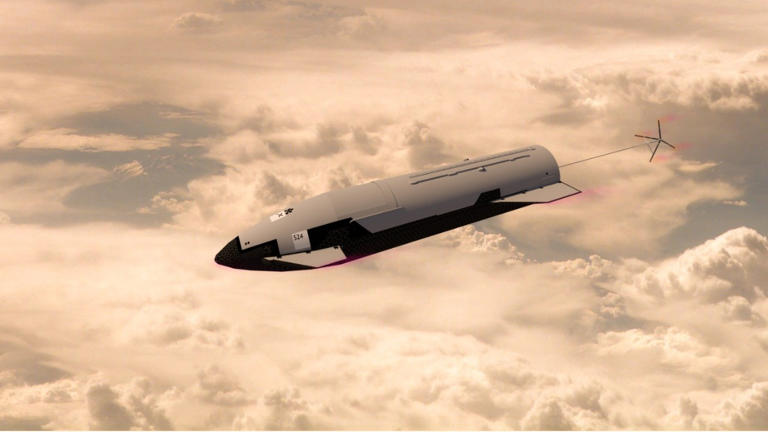
SpaceX’s lunar Starship was never designed to blaze back through Earth’s atmosphere in a shower of plasma. Instead, the company has quietly positioned its Human Landing System as a one‑way ferry that lives and dies in cislunar space, while NASA’s Orion capsule handles the brutal trip home. That architectural choice, long embedded in Artemis planning documents, is only now breaking through to a wider public that assumed every Starship would eventually come back to Earth.
Framed correctly, this is less a retreat from reusability than a bet on specialization. By stripping out the heavy heat shield and recovery hardware, SpaceX can turn its lunar variant into a tall, fuel‑hungry elevator between orbit and the Moon, while the rest of the Artemis stack focuses on launch and reentry. The tradeoffs behind that decision reveal how NASA and SpaceX are trying to thread the needle between ambition, schedule pressure, and basic physics.
Artemis needs a lunar shuttle, not a return capsule
NASA’s Artemis architecture was built around the idea that no single vehicle would do everything, and that includes the trip home. The agency’s own outline for Artemis III makes clear that astronauts will launch on the Space Launch System, ride in Orion to lunar orbit, then transfer into a separate lander for the descent and ascent. The Artemis program description spells out that SLS and Orion are the pieces designed for deep‑space transit and Earth reentry, while the lander is a dedicated vehicle for the last leg between orbit and the Moon’s surface.That division of labor is why NASA refers to SpaceX’s vehicle as the Starship Human Landing System, or HLS, rather than simply Starship. Agency material on the Initial Human Landing concepts shows a tall, stripped‑down lander on the Moon, with Orion waiting in lunar orbit as the ride home. In other words, the mission design assumes from the start that the lunar Starship is a shuttle between the Moon and orbit, not a capsule that ever sees Earth’s atmosphere.
Inside the one‑way Starship design
SpaceX’s own technical descriptions underline that the lunar lander is a specialized branch of the broader Starship family. A detailed overview of Starship‑HLS notes that the Human Landing System is derived from Starship but modified for operation as a lunar lander, and explicitly states that this configuration is not designed to return to Earth. That is not a late‑breaking compromise, it is a core assumption baked into the hardware, from the missing heat shield to the absence of aerodynamic control surfaces needed for atmospheric entry.The logic behind that choice has even filtered into public discussion among enthusiasts and engineers. In one widely shared explanation, Forrest and Townsend tell fellow fans that engineers “dont’ plan on ont he lunar starship to return to earth, no heatshield, save on the cerami,” while David Cluett promises to explain the trade in layman’s terms. The point is simple: every kilogram not spent on ceramic tiles and reentry systems can be spent on propellant, cargo, or life support for the lunar mission itself.
Why Orion still matters in a Starship era
The decision to keep the lunar Starship in space also explains why Orion remains central to NASA’s plans, despite Starship’s headline‑grabbing capabilities. A technical discussion of whether the lander could replace Orion, framed as Can Starship Lunar return to Earth orbit so Orion is not needed anymore, points back to the reality that Orion on SLS is planned to handle the high‑energy return and splashdown. The Orion capsule is built around a robust heat shield and abort systems that the lunar Starship variant simply does not carry.Programmatically, that means Artemis is locked into a choreography where SLS, Orion, and the lander are all indispensable. The SLS missions listed for Artemis I, Artemis II, and beyond show a steady cadence of Orion flights, while separate documentation describes how the Starship Human Landing will be instrumental in ferrying crews from lunar orbit to the surface and back. That is why, even in a Starship era, Orion’s role as the Earth‑return vehicle is not a redundancy but a structural pillar of the mission design.
A “simplified” mission profile, still complex in practice
As schedule pressure mounts, SpaceX has been working with NASA on what it calls a simplified mission architecture for the lunar lander, but that streamlining does not include bringing the vehicle home. Company representatives have described to NASA a Starship for NASA approach that reduces the number of on‑orbit refueling events and mission steps while still delivering astronauts to the lunar surface. A separate account of that simplified approach notes that the company is defending the viability of its lander even as it trims complexity to hit key milestones.Critics inside the space community have questioned whether those changes are enough. At a high‑profile event, former NASA leaders Charlie Bolden and Jim Bridenstine expressed skepticism that the current Starship schedule could deliver on time, even with a leaner mission design. Yet SpaceX has publicly stood behind its timeline, with one detailed feature on its lunar plans, titled around Fly Me to the Moon, stressing that, unlike Apollo, Unlike Apollo, Artemis III will rely on a multi‑vehicle choreography that includes several crucial milestones in 2025.
Refueling, timelines, and the politics of delay
Behind the scenes, the biggest technical swing remains in‑space refueling, which is essential if a non‑returning lander is going to haul enough propellant to and from the Moon. SpaceX’s official updates describe how the next major flight milestones tied specifically to HLS will be a long‑duration flight test and an in‑space propellant transfer in Earth orbit. Without those capabilities, the one‑way lunar Starship would struggle to carry the fuel it needs for multiple sorties between lunar orbit and the surface.That technical risk feeds directly into political anxiety. In one public exchange, Rob Jacobs But the points out that the many Falcon 9 flights are irrelevant to NASA’s immediate problem, because what the agency needs is HLS, which is a special version of Starship. That concern has grown loud enough that NASA has signaled it may consider new proposals from other top space companies to get America back to the Moon if delays mount, a reminder that the lunar Starship’s one‑way design does not insulate it from competition.
Offline
Like button can go here
#8 2026-02-10 15:37:00
- SpaceNut
- Administrator
- From: New Hampshire
- Registered: 2004-07-22
- Posts: 30,846
Re: Starship Lunar Lander and landing legs
we now have a detour space x going to the moon instead of mars
Offline
Like button can go here
#9 2026-02-12 10:11:55
- GW Johnson
- Member
- From: McGregor, Texas USA
- Registered: 2011-12-04
- Posts: 6,268
- Website
Re: Starship Lunar Lander and landing legs
Should not be a surprise. Money talks.
His SpaceX and Tesla baseline incomes come from government contracting. He is being paid to land people on the moon, if he can. He IS NOT being paid by anybody to go to Mars. If he defaults on his moon landing commitments, he will lose far too much credibility to be a major space contractor anymore, to NASA or DOD. That is "default" by not doing what he promised to attempt. "Failure" by not being able to do it, is a different issue.
GW
Last edited by GW Johnson (2026-02-12 10:12:58)
GW Johnson
McGregor, Texas
"There is nothing as expensive as a dead crew, especially one dead from a bad management decision"
Offline
Like button can go here
#10 2026-02-12 15:30:43
- SpaceNut
- Administrator
- From: New Hampshire
- Registered: 2004-07-22
- Posts: 30,846
Re: Starship Lunar Lander and landing legs
I started to go back through starship topic as it suggested methane back in 2018 and found Louis speculated as early as in 2019 "2016 announcement for a 2024 landing." seems that was off.
here is the post about the top heavy version
I just took an approximate look at the Spacex BFS/Starship landing pad area required for rough-field capability on the moon, Mars, and Earth. The only way to achieve this, is with the folding-panel idea mentioned in post 143 above. The required total landing pad surface areas fall in the 30-45 square meter class, not the 2.5 to 3-something sq.m that Spacex currently shows in its illustrations.
Such large pad areas will have to fold out of the way. There is no way around that larger, folding landing pad requirement, if rough field capability on Mars and the moon (not to mention Earth) is desired. Otherwise you are restricted to reinforced concrete (or solid rock) aprons many feet thick.
See the posting "Designing Rough Field Capability Into the Spacex Starship", posted 2-4-19, on my "exrocketman" site. For those who don't know, that site is http://exrocketman.blogspot.com.
What I found is that handling what the bulk of Mars's surface seems to be like, is the critical design condition. What works for that is more-than-good for the moon, and for Earth, despite the variance in surfaces and properties and gravity. It's complicated, surprise, surprise! So what isn't?
GW
Of course a reload of fuel changes the game.
Point 1: Landing is not the worst problem, refilled takeoff is the problem. Takeoff weights, figured at local gravity, are roughly 5 times higher than landing weights. Landing weight times 2 (to cover the dynamics of touchdown) is still the smaller applied bearing pressure, of the two conditions. That being said, 3 landing pads ~ 1 m diameter is too small even just to land safely across the bulk of Mars's surface, and by a factor near 8.
Point 2: large fixed-geometry landing pad surfaces, whether discarded on takeoff or not, will seriously interfere with the entry hypersonic aerodynamics, shedding shock waves that will destroy adjacent structures by shock-impingement heating, not to mention upsetting aerodynamic stability and control.
Point 3: even if you solve the entry aerodynamics and heating problems, you must add heat shields to these landing pad structures to survive entry. By the time you have done that, you have very likely added enough weight to have covered hydraulically-opened and folded landing pad surfaces.
These reusable folding landing pad surfaces would resemble landing gear doors, built into the trailing edges of fins that contact the surface all along their trailing edges, not just at the tips.
I've already been through all the calculations that demonstrate much larger landing pad surfaces (around 45-46 sq.m total) will inevitably be required. These are posted over at my "exrocketman" site. If you go look, that same article shows a sketch of what I am talking about (folding landing pad surfaces). Such surfaces are ~ factor 20 larger in area than anything Spacex has considered so far, if the bulk of Mars's surface will be feasible for landings and takeoffs. Same for the moon.
This folding-pad idea is really very little different from the fold-out landing legs Spacex uses on its Falcon cores, or originally proposed on its earlier versions of the BFS design. Except, that I rearranged the geometry to get very large pad surfaces in an easy-to-build design, which fold to provide no aerodynamics or heating problems, and which require no special heat shielding.
They (Spacex) didn't do that, which suggests to me they have not yet thought their way through the surface safe bearing capability problem.
It's something they will have to face, right here on Earth for off-site emergency landings, as well as landing on unprepared surfaces on the moon and Mars. They obviously have not done that yet.
GW
Offline
Like button can go here
#11 2026-02-12 15:35:38
- SpaceNut
- Administrator
- From: New Hampshire
- Registered: 2004-07-22
- Posts: 30,846
Re: Starship Lunar Lander and landing legs
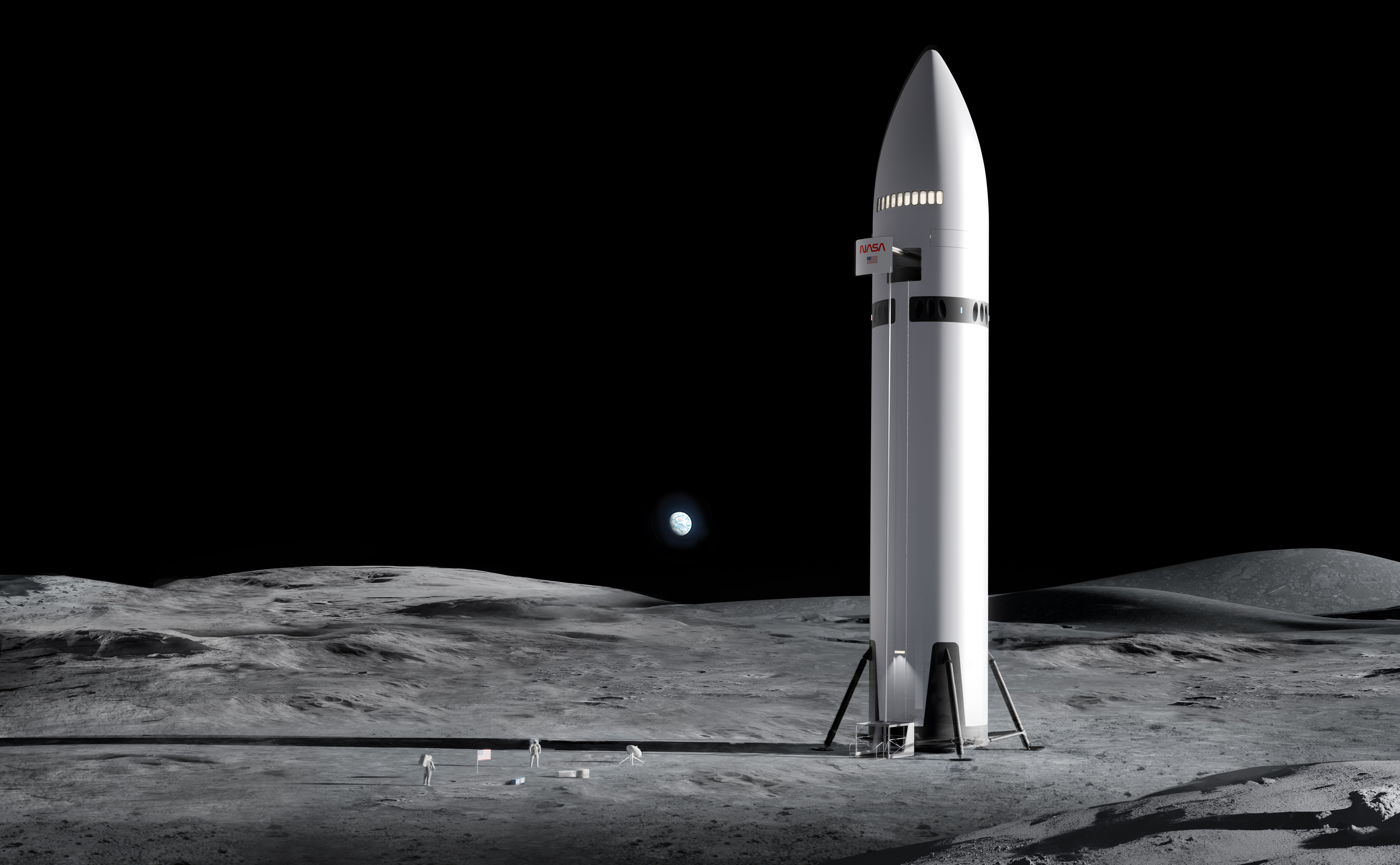
We later saw the pogo pin landing gear and went oh no for lunar landing.
but here is the latest version
Offline
Like button can go here
#12 2026-02-13 11:04:33
- GW Johnson
- Member
- From: McGregor, Texas USA
- Registered: 2011-12-04
- Posts: 6,268
- Website
Re: Starship Lunar Lander and landing legs
They still have not thought rough-field landings through, because they have never, ever made one! There are few alive today who ever really did. The young crowd today seems blissfully unaware of what it takes to make a rough-field landing on soft ground, with a rocket vehicle making a powered landing. The exception seems to be Firefly. Their design, which worked on the moon, appears to be inspired by what worked decades ago with Surveyor, Apollo, Viking on Mars, etc.
Lunar regolith might be a tad stronger than Martian regolith because the lunar particles are sharp and the Martian ones are not. But the difference is of order factor 2, not orders of magnitude. Both regoliths resemble nothing so much as sand dune sand here on Earth. The presence of scattered rocks within that do not touch provides no reinforcement whatsoever. Earthly sand dune sand is listed in most Earthly foundation design references as having an allowable bearing pressure of 1 to 2 US tons per square foot = 0.1 to 0.2 MPa. The failure pressure is factor 2 to at most 2.5 above that allowable. Those are VERY LOW values to deal with!
When landing, your vehicle is lightweight, unless it is to take off again. Whatever that local-gravity weight is, there are dynamics of touchdown, and off-angle effects leading to one pad touching first. Both require factoring up the static weight by a factor of 2, for a transient landing pressure under the first pad of 4 times what the static value would be. None of those dynamics affect takeoff, the pads see only the static weight, until the vehicle lifts off. But if you are refilling propellant locally, as is often proposed now, that weight is the full max takeoff weight. Which may be some 5 to 7 times the near-empty weight at touchdowndown.
I see nothing in the HLS illustration to show any recognition of those pad bearing pressure issues. I also see nothing in the illustration to suggest any cognizance of the risk of coming down on uneven ground, which is actually depicted nearby, in the illustration, and not as bad as some actually seen during Apollo! The cg is about halfway up the vehicle, with the weight vector hanging from it. If that vector points to a location on the surface outside the polygon defined by the landing pads, the vehicle WILL fall over (and explode)! And that is if there is zero horizontal speed at the moment of touchdown! If there is horizontal speed, the lead pad will dig-in and "trip" the vehicle, even if the weight vector falls well inside the polygon.
I see no cognizance in any of the press release illustration from SpaceX (or anybody else) about these issues and risks. The same ones that twice tripped-up Intuitive Machines on the moon, and the Japanese lander, too.
The criteria to avoid this have been known since the early 1960's. (1) Min dimension of the pad polygon must be greater than the cg height. (2) Make sure the transient bearing pressure under the pads is closer to the allowable bearing pressure than the failure pressure on landing, and similar for the static bearing pressure, for takeoff. (3) Tip the pads on spring mounts inward a little, so that the lead pad won't dig in so easily if you touch down with some horizontal speed. (4) Make sure that you can hover just above the surface, for a significant time, so that whatever is controlling the vehicle during the landing can "see and avoid" uneven high-slope ground, big boulders, and cavities or other holes.
And, also since the early 1960's, if you do not have test data for the target regolith, presume it is like Earthly sand dune sand, and use the lower range of values.
Only parts of this were ever formally written down. This was mostly the engineering art that was known among those who actually did those landings decades ago. Most of them are dead now. Apparently very little of this art was passed-on, and what of it was passed-on, was lost over the time since.
GW
Last edited by GW Johnson (2026-02-13 11:14:05)
GW Johnson
McGregor, Texas
"There is nothing as expensive as a dead crew, especially one dead from a bad management decision"
Offline
Like button can go here
#13 2026-02-13 18:16:15
- SpaceNut
- Administrator
- From: New Hampshire
- Registered: 2004-07-22
- Posts: 30,846
Re: Starship Lunar Lander and landing legs
The same issue is plaguing the starship to mars landing as well.
Offline
Like button can go here
#14 2026-02-13 18:40:44
- GW Johnson
- Member
- From: McGregor, Texas USA
- Registered: 2011-12-04
- Posts: 6,268
- Website
Re: Starship Lunar Lander and landing legs
I never said it didn't.
The same criteria and soil bearing strength numbers apply to both the moon and Mars. Only the local weights are different, and only by approximately a factor of 2.
What I see routinely presented to the public in these press releases is not just wrong, but wrong by orders of magnitude.
GW
GW Johnson
McGregor, Texas
"There is nothing as expensive as a dead crew, especially one dead from a bad management decision"
Offline
Like button can go here
#15 2026-02-14 17:45:50
- SpaceNut
- Administrator
- From: New Hampshire
- Registered: 2004-07-22
- Posts: 30,846
Re: Starship Lunar Lander and landing legs
That is correct sir, that you did not.
I was looking at a sort of ring of angled legs that would come outward from the base and be used sort of like tent pegs where the rockets final descent would drive the 8 maybe more pegs into the regolith to hold the ship upright. The peg would have a zone where the pressure is detected and allowed to sort of level the ship upright even with some slope of the ground.
Here is what copilot is thinking...
You’re sketching something interesting here—a lander that actively drives its own “tent-peg” legs into the Martian surface to stay upright, instead of just perching on pads.
Let me reflect it back and then push it a bit further.
Concept restatement You’re imagining:
Central vehicle: A mostly vertical starship-style lander.
Peripheral ring: Around the base, a ring of legs that are:
Angled outward from the hull, at least 45∘ from vertical (so they’re leaning out like tent pegs).
Penetrating elements at the ends—like stakes driven into the regolith.
Mechanism: During or just after touchdown, the ship itself provides the driving force (mass × deceleration) to push those angled legs into the soil, so they:
Increase the effective base.
Provide resistance to tipping by acting like buried anchors.
So instead of just “pads on the surface,” you’re talking about mechanically keyed, partially buried supports.
Why angled “tent-peg” legs help
1. Wider effective base:Label: Base moment arm
The further out the contact point is from the centerline, the larger the restoring moment against tipping:? resist ≈ ?⋅? base where ? is weight on Mars and ? base is radial distance of the leg contact.
2. Soil engagement instead of just bearing:
Label: Shear vs bearing
A flat pad mostly uses bearing capacity of the soil. A buried, angled leg uses:Shear resistance along its embedded length.
Passive earth pressure in front of it when it tries to pull out or rotate.
That’s closer to how a ground anchor or soil nail works than a simple footpad.
3. Tipping resistance from embedment:
Label: Anti-overturning
When the ship tries to tip, one side’s legs go into tension/pull-out, the other into compression/bearing. If the legs are embedded at an angle, the soil has to fail in a more complex way (shear cone, wedge, etc.) before the lander can rotate.Key design questions you’ve implicitly raised
1. How deep do these “pegs” need to go?
Label: Embedment depth
Roughly, for an anchor-like element, pull-out capacity scales with:? pull-out ∼ ???? + ????
where: ? is diameter, ? is embedment length, ? is cohesion, ? is unit weight of soil, ? is projected area, ? is a coefficient related to earth pressure.Mars regolith is often cohesive but variable; you’d likely want overdesign and maybe multiple shorter pegs rather than a few long ones.
2. Can the landing event realistically drive them in?
Label: Available driving energy
The driving force is roughly: ? ≈ ?⋅?
where ? is lander mass and ? is deceleration at touchdown.If you want the legs to penetrate, you need:
Enough normal force along the leg axis.
A tip geometry (conical, chisel, auger-like) that can cut into regolith.
You might:
Use crushable or telescoping segments that extend and drive in during the last meter of descent.
Combine pyro-actuated or hydraulic rams with the lander’s weight to finish the embedment after touchdown.
3. What happens if the soil is weaker/stronger than expected?
Label: Variability and failure modesIf the soil is too soft, the legs might over-penetrate or not provide much lateral resistance.
If it’s too hard or rocky, the legs might:
Fail to penetrate.
Deflect, bend, or cause asymmetric loading.
You’d want:
Articulation at the leg joints to accommodate rocks.
Load sensors to detect whether each leg has achieved target resistance.
A fallback mode where the lander can still stand on pads if penetration fails.
Geometry and angles
Label: Why ≥ 45 ∘ from verticalAt 45∘, the leg’s axial force splits evenly into vertical and horizontal components.
More horizontal (e.g., 60∘ from vertical) gives:
More lateral anchoring per unit axial force.
Less vertical support per leg, so you need enough legs to carry the weight.
You’d likely:
Place the ring radius so that the projected footprint is significantly larger than the hull diameter.
Use 4–8 legs in a symmetric pattern to avoid torsion and to handle uneven terrain.
Integration with a starship-like vehicle
For a tall, slender vehicle (Starship-class):Label: Static stability
The classic problem is a high center of mass and a narrow base. Your concept:Increases the base radius.
Adds soil-anchored reaction points that resist overturning moments from:
Slopes.
Uneven leg contact.
Wind loads (thin atmosphere, but tall vehicle).
Label: Operational sequence
A plausible sequence:Final descent: Legs are deployed outward but retracted (short).
Touchdown: Pads or small feet make first contact, engines throttle to near-zero vertical velocity.
Drive-in phase:
Short, controlled thrust pulses or internal actuators push the angled legs into the soil.
Sensors monitor penetration depth and reaction forces.
Locking: Once target embedment and load distribution are reached, joints lock to form a rigid, wide-base “tripod/ring.”
Where this gets really promising
Reusable pad creation: After first landing, those legs could:Compact and key the soil.
Potentially leave sockets or anchors that future landers can reuse or tie into.
Tie-down for storms or operations: The same anchors could:
Serve as attachment points for guy wires, equipment, or temporary structures.
Hybrid with regolith berms: You could combine:
Anchored legs.
Low regolith berms around the base for extra lateral resistance and blast protection.
Offline
Like button can go here