New Mars Forums
You are not logged in.
- Topics: Active | Unanswered
Announcement
#51 2026-01-25 17:45:41
- SpaceNut
- Administrator
- From: New Hampshire
- Registered: 2004-07-22
- Posts: 30,875
Re: Why Artemis is “better” than Apollo.
Offline
Like button can go here
#52 2026-01-26 10:15:28
- GW Johnson
- Member
- From: McGregor, Texas USA
- Registered: 2011-12-04
- Posts: 6,304
- Website
Re: Why Artemis is “better” than Apollo.
Well, NASA managers are "playing the odds". Yes, the Artemis-2 heat shield is going to spall out chunks, maybe more of them since it was built less permeable, or so the story says. The Artemis-1 heat shield was mostly identical, and spalled out chunks. But those ugly and alarming craters left behind were not enough to cause a burn through.
Less likely would be two craters close enough together to be one big crater, at the bottom of which another chunk happens to spall out! That would penetrate most of the way through the heat shield, leading to a burn-through, in turn very likely fatal for the crew.
You have to understand what Avcoat really is. It is a cycolac polymer loaded with little microballoons to lower its density and increase its ablation rate. Denser is lower ablation rate. Too dense, and gas has more difficulty getting out of the less permeable char. But the more filled with microballoons, the more viscous it is, and hard to mold into where you want it to go. Artemis 2 has fewer microballoons in more of the tiles they made, according to the story. That's denser, with a slower ablation rate, but a less permeable char, increasing the risk of the gas not getting out, and so causing chunks to spall off.
Their theory is that gas unable to get out fast enough blows off chinks of char, exposing virgin material beneath too soon. That’s probably right. Probably.
Have you ever handled real charcoal? Not the pressed crap they sell for your grill, but an actual charred piece of wood? Depending upon the species, it can be quite weak. The more fibrous and stronger the virgin wood, if the charred fibers hold together, the physically tougher a charred piece of it is. Think of oak as strong char (good coals in the fireplace), versus mesquite as weak (doesn't even form coals, just burns immediately to soft ash).
The fundamental mistake NASA made with the Orion heat shield has NEVER BEEN ADDRESSED! That was deleting the fiberglass hex from the Avcoat! They continue to think of that as an either/or decision. Either we build it like Apollo, or we make tiles. That is just plain BS !!!!
You can put the hex back into every tile you make, where as the hex chars and melts, but at a rate slower than the cycolac, its fibrous structure ties the cycolac char together, as a sort of composite material. THAT is why the heat shields built Apollo-style did not spall chunks! THAT is the real difference! Not piddling around with more or less microballoon content in the cycolac polymer!
Here is where you have to see beyond the either/or thinking, in order to put the hex back into the Avcoat. Apollo (and EFT-1 Orion) had the hex bonded to the capsule structure. Into each and every hex cell, you had to manually gun viscously-stiff cycolac with a high microballoon content, to make sure its ablation rate was faster than the fiberglass hex (likely epoxy or vinyl ester resin on glass fiber, I don't know such details). There were 300,000-ish cells on Apollo, and nearly 400,000 such cells on Orion EFT-1. That's a LOT of manual labor to be paid!
Managers do not like to spend money. The good ones will spend what it takes to protect lives. The bad ones will not. There are more bad ones than good ones, we’ve already seen that during 2 shuttle-loss inquests. In fact, the good ones might well now be extinct, near as I can tell.
Here is how you do it OUTSIDE their either/or thinking:
Put a hex core into a tile mold with no bottom. Instead of pouring your cycolac /microballoon mix into an empty mold with a bottom, put that hex-containing bottomless mold on the outlet of an extrusion press (such are very common in the molded plastics industry). Load your cycolac / microballoon mix into the press, and extrude it through the cells in the hex inside that bottomless mold. Use a trowel to scrape most but not all of the extruded strings of mix off the bottom of the hex, and install the bottom of the mold. Then remove the mold from the press, add a bit more mix on top with the trowel, and install the top of the mold. Go cure the thing.
Result: hex-reinforced tiles that will not spall, because they are fiber-reinforced AND you used the correct high-microballoon mix ratio to get the correct ablation-rate ratio! AND you did it with low labor, saving scads of money! The labor relates to a few dozen tiles, not a third of a million cells. But you filled a third of a million cells doing it this way!
I gave that notion free of charge to NASA long ago. I was able to confirm that their heat shield group in Houston actually got it, and that some folks in that group thought very well of it. Then I never heard another word from anybody at NASA about it.
Meanwhile, NASA has had the 2 years necessary to make tiles that way and confirm that the process actually works. But they DID NOT DO THAT! They instead spent all their time and money trying to make unreinforced tiles look OK by analysis, while ONLY considering the hand-gunned Apollo process as the alternative!
Either/or thinking among top managers. The very same as what killed 2 shuttle crews! They so very clearly do NOT listen to their own engineers, much less engineers from outside the agency!
And THAT, sadly, is my assessment of NASA, regardless of who leads it!
GW
GW Johnson
McGregor, Texas
"There is nothing as expensive as a dead crew, especially one dead from a bad management decision"
Offline
Like button can go here
#53 2026-01-26 12:24:51
- SpaceNut
- Administrator
- From: New Hampshire
- Registered: 2004-07-22
- Posts: 30,875
Re: Why Artemis is “better” than Apollo.
Photos: NASA's Orion Spacecraft Heat Shield on Display
For the manual filling.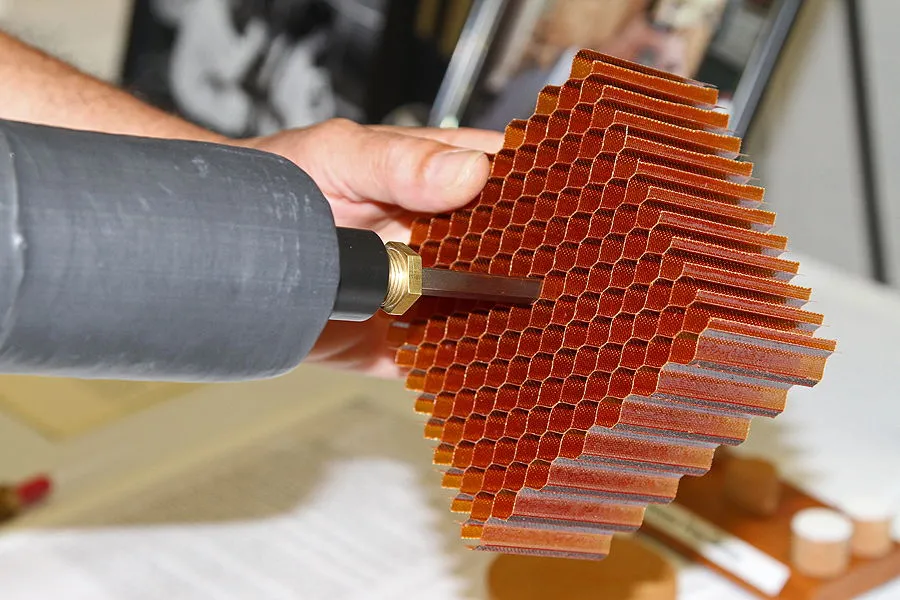
Offline
Like button can go here
#54 2026-01-29 10:48:26
- GW Johnson
- Member
- From: McGregor, Texas USA
- Registered: 2011-12-04
- Posts: 6,304
- Website
Re: Why Artemis is “better” than Apollo.
Based on the color in Spacenut's photo, the resin in the hex may be phenolic. The fiber definitely looks like glass, but could be a mineral fiber like fire curtain cloth, although that's not likely due to the high costs compared to glass.
I've never seen anything definitive about those material choices, so I do not know.
But look at Spacenut's photo once again! That's a chunk of the hex held in the hand, to show how the gun nozzle fits the hex cell, for hand-gunning the heat shield. It also shows almost EXACTLY my alternative!
Put a bottomless mold around that chunk of hex, and attach it to the outlet of a plastic extrusion press. Use the press to fill all the cells in the hex at once, plus the border between hex and mold wall. Trowel off the excess on the bottom, install the mold bottom, take the mold off the press, trowel some of that excess onto the top, and install the mold top. Then go cure the thing.
You have to think outside the either/or trap! They've spent 2 years now trying to justify-with-analysis flying a defective heat shield with a crew! They could have replaced that heat shield with a hand-gunned one in that 2 years, or they could have tried my idea and proven it worked in that 2 years, with the hand-gunned option as a backup.
THEY DID NEITHER!
They did not want to pay the labor to hand-gun any more heat shields, and I cannot fault that aversion. But they did NOT value crew safety high enough to NOT fly a known defective heat shield! And, they were too bound up in their either/or thinking to consider any other options! Not to mention "not invented here" thinking, since my idea came from outside their organization. (I had to use a friend at NASA just to get it inside!)
Either/or thinking and "not invented here" attitude. Not prioritizing crew safety above cost and schedule! THAT is the fault here! And it has NOT changed since Challenger and Columbia! The real lessons of those disasters were quite apparently NEVER learned!
Those shuttle loss inquests were around a billion dollars, and 18 months or more, each! There really is nothing as expensive as a dead crew! Especially crews dead from bad management decisions! Just like my by-line says!
GW
Last edited by GW Johnson (2026-01-29 10:49:00)
GW Johnson
McGregor, Texas
"There is nothing as expensive as a dead crew, especially one dead from a bad management decision"
Offline
Like button can go here
#55 2026-01-29 18:55:30
- SpaceNut
- Administrator
- From: New Hampshire
- Registered: 2004-07-22
- Posts: 30,875
Re: Why Artemis is “better” than Apollo.
NASA scrambles as Orion’s heat shield glitch forces a total reentry rethink
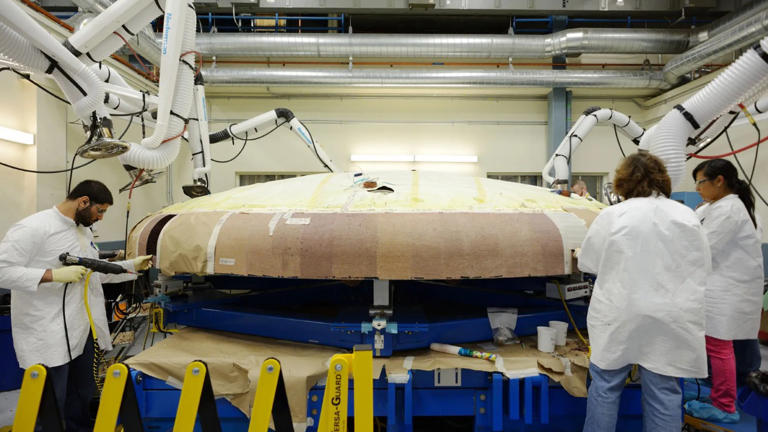
NASA’s return to crewed lunar flight is now hinging on a slab of material at the bottom of Orion that did not behave the way engineers expected. Instead of a straightforward fix, the agency is reworking how the capsule will slice back through Earth’s atmosphere, a late-stage pivot that has scrambled planning for Artemis II and beyond. The stakes are blunt: four astronauts, a 50-year gap in human lunar voyages, and a heat shield that has already surprised its designers once.
What began as an engineering anomaly on an uncrewed test has grown into a full campaign to rethink reentry, timelines, and risk tolerance. The result is a program that is still moving toward the Moon, but now with a visibly more cautious and contested path to getting its crew home alive.
The anomaly that turned a test flight into a warning shot
The trouble started when the first integrated Artemis flight, Artemis I, sent The Orion around the Moon and back to Earth as a high energy test of the Space Launch System and Orion and associated systems. As Orion slammed into the atmosphere at 25,000 miles per hour, or 40,200 kilometers per hour, the capsule’s ablative material did not erode in the smooth, predictable way models had forecast. Instead, chunks of the Avcoat coating came off in a pattern that suggested gases failed to vent properly and Pressure behavior inside the material was not fully understood, turning what should have been a textbook demonstration into a red flag for future crews.In the months after the Orion spacecraft splashed down, NASA acknowledged that the base of the capsule had lost more of its protective layer than expected as it returned to Earth from the uncrewed Artemis 1 mission. Internal reviews and an external Audit Identifies Significant Issues with the Orion Heat Shield, documented by the agency’s OIG, flagged concerns such as bolt melting and the possibility that unexpected erosion paths could threaten the vehicle and loss of crew. Those findings pushed the heat shield from a routine certification item into the central technical risk for the entire Artemis campaign.
NASA’s investigation and the decision not to rebuild
NASA responded with a sprawling investigation that, according to agency leaders, involved more than 100 tests across the country to understand why Avcoat had behaved so differently in flight. After that test campaign, Nelson and other officials said the U.S. space agency was moving forward with Ori hardware for the next mission rather than tearing the system apart. The agency’s decision comes after an extensive internal review of the Artemis I heat shield issue showed the Artemis II heat shield configuration could be flown safely if the mission profile was adjusted, a conclusion that has become the backbone of the current strategy.Experts who briefed the public described how NASA, Orion program managers, and materials specialists dissected flight data, ground tests, and modeling to isolate the root cause. In parallel, a separate Jan briefing framed how Artemis and later Mars ambitions depend on getting this right, since the same family of materials and design philosophies will be needed for crewed Mars missions. Another Jan discussion of the real cause of the Orion heat shield behavior, tied directly to Artemis and NASA’s broader exploration roadmap, underscored that the agency believes it understands the physics well enough to proceed, but will change how the spacecraft comes home rather than rebuild the shield from scratch.
A reentry profile rewritten on the fly
Instead of replacing the heat shield on the already assembled Artemis II capsule, NASA is flying the spacecraft as-is and instead modifying the re-entry profile. That choice, described in a Dec update that noted Last week NASA announced the new approach, effectively trades hardware changes for trajectory and attitude tweaks that reduce peak heating and alter how loads are distributed across the Avcoat surface. The issue relates to a special coating applied to the bottom part of the spacecraft, called the heat shield, and the new plan is to manage how that coating is stressed rather than to redesign it this late in the flow.Further complicating the situation was the fact that by the time the anomaly was fully understood it was already too late to fix the heat shield for Artemis II without a major schedule reset, as a Jan analysis of the program noted. NASA’s Artemis II Orion heat shield is now at the center of an ongoing safety debate in the lead-up to Artemis II, with engineers planning a reentry that uses the Moon’s gravitational pull and a carefully shaped corridor through the atmosphere to keep conditions within the bounds of what the investigation says the system can tolerate. In practice, that means a total rethink of how Orion will descend, from entry angle to roll maneuvers, all aimed at ensuring the Avcoat never again surprises the people riding behind it.
Schedules slip, rockets roll, and the Moon stays in sight
The heat shield saga has rippled directly into timelines. In Dec, NASA is hitting a reset on its Artemis Moon schedule, with In April 2026 now targeted for launching a crew of four as part of the Artemis II mission on a 10 day circumlunar flight. A separate Dec update on NASA’s Artemis II mission, which aims to return humans to the Moon after a 50-year hiatus, confirmed that the flight had already been delayed from an earlier September 2025 target, illustrating how thermal protection concerns and other integration work have pushed the calendar to the right.Accordingly, a Dec briefing announced new target launch dates for its Artemis II crewed test flight and Artemis III crewed lunar landing, with Both missions shifted so that the landing now moves from 2026 to mid 2027. A related Dec overview of the SLS hardware highlighted how the Core stage, which holds two propellant tanks for Liquid oxygen and Liquid hydrogen, stacks into a Total height fully stacked of 322 feet, or 98 meters, underscoring the scale of the system that must work in lockstep with Orion’s revised reentry plan. Even as schedules move, the physical rocket is advancing: Jan imagery shows NASA’s Artemis II Space Launch System, or Artemis II Space Launch System, and Orion illuminated at Launch Complex 39B as teams prepare for a fueling test and a simulated countdown known as terminal count, while a separate Jan community piece noted that The Space Launch System, or SLS, was rolled out to Launch Pad 39B with John Saccenti describing how the vehicle is expected to support a launch window that opens next week on Feb. 6.
Astronauts, risk, and a public test of trust
Behind the engineering charts are four people who will strap into this vehicle. Jan social media posts from NASA framed the mission in aspirational terms, with Our Artemis II crew highlighted as heading to the Moon and a reel noting that @astro_reid, @astro_victor, @astro_christina, and the @canadianspaceagency’s @astrojeremy will fly the first crewed Orion. Another Jan update on NASA’s Artemis II mission stressed that NASA’s Artemis II mission, which aims to return humans to the Moon after a 50-year gap, is not just a symbolic milestone but a critical systems test that must prove the heat shield, life support, and navigation can all function together in deep space before any landing attempt.
How Artemis II’s free return path could save astronauts if everything fails
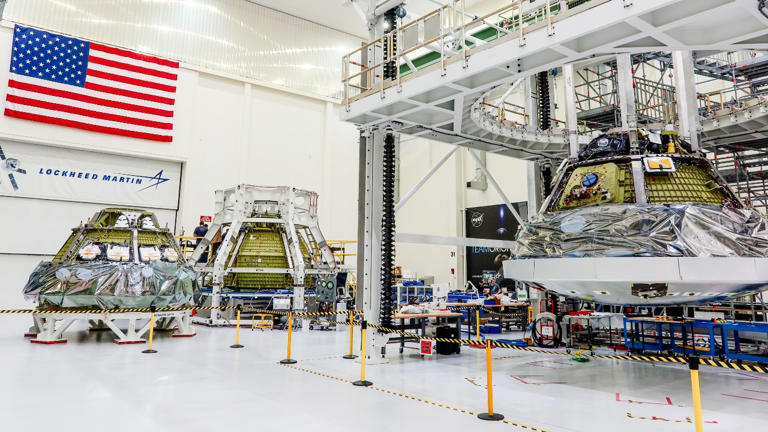
Artemis II is designed to carry humans around the Moon and back on a path that can bring them safely home even if their main engine never lights again. Instead of relying solely on propulsion, the mission leans on a carefully tuned “free return” loop that lets gravity do the work if everything else fails. I see that choice as the quiet centerpiece of NASA’s push to send people farther from Earth than any crew has ever gone in more than 50 years.
That backup path is not a bolt‑on contingency but a core part of how the flight is built, from launch through the swing behind the Moon and the plunge back into Earth’s atmosphere. It shapes the ten‑day timeline, the way Orion tests its systems, and even how far past the lunar far side the astronauts will travel before turning for home.
Why Artemis II needs a built‑in way home
Artemis II is the first crewed outing of the Artemis program, and it will send four astronauts on a roughly ten day loop around the Moon without landing. According to Artemis II mission descriptions, the flight is planned as a lunar spaceflight under the broader Artemis campaign led by NASA. It will be the first time humans travel toward the Moon since the Apollo program ended, and planning documents describe it as the first return of people to the lunar vicinity in over 50 years.That distance raises the stakes. The Artemis II crew will travel approximately 4,600 miles beyond the far side of the Moon, making it the farthest human spaceflight from Earth so far. With the Space Launch System rocket still relatively new, with only one full mission behind it, even supporters acknowledge that, as one analysis put it, Plus the rocket and its components do not yet have a deep flight record. In that context, a trajectory that can carry the crew home without further engine burns is not a luxury, it is a risk‑reduction tool.
How a lunar free return actually works
The free return concept is simple to describe and fiendishly complex to design. Mission planners set Orion on a path where, as it swings behind the Moon, the spacecraft falls into the grip of lunar gravity and then naturally arcs back toward Earth without needing another major burn. One explanation of the physics puts it this way: Here, as Orion approaches our lunar neighbor, the Moon’s immense gravity takes over and bends the track into a loop that guarantees a safe return home if nothing else intervenes.Visualizations of the Artemis II Trajectory show the Nominal path of Artemis II from Earth orbit around the Moon and back. As Orion nears the far side, the trajectory is tuned so that the spacecraft’s momentum and the Moon’s pull combine to “slingshot” it home. Commentators in one spaceflight group describe this as a backup engine in its own right, noting that On February, Artemis II will rely on a route where the spacecraft will automatically slingshot them home if needed.
From launch to lunar swingby: threading the needle
The safety net only works if the early part of the mission hits its marks. On Day 1, mission plans describe Day 1 as Launch and Earth orbit, with the rocket climbing through the atmosphere and, As the ascent continues, shedding its solid boosters and protective hardware. A major change from the uncrewed Artemis I flight is that the second mission will not enter a long lunar orbit but will instead approach and back away on a tighter loop, as outlined in comparisons of the two missions.On Day 2, while still flying around Earth, the crew will run Systems checks and a departure burn while Orion is still close enough for quick troubleshooting. That burn is what actually commits the spacecraft to the translunar trajectory. Flight dynamics specialists have published detailed work on optimized trajectory correction burns for NASA Artemis II mission, showing how small midcourse tweaks keep the path aligned with the free return corridor. Once those are complete, the crew is effectively riding a gravitational rail toward the Moon.
Why Artemis II will not orbit the Moon like Apollo 8
One of the most striking differences between Artemis II and its Apollo predecessors is that it will not brake into lunar orbit. As one mission manager put it when comparing the flights, Apollo 8 actually went into lunar orbit, did 10 revolutions and then came home, while Artemis II is not actually going into lunar orbit at all. That choice is deliberate. By skipping the braking burn that would capture Orion around the Moon, the mission avoids a point of no return where a failed engine firing could leave the crew stranded.Some enthusiasts have debated how closely Artemis II mirrors the Apollo era. One widely shared comment, attributed to JimEd Howland False, notes that Only Apollo 8, 10 and 11 used a free return trajectory before firing their main engine to get into lunar orbit. Artemis II, by contrast, is built so that the free return is not just a starting condition but the entire shape of the flight. That means the crew will still see the far side and travel thousands of miles beyond it, but they will always be on a path that naturally bends back toward Earth.
When everything fails: the “backup engine” of gravity
The real test of the free return design is what happens if something goes badly wrong. Mission briefings emphasize that Artemis II will return to Earth using what is called a lunar free return trajectory, which allows the astronauts to get back even in the event of engine failure. Another technical overview notes that The Artemis II mission will use a similar free return path precisely to provide that safety margin in the event of an engine failure. In other words, if Orion’s main engine refused to fire after the outbound burn, the spacecraft would still loop behind the Moon and head home.Fans of the program have seized on that feature as the most remarkable part of the mission. One viral post framed it this way: On February 6th the Artemis II mission will launch, but the most interesting part is not the rocket, it is the route that acts as a built‑in rescue plan. Another discussion of the same idea stresses that But the route is the backup engine, a technique that was used by the Apollos and that will automatically slingshot them home if the hardware goes quiet.
Offline
Like button can go here
#56 2026-01-30 02:22:37
- clark
- Member
- Registered: 2001-09-20
- Posts: 6,388
Re: Why Artemis is “better” than Apollo.
it will be a successful launch, and a very, very, anxious re-entry. if it was easy, SpaceX would have done it last year. cheers.
Offline
Like button can go here
#57 2026-01-30 11:21:05
- GW Johnson
- Member
- From: McGregor, Texas USA
- Registered: 2011-12-04
- Posts: 6,304
- Website
Re: Why Artemis is “better” than Apollo.
Some of these reporters and press release writers are abysmally ignorant. The phrase "moon's immense gravity" in paragraph 5 of the second article quotation is proof enough of that.
Plus I noticed the real reason they will not orbit the moon was NOT given: SLS block 1 with Orion does not have the delta-vee capability to enter lunar orbit and get back out of it! Block 1B might, but that's not what this SLS is.
As for the heat shield, I have previously posted how they are making the same kinds of bad management decisions as killed 2 shuttle crews. It's been 2 years since Artemis 1 flew. They have had the time to have replaced the heat shield, despite the article claiming there was not enough time. They spent that 2 years trying to analytically show changing entry trajectory was enough safety margin, and not everybody inside (or outside) NASA agrees with that.
Once again we see schedules and budgets prioritized above crew safety, while either/or thinking and "not invented here" attitude prevented looking for a third alternative besides flying flawed or doing it with the expensive Apollo method.
GW
GW Johnson
McGregor, Texas
"There is nothing as expensive as a dead crew, especially one dead from a bad management decision"
Offline
Like button can go here
#58 2026-02-01 15:04:29
- SpaceNut
- Administrator
- From: New Hampshire
- Registered: 2004-07-22
- Posts: 30,875
Re: Why Artemis is “better” than Apollo.
NASA delays Artemis mission to moon due to cold weather
Bracing for a weekend cold snap in Florida, NASA delayed a dress rehearsal fueling test for its Artemis II moon rocket, moving it from Saturday to Monday, and pushed the long-awaited launch back at least two days to no earlier than 11:20 p.m. EST on Feb. 8.
At the same time, NASA is gearing up to launch a fresh crew to the International Space Station to replace the four Crew 11 fliers who cut their mission short and returned to Earth on Jan. 15 due to a medical issue with an unidentified crew member.
Crew 12, launching atop a SpaceX Falcon 9 rocket, will be ready to blast off as early as Feb. 11. But if the Artemis II mission gets off on Feb. 8 as NASA hopes, Crew 12 commander Jessica Meir, pilot Jack Hathaway, European Space Agency astronaut Sophie Adenot and cosmonaut Andrey Fedaev will stand down until after the Artemis II crew returns to Earth. In that scenario, Crew 12 would launch around Feb. 19.
If Artemis II takes off on Feb. 10 or 11, the only other opportunities left in the February launch period, then Crew 12 could take off 11 days later. If Artemis II runs into major problems and slips to the next launch period in March, Crew 12 could launch as early as Feb. 13, depending on when the moon mission is called off.
But there are no scenarios where Artemis II and Crew 12 would be in space at the same time unless there's an emergency aboard the space station that requires a quick launch for Meir and her crewmates. Otherwise, the moon mission has priority.
The long-awaited Artemis II mission will use NASA's huge Space Launch System rocket to boost three NASA astronauts and a Canadian crewmate on a trip around the moon and back, the first such flight since the final Apollo mission 54 years ago. The upcoming mission will set the stage for another crew to attempt a landing near the moon's south pole in 2028.
Artemis II commander Reid Wiseman, Victor Glover, Christina Koch and Canadian astronaut Jeremy Hansen had planned to blast off next Friday, assuming a leak-free fueling test Saturday.
But with the test delay and the time needed for NASA to analyze the results, the agency opted to give up launch opportunities on Feb. 6 and 7. That leaves just three opportunities in the February launch period: Feb. 8, 10 and 11. If the rocket is not off the ground by Feb. 11, the flight will slip to early March.
The "wet dress" rehearsal countdown now will start at 8 p.m. EST Saturday. Fueling will begin around 11 a.m. Monday, leading to the opening of a simulated launch window at 9 p.m. that night.
Engineers plan to load the Space Launch System rocket with more than 750,000 gallons of supercold hydrogen and liquid oxygen to work through loading procedures and to make sure the rocket's tanks, valves, propellant plumbing and umbilicals attached to the side of the booster are leak-free and good to go.
Launch Director Charlie Blackwell-Thompson and her team plan to work through a variety of recycle options to rehearse procedures for dealing with unexpected problems.
The Artemis II SLS will be making the program's second flight. Before its unpiloted maiden flight in 2022, multiple fueling tests were required to address a variety of propellant leaks and other issues. The Artemis II rocket features upgrades and improvements to eliminate those issues.
"Artemis I was the test flight, and we learned a lot during that campaign, getting to launch," said Blackwell-Thompson. "And the things that we learned relative to how to go load this vehicle, how to load LOX (liquid oxygen), how to load hydrogen, have all been rolled into the way in which we intend to load the Artemis II vehicle.


Offline
Like button can go here
#59 2026-02-01 16:43:20
- GW Johnson
- Member
- From: McGregor, Texas USA
- Registered: 2011-12-04
- Posts: 6,304
- Website
Re: Why Artemis is “better” than Apollo.
The Artemis-II mission was delayed because of cold at Cape Canaveral. I don't know any details about the delay, but the reason (cold, just below freezing soak-out) is comparable to what killed Challenger back in 1986. That decision on NASA's part is unsurprising, since the SRB's on this launch vehicle are basically a 5-segment form of the Shuttle 4-segment SRB's. It would be incredibly stupid to make the Challenger mistake twice!
I am not sure how accurate this is, but one posting I saw on LinkedIn had an animation of the orbit Artemis-II is "going to use" (supposedly, anyway). It launches into an ellipse that apogees somewhere in or between the two Van Allen belts, then figure-8's around the moon (like Apollo, but further out from the moon), before making a free return and entry. There has to be a perigee burn to get from the ellipse onto the lunar transfer trajectory, but no other burns, other than course corrections.
If true, these astronauts will spend more time (twice or more) exposed to Van Allen belt radiation than the Apollo astronauts ever did. This is a high solar activity year. From what I read, that increases the radiation exposures from the Van Allen belts (it does decrease cosmic ray exposure outside Earth's magnetic field).
Notice also that I said nothing about the Orion heat shield risk. That is well covered in other postings. Peak convective heating occurs at about half the entry interface speed, which is near escape in a free return from the moon. Convective heating rate varies roughly as speed cubed. Plasma radiation heating rate varies by an exponent of 6 or more with speed. The effective plasma temperature in degrees K is crudely numerically equal to speed in m/s. You decide if flying a known-to-be-defective heat shield with a human crew was a "good risk to take".
GW
Last edited by GW Johnson (2026-02-01 16:58:36)
GW Johnson
McGregor, Texas
"There is nothing as expensive as a dead crew, especially one dead from a bad management decision"
Offline
Like button can go here
#60 2026-02-03 09:32:41
- GW Johnson
- Member
- From: McGregor, Texas USA
- Registered: 2011-12-04
- Posts: 6,304
- Website
Re: Why Artemis is “better” than Apollo.
Follow-up to post 59. I see also that Artemis-2 will now not launch until March at the earliest, since the propellant load rehearsal found hydrogen leaks. Reportedly, these were in the connections between the rocket and the launch pad structure, not the rocket itself. As I recall, the last SLS launch was delayed for the very same reason. So it looks like the leak problem might be chronic.
Meanwhile, I ran across this about severe solar flare activity:
From Space.com via AIAA’s Daily Launch email newsletter for 3 Feb 2026. Note that the “flare” is the burst of electromagnetic radiation that travels at the speed of light. The coronal mass ejection “CME”, if any, is the slower-moving mass of particles that constitutes the actual radiation exposure hazard. The bigger those are, and the more direct the impact upon “something”, the higher the radiation exposure that “something” receives. With big CME’s around, this might not be a good time to put crews out past Earth’s magnetic field in a spacecraft. Quote:
Sun unleashes extraordinary solar flare barrage as new volatile sunspot turns toward Earth
News
By Daisy Dobrijevic published yesterday
A rapidly growing sunspot has fired off at least 18 M-class and three X-class flares in just 24 hours, including an intense X8.3 eruption.
The sun has erupted in a relentless barrage of powerful solar flares over the past 24 hours, firing off at least 18 M-class flares and three X-class flares, including an X8.3 eruption — the strongest solar flare of 2026 so far. Solar flares are ranked by strength from A, B and C up to M and X, with each letter representing a tenfold increase in energy — meaning X-class flares are the most powerful explosions the sun can produce.
The culprit is sunspot region 4366, a volatile active region that has grown rapidly in just a few days. The flurry of activity began late Feb. 1 and has continued into Feb. 2, with multiple M-class and X-class flares erupting in quick succession. The prolific region appears to be far from finished. Spaceweather.com described the region as a "solar flare factory", warning that its rapid growth and magnetic complexity make further eruptions highly likely.
The X8.3 solar flare peaked at 6:57 p.m. EST (2357 GMT) on Feb. 1, unleashing a blast of extreme ultraviolet and X-ray radiation that ionized Earth's upper atmosphere. The flare triggered strong R3 radio blackouts across parts of the South Pacific, with shortwave radio disruptions reported across eastern Australia and New Zealand, according to NOAA's Space Weather Prediction Center.
Scientists are closely watching for signs of any coronal mass ejections (CMEs) that could follow these powerful flares. Early analysis of a CME linked to the recent X8.3 eruption suggests that most of the solar material is likely to pass north and east of Earth, with only a possible glancing blow expected around Feb. 5, according to NOAA's Space Weather Prediction Center.
If those glancing impacts materialize, they could briefly elevate geomagnetic activity and increase the chances of auroras at high latitudes. However, forecasters stress that it is too early to know whether conditions will be favorable, as much depends on the CME's speed, direction and magnetic orientation.
It's also possible that more eruptions are still to come. Sunspot AR4366 remains highly active and continues to rotate into an Earth-facing position, raising the chance that future eruptions could launch CMEs more directly toward our planet. NOAA forecasters say they expect more exciting space weather activity from this region in the coming days.
Solar flares are powerful explosions from the sun that emit intense bursts of electromagnetic radiation. They are ranked in ascending strength from A, B, C and M up to X, with each letter representing a tenfold increase in intensity. X-class flares are the strongest eruptions and the number following the X indicates how powerful the event is. Today's flare was measured at X8.3, putting it high in the upper tier of solar outbursts.
--- end quote
GW
Last edited by GW Johnson (2026-02-03 09:37:31)
GW Johnson
McGregor, Texas
"There is nothing as expensive as a dead crew, especially one dead from a bad management decision"
Offline
Like button can go here
#61 2026-02-04 09:58:41
- GW Johnson
- Member
- From: McGregor, Texas USA
- Registered: 2011-12-04
- Posts: 6,304
- Website
Re: Why Artemis is “better” than Apollo.
Follow-up to post 60. I found another article that gave more information. There were two sets of hydrogen leaks during the wet dress rehearsal. The first was in the connections between the rocket and the infrastructure around it, very similar to the leaks seen during the Artemis-1 wet dress rehearsal. These were fixed the same way as Artemis-1. Then a second set of leaks appeared. I had the impression that these were inside the vehicle. The article said they "did not understand" those leaks, and shut it down at that point.
This is a Boeing-built first stage core having propellant leak problems. So did the Starliner capsule that stranded 2 astronauts on ISS. I think I might see a pattern here: being too cheap damages quality, causing unreliability. Same corporate management mistake as what caused the 737MAX disasters. If I am right, the odds of killing the crew while riding the SLS just got higher.
GW
Last edited by GW Johnson (2026-02-04 09:59:17)
GW Johnson
McGregor, Texas
"There is nothing as expensive as a dead crew, especially one dead from a bad management decision"
Offline
Like button can go here
#62 2026-02-18 10:01:30
- GW Johnson
- Member
- From: McGregor, Texas USA
- Registered: 2011-12-04
- Posts: 6,304
- Website
Re: Why Artemis is “better” than Apollo.
I just followed a link on today's AIAA Daily Launch to a Space.com article on the Orion heat shield for Artemis. This was a reporter summarizing the latest press release from NASA, explaining why they do not think Artemis-2's heat shield will show spalling. They think deleting the skip and second heat pulse will prevent the spalling and cratering.
Most of us who actually did insulation work with ablatives DO NOT think so! NASA ran some tests and went to the same kinds of analyses to "prove" they were eliminating risks, the same stuff that failed to predict what happened to Artemis-1's heat shield.
The most disturbing thing about the press release is that they intend to build the Artemis-3 heat shield the very same way as Artemis-1 and Artemis-2, despite that landing being at least 2 years away. That mission cannot fly until (1) there is a reliable lander ready to fly crewed, and (2) their Gateway space station is in place around the moon (since SLS/Orion block 1 cannot get into and out of low lunar orbit).
They have 2 years to figure out a way to put the hex into the bonded Avcoat tiles. I gave them the way to do that over a year ago, and I know for a fact their heat shield group in Houston got it! There is NO EXCUSE not to do it, or else revert to the hand-gunned Avcoat into hex cells that worked on Orion EFT-1 and all of Apollo.
This is top level managers not listening to engineers within and outside the agency, valuing money above lives. The very same flaw that killed 2 shuttle crews!
GW
Last edited by GW Johnson (2026-02-18 10:02:49)
GW Johnson
McGregor, Texas
"There is nothing as expensive as a dead crew, especially one dead from a bad management decision"
Offline
Like button can go here
#63 2026-02-18 10:51:50
- RobertDyck
- Moderator
- From: Winnipeg, Canada
- Registered: 2002-08-20
- Posts: 8,611
- Website
Re: Why Artemis is “better” than Apollo.
Could you contact Jared Isaacman directly? He flew in space himself for Inspiration4 (2021), and Polaris Dawn (2024). He should understand the need for reliable equipment.
Offline
Like button can go here
#64 2026-02-18 14:48:48
- SpaceNut
- Administrator
- From: New Hampshire
- Registered: 2004-07-22
- Posts: 30,875
Re: Why Artemis is “better” than Apollo.
Somethings getting information into the hands of those that should care is harder than one things.
Offline
Like button can go here
#65 2026-02-18 15:12:00
- GW Johnson
- Member
- From: McGregor, Texas USA
- Registered: 2011-12-04
- Posts: 6,304
- Website
Re: Why Artemis is “better” than Apollo.
Rob:
I have no way to contact Jared Isaacman directly. All I can do is write a paper letter to him at NASA headquarters. He will not see it, some staffer will. And THAT is the problem. No one but that staffer will see it, and he/she will shit-can it. I had the very same problem writing to his predecessor with the heat shield "fix" almost 2 years ago now.
Rob & Harold:
What I eventually did was send the heat shield stuff to a former colleague whom I found out was working at NASA. He took it to the thermal protection group in Houston, and verified to me that they got it, and that they pretty much agreed with it!
My friend has since retired, so that doorway in, is now closed! After that, I never heard another peep out the heat shield group in Houston, and never from anybody else inside NASA, either.
Those are the verified facts. What follows is informed speculation.
That heat protection group in Houston took it to the Artemis managers, who promptly shit-canned the notion, and ignored the NASA engineers. For them, it was either the Apollo hand-gunning that they did on Orion EFT-1, or else do exactly what they did on Artemis-1. Exclusively! And they saved tons on money doing it the Artemis-1 way. My way to "fix" this fell way outside that either/or thinking. It was NEVER considered at all!
Does that sound hauntingly familiar?
As in the NASA (and Thiokol) engineers who argued against Challenger launching so cold? And the NASA engineers who wanted an inspection of Columbia's wing, either from an EVA, or from ground photography, or both? Both sets of engineers were ignored by management, who arrogantly (and as it turned out ignorantly) assumed that "they knew better". Both times! Many years apart!
Which is EXACTLY why I SIMPLY MUST CONCLUDE that NASA management culture learned absolutely NOTHING from the loss of 2 shuttle crews! Despite the billion-$ inquests and almost-2-year-delays after each one!
GW
Last edited by GW Johnson (2026-02-18 15:19:14)
GW Johnson
McGregor, Texas
"There is nothing as expensive as a dead crew, especially one dead from a bad management decision"
Offline
Like button can go here
#66 2026-02-21 15:50:09
- SpaceNut
- Administrator
- From: New Hampshire
- Registered: 2004-07-22
- Posts: 30,875
Re: Why Artemis is “better” than Apollo.
NASA delayed the highly anticipated flight yet again after a new problem cropped up with the rocket Saturday. This helium issue has nothing to do with the hydrogen fuel leaks that marred a countdown dress rehearsal of the Space Launch System rocket earlier this month and forced a repeat test. Hydrogen fuel leaks had already delayed the Artemis II lunar fly-around by a month. A second fueling test on Thursday revealed hardly any leaks, giving managers the confidence to aim for a March liftoff. NASA revealed the latest problem just one day after targeting March 6 for Artemis II, humanity’s first flight to the moon in more than half a century.
During NASA's Apollo program, 24 astronauts flew to the moon from 1968 through 1972. The new Artemis program has completed only one flight so far, a lunar-orbiting mission without a crew in 2022. That first test flight was also plagued by hydrogen fuel leaks before blasting off, as well as a helium issue similar to the one that arose Saturday. The first moon landing with a crew under Artemis is still at least a few years away.
Offline
Like button can go here
#67 2026-02-23 09:41:52
- GW Johnson
- Member
- From: McGregor, Texas USA
- Registered: 2011-12-04
- Posts: 6,304
- Website
Re: Why Artemis is “better” than Apollo.
From what I have read, we have not been told whether the helium problems were in the core rocket or the spacecraft and its service module.
The Europeans built the service module. Lockheed-Martin built the capsule. Boeing built the SLS core stage, and until it was retired, the upper stage of Delta-IV which is the second stage of SLS. The SRB's do not use helium at all. 2 of the 4 things that use helium are built by Boeing, and the helium problem was also one of two near-fatal difficulties for the Dreamliner, also built by Boeing.
See the pattern here? The odds favor the helium problem being either in the 1st or second stages of SLS.
GW
GW Johnson
McGregor, Texas
"There is nothing as expensive as a dead crew, especially one dead from a bad management decision"
Offline
Like button can go here
#68 2026-02-23 15:09:27
- GW Johnson
- Member
- From: McGregor, Texas USA
- Registered: 2011-12-04
- Posts: 6,304
- Website
Re: Why Artemis is “better” than Apollo.
From AIAA’s Daily Launch email newsletter for 2-23-2026:
NEW YORK TIMES
Problem With Artemis Rocket Is Likely to Delay NASA’s Moon Mission
A day after NASA officials optimistically said they were on track to launch astronauts around the moon early next month, a problem with the rocket’s upper stage will require rolling it off the launchpad for repairs.
My take on it:
“Upper stage” would refer to the interim upper stage that was the Delta-IV upper stage. That is something Boeing builds. The pattern really is complete.
GW
Last edited by GW Johnson (2026-02-23 15:09:48)
GW Johnson
McGregor, Texas
"There is nothing as expensive as a dead crew, especially one dead from a bad management decision"
Offline
Like button can go here
#69 2026-02-23 15:18:47
- SpaceNut
- Administrator
- From: New Hampshire
- Registered: 2004-07-22
- Posts: 30,875
Re: Why Artemis is “better” than Apollo.
Looks like it needs to head back to the VAB to be repaired and that will push it back another month and may not even do a flyby when it does....
Offline
Like button can go here
#70 2026-02-27 11:45:37
- GW Johnson
- Member
- From: McGregor, Texas USA
- Registered: 2011-12-04
- Posts: 6,304
- Website
Re: Why Artemis is “better” than Apollo.
I see various reports about shakeups at NASA and changes to the Artemis moon program, following the shellacking NASA management took in the outside safety report.
Isaacman is talking about making Artemis 3 an in-orbit rendezvous and docking test with whatever lander shows up. But he is also talking about increasing the flight rate and adding missions.
I don't think anything is yet settled. But they really need to properly fix that heat shield. Artemis 3 is being built with the same flawed design.
GW
GW Johnson
McGregor, Texas
"There is nothing as expensive as a dead crew, especially one dead from a bad management decision"
Offline
Like button can go here
#71 2026-02-27 18:29:11
- SpaceNut
- Administrator
- From: New Hampshire
- Registered: 2004-07-22
- Posts: 30,875
Re: Why Artemis is “better” than Apollo.
NASA cancels Artemis 3 astronaut moon landing. 'This is just not the right pathway forward.'
In short, Artemis 3 is changing from a crewed mission to the lunar surface to an Earth-orbit rendezvous of NASA's Orion spacecraft with one or more of the program's moon landers in 2027, NASA Administrator Jared Isaacman announced on Friday (Feb. 27). The program's first moon landing will now take place on Artemis 4, in 2028, with a potential second landing that same year with Artemis 5.
In addition, SLS' design will be standardized to streamline production, and the rocket's launch cadence will be shortened from once every three years to once every10 months, if all goes to plan. To accomplish this, NASA plans to bolster its workforce in order to "rebuild core competencies," Isaacman said, "that will directly contribute to NASA's launch cadence."
It's a major shift in the architecture of NASA's Artemis program, which aims to establish a sustained human presence on the moon and in lunar orbit. A recent report from NASA's Aerospace Safety Advisory Panel (ASAP), however, cast serious doubts on the previous architecture, calling into question the agency's timeline, projected mission safety and the readiness of the Human Landing System (HLS) vehicles that NASA has contracted from private companies to perform lunar landings.
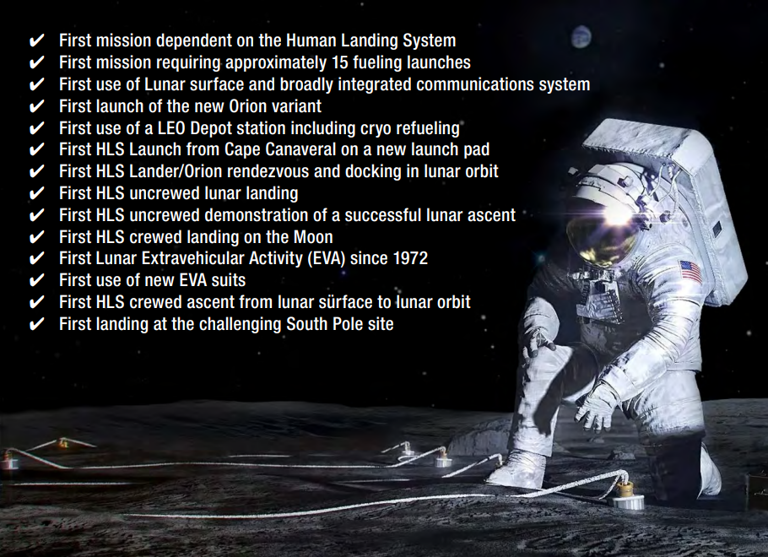
As originally designed, Artemis 3 encompassed a long list of technological firsts, with a heavy dependency on HLS, which the ASAP determined posed "significant risks at the mission level."
"This is just not the right pathway forward," Isaacman said. "Going right to the moon … is not a pathway to success."
"We want to reduce complexity to the greatest extent possible," he added. "We want to accelerate manufacturing, pull in the hardware and increase launch rate, which obviously has a direct safety consideration to it as well."
With the new framework, Artemis 3 is drastically simplified, and less dependent on the readiness of a moon lander's ability to actually land on the moon. The development of both private HLS landers chosen by NASA has fallen short of the space agency's hopeful timeline, resulting in impending delays.
NASA contracted SpaceX's Starship to land astronauts on the Artemis 3 and Artemis 4 moon missions. Starship has flown 11 suborbital test flights over the past three years but has yet to notch several critical milestones needed to qualify the spacecraft for lunar landings with astronauts onboard.
NASA picked Blue Origin's Blue Moon spacecraft, meanwhile, to land astronauts on the Artemis 5 moon mission. A Blue Moon pathfinder known as Mark 1 is currently undergoing testing at NASA's Johnson Space Center in Houston.
Before NASA will let either Starship or Blue Moon carry astronauts to the lunar surface, the vehicles will have to demonstrate their ability to transfer and store cryogenic fuels in space, rendezvous and dock with Orion, as well as execute an uncrewed moon landing and successful ascent back to lunar orbit.
Now, NASA plans to use Artemis 3 as a safe proving ground for those procedures in low Earth orbit before entrusting the landers to be 100% successful on their first flights to the moon.
Previous architecture for Artemis 4 used an upgraded version of SLS, called Block 1B, which featured the enhanced Exploration Upper Stage in place of SLS' current Interim Cryogenic Propulsion Stage (ICPS). If NASA's launch cadence with SLS remained unchanged, Artemis 4 would have launched sometime around 2030.
Space agency officials are counting on a standardized SLS configuration to shorten the wait time between launches, and are now targeting an Artemis 4 liftoff in 2028 as the program's first crewed lunar landing, with the potential for Artemis 5 to repeat the feat later that same year.
"I think what we're doing is directly in line with what ASAP asked us to do," Isaacman told Space.com during Friday's briefing. "I think it should be incredibly obvious you don't go from one uncrewed launch of Orion and SLS, wait three years, go around the moon, wait three years and land on it."
Isaacman compared the need for an increased SLS launch cadence to the United States' first lunar program, saying, "There has to be a better way, in line with our history."
"We did not just jump right to Apollo 11. We did it through Mercury, Gemini and lots of Apollo missions with the launch cadence every three months," Isaacman said. "We shouldn't be comfortable with the current cadence. We should be getting back to basics and doing what we know works."
In the meantime, teams at NASA's Kennedy Space Center continue to work toward an April launch date for Artemis 2, despite its recent relocation from the pad at Launch Complex-39B to the Vehicle Assembly Building (VAB) for repairs.
Engineers conducting routine post-fueling procedures after a Feb. 19 countdown rehearsal for the Artemis 2 rocket encountered a helium flow pressurization issue on ICPS that they could address only back inside the VAB. That countdown practice run was the second "wet dress rehearsal" for the Artemis 2 SLS, which experienced liquid hydrogen leaks and an early countdown termination during testing on Feb. 2.
"The suspected system component for the helium flow will be removed, and they're going to undergo detailed sections and assess the cause of the issue," Lori Glaze, acting associate administrator for NASA's Exploration Systems Development Mission Directorate, said on Friday. "We hope to get down to the root cause of that and make changes, not just to the hardware, but to our operational procedures, so that we don't encounter the same issue again when we roll back out to the pad."
Counting on a quick diagnosis and fix, NASA officials hope to have SLS back on the pad in time to meet Artemis 2's next launch window, which opens April 1, with additional opportunities April 3-6 and April 30.
Artemis 2 will be Orion's first mission with a crew onboard. They are NASA astronauts Reid Wiseman, Victor Glover and Christina Koch and Canadian Space Agency astronaut Jeremy Hansen. The quartet will launch on a 10-day mission to fly in a single loop around the moon before returning to Earth.
Artemis 1 successfully sent an uncrewed Orion capsule to lunar orbit and back to Earth in late 2022.
Offline
Like button can go here
#72 2026-03-01 13:17:39
- SpaceNut
- Administrator
- From: New Hampshire
- Registered: 2004-07-22
- Posts: 30,875
Re: Why Artemis is “better” than Apollo.
Here is the latest on going to the moon.
The revised Artemis architecture now envisions the first crewed lunar landing since the Apollo era to take place on Artemis 4 in 2028, with a possible second touchdown occurring that same year, on Artemis 5. Friday that they want to keep flying Artemis' Space Launch System rocket in a configuration as close to the current "Block I" as possible. Previously, Artemis 4 had been slated to use the "Block IB" variant, which would have featured a new, more capable upper stage. The ultimate goal of Artemis is to establish a permanent, sustainable human presence on and around the moon in the next five to 10 years. NASA also wants to land the first Artemis astronauts before China puts boots on the moon, which the nation aims to do by 2030.
NASA Administrator Jared Isaacman said in Friday's statement.
"Standardizing vehicle configuration, increasing flight rate and progressing through objectives in a logical, phased approach, is how we achieved the near-impossible in 1969, and it is how we will do it again," he added.
Offline
Like button can go here
#73 2026-03-03 15:20:04
- SpaceNut
- Administrator
- From: New Hampshire
- Registered: 2004-07-22
- Posts: 30,875
Re: Why Artemis is “better” than Apollo.
Nice letter for the Heatshield but I think they are going to look just at the cause of gas vapor coming from the honey combo of Avcoat material formula to alter, That's only a guess rather than looking at cure time and heat since its a liquid mixture that is hand packed rather than from a machine.
Offline
Like button can go here
#74 2026-03-03 15:40:33
- GW Johnson
- Member
- From: McGregor, Texas USA
- Registered: 2011-12-04
- Posts: 6,304
- Website
Re: Why Artemis is “better” than Apollo.
There's no reason you cannot mix up a batch of novolac polymer with microballoons (that is what Avcoat is) to load into an extrusion press instead of a hand-held caulking gun.
The thicker the char layer, the more important the porosity becomes to let the pyrolysis gases out. But no matter what, you need reinforcing fibers that connect that char to the virgin beneath. That is how you resist fluid scrubbing shear trying to tear chunks of char out, and also how you resist pyrolysis gas pressures trying to blow chunks off (so they need the hex put back into their bonded Avcoat tiles).
NASA mangers have "determined" that a change to entry profile will reduce the blow-off pressure. The same basic models on the computers told them that as failed to predict the cratering in the first place. They totally ignored the risk of fluid shear scrubbing forces ripping out chunks. And that shear rip-out is something I saw with insulators in ramjet combustors. It is quite the real effect.
GW
Last edited by GW Johnson (2026-03-03 15:43:50)
GW Johnson
McGregor, Texas
"There is nothing as expensive as a dead crew, especially one dead from a bad management decision"
Offline
Like button can go here
#75 2026-03-03 17:37:17
- SpaceNut
- Administrator
- From: New Hampshire
- Registered: 2004-07-22
- Posts: 30,875
Re: Why Artemis is “better” than Apollo.
February 27, 2026, the new Artemis launch schedule looks like this:
Artemis II: Launch in April 2026, will orbit the Moon to test the systems that will be used for the landing in 2028 by Artemis IV.
Artemis III: Launching in 2027. This will be a low Earth orbit mission to test the spacesuits. This mission will involve docking with a spacecraft either from SpaceX’s Starship or Blue Origin’s Blue Moon craft. Artemis III was originally the mission that was intended to land on the Moon in 2028. But now, that will be Artemis IV, so Artemis III is now a new mission.
Artemis IV: Launching in 2028. This will be a new Moon landing mission.
Artemis V: Also launching in 2028. This is also a Moonshot, but for later in that year.
Offline
Like button can go here