New Mars Forums
You are not logged in.
- Topics: Active | Unanswered
Announcement
#1 2026-01-11 16:23:34
- SpaceNut
- Administrator
- From: New Hampshire
- Registered: 2004-07-22
- Posts: 30,858
WIKI Project Designing for Mars
NOT A DISCUSION TOPIC
Project design is the crucial early phase of outlining a project's "why" and "what"—defining goals, scope, resources, deliverables, and success criteria before detailed planning—to create a strategic blueprint for stakeholders, often using visuals like flowcharts to align teams and guide execution. It establishes the conceptual foundation, differing from detailed project planning which focuses on "how" tasks get done.
Key components
• Goals & Objectives: What the project aims to achieve (SMART goals are ideal).
• Scope & Deliverables: Boundaries of the project and tangible outputs.
• Methodology & Strategy: High-level approach and chosen processes.
• Resources & Budget: People, tools, budget estimates, and constraints.
• Success Criteria & KPIs: How success will be measured.
• Risks: Potential issues and mitigation strategies.
Purpose
• Alignment: Gets everyone (team, stakeholders) on the same page.
• Foundation: Creates a clear, agreed-upon path before detailed work begins.
• Visualization: Uses tools (Gantt, Kanban) to make strategy transparent.
• Buy-in: Secures stakeholder approval for the overall direction.
Process steps (simplified)
1. Define the core problem/opportunity.
2. Establish clear goals and SMART objectives.
3. Identify key deliverables and success metrics.
4. Map out required resources and budget.
5. Identify potential risks and constraints.
6. Create visual aids (flowcharts, mockups) to communicate the design.
7. Get stakeholder feedback and approval.
Project design provides the strategic "why" and "what," leading into the detailed "how" of project planning, with outputs like project charters and plans built upon this initial framework
Project design concepts are the foundational ideas, principles, and high-level plans guiding a project, defining its goals, structure, and key features before detailed planning, using visuals like flowcharts and mood boards to align stakeholders on the 'why' and 'what,' ensuring a shared vision for success. Key elements include defining outcomes, identifying stakeholders, exploring options (like sustainability or accessibility), and establishing success criteria, serving as the blueprint for later execution.
Core Components of Project Design Concepts
• Goals & Objectives: What the project aims to achieve (e.g., "sleek and minimalist" for a phone).
• Target Audience & Problem: Who it's for and the problem it solves.
• Scope & Deliverables: What's included and what will be produced (e.g., sketches, prototypes, reports).
• Guiding Principles: Overarching ideas like sustainability, accessibility, or efficiency.
• Visuals & Mood Boards: Mood boards, sketches, flowcharts to convey aesthetics and process.
How They Work
1. Early Stage: Happens before detailed planning or charter development.
2. Blueprint: Creates a broad overview (the "what" and "why").
3. Exploration: Involves generating and evaluating multiple design options.
4. Stakeholder Alignment: Gets buy-in by presenting choices and setting expectations early.
Examples of Design Principles & Concepts
• Product: "Safe and reliable" (car) or "Intuitive user experience" (app).
• Architecture: Integrating local culture, sustainability, or maximizing natural light.
• Process: Using Agile principles or a specific project management methodology
In essence, a project design concept is the strategic "big picture" that transforms abstract goals into a tangible vision, guiding the entire project from its inception to successful completion.
Project design phases generally move from understanding the problem to creating detailed solutions, often covering Programming/Pre-Design, Schematic Design, Design Development, Construction Documents, Bidding, and Construction Administration, though models vary (like the AIA's 5 phases or broader project management cycles). Key stages define scope, develop concepts, produce technical drawings, select builders, and oversee building, ensuring a structured path from idea to reality.
Here's a common breakdown, blending architectural and project management steps:
1. Programming/Pre-Design (Problem Seeking): Define project goals, needs, budget, site analysis, and scope.
2. Schematic Design (Concept): Develop broad concepts, sketches, and basic layouts to explore possibilities.
3. Design Development (Refinement): Flesh out the chosen schematic design with materials, systems, and detailed plans.
4. Construction Documents (Technical Drawings): Create detailed blueprints and specifications for construction.
5. Bidding/Negotiation: Solicit and select contractors.
6. Construction Administration (Building): Oversee the building process, ensuring it matches the design.
Variations & Other Models:
•
Engineering:
Includes research, feasibility, concept generation, detailed design, and production planning.
•
Design Thinking:
Focuses on empathy, defining problems, ideating, prototyping, and testing (Discover, Define, Develop, Deliver).
•
Project Management Lifecycle:
Broader stages like Initiation, Planning, Execution, Monitoring & Control, and Closure.
No matter the model, the goal is to break a complex project into manageable steps, moving from abstract ideas to concrete results
Teacher Notes: Building on Mars, Instruction Sheet and Guidance
Starting a mission with goals of building—whether a physical structure, a community, or an organization—begins with defining your core purpose and values. This involves answering fundamental questions about who you are, what you do, why you do it, and for whom you do it.
Here is a step-by-step guide to where to start, based on established, mission-driven planning processes:
1. Define the Core Purpose and Vision
Identify the "Why": Before building, clarify the problem you are solving or the need you are addressing.
Draft a Mission Statement: Create a concise summary of your purpose, priorities, and daily actions to reach your goals.
Develop a Vision Statement: Describe the ideal, long-term, future outcome you want to achieve.
Identify Core Values: Determine the principles that will guide your decisions.
2. Set Strategic Goals (The "What" and "How")
Define Goals: These are general statements of what needs to be accomplished (e.g., "Build a community center," "Create a sustainable, low-income housing project").
Set SMART Objectives: Ensure your goals are Specific, Measurable, Achievable, Relevant, and Time-bound.
Develop a Strategy: Determine the unique approach you will take to achieve the vision, such as how you will use resources or build partnerships.
3. Build the Initial Framework
Identify Stakeholders: Identify who will be affected by or involved in the project (e.g., community members, investors, partners).
Establish a Team/Core Group: Identify key people who will help drive the mission, as collaboration is essential for long-term success.
Engage the Community: For building projects, start by gathering insights from the community to ensure the project meets actual needs.
4. Create an Actionable Plan
Perform a Feasibility Study: Assess the project’s feasibility, including funding, legal requirements, and potential risks.
Build an Initial Task Backlog: Break down your goals into specific, actionable steps.
Outline Resources: List the materials, finances, and skills required for the project.
5. Launch and Iterate
Run a Kickoff Meeting: Clearly communicate the mission to all stakeholders to ensure everyone is aligned.
Start Small: Rather than trying to achieve the entire vision immediately, start with a pilot project or a small, tangible goal to build momentum.
Monitor and Adjust: Regularly review progress and adjust your plans as you gain new information.
Key Takeaway: A mission-driven project starts by ensuring the "why" (mission) is in the driver's seat, ensuring that every building block contributes to the overall purpose
Offline
Like button can go here
#2 2026-01-11 16:23:55
- SpaceNut
- Administrator
- From: New Hampshire
- Registered: 2004-07-22
- Posts: 30,858
Re: WIKI Project Designing for Mars
NASA takes years, often decades, to plan Mars missions, developing concepts, technologies (like the Artemis program for lunar practice), and identifying locations through extensive studies, with initial human missions aimed for the late 2030s, building on learning from robotic explorers and lunar experiences for exploration and science goals. The decision process involves long-term strategic planning, refining objectives, and overcoming massive technical hurdles over many years before a specific mission is finalized.
Key Factors & Timelines:
Long-Term Vision: NASA's strategy uses the Moon (Artemis Program) as a testbed for deep space operations, with plans stretching over 20 years to prepare for Mars.
Technology Development: Years are spent developing crucial systems for life support, propulsion, and power, with breakthroughs needed before missions can launch.
Mission Formulation: Identifying specific locations and scientific goals involves extensive study and planning, with rough outlines for crewed missions developed years in advance.
Current Goals: NASA aims to send humans to Mars in the 2030s, using lessons from Artemis to inform these future deep-space endeavors.
In essence, the "how many years" isn't a fixed number but a multi-decade commitment, evolving from initial ideas to concrete plans, with decisions on specific locations and 'whys' refined over time as technology and understanding advance
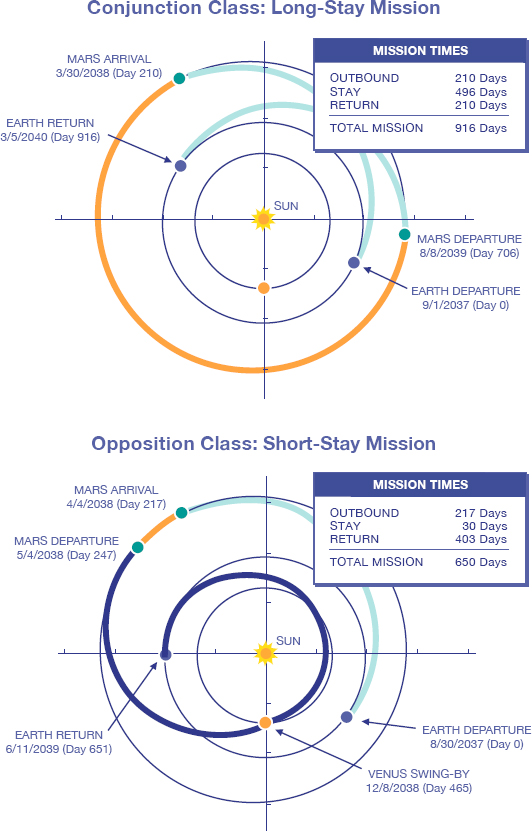
Mars missions for human spaceflight are primarily categorized into two types based on their trajectories and duration: Conjunction-class (long-stay) and Opposition-class (short-stay). Missions are constrained by the relative orbits of Earth and Mars, with launch windows occurring roughly every 26 months (the planets' synodic period).
Conjunction-class missions are generally favored in many studies because they offer significantly more time for surface exploration at a lower fuel cost and reduced crew exposure to the risks of prolonged zero-gravity and deep-space radiation.
Opposition-class missions, while having a shorter overall mission duration, require more advanced propulsion and expose the crew to more time in space and harsher conditions.
Mission Cycles
Launch Windows: Due to the relative orbits of Earth and Mars, launch windows (times of minimum energy transfer) open approximately every 26 months, or 780 days.
Optimal Windows: The specific energy requirements and travel times vary over a larger, roughly 15-year cycle, with certain windows offering the most optimal conditions (e.g., opposition occurring when Mars is closest to the Sun).
Solar Cycle: Mission planning must also consider the approximately 11-year solar cycle. Launching during a solar minimum helps mitigate the risks from solar storms and radiation exposure to the crew
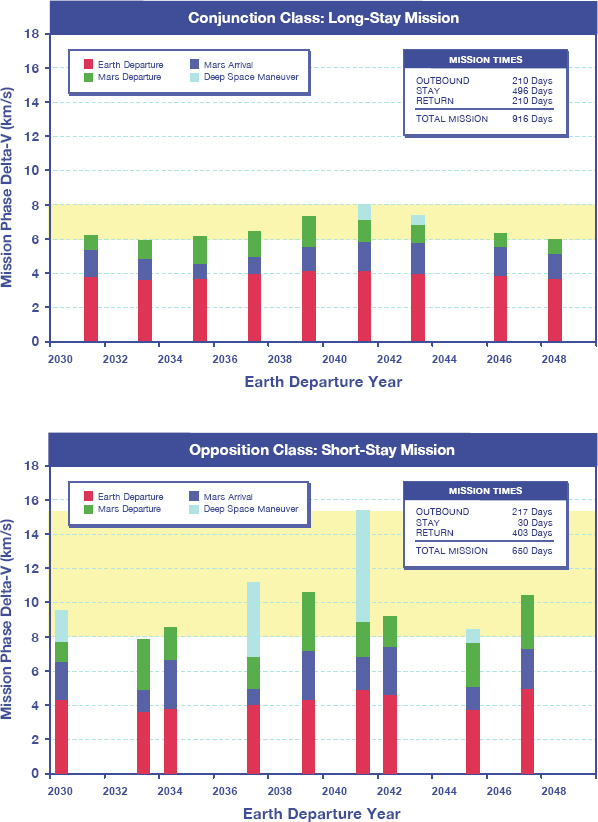
Earth to Mars Mission Opportunities 2026 to 2045
Earth to Mars—2026 Opportunity
Earth to Mars—2028 Opportunity
Earth to Mars—2031 Opportunity
Earth to Mars—2033 Opportunity
Earth to Mars—2035 Opportunity
Earth to Mars—2037 Opportunity
Earth to Mars—2039 Opportunity
Earth to Mars—2041 Opportunity
Earth to Mars—2043 Opportunity
Earth to Mars—2045 Opportunity
A 4-year round-trip mission to Mars represents a long-duration, high-safety-margin, or potentially, a lower-energy, extended-stay scenario often discussed in human spaceflight studies. While, theoretically, minimum-energy missions (Hohmann transfers) take roughly 2-3 years, a 4-year limit is proposed to mitigate cosmic radiation exposure. A typical 3-year mission involves a 6-9 month transit each way with a long, ~18-month, stay.
Radiation Safety Limits: Research indicates that limiting the total round-trip, including the surface stay, to roughly 4 years is crucial to keep astronaut radiation exposure within acceptable limits.
Mission Structure: A 4-year timeframe allows for a more relaxed, extended scientific exploration on the Martian surface compared to "short-stay" missions that only last 2 years but are higher-risk, faster transits.
Alternative Mission Durations: While 4 years is a safe, long-duration option, most near-term mission architectures with current chemical technology focus on 2 to 3-year round trips to manage logistical constraints.
The extended duration of a 4-year mission provides more time for surface operations and potentially reduces the fuel required for rapid orbital maneuvers, at the cost of increased health risks from radiation, which requires robust shielding solutions
knowing where on mars we want to go to is one of the key factors for mission planning.
The ideal site would be:
(1) Not too far from the equator, avoiding extreme cold in winter and at night.
(2) Close to a source of geothermal energy.
(3) Nearby access to liquid brine or at least easily accessible water ice.
(4) Would allow easy excursions to other parts of the planet, i.e avoid deep ravines and other natural barriers.
(5) Would have low altitude, maximising atmospheric shielding and atmospheric braking potential.
(6) Lower susceptability to impact by dust storms.Whilst we could in theory build a base anywhere, I suspect there are few locations that meet all of these criteria and there may indeed be none.
Criteria 1 is important, as a base too far from the equator would experience extreme cold and darkness for half of the year. If we are planning on using surface domes or polytunnels for agriculture, that is undesirable.
Criteria 2 is a nice bonus. It allows heating of surface structures, provides a source of low grade heat for multiple activities and adds an option for power production.
Criteria 3 is essential. Don't bother considering sites that don't have access to water. Liquid water, even if salty and cold, would be far more useful than ice. But abundant accessible ice is a minimal requirement.
Criteria 4 is important both for scientific exploration and for the city to develop as a hub for resource development. We are going to need minerals of every element on the periodic table. A lot easier if we aren't stuck at the bottom of a ravine.
Criteria 5 makes shipping resources from Earth easier and also makes surface activities less risky.
Criteria 6 is essential. A base site that is regularly engulfed in dust is a bad place to do anything. Solar panels stop working, crops stop growing, dust gets blown into moving parts and people will get lost and die.
Offline
Like button can go here
#3 2026-01-11 16:24:16
- SpaceNut
- Administrator
- From: New Hampshire
- Registered: 2004-07-22
- Posts: 30,858
Re: WIKI Project Designing for Mars
Exploration Mission
Population Needed: 4–6
Dependency on Earth: Total
Key Requirements: Transit vehicles, short stays
Research Outpost
Population Needed: 20–50
Dependency on Earth: High
Key Requirements: ISRU demos, basic agriculture
Semi-Independent Settlement
Population Needed: 100–500
Dependency on Earth: Moderate
Key Requirements: Local manufacturing, robust life support
Self-Sustaining Colony
Population Needed: 1,000–5,000
Dependency on Earth: Low
Key Requirements: Full industry, generational planning
Independent Civilization
Population Needed: 10,000–100,000
Dependency on Earth: None
Key Requirements: Cities, culture, economy
Designing a Mars mission involves defining clear goals (e.g., find life, establish presence), setting specific objectives (e.g., collect samples, test life support), choosing mission types (robotic, human, precursor cargo), and detailed planning for technology, logistics (launch, propulsion, landing), science operations, and risk management, all within budget and schedule constraints, following a phased approach like NASA's Moon to Mars strategy.
Types of Mars Missions
Robotic Landers/Rovers: Focus on remote science (habitability, past life, geology), sample collection (Perseverance), and preparing sites for humans (e.g., Mars 2020).
Cargo Missions: Pre-position supplies, habitats, and infrastructure before human arrival (e.g., NASA's 2033 plan).
Crewed Missions (Opposition/Conjunction Class): Long-duration missions with humans, requiring advanced life support, propulsion, and significant pre-placed assets.
Orbiter Missions: Study Mars from orbit, mapping, atmospheric analysis, and supporting surface operations (e.g., Indian Space Research Organisation's MOM).
Goals & Objectives
Overarching Goals: Discover past/present life, understand Mars's evolution, learn to live and work on other planets, prepare for sustained human presence.
Science Objectives: Identify key measurements, samples, landing sites for specific science campaigns (e.g., searching for biosignatures).
Technology Objectives: Develop and demonstrate new systems for propulsion, life support, surface power, entry/descent/landing (EDL).
Planning & Design Principles
Objective-Based Approach: Start with the "what" (goals/objectives) and work backward to design the "how".
System of Systems: Integrate various elements (launch vehicles, transit habitats, landers, surface assets) into a cohesive architecture.
Constraints: Design within strict mass, power, budget, and schedule limits.
Phased Approach: Utilize precursor robotic missions to pave the way for human exploration (Moon to Mars Strategy).
Risk Management: Address environmental factors (radiation, dust, communication lag) and engineering challenges.
Key Planning Stages & Elements
Define Science & Exploration Goals: What do we want to learn/achieve?.
Develop Mission Architecture: How will we get there and operate (split vs. single launch, propulsion, vehicles)?.
Technology Development: Build necessary tech (e.g., advanced engines, habitats).
Mission Operations: Plan for launch windows, transit, landing, surface activities, and sample return.
Instrumentation & Site Selection: Choose instruments and landing spots to meet objectives.
Collaboration & Public Engagement: Work with partners (international, industry) and build support
Human Mars Mission Design – The Ultimate Systems Challenge
NASA Space Mission Life Cycles
NASA project life cycles are divided into two primary phases: Formulation and Implementation.
Formulation Phase (Planning and Technology Validation)
Pre-Phase A: Concept Studies and Mission Definition - Broad ideas are produced and alternatives for missions are analyzed to confirm the mission need and feasibility.
Phase A: Concept and Technology Development - The feasibility of the suggested system is determined, and initial requirements and architecture are developed to establish a baseline for funding.
Phase B: Preliminary Design and Technology Completion - The project is defined in enough detail to establish an initial baseline and mitigate technical and programmatic risks.
Implementation Phase (Building, Launch, and Operation)
Phase C: Final Design and Fabrication - The system design is finalized, and hardware fabrication and assembly begin.
Phase D: System Assembly, Integration & Test, Launch - The system is assembled, integrated, tested, and prepared for launch/deployment.
Phase E: Operations and Sustainment - The mission is actively flown, and data is analyzed and sustained.
Phase F: Closeout - The system is retired after meeting its operational objectives.
This structure allows managers and stakeholders to assess technical progress and make informed decisions at key decision points (KDPs) separating each phase
Based on current SpaceX projections and studies of the Starship vehicle, the crew size for a mission to Mars is designed to be highly scalable, ranging from small, specialized teams for early missions to over 100 passengers for colonization.
Starship Mars Mission Crew Size Chart (Projected)
Mission Phase Estimated Crew Size Primary Focus
Initial Crewed Missions (2028-2030s) 6 – 15+ Pathfinders, base construction, infrastructure setup
Mature/Mid-Term Missions ~12 – 50 Increased operational efficiency and cargo capacity
Colonization Era (Long Term) 100 – 200+ Rapid, high-volume, cost-effective transportation
Key Factors Impacting Crew Size
Design & Comfort: With 1,000 m³ of usable space, the Starship can accommodate 10–15 people with private cabins and common areas.
Safety & Logistics: Early missions will likely use lower crew numbers (6–8) to prioritize safety, consumables management, and payload for return fuel.
Mission Profile: Initial missions will focus on landing, setting up in-situ resource utilization (ISRU) for fuel, and testing habitation systems.
First Mission Target: Estimates suggest 12 people on the first landing, likely accompanied by 2 or 3 total ships for redundancy.
Note: The first crewed missions are officially targeted for 2028 or late
1. Knowing that Starship plans to send 4 cargo and 2 crewed for the mars first mission of 20 crew means that outgoing will only use 1 starship for the return flight to earth. It would need to do initial setup of fuel factory along with the science and site exploration for the future flights going to the same site.
Crew & Cargo Requirements (Initial Mission Concept):
Crew: Two Starships for crew, potentially 10-20 people per ship, though future missions aim for 100+.
Cargo: Four Starships for supplies (habitat, ISRU equipment, food, etc.), carrying about 100 tonnes each (400 tonnes total).
2. keeping to the same ship cadence means only the shift of crew count to 100 to consumables will change for the out going with a similar return single ship for earth return leaves another starship crewed vehicle with 4 cargo on the surface. The early construction is for a care taker population that works to get a functioning greenhouse structure built.
For a second, larger human mission to Mars as outlined in potential SpaceX plans, the required number of Starships is expected to be a fleet including two crewed Starships and four cargo Starships. These are part of an overall mission architecture to build a self-sustaining city on Mars.
Mission Details
Crew Starships: Two Starships would transport crew, with an estimated capacity of 100 people per ship, though initial missions might carry a smaller number (around 12-36). The crew ships are designed for a faster, more direct trajectory to minimize health risks like radiation exposure.Cargo Starships: Four cargo-only Starships would be sent on a slightly longer, more energy-efficient (low-energy) trajectory to carry necessary equipment and supplies. Each cargo ship can carry over 100 metric tons of payload.
Primary Objective: A key function of the initial cargo missions is to pre-position infrastructure, especially the equipment to produce propellant (methane and oxygen) from local Martian resources (in-situ resource utilization or ISRU). This is essential for the return journey to Earth and future missions.
Operational Requirements
To execute this mission architecture, extensive in-orbit refueling is necessary:
Each crewed Starship would require approximately 15 refueling launches in Low Earth Orbit (LEO) before departing for Mars.
Each cargo Starship would require about 4 refueling launches in LEO.
Ultimately, for a fully self-sufficient Mars city, Elon Musk has stated that a fleet of 1,000 Starships would be needed to transport a million people and millions of tonnes of cargo over several transfer windows that occur every approximately 26 months.
3. this is to establish small colony as food production will be set aside for more building materials for building the exploration construction base. It will of course keep to the same ship cadence for the out with crew of 200 split between the 2 crewed ships with hopefully both coming back leaving only 4 cargo ships to make use of on the next cycle.
Designing construction on Mars focuses on using local resources (regolith), autonomous 3D printing robots for habitats, and innovative materials like "Marscrete" or fungi (mycelium), aiming for self-sufficiency by reducing Earth-launched materials, with key challenges including radiation, logistics, and creating sustainable living spaces. Designs often blend robotic 3D printing of outer shells with pre-fabricated inflatable cores, creating radiation-shielded, multi-functional habitats before crew arrival.
Key Design & Construction Principles:
• In-Situ Resource Utilization (ISRU): Using Martian soil (regolith) and elements like sulfur to create building materials is crucial.
• Additive Manufacturing (3D Printing): Autonomous robots print structures using Martian materials, reducing costs and labor.
• Robotic Swarms: Modular, intelligent robots with interchangeable tools can build, repair, and reconfigure structures.
• Hybrid Approaches: Combining 3D-printed regolith shells with inflatable modules (pre-fab from Earth) for core living spaces.
Materials & Methods:
• Marscrete: A sulfur-based concrete using Martian simulant, hardened by heat, ideal for 3D printing.
• Mycelium/Fungi: Growing habitats from fungi, potentially self-healing and providing insulation and filtration.
• Chitin-based Materials: Experiments with insect exoskeletons to create strong, low-energy building materials.
Habitat Features:
• Radiation Shielding: Thick regolith shells or water layers protect against cosmic radiation.
• Double-Shell Designs: For improved insulation and structural integrity.
• Integrated Systems: Incorporating labs, kitchens, and living spaces, often with aesthetic considerations for psychological well-being.
Project Examples:
• NASA's 3D-Printed Habitat Challenge: Competitions driving innovation in Martian construction.
• MARSHA (AI SpaceFactory): A cylindrical, 3D-printed habitat design using Martian polymers.
• Foster + Partners' Mars Habitat: A design using autonomous robots to excavate and build a crater for inflatable modules.
Future Vision:
• Goals extend beyond habitats to self-sustaining Martian cities, utilizing advanced rocketry (like SpaceX's Starship) for mass transport
Building on Mars requires using local resources like soil, basalt, or ice for strong, radiation-shielded structures, often 3D printed with sulfur-based "Marscrete" or fungi, while also needing robust life support, sustainable energy (solar/nuclear), efficient recycling, and advanced environmental control systems to overcome extreme temperatures, low pressure, and high radiation for self-sufficiency.
Key choices involve leveraging In-Situ Resource Utilization (ISRU) for materials, designing for harsh conditions (underground/buried), integrating closed-loop life support, and developing autonomous construction and power systems.
I. Material Choices (In-Situ Resource Utilization - ISRU)
Martian Soil/Regolith: Used for "Earth bagging," shielding, or mixed with binders.
Basalt: Volcanic rock, abundant on Mars, can be processed.
Martian Concrete/Sulfur Concrete: Sulfur (abundant) mixed with regolith, printable with 3D printers.
Ice: Water ice can be melted, used as a binder, or for life support/propellant.
Fungi/Mycelium: Genetically modified fungi to bind soil into strong, moldable materials.
II. Construction Techniques & Design
3D Printing: Robotic arms printing with sulfur concrete or regolith-based materials.
Underground/Buried Habitats: Using lava tubes or burying structures for natural radiation and temperature shielding.
Modular Systems: Inflatable or prefabricated modules (like Lavapolis/Hexamars) for expansion.
Earth bagging: Filling bags with Martian soil for cheap, stable walls.
III. Essential Systems & Infrastructure
Energy: Solar, nuclear (fission), or potentially wind.
Life Support: Closed-loop systems for air, water, and waste recycling.
Water: Locating and extracting subsurface ice.
Agriculture: Growing food, possibly using hydroponics or suitable plants like duckweed in controlled environments.
IV. Environmental Considerations
Radiation Shielding: Critical due to high Galactic Cosmic Rays (GCRs) and UV.
Temperature Control: Habitats must withstand extreme cold and large diurnal swings.
Low Pressure: Structures must be airtight and durable in Mars' thin atmosphere.
V. Key Requirements for Self-Sufficiency
Resource Independence: Reducing reliance on Earth supplies.
Durability & Resiliency: Materials and designs must withstand the harsh Martian environment.
Expandability: Modular designs for growth
Mars regolith is a fine-grained, highly basaltic soil covering the planet's surface, consisting primarily of silicon dioxide (
), ferric oxide (
), aluminum oxide (
), calcium oxide (
), and magnesium oxide (
). Key minerals include pyroxene, plagioclase, olivine, and iron oxides (magnetite). The soil is enriched with toxic, soluble salts like sulfates, chlorides, and perchlorates.
Key Compositional Details:
Mineralogy: Dominated by basaltic rock components, specifically pyroxene, olivine, and feldspar.
Major Elements: Iron oxides (
) give the soil its red color, often occurring as magnetite.
Chemical Components: High concentrations of Silicon (
), Iron (
), Magnesium (
), Calcium (
), Sulfur (
), and Chlorine (
).
Salts & Toxins: The soil contains high concentrations of magnesium, calcium, and iron sulfates, along with hazardous perchlorates.
Particle Size: The average grain size is roughly
, with a range from
.
Global Homogeneity: While local variations exist due to weathering and geology, the fine dust coating the surface is remarkably consistent across the planet.
Comparison to Earth:
Martian regolith is similar to weathered basaltic soils found in Hawaii but lacks organic matter and is generally more oxidized and enriched in sulfur and chlorine. It is often described as a toxic, iron-rich sand rather than true, nutrient-rich soil, requiring significant processing for in-situ resource utilization (ISRU)
Offline
Like button can go here
#4 2026-01-11 16:24:48
- SpaceNut
- Administrator
- From: New Hampshire
- Registered: 2004-07-22
- Posts: 30,858
Re: WIKI Project Designing for Mars
The concept of using a Starship cargo lander as a long-term habitat on Mars, sometimes called a "caretaker" or base camp, is central to {Link: NASA and SpaceX's Mars colonization vision, involving converting the massive lander into a livable base after its initial cargo delivery, with conceptual studies exploring how to offload and configure these huge structures, potentially using other Starships or specialized equipment for setup.
Key Concepts & Plans
Starship as Lander & Habitat: Starship's enormous payload capacity (up to 150+ metric tons) allows it to deliver not just supplies but also become a primary habitat on Mars after landing.
NASA's Common Habitat Architecture: NASA studies, like the "Common Habitat," envision using SLS core tanks or Starship-derived modules as large, long-duration habitats, leveraging the work on Starship landers for delivery and setup on the Moon and Mars.
Phased Deployment: Early cargo Starships land, offload equipment, and then potentially serve as initial shelters, with later, larger modules or converted Starships forming the core of a permanent base.
Deployment & Setup: A major challenge is getting the habitat off the lander and onto the surface, with studies exploring cranes, jib systems, or even other Starships to maneuver and position these massive structures.
Caretaker Role: The lander itself, or a dedicated Starship habitat, would provide immediate shelter, life support, and a base of operations, acting as a "caretaker" until larger, purpose-built habitats are established.
How it Works (Conceptual)
Launch & Transit: A modified Starship carries cargo and/or habitat components to Mars.
Landing: The Starship performs a powered landing on Mars.
Habitat Activation: The vehicle is configured (potentially by another Starship or robotic systems) to become a habitable zone, with internal decks, life support, and living quarters.
Expansion: Subsequent Starship deliveries bring more components to build out a larger, more permanent base around the initial lander habitat.
This approach leverages Starship's unique capabilities to drastically reduce the complexity and cost of establishing a long-term human presence on Mars
Project design for exploratory missions involves defining clear objectives, assembling diverse expert teams, developing concepts of operation (ConOps), conducting trade studies (AoA), identifying risks, and iteratively planning detailed activities using specialized software, all within structured life cycles (like NASA's) to move from initial ideas to a flight-ready plan, focusing on flexibility and measurable success. Key steps include envisioning, building minimum viable products (MVPs) for testing, deploying, observing, and deciding whether to cancel or productize the concept, all while managing constraints and contingency needs.
Key Stages & Activities
Concept & Definition (Envisioning):
Define Purpose & Objectives: Establish clear, SMART (Specific, Measurable, Attainable, Relevant, Time-bound) goals (e.g., scientific discovery, tech advancement).
Stakeholder Engagement: Involve science experts, engineers, project managers, and users to capture needs and goals.
Develop ConOps: Outline how the mission will operate, from launch to data collection.
Design & Analysis (Build & Observe):
Trade Studies (AoA): Evaluate alternatives for systems, trajectories, and operations.
Technology Development: Test hypotheses through building and deploying MVPs (Minimum Viable Products).
Risk Identification: Classify and identify initial technical risks.
Software Tools: Utilize tools like NASA's GMAT for trajectory design or SPICE for observation planning.
Planning & Iteration (Deploy & Productize):
Detailed Planning: Create specific activity plans, including contingency plans (e.g., backup Trajectory Correction Maneuvers - TCMs).
Flexibility: Use flexible plans that allow for adjustments (e.g., MAPGEN for Mars rovers).
Testing & Validation: Perform operational readiness tests (ORT).
Iterative Cycles: Loop back to refine plans based on observations and actual constraints.
Core Principles
Iterative & Adaptive: Plans evolve to meet changing constraints and priorities.
Data-Driven: Observation and measurement guide decisions.
Cross-Disciplinary: Success requires integrating science, engineering, and operations.
Risk Management: Proactive identification and mitigation of risks are crucial.
Example Frameworks
NASA's Lifecycle: Moves from concept to formulation, development, and operations.
Disciplined Agile (DA): Uses an exploratory lifecycle with envision, build, deploy, observe, and cancel/productize phases.
The primary project design goals for Mars construction management are centered on sustainability, self-sufficiency, safety, and efficient resource utilization due to the extreme and isolated environment. These goals ensure human survival, scientific advancement, and a foundation for a potential long-term settlement.
Key design goals include:
Survival and Safety
Radiation Protection: Designing structures, often buried or semi-buried, that provide robust shielding from the high radiation levels in the Martian environment.
Environmental Protection: Protecting crew, hardware, and electronics from extreme temperature variations, atmospheric differences, and micrometeorites.
Structural Integrity and Pressurization: Engineering buildings capable of withstanding the internal pressure of a breathable atmosphere within the thin Martian atmosphere, managing associated tensile stresses.
Reliable Life Support Systems: Integrating robust and redundant life support systems (oxygen generation, water recycling, waste management) to create a self-sustaining environment.
Resource and Efficiency
In-Situ Resource Utilization (ISRU): Minimizing the mass of materials transported from Earth by leveraging local Martian resources (regolith, basalt, water ice, etc.) for construction, which is a major cost and logistics driver.
Additive Construction (3D Printing): Utilizing autonomous or semi-autonomous 3D printing technologies to build infrastructure (landing pads, habitats, roads) with minimal human involvement and using local materials.
Energy Efficiency and Generation: Designing systems that require minimal energy consumption for material processing and operations, while integrating reliable surface power sources, such as nuclear power.
Functionality and Habitability
Scalability and Adaptability: Designing initial systems that can be incrementally expanded and modified to meet the needs of a growing population with minimal recurring development effort.
Maximizing Interior Space and Habitability: Creating functional layouts that maximize usable space and provide a psychologically comfortable living and working environment to support long-duration missions and a healthy work-life balance.
Support for Science and Operations: Ensuring infrastructure supports a wide range of activities, including scientific research, testing, and eventual industrialization, beyond just basic survival.
Autonomy: Developing construction hardware and processes that can operate autonomously or be managed with minimal oversight from Earth, given the communication delays and operational challenges.
These goals require collaboration across multiple disciplines, including civil and aerospace engineering, architecture, and material science, often utilizing advanced technologies and rigorous project management methodologies to control cost, schedule, and risk. NASA's Moon to Mars Planetary Autonomous Construction Technology (MMPACT) project is actively developing many of these capabilities on the Moon as a stepping stone for future Mars missions
Living and Working on Mars
Oxygen
The Mars Oxygen In-Situ Resource Utilization Experiment, or MOXIE, is helping NASA prepare for human exploration of Mars by demonstrating the technology to produce oxygen from the Martian atmosphere for burning fuel and breathing.
Food
Astronauts on a roundtrip mission to Mars will not have the resupply missions to deliver fresh food. NASA is researching food systems to ensure quality, variety, and nutritional values for these long missions. Plant growth on the International Space Station is helping to inform in-space crop management as well.
Water
NASA is developing life support systems that can regenerate or recycle consumables such as food, air, and water and is testing them on the International Space Station.
Power
Like we use electricity to charge our devices on Earth, astronauts will need a reliable power supply to explore Mars. The system will need to be lightweight and capable of running regardless of its location or the weather on the Red Planet. NASA is investigating options for power systems, including fission surface power.
Spacesuits
Spacesuits are like “personal spaceships” for astronauts, protecting them from harsh environments and providing all the air, water, biometric monitoring controls, and communications needed during excursions outside their spaceship or habitat.
Communications
Human missions to Mars may use lasers to stay in touch with Earth. A laser communications system at Mars could send large amounts of real-time information and data, including high-definition images and video feeds.
Shelter
An astronaut's primary shelter on Mars could be a fixed habitat on the surface or a mobile habitat on wheels. In either form, the habitat must provide the same amenities as a home on Earth — with the addition of a pressurized volume and robust water recycling system.
The logistics of providing sewer service, heating, water, power, communications and interior structures (ie, living and retails space) seem to lead toward solving the issue for large person population problem before advancing to something greater.
Habitat Technology: Developing durable habitats that protect inhabitants from radiation, maintain pressure integrity, and ensure overall livability.
Life Support Systems: Perfecting closed-loop life support systems that can reliably sustain human life through resource recycling and regeneration.
Habitat Technology: Developing durable habitats that protect inhabitants from radiation, maintain pressure integrity, and ensure overall livability.
Transportation: Enhancing spacecraft technology for more efficient, safe, and feasible transportation between Earth and Mars, such as through the MFPD we discussed below.
Entry, Descent, and Landing (EDL): Achieving reliable and precise EDL systems for safely landing payloads and humans on the Martian surface.
Resource Extraction and Utilization: Establishing viable technologies and methodologies for extracting and utilizing Martian resources (e.g., water-ice).
Energy Production: Ensuring sustainable and reliable energy production on Mars, potentially harnessing solar and nuclear power.
Countermeasures: Developing effective countermeasures against the detrimental effects of microgravity and radiation exposure on human health.
Medical Facilities: Establishing comprehensive medical facilities and protocols to manage health contingencies.
Geological Studies: Conducting thorough geological studies to understand Mars' terrain, subsurface, and potential resources.
Search for Life: Further exploration to understand the Martian environment, mainly focusing on life's potential existence or historical presence.
Crew Selection and Training: Establishing robust selection, training, and support frameworks for astronaut crews to manage psychological and social dynamics.
Mission Simulations: Conducting extensive mission simulations to understand and prepare for various mission scenarios and challenges.
Supply Chains: Establishing reliable supply chains, ensuring the consistent availability of essential resources and spare components.
Communication Systems: Developing robust communication systems to facilitate effective communication with Earth despite the substantial delay.
International Partnerships: Fostering international collaborations to pool resources, expertise, and share responsibilities and benefits.
Knowledge Sharing: Enabling a global knowledge-sharing framework to enhance collective understanding and technology development.
Public Engagement: Engaging with the global community to establish a collective vision and gain public support for Martian settlements.
Cultural Preservation: Considering how to preserve and convey Earth's cultural and biological heritage on Martian settlements.
Humans can safely stay on the Mars surface for a maximum of approximately four years before cumulative radiation exposure from cosmic rays and solar particles becomes too dangerous. While short-term, unprotected exposure would cause death from freezing or suffocation in seconds, long-term, unshielded surface survival is limited by high-energy radiation to about four years.
Key factors and findings regarding radiation on Mars:
Total Mission Time: Studies suggest a round-trip mission (including transit and stay) should be kept under four years to avoid exceeding safe, long-term exposure limits.
Radiation Source: The primary dangers are Galactic Cosmic Rays (GCRs) and solar particle events, which are not blocked by the thin Martian atmosphere.
Surface Risks: Without adequate shielding (e.g., habitat shielding), a person would face high cancer risks and potential acute radiation sickness over long durations.
Mitigation: Optimal mission timing during the "solar maximum" can provide some protection, as the sun's activity helps deflect harmful cosmic rays.
Without a protective spacesuit, an individual would instantly succumb to Mars' near-vacuum atmosphere and freezing temperatures. The four-year limit specifically refers to the cumulative dose of radiation, not immediate, acute, unprotected, unshielded environmental conditions
Radiation mitigation for a first human mission to Mars is a critical "showstopper" challenge, with crew exposures during a 3-year round trip expected to exceed standard safety limits (600 mSv), likely requiring an exception to current regulations and an reliance on "buying down" risks through advanced shielding. The strategy for a first mission will likely be a, combination of passive shielding (materials), operational mitigation (timing/scheduling), and natural terrain protection on the surface.
Key Radiation Mitigation Strategies
Optimal Mission Scheduling (Solar Max): Launching during the solar maximum (when the Sun is most active) is counter-intuitively the best strategy, as the increased solar wind deflects the more dangerous Galactic Cosmic Rays (GCRs). While this increases the risk of Solar Particle Events (SPEs), they are easier to shield against than GCRs.
Hydrogen-Rich Materials: Passive shielding is more effective using low-atomic-mass materials (hydrogen, plastics, rubber, synthetic fibers) rather than metals like aluminum, which can generate dangerous secondary radiation when struck by GCRs. Polyethylene is a top candidate for lining spacecraft.
Martian Regolith Shielding: On the surface, placing 2–3 meters of Martian soil (regolith) over habitats can significantly reduce radiation exposure.
Natural Terrain Shelter: Using natural geological features, such as lava tubes, cliffs, or canyons, offers significant, immediate reduction in radiation, with data showing a 4% reduction in dose simply by parking near a small butte.
"Storm Cellar" Design: Creating a heavily shielded, specialized, and compact area within the spacecraft or habitat to protect the crew during high-energy solar storms.
First Mission Challenges and Risks
Secondary Radiation: High-energy particles can cause a cascade of radiation when they hit shielding, which can be worse than the initial exposure.
Prohibitive Mass: Bringing massive amounts of shielding from Earth is cost-prohibitive, making the use of in-situ resources (like Martian soil) essential.
Health Consequences: Beyond radiation sickness, the primary risks are increased long-term cancer, cardiovascular disease, central nervous system damage, and cognitive decline.
While active shielding (using magnetic fields to deflect particles) is considered the ultimate goal, it is not considered practical for the first, near-term, missions due to power and structural requirements
Protecting crew members from space radiation is a critical "showstopper" for long-duration missions to Mars, as they will be exposed to high-energy Galactic Cosmic Rays (GCRs) and unpredictable Solar Particle Events (SPEs). Mitigation strategies focus on a combined approach of passive shielding, in-situ resource utilization (ISRU), and advanced, low-atomic-number materials to minimize secondary radiation.
Key Radiation Mitigation Strategies
Passive Shielding with Hydrogen-Rich Materials: Hydrogen-rich materials are the most effective at blocking GCRs without producing dangerous secondary radiation. Ideal materials include water, specialized plastics like polyethylene, and hydrogenated boron nitride nanotubes.
In-Situ Resource Utilization (ISRU): To avoid the massive cost of transporting shielding material, habitats will likely be covered with 2–5 meters of Martian regolith (soil).
Spacecraft and Habitat Design:
Storm Shelters: A heavily shielded "safe room" inside the spacecraft or habitat will be necessary to protect the crew during solar particle events, with shielding equivalent to 40 grams per square cm.
Fuel/Water Storage: Placing water or fuel tanks around the crew habitat acts as an effective, passive shield.
Subterranean Habitats: Utilizing natural features like lava tubes or cliffs can provide significant protection from above.
Operational Procedures: Minimizing Extra Vehicular Activities (EVAs) and avoiding surface operations during solar storms.
Active Shielding (Future Concept): Research into superconducting magnets to generate a localized magnetic field (a "mini-magnetosphere") to deflect charged particles is ongoing but not yet mature for flight.
Protection During Transit
Shielding Optimization: Spacecraft walls will be designed to maximize shielding, potentially using advanced composites rather than just aluminum, which can generate harmful secondary radiation upon impact.
Transit Time: Reducing the total travel time (e.g., using nuclear thermal-electric propulsion) is considered one of the best methods to reduce cumulative dose.
Real-time Dosimetry: Real-time monitoring of radiation exposure using personal dosimeters, such as those tested on the ISS, will be essential.
Protection on the Surface
Regolith Protection: Covering habitats with thick layers of Martian soil (5+ meters for long-term bases) is the primary method for long-term surface habitation.
Subsurface Living: Placing habitats inside natural caves or lava tubes can significantly reduce the radiation dose.
Biological Mitigation
Radioprotectors: Research into medications that boost the body's natural defense mechanisms against radiation damage.
Nutritional Countermeasures: Specialized diets to help the immune system manage radiation exposure.
Challenges and Future Directions
Secondary Radiation: Dense materials like aluminum can actually increase radiation doses by producing secondary particles (neutrons, hadrons) upon impact.
Weight Constraints: Massive shielding is too heavy for launch; therefore, leveraging ISRU (using Mars' own resources) is necessary.
Data Acquisition: Current missions are measuring the radiation environment on the surface (e.g., with the RAD detector) to refine future shielding designs.
Ultimately, the first crewed mission to Mars will likely rely on a combination of hydrogen-rich materials for the spacecraft and thick, localized regolith covering for the habitat
The radiation showstopper for Mars exploration
Beating 1 Sievert: Optimal Radiation Shielding of Astronauts on a Mission to Mars
Moon 2 Mars Space Radiation Protection “Buying Down” Risks to Crew
Offline
Like button can go here
#5 2026-01-11 16:25:09
- SpaceNut
- Administrator
- From: New Hampshire
- Registered: 2004-07-22
- Posts: 30,858
Re: WIKI Project Designing for Mars
A project design for experimentation missions follows a structured planning guide, crucial for valid results, starting with defining the problem and clear objectives, identifying independent/dependent variables, formulating a testable hypothesis, selecting an appropriate experimental design (e.g., factorial), determining factors/levels, planning sample size/runs, ensuring a reliable measurement system, and outlining the analysis method, with key phases including planning, screening, optimization, and verification for robust, reproducible insights.
Key Planning Stages & Components
Define the Problem & Objectives:
Clearly articulate the specific question or improvement opportunity.
Identify the process/system under study and symptoms of the problem.
Identify Variables & Hypothesis:
Independent Variables (Factors): Inputs you control (e.g., phone use time).
Dependent Variables (Responses): The outcomes you measure (e.g., sleep hours).
Hypothesis: A specific prediction about the relationship between variables.
Design the Experiment:
Factors & Levels: List potential factors and their specific settings (levels) to test.
Experimental Design Type: Choose a structure like full factorial (all combinations) or fractional factorial (subset) to efficiently test interactions.
Control & Randomization: Include control groups and randomize treatment assignment to minimize bias.
Sample Size: Calculate necessary runs for statistical significance.
Measurement & Data Collection:
Metrics: Define primary, secondary, and guardrail metrics to track.
Measurement System: Ensure your system for measuring the response is reliable (adequate measurement system).
Data Collection Plan: Detail how, when, and by whom data will be collected.
Analysis & Interpretation:
Method: Plan statistical analysis (e.g., ANOVA) to interpret results.
Decision Matrix: Establish criteria for success and next steps.
Phases of DOE Projects
Planning: The foundational phase detailed above.
Screening: Identifying the most influential factors.
Optimization: Finding ideal settings for factors to meet goals (e.g., maximize yield).
Verification: Confirming optimized results with a final run.
By following these steps, you create a robust framework for missions, ensuring valid, actionable insights rather than just data
Project design goals for Mars construction center on sustainability, autonomy, and protection, focusing on using local resources (regolith) via 3D printing, pre-fabrication, and robotics to build habitats resistant to radiation, dust, and extreme temperatures, ensuring life support while minimizing Earth-based supplies and maximizing habitat modularity and long-term functionality for crew safety and expansion.
Core Design Goals
1. In-Situ Resource Utilization (ISRU):
• Use Regolith: Harvest Martian soil (regolith) as the primary building material for 3D printing structures.
• Create Building Materials: Develop methods (like laser sintering) to turn regolith into strong, durable construction materials (e.g., ceramic-like structures).
2. Autonomy & Robotics:
• Autonomous Construction: Deploy robotic swarms to excavate sites, print structures, and prepare habitats before astronauts arrive.
• Versatile Robots: Use robots with interchangeable tools for various tasks, including printing, sensing, and repair.
3. Environmental Protection:
• Radiation Shielding: Design structures with thick regolith shells or underground placement to shield against cosmic radiation.
• Thermal Management: Build to withstand extreme temperature fluctuations.
• Dust Mitigation: Incorporate robust designs and materials to handle corrosive Martian dust.
4. Sustainability & Efficiency:
• Minimize Earth Cargo: Reduce reliance on Earth by building with local materials.
• Energy Efficiency: Optimize shapes and use materials to minimize energy needed for construction.
• Waste Repurposing: Recycle waste into new furniture or parts using 3D printing.
5. Habitability & Modularity:
• Modular Design: Create connectable habitat units for easy expansion and resource sharing.
• Zoned Interiors: Separate wet (lab, kitchen) and dry (bedroom, workstation) areas for efficient resource use.
• Pressurized Cores: Use inflatable or prefabricated modules for the core pressurized areas, covered by the 3D-printed regolith shell.
6. Long-Term Viability:
• Durability & Repairability: Design components for long operational lifetimes and ease of onsite repair.
• Scalability: Create systems that can grow from initial outposts to larger settlement
Offline
Like button can go here
#6 2026-01-11 16:26:52
- SpaceNut
- Administrator
- From: New Hampshire
- Registered: 2004-07-22
- Posts: 30,858
Re: WIKI Project Designing for Mars
Mars settlement projects typically progress through phases from initial robotic exploration and small outposts (Pre-settlement) to permanent, growing settlements with developing infrastructure (In-settlement), culminating in self-sufficient, potentially terraformed societies (Post-settlement), focusing first on establishing basic life support, resource utilization (ISRU), energy, and habitats before expanding to a city-like presence with economic independence. Key stages involve robotic reconnaissance, crewed landings, building propellant plants, establishing habitats, developing local agriculture, mining, and transitioning to self-sufficiency, requiring advances in transportation, closed-loop life support, and energy systems.
Key Phases & Stages
1. Pre-Settlement (Robotic & Early Outpost):
• Robotic Reconnaissance: Detailed surveys, sample collection (e.g., Perseverance), testing technologies for fuel/oxygen production from the atmosphere.
• Cargo Pre-Deployment: Sending autonomous cargo, including fuel production equipment, before human arrival.
• First Crewed Missions: Establishing a rudimentary base, completing the propellant plant for return fuel, and testing life support.
2. In-Settlement (Permanent & Growing Colony):
• Infrastructure Development: Building habitats, mining water, growing crops, creating power systems (solar/nuclear).
• Resource Utilization (ISRU): Extracting and processing Martian resources (water, metals, minerals) for construction and fuel.
• Population Growth: Increasing crew sizes, developing a local economy, and establishing governance.
3. Post-Settlement (Self-Sufficiency & Beyond):
• Industrial Independence: Scaling up mining, manufacturing (3D printing, metals, plastics) to reduce Earth reliance.
• Societal Development: Growing into towns/cities, developing unique Martian culture, governance, and potentially independent political structures.
• Terraforming (Long-Term): Modifying the environment to create breathable air and habitable zones, a highly speculative long-term goal.
Key Technologies & Goals
• Transportation: Reliable, efficient Earth-Mars transport (e.g., SpaceX Starship).
• Life Support: Perfecting closed-loop systems for air, water, and food.
• Energy: Sustainable power generation (solar, nuclear).
• ISRU: Water extraction, atmospheric processing for fuel/oxygen, material processing.
• Habitats: Durable, radiation-shielded shelters (surface and underground)
Mars settlement projects, like SpaceX's vision, progress through phases: pre-settlement (outposts), in-settlement (permanent bases), and post-settlement (self-sufficient society), aiming for crewed landings in the late 2020s/early 2030s and self-sufficiency by mid-century, requiring massive initial cargo (Starships carrying 100+ tons) for habitats, life support, and resource utilization (ISRU) like water and fuel production from Martian air and ice, with the ultimate goal of a large, self-sustaining population.
Phases of Development (Conceptual)
1. Pre-Settlement (Exploration & Outpost)
• Focus: Robotic missions, establishing basic infrastructure, resource identification (water ice, minerals).
• Key Tech: Advanced rovers, ISRU (In-Situ Resource Utilization) for oxygen/methane (fuel/air).
• Timeline: Current robotic exploration, early cargo missions (late 2020s).
2. In-Settlement (Permanent Base)
• Focus: First human landings, establishing initial habitats, expanding resource production (ISRU, agriculture), reducing Earth dependency.
• Key Tech: Habitable modules, power systems, water processing, basic manufacturing.
• Timeline: First crewed landings (early 2030s), developing permanent presence.
3. Post-Settlement (Self-Sufficient Society)
• Focus: Large-scale population, full industrialization, economic self-sufficiency, cultural development.
• Key Tech: Advanced manufacturing, large-scale life support, robust local economy, potential for terraforming elements.
• Timeline: Decades-long process, aiming for self-sufficiency by 2050+.
Timeline & Mass Estimates (SpaceX Example)
• Early Missions (2020s-2030s): Cargo & Crew via Starship (100+ tons capacity).
• Cargo: Essential for habitats, initial supplies, ISRU equipment.
• Crew: Small groups (4-10+), increasing over time.
• Self-Sufficiency: Goal by 2050, requiring a million people using numerous Starships over many launch windows (every ~26 months).
Mass Requirements & Challenges
• High Mass: Water, air (oxygen/nitrogen), fuel, food, equipment, habitats.
• ISRU Critical: Extracting water ice and using atmospheric CO2 for oxygen and methane fuel (CH4) is essential to reduce launch mass from Earth.
• Example: Water is heavy; a Starship (100 tons payload) could carry enough water for 20 people for years, but continuous resupply is needed.
In essence, Mars settlement requires a phased approach, leveraging current tech like Starship for massive cargo delivery, transitioning from outposts to permanent bases, and finally, fostering self-sufficiency through local resource utilization to support a growing population
Establishing a Mars propellant plant to refuel a Starship for a return trip likely requires several cargo missions, with estimates suggesting 2 to 6+ ships to deliver necessary infrastructure (solar panels, mining equipment) and initial fuel stocks. While some scenarios suggest 3-4 ships can enable a return via in-situ resource utilization (ISRU), initial, safer approaches might use 6+ tankers to establish necessary infrastructure.
Infrastructure Requirements: A fully operational plant capable of producing 1,000+ tons of propellant (methane and oxygen) for a return journey requires substantial power, estimated at 5 GWh, needing ~250 metric tons of equipment, equivalent to 2+ fully loaded cargo Starships.
Fuel Mining & Production: The process involves extracting water ice and capturing \(CO_{2}\) from the atmosphere.
Alternative/Interim Methods: Rather than immediate, full ISRU, early missions might rely on landing 3-4 Starships, where 3 are drained to fuel 1 for the return trip, or using 4-6 ships to establish a rudimentary plant.
Scale: SpaceX aims to send at least 2 uncrewed cargo ships before the first crewed mission to set up power, mining, and life support. Ultimately, the number of ships depends on the efficiency of the ISRU plant, the power capacity installed, and the willingness to risk the first crew's return capability
Water source from Korolev Crater
Based on current SpaceX Mars mission architecture, establishing a propellant plant on Mars to refuel a Starship for a return journey, utilizing water ice, requires a multi-stage, cargo-heavy operation. Initial Setup Phase: To establish the necessary propellant plant (Sabatier reactors, mining equipment, solar arrays) at a location like Korolev Crater, early, uncrewed missions would need to land several cargo Starships (potentially 2–5) containing roughly 100+ tons of equipment each.Propellant Production Requirement: To refuel a single Starship for a return journey, the plant must produce approximately 1,200 metric tons of propellant (methane and oxygen).Operational
Requirement: While early estimates suggested 1–2 cargo ships worth of equipment could start production, a more robust and faster turnaround (within one synod, or 26 months) likely requires at least 3-4 cargo ships to be active to ensure enough power and water processing capability to produce the ~1,200+ tons of fuel. In summary, to start a plant, 2-5 dedicated cargo Starships are required to land the equipment, with at least 3-4 of them acting as operational plant components/fuel depots to reliably produce enough fuel for one return trip.
Key considerations: Water Source: Korolev Crater is an ideal, high-latitude location (\(73^{\circ }\text{N}\)) with large, accessible, near-surface water ice deposits, reducing the need for deep drilling.
Power: The limiting factor will be the mass of solar panels or nuclear reactors required to power the electrolysis process to turn that water into hydrogen, requiring significant cargo mass for power generation.
Launch Windows: These cargo ships must arrive at least one, if not two, synodic periods (26–52 months) before the crew arrives, to ensure the tanks are full
Offline
Like button can go here
#7 2026-01-11 16:27:03
- SpaceNut
- Administrator
- From: New Hampshire
- Registered: 2004-07-22
- Posts: 30,858
Re: WIKI Project Designing for Mars
A Mars crew 10-20 life support system needs highly reliable, closed-loop air/water recycling, CO2 scrubbing, radiation shielding (using water/materials), robust food systems (ISRU potential), efficient power, and sophisticated waste management for oxygen, water, food, thermal control, and pressure, all crucial for survival and minimizing resupply, relying heavily on technologies like Sabatier reactors and advanced water recovery, with significant mass allocation for consumables and shielding.
Key Life Support System (LSS) Requirements
Atmosphere Management:
Oxygen: Generation (e.g., water electrolysis) and CO2 removal (e.g., Sabatier reactor to make water/methane).
Pressure/Humidity: Maintain Earth-like cabin pressure, temperature, and humidity.
Trace Contaminants: Filter methane, ammonia, and other metabolic byproducts.
Water Management:
Recycling: High-efficiency recycling of urine, hygiene water, and humidity condensate (aiming for >93% recovery).
Storage: Supply potable water for drinking, food prep, and hygiene.
ISRU Potential: Use Martian water ice for life support and fuel.
Food:
Storage: Carry sufficient supplies for the mission duration.
Production: Future systems aim for bioregenerative food growth.
Waste Management:
Solid/Liquid: Systems for managing feces, urine, wipes, etc., using airflow (space toilets) for collection and storage/processing.
Metabolic Products: Treat all waste to minimize risk and recover resources.
Environmental Control & Radiation:
Temperature/Humidity: Maintain comfort.
Radiation Shielding: Use water, polyethylene, or dedicated shielding materials, often integrated into habitat structure (e.g., water tanks).
Power:
Significant power needed for LSS, potentially 10-20 kW for 10-20 crew (extrapolated).
Requires robust power generation and storage for transit and surface operations.
Reliability & Redundancy:
High reliability with backup systems (dissimilar redundancy) and spare parts.
Closed-loop testing essential for long missions.
Habitat Design:
Adequate space for work, exercise, sleep, and equipment.
Ability to rotate for artificial gravity (for transit) or handle lower gravity (on Mars).
Mass & Logistics:
Minimizing launched mass is critical (e.g., water for shielding reduces resupply).
Repurposing hardware (like Starships) for storage/habitation on Mars
A 100-person Mars mission's life support needs massive closed-loop systems for air (CO2 scrubbing, O2 generation), water (recycling), food (production/storage), waste, thermal control, and radiation shielding, requiring high reliability (two-fault tolerance), spares, and robust power (>>~200 kW) to handle the long transit and surface stay without resupply, integrating In-Situ Resource Utilization (ISRU) where possible for sustainability.
Core Requirements
Air Revitalization: Remove CO2, control humidity (20-40%), maintain temperature (22-25°C), manage odors/VOCs, and generate oxygen.
Water Management: Recycle all water, including urine, hygiene water, and humidity condensate.
Food: Supply sufficient calories (>>~2,500/day/person), quality, and variety, potentially using bioregenerative systems.
Waste Management: Process solid and liquid waste, potentially for resource recovery.
Thermal Control: Manage heat from crew, equipment, and habitat.
Radiation Protection: Shield the crew from galactic cosmic rays and solar particle events.
System Design Principles
Closed-Loop Systems: Maximize recycling (>>~90%+) for air and water.
Reliability: Design for two-fault tolerance (FFMEA) and have redundant systems/spares for critical components.
ISRU: Use Martian resources (water ice, atmosphere) for oxygen and fuel when possible.
Power: High demand (>>~200 kW) for systems; nuclear or large solar arrays needed.
Key Challenges for 100 Crew
Scale: Systems must handle 100 people for years without resupply, magnifying failure impacts.
Power: An order of magnitude more power than a small crew, requiring substantial power generation.
Mass/Volume: Large habitats with extensive life support, radiation shielding, and storage.
Reliability & Maintenance: Systems must be highly maintainable and repairable in situ, potentially using 3D printing for parts
A 200-person Mars colony life support system needs highly reliable, largely closed-loop systems for air (O2/CO2), water, and waste, focusing on regeneration (like ISS ECLSS) plus bioregenerative elements (plants) for food, atmospheric balance, and psychological health, all supported by substantial power and In-Situ Resource Utilization (ISRU) for oxygen/water extraction from Mars, minimizing Earth resupply reliance for multi-year sustainability, with robust radiation shielding and medical support. Core Requirements Atmosphere: Maintain Earth-like pressure, O2 levels, CO2 scrubbing, inert gas balance, and toxic contaminant control.Water: Highly efficient recycling (urine, humidity, hygiene water) and sourcing from Martian ice.Food: Production via bioregenerative systems (plants) supplemented by stored supplies.Waste Management: Complete recycling and treatment of solid and liquid waste.Power: Significant, reliable energy for all systems (ISRU, habitat, lighting).Reliability: Extreme redundancy (dissimilar systems) and spares; no quick Earth return.Health: Radiation protection, medical facilities, psychological support. Key Systems & Technologies Physical-Chemical Life Support (PCLS): Similar to the ISS, but scaled up, using Sabatier reactors, CO2 scrubbers, and water processors.Bioregenerative Life Support (BLSS): Plants for food, O2 generation, CO2 absorption, and water transpiration, crucial for long-term sustainability.In-Situ Resource Utilization (ISRU): Extracting water ice and generating oxygen (e.g., from \(\text{CO}_{2}\) or \(\text{H}_{2}\text{O}\)) using local Martian resources.Habitat & Shielding: Pressurized, radiation-shielded structures, likely using Martian regolith.Waste Processing: Systems to reclaim water and nutrients from wastewater and solid waste. Challenges for a 200-Person Colony Scale: Dramatically increased power, consumables, and processing volumes compared to ISS or small crew missions.Self-Sufficiency: Achieving near-total closure (90%+), relying less on Earth resupply.Reliability: Designing systems to last years without failure, requiring extreme testing and backup.Integration: Complex interplay between physical, chemical, and biological systems.Energy: Massive power demands necessitate efficient solar, nuclear, or ISRU-derived power
Design of a Human Settlement on Mars Using In-Situ Resources
INSITU is often see plus a few others for making use of mars natural resources.
Offline
Like button can go here
#8 2026-01-11 16:27:10
- SpaceNut
- Administrator
- From: New Hampshire
- Registered: 2004-07-22
- Posts: 30,858
Re: WIKI Project Designing for Mars
In-situ (Latin for "on-site" or "in its original place") in the context of Mars construction refers to the practice of using local Martian resources, rather than transporting all materials and equipment from Earth. This is officially called In-Situ Resource Utilization (ISRU).
The core concept is "living off the land" to drastically reduce the enormous cost and logistical challenge of sending supplies across vast distances from Earth.
The idea that you would have no equipment at all is generally not feasible; some minimal, specialized equipment and robotic systems would be sent from Earth to act as the initial "factories" and "builders". How ISRU Addresses the "No Equipment" Constraint (Relatively) The goal is to minimize the mass and volume of material that must be launched from Earth, not to eliminate equipment entirely. Specialized, compact, and often autonomous, equipment would be sent first to leverage local materials.
The strategy involves: Sending minimal, critical machinery: Instead of sending heavy raw materials like concrete or steel beams, lightweight robotic equipment, 3D printers, and processing hardware are sent.
Utilizing local materials: The robots would use abundant Martian resources, primarily the soil (regolith) and atmosphere, to produce usable products.
Automated construction: The construction process would likely be managed by autonomous or semi-autonomous robots before humans arrive, allowing for the creation of habitats and infrastructure in advance.
Examples of In-Situ Resources for Construction With specialized equipment,
Mars offers several resources: Regolith (Martian soil): This can be used as a primary building material. Processes like sintering (fusing with heat) or mixing with binding agents (like an epoxy or sulfur) can create bricks, ceramics, and concrete-like structures for radiation shielding and general construction..
Water ice: Found below the surface, water is a critical resource. Once extracted, it can be used for life support (drinking water, growing food), split into hydrogen and oxygen (for breathing air and rocket propellant), or used in industrial processes.Atmospheric \(\text{CO}_{2}\): The Martian atmosphere is mostly carbon dioxide. Equipment like the MOXIE experiment on the Perseverance rover can extract oxygen from the atmosphere for life support and as an oxidizer for rocket fuel.
Basalt: Basaltic rocks are abundant and can be processed into glass or glass fibers, which have good insulating properties and can be used for construction. Essentially, "in-situ construction" is the practice of building with what you have on Mars, which is crucial for long-term sustainability and survival when resupply from Earth is nearly impossible
Basalt is a very hard, abrasive rock, so its processing for 3D printing requires robust, industrial-grade crushing and grinding machinery to produce the necessary fine powder or granule sizes. Typical crushing sequences involve multiple stages of specialized equipment, rather than a single machine.
Equipment for Basalt Crushing
A multi-stage process is typically used to break down large basalt rock into fine powder or granules suitable for applications such as fiber production or as an aggregate in 3D printed concrete.
Primary Crushing: Jaw Crushers
Purpose: The first stage of size reduction for large, raw basalt pieces.
Description: Jaw crushers are built strong with a deep crushing chamber to handle large, tough lumps of rock effectively, reducing them to sizes manageable by the next stage (e.g., from a meter down to a few inches).
Secondary/Tertiary Crushing: Cone Crushers or Impact Crushers
Purpose: To further reduce the basalt to a more uniform, smaller aggregate size (e.g., down to 0-40mm).
Description:
Cone crushers are highly recommended for hard, abrasive materials like basalt due to their durability and efficiency in producing a uniform, cubic product with lower wear rates than impact crushers.
Impact crushers can also be used, especially for shaping the material into a cubical form, but they tend to experience higher wear when processing hard basalt.
Fine Grinding (Milling): Ball Mills or Vertical Roller Mills
Purpose: To achieve the fine, micron-level powder needed for specialized 3D printing material composites, fillers, or fiber production.
Description: These machines use balls or high pressure to pulverize the basalt into the extremely fine particles required for additive
manufacturing processes.
Screening and Classifying Equipment
Purpose: To sort the crushed material by size and ensure the final product meets the required specifications for 3D printing projects.
Description: Vibrating screens are used after each crushing stage to separate the desired product sizes from oversized material, which is then recirculated for further crushing. Air classifiers or washers may also be used to remove impurities and achieve specific material properties.
Considerations for 3D Printing Projects
Particle Size and Shape: 3D printing requires a consistent and specific particle size distribution (PSD). The equipment used must be able to produce material within narrow tolerances.
Material Abrasiveness: Basalt is highly abrasive, with a Mohs hardness of 5-9. Equipment must have heavy-duty construction and wear-resistant liners (e.g., tungsten carbide components) to withstand the wear and tear.
Scale: For hobbyist or small-scale projects, small-scale jaw crushers might be available, though they are primarily industrial machines. For industrial 3D printing applications (e.g., large-scale additive construction using basalt-based concrete), a full production line is required.
Companies like Rubble Master, Zoneding Machine, and FTM Machinery manufacture industrial basalt processing equipment, and platforms like Alibaba.com list a variety of crushers and mills
A comprehensive iron ore processing and steel production facility on Mars would require an integrated suite of mining, comminution, beneficiation, and refining equipment. A 200-meter diameter is a massive scale, likely referring to the entire facility's footprint rather than a single piece of equipment, and would enable significant production capacity.
Required Equipment: The equipment would function in a sequence from raw material extraction to finished product, much like on Earth, but adapted for the Martian environment and the use of in-situ resources.
1. Mining and Raw Material Handling Excavation and Loading: Robotic rovers and excavators with magnetic systems could collect iron-rich regolith or access concentrated ore deposits.
Transportation: Robust, self-driving transport systems (e.g., heavy-duty rovers or a rail system) to move ore from the mine to the processing plant.
Crushing and Grinding: Equipment such as jaw crushers, hammer mills, and ball mills would be needed to break down the iron ore into fine particles for processing.
2. Beneficiation and Concentration Sizing and Screening: Vibrating screens and classifiers to sort particles by size.
Separation: Magnetic separators are key for iron ore beneficiation, potentially complemented by flotation equipment, to increase the iron concentration in the ore.
Dewatering/Filtration: Equipment like filter presses or vacuum filters would be necessary if wet processing is used, to remove water from the concentrated ore.
3. Iron & Steel Production Martian steelmaking would likely favor direct reduction or electric arc furnaces over traditional blast furnaces due to the lack of abundant coking coal and the availability of atmospheric \(\text{CO}_{2}\) and water ice for reactants/power generation.
Ore Agglomeration: Pelletizing or sintering machines to form the fine concentrate into larger, usable pellets.
Reduction Reactors/Furnaces:Direct Reduction Kiln: Equipment to reduce iron oxides using hydrogen and/or carbon monoxide derived from Martian resources.
Electric Arc Furnace (EAF): An EAF would melt the sponge iron (produced from direct reduction) and allow for the controlled addition of carbon (extracted from the Martian atmosphere's \(\text{CO}_{2}\)) and other alloying elements to produce specific steel grades.
Continuous Caster/Molds: Machinery to form the molten steel into basic shapes (e.g., billets, slabs) for further processing.
Ladle Furnace: Used for final refining of the steel.
4. Manufacturing and Finishing Rolling/Finishing Mills: Large mills to shape the raw steel into plates, sheets, beams, or pipes.
Additive Manufacturing (3D Printing): Metal powder bed fusion or directed energy deposition machines could use the produced steel powder for on-site fabrication of parts and infrastructure. Infrastructure and Support Equipment Power Systems: The entire process requires enormous amounts of power, suggesting large-scale nuclear fission reactors or extensive concentrating solar power (CSP) fields and storage systems.
Gas Processing Plant: A complex system involving electrolysis cells (like NASA's MOXIE technology) and chemical reactors (e.g., Sabatier reaction) to produce the necessary oxygen, hydrogen, and carbon monoxide from the Martian atmosphere and water ice.Habitat and
Maintenance Facilities: Pressurized environments, repair shops, and storage facilities for personnel and spare parts.Fume Extraction Equipment: Systems to manage and clean process gases, essential for operational efficiency and safety in a closed environment
Offline
Like button can go here
#9 2026-01-11 16:28:55
- SpaceNut
- Administrator
- From: New Hampshire
- Registered: 2004-07-22
- Posts: 30,858
Re: WIKI Project Designing for Mars
Objective
Produce 2,300,000 kg of stainless steel on Mars from regolith, using equipment delivered from Earth, and estimate equipment mass and power needs.
High-level production chain
[]1. Regolith mining & hauling – dig and move ore-bearing regolith
[]2. Crushing & grinding – reduce to fine particles
[]3. Beneficiation – concentrate iron-bearing fraction
[]4. Chemical reduction – convert oxides to metallic iron
[]5. Alloying & melting – add Cr/Ni, refine to stainless
[]6. Casting & forming – ingots, beams, plates, structural members7. Power, gases & thermal control – keep everything running continuously
Throughput assumptions
[]Target steel mass: 2,300,000 kg
[]Campaign duration: ~5 years of operation
[]Steel per year: ~460,000 kg/year (~460 t/year)
[]Steel per day (operational): ~1,300 kg/day (assuming ~350 days/year uptime)
Regolith and ore requirements
Assume:
[]Effective Fe-bearing fraction in processed regolith: ~15%
[]Overall recovery to usable iron: ~50–60%
[]Net iron yield from regolith: ~8–9% by mass
[]Stainless steel composition: mostly Fe, with Cr/Ni/Mn partly imported from Earth (or from richer local ores later)
Approximate regolith mass needed per kg of stainless steel:
[]Regolith per kg steel: ~7–8 kg/kg steel (iron from regolith + imported alloying elements)
[]Total regolith for 2,300,000 kg steel: ~16,000,000–18,000,000 kg (16,000–18,000 t)
[]Regolith per year: ~3,200–3,600 t/year
[]Regolith per day: ~9–11 t/day
This is a modest daily tonnage by terrestrial mining standards, but on Mars it still demands robust, autonomous equipment.
Energy and power budget (order-of-magnitude)
Primary steelmaking on Earth typically consumes on the order of 20–35 MJ/kg of steel (mining + beneficiation + reduction + melting). Mars will be less efficient at first, so assume:
Specific energy for Mars stainless steel: ~25–40 MJ/kg steel (including overheads)
For 2,300,000 kg of steel:
[]Total energy: ~58,000,000–92,000,000 MJ
[]In joules: ~5.8×10¹³–9.2×10¹³ J
Spread over 5 years of operation:
[]Seconds in 5 years (approx): ~1.6×10^8 s
[]Average continuous power: ~360–580 kW (ideal)With inefficiencies, downtime, and margins: design for ~2–3 MW continuous electrical + substantial thermal handling
Equipment breakdown: mass and power (delivered from Earth)
All masses are dry hardware masses, not including packaging; add ~20–30% for shipping overhead when planning cargo.
[]1. Regolith mining & hauling system
[]Function: Excavate ~10 t/day of ore-bearing regolith, transport to plant
[]Elements: 3–4 autonomous electric loaders, small dozers, haulers, maintenance shelter
[]Mass (hardware): ~40–60 tPower (peak while operating): ~150–250 kW
[]2. Crushing & grinding
[]Function: Jaw crusher + ball/rod mill to reduce regolith to fine powder
[]Mass: ~15–25 t
[]Power: ~200–300 kW
[]3. Beneficiation & separation
[]Function: Magnetic separation, density separation, dust handling, feed hoppers
[]Mass: ~25–40 t
[]Power: ~300–400 kW
[]4. Chemical reduction furnaces
[]Function: Reduce iron oxides to metallic iron (e.g. hydrogen or CO-based direct reduction, or carbothermal)
[]Hardware: One or two shaft/rotary furnaces, preheaters, gas recirculation, refractory linings
[]Mass: ~60–100 tPower (electrical + thermal equivalent): ~800–1,200 kW
[]5. Alloying, melting & refining
[]Function: Electric arc or induction furnace to melt iron, add Cr/Ni/Mn, refine to stainless
[]Mass: ~30–50 t
[]Power: ~400–700 kW (high peak, lower average with batching)
[]6. Casting, rolling & forming
[]Function: Continuous or batch casting, rolling mill for beams/plates, cutting and shaping
[]Mass: ~40–70 t
[]Power: ~300–500 kW
[]7. Process gases & consumables production
[]Function: ISRU plant for H2, CO, O2 (electrolysis, Sabatier/Reverse Water Gas Shift), water handling
[]Mass: ~50–80 t
[]Power: ~400–600 kW
[]8. Power generation & storage
[]Option A – Nuclear:
[]Type: Modular fission reactors totaling ~3–4 MWe
[]Mass (reactors + radiators + shielding): ~150–250 t
[]Option B – Solar + storage (harder on Mars):
[]Array size: ~25–35 MWp (to cover night, dust, and storage losses)
Mass (panels, structure, batteries/flywheels): ~300–500 t
[]9. Thermal management & radiators
[]Function: Reject waste heat from furnaces, power systems, electronics
Mass: ~30–50 t
[]10. Control, robotics, spares & infrastructure
[]Function: Control rooms, electronics, cabling, structural frames, assembly tools, spare parts, inspection robots
Mass: ~50–80 t
Total equipment mass (hardware only)
[]Process + mining + ISRU + forming: ~310–475 t
[]Power system (nuclear or solar): ~150–500 t (depending on architecture)
[]Thermal + control + spares: ~80–130 t
[]Subtotal hardware: ~540–1,100 tWith packaging, launch adapters, margins (+20–30%): ~650–1,400 t to be delivered from Earth
You can tune this range depending on how aggressive you are with:
[]Automation level: more robots vs. more human labor
[]Power choice: nuclear (lower mass, higher complexity) vs. solar (higher mass, simpler tech)Throughput: longer campaign (lower power) vs. shorter campaign (higher power)
Cargo delivery concept (Earth → Mars)
Assuming a heavy cargo architecture (e.g. multiple large cargo landers or Starship-class vehicles):
[]Total delivered mass for steelmaking complex: ~650–1,400 t
[]Per-cargo-ship mass (if ~100 t landed per flight): ~7–14 cargo flights
[]Staging:[]Wave 1: Power, basic ISRU, initial mining & crushing (~200–300 t)
[]Wave 2: Full beneficiation, reduction furnaces, first melting/casting line (~250–400 t)
[]Wave 3: Expanded rolling/forming, additional power, redundancy, spares (~200–400 t)
Direct answer to your question
For producing ~2,300,000 kg of stainless steel from Mars regolith:
[]Equipment types needed:
[]Mining & hauling robots
[]Crushing & grinding plant
[]Beneficiation/separation line
[]Reduction furnaces
[]Alloying/melting furnaces
[]Casting & rolling/forming line
[]ISRU plant for H2/CO/O2
[]Power generation & storage
[]Thermal management & radiatorsControl, robotics, spares, structural frames
[]Mass per type (typical ranges):
[]Mining & hauling: ~40–60 t
[]Crushing & grinding: ~15–25 t
[]Beneficiation: ~25–40 t
[]Reduction furnaces: ~60–100 t
[]Alloying/melting: ~30–50 t
[]Casting & forming: ~40–70 t
[]ISRU gases plant: ~50–80 t
[]Power system: ~150–500 t
[]Thermal management: ~30–50 tControl & spares: ~50–80 t
[]Power needs:
[]Average continuous process power: ~2–3 MWe (including mining, ISRU, furnaces, forming)
[]Peak process power (melts, startup): up to ~4–5 MWe
[]Total installed generation (with margin): ~3–6 MWe equivalent
without bbcode formating
Objective
Estimate equipment types, mass, and power needed—delivered from Earth—to use Mars regolith to produce about 2,300,000 kg of stainless steel for building structures.
Production scale and material flow
Target steel:
Total stainless steel: 2,300,000 kg
Campaign assumption:
Operating duration: ~5 years
Steel per year: ~460,000 kg/year (~460 t/year)
Steel per operational day (≈350 days/year): ~1,300 kg/day
Regolith requirement (order-of-magnitude):
Effective iron-bearing fraction in processed regolith: ~15%
Overall recovery to usable iron: ~50–60%
Net iron yield from regolith: ~8–9% by mass
Regolith per kg of finished stainless (iron from regolith + imported alloying elements): ~7–8 kg/kg steel
So:
Total regolith processed: ~16,000,000–18,000,000 kg (16,000–18,000 t)
Per year: ~3,200–3,600 t/year
Per day: ~9–11 t/day
Energy and power (order-of-magnitude)
Primary steelmaking on Earth is roughly 20–35 MJ/kg of steel (including mining, reduction, melting). Mars will be less efficient initially, so assume:
Specific energy for Mars stainless steel: ~25–40 MJ/kg
For 2,300,000 kg of steel:
Total energy: ~58,000,000–92,000,000 MJ (≈5.8×10¹³–9.2×10¹³ J)
Spread over 5 years of operation (~1.6×10⁸ seconds):
Ideal average power: ~360–580 kW
With inefficiencies, downtime, and margin: design for roughly 2–3 MW continuous electrical, plus substantial thermal management capacity
Major equipment types, mass, and power
All masses are dry hardware estimates; real cargo planning would add ~20–30% for packaging, structure, and integration.
1. Regolith mining and hauling
Function: Excavate ~10 t/day of ore-bearing regolith and deliver it to the plant
Elements: 3–4 autonomous electric loaders/haulers, small dozer, maintenance shelter
Mass: ~40–60 t
Power (while operating): ~150–250 kW
2. Crushing and grinding
Function: Jaw crusher + mill to reduce regolith to fine powder
Mass: ~15–25 t
Power: ~200–300 kW
3. Beneficiation and separation
Function: Magnetic and/or density separation, dust handling, feed hoppers
Mass: ~25–40 t
Power: ~300–400 kW
4. Chemical reduction furnaces
Function: Reduce iron oxides to metallic iron (e.g., hydrogen or CO-based direct reduction, or carbothermal)
Hardware: One or two shaft/rotary furnaces, preheaters, gas recirculation, refractory linings
Mass: ~60–100 t
Power (electrical plus thermal equivalent): ~800–1,200 kW
5. Alloying, melting, and refining
Function: Electric arc or induction furnace to melt iron, add Cr/Ni/Mn, refine to stainless
Mass: ~30–50 t
Power: ~400–700 kW (high peak, lower average due to batch operation)
6. Casting, rolling, and forming
Function: Casting of ingots/billets, rolling mill for beams/plates, cutting and shaping
Mass: ~40–70 t
Power: ~300–500 kW
7. Process gases and consumables (ISRU)
Function: Produce H₂, CO, and O₂ from Martian resources (water electrolysis, Sabatier/RWGS, gas handling)
Mass: ~50–80 t
Power: ~400–600 kW
8. Power generation and storage
Two broad options:
Option A – Nuclear
Type: Modular fission reactors totaling ~3–4 MWe
Mass (reactors, radiators, shielding, power conditioning): ~150–250 t
Option B – Solar plus storage
Array size: ~25–35 MWp (to cover night, dust storms, and storage losses for a ~2–3 MW average load)
Mass (panels, structure, batteries/flywheels): ~300–500 t
9. Thermal management and radiators
Function: Reject waste heat from furnaces, power systems, and electronics
Mass: ~30–50 t
10. Control systems, robotics, spares, and infrastructure
Function: Control rooms, electronics, cabling, structural frames, assembly tools, inspection/maintenance robots, spare parts
Mass: ~50–80 t
Totals and cargo delivery from Earth
Process, mining, ISRU, and forming equipment:
Mining and hauling: 40–60 t
Crushing and grinding: 15–25 t
Beneficiation: 25–40 t
Reduction furnaces: 60–100 t
Alloying/melting: 30–50 t
Casting and forming: 40–70 t
ISRU gases plant: 50–80 t
Thermal management: 30–50 t
Control, robotics, spares, infrastructure: 50–80 t
Subtotal (process + support): roughly 340–555 t
Power system:
Nuclear option: ~150–250 t
Solar + storage option: ~300–500 t
So:
Total hardware mass (process + power + support): about 500–800 t (nuclear-heavy) up to 650–1,050 t (solar-heavy)
With packaging, structure, and margin (+20–30%): roughly 650–1,400 t delivered from Earth
If a single cargo vehicle can land ~100 t on Mars, you’re looking at on the order of:
About 7–14 dedicated cargo flights to deliver a full stainless-steel production complex capable of producing ~2.3 million kg of stainless steel over ~5 years.
Mars in-situ regolith mining equipment involves robotic excavators (like RASSOR/Razer), drilling/microwave probes for volatiles, and processing units for extracting water, metals (iron/steel), and oxygen, using systems like Solid Oxide Electrolysis Cells (SOEC) (MOXIE heritage) and 3D printing for construction materials, with key technologies focusing on automation, heat recycling, and handling abrasive Martian dust for ISRU (In-Situ Resource Utilization).
Key Equipment & Technologies
Excavation & Collection:
Robotic Excavators/Rovers: Systems like RASSOR 2.0 and Razer use counter-rotating drums or buckets for digging in low gravity, designed for high volume and autonomous operation.
Microwave Probes: Non-excavation method to heat subsurface ice, turning it into vapor for collection, reducing mass/cost of heavy machinery.
Processing & Extraction (ISRU):
Water/Volatiles: Extraction from regolith via microwave sublimation or drilling, followed by purification (membranes, distillation) and electrolysis to produce hydrogen (fuel) and oxygen (life support).
Metals & Oxygen: Systems (like MMOST) use electrolysis and reduction processes (e.g., using H₂/CO) to extract iron, steel, and oxygen from iron oxides in regolith.
Sifting/Refining: Machinery to achieve optimal particle size for construction aggregates, often involving heating and mixing with binders like sulfur.
Manufacturing & Construction:
3D Printers: Use processed regolith (sintered, mixed with binders) to build structures, reducing reliance on Earth-imported materials.
Sulfur Concrete Units: Heated mixers (pugmills) to combine regolith aggregate with molten sulfur (around 120°C) for bricks.
Key Processing Units:
Solid Oxide Electrolysis Cells (SOEC): Efficiently split water and CO₂ into constituent gases (H₂, O₂, CO) for chemical processing.
Heated Mixers/Kilns: For creating construction materials like sulfur concrete or sintering regolith.
Challenges & Considerations
Automation: Mining must be fully robotic and autonomous due to distance and communication delays.
Abrasion: Martian dust is highly abrasive, requiring robust seals and durable components.
Power & Logistics: Requires reliable, renewable power and efficient transport/storage systems.
High-Fidelity Simulants: Accurate testing relies on materials like MGS-1C (clay-rich) and MGS-1S (sulfate-rich) to mimic real Martian conditions.
Example System (Conceptual)
An integrated system might include a Razer excavator, feeding a processing unit that uses SOECs and heat recycling to produce oxygen, water, and metal powders, with a 3D printer using these materials to build habitats.
To build with Mars regolith, milling equipment (like vibratory/planetary ball mills) reduces particle size, while separation methods use techniques like laser sintering, cold sintering (CSP), polymer binders, or microwave systems to bind or melt regolith into structures, often requiring 3D printers for shaping, aiming for materials like bricks, shielding, or metal parts from extracted elements like iron/titanium. Key processes involve size reduction (milling) and consolidation (sintering/binding) to create usable materials like "Mars concrete" or fused components, with focus on robotic, energy-efficient systems.
Milling Equipment & Processes
Ball Milling (Planetary/Vibratory): Used to reduce particle size (PSD) of raw regolith simulant, with planetary mills being faster but roller banks better for large slurries.
Sieving: Separates milled particles into specific size ranges (e.g., 60-mesh).
Separation & Consolidation Technologies
Laser Sintering: Uses high-power lasers to melt and fuse regolith into solid layers, creating paving or structural elements.
Cold Sintering (CSP): Binds regolith with water/alkaline solutions at low temperatures (under 250°C) and pressure, forming strong bricks or blocks.
Polymer Binders: Mixes regolith with polymers (made from Martian CO2/water) for 3D printing concrete-like materials.
Microwave/Solar Sintering: Alternative methods to use focused energy for hardening regolith.
Metal Extraction: Processes like carbonyl metallurgy or vapor deposition extract iron and other metals for 3D printing steel parts.
Additive Manufacturing & End Products
3D Printing (Extrusion/Powder Bed): Deposits processed regolith/binders layer-by-layer, building structures like domes, habitats, tools, or rebar.
Products: Sintered bricks, concrete-like blocks, radiation shielding, metal components (rebar, gears, tools), and coatings.
Key Considerations
In-Situ Resource Utilization (ISRU): The core principle, maximizing use of Martian soil.
Energy Efficiency: Focus on low-energy methods like cold sintering.
Robotics: Automation is crucial for mining, milling, and construction
Final product sizes and applications
0–5 mm: Manufactured sand for concrete, dry-mix mortar, asphalt mix
5–10 mm: High-grade road base, permeable concrete
10–20 mm: Municipal projects, ready-mix concrete plants
20–31.5 mm: Railway ballast, highway base, mass concrete
>31.5 mm: Returned for re-crushing to ensure proper gradation
Offline
Like button can go here
#10 2026-01-12 09:38:00
- SpaceNut
- Administrator
- From: New Hampshire
- Registered: 2004-07-22
- Posts: 30,858
Re: WIKI Project Designing for Mars
Scientists and engineers have proposed several methods and "equipment" concepts for making bricks on Mars using local resources (in-situ resource utilization), primarily Martian regolith (soil). A key discovery is that simple compression, without binders or heat, can create bricks stronger than steel-reinforced concrete.
Proposed Equipment and Methods
Since transporting all construction materials from Earth would be prohibitively expensive, research focuses on using the iron oxide-rich Martian soil itself.
High-Pressure Mechanical Press/Hammer:
The most promising method uses sheer pressure. Researchers at UC San Diego accidentally discovered that by enclosing Mars simulant in a flexible container (like a rubber tube) and applying high pressure, they could form solid, strong pellets which can be cut into brick shapes. The necessary "equipment" could be a robotic, high-pressure compacting device or even a simple hammering mechanism operated by future astronauts.
3D Printing Systems:
This is a major focus of ongoing research.
Regolith melting: One idea involves melting the regolith with lasers or focused solar energy and pouring it into molds, though this requires significant energy.
Binder extrusion:
Regolith could be mixed with a binder (polymer or even human-derived materials like blood plasma protein or urea) and extruded through a 3D printer to build structures autonomously.
Kilns/Furnaces:
Early proposals suggested using a nuclear-powered or solar furnace to bake the bricks, similar to ancient Earth methods. This method would require a significant power source and complex equipment to capture any released water for reuse.
The equipment needed to create hot sulfur regolith bricks for Martian in-situ buildings involves machinery for excavation, processing, mixing, heating, and molding the materials. A 1200°C kiln is used for sintering processes with other potential binders, but for sulfur concrete, the required temperature is much lower (around 120°C to melt the sulfur).
Materials Acquisition & Processing
Excavation and Sifting Equipment:
Robotic excavators or rovers with digging mechanisms to collect the Martian regolith. Sifting or refining machinery may be needed to achieve the optimal particle size distribution for the aggregate.
Sulfur Extraction and Refining Unit:
A chemical processing plant to extract elemental sulfur from Martian sources (sulfides/sulfates), likely involving high-temperature oxidation and reduction processes.
Storage Tanks/Hoppers:
Secure storage for both the raw regolith powder and the extracted, refined sulfur (solid and liquid).
Brick Production & Molding
Heated Mixer (e.g., Pugmill or Drum Mixer): An industrial mixer capable of hot-mixing the dry regolith aggregate with molten sulfur (liquid at ~120°C). The mixer must have robust seals to handle the abrasive dust and potentially a controlled atmosphere (CO₂-rich).
Heating System/Kiln:
While a 1200°C kiln is used for other methods like sintering, sulfur bricks only need a melting temperature of around 120°C. This heating could be powered by a solar furnace or a nuclear reactor's waste heat. The system needs precise temperature control to prevent boiling and ensure uniform heating.
Molding/Casting System:
Molds (potentially made from 3D printed durable thermoplastics like PEEK or metal) or a robotic extrusion system (like a 3D printer) to form the liquid mixture into desired brick shapes.
Curing Area:
A controlled environment where the bricks can cool and solidify (harden through physical crystallization, not hydration).
Power Supply:
A robust, reliable power source (e.g., solar panels with battery storage or a fission reactor) capable of powering all machinery autonomously.
Ancillary and Support Equipment
Autonomous Robotic Systems:
The entire process is envisioned to be highly automated due to limited human labor on Mars.
Dust Mitigation Systems:
Given the pervasive, fine nature of regolith dust, equipment must incorporate advanced seals and filtration to prevent damage and contamination.
Quality Control and Testing Apparatus:
Equipment to test the compressive and flexural strength of the final bricks to ensure they meet structural requirements.
Thermal Management Systems:
Equipment to manage the significant temperature variations and maintain consistent operating temperatures
Biomaterial Production Systems: Emerging research involves using synthetic biology, like engineered lichens or bacteria, to create a self-growing, concrete-like material from the Martian soil. This would require specialized bioreactor equipment and the necessary organic inputs.
Key Advantage
The simple, no-bake, no-binder method using a mechanical press is a leading candidate because it requires the least amount of complex machinery, energy, and additional materials transported from Earth, making it highly practical for initial manned missions
While no operational 3 m diameter TBM specifically for Mars currently exists, the development of such equipment is a key concept in proposed strategies for establishing a Martian colony.
Current Status of Mars Tunneling Equipment
Conceptual Stage:
Current discussions revolve around the concept of using tunneling technology for Mars habitats, providing protection from cosmic radiation and micrometeorites, and leveraging the thermal stability of the subsurface.
Earth-based Prototypes:
Companies like The Boring Company (TBC) are developing advanced, all-electric Tunnel Boring Machines (TBMs) for Earth-based projects (e.g., the Prufrock series, which creates a tunnel approximately 3.7m/12ft in diameter).
Technology Transfer:
While TBC's current machines are unlikely to be deployed on Mars without significant modification, the technology and engineering experience gained (such as automation and faster boring speeds) are seen as foundational for developing future off-world systems.
Prototype Drills:
Research has been conducted on smaller-scale "3-meter-class Mars drill prototypes" for scientific exploration of the shallow subsurface, but these are for drilling, not large-scale tunneling for habitats.
Transportability:
A 3m-class TBM (or its segments) is considered potentially transportable by a SpaceX Starship, which has an 8m diameter cargo bay.
Key Challenges for Martian TBMs
Atmosphere:
Earth TBMs use significant amounts of water for cooling and other operations, which would be a major challenge in Mars's cold, near-vacuum atmosphere.
Automation:
Due to communication delays and the need for efficient pre-human construction, Martian equipment would require a high degree of automation and robotic operation.
Geology & Materials:
The machines would need to be adapted to Mars's unique rock and soil conditions. Also, instead of concrete segments (which are heavy to transport), innovative methods like sintering the excavated rock or using local materials for tunnel lining would be necessary.
In short, 3 m diameter equipment for Mars is an active area of conceptual development and technological aspiration, leveraging Earth-based innovations, but is not yet a developed or deployed product.
Offline
Like button can go here
#11 2026-01-12 09:38:06
- SpaceNut
- Administrator
- From: New Hampshire
- Registered: 2004-07-22
- Posts: 30,858
Re: WIKI Project Designing for Mars
The equipment needed to make hot sulfur regolith bricks for Mars in-situ buildings involves machinery for excavation, material processing, heating/mixing, and automated construction, likely in the form of a robotic 3D printing system.
The key equipment can be categorized by function:
Raw Material Acquisition and Processing
Excavation Rovers/Machinery:
Automated diggers or rovers designed for low-gravity and remote operation to mine the Martian regolith (soil) and extract sulfur from sulfates and sulfides.
Crushing and Milling Equipment: Machines to break down the excavated regolith and sulfur compounds into a uniform aggregate size suitable for mixing and extrusion.
Chemical Processing Unit:
Equipment, possibly including a thermochemical or electrochemical processing system (like a solid oxide electrolysis cell), to refine the sulfur compounds into elemental sulfur, which is the required binder material.
Sieving/Separation Systems:
Mechanisms to ensure the proper particle size distribution of the regolith aggregate, as optimized mixtures can achieve higher compressive strengths.
Brick Production and Construction
Storage and Feeding System:
Hoppers or containers to store the processed regolith and elemental sulfur and feed them at a precise, pre-designed weight ratio (around 65% aggregate to 35% sulfur is a common ratio) into the mixing apparatus.
Heated Mixer/Extruder:
A core component that heats the mixture to above sulfur's melting point (around 120°C) to liquefy the sulfur, uniformly mixes it with the regolith aggregate, and then extrudes the hot, molten sulfur concrete.
This system requires closed-loop heating control and monitoring systems to maintain precise temperature levels.
3D Printing System (Gantry or Robotic Arm):
An automated construction system that receives the hot mixture from the extruder and precisely deposits it in specific forms (layers) to build walls or structures directly on site.
Power Systems:
A robust, reliable power source is essential to run all the machinery, particularly the energy-intensive heating and processing units. This would likely involve solar panels and energy storage systems.
Ancillary Equipment
Robotic Control Systems:
The entire operation is envisioned to be largely autonomous, requiring advanced robotic control and monitoring systems due to the communication lag with Earth and the need for reliable, continuous operation in a harsh environment.
Testing Apparatus:
Equipment to perform quality control tests on the finished material, such as compression and flexural strength testers, to ensure structural integrity.
Thermal Management Systems:
Equipment to manage heat and prevent issues like sulfur sublimation in a vacuum or under large temperature swings
Offline
Like button can go here
#12 2026-01-12 09:38:12
- SpaceNut
- Administrator
- From: New Hampshire
- Registered: 2004-07-22
- Posts: 30,858
Re: WIKI Project Designing for Mars
A Mars open-pit mining operation, even one of 200m diameter, would rely on modified versions of terrestrial open-pit equipment, adapted for the Martian environment (low gravity, extreme cold, dust, and lack of atmosphere). The primary functions—excavation, loading, hauling, and processing—remain the same.
Key Equipment Categories & Adaptations
Excavation and Loading Equipment:
Large Hydraulic Excavators/Rope Shovels: These would be the primary tools for digging and loading broken material into haul trucks.
Bucket-Wheel Excavators (BWEs): For large, continuous digging operations, BWEs are efficient for continuously moving large volumes of material.
Bulldozers & Wheel Loaders: Used for site preparation, clearing overburden (regolith), and maintaining the working area.
Adaptation Insight: Lower gravity on Mars (38% of Earth's) means reduced ground pressure for digging, so equipment may need modifications (e.g., dual-barrel digging wheels for traction, as explored by NASA for lunar robots).
Haulage and Transportation:
Large Mining Trucks: Essential for transporting large quantities of ore and waste rock from the pit to processing plants or waste dumps.
Conveyor Systems: May be used for more efficient, continuous transport over specific, long distances, potentially integrated with BWEs.
Adaptation Insight: Tires and hydraulic seals must be made of materials that can withstand the extreme cold, as many Earth-based materials become brittle. Haul road maintenance using graders and dozers is critical for efficiency.
Drilling and Blasting (Optional but likely):
Large-Diameter Rotary/Percussion Drill Rigs: Used to drill blast holes for breaking up hard rock formations that excavators cannot manage alone.
Explosive Delivery Systems: While potentially complex due to the need to manufacture explosives (like AN/FO) on-site or transport them from Earth, blasting is a highly efficient way to fragment large amounts of rock.
Processing Equipment:
Primary Crushers: Large gyratory or jaw crushers would be needed to break down raw material to a manageable size before further processing.
Analytical Instruments: Tools like the Rock Abrasion Tool (RAT) used on Mars rovers, spectrometers, and real-time analyzers would be necessary for on-site geological analysis and quality control of the extracted material.
Adaptation Insight: Processing plants would need to be enclosed and possibly heated to function effectively in the harsh environment.
Supporting Infrastructure & Automation:
Power Systems: Large operations require significant power, likely from advanced nuclear, solar, or a combination of sources.
Automated/Remotely Controlled Systems: Due to the hostile environment, a high degree of automation, robotics, and remote operation would be essential to ensure continuous operation and human safety.
Life Support Systems: Pressurized operator cabins (if human-crewed) or remote operation centers would be required.
The specific type of equipment would ultimately depend on the target resource (e.g., water ice, iron-bearing minerals) and the specific geological properties of the Martian site
To move 10 cubic meters of Mars regolith, you would need a tandem axle dump truck or a medium-to-large single-axle dump truck. A standard commercial tandem axle dump truck typically holds between 7.6 to 10.7 cubic meters (10 to 14 cubic yards) of material, making it a suitable option for exactly 10 cubic meters.
Dump Truck Options for 10 Cubic Meters
Medium Dump Truck (Single Axle):
These can hold a load volume of 3 to 6 cubic meters, so you would likely need two trips, or a very large single-axle model near its upper limit.
Tandem Axle Dump Truck:
This is the most efficient option, as its typical capacity of 7.6 to 10.7 cubic meters can handle the entire volume in a single load. Some models can even handle up to 13 to 20 cubic meters.
Large Dump Truck (Tri-Axle/Super Dump): These trucks have capacities ranging from 13 to over 25 cubic meters, which would easily manage the load, though the truck might not be operating at full volumetric capacity.
Important Considerations
Weight vs. Volume:
The weight of the regolith (Martian soil) is a critical factor, even more so than volume. The density of material matters in determining the actual safe load capacity to avoid overloading the truck's weight limits.
Martian Gravity:
The user's prompt specifies "Mars regolith," which implies an off-world scenario. The lower gravity on Mars (roughly 38% of Earth's gravity) would significantly alter the weight constraints and potentially allow a standard Earth-rated dump truck to carry a larger mass of material than it could on Earth, assuming the engineering for the martian environment is addressed.
Equipment Specialization:
For actual off-world operations, the equipment would be specifically designed for the Martian environment, likely featuring wider cutting heads or different axle configurations to handle the unique terrain and gravity conditions.
Offline
Like button can go here
#13 2026-01-12 09:48:07
- SpaceNut
- Administrator
- From: New Hampshire
- Registered: 2004-07-22
- Posts: 30,858
Re: WIKI Project Designing for Mars
Again shape still may change as its never been built as if we are on mars.
It is unknown how fast the mining of ore, processing to be able to cast panels, but to make and weld the frame is also a question. Time and crew size plus equipment causes the build to be pushed across multiple cycles.
Funny we have been there for Cast Basalt
With Basalt melting at temperatures of 1175 - 1350°C, depending on composition.
Similar equipment for other mining operations.
Basalt mining and processing require extremely wear‑resistant, high‑capacity equipment because basalt is one of the hardest and most abrasive natural stones. The core machinery includes drilling/blasting tools, heavy-duty loaders, jaw and cone crushers, VSI sand makers, vibrating screens, and dust‑controlled conveyor systems.
Below is a clear, structured breakdown of the full equipment lineup and process flow, grounded in the latest industry data.
? What Equipment Is Used for Basalt Mining & Processing?
1. Mining / Quarrying Equipment
Basalt is typically extracted from open‑pit quarries.
Extraction Tools
Drilling rigs – for blast‑hole drilling in hard rock.
Explosives & blasting systems – controlled fragmentation of basalt benches.
Hydraulic excavators (30–70 ton) – for loading blasted rock.
Wheel loaders & haul trucks – transport raw basalt to the processing plant.
? 2. Primary Processing Equipment (Crushing)
Basalt’s hardness (Mohs 5–6.5) demands high‑strength crushing machines.
Primary Crusher
Jaw Crusher
Handles large basalt blocks up to 700–1200 mm.
High-strength manganese plates.
Example: C6X Jaw Crusher.
Secondary Crusher
Hydraulic Cone Crusher
Ideal for medium-hard basalt.
Produces uniform, cubical aggregates.
Multi‑cylinder design reduces wear costs.
Tertiary Crusher (Optional)
VSI Sand Maker
Used when producing manufactured sand or highly cubic aggregates.
Common in asphalt and concrete aggregate plants.
? 3. Screening & Sorting Equipment
Vibrating screens (2–4 decks)
Separate crushed basalt into size fractions (e.g., 0–5 mm, 5–12 mm, 12–22 mm).
High-strength screen meshes
Required due to basalt’s abrasiveness.
? 4. Material Handling Systems
Belt conveyors (650–1000 mm width)
Abrasion‑resistant belts and dust‑proof covers.
Hoppers & feeders
Heavy-duty vibrating feeders with wear liners.
? 5. Optional Processing Equipment
Depending on the final product:
For Manufactured Sand
VSI or HVI sand-making machines
Air separators for fine control
For High‑Quality Aggregates
Hydraulic cone crushers (HPT, HP series)
Washing systems (log washers, spiral washers)
For Basalt Fiber Production
Basalt melting furnace
Fiber drawing equipment
Winding machines
? 6. Typical Basalt Crushing Plant Configuration
Based on industry-standard setups:
Stage Equipment Purpose
Feeding Hopper + Vibrating Feeder Regulated feeding of raw basalt
Primary Jaw Crusher First-stage size reduction
Secondary Cone Crusher Produces uniform aggregates
Tertiary VSI Crusher Sand making / shaping
Screening Multi‑deck Vibrating Screen Size classification
Conveying Belt Conveyors Material transport
Example capacity: 250–450 TPH basalt plant with jaw + cone + VSI + screens.
? Tips for Choosing Basalt Processing Equipment
Prioritize wear resistance (manganese steel, ceramic liners).
Use compression crushers (jaw + cone) to reduce wear costs.
Ensure dust suppression for environmental compliance.
Choose variable-speed feeders to stabilize plant output.
For sand production, include VSI or HVI machines.
? Sources
MINEVATE Basalt Crushing & Screening Plant
Liming Heavy Industry Basalt Crusher Overview
Zoneding Basalt Crushing Plant Guide
CCE Online News – Basalt Quarry Equipment Selection
Fote Machinery – Basalt Crushing Process & Machines
Designing interlocking cast‑basalt thick tile panels for use on Mars is a fascinating challenge because it blends planetary engineering, materials science, and in‑situ resource utilization (ISRU). You’re essentially asking: How could we manufacture basalt‑based structural panels on Mars that lock together like giant LEGO blocks and survive Martian conditions?
Let’s build a complete, realistic process from extraction to finished interlocking tiles.
? 1. Basalt as a Martian Manufacturing Feedstock
Basalt is abundant on Mars. It’s chemically similar to terrestrial basalt and ideal for:
Casting into tiles or panels
Melting into basalt fiber
Forming abrasion‑resistant surfaces
Thermal and radiation shielding
Its melting point (~1200–1250°C) is high but manageable with electric or solar‑thermal furnaces.
? 2. Full Process for Creating Interlocking Cast Basalt Panels on Mars
Step 1 — Basalt Collection & Pre‑Processing
Robotic excavators or small autonomous rovers gather basalt rubble.
Material is crushed into uniform feedstock (5–20 mm).
Magnetic separation removes iron-rich particles if needed for furnace efficiency.
Mars advantage: Low gravity reduces wear on crushers and conveyors.
Step 2 — Melting the Basalt
Basalt must be melted into a homogenous liquid.
Possible furnace types for Mars
Solar‑thermal concentrator furnace
Uses mirrors to reach >1300°C
No oxygen required
Ideal for daytime production
Electric resistance furnace
Powered by nuclear or solar arrays
More stable temperature control
Induction furnace
Efficient if basalt is pre‑enriched with iron
The melt is held at ~1250–1350°C.
Step 3 — Casting Into Interlocking Tile Molds
This is the heart of your idea.
Tile geometry
Interlocking basalt tiles could use:
Tongue‑and‑groove edges
Dovetail joints
Hexagonal puzzle‑fit geometry
Male/female castellated edges
These shapes prevent lateral shifting and allow construction without adhesives.
Casting process
Pre‑heated molds (steel, ceramic, or regolith‑ceramic composite) are prepared.
Molten basalt is poured into molds under low atmospheric pressure.
Controlled cooling prevents cracking.
Annealing phase relieves internal stresses.
Thickness:
20–80 mm for structural panels
100–150 mm for radiation shielding or load‑bearing walls
Step 4 — Controlled Cooling & Annealing
Mars’ environment is extremely cold, so cooling must be regulated, not passive.
Tiles are cooled in insulated chambers to avoid thermal shock.
Annealing at 500–600°C for several hours improves toughness.
Step 5 — Surface Finishing
Depending on use:
Polished for interior habitats
Textured for traction on exterior walkways
Grooved for mechanical interlock with regolith backfill
Coated with thin basalt‑fiber mesh for crack resistance
Step 6 — Quality Testing
Tiles must survive:
Thermal cycling from −120°C to +20°C
Dust abrasion
Low‑pressure fracture tests
Radiation exposure simulations
Impact resistance (meteoroid micro‑debris)
? 3. Assembly of Interlocking Panels on Mars
Dry‑fit construction
Because water is scarce, tiles should assemble without mortar.
Possible assembly methods
Robotic arms place tiles into interlocking patterns.
Regolith backfill locks panels in place.
Basalt‑fiber tie rods or pins reinforce joints.
Vacuum‑tight interior walls may use a thin polymer seal between tiles.
? 4. Why Cast Basalt Panels Are Ideal for Mars
Radiation shielding (dense, high‑silica material)
Thermal stability
Abrasion resistance against dust storms
ISRU‑friendly (basalt is everywhere)
Non‑toxic, non‑flammable
Long lifespan
Interlocking geometry reduces the need for adhesives, which are expensive to transport from Earth.
? 5. Optional Enhancements
Basalt‑fiber reinforcement
Mixing chopped basalt fiber into the melt increases toughness.
Hollow‑core tiles
Reduce mass and improve insulation.
Embedded channels
For wiring, heating loops, or gas lines.
Self‑locking hexagonal tiles
Inspired by honeycomb structures for pressure‑resistant habitats.
If you want, I can also design:
A specific interlocking geometry
A full production line layout for a Martian basalt tile factory
A tile panel standard (dimensions, tolerances, strength specs)
A robotic assembly system for building habitats with these tiles
The most promising sites cluster around volcanic provinces, ancient lakebeds, and polar regions, according to recent analyses.
Below is a clean, practical breakdown of where humans would actually mine on Mars based on current science.
? 1. Best Locations for Basalt Mining (for cast basalt tiles, ISRU construction)
Basalt is everywhere on Mars, but the richest, freshest, and easiest‑to‑access deposits are:
Tharsis Volcanic Province
Includes Olympus Mons, Ascraeus Mons, Pavonis Mons, Arsia Mons
Giant basaltic shield volcanoes
High‑purity basalt ideal for casting, fiber production, and structural materials
Highlighted as resource‑rich volcanic zones
Elysium Planitia
Young basaltic lava plains
Smooth terrain → easy rover access
Good for large‑scale basalt tile production
Gale Crater Region
Curiosity rover confirmed basaltic provenance in sediments
Abundant basalt fragments transported by ancient rivers
Jezerο Crater
Perseverance rover found basaltic igneous rocks in crater floor
Easy to collect and crush for ISRU
❄️ 2. Best Locations for Water Ice Mining
Water ice is the most valuable early resource.
Mid‑Latitude Ice Deposits
Arcadia Planitia
Utopia Planitia
Vast subsurface ice sheets
Easy to access with shallow drilling
Polar Regions
North Polar Layered Deposits
Thick, clean water ice
Highest volume but harder to reach for early missions
? 3. Metal & Mineral Mining Locations
Based on rover samples and meteorite analysis:
Volcanic Slopes of Tharsis & Elysium
Likely sources of:
Nickel
Chromium
Titanium
Identified as high‑value targets for future mining robots
Hematite‑Rich Regions
Meridiani Planum (Opportunity rover site)
Contains iron oxides (hematite “blueberries”)
Sulfur, Chlorine, Potassium, Phosphorus
Widely distributed in Martian regolith
Useful for agriculture, batteries, and chemical processing
? 4. Best Locations for Construction Materials (Regolith, Basalt, Silicates)
Valles Marineris walls – layered basalt and sediment
Lava tubes in Tharsis & Elysium – natural shelters + basaltic rock
Isidis Basin – basaltic plains with fine regolith
?️ 5. Summary Table: What to Mine and Where
Resource Best Locations Why
Basalt Tharsis, Elysium, Gale, Jezero Casting, tiles, fibers
Water Ice Arcadia, Utopia, Poles Life support, fuel
Metals (Ni, Ti, Cr) Tharsis volcanoes Concentrated in volcanic flows
Iron Oxides Meridiani Planum Hematite nodules
Silicates Everywhere Glass, ceramics
Salts & Volatiles Regolith globally Agriculture, chemistry
? If your goal is specifically basalt tile production for Mars:
The top two mining zones are:
⭐ Elysium Planitia
Flat, accessible, young basalt
Ideal for large automated factories
⭐ Tharsis Montes (volcano slopes)
Highest‑quality basalt
Rich in metals for tools and furnace components
If you want, I can also map out:
A full mining + processing base layout
A site selection comparison (Elysium vs Tharsis vs Jezero)
A logistics plan for transporting basalt to a casting facility
The Mars cast basalt manufacturing process involves melting Martian basalt/regolith in a furnace (around 1200-1500°C), pouring the liquid rock into molds to form shapes like bricks, pipes, or tiles, and then carefully cooling (annealing) the cast product in kilns to control crystallization, eliminating internal stress and creating durable, wear-resistant structures for planetary habitats.
Key Steps in Manufacturing Cast Basalt for Mars
Raw Material Preparation: Basalt rock or Martian regolith (soil) is collected and processed.
Melting: The material is heated in an electric furnace to a molten state, typically around 1200-1500°C, similar to terrestrial glassmaking.
Molding: The molten basalt is poured into molds to create desired shapes, such as bricks, tubes, or structural components.
Annealing (Controlled Cooling): This crucial step involves slow, controlled cooling in a kiln over many hours, often from high temperatures (e.g., 800°C) down to lower ranges (480-520°C) and then to room temperature, to prevent cracking and develop optimal strength.
Finishing: Products can be used as-is or further processed, like being lined with cement grout for enhanced durability.
Why It's Ideal for Mars
In-Situ Resource Utilization (ISRU): Uses readily available Martian basalt.
Durability: Creates hard, strong, abrasion-resistant, and chemically inert materials.
Versatility: Can form building blocks (bricks, beams, columns, domes) and structural reinforcements.
Energy Efficiency: Basalt melts at relatively lower temperatures compared to some metals, making it suitable for solar or nuclear-powered Martian systems
The industrial production of cast basalt blocks is a multi-stage process involving melting raw basalt at very high temperatures and annealing it to create a durable, abrasion-resistant product. The total, comprehensive production cycle is often shortened in modern methods to roughly 5 to 6 days (approx. 130 hours), according to manufacturing patents.
Here is the breakdown of the time required for each phase:
Mining/Quarrying (Raw Material Gathering): Variable, depending on the scale of the operation, but typically, this is done in bulk.
Melting (Smelting): Basalt is melted at temperatures between 1280°C and 1500°C. Some studies indicate that the melting process itself, in a batch furnace, lasts about 4.5 hours.
Molding (Casting): The molten basalt is poured into molds or cast into cylinders. This is done shortly after melting.
Annealing (Heat Treatment/Crystallization): This is the most crucial, time-intensive step. The molded basalt is placed in a kiln for annealing to eliminate internal stresses and form a microcrystalline structure. This process usually takes 16 to 21 hours, though some specialized processes might take longer depending on the thickness of the material.
Cooling to Room Temperature: After annealing, the tiles are cooled, which can take an additional 9 to 14 hours.
Total Production Cycle Time:
Older, traditional methods could take significantly longer.
Modern, optimized manufacturing processes aim for a, total production cycle (from raw material to finished cast) in a significantly shorter timeframe, with some patents mentioning a, total cycle of 130+ hours (approx. 5.4 days).
Other Factors:
Preparation: Before melting, the basalt may need to be crushed into smaller particles.
Customization: Special molds and cooling processes for specific shapes or custom designs may increase the total turnaround time
Basalt sand is widespread on Mars, forming vast dark dunes, especially around the North Polar erg (Olympia Undae), where winds sculpt them into active patterns, and in regions like Meridiani Planum (seen by Opportunity) and near volcanoes like Syrtis Major, often appearing dark or blueish due to mineral composition, contrasting with the reddish dust and sometimes mixed with gypsum.
Key Locations & Features:
North Polar Region (Olympia Undae): A massive ring of basaltic (and some gypsum) sand dunes, some over 100 feet high, showing active movement and sublimation-driven "tree-like" streaks.
Meridiani Planum: Explored by the Opportunity rover, this area features basaltic sand grains, sometimes forming spherical aggregates, with distinct dark patches.
Syrtis Major: A large volcanic region where dark basaltic sand and rock are prominent, showcasing volcanic origins for the sand.
Impact Craters: Many craters expose underlying basalt layers, providing sources for sand that gets reworked by wind.
Characteristics:
Color: Dark, often appearing black or bluish in images due to volcanic minerals like olivine.
Formation: Created from volcanic eruptions and mechanical weathering, then shaped by wind (aeolian processes).
Activity: Dunes are very active, shifting significantly over time, influenced by seasonal frost and dry ice sublimation.
How it's Found:
Orbital imagery (like NASA's Mars Reconnaissance Orbiter (MRO) and its HiRISE camera) reveals large dune fields.
Rovers (Curiosity, Opportunity) analyze surface sands up close, confirming their basaltic composition
It appears that, Mars has abundant basalt sand, derived from volcanic activity, making up much of its dark dunes and regolith, with minerals like olivine, unlike Earth's quartz-dominant sands, creating unique features like "sandfall" streaks from sublimating dry ice.
Key Characteristics
Volcanic Origin: Mars's surface is dominated by basaltic rocks, the same dark volcanic rock common on Earth, so Martian sand is typically basaltic.
Dark Color: This basalt composition gives Martian sand its characteristic dark color, similar to dark volcanic sand beaches on Earth.
Primary Minerals: The sand contains igneous minerals like olivine and pyroxene, indicating formation through physical breakdown (wind, thermal stress) rather than extensive chemical weathering.
Dune Fields: Vast dune fields, such as the North Polar erg and the Bagnold Dunes, are composed of this basaltic sand.
Unique Martian Phenomena
Dark Sand Cascades: In the Martian spring, sunlight warms seasonal dry ice (frozen CO2) on dunes, causing it to sublimate (turn to gas) and trigger sand slides, leaving behind dark streaks that look like "trees" or "sandfalls".
Light Dust Cover: While the sand is dark, much of the Martian surface is covered by lighter-toned dust, which can obscure the dark sand unless it's actively moving or newly exposed.
Exploration
Curiosity Rover: The rover has extensively studied dark basaltic dunes in the Bagnold Dune Field, observing active sand movement and ripple formation.
BASALT Program: NASA's BASALT (Biologic Analog Science Associated with Lava Terrains) project studies Earth's volcanic areas to understand potential Martian environments for human exploration
basalt sand/regolith can be used to 3D print a habitat on Mars, but not directly as a 100% pure, raw powder. It requires a binding agent or a sintering process to form solid structures.
NASA-awarded concepts, such as AI SpaceFactory's "MARSHA" project, successfully used a composite material derived from basalt fiber mixed with a biodegradable, bio-polymer binder (PLA) produced from plant waste, demonstrating that indigenous materials can be used for in-situ construction.
Here is the breakdown of how basalt is used in Martian 3D printing:
1. The Method: Basalt Composites (Most Feasible)
Basalt Fiber + Bioplastic (PLA): AI SpaceFactory used a basalt fiber-reinforced polylactic acid (bf-PLA). The basalt is extracted from local rock, and the PLA is derived from plants grown on Mars, making it renewable.
Performance: This composite passed NASA’s pressure, smoke, and impact tests, proving to be stronger and more durable than traditional concrete.
Basalt-Cement Mixture: Another approach involves creating a "Martian concrete" using pulverized basalt rock, water (if available), and a binder.
2. Alternative: Sintering (Direct with Heat)
Selective Laser Melting: Raw Martian basalt regolith can be heated to over 1,100°C–2,000°C, causing it to melt and solidify into a solid, glass-like material.
Challenges: This process is extremely energy-intensive, making it difficult to power with current solar technology on Mars for building entire structures.
3. Key Challenges to Direct Use
Need for Binders: Raw, fine-grained, sharp-edged basalt regolith on its own is not adhesive. It requires a binder to be 3D printed, particularly in low-pressure, low-temperature environments.
Thermal Management: The extreme temperature fluctuations on Mars (-153°C to +20°C) can cause rapid cooling and warping of materials like PLA during the printing process.
Energy Requirements: Producing enough basalt fiber or sintering large amounts of rock requires immense power (kilowatts per hour).
Summary of Feasibility
Basalt is considered a premier "in-situ" material because it is abundant on Mars. While not used as a pure, raw powder, it acts as the primary ingredient (filler) in 3D-printable compounds
Automated 3D Printing with Basalt for Space Habitation
3D printing in space is the secret to your future home on Mars
Offline
Like button can go here
#14 2026-01-12 09:48:13
- SpaceNut
- Administrator
- From: New Hampshire
- Registered: 2004-07-22
- Posts: 30,858
Re: WIKI Project Designing for Mars
3D printing of dome-shaped habitats on Mars using basalt-based materials is a leading area of research for in-situ construction. This approach leverages the abundant basaltic rock and regolith found on the Martian surface to create a structurally sound, radiation-shielding building material, eliminating the need to transport heavy materials from Earth.
Construction Techniques
The primary method involves additive manufacturing (3D printing) using robotic systems deployed autonomously before human arrival.
Material Acquisition and Processing: Robots collect basalt rocks and regolith (crushed rock and dust) and process them into a usable feedstock. One method involves melting the basalt in a furnace and pulling it into fibers, which are then combined with a binder.
Binding Agents: To create a cohesive, printable "ink," the basalt material is often mixed with a binder. In various NASA challenges, teams have experimented with:
Polymer composites: Combining basalt fibers with polylactic acid (PLA) or other recyclable plastics, which can potentially be synthesized from plants grown on Mars.
Geopolymers/Cements: Using fast-setting metakaolin geopolymer cement formulations.
Printing Process: The material is extruded layer by layer by a gantry-style or robotic arm printer, building the habitat from the ground up. The dome shape itself is a functional design choice, as the curved walls help to withstand the significant pressure difference between the internal human-habitable atmosphere and the near-vacuum Martian environment.
Advantages of Basalt for Mars Habitats
Radiation Shielding: Cooled basalt has a high density, which provides superior protection from electromagnetic space radiation and micrometeorites compared to more porous materials.
Structural Integrity: Basalt fiber-reinforced composites can be several times stronger than traditional concrete, providing robust structural elements.
Thermal Regulation: The material has a low coefficient of thermal expansion, advantageous for the extreme temperature swings on Mars.
Airtight Seal: Basalt's low permeability makes it suitable for forming the necessary hermetic seal to maintain a pressurized, life-supporting internal atmosphere.
Current Status and Research
Research has largely been driven by competitions like the NASA 3D-Printed Habitat Challenge. While material processing and 3D printing techniques have been successfully demonstrated using Martian regolith simulants on Earth, the practical challenge of establishing the energy-intensive processing equipment (like high-temperature furnaces) on Mars remains a significant engineering hurdle.
For building arch shapes, you can use either tapered/wedge-shaped bricks or standard rectangular bricks. Tapered bricks are specially designed for arches to create uniform mortar joints, while rectangular bricks can be used for a flatter arch, sometimes called a soldier arch. Special shapes like double-tapered arch bricks or bricks with a specific angle (like a 70° skew-back angle for flat arches) are also available for curved elements.
Types of bricks for arches
Tapered or wedge-shaped bricks:
These are the most common for rounded arches. They are tapered to ensure that the mortar joints are of a consistent thickness throughout the depth of the arch.
Double-tapered arch bricks: These are double-tapered in either width or length to form curved features, like an archway or a circular window.
Rectangular bricks (cut or full-size):
Soldier arches:
These are created by placing standard rectangular bricks on their ends, with their long sides set vertically. This type is more of a flat arch and requires support like a lintel or frame.
Flat arches:
Flat arches are often constructed with standard rectangular bricks that are the same size and have parallel sides, sometimes with a specific skew-back angle.
Specialty and pre-fabricated arches: Modern technology allows for pre-fabricated brick arches built to specific dimensions and designs, which can be a cost-effective solution.
Key considerations for size and shape
Uniformity:
The key for most arches is achieving uniform mortar joints for structural integrity. Tapered bricks achieve this, while flat arches often use standard rectangular pieces with a consistent, small mortar joint.
Angle:
For flat arches, a 70° skew-back angle is common for the voussoirs (the wedge-shaped stones used to build the arch).
Customization:
If your design requires specific angles, curves, or a certain rise, you may need to specify custom dimensions or use pre-fabricated arches
Offline
Like button can go here
#15 2026-01-12 09:48:23
- SpaceNut
- Administrator
- From: New Hampshire
- Registered: 2004-07-22
- Posts: 30,858
Re: WIKI Project Designing for Mars
stay tuned
Offline
Like button can go here
#16 2026-01-12 09:56:58
- SpaceNut
- Administrator
- From: New Hampshire
- Registered: 2004-07-22
- Posts: 30,858
Re: WIKI Project Designing for Mars
In-situ (on-site) Martian rocket fuels primarily focus on producing methane (\(CH_{4}\)) and liquid oxygen (\(LOX\)), using the abundant atmospheric carbon dioxide (\(CO_{2}\)) and water ice (\(H_{2}O\)) through processes like the Sabatier reaction and electrolysis, significantly reducing launch mass from Earth. Alternative approaches involve biotechnology to create fuels from Martian resources or using carbon monoxide (\(CO\)) and oxygen (\(O_{2}\)) as propellants, leveraging Mars's unique environmental conditions to enable sustainable Mars missions and colonization.
Primary Method: Sabatier Reaction & Electrolysis
Gather Resources: Collect Martian atmospheric \(CO_{2}\) and extract water (\(H_{2}O\)) from subsurface ice/regolith.
Electrolysis: Split water into hydrogen (\(H_{2}\)) and oxygen (\(O_{2}\)).
Sabatier Reaction: React \(CO_{2}\) with the produced \(H_{2}\) to create methane (\(CH_{4}\)) and water.
Oxidizer: The \(O_{2}\) from electrolysis serves as the oxidizer.
Result: This process yields both fuel (methane) and oxidizer (liquid oxygen) on Mars. Key Benefits Cost Reduction: Eliminates the need to transport massive amounts of propellant from Earth.
Mass Leverage: A small amount of imported hydrogen can generate significantly more fuel on Mars.
Resource Utilization: Utilizes abundant Martian resources (\(CO_{2}\), \(H_{2}O\)).
Alternative & Advanced Concepts Biotechnology (Bio-ISRU): Using engineered microbes (like cyanobacteria and E. coli) to convert \(CO_{2}\) into complex hydrocarbons (rocket fuel) and generating excess oxygen, taking advantage of Mars's lower gravity for less energy-intensive liftoffs.
Carbon Monoxide/Oxygen (CO/O2): A propellant combination derived from \(CO_{2}\), potentially offering higher specific impulse, though it still requires a hydrogen source.
Solid Propellants: Research explores creating solid fuels (like aluminum/magnesium-based) from Martian regolith, though less developed. Challenges Power & Infrastructure: Requires significant power for processing and liquefaction.
Efficiency & Reliability: Developing robust, long-term systems for the harsh Martian environment
Offline
Like button can go here
#17 2026-01-12 09:57:04
- SpaceNut
- Administrator
- From: New Hampshire
- Registered: 2004-07-22
- Posts: 30,858
Re: WIKI Project Designing for Mars
Engineered breathable atmospheres for Mars habitats focus on two main approaches: in-situ resource utilization (ISRU) for immediate, localized, or small-scale breathable environments inside habitats, and long-term terraforming to transform the entire planet's atmosphere. Current strategies focus on converting the 95% carbon dioxide (\(CO_{2}\)) Martian atmosphere into oxygen (\(O_{2}\)) using electrical, chemical, or biological methods.
Immediate In-Situ Habitat Strategies For early human missions, breathable air will be generated inside pressurized, sealed habitats or in localized, covered areas: MOXIE (Mars Oxygen In-Situ Resource Utilization Experiment): A technology demonstrator on the Perseverance rover that has successfully converted Martian \(CO_{2}\) into \(O_{2}\) via solid oxide electrolysis, heating gas to 800°C.
Hydroponic Greenhouses: Utilizing plants to take in \(CO_{2}\) and produce \(O_{2}\).Engineered
Microbes: Deploying extremophile microorganisms to convert the atmosphere.S
ilica Aerogel Shields: Placing silica aerogel layers over areas to create a localized, warm, high-pressure "greenhouse" effect that could allow for liquid water and photosynthesis.
Plasma Technology: Using plasma discharge to split \(CO_{2}\) molecules directly from the atmosphere. Long-Term/Global Terraforming Approaches Transforming the entire planet requires raising the temperature to melt polar ice, which in turn thickens the atmosphere.
Engineered Nanoparticles: A 2024 study proposed releasing engineered, iron/aluminum-based, dust-like nanorods into the atmosphere to trap escaping infrared radiation, which could potentially warm the planet by 50°F in decades.
Orbital Mirrors: Placing large mirrors in orbit to focus sunlight on polar caps, triggering the release of frozen \(CO_{2}\) and increasing air pressure.
CFC Importation: Introducing chlorofluorocarbons (CFCs) to Mars to trigger a rapid greenhouse effect. Key Technical and Environmental Challenges Pressure and Density: The current atmosphere is too thin (<1% of Earth's pressure).
Low Oxygen: The atmosphere is 96% \(CO_{2}\) and only 0.1% \(O_{2}\).Radiation: Lack of a global magnetic field poses severe radiation risks to surface life.
Timeframes: Full terraforming could take hundreds to thousands of years.Material Sourcing: Creating a breathable atmosphere requires massive amounts of raw materials, with one proposal requiring, for example, 0.1% of Earth's annual metal production.
For a single astronaut, a lunar greenhouse needs enough space for food, air, and water recycling, with NASA concepts suggesting around 28-40 square meters (300-430 sq ft) of cultivation area for 50% caloric needs, while smaller habitat modules might use 3-4.5 m² for basic needs, emphasizing volume and flexibility, not just area, for crew comfort and functions. Actual sizes vary wildly, from small, deployable units to massive, buried structures, but expect a dedicated module or significant habitat volume.
Key Factors Influencing Size:
Food vs. Life Support: A greenhouse providing 100% oxygen and water recycling needs a different footprint than one just supplementing food.
Caloric Needs: Growing 50% of a 2000 kcal/day diet (1000 kcal) requires roughly 28-40 m².
Habitat Integration: Some designs integrate growing areas within living quarters (like HAVEN), while others are separate, buried modules for radiation protection.
Technology: Hydroponics, lighting, and automation affect space efficiency.
Examples of Proposed Sizes:
ED&EN ISS Prototype: Around 30 m² (323 sq ft) for food on Moon/Mars.
Mars-Lunar Greenhouse (MLGH): Aims for 28-40 m² for a crew of four.
Lunar FARM (Concept): A large concept with 538 m² for 18 astronauts, showing scalability.
HAVEN (Habitat Module): Smaller modules (3-4.5 m²) offer storage and basic functions, with larger crew quarters for standing/moving.
In Summary for One Person:
You're likely looking at a dedicated space of at least 30 square meters for significant food and life support, or a smaller, integrated volume within a habitat for basic functions, emphasizing efficiency and multi-use areas
greenhouse is sized for 1 crewman's life support of food and recycling of waste as well as air. The approximate 5.5 m long cylinder is about 2 m diameter. That means roughly 20 m^3 making use of vertical height and not just surface area. But I think we should double that as the aliases in the middle of the example'
The greenhouse is to support 50% of food with 100% for water and Oxygen for the original size.
If just half of the dome 31,000 m^3 is used for the life support that means we have a max number of crew that it can support just 440 crew when habitat area for them is based on 140m^3 that crews of 4 will make use of.
Floor to ceiling areas require all of the plumbing, vents for heating and cooling plus, water and waste removal and electrical with in a distance of 1.5 meter for each floor. planned in post 15 with the diameter is half of the dome distance at that height.
Using LED's we need just for light even using just 20w units to give 500 lumens or what is a 100w incandescent bulbs amount. Groups that need higher levels would have greater bulb density.
440 x 20w = 8.8k w x 25hr = 220kwhr daily consumed if we waste the power by having them all on.
Some plants want less and some more so post 13 is why we have varying intensities.
So until a crop plot area is planted the amounts are minimum with ability to go up in intensity.
With current prepackaged foods designed for space, six crew members living on Mars for 1,095 days will require over 13 tons (12,023 kilograms) of food.
Designing a Martian menu involves creating a sustainable food system that provides nutritious, tasty, and varied meals with minimal resources for years, focusing on lightweight, shelf-stable items (like freeze-dried foods) and on-site crop growth (e.g., potatoes, spirulina, lettuce) to combat menu fatigue, ensure health, and support crew morale far from Earth, addressing major challenges like water usage, waste, energy, and microgravity cooking.
Key Components of a Martian Food System:
Pre-Packaged & Processed Foods:
Freeze-dried/Dehydrated: Water is removed to reduce weight and extend shelf life, requiring rehydration with water. Examples: fruits, vegetables, meats.
Thermostabilized: Similar to Earth canned/pouch foods, sealed for preservation.
Natural/Semi-Dried: Ready-to-eat items.
Condiments: Sauces, spices to add flavor variety.
On-Site Production ( Hydroponics/Aeroponics): Growing crops like potatoes, tomatoes, soybeans, wheat, spinach, lettuce, and nutrient-rich spirulina (algae).
Cellular Agriculture: Culturing meat or other proteins (future potential).
Menu Design Principles:
Nutrition: Meet daily caloric needs, maintain nutrient density over years, support bone/muscle health in low gravity.
Palatability & Variety: Combat menu fatigue with diverse flavors, textures, and easy preparation to keep astronauts eating well.
Resource Efficiency: Minimize mass, volume, energy, and water use; reduce waste.
Safety: Rigorous testing for contaminants in closed-loop systems.
Simplicity: Quick, easy meal prep for busy schedules in microgravity.
Sample "Martian" Meal Ideas:
Breakfast: Freeze-dried berries with rehydrated yogurt, wheat porridge with spirulina boost, or omelets with hydroponic spinach.
Lunch: Tomato soup (from dried tomatoes) with soy-based protein, sandwiches on Martian-grown wheat bread, or spirulina-enriched pasta.
Dinner: Rehydrated chicken/beef with freeze-dried veggies, potato-based dishes, or "Martian" pizza using grown ingredients.
Key Challenges Addressed by the Menu:
Transportation Costs: Freeze-drying reduces weight, making food cheaper to launch.
Psychological Support: Familiar, tasty food improves crew well-being.
Sustainability: Growing food on Mars creates a closed-loop system, reducing Earth reliance
The Menu for Mars: Designing a Deep Space Food System
The Nutrition paper, authored by NASA scientists Douglas, Sara Zwart, and Scott Smith, highlights the general criteria for a potential Mars or other space exploration mission food system, including:
Safety: The space station’s food system is tested and processed on Earth to ensure the food is safe for astronauts to eat. Food grown aboard the spacecraft and in microgravity could interact with microbes that float and mix with the spacecraft’s atmosphere until removed by air and water filters. Thus, resources will be required for cleaning and testing to reduce the risk of crews succumbing to foodborne illnesses.
Stability: Crews will not have the luxury of phoning home to resupply food on a multi-year, round-trip mission to Mars, meaning the food that the crew members bring with them or grow must last for years. Consequently, the nutrition and quality of the Mars food system must be stable for the length of the mission.
Palatability: Equally important is ensuring the food on a Mars mission is enjoyable to consume. Otherwise, astronauts may not consume enough food to support their health and well-being.
Nutrition: The Mars food system must provide food that is as nutritious as it is delicious. To function, the human body requires a handful of essential nutrients that must be absorbed from food. Failing to fulfill any one of these nutritional requirements can result in a deficiency that leads to a variety of health problems.
Resource minimization: Resources such as water, power, and volume are limited in a spacecraft. The Mars food system needs to provide safe, nutritious, palatable food while keeping resource consumption and waste production to a minimum. “You can have a food system that provides everything you need, but if it doesn’t fit within the resources, you cannot take it with you,” Douglas said.
Variety: The Mars food system must provide a variety of food so that astronauts don’t grow tired of consuming the same thing. “Menu fatigue” can dampen crew morale and cause astronauts to eat less, which can lead to health issues.
Reliability: “One of the big concerns with growing food is that if it doesn’t grow and you were depending on it, now you have insufficient food, which can be a very, very big concern when you’re going on these missions,” Douglas said. As a result, an exploration mission food system has to be dependable.
Usability: The Mars food system must allow crews to prepare meals with ease, providing them the time to focus on mission-critical tasks. “Prepackaged foods are a great candidate because they are easy to prepare, easy to consume. They already have a safe and long history in spaceflight, but there are some challenges with them—that nutrition and quality degrade over time,” Douglas said. “So, on longer missions, it would be nice to get a fresh component.”
Space-ready appliances: Astronauts aboard the space station prepare meals with heat or by adding water. The Mars food system will require new food preparation equipment that satisfies safety and spaceflight requirements.
Breathable Mixture Goals: The goal for a breathable atmosphere is a mixture that provides roughly 100 millibars of oxygen, allowing humans to work with only light breathing apparatus rather than full, bulky pressure suit
Environmental Control and Life Support System (ECLSS) that provides for crew health and safety over the duration of the crewed mission with a nominal operating pressure of 10.2 psia (70.3 kPa) and 26.5% Oxygen concentration and the capability to operate at 8.2 psi (56.5 kPa)and 34% Oxygen.
A vertical farming greenhouse hydroponic system integrates stacked growing structures (like towers or shelves) with soilless hydroponics inside a controlled greenhouse, maximizing yield per square foot by growing upwards, using nutrient-rich water to feed roots for high efficiency, reduced water use, and minimal pesticide needs, creating ideal microclimates for crops like leafy greens and herbs year-round.
How it Works:
Vertical Structures: Plants are grown on stacked layers or in towers, rather than just flat fields, increasing planting density.
Hydroponics: A nutrient-rich water solution (instead of soil) delivers essential minerals directly to the plant roots, often via a closed-loop system where excess water is recycled.
Greenhouse Environment: The structure controls light (supplemented by LEDs), temperature, humidity, and CO2, creating optimal conditions and protecting plants from pests and weather.
Aeroponics (Optional): Some systems mist roots directly with nutrients, offering even better oxygen access.
Key Benefits:
High Yields: Significantly more food from less space (e.g., an acre of vertical farming can equal 40 acres of traditional farming).
Water Efficiency: Uses drastically less water (up to 95% less) due to recirculation.
Pesticide Reduction: Enclosed environment minimizes pests and pathogens, reducing or eliminating pesticide reliance.
Year-Round Production: Climate control enables consistent harvests regardless of external seasons.
Common Crops:
Leafy greens (lettuce, spinach, kale)
Herbs (basil, mint, cilantro)
Strawberries, small fruiting crops
Considerations:
High Initial Cost: Specialized equipment and technology require significant investment.
Energy Use: Can be energy-intensive for lighting and HVAC, requiring efficient systems.
Technical Knowledge: Requires expertise in controlled environment agriculture (CEA).
For Mars, vertical farming greenhouses using hydroponics are key for life support, relying on enclosed systems (like inflatable units or stacked modules) for soil-free growth, recycling water/waste, and providing oxygen, food (greens, superfoods), and air revitalization, using LEDs for light and Nutrient Film Technique (NFT) or Dutch Buckets for efficient water/nutrient delivery, creating compact, high-yield farms vital for sustainable long-duration missions.
Key Technologies & Concepts:
Hydroponics: Growing plants without soil, using nutrient-rich water solutions (NFT, Dutch Buckets) to deliver precise nutrients to roots, drastically reducing water use.
Vertical Farming: Stacking plants in layers, maximizing crop production in minimal space, ideal for confined habitats.
Bioregenerative Life Support (BLSS): Integrated systems that use plants to produce food, oxygen, and recycle waste (water, human/plant waste), essential for closed-loop sustainability.
Greenhouse Structures: Inflatable cylindrical units (like the Lunar Greenhouse prototype) or modular, stacked cubes (like NUCLEUS) provide controlled environments.
Lighting: LEDs provide energy-efficient, tunable light, often with specific wavelengths (like purple hues) to optimize plant growth, mimicking or supplementing Martian sunlight.
Mars-Specific Adaptations: Systems are designed for low gravity/pressure, using sealed environments, Mars-like day length (a "sol"), and potentially using processed Martian resources.
Examples & Research:
NASA's MLGH: An inflatable hydroponic system using Cable-Culture (NFT variant) for astronauts' food, air, and water.
Project HOME (Embry-Riddle): Focuses on "superfoods" (Moringa, kale, etc.) in hydroponics under Mars light conditions, testing nutrient sufficiency.
Interstellar Lab's NUCLEUS: Modular pods for growing various crops and even insects for a full diet.
Benefits for Mars:
Food Security: Fresh, nutritious food (vitamins, minerals, fiber) for long missions.
Resource Efficiency: Extreme water savings, efficient nutrient use, waste recycling.
Environmental Control: Provides oxygen, removes CO2, recycles water, crucial for life support.
Space Efficiency: Vertical stacking maximizes yield in limited habitat volume.
GREENHOUSE DESIGN FOR A MARTIAN COLONY
A 40,000 cubic meter (approx. 430,000 sq ft) greenhouse is a very large, industrial-scale facility requiring high-efficiency, commercial-grade LED lighting to supplement natural light and maximize yield, with a recommended power density of 20-40 watts per square foot. Recommended LED Lighting Solutions Horticulture Lighting Group (HLG) Greenhouse Pro HE: High-efficiency (up to 3.62 μmol/J) with a 5'x5' flowering footprint designed for 1:1 replacement of HPS lamps, reducing operational costs.Verjure Pro Series LED VPS4: Designed for large-scale greenhouse operations, featuring a 520W output and a wide form factor for uniform light distribution.Verjure Arize Element L2000: A 630W, IP66-rated fixture optimized for high-yield crops, offering 2,000 μmol/s output and designed to withstand high-humidity greenhouse environments.Photontek XT 1000W CO2 Pro: Suitable for high-density, high-intensity requirements, delivering 2925 μmol/s for 5'x5' to 6'x6' areas. Key Considerations for a 40,000 \(m^{3}\) Facility Light Density: Aim for 32 watts of actual power per square foot for high-demand, flowering, or fruiting crops.Voltage: Use 277V-480V systems to minimize wiring costs and improve energy efficiency for large-scale operations.Spectrum: Utilize full-spectrum lights with enhanced red wavelengths (e.g., Deep Red boost) for maximum yield.Environmental Protection: Fixtures should be IP65 or IP66 rated to withstand moisture and dust.Layout: Install fixtures 30-90 cm (1-3 ft) above the canopy to ensure uniform coverage, potentially using light movers or, for vertical farms, specialized stacking. Operational Strategies Lighting Duration: Run lights for 12-16 hours per day to achieve the necessary Daily Light Integral (DLI).Management: Use smart, dimmable fixtures with control systems for, e.g., simulating sunrises and sunsets.Efficiency: LEDs are 1:1 replacements for 1000W HPS, often using 40% less energy for the same light output
Offline
Like button can go here
#18 2026-01-12 09:57:10
- SpaceNut
- Administrator
- From: New Hampshire
- Registered: 2004-07-22
- Posts: 30,858
Re: WIKI Project Designing for Mars
Processing Martian air into breathable air at 0.5 bar (roughly 50% of Earth’s sea-level pressure) is a complex terraforming challenge requiring specialized infrastructure. While locally generated breathable air (in domes) is possible within a few years of settlement, creating a breathable planetary atmosphere would take thousands to over 100,000 years. Key considerations for this timeframe include: Localized Production: Small-scale, breathable air (high \(O_{2}\)) inside pressurized habitats could be produced shortly after arrival, likely within a few years to decades.Terraforming Timeline: Transforming the entire Martian atmosphere to 0.5 bar with a significant oxygen mix is a massive, multi-generational project. Estimates range from 50 years to thousands of years, with some theories suggesting up to 100,000 years or longer for full transformation.Challenges: The process requires immense energy to convert CO\({}_{2}\) into \(O_{2}\) (e.g., via plasma technology or bioengineering). Additionally, Mars lacks a magnetic field, meaning a newly created atmosphere could take millions of years to escape via solar wind.Pressure Limitations: The 0.5 bar goal is attainable for habitat environments, but changing the ambient atmosphere to this level requires massive planetary engineering. Therefore, breathable air in habitats will be available quickly (years), while a breathable, open-air environment is a project lasting centuries or millennia
atmospheric composition of Mars:
Carbon Dioxide (CO2) - 95.32%;
Nitrogen (N2) - 2.7%;
Argon (Ar) - 1.6%;
Oxygen (O2) - 0.13%;
Carbon Monoxide (CO) - 0.08% Minor (ppm):
Water (H2O) - 210;
Nitrogen Oxide (NO) - 100;
Hydrogen-Deuterium-Oxygen (HDO) - 0.85;
Neon (Ne) - 2.5;
Krypton (Kr) - 0.3);
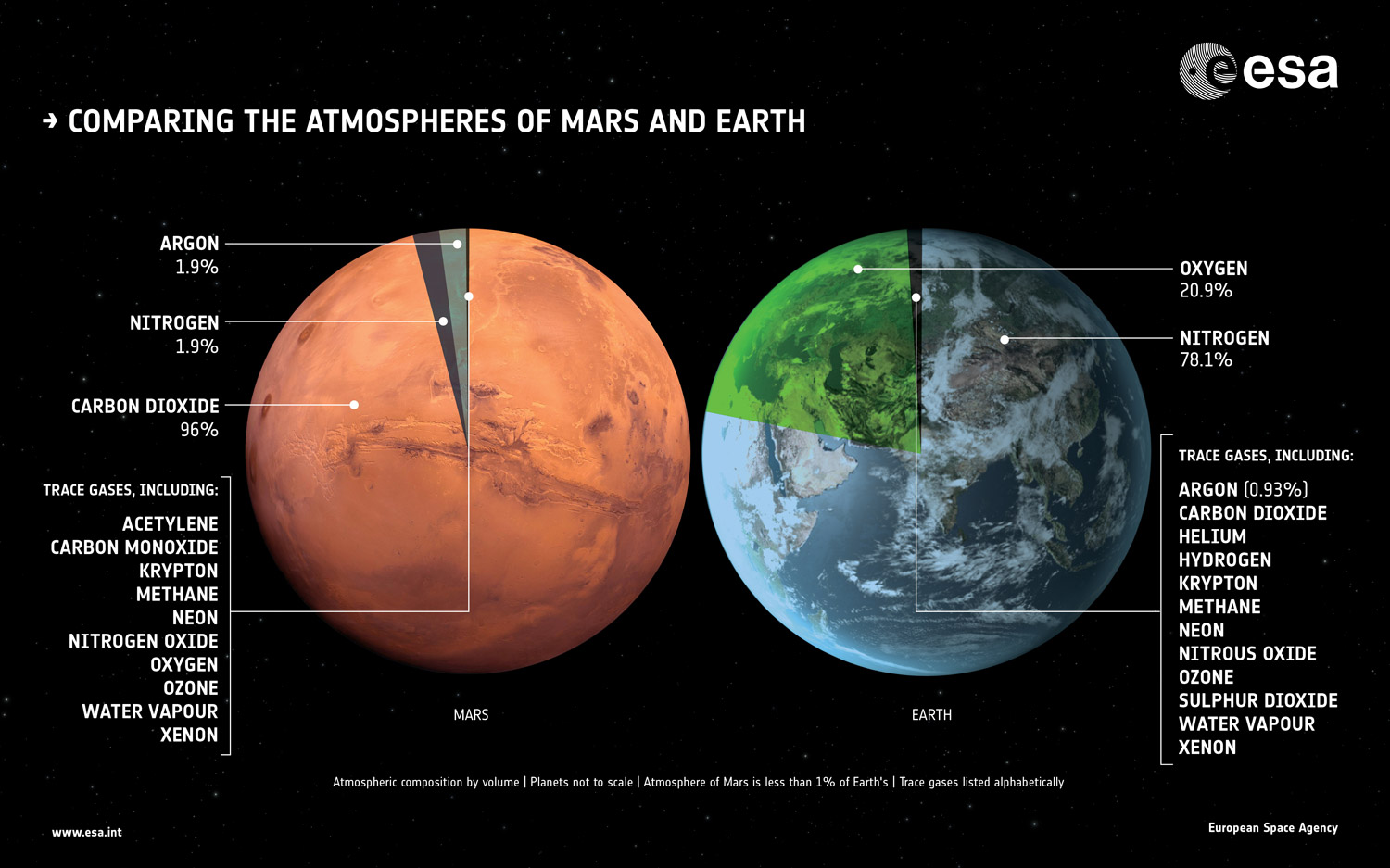
Based on the performance of the Mars Oxygen In-Situ Resource Utilization Experiment (MOXIE) on the Perseverance rover, producing a breathable atmosphere of 0.5 bar (which is 500 mbar, roughly half of Earth's sea-level pressure) from Martian air is a monumental, long-term engineering effort rather than a quick process.
Key Findings on MOXIE and Timeframes: Current MOXIE Capabilities: The toaster-sized MOXIE unit produced oxygen at a rate of roughly 6–10 grams per hour (g/h), with a peak of about 10.56 g/h.
Breathable Air Ratio: A single, current-scale MOXIE unit generates enough oxygen for a small dog for 10 hours, or roughly 10–20 minutes of breathing air for a human per hour of operation.
Scale-Up Needed: A full-scale system capable of producing the tons of oxygen needed for human exploration would need to be scaled up by roughly 200 to 300 times compared to the current MOXIE.
Processing Timeframe: A scaled-up system (2 to 3 kg/hour of O2) could theoretically produce enough oxygen to support a mission, but pressurizing a habitat or the atmosphere to 0.5 bar—which is significantly higher than the ambient Mars pressure of ~0.007 bar—would require continuous operation for over a year (300-600+ days). Detailed Breakdown: Current MOXIE Performance: MOXIE takes in CO2 from the Martian atmosphere, compresses it, and breaks it into oxygen and carbon monoxide. In its 16th run, it produced 9.8 grams of oxygen in one hour.
Limitations: MOXIE is limited by the power available on the Perseverance rover (about 100 watts for the instrument).Scaling for Humans: To support a human crew and make oxygen for rocket fuel (for the return trip), a future, much larger system is needed. If a scaled-up device produced 3 kg of \(O_{2}\) per hour, it would take roughly one full Martian year (687 Earth days) of continuous operation to generate enough oxygen to support a small crew for a mission.
Atmospheric Pressure vs. Breathing Air: It is important to note that MOXIE produces breathable oxygen, but not a full, 0.5-bar breathable atmosphere. Achieving a 0.5 bar pressure in a habitat requires compressing the thin ambient Mars air, not just breaking down CO2. The 0.5 bar goal is generally meant for pressurizing habitats, not for trying to make the entire planet's atmosphere breathable.
In summary, a single MOXIE unit would take decades to produce a significant, breathable habitat volume, but a scaled-up, "factory-size" version could feasibly produce enough oxygen to support a crew within one 26-month (2-year) mission cycle
Based on the performance of the MOXIE instrument on Mars, which produces roughly 6–12 grams of oxygen per hour, processing 150,000 cubic meters (\(m^{3}\)) of Martian air into breathable air at 0.5 bar would take thousands of years with a single prototype unit, but could be achieved in roughly 1–2 years using a scaled-up, full-size industrial system.
1. The MOXIE Scale (Prototype) Production Rate: 6–10 grams of \(O_{2}\) per hour.Daily Operation: Limited to ~1 hour of oxygen production per sol due to power constraints, requiring a 2-hour warmup.Time for 150,000 \(m^{3}\): A single, toaster-sized MOXIE unit would take over 10,000 years to fill a 150,000 \(m^{3}\) volume to 0.5 bar.
2. Scaled-Up System (Human Mission Scale) To make this practical, NASA envisions a scaled-up system 200–300 times larger than the current MOXIE, producing roughly 2–3 kg of \(O_{2}\) per hour, or 25–30 tons over a 17-month period. Required Oxygen: 150,000 \(m^{3}\) at 0.5 bar (50% of Earth's surface pressure) requires a significant amount of \(O_{2}\) (assuming breathable air is 20% \(O_{2}\)).Timeframe: A system of 100 scaled-up MOXIE stacks could generate tons of oxygen within one Martian year (687 Earth days).
3. Key Constraints Power: A full-scale plant requires ~25–30 kilowatts (kW) of continuous power.Compressed Atmosphere: MOXIE compresses Martian air to roughly 0.5 bar, but the output is nearly pure \(O_{2}\), not breathable air (which needs nitrogen/argon mix).Filter System: A system processing this much air requires efficient filters to handle dust, as the Martian atmosphere contains roughly \(1.8\times 10^{-7}\) kg of dust per \(m^{3}\).
Summary: Using the current MOXIE is not feasible for such a large volume. However, a scaled-up "factory" (100x larger) could produce this amount in about 1–2 Earth years, which is the time required for a typical Mars mission return cycle.
For a Martian habitat at 0.5 bar (significantly higher than Mars's ~0.006 bar average), spherical or cylindrical shapes are optimal for a stainless steel structure, as they efficiently contain internal pressure, with cylindrical shapes often favored for practical construction and use with regolith shielding, using tension members to handle stress, similar to pressurized vessels on Earth.
Why These Shapes?
Spherical: A sphere distributes stress equally in all directions, making it structurally ideal for holding internal pressure against a vacuum or low external pressure.
Cylindrical: Cylinders (especially with domed ends) are practical for larger volumes, offer better usable floor space, and can be buried or covered with Martian soil (regolith) for radiation shielding without collapsing.
The largest solid oxide electrolyzer (SOE) developed for Mars is the mission-scale SOXE stack by OxEon Energy, a 33x scaled-up version of the toaster-sized MOXIE device on NASA's Perseverance rover, designed to produce propellant for human return missions, though the MOXIE unit itself was the first SOE to operate on Mars, generating oxygen from CO2. On Earth, Bloom Energy's 4 MW Bloom Electrolyzer is the world's largest SOE system, stemming from that original NASA Mars technology.
For Mars Missions (Technology for Future Human Exploration):
MOXIE (Mars Oxygen ISRU Experiment): This small, toaster-sized SOE device on the Perseverance rover successfully demonstrated solid oxide electrolysis on Mars, producing oxygen from the thin CO2 atmosphere.
OxEon Mission-Scale SOXE: OxEon scaled up its MOXIE technology significantly (33x) for potential Mars crewed missions, aiming to produce large quantities of oxygen for propellant (Mars Ascent Vehicle) and life support, according to this TTU DSpace Repository document and OxEon Energy's website.
For Earth (Current Largest SOE):
4 MW Bloom Electrolyzer: Bloom Energy built the world's largest solid oxide system, operating at NASA's Ames Research Center, with roots in the original Mars technology to produce clean hydrogen for terrestrial decarbonization.
In summary, MOXIE was the first SOE on Mars, OxEon scaled it up for future large-scale Mars needs, and Bloom Energy created the largest SOE on Earth based on that heritage
The cell can also be used to make power from the input at about 60% efficiency.
Based on data from OxEon Energy and NASA regarding the MOXIE program, a 33x scaled-up version of the SOXE (Solid Oxide Electrolysis) stack is designed to meet mission-scale requirements for Mars habitation. OxEon 33x Scaled-Up SOXE
Performance Scale: The newer variants of the SOXE stack have a five-fold increase in cell area and a 6.5-fold increase in cells per stack, resulting in a stack with 33 times the capacity of the original, toaster-sized MOXIE device.
Production Capacity: Each 33x mission-scale stack is designed to produce approximately 675 g/hr of oxygen (\(O_{2}\)).Mission Setup: A system using six (6) of these 33x SOXE stacks is designed to produce 30 tons of propellant oxygen within the 19-month window between landing a Mars Ascent Vehicle (MAV) and the next launch opportunity.
Filling a 200m Diameter, 120m Tall Parabolic Structure Filling a 0.5 fraction (or any given volume) of a 200m diameter (\(r=100m\)), 120m tall paraboloid (volume \(V=\frac{1}{2}\pi r^{2}h\approx 1,884,955\text{\ m}^{3}\)) with oxygen on Mars involves using the atmosphere (\(\approx 96\%\) \(CO_{2}\)) as the feedstock.
Production Goal: The target for a human mission is 30 metric tons of liquid oxygen to launch a MAV, not filling a large storage dome.Time to Fill: A single 33x stack (675 g/hr) would take approximately 5 years of continuous operation to produce 30 metric tons.
Scaled Capability: Using six 33x stacks in parallel (as designed) results in a total production rate of \(\sim 4\) kg/hr.
To fill a 200m diameter structure with significant oxygen concentration would require a massive, energy-intensive array of these stacks, far beyond the 6-stack MAV refueling design. The OxEon mission-scale technology is designed for 30 tons of O2 within 19 months, which is sufficient for return, but not for filling a large-scale habitat structure to 50% capacity within that timeframe
Structural Considerations for 0.5 Bar (50 kPa)
Pressure Difference: A habitat at 0.5 bar (50 kPa) has a substantial pressure difference from the Martian surface (around 0.6 kPa), requiring robust structures.
Stainless Steel: While good for strength, stainless steel is heavy, making it costly to transport; however, it's excellent for withstanding pressure.
Tension: The primary force is outward tension. Structural members (like steel bands) wrapped around cylindrical habitats help contain this.
Design Concepts
Buried Cylinders: Building cylindrical habitats within trenches and covering them with regolith provides shielding from radiation and micrometeoroids, using the soil's weight to help counteract the internal pressure, notes Marspedia and NIH.
Domes: Dome-shaped structures (hemispherical) are also efficient for pressure containment, as studied by NASA.
In essence, think of large, pressurized tanks – spheres and cylinders are the best shapes for holding pressure, and adding regolith makes them even more effective Martian habitats
A counter pressure is generally not how an internal atmosphere in a Martian dome would be contained. The force from an internal, human-habitable atmosphere on Mars is immense (around 10 tonnes per square meter), meaning the structure needs sufficient mass and design to resist this tension and prevent it from being lifted off its foundations. The most practical engineering approach for a dome made of Martian regolith bricks involves using the weight of the material itself (or an external regolith covering) to counteract the internal pressure differential.
Internal Pressure Requirements
Mars's Atmospheric Pressure:
The external atmospheric pressure on the surface of Mars is extremely low, averaging only about 0.6 kilopascals (kPa), which is less than 1% of Earth's sea-level pressure. It is effectively a near-vacuum from an engineering perspective.
Human Habitable Pressure:
A human habitat requires a total internal pressure of at least 25 kPa with sufficient oxygen partial pressure to be functional without a pressure suit, or full Earth-equivalent pressure of 101.3 kPa (1 atm) for a standard environment.
Pressure Differential:
The critical engineering challenge is the 100+ kPa pressure differential between the inside of the dome and the outside Martian atmosphere. This creates a massive outward and upward force on the structure.
Structural Considerations for Regolith Domes
Tension vs. Compression:
Domes on Earth are compression structures, meaning their shape naturally handles the force of their own weight pushing down. On Mars, the low gravity and high internal pressure put the dome under tension, trying to tear it apart and lift it from its foundations.
Material Limitations:
Regolith bricks, even advanced "StarCrete" or sintered versions with high compressive strength (up to 72 MPa), have lower tensile strength. Standard bricks and concrete perform poorly in tension.
Design Solution: Weight and Reinforcement:
The primary method to manage the internal pressure is to use a thick layer of regolith as shielding/ballast.
Proposals often suggest using an internal inflatable bladder or a strong internal shell (perhaps with steel or carbon fiber reinforcement) to contain the air.
This internal structure is then buried under several meters of Martian soil/bricks. The sheer weight of this external material provides the necessary "counter pressure" by pushing down and counteracting the upward lift from the internal atmosphere.
In short, the counter pressure is not an engineered force applied externally but rather the passive mass of significant regolith shielding used to anchor the structure to the ground.
Offline
Like button can go here
#19 2026-01-12 10:20:59
- SpaceNut
- Administrator
- From: New Hampshire
- Registered: 2004-07-22
- Posts: 30,858
Re: WIKI Project Designing for Mars
Maintaining a 0.5 atmosphere (approx. 50 kPa or 7.25 psi) internal pressure for crewed habitats on Mars—roughly half of Earth's sea-level pressure—is a common design target because it balances structural requirements, reduces leakage risks compared to 1 atm, and provides enough oxygen for breathing without causing significant nitrogen decompression sickness. At this pressure, the primary structural requirement is managing high tensile stress, demanding shapes that minimize corners and maximize volume efficiency.
Shape Requirements for 0.5 ATM Habitats
Spherical and Cylindrical Domes: These are the most optimal shapes because they evenly distribute internal pressure. Spheres provide the best surface-area-to-volume ratio, reducing material usage, while cylinders are better for modular expansion.
Rounded/Bulbous Structures: Due to the severe pressure difference (0.5 atm internal vs. ~0.006 atm external), structures must avoid sharp edges or corners, which create stress concentrations.
Inflatable and Hybrid Designs: Inflatable structures, which often adopt a pill-like or rounded shape, are ideal because they are lightweight for transport and distribute tensile loads efficiently.
Buried or Covered Modules: To protect against radiation and potential structural failure from meteoric impact, modules are designed to be covered by several meters of regolith (soil), creating a flattened, mound-like structure rather than a standalone dome.
Concentric/Modular Units: To reduce structural load on a single, massive structure, multiple smaller pressurized modules (spheres or tubes) connected by airlocks are considered the safest design.
Key Structural Considerations
Internal vs. External Pressure: The 0.5 atm internal pressure is effectively a high-pressure vessel in a vacuum-like environment, placing massive stress on the walls.
Tensile Strength: Materials must have high tensile strength to prevent bursting. The internal pressure exerts about 10 tonnes of force per square meter (100 kN/m²).
Material Selection: Reinforced materials like Kevlar or Vectran for inflatable structures, or 3D-printed regolith-concrete mixtures, are necessary to hold the pressure.
Thermal Stress Management: Extreme temperature changes (day/night) cause significant thermal stress, requiring flexible, durable materials.
Operational Benefits of 0.5 ATM
Reduced Leakage: Lowering the pressure to 0.5 atm significantly reduces the pressure gradient, which minimizes the rate of atmosphere loss in case of small cracks.
Efficient Air Management: This pressure allows for an acceptable air mix (approx. 5 psi oxygen and 1.5 psi nitrogen), reducing the risk of fire compared to higher pure oxygen environments.
Efficient EVA Scheduling: A 0.5 atm environment reduces the time needed for astronauts to pre-breathe oxygen before performing Extra Vehicular Activities (EVA)

For welding SpaceX Starship's 304 stainless steel, the key equipment involves advanced, high-speed robotic laser welding machines for precise, fast, single-pass welds, replacing slower TIG/MIG methods, though standard TIG/MIG welders (like inverter-based Synergic ARC 304) with appropriate filler (ER308L) and argon gas are used for other stainless work. SpaceX uses specialized systems for deep penetration and heat conduction to minimize warping, enabling lighter, stronger structures quickly.
Cutting and Welding on Mars: Performing precision cutting and subsequent welding in the harsh Martian environment (thin atmosphere, dust, extreme cold) would require specialized, automated tools and techniques. While stainless steel can be welded relatively easily compared to other aerospace materials, doing so robotically in an off-world environment is a significant engineering challenge.
Key Equipment & Techniques for Starship (304 SS)
Robotic Laser Welding: The primary method for Starship rings, offering speed, precision, and minimal heat distortion, allowing thinner sheets.
Heat Conduction Welding: For thin sheets, creating clean welds with little warping.
Deep Penetration (Keyhole) Welding: For thicker sections, creating deep, strong single-pass welds.
TIG/MIG Welders (for general use/prototypes):
Inverter-based MIG/MAG: Machines like the Synergic ARC 304 offer advanced features, high duty cycles, and robust wire feeds.
TIG (GTAW): Known for beautiful, high-quality welds, requiring more skill.
Consumables:
Filler Wire: ER308L is standard for 304 stainless steel.
Shielding Gas: Argon-rich gases are essential for stainless steel welding.
Why the Shift to Laser Welding?
Efficiency: Dramatically speeds up assembly, reducing build times from months to weeks.
Weight Reduction: Enables use of thinner steel by creating stronger, consistent welds, cutting overall mass.
Quality: More precise, consistent welds with less warping than traditional methods.
General Stainless Steel Welding Tips
Cleanliness: Always start with clean stainless steel.
Filler: Use the correct filler (ER308L for 304).
Gas: Use appropriate argon mix.
Duty Cycle: Choose a machine with a high duty cycle for continuous work
SpaceX Starship uses 304L stainless steel, typically in large rolls or sheets for construction, with specific thicknesses around 4 mm (0.156 in), though thinner gauge sheets (like 0.8-1.2mm) are common for various finishes and sizes (e.g., 2000x1000mm, 2500x1250mm) from suppliers. While standard industrial sizes (4'x8', 4'x10') exist, Starship uses large, custom formats for its cylindrical sections, with some reports mentioning rolls over 72 inches wide.
Key Details:
Material: 304L Stainless Steel (low carbon version).
Thickness: Around 4 mm (0.156 inches) for main structure, but thinner for other parts.
Formats: Large sheets or rolls, not small standard sheets.
Standard Sheet Sizes (for general use): 4'x8', 4'x10', 5'x10' (and cut-to-size).
Specific SpaceX Use: Reports mention rolls 1828.8mm (72 inches) wide for building the rocket's body.
So, while standard sizes are common in the industry, Starship uses massive, specific sizes to form its huge cylindrical tanks and body sections.
SpaceX Starship uses 304L stainless steel, typically in large rolls or sheets for construction, with specific thicknesses around 4 mm (0.156 in), though thinner gauge sheets (like 0.8-1.2mm) are common for various finishes and sizes (e.g., 2000x1000mm, 2500x1250mm) from suppliers. While standard industrial sizes (4'x8', 4'x10') exist, Starship uses large, custom formats for its cylindrical sections, with some reports mentioning rolls over 72 inches wide.
Key Details:
Material: 304L Stainless Steel (low carbon version).
Thickness: Around 4 mm (0.156 inches) for main structure, but thinner for other parts.
Formats: Large sheets or rolls, not small standard sheets.
Standard Sheet Sizes (for general use): 4'x8', 4'x10', 5'x10' (and cut-to-size).
Specific SpaceX Use: Reports mention rolls 1828.8mm (72 inches) wide for building the rocket's body.
So, while standard sizes are common in the industry, Starship uses massive, specific sizes to form its huge cylindrical tanks and body sections.
Offline
Like button can go here
#20 2026-01-12 10:21:05
- SpaceNut
- Administrator
- From: New Hampshire
- Registered: 2004-07-22
- Posts: 30,858
Re: WIKI Project Designing for Mars
A dome constructed of 304L stainless steel with a 100-meter diameter and 20-meter height is theoretically possible but presents significant engineering challenges, primarily related to managing internal pressure and radiation shielding. The material properties of 304L stainless steel are suitable for the Martian environment, but building at this scale requires novel construction techniques and massive material transport from Earth or extensive in-situ resource utilization (ISRU).
Feasibility and Challenges
Pressure Management: The primary challenge is anchoring the dome against the internal air pressure required for a habitat. A 100m diameter dome would exert tremendous vertical force (around 78,000 tonnes of force), requiring extensive foundation engineering to prevent the dome from lifting off the ground.
Radiation Shielding: A bare metal dome would offer poor protection against high-energy cosmic rays. The structure would need to be covered with a thick layer of Martian regolith (soil) or ice for adequate shielding, potentially adding millions of tonnes of mass and significantly altering the design requirements.
Material Transport vs. ISRU: Transporting the vast amount of steel required from Earth is likely cost-prohibitive. While iron is abundant on Mars, developing the infrastructure to mine the ore, smelt it into iron, and then produce 304L stainless steel plates of sufficient quality and thickness on an industrial scale would be a massive undertaking.
Material Properties: 304L stainless steel performs well in the extreme cold of Mars and is resistant to radiation damage (it doesn't become brittle). However, it offers no radiation shielding for occupants.
Design & Scaling: Domes can be difficult to scale efficiently; as they get larger, the material thickness or strength needed increases disproportionately to handle the pressure, and interior space can be awkward to utilize. SpaceX uses 304L stainless steel for its Starship, which are pressure vessels, demonstrating the material's suitability for containing pressure, but these are smaller in diameter (9m) and use a cylindrical shape with domed ends, which is structurally more efficient for pressure containment than a large architectural dome.
Construction: On-site assembly would require advanced robotics and welding capabilities in a near-vacuum, extreme-cold environment.
Conclusion
While the material properties of 304L stainless steel are suitable for the Martian environment, the engineering challenges associated with building a 100-meter diameter, 20-meter tall habitat-grade dome are formidable. A more practical approach would likely involve a hybrid design using a much thicker layer of local regolith for shielding and using the steel for an internal pressure shell, or building the habitat primarily underground or within lava tubes to utilize the natural shielding of the planet's surface
Building a large-scale stainless steel isogrid dome on Mars to house 1,000 crew members requires an industrial-scale, multi-decade construction effort, focusing on in-situ resource utilization (ISRU) to minimize the immense cost of transporting materials from Earth.
Structural Design and Engineering Isogrid Structure: An isogrid—a triangular pattern of ribs—provides high stiffness-to-weight ratios, ideal for resisting the high tensile stresses of a pressurized dome against the near-vacuum of Mars.
Dome Sizing: To house 1,000 people, the structure would likely need to be a large, multi-hectare habitat, similar to "mega dome" concepts.
Dimensions: A 20-meter high, 24mm thick steel plate wall, bolstered by vertical stringers, can withstand internal pressure.
Anchoring: Large domes create immense upward pressure (approx. 10 tonnes per \(m^{2}\)). The dome must be anchored deeply into the ground, likely using the weight of Martian regolith.
Construction Process and Materials Stainless Steel Sourcing: Stainless steel components can be fabricated on-site. Using locally sourced materials requires 40-50 years of development, involving heavy mining and smelting, with a 1-meter deep, 8x8 km pit of regolith necessary for material to sustain a large population's infrastructure.
Fabrication: Panels would be manufactured on Mars and welded in place to create a pressure-tight, airtight structure.
Prefabrication Limits: Due to transport constraints, domes cannot be brought in one piece; they must be constructed using modular, assembled components.
Protection: The steel shell must be shielded from radiation and micrometeoroids, typically by covering it with 1–3 meters of compacted Martian regolith.
Challenges and Considerations Atmospheric Pressure: The 78,000 tonnes of force on a 100-meter dome requires massive, specialized structural engineering.
Surface Conditions: Extreme cold and dust storms will hinder construction, requiring durable, automated robotic equipment.
Alternative Approaches: While steel is possible, some experts suggest that 3D-printed regolith, ice, or carbon fiber might be more efficient in terms of weight and material, as bringing steel from Earth is too costly.
Redundancy: To prevent single-point failures, the habitat should consist of multiple interconnected domes rather than one single, massive structure
Stainless steel isogrid dome construction on Mars offers a robust method for creating large-volume, pressurized habitats, leveraging high-strength, lightweight, and durable materials that can be transported from Earth or potentially manufactured on-site. Isogrid structures (triangular, lattice-reinforced, or sandwich panels) are engineered for maximum stiffness, providing the necessary pressure vessel strength to withstand the high-pressure differential (approx. 14.6 PSI) between a breathable, pressurized interior and the near-vacuum, low-pressure (0.1 PSI) Martian environment.
Key Aspects of Stainless Steel Isogrid Dome Construction on Mars
Structural Integrity: Isogrid designs, often used in aerospace for their exceptional strength-to-weight ratio, are considered for large domes to manage the massive tension loads on the dome surface. These designs use stiffeners to prevent the panels from "ballooning".
Material Advantages: Stainless steel is deemed more cost-effective to produce and, for certain applications, more reliable than inflatable alternatives. SpaceX, for instance, has developed technologies to work with stainless steel for large pressure vessels.
Construction Process:
Modular Assembly: Domes would likely be constructed from smaller, manageable panels rather than being sent as one large unit, given cargo constraints (e.g., SpaceX's 12m diameter limit).
Welding and Joining: Electron beam welding or similar advanced, automated techniques would be used to join panels, taking advantage of the vacuum of space (or, by extension, the Martian atmosphere) for high-quality welds.
Foundations: The structure would likely be anchored firmly into the Martian regolith to withstand internal pressures and environmental stressors.
Environmental Protection: While the steel provides the pressure vessel, additional layers are needed for radiation shielding and to handle the extreme temperature differences (around -63°C average).
Regolith Shielding: Covering the dome with 3–5 meters of local soil (regolith) is proposed to protect against high radiation levels and micrometeoroid impacts.
Hybrid Designs: Using a "thermos" style, with an inner pressurized steel hull and an outer shell, is a potential design to manage thermal and structural loads simultaneously.
Potential Challenges:
Massive Pressure Load: A large, unburied dome would need to be extremely heavy to prevent it from bursting. This requires significant anchoring and material strength.
Transport Costs: Moving large amounts of steel from Earth is expensive, necessitating, in the long term, on-site, in-situ resource utilization (ISRU) to create construction materials.
Stainless steel isogrid domes are a viable, high-tech option, often discussed in parallel with other techniques like 3D-printed ice habitats or underground, excavated, or "buried," in-situ, "dome-on-a-crater" concepts
Constructing a stainless steel isogrid dome on Mars to maintain an internal atmosphere of 0.5 bar (approx. 7.25 psi, similar to Apollo-era spacecraft) is an engineered solution designed to balance high structural efficiency with the need to withstand intense internal tensile stress. At this pressure, the dome is primarily a pressure vessel, requiring superior anchorage to prevent it from lifting or buckling.
1. Structural Design & Advantages (Isogrid)
An isogrid structure—a triangular, lattice-like reinforcement on the interior of the skin—is ideal for a Mars dome because it offers high bending stiffness with minimal material weight.
Tensile Strength: Because the 0.5 bar internal pressure far exceeds the 0.006 bar external pressure, the dome is under constant, significant tension. Isogrid structures efficiently manage these hoop stresses.
Material Selection: Stainless steel is favored for its high strength-to-weight ratio, ease of welding/prefabrication on-site, and high cryogenic strength at low temperatures.
Shape Optimization: While geodomes are common, low-pressure Mars environments might favor "egg-like" or flatter shell geometries to better distribute the internal pressure loads.
2. Construction Methodology on Mars
Constructing such a structure requires automated, robotic assistance to handle hazardous, low-pressure, and cold conditions.
Prefabrication and Welding: Stainless steel panels can be pre-manufactured on Earth and transported, then welded together on-site. Welding is considered feasible for stainless steel compared to other materials like carbon fiber.
Anchorage: The dome must be heavily anchored to the Martian surface to prevent it from lifting off, requiring foundation engineering or covering the dome with several meters of regolith (soil) for ballast and radiation shielding.
In-Situ Resource Utilization (ISRU): Long-term construction can leverage ISRU by producing steel on Mars using local iron oxide and carbon, although this is a long-term goal.
3. Key Challenges at 0.5 Bar
Pressure Management: The dome must maintain its structural integrity under constant outward pressure, necessitating robust sealing against air loss.
Material Embrittlement: Although stainless steel has good low-temperature properties, it must be carefully selected to avoid becoming brittle in extreme cold.
Dust Accumulation: Abrasive Martian dust can settle on the dome, reducing solar gain and requiring maintenance.
Radiation Protection: While 0.5 bar of pressure provides some, it is insufficient to block harmful cosmic radiation; therefore, a covering of regolith is often necessary.
4. Comparison with Alternatives
vs. Rigid Domes: Stainless steel isogrid provides superior strength over standard rigid domes but is heavier to transport.
vs. Inflatable Domes: While lighter, inflatable structures (like the NASA Ice Home concept) require thicker insulation layers to prevent freezing and, often, a protective outer shell.
vs. Cut-and-Cover: Using buried or "cut and cover" techniques is often preferred for long-term, high-pressure habitation to minimize tension, whereas isogrid domes are excellent for high-volume work/living spaces.
A 0.5 bar environment represents a balance between the high cost of maintaining a 1-bar Earth-like atmosphere and the metabolic needs of humans, making it a viable, high-efficiency compromise for Martian habitation
Yes, an isogrid structure made from flat stainless steel sheets is a viable concept for large Martian habitats, offering high strength-to-weight with triangular ribs from single sheets, ideal for withstanding Martian pressure/loads while being potentially manufacturable (even 3D printed) in-situ or from pre-fab, balancing lightweight needs with Mars's harsh environment, though material processing and thermal swings remain key challenges.
Why Isogrids Work for Mars:
Strength & Lightness: Isogrids, essentially thin skins with stiffening ribs (often triangular), provide high structural stiffness and strength while minimizing mass, crucial for space structures.
Single-Sheet Fabrication: They can be machined or printed from single sheets, reducing complex assembly and potential leak points compared to honeycomb structures.
Isotropic Properties: The triangular pattern makes them behave like an isotropic material (same properties in all directions), offering uniform performance.
Material Adaptability: While traditionally metal, new additive manufacturing allows printing composite isogrids, and stainless steel offers durability.
Stainless Steel & Mars:
Durability: Stainless steel offers excellent resistance to corrosion and extreme temperatures, making it suitable for the harsh Martian environment.
Manufacturability: While requiring significant energy, it's a known material, and techniques like additive manufacturing (3D printing) are being explored for creating these structures on Mars using local resources or brought materials.
Challenges & Solutions:
Thermal Swings: Extreme temperature variations on Mars (e.g., 20°C to -73°C) can affect material adhesion and performance, requiring software/design solutions.
In-Situ Resource Utilization (ISRU): Processing Martian regolith or imported steel into printable/formable sheets for these structures is a major engineering hurdle.
Habitat Design: Integrating isogrid panels with other systems (like regolith shielding for radiation) and ensuring airtightness for large volumes remains complex.
In essence, an isogrid made from flat stainless steel sheets is a strong structural choice, but its practical application on Mars hinges on advanced manufacturing and material science to overcome thermal and processing challenges
Offline
Like button can go here
#21 2026-01-12 16:00:31
- SpaceNut
- Administrator
- From: New Hampshire
- Registered: 2004-07-22
- Posts: 30,858
Re: WIKI Project Designing for Mars
Turning Starship stainless steel into a 200m diameter, 120m tall isogrid parabolic dome on Mars requires a multi-stage, in-situ resource utilization (ISRU) approach. Given the scale, the process involves re-purposing the landed Starship structures for materials, while using automated, high-precision, on-site manufacturing to fabricate the isogrid structural components and covering them with Martian regolith for shielding.
Here is the breakdown of the process and the equipment required.
I. Conceptual Approach
Site Selection: Locate a, flat, stable, and iron-rich regolith area near landing sites.
Structural Re-purposing: Use landed, retired Starship hulls as raw stainless steel 301/321, which are ideal for high-strength, low-temperature structures.
Fabrication Method: Cut and press the stainless steel into isogrid panels (a lattice pattern of ribs), which are more efficient for large, lightweight structures than solid sheets.
Assembly & Shielding: Assemble the dome, cover it with a 1m+ thick layer of compacted Martian regolith to provide protection from radiation and meteorites.
II. Process Steps
Step 1: Raw Material Generation (On-Site): Utilize robotic systems to mine Martian soil and iron oxide to generate additional steel components, as relying solely on Starship hulls (100–150 tonnes each) may not be sufficient for a 200m dome.
Step 2: Processing & Fabrication:
Cutting: Large industrial waterjet or laser cutters (similar to those used at SpaceX Boca Chica) cut the stainless steel into necessary parabolic segments.
Isogrid Formation: CNC milling or hydraulic pressing machines form the isogrid triangular lattice and attachment flanges.
Step 3: Assembly:
Robotic Welding: Automated orbital welding robots, operated by cranes, weld the panels on the Martian surface.
Precision Alignment: Use laser surveying equipment for accurate placement of components, ensuring the parabolic shape is maintained.
Step 4: Foundation and Anchoring: Utilize pile drivers and concrete-like, binder-based anchors to fix the dome to the ground.
Step 5: Shielding: Use heavy-duty, earth-moving autonomous bulldozers to cover the structure with 1–3 meters of compacted Martian regolith.
III. Equipment List
To achieve this, the following equipment must be transported or manufactured on-site:
Extraction & Mobility:
Autonomous Mining Excavators (for regolith).
Large-Scale Autonomous Crane Systems (for moving Starship components).
Bulldozers/Regolith Movers (for dome covering).
Material Processing:
High-Energy Thermal Processing Units (to produce steel/glass fiber from local materials).
Robotic Plasma/Waterjet Cutters (for cutting steel panels).
Hydraulic Presses (to form isogrid patterns).
Assembly & Construction:
Autonomous Welding Robots (specifically designed for on-site, low-gravity, or vacuum-like conditions).
Laser Surveying & Alignment Equipment (for dome curvature).
Concrete Mixing/Binder Application Machinery (using local regolith and binders).
Power & Logistics:
Nuclear Reactors (e.g., Kilopower) or vast Solar Arrays (to power the heavy manufacturing).
Airlock Modules & Environmental Control Systems (to pressurize the finished dome).
IV. Key Considerations
Weight & Pressure: A 200m dome faces massive pressure differentials (14.7 psi inside vs 0.1 psi outside). It must be designed as a pressure vessel, using the weight of the regolith (compressive strength) to counteract the internal pressure (tensile strength).
Isogrid Benefits: Isogrid panels allow the structure to be both lightweight and incredibly strong, with the added benefit of using the cavities to mount insulation, sensors, or habitat infrastructure.
Scale: This structure is roughly 10x larger than the largest earthly dome, making it a "mega-project" requiring extensive automation, as shown in Surviving Mars construction concept
Turning Starship stainless steel (300-series) into a 200m diameter, 120m tall isogrid parabolic dome on Mars is a massive-scale in-situ resource utilization (ISRU) and construction project. It requires repurposing landed ship hulls, autonomous manufacturing, and extensive use of Martian regolith for shielding against the 0.5 bar internal pressure and radiation.
Construction Process
Site Preparation & Foundation: Level the site and utilize robotic loaders to clear rocks. Lay a foundation, likely using sintered regolith bricks or 3D-printed ceramic-like material.
Structural Fabrication (Isogrid):
Starship’s 300-series steel panels (approx. 4mm thick) are cut and welded into structural ribs (stringers) and rings, using an isogrid pattern (triangular grid) for strength.
In-situ fabrication: Instead of machining away 75% of material, use plasma cutters and welding robots to fabricate the isogrid by attaching stiffeners directly to steel sheets.
Dome Assembly:
Utilize a large-scale robotic, crane-based system (like an upgraded "Megabay" crane) to lift prefabricated segments into a 200m parabolic shape.
Weld segments together. The 0.5 bar internal pressure requires significant structural reinforcement.
Regolith Shielding Application:
Use robotic excavators to move, screen, and clean Martian regolith.
Apply 2m of regolith over the dome. A potential technique involves using electro-static, plasma-based sintering (melting) to stabilize the regolith into a rigid, insulating shield layer.
Equipment List
Raw Materials: Multiple landed/decommissioned Starships (300-series steel).
Heavy Machinery:
Autonomous Mining Excavators (for 2m depth, roughly 200,000+ tons of regolith).
Large-scale Cranes and Robotic Assemblers.
Fabrication Tools:
Plasma Cutters (plasma-arc or CNC).
Welding Robots (Flux-cored Arc Welding or Friction Stir Welding).
5-Axis Milling/Fabrication Units (for complex joints).
Regolith Management:
Regolith Sintering/3D Printing Robots (Laser/Microwave Sintering).
Screening/Cleaning Conveyor Systems.
Environment Control:
High-capacity Air Compressors (for 0.5 bar inflation/maintenance).
Air Locks and Environmental Monitoring Systems.
Key Constraints & Considerations
Pressure Management: A 0.5 bar internal pressure on a 200m dome creates immense structural stress. The isogrid structure must be rigid and airtight.
Radiation Protection: 2 meters of regolith is sufficient for shielding against cosmic rays and solar particles on the surface.
Fabrication Challenges: Machining isogrid is material-intensive (up to 75% loss); welding stiffeners onto sheets is more efficient for this scenari
Nasa has been planning with a crew of 4 electrical needs for a capsule being provided 10Kw from solar panels but for mars the amount of energy is divided for use for just 2 crewmen for all functions to create.
So a key power requirement is divide for all functions and must be greater than the stated so as to have margin for all personel to make use of it.
All designs must be based on personnel count for all designs for that reason.
Experiments at HI-SEAS analog station the 10 kw array saves to batteries that hold 28.5 kw hrs of energy.
A solar array needs to cover 4500 sq ft on mars while the same on earth is just 525 sq ft for a 10 kw needs to be 40 kw on mars.
Integrated Surface Power Strategy for Mars
NASA's power standards for crewed Mars missions vary significantly by mission phase and scale, ranging from a minimum of ~10 kilowatts (kW) for short surface stays with two crew members to potentially megawatt (MW)-class systems for larger, longer missions with in-situ resource utilization (ISRU) like propellant production, with nuclear power often favored for its reliability, though early missions might use solar/battery systems, with total requirements approaching 160 kWe for some concepts.
Key Power Requirements & Considerations:
Minimum Surface Power: Around 10 kW is considered the baseline for even short (30-day) missions with two crew, covering habitat, life support (ECLSS), and some science/exploration.
ISRU & Larger Crews: Missions involving propellant manufacturing (ISRU) and larger crews (e.g., six people) can push power needs to 40-160 kW or more for activities like producing oxygen and fuel.
Transit/Propulsion: Missions using nuclear electric propulsion (NEP) could require very high power, with some concepts needing 1.9 MWe (megawatts electric) for the journey itself.
Reliability & Redundancy: Critical safety systems demand high availability, often necessitating redundant power sources, like multiple nuclear reactors or large battery/fuel cell backup.
Power Technologies Considered:
Nuclear Fission Systems: Fission power (like Kilopower) is a strong candidate for its mass efficiency and continuous power, providing both electricity and heat, crucial for ISRU and reliability.
Solar Arrays: Roll-out or advanced photovoltaic blankets are an option, but limited by dust, available area, and nighttime needs, requiring significant energy storage.
Energy Storage: Advanced batteries (lithium-ion) and regenerative fuel cells are vital for bridging gaps in solar power or providing backup.
Example Mission Architectures:
Early Missions (2010s Studies): Concepts used two 40 kWe fission systems for 500-day stays, with one primary unit for ISRU and a backup near the habitat.
DRA 5.0 (Design Reference Architecture): Explored options requiring significant power for habitat, science, and ISRU, with pre-deployed cargo landers.
In essence, NASA's power strategy balances mission goals (science, ISRU, crew size) with technology capabilities, leaning heavily towards reliable nuclear systems for higher power needs while integrating robust energy storage for all scenarios
For a Mars garage or any other structure, power systems need reliability in dust and cold, likely combining solar arrays with advanced batteries (like Lithium-ion or supercapacitors) for peak loads and consistent energy, supplemented by Radioisotope Thermoelectric Generators (RTGs) or future Nuclear Fission Reactors for baseline power, especially during dust storms and night, alongside energy storage and distribution systems (PMAD) to manage variable demands for tools and habitat functions.
Primary Power Sources
Solar Arrays (Photovoltaics): Efficient when sunlight is available but challenged by dust accumulation and reduced intensity during Martian winter/storms, requiring regular cleaning.
Radioisotope Thermoelectric Generators (RTGs): Use natural decay of plutonium to generate continuous heat and electricity, providing reliable, long-term power independent of sunlight, excellent for baseline needs.
Nuclear Fission Reactors: For larger, sustained power needs (like industrial processes or larger habitats), small fission reactors offer high power output but require significant shielding for radiation.
Energy Storage & Management
Batteries: Rechargeable lithium-ion batteries (like those used on rovers) handle peak power demands, while advanced alternatives like graphene supercapacitors offer faster charging and wider temperature tolerance.
Power Management & Distribution (PMAD): Essential systems to convert, condition, and distribute power from sources to loads, handling start-up, shutdown, and dynamic events.
Supporting Technologies
Waste Heat Utilization: Nuclear systems produce excess heat, which can be converted to electricity or used for habitat/regolith heating, improving efficiency.
In-Situ Resource Utilization (ISRU): Solar concentrators could use sunlight for heating and 3D printing/sintering, potentially reducing reliance on pure PV cells.
Advanced Motors/Generators: Electric motors are preferred over combustion engines due to simplicity; next-gen storage like supercapacitors could revolutionize rapid power delivery.
A 10-megawatt (MW) nuclear reactor designed for Mars, often classified as a "Megapower" or small modular reactor (SMR), would likely be a compact, transportable unit, potentially fitting on a large flatbed truck or within a Starship payload bay, measuring roughly 10–20 meters in height. Such units are designed to operate within a small footprint (kilopower systems).
Key Details on 10MW Mars Reactor Sizes:
Scale: While 1–10 kilowatt (kW) reactors (Kilopower) are the size of a wastepaper basket, a 10 MW unit (10,000 kW) requires a much larger, though still "modular" design.Dimensions: Similar Megapower designs for space applications use compact, modular layouts with Stirling engines, enabling units to be transported in segments and assembled on-site, possibly similar in footprint to a small industrial building.
Configuration: These reactors are often designed to be buried in the Martian regolith for shielding or placed in a shallow crater.
Power Density: A 10 MW reactor is considered a "micro-reactor" in terrestrial terms (1–20 MW) but provides significant power for, say, propellant production and colony infrastructure.
For context, a 10 MW system produces 1,000 times the power of the 10 kW units currently being developed by NASA for early Mars missions
This is the bottom end of the NuScale small modular reactor (SMR) that are sized to fit on a tractor trailer trucks bed.
A 10 MWe (megawatt-electric) Small Modular Reactor (SMR) designed for space or remote applications is estimated to have a mass of approximately 40 to 70 metric tonnes. Yes, an SMR of this size can fit on a SpaceX Starship bound for Mars, as the rocket is designed to deliver over 100 metric tonnes of cargo to the Martian surface.
10 MWe SMR Mass and Dimensions
Mass: A scaled-up version of NASA’s Kilopower (Megapower) reactor capable of 10 MWe is estimated to weigh around 40 tonnes.
Size: These reactors are designed to fit inside standard transport containers or cargo fairings, making them compact enough for space launch.
Alternative Designs: While commercial terrestrial SMRs (like NuScale) are far too heavy (700+ tons), specialized space-rated designs (like General Atomics' 4–10 MWe reactor) fit within the necessary mass and volume constraints.
Fitting on Starship to Mars
Payload Capacity: Starship is intended to land 100–150 metric tonnes of cargo on Mars, easily accommodating a 40-50 tonne reactor.
Logistics: The reactor would likely be shipped in a "pre-deployed" cargo Starship to generate electricity and power In-Situ Resource Utilization (ISRU) for propellant production, allowing for a return trip.
Operational Considerations: While the reactor fits, the main challenges are deploying it using robots and providing enough radiation shielding for surface operations.
Key Constraints
Heat Rejection: The reactor requires large radiator panels to operate, which must also be transported and deployed.
Shielding: Substantial shielding is required to protect equipment and future crew from radiation
Maximizing electrical power output from a nuclear reactor delivered by Starship to a base on Mars
https://marspedia.org/Nuclear_power
Considerations for a Mars Garage or other structures
Dust Mitigation: Systems to clean solar panels and protect equipment from fine dust are crucial.
Thermal Management: Dealing with extreme cold (using waste heat or electrical heaters) is vital for equipment and battery health.
Scalability: A mix of sources (solar for peak, nuclear for baseline) offers the best resilience, from small tools to large fabricators
Offline
Like button can go here
#22 2026-01-12 16:00:36
- SpaceNut
- Administrator
- From: New Hampshire
- Registered: 2004-07-22
- Posts: 30,858
Re: WIKI Project Designing for Mars
A 10-megawatt (MW) nuclear reactor for Mars is significantly more compact than an equivalent solar farm, with a core unit that can fit into a relatively small area, although safety considerations require a wider exclusion zone. While current NASA "Kilopower" technology is in the 10-kilowatt (kW) range (40kW total for a base), a 10 MW system, which is 1,000 times more powerful, would likely be a small modular reactor (SMR) or a similar design.
Physical Size of Unit: A 10 MW SMR or similar reactor could likely fit within a very small footprint, potentially just a few hundred square meters for the reactor building itself, similar to, or smaller than, a small Earth-based SMR.
Total Footprint & Safety Zone: While the core, power conversion, and radiator systems are compact, radiation shielding requires an exclusion zone. Based on safety considerations for space-based reactors, a 10 MW reactor would likely require an exclusion area of several acres to several dozen acres (considerably less than 1 square mile, which is 640 acres) for safety and security, though this can be minimized if the reactor is buried or if the zone is sparsely used.
Comparison to Solar: A 10 MW solar farm on Mars would require roughly 50-100 acres, and potentially up to hundreds of acres for necessary battery storage. A 10 MW nuclear reactor would have a drastically smaller, more localized footprint.
Key Factors for 10 MW Nuclear on Mars:
Safety Requirements: Radiation shielding, such as burying the reactor, is essential to reduce the exclusion zone size.
Mass vs. Size: The primary challenge is not the area required to build it on the ground, but the mass and volume limitations of transporting it from Earth to Mars, often requiring assembly on-site.
Efficiency: Small modular reactors (SMRs) are highly efficient, with an estimated capacity factor of around 90 percent
For a KRUSTY-type fission reactor on Mars, safety berms use local regolith (Martian soil) for shielding, requiring significant mass to block radiation; calculations show thousands of kilograms of regolith needed, with studies focusing on optimal thickness (around 1-2 meters) and configuration (like a solid mound or annulus) for radiation safety, often using depletion zone models, depending on reactor power (Kilopower ~1-10 kWe) and acceptable dose limits for crew/equipment, with sizes varying but aiming for effective self-shielding.
Key Factors for Berm Sizing
Reactor Power: KRUSTY is a 1-10 kW(electric) prototype; higher power needs more shielding.
Radiation Type: Fission produces neutrons and gamma rays, requiring different shielding materials/thicknesses.
Regolith Properties: Martian regolith density and composition affect shielding effectiveness (mass attenuation).
Acceptable Dose: Safety standards dictate how much radiation reaches crew/equipment (e.g., below 10 mSv/year).
Configuration: Berms can be solid mounds or surrounding rings (annulus), impacting volume.
Typical Berm Specifications
Thickness: Studies suggest thicknesses of 1 to 2 meters (about 3-6 feet) of regolith are common for Kilopower-class reactors to achieve sufficient shielding.
Mass: This translates to significant mass, potentially thousands of kilograms, piled around the reactor.
Design: A common design involves a solid berm or a donut-shaped (annular) berm to shield the reactor while allowing access and heat rejection.
Example (Conceptual)
For a 1-kW(e) Kilopower reactor, analyses might require a regolith berm providing a dose reduction factor of about 100-1000, leading to a berm around 1.5 meters thick to meet crew safety guidelines.
In essence, the berm size (volume/mass) scales with reactor power and safety requirements, using readily available Martian soil for effective radiation protection
Offline
Like button can go here
#23 2026-01-12 16:00:43
- SpaceNut
- Administrator
- From: New Hampshire
- Registered: 2004-07-22
- Posts: 30,858
Re: WIKI Project Designing for Mars
Human habitat volume requirements vary greatly by mission, with individual private crew quarters needing ~2.1 to 5.4 cubic meters (74-190 ft³) for sleep/privacy (ISS to deep space concepts), while total habitable volume per person ranges from ~25 m³ (zero-g, near-term tech) to over 80 m³ (deep space Mars transit), balancing personal needs, equipment, and life support, with larger volumes preferred for long durations and artificial gravity.
Key Factors Influencing Volume:
Mission Duration & Destination: Longer missions (months/years) demand more volume for psychological well-being and supplies.
Gravity: Microgravity allows for compact designs, while artificial gravity (like spinning habitats) requires much larger volumes to accommodate equipment and normal human movement.
Functionality: Space for sleeping, hygiene, work, exercise, food prep, and communal areas all add up.
Technology: Advanced recycling and life support can reduce storage needs, but equipment still takes space.
Examples by Context:
Current ISS (Microgravity): Individual private quarters are small, around 2.1 m³ (74 ft³), but the overall station is large.
Deep Space Concepts (Future):
Individual Quarters: Aiming for 4 m³ (141 ft³) or more for better psychological health.
Total Habitat: Designs propose anywhere from 25 m³ (zero-g, near-term) to ~80 m³ or more per person for Mars transit, balancing mass and habitability.
Regulatory (Offshore): U.S. Coast Guard requires at least 6 m³ (210 ft³) per crew member in some vessels.
In Summary: There's no single number, but for long-duration deep space, expect requirements to trend towards tens of cubic meters per person for the entire habitat, significantly more than current microgravity quarters, especially if artificial gravity is used.
Offline
Like button can go here
#24 2026-01-13 18:53:30
- SpaceNut
- Administrator
- From: New Hampshire
- Registered: 2004-07-22
- Posts: 30,858
Re: WIKI Project Designing for Mars
Another material to check
Martian concrete is gypsum sand available on the Martian surface. Thermal dehydration converts the gypsum to plaster and water, two of the three ingredients necessary for concrete. A concrete 3D printer tunes the proportion of those materials, along with Martian sand and/or stone, to produce mix designs.
Gypsum on Mars is found in large dune fields near the North Pole (Olympia Undae), indicating past liquid water, and in smaller deposits like veins in Gale Crater (Curiosity rover), showing ancient lake environments. It's common in various locations, including fracture fillings and sediments, often alongside other sulfates like bassanite and anhydrite, pointing to diverse past watery conditions.
Key Locations:
Olympia Undae (North Polar Region): The largest known Martian gypsum deposit, found in extensive sand seas near the North Polar Cap, formed during wetter periods.
Gale Crater (Curiosity Rover): Gypsum veins and deposits have been identified in areas like Yellowknife Bay, evidence of an ancient lake system.
Juventae Chasma: Features named "Gypsum Hills" also indicate the mineral's presence.
Formation & Significance:
Requires Liquid Water: Gypsum (calcium sulfate dihydrate) forms in the presence of liquid water, confirming past warmer, wetter Martian environments.
Evidence of Ancient Water: Its presence in dunes suggests water emerged from melting polar deposits, while its occurrence in craters points to ancient lakes.
Mineral Associations: Often found with bassanite and anhydrite, indicating different hydration states or dehydration processes on the cold, dry planet.
Detection Methods:
Orbital Spectrometers: Instruments like OMEGA (Mars Express) and CRISM (MRO) detected broad sulfate signatures, including gypsum, from orbit.
Rover Instruments: The Curiosity rover's CheMin instrument confirmed gypsum's presence via X-ray diffraction, allowing for detailed mineral analysis
Offline
Like button can go here
#25 2026-01-13 18:55:32
- SpaceNut
- Administrator
- From: New Hampshire
- Registered: 2004-07-22
- Posts: 30,858
Re: WIKI Project Designing for Mars
Based on NASA's exploration-class mission studies and the Human Research Program (HRP), the recommended minimum acceptable Net Habitable Volume (NHV) for a Mars habitat is 25 m³ (\(883ft^{3}\)) per person. This volume represents the usable space after accounting for equipment, storage, and structural constraints.
Key Requirements and Volume Estimates: Minimum Habitable Volume: Approximately 25 m³ per crew member for long-duration missions (up to 30 months).Total Habitat Size (4-6 Crew): A 4-person crew requires a minimum of 100 m³ of net, usable space. Proposed Mars Direct mission plans suggested around 80 m³ total for 4-6 crew (approx. 13-20 m³ per person), though 25 m³ is the safer, more modern minimum estimate.
Net vs. Gross Volume: The "Net" habitable volume excludes space occupied by essential systems (airlocks, environmental control, storage), which can take up a significant portion of the total structure.
Minimum Dimensions: In addition to total volume, habitats must have enough space for tasks like exercise and medical evaluation, often requiring specific, functional, non-cramped spaces to prevent psychological distress.
Comparison: The International Space Station (ISS) offers roughly 153 m³ per crew member, but a Mars habitat will be much more restricted due to launch weight limits.
Functional Area Requirements per Crew Member:
Studies have broken down the necessary volume for specific functions within a habitat:
Sleeping Quarters: ~0.85 m³ per crew.Private Hygiene: ~2.36 m³ per crew.
Exercise/Equipment: ~3.06 m³ per crew.
Health/Medical Area: ~1.06 m³ per crew. For long-term, permanent, or expanding settlements, the available volume can increase through local construction (e.g., using regolith for radiation shielding), but the initial landing, transit, and surface habitats will likely operate close to the minimum 25 m³/person requirement
Comparison to Actual Mars Fines/Dust
Composition: While simulants try to match the iron-rich composition, they rarely replicate the exact mineralogy, specifically missing the exact amorphous silicate structure and, until recently, lacking the toxic perchlorates found on Mars.Particle Size: Martian dust is an incredibly fine powder, with many particles below 100 micrometers. High-fidelity simulants like MGS-1 are specifically processed to match this grain size distribution.Environmental Factors: Real Mars dust is highly oxidized and often electrostatically charged, posing a risk of sticking to equipment and clogging seals. Simulants must be tested for similar electrostatic behavior, but rarely achieve the exact conditions.Physical Differences: Real Mars fines often form duricrusts (hard surface layers) due to interaction with water vapor, a property difficult to fully replicate in simulants
Martian Fine Dust: Elemental/Oxide Composition
Martian dust is essentially pulverized, weathered mafic (basaltic) rock and is relatively uniform across the planet.
The primary oxides (\(>90\%\)) in Martian fine dust are:
Silicon Dioxide (\(SiO_{2}\)): \(\approx 49.5\%\)
Iron (III) Oxide (\(Fe_{2}O_{3}\)): \(\approx 18\%\) (causes the red color)
Magnesium Oxide (\(MgO\)): \(\approx 7.7\%\)
Aluminum Oxide (\(Al_{2}O_{3}\)): \(\approx 7.2\%\)
Calcium Oxide (\(CaO\)): \(\approx 6.7\%\)
Landing site give different amounts and composition.
As seen some have no Basalt sands....
Perseverance has identified a diverse mineral suite in Jezero Crater, pointing to a wet, formerly habitable environment. Key discoveries include olivine-rich igneous rock (Máaz and Séítah formations), carbonates, smectite clays, and hydrated silica. The rover recently discovered kaolinite, nickel-rich Fe-sulfides, and manganese hydroxide, indicating sustained watery conditions.
Key Mineralogical Findings:Carbonates & Clays: Detected early in the mission, these signify the presence of an ancient lake, acting as ideal materials to trap fossilized microscopic life.Igneous Minerals: The crater floor is composed of olivine and pyroxene-rich basaltic rock.Aqueous Alteration Minerals: Sulfate and perchlorate salts, along with Fe/Mg phyllosilicates, are found in the delta and crater floor deposits, indicating multiple water alteration episodes.Recent Discoveries:Kaolinite & Aluminum-rich rocks: Found as "white stones," suggesting long-term weathering in water.Nickel (Ni) Enrichment: Up to 1.1% nickel was found in Fe-sulfides in the Neretva Vallis area, associated with organic matter and similar to terrestrial microbial habitats.Manganese Hydroxide: Found in the "Kenmore" rock, indicating a highly oxidizing environment.Leopard Spots (Cheyava Falls): A rock containing olivine-rich, red-speckled material, including iron phosphate (vivianite) and iron sulfide (greigite), which are known to be potential biosignatures on Earth.
Rover Spirit
The Mars Exploration Rover Spirit, which landed in the Gusev Crater in 2004, discovered a variety of volcanic minerals and evidence of aqueous alteration, particularly in the Columbia Hills. The landing site was dominated by basaltic rocks rich in olivine, pyroxene, plagioclase, and magnetite. As Spirit explored, it found significant concentrations of iron, silicon, sulfur, chlorine, bromine, and phosphorus
Key Mineral and Elemental Findings:Plains Basaltic Rock: The initial landing site in the Gusev Crater was covered with olivine-rich basaltic rocks and volcanic dust containing magnetite (with titanium).Columbia Hills (Aqueous Mineralogy):Silica-Rich Soil: In areas like "Home Plate," Spirit discovered high concentrations (up to 90%) of pure silica (\(SiO_{2}\)), which likely formed in hot spring environments, indicating past volcanic activity in the presence of water.
Sulfates: The rover identified magnesium sulfates and other sulfate-rich soils, particularly in the "Paso Robles" class of soils, which indicates water-related processes.Carbonates: A major discovery in the "Comanche" outcrop was a high concentration of carbonate minerals, pointing to a formerly neutral pH, watery environment.Goethite: The iron-bearing mineral goethite was found, which is a known indicator of water-related oxidation.Mineral Weathering: The rocks in the Columbia Hills were significantly altered by water, featuring high levels of sulfur, chlorine, and bromine, suggesting a history of interaction with liquid water
Opportunity rover
The Opportunity rover landed in Meridiani Planum, finding extensive evidence of past liquid water through minerals like jarosite, hematite "blueberries," and various sulfate salts (kieserite, gypsum). The site, featuring sedimentary bedrock, revealed a highly acidic, wet environment in its early exploration, later discovering clay minerals indicating neutral water conditions
Key Mineral Elements and Findings:Jarosite & Sulfates: The Mössbauer spectrometer detected jarosite, a hydrated iron sulfate, confirming acidic water environments. Other sulfates include kieserite, sulfate anhydrate, bassanite, hexahydrite, and epsomite.Hematite: Abundant iron-rich spherules (blueberries) found on the surface were formed by iron oxidizing and accumulating in water, confirming a wet past.Clay Minerals (Phyllosilicates): Later in the mission, specifically at Matijevic Hill (Endeavour Crater), Opportunity found clay minerals (smectites), suggesting a more neutral, habitable, and older water environment.Other Minerals: The rover found magnesium, iron, and calcium salts, along with iron oxides. Silica (often indicating hot spring activity) was also identified in later exploration areas
Poor quality bricks can be made with simple compression, tho stronger bricks can be made with gentle heating. See Brick for more information.
https://marspedia.org/Brick
https://marspedia.org/Regolith
here is the copilot output for mars mission sites
Mission / Site: Viking 1 & 2 – Chryse / Utopia soils
SiO2 (wt%): ~43–47
FeO (wt%): ~17–20
MgO (wt%): ~8–10
Al2O3 (wt%): ~8–10
CaO (wt%): ~5–7
SO3 (wt%): ~6–8
Cl (wt%): ~0.5–0.8
Perchlorate (wt%): ~0 (not resolved)
Carbonate (wt%): ≤1 (inferred, poorly constrained)
Organics (mg C/g): n/a (no direct quantification)
Notes: Basaltic soil; high S and Cl; Fe-oxides (crystalline + poorly crystalline); trace meteoritic Ni.
Mission / Site: Mars Pathfinder – Ares Vallis soils/rocks
SiO2 (wt%): ~45–50
FeO (wt%): ~16–19
MgO (wt%): ~8–11
Al2O3 (wt%): ~8–11
CaO (wt%): ~5–7
SO3 (wt%): ~5–7
Cl (wt%): ~0.5–0.8
Perchlorate (wt%): ~0 (not resolved)
Carbonate (wt%): ≤1 (inferred)
Organics (mg C/g): n/a
Notes: Basaltic rocks; soils similar to Viking global dust; Fe-oxides, pyroxene, feldspar.
Mission / Site: MER Spirit – Gusev plains
SiO2 (wt%): ~45–50
FeO (wt%): ~16–20
MgO (wt%): ~8–12
Al2O3 (wt%): ~8–11
CaO (wt%): ~5–7
SO3 (wt%): ~4–7
Cl (wt%): ~0.5–0.8
Perchlorate (wt%): ~0 (not resolved)
Carbonate (wt%): ≤1
Organics (mg C/g): n/a
Notes: Primitive basalts; olivine, pyroxene, magnetite; global dust–like soil chemistry.
Mission / Site: MER Spirit – Columbia Hills altered rocks
SiO2 (wt%): ~40–50 (variable)
FeO (wt%): ~12–18
MgO (wt%): ~6–10
Al2O3 (wt%): ~8–12
CaO (wt%): ~5–8
SO3 (wt%): up to ~10–15
Cl (wt%): ~0.5–1
Perchlorate (wt%): ~0 (not resolved)
Carbonate (wt%): 1–3 (locally higher)
Organics (mg C/g): n/a
Notes: Weathered basalts; sulfate-cemented rocks; P, S, Cl, Br enrichments; evidence for aqueous alteration and some clays.
Mission / Site: MER Opportunity – Meridiani Planum soils
SiO2 (wt%): ~45–50
FeO (wt%): ~16–20
MgO (wt%): ~8–11
Al2O3 (wt%): ~8–11
CaO (wt%): ~5–7
SO3 (wt%): ~5–8
Cl (wt%): ~0.5–0.8
Perchlorate (wt%): ~0 (not resolved)
Carbonate (wt%): ≤1
Organics (mg C/g): n/a
Notes: Soils dominated by hematitic spherules (“blueberries”) mixed with basaltic fines; Br enrichment; meteoritic Ni.
Mission / Site: MER Opportunity – Sulfate sandstones
SiO2 (wt%): ~35–45
FeO (wt%): ~12–18
MgO (wt%): ~6–10
Al2O3 (wt%): ~6–10
CaO (wt%): ~5–8
SO3 (wt%): up to ~15–20
Cl (wt%): ~0.5–1
Perchlorate (wt%): ~0 (not resolved)
Carbonate (wt%): 1–3
Organics (mg C/g): n/a
Notes: Layered sulfate-rich sedimentary rocks; hematite; jarosite and other Fe-sulfates; strong aqueous alteration signature.
Mission / Site: Phoenix – Polar soils
SiO2 (wt%): ~40–45
FeO (wt%): ~15–18
MgO (wt%): ~7–10
Al2O3 (wt%): ~8–11
CaO (wt%): ~5–7
SO3 (wt%): ~3–6
Cl (wt%): ~0.5–1
Perchlorate (wt%): ~0.5–0.6
Carbonate (wt%): ~3–5
Organics (mg C/g): ~500
Notes: Alkaline soil (pH ~7.7); Ca-carbonate; perchlorate ~0.6 wt%; oxidized organics; ice-rich subsurface.
Mission / Site: Curiosity – Gale Crater basaltic sandstones (Rocknest / Yellowknife Bay)
SiO2 (wt%): ~45–50
FeO (wt%): ~16–20
MgO (wt%): ~8–12
Al2O3 (wt%): ~8–12
CaO (wt%): ~5–8
SO3 (wt%): ~3–6
Cl (wt%): ~0.5–1
Perchlorate (wt%): ~0.3–0.5
Carbonate (wt%): ~1–3
Organics (mg C/g): up to ~2000
Notes: Plagioclase, pyroxene, magnetite, hematite, anhydrite, minor sulfates; 30–40 wt% amorphous; perchlorate and nitrate; oxidized organic carbon.
Mission / Site: Curiosity – Gale Crater mudstones (Sheepbed / Murray)
SiO2 (wt%): ~45–55
FeO (wt%): ~12–18
MgO (wt%): ~6–10
Al2O3 (wt%): ~10–15
CaO (wt%): ~4–7
SO3 (wt%): ~3–6
Cl (wt%): ~0.5–1
Perchlorate (wt%): ~0.3–0.5
Carbonate (wt%): ~1–3
Organics (mg C/g): up to ~2000
Notes: Fine-grained lacustrine mudstones; more Al-rich; clays, Fe-oxides, sulfates; organics detected by SAM.
Mission / Site: Perseverance – Jezero Crater igneous rocks
SiO2 (wt%): ~45–50 (provisional)
FeO (wt%): ~15–20
MgO (wt%): ~8–12
Al2O3 (wt%): ~8–12
CaO (wt%): ~5–8
SO3 (wt%): ~3–6
Cl (wt%): ~0.5–1
Perchlorate (wt%): not yet well quantified
Carbonate (wt%): trace–few wt% (local carbonates)
Organics (mg C/g): n/a (no bulk mg/g yet)
Notes: Basaltic to ultramafic igneous rocks; olivine-rich units; corundum (Al2O3) with Cr/Ti/Fe impurities; carbonates in some units.
Mission / Site: Perseverance – Jezero deltaic / sedimentary targets
SiO2 (wt%): ~45–55 (provisional)
FeO (wt%): ~12–18
MgO (wt%): ~6–10
Al2O3 (wt%): ~10–15
CaO (wt%): ~4–7
SO3 (wt%): ~3–6
Cl (wt%): ~0.5–1
Perchlorate (wt%): not yet well quantified
Carbonate (wt%): up to several wt% (carbonates, sulfates)
Offline
Like button can go here