You are not logged in.
- Topics: Active | Unanswered
Announcement
#26 2025-11-03 12:00:26
- GW Johnson
- Member
- From: McGregor, Texas USA
- Registered: 2011-12-04
- Posts: 6,199
- Website
Re: Why Artemis is “better” than Apollo.
I see in the news that NASA finally threw open the lunar lander thing to all of industry, seeking a "plan B". So far, there have been 2 responses, one from SpaceX, the other from Blue Origin, the same original HLS contractors NASA selected, then finally downselected to SpaceX. The news reports provide no clue as to what SpaceX and Blue Origin "plan B" items really are.
You can pretty much bet that the SpaceX "plan B" is still some variant of its Starship modified to land on the moon, which is exactly what they were contracted to do in the first place. You can also bet that the Blue Origin "plan B" will be based on the "Blue Moon" lander they were designing right up until the downselect. They both have too much effort invested in those ideas to switch horses now. Simple as that!
Both are too tall to be stable for rough field landings on the moon (they violate the "stance wider than the cg is tall" criterion that was successful with Surveyor and the Apollo LM). And, you have to worry also about landing pads sinking deep into the lunar regolith, because it is no stronger than an Earthly sand dune! I do not know how loaded the Blue Origin pads would have been, but as of yet I have seen nothing out of any SpaceX designs that take dynamic (transient) bearing pressures during touchdown into account. They only have touchdown experiences on a hard pad or steel deck.
NASA needs somebody else to respond with a different idea from either of these two. But, with the landing scheduled for only 1 or 2 years way, there is no reality to NASA's plans, either! The Apollo LM took 4 years paper to flight, and that was a crash program where money was secondary. This is not. The downselect was driven by insufficient money in the first place. This lander cannot be done "from scratch" in 1-2 years, even if it were a crash program.
The original SpaceX and Blue Origin ideas have about 2 years under their belts now. Some variants of those are the only feasible things that might get done in another 2 years. And that could ONLY happen if NASA funded both contractors at a crash program level, from now until then. That's the only way to have a viable option AND a viable backup option! Common sense says so!
But it ain't going to happen that way, people!
All you need do is look at what is happening to JPL to understand what has already been happening at the rest of NASA. So far, 25% of workforce laid off, and they were by far NASA's most capable people! Demonstrably so! THAT is what this government is really doing!
Just as I have always recommended: "look ONLY at what they really do; do NOT listen to what they say or promise!"
GW
GW Johnson
McGregor, Texas
"There is nothing as expensive as a dead crew, especially one dead from a bad management decision"
Offline
Like button can go here
#27 2025-11-19 15:36:02
- SpaceNut
- Administrator
- From: New Hampshire
- Registered: 2004-07-22
- Posts: 30,706
Re: Why Artemis is “better” than Apollo.
Leaked Document Shows Elon Musk’s SpaceX Will Miss Moon Landing Deadline. Here's What To Know
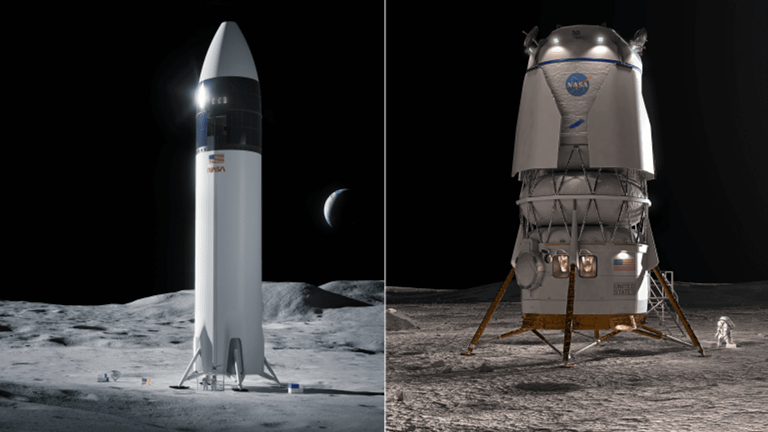
According to the original Artemis plan, we should have already put people on the Moon. Artemis III should have gone and come back by now. Instead, it is currently tentatively scheduled for no earlier than mid-2027. However, the mission is almost certain to be delayed again. The reason for the delay lies with SpaceX's Starship rocket: a leaked memo states that the vehicle won’t be ready until mid-2028, at least.
During the first Trump administration, the mission to bring humans back to the Moon was christened Artemis. It was going to involve the already-in-construction Space Launch System (SLS) and Orion capsule, as well as a privately built Human Landing System. Orion and SLS were tested with Artemis I in 2022.The original selection for the Human Landing System spacecraft was SpaceX's then-planned Starship. This actually created legal troubles for NASA. Jeff Bezos’s Blue Origin, a rival space company, filed a complaint in federal court against NASA, escalating its original complaint that NASA unfairly awarded the lunar lander contract to Elon Musk’s SpaceX.
At the time, the legal trouble seemed to be a major delaying factor. Issues with the spacesuit designs and problems with the heatshield of Orion added to the delays of both crewed missions: Artemis II, which will launch next year and travel around the Moon, and Artemis III, the mission that is going to bring the first woman and first person of color to the surface of the Moon. The next Moon landing was first envisioned to happen in 2024, then this year, and then it was postponed to next year. At the end of 2024, a mid-2027 date was put down, which remains the currently agreed target.
Before that agreement, an analysis published over a year ago by the US Government Accountability Office was skeptical that it would be possible to make that date, and posited it would be pushed to 2028. The major delaying factor now is Starship. The vehicle suffered multiple explosions this year. Despite the most recent successes, the vehicle is well behind schedule to safely carry astronauts from lunar orbit to the Moon's surface and back.
A few weeks ago, acting NASA administrator Sean Duffy went on TV to announce that the space agency was open to other companies to provide a lunar landing system. “[SpaceX and Musk] push their timelines out, and we’re in a race against China,” Duffy told CNBC’s “Squawk Box” at the time. “So, I’m going to open up the contract. I’m going to let other space companies compete with SpaceX.”
The only company that is ready to compete is Blue Origin. The company has not been advertising what they have been doing with their Blue Moon human lander, but it is expected that an actual space test will happen in the first half of next year. Blue Moon is supposed to be delivered in 2030 for Artemis V
Elon Musk did not take the news of NASA shopping around well. He turned to social media to post school-yard insults regarding Duffy (called him “Sean Dummy”) and wrote that: “The person responsible for America's space program can't have a 2-digit IQ.” Duffy retorted that “great companies shouldn’t be afraid of a challenge.”
In the leaked memo reported by Audrey Decker at Politico, SpaceX will be ready to land humans on the Moon in September 2028, more than a year after the mid-2027 goal of NASA. Before that, Starship needs to demonstrate in-space refueling, currently scheduled for June 2026, and an uncrewed landing on the Moon in June 2027.
To make that schedule work, nothing can go wrong. While Starship has achieved certain success as defined by the specific tests from SpaceX, it has yet to demonstrate the capabilities of flying to space and landing back on Earth safely. To state the obvious, a safe landing is the crucial part of a Lunar Human landing system.
NASA’s plans for the Moon missions continue to shift. The Trump administration’s budget has proposed canceling SLS, Orion, and the Lunar Gateway – the next-gen international space station currently under construction to replace the ISS – that is supposed to orbit the Moon to help facilitate both Moon landings nd further space travel. The administration's goal is to rely more on commercial partners, but it's an ever-changing race which ones they will be.
Offline
Like button can go here
#28 2025-11-24 19:52:26
Re: Why Artemis is “better” than Apollo.
Blue Origin is rapidly advancing in its space capabilities. It plans in first quarter 2026 to test land a cargo lunar lander in the Blue Moon Mk1, capable of transporting 3 tons payload to the lunar surface. Because of its large cargo capacity, Blue Origin is investigating it as a crewed lander to do Artemis III.
If it succeeds at this test landing in 2026 it will be a watershed moment. Not only is the landing important, but the lander uses hydrolox. In order for this to work the Mk1 will have to employ low boiloff tech. Others have speculated on accomplishing this, notably ULA with their proposed ACES hydrolox upper stage. Blue Origin having a stage with this tech would open up cryogenic stages being used as propellant depots and even for longer missions such as to Mars.
Beyond that, Blue Origin has announced a larger version of the New Glenn capable of 70 tons to LEO. I’m trying to find out if this is with partial reusability, i.e., recovering the booster. If it is, then its expendable payload would be ca. 100 tons. This is important because this is the range commonly thought needed for a “Moon rocket”, one capable of single launch manned Moon missions, a la the Saturn V. Eric Berger has written the upgraded new Glenn might cost only ca. $200 million and be ready by 2027:
Blue Origin revealed some massively cool plans for its New Glenn rocket
“The iterative design from our current 7×2 vehicle means we can build this rocket quickly.”
ERIC BERGER – NOV 20, 2025 1:06 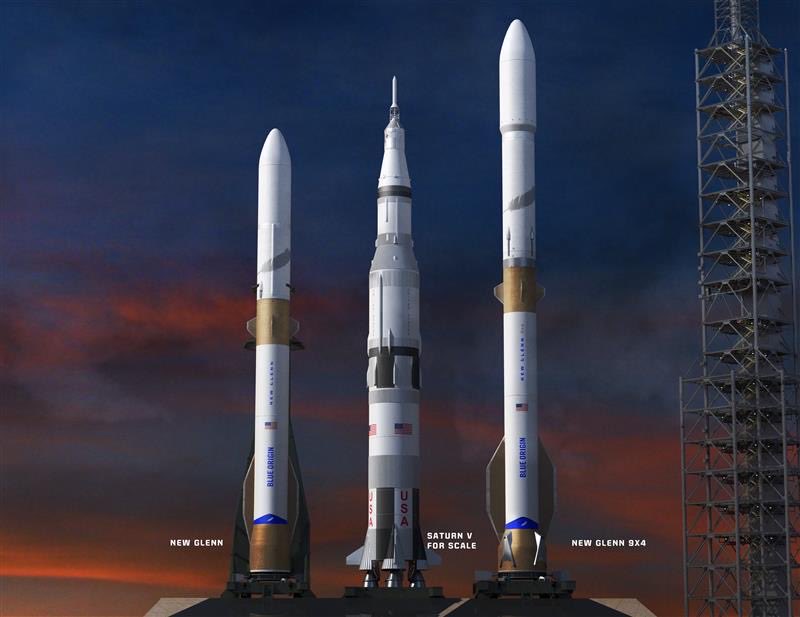
https://arstechnica.com/space/2025/11/b … nn-rocket/
If Blue succeeds at this, it again would be a game changer. This is scarcely more than what we spend just sending astronauts to the ISS. If manned Moon missions could be launched at costs this low it would finally open up the Moon to sustainable habitation and development.
Bob Clark
Last edited by RGClark (2025-11-25 08:45:44)
Old Space rule of acquisition (with a nod to Star Trek - the Next Generation):
“Anything worth doing is worth doing for a billion dollars.”
Offline
Like button can go here
#29 2025-11-25 10:59:35
- Void
- Member
- Registered: 2011-12-29
- Posts: 9,415
Re: Why Artemis is “better” than Apollo.
It is so good to see results for Blue Origin. They seem to have a working relationship with Rocket Lab as well. In the current situation they both do not have reusable 2nd stages, (Yet).
An interesting thing would if rocket Lab eventually size up their Neutron, if it works well.
So, it may be interesting to see if two cores SpaceX and Blue Origin, may gather others to their "Sphere of Influence".
I am fairly sure that NASA does not want just one major player.
If I am wrong, then perhaps a Blue Origin moon lander could be hosted by Starship.
If I am right, then I think that perhaps Stoke Space will enter the sphere of influence of SpaceX, and Starship/Superheavy might host a Starboat sized version of the 2nd Stage of Stoke Space, or Superheavy might lift a supersized Hydro-Lox, 2nd Stage of Stoke Space.
So, I am wondering about "In-Flight-Hot-Staging": 
By working with Stoke Space, SpaceX might get a Hydro-Lox 2nd Stage into their tool kit. And possibly with that different heat shield method. Although there is a question about if that heat shield could cope with speeds from the Moon, it perhaps would do OK with coming back from LEO.
And a Stoke Space 2nd Stage might work OK on the Moon. perhaps even landing into a cradle the shape of its heat shield.
I think it is possible that Blue Origin may create a Jarvis being a bit like the Stoke Space 2nd Stage as well.
https://www.bing.com/videos/riverview/r … &FORM=VIRE
Quote:
Stoke Space Second Stage: High Performance and Reusable within 24 Hours of Landing
YouTube
Space Startup News
5.4K views
Just a wish. With all the water which supposedly is not said to exist on the Moon, the 2nd stage might work rather well on the Moon and might support efforts with Starship itself.
Ending Pending 
Last edited by Void (2025-12-03 09:11:36)
Is it possible that the root of political science claims is to produce white collar jobs for people who paid for an education and do not want a real job?
Offline
Like button can go here
#30 2025-12-02 15:45:19
- GW Johnson
- Member
- From: McGregor, Texas USA
- Registered: 2011-12-04
- Posts: 6,199
- Website
Re: Why Artemis is “better” than Apollo.
I am glad to see Blue Origin entering the orbital launch fray. They do have an impressive design in New Glenn. It's smaller than Starship/Superheavy, so it fills a different payload mass niche.
Meanwhile, SpaceX has been proving out the "rideshare" concept with its Falcon-9. That is to be the technique by which the giant Starship/Superheavy can address the market for smaller payloads.
A rocket sized about right for a given payload offers the possibility of a sooner date to launch, but at a somewhat higher price. The "rideshare" option offers the lowest price, but at a longer wait time before launching, trying to fill the "seats".
I think both are good approaches, and actually the two companies will offer services that are as much complimentary as they are competitive.
Being so much bigger with an upper stage that is also a fully-qualified entry vehicle, I think SpaceX has the longer row to hoe, before their vehicle is considered safe and reliable. Blue Origin still has a similar row to hoe with New Glenn, but not one quite as long as Spacex's, because Blue Origin's upper stage is not reusable.
It's apples and oranges. I did the best I could to compare in a realistic way.
GW
GW Johnson
McGregor, Texas
"There is nothing as expensive as a dead crew, especially one dead from a bad management decision"
Offline
Like button can go here
#31 2025-12-03 09:16:44
- Void
- Member
- Registered: 2011-12-29
- Posts: 9,415
Re: Why Artemis is “better” than Apollo.
I like your evaluation Dr Johnson.
I think that Starships that land and stay on the Moon may have value, and those the loiter in orbit of the Moon may have value.
If it is true that the Moon has lots of water from ancient volcanism, then if Starship stopped off in orbit of the Moon and Carbon might be supplied by some efficient freighter, then a Hydro-Lox, Moon vehicle could act as a tanker to bring water to Lunar Orbit, where a space station might generate propellants for the Starship.
The Starship could bring freight to Lunar orbit and get refilled to either return to Earth, or go to another destination.
The Tanker could bring water up and freight down.
Ending Pending
Is it possible that the root of political science claims is to produce white collar jobs for people who paid for an education and do not want a real job?
Offline
Like button can go here
#32 2025-12-03 10:19:19
- GW Johnson
- Member
- From: McGregor, Texas USA
- Registered: 2011-12-04
- Posts: 6,199
- Website
Re: Why Artemis is “better” than Apollo.
Copied from my post 26 above:
"NASA needs somebody else to respond with a different idea from either of these two. But, with the landing scheduled for only 1 or 2 years way, there is no reality to NASA's plans, either! The Apollo LM took 4 years paper to flight, and that was a crash program where money was secondary. This is not. The downselect was driven by insufficient money in the first place. This lander cannot be done "from scratch" in 1-2 years, even if it were a crash program."
Now see this from the Wednesday 12-3-2025 issue of AIAA's "Daily Launch" email newsletter:
"Ars Technica
NASA seeks a “warm backup” option as key decision on lunar rover nears
By the time the second group of NASA astronauts reach the Moon later this decade, the space agency would like to have a lunar rover waiting for them. But as the space agency nears a key selection, some government officials are seeking an insurance policy of sorts to increase the program’s chance of success.
-----
My take on it:
Told ya so, didn't I? No reality at all to the Artemis plan and schedule.
They announced a landing date without a working prototype for a lunar lander, and no fruitful effort at all toward a rover. What kind of "planning" is that? What kind of "management" is that? None, I would say!
And just how are they going to address these needs while laying off 25-50% of their workforces? Answer -- they cannot!
All of which proves my point here: the NASA we knew and loved no longer exists.
It was slowly being destroyed by Congress using it for porkbarrel politics the last several decades, and here in the last several months, the destruction has been sped up enormously by this administration, which is demonstrably anti-science, and also apparently only interested in warfighting technologies it can purchase more over-the-counter than by developing them.
GW
GW Johnson
McGregor, Texas
"There is nothing as expensive as a dead crew, especially one dead from a bad management decision"
Offline
Like button can go here
#33 2025-12-03 10:27:24
- GW Johnson
- Member
- From: McGregor, Texas USA
- Registered: 2011-12-04
- Posts: 6,199
- Website
Re: Why Artemis is “better” than Apollo.
There may or may not be large quantities of easily-recoverable ice on the moon near its poles. We still do not know with real ground truth. Remote sensing still often lies to you, precisely because too many inferences have to be made.
But if easily recoverable ice exists, then LOX-LH2 should be producible powered by a mix of solar and nuclear electricity (remember, the day/night cycle is a month long!). All it takes is electricity to do purification, electrolysis, and liquifaction.
If you have a single stage, reusable lander rigged to use LOX-LH2 propellant, you can use it to ferry some of that same LOX-LH2 propellant to orbit. You refuel the lander on the surface. It uses less propellant to launch cargo into lunar orbit and return, done that way.
That being the case, what purpose does a lunar space station serve? Why build 2 propellant production plants? Just use the one you need on the surface, and ship product to orbit for transit elsewhere.
That approach makes more sense to me, because you get the same effect while building less infrastructure.
Now, if you intend to use LOX-LCH4 propellants, you will have to ship carbon from Earth or elsewhere, and it needs to be pure, and in powder form. There is no easily recoverable carbon on the moon.
Extremely dilute concentrations of anything are not easily-recovered resources. That is why sea water has never been "mined" for the uranium that is there, in extremely dilute concentrations.
GW
Last edited by GW Johnson (2025-12-03 10:30:39)
GW Johnson
McGregor, Texas
"There is nothing as expensive as a dead crew, especially one dead from a bad management decision"
Offline
Like button can go here
#34 2025-12-03 12:32:51
- Void
- Member
- Registered: 2011-12-29
- Posts: 9,415
Re: Why Artemis is “better” than Apollo.
Yes, what I suggested is contingent on there being large amounts of ice and very little CO2.
https://www.snexplores.org/article/ice- … tion-water
Quote:
Space
Ancient volcanoes may have left ice at the moon’s poles
The eruptions may have produced several temporary atmospheres that held water vapor
So we have a bit of a logic tree.
If Ice and No CO2, then lift H20 to Moon orbit refill station, and bring Carbon to Lunar orbit. (Starship needs Methane).
If Ice and CO2 (Dry Ice) on the Moon, make O2 and Methane and bring to orbit of the Moon to refill Starship.
An alternative would be to have a Hydro-Lox Booster that might give Starship a kick from the Moon.
We need to have facts about available resources as I know you have always maintained.
Ending Pending
Last edited by Void (2025-12-03 12:37:43)
Is it possible that the root of political science claims is to produce white collar jobs for people who paid for an education and do not want a real job?
Offline
Like button can go here
#35 2025-12-05 11:55:37
- GW Johnson
- Member
- From: McGregor, Texas USA
- Registered: 2011-12-04
- Posts: 6,199
- Website
Re: Why Artemis is “better” than Apollo.
Regarding post 32 above, more "I-told-you-so" stuff showed up in today's (5 Dec 25) "Daily Launch" from AIAA:
Ars Technica
Congress warned that NASA’s current plan for Artemis “cannot work”
In recent months, it has begun dawning on US lawmakers that, absent significant intervention, China will land humans on the Moon before the United States can return there with the Artemis Program. So far, legislators have yet to take meaningful action on this—a $10 billion infusion into NASA’s budget this summer essentially provided zero funding for efforts needed to land humans on the Moon this decade. But now a subcommittee of the House Committee on Space, Science, and Technology has begun reviewing the space agency’s policy, expressing concerns about Chinese competition in civil spaceflight.
-----
My take:
Finally, it is just beginning to dawn on the politicians running NASA's show that they have been seriously miss-running it! About time! Actually, far too late! Announcing an expected landing date without a lander (and a rover) almost done with development, was just UTTERLY STUPID! But that's EXACTLY what you get when you let incompetent politicians be the top managers. Always has been, always will be.
This return-to-the-moon thing should not be another space race in the first place. The US put boots on the moon 56-53 years ago. It should no longer be about "who does something first". It should actually be about going there to do something significant and perhaps even useful.
Congress took over managing NASA by the end of Apollo. We have spent the last half a century puttering around with men in orbit (WITHOUT doing artificial spin gravity work !!!), while sending probes to other planets from the one part of NASA not so badly micromanaged by Congress until recently. Before Nixon killed all manned spaceflight outside LEO (not just Apollo!!!), the plan was US boots on Mars in the 1980's!!!
EDIT UPDATE same day: NASA killed NERVA just as it was ready to fly as an alternate 3rd stage on Saturn-5, when Nixon forbade manned flight outside LEO, based on the reasoning "who needs the rocket if we aren't going to go?" They learned that kind of "reasoning" from Congress!
See what Congress micromanaging NASA REALLY did?
GW
Last edited by GW Johnson (2025-12-05 15:47:31)
GW Johnson
McGregor, Texas
"There is nothing as expensive as a dead crew, especially one dead from a bad management decision"
Offline
Like button can go here
#36 2025-12-08 10:41:13
- GW Johnson
- Member
- From: McGregor, Texas USA
- Registered: 2011-12-04
- Posts: 6,199
- Website
Re: Why Artemis is “better” than Apollo.
from the Monday 12-8-2025 "Daily Launch" email newsletter, there was a link to a longer article at Space.com, the text of which I copied and reproduced here:
TITLE 'We have lost a lot of time.' Former NASA chief says US needs to start over with moon landing plans or risk losing to China
AUTHORSHIP By Brett Tingley published 3 days ago
SUBTITLE "We have stuck to a plan that does not make sense."
TEXT Former NASA administrator Michael Griffin pulled no punches about where he sees America's current Artemis moon landing program in Congressional testimony today.
Griffin testified alongside other witnesses at a hearing held in Washington D.C. on Thursday (Dec. 4) by the Space and Aeronautics Subcommittee of the U.S. House of Representatives. The hearing, titled "Strategic Trajectories Assessing China’s Space Rise and the Risks to U.S. Leadership," was held to discuss the rapid development of China's space program and what that means for America's long-held dominance when it comes to space exploration.
And according to Griffin and the witnesses at the hearing, that dominance might soon cede to China due to policy decisions that continue to plague the Artemis program, NASA's current planned campaign of moon missions. "Sticking to a plan is important when the plan makes sense. China is sticking to a plan that makes sense. It looks a lot, in fact, like what the United States did for Apollo," Griffin said. "We have stuck to a plan that does not make sense."
Griffin said NASA and two consecutive presidential administrations have stuck to an Artemis moon landing architecture that "cannot work" and "poses a level of crew risk that should be considered unacceptable." The former NASA administrator reiterated a previous recommendation he made to Congress, arguing that NASA's Artemis 3 mission, currently planned for 2027, should be canceled — along with every other Artemis mission — so NASA and the U.S. government can rethink the whole plan for America's return to the moon.
"We should start over, proceeding with all deliberate speed," Griffin said. "We have lost a lot of time, and we may not be able to return to the moon before the Chinese execute their own first landing. Or we may; space is hard and despite the progress that China is making, mission success is guaranteed to no one. But though we may not win at this first step, we cannot cede the pursuit and leave the playing field to others."
NASA and SpaceX's current plan for Artemis 3 and other moon missions in the program relies on a complicated in-orbit refueling system. The current moon landing architecture requires a high number of SpaceX Starship launches in order to refuel the lander that would take NASA astronauts to the moon. The exact number still isn't even known, though SpaceX estimates it could require 12 Starship launches to fully refuel the lander. The concept also remains unproven; SpaceX intends to test Starship's in-flight refueling system on an upcoming launch.
Furthermore, Griffin added, the length of time the lander would need to remain in orbit while the refueling flights launch and rendezvous with it would "almost guarantee" the propellant loaded into the lunar lander would boil off before the mission proceeds. "I do not see a way with the current technology we have to overcome those problems, and therefore we should not pursue that line of approach," Griffin said.
Even SpaceX appears to doubt the current Artemis moon landing architecture. In internal company documents obtained by Politico, SpaceX estimates that September 2028 is the earliest timeline for a first crewed lunar landing attempt; however, according to publicly available information, NASA is still aiming for 2027 for that mission.
If Artemis 3 is delayed to late 2028, there will have been an average of two years between the first three Artemis program missions. The Apollo program, by comparison, launched each of its 11 missions an average of once every 4.5 months between 1968 and 1972.
NASA's current acting administrator has even criticized SpaceX for being "behind" on its lunar lander and Starship development. In remarks made in October 2025, acting NASA chief Sean Duffy suggested the Trump administration might be looking for other companies to compete to build and launch NASA's next moon lander. "The president and I want to get to the moon in this president's term, so I'm gonna open up the contract," Duffy told CNBC. "I'm gonna let other space companies compete with SpaceX, like Blue Origin."
But it could be that such programmatic instability is what is holding the United States back from committing to a moon landing program in the long-term, according to Dean Cheng, a China expert at the Potomac Institute for Policy Studies. Cheng told House representatives during the hearing that the bureaucratic structures of the Chinese government allow the nation to stick to plans over longer timelines than the U.S. government system allows. "China sticks to a plan. It creates a plan that sticks to it for decades," Cheng said. "And the benefit there is programmatic stability, budgetary stability, staff stability."
NASA, meanwhile, has been in a period of turmoil that has seen key science facilities lose capabilities, many flagship science missions put at risk of cancellation due to budget cuts, and thousands of personnel lost due to federal workforce reductions.
But whether or not the United States returns to the moon before China, former NASA chief Griffin said that the real risk is "failing to commit to what winning really means in the long run." Many U.S. government officials have stressed that whichever nation is able to establish a sustained presence on the moon first will have the privilege of establishing norms for how other nations can access and use lunar resources. If China manages to get a foothold on the moon ahead of the United States, it may be able to dictate who uses certain areas of the moon going forward, and how.
"I am confident that China fully understands this," Griffin said.
-----
My take:
Here are some high-level people saying essentially the same things I have been saying: how ridiculous our still-evolving mission architecture has been for returning to the moon, and how stupid it was to project a landing date without a lander leaving development testing already in-hand. The only item missing from this article is my comment that this should not be a race to see who is "first" about anything, because we already put boots on the moon over half a century ago! However, to get the politicians to do anything, I guess it has to be some sort of race, because of the technically-incompetent idiots that the politicians usually are. Another stupid race, just like with Apollo.
GW
GW Johnson
McGregor, Texas
"There is nothing as expensive as a dead crew, especially one dead from a bad management decision"
Offline
Like button can go here
#37 2025-12-08 11:07:53
- GW Johnson
- Member
- From: McGregor, Texas USA
- Registered: 2011-12-04
- Posts: 6,199
- Website
Re: Why Artemis is “better” than Apollo.
I would also add to the previous post that I think the concerns about in-space refueling are overblown. SpaceX is evolving toward accelerating the docked pair of vehicles at very low gee with thrusters of one type or another, slowly settling the propellants into the bottoms of the tanks. That will work.
Whether this can be done robotically is the real question here, especially since the AI stuff is already proving to be problematical in self-driving vehicles. If the programmers actually address all the possible contingencies, it will work. If they do not, sooner or later there will be a catastrophe. Simple as that. The track record with self driving cars is not promising, as regards programmers anticipating all possible contingencies.
As for the number of tanker flights, I think it is far too soon to be saying that it will take this or that number of flights. This thing is still in experimental flight test, and the final vehicle layout and configuration is still unknown at the detail level required to determine how much propellant payload could be delivered on-orbit. Even the propellant capacity of the vehicle is still evolving. For a full refill, could be anywhere from 6+ to 12+ flights. No one knows for sure yet! Claims "to know" this number are still BS.
And there is the long-term boil-off problem. Most anything they are doing will get you days of "stage life", but not weeks. They might get to weeks if the propellant tankage has the header tanks nested inside the main tanks, but only for the small quantities that the header tanks hold. To make it work, they will have to empty and vent the outer main tank, so that the vacuum between makes the tank system into a thermos bottle. The outer tank shell is also the sun shield that stops solar heating of the header tank, but only if there is vacuum between them.
One header tank is nested right now in the flight test configuration up to this point, the other is not. That will have to be rectified for the real mission. But as I said, we are still in experimental flight test with experimental configuration, and these configurations are still evolving. Claiming to already know the final "stage life" is also BS at this stage of the game.
But, what those considerations just discussed prove, is that this vehicle design is NOWHERE NEAR done with very experimental flight test, much less any final development prove-out testing! Precisely because of that, projecting mission schedules using it are still near-100% BS! That's the real effect of the factor-3-ish ratio between "Musk time" and real-world time that we have seen, ever since SpaceX first started flying Falcon-1's expendably out of Kwajalein.
That time ratio is different with each contractor, but all contractors have always had such time ratios. Long ago, that was taken into account by the government when planning military aircraft and space programs, and also for the civilian space program (same crowd of contractors back then). The details have shifted some since then, especially since there are now different pools of contractors for the various military and civil programs that only overlap some now. But it would seem that nobody at today's version of NASA (or DOD for that matter) remembers anything about evaluating and taking into account these time ratios.
That lack shows in how slow (and concomittantly expensive) it has become to actually do anything anymore. The P-51 Mustang went from a sketch on a napkin to a flying prototype in about 100 days. It took another year to re-engine the plane to make it the success that it finally became. And another year or three before they went to the bubble canopy on P-51D, solving the pilot combat visibility issue. That's about 3.5 years from an idea to a fully-successful combat design truly worthy of mass production.
Today that's now running about 25+ years (!!!) for airplanes and giant rockets. I think SpaceX is doing fairly well; their half-reusable Falcon-9 was ready in about a decade from idea to reality, which is way better than the industry usual. I think Starship/Superheavy is going to take them about that same decade to make ready. They are still a tad less than halfway done doing that.
GW
Last edited by GW Johnson (2025-12-08 11:31:27)
GW Johnson
McGregor, Texas
"There is nothing as expensive as a dead crew, especially one dead from a bad management decision"
Offline
Like button can go here
#38 2025-12-08 11:56:48
- Void
- Member
- Registered: 2011-12-29
- Posts: 9,415
Re: Why Artemis is “better” than Apollo.
I hope you don't mind the intrusion.
It looks like China and Blue Origin will be able to "Top" Falcon 9 within a period of time. Just knowing something can be done allows them to skip many of the mistakes that SpaceX had to endure.
I am wondering if when the HLS is satisfied, SpaceX could adapt its reentry methods to the 2nd Stage of Falcon 9.
It would be a diversion. And Merlin Engines are not as good. But there may be many more Spaceports that an upgraded Falcon 9 could operate from. And if they had landing barges for Starship/Superheavy, they also could use them for the Falcon 9.
Not all payloads are Starship sized anyway.
They have the Heat Shield almost figured out and the flaps are pretty much understood. But I expect that a Falcon 9 2nd Stage would have to do a "Hover Slam" landing like the 1st stage does.
Maybe they could upgrade the 2nd stage to Metha-Lox???
Granted, it is a diversion but the competitors don't have these skills yet.
Ending Pending
If they made is correctly then it could also be lofted to orbit by Starship itself at times and be a 3rd Stage "Starboat".
Ending Pending
Last edited by Void (2025-12-08 12:03:22)
Is it possible that the root of political science claims is to produce white collar jobs for people who paid for an education and do not want a real job?
Offline
Like button can go here
#39 2025-12-13 15:43:06
- SpaceNut
- Administrator
- From: New Hampshire
- Registered: 2004-07-22
- Posts: 30,706
Re: Why Artemis is “better” than Apollo.
With similarities to the use of the shuttle ET for humans to make use of.
A Common Habitat Deep Space Exploration Vehicle for Transit and Orbital Operations
Offline
Like button can go here
#40 2025-12-17 10:55:49
- GW Johnson
- Member
- From: McGregor, Texas USA
- Registered: 2011-12-04
- Posts: 6,199
- Website
Re: Why Artemis is “better” than Apollo.
Up to now, the usual orbital launch vehicle is two stages with a payload shroud. It has proven possible to recover the first stage, even if is largely constructed of aluminum, but ONLY because speed at entry is far lower than from orbit. Nearer 1 km/s than 8. With aluminum, you usually need an entry burn to slow down enough. With stainless steel, this is proving not to be necessary. There is very little in the way of plasma at Mach 6, and the hot air temperature is near 1800-1900 K. And for only a minute or two.
Second stages capable of surviving entry from orbit are a real problem, simply because the speed is so much higher. The exposure is to far higher plasma temperatures (in the 4000 to 8000 K range), and for a far longer duration(3 or 4 minutes). So far, it has proven to require some or all of the stage to be covered in some sort of heat shield material. Coming back from the moon or deep space is even worse: similar exposure times, but plasma temperatures can approach 6000 to 11,000 K.
What works at best mass ratio for an expendable second stage is not what you have to build for a recoverable second stage, as SpaceX has been demonstrating with its Starship. It must also be a qualified, heat-shielded entry vehicle, and in addition to that must also be capable of some sort of final descent and landing. That pretty much at least doubles, and maybe triples, the stage inert mass fraction.
GW
GW Johnson
McGregor, Texas
"There is nothing as expensive as a dead crew, especially one dead from a bad management decision"
Offline
Like button can go here
#41 2025-12-21 12:19:43
- SpaceNut
- Administrator
- From: New Hampshire
- Registered: 2004-07-22
- Posts: 30,706
Re: Why Artemis is “better” than Apollo.
Artemis III pressure and the threat to SpaceX
all about meeting the lunar manned mission date.
Offline
Like button can go here
#42 2026-01-11 11:12:32
- SpaceNut
- Administrator
- From: New Hampshire
- Registered: 2004-07-22
- Posts: 30,706
Re: Why Artemis is “better” than Apollo.
For GW Johnson...
https://www.msn.com/en-us/news/technolo … e130a&ei=8
I think this is the best way to preserve items that would disappear over time.
The story at the link above reports on a personal review of the heat shield for Artemis II by the new NASA director.
(th)
NASA chief puts Orion heat shield through final go/no-go check
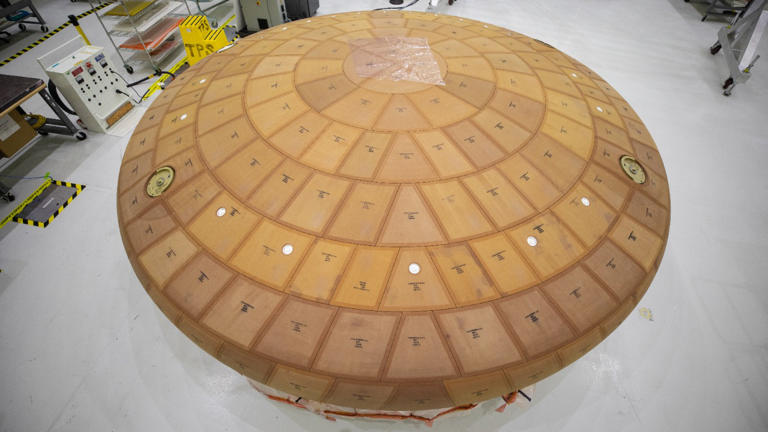
On the eve of the first crewed flight of the Artemis program, NASA’s top leadership has zeroed in on a single, unforgiving piece of hardware: the Orion capsule’s heat shield. The final go or no-go review of that system is not just a technical milestone, it is a public test of whether the agency has truly learned from the scorching lessons of Artemis I and is ready to send astronauts back toward the Moon.
By personally scrutinizing the Orion heat shield before Artemis II, the new NASA chief is signaling that the agency’s confidence must be earned, not assumed. The outcome of that review will shape when the mission flies, how the crew returns, and how the public judges NASA’s willingness to confront uncomfortable risks in full view.
From char loss mystery to root cause
The scrutiny now focused on Orion’s heat shield began the moment the uncrewed Artemis I capsule was pulled from the Pacific and hauled back to shore. After NASA recovered the Orion spacecraft and transported it to NASA’s Kennedy Space Center, engineers found that parts of the charred layer on the ablative shield had come off in ways they did not fully predict, a surprise for a system designed to burn away in a controlled fashion during reentry. That discovery triggered a long investigation into why chunks of material were shedding, and whether the pattern hinted at a deeper design flaw in the thermal protection system that guards the crew module.Investigators eventually traced the problem to how the material behaved under the specific heating and airflow conditions of the Artemis I trajectory, rather than to a single manufacturing defect or obvious structural crack. NASA has described how the charred layer on Orion’s base heat shield experienced unexpected char loss, prompting teams to dissect the shield, model the aerothermal environment, and compare test data with flight telemetry. That work set the stage for the current go or no-go decision, because it forced NASA to decide whether the anomaly could be bounded with analysis and minor tweaks, or whether a more invasive redesign was needed before putting people on board.
Why Artemis II depends on a single shield
The stakes of that decision are clear when I look at what Artemis II is supposed to do. The mission will send a crew of four, including Christina Koch, on a loop around the Moon and back to Earth, exposing Orion to a high-speed reentry that is only slightly less punishing than a direct lunar return. Koch and the other members of the Artemis 2 crew are eager to launch on their mission, but their path home runs straight through the same thermal environment that stripped away char on Artemis I, and any uncertainty about the shield’s performance becomes a direct question about crew safety.NASA has already acknowledged that the next flight is a crucial stepping stone toward a sustained lunar presence and, eventually, the kind of deep-space expeditions needed for crewed Mars missions. The agency’s decision to proceed with Artemis II using the existing Orion heat shield design, rather than ripping it out, followed an extensive review of the Artemis I data and a formal update to the broader Artemis flight plan. That choice effectively ties the schedule for returning humans to lunar orbit to the confidence engineers and leadership can place in a single, upgraded but not fundamentally redesigned shield.
Skip entry, schedule pressure, and a narrow launch window
The technical debate around Orion’s protection system is inseparable from the way the capsule comes home. For Artemis I, NASA used a “skip entry” profile in which Orion dipped into the atmosphere, then briefly bounced back out before making its final descent, a maneuver that spreads heating over a longer path but also creates complex aerodynamic loads. NASA traced the problem in part to Orion’s skip entry trajectory, noting that the pattern of char loss matched the phases when the capsule was skimming the upper atmosphere and then diving back in, which is why the same profile for Artemis II has drawn so much attention from engineers and outside analysts alike.All of this is unfolding against a tight but flexible launch window that could open as soon as early February. NASA’s Artemis II mission is currently targeted to launch in February, with officials describing a window that stretches from Feb. 6 to April 10 and is broken into several distinct periods of possible liftoff opportunities. Local coverage has underscored how the mission, updated at 10:24 PM EST, will be the first time astronauts fly around the Moon since Apollo, and that schedule pressure is now colliding with the need to be absolutely certain about the heat shield’s behavior on another skip entry.
nside the new NASA chief’s go/no-go moment
Into this mix has stepped a new NASA administrator, Jared Isaacman, who has made a point of personally engaging with the Orion heat shield issue. In a detailed review session described by space reporter Eric Berger, Isaacman pressed engineers on what went wrong with Artemis I and what had changed for Artemis II, before ultimately expressing full confidence in the system. That level of openness and transparency is exactly what should be expected of NASA, Berger wrote, noting that Isaacman had only been sworn in on December 18 when he convened the review that would effectively serve as the final go or no-go check for the shield, a moment captured in Jan coverage of the meeting.What stands out to me is how candid the internal conversation appears to have been. According to a detailed account shared by one attendee, the NASA team spent most of the session walking through charts and models before, toward the end of the meeting, agreeing to discuss something that no one really liked to talk about: the residual risk that cannot be engineered away. One of the NASA engineers said that even with all the analysis, there is still a nonzero chance of unexpected char behavior, a comment that surfaced in a However detailed community write-up of the review. Isaacman’s decision to accept that residual risk, while insisting on continued testing and monitoring, is the essence of a go call in human spaceflight.
Rollout, wet dress, and what still worries engineers
Even as the heat shield debate plays out in conference rooms, the hardware for Artemis II is moving toward the pad. NASA plans to roll out the Space Launch System rocket for the mission on Jan. 17, a key step that will lead into a full “wet dress rehearsal” where teams load the core stage and upper stage with more than 700,000 g of cryogenic propellants, roughly 2.65 m liters, and run through the countdown. During wet dress, teams demonstrate the ability to load more than 700,000 g of supercold fuel without leaks or valve issues, a rehearsal that must succeed before anyone worries about the heat shield’s performance on the way home.Behind the scenes, though, some specialists remain uneasy about how much of the Artemis I anomaly has been retired by analysis alone. A detailed video breakdown posted in Jan by an independent analyst revisited the Orion heat shield investigation and walked through what char loss really means for the structure underneath, highlighting how localized material shedding could, in a worst case, expose underlying layers to higher heating than expected. That follow-up on Orion underscored that while NASA’s official line is that the shield is safe for flight, there is still a healthy debate in the technical community about whether the current design has enough margin for the long-term Artemis roadmap.
Delay debates, outside critics, and the politics of risk
The path to this moment has already included one major schedule reset. In Dec, NASA announced that it would delay the next flight of the Aremis program, Artemis 2, pushing the mission back from its earlier target so engineers could fully understand the heat shield behavior and other systems. That decision, dissected in a widely viewed explainer on why NASA is not fixing the heat shield on Artemis II, made clear that the agency preferred to accept a longer gap between flights rather than rush a redesign that might introduce new unknowns, a tradeoff that was laid out in detail in a NASA-focused analysis of the delay.Critics have also questioned whether the nomination of Jared Isaacman, a billionaire pilot with his own commercial spaceflight ambitions, has overshadowed the technical issues around Orion. In Dec, one commentator argued that the Isaacman nomination risked pulling attention away from the hard engineering questions and toward personality-driven coverage, urging viewers on Thursday to focus instead on the new information about the heat shield and its test history. That perspective, shared in a detailed Thursday breakdown of the nomination, reflects a broader tension: NASA must balance the political optics of bold leadership with the unglamorous work of resolving char patterns and thermal margins.
Crew confidence and the long road back to the Moon
For the astronauts assigned to Artemis II, the heat shield debate is not an abstract engineering exercise. Christina Koch has spoken about how she and her crewmates are preparing for a mission that will test not only Orion’s systems but also the procedures and teamwork needed for later landings, and Koch and the other members of the Artemis 2 crew are eager to launch on their mission as soon as NASA gives the final green light. Their confidence rests on the assurance that the same shield which protected an uncrewed capsule through a skip entry will do the same with four people strapped inside, a point underscored in a feature on how Koch and the crew are training for the unknowns they might encounter around the Moon.NASA’s own messaging has tried to thread the needle between caution and ambition. Agency leaders have emphasized that the Artemis architecture, including Orion’s heat shield, is being built not just for a single lunar flyby but for a series of increasingly complex missions that will eventually support long-duration stays on the surface and, further out, crewed Mars expeditions. Local television coverage in Jan, updated by reporter Meghan Moriarty and reporter Hayley Crombleholme, has highlighted how the Artemis II mission to launch in February is framed as a historic return to deep space that must still clear a rigorous safety bar before liftoff. That framing, captured in a Meghan Moriarty segment, shows how the final go or no-go on the heat shield has become a proxy for the public’s trust in NASA’s entire lunar strategy.
What the final call will really decide
As the rollout date approaches, the agency is also refining its launch opportunities and contingency plans. NASA has broken the Artemis 2 launch window into three periods, each with a restricted set of possible liftoff times that balance lighting conditions, communications coverage, and the geometry of the return corridor. That structure, outlined in a Jan update on how Artemis 2 will move to the pad and aim for dates between Feb. 6 and April 10, underscores how tightly the mission’s trajectory, including the skip entry, is woven into the calendar.In parallel, public-facing explainers have reminded viewers that the heat shield will face its biggest test yet when Orion comes back from the Moon with people on board. One recent overview noted that the same skip entry profile that contributed to char loss on Artemis I will again be used to manage g-forces and heating, and that NASA traced the earlier problem in part to that trajectory while still concluding the system is safe for flight. That assessment, summarized in a Jan report on the upcoming mission, makes clear that the final go or no-go check by the NASA chief is less about discovering a new flaw and more about affirming that the agency is willing to own the residual risk it has already mapped.
Offline
Like button can go here
#43 2026-01-11 14:39:53
- SpaceNut
- Administrator
- From: New Hampshire
- Registered: 2004-07-22
- Posts: 30,706
Re: Why Artemis is “better” than Apollo.
The odds favor their survival, but the lethal uncertainty is nowhere near zero. Initially, the excuse was eliminating the skip and just going for direct entry. I do not see anything of that plan in the recent stories. This reminds me eerily of Challenger and Columbia.
I am still disappointed seeing the entire debate framed only as "fly what you have" vs "total redesign". Total redesign is NOT required, all they need to do is go back to the labor-intensive hand-gunned heat shield. There is NO REDESIGN associated with that! They already HAVE that design! They already flew it!
Doing that would enable them to work out how to cast those tiles with the hex cores in the them, and fly such a thing, even as a subscale test article, to see it actually work right. I already showed how to do that revised processing with an extrusion press, here on these forums, and I already sent that idea to them via a contact I knew within NASA, who has since retired. I NEVER EVER heard back from their heat shield people, to whom my contact forwarded my materials. "Not invented here" is a real flaw shared by lots of big organizations!
But it would definitely work, because the fibrous nature of the charred hex helps tie the otherwise weak carbon char together. It's a composite material that is better than just the carbon char from the polymer alone. I know that because of my experience with ablatives in ramjets and solid rockets. If you cannot reinforce the char, it goes away too quickly, in one fashion or another. Which experience goes way beyond sample testing in an arc jet tunnel, and running CFD codes that usually do not deserve to be believed, without confirmation testing! I'm talking real burn experiences with real motors and engines here!
The Artemis 1 failure already proved that fiber reinforcement contention of mine! The only difference between Artemis 1 and the first Orion that flew was that they deleted the hex to cast the tiles instead of hand-gunning the polymer into a hex core already attached to the capsule, like Apollo. Which is what flew on the first Orion. That's NOT a FULL re-design of anything, it's only a variation on the cast tile processing they now prefer (at the risk of the crew's lives, I might add, if they don't do something to reinforce that char).
GW
Offline
Like button can go here
#44 2026-01-11 14:43:26
- SpaceNut
- Administrator
- From: New Hampshire
- Registered: 2004-07-22
- Posts: 30,706
Re: Why Artemis is “better” than Apollo.
That's going to happen when management tries to be engineers looking at balance sheets rather than performance.
So which shield type is this one as I remember the original PICA version was dismissed for the honey combo hand inserted materials to which this one makes me wonder...
Offline
Like button can go here
#45 2026-01-12 10:38:00
- SpaceNut
- Administrator
- From: New Hampshire
- Registered: 2004-07-22
- Posts: 30,706
Re: Why Artemis is “better” than Apollo.
NASA just switched on a giant solar engine, and it’s headed for the moon
The Gateway, NASA’s upcoming lunar space station, is one step closer to reality as engineers have successfully powered on its solar electric propulsion system, a spacecraft engine designed to orbit and maneuver around the Moon. This achievement marks a major milestone in NASA’s Artemis program, which aims to establish a sustainable human presence on the lunar surface and prepare for future missions to Mars.
Building The Power And Propulsion Element
At the heart of the Gateway lies the Power and Propulsion Element (PPE), developed under the supervision of NASA’s Glenn Research Center in Cleveland, Ohio. Construction and assembly are led by Lanteris Space Systems in Palo Alto, California, where teams have integrated the spacecraft’s main electrical system within protective panels. This ensures the hardware can withstand the harsh environment of deep space.Once fully operational, the PPE will generate up to 60 kilowatts of electricity,enough to supply power for communications, navigation, and orbital adjustments. The engine’s advanced solar electric propulsion allows for continuous, efficient thrust powered by sunlight, offering an innovative alternative to traditional chemical propulsion.
The system’s propulsion capability is built around three 12-kilowatt thrusters developed by L3Harris and four 6-kilowatt BHT-6000 thrusters by Busek. Together, these thrusters provide the necessary maneuverability to maintain the Gateway’s orbit and reposition it as needed for lunar missions. Redwire, another NASA partner, is responsible for the roll-out solar arrays, lightweight, flexible panels that convert sunlight into electrical energy.
This hardware will power not only the Gateway’s core functions but also its visiting spacecraft and future science payloads, forming the energetic backbone of NASA’s next-generation lunar operations.
The Gateway’s Role In NASA’s Artemis Program
The Gateway is a cornerstone of NASA’s Artemis program, which aims to return astronauts to the lunar surface for the first time since Apollo 17. Unlike the International Space Station, the Gateway will not be permanently crewed. Instead, it will serve as a modular outpost, orbiting the Moon in a highly stable near-rectilinear halo orbit (NRHO).This orbit provides ideal access to both the lunar surface and deep space, making it an essential platform for testing life-support systems, radiation protection, and advanced propulsion technologies. Astronauts visiting the Gateway will conduct scientific experiments, prepare landers for surface missions, and evaluate long-duration spaceflight conditions, all critical for future crewed missions to Mars.
NASA envisions Gateway as an international collaboration, involving key contributions from ESA (European Space Agency), JAXA (Japan Aerospace Exploration Agency), and CSA (Canadian Space Agency). Each partner will deliver specialized modules, robotics, and technology to create a truly global platform for exploration.
Engineering A Sustainable Future Beyond Earth
NASA’s decision to rely on solar electric propulsion for the Gateway is both a technological and environmental breakthrough. Unlike conventional rockets, which burn large quantities of fuel in short bursts, this system produces continuous, gentle thrust using electricity derived from sunlight. Over time, it can achieve impressive velocities with minimal resource consumption, an essential feature for long-duration missions far from Earth.The Gateway will also act as a proving ground for autonomous operations, as it will often function without a human crew onboard. This autonomy will be vital for deep-space missions where communication delays make real-time control impossible. The spacecraft’s design prioritizes efficiency, durability, and adaptability, ensuring it can operate safely and independently in lunar orbit for years at a time.
Through its partnership with Lanteris, L3Harris, Busek, and Redwire, NASA is cultivating a powerful ecosystem of innovation that bridges public and private sectors. These collaborations are essential for building the infrastructure required for humanity’s next leap: establishing a permanent foothold on another world.
Offline
Like button can go here
#46 2026-01-18 12:26:23
- SpaceNut
- Administrator
- From: New Hampshire
- Registered: 2004-07-22
- Posts: 30,706
Re: Why Artemis is “better” than Apollo.
Artemis II: NASA's mega Moon rocket arrives at launch pad
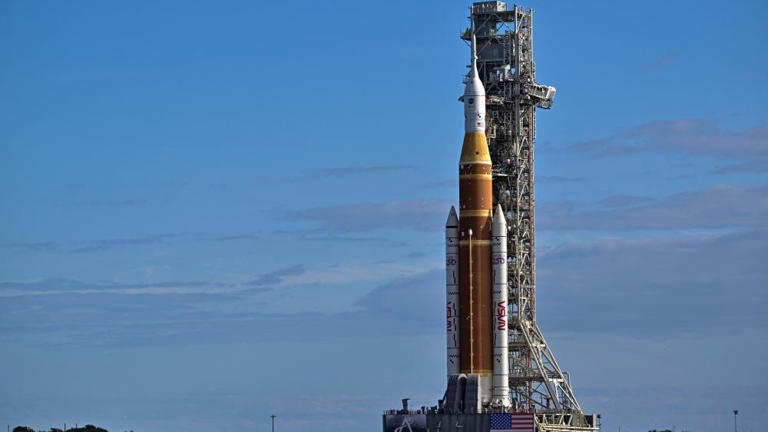
Nasa's mega rocket has been moved to the launch pad in Cape Canaveral, Florida, as the final preparations get underway for the first crewed mission to the Moon in more than 50 years.
Over almost 12 hours, the 98m-tall Space Launch System was carried vertically from the Vehicle Assembly Building on the 4-mile (6.5km) journey to the pad.
Now it is in position, the final tests, checks - and a dress rehearsal - will take place, before the go-ahead is given for the 10-day Artemis II mission that will see four astronauts travel around the Moon.
Nasa says the earliest the rocket can blast off is 6 February, but there are also more launch windows later that month, as well as in March and April.
The rocket began moving at 07:04 local time (12:04 GMT) and arrived at Launch Pad 39B at the Kennedy Space Center at 18:41 local time (23:42 GMT).
The rocket was carried by a huge machine called a crawler-transporter, travelling at a top speed of 0.82 mph (1.3 km/h) as it trundled along. Live coverage captured the slow-moving spectacle.
Nasa said the rocket will be prepared over the next few days for what it calls a "wet dress rehearsal" - a test for fuel operations and countdown procedures.
The Artemis II crew - Nasa's Reid Wiseman, Victor Glover and Christina Koch and Canadian astronaut Jeremy Hansen - were at the Kennedy Space Center watching the rocket as it was moved.
In just a few weeks, the four astronauts will be strapped into a spacecraft, perched on the top of the rocket, ready to blast off to the Moon.
It will be the first crewed mission to the Moon since Apollo 17 landed on its surface in December 1972.
Nasa said the mission could take its astronauts further into space that anyone has been before.
Artemis II is not scheduled to land on the Moon, but will instead lay the groundwork for a future lunar landing led by the Artemis III mission.
Nasa said the launch of Artemis III will take place "no earlier than" 2027. But, experts believe 2028 is the earliest possible date.
Koch said it was an amazing feeling to see the rocket.
"Astronauts are the calmest people on launch day. And I think... it feels that way because we're just so ready to fulfil the mission that we came here to do, that we've trained to do," she said.
Hansen said he hoped the mission would inspire the world.
"The Moon is something that I've taken for granted. I've looked at it my whole life, but then you just glance at it and glance away," he said.
"But now I've been staring at it a lot more, and I think others will be joining us and staring at the Moon a lot more as there will be humans flying around the far side and that is just good for humanity."
Before Artemis II heads to the Moon, the first two days of their mission will be spent in orbit around the Earth.
"We're going to be going into an orbit almost right away that is 40,000 miles out - like a fifth of the way of the Moon," Koch told BBC News.
"We will have the Earth out the window as a single ball, something none of us have seen in that perspective.
"And then we're going to travel a quarter of a million miles away… we're going to do a lot of science and operations along the way."
While they fly around the far side of the Moon, the crew will have three hours dedicated to lunar observation - to gaze, take images and to study its geology, which will help plan and prepare for a future landing at the Moon's south pole.
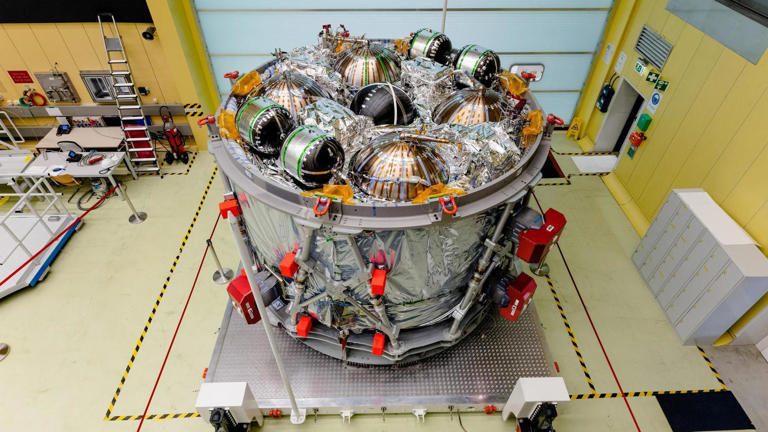
A key part of the Orion spacecraft that the astronauts will be flying in was made in Bremen in Germany.
The European Service Module, which sits behind the crew capsule, is the European Space Agency's contribution to the mission and has been built by Airbus.
"The European Service Module is so important - we basically can't get to the Moon without it," says Sian Cleaver, a spacecraft engineer at Airbus.
"It provides the propulsion that Orion needs to get us to the Moon."
Its large solar arrays will generate all the electrical power for the craft, she adds.
"We've also got these big tanks full of oxygen and nitrogen, which are mixed to make air, and also water, so that we can provide everything that the astronauts need in the crew module to keep them alive on their journey."
Inside their cleanroom, the team is busy building more modules for future Artemis missions. Each one takes about 18 months to put together but has taken thousands of engineering hours to design. Everything on board has to work perfectly.
"We've got to get those astronauts to the Moon and then back again, completely safely," says Cleaver.
With the rocket now on launchpad 39B, the Artemis team is working around the clock to get it ready for lift off.
The mission has already faced years of delays, and Nasa is under pressure to get the astronauts on their way as soon as possible. However, the US space agency said it would not compromise on safety.
John Honeycutt, chair of the Artemis mission management team, said: "I've got one job, and it's the safe return of Reid and Victor and Christina and Jeremy.
"We're going to fly when we're ready... crew safety is going to be our number one priority."

Offline
Like button can go here
#47 2026-01-24 15:42:54
- SpaceNut
- Administrator
- From: New Hampshire
- Registered: 2004-07-22
- Posts: 30,706
Re: Why Artemis is “better” than Apollo.
sort of old news about the SRB smoking its self to destruction but now its a big deal for the coming launch as NASA Artemis rocket booster suffers alarming anomaly in key test
ATK did have these happen but since being bought who knows why this one happened.
Offline
Like button can go here
#48 2026-01-24 16:45:16
- GW Johnson
- Member
- From: McGregor, Texas USA
- Registered: 2011-12-04
- Posts: 6,199
- Website
Re: Why Artemis is “better” than Apollo.
Spacenut:
I have a pretty good idea why it happened. These things are made by owned subsidiaries of Northrup-Grumman and one other company. The leaders of these corporations know nothing and care less about high-quality engineering of anything. We just saw that with the Boeing MAX disaster. They fire experienced hands and hire kids fresh out of school they can under-pay. Typical corporate thinking. But aerospace energetics in general, and rockets in particular, ESPECIALLY SOLIDS, do not do well in that environment!
Why? Because rocket "science" is not science, the science being what was actually written down for others to use. In production work, rocket "science" is only about 40% science. It is about 50% art, that being the also-essential knowledge passed on from oldsters to newbies, one-on-one, on-the-job. Why? Because no manager wanted to pay for writing it down!
But this gets done ONLY if those oldsters are still there to do that! And today's corporate "wisdom" specifies getting rid of anybody older than about 45-50 years old as "too expensive".
The other 10% is just plain old blind dumb luck!
This has been going on for decades, and is almost universal among today's gigantic (and almost totally unaccountable) corporations. Competition was once a brake on that evil behavior, but no longer. We only have monopolies or oligopolies now, in government contracting, and other arenas, too.
It's actually worse with development items: the art and luck percentages are higher, and the "science" written down is very much lower!
High-level managers ignoring or being unaware of these truths are EXACTLTY why bad management decisions killed two shuttle crews and 2 sets of MAX passengers. That plus a completely unwarranted arrogance that they know better than their engineers, when in truth they do not!
You don't take shortcuts with solids! You will blow them up if you do! And if it's a big solid, that can be quite the spectacular (and expensive and possibly lethal) event. Effective managers for such dangerous things (and there are many besides solid rockets, such as heat shields) will prioritize success over money and schedule. It is possible to get 1/million failure rate reliability out of solids (I once worked in a plant that did exactly that and was profitable)! But, such effective managers are now rare, if not totally extinct!
GW
Last edited by GW Johnson (2026-01-24 16:54:11)
GW Johnson
McGregor, Texas
"There is nothing as expensive as a dead crew, especially one dead from a bad management decision"
Offline
Like button can go here
#49 2026-01-24 18:34:42
- SpaceNut
- Administrator
- From: New Hampshire
- Registered: 2004-07-22
- Posts: 30,706
Re: Why Artemis is “better” than Apollo.
I suspected management decision making for budget and profit margins were behind it.
AKA shuttle disaster waiting to happen....
Offline
Like button can go here
#50 2026-01-25 13:06:12
- tahanson43206
- Moderator
- Registered: 2018-04-27
- Posts: 24,342
Re: Why Artemis is “better” than Apollo.
This is a follow up to GW Johnson's post #48 and to many other posts, letters and warnings he has issued on this subject.
The article quoted below goes into detail about the history, the decisions made, and the likely consequences.
This all comes down to the decision made a long time ago NOT to continue with the successful, proven, Apollo honeycomb design.
This article includes some painful reading, for some...
CNN
NASA is about to send people to the moon — in a spacecraft not everyone thinks is safe to fly
Jackie Wattles, CNN
Fri, January 23, 2026 at 9:36 PM EST
21 min read
Add Yahoo on Google
Add Yahoo as a preferred source to see more of our stories on Google.
NASA’s Orion spacecraft, which sits atop the Space Launch System rocket for liftoff, are seen at Kennedy Space Center in Florida on January 17. - Keegan Barber/NASA
NASA’s Orion spacecraft, which sits atop the Space Launch System rocket for liftoff, are seen at Kennedy Space Center in Florida on January 17. - Keegan Barber/NASAWhen four astronauts begin a historic trip around the moon as soon as February 6, they’ll climb aboard NASA’s 16.5-foot-wide Orion spacecraft with the understanding that it has a known flaw — one that has some experts urging the space agency not to fly the mission with humans on board. But NASA remains confident it has a handle on the problem and the vehicle can bring the crew home safely.
The issue relates to a special coating applied to the bottom part of the spacecraft, called the heat shield. It’s a crucial piece of hardware designed to protect the astronauts from extreme temperatures as they’re descending back to Earth during the final stretch of their moon-bound mission called Artemis II.
This vital part of the Orion spacecraft is nearly identical to the heat shield flown on Artemis I, an uncrewed 2022 test flight. That prior mission’s Orion vehicle returned from space with a heat shield pockmarked by unexpected damage — prompting NASA to investigate the issue.
AdvertisementAnd while NASA is poised to clear the heat shield for flight, even those who believe the mission is safe acknowledge there is unknown risk involved.
“This is a deviant heat shield,” said Dr. Danny Olivas, a former NASA astronaut who served on a space agency-appointed independent review team that investigated the incident. “There’s no doubt about it: This is not the heat shield that NASA would want to give its astronauts.”
At the conclusion of the Artemis I test flight, the recovered Orion spacecraft was transported to Kennedy Space Center, where its heat shield was removed and inspected. - NASA
At the conclusion of the Artemis I test flight, the recovered Orion spacecraft was transported to Kennedy Space Center, where its heat shield was removed and inspected. - NASAStill, Olivas said he believes after spending years analyzing what went wrong with the heat shield, NASA “has its arms around the problem.”
Upon completing the investigation about a year ago, NASA determined it would fly the Artemis II Orion capsule as is, believing it could ensure the crew’s safety by slightly altering the mission’s flight path.
AdvertisementIn a statement to CNN on Friday, NASA said the agency “considered all aspects” when making that decision, noting there is also “uncertainty that comes with the development and qualification of the processes of changing the manufacturing process of the Avcoat ablator blocks.”
Basically, NASA said, there’s uncertainty involved no matter which course of action it takes.
“I think in my mind, there’s no flight that ever takes off where you don’t have a lingering doubt,” Olivas said. “But NASA really does understand what they have. They know the importance of the heat shield to crew safety, and I do believe that they’ve done the job.”
Lakiesha Hawkins, the acting deputy associate administrator for NASA’s Exploration Systems Development Mission Directorate, echoed that sentiment in September, saying, “from a risk perspective, we feel very confident.”
AdvertisementAnd Reid Wiseman, the astronaut set to command the Artemis II mission, has expressed his confidence.
More in Science
A mystery object is holding this 120 million-mile-wide cloud of vaporized metal together
Space
Scientists discover alarming hazard lurking in drinking water: 'Can alter gut and liver function'
The Cool Down
Scientists Intrigued by Unfamiliar Life Form
Futurism
5 Simple Cardio Exercises from HomeMutual of Omaha
Ad“The investigators discovered the root cause, which was the key” to understanding and solving the heat shield issue, Wiseman told reporters last July. “If we stick to the new reentry path that NASA has planned, then this heat shield will be safe to fly.”
Others aren’t so sure.
“What they’re talking about doing is crazy,” said Dr. Charlie Camarda, a heat shield expert, research scientist and former NASA astronaut.
Camarda — who was also a member of the first space shuttle crew to launch after the 2003 Columbia disaster — is among a group of former NASA employees who do not believe that the space agency should put astronauts on board the upcoming lunar excursion. He said he has spent months trying to get agency leadership to heed his warnings to no avail.
Advertisement“We could have solved this problem way back when,” Camarda, who worked as a NASA research scientist for two decades before becoming an astronaut, said of the heat shield issue. “Instead, they keep kicking the can down the road.”
Now, the agency appears on track to green-light Artemis II for takeoff, as its leaders have sought to assure the public — and the crew — the mission will be safe.
The Orion spacecraft was rolled to its launchpad atop the Space Launch System (SLS) rocket on January 17. And a crucial milestone could be days away as Artemis program leaders gather for final risk assessments and the flight readiness review, a meeting in which top brass will determine whether the Artemis II rocket and spacecraft are ready to take off with NASA’s Wiseman, Victor Glover and Christina Koch, and the Canadian Space Agency’s Jeremy Hansen, on board.
The Artemis II crew: Canadian Space Agency's Jeremy Hansen and NASA's Christina Koch, Victor Glover and Reid Wiseman, seen in November 2023. - NASA
The Artemis II crew: Canadian Space Agency's Jeremy Hansen and NASA's Christina Koch, Victor Glover and Reid Wiseman, seen in November 2023. - NASA
A consequential design changeEven before Artemis, the Orion capsule — a $20.4 billion spacecraft that NASA spent 20 years developing — was not exactly a darling of the aerospace community. Resentment for the vehicle has been brewing in various pockets of the industry for some time.
AdvertisementOne engineer and physicist who previously worked on advanced technology development but did not work directly on the Artemis program derided Orion as “flaming garbage.” A former employee at NASA’s Jet Propulsion Laboratory, he decried the capsule’s exceptionally long development timeline and cost overruns that have ballooned into the billions of dollars.
Lori Garver, a former deputy administrator for NASA under the Obama administration, has publicly lamented the politicking that colored the vehicle’s path to completion.
But Orion’s issues can’t be fully pinned on politics, said Dr. Ed Pope, a heat shield and material science expert who founded Matech, a California-based missile defense technology company. Pope did not participate in NASA’s heat shield investigation.
“It’s not a Republican thing or a Democrat thing at all,” Pope told CNN. “It’s a bureaucrat thing.”
AdvertisementThe decisions that led up to the heat shield issues NASA is grappling with today began early in the spacecraft’s development process, according to Pope.
Orion program managers chose to make the spacecraft’s heat shield out of Avcoat material in 2009. The heat shields manufactured for NASA’s Apollo capsules all had a protective Avcoat layer, so leaders viewed it as a well-understood material with decades of data to back up its effectiveness.
For an uncrewed test flight in 2014, called EFT-1, the mission team outfitted an Orion capsule with a heat shield applied in the same manner as in the Apollo era — in an intricate honeycomb-like structure.
But that approach required a tedious manufacturing process that NASA hoped to avoid.
For the first test flight of Orion, the heat shield ablative material reached temperatures of about 4,000 degrees Fahrenheit (2,200 degrees Celsius). - Emmett Given/NASA/MSFC
For the first test flight of Orion, the heat shield ablative material reached temperatures of about 4,000 degrees Fahrenheit (2,200 degrees Celsius). - Emmett Given/NASA/MSFC“It was very finicky, and it was going to be really, really hard to reproduce that quickly,” said Pam Melroy, a longtime NASA employee, former astronaut and Air Force officer who once served as deputy administrator of the space agency. “That was part of the reason why we said, ‘Let’s just make this a simpler design.’ It was really all about producibility.”
AdvertisementEven before the EFT-1 test flight launched, NASA program managers wanted to alter the design, according to Melroy. Though NASA said in a statement the final decision was made in 2015.
NASA also said the honeycomb-structured Avcoat experienced issues during manufacturing for EFT-1, noting “cracks in seams appeared between the different honeycomb sections” and the material did not cure evenly and was weaker than expected. That made it “marginally acceptable” for the 2014 test flight and likely unusable for a lunar mission that requires far faster speeds and a more violent reentry process.
Textron Systems, the Texas-based company that produces Avcoat, told CNN in a statement that in 2015 it “licensed the Avcoat material to Lockheed Martin, who is contracted by NASA to manufacture the heat shields for the Artemis program” and deferred further comment to the aerospace giant.
Blaine Brown, director of Orion Spacecraft Mechanical Systems at Lockheed Martin Space, confirmed in a statement to CNN that the Avcoat structure was altered “to increase manufacturing and installation efficiency.”
Advertisement“We support NASA’s decision to fly the Artemis II mission with its current heat shield and are committed to seeing Orion safely launch and return on its historic mission to the Moon with crew onboard,” Brown said.
The Orion capsules built for the Artemis missions abandoned the Avcoat honeycomb structure in favor of a heat shield constructed using large blocks of the material.
An Orion heat shield configured using the block structure is seen. - Isaac Watson/NASA
An Orion heat shield configured using the block structure is seen. - Isaac Watson/NASA“Our experience with a block design on Mars heat shields showed us that blocks were easier to produce, test and install,” Brown said.
The first real-world test of the new Orion heat shield design, however, came with the Artemis I test flight in 2022. After that mission, NASA found chunks of the heat shield had broken off, leaving divots in the charred Avcoat material.
AdvertisementThat is not how the heat shield is supposed to behave. The Avcoat layer is meant to erode in a controlled manner as it heats.
NASA disclosed the problem months after Orion returned from space in 2022. The agency’s office of the inspector general then released images of the ravaged Artemis I heat shield in a 2024 report.
Images show the heat shield post-Artemis I mission, including cavities resulting from the loss of large chunks of the heat shield during reentry. - NASA
Images show the heat shield post-Artemis I mission, including cavities resulting from the loss of large chunks of the heat shield during reentry. - NASAFurther complicating the situation was the fact that by that point it was already too late to fix the heat shield for Artemis II.
NASA did not — and could not — replace the Artemis II heat shield with a new one. The Orion capsule slated for the mission already had its heat shield installed even before Artemis I flew, and “you couldn’t just go to Billy Bob’s heat shield removal shop” to replace it, Olivas noted.
AdvertisementThe investigation into the Artemis I heat shield issue also concluded that even though there were no astronauts on board the test flight, “flight data showed that had crew been aboard, they would have been safe.”
When asked about NASA’s decision to move forward with the Artemis II mission without replacing the heat shield, Melroy, who oversaw the heat shield investigation as deputy administrator, said that NASA “program managers sometimes have to make these trades for cost, schedule and performance, and they certainly didn’t undertake that decision lightly.”
Rethinking Orion’s reentryHeat shields produced for future Artemis missions will be manufactured with upgraded techniques, NASA leaders revealed in a December 2024 news conference.
Specifically, the agency plans to alter the “billet mold loading” essentially altering how much Avcoat is loaded into a mold to ultimately produce a more permeable shield, NASA said in its Friday statement to CNN.
AdvertisementIn the meantime, analysis of what went wrong during the 2022 test flight is informing a new approach for this year’s upcoming mission.
Avcoat is ablative, meaning the material is designed to char and erode in a controlled manner as the spacecraft comes roaring back from the moon and dips back into the thick inner band of Earth’s atmosphere while still traveling more than 30 times the speed of sound.
Before and after photographs show test results of heating Avcoat material for 660 seconds. - NASA
Before and after photographs show test results of heating Avcoat material for 660 seconds. - NASAThis phase of flight, called “reentry,” causes a violent compression of air molecules that can heat the spacecraft’s exterior to more than 5,000 degrees Fahrenheit (2,760 degrees Celsius).
NASA engineers designed the Orion spacecraft for a “skip reentry” — the capsule acts like a flat stone skipping atop the surface of a still lake as it dips briefly into the atmosphere and briefly raises its altitude once more before final descent. The special trajectory allows Orion to target a precise splashdown location.
AdvertisementIn 2024, NASA twice opted to delay the timeline for the Artemis II launch in part to allow more time to collect data.
The problem, NASA concluded after months of research, was that the Avcoat material used in the Artemis I heat shield was not permeable enough. That meant that when the Orion capsule dipped into the atmosphere, gases built up in the heat shield’s interior, causing chunks of the material to break off and cracks to form.
None of the experts interviewed by CNN dispute this characterization of why the Artemis I heat shield did not perform as expected.
Up for debate is how well NASA’s Artemis mission managers understand the problem and exactly how much risk the suboptimal heat shield poses to the four astronauts slated to launch in a few weeks.
In September, some of the space agency’s Artemis program leaders said they believed Orion’s heat shield would perform well on Artemis II, despite there being no substantial changes to its design.
In fact, while NASA now plans to manufacture future heat shields to be permeable, Artemis II’s heat shield is actually less permeable than the one built for Artemis I.
About 6% of the Artemis I heat shield’s surface area was permeable, Olivas noted, and that permeable area did not suffer any cracking. But the Artemis II heat shield, he added, does not have any permeable areas, noting that change was made prior to the Artemis I test flight and before NASA realized the heat shield needed to be permeable to perform well.
Rick Henfling, the Artemis flight director leading reentry, said during a September news conference that the Artemis II reentry trajectory has been modified with the goal of avoiding the conditions that caused the Artemis I heat shield to crack.
“We won’t go as high on that skip, it’ll just be a loft,” Henfling said.
This new reentry path, Henfling said, should allow the Avcoat material to erode normally.
“We want to emphasize that safety is our top priority,” Hawkins added, repeating a long-held NASA mantra.
The decision to use an altered trajectory was made after extensive testing, NASA said in its Friday statement. And the adjusted return path is designed to create “a steeper descent angle to reduce exposure time at peak heating, thus minimizing further char loss.”
“This thorough testing, analysis, simulation, and expert validation collectively formed NASA’s official flight rationale providing sufficient justification to proceed without redesigning the heat shield,” the statement reads.
Other experts, however, disagree that changing Orion’s flight path is enough to guarantee that the crew will make it home safely.
“The reason this is such a big deal is that when the heat shield is spalling — or you have big chunks coming off — even if the vehicle isn’t destroyed, you’re right at the point of incipient failure now,” said Dr. Dan Rasky, an expert on advanced entry systems and thermal protection materials who worked at NASA for more than 30 years.
“It’s like you’re at the edge of the cliff on a foggy day,” Rasky said.
Rasky, like Camarda, does not believe that NASA should allow astronauts to fly on board the Artemis II Orion capsule.
‘Yes, it’s going to crack’Even some experts who believe Artemis II is safe to fly acknowledge that the Orion heat shield will likely crack and display signs of damage upon its return from Earth, even with the modified trajectory.
“Will the heat shield crack? Yes, it’s going to crack,” Olivas, the astronaut who aided NASA’s heat shield investigation, said.
But Orion has some built-in “robustness,” said Dr. Steve Scotti, a distinguished research associate at NASA’s Langley Research Center in Hampton, Virginia, who served as a volunteer on an advisory team that was involved in the Artemis I heat shield investigation.
Underneath the Avcoat layer, Scotti said, lies a composite structure that during testing has been able to briefly survive the extreme temperatures of reentry. And that structure could serve as a last line of defense in the unlikely case that the Avcoat material becomes so deformed it begins to expose the underside of the spacecraft, Scotti said.
The composite structure wasn’t put there as a fail-safe or backup for the heat shield — but it’s lucky it is there, Scotti said.
Olivas emphasized that NASA isn’t expecting to rely on the composite structure to keep the astronauts safe. The Avcoat material should still do that, he said. But the structure does provide an extra layer of safety, Olivas noted.
And even if the Artemis II heat shield performs worse than it did during Artemis I, Olivas and Scotti are confident the astronauts will remain safe.
“I don’t have any strong fears that the crew is in danger,” Scotti told CNN, echoing Olivas’ sentiments.
But neither Scotti’s nor Olivas’ expressions of optimism come without an asterisk. Both experts acknowledge, as Camarda argues, that engineers cannot possibly predict exactly how the heat shield will behave.
“There’s very little data to be able to put into an analysis” of the heat shield, Scotti told CNN. “The material itself changes every 20 seconds or so during reentry,” he said, referring to the Avcoat layer.
“We still have things we don’t know,” Scotti added. “It’s not low risk, it’s a moderate risk.”
‘Things we can never know’Scotti’s and Olivas’ votes of confidence in the Artemis II mission were hard won.
Olivas, in fact, held serious doubts about NASA’s intention to fly the Artemis II mission with crew until he sat through a three-hour meeting at the space agency’s headquarters in Washington, DC, on January 8.
CNN requested and was denied access to the meeting. Only two journalists were invited to attend, and the meeting was expected to be largely off the record because confidential information was being discussed.
NASA’s newly installed administrator, Jared Isaacman, convened the meeting to gauge dissenting opinions, he told CNN affiliate station WESH in Orlando.
The meeting, Isaacman said, “only reaffirmed my confidence in the decisions of the bright engineers at NASA.”
“We have modified our reentry profile. We have regained margin to safety, and I feel very good about that with Artemis II,” he added.
The flags of the United States and Canada are seen on the left shoulder of the Orion Crew Survival System suits on January 17 at Kennedy Space Center. - Joel Kowsky/NASA
The flags of the United States and Canada are seen on the left shoulder of the Orion Crew Survival System suits on January 17 at Kennedy Space Center. - Joel Kowsky/NASABut Olivas said his hesitations were absolved by a presentation from a “Tiger Team” — a NASA term for a specialized team brought together to solve a complex problem — at Johnson Space Center in Houston.
“The key parameter here is: When is the heat shield going to crack? And how deep into the atmosphere are you going to be if it does crack?” Olivas said.
“There’s things that we can never know until it actually happens,” he added, referring to the heat shield. But the Tiger Team’s analysis gave him confidence that NASA understood the Avcoat material well enough to be certain the crew would not be in danger.
“The Tiger Team did a phenomenal job,” Olivas said. “I trust those engineers emphatically, and the program managers who are driving them.”
That, however, is where Camarda — who also attended the January 8 meeting at NASA headquarters — disagrees.
Fighting with physicsCamarda takes issue, for example, with a computer program that the Tiger Team used in its heat shield analysis.
Called the Crack Indication Tool, or CIT, it was meant to model how and when the Avcoat material might begin fragmenting in various conditions.
What if Orion were to take a smaller “skip” before making its final plunge?
The CIT is meant to churn out data about how such changes might impact the heat shield — and whether those scenarios would trigger cracking.
But the data is imperfect, Camarda argues, and the tool relies on “simplifying assumptions.”
“The analysis is a simplistic model to predict gas generation, material charring and qualitatively when cracks happen,” Camarda said. “But the failure mechanism is how the cracks grow, and it definitely can’t predict that. It cannot predict the stresses and strains that cause the cracks or how they can grow.”
When asked about Camarda’s criticisms of the CIT, Olivas acknowledged that no computer modeling program is completely accurate. And the CIT cannot predict crack growth.
But among the data points that assuaged Olivas’ concerns, he said, was the fact that the Tiger Team lined up the computer program’s predictions with real-world lab tests involving Avcoat material. The CIT was also able to correctly predict and re-create the conditions that led to the cracking on Artemis I.
“That gave me a confidence that the tool itself was indeed a good predictor,” Olivas said.
On the fifth day of the Artemis I mission, a camera on the tip of one of Orion’s solar arrays captures the spacecraft with the moon beyond in November 2022. - NASA
On the fifth day of the Artemis I mission, a camera on the tip of one of Orion’s solar arrays captures the spacecraft with the moon beyond in November 2022. - NASABut, Camarda counters, it is possible to create modeling tools that take a more interdisciplinary approach.
“A multi-physics analysis can do everything in one computer code,” Camarda said. “It’s predicting the aero thermodynamic heating on the outside of the vehicle, and studying how the material changes phases and starts to burn and produces gases.”
That, he said, is the type of analysis that could give program managers a more holistic understanding of the risks this heat shield poses.
Assessing riskTo Camarda, the heat shield problem is one symptom of a widespread ailment plaguing NASA that took root in the shuttle era. His view of the agency is informed by his experience as a young astronaut preparing to fly when the Space Shuttle Columbia broke apart during reentry in 2003, killing all seven passengers.
It marked the second tragedy for the program after the Space Shuttle Challenger was destroyed during ascent in 1986.
In a phone interview with CNN, Camarda highlighted that in the early 1980s, NASA had estimated that the space shuttle would have a roughly 1 in 100,000 chance of experiencing a deadly malfunction.
Ultimately, however, the shuttle flew a total of 135 missions with two explosions, resulting in 14 total casualties. That put the vehicle’s actual odds of experiencing a catastrophic failure at 1 in 67.5.
At one point during his NASA career, Camarda was appointed head of engineering at Johnson Space Center only, he said, to be pushed out from that role after vocally expressing concerns about mission safety in the aftermath of the Columbia disaster, he wrote in “Mission Out of Control,” a memoir and technical deep dive about his years at the agency.
The American flag is lowered to half staff at the press site with launchpad 39A in the background, at Kennedy Space Center on February 1, 2003, following the Space Shuttle Columbia disaster. - Duffin McGee/Reuters
The American flag is lowered to half staff at the press site with launchpad 39A in the background, at Kennedy Space Center on February 1, 2003, following the Space Shuttle Columbia disaster. - Duffin McGee/ReutersCamarda’s former boss did not respond to an email request for comment.
Camarda ultimately left NASA in 2019 after 45 years of service.
In his view, the space agency has shifted away from a research and discovery mindset that it embodied during the Apollo era — when engineers were encouraged to identify and express concerns about potential safety issues as they picked apart engineering challenges on a fundamental level.
In today’s climate, Camarda said, he worries NASA employees are encouraged to fall in line with the assessments and goals of the agency’s management and leadership.
Edgar Zapata, a retired Kennedy Space Center engineer who still serves on the NASA Innovative Advanced Concepts (NIAC) External Council, a program that aims to fund bleeding-edge technology development, said he shares Camarda’s concerns.
“I think our experiences are shaded by having seen that once this body politic decides, almost by mysterious forces, that it’s going to do something — it tends to figure out a way to move forward,” Zapata said of NASA’s decision-making process and risk assessments.
NASA spokespeople did not respond to a request for comment about criticisms from Camarda regarding the agency’s culture. NASA has long maintained and emphasized that it considers safety to be its top priority.
‘Our history is not perfect’Camarda also emphasized that his opposition to Artemis II isn’t driven by a belief it will end with a catastrophic failure. He thinks it’s likely the mission will return home safely.
More than anything, Camarda told CNN, he fears that a safe flight for Artemis II will serve as validation for NASA leadership that its decision-making processes are sound. And that’s bound to lull the agency into a false sense of security, Camarda warned.
The two former astronauts and heat shield experts — Olivas and Camarda — do not share the same opinion about whether NASA should launch the Artemis II mission with crew on board. But on this point, they agree: “Sometimes we get lucky. And when we get lucky, sometimes we trade that for being good — and then we convince ourselves we’re better than we really are,” Olivas told CNN.
“I think it’s valid to question what’s happening at NASA,” Olivas added, “because our history is not perfect.”
EDITOR’S NOTE: This story has been updated with additional information.
For more CNN news and newsletters create an account at CNN.com
(th)
Offline
Like button can go here