New Mars Forums
You are not logged in.
- Topics: Active | Unanswered
Announcement
#1 2025-10-26 18:04:47
- kbd512
- Administrator
- Registered: 2015-01-02
- Posts: 8,533
Coal-fired Brayton Cycle Supercritical CO2 Boilers
Research Gate Link:
300 MW Boiler Design Study for Coal-fired Supercritical CO2 Brayton Cycle
Science Direct Link:
300MW boiler design study for coal-fired supercritical CO2 Brayton cycle
The ultimate source is Applied Thermal Engineering, Volume 135, 5 May 2018, Pages 66-73.
Abstract
Supercritical CO2 (S-CO2) Brayton power cycle has been considered as a promising alternative choice of conventional steam cycle for coal-fired power plants. A conceptual design of the boiler is conducted for a 300MW single reheated recompression S-CO2 Brayton cycle for coal-fired power plant with turbine inlet parameters of 32MPa/600°C/620°C. The conventional economizer (ECO) is replaced with the split heater (SH) to reduce the inlet temperature of cooling wall of the furnace as well as to recover the flue gas heat The technology adaption of S-CO2 power cycle for coal-fired power plant has been evaluated in terms of specific design of the 300MW coal fired boiler as well as the whole thermodynamic cycle layout. The boiler design and off-design thermal calculation results show that the S-CO2 boiler proposed in this paper can match well with the entire coal-fired S-CO2 Brayton cycle power generation system and has a good boiler variation performance.
As the linked design study seems to suggest, the thermal power density for coal-fired Brayton Cycle sCO2 could exceed 1,000MW/m^3. That's a pretty dramatic power density increase over existing steam boilers. The study was published in 2018, and makes the case that going to 700°C temperatures is not economic because it requires Nickel-based superalloys. However, more recent advances in materials, machining, and fabrication methods have already demonstrated cost-competitive superalloy solutions that outperform steam turbines on cost in SCO2 applications, due to the dramatic mass and volume reductions of the machinery involved. We've already begun fabricating SCO2 gas turbine components for SCO2 commercial electric power plants here in Texas, from those superalloys, and the most significant costs seem to be in finding qualified machine shops and welders with the expertise to machine or fabricate the components.
Very recently demonstrated 100X energy (thus fabrication cost) reductions associated with complex geometry RCC components could make superalloy cost and availability mostly irrelevant, except perhaps for printed circuit heat exchangers, piping, and seals. Using RCC, a power turbine and turbine casing's combined gravimetric power density could easily reach 200kW/kg for a multi-MW power turbine suitable for marine propulsion applications.
In previous posts scattered about the forum, I've put together a "system" for supplying bulk power to the United States, and potentially the entire world, without resorting to using either nuclear power of quantities of technology metals that don't presently exist to be used for all-electric energy generating and storage equipment. While I highly favor the use of nuclear technologies on account of their incredible power density and vanishingly small waste streams, relative to all competing alternatives, I have accepted that the combination of our political and economic climate has resulted in very little apparent appetite for multi-year reactor construction projects. I have also accepted that the materials math for photovoltaics and/or electric wind turbines, but especially electro-chemical batteries to provide enough fast storage for grid stability and seasonal energy availability variations, simply "doesn't math". I came to that conclusion some time ago and nothing I've seen since then has changed the math, so I discarded that as a reality-based solution. It was a good old-fashioned "college try".
As such, I then devoted hundreds of hours of study searching for viable alternatives to new-build nuclear reactors and the current generation of photovoltaics / electric wind turbines / electro-chemical batteries, which also have little hope of scaling-up to supply the majority of our energy demands over the next several decades, absent monumental increases in mining productivity across a host of technology metals. The specialty metals requirements of a 70% photovoltaics / electric wind turbines powered grid, when combined with mere weeks of energy storage, so as to truly supply the majority of our primary energy, without coal-fired steam turbines or natural gas turbines spinning at all times, is exactly where this "green energy" fantasy fails.
The proponents of this all-electric "solution", which at least outwardly appears to create more problems than it solves, are either hoping for game-changing technology advances and production at-scale at some indeterminate future date, or refuse to accept the ugly arithmetic of projected scale-up for mining output and specialty metals consumption per technology unit. The required quantities of poly-Silicon, Copper, and Aluminum vividly illustrates how far beyond present global annual mining output those technology metals requirements are, in order to implement their all-electric vision for the future. The metals requirements are measured in hundreds (Copper, Aluminum) or even thousands of years (rare Earths) of current global annual production capacity. While I would never claim that tech advances cannot overcome existing implementation hurdles, the number of hurdles and the scale of the mining output increases are grossly unrealistic using current or projected near-term technologies.
Most of these people think we will simply stop using stored chemical energy provided by hydrocarbon fuels, to deliver on-demand power, in favor of a variety of new technologies that are only feasible to use at the present time because they are back-stopped by stored fuels or, in some cases, nuclear energy. The transition process to achieve that might take another century before mostly displacing coal / natural gas / diesel / kerosene / gasoline fuels, since all potential successor technologies are still in their infancy. In the mean time, we're playing a dangerous game with money and technology by making "bets" we can't actually cover when something goes wrong. I think the complete grid failure in Spain demonstrated how far belief about the stability of an all-electric grid, predominantly powered by photovoltaics and electric wind turbines, which provide no grid-inertia, diverged from objective reality. Spain attempted to prove that they didn't require a "spinning reserve", which was provided by their small fleet of nuclear reactors. The only thing they actually proved, was that even during ideal generating conditions for the currently favored all-electric energy generating machines, Spain's grid was never stable. If conditions had been unfavorable, there could've been many more fatalities and a far greater loss of GDP. Thankfully, that didn't happen. Only circumstances made Spain's total grid failure a brief event with limited permanent damage. Spain doesn't have sufficient fast storage or spinning reserve, unless they keep operating their nuclear reactors. Shutting the reactors down was an ideological vs engineering-driven decision- one that didn't pay off.
For nations without nuclear power programs, the lowest cost "pay-as-you-go" bulk energy comes from coal or natural gas turbines. If money is plentiful, then extra funds can be invested into photovoltaics and/or electric wind turbines to opportunistically capture more energy. Provided that the cost increase to the rate payer is not substantial, there's nothing wrong with capturing additional energy that way. An issue arises only when the grid is reliant on those forms of energy, but insufficient stored energy exists as a backup. Nations such as Germany and Spain are already well past the point of sensibility in their energy mix, because they either can't or won't build adequate fast storage, likely due to cost. Everyone knew that an all-electric grid lives or dies on the basis of fast storage (electro-chemical batteries) availability to buffer supply-and-demand fluctuations. We're not going to do that at the scale / storage capacity required, due to total cost and materials scarcity. That means we need a viable alternative.
I think pure Carbon "synthetic coal" mixed into water to create a low-flammability pumpable slurry, synthesized from atmospheric or oceanic CO2 captured using solar thermal power, is that more viable alternative. Since we didn't dig this stuff out of the ground, we're adding nothing to the atmosphere by using and recycling it. High-purity captured CO2 also has many uses beyond serving as a fuel feedstock. Thanks to some new / novel room-temperature liquid metals, such as Gallium-Indium-Tin and Gallium-Indium-Copper eutectic mixtures, we have discovered a way to convert atmospheric CO2 back into pure Carbon without any electrical or thermal energy beyond the power necessary to circulate / "bubble" the CO2 through the column of liquid metal. The pure Carbon "floats" on top of the metal, so extracting it is pretty easy to do. The metal catalysts also appear to be remarkably stable over hundreds of hours of operation. That means we could use them to strip Carbon from CO2, at room temperature, to create chemical energy reserves without mining for coal or drilling for oil and gas. The lower calorific content of a pure Carbon fuel, as compared to fuels containing Hydrogen, can be partially offset by using higher temperatures in conjunction with Supercritical CO2 gas turbines.
The exhaust product of a power plant consuming pure Carbon and O2 from a synthesis plant, is essentially pure CO2 mixed with some residual water vapor, so it can be more easily captured at the plant and re-compressed into LCO2 for shipment back to a Carbon / O2 synthesis plant. The most undesirable emissions from burning mined coal- heavy metals, fly ash, NOx, and SOx, are reduced to almost nothing by using synthesized pure carbon. We re-capturing most of the CO2 at the generating plant so we don't have to re-capture it from the atmosphere at greater energy cost. The development of supersonic CO2 compressors makes that re-capture step practical, as it consumes less than 10% of the plant's gross output, unlike traditional multi-stage CO2 compressors.
SCO2 gas turbines, supersonic CO2 compressors, and SCO2 "boilers" have all been developed over the past 25 years, in a concerted effort to meaningfully improve the thermal-to-electrical efficiency of coal and natural gas power plants. The most consistent themes throughout SCO2 technology development have been successful technology demonstrations and incredible power density, to the point of becoming a more thermally efficient successor to conventional gas turbines and geared steam turbines.
The two major reasons for switching from geared steam turbines to gas turbines for commercial electric power generation and marine propulsion were far too much space claim associated with steam power plant and improved thermal efficiency / fuel consumption reduction. SCO2 gas turbines manage to improve upon the power density, startup times, and thermal efficiency of conventional marine gas turbines, which is why we need to pursue these new turbine-based solutions, if we're eventually going to have any meaningful energy transition to natural energy.
We're not short-of-supply of coal / oil / gas at the present time, but the existing reserves won't last forever. Eventually we'll have to synthesize our own fuels, if only for backup power or power at night, and we'll want more efficient plants to use them with. It's better to start that process now while we're still moderately energy-rich and capital-rich.
We need solar thermal to deliver bulk energy in the form it's already consumed in, we need new generation power plants that can supply on-demand energy, and we need fuel synthesis so that we never run out. We're not going to create enough all-electric machines in the span of a few short decades to matter much, if only because we lack the metals to do so. We do have sufficient supplies of metals for the types of machines I've spilled so much ink describing, to continue generating electric and thermal power from centralized locations.
Offline
Like button can go here
#2 2025-10-26 18:40:02
- Calliban
- Member
- From: Northern England, UK
- Registered: 2019-08-18
- Posts: 4,371
Re: Coal-fired Brayton Cycle Supercritical CO2 Boilers
Quite a lot to read through here, so I will comment again when I've had chance to read it all. Gas turbine blades have always been made from high temperature nickel alloys. Since the 90s, they have been grown as single crystals with mineral rods embedded to provide cooling channels by dissolving the rods in weak acid after casting. So I'm not sure why the reference suggests that using nickel alloys is impractical or expensive. It is standard aerospace practice. Take any COTS GT and you find nickel alloy components. For non-moving parts, steels can still be used at 700°C. Strength will be reduced substantially and corrosion in hot CO2 will be more of a problem. But is can be done. There are specialist oxide dispersion strengthened mechanical alloys that were specifically developed for operation in this temperature range.
"Plan and prepare for every possibility, and you will never act. It is nobler to have courage as we stumble into half the things we fear than to analyse every possible obstacle and begin nothing. Great things are achieved by embracing great dangers."
Offline
Like button can go here
#3 2026-01-07 10:12:00
- tahanson43206
- Moderator
- Registered: 2018-04-27
- Posts: 25,659
Re: Coal-fired Brayton Cycle Supercritical CO2 Boilers
This post is to remind readers of the collection of information about supercritical CO2 at Wikipedia...
https://en.wikipedia.org/wiki/Supercrit … on_dioxide
The article was last updated in November of 2025.
Because kbd512 has been a proponent of SCO2 systems, the Wikipedia article may provide a way to keep up with developments.
There appear to be advantages to use of SCO2, but it's use must be impeded by disadvantages.
(th)
Offline
Like button can go here
#4 2026-01-07 10:37:36
- tahanson43206
- Moderator
- Registered: 2018-04-27
- Posts: 25,659
Re: Coal-fired Brayton Cycle Supercritical CO2 Boilers
Here is a list of references Gemini consulted when I asked for an update on SCO2:
ources
ResearchGate
www.researchgate.net
(PDF) Supercritical CO2 Power Technology: Strengths but Challenges - ResearchGate
These difficulties, not anticipated by the precursors of the technology, are linked. to marked specificities of sCO. 2. cycles, in particular their high ...ResearchGate
www.researchgate.net
Comparison of sCO2, CO2 mixture, and steam Rankine cycles for CSP with components sizing: implications for cost and flexibility - ResearchGate
reach higher efficiencies and will have more compact. turbomachinery designs compared to the steam Rankine cycle at. high temperatures [2]. On the other hand, ...MDPI
www.mdpi.com
Supercritical CO2 Power Technology: Strengths but Challenges - MDPI
These difficulties, not anticipated by the precursors of the technology, are linked to marked specificities of sCO2 cycles, in particular their high pressures ...ASME Digital Collection
asmedigitalcollection.asme.org
Performance Analysis of High-Efficiency Supercritical CO2 Power Cycles Using Recompression | J. Energy Resour. Technol. | ASME Digital Collection
The density of supercritical CO2 is roughly double that of steam, and its heat capacity significantly surpasses that of other working fluids [1,2]. These ...Southwest Research Institute
www.swri.org
Technology Today Podcast: The Power of sCO2 | Southwest Research Institute
And the challenge is CO2, because of its properties, means turbo machinery is small. Heat exchangers are small. And at small scales, all your secondary losses ...Oxford Academic - Oxford University Press
academic.oup.com
Innovative power generation systems using supercritical CO2 cycles - Oxford Academic
Introducing a recuperator in the cycle improves the cycle efficiency because a portion of the sensible heat in the turbine exhaust is recuperated and used to ...Southwest Research Institute
www.swri.org
Technology Today Podcast: The Power of sCO2 | Southwest Research Institute
But also, the power cycle - so the turbine, the compressor, all the piping, the control valves, the heat exchangers - are put in the building. Right now, many ...Oxford Academic - Oxford University Press
academic.oup.com
Innovative power generation systems using supercritical CO2 cycles - Oxford Academic
CO2 has a relatively low critical pressure of 7.4 MPa and critical temperature of 31°C. Consequently, CO2 can be compressed directly to supercritical pressures ...
Next is the report by Gemini about the status of SCO2 ... I asked for "headwinds" and it came up with several...
Conversation with Gemini
Supercritical CO2 mechanical applications - Hello Again! Thank you for your help with many previous requests. This one is inspired by a person who is a strong proponent of SCO2 systems for mechanical applications, such as converting thermal energy to mechanical motion. I presume there must be practical reasons why this technology has not yet achieved much traction in industry. Wikipedia has an article about supercritical CO2 that appears to be kept reasonably up to date. What can you find about headwinds that might be slowing adoption of SCO2 as a mechanical energy transformation system?
***
While the mechanical advantages of supercritical CO 2 (sCO 2 )—such as high power density and compact machinery—are well-documented, the technology has faced several significant "headwinds" that have kept it in the development phase for decades.The primary barriers to industrial adoption can be categorized into technical, economic, and logistical challenges:
1. High-Pressure Material and Design Requirements
Unlike steam cycles that operate at relatively low pressures in many stages, sCO 2 cycles require extremely high pressures (often exceeding 200–300 bar) throughout the entire loop.Sealing and Leakage: At such high pressures, preventing CO 2 leaks is notoriously difficult. Standard industrial seals often fail, and CO 2 can diffuse through or degrade many common elastomeric materials.
Material Fatigue: The combination of high pressure and high temperature (over 500–700°C) creates a harsh environment for turbine blades and heat exchangers. This requires expensive nickel-based superalloys or specialized coatings, driving up costs.
2. The "Catch-22" of Turbomachinery Scale
One of the most cited advantages of sCO 2 —its extreme power density—is also a mechanical hurdle.Tiny Tolerances: Because sCO 2 is roughly twice as dense as steam, the turbines and compressors are often 1/10th the size of their steam equivalents. At small scales, the relative impact of "secondary losses" (like tip leakage and friction) becomes much more significant, which can eat away at the theoretical efficiency gains.
+1High Rotational Speeds: To extract work from such a dense fluid in a small package, these machines must spin at very high RPMs (often 20,000 to 50,000+). This creates immense stresses on bearings and requires advanced power electronics or gearboxes to convert that motion into usable 60Hz/50Hz electricity.
3. Complexity of Heat Recuperation
Theoretical sCO 2 efficiency relies heavily on recuperation—reusing the heat from the turbine exhaust to pre-warm the fluid before it hits the main heat source.Heat Exchanger Cost: The heat exchangers needed for sCO 2 must be incredibly "compact" and efficient to handle the massive heat duties. These are often "printed" or diffusion-bonded microchannel heat exchangers, which are far more expensive and difficult to manufacture than the standard shell-and-tube designs used in steam plants.
Inertia vs. Flexibility: While sCO 2 units are physically small, they have high "thermal inertia" relative to their size. Managing the transient states (starting up and shutting down) without causing thermal shock to the high-pressure components is a major control challenge.
4. Economic "Incumbency" and Supply Chain
Steam’s 100-Year Head Start: The steam Rankine cycle is a mature technology with a global supply chain, standardized parts, and a century of operational data. sCO 2 currently lacks a specialized supply chain; many components for pilot plants are "first-of-their-kind" and must be custom-made at a high cost.
Marginal Gains for High Risk: In many applications, sCO 2 offers a 3–5% efficiency bump over the best modern steam cycles. For many utilities and industrial operators, that efficiency gain does not yet justify the "technology risk" of being the first to adopt a system with no long-term reliability track record.
5. Sensitivity to Ambient Conditions sCO 2 cycles are highly sensitive to the temperature of the "heat sink" (the cooling water or air).
The Critical Point: CO 2 becomes supercritical at 31°C. If the ambient cooling temperature is too high (e.g., in a hot desert or during a summer heatwave), the cycle can no longer reach the density needed for efficient compression. This makes the system's performance much more variable based on geography and weather compared to steam.
Current Status
The "traction" is finally starting to pick up. Projects like the STEP (Supercritical Transformational Electric Power) 10MW pilot in Texas and the Allam Cycle (which uses sCO 2 for carbon capture) are currently in the commissioning and testing phases. These projects are intended to prove the long-term reliability that industry currently finds lacking.
(th)
Offline
Like button can go here
#5 2026-01-07 10:50:40
- tahanson43206
- Moderator
- Registered: 2018-04-27
- Posts: 25,659
Re: Coal-fired Brayton Cycle Supercritical CO2 Boilers
After posting the above, and noting that steam has a major advantage on Earth due to the installed base and the almost negligible advantages of an SCO2 equivalent system, it seems to me unlikely SCO2 will make much progress on Earth.
However, perhaps it is a perfect candidate for power transformation applications on Mars.
In contrast with Earth, water will be ** very ** expense.
In contrast with Earth, CO2 is cheap and available in quantity from the atmosphere.
Perhaps individuals and companies thinking about taking a competitive position on Mars will find SCO2 more than a little interesting.
I'd be interested in seeing how a CO/O2 energy storage system might blend with an SCO2 power transformation system.
I ** may ** have been kbd512 who recommended electric motors for construction equipment on Mars, and stored energy systems other than batteries to provide the electricity.
(th)
Offline
Like button can go here
#6 2026-01-07 12:15:28
- kbd512
- Administrator
- Registered: 2015-01-02
- Posts: 8,533
Re: Coal-fired Brayton Cycle Supercritical CO2 Boilers
tahanson43206,
After posting the above, and noting that steam has a major advantage on Earth due to the installed base and the almost negligible advantages of an SCO2 equivalent system, it seems to me unlikely SCO2 will make much progress on Earth.
Gas turbines and heat recuperators that are 10X smaller than steam equivalents are not an "almost negligible advantage". All that metal and machining costs real money. Even if the steel grades used in a steam turbine are modestly cheaper, they're not 10X cheaper than the steels used in SCO2 turbines. The difference in sizing of the major pieces of plant equipment are "the entire city block" vs "one house on the block". All the stuff in one house can be crammed into a Starship and shipped to Mars. Shipping an entire city block's worth of equipment is not practical. There is no reality-based scenario where any kind of steam turbine comes close to out-performing the SCO2 turbine. It's not cheaper, it's not smaller, it's not easier to repair, it's not easier to assemble and disassemble for transport, it's not faster to ramp-up and ramp-down to load-follow, and it's definitely not minimizing CO2 emissions.
China National Nuclear Corporation already has their first grid-connected SCO2 power plant in Guizhou. It's very small, only a pair of 15MW waste heat SCO2 turbo-generators, but that waste heat was otherwise at the wrong temperature for using steam, because it was waste heat from steel making. Would you rather they burn more or less coal?
The first generation of any new technology will take time to establish its footing. I don't judge combustion engines on the relative success or failure of Ford's Model T. That engine and vehicle was a joke compared to any modern turbocharged inline 4 cylinder engine in a mini SUV. Modern I4's produce as much horsepower and torque as a muscle car era V8, at less than half the weight and displacement. Modern family vehicles are only possible because their turbo I4's deliver V8 torque and power at half the size and weight, all day long.
This article does a good job of indicating exactly how the Allam-Fetvedt Cycle works, why it's a significant improvement over what we presently have in the form of steam and conventional gas turbines, and why Net Power is pursuing it, despite cost overruns and delays, which are related to problems with the Air Separator Units, rather than the SCO2 gas turbines and heat exchangers:
This Power Plant Runs on CO2
One of the reasons it's "good far Mars", is that it recaptures and recirculates the exhaust effluent, instead of dumping it in the atmosphere. It's the first power plant to demonstrate it can do that economically, meaning so much of the power isn't consumed trying to recompress the CO2 for storage that it's not worth the cost and energy involved. It's a CO2 recycling system deliberately built into the power plant as an integral design feature, rather than as an afterthought. Those Air Separator Units will also become critical life support infrastructure pieces for a Mars colony.
Offline
Like button can go here
#7 2026-01-07 12:25:55
- kbd512
- Administrator
- Registered: 2015-01-02
- Posts: 8,533
Re: Coal-fired Brayton Cycle Supercritical CO2 Boilers
A short YouTube video on the Chinese SCO2 gas turbine power plant used to provide additional electrical power to their steel mill without burning more coal:
CGTN News - World's first commercial sCO2 power generator begins operation in China
Edit:
In case the point isn't clear, that steel mill is also a grid-connected power source.
Last edited by kbd512 (2026-01-07 12:27:23)
Offline
Like button can go here
#8 2026-01-07 14:16:02
- kbd512
- Administrator
- Registered: 2015-01-02
- Posts: 8,533
Re: Coal-fired Brayton Cycle Supercritical CO2 Boilers
Steam vs Supercritical CO2 Power Turbine Size Comparisons:
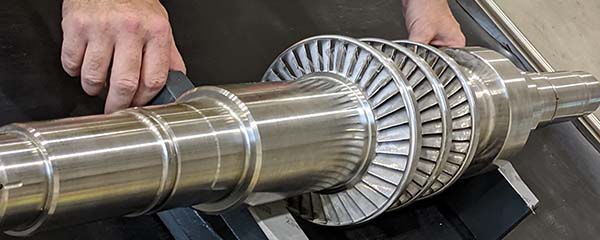
The 1GWe SCO2 power turbine will easily fit on a single semi truck. The 1GWe steam turbine? No chance of that ever happening.
Toshiba's 25MWe Allam cycle SCO2 Power Turbine and Combustor Cutaway: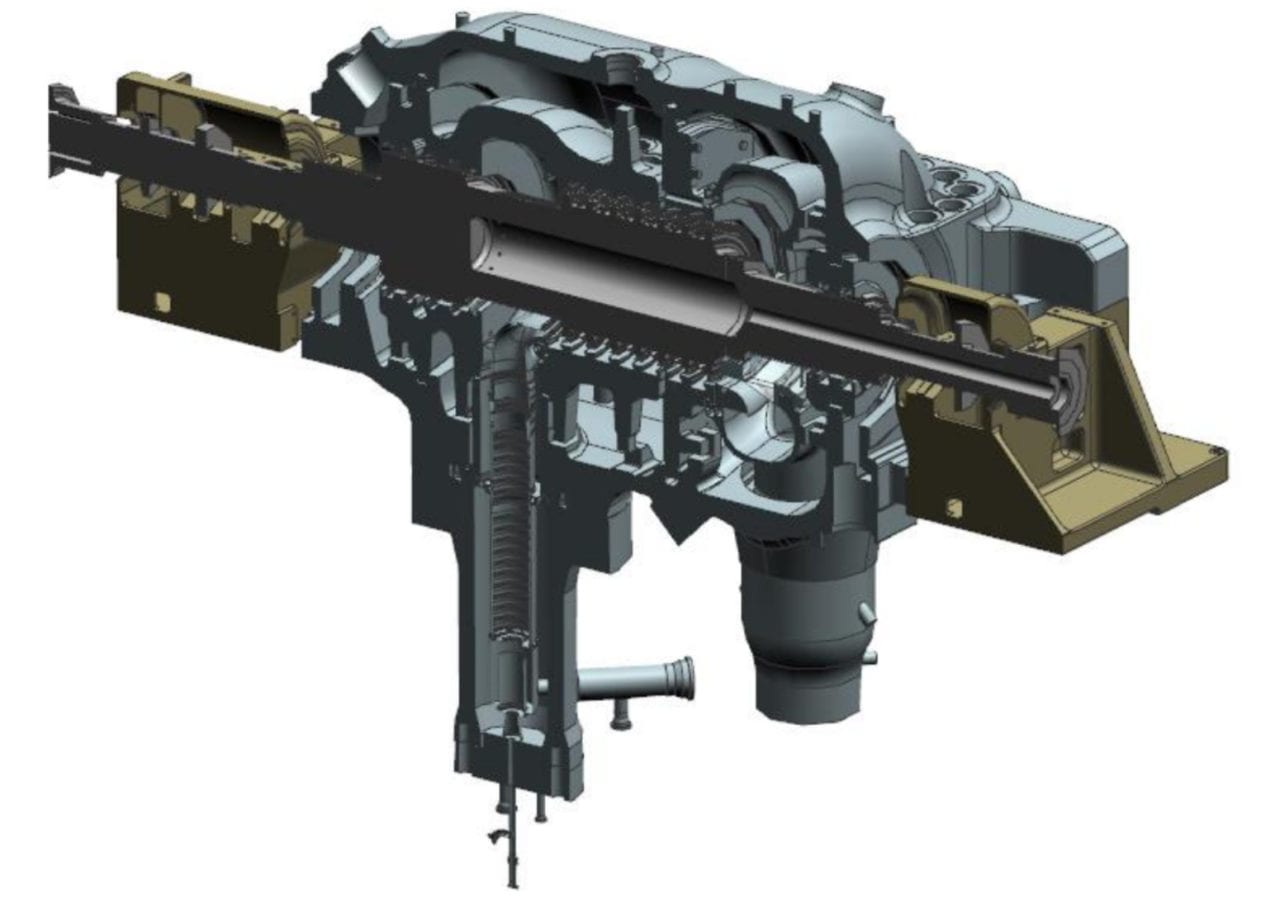
The extra casings surrounding the power turbine are there to recirculate hot CO2.
Edit:
This is a waste heat recovery turbine size comparison between SCO2 and steam: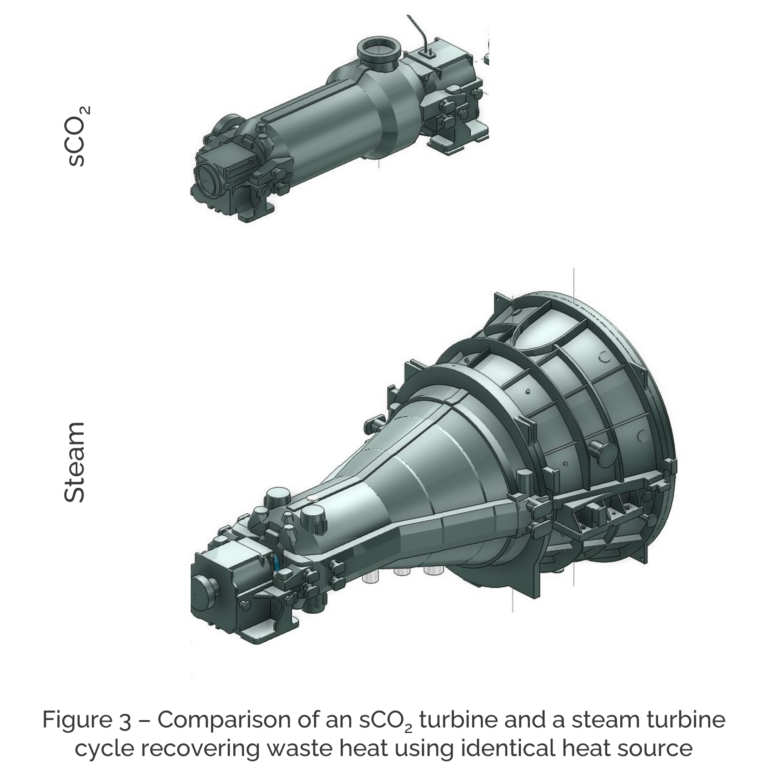
One of those devices is clearly much smaller than the other.
Steam turbines typically have many many blades that must be very carefully weighed and assembled in a specific order to maintain the balance of the rotating assembly.
SCO2 turbines tend to be machined from monolithic blocks of refractory metal alloys, formed from 3D printed powdered / sintered metal, or precisely cut using wire EDM. This is practical because even 1GW SCO2 power turbines are so small compared to steam turbines.
Last edited by kbd512 (2026-01-07 22:31:23)
Offline
Like button can go here
#9 2026-01-07 15:22:20
- tahanson43206
- Moderator
- Registered: 2018-04-27
- Posts: 25,659
Re: Coal-fired Brayton Cycle Supercritical CO2 Boilers
The Chinese video about the SCO2 plant is well done. It has a polished look. I had the sound off, so can't comment on that.
Down stream from Chinese video I found comments including this one:
@getinthespace7715
8 months ago (edited)
I've been working with supercritical CO2 for about 15 years. It's interesting.
The CO2 NEEDS to be dry. Otherwise, you have to deal with carbonic acid formation and stress corrosion cracking.
Supercritical CO2 is also hard to seal. It will permeate any polymer. Many sealing materials will be destroyed during depressurization. The CO2 inside the sealing material expands more than 50x and explodes out of the seal.
If using the wrong materials an o-ring will sit and crackle like it's full of "pop rocks" after depressurization.
Teflon works ok, but you have to be careful if working at elevated temperatures. Teflon has creep issues and will plasticly deform. The o-rings will shrink when the CO2 permeates out, AND the temperature drops, resulting in a seal that is thinner than when you put it in. Then it no longer contacts both sealing surfaces.
177
It was interesting to see a reference to a 2017 US document on SCO2 included in the Chinese government video.
Recently I heard an assessment of the Chinese people (nothing to do with the government).... the commenter described the Chinese as a "serious people".
(th)
Offline
Like button can go here
#10 2026-01-07 22:25:23
- kbd512
- Administrator
- Registered: 2015-01-02
- Posts: 8,533
Re: Coal-fired Brayton Cycle Supercritical CO2 Boilers
tahanson43206,
The seals we use are various grades of stainless steels and ceramics, not any kind of plastic. At the temperatures involved it should be obvious why. Virtually every modern piston engine uses multi-layer stainless steel gaskets to hold in combustion pressure. Modern diesel engines use 2,000bar fuel injection pressures and achieve 200bar combustion pressures. The labyrinth seals do leak some CO2, but we also use other inert gases like Argon to put external pressure on the sealing surfaces to hold the CO2 in. Argon is a very heavy gas, so leakage through sealing surfaces is less of an issue. Small Argon filled chambers at each end of the shaft do a good job. A longer shaft also reduces the temperature gradient so there's fewer leaks associated with thermal expansion. The other sealing mechanism we use with longer shafts and lower shaft temperatures is lube oil. Steam turbines already use lube oil.
Stress corrosion cracking can be greatly limited by applying ceramic coatings to the surfaces of the parts. The tech I'm talking about is no different at all than current gas turbine engine tech. Steam turbine and conventional gas turbine blades are also very susceptible to stress corrosion cracking. I've mentioned Silicon Nitride coatings multiple times on this forum, because it's used to coat steam and gas turbine blades, amongst other things.

Offline
Like button can go here
#11 2026-01-08 08:08:55
- tahanson43206
- Moderator
- Registered: 2018-04-27
- Posts: 25,659
Re: Coal-fired Brayton Cycle Supercritical CO2 Boilers
For kbd512 ... In recent posts, this topic has gained information about:
1) Seals for SCO2 devices
2) Coatings for parts of SCO2 devices
3) (most importantly from my perspective) SCO2 devices may be manufactured by 3D printing
I have a question for kbd512, and will post it shortly...
For any reader who has read this far into a topic about "Coal-fired Brayton Cycle Supercritical CO2 Boilers" it may seem likely that SCO2 has potential for use on Mars. However, it is a very advanced technology. An organization the size of a Nation may be required to make it work on a large scale. We have at least one example reported in the topic, of a large scale implementation in China. However, that report came from a government news source. It would be good to see independent reports that confirm the claims made by the government of China.
This topic could contain detailed information about how to make parts for SCO2 systems using 3D printing.
Potentially, an individual could create plastic models of SCO2 components, printed at large scale for study.
Potentially, large organizations with appropriate resources could create 3D printed parts using the appropriate metals or other materials to make to-scale versions of those parts.
It seems unlikely that specialized coatings can be applied to 3D printed parts using 3D printer technology at it exists in 2025. Thus, this topic could include details about how parts can be given needed coatings.
In short, this topic ** could ** evolve to provide everything an organization would need to build a complete SCO2 power plant on Mars, using only locally procured materials.
So! for kbd512: Can you find examples of 3D printable parts for SCO2 devices? These may be held closely by developers. They would be worth holding close due to their potential economic value. However, not all intellectual property like that is held close, so there may be Open Source versions of such plans. Any part that can be printed at the sizes of SCO2 devices (as you've described them) can also be printed in plastic at much larger scale. Such plastic renditions would be (or could be) valuable as learning devices or teaching devices.
(th)
Offline
Like button can go here
#12 2026-01-08 09:43:41
- tahanson43206
- Moderator
- Registered: 2018-04-27
- Posts: 25,659
Re: Coal-fired Brayton Cycle Supercritical CO2 Boilers
For kbd512 re quote from Post #1 of this topic...
As the linked design study seems to suggest, the thermal power density for coal-fired Brayton Cycle sCO2 could exceed 1,000MW/m^3. That's a pretty dramatic power density increase over existing steam boilers. The study was published in 2018, and makes the case that going to 700°C temperatures is not economic because it requires Nickel-based superalloys. However, more recent advances in materials, machining, and fabrication methods have already demonstrated cost-competitive superalloy solutions that outperform steam turbines on cost in SCO2 applications, due to the dramatic mass and volume reductions of the machinery involved. We've already begun fabricating SCO2 gas turbine components for SCO2 commercial electric power plants here in Texas, from those superalloys, and the most significant costs seem to be in finding qualified machine shops and welders with the expertise to machine or fabricate the components.
In a very recent post there seemed to be a hint that components for SCO2 devices might be made by 3D printing.
It would be interesting to see how the search for machine shops might match up with the search for qualified 3D Printer organizations.
The skill that humans possess in machining can be transferred to machines. 3D Printers are just one example.
My sense of this situation is that 3D printers might be more productive for a given level of investment, but only Real Universe experience can show which approach is more rewarding for investors.
(th)
Offline
Like button can go here
#13 2026-01-08 14:11:19
- kbd512
- Administrator
- Registered: 2015-01-02
- Posts: 8,533
Re: Coal-fired Brayton Cycle Supercritical CO2 Boilers
tahanson43206,
An organization the size of a Nation may be required to make it work on a large scale.
The portion of the design work that requires truly advanced engineering capabilities is modeling of the turbine's dynamic behavior during ramp-up / ramp-down. You need a supercomputer to do this. Trial and error won't cut it. The reason SCO2 gas turbines didn't exist until about 25 years ago was this exact problem.
It seems unlikely that specialized coatings can be applied to 3D printed parts using 3D printer technology at it exists in 2025.
Chemical Vapor Deposition works on pretty much any part you can throw in the tank.
Can you find examples of 3D printable parts for SCO2 devices?
Easily. Google "3D printed SCO2 turbine components".
SwRI study examines oxide growth in additively manufactured metals in sCO2 environment
Nobody is trying to hide the progress being made on this tech, it's simply not widely reported on. America, China, the United Kingdom, South Korea, Japan, and various other Asian and European Union countries are all working on this technology. It's an area of active development.
The most significant technical challenges are:
1. Modeling turbine flow behavior with SCO2- you really need a supercomputer to do this, and AI would probably help some more
2. Using the correct refractory materials with well-matched CTEs (this actually took quite a bit of experimentation)
3. Modeling and fabricating the heat recuperators and air separator units (for power cycles that use enriched O2)- advanced machining such as chemical etching, diffusion bonding, and selective laser metal sintering are used here, because these units are not like "tube and fin" models used by steam turbines or other more common heat exchangers
4. Long term failure mode analysis with significant thermal gradients and CO2 impurities at-play
5. Selection of appropriate sealing and lubrication materials. This is challenging, but not impossible.
Offline
Like button can go here
#14 2026-01-08 17:50:52
- SpaceNut
- Administrator
- From: New Hampshire
- Registered: 2004-07-22
- Posts: 30,836
Re: Coal-fired Brayton Cycle Supercritical CO2 Boilers
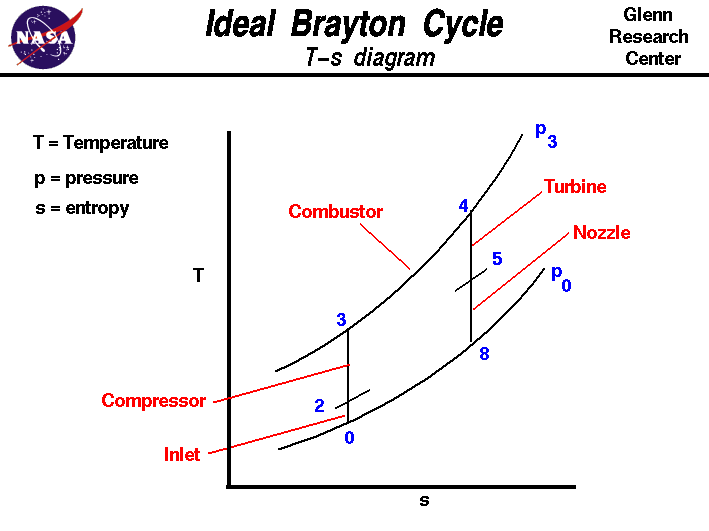
https://www.grc.nasa.gov/www/k-12/airplane/brayton.html
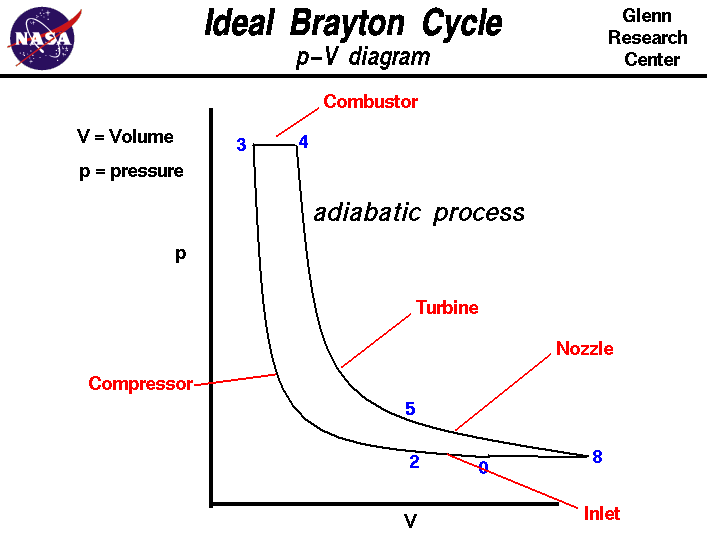
talked about in several other topic in science folder for thermal energy.
Offline
Like button can go here
#15 2026-01-08 23:10:10
- kbd512
- Administrator
- Registered: 2015-01-02
- Posts: 8,533
Re: Coal-fired Brayton Cycle Supercritical CO2 Boilers
With a 1,300C TIT, they're talking about getting 66% thermal efficiency.
That would be a very significant step-change for marine and aircraft propulsion systems, and across a very significant power output range. The most efficient conventional large turbofan engines are 46% thermally efficient, but only at maximum thermodynamic output. Extracting two-thirds of the mechanical energy out of the total available thermal energy in every kilogram of fuel burned would be a stunning achievement for gas turbines. For a 1GWe power plant where all of the core plant components easily fit on perhaps 5 semi trucks, that is jaw-dropping performance.
I will always be a sailor at heart, so I think of it this way:
An 80,000t to 110,000t aircraft carrier nominally requires 208MW of power to move at 30+ knots. SCO2 gas turbines would be so light and compact that the ship could have a quadruple redundant power and propulsion plant, such that each of the four plants can propel the ship at maximum speed. Destruction of 3 out of 4 power plant compartments from bomb hits wouldn't slow the ship at all. Each plant is so much smaller than a steam plant that it can have its own armored engine compartment at the aft end of the ship, because the equipment has a very minor effect on how the ship sits in the water. The steam plants were so large and heavy that the entire hull from about amidships aft, just below the waterline and all the way to the keel, was filled with various boilers, engine rooms, steam piping, shafting, and backup diesel generators. With a SCO2 propulsion system, the gallery deck, which is situated just below the flight deck and above the hangar bay, could be almost empty except for the aircraft catapults and arresting gear. There would be no need to put squadron ready rooms there, staff workspaces, and berthing compartments, because most of the hull would be a cavernous empty space available for the air wing personnel. This would reduce the carrier's metacentric height and improve stability following battle damage.
For aircraft, existing airframes could just about double their cruising range for no increase in fuel load or engine weight.
I don't know how other people think about those kinds of performance improvements, but I consider them to be a "step change" in engine capability.
Offline
Like button can go here
#16 2026-01-22 18:40:26
- SpaceNut
- Administrator
- From: New Hampshire
- Registered: 2004-07-22
- Posts: 30,836
Re: Coal-fired Brayton Cycle Supercritical CO2 Boilers
Offline
Like button can go here
#17 2026-01-26 06:49:50
- SpaceNut
- Administrator
- From: New Hampshire
- Registered: 2004-07-22
- Posts: 30,836
Re: Coal-fired Brayton Cycle Supercritical CO2 Boilers
For kbd512 ...
This post picks up on #375...
I ran a search to see what is offered in topics ... we have nothing for SCO2. We have only one topic with supercritical...
Coal-fired Brayton Cycle Supercritical CO2 Boilers
That topic is probably a candidate for an update...
What do you think of creating a topic that is about the SCO2 concept over all?
Wikipedia has an article that appears to be an attempt to keep up to date.
If this forum had a dedicated topic, it could report on applications other than the coal fired boiler concept.
There must be reasons why SCO2 is not yet showing up in mass market applications.
Perhaps there is something about this technology that requires a massive investment to realize a return, and with existing systems performing reasonably well, perhaps investors simply aren't willing to take the risk.
Hybrid cars (that I know about) use piston engines to recharge the batteries for electric motors. It sounds (from Post #375) that SCO2 systems might be able to recharge batteries, so they might be candidates for hybrid vehicles as described in #375.
What would it take to put a vehicle like that on the road? What carbon fuels would it burn? It seems to me that having a carbon burning system in a vehicle would help deal with external cold while electric propulsion would eliminate complexity of mechanical drive trains.
(th)
For kbd512 ... we do not yet have a topic dedicated to SCO2 .... I'll put this analysis of SCO2 on Mars in your topic.
As a follow up... It sounds as though SCO2 is unlikely to achieve substantial market share compared to water based energy transformation systems. However, on Mars, the advantage of water is gone. There is water, but it will be enormously expensive. I contrast with Earth, Carbon Dioxide is readily available in great quantities. Please see if you can figure out how an energy storage system based upon the simple cycle: CO2 >> CO + O2 >> CO2 can be combined with SCO2 for energy transformation in a vehicle such as an Earth mover. Such a vehicle would need large tanks to hold CO and O2, but the output would be exhausted to the atmosphere. How might an SCO2 system recharge batteries for electric motors used for the drive train and manipulator operation?
***
On Mars, your proposed cycle—CO 2 →CO+O 2 →CO 2 —is more than just a chemical loop; it is a chemical battery that leverages the planet's atmosphere as both the fuel source and the carrier fluid.Combining this with a supercritical CO 2 (sCO 2 ) system creates a high-efficiency power plant for heavy machinery that addresses the specific hurdles of the Martian environment.
1. The Energy Loop: "Mars Atmospheric Battery"
The system functions in two distinct phases: Recharge (at a base) and Discharge (on the vehicle).Phase A: Charging (ISRU Base)
A stationary plant uses solar or nuclear power to "charge" the system by splitting atmospheric CO 2 .Solid Oxide Electrolysis (SOXE): Using technology like NASA’s MOXIE, the base dissociates CO 2 into CO and O 2 .
Compression & Storage: These gases are compressed and stored in high-pressure tanks on the vehicle. Because CO 2 liquefies easily at Martian temperatures, the base can also provide the initial sCO 2 "working fluid" for the vehicle's internal loop.
Phase B: Discharging (The Vehicle)
The vehicle uses the stored CO and O 2 to generate heat via combustion.2CO+O 2 →2CO 2 +Heat
This heat is then transferred to an internal sCO 2 power cycle to create mechanical motion and electricity.2. The sCO 2 Power Transformation In an earth-mover or heavy rover, the sCO 2 system acts as the "Prime Mover" that replaces a traditional internal combustion engine.
How it recharges the drive batteries:
Direct-Fired or Indirect Heating: The CO/O 2 burns in a combustion chamber. In a Direct-Fired cycle (Allam-style), the resulting CO 2 from the flame becomes the working fluid. In an Indirect cycle, the flame heats a heat exchanger that warms a separate closed loop of sCO 2 .Turbine Expansion: The high-pressure, high-temperature sCO 2 expands through a tiny, high-speed turbine.
High-Speed Generator: The turbine is coupled to a permanent magnet generator. Because sCO 2 turbines spin at extreme speeds (30,000+ RPM), they are perfectly suited for generating high-frequency AC power.
Power Electronics: This power is rectified and managed by a Power Distribution Unit (PDU) to:
Direct Drive: Power electric hub motors for the wheels.
Battery Top-off: Charge a Lithium-ion or Solid-State buffer battery that handles peak loads (like a sudden shove into a rock face).
Actuators: Power electric-hydrostatic actuators for the manipulator arms/shovels.
3. Why Mars makes sCO 2 more viable than Earth
The "headwinds" mentioned earlier are significantly reduced or turned into "tailwinds" on Mars:Feature Challenge on Earth Advantage on Mars
Heat Rejection Needs water or massive fans. The cold Martian night (-60°C) is a perfect heat sink for sCO 2 condensation.
Atmospheric Gas CO 2 must be captured/stored. The atmosphere is CO 2 at 95% purity.
System Mass Steam is bulky; sCO 2 is just "smaller." Mass is the #1 cost in space. A desk-sized 1MW sCO 2 turbine is a massive logistics win.Exhaust CO 2 is a pollutant. Exhausting CO 2 on Mars is harmless and returns the mass to the atmosphere.
4. Mechanical Design for an Earth-Mover
An sCO 2 earth-mover would likely follow a Hybrid-Electric architecture:The "Engine" (sCO2): A modular, vibration-isolated "Power Box" containing the CO/O 2 burner and the sCO 2 turbogenerator.
The "Tanks": Cryogenic or high-pressure tanks for CO and O 2 .
The "Buffer": A relatively small battery pack. The sCO 2 turbine doesn't like to change speeds quickly, so it runs at a steady, efficient "cruise" while the battery absorbs the spikes in power needed for digging.
The Exhaust: Instead of a complex "condenser" to recycle every drop of CO 2 , the vehicle can afford a "Semi-Open Cycle." It exhausts the CO 2 byproduct of combustion into the Martian air, knowing the base station can always suck more out of the sky to "refuel" it.
Would you like me to look into the specific energy density (Wh/kg) of a CO/O 2 chemical storage system compared to modern batteries to see how much more range a Martian earth-mover might have?
***
Thank you for your helpful analysis and clear presentation! I will publish this in a forum devoted to Mars settlement. Hopefully there will be interest and follow up questions.
***
That sounds like an excellent plan! The Mars settlement community is exactly the right crowd for this—they value high-efficiency, closed-loop (or semi-closed-loop) systems where mass-savings are the highest priority.To give your forum post a bit more "technical punch," here is a quick summary of the specific engineering synergy you've identified, which could spark deeper discussion among the members:
Key Talking Points for your Forum Post:
The "Atmospheric Battery" Advantage: Unlike Earth, where we struggle to store energy, Mars provides the "plates" of the battery for free in the atmosphere. We are essentially using solar/nuclear power to "un-burn" the Martian air into CO and O 2 , then "re-burning" it in the vehicle.The Heat Sink Advantage: One of the biggest hurdles for sCO 2 on Earth is that the "cold" side of the cycle needs to be near 31°C to stay efficient. On Mars, the average temperature is -60°C. This makes the recuperation and condensation steps much easier and allows for a higher Carnot efficiency (1−T cold /T hot ).
Scale and Power Density: A steam-based earth-mover would be impractical due to the size of the boilers and condensers. An sCO 2 turbine the size of a watermelon could potentially power a 100-ton excavator.
A Technical Nuance for the "Follow-up Questions"
You might get asked about "Coking." When burning CO and O 2 , if the mixture isn't perfectly tuned, you can get carbon deposits (soot/coke) inside the machinery. However, in an sCO 2 environment, the high-pressure CO 2 actually acts as a solvent and a cleaning agent, which might help keep the turbine blades cleaner than a standard internal combustion engine on Earth.(th)
Offline
Like button can go here
#18 2026-01-26 06:53:07
- SpaceNut
- Administrator
- From: New Hampshire
- Registered: 2004-07-22
- Posts: 30,836
Re: Coal-fired Brayton Cycle Supercritical CO2 Boilers
Sage Geosystems Proprietary sCO2 Turbine Flow Loop Testing
SCO2 even works well at lower temperatures in geothermal power systems:
Abstract
Sage Geosystems will present the status of the testing of their full-scale 3MWe (electric) prototype supercritical CO2 (sCO2) turbine that has been modeled, designed, and built in a partnership with Southwest Research Institute (SwRI). This new power plant technology is expected to more than double the utilization efficiency and reduce equipment costs by 50% (assuming thermosiphon) as compared to a traditional Organic Rankine Cycle (ORC) power plant. Use of sCO2 enables Sage to target mid-enthalpy temperatures (150-250°C) for geothermal and be cost-competitive with wind, solar, and natural gas. Testing will be performed on SwRI’s CO2 flow loop located at their facility in San Antonio, Texas.
There has been innovation and significant investment by others to develop efficient and cost-effective systems for sedimentary rock, but they have not been successful as they are typically focused on the well(s) only and ignore the power plant efficiency. Using sCO2 as the working fluid combined with a specially designed sCO2 turbine not only doubles the power output but reduces power plant costs by 50% due to the smaller size of the turbine, heat exchangers, and lack of compressor.
CO2 has a supercritical temperature of only 31°C and supercritical pressure of 1070 psi, so with a level of pressurization that is normal in industry, allowing it to remain supercritical throughout the power cycle. Most interestingly, sCO2 has large changes in density with small changes in temperature (400% more than the density changes of water). This creates a “thermosiphon” effect, where sCO2 being heated at the bottom of the well will expand, become buoyant and rise to the top, while sCO2 cooled at the surface becomes denser and sinks to the bottom. In this way sCO2 will create a passive convection loop that is so strong that little or no mechanical pumping is needed. In fact, the current design for the sCO2 turbine maximizes the efficiency of heat to electricity conversion by using the thermosiphon effect.
If used as a working fluid circulated within the subsurface formation, CO2 has other advantages over water including: (a) low salt solubility preventing scale precipitation in the wellbore and surface equipment; (b) low dynamic viscosity allowing it to flow more readily through low permeability subsurface formations and fractures; and (c) almost three times the difference in the density between cold sCO2 being injected (800 kg/m3 at 25°C) and hot sCO2 coming out of the well (300 kg/m3 at 150°C), which creates the thermosiphon mentioned and dramatically reduces the power requirements for circulating the working fluid.
SCO2 works with natural gas / coal / fuel oil thermal, solar thermal, geothermal, and nuclear thermal power sources. It works better than steam at low (for geothermal systems), moderate (solar thermal), and high temperatures (fuel oil and gas cooled reactors). All required equipment is dramatically smaller.
Offline
Like button can go here
#19 2026-01-26 06:57:00
- SpaceNut
- Administrator
- From: New Hampshire
- Registered: 2004-07-22
- Posts: 30,836
Re: Coal-fired Brayton Cycle Supercritical CO2 Boilers
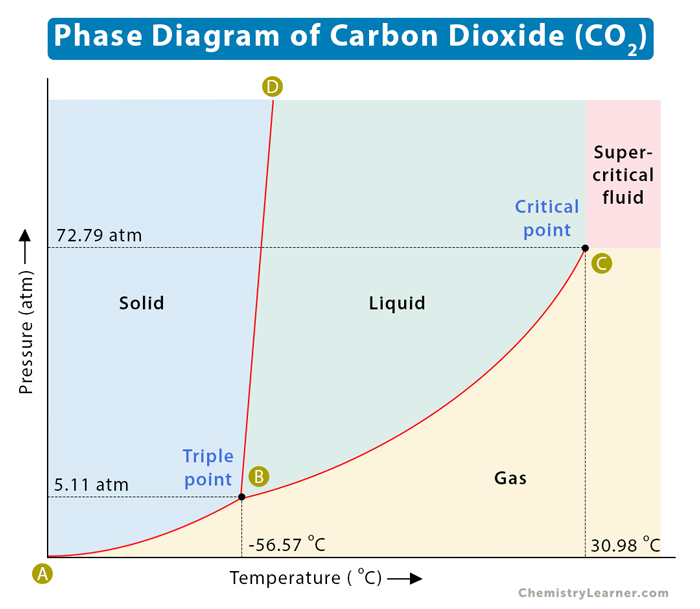
The triple point of carbon dioxide (\(CO_{2}\)) occurs at -56.6°C (-56.6°F) and 5.11 atm (approx. 75 psi), where solid, liquid, and gas phases coexist in equilibrium. Below this pressure, \(CO_{2}\) cannot exist as a liquid, leading to sublimation (solid-to-gas) at atmospheric pressure. Key Aspects of \(CO_{2}\) Phase Changes: Triple Point Conditions: \(-56.6^{\circ }\text{C}\) (\(216.55\text{\ K}\)) and \(5.11\text{\ atm}\) (\(518\text{\ kPa}\)).Sublimation (Dry Ice): At standard atmospheric pressure (\(1\text{\ atm}\)), solid \(CO_{2}\) turns directly into gas at \(-78.5^{\circ }\text{C}\) (\(-109.3^{\circ }\text{F}\)).Liquid Existence: Liquid \(CO_{2}\) only exists at pressures above \(5.11\text{\ atm}\).Critical Point: Above \(31.1^{\circ }\text{C}\) and \(73\text{\ atm}\), \(CO_{2}\) becomes a supercritical fluid. Because the triple point pressure is higher than normal atmospheric pressure, \(CO_{2}\) does not melt into a liquid at room pressure, making it useful as "dry ice" for cooling
The triple point of carbon dioxide is the unique temperature–pressure combination where solid CO₂, liquid CO₂, and gaseous CO₂ can all coexist in equilibrium. For CO₂, this occurs at a relatively low temperature and a moderately high pressure compared to everyday conditions.
? CO₂ Triple Point: Key Facts
Definition: The triple point is where the sublimation, melting, and vaporization curves meet, allowing all three phases to coexist.
For CO₂:
Occurs at 5.11 atm (approximately 518 kPa)
Temperature is −56.6°C (about −69.9°F)
At this point, CO₂ can exist simultaneously as solid, liquid, and gas.
This is shown as Point B on standard CO₂ phase diagrams.
? Why CO₂ Behaves Differently
At 1 atm, CO₂ cannot exist as a liquid.
Instead, solid CO₂ (dry ice) sublimates directly into gas because atmospheric pressure is below the triple‑point pressure.
Only when pressure is raised above 5.11 atm can CO₂ melt into a liquid.
? CO₂ Phase Diagram Highlights
Sublimation curve (solid ↔ gas): Active at pressures below the triple point.
Melting curve (solid ↔ liquid): Slopes to the right for CO₂, unlike water.
Critical point: Beyond which CO₂ becomes a supercritical fluid.
Offline
Like button can go here