New Mars Forums
You are not logged in.
- Topics: Active | Unanswered
Announcement
#26 2026-01-02 11:36:49
- SpaceNut
- Administrator
- From: New Hampshire
- Registered: 2004-07-22
- Posts: 30,107
Re: This title has no meaning
A rail would need to be shipped and a open door does not keep dirt or dust out which keep risk increasing not decreasing.
That is why you must plan for the actions to be under taken on mars.
Any insitu must keep in mind the delivery of all things we need to make any construction possible.
Construction of components to make doors, shelves, storage lockers and other components from local resources will be ** much ** more challenging.
All those things are part of outfitting plan of any structure that mars builds and they can come out of the starship's raw plates, installed stuff for human support. We must recycle what we go with and repurpose these materials. Sheet metal building is a nothing from raw sheets.
Things needed to repurpose is a cutting tools, welding equipment, bending tables or breaks, misc hardware if we make holes and drilling stuff.
Even I have made with less sheet metal to fix parts of my car....when its rusted through,
My very first post was
Structure type is not defined as we must know what type of early equipment type as well as the fuels that they will need to make use of. It is suggested to be a separate attached system with possible machine shop capability.
So design was not a determined for path until items that will go in the garage are known.
Offline
Like button can go here
#27 2026-01-02 12:21:06
- Void
- Member
- Registered: 2011-12-29
- Posts: 9,132
Re: This title has no meaning
Here is an intrusion that you may ignore, as I do not wish to make the members unhappy: https://newmars.com/forums/viewtopic.ph … 90#p236790
Ending Pending 
Is it possible that the root of political science claims is to produce white collar jobs for people who paid for an education and do not want a real job?
Offline
Like button can go here
#28 2026-01-02 13:05:40
- tahanson43206
- Moderator
- Registered: 2018-04-27
- Posts: 23,736
Re: This title has no meaning
For SpaceNut ... in situ means ** nothing ** is imported.
Everything has to be made from materials made on site.
Those were the words you used in the topic title.
If you meant something else now is a bit late to be telling us.
Please ask your AI friend what in situ means, and let us know.
(th)
Offline
Like button can go here
#29 2026-01-02 14:01:32
- SpaceNut
- Administrator
- From: New Hampshire
- Registered: 2004-07-22
- Posts: 30,107
Re: This title has no meaning
What AI thinks
In-situ (Latin for "on-site" or "in its original place") in the context of Mars construction refers to the practice of using local Martian resources, rather than transporting all materials and equipment from Earth. This is officially called In-Situ Resource Utilization (ISRU).
The core concept is "living off the land" to drastically reduce the enormous cost and logistical challenge of sending supplies across vast distances from Earth.
The idea that you would have no equipment at all is generally not feasible; some minimal, specialized equipment and robotic systems would be sent from Earth to act as the initial "factories" and "builders". How ISRU Addresses the "No Equipment" Constraint (Relatively) The goal is to minimize the mass and volume of material that must be launched from Earth, not to eliminate equipment entirely. Specialized, compact, and often autonomous, equipment would be sent first to leverage local materials.
The strategy involves: Sending minimal, critical machinery: Instead of sending heavy raw materials like concrete or steel beams, lightweight robotic equipment, 3D printers, and processing hardware are sent.
Utilizing local materials: The robots would use abundant Martian resources, primarily the soil (regolith) and atmosphere, to produce usable products.
Automated construction: The construction process would likely be managed by autonomous or semi-autonomous robots before humans arrive, allowing for the creation of habitats and infrastructure in advance.
Examples of In-Situ Resources for Construction With specialized equipment,
Mars offers several resources: Regolith (Martian soil): This can be used as a primary building material. Processes like sintering (fusing with heat) or mixing with binding agents (like an epoxy or sulfur) can create bricks, ceramics, and concrete-like structures for radiation shielding and general construction..Water ice: Found below the surface, water is a critical resource. Once extracted, it can be used for life support (drinking water, growing food), split into hydrogen and oxygen (for breathing air and rocket propellant), or used in industrial processes.Atmospheric \(\text{CO}_{2}\): The Martian atmosphere is mostly carbon dioxide. Equipment like the MOXIE experiment on the Perseverance rover can extract oxygen from the atmosphere for life support and as an oxidizer for rocket fuel.
Basalt: Basaltic rocks are abundant and can be processed into glass or glass fibers, which have good insulating properties and can be used for construction. Essentially, "in-situ construction" is the practice of building with what you have on Mars, which is crucial for long-term sustainability and survival when resupply from Earth is nearly impossible
As you can see you must plan resources tto utilize as well.
Offline
Like button can go here
#30 2026-01-02 20:46:32
- tahanson43206
- Moderator
- Registered: 2018-04-27
- Posts: 23,736
Re: This title has no meaning
For SpaceNut ....
This topic should be about building a garage on Mars using materials collected on Mars. It appears that your AI friend thinks it is OK for this topic to bring tools from Earth, but it seems to understand that none (NONE) of the material used to make the garage can come from Earth.
I have opened a new topic for garages to be imported from Earth.
This topic should NOT be about space suits. We have topics for that.
This topic should NOT be about airlocks.
We have topics for that.
This topic should NOT be about Starship or any other ship of any kind what so ever!
These systems have no place in this topic.
This topic should NOT be about radiation.
Radiation has plenty of other topics.
It seems to me that this topic has filled up with every possible kind of distraction your AI friend can think of.
When you opened this topic I thought it had potential value to someone who is planning to go to Mars (or more likely) to work on providing products and services that will be needed by those who go.
What would it take to keep a very simple topic focused upon the content that belongs in the topic?
(th)
Last edited by tahanson43206 (2026-01-02 20:48:05)
Offline
Like button can go here
#31 2026-01-02 23:45:55
- kbd512
- Administrator
- Registered: 2015-01-02
- Posts: 8,395
Re: This title has no meaning
Back here on Earth, in admittedly less extreme temperatures, for Canadian mining and rock crushing equipment operating in -30C temperatures, they're using a combination of high-Manganese steel, high-Chromium "white" Iron, and Austenitic Ductile Iron. Mangalloy is the traditional cold weather steel that becomes work hardened with use, but has already been replaced with Ductile Iron in many applications for cost and wear benefits. White Iron is used in applications where abrasion / cutting from rock is the most important factor, such as razor sharp little shards of crushed rock being pulverized into a powder. The first couple of stages of rock crushers will be Ductile Iron, with the final one to two stages being White Iron because softer metals will get abraded too quickly. Chromium makes White Iron very hard.
Nearly every component in a heavy duty diesel engine can be and in fact are made from ADI, with only the connecting rods, pistons, piston pins, fasteners, and other small parts being steel vs Ductile Iron. Forged 4340 steel is still the best general purpose material for crankshafts and connecting rods subjected to severe stresses, but even high performance engines like Chrysler's Gen III Hemi are now using ADI camshafts as OEM equipment, and some engines use ADI crankshafts as well. Ford put ADI on the map during the 1980s when they put ADI crankshafts in some of their high-output engines, so one could say ADI is a 1980s and beyond material. TVR, a British company known for their extreme performance road-legal race cars, was also well known for using ADI instead of forged steel in their high-output V8 and I6 engines. If ADI lacked performance relative to 4340, then TVR would've discovered this during testing. OEMs like Caterpillar don't try to "hot rod" their engines though, so ADI crankshafts work for them in their largest mining truck and marine engines, saving piles of cash over modestly stronger forgings.
If you do everything absolutely correctly with a 4340 forging, then you get about 20% more "power holding" capability and fatigue life over ADI, at extreme cost. Modern "wonder materials" like 300M or Titanium also come with use case limitations, like "don't ever scratch the surface or drop the part on something hard". You should not expect the average mechanic to abide by those limitations. You see 300M and Titanium used in race engine connecting rods or aircraft landing gear / wing spars / engine mounts only. Nobody uses Titanium in crankshafts, which should tell you something. You would never design a factory diesel engine to use Titanium parts, for example. You also "give up" toughness at low temperatures and chemical exposure resistance, hence why you don't see Titanium or super alloys used in ship hulls or propellers. The Soviets used Titanium successfully in a literal handful of submarines, but not without a lot more hull maintenance, and every class of attack sub designed thereafter switched back to steel. Titanium exhaust manifolds are notorious for cracking. Everyone with a lick of sense uses stainless, an Inconel super alloy to reduce weight and achieve high temperature resistance, or plain old cast ductile Iron if cost matters at all. Titanium is pretty and produces unique "engine noises", but engineers with design latitude will generally opt for any other material.
Why ADI for heavy duty earth moving equipment?
ADI is 50% less energy-intensive to make than cast steel and 80% less energy-intensive than forged steel because there are fewer processing steps involving extreme heating. ADI will give you 80% of the performance of a 4340 forging in a practical application, like a crankshaft. Nobody makes a crane boom out of 4340 forgings, though. They all use mild steel or boiler plate steel. ADI in automotive use is a 120ksi YS material, tempered 4340 can go up to 200ksi if you don't care about toughness, but 125ksi YS is typical of normalized 4340. Fatigue resistance is better with 4340 forgings only if you spare no expense in production. Any lesser forged steel is probably not as good as ADI, such as the micro-alloyed low-alloy content forgings that come out of the major automotive OEMs, particularly for crankshafts / camshafts / connecting rods. They use forging of cheaper steels for part-to-part consistency, not absolute strength and fatigue life. As heat treatment process control improved dramatically with computerized ovens, appropriately tempered Iron castings largely replaced forgings.
ADI can technically be welded, but isn't worth the expense. If you want to economically weld parts together, then you really need to use mild steel or boiler plate steels. The only kinds of cryogenic capable steel we have for heavy earth moving equipment are either 300 series stainless steels, which are no stronger than mild Carbon steels and often modestly weaker, or stronger high-Manganese steels more akin to HY80 equivalents used in ship building.
Caterpillar really likes to use ADI for cast components used to reduce component count and assembly time, or mild steel requiring no special weld prep, so that if someone welds on their equipment or bends a frame rail back into place, the structural integrity of the equipment hasn't been compromised. Mild steel cannot remain ductile due to the cold temperatures on Mars, which leaves stainless, which is also safe to weld without concern over strength loss.
That complex part on the back of their haul trucks where the wheels / final drive / frame rails attach is a very large single piece ADI casting. The bucket, cab, and forward chassis components are welded mild steel. On Mars that would be welded stainless steel.
So, I have a proposal:
Let's "get real" about something fundamental to "civilization building":
Modern human society is built on water processing ability, industrialized farming, thermal energy, steel, and concrete. All other "nice to have" materials and other technological advancements have come from that foundation.
Every Starship that lands eventually becomes part of the chassis or crane boom or other large components for these mining vehicles that we need to mine enough metal ore to create pressurized habitation to actually live on Mars permanently. The first order of business is to be able to produce pure Iron using electrolytic reduction techniques. This requires a lot of electricity, but the temperatures are very modest. Pure Iron plus small quantities of alloying metals and Carbon unlocks ADI. Most structural parts can be built using this material, because ADI has few problems with mildly cryogenic temperatures. As we make more equipment from scratch using mined metals, we'll want to add a steel mill and forging tools so small parts that really need to be forged steel can also be locally sourced. The only kinds of steels we can expect to survive the Martian nights are ADI, stainless, and high-Manganese alloys. Every bit of metals-based infrastructure needs to "natively" survive being cold-soaked, meaning the intrinsic material properties are suitable for use in a mildly cryogenic environment.
Most Iron-based alloys used on Earth are intended for construction, with equipment of any kind being a distant secondary consumer of metals. The majority of Iron production must be directed at pressurized habitation construction, not equipment or vehicles. Iron wiring is not lightweight compared to Copper or Aluminum, but most of it won't go anywhere after installation, won't corrode, and won't be transported very far, either. If a length of Copper conductor wire weighed 1lb, then its equivalent Iron wire only weighs 5lbs on Earth, but only 1.9lbs on Mars. This is obviously not ideal, but eliminates the immediate need for a Copper or Aluminum mining and refining industry. We can live with that result, though, even if Copper and Aluminum mining takes several additional decades of settlement development before it can be pursued.
After we have re-mastered Iron and steel suitable for production and use in the new context of the Martian surface environment, Aluminum, Silicon, Copper, and Uranium are our next priorities. Unfortunately, all of these technology metals are also very energy-intensive, which is why they're secondary priorities.
Everything else is an artifact of mass production of those metals. Iron is the key metal, as it always has been. When you have Iron, you can make most of the the structures and machines humans need to survive on Mars. The stainless steel is already being imported from Earth in the form of vehicles suitable for making the trip from Earth to Mars. If SpaceX follows their plan to deliver 1,000 Starships per launch opportunity, then that's about 100,000t of steel to work with. Mining haul trucks like the Caterpillar 797 weigh about 215t, so a decently-sized mining operation may have 10,000t of equipment, leaving the other 90,000t available for initial pressurized habitation construction.
We need tracked all-terrain earth movers powered by SCO2 gas turbine engines and electric motors to eliminate gear boxes, drive shafts, and as much of the working fluids as is practical. The fuel will be a finely powdered Carbon fluidized with CO2 for pumping, compressed O2 or LOX for oxidizer. The electric motors will save wear and tear on the brakes by mostly not requiring them. A super capacitor bank will provide the jolt of energy to overcome initial rolling resistance to get the vehicle moving, and then be recharged by the traction motors during braking. This is essentially an advanced turbine-electric locomotive power train. Daily maintenance tasks will include fuel replenishment, checking hydraulic fluid levels, track tension adjustment, determining if someone accidentally bent one of the soft stainless steel structural members holding the vehicle together. When turbine power is not being demanded to propel the vehicle, an electric pump will siphon CO2 from the atmosphere. At the end of each shift, the LCO2 tanks will be emptied back at the shop where it will be used to supply CO2 for shop air tools and making fresh batches of powdered Carbon fuel and O2 oxidizer using Gallium-Indium-Copper liquid metal. If we happen to discover a natural gas well nearby, then we might consider using Methane instead of synthetic coal, provided that the rockets don't consume all of the Methane. Regardless, the Martian atmosphere is the fuel / oxidizer and working fluid of choice.
Since we cannot readily use gigantic rubber tires in a cryogenic environment, we'll use steel track links instead. The dramatic reduction in relative vehicle gross weight means we need less power, even with tracks vs tires. The Cat 797F haul truck's gross weight with 400t max payload is 623.7t on Earth, but only 237t on Mars. Top speed is officially 65kmh when fully loaded, though I would surmise speed depends greatly upon local terrain and room to maneuver. Instead of 4,000hp, we can manage with less than that, say 1,520hp. 1,500hp corresponds with the output of the M1 Abrams AGT-1500 conventional gas turbine. Fuel consumption over an 18 hour shift is about 75gph.
US EIA rates diesel fuel at 138,500btu/gallon, so 75 gallons is 10,387,500BTU.
Net electrical output vs fuel burn for the big Cat C175-20 diesel engine which powers the 797F are as follows:
Max rated electrical output is 3.2MWe in an electric generator application.
It's burning 208gph at full output, so 28,808,000BTU.
10,918,400BTU (net electrical output) / 28,808,000BTU/hr (fuel consumption) = 37.9% overall thermal efficiency
Let's be very generous to the Cat engine and assert it's 40% thermally efficient at reduced engine load.
10,387,500BTU * 0.4 = 4,155,000BTU
4,155,000BTU / 2,545BTU/hr = 1,633hp
An average of 1,633hp constant power output on Earth equates to 620hp on Mars.
For a 50% thermally efficient SCO2 gas turbine, 620 * 2 * 2545 = 3,155,800BTU/hr
Pure Carbon produces 14,100 to 14,600BTU/lb, so let's use 14,100.
3,155,800BTU / 14,100BTU/lb = 223.8lbs of pure carbon per hour
223.8lbs of pure C * 2.67lbs of pure O2 per lb of pure C = 597.5lbs of pure O2 per hour
18 hour shifts would therefore require 4,028lbs of pure Carbon and 10,756lbs of pure O2
At 700bar, 10,756lbs of pure O2 would required 12.195m^3 of tank capacity
Pure Carbon powder is 1,800-2,200kg/m^3, so approximately 1.015m^3 of fuel tank capacity
5X 1mDx3mL O2 tanks will easily fit within the engine bay previously occupied by the C175-20, as will the fuel tank and SCO2 turbine and electric generator, although maybe the fuel tank should be in its standard location for what should be obvious reasons.
Anyway, we just did enough simple math to figure out that all the oxidizer and fuel will fit inside the engine compartment with lots of room to spare for the SCO2 gas turbine and electric generator. The haul truck doesn't require a complete redesign, it only needs to be gutted internally and the best layout for the new power train equipment established. Therefore, a Caterpillar 797F mining haul truck can be fabricated primarily from 300 series stainless cannibalized from Starships vs mild steel and ADI (already used in Earth-bound 797Fs). It can then be operated in a Martian metals mining operation with concessions made to use of a more thermally efficient SCO2 gas turbine engine driving an all-electric power train and delivering the power to ADI or high-Manganese forged steel tracks vs giant rubber tires. It's not perfectly ideal, but nothing ever is.
Note to self:
Make sure the high temperature radiator surface area can be a simple forward-facing steel panel.
Now back to ground pressure and power consumption, and rolling resistance for tracked vs wheeled vehicles...
US Army Published a Table Regarding Generally Observed Coefficient of Rolling Resistance vs Surface Type:
Concrete / Hard Soil / Sand
Heavy Truck: 0.012 / 0.06 / 0.25
Tracked Vehicle: 0.038 / 0.045 / (no value provided for sand in this table)
By the time you move the wheeled vehicle over hard soil, the tracked vehicle already has lower rolling resistance. If you have to move the vehicle through soft sand, then the wheeled vehicle is all but guaranteed to consume more fuel at equal weight. Wheels almost always deliver more speed in both on-road and off-road environments with sufficient power available / appropriate gearing, but not for equal fuel burn at equal vehicle gross weight. If you have a concrete or asphalt or hard rock quarry road, then the tracked vehicle is all but guaranteed to be less efficient. This follows reports I've seen regarding the actual fuel economy of our wheeled Stryker APCs, which while very fast and fuel efficient on roads, suddenly become fair to terrible in the deep sand drifts of Iraq and loose gravel mountain roads of Afghanistan.
Rubber Tracks vs Steel Tracks: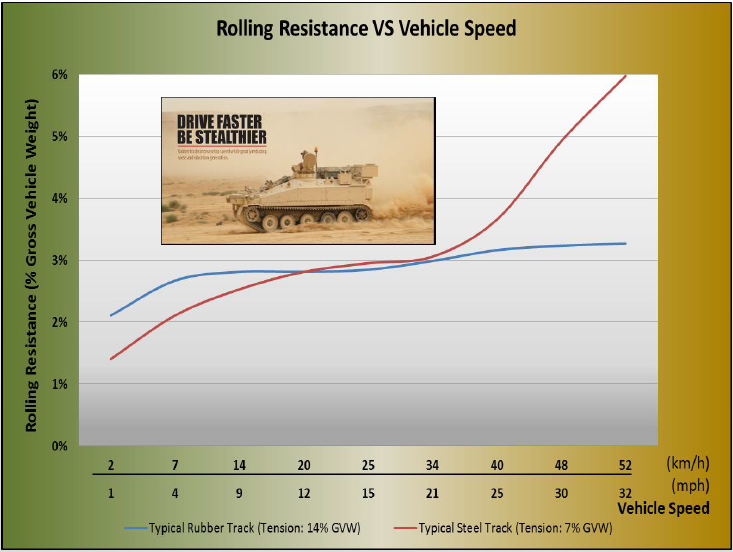
Go to Page 29 to see the observed rolling resistance coefficients table I referenced above:
US Army Engineer Research and Development Center - Geotechnical and Structures Laboratory - Standard for Ground Vehicle Mobility - February 2005
The mining haul truck is one of the largest pieces of equipment that needs to fit inside the garage, so 7.75m minimum height, preferably 16m high so the bucket can be tested inside the garage. The 797F is 9.5m wide, so perhaps the garage should be 25m in width to accommodate a pair of trucks. Overall length is 15m, so the garage should be 30m long.
Minimum Equipment Garage Dimensions for a pair of trucks, with room to spare for equipment and mechanics:
16mH x 25mW x 30mL
Offline
Like button can go here
#32 2026-01-02 23:55:25
- kbd512
- Administrator
- Registered: 2015-01-02
- Posts: 8,395
Re: This title has no meaning
What would it take to keep a very simple topic focused upon the content that belongs in the topic?
Why would you attempt to engineer a design for a structure or piece of equipment in the absence of all other relevant information related to how said structure or equipment will actually be used?
What materials are you going to use to make this equipment garage / outdoor repair shop?
How are you going to obtain them and where do they come from?
If this garage is for heavy duty construction and mining equipment, how big does it need to be, what types of repair and refueling equipment does it need to accommodate?
These are just a few of the many questions you cannot answer without consideration given to so many other seemingly unrelated details.
It's gonna be small / big / somewhere in between, we're gonna put some kind of repair equipment in it to repair something, and maybe people can work there, or maybe not.
Why can't we consider what we actually want to use this garage for, and if there's no discussion allowed for that, then what's the point?
Alternatively, why can't you specify exactly what you want put in this garage so nobody else is left to ponder over its purpose?
Offline
Like button can go here
#33 2026-01-03 02:12:06
- kbd512
- Administrator
- Registered: 2015-01-02
- Posts: 8,395
Re: This title has no meaning
We could use these "ice caves" on Mars for our earth moving equipment, as a water source, and for the radiation protection provided:
THE HEBRUS VALLES EXPLORATION ZONE: ACCESS TO THE MARTIAN SURFACE AND SUBSURFACE
Resource potential and planning for exploration of the Hebrus Valles, Mars
We have water, some of it potentially liquid, carbonates, sulfates, basalts, and other useful materials. If we find a good source of Iron-Manganese ore there, then I'd say we have a candidate for exploration at the very least, and likely a decent place to put a base since we're going to need enormous quantities of water for a decently-sized city.
Offline
Like button can go here
#34 2026-01-03 14:56:26
- SpaceNut
- Administrator
- From: New Hampshire
- Registered: 2004-07-22
- Posts: 30,107
Re: This title has no meaning
For SpaceNut ....
This topic should be about building a garage on Mars using materials collected on Mars. It appears that your AI friend thinks it is OK for this topic to bring tools from Earth, but it seems to understand that none (NONE) of the material used to make the garage can come from Earth.
I have opened a new topic for garages to be imported from Earth.
This topic should NOT be about space suits. We have topics for that.
This topic should NOT be about airlocks.
We have topics for that.
This topic should NOT be about Starship or any other ship of any kind what so ever!
These systems have no place in this topic.
This topic should NOT be about radiation.
Radiation has plenty of other topics.
It seems to me that this topic has filled up with every possible kind of distraction your AI friend can think of.
When you opened this topic I thought it had potential value to someone who is planning to go to Mars (or more likely) to work on providing products and services that will be needed by those who go.
What would it take to keep a very simple topic focused upon the content that belongs in the topic?
(th)
The post above yours tells you what is required to bring in order to build insitu on mars. This insitu resource must be present in the site selection process not after as that means you will fail.
How many compact bricks can you make with digging by hand and playing paddy cake to compress them.
That's why the planned needs sub topics along the project fishbone listing requirement to accomplish the desired goal.
Offline
Like button can go here
#35 2026-01-03 15:02:01
- SpaceNut
- Administrator
- From: New Hampshire
- Registered: 2004-07-22
- Posts: 30,107
Re: This title has no meaning
Thank you for posting in the topic kbd512.
post #31 is about how to process ore to make insitu materials into lite metals which is a topic all by itself for what can be used to get to the end goal of an insitu garage.
topics to post for metal mining and processing Iron and Steel on Mars
Post #33 is about site selection and why that site gives a particular insitu resource once there. It is part of the fishbone of site selection and why there.
What Are The Best Settlement Sites on Mars?
Thanks for trying to in Post #32 to try and explain why we still need the information for the equipment to make use of in the building process and what's going to be in the garage.
Which is Boring plus Drilling tech, 3D printing insitu and Tunneling equipment ect....
We all know about compressed brick and arch structures in several topics that are sub sets to any insitu building. That same equipment needs long term protection and repair between mars delivery cycles.
Cave selection option needs known dimension for holding the equipment size and shape may not be possible.
Offline
Like button can go here
#36 Yesterday 14:19:29
- SpaceNut
- Administrator
- From: New Hampshire
- Registered: 2004-07-22
- Posts: 30,107
Re: This title has no meaning
Magic of insitu means nothing without the prefixes of how you are going to get there.
1. How large is unknown until you specify how much equipment will be in it by, shape, size footprint, roof clearances. Picking a magic number is meaningless.
2. determining the materials that are going to be turned into the structure via brick, block, floors, architectural shape ect..
3. what process will be used with the insitu materials
4. how will it be made use or features it will have as it has to do with the crews that will be within it.
5. how is it powerd, lighted, given crew protection,
The list goes on but all some wanted was a dumb insitu structure that does nothing but keep the equipment from being sandblasted, which is not enough.
Offline
Like button can go here
#37 Yesterday 14:39:01
- tahanson43206
- Moderator
- Registered: 2018-04-27
- Posts: 23,736
Re: This title has no meaning
For SpaceNut .... When you are designing something for the first time you don't know how large it needs to be.
You don't have to let that stop you! Just pick a number ... You just build a shed in the Real Universe. You knew how to proceed.
There is nothing about working on Mars different from creating a design for any location.
You just make decisions as you go, and come back later to adjust them as your customer or circumstances require.
Chose some volume that seems reasonable and just build a structure to contain that volume.
The purpose of the topic is to work out how you are going to use Mars materials to make a garage.
Start with a simple cube if that is where you are most comfortable.
Design something.
Show it to others.
Collect feedback.
change something.
Just get moving.
You can and did build a shed in the Real Universe !!! You used in Situ resources, as a matter of fact.
Did you worry about extraneous issues? Maybe, but you didn't let them slow you down.
You can ask your AI friend to create images that show your concept.
After you've chosen your dimensions, start with the foundation.That's where most people start.
GW Johnson has given you detailed advice about how to build a strong foundation and floor.
Go read his posts and apply the methods.
Show us your floor with an image.
Decide on a wall ... do that.
Decide on a roof ... do that.
Decide on doors (or just one if you do as most people would do) ... do that.
Before you know it, you'll be done.
By the rules you set up with your AI friend in the first post, you can bring tools from, Earth but you must use materials you collect on Mars.
You're going to learn a LOT, and we will learn right along with you, if you share what you are learning.
(th)
Offline
Like button can go here
#38 Yesterday 14:53:00
- SpaceNut
- Administrator
- From: New Hampshire
- Registered: 2004-07-22
- Posts: 30,107
Re: This title has no meaning
Content now has no meaning to and end goal. now dead on arrival.
Offline
Like button can go here
#39 Today 07:36:42
- tahanson43206
- Moderator
- Registered: 2018-04-27
- Posts: 23,736
Re: This title has no meaning
For SpaceNut .... Please restore the correct title for this topic ...
Your humorous experiment while learning how to change topic titles might be misleading to a prospective new member.
(th)
Offline
Like button can go here