New Mars Forums
You are not logged in.
- Topics: Active | Unanswered
Announcement
#1 2025-12-07 23:40:19
- RobertDyck
- Moderator
- From: Winnipeg, Canada
- Registered: 2002-08-20
- Posts: 8,540
- Website
Fighter jets: F-35 vs Gripen vs Avro Arrow
The current Canadian Prime Minister, Mark Carney, announced the F-35 fighter jets that have already been paid for by the previous Prime Minister would be accepted. However, no further F-35 jets would be purchased. Canada is in negotiations with Sweden to purchase JAS-39 Gripen fighter jets. Donald Trump, one of his cabinet ministers, and the US Ambassador to Canada have said they doesn't like this.
I would like to challenge Trump and his crew with a simple test. Fly an F-35 to Resolute Bay in January. Leave it parked outdoors overnight for 12 hours in temperatures between -30°C and -40°C, then scramble in the morning when it's still dark. Resolute Bay is above the arctic circle, sun doesn't rise in January at all. Scramble simulating a Tu-95 bomber flying over the north pole. From engine start can it reach 50,000 feet in 5 minutes? (1953 requirement for the Avro Arrow)
I posted that paragraph on Facebook. One person claimed "A Gripen on internal fuel only would be close to bingo fuel in a maximum performance TTC to 50k. That doesn’t matter though, since the engine would be destroyed on the takeoff roll."
I would like to hear from GW Johnson: is this true?
I would like to point out history of the Avro Arrow. Russia test flew the Tu-95 bomber (later called Bear) in 1952. This was a threat to North America, because it was designed to carry nuclear bombs, and was the first Russian bomber capable of flying from Russia to the US and back, dropping said nuclear bombs. Response by the US was to design and build the B-52 bomber, which was better than the Tu-95. Response by the Canadian air force was to write requirements for a new All Weather Interceptor. Those requirements were made available to Canadian contractors in 1953. RCAF Specification AIR 7-3
Performance
Maximum Speed: Mach 2 maximum at altitude, with a cruising speed of Mach 1.5 at 70,000 feet (21,000 m).
Altitude & Climb Rate: A combat ceiling of at least 60,000 feet (18,000 m) and a climb to 50,000 feet within 5 minutes of engine start.
Manoeuvrability: The ability to perform a 2g turn at Mach 1.5 at 50,000 feet without losing speed or altitude, a requirement described as highly challenging even by modern standards.
Range: A normal mission range of 300 nautical miles (556 km) and a high-speed interception range of 200 nautical miles (370 km).
Operational Constraints: The aircraft was required to operate from a 6,000 ft (1,830 m) runway and have a ground turn-around time of less than 10 minutes.
Design and Systems
Crew: A two-place (pilot and weapons control officer) design was specified to handle complex operations and potential automation failures.
Powerplant: A twin-engine configuration.
Armament & Systems: An internal armament package capable of carrying up to six long-range air-to-air missiles and 50 shorter-range 2-inch rockets. This was paired with a highly advanced, integrated electronics system for radar detection, navigation, fire control, and flight control.
The RCAF determined that no existing or planned aircraft from other nations could satisfy these demanding requirements, prompting the domestic development of the Arrow.
Now I know the F-35 cannot supercruise at all, much less achieve supercruise at mach 1.5 at 50,000 within 5 minutes of engine start. One question is whether the F-22 Raptor can do this? But the question I asked is whether F-35 can reach 50,000 at all within 5 minutes of engine start. Under conditions I just listed.
Offline
Like button can go here
#2 2025-12-08 07:12:21
- tahanson43206
- Moderator
- Registered: 2018-04-27
- Posts: 25,691
Re: Fighter jets: F-35 vs Gripen vs Avro Arrow
This post is reserved for an index to posts that may be contributed by NewMars members.
This topic seems sure to receive at least one additional post.
In the context of Mars settlement, it seems reasonable to suppose there will be no fighter jets at all. However, vacuum capable missiles seem likely to be needed for planetary defense from the beginning of permanent residence.
Index:
GW Johnson https://newmars.com/forums/viewtopic.ph … 59#p236059
(th)
Offline
Like button can go here
#3 2025-12-09 12:17:13
- GW Johnson
- Member
- From: McGregor, Texas USA
- Registered: 2011-12-04
- Posts: 6,266
- Website
Re: Fighter jets: F-35 vs Gripen vs Avro Arrow
Rob:
I don't know enough to respond fully to what you asked in post #1 above. But I will say what I do know.
The cold soak up there in Arctic Canada does present some pretty serious problems operating gas turbine engines. It usually takes a wide-cut fuel to get reliable ignition and operation, when the plane and fuel are that soaked-out that cold or colder. Such fuels would be Jet-B/JP-4 (pretty much the same product sold to different customers with different specs). The JP-8 that most modern military jets burn is not a wide-cut fuel, but a kerosene, rather similar to JP-5/Jet-A/Jet-A-1. Freezepoints vary with the spec a little, but fall in the -58 to -65 F range (-50 to -54 C). Wide cut will successfully go colder than that. Gasoline goes much colder still. It is not the actual freezepoint, but the cold vapor pressure which governs the vapor/air ratio in the combustor cans, that is the real issue.
I am very impressed by the 2 gee maneuver capability at 50,000 ft altitude in that RCAF spec. Service ceilings for jet fighters usually have been in the 50-60,000 foot range since the Korean War, right down to the present day, with exceptions like the U-2 and the SR-71/A-12 family. Service ceiling is defined in the FAR's to be the altitude at which max power climb rate is down to the almost-imperceptible 200 feet per minute. Military specs are similar. There is no maneuver at that service ceiling condition, the airplane can just barely fly unaccelerated straight and level. It's easy to stall at high altitude, and the stall danger is a violent spin, in air too thin to prevent inertia coupling. (BTW, the larger vertical fin on the B-17 from the E model of 1940-onward was a response to this same kind of high-altitude spin risk.)
The "combat ceiling" of 60,000 feet in the spec is not the service ceiling, not with a spec'd cruise at 70,000 feet! That would be one impressive high altitude airplane! I suppose the SR-71/A-12 might be roughly comparable with a Mach 3 to 3.2 max cruise at 85,000 feet. But those planes burned an early version of thermally-stable jet fuel designated JP-7. There is no JP-7 any more, but it would be similar to the kerosenes JP-5, JP-8, and Jet-A/jet-A-1. Wouldn't work well at all in Arctic Canada.
As for burning-out engines in a fast climb, there is a time limitation for operation at full power, because turbine blades, combustor cans, and afterburner/nozzle hardware just gets too hot at the max power setting. You can only do that for a very few minutes. But, it takes full power to climb fast. The "trick" really is being able to handle the heat long enough to get to high altitude at full power, to meet the time spec. If the engine was not designed to operate that long at max power, there is little you can do to meet the tougher short time spec to high altitude.
This effect was manifested in a different way in the Mig-25 Foxbat. That airplane, if carrying no external stores at all, could fly as fast as Mach 3.5. Its engines were short-life at only 500 hours. And you did not overhaul them, you simply replaced them. This obtains because of the max power setting for long intervals required to intercept at Mach 3.5, or to intercept at the redline Mach 2.8 and near-max power with external stores. At max power, engine stuff just gets hot. And at high supersonic, the inlet air is rather hot, which makes the whole problem worse. Carrying stores, the issue was vibration from the aerodynamics around the stores, but with the drag of the stores, it wouldn't have gone much faster, even without vibrations.
If you really want to fly high altitude with handling practicality, you must fly well-supersonic. The U-2 was subsonic, with a service ceiling altitude somewhere around 70,000 feet. But subsonic like that, the difference between stall speed and max speed was only 5 KIAS, even with that huge wing. And that huge wing made landings difficult indeed. The wind can upset you all too easily with a landing speed that low, in an airplane that big.
I hope that answers your question to me.
GW
Last edited by GW Johnson (2025-12-09 12:36:22)
GW Johnson
McGregor, Texas
"There is nothing as expensive as a dead crew, especially one dead from a bad management decision"
Offline
Like button can go here
#4 2025-12-11 02:37:58
- kbd512
- Administrator
- Registered: 2015-01-02
- Posts: 8,533
Re: Fighter jets: F-35 vs Gripen vs Avro Arrow
RobertDyck,
Any kind of bomber Russia and China actually operate are about as maneuverable at high altitude as a beached whale. As GW already pointed out, they can just barely fly at all up there, and while they do move a bit faster because the air is so much thinner, they'd literally fall out of the sky if they didn't. For a strategic bomber cruising above 40,000ft, anything much beyond high subsonic level flight and lazy turns is wishful thinking. That means they're easy pickings for air defense missiles launched towards them on ballistic trajectories. Missiles will always out-accelerate manned aircraft on simple physics alone. How the incoming bombers and missiles are destroyed is unimportant. A job well done, efficiently and at minimal cost to Canadian tax payers, should be the desired end result.
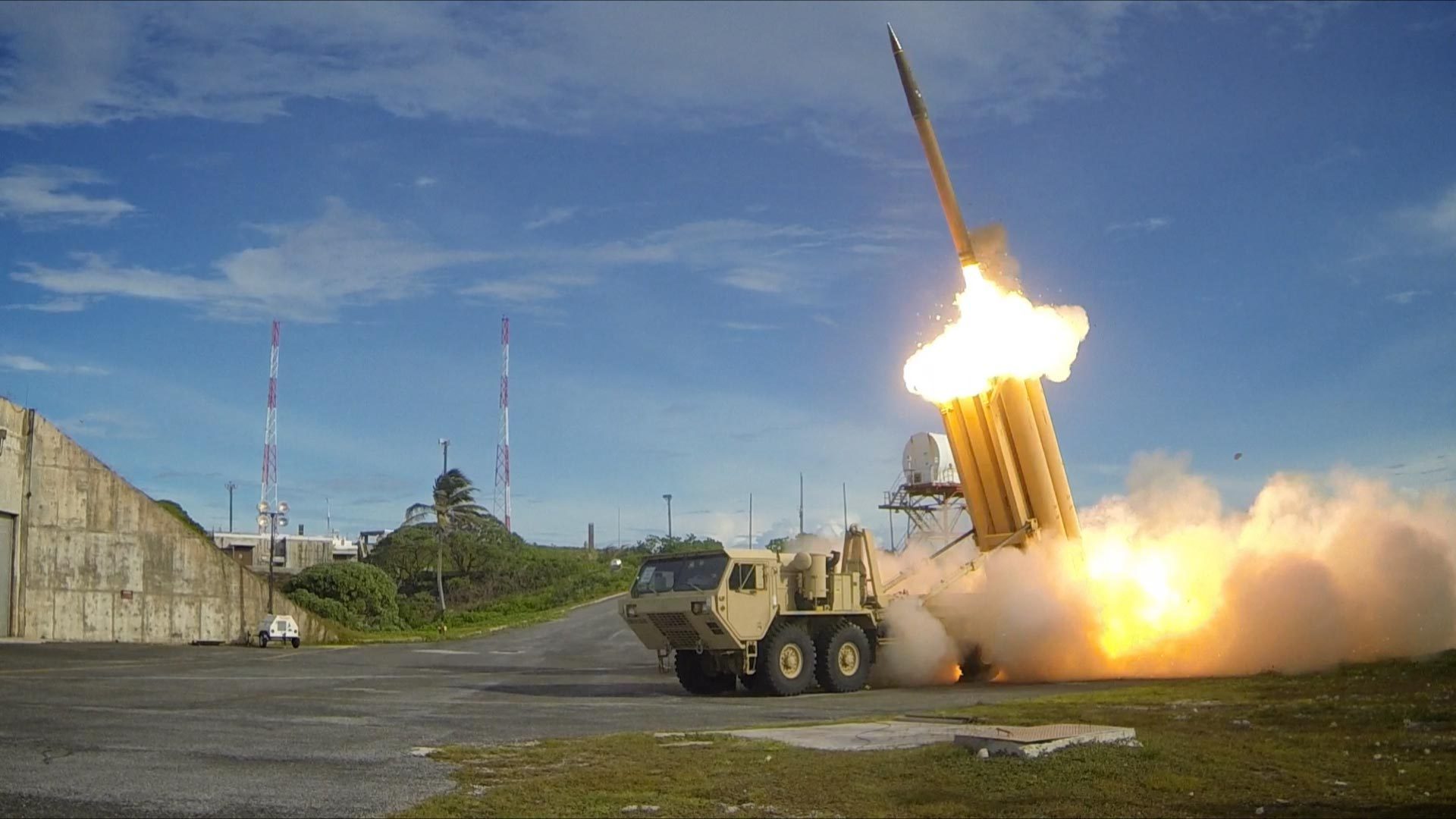

THAAD-ER could be ready in a few years instead of a decade, which is approximately how long Canada has been dragging its feet on modern fighter jet acquisition: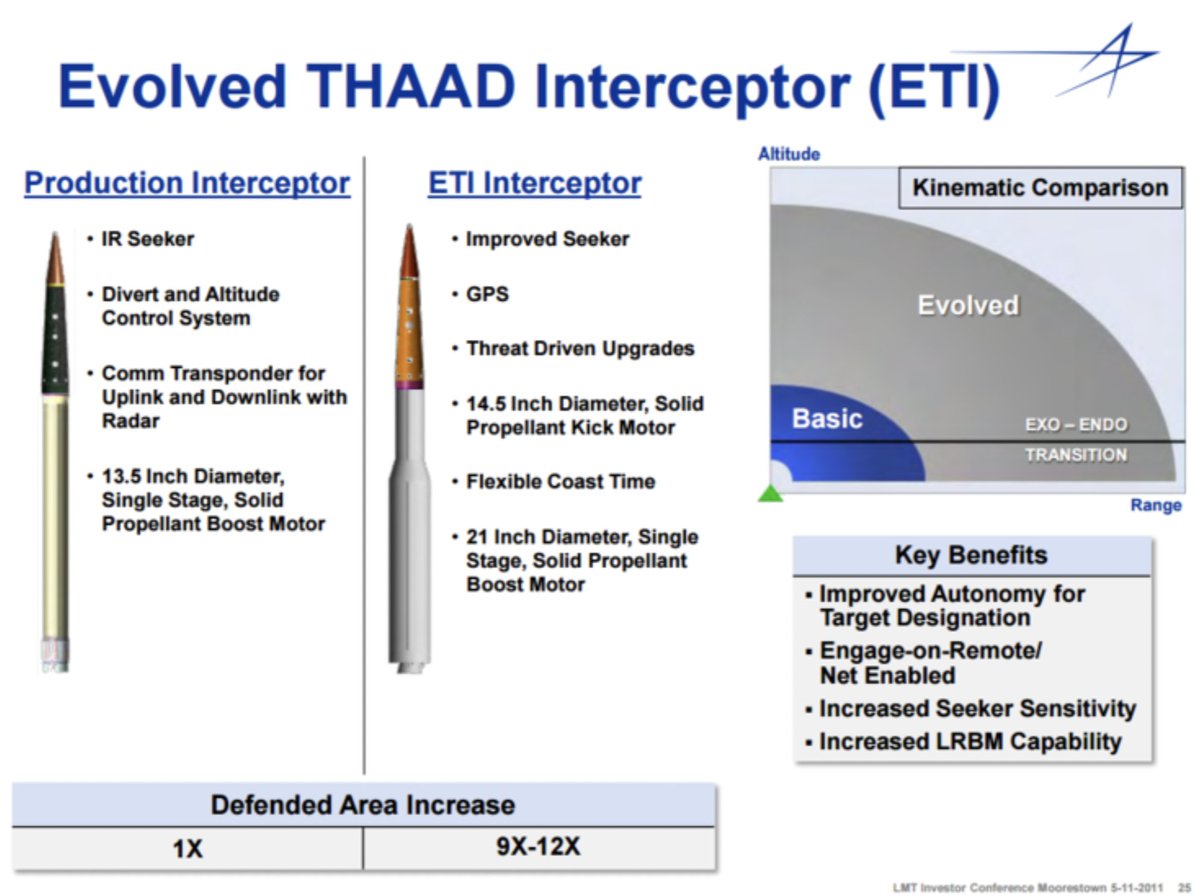
If you are sincere in your desire to defend Canadian airspace, and acknowledge the significant budgetary constraints applied to the Canadian military, then you ought to propose a solution that stands a chance of actually being ready and available when called upon to defend Canadian airspace. A few squadrons of fighters, even if they were Mach 4 capable, are simply not enough to defend a block of airspace as vast as the approaches to Canada. Radars and missiles can bring down enemy bombers and missiles a lot more cost-effectively than 2-5 squadrons of fighter jets. We throw more money than any other nation at fighter jets, but weren't able to purchase enough F-22s to merely replace the F-15. If America simply "gifted" all our F-22s to Canada, your military would run out of operational funding trying to maintain them as airworthy assets, as opposed to fully mission capable assets. We quit buying them because their radar and avionics tech is now ancient by modern standards.
Canada's entire annual defense budget is around $12B USD, so maybe 1.5% of what the US spends on defense. Canada can still do quite a lot with the money it does spend, but only when it's very shrewd about where those defense dollars are spent, which means foregoing flash for substance. Air defense is mandatory in modern warfare, but how that's achieved is a choice which carries significant cost implications. If missiles weren't very effective, then they wouldn't be employed by the thousands by every modern military. Whether or not Canada buys American weapons, European weapons, or chooses to develop their own weapons is irrelevant to having something effective available, and in sufficient quantity, when that doomsday scenario you keep throwing out there is no longer a theoretical problem to solve.
Logistics wins wars, not who has the faster fighter. WWII German military hardware and training was judged as superior to most allied hardware, even amongst the allies, but for all their technical superiority, whether real and demonstrated in battle or merely theoretical, it never amounted to a hill of dog crap in the face of superior allied logistics.
Ask yourself how many bombers and missiles Russia or China might throw at Canada to wreck your economy. Next, ask yourself if Canada would have enough weapons (fighters / missiles / radars / spare parts / trained operators / usable air bases / etc) ready to use, from advantageous positions, to intercept all or most incoming weapons, if only Canada did "X" vs "Y" with their defense dollars. When the answer is "not enough", something's wrong with the chosen solution, however personally appealing.
Offline
Like button can go here
#5 2025-12-11 12:00:03
- kbd512
- Administrator
- Registered: 2015-01-02
- Posts: 8,533
Re: Fighter jets: F-35 vs Gripen vs Avro Arrow
Now I know the F-35 cannot supercruise at all, much less achieve supercruise at mach 1.5 at 50,000 within 5 minutes of engine start. One question is whether the F-22 Raptor can do this? But the question I asked is whether F-35 can reach 50,000 at all within 5 minutes of engine start. Under conditions I just listed.
The F-4 Phantom was able to reach 82,000ft in 3 minutes 50 seconds, using full afterburner, despite its inferior thrust-to-weight ratio as compared to the F-35, so what makes you think F-35s cannot quickly reach 50,000ft?
Thrust-to-Weight with Zero Fuel / Zero Weapons of Select Fighters
Avro Arrow w/ J75 engines: 0.96:1
F-106A: 1.00:1
F-4E: 1.18:1
F-14D: 1.23:1
Avro Arrow w/ Orenda Iroquois engines: 1.25:1
JAS-39E/F: 1.25:1 <- Edit: I somehow forgot to include the Gripen in this list
F-18E/F: 1.37:1
F-35A: 1.47:1
F-16C/D: 1.54:1
Rafale C: 1.57:1
F-22A: 1.62:1
F-15C: 1.64:1
F-15EX II: 1.66:1 (no CFTs installed)
Eurofighter Typhoon: 1.67:1
All the rest of the fighters on that list are at least as climb-capable as the F-4 when proportionally laden with fuel and weapons. The F-35 has a significantly greater excess of thrust, relative to its own empty weight, than the Avro Arrow ever did, even if the Arrow was equipped with Iroquois engines that were never installed. The F-14D's initial climb rate was nearly identical to the F-35A. I've never heard anyone claim that a Tomcat couldn't climb very well. If all fighters on that list were proportionally encumbered with fuel and weapons, then as a general rule the fighters with higher excess of thrust would still climb better than ones with lower excess thrust.
Does aerodynamics still matter?
Absolutely. Quite a lot, actually.
How much less aerodynamic are the non-stealthy jets when they're carrying 2-4 gigantic fuel tanks on wing pylons as part of their combat configuration?
There's a reason why all the latest jets are carrying significantly more fuel internally, even if that means the base jet design has greater drag than a more streamlined airframe carrying less internal fuel. Drag penalties from multi-hundred gallon external fuel tanks are very real, to say nothing of how external point loads affect real world maneuverability limits to avoid over-stressing the airframe.
If the F-35s ultimately receives the 50,000lbf F-135 or F-136 engine refresh under development, then A model TWR becomes 1.71:1, outclassing the very best Gen 4.5 fighters. If the CNT / BNNT wiring replacement is fully implemented and Aluminum wing spars fully replaced with CFRP, there's a real shot of re-engined and re-manufactured F-35As hitting 2:1 TWR and F-35Bs being able to take off vertically with full fuel. C models would perform better than current A models. A models would be able to climb vertically, and quite rapidly, when laden with full internal fuel and 6X AIM-120s. Up to high subsonic speeds, they'd accelerate faster and therefore recover energy following hard maneuvering faster than all other jets with lesser TWRs and proportional fuel / weapons loads.
Last edited by kbd512 (2025-12-11 16:45:23)
Offline
Like button can go here
#6 2025-12-11 12:34:46
- RobertDyck
- Moderator
- From: Winnipeg, Canada
- Registered: 2002-08-20
- Posts: 8,540
- Website
Re: Fighter jets: F-35 vs Gripen vs Avro Arrow
Thank you for the reply. As you mentioned, Canada is vast. Only Russia has more land area than Canada. But most of the population is huddled south where it's warm. And where crops can grow. The north is vast with very little there. Fighter jets were the 1950s defense against strategic bombers. In the early '60s the US government convinced Canada to get Bomarc missiles. They had problems, didn't work very well. So now you're arguing for a ground launch system that hasn't been fully developed yet.
If a Russian bomber can fly faster than a fighter, if just needs to spot the fighter at distance with radar. It doesn't have to be a precise radar lock for a missile, just enough for a warning. As long as the bomber stays at least 100 miles away from the fighter, it can't do anything. The bomber doesn't require sharp turns, just enough to keep the fighter at distance. That's what an interceptor must be able to cruise (no afterburner) faster than the bomber. Now look at not only 1952 vintage Tu-95 Bear bombers, but Tu-22M3 Backfire and Tu-160 Blackjack. An interceptor's job is different than an air superiority fighter. Also realize the Tu-160 is used to launch cruise missiles, so must be shot down much farther back.
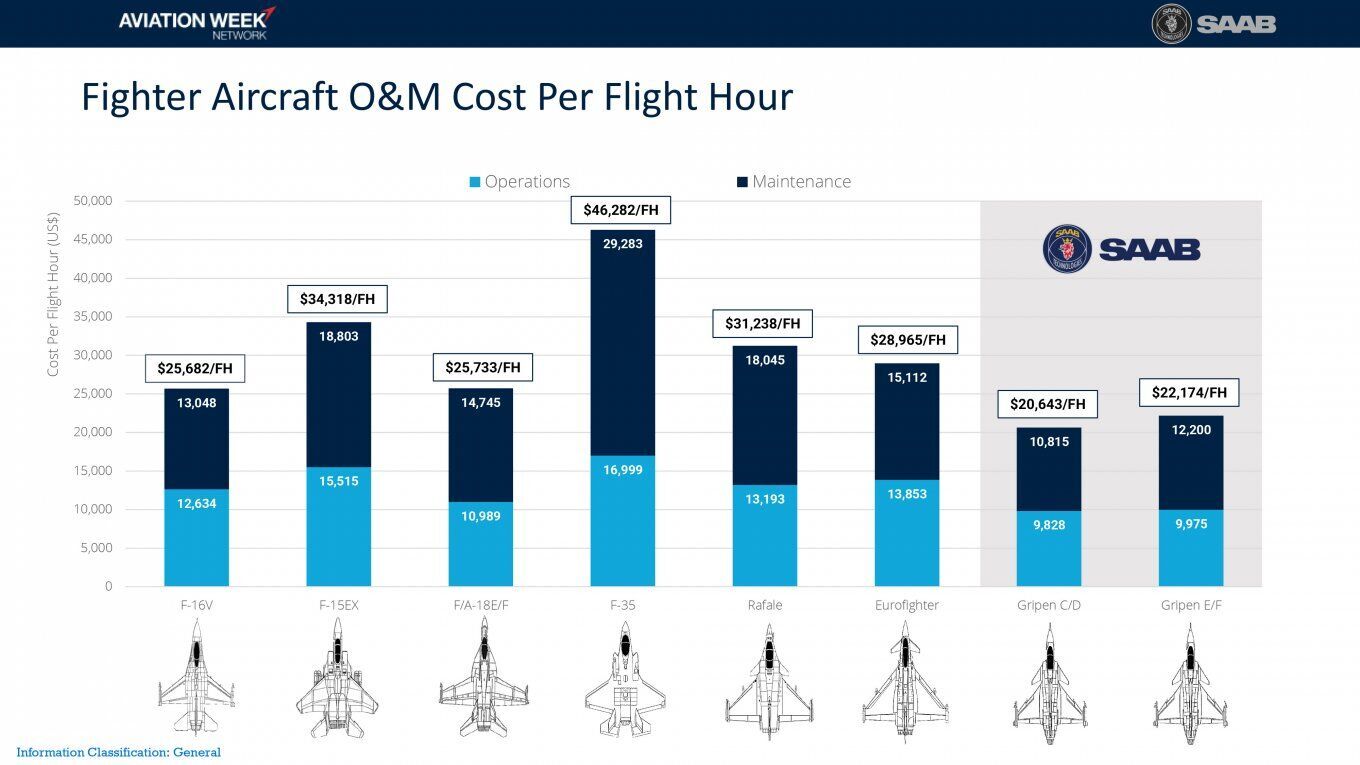
The first reason Canadians objected to F-35 was cost. Not just acquisition cost, but maintenance and operation. How effective is it? Can we afford it? JAS-39 Gripen has a similar acquisition cost, but much cheaper to maintain and operate. And it's designed for Arctic cold.
Performance of fighters you listed are impressive. Now could they operate in the cold of the scenario in post #1? Temperature I listed is typical for night in January in the city where I live. It can get colder at the location listed. Can an F-35 operate when cold soaked?
Offline
Like button can go here
#7 2025-12-11 14:34:32
- kbd512
- Administrator
- Registered: 2015-01-02
- Posts: 8,533
Re: Fighter jets: F-35 vs Gripen vs Avro Arrow
RobertDyck,
So now you're arguing for a ground launch system that hasn't been fully developed yet.
THAAD has been operational since 2008. Strapping a 2X more powerful rocket motor to a weapon already designed to accelerate to hypersonic speeds doesn't make it a completely new weapon with completely unknown characteristics. What I'm suggesting is that Canada take a proven weapon system, like THAAD or Patriot, let LM develop the improved motor unless you have the R&D and manufacturing capacity to do that yourselves, and then add a home-grown kill vehicle to Canada's version of the weapon. That's what you guys already do with every American weapon system you purchase, so why should this one be any different?
If a Russian bomber can fly faster than a fighter, if just needs to spot the fighter at distance with radar. It doesn't have to be a precise radar lock for a missile, just enough for a warning. As long as the bomber stays at least 100 miles away from the fighter, it can't do anything.
I find this idea of the F-35 being tracked by an enemy bomber from 100+ miles away, to be quite fanciful. If considerably more powerful ground stations cannot do that with any degree of reliability, no, just... no. When the F-35 is equipped with AIM-260s or AIM-174Bs, those bombers absolutely are within range. AIM-174B can hit bomber-sized targets from 250 miles.
The first reason Canadians objected to F-35 was cost.
So, your counter-proposal was to acquire considerably more expensive and maintenance-intensive jets like the F-22, on the sole basis of it being able to "supercruise"?
Do you not see how absurd that is?
If bombers really can see the F-35 on their radar screens, is the Gripen going to be less visible to the bomber?
And it's designed for Arctic cold.
You think Alaska isn't cold, or that when we conducted flight ops below the Antarctic Circle aboard carriers, that somehow doesn't count as cold weather?
Do you realize that we leave the jets on the flight deck at night, with fuel in the tanks, and then use them the next morning?
Cold-soaked, or heat-soaked, is the only kind of "jet operating" we do in the Navy. The only thing we remove is ice, because ice will screw up any aircraft ever made, period. We don't show any deference to "fancier" stealth aircraft brought aboard. If it's on our flight deck, then it's a combat asset, or we send it home because it's useless to us.
The Gripen's airframe is made from the exact same kinds of materials as the F-35, and uses an American Super Hornet engine. The F-35 in particular uses its fuel as a heat sink, so it can definitely heat up the airframe if necessary. Making the jet in Sweden vs Texas doesn't imbue its airframe materials with special properties. America operates combat jets in every climatic conditions imaginable, from Death Valley heat, to jungle insect FOD and humidity, to ice-spray encrusted aircraft carrier flight decks rolling and bobbing around off the coast of Antarctica.
Offline
Like button can go here
#8 2025-12-19 19:50:22
- kbd512
- Administrator
- Registered: 2015-01-02
- Posts: 8,533
Re: Fighter jets: F-35 vs Gripen vs Avro Arrow
Here's another interesting tidbit about jet aircraft and best maneuvering speeds:
All supersonic capable aircraft such as the F-8, F-4, F-14, F-15, F-16, F/A-18, F-22, F-35, Rafale, Typhoon, Fulcrum, Flanker, Gripen, et al share a common characteristic related to best maneuvering speeds. Every single one of them exhibit best maneuverability characteristics at speeds remarkably similar to the top speeds achieved by WWII era "super-prop" propeller-driven aircraft, which tends to be somewhat below the max cruising speeds of large jet airliners. There is not a single example of a turbojet or turbofan powered fighter that makes tighter turns at supersonic speeds. As long as a human is in the cockpit, there never will be.
Every purpose-built fighter turns / re-points its nose exceptionally well at 350 to 550mph. Some are capable of "super-maneuverability" at Cessna 172 speeds, which means they can turn as tightly as a Cessna 172 at Cessna 172 cruise speeds by using afterburner to prevent them from literally falling out of the sky. When those same fighter jets maneuver at supersonic speeds, despite the fact that they change their position in 3D space much faster, the time it takes to execute a 90 degree turn greatly resembles turn rates associated with WWII era tactical bombers. B-25s had decent maneuverability for what they were, but I would never want to attempt to avoid a missile shot while flying one. That's what you're transforming a fighter jet into when you fly it faster than the speed of sound- a much faster B-25 with only modestly worse turn rate (degrees or radians per second) and radius (feet or meters).
Roll rates stay about the same or slightly increase at modestly supersonic speeds, so more speed helps there, at least a little. Best climb speed for all of them is deeply subsonic when combat loaded, even if a F-15 or Flanker with all combat equipment removed, no weapons, and only 10% fuel can "go supersonic" in a vertical climb. A jumbo jet airliner likewise turns into a real "hot rod" with all the passenger seats and other cabin equipment removed, and only 10% fuel remaining. The one minor problem is that it's useless as an airliner.
Turn Radius = Velocity^2 / Acceleration
Mach 1 = 1,125.33ft/s
g0 = 32.2ft/s
Divide the turn radius by 2 to get a sense of how far a hard evasive maneuver places the targeted aircraft from the incoming missile's warhead.
AIM-9X is reputed to be able to pull up to 80g maneuvers and its seeker has a 110 deg/s tracking rate, so let's see how that translates to missile turn radius at Mach 2 (average speed over its fairly brief flight duration):
AIM-9X Mach 2 Turn Radius:
(1,125.33ft/s * 2)^2 / (80 * 32.2)
5,065,470.4356 / 2,576 = 1,966ft
All missiles bleed speed like mad when not under power, but as they slow down a bit, they also make tighter turns. This would be worth remembering.
F-22 Mach 1.5 Supercrise Turn Radius:
(1,687.995)^2 / (9 * 32.2)
2,849,327.120025 / 289.8 = 9,832ft
10,560ft = 2 miles
Turn capabilities for longer / heavier radar guided missiles are typically in the 40-70g range, which makes them somewhat easier to out-maneuver, but this isn't looking very promising for our "I feel the need for speed" F-22 pilot.
Same F-22 cruising at Mach 0.5, same 9g turn capability:
(562.665)^2 / (9 * 32.2)
316,591.902225 / 289.8 = 1,092ft
At least now we have a real shot at evading a highly maneuverable heat-seeker. Timing is everything, as-always, but at least we're not setting ourselves up for failure from the word "go".
max speed at which a 9g capable super-prop has a reasonable turn radius and rate: (400mph * 5,280) / 3,600 = 586.66ft/s
max speed at which a 9g capable combat jet has a reasonable turn radius and rate: (550mph * 5280) / 3,600 = 806.66ft/s
Regardless, you're 1 to 1.5 football fields away from away from the missile warhead's blast radius with correct timing of evasive maneuvers. Pretty much all of them are designed to pass within 0.25 football fields in order to reliably destroy a maneuvering target using a continuous rod warhead, irrespective of warhead orientation to the target.
For those who don't know what a "continuous rod" warhead is, imagine a thick steel wire rope being explosively driven radially outward from the point of detonation, slicing through everything in its path, because that's how it works. It's not like a conventional blast-fragmentation iron bomb, nor does it create a jet of molten metal like a High-Explosive Anti-Tank warhead. The reason is fairly simple. Blast-frag is exponentially less lethal with increasing distance from the point of detonation because all fragments being projected outwards are flying through an ever-increasing volume of airspace. That means most fragments are hitting nothing at all unless it detonates very close to the target. HEAT has to be pointed directly at the target, and a combat jet is not armored like a tank, so there's not much point to that. You may still get hit with some small random bits of steel missile casing with any of these warhead types, but so long as ye olde continuous rod passes within lethal distance, then before the continuous rod breaks into individual rod segments, creating "gaps" in the "death lasso" during radial outward expansion, a "large fragment hit" on target is effectively assured.
Blast-frag could potentially do greater damage with a greater number of projectiles if you could assure that the missile passes very close to the target and its warhead has the correct orientation with respect to the target, but that's much harder to do. A guaranteed hit when the missile passes within fusing distance is better than potentially getting a few more fragments or no hit at all with other warhead types. Imagine a blast-frag detonation 0.25 football fields directly astern of the target. Even though the missile technically passed within lethal distance to trigger its warhead, the target may not get hit at all because it's displacing so rapidly that almost no fragments are directly aimed at the target. If the same missile passed directly under the belly of the target, then yes, blast-frag might spray the target with quite a bit more metal than a continuous rod. Throwing a 0.5" thick / 12-20" long steel bar through the target at hypersonic velocity generally ensures something catastrophic happens to engines or fuel or airframe.
Any pilot who likes being counted amongst the living wants to be as far away as he can get, but 1 vs 1.5 football fields for super-prop vs jet is not a game-changing difference most of the time. The super-prop is fast enough that a hard maneuver will remain well inside the missile's turn radius and it still displaces fast enough that a near-miss is unlikely to be immediately fatal.
The implications for surival are crystal clear, though. At Mach 1.5 there's no hope of turning inside an 80g capable missile in a 9g capable combat jet. At Mach 0.5, especially with perfectly-timed computer-controlled evasive maneuvers, you have a better than average chance of living to fly and fight another day.
A skilled F-16 pilot with situational awareness and visual advance warning of incoming missiles demonstrated how this works in real combat a half dozen times on a single mission which took place during Gulf War I. The Iraqi's had his jet locked-up and fired off at least six SAMs. He survived not because of his supersonic speed capability, nor the missile's lack of speed, given that he was well within its engagement envelope, but because of his ability to turn inside the missiles fired at his subsonic jet, which wasn't moving any faster than a WWII era super-prop plane except at the start of his ordeal when he was cruising around like an airliner.
Offline
Like button can go here
#9 2025-12-21 08:00:45
- NewMarsMember
- Member
- Registered: 2019-02-17
- Posts: 2,040
Re: Fighter jets: F-35 vs Gripen vs Avro Arrow
kbd512 posted an interesting and detailed follow up to the report above...
https://newmars.com/forums/viewtopic.ph … 61#p236361
The post includes additional details about the flight mission and roles of the various components.
A detail that might interest a reader with knowledge of aircraft piloting is kbd512's report that a pilot can be trained to evade an oncoming missile by forcing the missile to use only two of four control surfaces. How a pilot could master ** that ** nuance while engaged in flight is something that must be taught in advanced flight school, which kbd512 ** also ** describes.
All the weaponry our (US and allied) pilots engaged in Iraq were designed by the Soviets.
(th)
Recruiting High Value members for NewMars.com/forums, in association with the Mars Society
Offline
Like button can go here
#10 2025-12-22 05:49:36
- kbd512
- Administrator
- Registered: 2015-01-02
- Posts: 8,533
Re: Fighter jets: F-35 vs Gripen vs Avro Arrow
All Weights in Pounds, Ranges in Statute Miles (5,280ft per Statute Mile)
Engine(s); Empty; MTOW; Internal Fuel; External Fuel; Max Stores
Gripen E: 1X F414; 17,637; 36,376; 7,496; 7,798; 15,900
F-16C - 1X F110; 18,900; 42,300; 7,000; 12,240; 17,000
Rafale M - 2X M88-4E; 23,400; 54,013; 10,362-18,658 w/CFTs; 14,771; 20,900
Typhoon - 2X EJ200; 24,251; 51,809; 9,900; 5,386; 19,800
KF-21 - 2X F414; 26,015; 56,400; 13,227; UNKNOWN; 17,000
F-35A - 1X F135; 29,300; 65,918; 18,250; 8,160; 18,000
F/A-18E - 2X F414; 32,081; 66,000; 14,700; 13,056; 17,750
F-15EX - 2X F110; 35,500-40,000 (2X CFTs); 81,000; 13,550-23,750 w/CFTs; 12,240; 29,500
F-22A - 2X F119; 43,340; 83,500; 18,000; 16,320; 20,000
Max Fuel and Ferry Range
F-16C: 19,240; 2,620
Gripen E: 15,294; 2,500
F-15EX: 35,990; 2,400
Typhoon: 15,286; 2,350
Rafale M: 29,716; 2,300
F/A-18E: 27,756; 2,070
F-22A: 34,320; 2,000
KF-21: 13,227 *1; 1,800
F-35A: 26,410; 1,700 *2
Notes:
*1: KF-21 external fuel capacity is unknown, though external stores capacity suggests it can carry at least 2X 600 gallon external tanks.
*2: F-35A is plumbed to carry 2X 600 gallon non-stealthy external tanks on underwing pylons, so ferry range listed is on internal fuel alone. AFAIK, you can't "dump" 600 gallon tanks. If you decide to carry them, then they're staying on the wings, period. This adds about 45% to total fuel capacity. If we guess at the increase in ferry range as being 30% greater, meaning the drag penalty eats up 15%, then 2,210 miles seems quite reasonable. If only 10% of the external fuel carried is consumed by the additional drag, then 2,295 miles. Regardless, "rule-of-thumb" says that's where your ferry range falls.
Conclusions:
The European fighter jets are remarkably fuel-efficient designs with long legs. However, ALL fighter jets love the fuel. Russian and Chinese fighter jets don't burn any less. Whenever you say, "Yes, sir, yes, sir, three bags full", you're no longer going supersonic and your previously nimble fighter jet has all the maneuverability of a fuel truck, which is what you turned it into.
Despite claims to the contrary about European / Russian / Chinese fighters, American jets are the ones which are built like tanks. Even Russian defense analysts have commented on how "over-built" American jets are, relative to Fulcrums and Flankers. US Navy jets in particular are noted for their durability. I can't speak intelligently on any other nation's jet design philosophy, but there is a notable difference in empty weight between comparable designs.
Airframe Design Service Life, Equivalent Flight Hours
MiG-21 / MiG-29 / Su-27: 2,000 to 3,500
Su-35: 6,000 (aspirational, according to the Russians)
Typhoon: 6,000
Rafale: 5,000, extension to between 7,000 and 9,000
F/A-18E: 6,000, extension to 12,000
Gripen E: 8,000
F-22A and F-35A: 8,000 (accelerated fatigue testing has shown no structural failures at 24,000)
F-16C: 8,000 (Block 40-52) 12,000 (Block 70/72)
F-15EX: 20,000 (highest deliberate airframe design service life for a tactical fighter that I'm aware of)
If Canada wants a non-stealthy twin-engine, two-seat, long-range, high-speed (Mach 2.9 max dash speed), high-capability tactical fighter with a full state-of-the-art sensor and electronics package, then the F-15EX Strike Eagle II best fits that description. It carries more fuel than any other tactical fighter except the Chengdu J-20. I would absolutely L-O-V-E to hand over our entire inventory of F-22As to Canada, but the Royal Canadian Air Force would bankrupt themselves trying to maintain those jets. Fewer F-22s means more money for F-35s and F-47s.
Here's what I wish more people knew or understood about real world tactical fighter operations:
1. Situational awareness through sensor fusion and concise "dumbing-down" of information to only what you need to know RIGHT NOW, not having to manage the jet itself while you're trying to attack or evade something, seamless communications and networking, combined with raw sensor + compute + data sharing capabilities means more than any amount of stealth or raw speed / climb rate / maneuvering performance. If the 1950s F-5 airframe was upgraded with all of that, minus the stealth, then it would still be a terrifyingly capable opponent, every bit as serious and lethal as a heart attack. The fact that it couldn't out-climb the F-22 or fly as fast as the F-15 is almost entirely irrelevant to anything. In 2025, you are fighting semi-automated and automated air defense systems much more than you're fighting actual human beings. Enemy fighters are mostly a non-issue because there are so few of them, they're mostly sent out to attack targets vs defend them, everyone is so spread-out, and typical fights take place over seconds to minutes at most.
2. Big jets cost big money. If your military can't eat the cost, then don't put that much metal in the air. I'm dead serious, because that is literally the extent of the issue. All jets are expensive. Combat jets are really expensive. The entire Free World needs more cost-effective fighters that don't mandate spending so much money on the basics, so that real combat training can be conducted by flying with greater frequency. There's no point to buying them if you cannot afford to use them with regularity. They're not lawn ornaments. Nations with smaller military budgets can still afford to stuff the latest and greatest electronic gadgets into airframes that don't put them in a financial bind. If you put the F-35's radar in the nose of the F-5 after removing the guns.
3. The idea that you can train differently from how you fight is pure nonsense. You CANNOT economize on total cost of ownership by not flying the fighter regularly. From both a mission readiness standpoint and equipment service life standpoint, once you start flying a combat jet, or any aircraft for that matter, the absolute worst thing you could possibly do is to quit flying it regularly. Jet aircraft not undergoing an overhaul, that haven't flown more than a handful of hours during the last calendar year, may as well be destined for the Bone Yard. The entire reason Navy combat jets didn't literally fall apart is that the maintainers are constantly taking them apart, replacing whatever little bits and pieces have failed, and then putting them back together so they can be flown again so that the entire cycle can repeat itself. That process is normal and necessary. Yes, it's a pain. Yes, it appears to the untrained eye that the jet is "always broke". Yes, it costs real money. However, that is a vital part of the operational art. They get good at doing it because they do it every single day.
If you fly any modern combat jet less than 200 hours per year, the odds are better than average that your aircrews are only proficient enough to not kill themselves flying the jet from Point A to Point B. The first 150 to 200 hours is entirely devoted to maintenance of basic airmanship skills and represents the cost of entry into the world of combat jets. At 250 hours, you can conduct training for a single mission type. You need 300 to 350 flight hours per aircrew per year to maintain any kind of proficiency across multiple missions. Let's say your Air Force has decided that your squadron will train for air intercept and tactical strike. If you're not flying at least 300 hours per year to train for both of those missions, then I cannot take you seriously if you tell me your aircrews are mission ready, because any kind of realistic exercise will quickly demonstrate that they're not.
There is no software simulator that can teach you how to fuel and rearm the jet quickly, nor trace a faulty electrical cable. You have to actually practice that to get good at it. How might one accomplish that, you ask? Fly the jet. Practice the mission. Figure out what works and what doesn't. Practice fixing the jet by flying it until you break something. If your ordies need half a day to read through a manual to assemble and hang a JDAM because nobody in your squadron has done it during the past month, that's a pretty serious problem if you intend to fly strike missions. If your pilot hasn't briefed ingress and egress routes and "what-if'd" through alternative waypoints and secondary targets, then they're not proficient, either. I don't care if they have a vague idea of what's involved. I want them to be intimately familiar with every aspect of mission planning. When we did this stuff before real combat missions over Afghanistan and Iraq, it took a half day of work for one officer who was doing it at least once per week, if not more often.
I'll write more about what I think a realistic modern day "light fighter" (twin engine, two-seat) and "micro fighter" (single engine/seat) involves for Canada, but broad strokes:
1. CFRP airframe fabricated using "Carbon Forging" vs extended duration vacuum bagging and autoclaving.
2. Pratt & Whitney Canada PW545B engine, which delivers almost triple the fuel economy of the J85 turbojets that powered the F-5E, $1-2M per engine. This is a non-afterburning turbofan engine, built in Canada, and primarily used in Biz Jets. America has already used this engine to power the General Atomics MQ-20 Avenger combat drone.
3. Raytheon PhantomStrike AESA radar, around $1-2M and 119lbs. This radar has already been used in the Kratos XQ-58 and Boeing MQ-28. This lower cost and weight system still provides the ability to launch AIM-9X, AIM-120, presumably Raytheon's new Peregrine missile, JDAMs, JSOWs, and other common munitions like Hellfire. It's a full-capability miniaturized Super Hornet radar.
4. High subsonic speeds for reduced operating cost and takeoff / landing / stall speeds to permit operation from austere facilities.
5. Strict adherence to a no-frills design, which includes foregoing stealth. No unnecessary gadgetry or novelties will be included in these light fighter and micro fighter designs. The temptation to load-up the jet with everything but the kitchen sink will be ever-present and someone will try to rationalize and sell their gadget idea. To prevent the design team from creating miniature versions of the F-22 and F-35, both design and scope discipline are mandatory.
The more you reduce the scope of requirements, the faster you arrive at a workable and affordable solution. Canada wants an afforable interceptor, but neither F-35 nor Gripen-E are truly affordable fighters which Canada could purchase in sufficient quantity. They already have 16 stealth strike fighters for eliminating heavily defended ground targets.
Offline
Like button can go here
#11 2025-12-22 09:50:01
- RobertDyck
- Moderator
- From: Winnipeg, Canada
- Registered: 2002-08-20
- Posts: 8,540
- Website
Re: Fighter jets: F-35 vs Gripen vs Avro Arrow
Offline
Like button can go here
#12 2025-12-22 13:47:19
- kbd512
- Administrator
- Registered: 2015-01-02
- Posts: 8,533
Re: Fighter jets: F-35 vs Gripen vs Avro Arrow
RobertDyck,
Those values are based upon an entire series of assumptions about how the fighters are used and how many are used.
One of your home-grown "leakers" recently published a classified infographic attached to the findings of the F-35A and Gripen-E evaluation report. The Gripen scored significantly worse in all categories, by Canada's own government. The category where it scored the worst, relative to the F-35, was entitled, "Mission Performance". The people your own government paid to evaluate it didn't think too highly of it.
Do you see how closely CPFH for the F/A-18E matches the Gripen-E, despite being a twin-engine jet flown from carriers?
Total CPFH for a twin-engine heavy fighter that gets the piss beat out of it by launching from and landing on aircraft carriers is only $3.6K more than the Gripen.
The F-35A cost per flight hour (CPFH) has seen significant reductions, with recent estimates around $33,000 to $36,000 for the U.S. Air Force, down from higher figures in earlier years, though targets and actual costs vary with sustainment efforts, parts, and upgrades, with some projections seeing slight upticks as aircraft age into depot maintenance.
Recent Estimates (FY2024): The Defense Department's Cost Analysis and Program Evaluation (CAPE) estimated around $36,000/hour, while the F-35 Joint Program Office (JPO) projected $34,000/hour.
Declining Costs: The program achieved a 61% improvement in CPFH between 2014 and 2022, reaching about $33,600/hour by 2022.
Historical Context: Costs were higher in previous years (e.g., ~$47,000 in 2017), but continuous efforts to improve reliability and logistics are driving them down.
Saab is attempting to sell Gripens using 2017 F-35A O&M costs to anyone who will indulge them. Don't take my word for it, though, read the reports. We make them publicly available. Our costs are true O&M costs per fiscal year across the entire fleet. We provide total expenditures by category, hours flown, and number of jets in inventory. F-35A averages 4.4-4.8 maintenance man-hours per flight hour. These are NOT notional costing figures, they're what the American tax payers are on the hook for.
Saab JAS 39 Gripen - Wikipedia
The Saab Gripen-E, designed for efficiency, aims for low maintenance, with claims suggesting around 10 maintenance man-hours (MMH) per flight hour (FH) on average for the Gripen family, emphasizing modularity and quick field servicing, though specific Gripen-E figures vary but generally are significantly lower than older jets like the F-14 (40-60 MMH/FH).
10MMH/FH for a non-stealthy Gripen with less advanced everything
vs
4.8MMH/FH for the F-35A, the most sophisticated fully operational fighter jet in the world
Offline
Like button can go here
#13 2025-12-23 01:25:41
- RobertDyck
- Moderator
- From: Winnipeg, Canada
- Registered: 2002-08-20
- Posts: 8,540
- Website
Re: Fighter jets: F-35 vs Gripen vs Avro Arrow
There's one major factor that kbd512 refuses to acknowledge. Donald Trump has threatened Canada. Donald Trump's administration has written a "National Security Strategy" that identifies NATO countries of Europe as America's greatest threat. This means the US is no longer a reliable partner. Many in NATO governments would like to believe that the US will once again be a reliable ally once Trump is no longer President, but there is no guarantee of that. And while Trump is President, the US is not reliable. This is not a partisan statement; it is not Republican vs Democrat. Trump has stated his intent to annex Canada. And he's serious. This is a major threat.
Even if the US does not send military to invade Canada, the US could withhold parts for maintenance of F-35 fighter jets. There was a discussion through main-stream media about a kill-switch built into F-35 jets. US government officials made repeated strong statements there is no such kill switch. For one thing, if it existed the enemy could find it and activate it. But even without a kill switch, the US will not allow repairs or major maintenance to be performed in the country that owns and operates F-35 fighter jets. That work must be done in the US. So what happens if Donald Trump decides he doesn't like that country today, and orders said repairs to not be done? What happens if the US withholds parts?
Defence of North America has been unified through NORAD for many years. NORAD was founded May 12, 1958. NORAD command has authority to give orders to both American and Canadian fighter jets. A Canadian general is in charge of NORAD during the overnight shift. For Canada to not be able to trust the US? That's shocking. But Donald Trump has repeatedly stated his intent to annex Canada, and said that this is not a joke.
Offline
Like button can go here
#14 2025-12-23 10:15:49
- kbd512
- Administrator
- Registered: 2015-01-02
- Posts: 8,533
Re: Fighter jets: F-35 vs Gripen vs Avro Arrow
RobertDyck,
Even if the US does not send military to invade Canada, the US could withhold parts for maintenance of F-35 fighter jets.
The US isn't sending our military to invade Canada, so this entire line of argumentation is spurious in nature.
There was a discussion through main-stream media about a kill-switch built into F-35 jets.
The mainstream media has always been such a reliable source of misinformation. It's good for terrorizing people who are already ignorant and angry or afraid, but not much else. Did you truly learn nothing from COVID?
If you buy a Swedish fighter jet using an American engine and American avionics, and the same American aircraft weapon systems like the AIM-120, how exactly does that help Canada become independent of US military parts sources?
If there was to be an invasion of Canada, President Trump would cut off F135 engine repair parts, but not F414 engine parts?
Perhaps more importantly, even if there were ways around the engine and avionics parts problem, do you think we'd keep selling AIM-120s to Canada so they could be fired back at American pilots?
Do you understand how absurd all of that sounds?
What happens if the US withholds parts?
What happens if Canada withholds parts since some F-35 parts are only made in Canada?
As you circle through your list of irrational arguments, your logic loop keeps closing around you, ever-tighter, like a python.
Defence of North America has been unified through NORAD for many years.
Has this actually changed?
If not, then you know President Trump is neither serious about invading Canada, nor is there any actual plan to invade Canada. He's saying the things he's saying to get a rise out of your government's leadership after they've already done the same thing to him, repeatedly. The fact that your ego and their egos are so fragile that they cannot tolerate the exact same jabs directed back at them says more about them and you than it does about him. Please tell your leaders to come down off of their high horses before they fall off and look more pathetic than they already do, which, at this point, is already pretty sad.
Offline
Like button can go here
#15 2025-12-23 10:38:10
- kbd512
- Administrator
- Registered: 2015-01-02
- Posts: 8,533
Re: Fighter jets: F-35 vs Gripen vs Avro Arrow
RobertDyck,
The most honest argument in this entire thread, against the F-35, is that stealth fighter jets are really expensive to own and operate, and Canada doesn't want to pay what they truly cost. That is very understandable, but as always, in war the enemy gets a vote. They "voted" that 30% to 50% of the non-stealthy planes don't survive their first strike mission. Our own fighter pilots became demoralized because during every exercise strike mission they flew, up to half their squadron was lost. Rather than complain about the cost, America decided to do something effective to prevent that because we don't think losing half our trained pilots and aircraft on the first day of the war is an acceptable cost to pay. We can't replace trained pilots or their combat jets that fast. I seriously doubt anyone else can, either. We succeeded in reducing the horrific loss rates, but that success came with a significant price tag attached to it.
Offline
Like button can go here
#16 2025-12-23 11:38:15
- RobertDyck
- Moderator
- From: Winnipeg, Canada
- Registered: 2002-08-20
- Posts: 8,540
- Website
Re: Fighter jets: F-35 vs Gripen vs Avro Arrow
If not, then you know President Trump is neither serious about invading Canada, nor is there any actual plan to invade Canada.
YouTube, dated 2 weeks before inauguration: Trump threatens to use ‘economic force’ to annex Canada
I realize there are a lot of Americans who want to support Trump, and don't want to believe he's serious about some of the stupid things he's said. But reality is Trump has said repeatedly, he's serious. Several America servicemen have had to start the discussion, what do they do when Trump gives an illegal order. Several have said they refuse to shoot at any Canadian, whether it be a member of Canadian Border Security or Canadian military. But Trump is pushing it. Young 18-year-olds who haven't lived through multiple administrations (not during their adult life) might think they're required to follow all orders, including illegal orders. One textbook case: firing on a ship at sea, people in the water, yet American forces fire on the survivors in the water. That's literally a textbook case of war crime, yet Pete Hegseth ordered Americans in a helicopter to do exactly that to a boat off Venezuela. Unfortunately, the American servicemen followed that illegal order.
Offline
Like button can go here
#17 2025-12-24 05:47:51
- kbd512
- Administrator
- Registered: 2015-01-02
- Posts: 8,533
Re: Fighter jets: F-35 vs Gripen vs Avro Arrow
RobertDyck,
President Trump is gone in 3 years, so the only real "factor" he represents is one that exists entirely inside your head. America and Canada will still be here when he's out of office, as will all hostile foreign nations, so unless you think every American and Canadian leader from this point forward are going to engage in the same sort of pointless pissing contest, please come back to reality. Leftists say mean things about President Trump, who responds by saying mean things about them. It's free entertainment for people who aren't offended by everything.
Foreign national drug cartel gang members are not uniformed military combatants, nor are they civilians. If they shoot at US Navy helicopters attempting to board their boats to seize the drugs or if they fail to stop when signaled to do so, then they will be shot in return. We are not under any legal obligation to treat terrorists and drug smugglers as if they're fellow uniformed sailors or civilian merchant mariners, because they're obviously international organized criminal syndicates that extort, bribe, rape, rob, and murder people for sport. If they quit behaving like criminals, we'd quit treating them that way. Since they're not going to stop acting like criminals, we're not going to stop being the ones who prevent them from preying on other people.
We've seen leftists attempt to run over ICE Agents using cars, then whine and cry like petulant toddlers about ICE "shooting unarmed civilians" when they respond in kind to criminals who just tried to murder people who weren't even talking to them. When you try to run over cops with your car, the cops will shoot you, whether you have a gun or not, whether you said anything to them about your reasoning or nothing at all. That is how real world law enforcement works.
Similarly, if you want to fire off your AK-47 at US Navy helicopters signaling for you to stop, or simply refuse to stop because you don't want to go to prison for drug smuggling, then they will mow you down with their missiles and machine guns, whether you happen to fall into the water during that process, or not. That is how we stop the activities of the drug cartels, not by allowing them to distribute their poison with impunity to kids and people suffering from mental illness. People like you can complain incessantly about it or learn to accept that is how picking a fight with a wildly superior adversary tends to go. Regardless, we know who these people are and what they're doing to us, and now we're finally refusing to look the other way because it's so out-of-hand.
President Obama allowed the CIA to launch Hellfire missiles into a cafe filled with people in a country we were not a war with, to kill one American who was suspected of being a terrorist- not any kind of immediate threat according to them, merely a suspected terrorist. In point of fact, he droned more people than President Bush ever did by a significant margin. President Biden's administration did the same thing. You and people like you did not utter one little peep about them doing that. Since you didn't care about it when a Democrat was doing it, you don't actually care about it when President Trump is doing it, either.
None of the arguments you've brought up seem to be centered around the viability of Fighter A vs Fighter B within the context of some realistic national defense scenario. All your pointless "whataboutism" which has nothing to do with fighter jets is proving that you're not making an honest attempt to engage with the substance of this issue.
Try to put President Trump out of your mind long enough to maintain a coherent rationalization of national defense choices. This is not a decision to make impulsively or because you don't like politician A, B, or C. As of late, American politicians are here today and gone tomorrow. The political pendulum ultimately swings towards the center.
1. Is the Gripen similarly capable to the F-35 for what Canada intends to use it for?
Canada's government evaluators have already said that it's not. It's fairly obvious why it's not. Perhaps what your government intends to use tactical fighters for, as it relates to projecting or merely defending the national sovereign power of Canada, is not what the average Canadian thinks they should use it for. This is a more nuanced difference of opinion. F-35s are stealthy offensive air superiority / strike / electronic warfare weapons at the forefront of tactical fighter design. In this context, "stealthy" means substantial reduction of radar and infrared signatures useful for guiding interceptor missiles to shoot down fighter jets. Shooting down a stealthy combat jet is not impossible, but the rate at which they'll be lost to enemy air defense systems is dramatically reduced when compared to non-stealthy jets.
The combination of F-35 capabilities largely replaces the capabilities provided by the F-14D, F-15E, F-16C, F/A-18E, and EF-18G. It's not a neat and precise direct duplication of capabilities. If you have F-35s, then you really don't need the capabilities provided by those other platforms, because their sensors and computers are nowhere near as capable. F-35 was never designed as a F-15C / F-22A role replacement, but the weapons do the killing, not the aircraft itself. By that metric, it's still a 9g capable jet that accelerates and recovers energy faster than Super Hornets, points the nose better than Vipers do during high-AoA maneuvering, and carries a large enough percentage of the Strike Eagle's ordnance load with equivalent internal fuel.
Most of what the Strike Eagle carries externally is fuel, rather than weapons. Put another way, the F-35A with max internal fuel plus gun ammo plus 200lb pilot can still take off with a max ordnance load and remain below MTOW. I'm not aware of a Gen 4 fighter with equivalent combat radius while carrying max ordnance. Rafale is one of the best, but taking their 2,000km subsonic cruise range estimate in clean configuration, it still falls slightly short of the F-35A carrying 4X AIM-120 and 2X Mk84. The Su-35 is the only fighter with greater usable combat radius, but with full internal fuel it's external stores capacity is reduced by half, so it can only carry 8,771lbs with max fuel and remain at MTOW. For air intercept, not a problem. For long range strike, it's carrying 4X 1,000kg bombs. Put a pair of 600 gallon tanks under the wings of the F-35 and it will carry that same payload to at least the same distance. Is it becoming apparent how much more usable the F-35 is as a tactical fighter? All the rest of them tradeoff substantial range or ordnance load. If they carry enough fuel to match or exceed F-35's range / combat radius, then their ordnance load reduces by a lot. If they opt to carry a max ordnance load, then their range falls far short of the F-35 from lack of internal fuel and because carrying everything externally means drag increases quite a bit. CFTs add substantial weight before you fill them. When both range and carrying capacity is desired, designing a jet to carry more internal fuel from the outset is the correct solution.
Any fighter equipped with one F404 or F414 engine has less than half the dry thrust of the F-135. There is no possible way for it to provide the same well-rounded mix of speed, maneuverability, range, and ordnance carrying capacity. Something must be sacrificed. Gripen didn't want to sacrifice speed or maneuverability or carrying capacity, so it sacrifices range on internal fuel. Gripen can carry a lot more fuel externally, but then it's no longer a Mach 2 capable fighter, no longer similarly maneuverable to an aerodynamically clean stealth fighter, and ordnance gets swapped for drop tanks. Viper / Gripen / Fulcrum can out-turn the F-35A when the Viper / Gripen / Fulcrum is in an airshow configuration, which also makes it useless for combat. The same applies to the MiG-29 and Su-35. They all look great on paper until you realize that combat is not a board game.
Look at the size of the tail surfaces on the F-35s, then compare them with the size of the wings on the Gripen. The only downside is that it takes a huge amount of thrust to drag something that large through the air at high subsonic speed. The upshot is that with full fuel and weapons, when attached to the F-35's lifting body airframe, its ability to sustain a turn at altitude without losing speed and then altitude is much greater. The same thing that makes Gen 4 Russian and European fighters so aerodynamically efficient is the same thing that limits them after you load them up with fuel / weapons and take them to altitude. At lower altitudes, say 15,000ft or less, they'll perform a lot better against the F-35, but nobody flies expensive tactical fighters at low level these days because nobody can afford to lose them to ground fire. At 20,000ft, effective ground fire from MANPADS and AAA is very fleeting, and nonexistent at 30,000ft. The Indians learned all about their Flanker's "ability to turn at altitude" against F-22 and F-35 lifting bodies at Red Flag. They don't have much. Their fighters are literally falling out of the sky at 30,000ft, even in full afterburner. Razor thin wings are efficient in high speed straight-and-level flight, but not "high lift". Take away significant forward airspeed in thin air and you take away the lift as well. One hard maneuver and they're losing altitude fast, because the drag from broadsiding "big wings" at 600mph slows them down so fast. Splitting lift between body and wings is what allows the F-22 and F-35 to maneuver as well as they do at high altitudes. At lower altitudes, the traditional "big thin wings" air superiority fighter aerodynamics works better due to air density and relative speed necessary to maintain lift, but the lifting body doesn't work substantially worse, it simply won't be as fast for any given amount of thrust at any altitude. All real air combat involving maneuvering takes place between 300 and 600mph. At only 300mph, neither the Fulcrum nor the Flanker are still "flying" at 30,000ft, they're stalling, which is why they lose altitude so fast that F-22 and F-35 pilots at Red Flag had to employ air brakes to avoid over-shoot in a turn-and-burn dogfight.
Flankers and Tomcats do generate some body lift. All Gen 5 fighters (F-22, F-35, F-47, Su-57, Su-75, J-20, J-35, X-2, KF-21, AMCA, TF-X) are deliberately designed as lifting bodies from the word "go". Either all aerodynamicists don't understand what they're after, or Gen 5 is synonymous with "still turns really well at high altitudes where dogfights start, even though it's slower at all altitudes". Gen 4 loses altitude following hard maneuvers at higher altitudes. Why else do you think Gen 3 dogfights almost inevitably ended up "on the deck" if the fight continued for any length of time? Small wings, high wing loadings from heavy airframes built for Mach 2 speed and acceleration loading, lower thrust relative to weight, plus heavier avionics and weapons on top of that, all conspired to help drag and gravity do what they do.
Use case really does matter quite a lot. If Canada never intends to fly their fighter jets against an adversary equipped with stealth fighters or integrated air defense systems, then I don't think you need F-35s, even if Lockheed-Martin and the US government are in fact pressuring Canada to purchase the fighters that they previously agreed to purchase.
I understand that you want the capability to shoot down bombers if they attempt an incursion into Canadian air space or attack Canada. That is a completely understandable desire. I would want the same thing for my country. The fact of the matter is that missiles, not the fighter itself, is what performs the shoot-down. Long range air intercept missiles are faster than any fighter jet, period. AIM-260 flies at Mach 5 and range against a bomber is in excess of 150 miles. AIM-174B flies at Mach 3.5 and range is about 250 miles. You don't have to get that close to launch. If either of those missiles were launched at a high altitude bomber or long range missile coming in at Mach 2+, then it's attacking an ideal target- a large radar return associated with an airframe not capable of significant maneuvering relative to any air intercept missile. If the fighter that launched it was cruising along at "only" 550mph and 30,000 to 40,000ft, then that is also ideal.
If Russian bombers did attack Canadian military assets or population centers, even if the attack used conventional rather than nuclear weapons, do Canadians want the capability to retaliate by bombing Russian air bases?
If so, then having F-35s is no longer optional. Gripens are not likely to survive a strike on a major air base, nor any other target defended by integrated air defense systems, such as a destroyer or frigate.
2. Is the Gripen more or less sustainable if Canada attempts to deploy and operate it the way Sweden does?
The Swedes have their own unique approach to distributed lethality. I admire what they've done, but no other air force operates the way they do, so there must be significant tradeoffs involved. Perhaps Canada can operate combat jets the way the Swedes do, and perhaps that's even ideal for Canada, but you'd better test that theory before signing contracts.
3. Are there any actual considerations or concerns, not related to political beliefs or cost, which you think the F-35 doesn't address for Canada?
We've already covered why the F-35 costs more to own and operate. It does more. In the world of fighter jets, you typically get what you pay for. Fat Amy, as we call her, is an exceptionally capable fighter jet. She has to be larger than her contemporaries to provide those capabilities, but all characteristics useful for real world air combat and tactical strike have been rolled into a single design so an entire strike package and purpose built air superiority fighter don't require at least 4 distinct airframes (air superiority, strike, electronic warfare, airborne tanker). When the Block 4 and Block 5 technology refreshes are completely rolled out, no other operational multi-role fighter, to include the F-22, will be in the same class as the F-35.
If you're at all concerned about what the Russians and Chinese may attempt to use against Canada to usurp Canadian sovereignty, in terms of air power, then the F-35 is the most potent counter to their designs on Canada, currently on-offer from the Western World.
If I wasn't completely confident that the F-35 could perform as advertised, then I would simply say-so. I won't "go along to get along" with anyone or anything. If I see anything that makes me question whether or not something actually does what it purports to do, then I will point it out loudly and proudly.
Most recently, Israeli F-35s destroyed Russian-made Iranian S-300 and S-400 integrated air defense systems in preparation for American B-2 strikes against Iranian Uranium enrichment facilities, as well as various lower tier air defense systems, protecting Iran. They completely dismantled Iran's air defense networks and lost no planes in the retaliatory strike from any causes. Whether or not Iran was even aware of their presence is unknown, but presuming they were, nothing effective was done to stop Israel's F-35s. This latest strike mirrors results achieved by earlier strikes and recon missions against Russian forces in Syria.
As more and more evidence of suitability to purpose accumulates, beyond mere exercises against American and European integrated air defense system operators who are actively searching for those F-35s to conduct simulated "shoot-downs", it's becoming increasingly apparent that the F-35 does exactly what it was designed to do. All existing S-300, S-400, or derivative air defense radars and interceptor missiles, are inadequate as air defense measures against any nation equipped with F-35 stealth strike fighters.
Whether or not the Russians and Chinese have somewhat more capable systems than their export models, it's unlikely that essential core functionality is missing, because purchasing them would serve no purpose. The Indians are now considering western alternatives as well, because so little of what has been claimed by Russia and China is apparent from real world performance in combat.
Do I think Canada should purchase F-35s if they only want to shoot down incoming bombers and missiles?
In a word... No.
If that is the only role Canada wants to use tactical fighters for, then truck loads of money could be saved by purchasing more capable air defense systems. The combination of Patriot and THAAD provides more credible real-world air defense capability against bombers and missiles, dollar-for-dollar, than any kind of fighter jet. Radars and missile batteries are less costly to maintain.
If you don't like the pure air defense missile battery solution, then Shield AI's stealthy X-Bat supersonic VTOL drone is probably also a better anti-bomber solution than Gripen since it does not require trained pilots or runways.
If you want to develop home-grown light fighters or micro fighters, those would probably best fill the air defense role for Canada.
Offline
Like button can go here
#18 2025-12-24 23:13:56
- kbd512
- Administrator
- Registered: 2015-01-02
- Posts: 8,533
Re: Fighter jets: F-35 vs Gripen vs Avro Arrow
These are the microfighter concepts Boeing studied: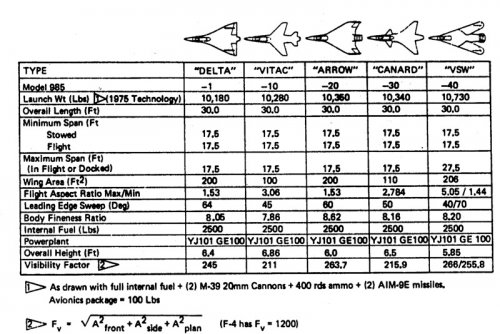
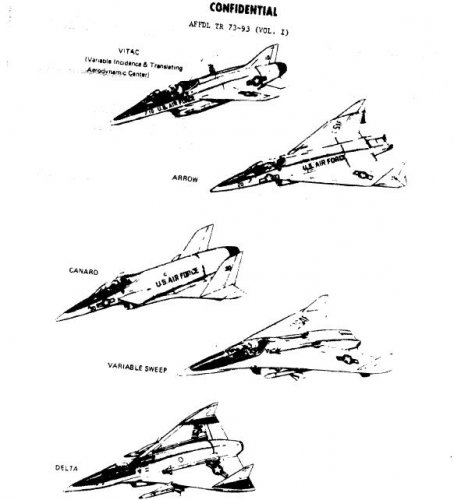
The "VITAC" concept is a miniaturized F-16. In the 1970s, there'd be little in the way of capability provided by a fighter that small. Fast forward to 2025, and we have PhantomStrike miniaturized radars and Peregrine long range radar guided missiles, touch screen panels, and CFRP "Carbon Forging" tech that simply didn't exist in 1970. The YJ101 / GE100 development efforts ultimately led to the GE F404.
Micro Fighter Engine
General Electric F404-GE-F1D2 - Non-Afterburning F404 Variant
Dimensions: 34.8inD x 87inL
Weight: 1,730lbs
Static Thrust: 10,540lbf
Current bulk-buy engines cost $7M to $8M. I would "guess" that a non-afterburning variant, which removes quite a bit of weight and complexity from the engine, might cost around $6M per copy.
Original Micro Fighter Armaments
2X M39A2 20mm Autocannons: 357lbs
400rds of 20mm ammo: 240lbs
2X AIM-9E Sidewinder: 337lbs
Total Weight: 934lbs
20mm cannons have proven almost useless against modern tactical fighters and bombers, so I propose modernized armaments:
Air Intercept Mission Armaments
4X Raytheon Peregrine missiles on 4X wing pylons
2X AIM-92 Stingers on wingtip pylons
Close Air Support
4X AGM-176B Griffin missiles on 4X wing pylons
2X AIM-92 Stingers on wingtip pylons
PhantomStrike radar cost is $1-2M per copy, so it's at least conceivable that flyaway airframe cost is about $10M.
Peregrine missile is projected to cost about $250K per copy, so substantially more affordable than AMRAAM with the same range performance. New production Stingers for Ukraine were in the $120K to $150K range after initial high cost batches associated with restart of production. Griffin missiles are in the $130K range.
If we define a "war load" per tail as 4X Peregrines, 4X Griffins, 4X Stingers, then that's roughly $2M in armaments per tail to provide basic combat capabilities. Weapons handling requires no ground support machinery more sophisticated than a hand cart and no more than 3 men to pin the Peregrine and Griffin missiles to the wing pylons- 2 man lift plus 1 man to pin the weapon. If you pin weapons inside a hardened aircraft shelter with a weapons magazine, then no equipment is necessary. The pilot can have half of the combo to the magazine and his / her crew chief can have the other half. You need 4 techs per tail, 1 mech for the engine, 1 avionics tech for the radar and electronics, 1 airframer, and 1 crew chief who supervises weapons handling and movement of the jet on the ground. If you store 2 jets per shelter, then you have 2 of each type of tech. Since the mech works on the engine, he / she can also fuel the jet and test fuel quality. I would have 2 guards per jet who perform paperwork for the detached squadron unit as well. Whenever the hangar door is open and the jet is exposed, there's real physical security equipped with thermal imager optics to scan the mini base perimeter for saboteurs. If enemy presence is detected, then he / she can radio a nearby squadron unit to scramble to provide close air support to kill them. If Russian Spetsnaz tries anything untoward, they'll be met with air support. I don't think Russia has enough men to attack a significant number of Canadian Forward Operating Bases.
Bases would be spread out every 100 miles or so to provide mutual support. If the potential ingress routes into Canada, from Russia, are around 2,400 miles in length, then 48 micro fighters would be required. 96 micro fighters would have approximately the same cost as 12 F-35As. If Canada can afford 1 squadron of F-35s, then it can also afford 8 squadrons of micro fighters. I don't think Russia has 96 operational bombers, but even if they do at least some of them are not stationed near Canada. Russia has 127 operational Tu-22M3s, Tu-95MSs, and Tu-160s, possibly fewer now due to destruction of at least a full squadron's worth of bombers by Ukraine. At least 150 Su34s are also in service, but those lack the range to attack Canada in a realistic way. However, they could hit your FOBs in preparation for a strike.
If you had no intention of using your micro fighters to attack ground targets, then some money could be saved by focusing on ramping up Peregrine and Stinger production numbers to bring down per-missile cost figures. If Peregrine could also be adapted to attack ground targets, then despite its higher cost, it's a much more capable weapon than Griffin. Once you have the missiles, their rocket motors require replacement about every 10 years or so. If you conduct live-fire exercises against target drones twice per year, then your weapons turnover can include new build weapons with upgraded guidance systems. We do this to trickle-in new build weapons. Once or twice per year we'll live-fire ordnance and then the squadron gets brand new replacement weapons. Apart from being realistic practice, it confirms that training is sufficient and the weapons still work.
These airframes and engines are light and compact enough that C-130 and truck transport are practical options. C-130s could fly micro fighters back to Cold Lake for depot level repair, as-required. An empty micro fighter is about as heavy as a full size pickup truck. Un-pin the wings and the entire jet can be C-130 transported. F404 is an engine that RCAF maintainers are already familiar with.
Offline
Like button can go here
#19 2025-12-30 10:51:43
- kbd512
- Administrator
- Registered: 2015-01-02
- Posts: 8,533
Re: Fighter jets: F-35 vs Gripen vs Avro Arrow
This year alone, Canada has made almost twice as much money off supplying parts and electronics for the F-35 program as Saab's fighter jet business made worldwide. The very first Gripen-E was only delivered to the Swedish Air Force in October of 2025. That means they have no clue how well Gripen-E will perform in Swedish service because they've yet to train and deploy a complete squadron. Saab has already circumvented their supposed jobs deal with Brazil, for Brazil to supply Gripen-E to the Colombian as well as Brazilian Air Forces. Good luck, Canada. I mean that sincerely. You're going to need it!
More F-35 production infrastructure already exists in Canada than exists in Brazil for Gripen-E construction, but they've already sunk many billions into Brazil's Gripen program. Saab has delivered a whopping 2 fighter jets in 2025. Meanwhile, Lockheed-Martin has delivered over 190 F-35s in 2025, which is almost more than total Gripen production spanning multiple decades. Saab began "delivering" Gripen-E in 2021. We're at the end of 2025. Saab has delivered 6 Gripen-E models over the past 4 years. Canada almost made more tail sections for F-35s in 2025 alone than Saab has delivered total Gripen A/B/C/D/E/F models across multiple decades. Please let that mathematical reality sink in.
I always thought President Trump was king of egotistical decision making, but apparently he's an amateur compared to Canadian and European politicians. All that sweet F-35 program money will get burned setting up a Gripen factory in Canada, assuming that part of the deal ever happens, which might produce a grand total of 36 fighters. Burning your own house down to spite one American politician who will be gone in 3 years cannot possibly be "worth it", unless you're a leftist.
Ten years ago, Lockheed-Martin was practically begging all the partner nations to set up their own F-35 production lines so they wouldn't have to spend the billions to expand their own production facilities and ship F-35 components all over Christendom. Italy was the only nation which took them up on their request. Everyone else, to include Canada, only wanted to profit off of making parts for the F-35 fleet.
IIRC, the only portions of the software package that Lockheed-Martin "blocked" partner nations from accessing was the engine and flight control software, and only to ensure it was not locally modified. Nobody is going to show up at LM's corporate offices demanding a refund on their F-135 engine because they "hot-rodded" the thing. If Pratt doesn't approve an engine control software mod, then that's because they haven't tested it and don't know how it will affect engine life and reliability. General Motors does the same thing for warranty service on their engines and transmissions. If you modify the engine or transmission software, then you become personally responsible for the vehicle's performance. That is completely fair. GM sells passenger vehicles for general public and military use, not custom shop "hot rods". They have a side business, GM Performance Parts, to cater to people who want to "go nuts" with performance mods.
Stop allowing your leftist clown politicians to repeatedly screw your people over financially! President Trump will be gone in 3 years, and then they'll have to manufacture a new "crisis" to avoid public scrutiny while they continue to rob you blind. Canada could be waiting for Sweden to deliver Gripens to replace the RCAF's aging Hornets for the better part of a decade.
No, Canada Doesn’t Need to Spend $19 Billion on Jet Fighters
Excerpt from the article:
It asks: “Should Canada continue to be part of NATO or instead pursue non-military paths to peace in the world?”
Across the political divide, more and more voices are calling for a review or reset of Canadian foreign policy.
Until such a review has taken place, the government should defer spending $19 billion on unnecessary, climate-destroying, dangerous new fighter jets.
That was written in 2020. It's just more mentally retarded "we're saving the world by socially justifying ourselves to ourselves" leftist idiocy. These people don't give a crap about whether or not you even have a country, and lack the intellect to understand how a world run by Russia or China would simply grind them up to use as pot hole filler.
If you truly don't want the F-35, that's fine. Pick another fighter jet produced by a nation with an actual production line that can deliver combat jets. France and the UK can both deliver legacy fighter jet tails. Rafale and Typhoon are both capable fighters, and of completely non-US origin. Typhoon can fire US-made ordnance, if that's important to Canada. Rafale can fire AIM-120 and AIM-9 as well. Both can fire Meteor, which has longer range than our AIM-120. Ask them if they have some older jets to provide if money is truly that tight in Canada. Scavenge the remainder of the legacy Hornet fleet for spare parts, if you must, or start submitting tails to Boeing for their Service Life Extension Program. Get some more modern radars and cockpit instrumentation while you're at it. If you do actually want F-35s, but don't want to buy them directly from America so you can "stick it to Trump", then buy them from Italy or Japan. We really don't care and aren't offended by nations making defense choices that cater to their specific needs and wants. What we really do care about is a nation the size of Canada, which happens to share a border with America, not having any usable tactical fighters!
The micro fighter was and is a workable concept to provide many more tails for Canadian air defense than Canada would be able to afford by purchasing larger and therefore more expensive heavy fighters. Virtually every modern combat jet qualifies as a heavy fighter, to include the Gripen and F-16. They're great for strike missions, but heavy fighters will always be jaw-droppingly expensive to own and operate. If you're only going to fly intercept missions, then a miniaturized F-16 and Peregrine are ideal. Computer / sensor / weapons tech is at a place where micro fighters are perfectly usable in that role.
Offline
Like button can go here
#20 2026-01-02 21:25:45
- RobertDyck
- Moderator
- From: Winnipeg, Canada
- Registered: 2002-08-20
- Posts: 8,540
- Website
Re: Fighter jets: F-35 vs Gripen vs Avro Arrow

Offline
Like button can go here
#21 2026-01-02 21:30:50
- RobertDyck
- Moderator
- From: Winnipeg, Canada
- Registered: 2002-08-20
- Posts: 8,540
- Website
Re: Fighter jets: F-35 vs Gripen vs Avro Arrow
Note: several supporters of Donald Trump claimed that Trump doesn't really want to annex Canada, he's just kidding. So reporters asked Donald Trump on camera whether he's just kidding. Donald Trump himself said he is NOT kidding. He's serious.
Whether you think it's ridiculous is not the point. Donald Trump has said he will not order military invasion of Canada, but intends to apply economic pressure to force Canada to join the United States. And again, Donald Trump said he's not kidding.
Under such circumstances, why would Canada trust the United States under Donald Trump to supply critical defence equipment? This is shocking, but this is the world we live in. It's 3 years and 18 days until his successor is sworn-in. Whoever that may be.
Offline
Like button can go here
#22 2026-01-03 01:00:29
- kbd512
- Administrator
- Registered: 2015-01-02
- Posts: 8,533
Re: Fighter jets: F-35 vs Gripen vs Avro Arrow
RobertDyck,
Under such circumstances, why would Canada trust the United States under Donald Trump to supply critical defence equipment?
Are you unable to acknowledge that the Gripen is just as dependent upon American military equipment as the F-35 is?
Can a Gripen fly without its US-supplied F414 engine?
If not, then it's as irrelevant to this discussion about your personal fears about President Trump as the F-35 is, assuming Canada is truly worried that the US won't supply defense articles to them.
The topic of this thread is selecting a new tactical fighter that serves Canadians military requirements. To that end, I've put forward some ideas that have at least some chance of helping Canada establish an indigenous tactical fighter development and production.
Are you able to set aside your personal feelings about President Trump so we can discuss more important subject matter?
If not, then what alternative non-US-origin engine will power Canadian Gripens?
What non-US-origin avionics will Canadian Gripens use?
What non-US-origin weapons will Canadian Gripens use?
Offline
Like button can go here
#23 2026-01-03 01:36:26
- kbd512
- Administrator
- Registered: 2015-01-02
- Posts: 8,533
Re: Fighter jets: F-35 vs Gripen vs Avro Arrow
RobertDyck,
You know how I can tell who's serious about defending their homeland and who's merely paying lip service to the idea?
Actions. Actions speak louder than words ever will.
Dithering is an action, but not one the enemy respects.
If Canada was truly concerned about fending off a Russian sneak attack over the pole, they'd have enough radars up there so that if a Russian farted in Nagurskoye or Kotelny Island or Rogachevo, Canada would know about it. I've never heard you so much as mention those names before, which tells me most of what I need to know about how seriously you take the problem.
Since complaining about what President Trump said won't make those air bases disappear, I fail to see the point.
Offline
Like button can go here
#24 2026-01-03 07:45:49
- RobertDyck
- Moderator
- From: Winnipeg, Canada
- Registered: 2002-08-20
- Posts: 8,540
- Website
Re: Fighter jets: F-35 vs Gripen vs Avro Arrow
I have always said the F-35 is not the right fighter jet for Canada. From the time the F-35 was first completed and offered to America's allies. I have never dithered. Many in Canada have said the same thing. The US has applied pressure to Canada to buy the F-35. Under Prime Minister Paul Martin, the decision was the Canada would participate in development of technology for the F-35, and would manufacture parts for the F-35, but would not purchase the F-35. The corporation Lockheed-Martin didn't like that, complained loudly. But too bad, so said. Canada looked at the F-22, but US Congress said it would not sell the F-22 to anyone, not even Canada. Canada went through a bidding processes. Bidders included the Eurofighter Typhoon and Dassault Rafale. The Gripen was offered, but the A/B/C/D models did not perform well enough. Then politics got involved. Under Prime Minister Stephen Harper, there was much discussion but his government said they would purchase. They made the announcement, but didn't actually sign a contract. This became a major political issue, as many Canadians did not like the F-35, and the political party of Paul Martin made a stink about it. Then Justin Trudeau got elected. His party was the Party of Paul Martin, but Trudeau was dramatically different. He signed a contract to purchase F-35, but many people including voters for his party thought it was a big mistake. Now Donald Trump is President of the US, and Mark Carney is Prime Minister of Canada. Trump has dramatically changed the relationship between the US and Canada. Like it or not, Trump changed everything.
Your country changes policy when Republican vs Democrat are elected. Why be surprised that something similar happens with the two major parties in Canada?
Offline
Like button can go here
#25 2026-01-03 07:57:46
- RobertDyck
- Moderator
- From: Winnipeg, Canada
- Registered: 2002-08-20
- Posts: 8,540
- Website
Re: Fighter jets: F-35 vs Gripen vs Avro Arrow
"Nagurskoye or Kotelny Island or Rogachevo"? Hmm. Never heard of them. Canada does have a military base on the northern most point of Ellesmere Island; it's called Alert. There was an air force station at Resolute Bay, but was decommissioned. It's now the airport for the town at Resolute. The capital of the territory of Nunavut is Iqaluit, on Baffin Island.
Let's see... Ah! Nagurskoye is a military base on an island in Russia, north of Siberia. Kotelny Island, also Russian, also north of Siberia, but farther east. Rogachevo... another Russia military base on an island north of Siberia, but farther west, on the coast of the White Sea.
Canada has radar stations across its northern arctic. If any Russian aircraft approaches Canadian air space, it is seen and Canadian CF-18 Hornet fighter jets fly to intercept and escort them away. It happens all the time, probably every day. Canadian radar stations are integrated with NORAD, so both the US and Canada know when any aircraft flies anywhere near North American air space. Considering how integrated Canada and US air defence is with NORAD, it's sad that Trump wants to threaten Canada. Several senior US air force officers have spoken to Congress about the excellent relationship Canada has with the US, and how integrated our air defence is. The US is dependent on Canadian radar to detect and track any Russian bombers trying to fly over the North Pole and over Canada to reach the US.
Offline
Like button can go here