New Mars Forums
You are not logged in.
- Topics: Active | Unanswered
Announcement
#76 2025-04-15 19:07:19
- Void
- Member
- Registered: 2011-12-29
- Posts: 9,605
Re: Terraforming Earth
So, looking at this again:
Far better though, perhaps would be to work with fresh water on a humid seacoast.
OK, this would be a round canal as a collector:
I am imagining that if you were putting slush of water ice into the canal under the Shade Balls, you might be able to push the slush and Shade Balls around the circle to help distribution of the Slush.
I have been thinking of the potential value of this structure on Mars.
I could serve as an air generator, and distillation, and Precision Fermentation device.
In the process of distilling water, the waste heat could go into the canal along with Hydrogen.
Oxygen could be handled separately.

A circular structure is not mandated. It could be of a polygon. Perhaps a Square, or Serpentine.
In the age of animated machines, complex heliostats would be able tilt light to appropriate spots on the covering roof for the solar cells. The roof could be "Smart", and say that it wants more, or less.
Solar Panels will not want to be overheated, but kept cool, but may handle more light if not abused with too much heat.
Robots that work as Heliostat directors during daylight might be able to do other tasks at night.
This should have value on Earth, Mars, and maybe other worlds.
Ending Pending 
Is it possible that the root of political science claims is to produce white collar jobs for people who paid for an education and do not want a real job?
Offline
Like button can go here
#77 2025-04-16 10:24:56
- Void
- Member
- Registered: 2011-12-29
- Posts: 9,605
Re: Terraforming Earth
In the previous post I mentioned heliostats to assist solar panels.
I do not think they have to be very powerful as solar concentrators. Perhaps they can have a active flex mirror, that can go slightly convex or concave.
I also think that since they would be robots, they may have the ability to protect themselves from bad weather, such as wind, Hail, or Dust.
With humanoid robots nearing stronger utility this is not as silly as it may seem.
It is also not completely wrong to think that solar panels might have some form of active protective animation.
Ending Pending
Last edited by Void (2025-04-16 10:25:55)
Is it possible that the root of political science claims is to produce white collar jobs for people who paid for an education and do not want a real job?
Offline
Like button can go here
#78 2025-05-06 14:38:33
- Void
- Member
- Registered: 2011-12-29
- Posts: 9,605
Re: Terraforming Earth
Well, it appears that the Earth has greater than advertised coping mechanisms for CO2.
https://www.msn.com/en-us/news/technolo … r-AA1EhmfI Quote:
Worldwide increase in plant CO2 capture signals major climate shift
Story by Joshua Shavit • 1h •
5 min read
Quote:
Plants play a huge role in shaping Earth’s climate. Through photosynthesis, they pull carbon dioxide (CO₂) out of the air. This massive exchange—called gross primary production (GPP)—is the largest carbon movement on the planet. GPP fuels the land carbon cycle and helps balance the atmosphere. But for years, scientists haven’t been able to pin down just how much carbon plants take in, or where and when they do it.
For decades, the global estimate for GPP hovered around 120 petagrams of carbon per year. That number, based mostly on satellite data and indirect modeling, became the standard. But a fresh look at the numbers reveals that plants may actually absorb far more carbon—up to 157 petagrams each year. That’s a leap of 31%, shaking up long-held views on how the planet breathes.
The revised estimate appeared in Nature and carries big weight. If plants soak up more carbon than we thought, they may offer more help in slowing climate change. It also changes the math in models that predict how Earth’s climate will shift in the coming decades. These models rely on solid GPP numbers to track carbon sinks and gauge how fast greenhouse gases pile up.
And also,
It is not a surprise then that the Sahara may be greening, as rising CO2 and the greater amount of water vapor cycling, should make it greener.
So, it may be that we are just lucky. Good!
Ending Pending
Last edited by Void (2025-05-06 14:42:45)
Is it possible that the root of political science claims is to produce white collar jobs for people who paid for an education and do not want a real job?
Offline
Like button can go here
#79 2025-11-26 12:30:36
- Void
- Member
- Registered: 2011-12-29
- Posts: 9,605
Re: Terraforming Earth
OK, the Saton Sea again: https://www.msn.com/en-us/money/technol … i-AA1R4V1s Quote:
Protevs: The Floating Solar Power Revolution Boosting Efficiency by 40%
OK, first off, salt corrodes, but it also helps things to float.
https://www.startupselfie.net/2023/10/0 … -tracking/
Quote:
The Protevs floating solar power system, developed by SolarisFloat, is a revolutionary innovation that combines floating solar panels with sun-tracking technology. This system, currently installed in Oostvoorne Meer, Netherlands, features 180 modules with dual-axis tracking, allowing the panels to adjust their elevation from 0° to 45°. The PROTEVS+ installation boasts a total installed capacity of 73 kWp with 370 wp modules, achieving an energy production boost of up to 40%. Additionally, water-cooled air enhances solar panel efficiency, resulting in up to 15% increased production. The PROTEVS Single360 variant operates on a single axis and houses 360 PV modules, offering an impressive installed capacity of 147 kWp for 410 W panels, with energy production increased by up to 30%. These innovative solutions are modular, detachable, and scalable, making them suitable for various project needs and environmental considerations
For the "Greens". Suppose you made floats out of recycle plastics. Plastics are fairly stable in salt water, I read, and anyway the Salton Sea is toxic now.
But you might be able to improve the lake by reducing evaporation. These floating islands would do that and generate power.
In actuality, if the environment were not too obnoxious, you could have house boats alongside of these, as they do provide power, and it might be hoped to revive the waters anyway.
If you still the waves with this, then it is possible that you could cause a layer of fresher water to float on top of the more salty bottom water.
But you will have to spank the farmers, if they want to take the extra water conserved.
As it happens it made sense to make the aqueduct to take Colorado River water in the last century. But now, it is kind of stupid to do dry land farming with the river water. If you can expand the lake and put solar power on top of it, you probably could do a bit of aquiculture, as not all the light would be absorbed by the solar panels.
A possibly sensible thing to do would be to distill fresh water from the bine, then use it. (Not for dry land farming!), and then partially improve the water and release into to float on top of the brine of the lake. Microbes in the water would likely finish improving the water.
But you would not want too many nutrients in the water.
I would be curios if salt could be encapsulated as a solid into plastic containers and placed on the bottom of the lake.
As I have said before, I think that a more sensible solution long term would be to dig a canal though Mexico and conduct sea water into the lake generating electricity from turbines, then pumping water back out when the solar energy was productive.
A sort of artificial tide for the lake. But you would not want to pump brine that is too salty out to the gulf of California.
Why would Mexico want this? Well, a base load power supply. Also, perhaps a canal system could even carry freight, such as solid salt to dump out in the pacific at some point.
Quite a lot of people of Mexican descent live in the SW USA anyway, so maybe it is not a wrong plan for them.
Ending Pending
Last edited by Void (2025-11-26 13:06:33)
Is it possible that the root of political science claims is to produce white collar jobs for people who paid for an education and do not want a real job?
Offline
Like button can go here
#80 2025-11-26 19:44:14
- Void
- Member
- Registered: 2011-12-29
- Posts: 9,605
Re: Terraforming Earth
Continuing the last post on the Salton Sea:
A) Query: "How much of Ocean water is salt?"
https://brilliantmaps.com/ocean-salinity-map/
Quote:
About 3.5%
About 3.5% of ocean water is salt, which means there are approximately 35 grams of salt for every liter of seawater. This salinity level is consistent across most of the world's oceans, with variations typically ranging between 34 and 36 parts per thousand (ppt).
The above numbers are weight though; I am also interested in volume.
B) Query: "How much does a liter of salt weigh?"
https://www.aqua-calc.com/calculate/vol … tance/salt
Quote: "Approximately 2.17 grams
A liter of salt weighs approximately 2.17 grams. This is based on the density of salt, which is about 2,170 kg/m³ at 20°C.
Aqua-Calc"
35/2.17 = "Therefore a witch!": https://www.youtube.com/watch?v=rf71YotfykQ
35/2.17 = 16.12903225806452
If I did that correctly then for 1 out of 16.12902335806452 Liters of sea water could be condensed sea salt and the rest be fresh water.
C) Query: "How much of the salton seas water is salt?"
Quote:
60 parts per thousand
The Salton Sea is approximately 60 parts per thousand (PPT) saltier than the Pacific Ocean, which is about 35 PPT. This means that the Salton Sea has a salinity level of around 44,000 mg/L. The salinity of the Salton Sea increases annually due to evaporation and the influx of agricultural drainage water.
So for the Salton Sea, you would have 2 almost two Liters of condensed solid salts.
We had a currently inactive member who considered making islands out of sea salt. It was "Karov".
So, for a Salt Lake, a salt island might be a useful trick. That and not cutting off the water supply to the lake.
So, if you could make containers of plastic and fill them with salt, maybe you could build the Salt Islands. They don't necessarily have to project above the water line.
You could make "Salt & Plastic Anchors" to moor floating solar panels to
https://www.startupselfie.net/2023/10/0 … -tracking/
Quote:
Floating solar panels that track the sun
October 7, 2023
Image Quote: 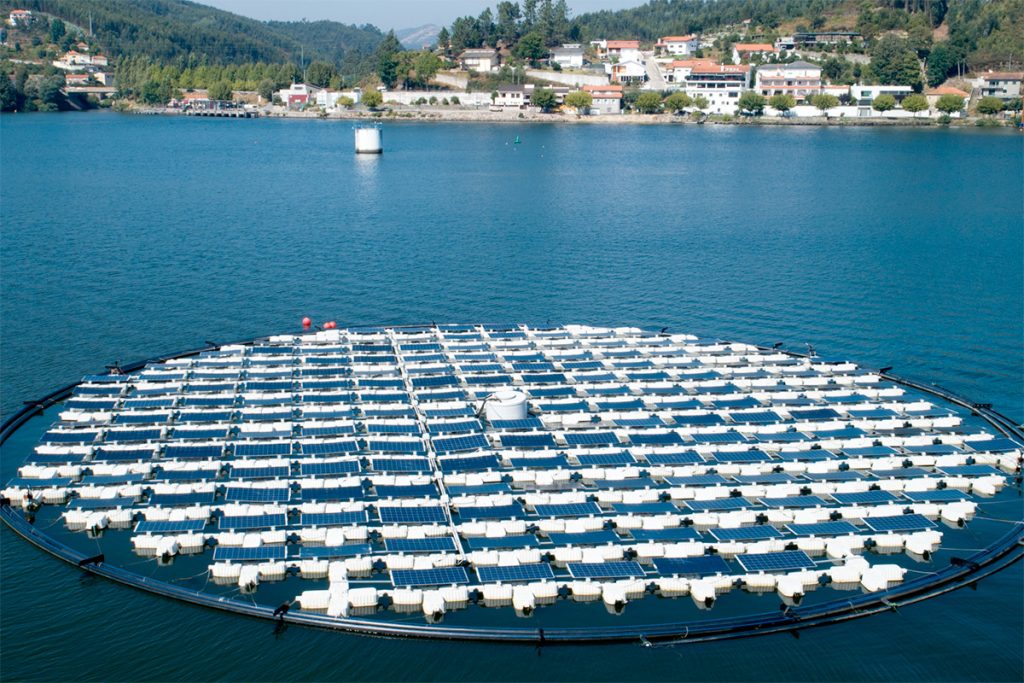
With the shade from this you could reduce evaporation.
Quote:
Benefits and implications
Antonio Duarte, SolarisFloat’s lead technical engineer, rightly observes that renewable energy production, especially solar, will find more adoption on water than on land, primarily because land is a dwindling asset. Floating solar offers an innovative solution without compromising precious land resources.Additionally, Alona Armstrong, an expert from Lancaster University, points out that if executed correctly, floating solar systems can offer not only low-carbon energy but also improve water body conditions by cooling the water and reducing phytoplankton biomass. This multi-pronged advantage is indeed a boon for the environment and energy sectors alike.
According to data reported by the BBC, solar PV capacity has skyrocketed from 72GW in 2011 to 843GW in 2021, now accounting for 3.6% of global electricity generation. With floating solar’s advent, this trajectory is only expected to rise steeply.
I wonder if the reverse side of the solar panels could have a radiating pigment on them which could be turned to the desert sky at night?
https://www.science.org/content/article … ny-surface
Quote:
Cooling paint drops the temperature of any surface
Material that reflects light and sheds heat could put a large dent in AC costs
27 Sep 2018ByRobert F. Service
For the Salton Sea and other salt lakes like it, only part of the salts have to be containerized. Some fish can tolerate salt levels greater than the saltiness of the oceans.
https://pondinformer.com/salton-sea-fish-species/
Quote:
Global web icon
Pond Informer
https://pondinformer.com › salton-sea-fish-species
List of Fish Species in the Salton Sea (Updated) - Pond Informer
In addition, the Salton Sea has a salinity of around 60 parts per thousand, close to double the average salinity of the ocean. As a result, few species of fish can survive in the lake, and most of the aquatic biodiv… See more
The fish are extinct now or are about to go extinct.
So, it seems to me that you might not have to remove that much of the salt to resuscitate the Salton Sea.
I am suggesting making anchors primarily out of Recycled Plastics and Solid Salt.
Query: "What can recycle plastics be made into?"
https://theroundup.org/everyday-product … d-plastic/
Quote:
Copilot Search Branding
Like
Dislike
TerraCycle
Recycled plastic can be transformed into a wide variety of products, including household items, construction materials, clothing, and packaging, contributing to sustainability and reducing waste.
Common Products Made from Recycled Plastic
Household Items: Many everyday products such as storage bins, kitchen utensils, and tableware are made from recycled plastics. For example, plates, cups, and cutting boards are often produced using recycled polypropylene and PET, which are durable and food-safe.
2
Textiles and Fashion: The fashion industry has embraced recycled plastics, particularly in the form of recycled polyester (rPET). This material is used to create clothing, activewear, and accessories, effectively turning plastic bottles into stylish garments.
2
Construction Materials: Recycled plastics are increasingly used in the construction industry. Products like composite lumber, insulation, and roofing tiles are made from recycled plastic, offering durability and weather resistance while reducing the need for virgin materials.
2
Rugs and Carpets: Area rugs made from recycled plastic can contain hundreds of recycled bottles, providing a soft and stain-resistant option for home decor.
1
Packaging: Many companies are now using recycled plastics for packaging, including food containers and wrappers. This shift helps reduce the production of new plastic and encourages sustainable consumer choices.
1
Furniture: Modern furniture, including kitchen cabinets and outdoor furniture, is often made from recycled plastics combined with other materials, providing a sustainable alternative to traditional wood products.
14 Sources
Benefits of Using Recycled Plastic
Environmental Impact: Using recycled plastic helps divert waste from landfills and oceans, reducing pollution and conserving natural resources.
Energy Conservation: The production of items from recycled plastics typically requires less energy compared to manufacturing with virgin materials, making it a more sustainable choice.
1By choosing products made from recycled plastic, consumers can contribute to a more sustainable future and help combat plastic pollution.
1 Source
OK, the Salton Sea is in California, and we know what that comes with.
Unlike putting toxic waste into oil drums and putting them on the bottom of the lake, if the salt anchor leaks, then you pull it up and recycle the plastic into a new anchor and fill that with solid salt, and put it on the bottom of the lake.
Microplastics OH MY!
https://en.wikipedia.org/wiki/Microplastics
Quote:
Sources of microplastics
The existence of microplastics in the environment is often established through aquatic studies. These include taking plankton samples, analyzing sandy and muddy sediments, observing vertebrate and invertebrate consumption, and evaluating chemical pollutant interactions.[54] Through such methods, it has been shown that there are microplastics from multiple sources in the environment.[citation needed]Textiles, tires, and urban dust[55] account for over 80% of all microplastics in the seas and the environment.[9] Microplastic is also a type of airborne particulates and is found to prevail in air.[56][57][58] Paint appears as the largest source of microplastic leakage into the ocean and waterways (1.9 Mt/year), outweighing all other sources of microplastic leakage.[59] Microplastics could contribute up to 30% of the Great Pacific Garbage Patch polluting the world's oceans and, in many developed countries, are a bigger source of marine plastic pollution than the visible larger pieces of marine litter, according to a 2017 IUCN report.[5] Oceanic microplastics are a common source of heavy metals[60] due to the inclusion of coloring compounds containing chromium, manganese, cobalt, copper, zinc, zirconium, molybdenum, silver, tin, praseodymium, neodymium, erbium, tungsten, iridium, gold, lead, or uranium.[61]
Oral intake
Oral intake is the main pathway of human exposure to microplastics.[62] Microplastics exist in daily necessities like drinking water, bottled water, seafood, salt, sugar, tea bags, milk, and so on.[63]65 million microplastics are released into water sources every day.[64] In 2017, more than eight million tons of plastics entered the oceans, greater than 33 times as much as that of the total plastics accumulated in the oceans by 2015.[65] One consequence of this is marine life consumption of microplastics. It is estimated that Europeans are exposed to about 11,000 particles/person/year of microplastics due to shellfish consumption.[66]
Microplastics may enter drinking water sources in a number of ways: from surface runoff (e.g. after a rain event), to wastewater effluent (both treated and untreated), combined sewer overflows, industrial effluent, degraded plastic waste, and atmospheric deposition.[67] Surface run-off and wastewater effluent are recognized as the two main sources, but better data are required to quantify the sources and associate them with more specific plastic waste streams. Plastic bottles and caps that are used in bottled water have been confirmed as sources of microplastics in drinking-water.[67][68]
Microplastics may also have been widely distributed in soil, especially in agricultural systems.[69] They (especially with negative charge) can get into the water transport system of plants, and then move to the roots, stems, leaves, and fruits.[70] Once microplastics enter agricultural systems through sewage sludge, compost, and plastic mulching, they will cause food pollution, which may increase the risk of human exposure.[71] A 2023 study found that microplastics can reduce soil fertility and crop yields by disrupting soil microbial communities and water retention capacity.[72]
Clothing
Quote: Textiles, tires, and urban dust[55] account for over 80% of all microplastics in the seas and the environment.
So, before you get all middle ages about plastic salt anchors, solve the above first.
Probably any shedding will largly stay down in the sediments of the lake, if solar panels stiffel the wind which would stir the water.
Fresh water extracted from the lake might possibly be fee of microplastics, depending on method.
The fish may have microplastics, but life is sometimes about dealing with what you got. My understanding is that most microplastics enter though breathing or drinking water.
I might add that making salt anchors out of recycled plastic should please the greens as it is to sequester Carbon.
And it should please the petrochemical industry as it is to provide a additional market.
How long could you keep making more anchors as salts accumulate in water? Maybe forever.
Other salt lakes/seas might be treated similar to this.
Ending Pending
Last edited by Void (2025-11-26 21:08:41)
Is it possible that the root of political science claims is to produce white collar jobs for people who paid for an education and do not want a real job?
Offline
Like button can go here
#81 2025-11-26 22:23:45
- Void
- Member
- Registered: 2011-12-29
- Posts: 9,605
Re: Terraforming Earth
Relating to the two prior posts about the Salton Sea: "https://www.youtube.com/watch?v=8zRFB-xUEcU"
Quote:
Egypt Is Cutting Open the Sahara Desert to Let the Mediterranean In Until It Realizes What It’ll Do
One thing that could be done with salt is drop it to the bottom of the ocean. Possibly damaging the bottom environment.
Perhaps not practical. Imagine a "Salt wheel" like a water wheel.
If you could do it, by some more practical means, extracting the salt from the depression may be energy positive or at least energy assisted.
If it could be done where brine or salt falling down is gradually mixed with sea water, perhaps on exit the exiting mix would be tolerable to sea life.
A very complex thing to do though.
https://en.wikipedia.org/wiki/Qattara_Depression
Image Quote: 
Image Quote: 
Imagine floating solar panels over all of it.
Ending Pending
Last edited by Void (2025-11-26 22:33:14)
Is it possible that the root of political science claims is to produce white collar jobs for people who paid for an education and do not want a real job?
Offline
Like button can go here
#82 2025-11-27 21:13:18
- Void
- Member
- Registered: 2011-12-29
- Posts: 9,605
Re: Terraforming Earth
This is interesting to me, about the progress of the Boring Company: https://www.youtube.com/watch?v=_XqPqHQr8OI
Quote:
Elon Musk’s Plan to End Traffic Forever - 90% Cheaper & 10x More Convenient!
BestInTESLA
109K subscribersJoin
I have the idea to use the above with this: https://energy.sustainability-directory … nt-energy/
Quote:
Salinity Gradient Energy
By Sustainability Directory5 April 2025
Both of these are immature but might hold promise both together and separately.
Rather than to convey liquid water through tunnels to salty water, what if you could convey water steam to salty water?
You might do that with a tunnel at 100 degrees C.
But Boring tunnels for hyperloop could operate at lower temperatures and pressures.
Here is a useful tool: https://endmemo.com/chem/vaporpressurewater.php
At 50 degrees C as an example the tunnel pressure could be 123.0665 millibars, or .123 Bar.
So, if you have a source of steam near an abundant body of water you could thrust it though a tunnel and extract it at a remote location where things are dryer.
While steam is not as dense as is water, if you have periodic turbines, you can accelerate the steam flow quite a lot to make up for that.
This then could be an inverse Los Angeles Aqueduct where you might send steam to the Salton Sea.
The brine created at the source which would be the Pacific Coast, might be blended with treated sewer water from Los Angeles, to generate electricity.
The Steam sent to the Salton Sea, could be condensed and used as a consumable, and then again, the partly treated sewage could be reacted with the salty water of the Salton Sea, to generate electricity.
Here then we avoid the need for canals connecting to a foreign country, "Mexico", and may, perhaps push useful water into the Great Basin.
In lifting steam over mountains, a depth of the tunnels of a fraction of a kilometer, may be acceptable. And slopes may not mater so much as they do for liquid water.
In a fantastic world, steam tubes might even reach the Great Salt Lake.
Of course, to do this there would likely need to be very big steam evaporators in the ocean water, likely powered by solar energy. Perhaps mirrors. And the tunnels would have to cross many mountains.
Perhaps if this works it could be done on Mars, to move polar water to desired locations.
Ending Pending
Last edited by Void (2025-11-27 21:42:25)
Is it possible that the root of political science claims is to produce white collar jobs for people who paid for an education and do not want a real job?
Offline
Like button can go here
#83 2025-11-28 19:43:47
- Void
- Member
- Registered: 2011-12-29
- Posts: 9,605
Re: Terraforming Earth
In support of the just previous post, I have this material:
https://www.bing.com/videos/riverview/r … ORM=VAMGZC
Mohsin Insights, Japan's Osmotic Power Plant How Saltwater is powering the F...
Is it possible that the root of political science claims is to produce white collar jobs for people who paid for an education and do not want a real job?
Offline
Like button can go here
#84 2025-11-28 19:50:16
- Void
- Member
- Registered: 2011-12-29
- Posts: 9,605
Re: Terraforming Earth
In further support of the previous post I have this:
https://www.bing.com/videos/riverview/r … ORM=VAMGZC
Mohsin Insights, Japan's Osmotic Power Plant How Saltwater is powering the F...
But I have something else about the Boring Company that interests me now.
According to information from the previous post, we might expect tunnels to become cheaper build than Highways.
So, if you can extract sufficient value from a tunnel then you can justify building it.
So, I feel that we could make underground canal systems that would also serve as farms and also as a "Heat Bank".
Now it might sound funny but if you make a tunnel loop in the rock and fill it halfway with water, you have a heat sink. You also could grow things in it using Oxygen and feed, such as Acetate.
Datacenters could dump heat into it year around. In some places the stored heat would be valuable, so you might build buildings above ground over the Canal-Tunnel.
Is it more stupid to consider Voyager Type Canoes in such a tunnel system than to consider a railroad system?
So, now I meddle with Canada, as it is parts of it are similar to places where I live or have lived.
They would likely be customers for heat in the winter.
Such an underground canal system could have mostly robotic boat lifts to compensate for changing elevations.
A project that would be interesting would be to link the James Bay to Lake Superior.
Another project might link Lake Superior to the Mississippi.
Yes these things would be expensive to build, but the Yealy payoff could extend far into the future.
For the Moment, we are glued to the Continental climate, so that if you are to cool data centers, then you have to suffer through the summers which can be warm to hot.
But if you have a system of underground Canal-Tunnels, then you can store cold from the winter by heating buildings, and yet add heat year around from data centers.
Many glaciated places in the north hold lakes that could be linked into a transportation system using such Canal-Tunnels.
And a form of aquiculture could go on in the tunnels, in places that do not support agriculture.
I think this could be done largely without damaging the environments of rivers and lakes.
You could conceivably link the large, dammed lakes in the Dakotas with the Mississippi River.
The water within would be very seldom changed out, but would be used over and over again, so you would not so much be drawing on surface water reserves after you filled the Canals in the Tunnels.
I have considered something similar to this for Mars, of course.
Ending Pending
Last edited by Void (2025-11-28 20:31:34)
Is it possible that the root of political science claims is to produce white collar jobs for people who paid for an education and do not want a real job?
Offline
Like button can go here
#85 2025-11-29 13:02:53
- Void
- Member
- Registered: 2011-12-29
- Posts: 9,605
Re: Terraforming Earth
So, I have decided to do some idiot checking on the recent notions here.
The Boring Company may get up to doing 1 mile of tunnel per week. That is a 12-foot tunnel, I believe. It is designed to do it's tunnel about 30 feet underground.
If that is true then one machine could perhaps do a 50-mile loop in one year.
The cost would be significant, so the value has to also be significant. A question is, for tunnel doing minor repairs over time, how long can it remain functional? I presume for centuries.
We also have to factor in Verbal and Violent Idiot Savants, as they might intentionally do damage to it.
At this time, I am imagining the water level as being halfway to the top. I am not thinking so much of circulating the water but circulating the air within it. But flowing water in it would not be prohibited.
In order to cool a data center, I am imagining an air fed heat pump, where heat is dumped into the air of the loop.
In order to use and limit the level of heat in the loop, I am imagining heat pumps that pull heat out of the air of the loop.
In order to limit the heat internal to the loop, it would be preferred to use the extracted heat for a gainful purpose, but some situations could provide dumping heat into the atmosphere. For instance, the heat pump might do that when the sun shines, or you might even circulate night air though the loop, but that would cause evaporation as well, so you would have some water losses.
Useful uses of the Heat:
-Heating for dwellings.
-Industrial Heat.
A feature of extracting heat from the air of the loop would be that you could condense water from that air and so dry the air out.
The condensed water could have a value. Of course, if you extract water then you have to make that water up. But the makeup water could be of marginal value.
-Grey Water? (If you use the condensate for a washing process then you might return that water to the loop).
-Sea Water? (Brine accumulation would have to be extracted out of the system).
-River Water? (Does not have to be potable).
Depending on the toxicity of the environment you could perform some sort of aquiculture in the water of the Loop.
For instance, Oxygen and Acetate might grow yeast or Algae. That could feed some useful process.
The loop could support water transportation. Even if the water were boiling or sub-freezing (Brine), but of course extreme temperatures would prohibit aquiculture. Obviously extreme conditions would prohibit humans in the loop as well. For instance, boiling water, could allow robots to function in the loop.
It is possible that the watercraft might "Sail" on the air currents imposed in the loop. Or, perhaps more likely robots could drop battery replacements into the tugs at useful intervals, taking the expended battery to be recharged.
Motorized wheels could contact the walls or ceiling to propel the watercraft using electric motors.
So, I think that the concept may have merit and could possibly be useful on Mars someday.
I think that it is not totally stupid.
Ending Pending
Last edited by Void (2025-11-29 13:40:12)
Is it possible that the root of political science claims is to produce white collar jobs for people who paid for an education and do not want a real job?
Offline
Like button can go here
#86 2025-11-30 13:15:52
- Void
- Member
- Registered: 2011-12-29
- Posts: 9,605
Re: Terraforming Earth
I am encouraged in the thinking of this topic the last few posts, as it occurred to me that a "Loop", made by the Boring Company could be considered a Cistern that is also a Heat Sink.
I feel it may work well with Superpower as per RethinkX
https://www.youtube.com/watch?v=92_SzHGUjJI
Quote:
Understanding Stellar Energy launch chat | Friday May 16, 2025
RethinkX
21.6K subscribers
What this could mean is that any desert could have such Cisterns/Heat Sinks below it's surface, and they could also perform other functions.
While even low rainfalls and even extracting water from the air could fill these Cistern/Heat Sinks, you could take water from the Salton Sea, with it's salt, and add some flash flood runoff water and get to a saltiness of the oceans of Earth, compatible with fish. Over time this could remove the salts from the Salton Sea.
The majority of the Great Basin could have these Seawater-Cistern/Heat Sinks in the flat areas. Solar panels and heat can make electrolyzes practical.
You could dump heat into the Cistern from Data Centers. Then you could condense water from the air inside the cistern, by using a heat pump to disperse heat during the desert nights. Then the water might be recycled back into the cistern if it is grey water or wash water.
Obviously if you are going to grow fish, then you need to avoid toxicity. The minimum humane thing to do though, is to provide just a little lighting inside these.
I think that the Cisterns could support the growth of Algae using Oxygen and chemical fuels, such as Acetate.
You could also perhaps draw heat from the heat sink, to provide industrial heat, using a heat pump. I believe that 180>200>250 degrees C are or may become available using heat pumps.
This could be done on the Great Plains as well, so as silly as it sounds, it might be possible to have an interconnected underground canal system that performs these other functions as well.
Yes, it will be expensive to create, but it will also be quite useful.
Yes, it would be wonderful if we did not eat animals, but endless fish are pulled out of the oceans for people to eat. If you get rid of that then we can think of abandoning fish farming.
Ending Pending
Last edited by Void (2025-11-30 13:35:00)
Is it possible that the root of political science claims is to produce white collar jobs for people who paid for an education and do not want a real job?
Offline
Like button can go here
#87 2025-11-30 13:54:40
- Void
- Member
- Registered: 2011-12-29
- Posts: 9,605
Re: Terraforming Earth
This is an addition ot the just prior post.
The question of Mega Algae. Can they also grow on Oxygen and Acetate? Some of them are used as food.
https://iere.org/what-algae-can-be-eaten/
Quote:
Here are some edible algae that can be consumed:
Nori (Porphyra): Commonly used in sushi rolls, nori is rich in vitamins and minerals, particularly vitamin B12.
1
Wakame (Undaria pinnatifida): Often used in miso soup and seaweed salads, wakame offers a slightly sweet flavor and is a good source of iodine, calcium, and iron.
2
Kombu (Laminaria japonica): A thick, leathery kelp used to make dashi, a Japanese broth, providing essential minerals and enhancing flavor.
2
Spirulina (Arthrospira platensis): A blue-green algae known for its high protein content, often consumed as a dietary supplement.
2
Chlorella: A microalgae that is rich in vitamins and minerals, often used in dietary supplements.
1These algae are not only nutritious but also have various culinary uses, making them a valuable addition to a balanced diet.
2 Sources
Also it may be possible that vascular plants such as Duckweed and Hydrilla, might be grown with little or no light.
Ending Pending
Last edited by Void (2025-11-30 13:56:44)
Is it possible that the root of political science claims is to produce white collar jobs for people who paid for an education and do not want a real job?
Offline
Like button can go here
#88 2025-11-30 19:56:46
- Void
- Member
- Registered: 2011-12-29
- Posts: 9,605
Re: Terraforming Earth
I would like to expand on the idea a bit more.
I am going to speculate that Algae, Fungi, Yeast, and even vascular plants accept Acetate as "Food" as Acetate or other "Food" chemicals have been available due to the decay of organic matter in water and wet soils.
I have hopes that this factor is more important in deep water than it is on land. Deep water struggles for sunlight, but land has relatively abundant sunlight. So, I am hoping that large type Algae may be able to use chemicals like Acetate better than land Vascular plants can.
But at this point I have no proofs of this.
https://www.usgs.gov/publications/stabl … ecies-deep
Quote:
The stable carbon isotope biogeochemistry of acetate and other dissolved carbon species in deep subseafloor sediments at the northern Cascadia Margin
January 1, 2009
This may be supportive however Quote;
Acetate plays a crucial role in the carbon cycling process in ocean waters. It is a key metabolite in the cycling of carbon in anoxic sediments, and its stable carbon isotopic composition provides insights into the metabolic processes dominating acetate turnover. In the Cariaco Basin, acetate uptake rates were correlated with organic carbon supply, indicating that acetate cycling is an important component of organic carbon oxidation in both oxic and anoxic environments.
So, it might be hoped to grow some seawater "Vegetables", in Boring Company Loops. There are not very many fresh water macro-algae that I am aware of, so I am supposing salt water.
We know now that there are microbores that "Eat" chemicals out of the air like Methane, Hydrogen, CO, and CO2, so it should not be to much of a surprise if organisms in the ocean may consume chemicals from the water such as Acetate and the above-mentioned chemicals.
Here is an interesting resource: https://www.masterclass.com/articles/wh … le-seaweed
Quote:
Where Does Edible Seaweed Come From?
Seaweed can be found in oceans and marine environments around the world. While some seaweed is harvested directly from its natural environs, seaweed farming produces much of the world’s aquatic crops today.Some farmers use saltwater tanks to grow seaweed. Most others have the equivalent of garden plots out at sea. These farmers cultivate seaweed on ropes to closely monitor the growth and promote a healthy harvest by removing any undesirable plants or marine life.
So, if Boring Tunnel Loops were filled with salt water and were as watertight as cactus, then I speculate that sea water Algae farming could be carried out. Some fresh water should be incorporated, This might be far better water management than dry land irrigation as the water should be rather persistent if the structure is made properly.
If you read prior posts, you may understand the other useful features that Sea Water Cistern/Heat Sink Canals might provide.
Of course, yes, fish farming could be done as well.
Ending Pending
Last edited by Void (2025-11-30 20:24:42)
Is it possible that the root of political science claims is to produce white collar jobs for people who paid for an education and do not want a real job?
Offline
Like button can go here
#89 2025-12-01 10:51:50
- Void
- Member
- Registered: 2011-12-29
- Posts: 9,605
Re: Terraforming Earth
I am interested at looking further at hypersaline lakes as a feeder process for possible tunnel systems.
It may be that eventually hypersaline lakes might be created on Mars, and those could contribute to human survival on both worlds.
Where I have been speculating on the possibility that Macro-Algae may be able to live in the dark and grow very well like microalgae and yeast do, I can backtrack to that microalgae can grow well in suitable water that is infused with chemicals like Oxygen and Acetate.
I caught my copilot giving an apparent falsehood. I asked "Do Plastics tolerate salt water?".
Quote:
Do not tolerate salt water well
Plastics generally do not tolerate salt water well. While some advanced materials, like the new type developed by Japanese scientists, can dissolve in saltwater, leaving no trace behind, traditional plastics are often susceptible to corrosion and degradation when exposed to high salt concentrations. Plastics like HDPE and polypropylene are known for their strength and durability, making them suitable for saltwater applications, but they can still be affected by the corrosive nature of salt.
ZME Science
+1
But my memory was that they do generally tolerate all salts rather well, and I think I have a reconfirmation of that.
https://www.corzan.com/en-us/blog/how-w … r-seawater
Quote:
Plastics Compatibility with Salts
Conversely, plastics are inert to salts, which means floating ions pass right over the material without any negative effects. All plastics are inherently resistant to all salts. However, CPVC’s ability to work at higher temperatures than cheaper plastics, such as PVC, presents an area of distinction.Put simply, for applications dealing with salts, plastics should be the first choice to avoid unnecessary repairs.
See what differentiates CPVC piping from PVC piping in this blog post.
In a salt environment, I would expect that U.V. light might damage plastics, so my intention is to not expose them to the U.V. light more than necessary.
From post #80 we can have another look at this: https://www.startupselfie.net/2023/10/0 … -tracking/ Quote: 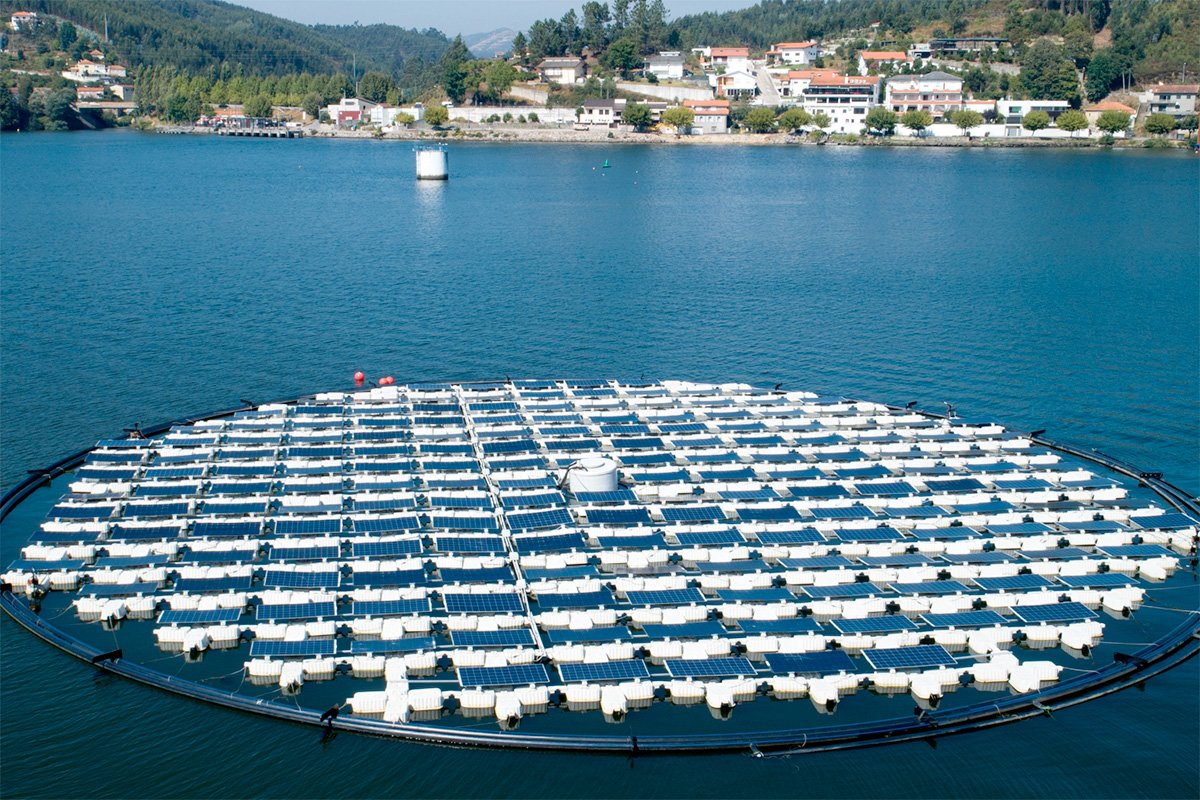
This thing needs floats, but I know where I discovered that fresh water could float on salt water.
https://en.wikipedia.org/wiki/Lens_(hydrology)
Image Quote: 
So, the solar structure could float on bags of fresh water, but I think I would prefer sea water simulant. In the deserts you typically get either excessively Briney water or fresh water.
But putting the bags below the solar apparatus, we cut down the UV hitting the plastic. You can also put some protective sheets of materials over the bags as well to reduce that to perhaps zero.
It is thought that the use of Oxygen and Acetate is many times more efficient than is natural photosynthesis, so we would opt for that.
So, our floats will have anything from fresh to almost 2x salt, sea water in them. More likely a simulation of sea or brackish water.
The whole assembly is sun following as for daily rotation and if desired the solar panels have individual single axis up-down sun following functions.
We may hope to grow organisms inside of the liquid floats:
https://source.washu.edu/2024/10/how-to … out-light/
Electro-agriculture
Electro-agriculture is a revolutionary approach to growing plants using acetate, a carbon-rich compound that can be produced through a solar-powered process. This method bypasses the need for sunlight and can be used to grow food in areas previously considered unsuitable for farming. The technology has the potential to significantly reduce agricultural land use, conserve water, and make farming possible in controlled environments. Researchers are working on adapting the technology for staple crops like maize, rice, and wheat, which would be crucial for addressing global food security challenges.
My recollection is that algae are about 4 times as efficient with acetate than normal growth??? That has uncomfortable wiggle room, but I will just say that apparently you could grow algae effectively with Oxygen and Acetate.
As I have said before, I am not at all certain that macro-algae can grow in such conditions, but I suspect it can. Or eventually means may be found to make it compatible.
While fish farming is interesting, growing vegetables from Seaweeds, is likely more efficient. I am not a vegetarian, but I think that over time better vegetables might be developed that will support large brain size better than the ones we have now do. Also vegetables tend to have toxins, so it might be good to get rid of those.
Some of these, might grow in the environment inside the bags: https://www.nutritionadvance.com/sea-vegetables/
Quote:
Table of contents
What Are Sea Vegetables?
A List of Sea Vegetables
1) Aonori
2) Arame
3) Badderlocks
4) Dulse
5) Gim/Nori
6) Guso/Eucheuma
7) Hijiki
8) Irish Moss
9) Kombu
10) Oarweed
11) Ogonori
12) Sea Grapes
13) Sea Lettuce
14) Wakame
Frequently Asked Questions About Sea Vegetables
Final Thoughts
A freshwater environment might also be tried, for something like Hydrilla, but I am not certain that current strains of Hydrilla can grow entirely without light. So, if might be that some light might be provided, a minimum necessary amount perhaps.
https://www.eattheweeds.com/hydrilla/
Quote:
I am often asked can we eat Hydrilla? The answer is no, and yes.
There is only one species of Hydrilla, verticillata. The Hydrilla you buy in the health food store is the same that clogs lakes around the world. Can you take it out of a lake, cook it up, and chomp it down? No… Well, I don’t know of anyone doing that. But you can buy it as a dried powder to add to soups and stews and smoothies. So what’s the difference?
Hydrilla floating on the surface, photo by dsfadflkjhlas
Hydrilla floating on the surface, photo by Colette JaconoHydrilla is an Eurasian weed that entered the western hemisphere via Florida sometime in the 1950’s probably through one aquarium dealer who imported live Hydrilla from Sri Lanka.
With the water covered, the cooling effects of the water may be reduced. That cooling may enhance solar panel performance. But if you combine heat exchangers and solar panels into one structure, then you may actively cool the solar panels during the day. And at night you may actively cool the water in the bags. You may coat the reverse side of the solar panels which are sun tracking to radiate heat efficiently at night.
https://spicoatings.com/super-therm-and … echnology/
Quote:
Passive radiative cooling (PRC) materials
Coatings that help radiate heat into the night sky are known as passive radiative cooling (PRC) materials. These materials work by emitting heat to the sky, a process that generally occurs at night when the surrounding environment cools the material to a temperature below the dew point or below freezing, forming frost. This phenomenon is known as passive radiative cooling (PRC) and can be enhanced by materials with selective emissivity, allowing them to radiate heat in the precise infrared wavelength known as the atmospheric window. PRC can provide 24/7 supplemental cooling and energy reduction when integrated with building refrigeration and HVAC systems.
spicoatings.comOne example of a coating that helps radiate heat into the night sky is Super Therm®, which has an emissivity rating of 0.91 and solar absorption of just 0.039, making it a super cool solution proven for over 35 years.
An note that you could involve a heat pump system if you liked.
But you also have to protect from freezing situations that might occur.
If these machines work then we now have a way to turn saline inland waters into energy productive and food productive assets.
And the devices will reduce evaporation, so these bodies of water might be made to swell up to larger sizes. If you doubled the size of the Salton Sea, then you would reduce the salt level down to about that of sea salt. (Of course, then you have to reduce the salt in your liquid floats).
So, why not increase the size of the Salton Sea, the Great Salt Lake, The Dead Sea, and the Arol Sea?
https://en.wikipedia.org/wiki/Aral_Sea
The amount of solar power would be enormous, and the possible agricultural produce may be very valuable.
Yes, you then need lots of materials, including plastics, but that gives the petroleum industry an alternate market.
As for wild life, there would still be open water. Wild life has already be altered by dry land farming anyway, which dries up the lakes.
Can you make more inland seas? I think so, impoundments may be profitable in depressions.
If you lower the evaporation rate sufficiently it may be worth it, for the solar power and the food.
Ending Pending
Last edited by Void (2025-12-01 11:58:03)
Is it possible that the root of political science claims is to produce white collar jobs for people who paid for an education and do not want a real job?
Offline
Like button can go here
#90 2025-12-01 13:29:24
- Void
- Member
- Registered: 2011-12-29
- Posts: 9,605
Re: Terraforming Earth
This is my sort of thing: https://www.youtube.com/watch?v=rfH1JIO-qjM
Quote:
U.S. Is Releasing the Pacific Ocean into Nevada to Create an Inland Sea
Fresh Tech
222K subscribers
Salt is a problem of course.
I recall that a drop of water that enters the Great Basin could fall as rain and snow 7 times before leaving the Great Basin.
Here is some sort of a notions:
I will believe this when they prove it.
https://soldesal.energy/
Water Sponge: https://www.msn.com/en-us/weather/topst … cz#image=7
Salt/Brine can be toxic. But if you handle it correctly you might generate electricity using salt gradients while distributing the salt to levels not toxic.
Easy to say, not so easy to do.
I would say that if you many salt lakes, you then partially cover them with floating platforms with solar panels. Or even solar thermal electric.
So, going through all the work of watering Nevada, why not discourage the evaporation from the lakes/seas.
Perhaps 95% of the lake surfaces would be made cactus like, to inhibit evaporation. The shorelines could then be left open, and perhaps some channels for boats. Maybe 5% of the lake surface?
In realty, if you can limit evaporation to 4 inches a year, the lakes might be self-filling from natural rain.
If you made Boring Tunnels up to the mountain passes of California, you could run steam up them, and then condense the water and then let it run down the interior surface of the mountains.
An advanced society might pull this off some day.
I have suggested underground tunnels with sea water in them. The salt from the Great Basin might be distributed into them for a time.
Rainfall in Nevada: https://www.currentresults.com/Weather/ … tation.php
By the way if you put 95% cover above the reservoirs of the Colorado River, then I feel that good things can be done with the water conserved.
Ending Pending
FYI, the Salton Sea has exited many times naturally when the Colorado River changed channels.
Ending Pending
Last edited by Void (2025-12-01 13:49:49)
Is it possible that the root of political science claims is to produce white collar jobs for people who paid for an education and do not want a real job?
Offline
Like button can go here
#91 2025-12-02 11:06:05
- Void
- Member
- Registered: 2011-12-29
- Posts: 9,605
Re: Terraforming Earth
A way to power desalination on the ocean floors could be wave power: https://symphonywavepower.nl/
The desalination process done with: https://genviss.in/deep-sea-desalinatio … gy-future/
Quote:
Deep-Sea Desalination: The Ocean-Floor Tech That Could Revolutionize Clean Water Access
Leave a Comment / Technology, Water Management / By Tirth Harshi
Water. It covers over 70% of the Earth’s surface, yet only a tiny fraction of it is safe to drink. As the world faces growing concerns over freshwater scarcity, especially in coastal and arid regions, scientists and engineers are diving deep—literally—to find sustainable solutions. One of the most intriguing developments in recent years is deep-sea desalination —a revolutionary method that turns ocean pressure into an ally, offering a new way to produce fresh water with minimal energy and infrastructure.This isn’t a concept pulled from a sci-fi movie. It’s already being tested in parts of Norway, California, and Japan, and could soon change how we approach water treatment in countries like India. But how does it work, and why should we care?
I believe that this method is less likely to create a toxic brine concentration, so will do much less damage to the environment than previous methods of desalination.
So, at least the continental shelfs might support this, and water sent to shore might be sent by vapor tubes to high mountain passes in eastern California, and condensed into water to let fall into the Great Basin.
https://en.wikipedia.org/wiki/Sierra_Nevada
Image Quote: 
Or maybe the vapor tubes could pass south of those mountains.
Of course you could pump water but that is a pretty big task.
A vapor tube could have an internal pressure low enough that solar energy could easily keep the steam from condensing. You would need a pumping device to pull the low pressure steam out of the vapor tube at the termination point inside the Great Basin. This could be solar powered as well and only function when the sun shined.
The low pressure steam might be thin, but of a very high velocity to increase throughput.
But if you wanted to do high pressure hot steam that might be an option as well.
Ending Pending
Last edited by Void (2025-12-02 11:17:48)
Is it possible that the root of political science claims is to produce white collar jobs for people who paid for an education and do not want a real job?
Offline
Like button can go here
#92 2026-04-19 09:15:00
- Void
- Member
- Registered: 2011-12-29
- Posts: 9,605
Re: Terraforming Earth
Solar Power and Rainfall:
Quote:
Large solar panel arrays can create localized conditions that promote rainfall by altering temperature, airflow, and moisture patterns.
Mechanism of Rain Formation from Solar Panels
Solar panels affect the local microclimate primarily through temperature and airflow changes. Dark photovoltaic panels absorb sunlight, converting 10–20% into electricity while the rest contributes to heat. This creates thermal gradients, where the air above the panels warms slightly while the ground beneath remains cooler due to shading. The rising warm air generates updrafts and convection currents, which can lift moisture into the atmosphere and enhance cloud formation.
biologyinsights.com
+2The panels also increase surface roughness, slowing near-ground winds and promoting vertical mixing of air. This combination of rising warm air and altered wind patterns can lead to greater atmospheric instability, which is a key factor in precipitation formation.
biologyinsights.com
+1
Positive Feedback in Desert Environments
In arid regions like the Sahara, large solar farms have been observed to trigger rainfall and vegetation growth. The process works as a positive feedback loop: solar panels lower ground temperatures, warm air rises, clouds form, and rainfall increases. This rainfall supports plant growth, which further enhances local moisture levels, potentially leading to a gradual “greening” of desert areas.
EcoPortal.net
+1
Scale and Limitations
While these effects are noticeable in massive solar farms, the current scientific consensus indicates that typical solar installations are too small to significantly alter regional weather or precipitation patterns. Most observed impacts are localized, affecting the thermal boundary layer and dew point rather than causing widespread rainfall changes. Simulations suggest that only solar arrays covering extremely large areas, such as a significant portion of the Sahara, could meaningfully influence rainfall and global climate patterns.
biologyinsights.com
+3
Summary
Solar panels can indirectly cause rain by:
Creating thermal updrafts that lift air and moisture.
Modifying local wind and airflow through surface roughness.
Shading the ground, which reduces evaporation and enhances convection.
Supporting a positive feedback loop in deserts, where rainfall encourages vegetation growth, further increasing moisture.
These effects are most pronounced in large-scale solar farms in arid regions, while smaller installations mainly influence microclimates rather than regional weather.
3
I worked on this issue before: 
An additional feature might be exploited, if you could cool the soil using solar power and natural cooling events.
To do this then the part of the frame of pipes buried under the soil needs to be resistant to corrosion. Plastics, Aluminum?
Natural cooling events are :
1) Shade from the solar panels.
2) Night cooling.
3) Winter seasonal cooling.
Using fans, you could push cool air through non-permeable pipes when #2 and #3 are favorable.
You might also incorporate a cooling method for Solar Panels that the Saudi seem to be involved in: https://www.pv-magazine.com/2025/06/09/ … ncy-by-12/
Quote:
New cooling gel could raise PV module efficiency by 12%
Researchers in Saudi Arabia have developed a hydrogel composite that absorbs moisture in solar modules overnight and facilitates evaporative cooling throughout daylight hours. The system has undergone lab tests and outdoor experiments on two continents.June 9, 2025 Lior Kahana
If during the night for instance you cooled the soil by pushing cool night air through the pipes under the soil, now you may push the humidified air from the gel evaporation into the cooled pipes, hoping to promote condensation. Of course, you will need a small drain hole to allow the condensate to exit the pipe into the soil.
So, many places on Earth could benefit from this but I think that the western interior core of North America could benefit greatly.
Here is moer support for the rainfall production: https://www.ecoportal.net/en/solar-pane … uds/19854/
Quote:
Solar panels are creating an unexpected effect by forming rainfall clouds and thriving oases in the middle of the desert
Warren van der Sandt by Warren van der Sandt April 11, 2026 in Energy
Returning to the idea of pipes to cool the soil, you might even get into heat pump methods.
IF you could cool soil using buried pipes and produce industrial heat, you might even induce permafrost in the soil which might improve moisture quality.
Permafrost ponds occur in the arctic because the icy permafrost of the pond bottom does not allow the water to drain.
In Alaska under the Midnight sun, it is possible to grow "Crops" on top of permafrost, in the upper soil hat has thawed.
https://www.permafrostgrown.org/
Quote:
Researchers and farmers working together to understand permafrost-agriculture interactions.
Quote:
Farming on permafrost soil presents unique challenges and opportunities. The Permafrost Grown Project is a significant initiative that aims to understand the interactions between permafrost and agriculture in Alaska. The project focuses on developing sustainable, adaptable, and resilient permafrost-agroecosystems by co-producing knowledge with farmers and researchers. It employs a combination of field data collection, sensor networks, remote sensing techniques, agricultural experiments, existing agriculture experience, interviews, and socio-economic risk modeling to address various objectives related to permafrost and agriculture. The project is funded by the US National Science Foundation's Navigating the New Arctic Initiative and has a budget of 3 million USD over 5 years.
permafrostgrown.orgThe project's research team includes experts from the University of Alaska Fairbanks and Alaskan farmers, who collaborate to investigate the impacts of permafrost on agricultural infrastructure and cultivation activities. They aim to understand how permafrost affects soils used for agriculture and how agriculture affects permafrost. The team conducts ground penetrating radar (GPR) surveys and collects ground cores to assess permafrost conditions. The project's findings can benefit from the ~120-year legacy of farming on permafrost in Alaska and the predicted intensification of high-latitude agriculture in response to climate changes.
Futurum Careers
It is also possible that solar panel installations might moderate killing frosts. But natural thermal inertia, or you might even put a heating method into them, that may run on batteries and be used to extend the growing season a week or two.
Ending Pending
Last edited by Void (2026-04-19 09:39:07)
Is it possible that the root of political science claims is to produce white collar jobs for people who paid for an education and do not want a real job?
Offline
Like button can go here
#93 2026-04-22 18:26:27
- Void
- Member
- Registered: 2011-12-29
- Posts: 9,605
Re: Terraforming Earth
I am interested in chasing the idea of refrigerating soil, to increase it's humidity in conjunction with solar power.
I think it may be possible to achieve the following:
1) Double soil humidity.
2) Generate Industrial Heat.
3) Refrigerate Solar panels to increase their efficiency and to lifetimes.
4) Make pipes of Carbon from Oil and Natural Gas, and yet extract the Hydrogen as a fuel. (Maybe)
While I have previously focused on night and winter air, here I am exploring active cooling.
Quote:
I worked on this issue before: This depiction is approximately appropriate.
An additional feature might be exploited, if you could cool the soil using solar power and natural cooling events.
I have only marginal understanding of heat pumps so what I might suggest could be somewhat iffy.
https://link.springer.com/article/10.10 … 25-00021-z
Quote:
Home Carbon Neutral Systems Article
High-temperature heat pumps: key technologies and industrial applications toward carbon–neutral process heating
Review
Open access
Published: 29 December 2025
Volume 1, article number 21, (2025)
Cite this article
You have full access to this
open access
article
I am speculating on buried plastic pipes. Plastics have been criminalized. That and Microplastics.
But I feel that if we wear cloths that make microplastics and car tiers and such, pipes buried in the ground may not be a thing to fear. Just don't dump them in the ocean or grind them to fine dust.
My logic it to keep a value added to culture from hydrocarbon sources.'
*I feel that monarchists and other elites have dreamed of a form of socialism where they can cultivate a low intelligence servant race and reserve for themselves glorious superiority. You might thing they would want vast abundance, but I think they want to be superior to other people. So they do not like industrial societies at all. Reportedly this was true for the Estate Owning English.
I do not particularly like them if that is how they think a good society should be run. Just to give comfort to their ego's. To make the common people suffer, just so that an elite may feel superior, to me is not appropriate at all.
As I currently am trying to think of it, I am thinking of usine air as the fluid that interacts with the pipes and the solar panels.
Obviously, there are many climates. Some climates may be naturally dry and some naturally wet.
In either case the increase of humidity and even wetness in the soil the pipes would be burred in could be useful.
You would need energy storage to use it at night of course. In the night you could shed heat into the night air. And then cool the buried pipes. Then during the day, you could pull cold out of the pipes to cool the solar panels. Cooling the solar panels may increase their life span and efficiency.
One possible place to think about might be North Dakota or the south of the prarie provences.
In the summer you might cool the soil and so humidity the soil to suit plants. But in the winter, you might draw heat of the solar panels and push it into the soil. Then you might draw the stored heat out of the soil to heat a building.
If you were in Texas, you might cool the soil almost all year to humidity it. You might pull heat out of the soil to produce industrial heat from a heat pump system.
What if you are in Florida with high humidity? Well maybe you will get condensate to draw off. Water of that sort might be quite welcome.
I am working on it.
I already understand that in this economy the hardware may be too expensive. But with future robotics, deflation of hardware costs might become a reality.
Well, that is a bit of it. I am sure better can eventually be arrived at.
Goodnight, Ending Pending
Last edited by Void (2026-04-22 19:06:48)
Is it possible that the root of political science claims is to produce white collar jobs for people who paid for an education and do not want a real job?
Offline
Like button can go here
#94 2026-05-20 11:28:19
- Void
- Member
- Registered: 2011-12-29
- Posts: 9,605
Re: Terraforming Earth
I like this: https://www.bing.com/videos/riverview/r … ORM=VAMGZC Quote:
Utube, How Agri VoltaicsTurned Solar Panel Fields Into Massive Agricultyural Systems, May 14 2026
28:43How Agri Voltaics Turned Solar Panel Fields Into Massive Agricultural Systems
YouTube
Terran Works
520 views
I am wondering if such installations in remote areas, might be suitable to power data centers. They would need good backup energy such as batteries. But what if an isolated natural gas field, not worth putting pipes to, might support such. Maybe expired fracking wells might be able to use the remnants as backup energy for some time.
Also, it could be that the premium energy goes to data center, but when "Superpower" is available it is used to draw water from the air, or to charge grounds grooming robots.
The data could be linked up to Starlink.
Ending Peiding
Last edited by Void (2026-05-20 11:33:32)
Is it possible that the root of political science claims is to produce white collar jobs for people who paid for an education and do not want a real job?
Offline
Like button can go here