New Mars Forums
You are not logged in.
- Topics: Active | Unanswered
Announcement
#1 2024-02-15 20:07:32
- tahanson43206
- Moderator
- Registered: 2018-04-27
- Posts: 26,059
CO2 Energy Storage System - Compressed Gas - Closed Loop
We have a lot of topics that include the word "storage" in the title.
Now we have one more.
This is a closed storage system, that uses CO2. What is interesting is the scale...
https://www.msn.com/en-us/money/other/d … 121a&ei=31
This project will be the largest energy storage system of its kind in the world.
© Provided by The Cool Down
A first-of-its-kind project for the United States has received a grant of up to $30 million from the government, the project’s developers announced.Alliant Energy and WEC Energy Group, co-owners of Wisconsin’s Columbia Energy Center, will use the funding from the Office of Clean Energy Demonstrations to create the country’s first compressed carbon dioxide long-duration energy storage system.
The idea of the system is that it can turn carbon dioxide gas into a liquid for easier storage when energy is abundant. When energy is needed, it turns the carbon dioxide back into gas, which then powers an electricity-generating turbine.
Crucially, the setup operates as a closed-loop system, meaning that it should release no carbon dioxide and require no additional carbon dioxide after it is built out.
In addition to being first in the U.S., the Columbia Energy Storage Project will be the largest compressed carbon dioxide long-duration energy storage system in the world. A much smaller version of the same project is already operational in Sardinia, Italy. The two projects were designed by the same company, Energy Dome, which is based in Italy.
The Sardinia system has achieved an enviable 75% efficiency rate — which the much larger Wisconsin one will hope to match.
Currently, the Columbia Energy Center is Wisconsin’s largest remaining coal plant. It was supposed to be retired in 2024, but that date was pushed back to mid-2026. Its eventual transition into a much more sustainable battery storage system is good news for Wisconsinites and the planet.
“The expansion of energy storage infrastructure is key to accelerating the transition to cleaner, more sustainable renewable energy,” a spokesperson for Alliant said. “As we retire older fossil fuel facilities and add additional renewable resources to our generation portfolio, energy storage solutions help to ensure system reliability and meet customer needs.”
(th)
Offline
Like button can go here
#2 2024-02-15 20:08:06
- tahanson43206
- Moderator
- Registered: 2018-04-27
- Posts: 26,059
Re: CO2 Energy Storage System - Compressed Gas - Closed Loop
This post is reserved for an index to posts our members may add.
(th)
Offline
Like button can go here
#3 2024-02-16 04:37:35
- Calliban
- Member
- From: Northern England, UK
- Registered: 2019-08-18
- Posts: 4,411
Re: CO2 Energy Storage System - Compressed Gas - Closed Loop
CO2 has the advantage over compressed air that it can be compressed to a saturated liquid at ambient temperatures, with enough pressure. A saturated liquid is a much denser storage medium than a compressed gas and makes better use of pressure vessels. The downside is that exhaust CO2 from the energy recovery step must be captured and reused, as CO2 is a trace gas in air. A large tank or inflatable vessel is needed, which adds to cost and land used. Still, pressure vessels are expensive to engineer. Ambient pressure tanks are not. So overall, the concept likely has a cost advantage over CAES.
There are other gases that we could use that also have the right phase properties to liquefy at ambient temperature. Propane and butane, for example. But CO2 is cheap and non-flammable, so is the best choice. The size of the tank makes this unsuitable for long-term energy storage of large quantities of energy. This is a technology that directly competes with batteries for grid frequency control. But it is far more sustainable and environmentally freindly than batteries. This is a thermodynamic device. The main components involved can be made from abundant materials. A compressor, a liquid CO2 pressure vessel, a gas turbine for energy recovery and a telescopic steel expansion tank, which would be very similar to those old gasometer tanks that we have been building for 200 yesrs now.
It is also possible to integrate this system into a district heat delivery system. As the CO2 is compressed, the compressor will generate heat that can be put into a district heat network. During reexpansion, we can use ambient heat stored in a borehole to reheat the CO2 as it expands. We get slightly lower round trip efficiency doing this, but the hot water is a valuable product in itself, provided we have a way of delivering it. This is a system that could be developed small scale for individual houses or a clustered group of houses.
Another option for closed cycle pressurised gas storage, is to employ adiabatic compression and expansion. When gas is compressed, it heats up, because work is done on the gas increasing its internal energy. When it expands the reverse happens, as internal energy is converted into kinetic energy. With adiabatic expansion, i.e without reheat of the gas between expansion stages, the gas that emerges from the turbine exhaust is extremely cold, not far above the dry ice sublimation point. The work extracted by the turbine from each unit mass of gas will be lower, maybe only half what could be extracted from the gas under isothermal expansion conditions. But conversely, the work required by the compressor to reliquefy the gas will also be much lower. So round trip efficiency will not be effected. What advantage does this provide? Simpler and cheaper compressors and turbines, without need for reheat or interstage cooling.
Last edited by Calliban (2024-02-16 05:15:06)
"Plan and prepare for every possibility, and you will never act. It is nobler to have courage as we stumble into half the things we fear than to analyse every possible obstacle and begin nothing. Great things are achieved by embracing great dangers."
Offline
Like button can go here
#4 2024-02-16 07:09:56
- tahanson43206
- Moderator
- Registered: 2018-04-27
- Posts: 26,059
Re: CO2 Energy Storage System - Compressed Gas - Closed Loop
For Calliban re #2
Thank you for your review of this new storage system....
A detail that may have escaped your careful reading of the article is that the CO2 is ** not ** released.
This is a closed system.
I see a distinct business case for this particular technology. There are incentives in place for carbon capture, and this means the business may be able to obtain otherwise expensive (energy cost) CO2 for a low price or even be paid to accept it.
Since the CO2 is sequestered in the system, there will be little additional expense except for leakage.
I expect to see a successful commercial future for this technology.
(th)
Offline
Like button can go here
#5 2024-02-16 11:32:44
- Terraformer
- Member
- From: The Fortunate Isles
- Registered: 2007-08-27
- Posts: 4,018
- Website
Re: CO2 Energy Storage System - Compressed Gas - Closed Loop
Calliban,
Are you proposing that the gaseous co2 be stored at low temperature, so that it is easier to reliquify?
I'm still thinking water's latent heat is the best choice to provide the reheat. Water can be stored close to ambient temperature, and if the ice melts that's just extra energy added to the system. For much of the year, we could make up energy losses using heat from the air to provide additional melting. If we're using air, cold water can be used for the prechilling part to remove water vapour perhaps.
Use what is abundant and build to last
Offline
Like button can go here
#6 2024-02-16 17:25:29
- SpaceNut
- Administrator
- From: New Hampshire
- Registered: 2004-07-22
- Posts: 30,864
Re: CO2 Energy Storage System - Compressed Gas - Closed Loop
A geothermal-powered, climate-friendly way to capture carbon dioxide in the air
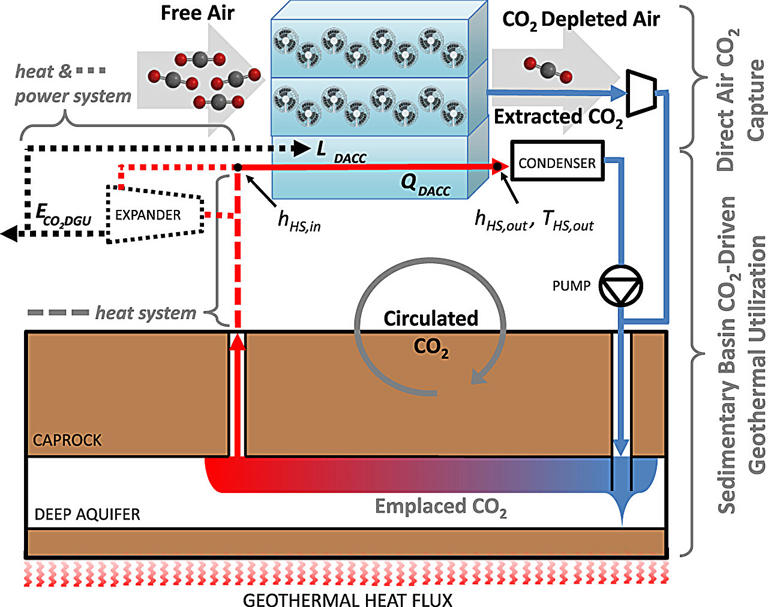
Direct Air CO2 Capture with CO2 Utilization and Storage (DACCUS)
Offline
Like button can go here
#7 2024-02-16 19:11:27
- Calliban
- Member
- From: Northern England, UK
- Registered: 2019-08-18
- Posts: 4,411
Re: CO2 Energy Storage System - Compressed Gas - Closed Loop
Calliban,
Are you proposing that the gaseous co2 be stored at low temperature, so that it is easier to reliquify?
I'm still thinking water's latent heat is the best choice to provide the reheat. Water can be stored close to ambient temperature, and if the ice melts that's just extra energy added to the system. For much of the year, we could make up energy losses using heat from the air to provide additional melting. If we're using air, cold water can be used for the prechilling part to remove water vapour perhaps.
Yes. If the CO2 exhaust has low temperature, then liquefaction requires less energy. There is no free lunch here in energy terms, as the avoidance of reheat within the cycle reduces recoverable energy. But it will make the turbine and compressor easier to design, as there do not need to be any (or at least fewer) intercooling and reheat stages, for the compressor and turbine, respectively.
If we could find some way of using the cold from adiabatic expansion, then we get the best exergy efficiency all round. Compression generates heat that provides hot water. Expansion generates work and cold energy, which can be used for other applications, like refrigeration. Compressed air energy storage can function as a sort of heat pump. Compression allows us to remove thermal energy from air for heat and expansion converts internal energy into work, lowering the temperature of the air. Given that refrigeration is something we normally use additional energy for, it would be really neat if we could use a single heat pump to provide both heat (for hot water) and cold for refrigeration.
One example of how we might use this. If we build a ice rink next door to a swimming pool. A CAES type facility would generate heat from compression that could warm the pool. The expander turbine would generate cold, which could cool the ice rink. If a town has a district heating network able to absorb compression heat, we could build a year round ski slope, complete with snow under an ETFE canopy. The CAES exhaust air could be vented under the canopy, keeping the slope frozen.
"Plan and prepare for every possibility, and you will never act. It is nobler to have courage as we stumble into half the things we fear than to analyse every possible obstacle and begin nothing. Great things are achieved by embracing great dangers."
Offline
Like button can go here
#8 2024-02-17 16:13:21
- SpaceNut
- Administrator
- From: New Hampshire
- Registered: 2004-07-22
- Posts: 30,864
Re: CO2 Energy Storage System - Compressed Gas - Closed Loop
Offline
Like button can go here
#9 2024-02-19 08:56:38
- SpaceNut
- Administrator
- From: New Hampshire
- Registered: 2004-07-22
- Posts: 30,864
Re: CO2 Energy Storage System - Compressed Gas - Closed Loop
Offline
Like button can go here
#10 2025-12-28 16:37:32
- SpaceNut
- Administrator
- From: New Hampshire
- Registered: 2004-07-22
- Posts: 30,864
Re: CO2 Energy Storage System - Compressed Gas - Closed Loop
Google Rapidly Deploying Huge CO2 Battery Facilities That Store 200 Megawatt Hours of Power

While we’ve made major strides in generating renewable energy, storing that green power to use when the Sun isn’t shining or the wind isn’t blowing remains a major engineering challenge.
Researchers have developed many creative concepts — storing it in cranes that hoist humongous concrete blocks up and down, inside hot giant rocks, or spinning turbines by pumping water out of deep, decommissioned mines — none have yet proved practical enough for wide deployment.
Now, as IEEE Spectrum reports, a Milan-based company called Energy Dome has come up with an intriguing approach that stores energy in enormous domes that are filled with compressed carbon dioxide gas.
The idea behind the “CO2 battery” is simple. By compressing the gas using excess green power, it can later be depressurized to spin large turbines. A fully charged facility can store a formidable 200 megawatt-hours of electricity — enough to power around 6,000 homes for a full day.
To charge, the battery uses a thermal-energy storage system to cool the CO2 down to ambient pressure, and a condenser turns it into a liquid over a span of ten hours. To discharge it, the CO2 is evaporated and heated to power the turbine.
The goal is to bridge the gap between when renewable energy is available and when it’s actually needed through a “long-term duration energy storage” (LDES) solution. For instance, solar energy generation may hit its peak during the day, but peak household demand lags hours behind when people are home in the evening.
The idea has even caught the attention of Google, which announced a partnership with Energy Dome earlier this year. Now, IEEE Spectrum reports that the tech giant “plans to rapidly deploy the facilities in all of its key data-center locations in Europe, the United States, and the Asia-Pacific region.”
Energy Dome is currently working on a pilot CO2 battery built on five hectares of flat land in Sardinia, Italy. If successful, it wants to expand rapidly, popping up similar facilities across the world, starting with a separate plant in Karnataka, India. Authorities are also working on laying the groundwork for another in Wisconsin.
Google’s senior lead for energy strategy, Ainhoa Anda, told IEEE Spectrum that one big benefit of the approach is that it’s one-size-fits-all.
“We’ve been scanning the globe seeking different solutions,” he said, adding that “standardization is really important, and this is one of the aspects that we really like” about Energy Dome.
“They can really plug and play this,” Anda added.
The tech giant is looking to start in places where the electricity grid is already reliable and has a surplus of renewable energy that needs to be stored. Nearby data centers can then tap into the CO2 battery.
Unlike other renewable energy storage solutions, CO2 batteries don’t need special minerals, supply chains for complex parts, or constant upkeep.
And it’s not just Google looking to harness the benefits of LDES. China is also working on constructing CO2 batteries, according to IEEE.
Nonetheless, questions surrounding the concept’s long-term economic viability remain. For one thing, a CO2 battery’s footprint is considerably larger than a lithium-ion battery storage facility. There’s also the shortcoming that plagues all bubbles: the threat of a puncture, which could release thousands of tons of CO2 into the atmosphere.
Offline
Like button can go here