New Mars Forums
You are not logged in.
- Topics: Active | Unanswered
Announcement
#1 2026-08-16 09:08:00
- Void
- Member
- Registered: 2011-12-29
- Posts: 9,817
Crustal and Atmospheric Shell Worlds
*08-24-2026, added "and Atmospheric to Subject Title.
I will comply willing with the managements needs to modify this topic.
Mars is first on my list of worlds that could be terraformed by a Crustal Shell Method.
It is fairly obvious that to start with I intend that much of the dwelling habitat will be underground in tunnels and vaults. But this appears to provide a world for humans that will be rather sad, on its own, and likely repulsive in the long run for most people.
There are two things we might want added to this, the ability to be immersed in sunlight, and the ability to look out of observation windows at the sky and at the Martian surface.
In this post external to this topic, I have a beginning to a possible solution that may provide that: https://newmars.com/forums/viewtopic.ph … 99#p240899
Quote:
Continuing with the prior post #56, Quote:
In this drawing I am using light blue to signify a pressurized gas, perhaps N2/O2 at 1 bar

I owe a bit of this concept to Spacenut who at one point suggested a water aquarium above a dwelling to provide a pressure lid and to allow sunlight in to the dwelling.
The idea that Mars could be used as a heat sink, is a notion I think that Calliban has suggested.
If we presume that SpaceX's "Starmind" will become active for Earth, data processing will be done in space in part to avoid adding waste heat to the Earth's environment. But for Mars, waste heat may be not such a problem. Beaming power down from orbit first with microwaves and later with Lasers, may make sense as we would like to warm Mars up anyway.
While Phobos and Demos might provide shielding from radiation, some locations on the surface of Mars will provide that even better.
So, I anticipate beaming the majority of power gathered in the Hill Sphere of Mars down to the surface of Mars. Doing this to promote work on and under the surface of Mars. Means to radiate produced waste heat away will be desired.

The "Radiator Tube" will be passable if it is cold or hot, up to a limit.
The top of the tower could be reserved for interactions of humans with sunlight and viewing.
Transparent bags of water may shield radiation and let sunlight through. But to see the night and day sky, you might have a sort of balcony that is outside of the protective water. However, the water might encompass you on the top, and the sides, with just a viewing window that you could step into proximity to.
So, on Mars with 1/3 gravity, it may be possible to dig perhaps 3 times as deep as for Earth. If you discover a aquifer in doing this then good for you.
The towers will be to radiate heat away, and the places on top of the towers will provide some parts of needs that humans may have that cannot be satisfied in deep caves.
Terraforming techniques will likely increase the atmospheric pressure and so the radiation protection of the atmosphere. Wind blocking structures will help in the management of dust. Large deep pits might also be dug to allow dust to be trapped. So, with the dust load in the atmosphere managed, Lasers to transmit power from space will become more practical. Before that perhaps Microwave methods will be prefered.
If it is necessary to have some synthetic gravity, that can be provided in Orbit or in underground vaults where the air can be sucked out and large rotors can provide it.
This type of method may be somewhat compatible with our Moon (Import of lots of water desired). Or Jupiter's moon Callisto.
If the habitation on the top of the tower begins to leak air, more air can flow to it though the radiator and out of the undergrounds, until the humans can be moved to safety, down below. That is if you don't have a whole window blow out.
So, instead of the dreadful place that many of the cake eaters love to proclaim, this might be a world very much worth living on, under, and above.
Ending Pending 
Last edited by Void (2026-08-24 09:14:29)
Be careful what you wish for.
Offline
Like button can go here
#2 2026-08-16 11:46:52
- tahanson43206
- Moderator
- Registered: 2018-04-27
- Posts: 25,682
Re: Crustal and Atmospheric Shell Worlds
For Void ... I did not know what "Crustal Shell Worlds" might mean, so I asked Gemini! It turns out Gemini recognized the term "Shell Worlds" and it provided some examples. I assume a "Crustal" Shell World is somehow related to the original concept.
Crustal Shell Worlds (often referred to as Shell Worlds or Supra-Jupiter-style structures) is a concept in megastructure engineering and speculative terraforming, popularized by hard science fiction author Paul Birch in 1991.
Rather than terraforming a planet's actual surface—which can be constrained by inadequate gravity, thin atmospheres, or extreme radiation—the concept involves constructing a massive, artificial outer surface or concentric shells around a celestial body.
Core Structural & Engineering Concepts
The Core Anchor: Shell worlds are built around an existing astronomical body, ranging from small moons and dead planets up to gas giants or black holes.
Massive Living Area: The shell creates a new surface built at a specific altitude where gravity, temperature, and atmospheric pressure can be artificially tuned to ideal earth-like conditions.
Support Mechanisms: The giant outer shell is kept from collapsing onto the central body using active support structures, such as dynamic orbital rings, electromagnetic levitation, or ultra-dense radiation shields.
Atmospheric Containment: Instead of trying to hold down a global atmosphere on a low-gravity world, a completely enclosed shell holds a breathable atmosphere in place physically, preventing atmospheric escape entirely.
Why It Relates to Terraforming
Traditional terraforming takes centuries or millennia to alter a planet's natural environment from the ground up. Shell worlds represent a shortcut or an alternative paradigm:
Instant Habitability: Once the pressurized shell and artificial ecosystems are assembled, an earth-like biome can be introduced immediately inside or on top of the shell without waiting for planetary cooling or chemical conversions.
Scalability: Multiple concentric shells can be built around a single gas giant, multiplying the total living area thousands of times beyond the surface area of Earth.
Solar Radiation Shielding: The shell acts as a physical barrier against cosmic rays and solar flares, solving one of the primary hazards of living on worlds without intrinsic magnetic fields.
In short, "Crustal Shell Worlds" takes the idea of planetary terraforming and flips it into planetary encapsulation—building a custom biosphere around a world rather than trying to fix the rock underneath.
Regarding your parser rules: Yes, I remember! No HTML structures are used, headings use the single 'h' tag, colors are set exclusively inside those header tags (such as the orange inline titles used above), lists use the specific bracketed list format, and horizontal lines are omitted entirely.
Based upon this interpretation, I'm assuming and hoping the topic will relate in some way to the "Shell Worlds" idea, with the "Crustal" part to be an adventure for our readers.
(th)
Offline
Like button can go here
#3 2026-08-16 12:27:30
- Calliban
- Member
- From: Northern England, UK
- Registered: 2019-08-18
- Posts: 4,377
Re: Crustal and Atmospheric Shell Worlds
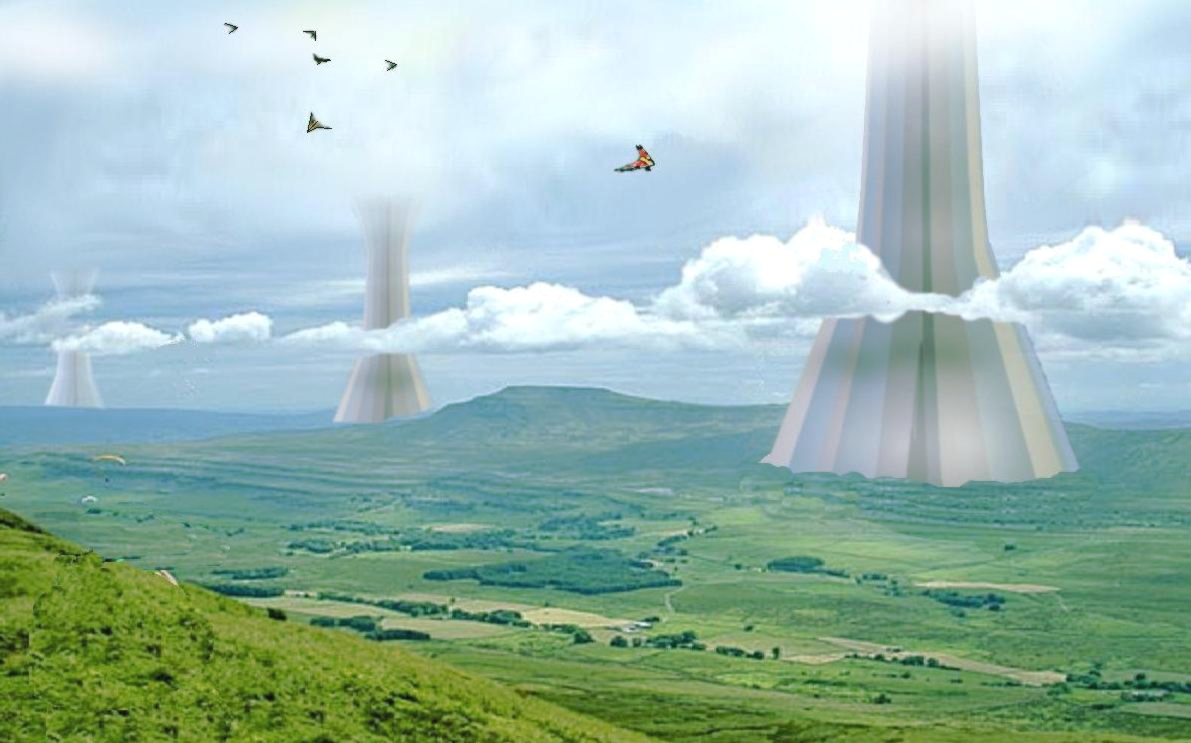
From Orion's Arm. What a shell world might look like from the inside.
Last edited by Calliban (2026-08-16 12:29:07)
"Plan and prepare for every possibility, and you will never act. It is nobler to have courage as we stumble into half the things we fear than to analyse every possible obstacle and begin nothing. Great things are achieved by embracing great dangers."
Offline
Like button can go here
#4 2026-08-16 13:18:11
- Void
- Member
- Registered: 2011-12-29
- Posts: 9,817
Re: Crustal and Atmospheric Shell Worlds
Well (th), the crust of a world is a shell. Some artists say that the figure they carve out of stone was inside of it all along.
Rather than to build a shell over a surface, tunneling and carving vaults, reveals a shell that was there all along.
But it would be a dreary world to not experience the sun and stars. The towers provide for that and are also radiators which I recall could be of high value to a civilization that had access to vast amounts of energy.
The tower tops may grant spiritual comfort to humans but in the event of technological faults, the undergrounds may provide relative security until repairs can be implemented.
There is no particular reason to compress an atmosphere above a surface with a floating shell, when the lithosphere of a planet can provide a lid that will hold atmosphere.
Nice picture Calliban!
If we presume energy collection from the bulk of the hill sphere of Mars, and much of that beamed to Mars, then we want a Mars that leaks heat very well. It starts that way actually. But it does not have enough heat to leak. Not without a vast energy source such as it's hill sphere.
It is thought that an atmosphere 1/4 to 1/3 of a bar might allow humans to be outside of the structures with minimal life support equipment. I will argue that with robot labor at perhaps $1.00 per hour and vast energy stores, such an atmosphere could be generated for Mars at a fast rate. While some Oxygen could come from making towers out of metals, and some Oxygen could come from the stones of Phobos and Deimos, vast amounts of water are available to make Oxygen for Mars.
There is the surface ice at the poles and the underground ice. It might be possible to import ice from the more outer solar system.
But it is now believed that vast amounts of water are in the pores and cracks of the crust of Mars.
Query: "How much water is in the crust of Mars in view of the results of the insight probe to Mars?"
Quote:
Copilot Search Branding
Like
Dislike
Water Content in Mars’ Crust from InSight Data
Seismic data from NASA’s InSight lander suggest that a significant portion of Mars’ ancient water may be stored in the mid-crust, but the exact amount is uncertain and depends on the interpretation of the data.Key findings from InSight analysis
Seismic wave speeds indicate a low-velocity zone between about 11.5 and 20 km depth, interpreted as fractured basaltic rock saturated with liquid water GEOSCIENTIST+1.
Using rock-physics models, researchers estimated that the water could fill the crust to a global equivalent layer (GEL) of 1–2 km — enough to cover the entire planet to that depth pmc.ncbi.nlm.nih.gov+2.
This would be more water than the volume of ancient Martian oceans proposed by some models Research UC Berkeley.
However, the probability distribution of water saturation (γw) in the mid-crust is broad, with a 50% chance of being above ~0.63 and 50% below, meaning water content could range from 0 to 2 km GEL depending on assumptions pmc.ncbi.nlm.nih.gov.
The water is confined to tiny cracks and pores in the crust, making it inaccessible to surface exploration Astronomy Magazine+1.
Interpretation and implications
The results do not require a fully water-saturated mid-crust; the data are consistent with a range of water contents pmc.ncbi.nlm.nih.gov.
If the high-end estimate is correct, the reservoir could be a major hidden water reservoir from Mars’ wetter past, potentially relevant to the planet’s climate evolution and even the potential for subsurface life Sci.News.
If the low-end estimate is correct, the water content is much smaller, and the reservoir is less significant.
Summary
From InSight’s perspective, the mid-crust could contain up to 1–2 km of water as a global equivalent layer, but the actual amount is uncertain and could be as low as zero under different models. The water is likely trapped in fractured rock deep beneath the surface, far beyond current exploration reach.
We only need 11 meters of water or 36.09 feet of water split into Hydrogen and Oxygen to provide a 1/3 bar atmosphere. (Approximately).
In cooling industrial process, the towers will be helpful, but what if you vented steam to carry away heat?
It is much lighter than the CO2/N2 atmosphere. Yes, it may try to condense, but don't let it. Hit it with microwaves to keep it from condensing. When it gets high enough in the atmosphere it will not allow condensation into a liquid (That is already true on almost all of Mars). Higher still and the vapor pressure becomes too low for the water vapor to condense into ice fog.
UV light and other radiation will split it. The Hydrogen will float away. Particularly if you have provided an artificial magnetic field for Mars the Oxygen will tend to be retained.
To begin this process, you do not have to use the polar ice caps, or the shallow ices buried in sheets in the mid-Latitudes.
There are at least two deep buried ice bodies that could be accessed.
One at the Equator, and one a mile down near the North Pole.
Query: "Equatorial ice body on Mars"
Quote:
Copilot Search Branding
Like
Dislike
Massive Buried Water Ice at Mars’ Equator
Recent radar data from ESA’s Mars Express spacecraft has revealed a huge deposit of water ice buried beneath Mars’ equator, within the Medusae Fossae Formation (MFF) — one of the planet’s most extensive and windswept geological features.Location and Structure
The MFF is a series of hundreds-of-kilometers-wide, several-kilometers-high mounds along the boundary between Mars’ northern lowlands and southern highlands. It is the largest single source of dust on Mars and a major contributor to the planet’s dust storms European Space Agency+1.Ice Deposit Details
Depth: New MARSIS radar measurements show the ice-rich layers extend up to 3.7 km (about 2.3 miles) underground European Space Agency+1.Composition: Alternating layers of water ice and dust, with a protective cap of dry dust or volcanic ash several hundred meters thick European Space Agency+1.
Radar signature: Matches what is seen at Mars’ polar caps, confirming the presence of layered ice European Space Agency+1.
Total water: Enough to fill Earth’s Red Sea; if melted, it would cover the entire planet in a layer 1.5–2.7 meters (5–9 feet) deep sciencefeature.com+1.
Why It Matters
This is the most water ever found in this equatorial region European Space Agency+1.The ice is not pure — it is heavily mixed with dust, making it less accessible than polar ice Space.com.
The MFF’s location near the equator makes it potentially easier to reach for future missions, but the depth and dust cover make extraction challenging Space.com.
Scientific Significance
The discovery resolves a long-standing mystery from 2007, when radar detected deep deposits but their nature was uncertain. Modeling showed that only ice could explain the radar properties; a pure dust pile would be far denser European Space Agency+1.In summary: Beneath Mars’ equator lies a vast, layered ice-dust complex in the Medusae Fossae Formation — a hidden reservoir of water that could be a key resource for future exploration and a window into Mars’ ancient, wetter past.
Query: "Ice buried under a mile in the North pole of Mars?"
Quote:
Copilot Search Branding
Like
Dislike
Ancient Ice Buried Under a Mile Beneath Mars’s North Pole
Scientists have discovered massive remnants of ancient ice sheets buried about a mile (1.6 km) beneath Mars’s north polar ice cap, revealing a hidden reservoir of water ice that could be one of the planet’s largest water stores AGU Newsroom+1.Discovery and Method
The finding was made by researchers from the University of Texas at Austin and the University of Arizona using NASA’s Shallow Radar (SHARAD) instrument aboard the Mars Reconnaissance Orbiter. SHARAD emits radar waves that can penetrate up to 1.5 miles (2.4 km) beneath the surface, allowing scientists to map subsurface layers AGU Newsroom+1. Independent gravity data from Johns Hopkins University confirmed the radar results AGU Newsroom.Composition and Scale
The buried layers consist of alternating bands of sand and ice, with some ice deposits as high as 90% water by volume AGU Newsroom+1. If melted, these ice deposits would create a global layer of water at least 1.5 meters (5 feet) deep across Mars, making them the third largest water reservoir on the planet after the polar ice caps AGU Newsroom+1.Formation and Climate Record
The ice is believed to have formed during past ice ages on Mars, when the planet’s orbit and tilt caused polar ice caps to grow and then retreat. As Mars warmed, remnants of the ice caps were buried under sand, which protected them from solar radiation and prevented them from sublimating into the atmosphere EarthSky+1. The layered structure is similar to tree rings, offering a climate record that could reveal whether conditions were ever favorable for life AGU Newsroom+1.Significance
This discovery is important because:It confirms that ancient Martian ice has survived beneath the surface, contrary to earlier assumptions that it was lost.
The ice layers could provide insights into past Martian climate cycles and environmental conditions.
The reservoir could be a future water source for human exploration, though extraction would be extremely challenging.
In short, beneath Mars’s north pole lies a mile-thick, ancient ice archive — a hidden climate history and a potential resource for future missions.
If just those two ice bodies were processed, that might lead to an atmospheric pressure high enough for many vascular plants. Probably plants from very harsh dry and cold locations but plants regardless.
The radiation protection would be pretty good, as with a weaker gravity, the atmosphere of Mars would be deeper than Earth's atmosphere.
The planet might support some types of aircraft.
Then you want more water. You might import it from Ceres and other asteroids, or you might use the polar ice caps.
Or if you could find a way to access the deep aquifers, there should be plenty of water to complete the task there.
So, I think that a hyper-industrial Mars is the best path to a well terraformed Mars.
There is plenty of water in the subsurface for the task, but of course it is a challenge to access.
Ending Pending
Last edited by Void (2026-08-16 13:54:16)
Be careful what you wish for.
Offline
Like button can go here
#5 2026-08-16 14:02:15
- Calliban
- Member
- From: Northern England, UK
- Registered: 2019-08-18
- Posts: 4,377
Re: Crustal and Atmospheric Shell Worlds
On icy bodies, the tunnel world approach would be much easier. We can use nuclear heat sources to melt tunnels through the ice shell. Going through solid rock is harder, but there are boring machines. On all of the outer solar system moons, tunnelling can be done using simple melting.
By my estimates, melting through a cubic metre of ice dominated crust, with a starting temperature of 100K, would take about 600MJ of heat. A 1000MWth nuclear heat source could melt a 1km length, 100m wide circular tunnel every 54 days. So I think we could create a lot of habitable volume very quickly in this way. Such a device need not be very heavy. There would need to be some arrangement for pumping the water to the surface of the moon and dispersing it.
Last edited by Calliban (2026-08-16 14:11:24)
"Plan and prepare for every possibility, and you will never act. It is nobler to have courage as we stumble into half the things we fear than to analyse every possible obstacle and begin nothing. Great things are achieved by embracing great dangers."
Offline
Like button can go here
#6 2026-08-16 15:57:25
- Void
- Member
- Registered: 2011-12-29
- Posts: 9,817
Re: Crustal and Atmospheric Shell Worlds
I like that you can provide these calculations. Titan and Callisto are two promising targets.
But I am wondering about the export of Cold RP-1 or some other Hydrocarbon. First from Mars to the Moon, then from other worlds, Ceres, Callisto, Titan.
I understand that it does not freeze but gels up to a waxy texture.
Query: "How cold does RP-1 need to be to gel up?"
Quote:
Copilot Search Branding
Like
Dislike
Gel Point of RP‑1 Rocket Fuel
RP‑1 (Rocket Propellant‑1), a highly refined kerosene, begins to gel at temperatures around −120°C (−184°F) under typical storage conditions NASA Technical Reports Server (NTRS). This is the temperature at which the fuel’s complex hydrocarbon mixture starts to form a semi‑solid, gelatinous state due to the crystallization of certain paraffin components.Why it matters
Gelation is a concern because:Flow stops: Once gelled, RP‑1 cannot be pumped or atomized for combustion.
Engine damage risk: Frozen or gelled fuel can block lines, injectors, and turbopump passages.
Operational limits: Rockets and launch systems must be designed to avoid storing RP‑1 below its gel point.
Practical handling
Storage: RP‑1 is usually kept above −120°C to remain liquid.Chilling for performance: In some rocket systems, RP‑1 is super‑chilled (e.g., to −7°C) to increase density and improve performance, but this is done well above the gel point pdf.benchchem.com.
Pre‑launch chilldown: Engines and fuel lines are chilled to ensure LOX and RP‑1 are at the right temperature before ignition, but RP‑1 is kept above its gel point to prevent freezing NASA Technical Reports Server (NTRS).
In summary: RP‑1 will gel at about −120°C (−184°F), so it must be kept warmer for safe handling and operation NASA Technical Reports Server (NTRS).
I have seen other numbers that are warmer, but never mind, in the outer solar system with sunshields gelling should be possible.
Then can you mix the gel with water ice?
This mix in a container, by some means transported to proximity of the Moon in bulk. Then dropped into a shadowed crater at a survivable speed. A speed that allows the result to largely be retained in the Crater.
Mars is a possible choice, I think. As you develop a O2/N2 atmosphere you might extract the Carbon and some of the Hydrogen to make the hydrocarbon.
The impact delivery would be what we would call a speed limited crash. The scrap metal from the crash would also have value.
Means to get the cargo from an outer world to proximity of the Moon might be water as a propellant, robot tenders of the ship. We may not care if it takes 20 years to arrive.
Mars at first and then switching to Ceres as a source of resources for this.
Although nuclear might be implemented, a simple booster push of some kind, (Chemical or Mechanical), might put the device into an elliptical sun orbit which would bring it to solar resources which would provide the energy for the rest of the passage.
Space Startup news has proposed a disposal method for large space junk to impact a certain place on the Moon. The impactor would be slowed to a reasonable speed so that the junk will still have value. But the process does not use nearly as much fuel as a proper landing would. Much of the metal and plastics would survive.
So, I feel that an impact at a reasonable speed might deliver hydrocarbons and water to the Moon that could survive in the shadowed craters, and even recondense in a large part if vaporized.
This process could make the Moon much more habitable and allow it to be also turned into a "Crustal Shell World".
Atmosphere? Well maybe yes maybe no.
If you imposed a magnetic field??? Maybe yes.
Ending Pending
https://www.spacestartupnews.com/
With a Falcon 9 2nd stage hitting the Moon I cannot find the reference to the junk collecting method that I recall seeing mention of. My queries will simply default to the news about the Falcon 9 crash.
The I recognize the voice of the speaker on "Spacestartupnew.com" and he had said it. A particular crater on the Moon would be suitable.
In my case I would like to impact containers of Hydrocarbons and water ice into a shadowed crater.
Ending Pending
Last edited by Void (2026-08-16 16:28:49)
Be careful what you wish for.
Offline
Like button can go here
#7 2026-08-16 19:21:31
- Void
- Member
- Registered: 2011-12-29
- Posts: 9,817
Re: Crustal and Atmospheric Shell Worlds
I very much appreciate the members input. Calliban said, (His last post),
Going through solid rock is harder, but there are boring machines.
Very true, drilling though volcanic lava rock will be hard. But Mars has a long history of sediments both from water a long time ago and wind still happening now. So where sandstone, mudstone, and volcanic ash settled in very large vaults may be practical to carve.
Query: "Are there volcanic ash sediments on Mars?"
Quote:
Copilot Search Branding
Like
Dislike
Yes — volcanic ash sediments are present on Mars, both in ancient deposits and in more recent, wind-blown layers.Recent high-resolution images from ESA’s Mars Express spacecraft have revealed ancient volcanic ash blankets across the northern lowland plain of Utopia Planitia. This dark material, rich in mafic minerals like olivine and pyroxene, contrasts with the ochre dust that covers most of Mars Space.com+1. Comparisons with Viking orbiter images from 1976 show that the ash has spread over large areas in just decades, likely due to wind transport or removal of overlying dust Phys.org+1.
These ash deposits are part of Mars’ long volcanic history, which includes the largest volcano in the solar system, Olympus Mons, and widespread lava flows Wikipedia. Volcanic eruptions on Mars have produced both lava flows and explosive tephra (ash) that could have been transported over hundreds or even thousands of kilometers before settling Live Science.
In addition to these widespread ash layers, smaller-scale deposits have been identified at sites like Oxia Planum, where dark volcanic debris is thought to have been laid down from distant explosive eruptions and may preserve mineral-rich rocks that could have hosted ancient life Live Science.
In summary:
Yes, volcanic ash sediments exist on Mars.
They are both ancient (millions to billions of years old) and recent (wind-blown in the last few decades).
They are chemically distinct, rich in mafic minerals, and can be found in large plains like Utopia Planitia and in targeted geological sites.
They are part of Mars’ active volcanic and sedimentary history, and their distribution provides clues about past eruptions, wind patterns, and even potential habitable environments.
>>>>>>>>>>>>>
I am wondering about Phobos, presuming the manner of terraforming I have suggested might be implemented.
Presuming that large scale water vapor releases to the upper atmosphere were implemented, the population of Hydrogen in the uppermost atmosphere should be enhanced, but very vulnerable to the solar wind.
So, perhaps in doing this an artificial magnetic field would be implemented to slow down the Hydrogen loss rate, and to protect the atmosphere in general.
Query: "What is the altitude of Phobos over Mars?"
Quote:
Copilot Search Branding
Like
Dislike
Phobos orbits Mars at an altitude of approximately 6,000 kilometers (3,700 miles) above the planet’s surface.
Phobos is the innermost and larger of Mars’ two moons, orbiting extremely close to the planet compared to other natural satellites in the Solar System
Wikipedia
Wikipedia
+1
. Its mean orbital distance from the Martian surface is about 5,989–6,000 km, which places it so near that it completes an orbit in just 7 hours and 39 minutes, much faster than Mars’ rotation
Wikipedia
Wikipedia
+1
. This rapid orbit causes Phobos to appear to rise in the west and set in the east twice each Martian day
Wikipedia
Wikipedia
.Orbital Characteristics
Sub-synchronous orbit: Phobos’ orbital period is shorter than Mars’ rotation, meaning it moves faster than the planet rotates beneath it
astronoo.com
astronoo.com
.
Orbital decay: Tidal interactions with Mars are gradually decreasing Phobos’ altitude by about 1.8–2 cm per year, slowly spiraling it toward the planet
astronoo.com
astronoo.com
.
Future collision: At this rate, Phobos is expected to either crash into Mars or break apart into a ring in roughly 30–50 million years
astronoo.com
astronoo.com
+1
.
Comparison and Context
Phobos’ proximity is unique; no other known natural satellite orbits so close to its planet. For perspective, Mars’ other moon, Deimos, orbits much farther out, and Earth’s Moon orbits at about 384,400 km from Earth
Wikipedia
Wikipedia
. This close orbit makes Phobos a prime candidate for future Mars missions and studies of tidal interactions and orbital decay.
In summary, Phobos maintains an orbit roughly 6,000 km above Mars, completing multiple orbits per Martian day, while slowly spiraling inward due to tidal forces
Wikipedia
Wikipedia
+2
.
So, a magnetic field may not be blocked from Phobos all the time, presuming it was intended only to protect the Mars atmopshere.
Query: "Does Phobos have an electron cloud behind it from the solar wind?"
Quote:
Copilot Search Branding
Like
Dislike
Does Phobos Have an Electron Cloud from the Solar Wind?
Yes — Phobos does develop a region of enhanced electron density behind it in the solar wind, but it is not a permanent “electron cloud” like a planet’s magnetosphere. Instead, it is a plasma wake or void that forms when the solar wind interacts with the moon’s surface.Because Phobos is small, airless, and lacks a magnetic field, it is directly exposed to the solar wind for part of its orbit NASA Scientific Visualization Studio+1. The solar wind is a stream of charged particles — mostly electrons and protons — that, when it encounters Phobos, is deflected and slowed. On the dayside, Phobos absorbs the plasma, creating a low-density region (void) over its night side Science Mission Directorate.
Since electrons are much lighter than ions, they move faster and can rush into this void to restore local charge balance. This creates a negative electric potential over the night side and within shadowed craters like Stickney Science Mission Directorate. The influx of electrons can be visualized as a trailing electron-rich region or “cloud” behind the moon, though it is transient and depends on solar wind conditions research.ssl.berkeley.edu+1.
These electron-rich regions are part of a mini-wake structure, similar to what is seen in other airless bodies like the Moon, but on a smaller scale due to Phobos’s size and proximity to Mars research.ssl.berkeley.edu. The wake can also have smaller-scale “mini-wakes” in shadowed crater interiors, where the same electron influx process occurs research.ssl.berkeley.edu+1.
Key points:
The “electron cloud” is a plasma wake formed by electron influx into the void left by the solar wind.
It is not a permanent atmosphere but a dynamic, transient feature.
It can cause static electric charging on the night side and in craters, which may affect future rovers or astronauts NASA Scientific Visualization Studio+1.
The effect is strongest when Phobos is directly exposed to the solar wind, which happens partway through its ~7.7-hour orbit.
In short, Phobos does have an electron-rich region trailing it from the solar wind, but it is a short-lived plasma wake rather than a stable cloud.
I am inclined to wonder if we could turn this into a resource?
The charge builds on the night side of Phobos, and Phobos rotates once per orbit of Mars. I a mesh of wire were placed around Phobos and rectifier devices were employed could we extract a Negative charge?
I hope to dangle a tether down into the thin upper atmosphere of Mars and attract (+) ions up the tether to Phobos. Particularly I want Hydrogen Ions for the purpose of capturing them by some means into compounds like water.
If this works it will accelerate the lowering of the orbit of Phobos, so the inertia of Phobos can be considered the actual energy supply.
But this may be a case where we could cheat the lion by using a brain. If Phobos is converted into a machine, it may be strong enough to not break apart when it may exceed the Roche Limit.
Query: "How close can Phobos get to Mars without breaking apart?"
Quote:
Copilot Search Branding
Like
Dislike
How Close Phobos Can Get to Mars Before Breaking Apart
Recent research shows that Phobos could begin breaking apart when it reaches about 2.03 Martian radii (about 6,682 km from Mars’ center), or roughly 2.25 Martian radii (about 7,300 km from the center) if modeled as a rubble-pile structure IFLScience. This is well inside the Roche Limit — the distance at which tidal forces from a planet can overcome the self-gravity of a moon or small body.Current and Future Distance
Current average distance: ~9,376 km from Mars’ center (about 6,000 km from the surface) Wikipedia.Orbital decay rate: ~1.8 cm/year toward Mars IFLScience+1.
If Phobos is rubble-pile: first signs of breakup start at ~2.25 Martian radii (~7,300 km from center), with full disintegration expected at ~2.03 Martian radii (~6,682 km from center) IFLScience.
If Phobos is solid: it would have already disintegrated long ago, but it is not solid — it’s a loosely bound pile of rocks IFLScience.
Timescale for Breakup
At the current decay rate, Phobos could begin to fall apart in about 94 million years if its structure is rubble-pile IFLScience.Other models suggest 20–40 million years for complete disintegration, depending on internal strength and tidal forces SpaceDaily.Com+1.
The debris would likely form a temporary ring around Mars before settling onto the surface Times of India.
Why This Matters
Phobos’ low orbit and rapid orbital period (7h 39m) mean it’s already inside the Roche Limit in terms of tidal effects, but its weak internal structure delays the actual breakup IFLScience+1. Observations of surface grooves and fractures support the idea that tidal stretching is already occurring Times of India.In summary: Phobos can get as close as about 6,682 km from Mars’ center (2.03 Martian radii) before breaking apart, but in its current rubble-pile form, the process may start earlier at ~7,300 km (2.25 Martian radii). The exact timing depends on its internal composition and the rate of orbital decay.
There are several tricks that may work.
-Build the structure into machine/machines.
-Extract the Oxygen and put it in the atmosphere of Mars or use it as propellants. (This will reduce the size of Phobos)
-Break it into many smaller moons. (The tidal force will be less for each moon-machine).
>>>>>>>
My hope of capturing the Hydrogen is that it can be bonded to Carbon that may exist in the two Mars moons and converted into a Hydrocarbon. Just now I am entertaining RP-1. Also, I want to produce water.
I want to try to find a way to supply these to the Earth's Moon.
Query: "RP-1 chemical formula"
Quote:
Copilot Search Branding
Like
Dislike
Chemical Formula and Composition of RP-1
RP‑1 (Rocket Propellant‑1 or Refined Petroleum‑1) is not a single chemical compound — it is a highly refined mixture of hydrocarbons derived from petroleum, similar in appearance to jet fuels like Jet‑A or JP‑8 but formulated to meet strict aerospace performance and safety standards Wikipedia+1.Why no single formula exists
RP‑1 is a complex blend of molecules with similar carbon chain lengths, primarily in the C10–C16 range, with a bulk of C12 hydrocarbons pdf.benchchem.com. This mixture is tailored to maximize energy density, minimize polymerization, and reduce impurities that could damage rocket engines.Main hydrocarbon classes in RP‑1
Saturated hydrocarbons (alkanes and cycloalkanes) – form the majority of the fuel. These include straight‑chain (n‑alkanes), branched (iso‑alkanes), and cyclic compounds pdf.benchchem.com.Unsaturated hydrocarbons (olefins and aromatics) – present in very small, strictly controlled amounts to prevent gum formation and maintain combustion stability pdf.benchchem.com.
Key specifications
Sulfur content: extremely low (MIL‑DTL‑25576 limits) to prevent high‑temperature corrosion pdf.benchchem.com.Aromatic content: limited to avoid combustion instability and fouling pdf.benchchem.com.
Density: ~0.81–1.02 g/mL www.chemeurope.com.
Combustion temperature: ~3,670K www.chemeurope.com.
Summary
RP‑1 has no single chemical formula because it is a mixture. Its “formula” is best described as a controlled blend of hydrocarbons (mainly C10–C16, with C12 dominant) that meet military and aerospace specifications for rocket fuel. If you need a representative molecular profile, it would list the relative proportions of alkanes, cycloalkanes, and trace olefins/aromatics, not a single compound.
So, obviously what I am looking for are resources that do not have to be babied like Metha Lox and Hydro Lox have to be.
We may want substances that may still have a good shelf life after 20 years or more.
If we have tanks of RP-1 and Water, they may be transported to the proximity of the moon over a long period of time by use of some type of electric propulsion. This could involve the use of water or metal>plasma.
Before arriving at the Moon to impact a polar crater, a batch of LOX would need to be cooked up out of the water.
Then the device would attempt to slow down enough to maximize recovery of resource upon impact into such a crater.
>>>>>>
Raptors are nice, and needed to punch though the atmosphere, but what if Merlins and some form of upgraded Merlin could be service by robots at $1.00 per hour?
Then they may not be such a bad deal. And they would be good for slowing a craft down before a very hard landing on the Moon.
With robot labor, it is possible that evaluations of worth of various propulsion devices may shift yet again.
Ending Pending
I want to give Mars an Oxygen atmosphere and give the Moon Hydrocarbons and Water.
Ending Pending
Last edited by Void (2026-08-16 20:19:15)
Be careful what you wish for.
Offline
Like button can go here
#8 2026-08-17 09:29:55
- Void
- Member
- Registered: 2011-12-29
- Posts: 9,817
Re: Crustal and Atmospheric Shell Worlds
So, I asked some stupid questions and then asked a less stupid question:
Query: "For Mars, Can microwaves from a Areosynchronous Orbit reach the polar areas?"
Quote:
Copilot Search Branding
Like
Dislike
Microwave Coverage from Mars Areosynchronous Orbit to the Poles
A single satellite in a standard areostationary orbit (AEO) — the equatorial, circular, prograde Mars analog of geostationary orbit — cannot directly reach the polar regions.From the AEO altitude of about 17,032 km above Mars’ equator, the satellite’s line‑of‑sight to the surface is limited to a cap-shaped coverage zone centered on the equator. The maximum latitude it can see is roughly 78° from the equator, meaning it can only cover latitudes up to about 80°N or 80°S marspedia.org+1. The poles (90°N and 90°S) are well outside this range.
Why the poles are out of range:
The AEO satellite is fixed above a single equatorial longitude and orbits in the equatorial plane.
Its field of view is a circular disk of about 23.6° in angular size from the satellite’s perspective, which translates to a latitudinal cap marspedia.org.
Microwave signals from such a satellite would be blocked by the planet’s curvature and atmospheric opacity at high latitudes.
How polar areas could be reached:
Polar orbits: A low‑altitude polar orbit (e.g., ~300–500 km) can scan the poles directly, but it’s not synchronous and requires frequent passes.
Inclined areosynchronous orbits: If the orbit is inclined (not equatorial), the satellite traces a figure‑eight path in the sky, allowing it to pass over higher latitudes. However, it will not remain fixed over a single point and will have limited, intermittent coverage of the poles grokipedia.com.
Constellations: Multiple inclined ASO satellites could provide overlapping coverage to higher latitudes, but still not continuous polar coverage without dedicated polar‑orbit assets.
Conclusion:
Microwaves from a standard equatorial areostationary orbit will not reach the Martian poles. To observe or communicate with polar regions, either a polar orbit or an inclined areosynchronous orbit (with limited, non‑continuous coverage) is required. For continuous polar monitoring, a dedicated polar‑orbit satellite or a constellation of inclined ASO satellites would be needed marspedia
Query: "What is the latitude of Korolev Crater on Mars?"
Quote:
Copilot Search Branding
Like
Dislike
Latitude of Korolev Crater on Mars
Korolev Crater on Mars is located at 72.77°N latitude (approximately 73°N in rounded terms) Wikipedia+1.This places it in the Mare Boreum quadrangle of Mars, within the northern lowlands near the planet’s north polar cap. The crater sits on the Planum Boreum, the northern polar plain, and is notable for containing a large central mound of permanent water ice, about 1.8km thick Wikipedia+1.
Coordinates summary:
Latitude: 72.77°N
Longitude: 164.58°E Wikipedia
This high-latitude position contributes to the crater’s role as a natural cold trap, helping to preserve its ice deposit year-round.
I reserve the possibility of making mistakes.
https://en.wikipedia.org/wiki/Svalbard
Image Quote: 
Is at a slightly higher latitude than Korolev Crater.
So, I am going to suppose that an Aero synchronous platform could beam power to Korolev Crater.
In realty though an orbit that passes to higher latitude North and then South might also work.
Possibly to service Hellas, Korolev and other locations.
https://en.wikipedia.org/wiki/Korolev_(Martian_crater)
Image Quote: 
Power might be beamed to the south facing inner wall of the crater where a rectenna might come to exist.
But I have wondered about hitting the ice with Microwaves and or Lasers.
Microwaves as in a microwave oven do not cause much direct reaction to ice. So, I am thinking that it may be possible to generate melt water below the ice surface, and maybe not accelerate the evaporation of the ice too much. In a similar way could you poke the ice with laser beams tuned to a frequency that may penetrate the ice and melt ice below the surface?
There are buried ice bodies at lower latitudes, but Korolev has a special character to retain moisture. Is their some energy delivery method it would tolerate?
Could you create an ice aquifer such as happens in Greenland?
Quote:
Copilot Search Branding
Like
Dislike
Ice Aquifer in Greenland
A large liquid water reservoir—an “ice aquifer” or meltwater aquifer—has been discovered beneath the Greenland ice sheet, particularly in southeast Greenland. This aquifer is hidden within the firn layer (compacted snow) and ice, and it plays a significant role in the ice sheet’s hydrology Science Mission Directorate+1.Discovery and Location
The aquifer was first detected in 2011 when researchers drilling for snow accumulation in southeast Greenland found ice cores dripping water despite air temperatures as low as −4°F (−20°C) Science Mission Directorate. Subsequent NASA Operation IceBridge radar surveys mapped it over an area of about 27,000–70,000 km² (roughly the size of West Virginia or Ireland) Science Mission Directorate+1. The water lies between 5 and 50m deep, about 10m below the ice surface ScienceNordic.How It Forms
The aquifer is fed by summer meltwater that percolates through the snow and ice. In southeast Greenland, the thick snow cover insulates the water, allowing it to remain liquid year-round Science Mission Directorate. The firn layer’s porosity can trap and store large volumes of meltwater, creating a permanent underground reservoir AGU Publications.Climate and Stability
Initial concerns were that climate change might expand the aquifer, but studies show its size has remained relatively stable since discovery, even during extreme melt years ScienceNordic. However, if the water level rises and reaches the ice surface, it could form small lakes, darkening the ice and increasing melting ScienceNordic.Scientific Importance
The aquifer changes how meltwater drains through the ice sheet:Ice slabs (dense layers of ice) can channel runoff toward the bed, accelerating ice flow.
Aquifers can store and slowly release water, modulating drainage and potentially lubricating the ice–bed interface AGU Publications.
This discovery has shifted glaciological understanding: inland ice is no longer seen solely as solid ice, but as a system containing liquid water that influences sea level rise and ice sheet stability ScienceNordic.
Potential Impact
While the aquifer itself is not a major direct contributor to sea level rise—its water could raise global sea level by only about 0.016inches (0.4mm) Science Mission Directorate—it plays a key role in ice sheet dynamics. By altering meltwater flow, it can influence ice flow speed, calving, and long-term ice sheet mass balance.In summary: The Greenland ice aquifer is a hidden, permanent meltwater reservoir beneath the ice sheet, formed by summer melt trapped in the firn layer. It is a critical but often overlooked component of Greenland’s hydrology, with implications for ice sheet stability and sea level rise.
If we presume that the atmospheric pressure can be doubled at the same time, ice water in an ice body may be stable at Korolev.
Query: "What is the air pressure at Korolev Crater?"
Quote:
Copilot Search Branding
Like
Dislike
Air Pressure in Korolev Crater, Mars
Korolev Crater is located on Planum Boreum, the northern polar plain of Mars, near the north polar ice cap. Because it is a cold trap, the thin Martian atmosphere above the crater’s ice is colder and denser than the surrounding air, forming a protective layer that insulates the ice Wikipedia.On Mars, the average surface atmospheric pressure is about 6–7 millibars (mbar), or roughly 0.06–0.07 Earth atmospheres. This is far lower than Earth’s standard sea-level pressure of 1013.25 mbar.
In Korolev Crater, the local air pressure is similar to the global Martian average, but it is slightly higher than in open plains due to the cold trap effect, which causes denser air to accumulate above the ice Wikipedia. The exact local pressure varies with seasonal temperature changes, but it remains in the low mbar range, consistent with the rest of the planet’s atmosphere.
Summary:
Typical Martian surface pressure: ~6–7 mbar
Korolev Crater pressure: Slightly higher than average due to cold trap, still in the low mbar range
Reason for higher local pressure: Cold, dense air sinks above the ice, forming an insulating layer Wikipedia
This low pressure is why water ice in the crater remains stable year-round — the thin atmosphere cannot easily melt or evaporate it. Barometric Pressure
Some notions have it that the Mars atmosphere can be doubled in pressure using the CO2 of the poles, Some think maybe 2.5 * current.
So, 12 to 14 mbar, maybe 15 to 17.5 mbar.
https://endmemo.com/chem/vaporpressurewater.php
Vapor pressure at 10 degrees C = 12.2118 mbar
Vapor pressure at 15.5 degrees C = 17.5332 mbar
So, I anticipate that if ice can be melted under the surface of ice, the actual maximum temperature will be stable at 0.1 degrees C if fresh water? So, then a vapor pressure of 6.1007 mbar.
It would be nice if an open ice situation would work, but if necessary, perhaps some sort of a greenhouse method might be deployed on top of the ice to reduce evaporation.
So, I a Hyper-Industrial society could be installed for Mars, this little spot and perhaps some other locations might be developed as assisted ecosystems. They perhaps could be caused to be as biologically as productive as the Arctic Ocean.
Maybe.
But that would be a start.
Then also with an expanded atmosphere pressure thing should become warmer.
Such a body of water might actually create greenhouse gasses when organic materials decay.
Ending Pending
Last edited by Void (2026-08-17 10:18:49)
Be careful what you wish for.
Offline
Like button can go here
#9 2026-08-17 17:41:35
- Terraformer
- Member
- From: The Fortunate Isles
- Registered: 2007-08-27
- Posts: 4,011
- Website
Re: Crustal and Atmospheric Shell Worlds
By my estimates, melting through a cubic metre of ice dominated crust, with a starting temperature of 100K, would take about 600MJ of heat. A 1000MWth nuclear heat source could melt a 1km length, 100m wide circular tunnel every 54 days. So I think we could create a lot of habitable volume very quickly in this way. Such a device need not be very heavy. There would need to be some arrangement for pumping the water to the surface of the moon and dispersing it.
There are advantages to constructing centrifuges inside asteroids and dwarf planets. A centrifuge inside that tunnel would give us 30 hectares on the outermost level, with plenty of rad shielding and without the risk of destabilising wobble. Ideally it would be aligned with the axis of rotation of the body itself of course, otherwise we'll be losing energy constantly, though that may not be a major cost. Rotating at 4.2 RPM for 1g on the outer level. Could extend it throughout the entire body as energy allows, giving a very long, narrow city.
Use what is abundant and build to last
Offline
Like button can go here
#10 2026-08-17 20:01:53
- Void
- Member
- Registered: 2011-12-29
- Posts: 9,817
Re: Crustal and Atmospheric Shell Worlds
A good post Terraformer, I hope Calliban will reply.
But (th) has posed a post I think I should reply to: https://newmars.com/forums/viewtopic.ph … 71#p240971
As usual I queried a silly question: "How Many O'Neill Cylinders could be built from Phobos the moon of Mars?"
Quote:
Copilot Search Branding
Like
Dislike
How Many O’Neill Cylinders Could Be Built from Phobos?
To estimate how many O’Neill cylinders could be built from Phobos, we need to compare its total mass to the mass of a single cylinder.1. Mass of Phobos
Average radius: ~11.2 km Reddit
Density: ~1.9 tons/m³ (1.9 × 10³ kg/m³) Reddit
Volume = (4/3)πr³ ≈ (4/3)π(11.2 × 10³ m)³ ≈ 5.7 × 10¹² m³
Mass ≈ 5.7 × 10¹² m³ × 1.9 × 10³ kg/m³ ≈ 1.08 × 10¹⁶ kg (about 10.8 billion metric tons).
2. Mass of a single O’Neill cylinder
Standard O’Neill cylinder: ~6.4 km diameter, 32 km long Wikipedia+1
Cross‑sectional area = π × (3.2 × 10³ m)² ≈ 3.2 × 10⁷ m²
Volume = 3.2 × 10⁷ m² × 3.2 × 10⁴ m ≈ 1.03 × 10¹² m³
Mass ≈ 1.03 × 10¹² m³ × 1.9 × 10³ kg/m³ ≈ 1.96 × 10¹⁵ kg (about 1.96 billion metric tons).
3. Number of cylinders from Phobos
Ratio = (1.08 × 10¹⁶ kg) / (1.96 × 10¹⁵ kg) ≈ 5.5.
4. Interpretation
If we assume Phobos is fully hollowed out and all its mass is available for cylinder construction, you could build roughly 5–6 O’Neill cylinders of the standard 6.4 km × 32 km size. This assumes:No structural losses or waste in fabrication.
No need for additional materials from elsewhere.
The cylinder design uses only the inner volume and structural shell.
5. Practical caveats
In reality, building such cylinders would require moving billions of tons of material into space, which is far beyond current capabilities.
Phobos’ low gravity (0.0057 g) means surface weight is much less, but launch energy requirements are still enormous Reddit.
Hollowing Phobos would be a massive engineering challenge, and the resulting structure would be unstable without active support.
Conclusion:
From Phobos’ total mass, you could theoretically build about 5–6 O’Neill cylinders of the standard size, but the practical challenges of construction and material transport make this a distant prospect Reddit+1.
So, I know this is tedious, actually you can just read the summary: "How Many Stanford Torus could be built from Phobos the moon of Mars?" Quote:
Copilot Search Branding
Like
Dislike
Number of Stanford Tori from Phobos
A Stanford torus is a proposed rotating space habitat about 1.8 km in diameter (major radius ~900 m) with a 130 m tube diameter Wikipedia+1. It is designed to house ~10,000 people and requires a large amount of structural and shielding material.Mass of a Stanford Torus
From design summaries, a Stanford torus has:Habitable area: ~6.5 km²
Volume: ~69 million m³
Radiation shield: ~10 million tonnes of regolith
Shell: ~2.1 cm thick aluminum stressed-skin shell grokipedia.com
This implies a total structural mass in the tens of millions of tonnes (including habitat, shield, and support systems).Phobos’ Mass and Resources
Phobos has:Mass: ~1.07 × 10¹⁶ kg (~10.7 trillion tonnes)
Surface area: ~1.64 × 10⁶ km² Reddit
It is mostly regolith, so most of its mass could be used for shielding and structural material if processed.Theoretical Capacity
If we assume:All Phobos’ mass could be converted into torus-like structural material (ignoring processing losses, launch costs, and engineering limits),
Each torus needs ~10⁷ tonnes of material (a reasonable upper bound for a full torus with shield and shell),
Then:
Number of tori ≈ (1.07 × 10¹⁶ kg) / (10⁷ kg/torus) ≈ 1.07 × 10⁹ tori.This is a very rough upper limit — in reality, you’d need to:
Mine and process regolith into usable metals/aluminum,
Launch and assemble in space (which is far more costly than just mass),
Account for structural efficiency and safety factors.
Realistic Estimate
Given the massive engineering and logistics challenges of building tori in space, even with Phobos’ resources, the number would be orders of magnitude smaller than the theoretical maximum. A more plausible scenario would be:Hundreds to thousands of tori if you could process and launch all Phobos’ material efficiently,
But only a few dozen to a few hundred if you limit to a single torus-scale habitat and shield.
Bottom line:
From Phobos’ total mass, you could, in theory, build billions of Stanford tori if you could convert all material into torus mass with no losses. In practice, with current or near-future technology, the number would be far smaller, likely in the hundreds or low thousands at most Reddit+1.
I don't know how good my question was, and I am not completely trusting of the answers, but I appreciate that the copilot indulged me.
It gives a sense of the magnitude of the mass.
I imagine that at some point a modest amount of human habitat might be manufactured in orbit of Mars. Maybe more if other sources of Mass can be obtained to the purpose.
But the materials of Phobos are only partially appropriate to that task.
Query: "What are the Materials of Phobos?"
Quote:
Like
Dislike
Phobos is primarily composed of carbon-rich rock similar to C-type asteroids, with a low-density, rubble-pile structure covered by a dusty, cratered surface.
Phobos, the larger of Mars’ two moons, is a small, irregularly shaped body with a mean radius of about 11 km and a heavily cratered surface dominated by Stickney crater
Wikipedia
Wikipedia
+1
. Its surface is extremely dark, reflecting only about 6–7% of sunlight, and is covered with a fine regolith formed from meteoroid impacts over billions of years
Encyclopedia Britannica
Encyclopedia Britannica
. Observations indicate that Phobos’ surface is a mix of rocky material and dust, with grooves and linear features likely caused by impacts and tidal stresses
Wikipedia
Wikipedia
+1
.
Phobos’ composition is similar to carbonaceous chondrite (C-type) asteroids, which are rich in carbon and primitive in nature
NASA
NASA
+1
. Its low mean density of approximately 1.9 g/cm³ suggests it is not solid rock but rather a rubble-pile structure, possibly held together by a thin crust and gravitational cohesion
Encyclopedia Britannica
Encyclopedia Britannica
+1
. This structure supports the idea that Phobos may either be a captured asteroid or a fragment ejected from Mars by a large impact, though its nearly circular orbit challenges the captured asteroid hypothesis
The Planets
The Planets
+1
.
Thermal imaging from NASA’s Mars Odyssey THEMIS camera has revealed that Phobos’ surface temperatures vary widely, from about −190°F (−123°C) in shadowed regions to near room temperature in sunlit areas, indicating a surface that is dusty and porous, unable to retain heat efficiently
Arizona State University
Arizona State University
. These observations also help scientists identify the mineral content and metallic components of the moon.
In summary, Phobos is a carbon-rich, low-density, rubble-pile moon with a dusty, cratered surface, resembling primitive asteroids, and its composition provides clues about its origin and the early solar system
NASA
NASA
+2
.
I hope that that turns out to be approximately true.
Each material may have it's treatments. Hoped for Carbon will be rather valuable for various purposes.
What about Oxygen? If Phobos is 40% Oxygen as the Moon is what about it?
If we reduced the metals, Carbon, and Silicon of Phobos all that Oxygen could be introduced into the atmosphere of Mars.
But to speed up Phobos and lift its orbit we might fire most of its Oxygen at an angle to intercept the atmosphere of Mars hoping to entrain it into that atmosphere. A Hall Thruster might do it, we would fire in a retrograde orbit and at an angle to hit the Mars atmosphere.
But we could also use some of that Oxygen to burn with Silicon to lift metals, Carbon, and Silicon materials to the orbit you suggested (th).
We might also put out a space elevator upwards from Phobos and lift such ships to a higher orbit and release them. This would lower the orbit of Phobos, but we are firing most of the Oxygen down to enter the Mars atmosphere which would lift Phobos.
And we also might consider Solar Sails to lift loads to higher orbits, these might be pushed by Photons, or maybe even the solar wind.
So, then we might position solar power satellites to a position that can beam power down to some parts of Mars, in some cases where there are resources such as ice.
In the end a remnant of Phobos might drop down to the tidal limits, but by that time the remnant would be built of sturdy materials that are much stronger than a rubble pile. Making it into several moons would also help it cope with the tidal forces.
Deimos is also a smaller but still useful source of materials in a higher orbit.
It may be possible to launch some materials up to orbit from Mars itself using Mass Drivers and Tethers, and Rockets.
And we may learn how to fly small asteroids into orbit of Marx by converting them partially into spaceships.
Ending Pending
Instead of firing a Oxygen thruster, you could simply have a partial space elevator that reaches the top of the Mars atmosphere and drop the Oxygen into it. That would lift Phobos also. And thicken the Mars atmosphere with a "Carrier Gas".
I call non-condensable gasses "Carrier Gas". Nitrogen and Argon are the small amount of "Carrier Gas" that Mars has now. Oxygen would increase it. I believe that Oxygen/Nitrogen mix also is about 1/2 the greenhouse effect of CO2. Not as good but a contribution.
While a greenhouse effect may warm the surface by blocking infrared radiation, a carrier gas, carries heat from sun side of a planet to the dark side. Currently CO2 can condense in the wintertime. but the more greenhouse effect and "Carrier Gas" effects the less prone it will be to do so.
Ending Pending
Last edited by Void (2026-08-17 20:41:40)
Be careful what you wish for.
Offline
Like button can go here
#11 2026-08-18 09:03:30
- Void
- Member
- Registered: 2011-12-29
- Posts: 9,817
Re: Crustal and Atmospheric Shell Worlds
It is my opinion that at the very least we can move beyond the barriers that the "Cake Eaters" seek to hold us prisoner with.
Their usual sales pitch is that there are not enough of the correct resources on Mars to terraform it. And it will necessarily be a horrible place to live forever.
The "Cake Eaters" seek to digest the efforts of you and I. They want us on their table all the time. If we are not accessible to exploit due to some new factor, they will seek to destroy that factor by some method.
The "Cake Eaters" are a sort of "Idiot Savant" with the narrow abilities that include strong verbal powers, and a moral inclination to seek power over others, in order to extract wealth.
Communists, Socialists, Monarchs. These can all be "Cake Eaters".
But I will make an exception. Exceptional Monarchs can, if they do their duty in obedience to God, be worth having around. I am less convinced that Communists and Socialists can be like that.
Unfortunately, some of our "Elites" tend to be in the direction of "Cake Eaters". And the University system seems too often facilitate such thinking. These people are not industrious, far from it they have the instincts to farm people and do so with greed.
So, when someone says that Mars could not be terraformed, remember this may be someone who benefits from keeping the people in psychological cages and extracting wealth from them.
Here is the final evidence that proves them wrong:
Quote:
Copilot Search Branding
Like
Dislike
Mars hosts significant underground water, ranging from deep aquifers in porous rock to subsurface lakes beneath polar ice, though most of it lies far below the surface.
Evidence of Subsurface Water
Recent studies using NASA’s InSight lander and ESA’s Mars Express orbiter have revealed that Mars contains vast reservoirs of liquid water trapped in porous rock and fractures deep beneath its surface, at depths ranging from about 5 to 20 kilometers (3 to 13 miles) below the crust
berkeley.edu
berkeley.edu
+2
. Seismic data indicate that these reservoirs could hold enough water to cover the planet in a global ocean up to 1–2 kilometers deep if spread evenly
berkeley.edu
berkeley.edu
+2
. Radar observations have also detected subsurface lakes beneath the southern polar ice cap, likely briny, which remain liquid due to high pressure and salt content
NASA
NASA
.Historical Context
Mars once had abundant surface water, including rivers, lakes, and possibly oceans, particularly during the Noachian and early Hesperian periods over 3 billion years ago
aldianews.com
aldianews.com
+2
. Geological features such as ancient flood channels, deltas, and layered sediments indicate that water flowed extensively across the surface. Over time, as Mars lost its atmosphere and cooled, much of this water either froze in polar ice caps or percolated into the crust, forming deep aquifers
Wikipedia
Wikipedia
+1
.Shallow vs. Deep Groundwater
Evidence also suggests that shallower groundwater existed in the past, influencing sediment cementation and mineral deposition in craters and dunes, such as those in Gale Crater
ScienceDaily
ScienceDaily
+2
. These subsurface flows may have created protected habitats for microbial life, even after surface water disappeared, leaving behind minerals like gypsum that can preserve organic material
ScienceDaily
ScienceDaily
+1
. However, most of the currently accessible water is either frozen near the poles or located too deep for practical extraction, making it challenging for future human missions
berkeley.edu
berkeley.edu
+1
.Implications for Habitability
The presence of liquid water in Mars’ crust, both in deep aquifers and polar subglacial lakes, suggests that habitable environments could exist underground, similar to deep biospheres on Earth
berkeley.edu
berkeley.edu
+1
. These findings are crucial for understanding Mars’ geological history, the evolution of its climate, and the potential for past or present microbial life.Summary
Mars has deep aquifers in porous rock 5–20 km below the surface, potentially holding oceans’ worth of water
berkeley.edu
berkeley.edu
+1
.
Subsurface lakes exist beneath polar ice, likely briny and pressurized to remain liquid
NASA
NASA
.
Shallow groundwater shaped sediments and mineral deposits, preserving evidence of past water activity
ScienceDaily
ScienceDaily
+1
.
These underground reservoirs provide key targets for astrobiology and insights into Mars’ hydrological and climatic evolution
berkeley.edu
berkeley.edu
+2
.
Overall, while liquid water is abundant beneath Mars’ surface, it is mostly inaccessible with current technology, but it remains a critical factor in the planet’s potential habitability and geological history.
And I am going to bet that there will be Natural Hydrogen, some Helium and maybe a pinch of stored Helium 3 below the Permafrost lid in the crust of Mars.
Water released to the upper atmosphere will have a very hard time condensing into ice particles, and if it does it will vaporize at the next sunrise before it can settle down to the surface.
So then there is a high probability of UV and radiation splitting it into Oxygen and Hydrogen with the Hydrogen more easily being carried away into space.
Quote from the above quote:
Recent studies using NASA’s InSight lander and ESA’s Mars Express orbiter have revealed that Mars contains vast reservoirs of liquid water trapped in porous rock and fractures deep beneath its surface, at depths ranging from about 5 to 20 kilometers (3 to 13 miles) below the crust
The deepest drilled well on Earth was 12.262 km but that was extremely difficult.
The deepest Mine is 4 km.
How deep Quaise intends to drill?
Quote:
Copilot Search Branding
Like
Dislike
Quaise Energy’s geothermal drilling plan targets extreme depths — over 12 miles (about 20 kilometers) below the surface Portside. At these depths, temperatures are expected to reach nearly 1,000°F (500°C), and in some cases exceed 400°C, which is the threshold for accessing “superhot” rock Wikipedia+1.This depth is far beyond the range of conventional geothermal resources, which are typically limited to within ~3km of the surface. By drilling so deep, Quaise aims to tap into a vast, globally available heat source that could supply the world’s energy needs for millions of years if just a small fraction were used EnerTherm Engineering+1.
The company’s millimeter‑wave drilling system, adapted from fusion research, uses a high‑power gyrotron to vaporize rock without mechanical contact, enabling faster and cleaner drilling through the hardest basement rock Wikipedia+1. While Quaise has already demonstrated its technology at 100m in a test, the commercial vision is to complete boreholes at 20km+ to unlock supercritical geothermal energy for large‑scale, baseload power generation Wikipedia+2.
But my suspicion is that if Natural Hydrogen has not pressurized the top of the reservoir of water, you could pull a vacuum and pull water vapor up a well.
But it may not be necessary to access that water:
Query: "How much Ice has been found on Mars at the poles and under the regolith?"
Quote:
Copilot Search Branding
Like
Dislike
Ice on Mars at the Poles and Under the Regolith
Mars holds vast amounts of water ice, both in its polar caps and beneath the surface.At the poles
The northern polar cap is a permanent water ice cap with seasonal dry ice (frozen CO₂) on top. It contains about 1.6 million km³ of water ice Wikipedia.
The southern polar cap is also mostly water ice, with a permanent dry ice layer about 8m thick. Including adjacent layered deposits, the south cap plus these deposits also contain roughly 1.6 million km³ of water ice Wikipedia.
If spread evenly over the north cap, this ice would be about 2km thick Wikipedia.
Under the regolith (subsurface ice)
Global mapping from NASA’s Subsurface Water Ice Mapping (SWIM) project shows more than 5 million km³ of ice at or near the surface Wikipedia+1.
This is enough to cover the entire planet to a depth of about 35m (115ft) if melted Wikipedia+1.
At the poles, subsurface water ice concentrations are essentially 100% Mars Education.
Between 60° latitude and the equator, ice concentrations range from ~20% to ~10%, with the largest patches near volcanic regions like Elysium and Terra Sabaea Mars Education.
Ground-penetrating radar and neutron spectrometers have detected ice in small craters, scarps, and gullies, indicating ice is present at shallower depths than previously thought Mars Education.
Other notable findings
In 2018, SHARAD radar data suggested a subglacial lake ~1.5km below the southern polar layered deposits, though it may be saline ice or solid minerals rather than liquid water Wikipedia.
Recent seismometer data (InSight) hints at possible liquid water deep underground Wikipedia.
SummaryPolar caps: ~3.2 million km³ of water ice (1.6M km³ each cap plus deposits).
Subsurface ice: >5 million km³ at or near the surface, with much more likely in the deep subsurface.
Global equivalent depth: ~35m if melted.
This ice is a critical resource for future Mars missions, as it can provide drinking water and hydrogen for rocket fuel NASA.
Copilot has been especially helpful in this questing.
Query: "How much pressure would be under 11 Meters of water on Mars?"
Quote:
Copilot Search Branding
Like
Dislike
Pressure at 11 Meters of Water on Mars
To find the hydrostatic pressure from a water column, we use the hydrostatic pressure formula:P
=
ρ
×
g
×
h
Where:P
= gauge pressure (Pa)ρ
= density of water (kg/m³)g
= gravitational acceleration (m/s²)h
= depth (m) Calculator Academy+1On Earth (for comparison):
Freshwater density
ρ
≈
997kg/m
3Earth’s gravity
g
≈
9.81m/s
2Depth
h
=
11m
P
Earth
=
997
×
9.81
×
11
≈
107
,
600Pa
(
~
1.06bar
)
On Mars:Martian gravity
g
≈
3.71m/s
2
(about 38% of Earth’s)Density of water is the same as on Earth (assuming liquid water exists there)
P
Mars
=
997
×
3.71
×
11
≈
40
,
700Pa
(
~
0.40bar
)
Interpretation:
At 11 meters of water on Mars, the hydrostatic pressure would be about 40.7 kPa (0.407 bar) gauge pressure — roughly 40% of Earth’s equivalent at that depth. This is because Mars’ gravity is much weaker, so the weight of the water column is less.Note: This calculation assumes liquid water is present and stable on Mars, which is rare today but possible in subsurface or protected environments Wikipedia. If the water is frozen, the pressure would be much lower due to the solid form’s density and lack of fluid weight.
Query: "How much of the weight of water is from Oxygen?"
Quote:
Copilot Search Branding
Like
Dislike
Oxygen’s Share of Water’s Weight
Oxygen makes up about 88.8% of the mass of water by weight, while hydrogen accounts for the remaining ~11.2% CompleteEra+1.Why this is the case
Water’s chemical formula is H₂O, meaning each molecule contains:2 hydrogen atoms (each ~1.008 g/mol) → total ~2.016 g/mol
1 oxygen atom (~16.00 g/mol) CompleteEra+1
The molar mass of water is:
2
×
1.008
+
16.00
=
18.016g/mol
Mass percentage calculation
Oxygen \%
=
16.00
18.016
×
100
≈
88.81
%
Hydrogen \%
=
2.016
18.016
×
100
≈
11.19
%
These values sum to 100%, confirming the composition Gauthmath+1.Practical takeaway
Even though there are twice as many hydrogen atoms as oxygen atoms in water, oxygen’s much higher atomic mass means it dominates the molecule’s weight. This ratio (H:O by mass ≈ 1:8) is important in chemistry, biology, and engineering applications like fuel cells, environmental science, and hydration calculations CompleteEra+1.
So, 0.407 bar * .888 = 0.361416 bar of mostly Oxygen. (Presuming that the Hydrogen on top has drifted away into space.
Quote:
what is the lowest partial pressure in bar of pure Oxygen that a human could breath in safely?
Quote:
Copilot Search Branding
Like
Dislike
Safe Minimum Partial Pressure of Oxygen for Human Breathing
For pure oxygen, the lowest partial pressure that a human can breathe safely depends on the context — whether the concern is oxygen deficiency (hypoxia) or oxygen toxicity.1. Oxygen deficiency limits
If the goal is to avoid hypoxia, the safe lower limit for oxygen concentration in air is set at 19.5% O₂ by OSHA and similar standards bluefieldsafety.com. At sea level (1013mbar), this corresponds to a partial pressure of oxygen (pO₂) of about 159mmHg (≈0.21bar) for 21% air, but for pure oxygen at 19.5% concentration, the pO₂ would be roughly 0.195bar. Breathing below this can cause impaired cognition, dizziness, and eventually loss of consciousness bluefieldsafety.com.2. Oxygen toxicity limits
For pure oxygen, the concern shifts to oxygen toxicity at high partial pressures. The lower safe limit for pure oxygen is often considered 0.5bar pO₂ (≈7.25psi), which can be tolerated indefinitely without causing oxygen toxicity bluefieldsafety.com. This is because at higher pO₂, oxygen can damage the lungs, eyes, and central nervous system.3. Practical breathing range for pure oxygen
Minimum safe pO₂ for pure oxygen: ~0.195bar (to avoid hypoxia)
Maximum safe pO₂ for pure oxygen: ~0.5bar (to avoid toxicity)
Typical safe range for pure oxygen breathing: 0.195bar to 0.5bar pO₂
Atmospheric pO₂ at sea level: ~0.21bar (21% O₂ in air) Wikipedia
4. Context matters
At high altitude, the ambient pO₂ is lower, so even pure oxygen may be insufficient unless delivered at higher total pressure.
In hyperbaric or diving environments, pO₂ is measured in bar relative to ambient pressure, and limits are adjusted accordingly.
Summary:
For pure oxygen, the lowest safe partial pressure a human can breathe without immediate harm is about 0.195bar pO₂ (≈19.5% O₂ in air), but for long-term safety, it should not exceed 0.5bar pO₂ to avoid oxygen toxicity bluefieldsafety.com.
Quote, from the above quote:
Typical safe range for pure oxygen breathing: 0.195bar to 0.5bar pO₂
I would think that 0.195 bar is low, but that is what it says. You could probably not be able to do much work, I expect.
So, it might be that 6 meters of water or 6.76 feet of ice would just barely make it possible to breathe outside if Oxygen recovery from water is 100% efficient.
But then Mars does not have uniform altitude, so Hellas might be quite good while the average altitude is just barely and the higher 50% of Mars would be unsuitable for survival at all.
So, that might be fine cities in the deep spots where people could walk about outside. But you might still want to wear a suit with slight compression most of the time, but be able to temporarily open your helmet or take off your gloves.
Please correct any errors I may have made.
Ending Pending
Last edited by Void (2026-08-18 10:05:48)
Be careful what you wish for.
Offline
Like button can go here
#12 2026-08-19 08:35:27
- Void
- Member
- Registered: 2011-12-29
- Posts: 9,817
Re: Crustal and Atmospheric Shell Worlds
I have only a little time to post this morning.
Titan is of interest, obviously. If anyone will have time to build an Oxygen Atmosphere for Mars, it seems certain that Titan will be looked at as well.
The issue of life on Titan will be needing examination. If it is on the surface that is one thing, if it shows up in Cryovolcanic deposits that is another thing. I guess if life is there you have to think it over with a bias of leaving Titan alone.
But presuming Titan will be inhabited, it needs energy. We hope for Fusion, but Saturn Hill Sphere Solar may be viable.
You would need about 1000 times the surface area in mirror to get any strong results though.
So, I have ideas about a Habitable Power Plant: 
I have depicted an "Eyeball Shaped" "Vacuum Oven" with a window that a focus can pass though. But the window is intended to absorb heat from InfraRed, and to absorb UV light, but pass some or most of the visible light.
Imagine a Stanford Torus inside of the Eyeball enclosure.
I do not want to impose a differential pressure on the window, as it will already be stressed by the high heat. Piping embedded/attached to the window will carry a high heat away.
From the Copilot:
Concentrated solar power (CSP) plants can heat sCO₂ to hundreds of degrees Celsius (often 400–600°C) in the heat exchanger
So, a window that can tolerate that is wanted, and I don't want to stress it with a differential pressure.
Instead, the Torus will have windows that hold the differential pressure.
The Torus may spin for artificial gravity but the Eyeball probably will not.
I have not shown an additional radiator as it can be supposed that the size of the "Eyeball" could be expanded and could have piping attached to the walls of the "Eyeball" that would take the output of a turbine and cool it.
I have intended to try to gain the maximum value from such solar energy as will be available at the orbit of Saturn. About 1/1000th of that or Earths orbit around the sun.
As the Saturn area has lots of ice I anticipated water in the Torus, but it could be air for people.
I have anticipated that power might be beamed from a host of structures like this to Titan, as Microwaves, or, depending on the future nature of the atmosphere of Titan, perhaps Lasers. Perhaps Laser to proximate orbiting targets or even lighter than air Airships.
Obtaining metals and Silicon for this may be a problem. We might hope that indeed the dunes of Titan may be of comet dust.
After all with ages of cosmic dust fall and impacting Comets, this might be possible. Comets would likely vaporize and it might be that the comet dust would separate from the ices in that process.
Otherwise, it may be possible to import metals and Silicon from the more inner Solar System.
https://www.universetoday.com/articles/ … comet-dust
Quote:
A new theory suggests that Titan's majestic dune fields may have come from outer space. Researchers had always assumed that the sand making up Titan's dunes was locally made, through erosion or condensed from atmospheric hydrocarbons. But researchers from the University of Colorado want to know: Could it have come from comets?
So, we might hope for at least 4 worlds in the solar system, with enhanced habitability from an atmosphere. Earth, Mars, Venus, Titan.
Ending Pending
Last edited by Void (2026-08-19 09:18:43)
Be careful what you wish for.
Offline
Like button can go here
#13 2026-08-20 10:07:05
- Void
- Member
- Registered: 2011-12-29
- Posts: 9,817
Re: Crustal and Atmospheric Shell Worlds
Adapting the solution for the Saturn system to the Jupiter System:
From the previous post:
You would need about 1000 times the surface area in mirror to get any strong results though.
So, I have ideas about a Habitable Power Plant:
I have depicted an "Eyeball Shaped" "Vacuum Oven" with a window that a focus can pass though. But the window is intended to absorb heat from InfraRed, and to absorb UV light, but pass some or most of the visible light.
Imagine a Stanford Torus inside of the Eyeball enclosure.
Query:
How much sunlight does Jupiter get?
Quote:
Like
Dislike
Jupiter receives about 3.7% of the sunlight that Earth does, due to its distance of roughly 5.2 astronomical units from the Sun.
Jupiter is located approximately 5.2 AU from the Sun, meaning it is over five times farther from the Sun than Earth is, and sunlight takes about 43 minutes to reach the planet
NASA
NASA
. According to the Inverse Square Law, the intensity of sunlight decreases with the square of the distance from the Sun, so Jupiter receives only about 3.7% of the solar energy that Earth receives
timeanddate.com
timeanddate.com
+1
. This is equivalent to roughly 1/25th of Earth’s sunlight.Atmospheric Effects
Jupiter is a gas giant with no solid surface, and its thick atmosphere of hydrogen, helium, ammonia, and water clouds further reduces the sunlight that penetrates to deeper layers
NASA
NASA
. The upper cloud layers scatter and reflect much of the incoming light, so the sunlight that reaches the lower atmosphere is significantly dimmer. This contributes to the planet’s relatively cold temperatures despite its proximity to the Sun compared to outer planets like Saturn or Neptune.Implications
The reduced sunlight affects temperature, weather patterns, and visibility of atmospheric features. For example, the Great Red Spot and the alternating belts and zones are visible because of sunlight reflecting off the upper cloud layers, but the energy available for heating the atmosphere is much lower than on Earth
NASA
NASA
+1
. Despite the weak sunlight, Jupiter’s internal heat from gravitational contraction also plays a major role in driving its dynamic weather systems.
In summary, Jupiter receives only a small fraction of the sunlight Earth does, and its dense atmosphere further limits the light reaching deeper layers, shaping the planet’s climate and visible features
timeanddate.com
timeanddate.com
+1
.
So, collecting solar energy in the Jupiter Hill Sphere is about 3.7 times as easy as it would be for the Hill Sphere of Saturn.
Now I notice that there is an error for me to correct. Saturn is not 1000 times dimmer in sunlight than the Earth, but 100 timed dimmer.
So, for 1 square km of Earth sunlight, presuming 100% efficiency of reflection and collection you need 100 sq km mirror for Saturn and 27.027 sq km at the Jupiter Hill Sphere.
There are four large moons, that it might be possible to install a "Crustal Shell Worlds" on. Of course, I consider Callisto and Ganymede to be the two easiest in that order.
These four worlds are a disappointment because we would like to install an atmosphere to, but it seems like it is unlikely to get satisfactory results.

Covering a moon like Callisto, with such a "Bumpy Crustal Shell" increases the surface area and so allows the average surface temperature to be reduced.
At the poles the surface gaps at the bottom of such bumps will be very cold. so that I anticipate that molecules of atmosphere bouncing around the surface of Callisto will tend to condense. Particularly CO2 and Ammonia.
While the bumps may have a metallic "Backbone", they may be encased in a method similar to Pykrete, where fibers and water can be caked on top of the "Backbone".
The bubbles will absorb a lot of radiation. Even if you are on the outside, you may have some additional protection from radiation if you are between two bumps.
This will work well for Callisto. It may work well enough for Ganymede. If your spaceship landed into a radiation protected enclosure it might be safe enough, but the spaceship will need to have on-board radiation protection.
To Europa this will also be an improvement, but Europa has a radiation hell going on.
IO? Well maybe for robots with protection. IO if harnessed would be one heck of a power supply.
I have faith that this could be useful for Callisto, and maybe for Ganymede.
The solar power collection in the Hill Sphere of Jupiter would allow power to be beamed to the three icy large moons of Jupiter.
As for gas that can be expected to leak from the pressurized spaces, may condense on the poles with the bumps shading between them condensation to ices will allow the recovery of some of the losses.
Ending Pending
Last edited by Void (2026-08-20 10:41:27)
Be careful what you wish for.
Offline
Like button can go here
#14 2026-08-21 10:18:44
- Void
- Member
- Registered: 2011-12-29
- Posts: 9,817
Re: Crustal and Atmospheric Shell Worlds
Quote: (From the previous post):
So, I have ideas about a Habitable Power Plant:
I have depicted an "Eyeball Shaped" "Vacuum Oven" with a window that a focus can pass though. But the window is intended to absorb heat from InfraRed, and to absorb UV light, but pass some or most of the visible light.
I want to elaborate on this a bit more.

The hope is that the boiler window can absorb wavelengths that are infrared, U.V. and any visible that you do not want to pass though. The Glass with piping embedded in it might be heated to a fairly high temperature and the piping might boil a fluid like CO2.
The boiler window will not be expected to hold any pressure or much pressure.
The "Plastic Web Window" being sheltered from U.V. does not have to be very exotic in nature but needs to be transparent. I would be expected to hold a small amount of pressure, and a pump would work to recapture those gasses. The gasses would be spill from the green aquatic life supporting Spherical chamber.
I have shown two spin gravity habitations each in their own vacuum chamber.
I suppose that we might consider that the somewhat rectangular shell that the Green Sphere exists in might have radiator piping bonded to its metal? Shell.
The Rectangular Radiator could be expanded in size as much as is needed.
So, then a power supply that you can live inside of.
-Impactor Protection.
-Radiation Protection.
-Thermal Regularity.
Methods to swim inside of the water filled sphere, of course need to prevent drowning or asphyxiation by toxic gasses or low pressure.
Airlocks water/air will be an interesting challenge. I think a sort of centrifuge at the door would allow a gas to envelop to dwell at the airlock doors.
I think it is obvious that this is sort of cut and paste, with lots of room for creative alterations according to desires and needs.
Ending Pending
This might be a good method for the Asteroid Belt, but also for places beyond, using larger mirrors.
I think it would be practical out to Saturn, but some people think that it would be practical out to Neptune and Pluto. Really big mirrors required for that.
Even Venus, in orbit of Venus.
We now understand many methods to propel spacecraft using materials from stony terrestrial crossing asteroids. We may be able to construct machines from the Stony Asteroids, and aerobrake them to orbit of Venus.
Water, Carbon, and Nitrogen can come from the atmosphere of Venus. Mercury? Maybe.
Ending Pending
Last edited by Void (2026-08-21 10:36:48)
Be careful what you wish for.
Offline
Like button can go here
#15 2026-08-22 09:15:05
- Void
- Member
- Registered: 2011-12-29
- Posts: 9,817
Re: Crustal and Atmospheric Shell Worlds
Continuing with this from the previous post:
Thermal circulation could be coldest fluid in the "Surround Radiator" Then that cooling fluid used to cool Life Habitable Zones. Then the somewhat warmed fluid sent though the "Boiler Window" which is a transparency that absorbs selected wavelengths of light. Absorbine UV, and perhaps getting heat from concentrated infrared from a concentrating mirror.
So, a power cycle with "Habitable Spaces" within.
These devices then to export power to Crustal Shell Worlds.
On many of the Crustal Shell Worlds, we might make "Permafrost Bubble Gardens"
From post #13: .
Covering a moon like Callisto, with such a "Bumpy Crustal Shell" increases the surface area and so allows the average surface temperature to be reduced.
Even for upper latitudes of Mars, we might make "Tin Sheds" and then encase them in a sort of "Muddy Pykrete".
Digging tunnels in the ice caps to make the water to mix with regolith to make the mud, add some fiber, and paste it on top of the "Tin Sheds". I have shown cones, but we might consider domes.
The insides of the structures can be well insulated thermally, and the outsides might have some kind of vapor barrier over them to inhibit vacuum drying. Otherwise they can be misted over with low temperature steam from low temperature boiling.
Low trust pressurization could be implemented in these internally. This situation would be where you could wear a minimal pressure suit but not keep it pressurized. In an emergency it might be sufficient to allow you to exit to safety.
My intention is to do seasonal crop growing in these:
Query: "News about growing plants in Acetate?"
https://www.bing.com/search?q=News+abou … pc=EDGEXST
Quote:
Copilot Search Branding
Like
Dislike
Acetate as a New Way to Grow Plants
Recent research shows that acetate — a simple organic molecule — could be a major alternative to sunlight in plant growth, opening the door to more efficient, controlled, and even space‑friendly agriculture.Plant Cell Cultures and Acetate
In plant cellular agriculture, cell cultures are often fed sucrose, but scientists are exploring cheaper, more sustainable alternatives. A 2023 study found that acetate can be metabolized by plant cell cultures such as tobacco, allowing them to produce proteins and carbohydrates. While high acetate levels (above 8mM) inhibit growth, lower concentrations (2–4mM) can boost dry weight without sucrose. Researchers used adaptive laboratory evolution to make tobacco cells more acetate‑tolerant, suggesting future potential for acetate as a sole carbon and energy source
Frontiers
Frontiers
.Electro‑Agriculture: Growing Plants Without Sunlight
A more radical application is electro‑agriculture, where plants are fed acetate instead of relying on photosynthesis. This system uses electrolysis to convert CO₂ into acetate, which is then absorbed by plants or fungi in hydroponic or vertical farming setups
ZME Science
ZME Science
+1
.Efficiency: Electro‑agriculture is estimated to be 4–94% more efficient than photosynthesis, converting electricity into chemical energy for plant growth
ZME Science
ZME Science
+1
.Benefits: Could slash land use by up to 94% in the U.S., conserve water, and enable farming in areas without sunlight
superinnovators.com
superinnovators.com
.Current progress: Mushrooms, yeast, algae, and some crops like tomatoes and lettuce have been grown in this system. The goal is to engineer staple crops to process acetate efficiently
ZME Science
ZME Science
+1
.Potential uses: Indoor vertical farms, space agriculture, and climate‑resilient food production.
Implications
If scaled, acetate‑based plant growth could:Reduce dependence on sunlight and seasonal farming.
Lower the environmental footprint of agriculture.
Enable year‑round, high‑efficiency food production in controlled environments.
In short, acetate is moving from a niche lab nutrient to a key player in next‑generation plant cultivation, with applications ranging from lab‑grown crops to futuristic indoor farms.
My notion is to include "Signaling Light". That is a small amount of light that will signal seasons to the plants.
For instance if the crop is duckweed or cattails. Or a more traditional garden crop, you would signal perhaps a 90 day growing season with the light simulating what is going to tell the plants "What Time It Is".
But most of the growth would be with Electro-Agriculture of Oxygen and Ascetate.
Periodically each shell would be cooled down to maintain the structure of the permafrost.
Some of these "Bumps" might be set up to please humans with higher lighting and park like characteristics. But they might need to be cooled down more often.
Such structures might support Orchards, I think. Maybe Apples as a "For instance".
And if this can work on Mars it may be suitable for Callisto, Ganymede, Titan, Triton, Pluto. But I feel that beyond Saturn, the concentrating mirrors will become a challenge. We can hope for fusion power. In that case we can go to Eris and various worlds in the Kuiper Belt and the Oort Cloud and perhaps even to Rogue objects between the stars.
Ending Pending
Last edited by Void (2026-08-22 09:32:57)
Be careful what you wish for.
Offline
Like button can go here
#16 2026-08-22 21:04:44
- Void
- Member
- Registered: 2011-12-29
- Posts: 9,817
Re: Crustal and Atmospheric Shell Worlds
From previous posts:
Continuing with this from the previous post:
Thermal circulation could be coldest fluid in the "Surround Radiator" Then that cooling fluid used to cool Life Habitable Zones. Then the somewhat warmed fluid sent though the "Boiler Window" which is a transparency that absorbs selected wavelengths of light. Absorbine UV, and perhaps getting heat from concentrated infrared from a concentrating mirror.
So, a power cycle with "Habitable Spaces" within.
A derivative of this could perhaps be incorporated into "Rung Worlds" that may circle the sun in chains.
https://www.reddit.com/r/IsaacArthur/co … ung_world/
Image Quote: 
So, these might be linked together by mirrors. As a factor in a Dyson Sphere. Your transport device could have magnetic action against the mirrors, so to travel. Each component to have habitable sections with spin gravity sections. The whole thing continuing chain of habitations that wraps around the sun.
Electrical power from each unit, but at times power can be transferred from a collection of many to a collective purpose. Perhaps processing an asteroid.
>>>>>>>>>>>
A method to extract atmospheric components from a planet like Venus. Could you use an electron beam to dislodge atmosphere and direct it to a collector of some kind?
I have originally thought of that for the gas giant planets. For instance, to force gas molecules from the atmosphere of Saturn to be captured to Titan. Looking for things like Helium, Deuterium, Helium3, and Hydrogen.
Sort of like playing pool where a relativistic electron beam might dislodge gas from Saturn and it to then go into Titan as the "Pocket".
Yes, if we (Those who inherit), develop fusion, then this technique might allow an effort to mine a gas giant or even Brown Dwarf as resource.
Granted, the ideas are rather raw, but it is possible that something might work.
But a problem exists with magnetic fields which may deflect electron beams, even relativistic ones. But maybe a method can be achieved.
As for Venus, it has not a significant magnetic field.
If we can pry molecules from the planet's atmosphere into space using a relativistic electron beam, we then have to find a way to catch the molecules.
Something to think about.
Ending Pending
Last edited by Void (2026-08-22 21:20:27)
Be careful what you wish for.
Offline
Like button can go here
#17 2026-08-23 09:46:40
- Void
- Member
- Registered: 2011-12-29
- Posts: 9,817
Re: Crustal and Atmospheric Shell Worlds
The topic "Crustal Shell Worlds", is a bit restrictive. But I am looking at this as not about a singular world plan but a partial Solar System Plan.
So, I am looking at how Venus may fit into this. Venus is potentially a source of raw martials that are going to be hard to come by until you go out to the Outer Asteroid Belt. So, Venus may be a companion to worlds like Luna, and Mars.
I do not have a firm notion of how to tap the raw materials of Venus but I have ideas.
*To be sure, if life is found in the atmosphere of Venus, then probably the correct action is to protect it.
I see a possible joining of small near asteroids with Venus, or possibly Lunar materials with Venus, providing that Lunar Mass Drivers work well enough.
https://en.wikipedia.org/wiki/List_of_V … or_planets
Many have thought about Cloud Cities, and I am OK with that, but I also am interested in the orbits of Venus.
The Starship may be adaptable to Venus, but I think that possibly the Stoke Space 2nd Stage is a good match.
https://www.nasaspaceflight.com/2026/08 … te-081926/
Image Quote: 
It has yet to be proven for Earth. However, if it does work relatively well, then I am attracted to the Hydrogen spew method of Heat Shield protection. I am hoping that it can also be used to protect from acid conditions.
I presume that it would land in a container filled with a neutralized gas such as cold CO2, in a "Cloud City".
https://www.sciencealert.com/50-year-ol … stly-water
Quote:
50-Year-Old Data Reveals Venus's Clouds Are Mostly Water
Space
05 October 2025
ByAndy Tomaswick, Universe Today
So, if this is true then Venus may have more water resources than was thought.
And I am not putting down Starship. It is good for many things, but the https://en.wikipedia.org/wiki/Stoke_Space_Nova
May be more adaptive to Venus.
The idea of a balloon rocket catches and release could be considered for Earth but it likely not practical in that case, but for Venus, perhaps it could be.
If you had a platform that could function from the 1/4 bar to 10 bar levels in the atmosphere, it could drop down to 10 Bars and catch the spacecraft, and then rise up to the 1/4 bar level to relaunch it. Probably more of a robotic system, as those two extremes are indeed going to be extreme.
But, at the 10 Bar Level, might the Stoke Space Ship float in the atmosphere?
If you could get to the 1/4 bar level, then the gravity of Venus is less than that of Earth. Might it go somewhat SSTO? The platform, itself, if it had rising to a higher level might have rocket engines on it and may be able to serve as a sort of booster to help the otherwise SSTO ship to reach orbit.
The consequence for the platform is that it would then stop firing it's engines and drop down in the atmosphere to again float. So, like a booster on Earth to experience less heating on reentry, but unlike it not having to do a powered landing.
So, when the ship lands to the platform, it may have protected it's engines and heat shield from corrosion by emitting Hydrogen. When landing on the platform perhaps landing into an enclosable tank where the platform might spray it with clean cold CO2 to protect it from corrosion.
If the ship has flotation properties at 10 bars, it might actually have to fire its engines to go down to the platform. Going into a tank which is filled with Cold CO2 a lid on top then could be closed.
In reality this could be split into 3 parts, the Platform, the Booster and the Orbital ship. The Booster would assist the Orbital ship and then fall back like a SpaceX booster and do the same thing as the Orbital Ship "Landing" into a tank of cold gas CO2 which is part of the Atmospheric Floating Platform.
So, I offer the above as a possible plausible method of working in the Venus environment.
>>>>>>>>>>>>>>>
If working with Venus, it will be desirable to get Metals and Silicates. These could come from:
1) Venus itself, rather hard.
2) Venus Crossing Asteroids.
3) Mercury, which is also rather hard.
4) Our Moon, if Mass Drivers work well.
I am going to go with #2 and possibly #4.
If we find a way such as the Stoke Spaceship to efficiently lift Water, Carbon, and Nitrogen to orbit, then this could be supportive of #2 or #4, as sources of desired materials for Venus.
As for #2, Venus Crossing Asteroids, if they can be supplied with Volatiles, then they might be converted into spacecraft that could be navigated to Venus and use aerobraking to insert materials into the atmosphere of Venus or orbits of Venus.
Again, the List of #2: https://en.wikipedia.org/wiki/List_of_V … or_planets
Although there can be Cloud Cities, I also would like to offer this once again from previous posts:
From previous posts:
Continuing with this from the previous post:
Thermal circulation could be coldest fluid in the "Surround Radiator" Then that cooling fluid used to cool Life Habitable Zones. Then the somewhat warmed fluid sent though the "Boiler Window" which is a transparency that absorbs selected wavelengths of light. Absorbine UV, and perhaps getting heat from concentrated infrared from a concentrating mirror.
So, a power cycle with "Habitable Spaces" within.
Although the idea has been used for situations where sunlight is attenuated, it might work OK for orbits of Venus as well.
A window boiler might use the energy from some wavelengths of light and allow other wavelengths that are life supporting to pass though.
Here is a relatively simplified version of a Boiler Window setup: 
Spring loaded sections of glass are pressed against a square pipe. The glass selectively treats various wavelengths of light. The glass heated up and in contact with the square pipe allows heat from the glass to boil liquid CO2, to high temperatures drawing off some of the heat.
The CO2 passes through a turbine, and then upon expansion into a radiator/condenser.
The hope is to have a habitable heat engine.
The glass shown in two sheets press against two surfaces of the square pipe, but also glass spring loaded could be arranged to press horizontally against the other two sides of the square piping.
The reason for spring loaded contact is to deal with the differential expansion due to temperature changes between glass and the piping.
Venus having much more sunlight than Earth/Moon, even so, mirrors could be used to concentrate the light. Of course you have to not melt the Boiler Window mechanism.
Ending Pending
Last edited by Void (2026-08-23 10:56:57)
Be careful what you wish for.
Offline
Like button can go here
#18 2026-08-24 09:16:45
- Void
- Member
- Registered: 2011-12-29
- Posts: 9,817
Re: Crustal and Atmospheric Shell Worlds
*Because of Venus, I have added "and Atmospheric" to the Subject of this topic. 08-24-2026.(See note of post #1)
Although my purpose here was to deal with Venus, I notice that perhaps some other worlds might in a very distant be included.
Query: "Is Methane lighter than Nitrogen?"
Quote:
Like
Dislike
Molecular nitrogen (N₂) is heavier than methane (CH₄), so methane is the lighter gas.
Molecular Weight Comparison
Methane (CH₄) has a molecular weight of 16.04 g/mol (12 for carbon + 4 for hydrogen)
Answers
Answers
+1
.
Nitrogen (N₂), the form in which nitrogen naturally exists, has a molecular weight of 28 g/mol (14 × 2)
Answers
Answers
+1
.
This means that a single molecule of nitrogen is almost 1.75 times heavier than a methane molecule.
Density at Standard Conditions
At standard temperature and pressure (STP):Methane density: 0.717 g/L
Nitrogen density: 1.251 g/L
This confirms that methane is less dense than nitrogen, making it the lighter gas
Answers
Answers
+1
.
Practical Implications
Methane is lighter than air (air density ≈ 1.2 g/L), which is why it rises when released into the atmosphere
studylib.net
studylib.net
.
Nitrogen, while slightly lighter than air (by about 3%), is not suitable as a lifting gas for balloons compared to helium or hydrogen
Wikipedia
Wikipedia
.
Summary
Although atomic nitrogen (N) is lighter than a methane molecule, molecular nitrogen (N₂) is heavier than methane (CH₄). Therefore, in practical terms, methane is the lighter gas both in molecular weight and density at standard conditions.
So, a very advanced human race might, if they choose to float a shell using Methane as a lifting gas, and perhaps also using Hydrogen.
This could be considered for Titan, Triton, Pluto and Eris, at least.
Exactly what the advantages for doing this might be I will not specify particularly. Probably retention of heat would matter, but Methane condensing on such a shell would be a possible problem. However, such a problem might be turned into a asset if it does not condense into ice but a liquid. Then you could extract power by dropping the methane in a gravity field. I might note also that wind power on Titan may be better higher in the atmosphere. Such wind power would be solar driven of course, for the most part.
But this would be parallel to Venus, were we might also use Nitrogen and Oxygen as lifting gasses.
For Venus a Wiffle Ball shell might be the most practical.
https://en.wikipedia.org/wiki/Wiffle_ball
Image Quote: 
So not continuous but having some holes in the shell. A continuous shell may be hard to regulate the pressure below with the pressure above.
On Venus, the heat below causes the Sulfuric Acid to decay into water and SO3, I believe. It is the UV light that causes the recreation of Sulfuric Acid.
Perhaps if you had a double shell where the holes were offset from each other the creation process for Sulfuric Acid could be inhibited by imposing darkness below. Just the soft dim red glow of the crust.
And yes if you could get the water to condense as liquid on one of the shells you could use water falling in a gravity field as an energy source. The upper shell could have solar power, and both shells could have wind power. So, extremely energy rich.
But unlike others, I see the value also of having orbital habitats, and I think I have indicated in this topic, that it could be possible to make heat engines that humans and other life could live in.
Although Venus cannot have a space elevator, I think it may be possible to use Rotavators to snatch atmospheric gasses to orbit.
From Isaac Arthur:
https://www.bing.com/videos/riverview/r … &FORM=VIRE Quote:
Skyhooks & Rotovators
YouTube
Isaac Arthur
527.6K views
So, although outer worlds may be of great interest, I think that eventually Venus could be one of the richest worlds.
Ending Pending
Last edited by Void (2026-08-24 09:40:18)
Be careful what you wish for.
Offline
Like button can go here
#19 2026-08-24 13:25:32
- Calliban
- Member
- From: Northern England, UK
- Registered: 2019-08-18
- Posts: 4,377
Re: Crustal and Atmospheric Shell Worlds
Calliban wrote:By my estimates, melting through a cubic metre of ice dominated crust, with a starting temperature of 100K, would take about 600MJ of heat. A 1000MWth nuclear heat source could melt a 1km length, 100m wide circular tunnel every 54 days. So I think we could create a lot of habitable volume very quickly in this way. Such a device need not be very heavy. There would need to be some arrangement for pumping the water to the surface of the moon and dispersing it.
There are advantages to constructing centrifuges inside asteroids and dwarf planets. A centrifuge inside that tunnel would give us 30 hectares on the outermost level, with plenty of rad shielding and without the risk of destabilising wobble. Ideally it would be aligned with the axis of rotation of the body itself of course, otherwise we'll be losing energy constantly, though that may not be a major cost. Rotating at 4.2 RPM for 1g on the outer level. Could extend it throughout the entire body as energy allows, giving a very long, narrow city.
Agreed. The only real limitations on habitability of tunnels are waste heat related. Initially, the ice will be very cold at -220°C. But as time goes on, surface layers within the tunnel will heat up as waste heat generated by human activities accumulates. We must either limit heat production to what can naturally be removed by conduction, or develop another means of cooling that relies on convection. Having a surface atmosphere, even a thin one, would really help a lot with disposal of heat. For large bodies, hundreds of km in diameter, that is possible. There are plenty of these planetoids in the Kuiper Belt and even more in the Oort Cloud.
But internal habitats within centrifuges could definitely meet human habitation needs. For a body with only ~1% earth gravity, forces on bearings will be limited. And the natural gravity of the body will be too slight for the human vestibular system to notice. Initially, the centrifuges would be small and could have multiple internal decks, with gravity decreasing towards the axis. Over time, as economic pressures diminish, centrifuges will grow larger, with open space within them and a landscaped interior. Future colonists could have mixed habitation. Some areas would be full gravity within centrifuges. Others may exist within the planetoid's natural gravity of 1% Earth normal. It will be interesting to see what impact low gravity has on an ecosystem. For humans, it makes building very easy, as there are very few structural forces that need to be resisted. Humans need gravity for health. But we don't necessarily need to be in high gravity all of the time.
Last edited by Calliban (2026-08-24 13:38:38)
"Plan and prepare for every possibility, and you will never act. It is nobler to have courage as we stumble into half the things we fear than to analyse every possible obstacle and begin nothing. Great things are achieved by embracing great dangers."
Offline
Like button can go here
#20 2026-08-24 16:50:56
- Terraformer
- Member
- From: The Fortunate Isles
- Registered: 2007-08-27
- Posts: 4,011
- Website
Re: Crustal and Atmospheric Shell Worlds
A certain level of gravity does help with plumbing. Maybe we can use diamagnetism to control water instead. Have actual baths and showers and ponds.
Trees could get pretty tall. And evolving to tree is carcinisation for plants. We could have dwarf planets covered in forests with human cities on the inside. In an inversion they may be lit from below.
Use what is abundant and build to last
Offline
Like button can go here
#21 Today 10:13:42
- Void
- Member
- Registered: 2011-12-29
- Posts: 9,817
Re: Crustal and Atmospheric Shell Worlds
As Terraformer mentioned trees, I thought I might bring this process into the topic:
Query: "Making Lumber out of grass?"
Quote:
https://www.bing.com/search?q=Making+Lu … pc=EDGEXST
Copilot Search Branding
Like
Dislike
Making Lumber from Grass: A New Carbon‑Negative Building Material
Companies like Plantd are pioneering a shift from traditional timber to fast‑growing perennial grasses as a source of structural panels that can replace wood in construction
Plantd
Plantd
+1
.How It Works
Plantd uses a tall, drought‑ and flood‑tolerant species of grass that can grow 20–30 feet in a single year, absorbing up to 30 tons of CO₂ per plant
kleanindustries.com
kleanindustries.com
+1
. Unlike pine trees, which may take 15 years to harvest, this grass can be harvested three times a season and regrows quickly, making it more sustainable and less prone to supply chain disruptions
kleanindustries.com
kleanindustries.com
+1
.The process involves:
Cultivation – Planting the grass on farmland (e.g., tobacco country in North Carolina)
kleanindustries.com
kleanindustries.com
.Fiber extraction – Using custom, all‑electric shredding and molding machines to separate and compress the grass fibers
Fast Company
Fast Company
.Panel formation – Pressing the fibers into panels that mimic the look and function of timber, but are stronger, lighter, and more moisture‑resistant
kleanindustries.com
kleanindustries.com
+1
.Carbon‑negative production – The manufacturing process stores more carbon than it emits, making the final product carbon‑negative
Good News Network
Good News Network
.
Performance & Benefits
Strength & durability – Comparable to or better than engineered wood, with improved moisture resistance
kleanindustries.com
kleanindustries.com
+1
.Fire resistance – Panels retain strength even when wet, unlike wood
Fast Company
Fast Company
.Cost stability – Grass grows predictably, avoiding the price swings common in timber markets
Fast Company
Fast Company
.Carbon capture – Each panel sequesters significant CO₂; for example, 10 million panels can store 165,000 metric tons of CO₂ and avoid cutting down 1.2 million trees
Fast Company
Fast Company
.
Applications
These grass‑based panels are used in walls, roofs, and subfloors for homes and can be scaled to produce cross‑laminated timber for larger buildings, replacing steel and concrete
kleanindustries.com
kleanindustries.com
+1
. Major builders like D.R. Horton are already ordering millions of panels for housing projects
Fast Company
Fast Company
.Why It Matters
This innovation offers a climate‑friendly alternative to traditional lumber, with the potential to:Reduce reliance on forests.
Lower construction costs and supply risks.
Lock away large amounts of atmospheric carbon in building materials.
In short, grass‑made lumber is not just a material swap—it’s a sustainable, high‑performance, and carbon‑negative building solution for the future
Plantd
Plantd
+2
.
The primary components of woody substances might be Carbon, Oxygen, Hydrogen. Those in abundance in most of the solar system.
Bamboo is in the family also.
Where trees are an attractive option, I anticipate that the vast types of grass may offer some that might be adaptable to space conditions.
These might grow on Sunlight or with Acetate and Oxygen, I might hope. Perhaps a combination of methods.
Query: "Growing grass in the dark with Acetate?"
Quote:
Copilot Search Branding
Like
Dislike
Growing Grass in the Dark with Acetate
Grass cannot naturally grow in complete darkness because it relies on photosynthesis for energy, but recent lab research shows plants can be grown in the dark using acetate as a substitute food source.Why Grass Needs Light
Grass, like all plants, uses photosynthesis to convert sunlight, water, and carbon dioxide into glucose and oxygen. Without light, grass cannot produce the energy it needs for growth, leading to stunted, pale, and weak plants — a process called etiolation
decorwithstyle.com
decorwithstyle.com
+1
. In the wild, grass will not survive long-term in total darkness.The Acetate Alternative
In a breakthrough study, researchers at the University of California, Riverside, and the University of Delaware developed an artificial photosynthesis system that replaces sunlight with electricity.Process: An electrolyzer uses electricity, water, and carbon dioxide to produce acetate — a simple organic molecule that plants can use as a food source instead of glucose
Modern Farmer
Modern Farmer
+1
.Setup: Plants are grown hydroponically in vials with acetate, without any direct sunlight.
Results: Some plants, including lettuce, rice, and other crops, grew in complete darkness and even thrived, with growth rates up to 18 times more efficient than traditional photosynthesis in sunlight
Modern Farmer
Modern Farmer
.What This Means for Grass
Not yet practical for home lawns: The acetate system is currently a lab-scale, energy-intensive process. It’s not a DIY solution for growing grass in your yard.Potential future uses: The technology could be adapted for controlled environments like greenhouses, vertical farms, or space missions where sunlight is unavailable
Science News Explores
Science News Explores
.For real-world shade lawns: In natural conditions, you can’t grow grass in full darkness, but you can choose shade-tolerant grasses (e.g., fine fescue, creeping red fescue) and improve soil, drainage, and moisture to help them survive in low-light areas
gardenerbible.com
gardenerbible.com
.
Bottom Line
Grass cannot grow in the dark without intervention. While acetate-based artificial photosynthesis is a fascinating scientific advance, it’s not yet a viable method for home or commercial lawn use. For now, the best approach is to select the right grass type and optimize growing conditions in shaded areas.
Query: "Is rice a grass?"
As I expected, it is:
Quote:
Copilot Search Branding
Like
Dislike
Yes, rice is a grass; it belongs to the Poaceae family, which includes all true grasses.Rice, scientifically known as Oryza sativa, is classified as a cereal grain and a member of the Poaceae (grass) family
biologyinsights.com
biologyinsights.com
+1
. This family also includes other staple crops such as wheat, maize (corn), barley, and oats
biologyinsights.com
biologyinsights.com
. Botanically, rice shares the defining features of grasses: it is a monocotyledonous plant with a single embryonic leaf, a fibrous root system, and hollow stems (culms) segmented by nodes from which long, narrow leaves with parallel veins emerge
biologyinsights.com
biologyinsights.com
+1
.Botanical Characteristics of Rice
Growth Form: Rice is an annual grass that typically grows to about 1.2 meters (4 feet) in height
Encyclopedia Britannica
Encyclopedia Britannica
.
Leaves and Stems: The leaves are long and flattened, borne on hollow stems, and the plant has a broad, spreading fibrous root system
Encyclopedia Britannica
Encyclopedia Britannica
.
Reproductive Structure: Rice produces a panicle, a cluster of spikelets that bear flowers and eventually grains, which are technically caryopses, a type of fruit unique to grasses where the seed coat is fused to the fruit wall
biologyinsights.com
biologyinsights.com
.
Cultivation Adaptations: Many rice varieties, particularly Oryza sativa, are grown in flooded paddies, which leverage the plant’s adaptability to waterlogged conditions, a trait shared with other grass species adapted to wet environments
biologyinsights.com
biologyinsights.com
.
Rice Species
There are two main cultivated species: Oryza sativa (Asian rice) and Oryza glaberrima (African rice),
Wikipedia
Wikipedia
. Oryza sativa is further divided into indica and japonica subspecies, differing in grain shape, plant height, and leaf color
Wikipedia
Wikipedia
.In summary, rice is undeniably a grass, sharing all the key morphological and reproductive traits of the Poaceae family, making it a true member of the grass lineage and a major cereal crop worldwide
Query: "Growing rice on Acetate?"
Quote:
Copilot Search Branding
Like
Dislike
Growing Rice on Acetate
Rice (Oryza sativa) can be grown on acetate, but its performance depends on the form of acetate, the growth conditions, and the purpose of cultivation.1. Acetate as a carbon source in rice cells
In laboratory studies, rice suspension cells grown on a mixture of acetate and glucose showed diauxic growth — first using acetate, then switching to glucose when acetate was depleted
National Center for Biotechnology Information
National Center for Biotechnology Information
+1
. This means rice cells prefer acetate initially, but once it’s gone, they can still use glucose. Acetate uptake was active throughout, while glucose uptake was repressed during the first phase. This behavior is similar to diauxic growth in bacteria, where a preferred carbon source is used first, followed by a less-preferred one.2. Acetate in stress tolerance
Research has shown that acetate can improve rice’s response to heat stress by inducing the synthesis of methyl jasmonate and quercetin, which help maintain pistil function and protect reproductive tissues
pmc.ncbi.nlm.nih.gov
pmc.ncbi.nlm.nih.gov
. This suggests that acetate may support rice growth under certain environmental stresses, though it’s not a standard nutrient source in field agriculture.3. Acetate in artificial photosynthesis systems
In experimental setups, acetate produced by artificial photosynthesis (converting CO₂, water, and electricity into acetate) can sustain the growth of various food-producing organisms, including rice, in the dark
SciTechDaily
SciTechDaily
. This approach bypasses natural photosynthesis and could be useful in controlled environments or off-Earth agriculture, but it’s not yet a practical large-scale farming method.4. Practical considerations
Field agriculture: Acetate is not a common nutrient source for rice in soil-based farming; nitrogen, phosphorus, potassium, and other macronutrients are essential. Acetate may be used in research or specialized bioreactor systems.
Bioreactor or lab-scale: Acetate can be part of a defined medium for rice cell cultures or suspension systems, especially when combined with other carbon sources.
Stress mitigation: Acetate supplementation may improve heat tolerance, but its effect on overall yield in field conditions is not well established.
Summary
Rice can grow on acetate in controlled environments, especially in lab or bioreactor settings, where it may be used as a preferred carbon source or to enhance stress tolerance. In field agriculture, acetate is not a standard nutrient, and rice still requires a full nutrient profile. For research, acetate can be part of mixed carbon media to study growth patterns or stress responses, but for commercial rice production, it is not a viable sole carbon source.
So, that is encouraging.
Query: "How deep is the water that rice can grow in?"
Quote:
Like
Dislike
Most rice paddies are maintained at an average water depth of about 5–10cm, though some systems use up to 15cm depending on growth stage and management goals.
Typical Water Depth Range
5–10cm is the most commonly recommended depth for general rice cultivation. This range supports weed suppression, stable temperature, and healthy seedling growth.
shuncy.com
shuncy.com
Sustainability-focused guidance also identifies 5–10cm as optimal for balancing plant health with reduced methane emissions.
sustainability-directory.com
sustainability-directory.com
Wet rice systems may maintain 5–15cm of water depending on local practice and field design.
scienceinsights.org
scienceinsights.org
Depth by Growth Stage
Research shows that optimal depth varies with crop development:Vegetative stage: ~5cm promotes strong root growth and plant survival.
mystum.com
mystum.com
Mid to late stage: ~10cm supports heavier spikes and higher grain weight.
mystum.com
mystum.com
+1
Summary
Across sources, the consensus is that 5–10cm is the average and agronomically optimal water depth for rice paddies, with slight adjustments improving yield at different growth stages.
Query: "How much radiation protection in space would 5–10cm of water give?"
Quote:
Copilot Search Branding
Like
Dislike
Radiation Protection from 5–10cm of Water in Space
A 5–10cm (2–4in) layer of water in space would provide moderate but not complete radiation shielding, reducing exposure from certain types of space radiation but not eliminating the hazard.How water works as a shield
Water is effective because it is dense and rich in hydrogen atoms, which interact with high-energy particles (like protons and electrons) and help slow them down or absorb their energy
European Space Agency
European Space Agency
. This makes it useful for shielding against solar particle events (SPEs) and some galactic cosmic rays (GCRs).Effectiveness for different radiation types
Gamma/X-rays: Water attenuates gamma rays well. A 7cm layer reduces ionizing radiation by about half
Space Exploration Stack Exchange
Space Exploration Stack Exchange
.5cm would reduce gamma dose by roughly ~30–40%.
10cm would reduce it by about ~60–70%.
Protons and electrons: Water is good at stopping low-to-medium energy particles.
5cm can stop most low-energy solar protons but may not fully stop high-energy GCR protons.
10cm improves stopping power, but still leaves a significant fraction of high-energy particles through.
High-energy GCR nuclei: These are the most dangerous because they penetrate deeply. Even 1m of water is needed to reduce GCR dose to near background levels
Space Exploration Stack Exchange
Space Exploration Stack Exchange
.5–10cm of water would only marginally reduce GCR dose, not to safe levels.
Realistic context
SPEs: A few cm of water can be enough to protect against most solar particle events, especially if the event is moderate.GCRs: 5–10cm is far too thin for long-term protection; astronauts would still receive a high annual dose without additional shielding.
Mission design: In practice, water shielding is often part of a hybrid approach (e.g., water in walls, regolith, or hydrogen-rich polymers) to reduce overall exposure
European Space Agency
European Space Agency
.
Summary
5cm water: ~30–40% reduction in gamma dose; partial protection against low-energy particles.10cm water: ~60–70% reduction in gamma dose; better for stopping low-to-medium energy particles, but still insufficient for high-energy GCRs.
For deep space missions: Much thicker shielding (meters of water or equivalent hydrogen-rich material) is needed for meaningful protection.
In short, 5–10cm of water is a modest shield—useful for short-term or partial protection, but not enough for long-term safety in deep space without additional measures
But probably there would be some wet soil under the layer of water., and this also would be inside of a pressurized container.
I am looking for two likely uses for this:
1) Minimum habitability synthetic gravity gardens in orbit.
2) Permafrost bubble farms on cold worlds such as the upper latitudes of Mars.
So, maybe this could work around the ice caps and down to a certain limit of latitude.
For Orbit I have this: 
The outer shell has a low spin and perhaps relatively low pressure and the "Hab" has a higher spin and spins in the opposite direction.
So, maybe this could work around the ice caps and down to a certain limit of latitude.
A window of time might allow the interior of the Pykrete Dome to be heated to grow rice. The rice stalks might be used to make more Pykrete.
I expect that the interior of the dome will likely need some kind of a shell with insulation, and the exterior might do best if it has a reflective vapor barrier over it.
The domes might grow a crop and then be allowed to freeze up again for a period of time.
Hopefully most of the growth could be done with Acetate and Oxygen, but probably some small amount of artificial light will be needed to signal seasons.
Query: "Products that can be made from rice plants?"
Quote:
Copilot Search Branding
Like
Dislike
Products Made from Rice Plants
Rice plants are not only a staple food source but also a versatile raw material for a wide range of products, from food and beverages to industrial and eco-friendly materials.Food and Beverage Products
Rice Flour – Used in gluten-free baking, noodles, and as a thickener in sauces
Chef's Resource
Chef's Resource
+1
.Rice Noodles – Thin, gluten-free noodles popular in Asian cuisine
Mom Loves Home
Mom Loves Home
.Rice Cakes – Puffed rice snacks, often low in calories
Mom Loves Home
Mom Loves Home
.Rice Paper Wraps – Translucent wraps for spring rolls and other dishes
Mom Loves Home
Mom Loves Home
+1
.Rice Milk – Non-dairy milk made by blending rice with water
Chef's Resource
Chef's Resource
+1
.Rice Syrup – Natural sweetener from brown rice
Mom Loves Home
Mom Loves Home
.Rice Vinegar – Fermented rice product used in marinades and dressings
mealsbyandy.com
mealsbyandy.com
+1
.Rice Pudding – A traditional dessert made from rice and milk
Mom Loves Home
Mom Loves Home
.Mochi – Chewy Japanese rice cakes made from glutinous rice
DeliFo
DeliFo
.Industrial and By-Product Uses
Rice Bran Oil – Extracted from rice bran, rich in unsaturated fats and antioxidants, used in cooking and cosmetics
Chef's Resource
Chef's Resource
+2
.Rice Water – A by-product used in beauty rituals for its skin benefits
Chef's Resource
Chef's Resource
.Rice Straw – Dried stalks used as biodegradable packaging, paper, cardboard, and even bioplastics
Chef's Resource
Chef's Resource
+1
.Rice Hulls – Hard outer shells used as insulation, roofing, and flooring
DeliFo
DeliFo
.Rice Husk Ash – Used as a concrete additive
Chef's Resource
Chef's Resource
.Biofuel – Rice can be processed into biofuels
Chef's Resource
Chef's Resource
.Packing Materials – Rice husks and straw are used for sustainable packaging
Chef's Resource
Chef's Resource
.Specialty and Cultural Products
Sake – Traditional Japanese rice-based alcoholic beverage
DeliFo
DeliFo
.Rice-Based Baby Food – Nutritious, easy-to-digest meals for infants
Mom Loves Home
Mom Loves Home
.In short, rice plants yield everything from everyday snacks and drinks to high-value oils, sustainable building materials, and even biofuels, showcasing their versatility far beyond the dinner plate.
Rice Stalks to mix with Mud and to make a sort of Pykrete for the domes.
It looks like wood-like products can be made from some parts of rice.
Ending Pending
Last edited by Void (Today 11:11:46)
Be careful what you wish for.
Offline
Like button can go here