New Mars Forums
You are not logged in.
- Topics: Active | Unanswered
Announcement
Pages: 1
#1 2026-06-06 10:04:42
- Void
- Member
- Registered: 2011-12-29
- Posts: 9,623
Cold Rocky (Terrestrial?) Planets
I will willingly take instructions on modifications desired by the management.
https://www.msn.com/en-us/news/technolo … f06bf7fa4f
Quote:
Morning Overview
50.5K Followers
Astronomers just caught a planetary system built inside out — small rocky worlds circling beyond the giants, backwards from everything we thought we knew
Story by BeckhamLangford • 1w •
5 min read
So, the inner planet is rocky probably due to the stars heating effects, the two middle planets are gassy, probably due to them forming while the disk was gassy, and the fourth planet furthest out was gas starved by the time it formed. So, it may resemble a terrestrial planet, but a cold one.
https://en.wikipedia.org/wiki/LHS_1903
Quote:
Copilot Search Branding
Like
Dislike
Sizes of Planets in the LHS 1903 System
The LHS 1903 system, orbiting a red dwarf star about 116 light years away, contains four confirmed planets (b, c, d, and e) with sizes measured in Earth radii (R⊕) or Jupiter radii (RJup) Wikipedia+1.Planetary sizes:
LHS 1903 b – 1.38 R⊕ (≈ 0.123 RJup) NASA Exoplanet Archive
LHS 1903 c – 2.05 R⊕ (≈ 0.183 RJup) NASA Exoplanet Archive
LHS 1903 d – 2.50 R⊕ (≈ 0.223 RJup) NASA Exoplanet Archive
LHS 1903 e – 1.73 R⊕ (≈ 0.155 RJup) NASA Exoplanet Archive+1
Notes on size context:
All four planets are rocky super-Earths, with radii larger than Earth but smaller than gas giants.
LHS 1903 e is the largest in the system, with a radius about 1.73 times Earth’s, and a mass of ~5.79 Earth masses Science Mission Directorate+1.
The system’s architecture is unusual: the inner planets (b, c, d) are rocky, while the outermost planet (e) is also rocky but orbits farther out, contrary to typical planet formation patterns Wikipedia.
These sizes are based on transit measurements from TESS and CHEOPS, with mass estimates from radial velocity observations Wikipedia+1.
So, LHS 1903 e is bigger than I want as per ability to lift mass to orbit, but it is of interest as their may be Mars to Earth sized such cold rocky planets.
So, we know that a Nitrogen dominated atmosphere can exist on Titan, and even some of the time on Pluto.
So, a gas starved Cold Rocky planet may be of interest because:
-They are currently hard to detect.
-They may not be tidal locked.
-They may have better chances of retaining a Nitrogen based atmosphere.
I have visualized a Cold Terrestrial before. These Cold Rocky Planets may have features similar to a Cold Terrestrial.
If reference to Red Dwarf Stars, these may have tidal heating if there are other planets in the system.
I have also considered such a planet having tectonic plates. Glaciation balanced against tectonic movements are of serious interest.
In general the colder the ice the more rigid.
Considering the Earth. Bring it out to Pluto's orbit.
Now the oceans freeze over except lower down. Perhaps km/miles of ice that stick to the shallower seafloors near the seafloor splits. The ice carried up and away from the splits.
https://en.wikipedia.org/wiki/Seafloor_spreading
Image Quote: 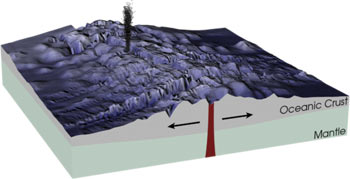
https://www.flickr.com/photos/10749411@N03/25774446790
https://flighttowonder.com/2024/05/19/i … r-is-lava/
Image Quote: 
Depending on precipitation rates and glacial flows, the Mid-Ocean ridge may be exposed more than just Iceland above water parts.
Ice dams may hold back the oceans and allow for a larger dry area where hot lava may be exposed. Things like Methane may react with the exposed lava to create water and perhaps CO2. Perhaps a place for life.
But I will admit the free Oxygen does not seem likely if it would come from plants.
As for a space fairing species such planets like this may be attractive if they can use orbital mirrors, geothermal, and various nuclear power methods.
So, maybe in the Centauri star systems there might be a chance for such?
For Proxima Centauri, a Mars sized planet at the cold level of Titan, such a planet may be hard to detect.
We might hope that young Red Dwarfs being nasty in flairs, may drive away the gasses early and cause the creation of Cold Rocky or Cold Terrestrial type planets that we have not yet been able to detect because of distance from the star.
Ending Pending 
Last edited by Void (2026-06-06 10:34:14)
Is it possible that the root of political science claims is to produce white collar jobs for people who paid for an education and do not want a real job?
Offline
Like button can go here
#2 2026-06-06 11:40:02
- tahanson43206
- Moderator
- Registered: 2018-04-27
- Posts: 25,016
Re: Cold Rocky (Terrestrial?) Planets
This post is reserved for an index to posts that may be contributed by NewMars members.
For Void, this post is an award for creating a topic that appears to have growth potential.
For SpaceNut, this post is an intentional reply to prevent an addition to the "topics without replies" list.
Index:
(th)
Offline
Like button can go here
Pages: 1