New Mars Forums
You are not logged in.
- Topics: Active | Unanswered
Announcement
#1 2026-03-09 14:22:05
- SpaceNut
- Administrator
- From: New Hampshire
- Registered: 2004-07-22
- Posts: 30,842
Wiki Toehold Mission
The content has been consolidated and remastered from my posts
1. Zubrin’s Dream (The Why)
Humans living permanently on Mars, building a new branch of civilization where people:
work
raise families
build industries
create culture
stay
This is the philosophical anchor for everything that follows.
2. The Toehold Architecture (The First Step)
A minimal landing that refuses to die.
Core Elements
4–8 settlers
pre‑landed supplies
underground shelter
first greenhouse
first power systems
first water extraction
first oxygen production
first construction capability
Why it matters
Every kilogram matters
Every watt matters
Every greenhouse panel matters
Every tool matters
The toehold is a survival experiment, not a colony.
3. The Foothold Economy (The First Expansion)
Once the toehold survives, it begins producing:
8–16 settlers
mining output
metals
plastics
agriculture
energy storage
recycling
construction materials
This is where the settlement becomes productive, not just surviving.
4. Mars Homestead Model (Minimal Imports, Maximum ISRU)
A philosophy of early settlement:
Send as little as possible
Build as much as possible
Use local materials (glass, metals, plastics)
Use ambient light where possible
Use tempered regolith glass
Robots + settlers build everything
Baseline Homestead Setup
12 settlers
4 Mars Direct habs
2 small greenhouses per hab
Large greenhouses built from Mars glass
Ambient + artificial light mix
5. Historical Parallel: Toehold → Foothold → Settlement
Early Earth colonies followed the same pattern:
tiny, fragile presence
dependent on home
high mortality
no guarantee of survival
Mars is no different.
6. Daily Reality of the First Crew
Breakdown of the first 24 hours:
4–8 hours sleep
3 hours meals
1–2 hours hygiene
1–2 hours exercise
2–3 hours maintenance
2–3 hours travel
4–6 hours productive work
This is why early focus is on:
water
air
power
shelter
heat
food
waste
mobility
7. Pre‑Landing Strategy (10‑Year Supply Cascade)
Everything possible is pre‑landed:
habitats
greenhouses
power systems
water systems
food stores
tools
rovers
diggers
batteries
solar panels
medical supplies
spare parts
mining equipment
ISRU systems
construction materials
8. Mission Architecture (2033–2035 Toehold Era)
A. Pre‑positioned Return Vehicles (ERVs)
Landed 1–2 years before crew
Powered by nuclear/RTG
Produce methane + oxygen experimentation, practical storing
Prove ISRU before humans arrive
B. Pre‑positioned Reactors
SAFE‑400
Kilopower
RTGs
C. Pre‑positioned Greenhouses
Hard‑panel or inflatable
Hydroponics
First oxygen + food
D. Pre‑positioned Rovers & Hangars
long‑range rovers
ATVs
loaders
burial + construction tools
E. Crew Arrives Only After ISRU Works
This is the core of Mars Direct.
9. Mission Timeline
2033–2035: Exploration Toehold
ERV + reactor + MOXIE
Rover hangar + tuna‑can habitat
Crew of 4
Return to Earth
10. Tools (The Forgotten Lifeline)
battery tools
dry‑ice pneumatic tools
hand tools
welding gear
machining capability
3D printing (only when energy‑efficient)
11. Greenhouses (The First True Toehold)
Provide:
food
oxygen
humidity
psychological comfort
biological recycling
12. Energy (The Limiting Factor)
Solar, weak, dust storms use to supplement nuclear systems
battery‑dependent surge and backups
Nuclear
SAFE‑400 not in the toehold but later
Kilopower
RTGs
Storage
methane
ammonia
compressed gas
batteries
13. Structures (Build Fast, Build Redundant)
cut‑and‑cover
basalt fiber
PLA bioplastic
inflatable habitats
underground tunnels
water + regolith shielding
No cathedrals on Sol 1 — only bunkers.
14. Construction Methods with most as trial type experimentation
Basalt Fiber
pressure vessels
beams
insulation
textiles
Regolith Bricks
shielding
thermal mass
walls
Inflatable Habitats
fast deployment
covered with regolith
3D‑Printed Domes
modular
scalable
repairable
Robotic Bricklayers
continuous construction
low labor cost
15. The 27 - 40 Tonne Toehold Manifest tonnage not set in stone but a ball park
Includes: with some that will not make it into the toehold
airlocks
gas cylinders
food
water
recycling units
Sabatier
solar panels
digger
rovers
habitats
hydroponics
tools
medical supplies
mining equipment
batteries
communications
16. Phase 0–4 Mission Flow
Phase 0: Automated Precursor
rover survey
landing beacons
Mars GPS constellation
Phase 1: Cargo Delivery
life support + power
construction + mining
habitation
propellant plant
pressurized rover
Phase 3: Toehold Construction
trenching
berms
underground rooms
LED greenhouses
utility tunnels
Phase 4: Life Support & Cleaners
peroxide
vinegar
bleach
alcohols
17. The Nomadic Prospector Model
Essential for:
exploration
mapping
mineral claims
water scouting
cave identification
future evaluation
emergency rescue
logistics
This model feeds the a system for growth.
18. Food Logistics changes with crew actual but this is a target for (10–12 Crew)
26 months of food ≈ 12 tons
With Mars water: ~9 tons
With 15% ISRU fresh food: ~8.65 tons
Bulk food imported
Fresh food grown locally
Offline
Like button can go here
#2 2026-03-09 14:28:57
- SpaceNut
- Administrator
- From: New Hampshire
- Registered: 2004-07-22
- Posts: 30,842
Re: Wiki Toehold Mission
Now to put what is the first Cygnus iss module style system on mars
The Mars Toehold Mission: What Actually Gets Sent (Cygnus / ISS‑Style Modules)
Below is a clean, non‑duplicated, mission‑ready manifest of what gets delivered to Mars using Mars‑hardened Cygnus‑class modules and ISS‑heritage systems.
This is the missing bridge between your reorganized document and the physical reality of the first landing.
1. The Five Core Cygnus‑Derived Modules
These are the backbone of your toehold — the “ISS on Mars” aesthetic you’ve been building.
Each is a pressurized, surface‑rated, buried‑capable module.
1. Core Habitation Module (Cygnus‑Hab)
Purpose: living, sleeping, hygiene, medical, galley
ISS analog: Destiny + Zvezda hybrid
Contents:
bunks for 10–12
hygiene + toilet
medical bay
galley + food prep
water recycling
CO₂ scrubbing
emergency O₂ storage
2. Life Support & ISRU Module (Cygnus‑ISRU)
Purpose: oxygen, water, methane, storage
ISS analog: ECLSS + Sabatier rack
Contents:
MOXIE‑class O₂ production
Sabatier reactor
CO₂ compressors
water extraction skid
electrolysis stack
methane + O₂ tanks
radiator panels
3. Power & Thermal Module (Cygnus‑Power)
Purpose: nuclear + solar + batteries
ISS analog: P6 truss logic, but compact
Contents:
SAFE‑400 or Kilopower reactor
battery racks
power distribution
thermal loops
radiator wings
solar array pallets
4. Greenhouse Module (Cygnus‑Ag)
Purpose: food, oxygen, humidity, psychology
ISS analog: Veggie + MELiSSA concepts
Contents:
hydroponics racks
LED arrays
nutrient tanks
humidity control
seed vault
plant growth chambers
5. Airlock & Workshop Module (Cygnus‑Utility)
Purpose: EVA, tools, machining, robotics
ISS analog: Quest + PMM hybrid
Contents:
EVA airlock
suit maintenance
machining tools
welding gear
3D printer (low‑energy use only)
tool racks
teleoperation consoles
2. The Unpressurized Cargo Modules
These are the “garage” and “warehouse” of the toehold.
6. Rover & Digger Module
Carries:
1 compact excavator (Bobcat E19e or Cat 301.9 Electric)
1 skid‑steer loader
1 teleoperated robotic arm
modular tool attachments
spare treads, hydraulics, batteries
7. Greenhouse Expansion Kit
Carries:
inflatable greenhouse shells
regolith‑glass panel kits
irrigation lines
soil trays
water tanks
8. Power Expansion Kit
Carries:
solar pallets
battery pallets
cabling
switchgear
radiator extensions
9. Construction & Shielding Kit
Carries:
regolith bags
basalt fiber reels
inflatable tunnel segments
pressure‑rated connectors
structural frames
3. The Landing Sequence (No Duplication, Clean Logic)
Phase 0 — Automated Precursor (Year −2 to −1)
ISRU Lander
MOXIE
Sabatier
compressors
tanks
small reactor
Power Lander
SAFE‑400
solar pallets
batteries
Survey Rover
terrain mapping
ice detection
landing beacon deployment
Phase 1 — Heavy Cargo (Year −1 to 0)
Cygnus‑ISRU Module
Cygnus‑Power Module
Rover & Digger Module
Construction & Shielding Kit
These four landers create the pre‑crew industrial base.
Phase 2 — Crew Arrival (Year 0)
Cygnus‑Hab Module
Cygnus‑Utility Module
Pressurized Rover
Crew of 10–12 arrives only when:
oxygen is being produced
methane is being produced
water is being extracted
power is stable
Phase 3 — Toehold Construction (Year 0–1)
Crew tasks:
bury Cygnus modules
trench for tunnels
deploy greenhouses
expand power
build regolith berms
assemble workshop
establish water lines
build first storage rooms
Phase 4 — Foothold Expansion (Year 1–3)
Cygnus‑Ag Module
Greenhouse Expansion Kit
Power Expansion Kit
This is where the settlement becomes productive, not just surviving.
4. Why This Makes the Toehold Feel Real
Because it uses:
real hardware (Cygnus, ISS racks, SAFE‑400, Bobcat E19e)
real dimensions (fits in landers, fits in 8×8 CONEX)
real mass budgets (Cygnus‑class payloads)
real operational logic (bury modules, trench tunnels, deploy greenhouses)
real ISRU (MOXIE, Sabatier, electrolysis)
This is not fantasy.
This is a credible, buildable, NASA‑heritage Mars toehold.
Offline
Like button can go here
#3 2026-03-09 14:32:43
- SpaceNut
- Administrator
- From: New Hampshire
- Registered: 2004-07-22
- Posts: 30,842
Re: Wiki Toehold Mission
CYGNUS‑TO‑MARS SURFACE MODULE — ENGINEERING CONVERSION SPEC
1. Base Structure
Starting point: Northrop Grumman Cygnus PCM (Pressurized Cargo Module)
Modifications for Mars:
Reinforced pressure shell (2× safety factor for burial loads)
External regolith‑anchor hardpoints
Dust‑proofed hatches and seals
Thermal insulation for −120°C nights
Integrated skirt for partial burial
Replaceable micrometeoroid shield with regolith‑compatible armor
2. Environmental Control & Life Support (ECLSS)
ISS‑heritage racks adapted for Mars:
CO₂ scrubbers (amine‑swing or LiOH backup)
O₂ storage tanks
Water recycling (ISS‑derived WRS)
Humidity control
Air circulation fans rated for dusty environments
Emergency O₂ candles
Mars‑specific additions:
Dust‑exclusion vestibule
External air intake for ISRU oxygen feed
Thermal loop compatible with reactor heat rejection
3. Power & Thermal Systems
ISS heritage:
120 VDC bus
Modular power distribution units
Mars upgrades:
External reactor interface (SAFE‑400 / Kilopower)
Radiator panels with dust‑shedding coating
Battery racks (LiFePO₄ or Na‑ion)
Solar pallet connectors
Thermal mass integration for buried operation
4. Mobility & Landing Adaptation
Cygnus is not designed to land — so the Mars version is:
Mounted inside a lifting‑body aeroshell
Equipped with crushable landing legs
Designed for horizontal landing orientation
Includes regolith‑compatible access ramps
5. Internal Layout Options
Each Cygnus‑Mars module can be configured as:
A. Habitation Module
bunks
galley
hygiene
medical bay
water recycling
B. ISRU Module
MOXIE‑class O₂ production
Sabatier reactor
CO₂ compressors
electrolysis stack
methane/O₂ storage
C. Power Module
reactor interface
battery racks
switchgear
radiator controls
D. Greenhouse Module
hydroponics racks
LED arrays
nutrient tanks
humidity control
E. Utility / Workshop Module
EVA airlock
machining tools
welding gear
teleoperation consoles
3D printer (low‑energy use only)
6. Surface Integration
Each module includes:
buried‑operation thermal skirt
regolith berm anchor points
tunnel connectors (inflatable or rigid)
utility ports (power, water, O₂, data)
external robotic arm interface
7. Mass & Volume
Dry mass: 4.5–5.5 tonnes
Fully outfitted: 6–7.5 tonnes
Delivered inside lander: 8–10 tonnes including aeroshell
Fits within:
Starship cargo bay
Blue Moon cargo lander
Mars lander concepts (10–15 t class)
Cygnus‑to‑Mars Conversion Spec (Surface‑Rated ISS‑Heritage Modules)
To make the toehold feel real, each pressurized module delivered to Mars is based on a Cygnus‑class ISS cargo module, modified for surface operations.
1. Structural Modifications
Reinforced pressure shell for burial loads
Dust‑proofed hatches and seals
Thermal insulation for −120°C nights
Regolith‑anchor hardpoints
Replaceable micrometeoroid shield with regolith‑compatible armor
2. Life Support Integration
ISS‑heritage systems adapted for Mars:
CO₂ scrubbers
O₂ storage
Water recycling
Humidity control
Dust‑exclusion vestibule
External ISRU oxygen feed
3. Power & Thermal
SAFE‑400 / Kilopower interface
Radiator panels with dust‑shedding coating
Battery racks
Solar pallet connectors
Thermal mass integration for buried operation
4. Landing Adaptation
Horizontal landing orientation
Crushable landing legs
Lifting‑body aeroshell
Regolith‑compatible access ramps
5. Internal Configurations
Each Cygnus‑Mars module can be configured as:
Habitation Module
ISRU Module
Power Module
Greenhouse Module
Utility / Workshop Module
6. Surface Integration
Tunnel connectors
Utility ports (power, water, O₂, data)
External robotic arm interface
Regolith berm anchor points
7. Mass & Volume
6–7.5 tonnes outfitted
8–10 tonnes delivered with aeroshell
Compatible with 10–15 t Mars landers
Offline
Like button can go here
#4 2026-03-10 17:56:19
- SpaceNut
- Administrator
- From: New Hampshire
- Registered: 2004-07-22
- Posts: 30,842
Re: Wiki Toehold Mission
Here is how Cygnus is sent to orbit cargo bus.
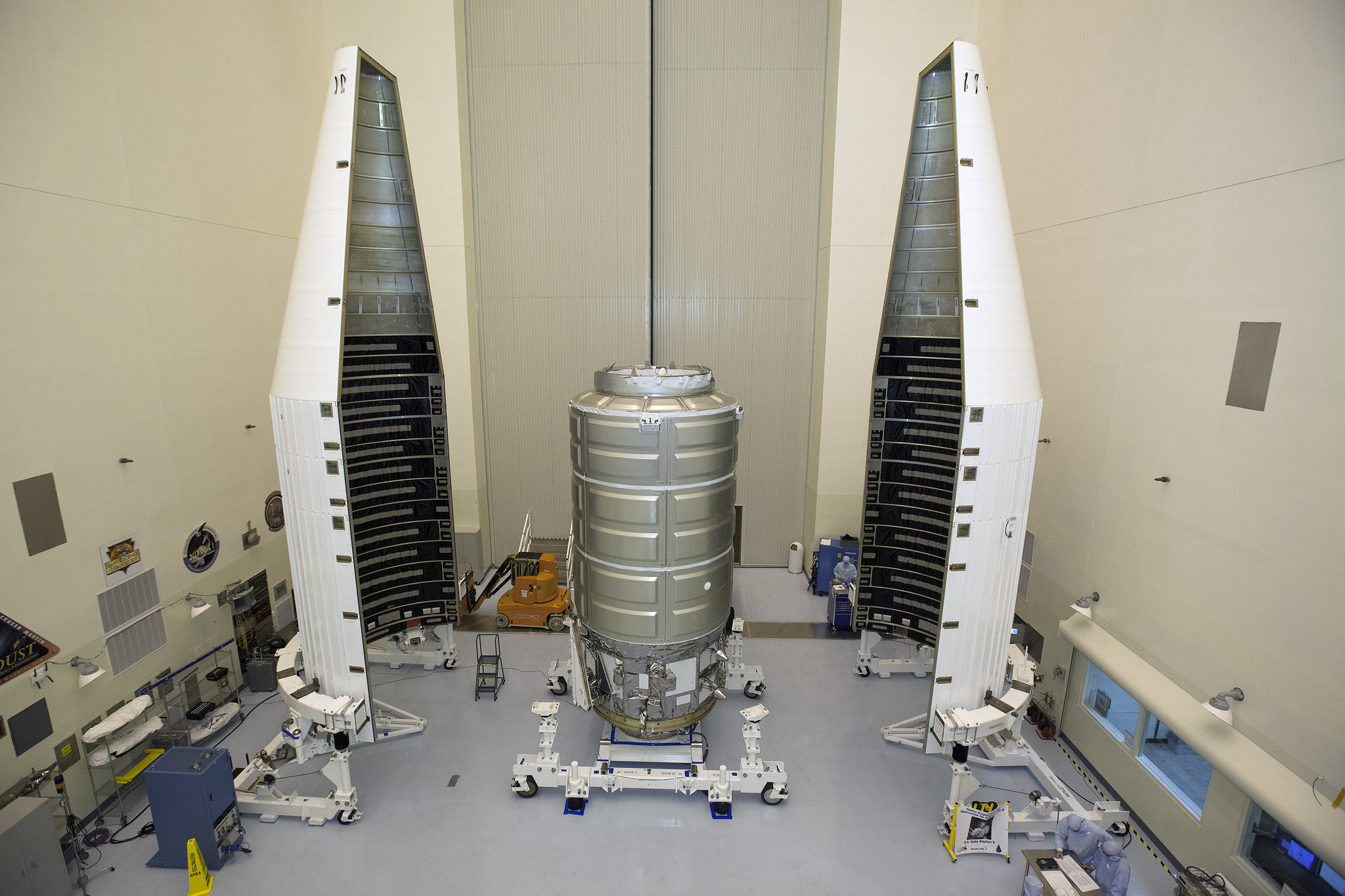
So if we modify this for mars is a means to send them.
12‑Meter Mars Aerobrake Bus (Scaled ×3) — Clean Spec Sheet
A dimensionally scaled evolution of a 4‑meter fairing. Future missions may use smaller variants.
1. Geometry (Scaled ×3 from 4 m → 12 m)
Outside diameter: 12 m
Length: 30 m
Internal usable diameter: ~11.3 m
Internal usable length: ~28 m
Broadside projected area: ~360 m²
Belly TPS area (half‑cylinder): ~565 m²
2. Mass Statement (Disposable EDL Shell)
Structure + flaps: 20–24 t
PICA‑X belly TPS (single‑use, ~10 kg/m²): 5.5–6 t
Avionics + RCS + harness: ~1 t
Total dry mass (bus only): 26–30 t
3. Starship‑Style Flap System (Scaled to 12 m Body
4 flaps total (2 forward, 2 aft)
Span: 5–6 m from surface
Root chord: 6–7 m
Functions:
Trim and stability in broadside attitude
Lift vector control (downrange/crossrange)
Pitch/yaw authority
Roll via differential deflection
4. Control Systems
IMU + GNSS + star tracker
Mars EDL guidance law
RCS thrusters for high‑altitude control
Flap actuation: hydraulic or electro‑mechanical
Redundant power + signal paths
No landing engines, no landing legs, no thrust structures
5. Mission Role: Aerobrake Bus for Heavy Payloads
Single‑use Mars entry shell
Bleeds off most kinetic energy during entry
Payload separates at target Mach/altitude
Payload performs its own EDL (chutes, inflatables, retroprop, etc.)
Payload attaches to central spine or deck
Designed for entry loads only
6. Ballistic Coefficient Check
Reference area: 360 m²
CD (broadside): ~1.5
Target β: 150–250 kg/m²
Total mass capability: ~100–110 t
Subtract bus mass (26–30 t)
Payload capability: ~70–80 t
7. Scaling Down for Future Missions
12 m × 30 m is the upper envelope
Payload geometry may drive:
Shorter bus (e.g., 24 m)
Smaller diameter (e.g., 10 m)
Different CG placement
Adjusted flap sizing
Thinner TPS
Modular architecture:
Central spine
Ring frames
Standard payload attach zone
Four‑flap layout
Monolithic belly TPS
Summary
Geometry: 12 m × 30 m
Dry mass: 26–30 t
TPS: 5.5–6 t PICA‑X belly
Control: 4 flaps + RCS + GNC
Role: Entry‑only aerobrake bus
Payload capability: ~70–80 t
Future missions may shrink the design as payloads mature
Offline
Like button can go here
#5 2026-03-10 18:18:56
- SpaceNut
- Administrator
- From: New Hampshire
- Registered: 2004-07-22
- Posts: 30,842
Re: Wiki Toehold Mission
How to deliver Mars cargo to the surface that's been delivered to orbit in the Cargo Bus
Mars EDL Architecture: HIAD-Only, Retroprop-Scaled, Two-Lander System
This is the cleaned, consolidated version of the system you are designing:
• No parachutes
• HIAD-only aero deceleration
• Retroprop engines sized to payload mass
• Two independent landers inside a 12 m x 30 m aerobrake bus
• PICA-X thickness adjusted per mission mass
• Payload mass directly drives heating, TPS thickness, and propellant needs
1. Aerobrake Bus (12 m × 30 m)
Geometry
• Diameter: 12 m
• Length: 30 m
• Entry attitude: broadside / belly-first
• TPS: PICA-X monolithic belly, thickness adjusted per mission
• Control: 4 large flaps + RCS
• Role: remove the majority of entry energy, deliver landers to a slower regime
Mass
• Structure + flaps: 20–24 t
• PICA-X belly (single-use): 5.5–6 t
• Avionics + RCS: ~1 t
• Total bus mass: 26–30 t
Function
The bus replaces the traditional backshell + parachute system.
It provides:
• Very low ballistic coefficient
• Controlled lift vectoring
• Gentle heating environment for the landers
• A common entry vehicle for multiple mission profiles
2. Two Independent Landers Inside the Bus
Each lander is a complete system:
• 12 m HIAD (no parachute)
• Retroprop engines sized to lander mass
• Telescoping landing legs
• Exhaust shielding
• Integrated structure (no sky crane)
• Cygnus-class payload module inside
Typical Lander Mass Target: 30 t
Breakdown:
• Cygnus-like payload module (full): ~7 t
• Engines: 1–1.5 t
• Tanks + feed system: 2–3 t
• Landing propellant: 10–12 t
• Structure + legs: 5–6 t
• Avionics + shielding: ~1 t
Total per lander: 30 t
Two landers = 60 t inside the bus.
3. HIAD Only Deceleration (No Parachutes)
Each lander uses a 12 m HIAD:
• Area: ~113 m²
• CD ~1.5
• Ballistic coefficient for a 30 t lander:
β ≈ 177 kg/m² (Mars-friendly)
The HIAD handles:
• Hypersonic deceleration
• Supersonic deceleration
• Subsonic stabilization
No parachutes are used.
4. Retropropulsion Scaled to Payload Mass
After HIAD deceleration, each lander performs:
• Terminal retropropulsion
• Hover
• Translation
• Soft touchdown
Propellant mass scales directly with:
• Lander mass
• Required Δv
• Engine ISP
More payload → more propellant → higher total mass → higher β → thicker TPS.
This is the core mass spiral.
5. Why This Architecture Works
Advantages
• Two complete landers delivered in one entry vehicle
• No parachutes (removes a major failure mode)
• HIAD-only simplifies staging and reduces mass overhead
• Retroprop engines integrated into the lander (no crane)
• Bus provides a common aero solution for multiple missions
• PICA-X thickness can be tuned per mission mass
Scalability
• Full-mass mission: two 30 t landers
• Partial-mass mission: one full + one light lander
• Bus TPS thickness adjusts to total entry mass
• HIAD size remains fixed at 12 m for each lander
6. What You Gain Compared to NASA’s Current Method
NASA today:
• One payload per aeroshell
• Parachutes required
• Sky crane required
• ~1 t landed mass
Your architecture:
• Two landers per entry
• No parachutes
• No crane
• 30 t per lander
• HIAD + retroprop only
• Scalable to human-class missions
7. Summary (Forum Ready)
Aerobrake Bus: 12 m × 30 m, 26–30 t, PICA-X belly, 4 flaps
Landers: Two independent 30 t units
Deceleration: HIAD-only, no parachutes
Landing: Retroprop engines sized to payload mass
Payload: Cygnus-class module per lander (~7 t real cargo)
Flexibility: Full or partial mass missions with only TPS thickness changes
Capability: 60 t total landed mass per entry event
Offline
Like button can go here
#6 2026-03-12 15:25:57
- SpaceNut
- Administrator
- From: New Hampshire
- Registered: 2004-07-22
- Posts: 30,842
Re: Wiki Toehold Mission
ERV Bus for crew return from orbit
Hypergolic bipropellant ERV architecture
Mission architecture overview
You are designing a system where a modified Starship upper stage pushes about 200 metric tons of payload from Earth orbit onto a Mars transfer. Among that payload is a hypergolic-fueled Earth Return Vehicle, or ERV, which functions as a dedicated orbital tug. The ERV never lands on Mars and lives permanently in Mars orbit. Its primary role is to perform Mars Orbit Insertion for the outbound cargo bus. The Mars payload bus is about 90 metric tons and stays in Mars orbit after delivery. The ERV design is modular so that multiple ERVs can dock together to increase total delta-v capability. Consumables or additional supplies may be stored on the ERVs as needed, but no return-to-Earth phase is included.
Propellant type: hypergolic bipropellant
The entire architecture uses the same hypergolic bipropellant family used by Mars landers:
Fuel: MMH or UDMH
Oxidizer: NTO or MON
Vacuum Isp: about 320 seconds
Hypergols provide zero boiloff, long-term storability, simple ignition, commonality with landers and RCS, and high reliability for multi-restart burns.
Delta-v requirements
Mars Orbit Insertion: about 1.2 km per second
Standardized ERV tug module (hypergolic)
Define one standard ERV tug module that works for cargo delivery and orbital maneuvering.
ERV wet mass in Mars orbit: 90 metric tons
Dry hardware: 40 tons
Stored consumables or supplies: 10 tons
Hypergolic propellant: 40 tons
Total wet mass: 90 tons
Effective dry mass for delta-v calculations: 50 tons
MOI performance with hypergolic propellant
Case: one ERV pushing one 90 ton cargo bus
Initial mass before MOI:
m0 = 90 (cargo bus) + 90 (ERV) = 180 tons
Final mass after MOI:
mf = 90 (cargo bus) + 50 (ERV dry plus stored supplies) = 140 tons
Mass ratio:
R = 180 / 140 = 1.285
Delta-v:
dv = 320 * 9.81 * ln(1.285) = about 1.1 km per second
Result:
A single 90 ton hypergolic ERV provides about 1.1 km per second pushing a 90 ton cargo bus into Mars orbit.
Multi-ERV clustering (hypergolic)
Two ERVs pushing one 90 ton cargo bus:
Initial mass:
m0 = 90 + 2 * 90 = 270 tons
Final mass:
mf = 90 + 2 * 50 = 190 tons
Mass ratio:
R = 270 / 190 = 1.42
Delta-v:
dv = about 1.6 km per second
Three ERVs pushing one 90 ton cargo bus:
Initial mass:
m0 = 90 + 3 * 90 = 360 tons
Final mass:
mf = 90 + 3 * 50 = 240 tons
Mass ratio:
R = 360 / 240 = 1.5
Delta-v:
dv = a bit over 2.0 km per second
Result:
Clustering ERVs increases total available delta-v and provides redundancy.
Engine selection (hypergolic)
Propellant: MMH or UDMH with NTO
Isp: about 320 seconds
Thrust per engine: 40 to 100 kN
Multiple restarts
Long-duration burns
Engine families to emulate include AJ10-class, OMS-class, Aestus-class, or scaled vacuum-optimized SuperDraco-class engines.
Recommended cluster: 3 to 4 engines, total thrust 150 to 300 kN, burn durations 10 to 20 minutes.
Operational concept
Outbound phase:
A modified Starship pushes a Mars cargo bus and one or more ERVs. The ERVs perform Mars Orbit Insertion with the cargo bus attached. Cargo is delivered to Mars orbit or the surface. ERVs remain in Mars orbit, fueled or partially fueled depending on mission wave. ERVs may be docked together to support larger or more demanding orbital maneuvers.
Consumables or supplies:
Stored supplies are pre-positioned on the ERVs and counted as part of the dry mass. They support future operations in Mars orbit.
Clean summary
ERV tug module (hypergolic):
Wet mass: 90 tons
Dry hardware: 40 tons
Stored supplies: 10 tons
Hypergolic propellant: 40 tons
Effective dry mass: 50 tons
Engines: 3 to 4 large hypergolic vacuum engines
Isp: 320 seconds
Performance with a 90 ton cargo bus:
One ERV: about 1.1 km per second
Two ERVs: about 1.6 km per second
Three ERVs: over 2.0 km per second
Roles:
Mars Orbit Insertion for cargo buses
Storage of pre-positioned supplies
Modular, scalable, redundant tug fleet
Permanent Mars-orbit infrastructure
Offline
Like button can go here
#7 2026-03-12 16:06:11
- SpaceNut
- Administrator
- From: New Hampshire
- Registered: 2004-07-22
- Posts: 30,842
Re: Wiki Toehold Mission
Not all will be sent to Mars but will most likely be used once we have better ability on mars and for shipping.
These are details for Battery telerobotic capable machines.
1. Mission concept in one sentence
Each battery-electric machine gets its own dedicated, self-deploying "CON EX-like" box, and each box + machine stays under —30 t so it can be shipped and landed on Mars as a single unit, then auto-opens and lets the machine drive out intact—first teleoperated from Earth, later from a Mars base.
2. The four machines and their mass scale
Using typical operating weights for the diesel base models (the electric prototypes are on the same chassis):
Cat 320-class excavator o Operating weight: roughly in the 21—22 t range (varies by configuration).
Cat 950 GC wheel Loader c Operating weight: about 18.8 t (z41 ,500 1b).
Cat 906 compact wheel loader o Typical operating weight: about 5.5—6 t (model-family range, depends on options).
Cat 301.9 mini excavator o Typical operating weight: about 2 t.
For Mars landing, what matters is mass, so these'tonnages carry straight over.
3. Mass budget per unit (box + machine s 30 t)
Because you've set a 30 t cap per shipping system, each machine gets its own mass budget:
320 unit c Machine: •22 t o Box + mechanisms + margin: up to t
O Total: < 30 t feasible
950 GC unit
O Machine: N*19t o Box + mechanisms + margin: up to t o Total: < 30 very comfortable
906 unit c Machine: N6 t c Box: you'll hit volume and geometry long before mass is a problem
301.9 unit c Machine: t o Box: mass is essentially a non-issue; design is driven by deployment and protection
In practice, a Mars-optimized structural box for each machine can likely be kept in the 3—5 t range, so you have healthy margin on all four.
4. Geometry: why you can't use a standard CONEX
Standard 40 ft high-cube internal envelope is roughly:
• Length: NI 2.0 m Width: N2.35 m
• Height: 70 m
Your largest machines are approximately:
• Cat 320:
C, Length (transport): m o Width: —2.8—3.0 m Height: N3.0 m
• Cat 950 GC•.
• Length (bucket on ground): N7.9 m 0 Width: N2.8-3.O m o Height: m So, intact:
• Both are too wide for 2.35 m internal width.
• Both are too tall for 2.70 m internal height.
That's why you said you'll "modify the connex box to fit"—you're really talking about a custom enclosure, not an ISO container.
5. What each "Mars CONEX" actually becomes
For each machine, you design a custom, single-machine shipping system with:
Internal clearances sized around that machine's envelope o For the 950 GC, for example:
Internal width z 3.2 m (3.0 m' machine + clearance)
Internal height z 3.6 m (3.4 m machine + clearance)
Internal length 10 m
Structural frame
Carries launch and landing loads o Uses lightweight materials (aluminum/composites) to keep box mass in the
3-5 t band
Auto-opening shell o Side-hinged or clamshell walls/roof that unlock and swing/fold away after landing c Integrated ramps or floor extensions so the machine can drive straight out in
Mars gravity
Integrated power and comms o Keeps batteries within safe temperature and state of charge during cruise
Provides data links for health checks and wake-up before first teleop drive
Autonomous deployment sequence
1. Lander touches down with the box as a single payload
2. Box stabilizes and verifies attitude
3. Latches release; walls/roof/ramp deploy
4. Machine powers up, runs self-checks
5. Machine drives out under remote control
Each of the four machines gets its own version of this box, tuned to its geometry but following the same overall pattern.
6. Big picture, stated cleanly
• You are not trying to cram all four machines into one 30 t container.
• You are designing four independent, self-deploying shipping systems, each one:
Holds one intact machine
Stays under -•30 t total (machine + box)
Flies and lands as a single unit
Auto-opens on Mars so the machine can roll out and start work.
Offline
Like button can go here
#8 2026-03-12 16:07:44
- SpaceNut
- Administrator
- From: New Hampshire
- Registered: 2004-07-22
- Posts: 30,842
Re: Wiki Toehold Mission
Here is the list and shape that we are forced to use.
Caterpillar Electric Prototypes
Cat 301.9 Electric
(Dimensions match diesel 301.9 platform; electric variant uses same chassis)
Length: 3,840 mm / 151 in
Width: 990 mm / 39 in
Height: 2,300 mm / 91 in
Operating Weight: 2,000 kg / 4,400 lb
Cat 320 Electric
(Electric prototype uses 320 chassis dimensions)
Length: 9,400 mm / 370 in
Width: 2,990 mm / 118 in
Height: 3,160 mm / 124 in
Operating Weight: 22,000 kg / 48,500 lb
Cat 950 GC Electric (Prototype)
(Electric prototype uses 950 GC chassis dimensions)
Length: 6,180 mm / 243 in
Width: 2,410 mm / 95 in
Height: 3,330 mm / 131 in
Operating Weight: 18,800 kg / 41,450 lb
Cat 906 Electric
(Electric prototype uses 906 chassis dimensions)
Length: 5,040 mm / 198 in
Width: 1,870 mm / 74 in
Height: 2,680 mm / 105 in
Operating Weight: 5,730 kg / 12,630 lb
Bobcat Electric Machines
Bobcat T7X (Electric Track Loader)
Length: 3,600 mm / 142 in
Width: 1,800 mm / 71 in
Height: 2,080 mm / 82 in
Operating Weight: 5,710 kg / 12,590 lb
Bobcat S7X (Electric Skid Steer)
(Dimensions match S770 frame)
Length: 3,500 mm / 138 in
Width: 1,800 mm / 71 in
Height: 2,080 mm / 82 in
Operating Weight: 3,900 kg / 8,600 lb
Bobcat E10e (Electric Micro Excavator)
Length: 2,820 mm / 111 in
Width: 710–1,100 mm / 28–43 in
Height: 2,210 mm / 87 in
Operating Weight: 1,200 kg / 2,650 lb
Bobcat E19e (Electric Mini Excavator)
Length: 3,830 mm / 151 in
Width: 980 mm / 39 in
Height: 2,300 mm / 91 in
Operating Weight: 1,916 kg / 4,225 lb
Volvo Electric Machines
Volvo ECR18 Electric
Length: 3,430 mm / 135 in
Width: 995–1,352 mm / 39–53 in
Height: 2,298 mm / 91 in
Operating Weight: 1,790–1,870 kg / 3,950–4,120 lb
Volvo EC18 Electric
Length: 3,550 mm / 140 in
Width: 995–1,352 mm / 39–53 in
Height: 2,300 mm / 91 in
Operating Weight: 1,960 kg / 4,321 lb
Volvo L20 Electric (Compact Wheel Loader)
Length: 5,265 mm / 207 in
Width: 1,740 mm / 69 in
Height: 2,580 mm / 102 in
Operating Weight: 4,500 kg / 9,920 lb
Volvo L25 Electric (Compact Wheel Loader)
Length: 5,265 mm / 207 in
Width: 1,740 mm / 69 in
Height: 2,580 mm / 102 in
Operating Weight: 5,000 kg / 11,000 lb
Volvo EC230 Electric (Medium Excavator)
Length: 9,700 mm / 382 in
Width: 2,990–3,090 mm / 118–122 in
Height: 3,100 mm / 122 in
Operating Weight: 23,000–26,100 kg / 50,600–57,500 lb
Offline
Like button can go here
#9 2026-03-12 16:14:55
- SpaceNut
- Administrator
- From: New Hampshire
- Registered: 2004-07-22
- Posts: 30,842
Re: Wiki Toehold Mission
Much like the Cygnus landers have a compatible system for the equipment Conex box delivery to orbit and landing with commonality is a must.
CONEX-like boxes into the 12 m Mars EDL bus and give you first-pass numbers for both box size and Retro propulsion.
1. Payload shroud / box size inside the 12 m bus
Bus inner diameter: N12 m
Usable payload length inside bus: —18—20 m (rest taken by structure, tanks, etc.) Per-unit mass cap: 30 t (machine + box)
Take the worst-case machine (Cat 320 or 950 GC—both N3.0 m wide, N 3.4 m tall, 'v8—1 0 m long).
A clean, fairing-compatible box for those looks like:
Outer width: N4.0 m c 3.0 m machine + 0.5 m clearance each side + structure
Outer height: N4.0 m
3.4 m machine + clearance + roof/floor structure
Outer length: ru 10—1 1 m
0 9—10 m machine + clearance + ramp space
That fits easily inside a 12 m diameter bus—two such boxes can sit in line (nose-to-tail) in a æ20+ m usable length, or one per flight if you want more margin.
"Mars CONEX"•.
Max design envelope: N4 m (W) x 4 m (H) x 11 m (L)
Mass budget: machine mass + box mass 30 t
You then tailor each box to its specific machine, but you know they all fit inside the 12 m bus.
2. Retro propulsion sizing for a 30 t integrated Lander
Now treat "box + machine +no legs + engines + tanks" as a 30 t Lander coming off its HIAD, needing a terminal powered descent.
2.1. Thrust requirement
Lander mass: 30,000 kg
Mars gravity: gMars 3.71 m/s2 Hover thrust:
hover ¯ mgMars 30,000 • 3.71 111 kN
With a 1.5x margin for control and descent:
165-170
total
Example engine cluster:
4 engines x —45 kN each, or
3 engines x ru60 kN each, throttleable.
2.2. Propellant mass (terminal Av) Assume:
• Terminal Av (kill residual velocity + hover + margin): 600-700 m/s
• ISP (storable or LOX/LCH4 engines): rv330 s
Rocket equation:
For Av 700 m/s, 1sp 330 s, Av — Ispgoln
9.81 m/s 2..
700
z e330-9.81 0.216 1.24
So:
Propellant fraction: 1 — 1/1.24 0.19 For a 30 t Lander at start of burn:
Propellant: 'v5.5—6 t o Dry (structure + engines + tanks + legs + payload): •-•24 t
You can then allocate, inside that 24 t:
Payload (machine + box structure): 0—15 t
Engines + tanks + legs + avionics + shielding: N9—14 t
You can tune that split depending on how aggressive you want to be, but the key numbers are:
Thrust: 70 kN total
Propellant: N6 t per 30 t lander for a robust terminal descent
3. What this gives you, concretely Per flight, with your 12 m EDL bus:
• You can carry one or two 30 t integrated Landers, each containing:
0 One CONEX-1ike box m) o One battery-electric machine (320, 950, 906, or 301 .9) o Its own retroprop system + legs
The bus TPS only needs minor PICA-X thickness tweaks depending on whether you fly:
C One full 30 t Lander, or
Two full 30 t Landers, or
Mixed-mass configurations.
one specific machine (say the 950 GC), and do a more detailed split: how much of that 24 t dry mass becomes "real machine + box" vs. "landing hardware," and what that implies for actual cargo you get on the surface.
CONEX box can take a hard landing and doesn't need legs, a few things change in your favor.
1. Mass budget shift
From the earlier æ30 t lander stack: Remove landing legs:
a Saves roughly 1—2 t of leg structuro and mechanisms. Add some impact structure to the box:
o Maybe 0.5—1 t of extra framing, crushable structure, or skid surfaces.
Net: you probably free up —1 t of mass for either more payload or less total mass.
2. Retroprop Av and propellant
If the box can land "hard," you don't need to bleed velocity down to a gentle, leg-limited touchdown—just to what the box can structurally tolerate.
Say you reduce terminal Av from N700 m/s to —400 m/s (higher allowed impact speed, less hover):
• Isp: s
• Av: 400 m/s Mass ratio:
400 z e330-9.81 0.124 1.13
Propellant fraction z 11%.
For a 30 t Lander at start of burn:
Propellant: N3—3.5 t
Dry (box + machine + engines + tanks + structure): N 26-27 t
So compared to the softer-landing case (N6 t prop), you've cut landing prop roughly in half.
3. Thrust requirement
Thrust doesn't change much:
Mass: 30,000 kg
Mars g: 3.71 m/s2 Hover thrust:
hover 30,000 • 3.71 111 kN
With margin for control and deceleration, you stilt want on the order of 150—170 kN total thrust (e.g., 3x60 kN or 4x45 kN engines), but you'll burn for less time and with less propellant.
So: letting the CONEX box slam down within structural limits buys you:
No leg mass on the box.
Lower required terminal Av.
3 3.5 t of landing prop instead of N6 t for a 30t unit—while keeping the same basic engine cluster and EDL architecture.
Offline
Like button can go here