New Mars Forums
You are not logged in.
- Topics: Active | Unanswered
Announcement
#1 2025-08-12 07:22:13
- tahanson43206
- Moderator
- Registered: 2018-04-27
- Posts: 23,409
Ferris Wheel in Space as Orbiting Hotel
This topic is offered for NewMars members who might wish to contribute links, images or test in support of the proposition that the shape and functionality of an on-Earth Ferris Wheel can be adapted for an orbiting Hotel.
Recent work by GW Johnson indicates that a spacecraft powered by LH2 and LOX can achieve LEO as an SSTO if it is launched vertically and has a drag coefficient of a cylinder with a conical nose cone.
Such a spacecraft would be of the form that would serve admirably as a module for human habitation. We already have the Skylab experiment as an example of what that would look like.
Artificial gravity can be achieved by mounting 2 or more of these habitats on a rotating structure.
This topic is available for NewMars members who might be interested in adding details to this concept.
(th)
Online
Like button can go here
#2 2025-08-12 07:22:50
- tahanson43206
- Moderator
- Registered: 2018-04-27
- Posts: 23,409
Re: Ferris Wheel in Space as Orbiting Hotel
This post is reserved for an Index to posts that may be contributed by NewMars members.
Index:
(th)
Online
Like button can go here
#3 Today 15:45:34
- SpaceNut
- Administrator
- From: New Hampshire
- Registered: 2004-07-22
- Posts: 29,886
Re: Ferris Wheel in Space as Orbiting Hotel
The world’s first space hotel is set to launch in 2027
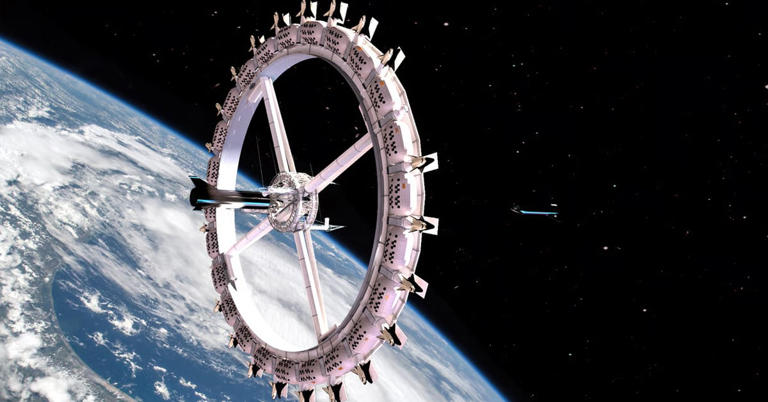
For decades, the idea of checking into a hotel among the stars has been confined to the realm of science fiction, but that is about to change: the world’s first true orbital resort is now set to launch in 2027. This groundbreaking facility promises to redefine luxury tourism, offering amenities far beyond what one would expect from a mere space station; guests will be able to enjoy fine dining restaurants, fully-stocked bars, a gym, a concert hall, and even a cinema, all while orbiting the planet. But while the opening year is confirmed, the question remains: How exactly will this colossal structure generate gravity for its guests, and what astronomical price tag will come with a room key to the cosmos?
How vacationing in space will become a reality
The era of space tourism is on the horizon, and it’s set to reach new heights in 2027 with the launch of Voyager Station, the world’s first hotel in orbit, developed by Above: Space Development Corporation (formerly Orbital Assembly Corporation). This state-of-the-art luxury resort will circle the Earth while providing artificial gravity, accommodating up to 280 guests and 112 crew members at a time.The station’s innovative design draws inspiration from decades of aerospace research, including the rotating wheel concept originally envisioned by Wernher von Braun. By spinning at roughly 1.5 rotations per minute, Voyager Station will initially replicate the Moon’s gravity and can later be adjusted to mimic conditions on Mars or even Earth, ensuring a comfortable stay for visitors.
Launching from Kennedy Space Center, Voyager Station promises unforgettable experiences above the planet. Upon arrival, travelers dock at a central zero-gravity hub before moving via pressurized elevators to the outer modules, where artificial gravity creates a familiar, Earth-like environment.
What guests can expect aboard Voyager Station
Voyager Station is designed as a vast rotating ring, consisting of 24 specialized modules and spanning approximately 125,000 square feet. Each module serves a distinct purpose, creating a seamless blend of luxury, entertainment, and innovation for guests in orbit. Visitors can enjoy gourmet meals and drinks at the onboard restaurant and bar, attend live musical performances in a concert hall, and stay active in a gym that creatively takes advantage of low gravity. A cinema provides both classic films and exclusive space-themed content, while observation decks offer breathtaking panoramic views of Earth.Guests will move between modules through pressurized transfer shafts, ensuring safety and comfort throughout the station. Before their journey, all travelers undergo comprehensive training to familiarize themselves with zero-gravity movement, the use of space equipment, and emergency procedures. Voyager Station itself is equipped with advanced life support systems and emergency protocols, giving visitors peace of mind as they experience the wonders of space. The result is a meticulously planned, immersive adventure that transforms the idea of a vacation into a truly out-of-this-world experience.
The price of staying in space
For now, space travel remains the domain of the ultra-wealthy — a single trip can cost tens of millions. One early example is Oliver Daemen, a Dutch teenager who became the youngest person to travel to space when he paid $28 million for a brief flight with Blue Origin, the aerospace company founded by Jeff Bezos that specializes in suborbital and orbital space tourism. But the team behind Voyager Station aims to change that. Their vision is to make space vacations more comparable in price to luxury cruises on Earth. According to Tim Alatorre, co-founder, COO, and chair of the board at Above Space, the station itself is relatively affordable to construct; the primary expense lies in reaching orbit.Alatorre notes that advances by companies like SpaceX could soon dramatically reduce launch costs, bringing orbital stays within reach for a wider audience within the next decade. Experts say this initiative represents a historic turning point, because for the first time, everyday people, not just trained astronauts, will be able to live, dine, and exercise in orbit.
How commercial space is heating up
Voyager Station isn’t venturing into uncharted territory alone. Other companies are making strides in commercial space as well. Axiom Space, in partnership with NASA, is developing a commercial module on the International Space Station that will eventually evolve into an independent platform. Meanwhile, Blue Origin and Sierra Space are collaborating on Orbital Reef, a new commercial space station.What sets Voyager Station apart, however, is its singular focus on tourism. Designed with entertainment, leisure, and hospitality at its core, it promises an experience unlike any other in orbit. To prepare for the full-scale station, Above Space will test smaller prototypes — the Gravity Ring and Pioneer Stations — by 2025, refining the technology and ensuring a seamless experience for future guests.
Beyond offering an unforgettable vacation, Voyager Station opens the door to a host of other opportunities. The orbiting resort will support scientific research, educational programs, entertainment ventures, and entirely new ways of working in space, ushering in a bold new era of human activity above Earth. With tourism at the forefront, the station represents a major leap toward making space not just a destination, but a thriving, multifaceted environment for exploration, learning, and leisure.
Offline
Like button can go here