New Mars Forums
You are not logged in.
- Topics: Active | Unanswered
Announcement
#9276 Re: Life support systems » The use of hydrostatic pressure on Mars. » 2012-03-19 16:05:25
The profit margin is what matters.
I have edited my first response. I think I can do better.
It is a matter of prereferences. You could put forward the "It's my or the highway" attitude, but I might say, that there are various places and conditions on Mars, and I am not an enemy of pressure suits, especially counter pressure suits.
However there will be two budgets. One will be for maintainence, and one will be for expansion.
I really do not think that large money will be expended from either budget so that small children can hang out outside of the habitat. It would be spent on suits, so that well prepaired adults could do real and necessary work needed for survival and profit.
If that society were to work it's children, I would expect their chores would be mostly indoors.
And I do believe that it is unwise to have children accumulate radiation exposure before they have been raised and have become old enough to have had their children.
Outside would best be reserved for rational adults past prime, and still physically fit.
And I do believe that the best future is avatar machines, with which all persons including children could experience the Martian surface, such as smelling it, and seeing it in ultra violet light, and so on.
I actually have notions on a radically different type of Robot/Avatar. However it would be for heavy and crude work, but would compliment and also support the robots that NASA has been doing work on. The logic of it's structure is quite different.
So, you see a person and a child person as well, could do work from within the habitat, perhaps running a avatar/robot, and it could be structured like a video game, and not made into some repugnant task. (Although usually we make our own realitys a hell by our lack of perception of what truely matters).
And further, that child could in the same day swim in a diving bell filled with air at the bottom of an ice covered reservoir, and could in addition travel in a submarine, and could in addition run an underwater avatar, and could walk from one settlement to another in an underground tunnel lighted artificially, and filled with apple trees.
Not exactly being locked up in a tin can is it?
But returning to people working outside, the necessary work would be done by the most cost effective and morrally acceptable methods.
#9277 Re: Life support systems » The use of hydrostatic pressure on Mars. » 2012-03-19 08:35:52
GW Johnson
Well, thanks! I have carried this for a very long time, and am pleased to pass it on in some form. It is old for me, so I have further options to describe.
JoshNH4H
I prefer a shake out, to be forced to be "Real" so thanks as well. Of course now I will continue.
Much of Mars will never be covered with water. The parts that make the most sense to cover at this time have the qualities of being suitable to hold a water cover, and also haveing large quantities of ice, and also the biggest prise is the precipitation which will always be dominantly at the polar ice caps (Until the axis of Mars changes in several 10,000 years).
So actually there are several options, and in my view they should all be used. However walking about in a pressure suit on the surface of Mars is going to be for adults only with rare exceptions, and such adults will have to be of a competent mind and in excellent health, and well trained. Even with that there will be risks such as radiation, so it would not be a prefered activity, just at times necessary. I would think that when possible avatar type virtual reality systems would be prefered over that when they could acctually acomplish a certain task.
I am guessing that a minority of Mars will ever be covered with water, and so the rest will require "Dry" methods. However if we capture the percipitation of the poles and create a reservoir that both is involved in energy production and having a large reservoir of water, then it is reasonable to draw water from those reservoirs, and "Pipe/Canal" it to locations dry to use as may be economically productive.
As for the layer of ice being too thick, the Dry Valley lakes in Antarctica do have photosynthisis in the top layers. The nature of those salty lakes is that the top layer is colder, and fresher, and has Oxygen in it. The lakes being isolated, they havea very limited number of species. Otherwise without the isolation, I expect that complex plants would have evoved to live there. However Photosynthis is limited. There is no point in acting like that is not true. The thickness of the ice could actually be thinner in places, to promote Photosynthisis, but of course then divers would have to be very careful not to get too high in the water column. Special safety measures would have to be employed. Keep in mind that under some circumstances ice can be much more transparant than we typically experience in our Temperate Earth Environments.
GW Johnson,
Although I have mentioned above that Photosysthisis does occur in the Dry Valley Lakes of Antarctica, I agree that it would be a weak boilogical system, perhaps strengthened by biological engineering to produce plants that are complex, and make the best use of the wavelengths available.
However I more favor Chemosynthisis. Methane seeps, Hydrothermal vents. All replicated artificially. Oxygen supplied, Chemical foods supplied, by industrial processes. Shellfish could extract calcium from the water which would disolve from the soils. The shells becomming a resource, perhaps for concrete?
Some of these life forms as food.
It is also true that the bottom of our ocean under the soil supports a living system without sunlight, just off of the reactions of chemicals, and from what I understand, that is very powerful. I don't know if some of it's properties of life would emerge into the water as well, but I am thinking it would.
Also I do support the use of transparent domes at low pressures, so that plants of a land type could be grown. Again, I am guessing eventually crops would be available which could be grown at 50 millibars, 20 Millibars and whatever, and so those domes could be pressurized accodingly to grow such a crop to produce bulk plant matter, and again in this case, waste plant matter could be dropped into water pools to support life. If these low pressure domes produced an excess of Oxygen, then that also could be injected into the water pools to support life.
Safety and also the happiness of humans: I see the value of creating some small very safe and rugged domes where humans could experience "Parks" the parks could have skylight sections where they could sit under the stars and moons, or sun themselves. However a safety feature might be a deep pool of water with an exit on it's bottom (And emergency Breathing apparatus at the bottom as well). If the dome became dangerous due to a drop in pressure or fire, or bad atmosphere,
then I presume well maintained alarms would direct them to dive into the pool and seek safety at the bottom.
Thanks much.
#9278 Re: Life support systems » The use of hydrostatic pressure on Mars. » 2012-03-18 15:06:08
I didn't know that gloves could come off that way for up to 10 minutes at a time. I bet if feels funny, and perhaps not all that good for you, but sometimes delicate work has to be done. Thats something.
Well, your responses were far more kind and generous than I was expecting.
And hopefully you will not mind if I expand the conversation around this subject.
Here is a link to such a lake in Antarctica:
http://en.wikipedia.org/wiki/Lake_Vanda
A nuclear reactor in the habitat at the bottom of the Lake would make sense, because if it were carfully managed, it could perhaps dump heat into the lake.
The lake would also be a direct solar collector. However, Mars of course does not have the same solar flux, perhaps > 1/2 that of the Earth, and also subject to dust
storms.
I do make the point that extra heat could be dumped into the bottom of the lake by boiling water in solar concentrators distrubuted around the lake, and then turning
a turbine, and quenching the steam directly into the lake water. So, the lake would serve the utility of being a part of a condensation process, and and also as a
energy storage, method, since during the nights, (And the terrible cold winters at higher lattitudes), the lake could serve as a source of heat to drive a different
boiling process where Ammonia might be boiled. Of course this implies metal radiators to dissapate the heat, and recondese the ammonia at the surface. However, I
have been contemplating cisterns inside of sheds filled with an Ammonia/Water mixed solution, to again quench the Ammonia steam. The cisterns might actually be
hollows in the ground with stone/tile floors and walls, and inside of that bags suitable to tollerate the solution and also the temperatures. The purpose of the
sheds would be to protect the bags from UV light during the day, and also to shade the condenser bags, and I suppose to keep the abrasive dust of the Martian
environment at bay to a degree. The sheds might have an open wall though facing the polar direction, to allow heat to radiate out, or perhaps just a transparent
layer of "Plastic film". Whatever that would be, it would be desired that it had the minimum greenhouse effect and let heat radiate out of the bags.
So, the nuclear power might be an small part of the power sourcing, but desired, in case of a major fault on the solar driven power system.
So, with much electricity, it becomes reasonable to think about a large industrial infrastructure. I suggest that this would be implemented in tunnels in sandstone
or other rather soft rock, under the lake. Of course some processes would work better on the surface in buildings built there.
I think that such tunnels would actually be a good place to grow fruit trees under artificial light. The artificial lights would be modulated in accordance with
power availablity, since trees are used to illumination variance due to clouds and changing seasons. Thus this would be a load leveling method, a method to utilize
scrap power, when there was an excess of power. The interesting thing is if it was apple trees, you could let the tunnels cool down and perhaps put in very little
light during the winter. However, I am not sure what the apple trees humor would be about having seasons twice as long. This would then be food, and wood, and also
"Parks" for people to spend leisure time in. So this could have significant value.
In the end my dream would be to fill the entire Northern basin back up with an ice covered sea. However the transformation to this situation would be long and hard.
I could mention several impediments to that. Such as the likelyhood that there is not enough water available to fill that flat baisin to 100 feet deep, and there
is no certainty that it would be a salty body of water. If it were to be, then the salt would have to exist under the soil, a remnant of the ocean that existed
Billions of years ago.
However if achieved, then the point northern condensation would be captured, and any ice and snow condensation would be melted from below, the solar concentrators ubiquitous on top of the ice layer. In such a case, I would presume terraformation at that point would have created an atmospheric pressure of at least 10 to 20 millibars. The need to shield the ice from sublimation would be reduced or eliminated, since you would have a continuous source of make up water from the condensation on the surface of the north pole, which would be continuously melted from below.
The I would expect a lesser sized ocean covered with ice, and likely not as salty as I would prefer. However, it would be easy to dyke off "Polders" to fill with properly salty water, to allow for bottom water of 23 C (73 F) and more.
Trucks that were partially boyant but traveled under the ice would be an option. They actually could run on roads on the bottom of the Ocean/Sea/Lake, or perhaps
could be very boyant, and connect to rails, under the ice, attached to the bottom of the ice surface. Subs? Yes.
#9279 Life support systems » The use of hydrostatic pressure on Mars. » 2012-03-17 11:32:22
- Void
- Replies: 17
In the past, I have made attempts to suggest at various websites that a good way of pressurizing a habitat is to have it at the bottom of a lake. Of course on Mars having a lake requries significant work. However the reason I am posting this is the hope that I could get feedback on why I never got what I considered a serious answer on the notion. I really don't care if it is ever done, it annoys me that I don't think that I ever got a killer reason why it shouldn't be attempted.
In the past, I did get the notion that Mars is completely Arid, and that a pool of water would simply sink into the rigolith.
Here is a link which suggests that this may not be true if you are in the northern or sourthern half lattitudes (And I susspect that if you had a supply of water that it could be done at lower lattitudes as well).
http://science.nasa.gov/science-news/sc … artianice/
The notion as put forward originally included emulation of Dry Valley Lakes in Antarctica. But on Mars manipulation of the environment would be required.
In it's present condition, it would be needed that a supply of make up water be available at a location accessable.
-Ice must cover the lake. To protect the ice from sublimination, mechanical means are required. (See articles on this site about IceCrete). I generally expect that a vapor barrier covered by a layer including glass windows is required (Just a little pressurization might be prefered).
-Salt in the water is prefered. In that condition the bottom of the lake could well experience terrestrial temperatures. (Google for Antarctic Dry Valley Lakes).
-Generally the notion of living underwater is not practicle, on Earth. Why do it. if you can walk about on the surface. On Mars, however, this equasion of preference does not hold true.
If I had an arcificial dry valley lake on Mars, I could:
1) Put on a swim suit suitable for a man (In order not to scare people), and have a breathing apparatus and go out in the bottom of the lake and touch a rock with my bare hands, and hold a handful of soil with my bare hands. I might expect the possiblity of temperatures I could endure, or even be comforatable with.
2) Build an arch type stone structure under the water on the bottom of the lake, and fill it with air, and cover it with soil so that the bubble of air within it did not explode it with boyancy. I would then have a underwater "House".
3) Dig tunnels under the lake into the rock. Create habitats there.
4) Perhaps have photosynthisis occuring in the cold layer of relatively fresh water just under the ice. With gentic engineering perhaps have crops growing there, production of food.
Anyway, I am fearful of the notion of glass domes, pressurized. The slightest break, and the pressure leaks out.
Hydrostatic pressurization is not like that. A leak means that sublimation is slowly taking the ice layer away that covers the liquid water (Which would scab over with ice if exposed to Martian Pressure). This would be a thing that could be addressed before lethal conditions occured.
Anyway, I am wondering what is against this set of notions?
#9280 Re: Exploration to Settlement Creation » Iron and Steel on Mars » 2012-03-17 10:42:57
I like it.
#9281 Re: Terraformation » Venus » 2012-03-17 10:09:47
You were beyond my scope in speculation on the Fusion blast. I don't dispute it, I just avoid it since I am not qualified to comment.
I was one of many who have speculated on fantastical Star Treckie notions. Out of desparation.
However if you want to boil off the Venus Atmosphere, Nasa suggested an Asteroid impact. However that would take thousands of years to cool off I believe. I can't wait that long.
Besides, it seems wasteful, since the Nitrogen in particular could be so helpful to Mars.
Perhaps a Microwave power source in orbit could overheat the upper layers of the Atmosphere of Venus. Plasma being magnetic, is there then a way to capture some of the bubble produced. (I believe that the sun actually produces such explosions/bubbles, and did so recently).
Then can the mass be accumulated into a container of some kind. (I presume the plasma has to yield it's energy, and become a liquid phase of solid phase through cooling).
This also requires make up energy, to hold the accumulated mass into orbit.
Then can it be transported to Mars? Star Treckie again I suppose, but Venus is about hopeless. And anyway talk is cheep. Don't bill me so much.
#9282 Re: Terraformation » Interstellar Terraformation » 2012-02-24 18:13:36
OK,
I will add to that:
http://www.physorg.com/news/2012-02-gal … anets.html
So, in any discussion of human travel from one star to another, it seems only reasonable to add as a very important precursor, the ability to find, and utilize these objects. I think that between the various views expressed there is some real options to expand into such a collection of objects, particularly if some of them are magnetic, and have moons, or have materials available to make large concentrating mirrors, or if Fusion or something else are available as an energy supply.
I am inclined to favor trying to find a Jupiter, because if it had an IO, then it would have boiled off it's water and exposed silicate materials to use. Also a Jupiter with a moon or two has energy available from the inertia of those moons, and also the tidal energy captured as heat in the moons in some cases.
Of further interest could be an "Earth", or "Venus" cast out of it's solar system. Having a hot core still, and likely a magnetic field (Venus would convect if it cooled off in the outer solar system?), Plate Tectonics would likely expose hot rock at the points where oceans spread, if it could spread faster than cold ice could flow over it. This also could be an energy source for starting a civilization on such a planet.
#9283 Re: Terraformation » Interstellar Terraformation » 2012-02-21 17:50:21
It seems to imply that the outer Oort cloud is limited in mass, but does not specify the mass of the inner disk of the Oort cloud.
My interest would be to find significant objects (Ceres, or Juno size or bigger) with metal cores, 1/8, 1/4, 1/2, and so on from our star "Sol" to another star. If a signficant planet, especially a gass giant with moons existed with a magnetic field, or even an Earth or Mars with a magnetic field, then of course that would not just be a stepping stone, but a location of major interest in itself.
#9284 Re: Terraformation » Artificial Magnetosphere - Electromagnetic Induction » 2012-02-21 17:43:10
My best attempt to create an inducer would be to put orbital objects in the same orbit, spaced at even intervals, and then to create a hot cathode to boil off electrons towards the next orbital object. Each orbital eliment would serve as a anode to the cathode of the other. To create a circuit, they would all have to be in action. The circuit would be an electron current passing between the collection of orbital objects. The field produced should have a field pointed at the north and south Martian poles, presuming that this "Circuit" of orbital objects were to orbit at the equator. If in the Martian interior there existed the convection of a fluid having magnetic properties, then perhaps some induced effect would occur, but I am quite out of my league in this, just grasping at straws, due to the nature of your request which is made with limited scientific information on what is the process inside of Mars.
That is not against you, but to say that I sort of have a notion, but notions at this level are usually wrong, but might be next door to something worth thinking about.
It is not required that the objects would orbit the equator.
#9285 Re: Terraformation » Interstellar Terraformation » 2012-02-19 19:19:56
I would like to add that once upon a time I read a Sci Fi where mining was done on the moon to very deep debths, by filling the mine shaft with mineral oil so that it would not collapse. I am not reccommending that, but at some point, I have suggested something similar, in a post that I since put in my archives.
For an ice moon or planet with a thick ice layer, melting a hole is not a great option, as the water is heavier than the ice, and the water column would sag, and I think the shaft would be unstable.
If you make a shaft filled with air, then that is also going to be at risk of collapse.
You might consider some very strong metal lining, but while that is an OK thing, for thick shells, I reccommend an oil fill, where the average weight of the oil is equal in specific gravity to the ice shell. In this way the shaft could stay open, and also would not be as inclined to freeze shut.
Crafts moving up and down the shaft would most likely be like gear railroads, but verticle, gripping the shaft walls which could indeed be metal lined.
Just a suggestion.
Reaching the liquid ocean there may be some energy and mineral asset made accessable by such methods.
Void.
#9286 Re: Human missions » Space X to Lead Mars Consortium? » 2012-02-19 10:53:09
Well this would be a side note on a possible technique, but funny you should mention Antarctica, but then again it is approximately the same process isn't it.
Method to inhabit Antarctica, and perhaps the Polar areas of Mars.
http://www.outerspaceplace.blogspot.com … enses.html
http://www.outerspaceplace.blogspot.com … lense.html
http://www.outerspaceplace.blogspot.com … solar.html
http://www.outerspaceplace.blogspot.com … lense.html
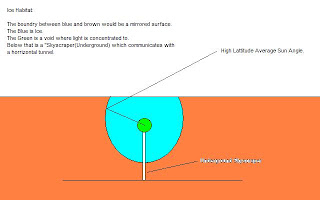
As I said a side note. And certainly other mehods of inhabiting Mars are not excluded.
#9287 Re: Terraformation » Interstellar Terraformation » 2012-02-19 06:02:19
Well you are not wrong, in the end that is the end.
However the Spin of Jupiter and the tides of Jupiter have to be kept in mind. In effect with Io erupts a volcano, and also has lakes of molten sulphur or magma on the surface, it is radiating heat to the cold universe, energy which was previously stored in the spin of Jupiter.
Jupiters tides keep trying to push Io and Europa into higher orbits, but the gravitational interactions of the two moons, keeps converting that spin/push from Jupiter into heated interiors, and they both radiate that heat ultimately into the universe.
Everything as we concieve it in terms of Energy and Matter has it's time limit.
However so called western civilization (Or any known civilization) is not more than 2000 or if you like 10,000 years old.
Anyway, I do share your concern to a degree, I was thinking of a collection of inhabitants at such a location of perhaps 5000 people. Just a first settlement of the Jupiter system. The advantages being that it is a convenient place to get energy, a convenient place to generate 1 gee simulated gravitation with spinning habitats, and also proximate to a moon, Callisto, which can supply ices and minerals, and also it is not too deep in the radiation belt of Jupiter.
So, if the Jupiter system were to become habitated in general, this would be a very good place to "Ignite" the fires of habitation. How much inertial energy would be consumed would have to be determined by any such inhabitants.
If they could dampen the radiation belts (A Russian proposed a way to eject the particles from the magnetic field of Jupiter, and make it safer), then they could access IO, and turn it into a power plant (Intecept the energy being radiated anyway).
Also there may be Fusion later.
Further, I understand that using new solar cells energy of that type is available. That could be improved with Solar concentrators.
So, I am just saying that the Jupiter system looks very lucrative to me. And of course I would do hollow ice worlds as well.
#9288 Re: Human missions » Space X to Lead Mars Consortium? » 2012-02-18 20:44:53
So I don't own Mars?
Well the logic is correct. Nations are not likely to build up a "Territory" which they cannot in any practicle way own.
That is the problem with Mars. With the Moon, we are getting to the point where a nation could "Own" a facility on the Moon, but of course there is the question of how do you get "Licenced" to extract a resource from the Moon.
For Mars, I think that the granting of an estate with the provision of the requirement that you do certain things to access, occupy and develop it is a good notion.
However, you are most likely correct that politicians world wide have worked to keep their slaves from escaping into space beyond their grasp of control.
However, the planetary culture could be modified to accomodate this type of financing. It is too early to tell.
I guess the US could issue such bonds, but I am guessing that the ownership rights would be disputed.
#9289 Re: Human missions » Space X to Lead Mars Consortium? » 2012-02-18 16:00:55
I feel that something like that could become the real thing. Good.
#9290 Re: Terraformation » Interstellar Terraformation » 2012-02-18 15:50:02
Hi Terraformer. LTNS
That seems like a interesting notion. Curious, I was just thinking about harnessing the energy in a lagrangian point of Callisto, the moon of Jupiter. So, parallel paths I guess.
In that case, I was hoping that the inerita of that moon could oppose the spinning magnetic field of Jupiter, so that coils could harness that differential motion. This could of course be used to good effect in a Brown Dwarf solar system, and also just possibly if their is an object in the Oort cloud with a magnetic field and moons. My only concern is that it might not be possible to keep the coils in the Lagrangian point, some are unstable, and of course in any case if you put too much magnetic drag on the system, it will be dragged out of that point, and will then not be coupled with Callisto's graviational well, so then not able to use it's inertia.
I don't totally grasp how your notion works to harness the energy, but I expect that your notions are sensible. I will look them over further.
Of course in such a case I am a hollow planet nut. The reason being that a shell hundeds of miles thick is good protection from the harsh nature of space out there. Then also, the gravitational effects would be nullified in the cernter of this hollow object, so you could have "Metal Artificial World Machines" there, which would spin and produce artificial graviation of Earth normal if that was desired. You could fly inside of the hollow world, if you had wings, and it contained an atmosphere. And of course my plan leaves behind Pluto, less a bunch of excess ice, so that you may do the terraform thing to it should you desire.
#9291 Re: Terraformation » Interstellar Terraformation » 2012-02-17 18:41:14
That is very exciting!
I cannot resist an attempt to talk on this subject.
So, in that case, be it true as much as they say, we might want to more learn to access a resource more proximate to our location than to so much try to directly go to another star.
Once upon a time I was AjaxWoji somewhere. Here I think I was someone else. I forget. Anyway, I did suggest that such worlds, could be mined for their ice, and from the ice and fibers of minerals, could be created substance strong, to use in the construction of hollow worlds. The inner lining could be of an insulation material. Inside of the hollow shell could be an atmosphere, and at the center spinning vessels to generate artificial gravity.
That is not to say that the objects themselves would be ignored, but typically they would be covered in ices, and to be efficient, the ice being removed to expose the rocky core, could be recycled to provide hollow shell worlds.
This all presumes that some type of fusion power, or some unknown power source could be utilized by the civilization preforming this "Terraforming" process. (Approximate notion).
I like Ice as a construction material www.outerspaceplace.blogspot.com
Void
#9292 Re: Terraformation » Impractical way to cool Venusian Atmosphere. » 2012-02-11 17:15:27
Part I:
Suppose the people live in orbit around Venus.
Suppose they can microwave the upper atmosphere, and make it swell.
If It becomes Plasma Then
It may be magnetic
If it is magnetic then
It may be collectible by electromagnetic system, enriching the population in orbit
Else
Let the solar wind drag it off
End If
End If
Perhaps a hollow cylinder 1 Mile (A silly number choice) in diameter, and reaching upwards to reasonable temperatures. Floors in the cylinder, partitioning it. Mixtures of gasses in the partitions, suitable to maintain neutral boyancy as needed. The bottom end of the cylinder anchored to the ground. The top end as a landing pad.
Thus humans present in workshops.
Robots in potected "Sheds" on the surface, where inside the conditions would be improved to make their functioning possible. Robots with new technology for very high temperatures. Mining underground from those sheds, and yes refrigeration. Electric power from wind or orbital microwave.
As always Sulphuric Acid is public enemy #1. Could it be altered chemically, by;
-Laser it from above or
-Microwave it from above or
-Drop chemicals into it or
-Enhance to possiblity of Ozone in it's Oxygen layer by putting something there to remove the Chlorine
?
Also, the winds would be very hard on any structure anchored on the ground, but perhaps if there is any wind it is a powerful energy source to refrigerate robots.
Part II:
From the above method my next attempt would be more cylinders, and then a floating covering over the whole planet, somewhere midway in the atmospheric column, and then once that is compete, begin removing CO2 from the atmosphere above it, and injecting it below, and begin removeing Nitrogen from below to put above. Then add Oxygen to the part above.
Extremely reflective of course.
I am calling upon new technologies to accomplish this of course super strong "Nano Materials".
Note: If it could be done, then this could create a shell in the atmosphere which could be walked on by light robots, and in places by humans. Supposing that it were possible to remove atmosphere by the methods in part I, then continually the atmospheric conditions would change, and the plan would have to adjust to that.
It would depend on the desires of the inhabitants. Perhaps they could simply keep re-enforcing their floating platform, and be satisfied to have a thick CO2 atmosphere below and a N2/O2 atmosphere above it. With reflectance and a lack of cloud cover, eventually that which is below would be cool also. One thing limiting this idea is you could not aford to have much water vapor in the atmosphere above, or it would condense on the night side.
C02 might become a problem as well, if the platform got too cold. That would not be a problem until the atmosphere below the platform cooled off.
This whole notion is of course far fetched, but as far as I can see so are pretty much any other notions of working with Venus. Far fetched does not mean impossible.
**NOTE: I can seldom log on to this place. I log on, and it says I have logged in and then it says I am not logged in. Not today though.
#9293 Re: Terraformation » Venus » 2012-01-27 19:19:44
Hi,
I would like to suggest that a first step to modification of Venus would be to estabilish a civilization on Mercury.
I don't expect that there can be any notion of making Mercury Earth like, but it already is somewhat Moon like.
Whatever capabilities it takes to make a living on the Moon, are likely to be adaptible to Mercury.
And Mercury it seems likely has many metalic resources. It is also speculated that it has Volitile substances at the poles, and perhaps even vents that exhaust gasses.
The notion is that any such population on Mercury, might spend a lot of time sending metals to various locations in the solar system by solar sailing. The could make a solar sail robot, and launch it with a linear accelerator, and then that robot could fly to various locations, typically impacting such a location, where the metals are wanted.
Titan, Pluto, Ceres, or others.
In the case of Venus, if the Mercurians were granted ownership of Venus, and were given premission to alter the planet to make it more useful, then they could fly those metalic robots to Venus to impact, and of course disintigrate, and the metal residue to react with the Sulphuric Acid, modifying the PH of the Venus atmosphere, and making that environment more suitable to floating houses, Microbes, and Aircraft.
Of course the incentive for the Mercurians to do this work as I said would be some type of estate granted to them for that service. They could then sell that estate to Earthlings for instance. (Mercurians would be Earthlings of course also).