New Mars Forums
You are not logged in.
- Topics: Active | Unanswered
Announcement
#9101 Re: Terraformation » Terraformation by Asteroid Impactor » 2013-02-25 15:53:06
I took the time to find out that comet is an Orrt Cloud comet, so lots of energy as you indicated. But I don't know the size and cannot quantify how much that energy is relative to a process perhaps desired.
I do know that a very large object with high energy could envelope Mars in a steam bath for 10's of years. A huge one could cause the present atmosphere to float off, and would leave an iron atmosphere for a time.
I guess you could try the "deeper hole in Hellas" trick, but ideally for that you would cut a object into pieces, and have high precision trailing impacts to the same spot.
A different trick would be to take some of the materials of Phobos and Demos and construct a object to strike first, shreding the comet before it hit. That could reduce the amount of shattering of the bedrock, and might lessen the amount of atmosphere lost to a splash.
In my ideal world, Mars would heat up to just above the point where high temperature Earth organisms could survive, and as it cooled you would inject a sequence of lower and lower temperature organisms. By the time Mars reapproached frigid, perhaps the biosphere could stand on it's own, generating greenhouse gasses, and maybe even allowing for a significant ozone layer.
In another direction, it would be good practice for terraforming Extrasolar cold Earths, an impact allowing a window of habitibility where a crew could habitat that location and promote a biosphere, or at least have a favorable temporary climate until they had dug in and set up to prosper in a glacial type world.
#9102 Re: Science, Technology, and Astronomy » A hot fusion reactor » 2013-02-21 00:40:48
I'm not against anything that works. The next unexpected breatkthrough is what will likely get us to a new chance, and I think we can agree that we want that. Expected breakthroughs, they typically just lead to more chains.
The status quo is death. I am also skeptical of the cold fusion thread I started, more so than this one, but someday someone is going to find a way, and it won't be a conventional dogma scheme. 1 in 1000 might work, but still, it is important to keep trying.
#9103 Re: Terraformation » Recent superconductor news and it's importance in terraforming » 2013-02-21 00:37:25
Well, a plan is a plan, which is better than none.
I have to say that opposing the force of the solar wind will be a daunting task. I don't say that to be a jerk. I wonder if we could turn the solar winds force against itself? Pull it's energy and turn it against itself. I don't have a plan, but I have a desire.
#9104 Re: Interplanetary transportation » Nuclear rocket » 2013-02-21 00:32:05
Thank You,
Rusakof
It is nice to get an answer.
Of course I have made a complex and perhaps unressonalble request, but you gave me part of what I wanted. As did GW.
Really thanks.
#9105 Terraformation » More credible than Cold Fusion, and maybe a source of Nitrogen » 2013-02-19 17:10:02
- Void
- Replies: 3
I encountered this article from Physorg.com which although speculative in the largely uncredited area of cold fusion, never the less to me is interesting to consider.
http://phys.org/news/2013-02-nuclear-re … ement.html
The parts that interest me are that the information suggests that in theory, a resonance of electrons could concentrate a force that could enable this process, the article also says that achieving that is particularly hard.
They more or less suggest that Nickle can be converted to Copper with Hydrogen as an aditional actor, and that a energy gain might occur. They also suggest the conversion of Carbon to Nitrogen, but give no indication of an energy gain (Or to the negitive).
Mars having an atmosphere currently approximately 1/3 Carbon, and likely from the isotope information I have seen having Carbon stored somewhere, a greater source of Carbon. Nickle being availble in current existing impacts to Mars, and also in the asteroid belt, it is an interesting matter. Carbon is also available from the asteroid belt.
A source of Nitrogen perhaps and also just possibly a source of energy?
I guess the part that made it a bit possible to me is this:
"Several labs have blown up studying LENR and windows have melted," according to Dennis Bushnell, Langley's chief scientist, in an article he wrote for NASA's Future Innovation website. This, he wrote, indicates that "when the conditions are 'right' prodigious amounts of energy can be produced and released." But it's also an argument for the approach that the Langley researchers favor: master the theory first.
I suppose the machine and it's energy input might have done that, but still Phys.org and NASA are somewhat involved. I have to wonder.
Of course to convert that much Carbon to Nitrogen, you would then generate large amounts of energy. For my thinking in that case, then you melt the polar ice caps into an ice covered ocean in the North, and a series of ice covered lakes in the south.
Add salt, and you have Antarctic dry valley lakes capable of capturing solar energy, and perhaps of a biosphere.
This would likely be assisted by other terraforming tricks.
And maybe an O2 + N2 atmosphere.
#9106 Re: Interplanetary transportation » Nuclear rocket » 2013-02-17 23:50:23
Thanks for the reply on the Nuclear part.
However, given an energy source nuclear or non nuclear, does it make sense that a "Mix" could be useful as a propellant?
One part which expands more with the application of heat, and one part which has greater mass per volume.
The example of water with Hydrogen bubbles in it, becomming water steam at a high temperature, and also Hydrogen which expands more, pushing the water steam to expand more. I have woried about the Hydrogen becomming disolved into the steam but I believe that at least for liquid water, you can saturate it and then add more.
Obviously if you have water, you can have Hydrogen. What you do with the excess Oxygen beyond breathing it of couse is another issue. I have tried to consider if it can provide propulsion by being expelled with a linear accelerator (Magnetic), or if you could inject it into the steam stream as well. Perhaps not only normal nuclear heating could be applied, but could you also boost the thrust by applying some microwave energy to expand the down stream flow just a bit more at the outlet?
Of course handling plasma might be something you would not want to go to. Just superheated gasses?
#9107 Science, Technology, and Astronomy » A different kind of habitible zone for Water/Ice planets. » 2013-02-17 23:40:08
- Void
- Replies: 3
I have tried to get feedback on this before, and somehow did not.
If anyone cares to speculate with me either in the negitive or positive it will make me happy.
I have been considering what happens when a planet with more water than Earth, perhaps enough to cover most or all of the continents is outside of the habitible zone as normally defined. I think that there may be a process that may allow parts of the planet to be habitible.
The easiest to justify version would be around a Red Dwarf (M) star. The idea is favored by the planet being tidaly locked, but is not entirely dependant on it.
In the case of a Shallow ice planet (I would define that as too shallow to support a planet wide underground ocean, but with enough ice to allow a hole perhaps 5000 to 10,000 feet (or more) to be excavated by sublimination over time.
My logic on this is that Saturns Moon Titan can support a Nitrogen dominated atmosphere, so that is the aproximate limit of energy to support a non-collapse of the atmosphere.
Earth is too warm to support a planet wide deep glacier.
An Earth in the orbit of Mars could most likely support some open water ocean.
Perhaps the energy input to Ceres is what I am thinking of, but around a red dwarf star. A icy Earth with a layer of water ice perhaps 20,000 feet deep, or if you like 30,000 feet deep would behave as I think?
If it were an "Earth" around a Red Dwarf, and was tidal locked (Which is less likely the further you go out in orbit), it could be that the spectrum of the Red Dwarf would still actively evaporate the ice on the "Sunward" side, and escavate a very large pit.
Of course this disequilibrium would be answered by a more active glaciation trying to fill the pit, but a balance point would be achieved.
Without the use of exotic greenhouse gasses, an extra layer of atmosphere 10,000 feet deeper than the average surface of the glacier which would cover the dark side would provide warming for the sunward side at the lower elivations.
Supporting the atmosphere on the dark side is an issue. The further out you go, the harder it is to cycle enough heat to the dark side. However, it would be reasonable to speculate that it should be possible in some cases for the dark side to remain warmer than the condensing point of Nitrogen. Not CO2 however.
This presents a problem of carbon lockup, but it can be answered by the flows of glaciers into to sunward side pit. Of course the "Ice Pack" would have to have a lot of dry ice in it as well as H2O. But since that planet would not have as active a means to chemically lock up the CO2, a large content of CO2 is a real possiblity. So the carbon cycle for this planet would involve a glacial loop.
Also, for such a planet it is possible that tidal interactions with neighbor planets would cause subglacial volcanism, both bringing more CO2 into the surface, and also causing rivers to flow out from under the ice into the large pit on the sunward side. Unfortunately as in Iceland, many times this would be catastrophic floods, but it would still be able to fill bodies of water which would in time become salty.
A more secure location for life might be secured where the land at the bottom of the pit was elivated to a degree.
So such a world with an extra layer of trophosphere might allow for life support even outside of the normal habitible zone in the cold.
As for "Earths" around Yellow stars, it might be possible that a equatorial pit would erode, with two massive polar ice caps bounding it. Such a world would be more stable if it had a significant Moon, however in the absence of one, the pits would wander over the ages.
As for the notion that the ice of such a world would be permanently reflective, and so would cause a snowball Earth lock up, I am inclined to think that cosmic dust, and also dust storms originating in the deep pit would deposite a non-reflective coating to much of the ice cap. You might argue that Vapor from the pit would then deposite snow on top of that, but it cold be true that the mosisture in many cases would only escape from the pit at a low rate. Most of it would fall as rain or snow or hail back into the pit.
It would take millions of years to form such a pit.
Anyway, that is about it. Some worlds might fit into this other "Godilocks" zone. Many would fail for one reason or another, just like not every "Earth" in a normal habitible zone will have reached it's potential to harbor a livable habitat.
#9108 Re: Interplanetary transportation » Nuclear rocket » 2013-02-15 17:54:27
I need some further understanding on the use of nuclear propulsion in space.
Typically I have read that Hydrogen is the prefered propellant, because of it's expansion properties.
I have also seen reference to water as the propellant mass, because it is availble many places in space.
I am wondering about a hybrid.
What might be possible where you would have a pressurized tank, and pumped water into it and also Hydrogen in a compressed gas form. An agitator would be needed to mix it into a slurry of water and compressed Hydrogen bubbles.
Having that could you heat it in a nuclear propulsion system, and get the advantage of Hydrogens expansion properties, and also the mass of the water?
(I am guessing that cavitation might be a problem with the metal parts).
I am thinking of a bullet. The rifle recoils when the burning explosion pushes the bullet out of the gun barrel. So the water is the bullet, but it also vaporizes and expands in the rocket nozzle, and the Hydrogen is an even more expanding gas.
I understand that water could be corrosive, but could the Hydrogen counteract that as well?
Alternately you could push heated steam out of the nozzle, and inject liquid Hydrogen?
#9109 Re: Terraformation » Terraformation by Asteroid Impactor » 2013-02-15 17:43:20
Karov,
I will take the caution. The sideways impact was just to change the length of days of Mars towards that of Earth.
I still think about the hole though, but yes there would need to be an evaluation of costs/benefits.
Conveniently something else has come up.
http://phys.org/news/2013-02-asteroids- … earth.html
If you can stop asteroids from hitting Earth, it should be possible to make them hit Mars.
There has been much talk about altering existing resources on Mars, and also with some method moving desired materials to Mars, but asteroid hits are like a re-boot arn't they?
With such a system, a very mild "Great Bombardment" might reset Mars to a temporary youth.
Of course I would want a deep hole.
Rods are also a notion to think about. If you have robots they can make them for you?
What about segmented rods?
A segment of reduced materials such as Magnisium, with some Sodium inclusions, and then a segment of a solid peroxide?
Altenating segments, and then plunge them into the crust, and let them mix and react.
I am not sure how much more energy that would inject, but it would be more.
If the normal number for energy were 1.0, and the chemestry added .1, still 1.1 might do something that 1.0 would not.
#9110 Re: Life support systems » Synthetic biology for improving food yields » 2013-02-11 17:39:07
I am thinking go with the microbe with the sugar.
An inflated plastic bag on the surface partially filled with water could maintain a relatively gentle habitat for the bacteria, since if there is enough thermal inertia, ice phase can be avoided. (I would think you would cover these balloons with a UV protective plastic tarp draped over them.
Yeast(O2 + Sugar) = Protein & Alcohol.
Alcohol could likely be feedstock for oil and plastics.
Mushrooms(O2 + Oil & Biowaste) = Certain Nutritions humans can use (Mushrooms can grow in a warm damp cave).
So, you would already have a good start.
After that you would only need a relatively small greenhouse to provide the rest of the needed nutrition.
Of course turning yeast into an appealing food might take some work.
I would start like that, and hope that they also engineer some complex plants for great efficiency.
#9111 Re: Terraformation » Terraformation by Asteroid Impactor » 2013-02-11 17:27:15
Terraformer,
You can have it all, manipulate the planet, and the impacts could generate atmosphic alterations.
I have been wondering (Way out there) if the planet could be given a more Earth similar day in length. Lots of sideways impacts for that. I wonder if multiple impacts like that could scoop a large gouge in one or more places. I am not sure that humans will even maniupate objects on that scale, but after that the atmosphere would have to be altered in chemestry, and volume I would think.
As for the hole, I think a gouge in the bottom of Hellas might end up with a pressure of 33 mb, if the average surface pressure had already been moved to 11 mb.
With further terraforming with an even denser atmosphere such a hole would be the first place where a partial pressure suit could be used, a city could be put in the hole.
Terraforming even more, eventually that hole would be the first place where you only needed a breathing apparatus.
KAROF
What are you thinking of doing with your "Really deep impact, could be done by elongated / rod shaped projectile"?
(I thought puncture a magma pocket if there are any).
#9112 Re: Human missions » Sustainable Access to Mars: Interplanetary Transportation Architecture » 2013-02-04 19:08:36
That's a notion to consider. Be useful if you can. That's pretty much the requirement to play ball.
#9113 Re: Terraformation » Terraformation by Asteroid Impactor » 2013-02-03 12:15:11
I am sure there are many more capable of answering the Magnetic Field part of your post.
However, I have read that it is thought that the Moon of Earth had a temporary magnetic field when an striking object caused it's crust to spin at a rate different than that of a then liquid core. An oblique impact might work, but I think we still don't know enough about the interior of Mars. I have also read that "A" scientist thinks that tectonic action is only now beginning on Mars, that it was slow in comming. I think that is a minioirty opinion. In that theory, the rift valley is just the beginning.
Maybe a shattering action could unlock or create plates?
As for assisting terraforming with impacts, I would look into an old thought I read about where the thinkers wanted to impact a chain of asteroid pieces sequentially in the same spot in the Hellas Basin, to produce a small very deep depression, where they thought that a lake from ground ice could form. They thought that that little spot being warm from the impacts (The rocks retaining the heat), and having a lake in it would be the seed where life planted would automatically terraform the whole planet eventually (100 years?).
I think the hole would be arid. However perhaps a combination could be considered to improve the situation.
-If possible generate a temporary magnetic field (Temporary being 1000 to millions of years). Do that with an oblique impact if it is possible to do.
-Make the deep hole in the Hellas Baisin.
*Maybe one or both of these events would cause the atmosphere to be thicker as well on a temporary basis.
-Address Phobos and/or Demos as a terraforming source potential.
-Toss dirt on selected sections of the polar ice cap in hopes of inflating the atmosphere more, if necessary.
-Try to scrub the Chlorine out of the Martian atmosphere in hopes of allowing some type of Ozone layer, using dust from
Martian moons.
-Fo the deep hole in the Hellas Baisin, try to produce snowfalls, using moon dust to try to seed precipitation.
-If needed also introduce greenhouse gasses.
A consirvative estimate supposes that there is enough C02 in the South polar ice cap to move the average surface pressure to 11 mb. I am going to guess that if that occurs the best pressure in Hellas might be 20-25 mb. In the deep hole it would be more.
Anyway that's all I have for it.
#9114 Re: Human missions » Sustainable Access to Mars: Interplanetary Transportation Architecture » 2013-02-03 11:48:13
I don't want to interupt your worthwhile conversation, but I have a notion of an item of hardware to propose which might be useful to an interplanetary mission where water is a large source of propulsion mass.
Here is my simple cross section diagram for it:
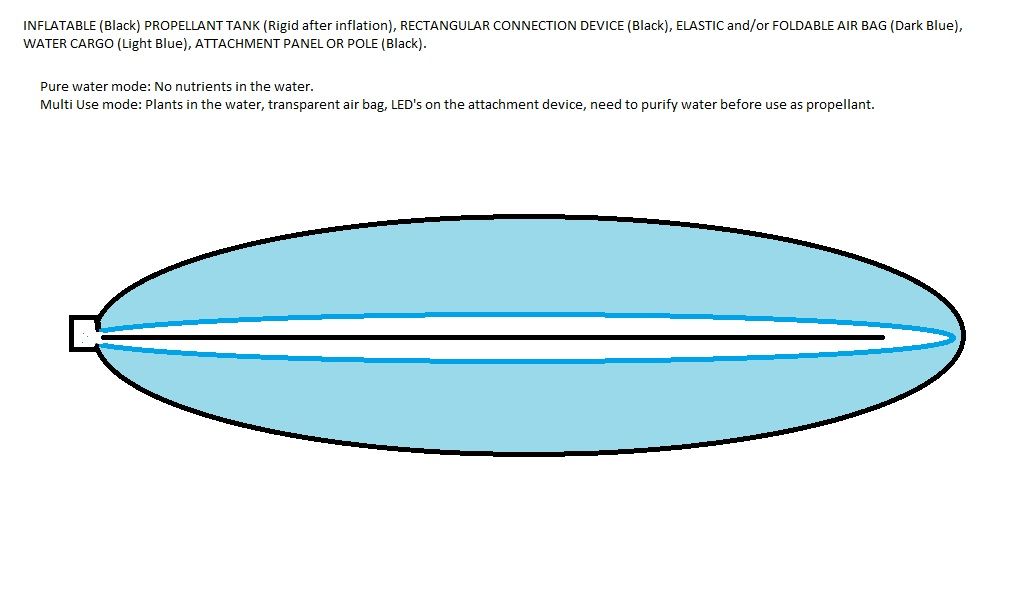
The notion is to use a "Bigelow Expandable Activity Module, or BEAM" as a rigid container.
http://abcnews.go.com/Technology/inflat … d=18240124
Inside a flexable/foldable/elastic bag filled with air. Inside of that a pole or a pannel to attach equipment or sleeping persons to.
As the water gets used up as propellant, the area filled by air gets larger.
Upon a refueling, it gets smaller.
I think the circular Bigelow BEAM might be quite good, if it is not too mass heavy. That is something I do not know.
I do not expect that the travelers will have only this to dwell in, but would have an attached crew compartment. However for various reasons it might be useful to be able to habitate the air filled volume as well at times.
-Cramped space in a crew module.
-Radiation storm.
-Radiation protection during sleeping.
-Crew module becomes temporarily marginal for habitation.
I have indicated two modes of use, the pure water mode would be where you do not want to monkey with purifying the water in the volume before using it for propulsion.
The other mode would allow you to grow plants in the water if the air bag was transparent. This would allow you to use LED's mounted on the pole or pannel to illuminate the interior, and that would be to produce Oxygen, purify Urine, and just maybe grow food. That whole process would be an additional complecation, and would require also that the water be purified, perhaps by distillation before being processed for propellant.
It is worth noting that one of these would be a novelty, but several joined as a unit could be a space station around Mars, and also a propellant depot.
Anyway, it is a direction to consider perhaps.
#9115 Re: Human missions » A Return to the Moon by the Apollo 11 50th Anniversary. » 2013-02-02 20:40:20
I like all of your notions.
I might add a strange one. I recall that one of the Sci Fi books I read as a kid had a guy visiting a monistary, which I think was a sort of a cycling spaceship. I think that for philisophy, the Moon would be quite a stimulus. The near side puts the whole Earth in view at times, as the Apollo missions briefly demonstrated. The far side would be another thing as well, only the stars in the sky of the universe.
Monks typically do not require large material needs, but are willing to toil for their group. Not many are called for such a thing, but there are some.
I would think that for them the Moon would be quite a place of contemplation, with the remoteness from worldly matters, and the celestial views, and the truth of the death of the human body just outside of the shelter.
It is true that religion has been at times a prompter for human wandering.
#9116 Re: Human missions » A Return to the Moon by the Apollo 11 50th Anniversary. » 2013-02-02 14:02:45
Those points, and also the two asteroid (NEO) mining organizations.
If the asteroid mining operations work, then it sort of dampens the notion of the Moon for non-Moon resources.
So, the Moon is an object in itself, perhaps a bit like Antarctica, but with space tourism?
I would think that an item of research might be how the human body holds up in the Moons gravity field, so perhaps tourists could get a discount, if they agree to be part of such a study.
That information might give clues on how humans might do in the Martian gravity field.
An interesting notion might be if there may be people who would want to live on the Moon long term, as a sort of home for a awhile. Artistic type people.
Of couse Scientists would likely have actions such as Telescopes on the far side? Or would that actually be automation with a few repair people on hand?
#9117 Re: Human missions » A Return to the Moon by the Apollo 11 50th Anniversary. » 2013-02-01 21:08:48
There are so many proposed new things, I am getting somewhat excited. True, reality will come to all of this over and over again, but I just have to think that eventually someone will hit the jackpot, and from there it will be a dreamers paradise.
Many things will be tried, most will not work out, but eventually something real, something big.
In the book "The Fourth turning" it suggests that the American baby boom generation was all about turning from the material to the spiritual. Which is not all bad. They were able to invent quite a few things, and dream of many more. However the Prophets (Baby Boomers) are followed by the Nomads and the Heros, who are very interested in the material, since they did not have the benifits of the material that the Baby Boomers inherited from the Nomads, Heros, and Artists who preceded them. So, I am optimistic that the Nomads and Heros comming into maturity will follow such a potential if there is some reasonable hope of a payoff. Particularly the Heros will endure extreme hardship to see it through.
I know that perhaps I have made references that are obscure to you, but actually I believe that that book has something, since I worked out a fair part of what they say on my own 20 years ago. Also there are references in that book to people who noticed these patterns many times centuries ago. (It is mostly a feature of the whole Anglo cultural sphere).
I am quite excited to see how these people are moving into the material reality. I am fully supportive, but very supprised at their excellent abilities. Very pleased in fact.
#9118 Re: Terraformation » Venus + magnesium » 2013-01-31 19:41:11
Perhaps it is OK, due to the lack of current activity if I should suggest an optional deviation from that plan.
I have considered a "First Step" to neutralize the PH of Venus and make it more machine friendly.
A second step would be to reduce or eliminate the cloud cover, letting a large part of the heat potential out.
Metals inserted into the atmosphere would most likely move the PH towards neutral. I expect it would take less metals than to dissapear the whole atmosphere into metal compounds.
It might be a perference if the Sulphuric Acid reacting with metals would leave behind some H20, but that may not be a subsidiary feature of such a process.
At any rate if you can dump metals into the atmosphere of Venus, perhaps not just Magnesium, but other metals, and Silicon.
I have speculated on a shell in the atmosphere previously, where below it is the bulk of the CO2, and also >3/4 ths of the Nitrogen.
Above the shell, Nitrogen at 58%, and if obtainable 42% Oxygen. (500 MB?, about right for Venus with Times 2 sunlight?)
I am aware that Venus has ferocious winds.
However such a shell would "Float" on a layer of mostly CO2 like the surface of a waterbed. Should it bulge, the weight of the bulge would draw it back down, because the above layer is approximately 1/2 as dense as what is below. The shell would also need to be lighter than the mix below, which requires hollows with a light gas.
The sequence of building might be:
1) Get rid of the acid PH.
2) Get rid of most of the clouds.
3) Wait for the turbulence from this change to settle down.
4) Floating habitats, and high temperature robots on the surface.
5) Perhaps the Hall weather machine? Refelctive bots?
6) More cooling if 5 is available.
7) Have a robotic system build a shell, hives of very small robots.
8) Begin separating the atmosphere above from that below.
9) Thicken the shell.
10) Habitate the surface of the shell.
It is all far fetched, but not the most far fetched ever mentioned here.
After all that either export atmosphere by some means, or indeed continue to import metals from Mercury, and reduce the volume of the atmosphere. The falling materials of course would have to be fashioned into shell materials, or pushed under the shell.
If I remember, you like shell worlds also.
I can also say that if this was done, then the "Shell" could generally be highly reflective, and would have only 1/2 bar of atmosphere above it which would help cooling, the lower layers below the shell would eventually cool more. Of course that would then require that the shell adjust it's size, so it's not all that easy, but I am guessing you are enterained a little bit by my response.
Venus is the really hard one.
Edited 01-Feb-2013 (I don't care much about the spellings, but I had the wrong N2 to O2 ratio I think). Verbal is my one of my weakest abilities.
#9119 Re: Martian Politics and Economy » Considering 3D printing and a Martian political/economic landscape » 2013-01-20 14:02:03
Actually, the field appears to be expanding massively, and is indeed generalizing:
The video in particular is worth watching I think.
http://en.wikipedia.org/wiki/Iron_pentacarbonyl
Nickel plated plastic mirrors
http://en.wikipedia.org/wiki/Iron_pentacarbonyl
http://en.wikipedia.org/wiki/Iron_pentacarbonyl
Extract fairly high purity iron to powder:
http://en.wikipedia.org/wiki/Carbonyl_iron
http://en.wikipedia.org/wiki/Powder_metallurgy
http://en.wikipedia.org/wiki/Rapid_manufacturing
An alternate build process with a vacuum chamber:
http://3dprinting.com/materials/metal/3 … ing-metal/
Direct Laser Sintering, the fire fighting section should be interesting for space suit accessories
customized to a morfic type, such as small/big, Man/woman, adult/child:
http://www.youtube.com/watch?v=6lJ8vId4HF8
http://en.wikipedia.org/wiki/Electron_beam_melting
Electronics:
Print power supply electronics?
Electrical:
Wire?
Medical:
Broke your leg? Special brace?
Amputation? Prostectics?
Dental? Make a filling to be glued in place? Make a tooth brush?
Martians will have cavities.
Dental floss?
This is a child technology, encouragement is the only moral treatment for it.
The direct laser sintering does not mention Iron or Steel, but I would think that it exists or can exist.
As far as Mass production, I guess if you could mass produce solar devices, that would be great.
I am going to stick to the notion that at first you would want iron nickle meteor raw materials, because:
-A robot could gather it magnetically for you (A rover type device), while you were working on other things.
-Your first settlement would not have to be located specific to a deposite of iron ore.
Further it is Iron and Nickel. In the links above, it seems suggested that you can get the metal Nickel out of the mix before you extract the iron. Nickel is good for plating metals and plastics.
The examples shown in the video, suggest to me that massive possibilities are already available, and go far beyond the last industrial revolution, so it would not be prudent to ignor this new born industrial revolution.
I guess I will add something that is my own thinking.
Mineral Wool, Tar, Nickle plating?
I see the opportunity to make mineral wool, and to glue it with tar, and maybe it would be possible to plate it with Nickle.
I am thinking of solar concentrators. Could this be constructed in part using 3D printer process? Maybe. I would think the mineral fibers would either be cut into short lengths and added to the structure like felt, or would be woven like beta cloth.
I presume that it will be necessary to manufacture hydrocarbon fuels, so the manufacture of tar is not out of the question.
As for suitability to purpose, Mars is colder in general than Arizona for instance, so it might be practicle to expect that deformation from melting of tar will be minimal. We generally think of Tar paper as relatively thin, but I believe that fiber asphalt constructs could be thick, and at least in the high lattitudes useful. I actually think that it will be rare for it to be too warm on Mars for this method.
As for landers, yes you can preposition supplies, but you can also hold a reserve of emergency supplies in orbit. If they never get used, then you have not had the cost of delivering them to the surface, and if you need them, you can have them.
Well the weekend is winding down, and I will likely not respond for a while, so don't let the lack of response be a concern.
#9120 Re: Martian Politics and Economy » Considering 3D printing and a Martian political/economic landscape » 2013-01-19 20:29:05
Well, as manufacturing goes 3D printers are a generalist, on the first few missions, the unexpected might be a factor, so I would want some generalist capabilities supported by innovative solutions (Software) from Earth.
The personal though? Specialized as far as a narrow purpose, most efficient at that. The 3D printer might save them, if events go outside of their specialized efficient abilities.
If you are talking exploration, then the scheme to escape danger might focus on leaving early.
If you are talking about the first construction crew, then maybe you send a drone/warehouse with robotic hard landers into orbit around Mars, with spare parts, 3D printers, and whatever, before sending the crew.
Then you send a split crew, some in orbit, and some early landers.
The early landers, set up the prelimary habitat and life support. As they need it, additional supplies from the drone are dropped down by the orbital crew. Spare parts, a 3D printer.
Supposing that it starts as a experiment, and they do a final evaluation. Is this location going to be worth building on. Are the resources expected actually available and usable? In the case of yes, then you send down more of the materials. Otherwise abort and relocate at a later date.
If the location is confirmed and the construction crew intend to stay permanently, then after the hard landers are all used up, the orbital crew lands also, and the drone and unused parts remain in orbit, to be sold to anyone wanting them to set up a different base.
I am presuming that the drone would have been propelled to Mars not by chemical rockets, but perhaps efficient and slow electrical or solar sail or solar wind methods.
This after all would be a construction project, not the first landing.
Here are some thoughts about bringing plastic raw materials:
-What if the fuel tank of the hard lander were Plastic? Could Kerosene be suitable for a lander fuel?
-What if such a parts lander had a cushion of crushable honeycomb made of plastic?
Then those materials could be scavenged to feed into the 3D printer.
Where it might seem like I am proposing that I am not being real about the amount of materials that could be available in orbit, I would suggest that by the time such an activity like this were actually done, humans would have already been capturing small asteroids/rocks, and moving them the the Earth/Moon area, and in that situation, I do not think that the mass delivery to Mars orbit budget will be nearly as strict as if we were supposing a delivery from the Earths surface to the Mars surface.
#9121 Re: Martian Politics and Economy » Considering 3D printing and a Martian political/economic landscape » 2013-01-19 16:58:32
True,
I was thinking of the recent effort where a primitive object was created using a laser process in a 3D printer. A sort of particle by particle sintering.
Manufacturing a glue to glue particles together might be an option, but perhaps not value effective. As you have said, transporting the raw materials is not a real option.
#9122 Re: Life support systems » Caves as Initial Footholds on Mars » 2013-01-19 12:43:53
Lewis said:
The only major advantage of a cave is providing protection against radiation. But we have ways of ensuring that protection is delivered outside in the open - most easily by simply heaping regolith over the habitat unit. Also, my favoured method of construction (trench and cover) gives you a lot of the advantages of caves with none of the problem.
Longer term I can see there may be some advantages to caves as natural structure, particularly if we could create safe, pressurised atmospheres in them. But we need to get plenty of humans there on the ground first.
I agree, that the probability of a lavatube being located at an advantage, and particularly finding one under ice is currently diffacult. But the person who initiated this thread had a specific set of requests, and I have tried to move forward on them.
However, I am thinking of a network of ice caves, sandstone caves, and lava tube caves (If lava tube caves are convenient).
The lavatube caves would be natural. The ice caves and sandstone caves would be manufactured, slight chances exist for sandstone caves, but in their natural state they would likely not be of much value.
For ice caves, I am thinking of skyscrapers embeded in ice, with airlocks on the top, and connection to a sandstone deposite below. The ice walls would help hold the structure's pressurization needs.
Here are some links to artificial sandstone caves. For some sandstone, but not all, they might be possible:
http://www.environmentalgraffiti.com/ar … ve-temples
http://www.faribaultdairy.com/tourthecaves/
http://news.nationalgeographic.com/news … mers-hole/
http://www.google.com/search?q=californ … 93&bih=491
http://en.wikipedia.org/wiki/Wine_cave
http://www.napanow.com/wine.caves.html
I have no expectations, that we would want to first settle the high lattitudes, unless a submerged cave of convenience offered some unusual advantage, which I do not expect.
However, for all the intentions of terraforming Mars, it is also not practicle in my opinion to have a strong efficient Earth type habitat which covers a large scale of area in any realistic time frame.
We need a plenum. On Earth our plenum is the surface with a suitable atmosphere above it.
That will not be available on Mars any time soon.
Mice and other rodents, are helped by a snowfall in the winter. They are small and will freeze without it.
I guess what I am looking for is a large scale network which can be expanded to great expanses. I have said verticle ice caves filled with a verticle building. I have also said sandstone caves which could be stable if the right sandstone pockets existed, and I think some will. Beyond that for bulk transportation, on long distances, I suppose surface trains and roads with robotic trucks make sense. However it might also be possible to have horrizontal subways in the ice (Which will require supports), or maybe even in the sandstone, and in some cases harder rock, which may not require support.
Solar collectors would need to be on the surface of course with robots to construct them from parts manufactured. (Above or below, depending on economics). The verticle buildings in the ice would be the location to route power cables down to the caves.
In this case your water supply would be mined, either tunneling, or open pit.
I believe that solar collection will continue to become more efficient, and also lighting devices would be better. So, it is not unreasonable to me to suppose that in some sandstone caves, you could have trees, most likely for fruit. The trees would also be for human happyness. The spectrum of light could be only that that the trees use when people are not visiting, but better light could be provided for those occasions when people want it.
Even more efficient will be chemosynthesis, where chemicals manufactured can drive a biological system. Mushrooms will grow on soil contaminated with oil for instance. I expect that the oil would have to be manufactured.
A harder to handle method would involve Hydrogen and Oxygen, which could be obtained from water and energy.
And of course their can be greenhouses on the surface as well.
I guess I have deviated from the "Initial Foothold" theme, but maybe "Initial foothold of a planetary civilization could be supposed".
I beleive that manufacturing materials for building a large scale plenum on the surface could be largely unprofitable, and sandstone under ice may exist in large quantities. I think that large scale of pressurized space many be more profitable with this scheme.
#9123 Re: Martian Politics and Economy » Considering 3D printing and a Martian political/economic landscape » 2013-01-19 12:13:59
Your crititisicms are fair.
But I will play my part and speculate. I presume a high degree of automation including robotics, and this thread starts as 3D printers and economics. I can offer that being flexible, the 3D printer system making bricks can also make other objects, such as counter tops, bowls, electrical insulators and so on. Once you have a production line taking in raw materials, it's output can be a spectrum of objects, and so the cost of bricks would be reduced by being able to make other things while demand was low for bricks.
I am presupposing that a environment would be developed underground which would be hollows under a significan layer of ground ice. I am supposing high lattitudes in both hemispheres, but probabbly not up to the polar ice caps. The dune material is something that Mars has to offer in large quantities. Although in another thread, I have supposed that it might be useful to find lava tubes submerged in ice as habitat, I am much more interested in finding sandstone deposites with overlying ice, the reason being that both ice and sandstone are relatively soft, and might yield a pressurizable network, which is hard to envision on the surface.
Against this, I know that 3D printers are more suited to special runs of a small quantity of a desired object, than to mass production, but the technology is new, and I expect that it may be integrated into a large system of automation, housed underground. Of course if you are carving hollows in sandstone, then you actually have to remove tailings from your hollows, and place them above ground, but the sandstone tailings, and dune materials may be different materials, so what you may make may be different from each. I am wondering if above ground some useful objects could be made from such materials.
perhaps some type of energy collection system.
My interest here is how you utilize what Mars has to offer as large scale "Gifts" in the upper lattitudes. The potential economics of it, and how 3D printers might fit in.
Solutions at other locations such as the equator, and poles would be different.
We almost never beneficiate a habitat, but rely on it to give us gifts, such as a hydroelectric plant on Earth harnessing the flow of water downhill. Mars does not offer that.
#9124 Re: Life support systems » Caves as Initial Footholds on Mars » 2013-01-19 00:51:45
I would want to figure out how to find lava tubes submerged under ground ice. Tunnel down to them through the ice, and set up shop. I would think that they would already be sealed by ice (Lava tubes have cracks), so they could be pressurized. They could be warmed to a reasonable temperature that does not melt ice, and building methods more similar to what we do on Earth could be used, to provide accomodations for living and for factories.
Finding them would be hard, and I suppose it would almost have to be at high lattitudes.
Could some type of rover with a sonar which pings into the ice work to search for them? I suppose you would have clues from the geology, to know that you were in a location where ice lies above a possible ancient volcanic location.
#9125 Re: Martian Politics and Economy » Considering 3D printing and a Martian political/economic landscape » 2013-01-19 00:44:19
One of the things I have been pondering is the use of ground ice as habitat. The point is that Mars may have a lot of it to offer at high lattitudes. For instance glaciers in the south part of Hellas?
I guess what I would be searching for is a submerged lava tube system, or a submerged bed of soft sediment stone like sandstone, which I think there could be a chance of.
But to get into it, you would have to have a tunnel system, and a means to habitate your location while you were tunneling.
If I were a Mars inhabitant, and had decided that I would be able to profit from such an effort, I would want materials to make the habitation of ice caves more pleasant.
So, as a customer, I would want patio type bricks, for a floor, perhaps putting an insulation under them. Not specified what insulation. I have considered an analog of tar paper as well. Mineral wool bonded with tar to make walls and roof. This supposes that it would be practicle to pressurize deep buried ice caves, and that you would have a power source.
I am not trying to deviate from initial plans for settling Mars. That would be by delivered materials. However having mastered habitation of "Glaciers", inhabitants would have a place to expand in a large degree. The methods would be useable in high lattitudes, to provide living space and factory space.
I am doing this as an exercise.
So I am a hypethetical construction oriented business person, can I get patio blocks an bricks built from dune materials or the tailiings from drilling in sandstone.
Could a 3D printer of sorts build walls and a ceiling from mineral wool and tar? Granted there could be other finishing materials involved in making the interior more pleasant. Insulation on the outside of the "Tar Paper Shack" as well.
Obviously if I am building an expanding system of tunnels in the ice, I have a water supply.
I hope my presence is not a negitive here.