New Mars Forums
You are not logged in.
- Topics: Active | Unanswered
Announcement
#651 Re: Meta New Mars » direction of New Mars & Mars Society » 2025-12-29 04:57:36
Individual discord forums ended up getting nothing but spammers.
https://discord.com/invite/Us69CW2wjA?m … 559dc6527c
New Mars Society Discord Server
Here is the reddit attempt
https://www.reddit.com/r/MarsSociety/
This is the instagram
https://www.instagram.com/themarssociety/
Twitter
https://x.com/themarssociety
#652 Re: Meta New Mars » direction of New Mars & Mars Society » 2025-12-28 20:13:44
https://www.marssociety.org/members-area-update/
Member Benefits
Benefits of Membership to the Mars Society include a membership card, a special invitation and discount to the International Mars Society Convention, regular Mars Society email updates and announcements, an opportunity to participate in local Mars Society chapter events and activities and special access to exclusive online chats, webinars and discussions with leading Mars experts and scientists.Sign up for the Mars Society Newsletter
Register for the International Mars Society Convention and submit research paper abstracts ( no more than 300 words) via abstracts.marssociety.org
Participate in the New Mars Discussion Forums
Purchase items from our Official Online Store
#653 Re: Science, Technology, and Astronomy » Google Meet Collaboration - Meetings Plus Followup Discussion » 2025-12-28 20:08:46
I was able to join using the computer and had to ask to join once putting in may name to join. It did not come up automatically.
#654 Re: Science, Technology, and Astronomy » Google Meet Collaboration - Meetings Plus Followup Discussion » 2025-12-28 19:04:50
The link is coming up in Russia on my cellphone will try computer
#655 Re: Life support systems » Crops » 2025-12-28 18:52:06
https://marspedia.org/Greenhouse
List of Shadow Tolerant Vegetables
Arugula (likes cool temperatures)
Asparagus
Beets (taste better in cool climates)
Bok Choi
Broccoli
Brussel Sprouts
Cabbage
Carrots
Cauliflower
Celery (likes cooler climates)
Chard
Chinese Cabbage (will not tolerate hot temperatures)
Collards
Culinary herbs
Fiddlehead of the Ostrich Fern
Garlic (in low light conditions cloves are smaller, but just as flavourful)
Horseradish
Kale
Kohlrabi (likes cooler climates)
Leeks
Lettuce
Meslun
Mizuna (likes cooler climates)
Mustard Greens (low light makes it taste better)
Parsnip
Peas (especially snow or snap peas)
Potatoes (prefer cooler weather, less sun will result in smaller tubers)
Radish
Rhubarb
Rutabaga (also known as Canadian turnips)
Scallions
Spinach
Swiss chard
Stinging Nettles (harvest with care, but edible and highly nutritious).
Tatsoi (likes cooler climates)
Turnip (tastes best at cooler temperatures)
https://marspedia.org/Food
Energy requirements
Using hydroponics and greenhouses or vertical farms, an average yield of 60 tonnes per hectare per year should be possible (ref). This corresponds to a yield of 6 kg/m2/y. If the average illumination is 250 W/m2, then the average energy required for food production is:
#656 Re: Science, Technology, and Astronomy » CO2 Energy Storage System - Compressed Gas - Closed Loop » 2025-12-28 16:37:32
Google Rapidly Deploying Huge CO2 Battery Facilities That Store 200 Megawatt Hours of Power

While we’ve made major strides in generating renewable energy, storing that green power to use when the Sun isn’t shining or the wind isn’t blowing remains a major engineering challenge.
Researchers have developed many creative concepts — storing it in cranes that hoist humongous concrete blocks up and down, inside hot giant rocks, or spinning turbines by pumping water out of deep, decommissioned mines — none have yet proved practical enough for wide deployment.
Now, as IEEE Spectrum reports, a Milan-based company called Energy Dome has come up with an intriguing approach that stores energy in enormous domes that are filled with compressed carbon dioxide gas.
The idea behind the “CO2 battery” is simple. By compressing the gas using excess green power, it can later be depressurized to spin large turbines. A fully charged facility can store a formidable 200 megawatt-hours of electricity — enough to power around 6,000 homes for a full day.
To charge, the battery uses a thermal-energy storage system to cool the CO2 down to ambient pressure, and a condenser turns it into a liquid over a span of ten hours. To discharge it, the CO2 is evaporated and heated to power the turbine.
The goal is to bridge the gap between when renewable energy is available and when it’s actually needed through a “long-term duration energy storage” (LDES) solution. For instance, solar energy generation may hit its peak during the day, but peak household demand lags hours behind when people are home in the evening.
The idea has even caught the attention of Google, which announced a partnership with Energy Dome earlier this year. Now, IEEE Spectrum reports that the tech giant “plans to rapidly deploy the facilities in all of its key data-center locations in Europe, the United States, and the Asia-Pacific region.”
Energy Dome is currently working on a pilot CO2 battery built on five hectares of flat land in Sardinia, Italy. If successful, it wants to expand rapidly, popping up similar facilities across the world, starting with a separate plant in Karnataka, India. Authorities are also working on laying the groundwork for another in Wisconsin.
Google’s senior lead for energy strategy, Ainhoa Anda, told IEEE Spectrum that one big benefit of the approach is that it’s one-size-fits-all.
“We’ve been scanning the globe seeking different solutions,” he said, adding that “standardization is really important, and this is one of the aspects that we really like” about Energy Dome.
“They can really plug and play this,” Anda added.
The tech giant is looking to start in places where the electricity grid is already reliable and has a surplus of renewable energy that needs to be stored. Nearby data centers can then tap into the CO2 battery.
Unlike other renewable energy storage solutions, CO2 batteries don’t need special minerals, supply chains for complex parts, or constant upkeep.
And it’s not just Google looking to harness the benefits of LDES. China is also working on constructing CO2 batteries, according to IEEE.
Nonetheless, questions surrounding the concept’s long-term economic viability remain. For one thing, a CO2 battery’s footprint is considerably larger than a lithium-ion battery storage facility. There’s also the shortcoming that plagues all bubbles: the threat of a puncture, which could release thousands of tons of CO2 into the atmosphere.
#657 Re: Exploration to Settlement Creation » Principles for successful settlement » 2025-12-28 16:15:27
In the 1490s, European fishermen traveling to the abundant Grand Banks off Newfoundland primarily ate preserved, non-perishable foods carried from Europe, supplemented by the vast amounts of cod they caught. The primary components of their diet included hard tack (ship's biscuits), salted meat (beef and pork), and dried or salted fish.
Primary Provisions
Hard Tack/Ship's Biscuits: This was a staple on all long sea voyages, a durable biscuit made of grain and oats that lasted a long time if kept dry.Salted Meat: Beef and pork were preserved in barrels of brine and consumed regularly. The meat had to be soaked in water before cooking to reduce the salt content.
Salted Fish: While fishermen rarely ate fish from the open ocean due to spoilage concerns and the logistics of cleaning them on the ship, they carried dried or salted fish, primarily cod, as part of their provisions. Once at the Grand Banks, the ease of catching fresh cod meant it was a plentiful, fresh food source while near Newfoundland.
Dried Legumes and Oatmeal: Peas, chickpeas, and beans (dried) were common additions, often made into a stew with the salted meats or fish. Oatmeal was also served.
Cheese and Butter: Hard cheese and butter were carried as they could last a long time.
Alcohol: Fresh water spoiled quickly in barrels, so beer and wine were common beverages as the alcohol helped preserve them. Sailors might be allotted a gallon of beer a day.
Life in Newfoundland
Upon arrival in Newfoundland, the Europeans developed a "dry" fishing method where they built temporary stages on shore to dry and salt the cod, turning it into a stable, long-lasting protein source for transport back to Europe. This land-based activity allowed for some supplementation of the ship's diet with fresh fish, small livestock (poultry), and foraged vegetables when possible, though the main goal was processing cod for expor
In the 1490s and early 1500s, Newfoundland fishermen, primarily English, French, Basque, and Portuguese, focused on catching and exporting cod, not growing crops; they used hooks, lines, and local bait (birds, herring, squid) to salt cod onboard ships for the European market, using existing trade routes for transport, making fish their main economic product, not agriculture.
What They Did:
Caught Cod: The Grand Banks offered incredibly rich cod stocks, making it the primary target.
Used Basic Gear: They fished daily from small boats using hook and line.
Used Local Bait: They used sea birds, herring, capelin, and squid for bait.
Salted at Sea: They processed their catch by salting it on the ships.
Exported to Europe: The salted cod was transported back to Europe for drying and sale, becoming a major export commodity.What They Didn't Grow (or Focus On):
No Agricultural Focus: The emphasis was entirely on the sea and the lucrative cod trade, not on cultivating crops in Newfoundland.Subsistence vs. Export: While First Nations people fished for subsistence, the European arrival transformed it into a major export industry.
Essentially, for these 1490s fishermen, Newfoundland was a massive fishing ground and processing station, not a place for farming
So lots of dry goods...but no growing of food when it could be done and preserved in the same manner as what is shipped with them on the out going journey.
Maps for getting started on mars is coming from the rovers, and orbiter satellites from many agencies that are operated by the governments..
#658 Re: Exploration to Settlement Creation » An astronaut is urging NASA to form new spacesuit program » 2025-12-28 12:45:35
Then there is the other issues created by Spacesuit Compatibility Requirement which has happened with the use of the ISS from the partners and with the crewed space x dragons.
#659 Re: Exploration to Settlement Creation » WIKI Starship repurposed to make or build what we need » 2025-12-28 12:30:05
Yes, the concept of using a Starship cargo lander as a long-term habitat on Mars, sometimes called a "caretaker" or base camp, is central to {Link: NASA and SpaceX's Mars colonization vision, involving converting the massive lander into a livable base after its initial cargo delivery, with conceptual studies exploring how to offload and configure these huge structures, potentially using other Starships or specialized equipment for setup.
Key Concepts & Plans
Starship as Lander & Habitat: Starship's enormous payload capacity (up to 150+ metric tons) allows it to deliver not just supplies but also become a primary habitat on Mars after landing.NASA's Common Habitat Architecture: NASA studies, like the "Common Habitat," envision using SLS core tanks or Starship-derived modules as large, long-duration habitats, leveraging the work on Starship landers for delivery and setup on the Moon and Mars.
Phased Deployment: Early cargo Starships land, offload equipment, and then potentially serve as initial shelters, with later, larger modules or converted Starships forming the core of a permanent base.
Deployment & Setup: A major challenge is getting the habitat off the lander and onto the surface, with studies exploring cranes, jib systems, or even other Starships to maneuver and position these massive structures.
Caretaker Role: The lander itself, or a dedicated Starship habitat, would provide immediate shelter, life support, and a base of operations, acting as a "caretaker" until larger, purpose-built habitats are established.
How it Works (Conceptual)
Launch & Transit: A modified Starship carries cargo and/or habitat components to Mars.
Landing: The Starship performs a powered landing on Mars.Habitat Activation: The vehicle is configured (potentially by another Starship or robotic systems) to become a habitable zone, with internal decks, life support, and living quarters.
Expansion: Subsequent Starship deliveries bring more components to build out a larger, more permanent base around the initial lander habitat.
This approach leverages Starship's unique capabilities to drastically reduce the complexity and cost of establishing a long-term human presence on Mars
A dome constructed of 304L stainless steel with a 100-meter diameter and 20-meter height is theoretically possible but presents significant engineering challenges, primarily related to managing internal pressure and radiation shielding. The material properties of 304L stainless steel are suitable for the Martian environment, but building at this scale requires novel construction techniques and massive material transport from Earth or extensive in-situ resource utilization (ISRU).
Feasibility and Challenges
Pressure Management: The primary challenge is anchoring the dome against the internal air pressure required for a habitat. A 100m diameter dome would exert tremendous vertical force (around 78,000 tonnes of force), requiring extensive foundation engineering to prevent the dome from lifting off the ground.
Radiation Shielding: A bare metal dome would offer poor protection against high-energy cosmic rays. The structure would need to be covered with a thick layer of Martian regolith (soil) or ice for adequate shielding, potentially adding millions of tonnes of mass and significantly altering the design requirements.
Material Transport vs. ISRU: Transporting the vast amount of steel required from Earth is likely cost-prohibitive. While iron is abundant on Mars, developing the infrastructure to mine the ore, smelt it into iron, and then produce 304L stainless steel plates of sufficient quality and thickness on an industrial scale would be a massive undertaking.
Material Properties: 304L stainless steel performs well in the extreme cold of Mars and is resistant to radiation damage (it doesn't become brittle). However, it offers no radiation shielding for occupants.
Design & Scaling: Domes can be difficult to scale efficiently; as they get larger, the material thickness or strength needed increases disproportionately to handle the pressure, and interior space can be awkward to utilize. SpaceX uses 304L stainless steel for its Starship, which are pressure vessels, demonstrating the material's suitability for containing pressure, but these are smaller in diameter (9m) and use a cylindrical shape with domed ends, which is structurally more efficient for pressure containment than a large architectural dome.
Construction: On-site assembly would require advanced robotics and welding capabilities in a near-vacuum, extreme-cold environment.Conclusion
While the material properties of 304L stainless steel are suitable for the Martian environment, the engineering challenges associated with building a 100-meter diameter, 20-meter tall habitat-grade dome are formidable. A more practical approach would likely involve a hybrid design using a much thicker layer of local regolith for shielding and using the steel for an internal pressure shell, or building the habitat primarily underground or within lava tubes to utilize the natural shielding of the planet's surface
#660 Re: Exploration to Settlement Creation » Principles for successful settlement » 2025-12-28 12:13:30
The caretaker was left behind to claim the island, land with squatters rights since they did not have a government to grant them the rights.
Not sure of the greenhouse abilities as that would have required heating with the wood of the island during winter cold.
It appears that The “greenhouse” term analogically refers to the sheltered sites where cod was salted and sun-dried, enabling control over the curing environment—a precursor to more permanent fish-processing facilities. Initially, the reason was for most Europeans left over the winter, leaving sites and equipment vulnerable to theft and environmental damage. To which those that stayed for these site were Employing caretakers, deserters, and planters, some crews began overwintering to protect gear, gradually establishing semi-permanent presence.
For mars a crop growing greenhouse we all know that we need it to function with minimal resource used to make it happen.
#661 Re: Meta New Mars » direction of New Mars & Mars Society » 2025-12-28 09:58:38
The mars society may not want the forum to be anything but discussion but its a question that maybe James Burk can give direction to.
Most forums have gone to Facebook pages that no longer discuss but are more whining.
Those that came here wanted to spam, post just there ideas, use us for school home work....not to discuss or talk about the issues which have not been resolved.
I have work tomorrow and 5 AM comes early but will try to stay up.
#662 Re: Meta New Mars » Housekeeping » 2025-12-28 09:40:05
I fixed my first negative with
Mars short list
1. no insitu food which means all must be brought and minimal ability to grow within the ship you come in which means outfitting the cargo ship with life support to stay plus modified for radiation protection
figured you will not have the equipment to build with due to funding of first mission.
#663 Re: Not So Free Chat » Politics » 2025-12-28 09:21:39
Problem is the hard evidence is dismissed as being generated and not real.
Evidence is law of having sex with minors. That is a crime and documented.
#664 Re: Exploration to Settlement Creation » WIKI Lighting use How and why things are not simple » 2025-12-28 09:16:21
If this is done on first mission then we can stay but here is part of what must be done.
Mars has an atmosphere. Greenhouses can be built with Mars soil for plants, and Mars atmosphere. It has to be processed. Carbon monoxide must be removed, or reacted with oxygen to produce CO2. CO2 itself must be reduced, but not eliminated. Greenhouses must have oxygen similar to Earth.
Mars soil must be treated. Perchlorates must be broken down. But scientists have already developed an enzyme to break down perchlorate. If there is perchlorate in soil, it will be take up by plants and be present in food. Perchlorate is toxic. But it breaks down into salt and oxygen. So breaking down takes effort and time, but can be done.
Mars soil has practically no nitrogen. Instruments on Spirit and Opportunity rovers found none. Instruments on Curiosity and Perseverance were more sensitive; they found some, but very little and only in certain locations. Nitrogen will have to be added to soil in greenhouses. That's Ok; there's nitrogen in Mars atmosphere. We know how to process Mars atmosphere to concentrate nitrogen. And we know how to react atmospheric nitrogen with hydrogen to make ammonia. We can react ammonia with more nitrogen to make ammonium-nitrate fertilizer. That's white granules, used as fertilizer for many decades.
Water: at mid-latitudes there are glaciers in the sides of canyons. These have been mapped by Mars Reconnaissance Orbiter. There's also a large frozen lake at low altitude just 4° north of the equator. It's the "frozen pack-ice" of v, a formation in a large area known as Elysium Planitia. The European Space Agency has studied it: surface area larger than the Great Lakes, or roughly equal to the North Sea. Volume greater than all the Great Lakes combined, or roughly equal to the North Sea. Not as deep as Lake Superior, but same depth as Lake Erie. Some people at NASA claimed it's lava, not ice. Professional geologists with PhD's at the European Space Agency said this is absolutely NOT lava; it is ice.
Here's an image showing a couple "sploosh" craters.

Robert is also talking about the right size for those that stay as caretakers which is not what others say we can do with out studies of mars gravity effects.
#665 Re: Exploration to Settlement Creation » Principles for successful settlement » 2025-12-27 18:43:17
Not trying to be negative
Mars short list
1. no insitu food which means all must be brought and minimal ability to grow within the ship you come in which means outfitting the cargo ship with life support to stay plus modification for radiation protection.
2. no breathable atmosphere, must be brought or insitu made if you have extra power and equipment
3. has minimal water and nothing free to draw from that is fresh or insitu made if you have extra power and equipment
4. minimal solar energy and lots of radiation with ships not designed for long term stay
5. no ship going back or to mars currently just future planning but you need to solve other issues first
6. Lacks materials other than insitu processed to make shelters from if you have extra power and equipment
7. mars has natural geological and mineral assets if you have extra power and equipment to make use of insitu sources
8. financing presently via government and not private
For SpaceNut ....
It is difficult to take a positive attitude when there are so many problems ahead of humans headed to Mars.
You've shown once again that the negative and difficulty are all that come to your mind when you think about Mars.
RobertDyck opened a topic that is intended to be full of hope and optimism, and which is designed to show exactly how to do the many tasks needed to grow food on Mars. Your first contribution is a list of problems to be overcome.
I'll quote the list and try to help you to understand how it comes across:
SpaceNut wrote:Not trying to be negative
Mars short list
1. no insitu food which means all must be brought and minimal ability to grow within the ship you come in
2. no breathable atmosphere, must be brought or insitu made if you have extra power and equipment
3. has minimal water and nothing free to draw from that is fresh or insitu made if you have extra power and equipment
4. minimal solar energy and lots of radiation with ships not designed for long term stay
5. no ship going back or to mars currently just future planning but you need to solve other issues first
6. Lacks materials other than insitu processed to make shelters from if you have extra power and equipment
7. mars has natural geological and mineral assets if you have extra power and equipment to make use of insitu sources
8. financing presently via government and not privateItem #1: You may not have read RobertDyck's post. He explicitly said that food must be grown before humans arrive to stay.
How did you miss that?
Here is what RobertDyck said in the opening post:
To put this in terms of Mars, a successful settlement must start producing food with the fist expedition.
Here's the rest of that key paragraph, because it contains the essence of the mission of this topic:
In 1496, fishermen returned to England at the end of each fishing season. A house was built in 1497 for a single caretaker to overwinter, to care for the camp. It was some years before people lived year-round. For Mars, first expeditions must build the first permanent buildings including a pressurized greenhouse to grow food. But the first few expeditions must return to Earth. Only after the base has been proven safe, with reliable food production, can permanent settlement be considered. Food production with absolutely no resupply from Earth must be established before we permanently settle Mars.
The topic is not the place to worry about all the challenges facing those who will build the first food production facility. We have plenty of other topics where you and others can worry about those issues. The topic RobertDyck created is where we NewMars members will build up a repository of knowledge about how to do whatever is needed. Your contribution is a list of challenges, but we already know about all the challenges. We don't need another list. We've had 20+ years (from 2001 I was reminded today) to think of all the challenges.
The opportunity for NewMars members is to think of all the answers that are needed to achieve RobertDyck's vision.
You've had since July of 2004 to think of every possible problem that humans might face in settling Mars.
It is past time to start working on solutions.
You are free to provide answers for any or all of the problems you've cited.
It is up to RobertDyck to decide, but ** I ** would vote for you being required to find a solution for each and every problem you've listed.
It's time (past time) to get moving on building up the knowledge, skill and resources to achieve the many subgoals of the Mars project.
Let's get moving!
We don't need more hand wringing. This forum has 24 years for hand wringing! We are about to enter 2026.
Let 2026 be the year of NewMars finding solutions to all those stacked up problems.
(th)
They all survive on the fish for year 1.
read the greenhouse was year 2 not the first.
Left only 1 crew men to be a caretaker of the habitat that was built.
So when did the Shift to Resident Fishery happen?
Mars can anyone stay without suffering the effects of reduced gravity?
HISTORY OF GREAT FISHERY OF NEWFOUNDLAND
Bristol and Newfoundland 1490-1570 (eprint)
History of Fisheries in the Northwest Atlantic:The 500-Year Perspective
Would You Be Prepared to Handle a Year on Mars?
Here are a few other vital tools and systems liable to face issues with the conditions on Mars, that require adequate testing for a year on the Red Planet:
Water filtration systems
EVA suits
Energy storage systems
Habitat structural materials
Mars-Earth communication devices
#666 Re: Meta New Mars » direction of New Mars & Mars Society » 2025-12-27 14:36:20
This forum started as a blog about mars with no attachment to Mars society but was later adopted.
Of course over time the process of opening chapters occurred
There are many pages related to this.
Get Involved with Our Chapters!
Locations where they have a presence
The Mars Society Chapters Council
some have
https://chapters.marssociety.org/usa/ma/subchaps.html
CHAPTER FORMATION INSTRUCTIONS
It seems that the choice to make the groups productive is not part of the plan.
#667 Re: Exploration to Settlement Creation » An astronaut is urging NASA to form new spacesuit program » 2025-12-26 19:44:42
This bookmark is for the habitat or space vessel atmosphere that allows humans to go outside into vacuum without pre-breathing.
https://newmars.com/forums/viewtopic.ph … 72#p236572
The link above points to one of many posts in the NewMars archive that make this point over and over again.
The simple rule of thumb for children growing up on Mars is 3 - 5 - 8.
Three parts Oxygen
5 parts Nitrogen or other neutral gas
8 pounds per square inch3 - 5 - 8
There are humans who want higher precision.
The Universe has room for folks who want higher precision.
(th)
did not forget....
Use the long-known NASA criterion for no pre-breathe time. The partial pressure in the habitat, of the nitrogen, may not exceed the total pressure of the pure oxygen fed to the suit, by more than a factor of 1.2.
If you satisfy that criterion, there is no "pre-breathe" time associated with donning an oxygen suit and going outside immediately, without risking the bends from the nitrogen.
If you do more than about half an atmosphere of 21% O2/ 79% N2 mix in the habitat atmosphere, at more than around 0.5 atm hab atmosphere pressure, this is impossible to do.
But half or a little less than half an atmosphere of oxygen-nitrogen mix in the habitat atmosphere, meets that criterion for donning a pure O2 suit and just going outside with no pre-breathe.
GW
#668 Re: Exploration to Settlement Creation » An astronaut is urging NASA to form new spacesuit program » 2025-12-26 19:11:28
Asking about Mars 0.5 bar pressure gets
While there is no current operational Mars-specific space suit, designs for future Mars exploration often involve low-pressure systems or alternative technologies to improve mobility.
Current and historical gas-pressurized suits for Extravehicular Activities (EVAs) operate at a lower pressure than Earth's atmosphere, typically around 4.3 psi (about 0.29 atm or 0.29 bar), to provide adequate oxygen and enable mobility. Russian and future NASA suits may be pressurized to approximately 0.56 bar (0.5 atmospheres) to shorten the time required for astronauts to adapt their bodies to the lower pressure environment and avoid decompression sickness (the bends).
Suit Pressurization Methods
Space suits must protect astronauts from the near-vacuum environment of space/Mars, but high gas pressure makes a suit rigid and difficult to move in, like an inflated balloon. Engineers use two primary methods to address this:
Gas-Pressurized Suits: These are the traditional "bag of oxygen" suits used by NASA and other agencies. They operate at low pressure (e.g., 0.29 to 0.56 bar of pure oxygen) to balance mobility and life support requirements.
Mechanical Counterpressure (MCP) Suits: Also known as "BioSuits," these concepts use tight, elastic garments with embedded materials to apply direct pressure to the skin, effectively "shrink-wrapping" the astronaut. The pressure is physical rather than pneumatic. This approach could offer greater mobility, eliminate puncture risks associated with gas suits, and simplify thermal management on Mars. Research on these is ongoing at institutions like MIT (the BioSuit) and others.
While 0.5 bar is a potential operating pressure for future suits using pure oxygen, the specific designs are still in development and testing phases
Which means adapt or use as designed.....
#669 Re: Exploration to Settlement Creation » Domed habitats... - ...size, materials, and more. » 2025-12-26 19:02:22
Stop saying your AI has solutions.....do the thinking.
It did not see Mars quakes, It did not see the frozen mars cycles of water and co2, it did not see that people could and did need to go in and out of the dome....
#670 Re: Exploration to Settlement Creation » WIKI Designing Mars equipment garage » 2025-12-26 18:59:39
Do you have the list of construction equipment that will be sent? The design can not go forward until it is known.
If you do then what are the statically type or number and dimensions as these are part of how a structure is designed as the floors need to support the mass without cracking.
Plus you still need it to fit size and mass on a flight manifest to Mars. Also these are used to right size the garage shelter for men to do work within.
I proposed a need to help in making the equipment last beyond this initial construction otherwise the Dome fails if any piece breaks.
Oh, I forgot air tools, lift devices and other common shop items. Not to mention spare parts like the tires which will most likely be similar to the current rovers that are on mars or tracks.
Research ignoring ignorance found heavy duty equipment on earth needs space that has a ceiling height of 15 m as we will use a crane to lift some items to work and move them inside the building.
The building can have any shape desired from A frame, square walled to dome. shape is not critical as I see but a 100m diameter gives plenty of space to park and work on all vehicles.
Internal to the building we require a means to separate those vehicles that are being worked on versus those that are in a storage area.
For large earthmoving equipment, repair bay sizes need significant width (14-20+ ft), height (14-20+ ft for dump trucks/excavators), and length (30-80+ ft) to accommodate massive machines, allowing for ample clearance (3+ ft) around vehicles, open beds, and service pits, with standard large bay sizes often starting around 40x60 ft or larger, depending on equipment dimensions and the need to work on trailers or raised components.
Key Dimensions to Consider
Width: Aim for at least 14-20+ feet per bay, providing clearance for large tires, extended tracks, and mechanics to move around freely, preventing side collisions.
Height: Crucial for dump trucks, allowing beds to fully extend (often 20+ ft high) for hydraulic work; even larger heights (20-25+ ft) are common for heavy machinery.
Length: Must fit the longest machine plus clearance for service pits, stairs, and working space (e.g., a 25ft truck + pit/stairs needs 30-40+ ft bay length).
Clearance: Minimum 3 feet of space on all sides of the equipment and bay doors for safe operation, with more needed for pits and stairs.Common Bay & Building Sizes
Single Bay: Large bays for massive equipment might be 20-25 ft wide, 40-60 ft long, and 14-20+ ft high.
Multi-Bay Structures: Look for buildings like 40x60 ft, 40x80 ft, or 50x100 ft for general large equipment shops, often featuring clear spans.High-Profile Models: Steel buildings with 20+ ft center heights (e.g., 42-21 or 52-25 models) are cost-effective for dump truck hydraulics.
Factors Influencing SizeType of Equipment: Excavators, dozers, haul trucks, and articulated loaders have vastly different footprints.
Service Needs: Do you need space for a service pit, overhead cranes, or lifts?.
Trailer Access: If you service trucks with trailers, you need bay length for both.Recommendation: Start by measuring your largest piece of equipment (length, width, height when raised/dumped) and add at least 3 feet on all sides and ends for working clearance and doors to get your minimum bay dimensions
So some where around 20-40 m^2 for small to medium sized items with 80 to 120 m^2 with height clearances of 6-8 meters. It seems that the floor still need to be able to support loads of 2-5 ton for each m^2.
#671 Re: Exploration to Settlement Creation » An astronaut is urging NASA to form new spacesuit program » 2025-12-26 13:25:25
Mars suits need advanced mobility, durability (dust/temp), and life support for equipment work, moving beyond bulky gas-filled suits to designs like SpaceX's agile EVA suit or concepts like the tight BioSuit, focusing on enhanced joints, integrated HUDs, and specialized materials (Orthofabric) to allow astronauts to perform complex tasks efficiently in Mars' low gravity and harsh dust. NASA's Z-series prototypes, Axiom suits, and material tests (SHERLOC) are all pushing for lighter, more agile, and reliable suits for exploration and maintenance.
Key Design Features for Mars Work:
Enhanced Mobility: Improved joint designs (like those in SpaceX's suit) and lighter materials to counter Mars' lower gravity and allow complex arm/hand movements for tool use.
Dust Protection: Highly resistant materials (e.g., Teflon, Orthofabric) to block pervasive Martian dust, a major issue for equipment.
Integrated Technology: Heads-Up Displays (HUDs) in helmets (like SpaceX's) for real-time data and easier task management.
Adjustability & Fit: Sizing features (adjustable shoulders/waist) to fit diverse astronauts and improve comfort for long work periods.
Durability: Built for millions of wear cycles, far exceeding lunar needs, using advanced composites and materials tested on the Perseverance rover.
Examples of Suit Concepts:
SpaceX EVA Suit: Evolved from Dragon IVA, focusing on agility, 3D-printed helmets, advanced thermal layers for extreme temps, and scalability.
NASA Z-2/Z-series: Prototypes emphasizing wide motion, docking, and lightweight composites, tested in extreme environments.
BioSuit: A tight, stretchy suit applying pressure directly to the skin, offering more natural movement than gas-pressurized suits.
Axiom Suits: Next-gen designs for NASA, focusing on broad adjustability, comfort, and modern tech for complex tasks.
Challenges & Solutions:
Bulky vs. Agile: Moving from bulky gas-filled suits (like Apollo's) to designs that don't hinder simple tasks like tightening a bolt.
Life Support: Developing efficient systems for heat rejection (like Swimmie) and ensuring extended survival in case of minor punctures.
Material Science: Ongoing tests (SHERLOC experiment) on various materials to find the best protection against Mars' unique environment
https://en.wikipedia.org/wiki/Mars_suit
NASA Unveils New Mars Spacesuits
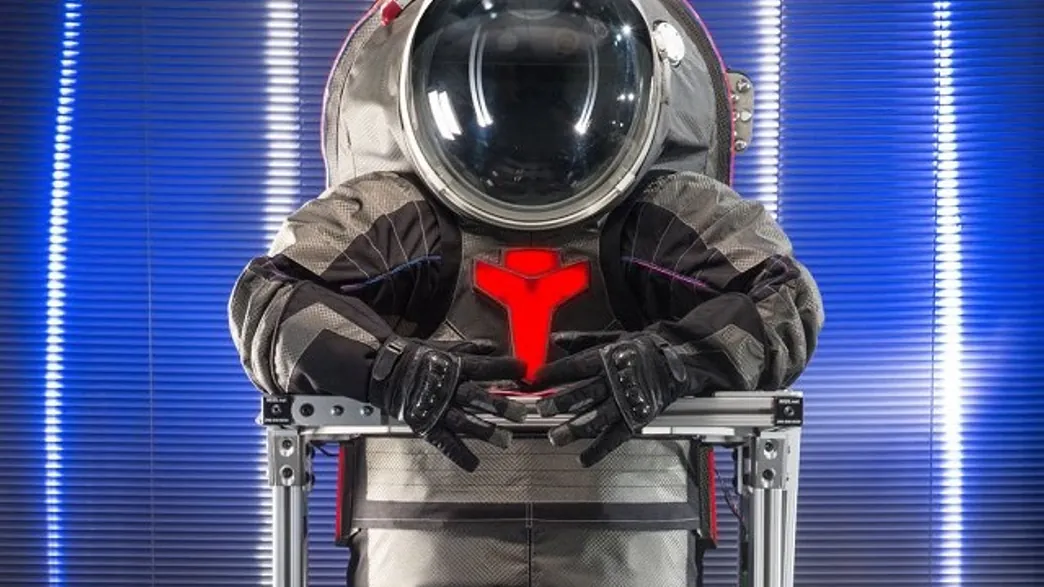
Mars spacesuit risk management focuses on protecting astronauts from extreme hazards (radiation, dust, temps, vacuum) and operational challenges (injury, life support failure, CO2 buildup, decompression), using rigorous design (Injury Modes & Effects Analysis, radiation shielding, better seals), advanced training (pre-breathing), constant monitoring (SFIT tools), and comprehensive protocols to ensure long-duration mission safety, balancing performance needs with crew survival, says NASA's risk management process for human spaceflight and NASA's approach to EVA suits for lunar and Mars missions. Key risks include dust contamination, thermal extremes, radiation exposure, and physiological strain from frequent, demanding EVAs, requiring redundant life support and injury mitigation.
Key Risks & Mitigation Strategies
Radiation & Dust: Martian regolith (dust) is abrasive, adhesive, and can damage equipment/harm humans; radiation is intense.
Mitigation: Advanced suit materials, better seals, dust-resistant designs, habitat shielding.
Physiological Strain/Injury: More frequent & demanding EVAs on Mars (24 hrs/week) increase injury risk compared to ISS.
Mitigation: SFIT (Spacesuit Fit & Injury Technologies) to predict/monitor injury, improved suit ergonomics (e.g., Z-2.5 design), better fit.
Life Support/Environmental Control: Risks like CO2 buildup, oxygen depletion, humidity, fire, and decompression sickness are critical.
Mitigation: Redundant systems, CO2 scrubbers, pre-breathing protocols (pure O2 for nitrogen purge) to prevent decompression sickness (DCS).
Operational & Technical: Design complexity, maintenance, long-duration reliability, and emergency scenarios.
Mitigation: NASA's formal risk management process (Human System Risk Board), detailed Maintenance plans, vacuum chamber testing, and designs for quick emergency return.
NASA's Approach
Formal Risk Management: Uses detailed causal diagrams (directed acyclic graphs) to map hazards to mission outcomes, improving stakeholder communication.
Focus on Exploration EVAs: Recognizing ISS EVAs (slower pace, fewer per mission) differ greatly from Mars needs, developing suits for higher performance and safety.
Integrated Systems: Designing suits (like xEMU) to support multiple programs (Artemis, ISS, Gateway) while managing unique mission risks
#672 Re: Exploration to Settlement Creation » WIKI Mars Airlocks and uses » 2025-12-26 13:23:35
Spacesuits no matter how many you have take time to get them on. They also have expirations dates for how many times they can be used plus more.
Sudden pressurization means you are dead...
Design goes after specifications of requirements are generated and reasons for what is required. That is mechanical and electrical engineering at its simplest form
1. dimension's of height, width, depth still not known...
2. safety interlocks for acceptable use parameters.
3. emergency contingency for crews that are out of air ect...
lots of stuff is required to be discussed long before the actual chamber is designed and for other features that are required. it is not a box with doors and pumps.
You are also ignoring risk management to people...
#673 Re: Exploration to Settlement Creation » WIKI Mars Airlocks and uses » 2025-12-26 12:15:59
Airlocks can and do many functions as desired in a sequence to remove issues that we might find. This is how humans think about problems that might be identified.
So we are going to need many inline locks to do what we require for a full development of a Dome entrance.
#674 Re: Exploration to Settlement Creation » Airlocks » 2025-12-26 12:10:52
AI can not always give the same reference content for an easily puncturable space suite where cuts can occur killing the mechanic by venture of being in a near vacuum.
For SpaceNut ... re https://newmars.com/forums/viewtopic.ph … 44#p236544
The text you pasted about airlocks looks reasonable, but there are no references.
This forum needs to get in the habit of providing references for every post that might be assumed by a reader to be something other than an opinion.
I like the discussion about multiple stages of air locks. That looks really tedious to me.
The worry about contaminating Mars is understandable for an initial expedition.
It has nothing to do with Calliban's dome airlock. We aren't going to be worried about contamination of Mars.
You have already started discussion because you are (apparently) worried about CO in Mars atmosphere that might enter the habitat.
I have tried to encourage you to guide your AI to produce useful guidance on how to do that. The AI may have found some NASA documentation but I don't see that has much if anything to do with Calliban's dome.
You provided a problem to solve. Now please guide AI to find a solution.
First AI does not find solutions that is a human function of gained knowledge.
Caliban's Dome has no airlock initially..to exit or enter....
This is something that we are trying to make real... AI is just a tool in the box...
The outer can also have a cleaning port entrance to minimize sand and dust using air spray nozzles to push it away. Think car port...
#675 Re: Exploration to Settlement Creation » WIKI Designing Mars equipment garage » 2025-12-26 12:05:08
No it calls out not single pieces but all that get delivered for larger projects.
Initial post is for a small not construction preload of items to bury the kilowatt reactor with berms.
A not with a restrictive easily puncturable space suit where cuts can occur killing the mechanic by venture of being in a near vacuum.
For SpaceNut ... re https://newmars.com/forums/viewtopic.ph … 44#p236544
The text you pasted about airlocks looks reasonable, but there are no references.
This forum needs to get in the habit of providing references for every post that might be assumed by a reader to be something other than an opinion.
I like the discussion about multiple stages of air locks. That looks really tedious to me.
The worry about contaminating Mars is understandable for an initial expedition.
It has nothing to do with Calliban's dome airlock. We aren't going to be worried about contamination of Mars.
You have already started discussion because you are (apparently) worried about CO in Mars atmosphere that might enter the habitat.
I have tried to encourage you to guide your AI to produce useful guidance on how to do that. The AI may have found some NASA documentation but I don't see that has much if anything to do with Calliban's dome.
You provided a problem to solve. Now please guide AI to find a solution.