New Mars Forums
You are not logged in.
- Topics: Active | Unanswered
Announcement
#651 Martian Chronicles » Nuclear War on Earth, Astronauts on Mars » 2016-10-10 00:01:06
- Tom Kalbfus
- Replies: 12
In the Martian Chronicles, towards the end of the book, there was a nuclear war on Earth. Lets update this a little. On the real Mars, what would happen to a Mars Colony if there was a nuclear war on Earth? If you were on Mars at the time what would you do? Lets try several scenarios.
Scenario 1: a Mars Mission, four astronauts on Mars collecting rocks doing experiments and things on Earth go to Hell, there is a war, Mission Control informs them of what's going on, they learn about Paris going up in a nuclear blast, then Mission Control informs them that they have to evacuate an that the astronauts will be on their own, and good luck. And then there is silence. The astronauts try to reestablish contact with Earth but there is no reply. What do the astronauts do in such a circumstance?
Scenario 2: a Mars base occupied by 100 people of various nationalities, including nations that go to war with each other, same as in scenario 1 back on Earth except this time there are more people on Mars, letssay a war between NATO and Russia gets out of control, neither side backs down and there is nuclear war and then silence from Mission Control. There are American and Russian astronauts on the base. What happens next.
Scenario 3: This time there is a community of 10,000 people, there are families and children, and a nuclear war on Earth and then silence, what happens next? What would you do?
#652 Re: Terraformation » Titan Terraformation - Is it possible? » 2016-10-09 23:19:28
I like simplicity, a ball of tungstein at the temperature of the Sun and the right distance is as simple as it gets, then all we have to do is worry about heating it. There are many ways to do this, one way is impact fusion on the far side of the ball of Tungstein, though this may cause a splash. the problem with fusion is that any fusion reactor that is brought close enough to heat this tungstein ball to the temperature of the Sun, will be vaporized, Impact fusion would add the kinetic energy of the pellets plus the nuclear energy of its atoms fusing to the heat of the tungstein ball, the linear accelerators stay a nice safe distance from this artificial sun, and the impacts always occur on the far side o the ball, the heat gets carried around to the near side, but the ball itself shields Titan from those gamma rays released by fusion, so we just have the visible light spectrum.
#653 Re: Terraformation » Titan Terraformation - Is it possible? » 2016-10-08 20:02:55
I understand the Moon could hold onto an Earthlike Atmosphere for a matter of centuries.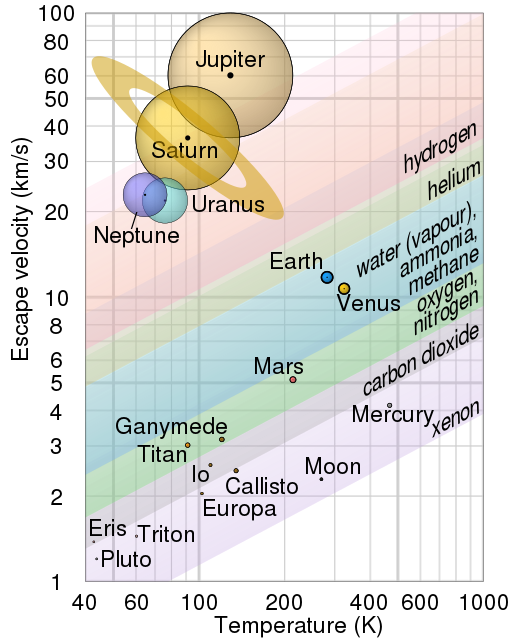
Titan has a higher escape velocity than our Moon, it you increased its temperature to that of out Moon, it would lose atmosphere much more quickly, but it would still be a matter of centuries to a millennium for it to lose its atmosphere.
Titan · Escape velocity
Titan · Escape velocity
8,658 feet/s (2,639 m/s)
Moon's Escape velocity (km/s)
2.38
The Moon's gravity is 0.165 of Earth.
Titan's is 0.14 of Earth.
Titan's Mass is
(1.3452±0.0002)×10^23 kg
Titan's orbit period is 15.945 days, in a 24 hour period Titan turns 360/15.945 = 22.578 degrees so in a 24 hour period an object which orbits over 360 degrees of its surface has to orbit a total of 360 + 22.578 = 382.578, that means its actual orbital period would be 24*360/382.578 = 22.584 Hours.
An orbit around Titan at a radius of 11455 km will produce an orbit period of 24 hours relative to Titan's surface, that means this artificial sun will rise and set and rise again as seen from a given location on Titan's surface in 24 hours. It is probably easiest to orbit this Sun over the equator and not have seasons, otherwise the seasonal cycle will last about 16 days without constant orbital correction. An artificial light source could instead vary its intensity instead to create seasons over the entire satellite. the radius of the Sun is 695,700 km, over a distance of 150,000,000 as seen from Earth.
11,455km/150,000,000 km = 7.6366666666666666666666666666667e-5 Multiply this by 695,700 km and we get a radius of 53.12829 km for our artificial Sun. The surface temperature of the Sun is Photosphere (effective): 5,772 K. the boiling point of Tungstein is Boiling point: 5,555 °C or 5,828K You know what that means? That means Tungstein remains liquid at a temperature equal to the surface temperature of the Sun. So an artificial sun can be a ball of glowing molten tungstein that is 53.12829 km in radius, as seen from the surface of Titan, such a glowing ball would look exactly like the Sun as seen from Earth.
The density of liquid Tungstein is 17.6 g/cm3 or 17.6 tons/meter^3
Volume of the sphere is 628143703822703 meters cubed times 17.6 tons = 11,055,329,187,279,572.8 tons of Tungstein or 1.1e16 tons.
Now the question is what's the best way to heat this molten ball of Tungstein to the temperature of the surface of the Sun, the great thing about liquids is they hold their volume, rather than expand as a gas, in a condition of microgravity, surface tension will keep it to a ball of white hot liquid. So what's the best way to heat it? Perhaps a laser, a very powerful solar powered x-ray laser, target this ball with it, but avoid hitting Titan and this ball of molten metal and illuminate one hemisphere of Titan heating up its surface to Earth like temperatures. This leads to another problem. Much of the surface is ice, not only water ice, by dry ice, its nitrogen atmosphere will probably get a lot of carbon-dioxide as the dry ice on its surface sublimates, the water ice will eventually melt and form an ocean. The good news is there are a lot of carbon compounds in Titan's atmosphere and crust, through chemical rearrangement, they can be formed into artificial rock, to form a shell in the shape of the topography of this Moon.
#654 Re: Human missions » Elon Musk wants to populate Mars with 1 million people to save humanit » 2016-10-08 18:49:15
Einstein wasn't the one who discovered that the speed of light measured as independent of the speed of the observer and always constant, that was discovered by an experiment run by Michelson and Moorely.
https://en.wikipedia.org/wiki/Michelson … experiment. With that information, it was only a matter of time that the equation E=MC^2 would be deduced. If not Einstein, someone else would have figured it out, Isaac Newton could have done it, if he was given that information, he is the father of Calculus after all!
#655 Re: Not So Free Chat » Oh Dear! » 2016-10-08 15:30:10
Usually you do that if you want a avoid a filter for using foul language. You misspell the foul word so it doesn't get removed. 
#656 Re: Terraformation » Shackleton Dome » 2016-10-08 15:28:18
The Moon has silicon and lots of it. I wonder if its possible to make a silicon based plastic instead of a carbon based one.
https://en.wikipedia.org/wiki/Silicone
The Moon lacks carbon, but has plenty of silicon I think we can use silicone based plastic for construction on the Moon. What do you think of that?
#657 Re: Human missions » Elon Musk wants to populate Mars with 1 million people to save humanit » 2016-10-08 15:17:47
Dook wrote:...
Dook wrote:What's it like putting money into the pockets of people who make products that I despise? It's called Capitalism or, you could also call it evolution. I'm not worried about dying, I know what comes next, unlike you.
Well, normally you're burnt or buried after you die..
That is third person, bet you don't know what happens first person when you die, no one does! Knowledge and belief are not the same thing.
#658 Re: Terraformation » Orbital Mirrors for the Transantarctic Mountains » 2016-10-08 00:00:17
Tom, its a terrible idea. Would you really want to risk destabilising the whole Antarctic ice sheet and raising sea levels by 10's of metres, all for the sake of a few worthless mountains in Antarctica?
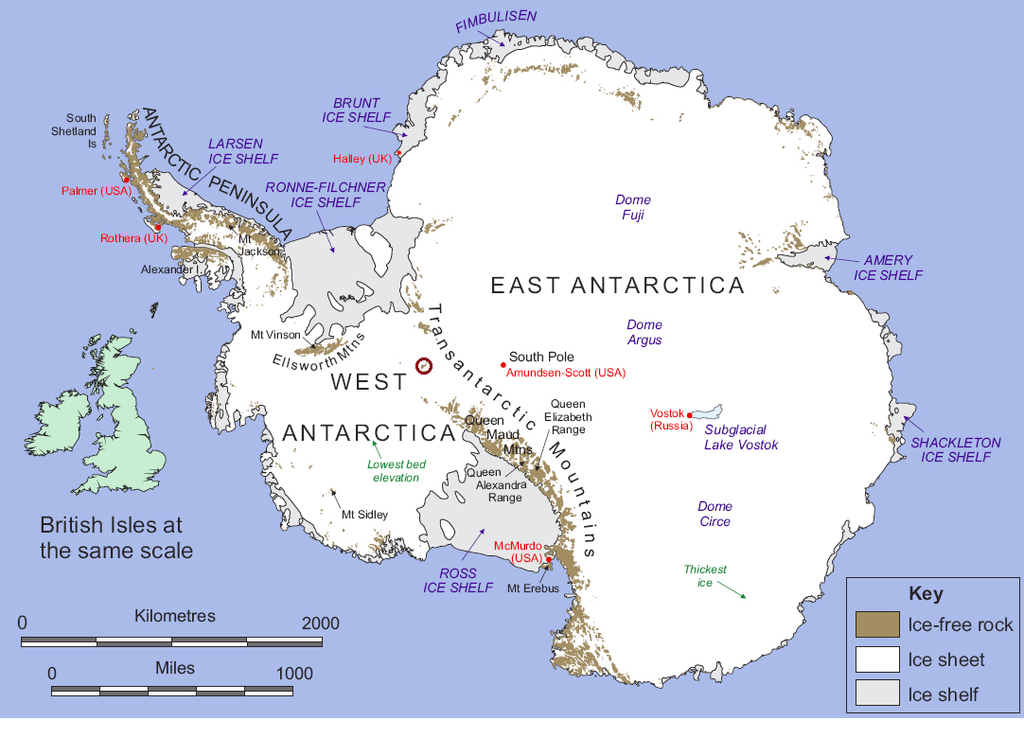
Do you see that little red circle I drew on this map of Antarctica? that is the radius of the area I'm talking about. Look how so much bigger Antarctica is compared to that little red circle, which I drew to scale! This is equivalent to a space colony on Earth, that little circle. I don't see how melting that little thing would leave Antarctica ice free, do tell me how this could happen.
#659 Re: Terraformation » Orbital Mirrors for the Transantarctic Mountains » 2016-10-07 09:44:51
In total, at the distance of 15,000 km, it would have to be 338.24 kilometers in diameter, this will take into account the fact that the mirror will have to be angled at 45 degrees to reflect incident light rays from the Sun, so this reduces its apparent diameter to 0.7 of its actual diameter. At a distance of 15,000 kilometers the orbital period is 8 hours and change, if we want, we could increase the orbit to 24 hours, but then we'd have to increase the size of the mirrors too. the size of the mirror would have to be proportional to the mirror's distance from the Earth. If we increase to orbit to 35,870 km we would get a 24-hour orbit, if we did this however...
35,870/15,000 km = 2.39133.
2.39133 * 338.24 = 808.84 km
We'd have to increase the mirror diameter to 808.84 kilometers the Sun would then rise on a 24-hour schedule, it could be synchronized with the appearance of the real Sun to produce twice as much sunlight, the mirror doesn't have to be 100% reflective of course, and the real Sun when it appears is at a low angle, heavily filtered by the atmosphere, so it won't be quite twice as much as we see the Sun at high noon in the New York area for example. You probably do want to warm it up more to compensate for the cooling effect of the surrounding glaciers.
This is to cover an area on the ground that is 50 km in radius, beyond that, you get a reflected partial image of the sun, and a transition zone to a normal polar climate. This zone will be quite isolated by these ice sheets, you won't get penguins or seals or walruses, or krill that are disturbed by this, and very little life exists in the interior of Antarctica, except for that which we place there.
If we can use material from the Moon, it might prove cheaper to do this, that to build a 50 km radius floating platform on the Ocean, and less environmental impact as well. Reflectors in space don't have to withstand the rigors of a churning ocean after all.
#660 Re: Human missions » Elon Musk wants to populate Mars with 1 million people to save humanit » 2016-10-07 08:08:58
It is big and completely reusable, it is the "Jumbo Jet" of rockets. It is expensive to build but then you get to use it multiple times, that helps pay for its cost, it has five times the lift capability of the Saturn V, and three times that capability when it is reused. reusability changes the equation on what is an economic size for these rockets, if they are throw away, you would want rockets that are medium-sized that can be rapidly manufactured and reliable with one shot one rocket, but with reusability, you can build larger. If this were the early days of aviation, I would say you were stuck on biplanes, and saying that it would not be economical to build a giant biplane that could carry 100 passengers.
#661 Re: Terraformation » Orbital Mirrors for the Transantarctic Mountains » 2016-10-07 08:00:40
Thank you, Tom, for the good back-on-Earth topic!
Thoughts, inspired by this.:
[1] https://en.wikipedia.org/wiki/Transantarctic_Mountains are 3500km long and 200-ish (average) wide. I.e. Total area of 700 000-ish km2. That is twice Japan, or 20-ish Swirzerlands. I.e. fits hundreds of millions of people easily! And only 5% of whole Antarctica.
[2] The soleta ( orbital mirror ) could be not orbiting, but Solar sail ( https://en.wikipedia.org/wiki/Solar_sail & https://en.wikipedia.org/wiki/Solar_sail#Materials ) material Statite ( https://en.wikipedia.org/wiki/Statite ) which to hover exactly over Antarctica. Other mirror ( Optics ) hardware materials option is host of vacuum baloons ( I already shared these: http://www.niac.usra.edu/files/studies/ … 4Crowe.pdf & http://www.niac.usra.edu/files/library/ … 4Crowe.pdf ), too.
I thought about this too, then I thought, do I want this "Sun" to be up all the time? If we were to turn off this "Sun" so the people in Antarctica can have some night, this statite would fall towards the Earth, you see what keeps it up is radiation pressure, and it not only has to reflect light towards a particular area on Earth, it also has to levitate itself with that same light, the direction the light has to be reflected in in order to levitate itself might not be in the same direction we want to reflect light in in order to warm a patch of Earth. It might be better to use a thicker, heavier mirror, still a solar sail, but one which can't levitate itself against the force of gravity, instead it uses light pressure to constantly change it orbit, when it is not over Antarctica, the orbit change is so that it is orbiting at right angles to the direction of the Sun, we call this a Solar Synchronous Orbit, it orbits in such a way that the Sun is always visible, it orbits over the poles, and is angled at 45 degrees to the incident light rays, and as it passes over that particular patch, it changes its orientation, using light pressure, to reflect light on that particular patch of ground. From the point of view of those on the Ground, the Sun will appear to rapidly rise from the South, go directly overhead, and then set in the opposite horizon, at times where will appear to be two Suns in the sky at the same time, one, low above he horizon, and one rising to its zeneith almost directly over head and then setting in about 4 hours. During winter, the transantarctic mountains will experience a series of 8-hour days with about 4 hours of sunlight and 4 hours of darkness.
[3] The mirror material can be launched this way.: http://www.iase.cc/accelerator.htm -- shooting machine gun way with enough Hertz of frequency in plasmoid way could keep open atmospheric exit corridor. This corridor acting like giant cable shortcuting the ionosphere could actually provide much of the energy for the launcher ( also we have ready available massive hydro- , wind and geothermal power )...
[4] The sail-mirror ( or the swarm of such ) kept 'inflated' and static by balance of redirected sun-light and earth's gravity over the target -- could also be modular-ly managed and to run diurnal and seasonal cycle of ... as it is desired or seen fit.
[5] The presence of well lit and warmer patch of 5% the Antarctic total area, could be mitigated so this to not switch-on negative effects ... the surrounding areas could be additionally cooled off to compensate. ( Blanketted by insulation layer, solar powered Peltier fridges ... etc., so exactly to mimic the conditions and effects - regional and global of an Antarctica without terraformed TAM area ). This is achievable by preventing evaporation/precipitation/air humidity effects and keeping the extra illuminated 'oases' very dry on the top, i.e. drop irrigation systems. And by illuminating ONLY the exact targets while keeping the surroundings into the dark?
The surrounding areas are ice sheets, one particular effect I think would be and artificial hurricane, you see warm air would rise in the center pulling it surrounding colder air. I think it would to a large extent be a "snow Hurricane" as a lot of precipitation from it will be snow. Snow will tend to pile up on top of the glaciers, the glaciers would tend to move inward toward the melt water lake and then be melted, and thus we continue the water cycle. If the area is small, say about 50 kilometers in radius, the rest of the continent wouldn't be affected much at all. All that ice surrounding it would isolate the ecology around the transantarctic patch from the more environmentally sentivie coastal areas of Antarctica, so the penguins and seals would hardly be affected at all, as the warmed up areas would be deep into the interior of the continent. And this would be good practice for terraforming Mars.
[6] The overall natural sun light flux would be far smaller then the total TAM area of 700k km2 multiplied by the average Swiss-equivalent flux, and the Soleta could be quite smart beaming EXACTLY as much as needed on area and in time! With very high precision. More advanced optical system can modulate not only by intensity, but also ... color, phase, ... Thus agricultural patches will peak in red and blue, the towns and cities will either have 24/7 noon or what the inhabitants vote for ( and buy from the National Climate Stability Board similarly to the 'carbon credits' - all illths' mitigation could be marketized, tokenized, monetized ... ).
[7] In fact Transantarctica would be a terrific country!:
- quite linear which will give quite good geometry of the trans-country backbone transport system ( most probably www.et3.com ! )
- it will have North Coast and South Coast, which could have dozens of thousands of miles coast line each if so fractalized as , say, Greece or Norway. Plenty of coast length to have lotsa ports, beaches, 24/7/365 tropical resorts few miles away from 24/7/365 ski resorts. ( It is comparatively easy to keep cold waters from shallow balmy waters apart by underwater barriers of different kind - inflatable, bubbly dynamic ones etc. ).
- the TAM country one of the biggest on Earth in terms of prime realty, would be right in the middle of a vast region of over 20 mln. km2 of natural riches - land and oceanic ones, mineral and biological ...
- beautiful nature! clean air. marvelous sightseengs and panoramas. http://wallpaperfolder.com/wallpapers/swiss+landscape or https://www.google.bg/search?q=southern … landscapes . Also think Chile, Norway, Himalayan countries ...
- 99% of the freshwater on Earth. Safely kept frozen. ( The minerals mining can go selectively under the ice sheet ).
- blue sky. never rain... but lush land. 99% wilderness (national park) by area on land and sea. ...
[image] http://img.wallpaperfolder.com/f/58EEDF … e-best.jpg [/image]
#662 Terraformation » Orbital Mirrors for the Transantarctic Mountains » 2016-10-06 22:39:27
- Tom Kalbfus
- Replies: 10

What I'm proposing here is a space colony, one that is easier to build than the O'Neill colonies, you build it in space, but you don't have to travel to space to get there once complete. The site of this space colony is the Transantarctic Mountains, it has all the things you need to survive except heat and light in the winter, with orbital mirrors we can add than missing element.
As you know, Antarctica is mostly covered with ice sheets, some of the exceptions to this are the tops of the transantarctic mountains, they jut above the ice sheets and their rocky surfaces are exposed. Now lets say we build a flat orbital mirror. The diameter of the Sun is 1.392 million kilometers, and its average distance is 150 million kilometers, now lets say we have a mirror orbiting the Earth at a 90 degree inclination to the equator, and it was 196.86 kilometers in diameter. Since the mirror is angled about 45 degrees to incident sunlight, its apparent width as seen from the ground will be 139.2 kilometers, this is about 10,000 times smaller than the Sun's diameter and since it is 10,000 times closer, it will produce an image of the Sun that is the same apparent size as the real sun. Now if we want to illuminate an area that is 50 kilometers in radius, we will have to increase the diameter of the mirror by 141.42 kilometers giving it a diameter of 338.28 km. This will produce an area on the ground where an image of the Sun will appear the same size as the real sun in the sky over an area that is 50 kilometers in radius or 31.25 miles. We would want to focus on the Transantarctic mountains because their tops are ice free and will readily absorb sunlight while the ice sheets will reflect that sunlight back into space. Those mountains will reradiate heat and melt he surrounding glaciers creating more land area around them and melt water lakes. The melt water will be dammed in by the surrounding glaciers of Antarctica. This melt water can be used for drinking, and watering of crops, a source of life for the transantarctic mountains, and they would b mush easier for colonists to get to than outer space.
The 15,000 km radius orbit will have an orbital period of 8.63672 hours, so there will be about almost 3 sunrises and 3 sunsets per 24-hour day, this extra sunlight will add to the sunlight during Antarctic summer, and create short 4+ hour periods of daylight followed by 4+ hours of night during Antarctic winter. his should make the area illuminated more habitable, allow for growth of vegetation and allow people to live there more comfortably.
#663 Re: Human missions » Elon Musk wants to populate Mars with 1 million people to save humanit » 2016-10-06 11:12:38
Because that's what were talking about! How many people fly in airplanes? Millions. Why is the idea about millions of people traveling in space such an incredible idea to you, just because we're not doing it now? Million of people fly in airplanes, you for you it seems space travel is mostly for audiences watching live pictures on their televisions. For you an astronaut is a celebrity figure who signs autographs, that has got to change, what's called The Right Stuff has go to change. If you need to be a super genius at the pinnacle of your career and be hired by the government to go into space, this is not a real and true space age. Suppose President Thomas Jefferson wanted to create an Aeronautical Agency to support balloon flights and taxpayer expense. Thomas Jefferson had seen balloon flights in France, wouldn't that be comparable to what NASA is doing today? We are in the hot air balloon age of space flight. Most people in the early 19th century didn't fly at all. though a few did, the Wright Brothers weren't the first.
Modern flight began in 1783 when Joseph-Michael and Jacques-Ètienne Montgolfier engineered the first hot-air balloon flights. On Oct. 15, 1783, the Montgolfiers brothers launched a balloon on a tether with Jean-François Pilâtre de Rozier, a chemistry and physics teacher, as the passenger. In that era, nobody knew if a person could withstand the rigors of being up in the air, so a previous flight had included animals, to see if they survived. They did, as did de Rozier. Later that year, the first untethered flight was made.
#664 Re: Terraformation » Shackleton Dome » 2016-10-05 21:41:23
It is literally a Lunar Analog to an orbiting O'Neill colony. the dome actually saves on mass because we don't need to build the ground, as in an O'Neill colony, so it should be easier to build, much of the material comes right from the Moon itself. the main enabling technology I would say is robotics, and of course cheaper transportation to get those robots there. The 3 second delay could be managed with some semi-smart robots. the controller on he ground, for instance indicates which rock to pick up, and the robot itself figures how to pick it up, and if it drops it, so what, there are plenty of other rocks on the Moon? You probably would need lots of robots on the Moon, as building a structure that size, even on Earth is unprecedented. I don't know of any 25-mile wide domes we have ever built on Earth. I think if the robots are semi-smart, they need not all be individually operated by a remote operator from Earth. Part of this technology might be found in the autonomous cars Google is developing. the robots need to be able to move around without bumping into things and getting stuck.
#665 Re: Terraformation » Shackleton Dome » 2016-10-04 19:32:00
http://www.nss.org/settlement/moon/Luna … ngs650.jpg
Basic parameters for the dome
• Size: 25 miles in diameter/5,000 feet tall
• Main components: ◦ Dome
◦ Anchoring system
◦ Maintenance systems
◦ Catastrophic repair facility• All assembly is via autonomous robotics
• All glass is manufactured in layers to enable thermal stress control
• Basic unit is a hexagonal pentagonal surface patch of glass with a titanium frame that interlocks with similar units
• Dome is anchored to bedrock
• Shield glass module is two to three meters thick
• Internal and external lattice work along with scaffolding for assembly
http://www.nss.org/settlement/moon/shackleton.html
Suppose we used the Interplanetary Transport System to establish a base on the Moon, a more modest goal than sending one million people to Mars. Lets talk about this Shackleton Crater Dome for instance. The ITS can deliver perhaps 300 tons to the Moon at a shot, this would be mining, refining and construction equipment.
An Island Three would by comparison have about 250 square miles of living space, the Shackleton Dome would have 78.5 square miles, still it is a great deal more than the O'Neill Bernal Sphere Island One. So if an Island Three O'Neill Cylinder can hold 10 million, with similar living space, the shackleton Dome could be home to as many as 3 million.
The total mass of silica in the concept of this dome is approximately 1.6 x 10^10 tonnes. Completion of the dome in about 15 years would require mining rates on par with helium-3 production, which involve excavation, processing, and manufacturing rates approaching 250,000 tonnes per hour. For instance, the mining capability for tar sand at a typical facility is about 28,000 tonnes per hour.
#666 Terraformation » Shackleton Dome » 2016-10-04 19:24:19
- Tom Kalbfus
- Replies: 21

Basic parameters for the dome
• Size: 25 miles in diameter/5,000 feet tall
• Main components: ◦ Dome
◦ Anchoring system
◦ Maintenance systems
◦ Catastrophic repair facility
• All assembly is via autonomous robotics
• All glass is manufactured in layers to enable thermal stress control
• Basic unit is a hexagonal pentagonal surface patch of glass with a titanium frame that interlocks with similar units
• Dome is anchored to bedrock
• Shield glass module is two to three meters thick
• Internal and external lattice work along with scaffolding for assembly
http://www.nss.org/settlement/moon/shackleton.html
Suppose we used the Interplanetary Transport System to establish a base on the Moon, a more modest goal than sending one million people to Mars. Lets talk about this Shackleton Crater Dome for instance. The ITS can deliver perhaps 300 tons to the Moon at a shot, this would be mining, refining and construction equipment.
#667 Re: Human missions » Elon Musk wants to populate Mars with 1 million people to save humanit » 2016-10-04 18:05:26
Tom Kalbfus wrote:Dook wrote:Can't have the cart before the horse.
If we have a good plan to send 1 million people to Mars in 50 years we should do it? With our current technology there is no possible good plan to send even 100 people to Mars in the next 50 years.
Colonists are not going to create their own energy systems on Mars for a 100 years and probably more like 200 years.
They will grow food, probably not nearly enough to sustain themselves for another 100 years.
Basic household items like furniture and kitchen utensils will never be key priorities on Mars.
How old are you? Are you in your 20s perhaps? Perhaps you can tell me what was going on 50 years ago at this moment, October 4, 1966. What about October 4, 1916?
https://en.wikipedia.org/wiki/October_1966Here's a small sample:
October 25, 1966 (Tuesday)
The People's Republic of China successfully test-fired a nuclear missile for the first time, with an accurate hit and an atomic blast at a pre-determined target in the Lop Nor desert site.[112][113]Meeting in Manila, the seven member nations of the South East Asian Treaty Organization (SEATO) agreed to a common plan for ending their participation in the Vietnam War. The Manila Communique, signed by U.S. President Lyndon Johnson, South Vietnam's Prime Minister Nguyen Cao Ky, and other leaders, the nations endorsed a six-point peace proposal and offered to completely withdraw the allied forces from South Vietnam within six months after "the other side withdraws its forces to the North, ceases infiltration, and the level of violence thus subsides." [114][115] However, North Vietnam's Prime Minister Pham Van Dong, referring to the Munich Agreement between Adolf Hitler and Neville Chamberlain in 1938, responded, "Never Munich again, in whatever form," and pledged that his nation "will fight until final victory against the U.S. imperialists." [116][117]
A military court in Jakarta sentenced Indonesia's ex-foreign minister Subandrio to death, on charges of being involved in the 30 September Movement.[118][119] The sentence would be reduced to life imprisonment upon the intervention of the British government.
Three days after accusing Britain's Royal Air Force of flying over Spanish territory in order to reach Gibraltar [120] Spain closed off its border crossing at La Línea de la Concepción, the only land connection between the British colony and the rest of Europe.[121]The Luna 12 space probe, launched by the Soviet Union on October 22, entered orbit around the Moon in order to photograph potential landing sites for a manned mission. With higher resolution television cameras (1100 scan lines) and a closer orbital approach than previous Soviet probes (as near as 103 kilometers), Luna 12 returned images in which 15 meter long objects could be discerned. Most of the photos, taken from a nearly equatorial lunar orbit, were not released.[122][123]
The British House of Commons voted 307-239 to approve the Labour government's compulsory freeze on wages and prices, with a 500-pound sterling fine against violators.[124]
Died: Floyd MacMillan Davis, 70, American illustrator
Superficially, how different is 1966 from today?
How old am I? I'm 49, how old are you?
How different is 1966 from today? And what have we done since 1966? Well, we went to the moon with a series of Apollo missions, then we spent the next 30 years in low earth orbit with the almost useless Space Shuttle. Then the first President Bush asks NASA to come up with a mission to Mars and their idea's are impossibly complex and way too costly. Then a nobody named Robert Zubrin makes NASA look foolish and comes up with Mars Direct and it's been, what, twenty years later and we're just now building a heavy lift vehicle to take us to Mars.
Technology is not what's holding us back, good NASA leadership is. We could have gone to Mars with Mars Direct ten years ago. Now NASA is stuck with this Orion capsule that isn't ideal for going to Mars so what is it going to be used for? Asteroids, great.
NASA can screw up in space and waste time and it will still get it's money. Elon Musk can't.
Even so, if everything goes perfectly for Elon Musk, we won't be anywhere near having 1 million people on Mars in 50 years. Even if he started sending his 100 man spacecraft to Mars once a month starting this month that would only be 60,000 people on Mars in 50 years. You guys are living in a science fiction fantasyland.
You know we don't have to work out of just one launch pad, if the demand is high enough, more launch pads can be built, we could launch multiple rockets at once, multiple rockets can fly in every launch window, just as we have multiple airplanes taking off and landing at multiple airports all the time. If the cost can be brought down, then the demand will go up. Each ship can carry 100 people, but if we launch 100 ships at once we can send 10,000 people to Mars on a convoy of spaceships. We don't do that now, because the cause is too high, but if we can bring down the cost, we can certainly justify building 100 launch pads to launch 100 rockets at once, there is nothing that says we couldn't do this, there is plenty of space to launch all of those rockets in a single launch window and not have them bump into each other. So if we could send 10,000 human beings every launch window that is how much in 70 years?, about 350,000. Okay, so if we built 300 launch pads and launched 300 ships at a time, we could have one million people on Mars in 70 years, not too bad. What sort of airplanes did we have in 1916?
I think they looked something like this. How do you go from this
to this in 70 years? What would be the early 22nd century equivalent to a 777 in space? Would it be those crude things we're talking about now?
#668 Re: Human missions » Elon Musk wants to populate Mars with 1 million people to save humanit » 2016-10-04 12:18:06
Can't have the cart before the horse.
If we have a good plan to send 1 million people to Mars in 50 years we should do it? With our current technology there is no possible good plan to send even 100 people to Mars in the next 50 years.
Colonists are not going to create their own energy systems on Mars for a 100 years and probably more like 200 years.
They will grow food, probably not nearly enough to sustain themselves for another 100 years.
Basic household items like furniture and kitchen utensils will never be key priorities on Mars.
How old are you? Are you in your 20s perhaps? Perhaps you can tell me what was going on 50 years ago at this moment, October 4, 1966. What about October 4, 1916?
https://en.wikipedia.org/wiki/October_1966
Here's a small sample:
October 25, 1966 (Tuesday)
The People's Republic of China successfully test-fired a nuclear missile for the first time, with an accurate hit and an atomic blast at a pre-determined target in the Lop Nor desert site.[112][113]Meeting in Manila, the seven member nations of the South East Asian Treaty Organization (SEATO) agreed to a common plan for ending their participation in the Vietnam War. The Manila Communique, signed by U.S. President Lyndon Johnson, South Vietnam's Prime Minister Nguyen Cao Ky, and other leaders, the nations endorsed a six-point peace proposal and offered to completely withdraw the allied forces from South Vietnam within six months after "the other side withdraws its forces to the North, ceases infiltration, and the level of violence thus subsides." [114][115] However, North Vietnam's Prime Minister Pham Van Dong, referring to the Munich Agreement between Adolf Hitler and Neville Chamberlain in 1938, responded, "Never Munich again, in whatever form," and pledged that his nation "will fight until final victory against the U.S. imperialists." [116][117]
A military court in Jakarta sentenced Indonesia's ex-foreign minister Subandrio to death, on charges of being involved in the 30 September Movement.[118][119] The sentence would be reduced to life imprisonment upon the intervention of the British government.
Three days after accusing Britain's Royal Air Force of flying over Spanish territory in order to reach Gibraltar [120] Spain closed off its border crossing at La Línea de la Concepción, the only land connection between the British colony and the rest of Europe.[121]The Luna 12 space probe, launched by the Soviet Union on October 22, entered orbit around the Moon in order to photograph potential landing sites for a manned mission. With higher resolution television cameras (1100 scan lines) and a closer orbital approach than previous Soviet probes (as near as 103 kilometers), Luna 12 returned images in which 15 meter long objects could be discerned. Most of the photos, taken from a nearly equatorial lunar orbit, were not released.[122][123]
The British House of Commons voted 307-239 to approve the Labour government's compulsory freeze on wages and prices, with a 500-pound sterling fine against violators.[124]
Died: Floyd MacMillan Davis, 70, American illustrator
Superficially, how different is 1966 from today?
#669 Re: Human missions » Musk's plans for Mars » 2016-10-03 20:46:52
Say Musk sends people to Mars. Those folks mine something.
Legal under treaties or not, just who the hell else is going to go out there and try to arrest them?
They don't have to arrest you, they can seize your assets back on Terra. Until you're self sufficient, they hold the upper hand. It's also very difficult to issue rights to the gold in your vault, for trading back on Earth, if those rights won't be recognised, and any gold that is withdrawn is seized upon arrival.
As regards gold mining, though, I think it could actually work. The total amount of mined gold in existence is 171,000 tonnes. At the moment, gold is around $42 million US per tonne, so 1000 tonnes would be worth $42 billion. That's less than 1% of the current gold available, so I don't think it's going to cause the price to collapse. At the moment, all that gold is worth $7.2 trillion. If we got 1% of that in our Martian vault, we'd have $72 billion available. Enough to fund the seed settlement, after which we can start selling semi-para-terraformed (thin atmosphere, just about habitable for plants) land?


There is no Terran Government to arrest you, instead there are lots of countries, land in the right country and they won't arrest you!
#670 Re: Human missions » Musk's plans for Mars » 2016-10-03 20:44:45
So could this ship make it at the location of the phonex lander?
https://tse1.mm.bing.net/th?&id=OIP.Mad … =0&p=0&r=0I believe it is flat, and has ice. Can the ice support it's weight?
It needs lots of ice, so there are;
-The two polar deposits around the ice caps or;
-Mid-Latitude glaciers or;
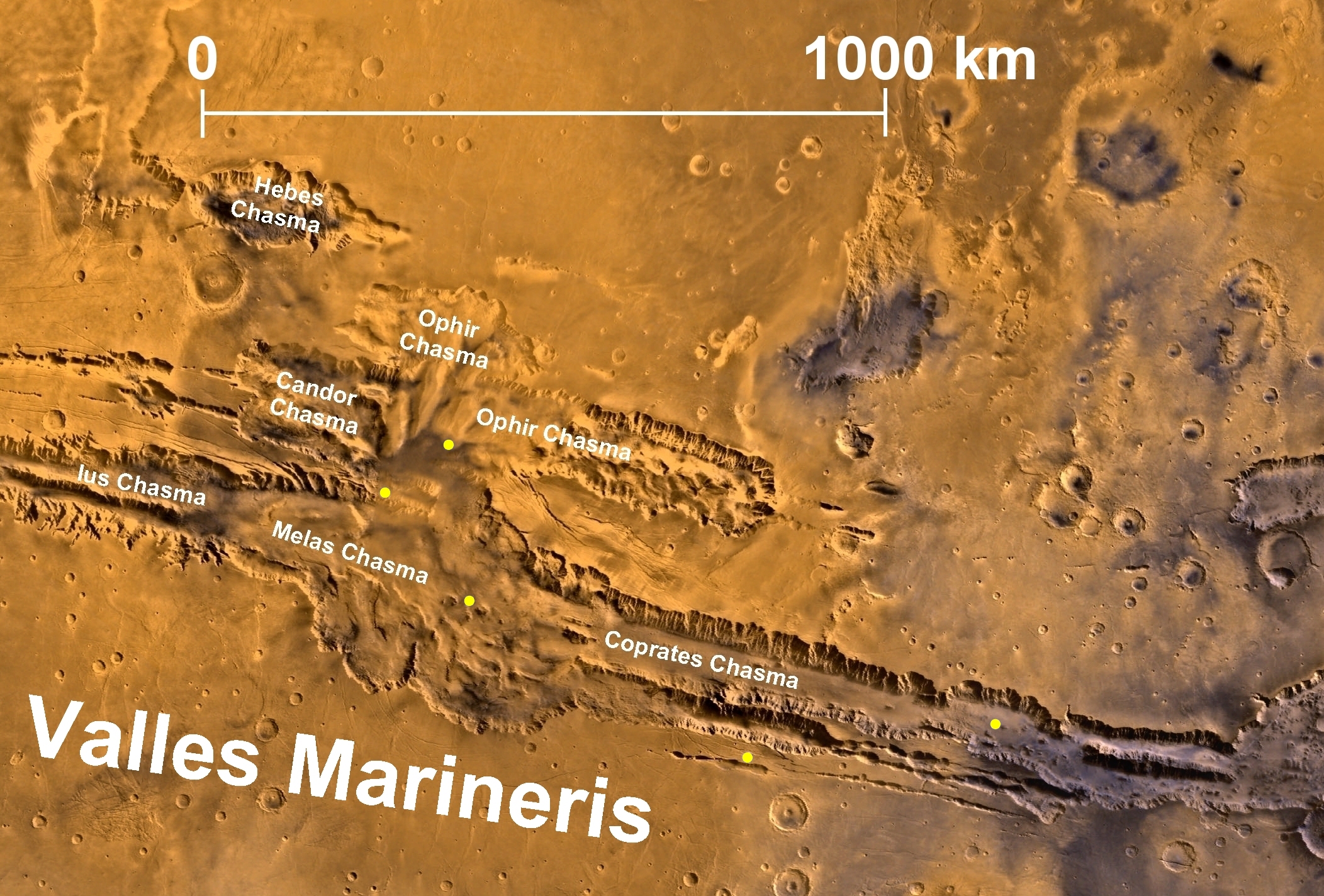
-Speculated fossil ice in the Mariner Rift Valley or places like it around the equator.I think they could get small nuclear reactors from the Russians, and perhaps others?
I am under the impression that spacesuits of today will not be sufficient for the polar areas even in the summer. Is that true?
Why not? Remember the movie the Martian, where it starts out with a dust storm that knocks down an antenna which impale an astronaut? In real life this could not happen, even the fiercest winds have only the force of a light breeze on Earth, the same can be held true of the atmosphere's ability to carry away heat, with a less than 1% atmosphere, the air might be way colder than Antartica, but it just can't dra the heat away from a suit that a blizzard in Antarctica can do on Earth. The worst part about it would be the heat drawn away through the soles of your boots, but I shouldn't be too much trouble to add extra thermal insulation there.
#671 Re: Human missions » Musk's plans for Mars » 2016-10-02 22:35:49
Interesting response Gary. The Mars Colonial Transporter is a reusable two-stage to orbit vehicle with two different second stages, one for carrying passengers and cargo and the other is a fuel tanker for refueling the passengers and cargo module. The ship relies on a chemical methane-oxygen combustion to not only achieve orbit but also to make the trans-Mars injection, no use of ion, plasma, or nuclear drives is mentioned. The crew-cargo module also has a fan-shaped deployable solar power array to power the ship during its cruise between planets. The passengers float around in zero-g during the cruise, the ship lands without a parachute and then produces its fuel for the return journey. I assume there is some sort of nuclear reactor of the type Zubrin mentioned to power the manufacture of return fuel, but perhaps extensive arrays of photovoltaic panels could do the same job if there are enough of them. Either the first explorers will be brought home, or we'll have to keep on resupplying them from Earth. We'll need long range rovers to do a thorough exploration of Mars around the landing site and to search for water, not the type of rover Mark Watney had to jury rig in the movie The Martian. We probably should preposition several long range rovers for the explorers to use, and plenty of spare parts to repair the same rovers. the rovers should be pressurized, because its hard to live in a spacesuit for those long journeys across Martian terrain, and the rovers should either have an airlock if a docking port for externally mounted spacesuits. I think an airlock is a better idea, as it allows the space suits to be cleaned and maintained within the pressurized rover.
#672 Re: Human missions » Musk's plans for Mars » 2016-10-02 12:11:25
The Moon is also a source of Gold, and all you need is a mass driver to send it to Earth. Platinum also has a high melting point, you could just chuck it at Earth as is, it will survive entry into the atmosphere and make a crater when it hits the ground.
#673 Re: Human missions » Musk's plans for Mars » 2016-10-02 08:28:22
Sadly gold is gold and will get golden treatment no matter where it is. One should expect a small variation in price due to differing industrial demand on Earth vs Mars, but this is likely to cause a premium or discount of only a few percent given the nature of how gold is used on the commodities markets.
What if the gold is still in the ground and unmined? It is there now. Why can't you buy and sell the Martian gold right now without mining it? I'm sure there is more gold in Mars right now than in the vaults of Fort Knox. I kind of suspect you have to do something with the gold other than leave it in the ground before you can buy and sell it. The difference between gold on Earth and gold on Mars is that you can't make jewelry out of gold that has been unmined and still on Mars. Or imagine this, a Hollywood star at the academy awards, wearing the latest fashion, and hanging on a string around her neck is a photograph of a necklace that was made out of gold and is still on Mars, and they Hollywood star insists that its hers to the reporters that ask. Gold on Mars is not the same as having gold on one's person.
#674 Re: Human missions » Musk's plans for Mars » 2016-10-01 01:26:36
Depends on how much it costs to get to Mars.
#675 Re: Exploration to Settlement Creation » Long Term Mars Habitat » 2016-09-30 08:21:17
How about building a hab next to a canyon wall of the Vallis Marineris, that should provide some radiation protection.