New Mars Forums
You are not logged in.
- Topics: Active | Unanswered
Announcement
#26 Re: Not So Free Chat » Politics » 2025-11-16 07:16:05
SpaceNut,
That veteran was also never an American citizen. For whatever reason, his paperwork was never processed. Following his military service, he was convicted of attempted murder after discharging a firearm at someone during a house party, and sentenced to 52 years in prison. He was released on parole after 15 years. Following his early release from prison, his request for asylum was formally denied by an immigration judge. After you try to murder someone, it turns out that immigration judges are less understanding when it pertains to your asylum case.
I think it sucks that he was injured in combat, that he had PTSD as a result, and that he tried to murder someone. I've no idea why he did that because the article makes no mention of motivation or circumstances. I must assume that being sentenced to 52 years meant what he did was pretty horrific. It's awful, but that was what he chose to do with his earned freedom (in my opinion, which counts for very little) following his military service. The immigration judge did not feel that his actions merited US citizenship, which also sucks, but that is our system of governance in action. If you think someone who has served in our military should be granted citizenship, irrespective of any other considerations, then convince your representatives as to why automatic citizenship should be bestowed upon anyone who served in our military.
Should our government be compelled to care for the people they crushed in our military?
Maybe they should, but I think you'll find that the majority of people, certainly those in our government, want us to quietly go away after we've completed our service. The general public doesn't seem to know which box to put us in, almost as if we're broken toys they're no longer interested in playing with.
#27 Re: Not So Free Chat » Politics » 2025-11-15 12:39:04
#28 Re: Life support systems » Dust Mitigation Mars Solidified Regolith or Artificial Lichen » 2025-11-13 12:09:51
tahanson43206,
While the lunar surface is almost devoid of atmosphere, even the very thin wispy atmosphere of Mars is sufficient to hold a significant amount of dust in suspension. We could "pave over" the entire planet, but unless we construct a planetary-scale air filter, that suspended dust is still going to be there. There ought to be less dust afterwards, but without building and operating that air filter, all the dust already in the atmosphere is never going away. You may not experience dust storms that blot out the Sun, but that's the extent of what paving over the entire planet could achieve. Be that as it may, there's one guaranteed way to remove dust from the Martian atmosphere- evaporating enough water vapor to trap more heat from the Sun and cause precipitation. That's how entrained dust gets removed from Earth's atmosphere.
What you proposed should work for the moon, until the next significant asteroid strike, and then we're right back to square one. Why does the moon have so much fine abrasive powder all over its surface?... It's the natural result of all those asteroid strikes through the ages, but no significant atmosphere or liquid water to cause weathering.
We have to learn how to engineer-around this problem.
#29 Re: Science, Technology, and Astronomy » Suspension Bridge Martian City Roof Design » 2025-11-13 09:55:14
Cast basalt's tensile strength is 30-40MPa, roughly half that of any variety of oak wood. While it doesn't absorb water at all and is highly resistant to most acids and bases, which is great for chemical processing and brine transport, it's not particularly fond of large thermal shocks or very cold temperatures or impact loading. Those drawbacks may mean very little for this application or they might become stumbling blocks on Mars since we're operating outside of the normal environmental extremes encountered on Earth. Here on Earth steel mills frequently use cast basalt as a liner for chemical processing piping and waste stream removal. Some sewers and runoff systems also use basalt liners.
Basalt can be cast or carved into plates / bowls / coffee mugs, too:
Mexico makes their traditional molcajetes from hand-carved basalt.
I've seen sinks / wash basins, bathtubs, and various decorative pieces carved from basalt as well. Presumably, all tile flooring, sinks / tubs / toilets / shower stalls / drain pipes for bathrooms and kitchens, and most types of ceramic kitchenware could be made from cast basalt.
For structural applications, are there examples where cast basalt was selected for use here on Earth, just to show that it can be done and has been done before?
How might we improve upon basalt's tensile strength and other mechanical properties to something approaching a plain Carbon steel, if that's possible to do?
Could we add small amounts of Carbon Fiber to greatly enhance tensile strength?
We'd be processing the materials in an Oxygen-free near-vacuum atmosphere.
If that's not possible, can internally pressurized structures be kept in near-uniform compression using externally-applied loads, and how difficult is this to do in practice?
It seems as if that requires very careful engineering and construction, like weighing-out the overburden used to bury a basalt structure to guarantee the applied load matches the engineering calculations. How generous are the "fudge factors"? Maybe we can carve tunnels into bedrock and then use cast basalt tiles as abrasion and chemically resistant liners? That would mimic how we already use cast basalt as pipe liners here on Earth.
You have to heat up the basalt, and presumably the mold, to around 1,300C to pour it like liquid Iron. I don't know how fast you can cool molded basalt without cracking. Pure Iron melts at 1,538C. Inconel and stainless start to melt at temperatures remarkably similar to basalt. They retain much more of their room temperature strength at higher temperatures than plain Carbon steels, but their alloy content, which reduces high temperature oxidation, actually depresses their melting points. That's not a major difference in melting temperature between basalt and Iron, even though you also have to source coking coal or Hydrogen to make steel. I can see how sourcing other materials to make steel would easily consume a huge amount of energy, though. Steelmaking on Mars could end up being far more energy-intensive than it is here on Earth, so there's sound engineering and economic logic behind choosing a construction material with fewer processing steps and energy inputs. The actual energy savings may be more modest than Earth-based energy input averages would suggest, though, and it's likely to be the case that making any bulk construction material on Mars is energy intensive.
If we have to make cast basalt structures thicker and therefore heavier to approximate the tensile strength values of steels, then how much energy do we save?
Is the entire logistical tail required to make cast basalt easier to acquire and use for structural applications?
Either way, we're starting from scratch here. We obviously wouldn't be welding or cutting as much, nor splitting water to source Hydrogen to make steel, but we might need quite a few molds for all the castings (standardization is obviously key here), grinding and polishing to exact dimensions, adhesives with special properties to work in extreme cold to seal the structure, and specialized construction techniques to support above-ground structures before internal pressure can be applied.
Steel has been a staple of construction for the past two centuries, but that's because we have easy access to the energy inputs to mass produce it here on Earth. Perhaps a modern Mars civilization will be built with stone instead of steel.
#30 Re: Meta New Mars » kbd512 Postings » 2025-11-10 11:23:27
tahanson43206,
Diameter of Cone at Merge with Throat (same thing as Throat Diameter): 2.5cm
Diameter of Rim (Nozzle Exit Diameter?): 25.232cm (radius * 2)
Length / Height of Frustum: 40.471cm
Divergence Angle of Nozzle: 15 degrees
Length / Height of the frustum is a derived value, yes, but does your student know how to derive it?
If I was working with a CAD software package, I would want to know Aexit and Divergence Angle to create a cone shape with the desired dimensions. From there, I can then figure out where to "slice the cone" for Athroat = 2.5cm^2, to give me the desired 200:1 expansion ratio. GW determined what the surface area of Athroat needed to be, roughly speaking, for the desired flow rate and pressure.
Using only Aexit = 500cm^2, Athroat = 2.5cm^2, and a 15 degree Nozzle Diverge Angle, presuming I know a little trigonometry to derive the height of the cone, meaning exit radius / triangle base length * tan(90-15) and formula to derive radius from the surface area of a circle, meaning sqrt(Aexit/pi), then I have all the info I need to create a frustum with the desired dimensions.
#31 Re: Science, Technology, and Astronomy » Google Meet Collaboration - Meetings Plus Followup Discussion » 2025-11-09 22:49:12
tahanson43206,
This document from Idaho National Laboratory describes XNR-2000's conceptual design:
Conceptual Design of a CERMET NTR Fission Core Using Multiphysics Modeling Techniques
It describes materials that were actually tested and proven to survive 3,000K temperatures while exposed to hot flowing Hydrogen. The total Hydrogen mass flow rate required to achieve a 25,000lbf thrust level, with an Isp of 950s using 512MWth of reactor power output, was 12.05kg/s. At the exhaust temperature / velocity associated with a 950s Isp, we'd therefore need 45,150,618Wth of input power per 1,000kg-f.
Edit:
The exact dimensions of a reactor will effect the magnitude of the volumetric energy deposition profile within the fission core; however the basic geometry is still the same. As an initiating point, the geometry of a slightly modified XNR-2000 reactor concept was chosen as a baseline. The XNR-2000 reactor design consists of 151 fuel elements, each with 37 coolant channels with a radius of 0.1778 cm and lined with a 0.025 cm thick W-25%Re cladding tube. The modified XNR-2000 core had a coolant channel surface area to fueled volume ratio of 7.0189. Each fuel element was surrounded with a 0.025 cm thick tungsten cladding sleeve. The reactor has a length of 90.69 cm and was surrounded by a 16.45 cm thick beryllium neutron reflector...
This idea that the core heating length needs to be kilometers long is completely bogus. I have no clue where it comes from.
Let's tally the total coolant flow channel volume.
0.1778cm^2 * pi * 90.69cm = 9.006847cm^3
9.006847cm^3 * 37 channels per fuel element = 333.253339cm^3
333.253339cm^3 * 151 fuel elements = 50,321.254189cm^3 (about 0.05m^3)
50,321.254189cm^3 / 12.05kg/s = 4,176.037692cm^3 per 1kg/s
The above is not exact since there's a power density difference in different core regions, but it's close enough.
50,321.254189cm^3 / 512MWth = 98.2837cm^3 to transfer 1MWth
1kg/s produces 941.064kg-f, so 1.063kg/s produces 1,000kg-f at 950s.
Let's say we did use a singular tube to transfer core thermal power, for whatever good that would do for us:
151 fuel rods * 37 coolant channels per fuel rod * 90.69cm core length = 506,685.03cm
506,685.03cm / 12 = 42,223.7525cm = 422.237525m
If we had a mere 37 individual coolant channels to mimic a single fuel rod, then the length of each heat transfer tube is 11.412m. Presumably, we can manage a heat transfer tube length of 1m with 422 heat transfer tubes. If each tube was "touching", then the width of a planar heat transfer device is only 150cm across. Obviously we'd need spacing between tubes to contain the pressurized Hydrogen, but it's pretty easy to determine that a planar device with 422X 1m length heat transfer tubes is far less than 1m in width. If the thickness of this "hot plate" was 2X that of the tube diameter, then it's only 7.112mm thick. The device could be made from Tungsten and its total mass still wouldn't matter all that much to the performance of this low-thrust vehicle.
If we had a "hollow cylinder" (aka, "a pipe") device with a bunch of heat transfer pipes drilled through the pipe wall, with a gas manifold on each end, somewhat similar in external appearance to a NTR reactor core, but with a big empty space where the reactor fuel would normally go, then we ought to arrive at a mass / volume / length remarkably similar to an "empty" NTR reactor core (since our heat is being applied externally by concentrated sunlight, rather than generated internally through fissioning Uranium).
#32 Re: Science, Technology, and Astronomy » Google Meet Collaboration - Meetings Plus Followup Discussion » 2025-11-09 21:49:41
tahanson43206,
You asked about the thermal analysis for the core, so let's start with this NTRS document from 2016 related to recent work done by NASA on their new "small engine" NTR concept:
Thermal Hydraulics Design and Analysis Methodology for a Solid-Core Nuclear Thermal Rocket Engine Thrust Chamber
#33 Re: Science, Technology, and Astronomy » Google Meet Collaboration - Meetings Plus Followup Discussion » 2025-11-09 21:11:20
tahanson43206,
Assuming I did this correctly, which I may not have since it's been about 20 years since I took trig...
For a 200:1 expansion ratio, given Athroat = 2.5cm^2 Athroat, then Aexit = 500cm^2.
r = sqrt(A/pi)
sqrt(2.5cm^2/pi) = ~1.772cm
sqrt(500cm^2/pi) = ~12.616cm
GW said keep the nozzle wall angle between 12 and 15 degrees to minimize erosion, so I'm going with 15 degrees:
base * tan(90-15) = height
12.616 * tan(75) = 47.084cm
1.772 * tan(75) = 6.613cm
47.084cm - 6.613cm = 40.471cm = height of the frustum (nozzle length)
#34 Re: Science, Technology, and Astronomy » Black Holes » 2025-11-07 15:07:37
I've seen that posted all over the internet. The amount of energy represented there is wild. The power output of 10 trillion Suns is a number so great that I have a hard time visualizing / comparing it with hyper-giant stars. UY Scuti is one of the largest / most powerful known stars. There may be a few larger known stars, but I know that one is pretty far up the list. The power output of 10 trillion Suns is over 29,000,000X greater than UY Scuti, so the "energy beam" emanating from that black hole is 7 orders of magnitude greater than the power output of any known hyper-giant star. I wonder how far you'd need to be from that energy beam to not get "atomically deconstructed" by it, and how much matter it must have consumed to generate that much power.
#35 Re: Science, Technology, and Astronomy » Rocket Nozzle Design » 2025-11-03 11:16:01
Anyone who wants to analyze a nozzle design can do so using the 3 software packages from the links I provided in my prior post in this thread, but you will need to know some design fundamentals- terminology, the basic equations involved in nozzle design, some gas and combustion kinetic fundamentals applicable to chemical rocket engines, etc.
I realize that our particular design problem only involves Hydrogen as a monopropellant used to produce NTR-like Isp using photonic power from the Sun, yet nearly all of the fundamentals still apply. Combustion kinetics won't apply since this engine does not use combustion to generate heat, but still useful for general understanding of liquid rocket engine nozzle design. GW can tell you if there are any major differences in solid vs liquid nozzle design considerations, but I think combustion kinetics would affect the design differently since combustion begins inside a rather lengthy motor casing and propellant grain geometry differences greatly affect reaction rates and thrust.
As a monopropellant, Hydrogen has some unique thermal properties and at the temperatures involved, hot flowing Hydrogen would cause a severe chemical attack against certain kinds of materials, especially metals, but the materials I specified are known to be resistant to that attack from the work NASA performed for the ROVER / NERVA Nuclear Thermal Rocket engine programs. Specifically, Hydrogen has the highest heat capacity of any element, a bit over 14.3kJ/kgK at or near room temperature. That's another way of saying it requires an enormous amount of heat energy input to raise the temperature of 2kg of H2 (the mass flow rate we previously agreed was necessary to achieve our thrust target) from 20K to 3,000K.
#36 Re: Science, Technology, and Astronomy » Rocket Nozzle Design » 2025-11-03 10:32:52
RocketIsp - Rocket Nozzle Design Software
Edit (in response to the questions posed by tahanson43206 during our last Sunday meeting):
Rocketisp uses a simplified JANNAF approach to calculate delivered specific impulse (Isp) for liquid rocket thrust chambers.
Note that RocketIsp gets propellant properties from the companion project RocketProps and ideal Isp performance from the companion project RocketCEA.
The Geometry object holds all the major thrust chamber geometry values. The code snippet below shows how to create a Geometry object, and the definition of all the parameters.

Edit #2:
JANNAF Standard
In 1975, the John Hopkins University, Applied Physics Laboratory published CPIA 246 in conjunction with JANNAF (Joint Army-Navy-NASA-Air Force) titled Rocket Engine Performance Test Data Acquisition and Interpretation Manual
CPIA 246 JANNAF Rocket Engine Performance Prediction and Evaluation Manual established a US national standard for the analytical and experimental evaluation of the performance of liquid propellant rocket engines and is a result of the work by the Interagency Chemical Rocket Propulsion Group (ICRPG) formed in 1962. In 1973, NASA-CR-131519 was published to discuss the history of the ICRPG meetings that led to CPIA 246 and to summarize the selected model approaches.
In 1977, Aerojet Liquid Rocket Company (ALRC), now known as Aerojet Rocketdyne, published an update to CPIA 246 entitled Analysis of rocket engine injection combustion processes that reflects on-going improvements to the models and software used to implement the “standard” JANNAF model. The Aerojet report also indicates that, in 1977, the JANNAF model, in general, could not yet achieve a 1% accuracy on predicting Isp without the help of test data.
There are two model approaches offered by JANNAF, a rigorous model and a simplified model.
#37 Re: Science, Technology, and Astronomy » Burezestnik - Russia's nuclear powered cruise missile » 2025-10-29 16:51:31
The radiation plume would've been a significant problem, but I feel like the overpressure effects from supersonic flight are a bit exaggerated. Back when the Air Force was still studying this, researchers were uninjured by a 144psf overpressure produced by a supersonic F-4 flying 100ft overhead.
Roughly speaking, Project Pluto envisioned a F-4 mass vehicle (61,000lbs), albeit with significantly improved aerodynamics, moving at Mach 3 at low-level only for the penetration run into Soviet airspace, using its 513MWth / 35,000lbf engine. However, this nuclear ramjet powered "cruise missile" would've flown at much greater altitudes while loitering and cruising into the target area. Its onboard autopilot would direct the weapon to descend to treetop level only upon entering enemy airspace. As far as "unlimited range" is concerned, that should be heavily qualified. Range was estimated to be around 113,000 miles, so this thing could "only" fly around at Mach 3 for two days or so before the reactor core suffered too much thermal damage and/or the fuel was depleted to the point of no longer able to maintain Mach 3 flight speeds. Perhaps the weapon could fly over longer distances at reduced speeds and temperatures, but the notion of it staying aloft for a month or more was mostly fantasy.

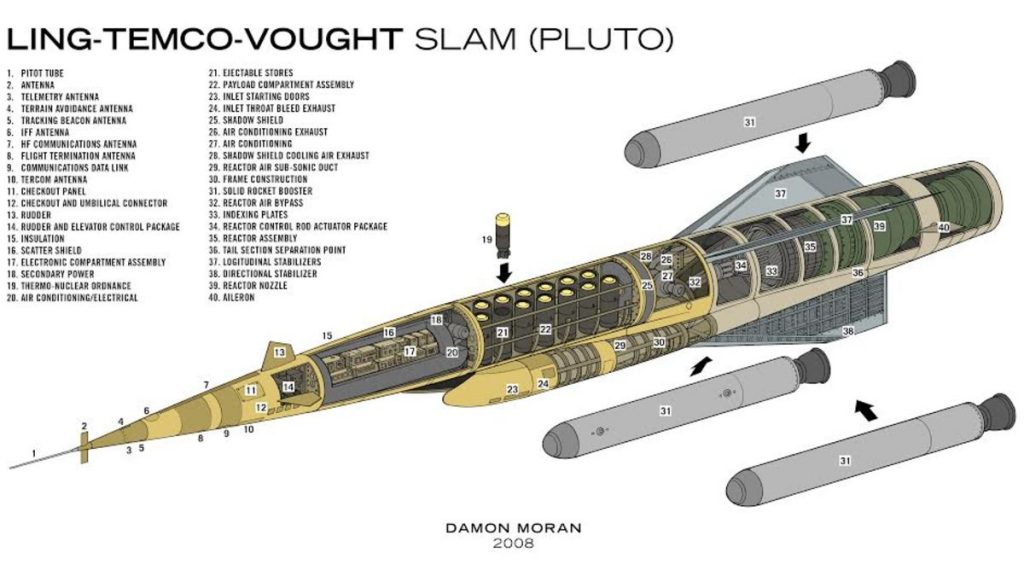
How or why this weapon would ever be more useful or more lethal than a conventional ICBM equipped with a dozen MIRV warheads is beyond my understanding. ICBMs reach their targets in less than 20 minutes, regardless of where they're launched from, and travel at speeds far beyond Mach 3. To this day, there are very few known-effective defenses against ICBMs. Successful interceptor weapons typically cost more than the nuclear warheads / ICBMs they're being fired at. There have been many successful interceptions of much smaller sea-skimming supersonic (Mach 2-3) anti-ship cruise missiles and target drones.
#38 Re: Human missions » Starship Lunar Lander and landing legs » 2025-10-29 15:41:53
ULA's "crasher stage" horizontal lander used thrusters mounted to both ends of the tank to land a Centaur-sized propellant tank with far less probability of "tipping over" during the landing. Creating a sufficiently wide landing gear track for a tallboy beer can is much easier to do when the can is laying on its side. Trying to land the propellant can on-end requires very large and heavy landing gear to create a track wide enough to avoid tipping over. Since the moon is 1/6th Earth gravity and some of the propellant will be consumed during descent, far less propulsive power is required from the thrusters, which makes mounting them on either end of the stage less problematic.
#39 Re: Not So Free Chat » Erroding birthright citizenship » 2025-10-28 20:07:50
SpaceNut,
Another video of the same incident, posted on InstaGram:
nickvalencianews
seems that your papers do not matter just color and being in the wrong place...
Is your insinuation that a couple of white guys arrested another white guy because they're racist against white people? The guy being arrested was whiter than the two officers arresting him. That much is clear from the video you posted and the one I posted. How did you equate that with his skin color being what led to his arrest?
Let's give this some time so we can figure out if "Mr Dindo Nuffin" threw bricks at the Police or tried to run them down with his car or interfered with an arrest, prior to being taken to the ground, since that's exactly what 95% of this stuff turns out to be. This normally plays out as the Police telling someone to stop doing something or to leave, the person in question believes they're not obligated to follow verbal commands from the Police in public places (a city street is a public place), and then quickly finds out that reality and their beliefs about it don't match. That's unfortunate, but happens quite often, especially to leftists with entitlement-superiority complexes. The Police aren't perfect, a few of them turn out to be as unhinged as the people they're supposed to be chasing, and none of them are angels, but leftist media has repeatedly proven that they will tell any lie to support their agenda.
#40 Re: Not So Free Chat » Politics » 2025-10-27 03:21:51
RobertDyck,
How else do you provide inter-generational prosperity and social mobility to your own people without locally making the things they use every day?
I'll keep asking that question until you provide a thoughtful answer. I'm starting to think that you don't have one, even while I hold out hope that you have a better solution.
kbd512, this post makes you sound like a brainwashed MAGA nut. You're more intelligent that this. We've spoken many times, I know you're more intelligent than this.
How many people have ever convinced you to change your opinion through ridicule?
We have fundamental points of disagreement over what policies America should implement. That's fine. I want policies that ultimately benefit working class Americans, because I believe our shared destiny is important. If I have to endure some economic pain and ridicule to achieve a better outcome for our children, then that is what I must do.
One reason young people are not having babies, is they can't afford a house.
Speaking of brainwashing, where does the belief that you first need a house with a yard, in order to have children, actually come from?
But housing costs are way too high.
As a percentage of income, housing costs today are no worse than what they were when my parents raised their four children, but fewer and fewer of us have memory of what life was like two or three generations ago. Interests rates today on home loans are dramatically lower than they were in the 1980s, which means the total cost over time is less than what it once was, as a total percentage of income. Whereas my parents' generation prioritized family formation and stable relationships, the current "city culture", which is driven exclusively by leftist agenda, prioritizes wealth accumulation and social status.
Anyone treating Canada as if it's the same as Mexico is either ignorant, or deliberately repeating political bullshit. Canada has a modern economy, on par with USA.
Nobody here is suggesting that Canada is exactly the same as Mexico. If you think what I wrote even attempted to insinuate that, then you performed some Olympic caliber mental gymnastics by reading something into what was actually stated, which went far beyond what was actually stated and meant.
Trump wants to treat Canada as a vassal state. Canada is no such thing. Canada is an equal, partner, pier.
If there was no money involved, what shared policy goals would America and Canada still pursue together, as partners?
#41 Re: Not So Free Chat » Politics » 2025-10-26 21:22:39
RobertDyck,
Since, offshoring didn't happen over 4 or even 10 years, reshoring won't be complete inside of 4 or even 10 years, either. Nobody here in America is "attacking" Canada or Mexico. Canada's worst enemy is its leadership, or lack thereof, not America, and certainly not President Trump. He sees Canada as a failing state on the basis of demographics, and Mexico as a state overrun by criminals in addition to poor demographics, neighboring failing states at that, hence his stream of commentary on this topic.
Try taking the point for once, instead of the entire arrow. If President Trump truly did not care about Canada and Canadians, then he would simply sit back and say / do nothing about it, and pretend everything was "fine". It's not fine, though, is it. Canada's demographics are horrific. City busy bodies quit having kids, and nothing we say or do is going to fix that. That's a "you problem". No kids equals no future. Your ideology and ways of doing things die with you. Liberalism and globalism has become a self-correcting problem. People who are so "airy-fairy" that they don't think a future generation is necessary are doomed to historical and cultural irrelevance. Getting upset at me or President Trump for pointing that out, however crudely, doesn't solve the problem.
Prove me wrong. Create some children of your own. Hopefully you'll learn how to value someone beyond yourself in the process. Get some first-hand experience with being "talked-at" instead of "talked-to", when your kids come home from school with ideas put in their heads by dictionary definition crazy people. That's been so much "fun" for me to deal with. The entire process of attempting to raise children with some basic direction and morals has been a very humbling endeavor- one which has made me appreciate my own parents ever-more as the years pass me by. Whatever their mistakes, I could never claim that they did not do the best they knew how. Invest in our collective futures instead of complaining about what went wrong with our past. Pour some of that anxious energy into something more productive than getting overly-upset at whomever is currently in power. That's what long term thinkers do. They don't fixate on one generation of problems because they view the world in terms of multi-generational patterns and dynamics. Today's problem is tomorrow's opportunity, but attitude and perspective truly do matter.
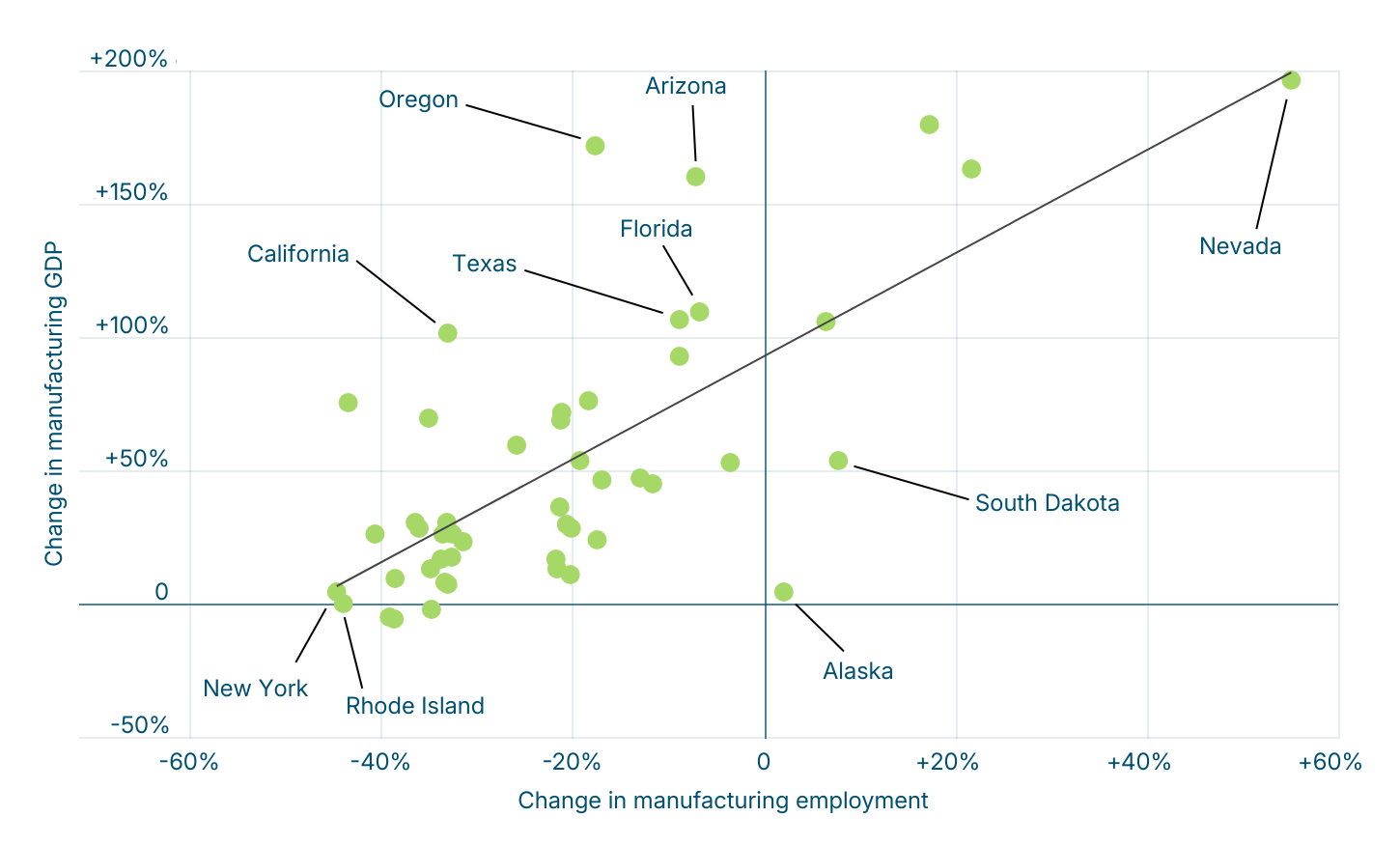
States That Have Lost the Most Manufacturing Jobs Since the Turn of the Century
States That Have Lost the Most Manufacturing Jobs Since the Turn of the Century, by ETQ
After decades of offshoring, the United States is attempting a manufacturing revival. Under the Biden administration, federal programs like the CHIPS and Science Act, the Inflation Reduction Act, and the Infrastructure Investment and Jobs Act directed hundreds of billions toward reshoring critical industries. More recently, President Trump’s sweeping tariff agenda has added new pressure to relocate production back to U.S. soil.
Together, these policies aim to rebuild domestic capacity in high-priority sectors such as semiconductors, pharmaceuticals, and clean energy. Across the country, companies are pouring money into new factories and expansion projects, with federal leaders frequently touting job creation as a central outcome of this industrial strategy.
But while reshoring may help reverse some losses, it is unlikely to restore manufacturing employment to its former scale. The modern factory floor is leaner and more automated than in decades past. The number of U.S. workers employed in manufacturing has dropped sharply over the last two decades—even as output has continued to grow. To assess the full picture, researchers at ETQ—a quality management platform for the manufacturing sector—analyzed data from the U.S. Bureau of Labor Statistics (BLS) and the Bureau of Economic Analysis (BEA), examining how manufacturing jobs have changed nationwide since 2000, which sectors and states were hit hardest, and the disconnect between employment trends and output.
Key Findings
U.S. manufacturing has become more productive but less labor-intensive: Despite a loss of over 4.5 million manufacturing jobs since 2000, real manufacturing GDP grew by 45%, revealing a sharp disconnect between employment and output.
Tech and printing sectors were hit hardest: More than 750,000 computer and electronics manufacturing jobs and over 450,000 printing jobs disappeared between 2000 and 2024.
The industrial Northeast suffered the steepest declines: States like New York, Rhode Island, and Massachusetts lost over 40% of their manufacturing workforces, more than any other region on a relative basis.
Only a handful of industries and states bucked the trend: Food manufacturing and beverage manufacturing were the only sectors to see net job growth. Nevada was the only state where manufacturing jobs grew faster than total private-sector employment.
Automation, not offshoring alone, explains the shift: The majority of states increased their manufacturing GDP while shedding jobs, pointing to rising productivity and a shift toward advanced, less labor-intensive manufacturing.
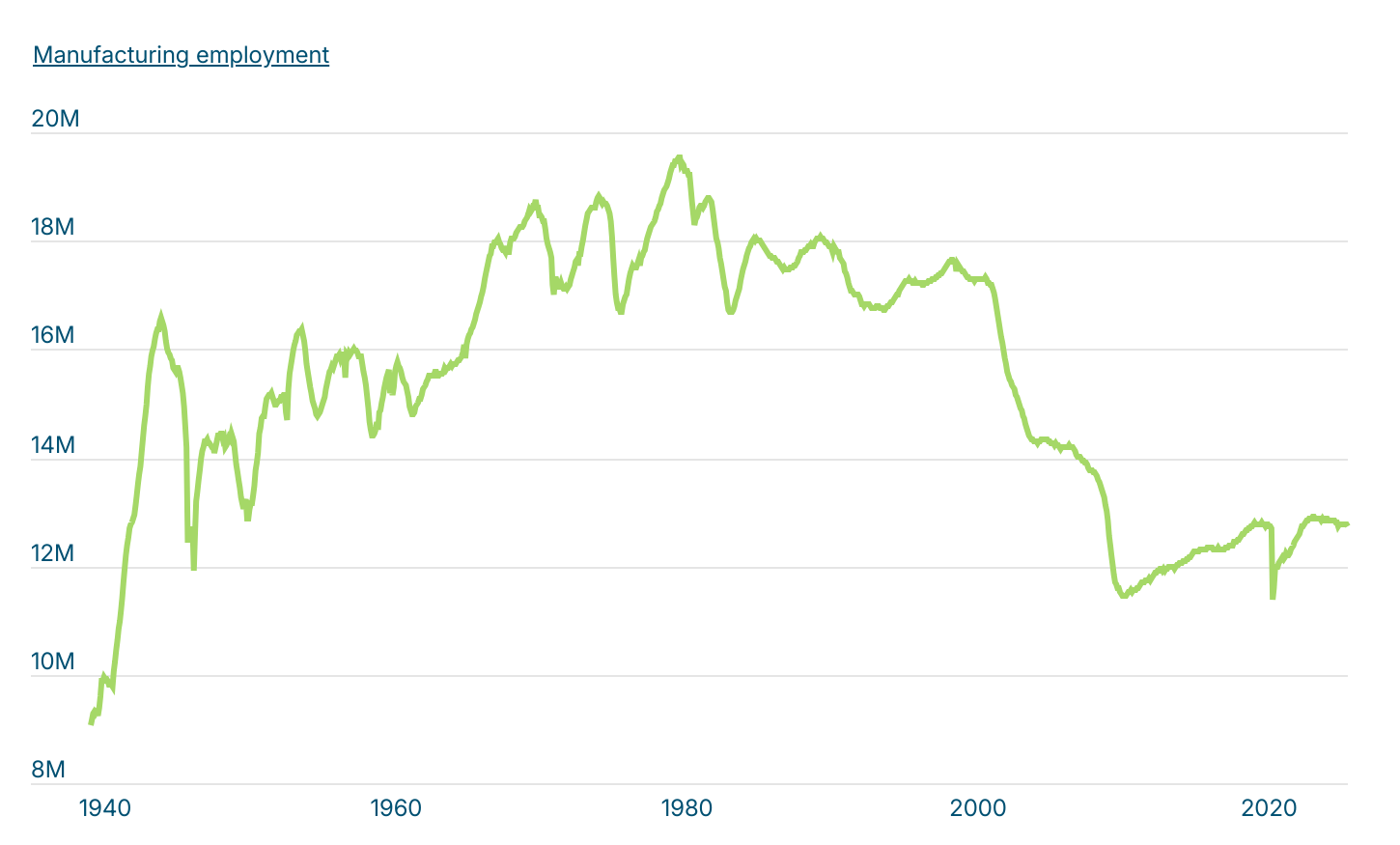
Source: ETQ analysis of U.S. Bureau of Labor Statistics dataU.S. manufacturing employment has followed a century-long arc—growing rapidly through the early 20th century, peaking in the late 1970s, and declining sharply in the decades that followed. From 1900 to 1945, industrial expansion and wartime production drove strong job growth. The postwar boom pushed manufacturing employment to a record 19.5 million workers in 1979, sustained by high demand and strong unionization.
From 1980 to 2000, U.S. manufacturing employment declined gradually as automation and rising global competition began to reshape industrial production. But between 2000 and 2010, job losses accelerated sharply—driven in large part by China’s entry into the World Trade Organization in 2001 and the ensuing “China Shock,” which triggered a wave of offshoring and plant closures across the U.S.
Since 2010, the sector has seen a modest recovery, but these efforts have not reversed long-term losses. Between 2000 and 2024, the U.S. shed over 4.5 million manufacturing jobs—a 26% decline—despite a 45% increase in real manufacturing GDP, according to the BEA. New technologies, automation, and process efficiencies have enabled producers to do more with fewer workers, underscoring a central tension in the reshoring debate: rebuilding industrial output doesn’t always mean rebuilding employment.
Manufacturing Job Losses by Sector
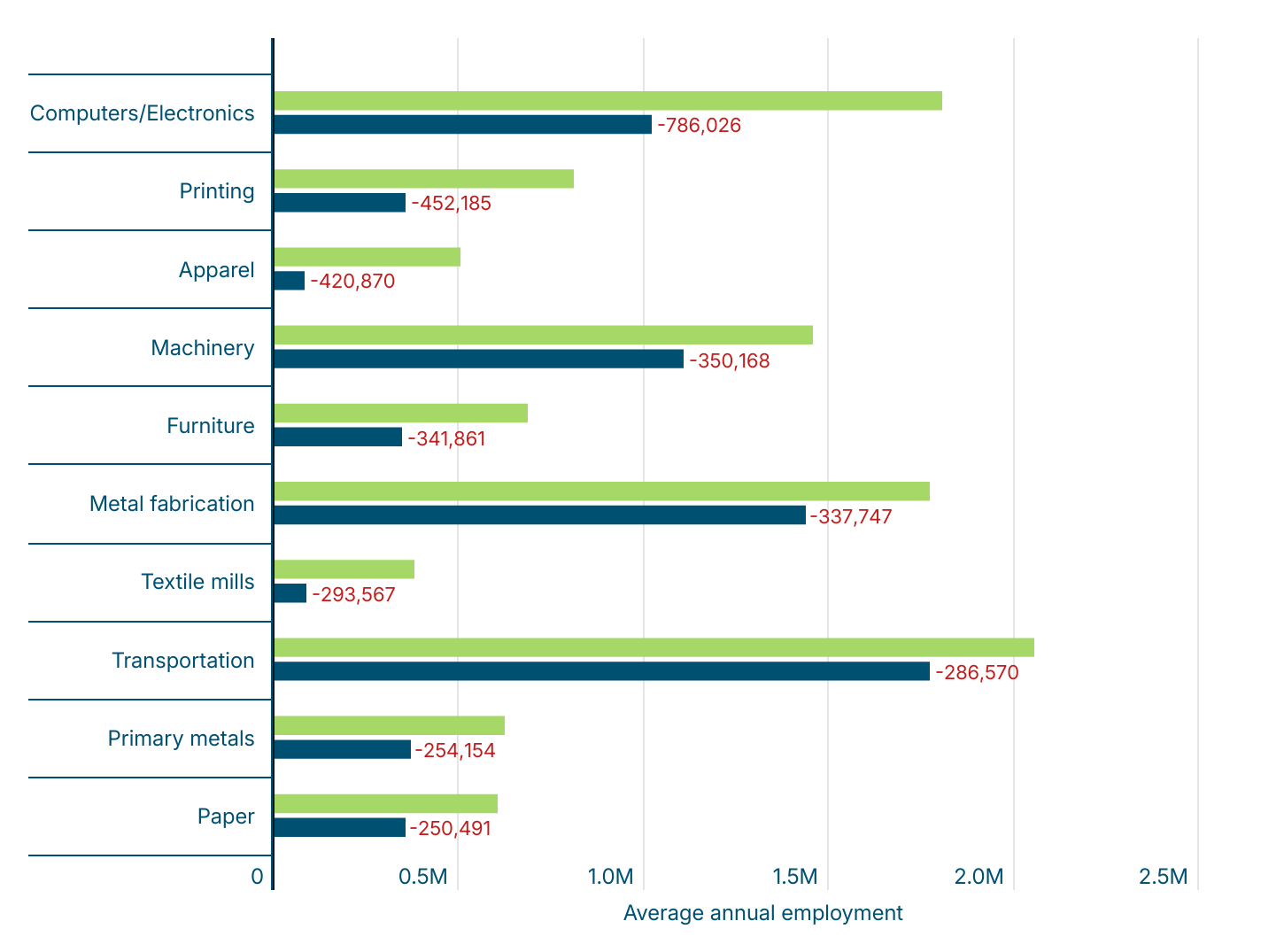
More than three-quarters of a million U.S. tech manufacturing jobs have disappeared since 2000
Source: ETQ analysis of U.S. Bureau of Labor Statistics dataNot all parts of the manufacturing economy have experienced the same level of job loss. Since 2000, employment in computer and electronic product manufacturing has fallen by 786,000 jobs, a decline of over 43%. Other sectors with substantial losses include printing and related support activities (-452,000), apparel manufacturing (-421,000), and machinery manufacturing (-350,000).
On the other hand, some sectors have remained more resilient. The food manufacturing sector and the beverage and tobacco product manufacturing sector are the only two to report job gains since 2000. These gains reflect increased domestic demand and relative insulation from offshoring, as many food-related manufacturing jobs remain tied to local agricultural supply chains and consumer markets.
States That Lost the Most Manufacturing Jobs
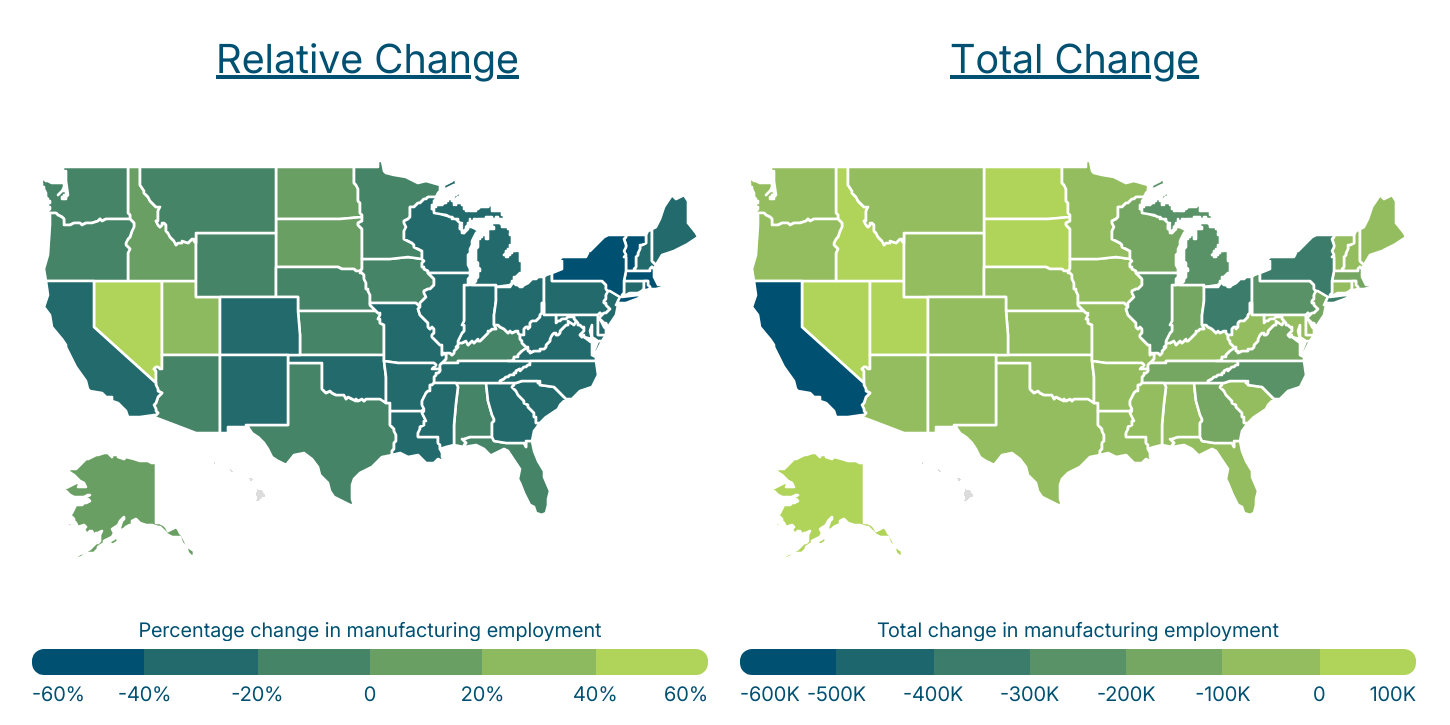
Rust Belt states, along with California and North Carolina, have lost the most manufacturing jobs
Source: ETQ analysis of U.S. Bureau of Labor Statistics dataManufacturing job losses have been most pronounced in the Northeast and Midwest, where many states were historically tied to heavy industry. When measured by percentage decline, the steepest losses occurred in the Northeast:
New York saw a nearly 45% drop in manufacturing employment between 2000 and 2024, shedding more than 330,000 jobs.
Rhode Island, Massachusetts, and Vermont also lost more than 40% of their manufacturing jobs during this period.
The states that reported the most total jobs lost were more geographically diverse, spanning the East Coast, Midwest, and California:
California, the nation’s largest manufacturing state by output, lost nearly 615,000 jobs.
Other major losses occurred in Ohio, New York, Pennsylvania, North Carolina, Illinois, and Michigan, each of which lost between 290,000 and 340,000 jobs.
Nationally, manufacturing employment fell by 26.5% between 2000 and 2024, even as overall private-sector employment grew by approximately 20%. Nevada stood out as the only state where manufacturing job growth exceeded the rate of overall job growth—driven largely by its expanding advanced manufacturing sector, including battery and electric vehicle production. A handful of other states—Utah, North Dakota, South Dakota, Idaho, and Alaska—also added manufacturing jobs during this period, though their growth trailed behind overall private-sector gains.
The Decoupling of Manufacturing Employment & Output
Manufacturing GDP has grown in all but four states, despite job losses
Source: ETQ analysis of U.S. Bureau of Labor Statistics and U.S. Bureau of Economic Analysis dataWhile most states lost manufacturing jobs between 2000 and 2024, nearly all saw gains in manufacturing output. All but four states experienced real, inflation-adjusted growth in manufacturing GDP over the period, highlighting a growing disconnect between employment and production.
As mentioned above, this divergence is driven by structural changes in the sector. New software, automations, and advanced manufacturing processes have reduced the need for manual labor, while high-value industries like pharmaceuticals, semiconductors, and aerospace generate substantial output with relatively few workers. As a result, many states have expanded their manufacturing economies without a corresponding increase in jobs—reflecting a broader shift toward capital-intensive, technology-driven production.
This trend is especially evident in states like Oregon, Arizona, Florida, and Texas, all of which more than doubled their manufacturing GDP during this period despite a net decline in manufacturing employment.
Final Thoughts
Reshoring manufacturing is central to U.S. economic and national security policy, but it’s unlikely to restore jobs at historic levels. Advances in automation and high-efficiency production mean that factories can expand output with far fewer workers. As a result, while reshoring may boost domestic manufacturing capacity, it won’t necessarily lead to widespread job growth.
Instead, it is creating demand for high-skilled, technical roles—positions that are increasingly hard to fill. The U.S. is projected to face a shortage of over 2 million skilled manufacturing workers by 2030, with hundreds of thousands of positions already unfilled. Closing this gap will require targeted investment in training and education. The success of reshoring will ultimately depend not just on bringing factories back, but on preparing workers for the jobs they require.
Methodology
Data for this analysis comes from the U.S. Bureau of Labor Statistics (BLS) Quarterly Census of Employment and Wages (QCEW) and the U.S. Bureau of Economic Analysis (BEA) GDP by State dataset. Changes were analyzed from 2000 to 2024. Only private-sector employment was included. Changes in GDP were inflation-adjusted using real chained-dollar values. Only states with complete data from both sources were included.
#42 Science, Technology, and Astronomy » Coal-fired Brayton Cycle Supercritical CO2 Boilers » 2025-10-26 18:04:47
- kbd512
- Replies: 1
Research Gate Link:
300 MW Boiler Design Study for Coal-fired Supercritical CO2 Brayton Cycle
Science Direct Link:
300MW boiler design study for coal-fired supercritical CO2 Brayton cycle
The ultimate source is Applied Thermal Engineering, Volume 135, 5 May 2018, Pages 66-73.
Abstract
Supercritical CO2 (S-CO2) Brayton power cycle has been considered as a promising alternative choice of conventional steam cycle for coal-fired power plants. A conceptual design of the boiler is conducted for a 300MW single reheated recompression S-CO2 Brayton cycle for coal-fired power plant with turbine inlet parameters of 32MPa/600°C/620°C. The conventional economizer (ECO) is replaced with the split heater (SH) to reduce the inlet temperature of cooling wall of the furnace as well as to recover the flue gas heat The technology adaption of S-CO2 power cycle for coal-fired power plant has been evaluated in terms of specific design of the 300MW coal fired boiler as well as the whole thermodynamic cycle layout. The boiler design and off-design thermal calculation results show that the S-CO2 boiler proposed in this paper can match well with the entire coal-fired S-CO2 Brayton cycle power generation system and has a good boiler variation performance.
As the linked design study seems to suggest, the thermal power density for coal-fired Brayton Cycle sCO2 could exceed 1,000MW/m^3. That's a pretty dramatic power density increase over existing steam boilers. The study was published in 2018, and makes the case that going to 700°C temperatures is not economic because it requires Nickel-based superalloys. However, more recent advances in materials, machining, and fabrication methods have already demonstrated cost-competitive superalloy solutions that outperform steam turbines on cost in SCO2 applications, due to the dramatic mass and volume reductions of the machinery involved. We've already begun fabricating SCO2 gas turbine components for SCO2 commercial electric power plants here in Texas, from those superalloys, and the most significant costs seem to be in finding qualified machine shops and welders with the expertise to machine or fabricate the components.
Very recently demonstrated 100X energy (thus fabrication cost) reductions associated with complex geometry RCC components could make superalloy cost and availability mostly irrelevant, except perhaps for printed circuit heat exchangers, piping, and seals. Using RCC, a power turbine and turbine casing's combined gravimetric power density could easily reach 200kW/kg for a multi-MW power turbine suitable for marine propulsion applications.
In previous posts scattered about the forum, I've put together a "system" for supplying bulk power to the United States, and potentially the entire world, without resorting to using either nuclear power of quantities of technology metals that don't presently exist to be used for all-electric energy generating and storage equipment. While I highly favor the use of nuclear technologies on account of their incredible power density and vanishingly small waste streams, relative to all competing alternatives, I have accepted that the combination of our political and economic climate has resulted in very little apparent appetite for multi-year reactor construction projects. I have also accepted that the materials math for photovoltaics and/or electric wind turbines, but especially electro-chemical batteries to provide enough fast storage for grid stability and seasonal energy availability variations, simply "doesn't math". I came to that conclusion some time ago and nothing I've seen since then has changed the math, so I discarded that as a reality-based solution. It was a good old-fashioned "college try".
As such, I then devoted hundreds of hours of study searching for viable alternatives to new-build nuclear reactors and the current generation of photovoltaics / electric wind turbines / electro-chemical batteries, which also have little hope of scaling-up to supply the majority of our energy demands over the next several decades, absent monumental increases in mining productivity across a host of technology metals. The specialty metals requirements of a 70% photovoltaics / electric wind turbines powered grid, when combined with mere weeks of energy storage, so as to truly supply the majority of our primary energy, without coal-fired steam turbines or natural gas turbines spinning at all times, is exactly where this "green energy" fantasy fails.
The proponents of this all-electric "solution", which at least outwardly appears to create more problems than it solves, are either hoping for game-changing technology advances and production at-scale at some indeterminate future date, or refuse to accept the ugly arithmetic of projected scale-up for mining output and specialty metals consumption per technology unit. The required quantities of poly-Silicon, Copper, and Aluminum vividly illustrates how far beyond present global annual mining output those technology metals requirements are, in order to implement their all-electric vision for the future. The metals requirements are measured in hundreds (Copper, Aluminum) or even thousands of years (rare Earths) of current global annual production capacity. While I would never claim that tech advances cannot overcome existing implementation hurdles, the number of hurdles and the scale of the mining output increases are grossly unrealistic using current or projected near-term technologies.
Most of these people think we will simply stop using stored chemical energy provided by hydrocarbon fuels, to deliver on-demand power, in favor of a variety of new technologies that are only feasible to use at the present time because they are back-stopped by stored fuels or, in some cases, nuclear energy. The transition process to achieve that might take another century before mostly displacing coal / natural gas / diesel / kerosene / gasoline fuels, since all potential successor technologies are still in their infancy. In the mean time, we're playing a dangerous game with money and technology by making "bets" we can't actually cover when something goes wrong. I think the complete grid failure in Spain demonstrated how far belief about the stability of an all-electric grid, predominantly powered by photovoltaics and electric wind turbines, which provide no grid-inertia, diverged from objective reality. Spain attempted to prove that they didn't require a "spinning reserve", which was provided by their small fleet of nuclear reactors. The only thing they actually proved, was that even during ideal generating conditions for the currently favored all-electric energy generating machines, Spain's grid was never stable. If conditions had been unfavorable, there could've been many more fatalities and a far greater loss of GDP. Thankfully, that didn't happen. Only circumstances made Spain's total grid failure a brief event with limited permanent damage. Spain doesn't have sufficient fast storage or spinning reserve, unless they keep operating their nuclear reactors. Shutting the reactors down was an ideological vs engineering-driven decision- one that didn't pay off.
For nations without nuclear power programs, the lowest cost "pay-as-you-go" bulk energy comes from coal or natural gas turbines. If money is plentiful, then extra funds can be invested into photovoltaics and/or electric wind turbines to opportunistically capture more energy. Provided that the cost increase to the rate payer is not substantial, there's nothing wrong with capturing additional energy that way. An issue arises only when the grid is reliant on those forms of energy, but insufficient stored energy exists as a backup. Nations such as Germany and Spain are already well past the point of sensibility in their energy mix, because they either can't or won't build adequate fast storage, likely due to cost. Everyone knew that an all-electric grid lives or dies on the basis of fast storage (electro-chemical batteries) availability to buffer supply-and-demand fluctuations. We're not going to do that at the scale / storage capacity required, due to total cost and materials scarcity. That means we need a viable alternative.
I think pure Carbon "synthetic coal" mixed into water to create a low-flammability pumpable slurry, synthesized from atmospheric or oceanic CO2 captured using solar thermal power, is that more viable alternative. Since we didn't dig this stuff out of the ground, we're adding nothing to the atmosphere by using and recycling it. High-purity captured CO2 also has many uses beyond serving as a fuel feedstock. Thanks to some new / novel room-temperature liquid metals, such as Gallium-Indium-Tin and Gallium-Indium-Copper eutectic mixtures, we have discovered a way to convert atmospheric CO2 back into pure Carbon without any electrical or thermal energy beyond the power necessary to circulate / "bubble" the CO2 through the column of liquid metal. The pure Carbon "floats" on top of the metal, so extracting it is pretty easy to do. The metal catalysts also appear to be remarkably stable over hundreds of hours of operation. That means we could use them to strip Carbon from CO2, at room temperature, to create chemical energy reserves without mining for coal or drilling for oil and gas. The lower calorific content of a pure Carbon fuel, as compared to fuels containing Hydrogen, can be partially offset by using higher temperatures in conjunction with Supercritical CO2 gas turbines.
The exhaust product of a power plant consuming pure Carbon and O2 from a synthesis plant, is essentially pure CO2 mixed with some residual water vapor, so it can be more easily captured at the plant and re-compressed into LCO2 for shipment back to a Carbon / O2 synthesis plant. The most undesirable emissions from burning mined coal- heavy metals, fly ash, NOx, and SOx, are reduced to almost nothing by using synthesized pure carbon. We re-capturing most of the CO2 at the generating plant so we don't have to re-capture it from the atmosphere at greater energy cost. The development of supersonic CO2 compressors makes that re-capture step practical, as it consumes less than 10% of the plant's gross output, unlike traditional multi-stage CO2 compressors.
SCO2 gas turbines, supersonic CO2 compressors, and SCO2 "boilers" have all been developed over the past 25 years, in a concerted effort to meaningfully improve the thermal-to-electrical efficiency of coal and natural gas power plants. The most consistent themes throughout SCO2 technology development have been successful technology demonstrations and incredible power density, to the point of becoming a more thermally efficient successor to conventional gas turbines and geared steam turbines.
The two major reasons for switching from geared steam turbines to gas turbines for commercial electric power generation and marine propulsion were far too much space claim associated with steam power plant and improved thermal efficiency / fuel consumption reduction. SCO2 gas turbines manage to improve upon the power density, startup times, and thermal efficiency of conventional marine gas turbines, which is why we need to pursue these new turbine-based solutions, if we're eventually going to have any meaningful energy transition to natural energy.
We're not short-of-supply of coal / oil / gas at the present time, but the existing reserves won't last forever. Eventually we'll have to synthesize our own fuels, if only for backup power or power at night, and we'll want more efficient plants to use them with. It's better to start that process now while we're still moderately energy-rich and capital-rich.
We need solar thermal to deliver bulk energy in the form it's already consumed in, we need new generation power plants that can supply on-demand energy, and we need fuel synthesis so that we never run out. We're not going to create enough all-electric machines in the span of a few short decades to matter much, if only because we lack the metals to do so. We do have sufficient supplies of metals for the types of machines I've spilled so much ink describing, to continue generating electric and thermal power from centralized locations.
#43 Re: Not So Free Chat » Politics » 2025-10-26 17:55:15
RobertDyck,
We're going to start manufacturing more of what Americans need / want, right here in America. Canada is welcome to do the same and I think Canadians should do that, for their own economic benefit. You can continue complaining about President Trump until the cows come home, and no doubt will, but that is the only program America is running right now. President Biden ran the same program, even though more of it was directed at manufacturing that America previously outsourced to Asian countries. That means the past two Democrat and Republican administrations were broadly aligned on how we're handling trade policy going forward, if not the optics of how to present actions taken to the general public. Whether the media sensationalized it, as they did under President Trump, or not, under President Biden, is irrelevant to actions taken. Protectionism is either universally bad, or it's "do as I say, not as I do". If the former were true, then other nations, such as Canada, wouldn't practice it. If the latter is what they're aiming for, then that game is over, because we're not playing it with them anymore.
Globalism is dead. It's not sustainable. America is walking away from globalism because it's proven to be wasteful and ultimately self-destructive. As Peter Zeihan frequently points out, the post-WWII Global Order established by the US was never an economics-based proposition for America, merely a bribe to allied nations to permit America to determine how to fight the Cold War against the Soviets without starting WWIII in the process. That issue was successfully resolved about 35 years ago, without firing a shot. The old Imperial Order would've already fought WWIII. Right about now, we'd probably be using sticks and stones to start fighting WWIV. Thankfully, none of that happened, due in no small part to American military leadership. Whatever their character flaws and personal shortcomings, you're not speaking Russian or glowing in the dark, so our military strategy worked, despite all the real or imagined mistakes we made.
You think we should continue doing what we've been doing, which has been highly detrimental to American families and our national economy, for the purpose of making rich people richer and selling an endless variety of cheap products to people becoming ever-poorer from outsourcing. The issue is that many people are no longer buying it, because they can't afford to, and they're no longer convinced that a bewildering array of meaningless choices are better than a few choices made about things that truly matter. Bread and games hasn't solved any problems. However brilliant or errant our new strategy is, we're attempting to turn a page by re-shoring manufacturing. It's no longer "business as usual". The American electorate has voted out status quo candidates during the past 3 election cycles, including President Trump. There's an object lesson in there somewhere, as it relates to what the majority of Americans think about our present economics problems. The men in this country, especially young men, aren't interested in purchasing more or cheaper trinkets, nor do they view bread and games with favor. They certainly don't care about making rich men richer. A growing number of them want to build something worth having. They'd rather do business with people they know, and they're willing to forego endless variety if that means a better tomorrow. Many of them think the current economic system leaves few realistic paths to family formation, which they do value but see as unrealistically achievable because they cannot give their prospective wives a comfortable middle class lifestyle on a single income. A lot of them are turning back towards traditional religions, which offer something no amount of money / fame / business success ever could- faith in a purpose beyond pure selfishness and hedonism. Radicals either don't understand this or refuse to place any value in it.
At the same time, the political left has had an endless series of identity crises stemming from the fact that they don't have, let alone share, any core values that they actually uphold. They reactively wander between crusades against whatever they've been instructed to hate at the present time. That has caused the working public to part company with liberalism and the Liberal / Globalist Economic Order. Most people aren't built to exist in a "never ending now", because it's exhausting and empty. The left's worldview has all the worst predilections of a dogmatic religion combined with the socially corrosive class warfare of socialism, with none of the other redeeming qualities of the traditional religions. Their religion offers only everlasting bitterness and enmity. They don't believe in any form of non-performative compassion or forgiveness of their neighbors, which alienated large swaths of the American electorate as a result. Their behavior is endlessly punitive in nature for merely voicing disagreement with their beliefs. You'd have to be naive beyond belief, scared beyond reason, or simply lack any introspection to think the mob won't eventually turn on whomever / whatever you represent to them. That doesn't describe most people. You can't remain naiver forever, the strongest fear eventually leads to numbness, and everyone will eventually catch an eyeful of their reflection in the mirror- most won't like what they see.
How else do you provide inter-generational prosperity and social mobility to your own people without locally making the things they use every day?
#44 Re: Science, Technology, and Astronomy » Thermal Energy Storage » 2025-10-23 09:46:24
According to the AI program output posted by SpaceNut, ~3.5m^2 of solar thermal collector surface area provides 17.5kWh over 5 peak generating hours per day. My surmise is that the solar insolation resource used was 1,250W/m^2:
17,500Wh / 5hrs = 3,500W
3,500W / 3.5m^2 = 1,000W/m^2
1,000W/m^2 / 0.8 (stated thermalization efficiency) = 1,250W/m^2
Houston, Texas, receives an annual average insolation of 5.27kWh/m^2/day (photonic power from the Sun), time-averaged across 4.5 to 5.5 peak insolation hours per day. We had 67 photovoltaic panels on the roof of our last home, each around 2m^2 of surface area per panel, with a BOL efficiency of 26.5%. Each 1m^2 worth of photovoltaic panel surface area therefore generated about 1,396.55Wh/m^2/day, so 187,137.7Wh/day for the entire installation. That computed value is remarkably close to the 182kWh I once saw in my wife's phone app following a sunny late July day, so I'm going to assert that using the averages for a well-sited installation is representative of objective reality.
Here's what a 134m^2 equivalent solar thermal installation would generate per day here in Houston, Texas:
5.27kWh/m^2/day * 0.8 * 134m^2 = 564,944Wh/day
That's just over 3X more power to work with. Whatever inefficiencies are associated with using that solar thermal power system, we can probably afford to eat the losses because we have some power to spare, unlike the starvation diet associated with converting all of the input photonic power from the Sun directly into electricity, at dramatically lower conversion efficiency. More importantly, we can do that without a single electrical or electronic control device, if so-desired.
Nearly all of the power consumed went directly into the home's HVAC system. All HVAC systems are giant refrigerant loops operating on the very same governing principles applicable to all other heat engines. HVAC systems don't absolutely require electrical input power, even though the vast majority of them consume electrical power to spin fans and pumps to circulate the conditioned air and refrigerant through the heat exchange loop. It's done that way because it works pretty reliably, so long as there's a continuous supply of 240V 60Hz 3-phase AC power available. Nowhere is it written that such systems absolutely must use electrical power.
Solar Thermal Air Conditioners
Solar thermal air conditioners are essentially solar water heaters that use the energy of the sun to heat up water. The hot water turns a refrigerant from liquid to gas, which absorbs heat when it condenses. The resulting cooler air is used for air conditioning, while the system also makes hot water available for household use.Solar thermal systems are more efficient than solar PV systems since it's easier to heat up and cool water than it is to produce electricity to run an electricity-powered air conditioner. This means fewer panels are needed to generate enough cooling.
This can be especially useful for roofs with a limited amount of sun exposure. However, unlike a solar PV system, you can't rely on batteries or the electrical grid to run your air conditioner at night. However, in areas where the days are hot and the nights are cool, such as in the desert, this may not be a concern.
That last part about "not being able to rely on batteries or the grid to run your AC at night" is only partially true.
"insulated hot water tank" = "batteries for a solar thermal system"
Dry sand or clay can also be used to store thermal energy for later use, perhaps most useful for larger plants located in deserts, but a hot water tank will still have the highest thermal storage capacity over the temperature ranges involved. To remove the requirement for glycol or alcohol to prevent freezing during winter, heat could be transferred using Supercritical CO2- a non-flammable thermal power transfer fluid. Aluminum heat pipes can be used instead of Copper tubing in all but high latitudes where efficiency matters most.
A diagram of a solar thermal battery system (no electrical or electronic components or grid-tie required):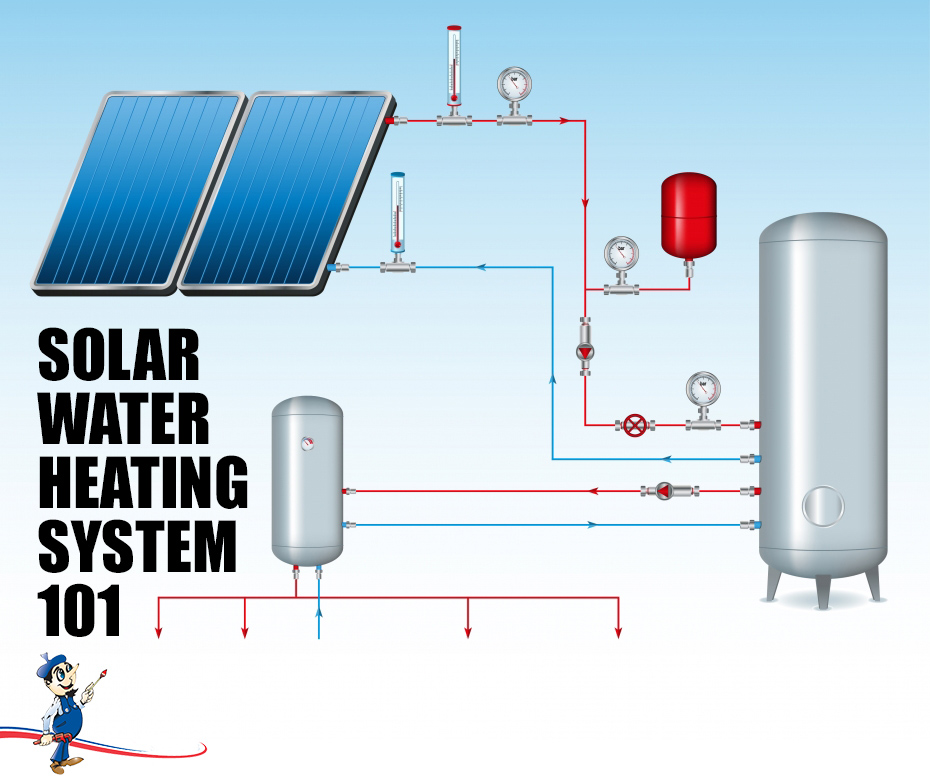
Another diagram:
A link to a commercial solar thermal water heater equipment supplier / installer:
Custom Solar and Leisure - Solar Thermal Hot Water Heater
Solaray's current home solar thermal hot water heater system was originally certified for home installation on March 23, 1993- over 32 years ago. This sort of tech was first commercialized in the 1970s. I saw them on roofs in Austin, Texas, starting in the early 1980s, along with a handful of photovoltaic installs. IIRC, I also saw them in San Diego, California. More thermally efficient evacuated tube systems are also commercially available now from a variety of other suppliers, but not too common in warmer climates where their improved efficiency is not necessary. That said, evacuated tube systems work in any climate here on Earth, on the moon (without the need for an expensive and heavy evacuated glass tube), and on Mars.
One of the most important features of evacuated tube solar thermal systems is that they rapidly become quite hot, even during winters at high latitudes. The ambient temperature can be below freezing and the sky can be overcast, but the moment the light of day kisses that tube, the temperature inside the tube will rise far above the boiling point of water (300F to 400F) in a matter of minutes. A cloud passing overhead is not going to instantly "turn the system off", either. Convection from wind, or lack thereof, also has very little effect on achieved temperature or thermal efficiency. A Canadian winter vs summer lowers efficiency by less than 5%, because the device effectively "traps" (based upon re-emission wavelengths) and thermalizes the photons. A bit of dust on the tube won't reduce the heat transfer to near-zero, either. These features make evacuated tubes suitable for thermal power generation on Mars, despite the fact that 50% less input power is available from the Sun. Boiling water on Mars or in the Arctic / Antarctic here on Earth is still readily achievable. Such systems are also used here on Earth to separate salt from sea water, to collect the salt for human consumption.
If reliable electrical power is no longer available, and it won't be if 70% of the grid's energy input is provided by photovoltaics and electric wind turbines, then we still need something that does the job of heating and cooling homes, providing hot showers, and cooking food without all the pointless cost and complexity presently used to deliver those services. Personal electronics and lights are very nice to have "optional extras" that make life much more enjoyable / entertaining. Fresh water and thermal regulation are not optional. People die without those. In the future when personal electronic devices become mostly or completely optical devices using 1M to 10M times less electrical power, the vast majority of home energy demand will still be thermal power for basic human needs and comfort.
Edit:
The National Renewable Energy Laboratory's Guide to Solar Water Heating Systems
#45 Re: Not So Free Chat » Politics » 2025-10-21 00:53:10
That "fact check" contains fictional terminology that carries no legal meaning with it:
Undocumented immigrants are not eligible for federally funded Affordable Care Act (ACA) Marketplace coverage or premium tax credits under current U.S. law
In response to the Democrats' rejected (by Republicans) proposed change to the ACA law to allow illegal aliens to purchase US citizen subsidized health care via the ACA, Democrats refused to fund the US federal government by refusing to sign the appropriations bill authorizing spending.
Illegal alien - a foreign national who is living without official authorization in a country of which they are not a citizen.
What is the difference between an immigrant and an alien?
An "immigrant" is someone who has moved to another country with the intent to live there permanently, while "alien" is a legal term for any non-citizen of a country. A person can be both an immigrant and an alien, but they are no longer an alien once they become a citizen.
"Undocumented immigrants" is leftist word salad nonsense for "illegal aliens". Anyone who is a legal immigrant / alien is also a "documented immigrant / alien". The legal distinction that actually matters is permission from our government to legally reside in the US. Anyone who has permission to reside in America also has documentation of that legal decision.
US citizenship documentation for immigrants is obtained by attending an immigration status hearing before an immigration court of law. The legal decisions made by our immigration courts of law is what determines legality. The documentation received by a new citizen is evidence that a legal determination was made by those who have the legal authority to do so. Receiving documentation means an immigrant's request for US citizenship was evaluated by a sitting US judge presiding over an immigration court of law, and determined to be of sufficient legal merit to grant citizenship.
The attempt to use suggestive language to conflate legality with documentation, in the minds of people who likely don't care enough to know anything about US immigration law to begin with, is yet another attempt by Democrats to usurp the rule of law. There's nothing wrong with having a personal opinion about a law, but presenting an ideologically-held opinion as "fact" is a bridge too far. Whenever a "fact check" contains ideological language mixed with legal terminology (such as "Affordable Care Act"), it's misleading at best, manipulative and fraudulent at worst. It's crystal clear that Democrats don't respect our laws, except perhaps when the law can be wielded as a cudgel for political advantage. When that fails, they resort to violence, which they support and encourage.
#46 Re: Not So Free Chat » Politics » 2025-10-20 16:19:18
Lest we forget No More Kings...
One of MSNBC's political commentators is calling this theatrics that the Democrats supported because it would provide health care to illegals. Whenever that same political party demonstrates through action that it cares about Americans at least as much as criminals who jumped over our border, I'll believe it's something beyond theatrics. I think it's yet another excuse to cheer-lead political violence while getting paid.
#47 Re: Meta New Mars » kbd512 Postings » 2025-10-20 08:22:31
tahanson43206,
If I understand the request correctly, I'm going to install / publish the phpBB3 web app on our NewMars web server.
What about database requirements?
Do I need to install and configure a database schema on our MySQL Server as well?
Is this a "standard" phpBB3 setup, or have you customized the phpBB3 web app or the database schema in any way?
I'm talking about editing the php files or database schema tables and objects, not any photos you've added.
Edit:
This web app is purely for local storage of user-generated media files, such as the rocketry-related PowerPoint presentations / photos / videos created by GW Johnson, correct?
#48 Re: Life support systems » Spacesuit materials » 2025-10-18 23:12:05
CNT and BNNT materials are both notable for their exceptional abrasion / cut resistance. I'd like to see how well swatches of these fabrics hold up to abrasion from crushed obsidian. Since they're both reasonably fire-resistant (up to 900C in air for BNNT or 400C for CNT) / UV resistant / MMOD resistant, and are now woven into fabric sheets by several US manufacturers, I think the cost of using them as protective layers for space suits can be justified. NASA has already done some initial experimentation with BNNT as a space suit material.
#49 Re: Science, Technology, and Astronomy » Trough Solar Collector- Design- Construction- Operation- Maintenance » 2025-10-15 15:20:06
SpaceNut,
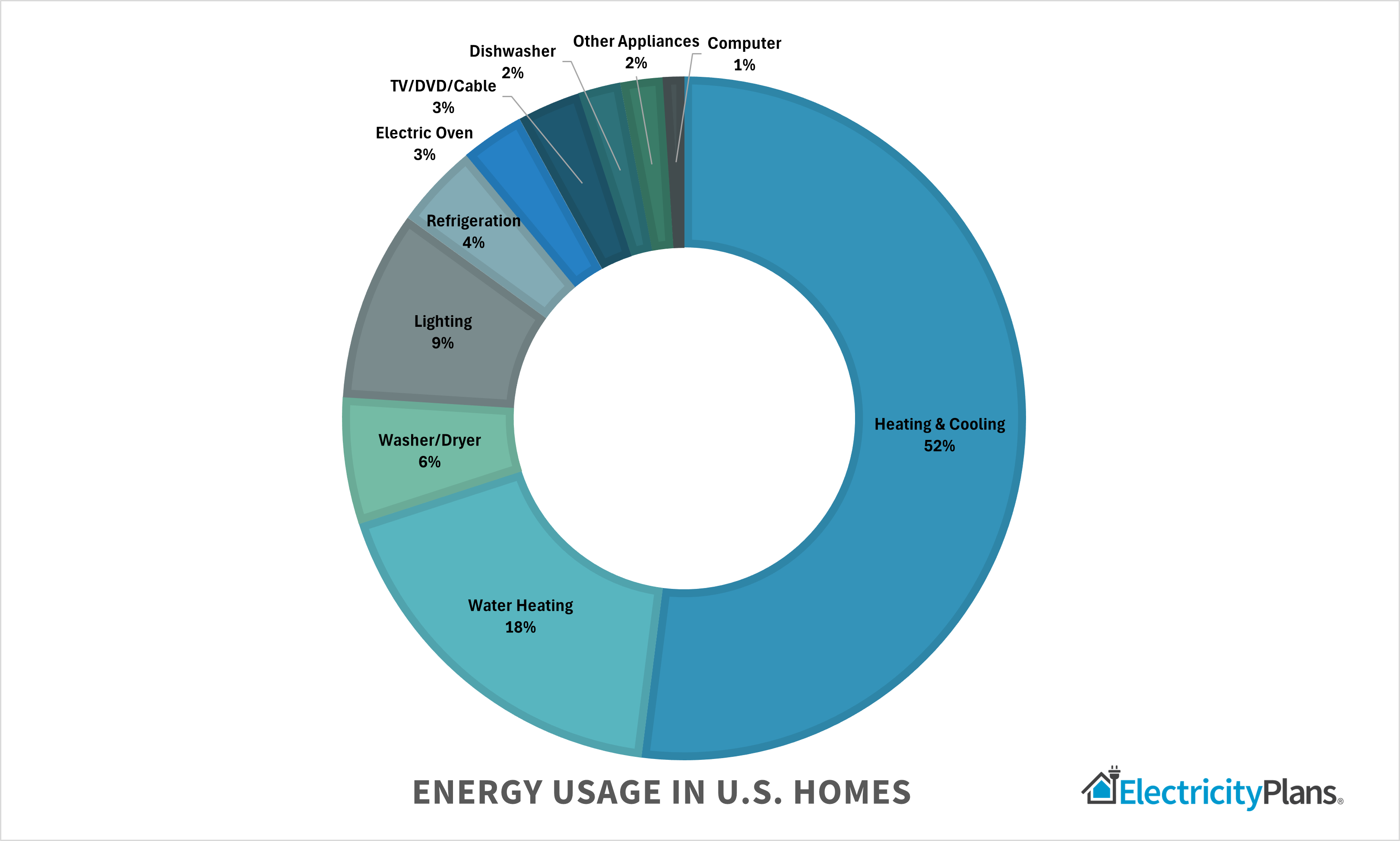
The overwhelming majority of energy consumption in all western homes, US or otherwise, is for direct heating and cooling applications. Thermal energy accounts for almost 75% of all the energy consumed in the average home, possibly more now that large TVs / desktop computers / incandescent bulbs have largely been replaced by laptops or cell phones and LED bulbs. That means a home's HVAC system is responsible for most of that 1.2-1.25kW figure. Home solar systems that fit on the roof of the home cannot provide that energy directly, because they're insufficiently powerful.
We had 67 photovoltaic panels on the roof and 2 Tesla Power Walls next to the breakers of the last home we owned. At no point in time did those devices directly provide the input electrical energy for our home's HVAC system, because they weren't capable of doing so. I asked the licensed electrical engineer who sold us our home solar system, what would be required to directly power the 3 AC units associated with our HVAC system, and he told me that most of our property's back yard would also need photovoltaic panels covering it. He said somewhere between double and triple the number of panels we actually had installed would be required to directly power our home's HVAC system, as well as another 2 to 4 Tesla Power Walls, in addition to the 2 Tesla Power Walls that were installed, to store more electrical power for use at night. Such a large photovoltaic / battery bank system would also be 50% to 60% of our home's purchase price. Texas does not allow ground-mount photovoltaic panels to be installed on residential property.
Our photovoltaics were, IIRC, 26.5% efficient, at BOL. Converting photonic / thermal power to electrical power is not terribly efficient, but using rooftop and ground hot / cold sinks to power HVAC systems is more practical because so much power from the Sun is NOT lost up-front by using photovoltaics to convert the incoming photonic energy into electrical energy. Until radically more efficient and less costly photovoltaics become available, the total quantity of thermalized photonic energy available from the Sun, per unit of collector surface area, is at least 3X greater, using less costly equipment. In simpler terms, our home's rooftop provided sufficient surface area to host thermal power collection equipment capable of generating high temperatures for the "hot side" of the thermal power transfer loop.
90% (visible spectrum photons to thermal spectrum photons) vs 26.5% (photons to electron movement) is a much greater total percentage of input power to work with, per unit of collector surface area, especially since the energy consumption system it's primarily being fed into is a thermal power transfer system (an over-glorified refrigerant loop- a device that works on the principle of a hot and cold sink). An HVAC system, a refrigerator, and cooking appliances all produce thermal output.
If most homes in America had 75% of their energy consumption provided by an onsite system that doesn't need to be connected to any grid, doesn't require a large amount of space in the yard, and doesn't require anything more complex and costly than some additional indoor plumbing to transfer thermal power from "rooftop water heat tech", that single change would deliver a major reduction in emissions at a cost that most people could actually afford to roll into their home's purchase price. Although there certainly are more exotic materials and refrigerants such a system could use, we're mostly talking about steel and water.
#50 Re: Human missions » Going Solar...the best solution for Mars. » 2025-10-13 21:53:51
SpaceNut,
If we're going to add that much metal to an already energy-intensive device like a photovoltaic cell, why not build a simpler and more robust solar thermal concentrator?