New Mars Forums
You are not logged in.
- Topics: Active | Unanswered
Announcement
#26 Re: Martian Politics and Economy » Concern about the Government.Will they allow black to go » 2005-10-12 11:50:02
A therapist on Mars will be essential since the montonous landscape and confining environments the colonists will live in would drive anyone crazy. Someone will need to check the sanity of the therapist herself from time to time. A therapist willing to go to Mars in the first place should be highly suspect.
I have met people that live in far more monotonous places than most seen on Mars, and I do not think that has anything to do with their sanity. Tough conditions will not make people go nuts - quite the contrary.
#27 Re: Space Policy » Chinese Space Program? - What if they get there first » 2005-10-12 07:16:31
A new race to the moon could be the worst thing to happen.
...
The last space race was about flags and footprints, and repeating it would be like an anti-climax. Besides, the US have as you pointed out already been there. A new space race should be about getting permanent settlements, and I believe this is the kind of race that we really need.
#28 Re: Space Policy » Chinese Space Program? - What if they get there first » 2005-10-12 06:47:12
Thou I did not state it, you have made my point that China can get there faster. Do we really want this to occur?
It was the Soviet satellite Sputnik that triggered to US to go to the Moon in the first place, and I do not believe that neither Europe nor the US will sit still if China suddenly reach Mars or the Moon. A new space race is what we need, and I wouldn't mind China triggering it.
#29 Re: Space Policy » Chinese Space Program? - What if they get there first » 2005-10-12 06:36:02
...This means they are about at the transition point of Nasa's mercury to gemini flights in terms of developement progress or the early 60's perhaps 1963...
You cannot compare China's progress to where the US was in 1963, because China has the advantage of not being first. They already have access to detailed material on how to build a ship that can reach the moon, and actually also Mars. It took the West many years to develop the first memory chips for computers (RAM), but Taiwan quickly managed to copy and improve this original design. China can get there fast.
#30 Re: Human missions » The Moon - A great place to build space ships » 2005-10-11 09:42:26
.. Second most important however, the Moon lacks certain key elements (Hydrogen, Carbon, Nitrogen, Halogens), which means most of these materials will have to be imported at great expense. Hydrogen imparticularly, since without it, you can't make rocket fuel.
How do we know this for sure? I haven't even seen any good pictures of the lunar surface, and this must be a clear indication on how little we know about our Moon. I am sure these elements can be found if we start looking for them with the same kind of equipment we are using to find stuff on Mars. If am wrong, then there are still lots of alternatives that can be used for chemical reactions. This includes alternative rocket fuels.
#31 Re: Human missions » The Moon - A great place to build space ships » 2005-10-11 09:26:26
Extracting metals from the moon would require huge amounts of energy, and the most efficient available technology is nuclear power. Solar power is fine for running life-support systems, but making materials like glass and steel (or even aluminum and titanium) takes a lot of energy. Fusion power could be a good alternative in the future, but progress so far has been slow.
If we manage to build settlements on the moon that are self-sufficient in low-tech materials and foods then we can succeed almost anywhere in our solar system, not just on Mars. Even locations like Pluto could be within reach of human settlements, although getting there would take many years and sustaining a small colony would require as much power as a current big city on earth.
We do not need space ships built on the Moon to reach Mars, but I think it could make traveling to the red planet a lot cheaper once we eventually start doing some real colonizing there. People could for instance get from earth to low orbit cramped together literally on top of each other, and then dock into a huge space ships that would carry them for the rest of their journey to Mars. These huge space ships would in many ways be similar to the great ships that shipped millions of people from Europe to the Americas between 1800 and 1900.
#32 Re: Terraformation » Projected Marsian Population? » 2005-10-09 08:16:19
The planet Earth or Mars will reach a physical limit as to how many people could or should live on Earth or Mars. But, you right that a lot of how many people can live or should live on Earth or Mars is dependent on what level of technology that we have developed. An example of this is man not making any improvement on the planet and the planet would be only able to support 20 to 30 million of humans on planet earth. But, if we implement new technology build the earth up, it could probably be able to support 20 to 30 billion conformably without over taxing or polluting the earth. But, I remind you there still is physical population load limit that we should not go past and should we should be looking for other places to expand our to like Mars, but it has it physical population load limit too.
I figure around one billion people on Mars as talking point or target to hit. If you have too few people on Mars, there going to have trouble maintaining an Earth type planet on Mars, because it going to be very labor intensive to maintain. Too many people on Mars and we will go over our logical population physical limits. But, anybody that thinks that we are going to have an Earth type planet with several million people on Mars, is just plain dreaming, because that not going to happen. We are going to have to have a large enough population with the infrastructure in place to manhandle that planet to make into an earth type planet and maintain it as an earth type planet and that takes a of man power to do that.
Larry,
I think we could actually end up with more people on Mars than on Earth, because big parts of the terrestrial ecosystem may end up being protected from human intervention a bit like the national parks of our time. The cradle of our civilization and the habitat of all our biodiversity will be considered extremely valuable, maybe even "holy", while there will not be anything stopping people from turning the empty deserts of Mars, the Moon and other similar places into continuous cities.
The densest parts of Hong Kong have a density of 200.000 people per square kilometer, and a similar density should be even easier to obtain in a low gravity environment. The surface area of Mars is 144,100,000 km2, and we could therefore theoretically fit 29 trillion people on its surface. That is 4400 times the current world population.
However, I believe my original figure of 20 billion is more realistic in the long term, but I have always imagined that the long term future of Mars would be more like a continuous city than another green planet. Still, the areas where people live will be extremely dense because this will make it cheaper to build domes over their heads. If cities are built dense enough, then the whole idea of terraforming may become completely irrelevant.
All of this is anyways far into the future, and I will be happy if I get to see just a few people living on Mars and the Moon in my lifetime.
#33 Re: Life support systems » Martian settlement with a few hundred people » 2005-10-08 05:33:10
Here is a render I made yesterday. It shows a Martian settlement with a capacity of a few hundred people. It doesn't depend on big greenhouses because machines in the central circular building take care of ensuring a stable indoor atmosphere, and making the most essential nutrients. The tallest building was dropped down by parachute while the others are constructed locally.

(I used POV-Ray for making this render. POV-Ray is like all great software free and fair)
#34 Re: Martian Politics and Economy » Problem with Mars government, a possible scenario » 2005-10-01 17:43:28
Only governments have the resources to send people and the substantial supplies and equipment that a mars colony will need but why would any government do this?
You don't see anyone other than scientists living in Antarctica and it's a much more hospitable and survivable place than mars.
Non-scientists are not allowed to move to Antarctica. However; my own country Norway has an outpost close to the North Pole (Svalbard/Spitsbergen ) and there are so many people who want to live there that the government have had to put in place restrictions on new settlements. People want to move there for a number of different reasons, but what attracts most is simply the adventure of living in such an exotic place. The total number of privileged people living there are now 2600, and 1600 of them live in the capital Longyearbyen. It could easily grow to 100,000 if the restrictions were removed. I believe Mars would attract the same kind of people.
#35 Re: Martian Politics and Economy » Problem with Mars government, a possible scenario » 2005-10-01 10:45:47
I agree with RobS
People will choose to live as close to the necessary facilities as possible, and the result will be a city. On Earth, people traditionally settled in the countryside to grow food, but food on Mars will probably be grown in extremely space efficient green houses, or synthetically in factories. There will not be any incentives for spreading out in the countryside. Living far away from other people will be dangerous, because there will not be anyone to help you if something goes wrong. Living within a few square kilometer will unfortunately make the colony vulnerable to meteor impacts and other natural disasters, but hedging against these risks will not be worth the cost.
#36 Re: Interplanetary transportation » Why don't we go to space in one of these babies? » 2005-10-01 09:20:25
Don't worry too much about transportation up to such a structure, because this could easily be taken care of by smaller air ships - or maybe even an elevator. Having a cable from the ground up to the structure would also make it possible to power it with electricity from a terrestrial power plant.
Edit: Before people start objecting regarding the weight of such a cable: You don't have to use a single 30 kilometer cable at all, because it could easily be divided into 3 cables of 10 kilometers each suspended between air ships at different heights.
#37 Re: Water on Mars » Martian dunes hide water secret » 2005-09-29 12:43:58
Ice Belt encircled Mars equator
Europe's Mars Express probe may have found evidence for a band of ice that once spanned the Martian equator. A frozen sea and patterns of glacial activity on the planet may be a relic of this ancient belt of ice, says a top scientist. The ice may have formed just before five million years ago due to a change in the tilt of Mars. This change caused moisture from the poles to be deposited as snow at the equator.
#38 Re: Civilization and Culture » Children growing up on Mars - ..problems and possible solutions... » 2005-09-28 13:17:16
I think a high percentage of the first babies born on Mars will die before they are 3 years old, because humans and other mammals are not adapted to the Martian environment. However, this is in a brutal way not necessarily a bad thing because it speeds up the process of evolution and adaptation.
Other mammals like rats may evolve many times as fast though. An average rat has a life span of less than two years, and is able to reproduce when it is only 3 months old. That means that it can go through 4 cycles of evolution and adaptation every single year, and 400 in a human 100-year lifespan. It would take humans 10,000 years to go through the same adaptation process. Genetic engineering of humans based on the genetic changes we observe among generations of rats in a low-gravity environment may not be as crazy as it sounds.
#39 Re: Interplanetary transportation » Why don't we go to space in one of these babies? » 2005-09-28 09:00:34
Well, you are probably right, but I still want to play around with some numbers to be absolutely sure:
Let's start with your formula. To reach orbit you will need a speed of around 8 kilometers per second. For comparison, a bullet on earth has a speed of around 1.5 kilometers per second. Let's assume that our space ship weighs 20 tons.
Ek = (1/2)*20,000*(8000²)
Ek = 640,000,000,000 J
I found a conversion table, and this energy equals 17,779 Kilowatt-hours. A liter of gasoline have energy equal to 1,200 watt-hrs/liter, meaning that the energy you need to bring our space ship to a speed of 8 km per second is 14 815 liters of gasoline, or around 14 tons. This energy can for instance be used in an electromagnetic catapult on board the airship, although I bet the g-forces will not be pleasant unless you make this catapult very long.
Please let me know if there are any mistakes here.
#40 Re: Interplanetary transportation » Why don't we go to space in one of these babies? » 2005-09-28 07:44:42
I am not an expert within this field at all, but wouldn't the air resistance be almost nothing 20-25 kilometers above ground? If there is no air resistance then wouldn't accelerating a space ship to an almost infinity speed require very little energy? Here is a graph I found on air pressure: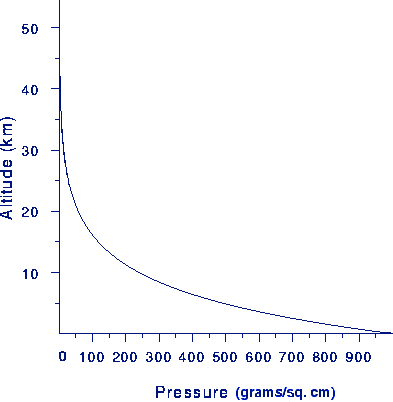
#41 Re: Interplanetary transportation » Why don't we go to space in one of these babies? » 2005-09-28 04:32:42
I would like to expand on my example:
Weight of air per liter = 1.2 grams
Weight of helium per liter = 0.18 grams.
Net lift per liter = 1.03 grams
(assuming standard pressure and temperature)
1m³ = 1000 liter
Uplift per m³ = 1.03 kg
A sphere with radius of 1 km will have a volume of 4 188 790 200 m³. Total uplift from helium inside = 4 314 453 906 kg, which is 4.3 million metric tons.
#42 Re: Interplanetary transportation » Why don't we go to space in one of these babies? » 2005-09-28 04:13:34
I was actually thinking about the possibility of using an airship to lift a rocket above most the atmosphere, just like SpaceShipOne is using an airplane. An airship have two obvious advantages over an airplane:
1. It can go higher
2. It can lift a lot more
On the downside:
1. more expensive
2. slower
I believe the most efficient shape of such an airship is a sphere, because this is how you would get the most volume out of each square meter of surface area.
An spheric airship with a radius of 10 meter will have a volume of (4/3)pi*r³ = 4188 m³. The surface area will be 4*pi*r² = 1256 m². Volume / Area = 3.33. It will probably not be able to fly. But what happens if we make the radius 1 km? Volume/Area is now 333,33. This is significant because the weight of the materials in your ship will depend mostly on the surface area, not the volume. A huge spheric airship would be able to lift almost anything, and probably enough equipment to get far far out to space. Size clearly matters! (but I hope you understand that a 1 km radius was a theoretical example).
#43 Re: Interplanetary transportation » Why don't we go to space in one of these babies? » 2005-09-27 19:21:18
Airships can take us 21 kilometers above ground, and even small ones can lift twice that of a commercial airliner. Why don't we use airships to get into space?


#44 Re: Terraformation » Projected Marsian Population? » 2005-09-26 13:52:02
Projecting the future population of Mars is an interesting exercise.
I believe it all comes down to how much energy you can produce, and that there is almost no limit on the land itself.
Converting energy to food is not really that hard, and is already taking place in many rich countries. Growing tomatoes in Northern Scandinavia during the Winter when it is pitch black outside and the temperature is around -35C is not a problem at all long as you have a cheap reliable source of energy. The same applies to desalination of sea water for agriculture which is a big industry in some of the small countries around the Arabian gulf. Growing food on Mars would require energy for both heating plants and extracting water, but can support a population of at least 20 billion if we find a cheap and reliable source of energy.
Putting in place restrictions on population growth would just be ridiculous, because human creativity always finds new ways of feeding more mouths.
Human settlements of Mars will already have adapted to the Martian environment, and might therefore object to the whole idea of terraforming because that will put big areas of their environment under water.
#45 Re: Human missions » The Moon - A great place to build space ships » 2005-09-26 09:29:39
I am new on this forum, and am getting the impression that many people here are negative to a possible lunar colony. I am certainly not an expert, but will outline why I believe a lunar colony is necessary for the future of space travel.
You have probably all seen the massive space ships in movies like Star Trek and Star Wars, where the ships are more like modern cruise ships than current space vessels. In real life, we will probably never find it economically viable to lift such space ships from Earth and into orbit, because that would require almost unbelievable amounts of energy.
However, huge space ships the size of cities are not entirely impossible. At least not if we build them in a low gravity environment with the necessary natural resources. The Moon is such a perfect place, and Apollo astronauts proved to the whole world how little energy you need to get off the ground up there. Huge space ships can certainly be made of carbon fibers, titanium or other fancy materials. However, steel is much cheaper and the moon has huge iron ores just waiting to be used.
If we succeed on the Moon then a lot of the technology can be used on other planets and moons as well, and there are plenty of similar rocky places even in our own solar system. Mars is one of them, but there are certainly other places as well - for instance the rockiest moons spinning around the huge planets further away from the sun. How about a colony in a deep crater on Mercury? 
A permanent base on the moon is exactly what we need to conquer space. Such a base would naturally start off as a research base, but should eventually be developed into a place where we build cheap and efficient space ships and extract the stuff necessary to fuel them.
Let's go to the Moon!