New Mars Forums
You are not logged in.
- Topics: Active | Unanswered
Announcement
#29576 Re: Human missions » Long duration Human space missions - Can we survive them? » 2004-10-15 19:54:31
On the note of astronauts and of the reduced if not 0 G gravity, not to mention the use of lower atmospheric conditions that might provail in the habitat. How would one go about the much needed research or of the eventual crew personel that could resist such effects.
I think one way would be to study the people who live in the mountainous terrains on Earth. Such as in the Alps, chilean mountain range and of course the Hymalans. But we should also study the people of the artic since they are best suited for the prevailing cold conditions of a mars surface as well. Then once these people are studied here on Earth then study them once again under the condition of space.
#29577 Re: Unmanned probes » Mars Reconnaissance Orbiter (MRO) » 2004-10-15 11:23:44
Well here is one problem that I see when it comes to cost:
Engineers put together the next Mars probe
Am I wrong to think we need someone with these engineering knowledge to turn a screw or to afix an item to it as it is being built.
#29578 Re: Unmanned probes » Mars Reconnaissance Orbiter (MRO) » 2004-10-15 10:55:55
After reading recent articles written with regards to the science that we wish to explore when it comes to Mars research. Most articles state that the first goal is to follow the water, second to photograph the surface in finer details and third I would hope would be a more indepth mineral study.
I beg to wonder how many more probes must be sent before we can answer the water question or will we ever.
Great that we will get the next two peices of research under way but will it be like we have done with the Apollo's moon data of old, in that it is just not good enough for when we finally to get to go?
Mars Reconsidered: New Data Raises Fresh Questions
http://www.space.com/scienceastronomy/m … 41015.html
#29579 Re: Science, Technology, and Astronomy » Genesis, Stardust, Etc.: Snag & Bag » 2004-10-15 08:05:48
It appears that a gravity sensor is at fault as indicated by NYTimes article(registration).
Los angeles article indicates a switch installed backwards.
Genesis Crash Blamed on Installation Error
http://www.latimes.com/news....science
NY Times
The crash of a capsule returning fragile samples of solar particles last month was likely to have been caused by a design flaw that led to the sensors that were to deploy the capsule's parachutes being pointed in the wrong direction, a NASA investigatory panel reported yesterday.
The Genesis spacecraft had spent 850 days in deep space collecting particles of solar wind, charged atoms ejected at high speeds by the sun that may tell scientists about conditions that existed in the infant solar system nearly 5 billion years ago.
Mission designers had been so worried about possible damage and contamination to the collection plates that plans not only called for parachutes to slow the capsule's landing but a helicopter flown by a stunt pilot was to catch it in midair and then gently lower it to the ground.
Instead, when Genesis returned to earth on Sept. 8, neither an initial small parachute nor the main parachute deployed, and the capsule slammed into ground at nearly 200 miles per hour.
The investigatory panel pointed to sensors that were designed to sense the tremendous forces of deceleration as friction during re-entry slowed the capsule down from 25,000 miles per hour. The sensors were then to send a signal to a computer that would deploy the parachutes.
A flaw in the design of the capsule, however, placed the sensors in an orientation that did not allow them to fully measure the deceleration, the panel said. Consequently, the sensors never sent the signal to the computer, and the computer never sent the command to deploy the parachutes.
"This single cause has not yet been fully confirmed, nor has it been determined whether it is the only problem within the Genesis system," Dr. Michael G. Ryschkewitsch, chairman of the investigation panel, said in a statement released by NASA yesterday evening. "The board is working to confirm this proximate cause, to determine why this error happened, why it was not caught by the test program and an extensive set of in-process and after-the-fact reviews of the Genesis system."
The crash broke open the capsule and smashed many of the collection plates, but mission scientists say they are nonetheless optimistic that they can still salvage much of the science.
#29580 Re: Interplanetary transportation » Da Vinci in the Running - Let the Space Race Begin! » 2004-10-15 06:21:57
Not much of an update but for what it is worth.
The Da Vinci's Canadian Project rocketeers are hoping to launch a privately built spacecraft from the small Saskatchewan town of Kindersley met with community officials Thursday, updating residents on the mission’s progress and reaffirming their intent to fly.
#29581 Re: Interplanetary transportation » New space Corp. in the making. - Former Soviet states, to build Kliper » 2004-10-15 05:26:22
Same mosnew article dating back to september, that had started off the previous postings topic also I found links and other stories as they related to the developing of a 4 cold war nations of russia to form a new space agency that was to build the klipper. Here is the other thread with the same reference article.
#29582 Re: Science, Technology, and Astronomy » Russia wants assembly stations - To build Lunar and Mars ships » 2004-10-14 19:10:21
Usually I am the one reading pravda even it is much like the enquirer, with its spectulation stories and sometimes total untruths.
I like the concept of making the most of the ISS and of using it for more than just doing some science experiments. I do feel that what goes up must be recycled and reused in other forms not wasted by sending it down by a progress dumpster. In fact the parts from these very same ships once properly recycled could even be used to build the very ship we would wish to go back to the moon in or onto mars.
A little creativity is all that is needed.
#29583 Re: Interplanetary transportation » Magnetized-beam plasma propulsion - 90 day Mars round trip? » 2004-10-14 18:57:28
New propulsion concept could make 90-day Mars round trip possible. Lots of details into the technology and concept.
#29584 Re: Science, Technology, and Astronomy » Wide-field Infrared Survey Explorer - wise telescope » 2004-10-14 13:26:41
UCLA professor to lead new NASA mission
Project will use infrared telescope to create detailed map of the cosmos.
http://www.dailybruin.ucla.edu/news/art … p?id=30349
UCLA scientist Edward Wright will serve as principal investigator of the new NASA Wide-field Infrared Survey Explorer mission. One of the project’s goals is to discover stars that are too cold to be detected with visible light.
The article has said there is still one more hurdle ahead of the NASA project, and that is the final construction of a satellite.
#29585 Re: Human missions » Funding space - How much do Americans pay for sneakers? » 2004-10-14 08:58:53
on the sneaker question it depends on how many you have to buy at one time, how much you have for funds and the brand to price style options that will be the choice for what you will and can get.
The same holds true for rockets to space. If there are limited to your choices and the prices are to high for those that you have.
Thats where the alternative space businesses come in. Maybe they should go to congress just like Nasa does to get funding for there space projects. Outline there project goals and returns for the investment.
#29586 Re: Interplanetary transportation » Falcon 1 & Falcon 9 » 2004-10-14 08:44:42
so strap on a SRB or SRM on the side and that solves the lift problem.
#29587 Re: Human missions » Funding space - How much do Americans pay for sneakers? » 2004-10-14 07:16:09
Give tax credits for volunteer workers who work on space programs, put to work the unemployeed within the space industry, create other space centers where either of the above would give the greatest number of bodies to work for the space program.
#29588 Re: Science, Technology, and Astronomy » Deep Impact Crashing mission - Comet Tempel 1 target » 2004-10-13 13:27:54
It would seem that more missions that were in the building phases are coming to a close. Which means more funds are needed by Nasa to meet these past due probes launch dates.
Engineers here at Ball Aerospace & Technologies Corporation are readying NASA's Deep Impact mission for shipping this month to Cape Canaveral, Florida.
#29589 Re: Science, Technology, and Astronomy » Vesta & Uranus » 2004-10-13 13:21:22
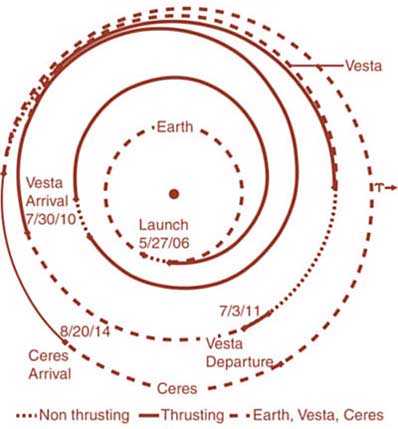
Vesta is a very interesting asteriod in its own little odd shape about the size of arizona. The Hubble has been used to image it as well as the keck and other observatories. Supposedly fragments from it where found in the early 70's after being seen in 1960 by two fence workers in Millbillillie, Western Australia. The fragments stood out from the area's reddish sandy soil because they had a shiny black fusion crust when it was finally located 10 years later.
Nasa had in 2001 a discovery mission called Dawn that was slated for launch in 2006, which would have orbited the two largest asteroids in our solar system.
I am not in the know as to if this mission has been cancelled or not, Anyone in the know?
#29590 Re: Unmanned probes » Mars Express (MEX) - ESA orbiter » 2004-10-13 11:41:20
The main antenna for Mars Express known as the MARSIS (Mars Advanced Radar for Subsurface and Ionosphere Sounding) which is a spindly shaped radar antenna - which could discover underground water on Mars - will now not deploy on Europe's Mars Express spacecraft until at least March 2005.
Mars Express 'divining rod' mission delayed
http://www.newscientist.com/news/news.jsp?id=ns99996509
#29591 Re: Science, Technology, and Astronomy » ISS cutbacks » 2004-10-13 11:20:13
Well all optimism aside the next crew will be blasting off tomorrow and found this article rather amusing for the superstitions and ceremonies that the Russians partake of before each launch.
There are many traditions before anybody launches into space on a Russian rocket. The cosmonauts watch the movie "White Sun of the Desert" the night before launch. The movie is sort of a western thriller, set in the Caucus mountains, and many of the cosmonauts have memorized the entire dialogue.
Danville astronaut ready for blastoff
Chiao scheduled to begin his mission on Russian Soyuz rocket today
http://www.trivalleyherald.com/Stories....0.html#
#29592 Re: Not So Free Chat » Songs about America - Know of any good songs about America? » 2004-10-13 10:40:28
But if you were looking at this years presidential election the song I hear would be from the group America.
A horse with no name.
#29593 Re: Human missions » Long duration Human space missions - Can we survive them? » 2004-10-13 10:27:13
Now back on subject sort of the Volunteers are Needed For the Mars Society Mars Desert Reseach Station (MDRS) Crews: Hard Work, No Pay, Eternal Glory, in southern Utah during extended simulations of human Mars exploration operations. Field season will begin in December 2004 and run through April 2005. Mars Society will also be issuing an additional call for volunteers for the summer 2005 field season of the Flashline Mars Arctic Research Station (FMARS) on Devon Island later.
Isn't it about time that NASA sends Astronauts to partake in the research effort.
#29594 Re: Science, Technology, and Astronomy » Farewell Magellan » 2004-10-13 08:57:28
Or B was this another of those cost saving endings by Nasa in order to hide other accounting short falls. (I hope I am wrong)
But the science it has given us of venus would have been hard to do without it, if it were launched today under the tight budget constraints that Nasa currently has.
#29595 Re: Science, Technology, and Astronomy » Wide-field Infrared Survey Explorer - wise telescope » 2004-10-13 08:38:13
This particular telescope is geared to a mission that will scan the entire sky in infrared light. Hoping the search will turn up nearby cool stars, planetary construction zones and the brightest galaxies in the universe.
Another article on the topic:
Stellar Night-Goggles
http://www.spacedaily.com/news/telescopes-04zf.html
#29596 Re: Science, Technology, and Astronomy » ISS cutbacks » 2004-10-13 08:12:25
Not to mention surviving though those years hurricane seasons which has been very devastating to the people of Florida but also in that it will cause delay for launches of time sensitive probes and the likes including the shuttle return to flight. Which is now slated for late may 2005 and could be even later if more CAIB recommendations are not cleared.
#29597 Re: Unmanned probes » Mars Reconnaissance Orbiter (MRO) » 2004-10-13 05:57:44
What is really funny though is what it is expected to achieve with this instrument set. That MRO is a crucial link to a wave of upcoming robotic landers slated to dot Mars in coming years, such as the next generation rover in 2009. Basically get a good picture of resources and chose the best sites for future missions.
Science instruments onboard MRO emphasize the spacecraft’s roster of key jobs at Mars: the High Resolution Imaging Science Experiment (HiRISE), Context Camera (CTX), Mars Color Imager (MARCI), Compact Reconnaissance Imaging Spectrometer for Mars (CRISM), Mars Climate Sounder (MCS), and the Shallow Radar (SHARAD).
After looking at the instrument I realize that many are the same as what would be needed for the LRO to be launched some time in the fall of 2008.
NASA has established the following "priority ordered" objectives for the initial robotic elements in the Lunar Exploration Program:
Characterize the lunar radiation environment, biological impacts, and potential mitigation by determining the global radiation environment, investigating shielding capabilities, and validating other deep space radiation prototype hardware and software;
Determine a high resolution global, geodetic grid of the Moon (in 3-dimensions) that provides the topography necessary and sufficient to identify future landing sites;
Assess in detail the resources and environments of the Moon's polar cap regions;
Determine in great detail the elemental composition, mineralogy, and other regolith characteristics of the Moon's surface.
The total budget for all investigations selected with the soon-to-be-released AO is expected to be less than $120M (Real Year Dollars) including design, development, test, launch, and mission support and data analysis.
While the MRO is to be a much longer duration mission I find the cost quite different.
MRO’s primary and relay mission requirement is to operate for 5.4 years. But it has the built-in chutzpa to keep on keeping on for a decade. Cost of the spacecraft, its booster, mission operations, and performing science for 10 years is in the $700 million range.
#29598 Re: Science, Technology, and Astronomy » LIGO, LISA and Gravity Probe B - Gravity Wave Studies » 2004-10-12 20:24:21
A comparison of voyager probes might yield simular data for this slowing effect.
#29599 Re: Unmanned probes » Mars Science Laboratory (MSL) - rover » 2004-10-12 20:06:31
The lander hovering then lowering the sky hook reminds me of the shape of a plane. The main problem of the next generation rover is the down mass. I would say that we needed to think in terms of a gentle type landing for the more fragile instrumentation that it will contain.
I sort of like the other thread inflating of a balloon to slow it down even more than a parachute followed by retro rockets.
Question for the bouncing ball approach, what type of gas is used to inflate those? If inflated with helium rather than possible leftover hydrogen would this not have the same effect as one larger balloon?
Definetly the steerable parachutes would come in handy for this project also that is in another thread.
Much of the science lab detection is being discussed under the chilean desert life detecting rover.
#29600 Re: Unmanned probes » Marsquakes - detecting marsquakes » 2004-10-12 20:04:20
That is the article with the 2009 date but I am not sure if that is the launch or the landing time frame.
The lander hovering then lowering the sky hook reminds me of the shape of a plane. The main problem of the next generation rover is the down mass. I would say that we needed to think in terms of a gentle type landing for the more fragile instrumentation that it will contain.
I sort of like the other thread inflating of a balloon to slow it down even more than a parachute followed by retro rockets.
Question for the bouncing ball approach, what type of gas is used to inflate those? If inflated with helium rather than possible leftover hydrogen would this not have the same effect as one larger balloon?
Definetly the steerable parachutes would come in handy for this project also that is in another thread.
Much of the science lab detection is being discussed under the chilean desert life detecting rover.