New Mars Forums
You are not logged in.
- Topics: Active | Unanswered
Announcement
#29226 Re: Human missions » Space Dev http://www.spacedev.com » 2004-11-17 08:44:22
I will bite John, What do you really want to discuss about spacedev.
#29227 Re: Planetary transportation » Airborne laser success » 2004-11-17 08:05:33
The Power of Light: An Airborne Laser for Missile Defense
With the successful ground test in the bag, the Missile Defense Agency is pushing forward with plans for an Airborne Laser (ABL), a Boeing 747 freighter aircraft with a laser-tipped nose designed to destroy ballistic missiles as they rocket through the sky. In the ultimate version of laser tag.
#29228 Re: Science, Technology, and Astronomy » Anaerobic Microbes caused - Natural gas or Methane in coal mines » 2004-11-17 08:00:23
Discovery Of Real-Time Natural Gas Formation Offers Prospect For Renewable Energy Resource
Researchers at Luca Technologies have made a discovery regarding natural gas production in Wyoming's Powder River Basin that could lead to a renewable source of energy for generations to come.
The Powder River Basin coal mines are generating natural gas in real time through the ongoing activity of anaerobic microbes (bacteria that live in the absence of oxygen) resident in those coal fields.
Methane production by these microbes can be stimulated by the introduction of additional nutrient compounds.
Sort of sounds like the methane measurements on Mars.
#29229 Re: Science, Technology, and Astronomy » Terminator Tether - ...space junk begone! » 2004-11-17 07:51:47
It has been suggested that every satellite deployed should carry extra propellant so the satellite can boost itself up to a higher "graveyard" orbit. Unfortunately, not only must the extra kilograms of propellant be boosted up from Earth, the rocket and guidance systems must be usable for many years after launch. Also, graveyard orbits merely leave satellites up higher, where micrometeorite damage slowly causes these objects to break apart; smaller fragments will filter back down, leaving this problem for our children to solve. These smaller fragments are almost impossible to clean up. Extra propellant could also bring the satellite down; of course, this also requires that the rocket and guidance systems work at the end of the satellite's life. If either system fails to work, the satellite stays right where it is.
Basically Hubble de-orbit boost ideas for how to either abandon its use plunging it into the Earths atmosphere to burn up or the attempt to put off the decision for another day.
But ya there is a lot of space debri out there.
How about putting up very large ion engine driven space fly swatter to knock the junk out of orbit.
#29230 Re: Science, Technology, and Astronomy » Gentle Acid, But strong but can they aid - The space exploration vision? » 2004-11-17 07:27:22
Strong, Yet Gentle, Acid Uncovered
Carborane, part of the world's strongest acid.
Atom color code:
orange = boron, gray = carbon,
green = chlorine, white = hydrogen.
Great article of different aspect of acids in general.
Can acids aid those first explorers in doing science on the moon or on mars?
Can they be used to help in the mining and processing operations for not only separating but also for the releasing of locked in oxygen molecules in the soils of either?
#29231 Re: Space Policy » Space fairing Nations - The ever changing view » 2004-11-17 07:03:08
Another step Govt. nod for ISRO'S RLV technology demonstrator Sorry not much to the article but at least they are getting funding for what needs to be done.
#29232 Re: Unmanned probes » Opportunity & Spirit **8** - ...More... » 2004-11-16 22:01:12
My question for the experts was if the colored area indicates thermal energy from or though solar obsorbtion or actual under ground venting. But still spectacular...
#29233 Re: Space Policy » Space fairing Nations - The ever changing view » 2004-11-16 21:51:32
On the continuing development of other nations India is still taking the rights steps along the way towards manned space flight.
The Indian Air Force is holding discussions with the ISRO in talks to set up spacelab for manned space mission
#29234 Re: Space Policy » Space fairing Nations - The ever changing view » 2004-11-16 21:48:03
This will mean a new guisness book of records entry for the x-43A. Though I wished that this was being designed around manned use but a start is still a start when it comes to new technology development.
#29235 Re: Human missions » ISS Woes & To-Mars » 2004-11-16 21:40:27
ON WEDNESDAY ISS TO JUMP 4.4 KILOMETRES UP
The usual daily sag of the ISS from earths terrestrial gravity is from 150 to 200 metres a day but under the recent very strong magnetic storm, the ISS station was going down by 300 metres daily throughout last week. Thus requiring a burn of the progress space trucks engines for 548 seconds.
#29236 Re: Human missions » NASA Technology Request BAA - A step in the right direction (finally)? » 2004-11-16 21:35:21
NASA Selects Exploration Systems Proposals
More than 3700 Notices of Intent were submitted to NASA, evaluated, and subjected to an integrated review across project areas. Submissions to the announcement follow a rigorous process to ensure timely and objective evaluation of their relevance, technical quality, cost, resources, planning, and socioeconomic merits. The field was narrowed from 485 full proposal submissions.
NASA's Exploration Systems Mission Directorate (ESMD) selected 70 proposals to support the research and technology goals and objectives of the Vision for Space Exploration. The total value of the work is more than $1 billion through fiscal year 2009.
#29237 Re: Not So Free Chat » Bush next four years agenda - Can he achieve his goals » 2004-11-16 15:06:02
The update as well as changing of the cabinet posts on the Powell resignation and the nomination of Rice as secretary of state to replace warrior-turned-diplomat Colin Powell as part of a sweeping second-term Cabinet overhaul.
#29238 Re: Human missions » A new thread - on Bigelow's space prize » 2004-11-16 14:44:52
Well the prize game is getting new interest from Nasa in regards to wanting to hand out bigger ones at least.
NASA Lobbying For Authority To Grant Prizes Above $250K
NASA is lobbying Congress for the authority to award prizes of more than $250,000 in its Centennial Challenges program, and hopes to get a green light during the current lame-duck session of Congress or early next year.
Four broad categories of challenges are planned: flagship challenges, keystone challenges, alliance challenges, and quest challenges. The biggest prizes offered by the program, flagship prizes will be worth $5-50 million. The program currently envisions four flagship competitions:
* Aero-assist demonstration. Although NASA spacecraft routinely use techniques such as aerobraking, "no one has actually demonstrated a true aerocapture or an orbital plane change using aero-effects in orbit," Sponberg said. Prize competitors will have to build a low-cost technology demonstrator to prove their technique in Earth orbit. Aero assist techniques use planetary atmospheres to help with orbital maneuvers.
* Micro re-entry vehicle. Competitors will have to build a low-cost automated vehicle capable of bringing small payloads down for accurate landings. NASA is interested in using such technology to improve science return from the space station.
* Lunar robotic soft landing. "The idea behind this prize is to stimulate someone to demonstrate the ability to softly land a small payload on the moon at low cost," Sponberg said.
* Stationkeeping solar sail. Competitors would have to build a solar sail capable of keeping a spacecraft in orbit for an extended period. NASA is interested in this technology for remote sensing and communications relay applications.
#29239 Re: Not So Free Chat » Political Potpourri - ...anything political goes. » 2004-11-16 14:17:02
sort of jumping in late on the dollar and masonic symbol but here is a few pages. Some agree that the notion of the symbols being connect to any underlining reference is meaningless.
http://www.crystalinks.com/freemasons.html
http://www.calodges.org/no406/ALLCEYE.HTM
http://www.mastermason.com/WallerLodge/dollar.htm
The symbols on the dollar bill relate to the Masonic notions of the founders. The all-seeing eye comes from the Masonic symbology. The concept of the pyramid with its missing capstone links with the ancient mystery school teaching of ancient Egypt.
#29240 Re: Not So Free Chat » Jeff Bell strikes again - Five predicted failures for NASA » 2004-11-16 12:00:48
Agreed it is what you do with it once you have it.
Salvaging of satelites maybe a little different for the owner must give up there claims for anyone to feel that it is worth while to venture into a very costly proposition.
The next part about the satelite salvage will be the in orbit ability to change planes over vast distances. Maybe solar energy and magnetic propulsion in some form.
As for the present senerio of bone head concepts and choice making we only need to look at the past to see how if staying the course will end up in the far off future. Stuck in LEO...
#29241 Re: Science, Technology, and Astronomy » New Solar Power Technology » 2004-11-16 11:41:42
The storage tanks first are insulated, plus they are huge not just a few gallons but reaching well above a million and it is still in the super heated state as stored energy.
Alot like heat pumps or well, from what I recall use to heat a home in winter but to act as a heat exchanger for the hot summer months by using the stored cold energy collected during the winter.
I think this site will be a resource to answer some questions.
http://www.eere.energy.gov/consumerinfo/
#29242 Re: Science, Technology, and Astronomy » Mars: Magnetic Field & Aurora » 2004-11-16 10:21:58
I see from the articles dating that there might be the question of, if the core is cooling has the magnetic field also lessened with time? Or is this more of the permanent magnetic material style field that was measured.
#29243 Re: Unmanned probes » Opportunity & Spirit **8** - ...More... » 2004-11-16 10:14:25
Yup the last article release was on the rovers back tracking out of the Endurance Crater. Here is what I have found so far.
http://story.news.yahoo.com/news?tm...._rovers
Also prior to that was the anouncement that the control over the rovers had begun the process of being driven by those at Cornell University.
http://news.yahoo.com/news?tm....rnell_1
http://www.athena.cornell.edu/
http://marsrovers.jpl.nasa.gov/home/index.html
Thermal Data Assists Volcanic Sleuths In Search of Eruption Clues

#29244 Re: Interplanetary transportation » Magnetized-beam plasma propulsion - 90 day Mars round trip? » 2004-11-16 09:30:42
To Mars and back in 90 days: UW researchers studying faster space travel methods
Students and faculty are working at the Earth and space sciences (ESS) lab are working on projects that will lead to an upcoming project to cut the costs and time of space travel.
#29245 Re: Human missions » ISS Woes & To-Mars » 2004-11-16 09:22:59
A follow up to Cindy's earlier post of the astro notes dent.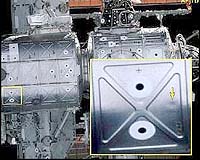
The original photograph in this image was taken during the Space Shuttle Endeavour’s approach to the ISS for docking during the STS-113/11A assembly mission, on 25 November 2002. An indentation in a micrometeoroid debris panel on the exterior of the Destiny Laboratory module is indicated by an arrow in an enhanced section of the image provided by the Image Science and Analysis Group at the Johnson Space Center. Analysis of this image and additional video indicates that the indentation is not from a debris strike, but is consistent with flat spots seen on other areas that are likely the result of significant temperature changes. The protective shield’s function is not affected by the indentations.
#29246 Re: Space Policy » Space fairing Nations - The ever changing view » 2004-11-16 09:16:23
Seems like they are being overly cautious on this scram jet project but will it matter in the end run since the follow up steps have been cancelled.
On another note of Nasa it would seem that some of the issues around Nasa is the fact that they have there hands in to many projects unrelated to space.
NASA Helps To Create Complete Human Genome Map and do not get me wrong, for I think that if they can provide the help they should to private industry but it should be not for free.
#29247 Re: Planetary transportation » Fuel Cells - A viable power source? » 2004-11-16 09:11:54
Well this has been a real dead thread since it was started so long ago but it is the right one to post this reference within.
This may or may not be a first for
NASA Buys Hydrogenics Light Weight Fuel Cell Stack To Test For Uses In Space.
Granted it is a light weight 5kW hydrogen/oxygen Proton Exchange Membrane (PEM) fuel cell. But in a pinch when power is of need it may do.
The technology of fuel cells has been matching forward to make them smaller and of course with that more effecient as well. Maybe someday they will replace batteries and then again maybe not.
#29248 Re: Human missions » The need for a Moon direct *2* - ...continue here. » 2004-11-16 08:48:31
Here is a quick view of what I know is in the works by foreign nations with regards to future moon missions:
SMART-1, a project of the European Space Agency, was launched in September 2003. It's taking 14 months to reach the moon -- the U.S. Apollo missions took four days -- because it's using an experimental propulsion system, called an ion drive, which starts very slowly and gradually accelerates to a high speed. It requires little fuel and is being tested for use in extremely long missions in outer space. Smart-1 is a square box, measuring about 3 feet on a side and weighing about 800 pounds. Inside are three toaster-sized instruments to study the chemical makeup of the moon in X-rays, infrared light and ordinary light.
Japan plans two lunar visitors but has been having trouble getting them off the ground. The first, a 1,200-pound orbiter called Lunar-A, originally was scheduled to take off in 1999, but has been delayed repeatedly by problems with the launch rocket. It's now slated to go up sometime next year. After settling into a 1,200-mile-high orbit, the spaceship will fire two missile-like penetrators that will drill 1 or 2 yards deep into the lunar surface, one on the side facing Earth, one on the back side. The penetrators will relay data on possible moonquakes and the nature of the moon's core. In 2006, Japan hopes to launch a more ambitious, 4,400-pound package of three satellites called Selene, the Greek name for the moon. The main orbiter will carry 13 scientific instruments to study the origin and evolution of the moon. It will spin off two smaller satellites, one to relay signals from behind the moon and the other to measure the moon's wobble as it circles the Earth.
The Indian Space Research Organization plans to launch Chandrayaan-1, Hindi for "moon voyage," in September 2007. The 1,200-pound orbiter is to circle the moon, 60 miles above the surface, for at least two years.
China, which launched its first man into Earth orbit in October 2003, plans to send up a lunar orbiter in 2007. It's named Chang-e, after a Chinese story about a fairy that flew to the moon. The Chinese space agency announced last summer that it will attempt a robotic soft landing on the moon in 2010 and a manned landing by 2020. The European Project Aurora has a goal of a manned landing on Mars by 2033, about the time the United States might be doing the same.
#29249 Re: Human missions » Retiring the Shuttle ASAP - How do we do it? » 2004-11-16 08:45:16
I figured that I would post this here since goes with out saying that Nasa has screwed up not only in the past but it is still on going in some of its space operations.
Five Big NASA Failures a discusion of project time, use of funding and the eventual wasting of talents under cancellation in later life of said same projects. It goes into past projects, current and of future ones still in design phases as to what is wrong with each.
#29250 Re: Unmanned probes » James Webb Space Telescope (JWST) - 6.5m mirror, L2 orbit » 2004-11-16 08:31:47
Finally an update on the sucessor to Hubble.
Fabrication of James Webb Space Telescope Mirror Moves Forward with the opening of a state-of-the-art facility in Cullman, Ala., that will machine the observatory's optical components.