New Mars Forums
You are not logged in.
- Topics: Active | Unanswered
Announcement
#26 2026-09-19 12:05:13
- Void
- Member
- Registered: 2011-12-29
- Posts: 9,985
Re: Transportation Issues and the Development of Worlds.
I have the Moon on my mind again this morning. The test results about the Moon from various nations.
Results from China suggest that the Far side of the Moon is dryer and different than the near side.
China also has found evidence of water in glass beads. America had some evidence of that also but for various possible reasons that was missed or purposely covered up in the past, but acknowledged now.
This claim is rather optimistic: https://curiosity.thespaceacademy.org/2 … d-300.html
Quote:
Home
Moon
BREAKING: Scientists Just Found 300 Billion Tons Of Water On The Moon
by
Haji Scientist
•
May 19, 2024
Quote:
And we're talking about a lot of water too, perhaps as much as 270 trillion kilograms (297.6 billion tons) of the stuff.
More recent articles have suggested a billion tons of water in beads.
I asked this question: "How much water is on the Moon?"
Quote:
Copilot Search Branding
Like
Dislike
Current measurements show that sunlit lunar soil contains about 100–412 parts per million of water—roughly the amount in a 12‑ounce bottle per cubic meter of soil—while permanently shadowed polar craters hold much larger deposits of ice.
Overview
Scientific missions, especially NASA’s SOFIA observatory, have confirmed that the Moon contains both molecular water (H₂O) and hydroxyl (OH) across its surface. Water exists in two main forms:Trace water in sunlit soil:
SOFIA detected 100–412 ppm of H₂O in the Clavius Crater region. This is extremely dry—the Sahara Desert has 100× more water than this lunar soil.
NASA
NASA
+1Ice in permanently shadowed regions (PSRs):
Earlier missions (LCROSS, LRO, Chandrayaan‑1) confirmed significant ice deposits in polar craters that never receive sunlight. These regions are cold enough for ice to remain stable over geologic timescales.
NASA
NASAWhat This Means
The Moon is much drier than Earth, but water is more widespread than once believed.
Sunlit water is present only in minute quantities, while polar regions may contain substantial ice reserves useful for future exploration.
Understanding how this water forms and persists remains an active research area.
These findings shape future lunar exploration strategies, especially for in‑situ resource utilization under NASA’s Artemis program.
Quote the Quote:
Current measurements show that sunlit lunar soil contains about 100–412 parts per million of water—roughly the amount in a 12‑ounce bottle per cubic meter of soil—while permanently shadowed polar craters hold much larger deposits of ice.
This site suggests that unlike Carbon Hydrogen/water extraction can be accumulative. You can add hot Hydrogen to Lunar soil and get out more Hydrogen as water than you put in. I am going to try to find that reference.
https://www.youtube.com/@Anthrofuturism
I will review this to see if I can recapture such a mention:
https://www.bing.com/videos/riverview/r … &FORM=VIRE
Quote:
Anthro Futurism ideas about extracting water from Lunar Regolith?
1:09:34Refining Moon Regolith With Lasers (Part 1)
YouTube
ANTHROFUTURISM
34.4K views
https://www.bing.com/videos/riverview/r … &FORM=VIRE Quote:
Refining Lunar Regolith
YouTube
ANTHROFUTURISM
69.9K views
Reference mentioned: https://www.lunarresources.space/
Reference mentioned: https://www.blueorigin.com/news/blue-al … nar-future
Long Pause.......
I will have to return to the search later, my patience is challenged.
I did this search: "Getting water from Lunar Regolith by heating?"
And happily got this:
The strategy for in-situ water production on the Moon through the reaction between lunar regolith and endogenous hydrogen. Credits: NIMTE
1,200 K
When heated above 1,200 K, the regolith releases this hydrogen, which then reacts with iron oxides to produce water. Remarkably, one gram of molten lunar regolith can generate 51-76 mg of water.spacevoyaging.com
New Method Discovered to Produce Water from Lunar Regolith
https://www.spacevoyaging.com/news/2024 … -regolith/
Now I have some ideas about capering thermal energy on the Moon using beads. Granted water from beads is also wanted.
Can we manufacture beads on the Moon from parts of the Lunar Regolith?
Now I want to capture Cold in the Lunar night.

Cold or hot with certain alterations.
I know that mechanical things need maintenance, so I have shown a 3/4 pile of beads with retaining walls so that the Augur can be accessed.
During the Lunar Night if you have electricity, you might circulate the pile of beads, drawing warm beads up and distributing them to the sides to be cooled. Probably it is necessary to have a small bull-dozer type robot that pushes the edges in from time to time.
So, then the hope to store lunar cold. The Augur walls and the retaining walls might also serve as heat enchangers, if you want to work with a contained fluid.
You can probably accumulate Lunar day heat using glass heat retaining greenhouse methods and Heliostats.
You may want additional methods to retain the heat into the night with deployed insulation methods. In a similar way you may have heat exchangers built into the augur walls and the retaining walls.
As for the water, it is unknown what is the rate of accumulation. It seems that water travels about the Moon in a day/night cycle.
If beads spread over the surface could accumulate water in the night then they might be put into a heating version of this to have the water baked out of them during the day.
I do understand that various additional features may need to be added to produce "Circulation" of beads.
But from the China experiments and those of others it seems that water may not be such a big problem on the Moon.
I would not mind being corrected if I am wrong, and someone could prove it.
Ending Pending :-)
Query: "Water Vapor moves around the Moon"
Quote:
Copilot Search Branding
Like
Dislike
How Water Vapor Moves Around the Moon
NASA’s Lunar Reconnaissance Orbiter (LRO) has directly observed water molecules “hopping” around the Moon’s sunlit surface, revealing a dynamic lunar water cycle
NASA
NASA
.What’s been observed
Using the Lyman Alpha Mapping Project (LAMP) instrument, scientists detected water molecules (H₂O) and hydroxyl (–OH) groups bound to lunar regolith grains. These molecules are not free water but are adsorbed or chemically bonded to minerals
Wikipedia
Wikipedia
+1
. On the Moon’s dayside, they remain stuck until surface temperatures peak near lunar noon. Then, thermal energy causes them to desorb — detach from the grains — and either:Bounce to a nearby cooler spot where they re‑adsorb, or
Enter the Moon’s extremely tenuous exosphere, where they can persist briefly before re‑depositing
NASA
NASA
.This process repeats as the Moon’s surface heats and cools over the lunar day (about 14 Earth days), creating a day‑to‑day redistribution of water molecules
NASA
NASA
+1
.Where the water comes from
Two main sources are recognized:Exogenous delivery — impacts of comets, asteroids, and meteoroids.
In‑situ production — solar wind hydrogen ions reacting with oxygen in lunar minerals
Wikipedia
Wikipedia
+1
.Why it matters
This movement is significant because:It shows the Moon is not completely dry, even in sunlit regions.
It links water distribution to thermal cycles and solar wind activity — for example, when the Moon passes behind Earth and is shielded from the solar wind, the “water spigot” may slow
NASA
NASA
.Understanding these processes helps assess future lunar resource use, since water could be harvested from regolith in permanently shadowed craters or from surface‑bound molecules
Wikipedia
Wikipedia
+1
.In summary: Water vapor on the Moon is not a static atmosphere but a transient, surface‑bound population that moves as the Moon’s surface heats and cools, hopping between grains and the exosphere in a cycle driven by solar heating and lunar gravity
NASA
So, maybe deployed beads might be left fallow for a lunar night and perhaps have been able to collect water into themselves, then the beads could be processed with relatively mild heating, more than is natural for a Lunar Day.
Ending Pending 
.
Last edited by Void (2026-09-19 13:56:59)
Be careful what you wish for.
Offline
Like button can go here
#27 2026-09-19 19:46:04
- Void
- Member
- Registered: 2011-12-29
- Posts: 9,985
Re: Transportation Issues and the Development of Worlds.
I often ask strange questions. Always did but had to use a library when I was young. That was slow. Now I can ask on my phone if convenient.
Today I got an answer I liked. Here it is "Will very dry Oxygen rust Iron or Steel?"
Here is the answer I liked:
Copilot Search Branding
Like
Dislike
Will Very Dry Oxygen Rust Iron or Steel?
No — very dry oxygen alone will not cause iron or steel to rust, because rusting requires both oxygen and moisture.Rust is a hydrated iron(III) oxide (Fe₂O₃·nH₂O) formed through an electrochemical oxidation process that needs three components working together:
Iron or steel (the metal)
Oxygen (from air or pure O₂ gas)
Water or sufficient moisture acting as an electrolyte
Wikipedia
Wikipedia
+2In completely dry oxygen, there is no water film to conduct ions between the anodic and cathodic sites on the metal surface. Without this electrolyte, the oxidation reaction that produces rust cannot proceed
biologyinsights.com
biologyinsights.com
+1
.Why moisture is essential:
Water dissolves oxygen at the metal surface and enables the movement of ions, allowing the redox reaction to occur
biologyinsights.com
biologyinsights.com
.Even small amounts of humidity (as low as ~60% relative humidity) can initiate rust if oxygen is present
CompleteEra
CompleteEra
.In the absence of moisture, oxygen may still cause very slow surface oxidation, but it will not form the flaky, porous rust layer that degrades the metal
CompleteEra
CompleteEra
.Practical outcome:
Dry oxygen only: No significant rusting; any oxide formed would be minimal and not the hydrated rust seen in normal corrosion.
Dry oxygen + moisture: Rusting proceeds normally, and the rate increases with humidity, temperature, and presence of electrolytes like salt
biologyinsights.com
biologyinsights.com
+1
.Summary:
Very dry oxygen will not rust iron or steel because the water component is indispensable for the rusting process. Without moisture, the electrochemical pathway for rust formation is blocked
So, I have been pondering how to make a gas filled thermal reservoir on places like the Moon where the containment contains also a bulk of beads. The beads probably being made of "Slag".
We still have the problem of where to get Carbon for Steel, but the possibility exists.
Oxygen is useful to breathe or for engines that burn fuel but otherwise is mostly a waste product that is very abundant on the Moon.
If we can make steel we might make containers and fill them with "Slag" beads, and use heated or cooled Oxygen to store heat or cold in them.
However, I still fear that Oxygen may limit the temperatures that the Steel can deal with. Otherwise, CO2 and Argon may be gasses that might be looked at. Argon and CO2 may exist in the cold traps of the Moon.
It is now considered that there is some Carbon dust and other Carbon in the Lunar Regolith. Not much but some.
Query: "Extracting Carbon from the Lunar Regolith?"
Quote:
Heating
Lunar carbon is found in trace amounts in the lunar regolith, where it can be extracted by heating (see Volatiles). This process results in a number of carbon compounds, chiefly carbon monoxide (C O), carbon dioxide (C O 2), and methane (C H 4).
https://lunarpedia.org/Lunar_Carbon_Pro … 20H%204%29.
Quote:
Lunar carbon is found in trace amounts in the lunar regolith, where it can be extracted by heating (see Volatiles). This process results in a number of carbon compounds, chiefly carbon monoxide (CO), carbon dioxide (CO2), and methane (CH4). It is desirable to produce elemental carbon from these feedstocks for production of lunar steel, as well as various other uses. In addition, processes to reduce these substances would be necessary in order to recycle carbon consumed in various industrial processes. A number of methods have been proposed for this.
Also, substances like Nitrogen might be recovered in small amounts at the same time.
I suppose it might make sense to import Carbon, but it may be possible to make Carbon Steel from what is on the Moon.
So, at any rate, in processing Lunar regolith you might first process for these items and then perhaps try to do other methods to extract things like Iron and Aluminum. Keep extracting until you have "Left Overs" that are probably Oxidized and might be only useful as bricks or thermal beads.
That is how I am thinking about it.
In the case of blowing very hot Oxygen into a pile of beads perhaps you push the hot Oxygen into the bead pile so that the very hot Oxygen does not contact the steel walls of the container. But that might leave you with the problem of how you heat Oxygen to very hot temperatures without eroding the heating mechanism and piping for it. Not yet analyzed/solved completely.
As I have said previously some thermal systems might not be pressurized with Oxygen at all. You would have to be able to flow the beads as a fluid by some means.
Ending
Last edited by Void (2026-09-19 20:10:26)
Be careful what you wish for.
Offline
Like button can go here
#28 2026-09-20 08:04:37
- Void
- Member
- Registered: 2011-12-29
- Posts: 9,985
Re: Transportation Issues and the Development of Worlds.
It is my suspicion that it was this type of monkey that caused our story to say that the Moon was bone dry: https://en.wikipedia.org/wiki/Dr._Zaius
Quote: 
There is science and their is story telling.
There are two views of what to do with America. Truth says we should speak truth, another one is to tell a story, that serves to cause the flow of money and power to be in the interests of the story tellers.
This is why I have a concern for the "Mars Roach Motel".
I am very enthusiastic for the movement to seek expansion into the solar system. I have been concerned that by making the story of the Moon "Bond Dry" and repeatedly breaking the space efforts, the game is to make the task so, fragile that it will be easy to break the effort in mid stream. The purpose for this is if you are the sort of person who believes that Americans exist to serve as servants to allow the story tellers to live a "High Life".
It may not be in the interests of a storyteller in the Planet of the Apes, to acknowledge truth, as he has a high position in the Ape Hierarchy, and to believe that humans would have a type of intelligence that might be worthy would upset that false story.
So, a space program that was held in captivity with the intention of continuing that captivity forever. So, that there can be high places that may be awarded to those who tell the right stories.
And so I am interested in making the Moon project work. Not because I want to displace the Mars project, but rather to hope to create conditions where space efforts can no longer be broken and the "Copper" sold off for pennies on the dollar, and then it can be restarted again to inflate profit margins for fake space companies.
I do not think that many space companies now are fake space companies, but the danger still exists.
Each situation has an advantage:
Moon (Proximity).
Mars (Potential to become more Earth like).
Asteroid Belt (Massive material gains).
Venus (An actual environment at altitude that is the most similar to Earth.
I don't think that a "Hail Mary", "Mars Roach Motel" path is the right one. I think that steppingstones is more correct, with the Moon being the first.
Ending
Last edited by Void (2026-09-20 08:20:08)
Be careful what you wish for.
Offline
Like button can go here
#29 2026-09-20 09:03:35
- Void
- Member
- Registered: 2011-12-29
- Posts: 9,985
Re: Transportation Issues and the Development of Worlds.
An item I have had my eye on for the Moon and Solid Asteroid Chunks is the Quaise drilling system.
https://www.bing.com/videos/riverview/r … 13b8827cd2
Quote:
Utube, America's New Discovery Could End Oil Forever
20:31America's New Discovery Could End Oil Forever
YouTube
NextBlueprint
1.4K views
https://www.quaise.com/
Quote:
Unlocking the true power of clean geothermal energy.
It is not impossible that the boring company could operate on the Moon, if you had sufficient water and chemicals for it.
But this "Disintegrator Beam" might be a useful tool, to carve rock with on the Moon.
America has revised its opinion about water on the Moon, at least for the regolith and polar deposit possibilities.
China has found evidence of water in glass beads (America has also).
But: https://www.technologyreview.com/2012/0 … n-in-1976/
Quote:
Soviet Moon Lander Discovered Water on the Moon in 1976
The last Soviet mission to the moon, Luna-24, returned to Earth with water-rich rocks from beneath the lunar surface. But the West ignored the result.
By Emerging Technology from the arXivarchive page
May 30, 2012
Quote:
A Soviet team analysed the sample and found unambiguous signs of water in the rock–they reported that water made up 0.1 per cent of the sample’s mass. In 1978, they published the result in the Russian journal Geokhimiia. This journal also has an in English language version but it was not widely read in the West.
That was from rock they drilled.
I don't think that we should expect all Lunar rock to be the same as per water and Carbon.
There are special places.
1) Outgassing Events.
2) Fossil Fire Fountains.
3) Deep Cracks.
If we drilled with the Quaise method and we had Hydrogen, we could push Hydrogen down the shaft and expect some water to come up. The water would be in part from the Hydrogen we sent down, and from Hydrogen in the rock itself. We would hope to have an increasing amount of Hydrogen.
Hydrogen would embrittle parts though, if excessive amounts were put in. Heat and Hydrogen will reduce Iron.
Query: "What substances will Hot Hydrogen reduce of Oxygen?"
Quote:
Copilot Search Branding
Like
Dislike
Substances Reduced by Hot Hydrogen
Hot hydrogen (H₂) can reduce metal oxides and certain other oxygen‑containing compounds, removing oxygen from them and producing the pure metal or a lower oxide, along with water vapor
Chemistry LibreTexts
Chemistry LibreTexts
+1
.How the reduction works
In redox chemistry, reduction is the removal of oxygen from a substance (or gain of hydrogen). When hydrogen gas is heated, it acts as a reducing agent: it donates electrons and bonds with the oxygen in the target compound, forming water (H₂O)
Chemistry LibreTexts
Chemistry LibreTexts
+1
. The metal oxide is thereby reduced to its elemental metal or a less oxidized form.General form:
Metal oxide
+
H₂ (hot)
→
Metal
+
H₂O
Common substances reduced by hot hydrogen
Examples from the literature
Chemistry LibreTexts
Chemistry LibreTexts
+1
:Copper(II) oxide:
CuO (s)
+
H₂ (g)
→
heat
Cu (s)
+
H₂O (g)
Hydrogen removes oxygen from CuO, producing copper metal.Copper(I) oxide:
Cu₂O (s)
+
H₂ (g)
→
heat
2
Cu (s)
+
H₂O (g)
Iron(III) oxide:
Fe₂O₃ (s)
+
3
H₂ (g)
→
heat
2
Fe (s)
+
3
H₂O (g)
Other metal oxides (e.g., ZnO, MgO) can also be reduced by hydrogen at high temperatures, though some require very high heat or special conditions.Key points
Hot hydrogen is needed because the reaction is often slow at room temperature; heat provides the activation energy
Chemistry LibreTexts
Chemistry LibreTexts
.The oxidizing agent in these reactions is the metal oxide (it gains electrons and loses oxygen).
The reducing agent is hydrogen gas (it loses electrons and gains oxygen to form water).
This method is used in laboratory and industrial settings for metal extraction and purification
Chemistry LibreTexts
Chemistry LibreTexts
+1
.In summary: Hot hydrogen will reduce many metal oxides—such as CuO, Cu₂O, Fe₂O₃, and others—by removing oxygen from them, producing the pure metal and water vapor
So, the Moon rock being about 41% Oxygen, we might recover only some of that Oxygen, depending on the types of materials in the Rock.
But the dust coming up may have reduced metals in it and water vapor. We might also have to cycle another type of gasses such as Argon or CO2 though it.
The balance between Oxidation and Embrittlement of metal parts would need management, a sort of balance perhaps maintained by amount of Hydrogen send down the well.
The Oxygen in the water, removed from the rock will reduce the total quantity of rock.
So, if we had means to expand this process to the ability to drill horizontal and to make giant vaults, we would not have to remove all of the rock to create VOIDs. If we removed some of the Oxygen our net VOID space would increase. But of course, we would likely remove various substances in the created dust, such as Iron, to build things with.
Certainly translating a drilling method to a "Carving Method" would be a set of serious problems but perhaps could be done.
So, then it might be possible to carve vast labyrinths under the Moons surface, all the while acquiring various useful substances.
I might consider a Fire Fountain a good place to carve.
https://clrn.uwo.ca/clrn-research/lunar-volcanism/
Image Quote: 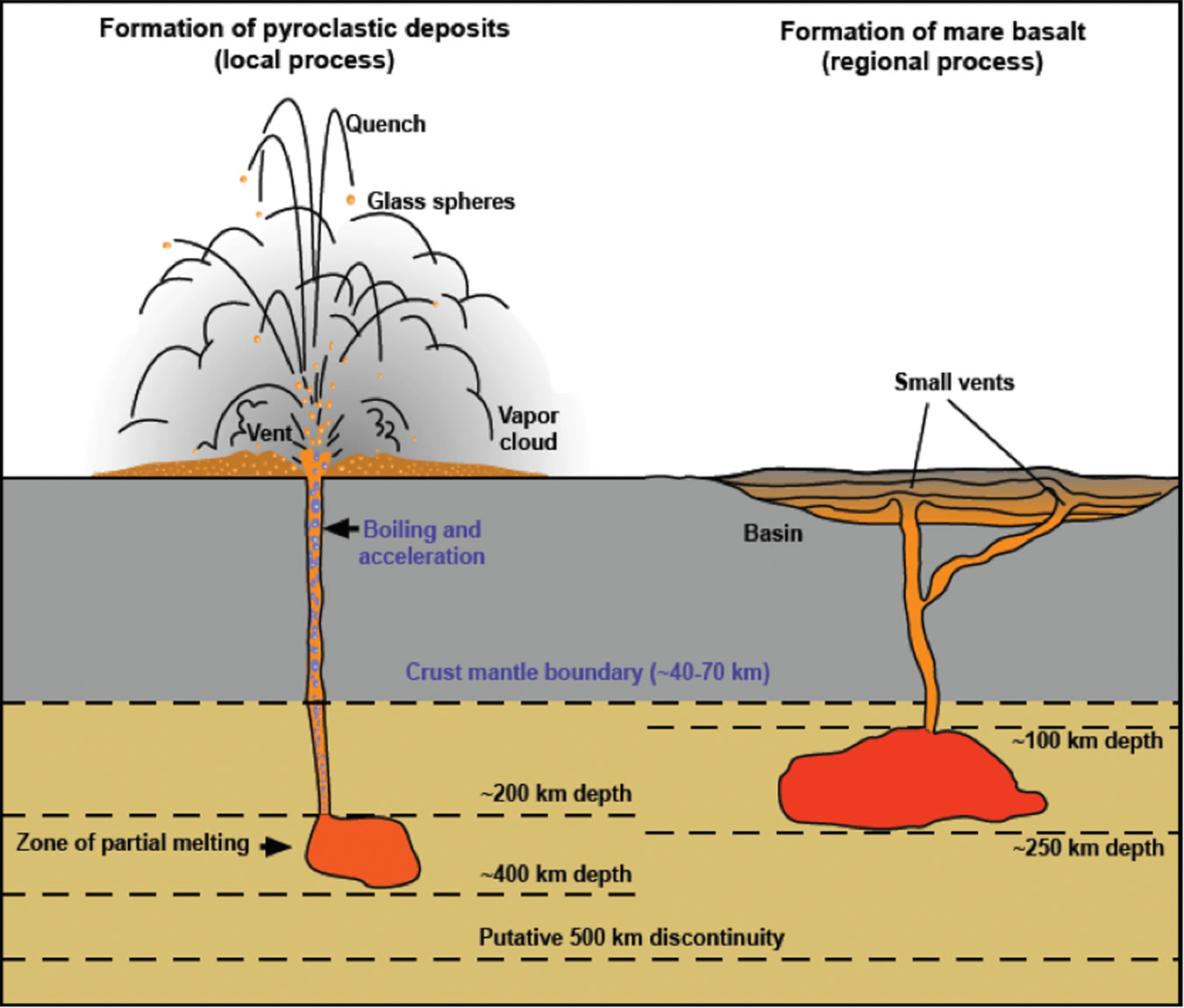
Image Quote: 
Thank You Canada.
So, perhaps carving into a body of rock like that you might not bring any solids up, but could send just Oxygen up to clear space for your habitations, presuming you had an energy source.
But of course why would you not bring Iron and other metals up to the surface to harvest energy to send down?
I am giving a guess that you could only go down perhaps 40 km before the rock pressure in the gravity would be excessive.
That is a pity as I would like to reach the cold Magma bodies themsleves.
Query: "Water from beads from fire fountains on the Moon?"
Quote:
Copilot Search Branding
Like
Dislike
Water in Lunar Fire Fountain Beads — What We Know
Water was detected in some lunar volcanic glass beads from the Apollo missions, but it is not considered the main driver of fire fountain eruptions — carbon monoxide (CO) gas is now thought to be the key volatile.Discovery of water in lunar beads
When Apollo astronauts collected samples in the 1960s–70s, they found tiny glass beads in lunar soil, formed during ancient volcanic “fire fountain” eruptions
The Economic Times
The Economic Times
. In 2008, researchers led by Alberto Saal at Brown University detected water in these beads
SpaceNews
SpaceNews
+1
. This was the first definitive evidence that the Moon was not completely devoid of volatiles, as once believed.Why water alone doesn’t explain fire fountains
Fire fountains, like those in Hawaii, require volatiles dissolved in lava that vaporize as the magma rises, expanding and blasting molten droplets into the air
SpaceNews
SpaceNews
+1
. If water had been the main driver, mineralogical signatures of hydrated phases should appear in the recovered beads — but none were found
EarthSky
EarthSky
. This means water, while present, was not the primary explosive agent.Current leading explanation: carbon monoxide
Recent high‑precision analyses of Apollo 15 and 17 glass beads, using advanced ion probe techniques, revealed significant carbon content in the lava
SpaceNews
SpaceNews
+1
. As the carbon rose, it reacted with oxygen to form carbon monoxide (CO) gas, which expanded and powered the fire fountain jets
SpaceNews
SpaceNews
+1
. This CO was the volatile responsible for spraying volcanic glass over the lunar surface.What this means for lunar water
The presence of water in some beads shows that the Moon once held volatiles, including hydrogen‑bearing compounds, but these are now gone. The water detected is trapped in the glass and does not indicate active or widespread surface water today
SpaceNews
SpaceNews
+1
. The main takeaway is that while water was present in ancient lunar magmas, CO, not water, drove the fire fountain eruptions.In short: Yes — water was found in some lunar fire fountain beads, but it was not the main explosive gas. Carbon monoxide is now recognized as the key volatile, with water being a minor, trapped component.
Query: "Carbon from beads from fire fountains on the Moon?"
Quote:
Scientists have found traces of carbon in volcanic glass collected from the Apollo missions to the Moon. The finding may not only explain the driving force behind ancient “fire fountain” eruptions on the Moon but also suggest that some volatile elements on the Moon and Earth have a common origin.
https://archive2.news.brown.edu/2007-20 … n%20origin. Quote:
Scientists have found traces of carbon in volcanic glass collected from the Apollo missions to the Moon. The finding may not only explain the driving force behind ancient “fire fountain” eruptions on the Moon but also suggest that some volatile elements on the Moon and Earth have a common origin.
So, maybe a source of Carbon. While the beads may have strongly outgassed, the "Pipe" of such a volcano, may have retained more of the CO and water due to back-pressure. (I hope).
So, maybe someday a Moon with endless tunnels and vaults down to maybe 40 km.
Ending
Last edited by Void (2026-09-20 09:57:54)
Be careful what you wish for.
Offline
Like button can go here
#30 2026-09-20 18:08:27
- Void
- Member
- Registered: 2011-12-29
- Posts: 9,985
Re: Transportation Issues and the Development of Worlds.
So, an electric vehicle method that can be similar on several worlds, should be very helpful.
I am reaching for limits on this but I am wondering about the interaction between permafrost on Mars and the speculated Ocean of water deep underground in it's crust.
https://www.bing.com/search?q=How+thick … pc=EDGEXST
Quote:
According to the U.S. Geological Survey, Mars’ mean surface temperature of about −80°C allows permafrost 1–3km thick to exist planet‑wide
https://news.berkeley.edu/2024/08/12/sc … ep-to-tap/
https://www.bing.com/search?q=Scientist … pc=EDGEXST
Quote:
A new study using seismic data from NASA’s InSight lander has revealed evidence of a huge underground reservoir of liquid water buried deep beneath Mars’ surface — enough to cover the entire planet to a depth of 1–2 km, but located 11.5–20 km (7–13 miles) below the surface
But here is the thing. If the cracked crust extends upward into the permafrost, then if moisture migrates up the cracks it may freeze shut.
But I think it may be possible to drill down to just below the permafrost and pull a vacuum and get gasses out. Perhaps Hydrogen, Helium, Methane, maybe even water vapor.
And it might be possible to force a gas into the crack structure, if it exists to store energy. Maybe compressed Nitrogen, Argon, or Oxygen, Air.
So, drilled wells might be good places for "Truck Stops" across the surface of Mars. 1/3 is supposed ot have shallow buried ice, and 2/3 does not, so this might be a way to support a network of habitation on the planet.
Ending
Last edited by Void (2026-09-20 18:36:46)
Be careful what you wish for.
Offline
Like button can go here
#31 2026-09-21 10:52:06
- Void
- Member
- Registered: 2011-12-29
- Posts: 9,985
Re: Transportation Issues and the Development of Worlds.
Venus does not directly fit into this topic, except if it could be linked to our Moon. Here is a preparation to make that link make sense.
https://newmars.com/forums/viewtopic.ph … 64#p241664
Quotes:
OK, so, I think I have figured out how to make such deliveries float in the atmosphere of Venus after aerobraking.
What if we could make "Skipper Bubbles" from stony materials, asteroids or our Moon?


We have been locked into the idea of Mass Drivers making the Moon a source of mass in space.
But what if we could have robotics on the Moon create giant bubble ships, perhaps launched with Silicon/Oxygen propulsion?
So, a Mass Driver might be a good thing as well. But in each case, it is mechanics, and energy to deliver a payload into orbits.
For the Moon, we can bypass the requirements that we do not make giant bubbles. Giant Bubbles are not suitable to launch from Earth, but the Moon does not have an atmosphere. However, Giant Bubbles may work very well to aerobrake into the atmosphere of Venus or to skip aerobrake to orbits of Venus.
The Moon seems to have the materials to do this, and Venus seems to have the materials that we might want to have in bulk on the Moon.
Giant Bubbles could be manufactured in a ship yard(s) on the Moon. IF you could build one, you might build many over and over again.
Some could simply be projected to Orbits of Earth, and converted into desired structures in orbit of Earth.
If Silicon/Oxygen propulsion is to become practical, then this may be favorable as a method even against the Mass Driver as a competive method.
Query: "Silicon Oxygen Hybrid rocket propulsion systems?"
Quote:
Copilot Search Branding
Like
Dislike
Silicon–Oxygen Hybrid Rocket Propulsion Systems
Silicon–liquid oxygen (SiLOX) hybrid rockets are a proposed in‑situ resource utilization (ISRU) propellant system that uses porous silicon as the fuel and liquid oxygen (LOX) as the oxidizer, designed for controlled combustion in space or on planetary surfaces
NASA TechPort
NASA TechPort
+1
.How SiLOX Works
In a hybrid rocket, the fuel and oxidizer are stored separately. In SiLOX, porous silicon serves as the solid fuel, and LOX is the liquid oxidizer. The silicon is hypergolic with LOX, meaning it ignites spontaneously upon contact, but NASA research shows that surface passivation (partial oxidation) can slow the reaction rate to a controlled burn
NASA TechPort
NASA TechPort
. This allows:Thrust control by regulating LOX flow
Shutdown capability by cutting LOX supply
Variable performance by adjusting burn rate for high‑thrust or efficient modes
NASA TechPort
NASA TechPort
+1
.NASA Research Highlights
Kennedy Space Center’s Center for Innovation Fund project has demonstrated:Controlled combustion of nano‑ and porous silicon in gaseous and liquid oxygen environments
NASA Technical Reports Server (NTRS)
NASA Technical Reports Server (NTRS)
.Burn rate tuning via pre‑treatment in a muffle furnace at set temperatures and durations
NASA Technical Reports Server (NTRS)
NASA Technical Reports Server (NTRS)
.Proof‑of‑concept that porous silicon can be made to burn steadily without detonation, enabling hybrid motor integration
NASA TechPort
NASA TechPort
+1
.
Advantages
According to NASA and hybrid propulsion reviews
NASA TechPort
NASA TechPort
+1
:In‑situ production from lunar regolith or other silicon‑rich bodies, reducing launch mass.
Long storage stability in vacuum (unlike silicon in air, which oxidizes).
Hybrid benefits: throttling, restart, and safe shutdown like liquid systems, with simpler handling than solids
Wikipedia
Wikipedia
+1
.Versatility: same propellant for different mission phases (launch vs. efficiency burns).
Potential ISRU integration with other lunar resource processing (e.g., CaRD, MRE)
NASA TechPort
NASA TechPort
+1
.Challenges
Burn rate control: ensuring the reaction is slow enough for stable combustion without explosion
NASA TechPort
NASA TechPort
.Material science: understanding regenerative properties and thermal stability of porous silicon discs
NASA Technical Reports Server (NTRS)
NASA Technical Reports Server (NTRS)
.System integration: designing a hybrid motor that can handle LOX flow control and silicon grain geometry.
Scaling: moving from lab‑scale to flight‑scale while maintaining performance and safety
MDPI
MDPI
.Potential Applications
Lunar Gateway refueling stations for deep‑space transit
NASA TechPort
NASA TechPort
.Mars and asteroid missions using local silicon and LOX
NASA TechPort
NASA TechPort
.Hybrid upper stages for multi‑burn missions with throttling and restart
www.web.stanford.edu
www.web.stanford.edu
.In summary: Silicon–oxygen hybrid rockets are an emerging ISRU‑enabled propulsion concept that combines the safety and controllability of hybrid systems with the potential for in‑space fuel production from abundant lunar and planetary silicon resources. NASA’s ongoing work has proven the feasibility of controlled silicon combustion with LOX, but further research is needed to address burn control, material durability, and system integration before flight demonstration
NASA TechPort
NASA TechPort
+1
https://ntrs.nasa.gov/citations/20240000517
So, a whole Moon in part dedicated to mass producing these devices.
Ending
Last edited by Void (2026-09-21 11:09:12)
Be careful what you wish for.
Offline
Like button can go here
#32 2026-09-21 13:26:03
- Void
- Member
- Registered: 2011-12-29
- Posts: 9,985
Re: Transportation Issues and the Development of Worlds.
So, if you could build "Moon Bubbles" and aerobrake them to Venus, I wonder how low you could drop the temperature by expanding the footprint?
The Numbers for Starship are said to be
Copilot Search Branding
Like
Dislike
Maximum Heat Shield Temperature for Starship
Starship’s heat shield is designed to survive re‑entry temperatures exceeding about 1,400°C (2,550°F), with the latest Version3 upgrades targeting sustained exposure up to roughly 1,500°C (2,730°F) in the hottest zones
sentinelmission.org
sentinelmission.org
+2
.Design baseline
According to SpaceX’s published TPS details, the Starship thermal protection system must withstand re‑entry temperatures over 1,400°C (2,550°F) on the windward side, where aerodynamic heating is most intense
sentinelmission.org
sentinelmission.org
+2
. This is well above the melting point of stainless steel, which is why the vehicle uses a ceramic tile system rather than relying on the hull alone.Latest upgrades
Recent Version3 Starship builds have been upgraded to handle plasma temperatures up to ~1,500°C (2,730°F)
elonbuzz.com
elonbuzz.com
+1
. This increase comes from:Full tile coverage with strategic reinforcements in high‑heat zones.
Optimized tile materials (toughened silica ceramics, similar to the Shuttle’s tiles but adapted for Starship’s size and reuse model)
starship-spacex.fandom.com
starship-spacex.fandom.com
.Flight‑tested resilience — earlier flights deliberately removed tiles to stress‑test the system, confirming that the stainless steel hull can survive brief direct plasma exposure if protected elsewhere
elonbuzz.com
elonbuzz.com
.How it works
The heat shield uses thousands of hexagonal ceramic tiles mounted on a stainless steel frame. These tiles:Have low thermal conductivity to slow heat transfer to the hull
sentinelmission.org
sentinelmission.org
.Are porous and black‑coated to radiate heat away
starship-spacex.fandom.com
starship-spacex.fandom.com
.Can be quickly replaced between flights, supporting rapid reusability
sentinelmission.org
sentinelmission.org
+1
.
Summary table
Source Max temperature cited
NotesSpaceX TPS docs
sentinelmission.org
sentinelmission.org
+1
>1,400°C (2,550°F)
Baseline design for orbital re‑entryV3 upgrade reports
elonbuzz.com
elonbuzz.com
+1
~1,500°C (2,730°F)
Latest optimized system, with reinforcementsIn short: Starship’s heat shield is engineered to endure at least 1,400°C, with the newest builds aiming for ~1,500°C in the most extreme re‑entry zones, ensuring survival under the harshest plasma conditions while maintaining rapid reusability
sentinelmission.org
sentinelmission.org
+3
.
How Thick is Starship?
Partial Quote:
Measured thickness
SN1 prototype: 3.97mm (≈0.156in) stainless steel plate
.General design: Around 3mm in many areas
Chimniii
Chimniii
.
This is roughly half the thickness of a modern smartphone, but made of solid stainless steel, making it far stronger than composites of similar thickness.
Melting point of Low Carbon Steel:
Copilot Search Branding
Like
Dislike
The melting point of low carbon steel is approximately 1410–1450°C (2570–2640°F).
Low carbon steel, also known as mild steel, typically contains 0.05–0.3% carbon by weight, along with small amounts of manganese, silicon, and copper, which slightly influence its thermal properties
mststeel.com
mststeel.com
+1
. Unlike pure iron, which melts sharply at 1538°C, low carbon steel exhibits a melting range rather than a single point due to its multi-element composition
sincere-machining.com
sincere-machining.com
. The solidus (beginning of melting) is around 1410°C, while the liquidus (complete melting) can reach 1450°C, depending on the exact carbon content and trace alloying elements
Material Properties
Material Properties
+1
.Factors Affecting Melting Point
Carbon Content: Higher carbon content generally lowers the melting temperature slightly, so low carbon steel melts at a higher temperature than medium or high carbon steels
World Material
World Material
.
Alloying Elements: Elements like manganese, silicon, and copper can shift the melting range by tens of degrees
mststeel.com
mststeel.com
.
Impurities and Manufacturing: Variations in impurities and processing methods can also affect the precise melting behavior
partsproto.com
partsproto.com
.
Practical Implications
The moderate melting point of low carbon steel makes it easier to process in applications such as welding, casting, and forging. Its combination of malleability, ductility, and cost-effectiveness is why it is widely used in construction, automotive body panels, structural components, and CNC-fabricated parts
partsproto.com
partsproto.com
. Understanding the melting range is crucial for furnace temperature control and avoiding unintended liquation during heat treatment or welding
sincere-machining.com
sincere-machining.com
.
So, a bubble might not have to hold pressures like 6 bar and may not have to itself work with cryogenic liquids.
Perhaps it can be thinner. You might wrap it in some sort of Ceramic fabric as a heat sheild though.
If it's inertia per surface area were lower, then peak heating may be less.
Although I will admit I have not addressed the entry speed to Venus which could be high. But a skimmer, might make several passes before settling into an orbit or dipping into the cloud level atmosphere.
So, repeated skimming, might be the key to make it work. If you could keep Low Carbon Steel from melting/buckling maybe you could do it.
Aluminum would be harder, I expect you would need more heat shield and perhaps more skimming events.
So, maybe.
Ending
Last edited by Void (2026-09-21 13:43:29)
Be careful what you wish for.
Offline
Like button can go here
#33 2026-09-21 15:11:11
- Void
- Member
- Registered: 2011-12-29
- Posts: 9,985
Re: Transportation Issues and the Development of Worlds.
In light of new claims that Sulfuric Acid on Venus may be fairly diluted, I am trying to look at the idea of assets that float in the atmosphere of Venus in a newer way.
Query: "Plastic tolerant of Sulfuric Acid?"
Quote:
Copilot Search Branding
Like
Dislike
Plastics Tolerant of Sulfuric Acid
Several plastics — especially polyolefins (HDPE, PP), PTFE, and some high‑performance polymers — are highly tolerant of sulfuric acid, with PTFE offering the best overall resistance across concentrations and temperatures
chemicalresistance.org
chemicalresistance.org
+1
.Best‑Performing Materials
According to chemical resistance charts and industry data
chemicalresistance.org
chemicalresistance.org
+1
:PTFE (Teflon) – Excellent resistance (Rating A) to most sulfuric acid concentrations, even at elevated temperatures. Suitable for long‑term contact
chemicalresistance.org
chemicalresistance.org
.HDPE (High‑Density Polyethylene) – Excellent resistance to sulfuric acid up to ~40% concentration; good for many industrial uses
chemicalresistance.org
chemicalresistance.org
+1
.PP (Polypropylene) – Excellent resistance to sulfuric acid, including concentrated forms
chemicalresistance.org
chemicalresistance.org
+1
.PVDF (Polyvinylidene fluoride) – Good to excellent resistance depending on concentration and temperature
chemicalresistance.org
chemicalresistance.org
.PEEK (Polyether ether ketone) – Good resistance, especially in high‑temperature applications
shunpoly.com
shunpoly.com
.Materials to Avoid
Nylons (PA), acetals (POM), polycarbonates, and many other engineering plastics are not recommended for sulfuric acid exposure — they can degrade, swell, or lose mechanical strength
chemicalresistance.org
chemicalresistance.org
+1
.Key Factors Affecting Compatibility
Concentration: Resistance can drop sharply with higher acid strength (e.g., 98% vs. 20%)
chemicalresistance.org
chemicalresistance.org
.Temperature: Higher temperatures generally reduce resistance; PTFE remains stable up to ~260°C, but other plastics may soften or degrade
chemicalresistance.org
chemicalresistance.org
.Exposure time: Short contact may be safe for borderline materials, but prolonged exposure increases risk
chemcafe.net
chemcafe.net
.Mechanical load: Stress can accelerate degradation in some plastics
Curbell Plastics
Curbell Plastics
.Practical Guidance
For general‑purpose, moderate concentrations: HDPE or PP are cost‑effective and durable.For harsh, concentrated, or high‑temperature service: PTFE is the most reliable choice.
Always confirm with the material supplier’s chemical resistance chart for your exact concentration, temperature, and exposure time
chemicalresistance.org
chemicalresistance.org
+1
.Example: A 40% sulfuric acid storage tank at 20°C can be made from HDPE or PP with excellent performance; for 98% acid at elevated temperature, PTFE is recommende
It seems like PEEK might be a good one.
https://en.wikipedia.org/wiki/Polyether_ether_ketone
I am wondering if you could have a cylinder of it that might work like a rain suit for interior structures?
This is wishing far more than being realistic but you have to start somewhere: 
https://en.wikipedia.org/wiki/Atmosphere_of_Venus
Image Quote: 
4009 seems to convert to about 126.85 C at perhaps 5 bar?
So, 10 bar is hotter.
Anyway, at the base of the clouds Sulfuric Acid is supposed to convert into Water Vapor and SO3?
The machine is a big ask for sure. The idea is though that it could have power from differential wind speeds, and also vertical thermal temperature differences.
I am imagining that a spacecraft floating at a 5 bar or more pressure might be conducted into the lower chamber which might contain dried Venus Atmopshere.
Yes, lots of way to go wrong with this but find the wrongs and you might be able to right them.
Ending
This post is appropriate for this topic if our Moon could be linked iconically with Venus, as to exchange materials.
Ending Pending
Last edited by Void (2026-09-21 15:56:01)
Be careful what you wish for.
Offline
Like button can go here
#34 2026-09-21 18:36:03
- Void
- Member
- Registered: 2011-12-29
- Posts: 9,985
Re: Transportation Issues and the Development of Worlds.
So, if it were practical to get Carbon and Nitrogen from Venus, and to transport to the Moon, from the Moon to Venus, perhaps metal and silica bubbles to air brake to orbit or into the atmosphere.
The sourcing of Carbon and Nitrogen from Venus might not even require cloud cities. If you could send Moon Bubbles to Venus, and have Rotavators that could dip into the atmosphere of Venus perhaps that would be sufficient.
As for the Moon, I suppose that the two main metals would be Iron and Aluminum. Iron probably requires Carbon to become Steel.
Copilot is spewing nonsense when I mention Rotavators for Venus.
So, I will resort to this again: https://www.bing.com/videos/riverview/r … &FORM=VIRE Quote:
Skyhooks & Rotovators
Pause...........
If you can get Carbon to the orbits of Venus: "Can you make a solar sail primarily from Carbon?"
Quote:
Copilot Search Branding
Like
Dislike
Making a Solar Sail Primarily from Carbon
Yes — a solar sail can be made primarily from carbon-based materials, such as carbon nanotube membranes or carbon fiber composites, and these are actively researched for ultra‑light, high‑reflectivity sails
IntechOpen
IntechOpen
+1
.Why carbon is promising
Solar sails need to be extremely lightweight, strong, and highly reflective to maximize thrust from sunlight’s radiation pressure
Wikipedia
Wikipedia
+1
. Carbon offers two main advantages:Low density and high strength — carbon fiber composites and carbon nanotubes (CNTs) have very high tensile strength-to-weight ratios, allowing ultra‑thin membranes that can withstand launch stresses
IntechOpen
IntechOpen
+1
.Potential for high reflectivity — CNT membranes can be engineered to reflect sunlight efficiently while remaining extremely thin
IntechOpen
IntechOpen
.Examples in research and development
Carbon nanotube membranes — Studies have proposed CNT-based sails that could achieve cruising speeds of a few thousandths of the speed of light, thanks to their ultra‑light, reflective properties
IntechOpen
IntechOpen
. These are still experimental, but they demonstrate that carbon nanostructures can meet the performance goals of solar sails.NASA’s Advanced Composite Solar Sail System (ACS3) — This mission uses carbon fiber and polymer composites for its booms and structural elements, which are lighter and stiffer than traditional metals
American Composites Manufacturers Association (ACMA)
American Composites Manufacturers Association (ACMA)
. While the sail itself is a multi‑material composite, the carbon fiber content is significant and contributes to the lightweight, durable design.Practical considerations
Fabrication — Producing large, defect‑free carbon membranes (especially CNTs) is challenging. Current technology can make small‑scale samples, but scaling to multi‑meter or kilometer‑scale sails requires advances in manufacturing and deployment mechanisms
IntechOpen
IntechOpen
.Reflectivity — Carbon alone is not highly reflective; it must be coated or structured (e.g., with a reflective layer) to meet solar sail optical requirements
Wikipedia
Wikipedia
+1
.Durability — The sail must survive extreme temperature swings, micrometeoroid impacts, and radiation in space. Carbon composites can be engineered for this, but testing is essential
American Composites Manufacturers Association (ACMA)
American Composites Manufacturers Association (ACMA)
.
Conclusion
A carbon‑primary solar sail is technically feasible in principle, and carbon nanotube membranes are a leading research direction for ultra‑light, high‑performance sails
IntechOpen
IntechOpen
. However, no large‑scale, fully carbon‑only solar sail has yet been flown; current operational sails use aluminized polyimide or similar films, with carbon composites mainly in structural components
Wikipedia
Wikipedia
+2
. Advances in CNT fabrication, reflective coatings, and deployment systems would be needed before a purely carbon sail becomes a routine mission asset.
So, if you can solve how to extract Carbon from Venus, and can make solar sails from Carbon, then you have a method to deliver Carbon and perhaps some other materials to the Earth/Moon.
I will argue that since Carbon is the primary Cargo, the highest quality of solar sail is perhaps not the most important objective.
Good enough to react Earth/Moon is possibly "Good Enough".
If a rotavator can snatch atmosphere from Venus, then the hope would be to obtain Carbon Dioxide and Nitrogen. To keep the rotavators in orbit, perhaps electric propulsion might do. A method to expel Oxygen and perhaps some Nitrogen might work. But if necessary, hard mass from the Moon might also be used in certain Metal>Plasma Drives.
So, I am thinking that "Venus Bubbles" manufactured on the Moon might be lifted to orbit and onto a path to Venus, using a Silicon/Lox method.
If Metal>Plasma drives such as the Neumann Drive and Magdrive become more sized up and practical, then Metal>Plasma drives might take over in moving the "Venus Bubbles" from Earth/Moon to Venus intercept for Aerobraking.
A main body of a "Venus Bubble" might serve as a radiator for a heat engine perhaps if a Metal>Plasma drive was to escort it to Venus.
You would need a mirror assembly also for your heat engine.
Possibly the engine that lifted the device off of the Moon would become propellants for the Metal>Plasma drive. But you might need more metal as well.
Optimistically the Metal>Plasma drives might be 10 to 30 times as efficient for propellant as are combustion propulsion methods. (Just guessing about ISP).
So, you might have mass ship building yards on the Moon to make these things.
When arriving at Venus you have to use the surfaces of the bubbles and mirrors to aerobrake perhaps using several passes.
Then if in orbit of Venus, metal's Silicon, and Carbon might be used to make habitats.
Nitrogen and Oxygen may be available to fill them, from snatched Venus Atmosphere.
So, this may be one path into the solar system along side of othere.
Ending
Although Neuman Drive may have more ISP, Magdrive looks more likely to be able to size up to what is needed for what I have suggested.
https://magdrive.space/
Paladin appears to be their biggest thruster so far: https://magdrive.space/products/paladin/
So not the same specs as a Xenon Ion Rocket:
Copilot Search Branding
Like
Dislike
Specific Impulse of a Xenon Ion Engine
A typical xenon ion engine has a specific impulse (Isp) in the range of about 2,000–5,000 seconds, with real-world missions like NASA’s Dawn achieving ~4,200s in vacuum
Wikipedia
Wikipedia
+1
.How it’s defined
Specific impulse (Isp) is a measure of propulsion efficiency: the ratio of thrust to propellant mass flow rate. It’s expressed in seconds and is equivalent to the effective exhaust velocity divided by standard gravity
Wikipedia
Wikipedia
. Higher Isp means less propellant is needed for a given Δv.Real-world xenon ion thrusters
NASA Dawn spacecraft: Each of its three ion engines, using xenon propellant, has an Isp of about 4,200s in vacuum
wiki.kerbalspaceprogram.com
wiki.kerbalspaceprogram.com
+1
. This is far higher than chemical rockets (typically 250–450s) but produces very low thrust (≈91mN per engine at max)
Science Mission Directorate
Science Mission Directorate
.General ion thrusters: Most operational ion engines operate at 2,000–5,000s Isp depending on design and operating conditions
Wikipedia
Wikipedia
.Example: The NSTAR thruster on Deep Space 1 had an Isp of ~3,100s
Wikipedia
Wikipedia
.Why xenon?
Xenon is the most common propellant for ion thrusters because it is:Easily ionized and has a high atomic mass, giving good thrust for the same ion beam current
NASA
NASA
.Inert and densely storable in compact tanks
NASA
NASA
+1
.
Summary table
Engine / Mission Propellant Isp (vacuum)
Thrust (max)NASA Dawn Xenon ~4,200s
~91mN/engine
Science Mission Directorate
Science Mission DirectorateNSTAR (Deep Space 1) Xenon ~3,100s
~90mN
Wikipedia
WikipediaTypical ion thruster Xenon 2,000–5,000s
25–250mN
Wikipedia
WikipediaIn short: A xenon ion engine’s Isp is typically ~4,200s for Dawn-class systems, with general designs ranging from 2,000 to 5,000s, making them far more fuel-efficient than chemical rockets but with much lower thrust
wiki.kerbalspaceprogram.com
wiki.kerbalspaceprogram.com
+2
.
But you can't get much Xenon from the Moon.
So, the thrust of the Dawn Engines: "Thrust of the Ion Engine of the Dawn Spacecraft?"
Quote:
Copilot Search Branding
Like
Dislike
Each Dawn ion engine produces a maximum thrust of about 91 millinewtons (0.091 N), with a throttle range from roughly 19 to 91 millinewtons depending on power level.
Detailed Explanation
Thrust Range
NASA documentation states that each of Dawn’s three NSTAR ion thrusters can generate 91 millinewtons at maximum power.
NASA
NASA
Additional spacecraft specifications list the thrust range as 0.07 to 0.33 ounces, which converts to 19–91 millinewtons.
NASA
NASA
How the Engine Produces Thrust
The thrusters accelerate xenon ions using electric fields, achieving exhaust velocities far higher than chemical rockets.
Despite the small thrust, continuous operation over thousands of hours produces large cumulative velocity changes.
Mission Context
Dawn used its ion engines for more than 2,000 days of thrusting during its mission to Vesta and Ceres.
NASA
NASA
This long-duration, low-thrust propulsion enabled Dawn to become the first spacecraft to orbit two extraterrestrial bodies.
The Dawn ion propulsion system remains one of the most efficient deep-space propulsion systems ever flown.
So, if I read it correctly the Paladin by Magdrive has several times more thrust 10x or 11x, but is not nearly as efficient with mass.
So I thought that Copper, Iron, and Aluminum were the only propellants for Magdrive, but: https://newatlas.com/space/super-magdri … etal-fuel/
Quote:
Astronautical engineers at Magdrive have developed a unique plasma thruster for use in space that's capable of using nearly any metal type as the fuel source, which means spacecraft would not have to return to Earth for refueling. Instead, comets, asteroids, moons or anything else floating in the vast expanses of space can simply be harvested for their metal contents to be used as fuel.
Ending
Last edited by Void (2026-09-21 19:52:04)
Be careful what you wish for.
Offline
Like button can go here
#35 2026-09-21 19:54:25
- Void
- Member
- Registered: 2011-12-29
- Posts: 9,985
Re: Transportation Issues and the Development of Worlds.
While I made a case for Venus<>Moon economics, in the just previous post, I might mention that Phobos and Deimos may have Carbon and Mars surely does.
Giant ships manufactured on the Moon could aerobrake at Mars, but it would be very tricky as Dr. Johnson has indicated.
Ending
Be careful what you wish for.
Offline
Like button can go here
#36 2026-09-22 09:17:52
- Void
- Member
- Registered: 2011-12-29
- Posts: 9,985
Re: Transportation Issues and the Development of Worlds.
So, complementary objects other than Vanus would be Bennu, Ryugu, Mars, maybe Phobos and Deimos, and Carbonaceous type asteroids.
Three main propulsion methods to bring materials to the Moon would be:
1) Carbon Solar Sails.
2) Silicon/Oxygen Propulsion.
3) Metal>Plasma Propulsion.
Query: "How solar sails can fly towards the sun?"
Quote:
Copilot Search Branding
Like
Dislike
How Solar Sails Can Fly Toward the Sun
A solar sail can move toward the Sun by “tacking” — angling its reflective surface so that sunlight’s pressure pushes it in the desired direction, much like a sailboat tacks against the wind
space.sciencearray.com
space.sciencearray.com
+1
.The Physics
Sunlight consists of photons, which have no mass but carry momentum. When photons hit a reflective sail, they bounce off and transfer momentum twice — once on impact and once on reflection — producing a tiny but continuous thrust perpendicular to the sail’s surface
scienceinsights.org
scienceinsights.org
+1
. At Earth’s distance, a perfectly reflective sail feels about 9 micronewtons per square meter of pressure
space.sciencearray.com
space.sciencearray.com
. This is extremely small, but in the vacuum of space, even that tiny force can accelerate a spacecraft for months or years without fuel.Why You Can’t Point Directly at the Sun
The thrust always pushes perpendicular to the sail’s surface, not directly along the Sun–spacecraft line
space.sciencearray.com
space.sciencearray.com
. If the sail faces the Sun head‑on, the push is directly away from the Sun. To move toward the Sun, the sail must be tilted so that the perpendicular push has a component pointing inward. This is the same principle as a sailboat tacking into the wind: you can’t sail directly into the wind, but by angling the sail, you can make progress toward your goal
space.sciencearray.com
space.sciencearray.com
+1
.Tacking Toward the Sun
By adjusting the sail’s angle, a spacecraft can:Trade thrust magnitude for direction — tilt the sail to redirect the push toward the Sun.
Spiral inward — combine inward thrust with orbital mechanics to gradually reduce the spacecraft’s distance from the Sun
space.sciencearray.com
space.sciencearray.com
.Maintain a non‑Keplerian orbit — use continuous thrust to balance gravity and stay in a stable, close‑in path
NASA
NASA
.Missions like IKAROS (2010) and LightSail‑2 (2019) have demonstrated this by steering the sail to change orbits and even move toward the Sun
Wikipedia
Wikipedia
+1
.Key Points
No fuel needed — thrust comes from sunlight alone
Wikipedia
Wikipedia
+1
.Continuous acceleration — as long as sunlight hits the sail, the spacecraft keeps gaining speed
The Planetary Society
The Planetary Society
.Steering by angle — the sail’s tilt determines the direction of the push, enabling inward travel
space.sciencearray.com
space.sciencearray.com
+1
.In short, a solar sail can “fly toward the Sun” by angling its reflective surface so that the perpendicular push from sunlight has an inward component, using a tacking maneuver similar to sailing against the wind
space.sciencearray.com
space.sciencearray.com
+1
.
I have always had trouble understanding this but I will expect to believe what those better than me will council on this.
So, if we are fortunate and Phobos and Demos have Carbon, then a flyback export method to the orbits of the Earth/Moon may be practical.
But perhaps it will be possible to get Nitrogen from places like Mars or Ceres to also bring back.
Query: "Can Nitrogen be in a compound including Carbon?"
Quote:
Copilot Search Branding
Like
Dislike
Nitrogen and carbon compounds are organic molecules containing carbon-nitrogen bonds, including amines, nitriles, imines, and nitro compounds, with diverse chemical properties and applications.
Overview of Carbon-Nitrogen Bonds
A carbon–nitrogen (C–N) bond is a covalent bond between carbon and nitrogen, one of the most common bonds in organic chemistry and biochemistry. Nitrogen has five valence electrons, typically forming three bonds and retaining a lone pair, which can make it basic in some compounds. C–N bonds can exist as single, double, or triple bonds, as seen in amines, imines, and nitriles, respectively. The bond is polarized toward nitrogen due to its higher electronegativity, often resulting in water-soluble compounds with significant dipole moments
Wikipedia
Wikipedia
.Types of Nitrogen-Containing Carbon Compounds
Amines
Amines are derivatives of ammonia where one or more hydrogen atoms are replaced by alkyl or aryl groups. They are classified as primary (1°), secondary (2°), or tertiary (3°) depending on the number of carbon groups attached to nitrogen. Amines are generally basic due to the lone pair on nitrogen and are widely used in pharmaceuticals, dyes, and agrochemicals
The National Institute of Open Schooling (NIOS)
The National Institute of Open Schooling (NIOS)
.
Nitriles
Nitriles contain a carbon triple-bonded to nitrogen (–C≡N). They are polar, often water-soluble, and serve as intermediates in organic synthesis. Cyanogen ((CN)₂) is the simplest carbon-nitrogen compound and is considered a pseudo-halogen due to its reactivity
libretexts.org
libretexts.org
.
Imines
Imines have a carbon-nitrogen double bond (C=NH or C=NR). They are formed by the condensation of amines with carbonyl compounds and are important intermediates in organic reactions
libretexts.org
libretexts.org
+1
.
Nitro Compounds
Nitro compounds contain one or more nitro groups (–NO₂) attached to carbon. They are highly polar and often explosive due to the release of nitrogen gas upon decomposition. Common examples include TNT (trinitrotoluene) and picric acid. Nitro compounds are used in explosives, dyes, and pharmaceuticals
scienceinfo.com
scienceinfo.com
.
Applications and Significance
Nitrogen-containing carbon compounds are essential in biochemistry, industry, and daily life. They form the backbone of proteins, alkaloids, and nucleic acids, and are used in fertilizers, drugs, dyes, and explosives. Their chemical versatility arises from the ability of nitrogen to form multiple bond types and participate in resonance, hydrogen bonding, and acid-base reactions
The National Institute of Open Schooling (NIOS)
The National Institute of Open Schooling (NIOS)
+1
.Summary
In essence, carbon-nitrogen compounds are a diverse class of organic molecules with significant chemical and biological importance. Their properties depend on the type of C–N bond and the functional groups attached, making them crucial in both natural and synthetic chemistry
So, the answer seems to be yes, things like Nitrogen, Hydrogen, and Oxygen can be woven into parts of a sail, I expect.
Alternately I suppose a sail could tow a tank of Ammonia.
Upon arrival to the Earth/Moon orbits, perhaps propulsions like Silicon/Oxygen and Metal>Plasma may assist in bringing the substances of the sails down to the surface of the Moon in some manner.
So, from my point of view, with robotic/Organic solar sails, the value of the Moon can be upgraded vastly. We also have the possibility of dispersing substances to stony asteroids that are already in orbits that cross terrestrial planets.
And then making bubble ships that could aerobrake to orbits of Venus or into the Clouds of Venus.
If Carbon/Nitrogen/Hydrogen are too hard to get from Venus itself then Robotic/Organic sails might bring it to Venus Orbits.
So, habitation of Venus Orbits may be practical even before extraction of substances from Venus to orbits becomes practical.
You might imagine factories to manufacture Robotic/Organic Sails, in the outer Asteroid Belt, primarily of Carbon maybe with bits of other things like Nitrogen. Then set to sail themselves to a place of need.
Acceleration of such loads may require a great deal of patience, but maybe some auxiliary initial push would start them on their way to greater amounts sunlight for propulsion.
So, I think that the association of various inner worlds and Asteroids, may be economically viable.
As for the Moon the landing of Carbon using Silicon/Oxygen may be practical, but If you could use rotavators, then dropping Carbon down to the surface would provide energy to lift materials to orbit.
Not sure if that is a needed method but it could be made to exist.
Ending
Last edited by Void (2026-09-22 09:45:12)
Be careful what you wish for.
Offline
Like button can go here
#37 2026-09-22 10:11:55
- Void
- Member
- Registered: 2011-12-29
- Posts: 9,985
Re: Transportation Issues and the Development of Worlds.
In the last few posts in this topic, I have been dealing with the idea of Carbon dominant solar sails for the purpose of interplanetary commerce to distribute substances to needed locations.
I decided to ask about Carbon on Ceres.
Query: "How Much Carbon may be in the Dwarf Planet Ceres?"
Quote:
Copilot Search Branding
Like
Dislike
Carbon Content in Dwarf Planet Ceres
NASA’s Dawn spacecraft data indicate that Ceres’ near‑surface material may contain up to about 20% carbon by mass — more than five times the carbon content of the most carbon‑rich meteorites found on Earth
Astronomy Magazine
Astronomy Magazine
+1
.What the data show
A team led by the Southwest Research Institute (SwRI) analyzed Dawn’s Visible and Infrared Mapping Spectrometer (VIR) and Gamma Ray and Neutron Detector (GRND) data. These instruments revealed:Up to ~20% carbon by mass in the near‑surface regolith
Astronomy Magazine
Astronomy Magazine
+2
.Carbon is present in multiple forms, including amorphous carbon (a carbon‑rich organic material) and carbon‑bearing minerals such as carbonates
Astronomy Magazine
Astronomy Magazine
+1
.Carbon‑rich compounds are mixed with products of rock–water interactions like clays and carbonates, suggesting past aqueous chemistry
Astronomy Magazine
Astronomy Magazine
+1
.How this compares to other bodies
The most carbon‑rich primitive meteorites on Earth (carbonaceous chondrites) typically have ~5–10% carbon by mass. Ceres’ surface carbon content is therefore several times higher
Astronomy Magazine
Astronomy Magazine
+1
.This makes Ceres one of the most carbon‑rich known inner solar system bodies
Astronomy Magazine
Astronomy Magazine
.Why it matters
The high carbon content supports the idea that Ceres formed in a cold, volatile‑rich environment (possibly beyond Jupiter’s orbit) and later migrated into the asteroid belt
Southwest Research Institute
Southwest Research Institute
+1
. The presence of organics has implications for:Planetary chemistry — Ceres may have acted as a “chemical factory” for organic compounds
Astronomy Magazine
Astronomy Magazine
.Astrobiology — Organic material could have been transported between bodies, influencing the distribution of life’s building blocks in the solar system
Astronomy Magazine
Astronomy Magazine
+1
.
Summary
Based on Dawn mission data, Ceres’ near‑surface material may contain as much as 20% carbon by mass, far exceeding Earth’s most carbon‑rich meteorites and marking it as an exceptionally carbon‑rich dwarf planet
Astronomy Magazine
Astronomy Magazine
+2
.
So, I am not sure that it is truly 20% but it must be a lot.
Query: "How Many Asteroids are Carbonaceous?"
Quote:
Copilot Search Branding
Like
Dislike
How Many Asteroids Are Carbonaceous?
About 75% of all known asteroids are carbonaceous (C‑type), making them the most common asteroid class
Wikipedia
Wikipedia
+1
.What “carbonaceous” means
Carbonaceous asteroids, also called C‑type asteroids, are dark, volatile‑rich bodies rich in carbon, clay, and silicate minerals, often containing hydrated (water‑bearing) minerals
Wikipedia
Wikipedia
+1
. They are considered among the most primitive remnants of the early solar system.How many there are
Overall proportion: C‑type asteroids make up around 75% of all known asteroids
Wikipedia
Wikipedia
+1
.In the main asteroid belt: About 80% of asteroids in the outer main belt are C‑type, but only ~40% of those in the inner belt (around 2 AU from the Sun) are C‑type
Wikipedia
Wikipedia
.Total known asteroids: With roughly 1 million asteroids identified so far
Wikipedia
Wikipedia
, that means hundreds of thousands are carbonaceous.Why they’re common
C‑type asteroids formed farther from the Sun, where it was cooler and volatiles like water and carbon could survive. This makes them more abundant in the outer main belt and less so closer to the Sun
Wikipedia
Wikipedia
+1
.In short: If you pick a random asteroid from the known population, there’s about a 3‑in‑4 chance it’s carbonaceous.
So, while previously imagination valued the thought of water from the Asteroid belt and maybe metals, Carbon can be our best friend, I think.
Carbon based Robot/Sails, could pump enormous amounts of Carbon to the proximity of our Moon being propelled by photons.
Other substances organic or metallic may come along for the ride.
Various "Kick" methods might set these sails in motion. Perhaps a Mass Driver system for instance or a tether that slings them towards the sun. Such a tether system might rotate being driven by Ion Propulsion.
If massive volumes of Carbon can be delivered to the Moon, a method to land the Carbon might be a tether release. To drop it near surface and drop to impact. The energy gained by this method could allow the lifting of Moon materials.
If such volumes of Carbon could be delivered, we could consider engines that burn CO or even Carbon in Oxygen, as a method of traveling up and down Moon<>Orbits.
So, I think we might like this. It is possible that before the Asteroid belt Deimos/Phobos/Mars could be a source of Carbon/Robot/Sails.
But the Asteroid belt is a vast reservoir of Carbon.
Ending
This may be favorable the notions of this post: https://www.intechopen.com/chapters/10009
Quote:
Carbon Nanotube Membrane Solar Sails A Challenge for Extremely Fast Space Flight
Written BySalvatore Santoli
Published: 01 March 2010DOI: 10.5772/39445
I think it is important to emphasize that with a Carbon solar sail primarily for the delivery of the Carbon, the Cargo is a "Working Cargo".
That is going to be rather efficient for the purpose of delivering Carbon to needed locations.
Ending
Last edited by Void (2026-09-22 10:39:56)
Be careful what you wish for.
Offline
Like button can go here
#38 2026-09-22 15:15:26
- Void
- Member
- Registered: 2011-12-29
- Posts: 9,985
Re: Transportation Issues and the Development of Worlds.
Further listing of materials to make solar sails: "Substances that Solar Sails can be made of?"
Quote:
Copilot Search Branding
Like
Dislike
Solar sails are made from ultrathin, lightweight reflective films such as Mylar or polyimide coated with metallic layers, supported by strong, lightweight composite booms.
Sail Surface Materials
The main component of a solar sail is its reflective surface, which captures the momentum of photons from sunlight to generate thrust. Common materials include Mylar or polyimide films, which are extremely thin—LightSail-2, for example, uses Mylar just 4.5 microns thick—making them lightweight yet durable in space conditions
The Planetary Society
The Planetary Society
+1
. These films are typically coated with a thin metallic layer, usually aluminum, to enhance reflectivity and maximize the force generated by photon impacts
ithy.com
ithy.com
+1
. Advanced designs aim for minimal areal density, sometimes as low as 0.02 g/m², to improve efficiency
ithy.com
ithy.com
.Structural Support Materials
To maintain the sail’s shape and enable deployment, solar sails use lightweight, rigid support structures. Modern spacecraft employ composite booms made from polymers reinforced with carbon fiber, which are flexible for stowage but stiff and resistant to bending or thermal distortion once deployed
NASA
NASA
+1
. These booms can be rolled or coiled for compact storage and then extended in space, similar to tape measures, providing both strength and low mass
The Planetary Society
The Planetary Society
+1
.Examples from Missions
LightSail-2: Uses four triangular Mylar sails with aluminum coating, deployed by cobalt alloy booms, covering a total area of 32 m²
The Planetary Society
The Planetary Society
.
ACS3 (Advanced Composite Solar Sail System): Employs composite polymer-carbon fiber booms and a 9-meter square sail, demonstrating lightweight, thermally stable deployment in orbit
NASA
NASA
.
Additional Considerations
Solar sail materials must withstand extreme temperatures, radiation, and micrometeoroid impacts while remaining highly reflective and lightweight. Some experimental concepts explore nanomaterials or diffractive gratings to improve thrust control, though these are less mature than reflective films
Wikipedia
Wikipedia
+1
.
In summary, solar sails combine ultrathin reflective films for photon capture with advanced composite structures for deployment and stability, balancing minimal mass with durability to enable long-duration propulsion in space.
Quote of the above quote:
Solar sails are made from ultrathin, lightweight reflective films such as Mylar or polyimide coated with metallic layers, supported by strong, lightweight composite booms.
https://en.wikipedia.org/wiki/Mylar
Image Quote: 
https://en.wikipedia.org/wiki/Polyimide
Image Quote: 
Image Quote: 
And then there can be more parts made only of Carbon.
So, if it is presumed that Ceres will be inhabited by humans and machines, the molecules of these substances could be delivered to our Moon and other relatively needy worlds such as stony asteroids.
There may be other asteroids and worlds that would be suitable but starting with a world like Ceres that we know a lot about, seems like a good plan.
Here is a useful query: "Colonizing Ceres?"
Response: https://www.bing.com/search?q=Colonizin … pc=EDGEXST
It does not hurt to look at other peoples work.
Ending
Last edited by Void (2026-09-22 15:32:09)
Be careful what you wish for.
Offline
Like button can go here
#39 2026-09-22 18:20:29
- Void
- Member
- Registered: 2011-12-29
- Posts: 9,985
Re: Transportation Issues and the Development of Worlds.
Here is a reason why we might want a Carbon source for the Moon.
Query: "Should there be platinum family metals on the Moon from asteroids?"
Quote:
Copilot Search Branding
Like
Dislike
Platinum‑Group Metals from Asteroids on the Moon
Yes — recent research suggests that thousands of lunar craters could contain platinum‑group metals (PGMs) delivered by asteroid impacts, potentially worth trillions of dollars, and may be more accessible to mine than many near‑Earth asteroids
ScienceAlert
ScienceAlert
+2
.Scientific findings
A 2025 study led by independent astronomer Jayanth Chennamangalam surveyed lunar impact craters and found that about 6,500 craters larger than 1km may have been created by metallic asteroids rich in PGMs such as platinum, palladium, rhodium, ruthenium, iridium, and osmium
ScienceAlert
ScienceAlert
+2
.These values are 1–2 orders of magnitude larger than the number of known ore‑bearing near‑Earth asteroids
ScienceAlert
ScienceAlert
+1
.A smaller subset (~40 craters >19km) could have especially concentrated deposits
www.orepulse.com
www.orepulse.com
.The total estimated value of these resources is around $1trillion in platinum and other metals
New Scientist
New Scientist
.The idea is that asteroids rich in metals have impacted the Moon, leaving remnants in craters. While most asteroids vaporize on impact, some survive under certain conditions, especially in large, complex craters
www.orepulse.com
www.orepulse.com
.Why it matters
Advantages over asteroid mining:The Moon is closer and more predictable to reach than most asteroids
ScienceAlert
ScienceAlert
+1
.Lunar gravity is only 1/6 of Earth’s, making operations easier than in micro‑gravity space
New Scientist
New Scientist
.Mining could also be paired with in‑situ water extraction from hydrated minerals in some craters
ScienceAlert
ScienceAlert
+1
.Challenges:
Legal: The 1967 Outer Space Treaty prohibits national appropriation of celestial bodies, but rules on extracting resources are unclear
New Scientist
New Scientist
.Technical: Accessing and processing materials in lunar regolith and craters requires new technology.
Economic: Current space mining ventures are still in early stages; large‑scale lunar mining is not yet proven.
Conclusion
From a scientific and economic perspective, there is strong evidence that the Moon could host significant platinum‑group metal deposits from asteroid impacts, and that mining them may be more practical than mining many asteroids
ScienceAlert
ScienceAlert
+2
. However, legal, technical, and economic hurdles remain before such resources could be exploited. In short: Yes, they could be there — but whether they “should” be mined depends on future law, technology, and market demand.
So, a source of Solar Sail materials to the Moon, may facilitate the strong development of the Moon and perhaps to get the special materisls that are perhaps likely to be on the Moon.
So, these would be robot cultures, on the Moon and perhaps Deimos/Phobos/Mars and Ceres or similar.
Ending
Last edited by Void (2026-09-22 18:25:55)
Be careful what you wish for.
Offline
Like button can go here
#40 2026-09-24 07:39:15
- Void
- Member
- Registered: 2011-12-29
- Posts: 9,985
Re: Transportation Issues and the Development of Worlds.
The major asteroids, on the average are Carbonaceous in nature.
https://en.wikipedia.org/wiki/List_of_e … _asteroids
Image Quote: 
Image Quote: 
My feeling is that from the 1960's and 1970's a water obsession has dominated futuristic thinking about space an perhaps more lately an obsession with metals.
I feel that a more proper obsession should be with Carbon. In any case from objects that have significant Carbon there is generally some amount of water.
Of those first listed, 26 are of C, G, B, and F nature, which are all thought to be Carbon rich. In addition to this, Callisto a moon of Jupiter may well be of a similar structure, at least near the surface of it.
Query: "How much sunlight is there at Ceres?"
Quote:
Copilot Search Branding
Like
Dislike
Ceres receives significantly less sunlight than Earth, about 12–13% of the solar energy Earth gets, due to its distance of roughly 2.77–2.8 astronomical units from the Sun.
Ceres orbits the Sun at an average distance of approximately 2.77–2.8 AU (414 million km or 257 million miles), which is nearly three times farther than Earth
NASA
NASA
+2
. Because solar intensity decreases with the square of the distance, the sunlight reaching Ceres is roughly 1/9th of that received on Earth, meaning it gets about 12–13% of Earth’s solar flux. Light from the Sun takes about 22 minutes to reach Ceres
NASA
NASA
+1
.
Ceres rotates once every 9 hours, giving it one of the shortest day lengths in the solar system
NASA
NASA
+1
. Its axial tilt is only 4 degrees, so it spins nearly upright relative to its orbit, resulting in minimal seasonal variation and fairly uniform sunlight distribution across its surface throughout its orbit
NASA
NASA
. The dwarf planet completes one orbit around the Sun in 4.6 Earth years, which affects the long-term variation in solar exposure
NASA
NASA
+1
.
The surface of Ceres is composed of rock and ice, with regions of water vapor and cryovolcanic activity, which can influence local albedo and the absorption of sunlight
Wikipedia
Wikipedia
+1
. Its relatively low reflectivity (albedo ~0.09) means that most of the sunlight it receives is absorbed rather than reflected, contributing to surface warming despite the low solar flux
Encyclopedia Britannica
Encyclopedia Britannica
.
In summary, Ceres receives much weaker sunlight than Earth, with minimal seasonal changes due to its small axial tilt, and its surface conditions are shaped by this reduced solar energy combined with its icy and rocky composition.
The problem of lifting materials from these asteroids is going to be small. So, to build concentrator mirror solar power plants will be relatively easy. So, these locations from the sun should be energy rich.
It should be possible if desired to have up to 26 locations in the asteroid belt where Carbon dominant solar sails can be manufactured on a large scale.
These then could be sent to worlds of reception such as our Moon or Stony terrestrial crossing asteroids.
We also could consider mirrors mostly made of Carbon with perhaps some other molecules. Mylar for instance.
Query: "Mylar concentrating Mirrors in space?"
Quote:
Copilot Search Branding
Like
Dislike
Mylar Concentrating Mirrors in Space
Yes — large aluminised Mylar mirrors are being developed for orbit to concentrate sunlight onto Earth, with the first commercial test, Eärendil‑1, approved for launch in 2026
orbitalsolar.ai
orbitalsolar.ai
+1
.How They Work
A space mirror is a large, lightweight reflective sheet — often aluminised Mylar film — deployed in orbit to redirect sunlight toward a chosen ground target
orbitalsolar.ai
orbitalsolar.ai
.Size & material: Eärendil‑1 will be an 18×18m square Mylar sail (≈300m² effective area)
nasaspacenews.com
nasaspacenews.com
+1
.Orbit: Planned 88° near‑polar orbit at 625km
orbitalsolar.ai
orbitalsolar.ai
+1
.Operation: The mirror is steerable, tilting to point sunlight at a target for ~3.5minutes per pass, creating a ~5km footprint
orbitalsolar.ai
orbitalsolar.ai
+1
.Brightness: Peak magnitude ~−4 (about Venus) during passes
orbitalsolar.ai
orbitalsolar.ai
.Current Project — Eärendil‑1
Developer: Reflect Orbital, a U.S. startup founded in 2021
Wikipedia
Wikipedia
.Status: FCC‑approved for launch later in 2026 on a SpaceX Falcon9 rideshare
orbitalsolar.ai
orbitalsolar.ai
+1
.Purpose: Demonstrate “light on demand” for solar farm top‑up, disaster relief, military illumination, and events
Wikipedia
Wikipedia
+1
.History: The only prior orbital mirror was Russia’s Znamya‑2 (1993), which briefly lit a 5km spot; its follow‑on, Znamya‑2.5, failed in 1999
Wikipedia
Wikipedia
+1
.
Benefits
Solar energy extension: Provide extra daylight for solar farms in early morning/evening
nasaspacenews.com
nasaspacenews.com
+1
.Emergency lighting: Rapidly illuminate disaster zones or forward operating bases
nasaspacenews.com
nasaspacenews.com
+1
.Military/industrial use: Targeted illumination for operations
nasaspacenews.com
nasaspacenews.com
.Risks & Controversy
Light pollution: Astronomers warn such mirrors could brighten the night sky by 0.1–1 magnitude during passes, harming astronomy, wildlife, and ecosystems
nasaspacenews.com
nasaspacenews.com
.Regulatory gap: No international body can currently block deployment; the IAU and major astronomy societies have called for a moratorium
orbitalsolar.ai
orbitalsolar.ai
.Technical challenges: Deployment reliability, attitude control, and avoiding collisions with other satellites remain issues
Wikipedia
Wikipedia
+1
.
Outlook
If Eärendil‑1 succeeds, it will be the first orbital mirror since 1999
orbitalsolar.ai
orbitalsolar.ai
+1
. Reflect Orbital envisions thousands of mirrors by the 2030s, but environmental and technical concerns are likely to shape future policy and design
nasaspacenews.com
nasaspacenews.com
+1
.In short: Mylar concentrating mirrors in space are real, with a first commercial test launch planned in 2026, but they bring both potential benefits and significant environmental and regulatory challenges.
I am neutral on the use proposed above but if it can be done, for that purpose then it could be done in the Asteroid Belt.
In many ways this may be a better plan than solar sails. They would probably be easier to manufacture than solar sails, and if kept in repairs would remain useful power plants wherever they might travel to.
Various means of propulsion would be practical. If you had abundant water you could just use that as a propellant.
Quote:
Copilot Search Branding
Like
Dislike
Water Plasma Thrusters in Space
Water plasma thrusters are electric propulsion systems that convert water into plasma and accelerate it to produce thrust, offering low power needs, high efficiency, and potential for in‑space refueling.How They Work
Water plasma thrusters, such as the Water-based Electric Thrusters (WET) developed by the University of Bologna, first vaporize water and then ionize it to create plasma — a superheated state of free electrons and ions
Interesting Engineering
Interesting Engineering
. This plasma is accelerated by electric fields to generate thrust. The process is similar to other electric propulsion systems but uses water as the propellant, which is abundant and potentially extractable from the Moon, asteroids, or other bodies
Interesting Engineering
Interesting Engineering
+1
.Key Advantages
Abundant propellant: Water can be sourced in space, reducing the need to launch large fuel loads from Earth
Interesting Engineering
Interesting Engineering
+1
.Low power demand: WET thrusters operate at 500–1000W, ideal for small satellites with limited power budgets
Interesting Engineering
Interesting Engineering
.Environmental benefit: Water is non‑toxic and produces no harmful emissions compared to chemical fuels
Interesting Engineering
Interesting Engineering
.High efficiency: Some designs, like Miles Space’s M1.5 thruster, achieve a specific impulse of ~4,800s at just 1.5W, making them excellent for long, low‑thrust maneuvers
Interesting Engineering
Interesting Engineering
.Current Developments
University of Bologna (WET): Aiming to standardize sustainable propulsion and enable in‑space refueling
Interesting Engineering
Interesting Engineering
.Momentus Space (Vigoride): Uses solar power to superheat water into plasma; passed critical thermal vacuum tests in 2022, moving toward real‑world missions
The Debrief
The Debrief
.Miles Space (Poseidon M1.5): Demonstrated a cubesat‑sized water‑vapor plasma thruster producing 37.5mN of thrust at 1.5W, optimized with AI‑driven genetic algorithms
Interesting Engineering
Interesting Engineering
.Commercial adoption: Companies like Bradford Space and Tethers Unlimited are integrating water‑based electrothermal or plasma thrusters into satellites
SpaceNews
SpaceNews
.
Applications
These thrusters are suited for:Orbital maneuvers (e.g., satellite station‑keeping, orbit raises)
SpaceNews
SpaceNews
+1
.Deep space missions where low power and high efficiency are critical
Interesting Engineering
Interesting Engineering
.In‑space resource utilization by enabling refueling from lunar or asteroid water
Interesting Engineering
Interesting Engineering
+1
.In summary: Water plasma thrusters combine the efficiency of electric propulsion with the practicality of a common, in‑space resource. They are moving from lab and test phases into operational use, with multiple startups and research teams actively developing and demonstrating them for both small satellites and deep space exploration.
It might be that CO2 or CH4 could be substituted for water.
I also am interested in Magdrive.
Query: "How much more ISP does Magdrive have than Raptor engines?"
Quote:
Copilot Search Branding
Like
Dislike
Comparing ISP: Magdrive vs SpaceX Raptor
Magdrive’s Rogue thruster has a maximum specific impulse of about 1,500s, while a SpaceX Raptor engine’s vacuum-specific impulse is about 350s — meaning Magdrive’s ISP is roughly 4.3 times higher
magdrive.space
magdrive.space
+1
.Step-by-step comparison
1. Magdrive Rogue ISP
From Magdrive’s product data, the Rogue’s maximum specific impulse is listed as 1,500s
magdrive.space
magdrive.space
. This is the highest ISP the system can achieve under optimal conditions (pulsed power, storable metal propellant, optimized plasma injector).2. SpaceX Raptor ISP
According to SpaceX’s Raptor specifications, the vacuum specific impulse is 350s
Wikipedia
Wikipedia
. This is the standard figure for the Raptor’s performance in space, where the nozzle is fully expanded.3. Ratio calculation
ISP ratio
=
Magdrive ISP
Raptor ISP
=
1500
350
≈
4.29
So Magdrive’s ISP is about 4.3× greater than Raptor’s vacuum ISP.Context and implications
Magdrive is an electric propulsion system, which inherently offers much higher ISP than chemical rockets because it uses electrical energy to accelerate ions or plasma, not hot combustion gases.Raptor is a chemical rocket engine using liquid methane and liquid oxygen; its ISP is limited by the physics of combustion and nozzle expansion.
The higher ISP of Magdrive means it can achieve the same Δv with far less propellant mass, but at the cost of much lower thrust per unit power compared to Raptor.
This makes Magdrive ideal for long-duration, low-thrust missions (e.g., station-keeping, deep-space cruise), while Raptor is suited for high-thrust, short-burn launch phases.
Final answer: Magdrive’s Rogue thruster’s ISP is about 1,500s, roughly 4.3 times higher than Raptor’s vacuum ISP of 350s
That is not too bad, I was hoping for 10 to 1, but 4.3 to 1 is significant.
Magdrive can use almost any metal as propellant including Iron and Aluminum.
>>>>>>>>>>
These devices, mass produced in the Asteroid belt could fly to stony worlds to make them more useful.
That is the Moon, and the majority of Venus, Earth, or Mars crossing asteorids.
Query: "List of Venus, Earth, and Mars crossing asteroids?"
Quote:
Copilot Search Branding
Like
Dislike
Venus, Earth, and Mars-Crossing Asteroids
Venus-crossers are asteroids whose orbits intersect Venus’s orbit. There are 2,809 known Venus-crossers and 98 outer-grazers
Wikipedia
Wikipedia
. Examples include 1566 Icarus, 1862 Apollo, 2201 Oljato, 3200 Phaethon, 3753 Cruithne, and 524522 Zoozve (also a Mercury- and Earth-crosser)
Wikipedia
Wikipedia
.Earth-crossers are near-Earth asteroids whose orbits cross Earth’s orbit. They include Aten asteroids (semi-major axis < 1 AU) and Apollo asteroids (semi-major axis > 1 AU)
Wikipedia
Wikipedia
. Examples include 3753 Cruithne, 99942 Apophis, and 2004 FH
Wikipedia
Wikipedia
.Mars-crossers are asteroids whose orbits intersect Mars’s orbit. These are less frequently catalogued in the provided data, but they are a subset of near-Earth objects and can be found in the NASA/JPL Small Body Database or the Minor Planet Center’s Mars-crosser lists
Space Reference
Space Reference
.Example Lists from Sources
Venus-crossers (selected)
Wikipedia
Wikipedia1566 Icarus, 1862 Apollo, 1864 Daedalus, 1981 Midas, 2063 Bacchus, 2100 Ra‑Shalom, 2201 Oljato, 2340 Hathor, 3200 Phaethon, 3753 Cruithne, 524522 Zoozve.
Earth-crossers (selected)
Wikipedia
Wikipedia3753 Cruithne, 99942 Apophis, 2004 FH, 1999 AN10, 2000 SG345, 2015 TB149.
Mars-crossers (examples from databases)
Space Reference
Space ReferenceThese are listed in the NASA/JPL Small Body Database under “Mars-crossers” and include objects such as 2000 SG345 and 2004 FH (also an Earth-crosser).
How to Access Full Lists
Venus-crossers: Wikipedia – List of Venus-crossing minor planets
https://en.wikipedia.org/wiki/List_of_V … or_planets
Wikipedia
WikipediaEarth-crossers: Wikipedia – List of Earth-crossing asteroids
https://en.wikipedia.org/wiki/List_of_E … _asteroids
Wikipedia
WikipediaMars-crossers: NASA/JPL Small Body Database – Mars-crossers
Space Reference
Space ReferenceThese sources provide complete, up-to-date enumerations with orbital parameters, discovery dates, and classification.
Mars Crossers: https://www.spacereference.org/category … -asteroids
So, if you can bring a Mylar based ship to a stony asteroid you might process that asteroid to make materials that can construct a structure that can aerobrake to a planet such as Venus, maybe Mars.
Mylar: https://en.wikipedia.org/wiki/Mylar
Image Quote: 
Should you move this material in bulk to the Moon, then you might access the minerals of the Moon which may well include asteroid materials such as Platinum family metals.
And the Moon will need electric vehicles to develop it.
Ending
Last edited by Void (2026-09-24 08:43:36)
Be careful what you wish for.
Offline
Like button can go here
#41 2026-09-24 20:33:59
- Void
- Member
- Registered: 2011-12-29
- Posts: 9,985
Re: Transportation Issues and the Development of Worlds.
If the technology I have discussed can become actual then a "Core" of the solar system might be from the outer Asteroid belt to Venus.
It occurs to me that despite how much it seems that the universe does not like life, perhaps it only wants some life.
The Universe makes an infinity of nuclear reactors, but only here and there provides what we have on Earth.
It appears that most star systems are not made for indigenous life but for those who could find a path between the stars.
What I will be more interested in more than habitable planets are Dwarf Planets, and Tidal locked planets that may have ice covered oceans on their dark sides.
The process of "Blending" between Ceres and Venus.
So, if most of the galaxy is abandoned, not occupied, I think that Dwarf Planets are going to be how something like the human race could increase habitablity.
No guarantees, but if we can make it work in this solar system, it might work in other solar systems.
Ending
Last edited by Void (2026-09-24 20:42:57)
Be careful what you wish for.
Offline
Like button can go here
#42 2026-09-25 12:19:48
- Void
- Member
- Registered: 2011-12-29
- Posts: 9,985
Re: Transportation Issues and the Development of Worlds.
I have been thinking about general types of propulsion, that might be appropriate to tie the Outer Asteroid Belt and Venus together and the other worlds within those boundries.
1) Fast and Hard.
2) Slow and Gentile
3) Aerobraking.
1) Raptors and Other Combustion, Mass Drivers, Spin Launch, Nuclear Thermal.
2) Electric Drives in general. Possibly direct Solar Thermal.
3) Atmosphere needed, and heat protection required.
I think that combinations of 1 followed by 2 are good and in some cases that followed by 3.
Nuclear Thermal is Masculine in nature, promising Muscle Beach, kicking sand in wimpy faces, but if you don't have convenient Hydrogen, it becomes somewhat impractical.
On Board Nuclear Electric has value, but then you are dealing with nuclear, which might not be compatible with Aerobraking.
There is actually a third option with Nuclear, and I believe that I recall that Dr. Zubrin has mentioned it. Cook up burnable chemicals, to do a #1 maneuver. At the orbit of Ceres for instance, you could do that. But if you are going to make giant space mirrors for solar energy you can do it with them as well.
Let's say that you did develop the means to mass produce space mirrors, some could be to cook chemicals, and some for space transport.
In the shadow of such mirrors, you could probably make large tanks to hold Lox and Methane, for a #1 boost.
You would be boosting a clam-shell mirror set to start a journey.
The Clam-Shell mirror sets could be made of metals and Hydrocarbons, desired at a destination. For our Moon we would want more Hydrocarbons. For Venus we might want a mix. For some destinations metals might be the most important. Titan comes to mind even if it is not between Ceres and Venus.
I am currently entertaining solar electric propulsion, but Solar Photon and Solar Wind may be appropriate to mix in at some point.
For future reference:
https://www.msn.com/en-us/science/physi … r-AA2cT5ay
Quote:Scientists want to replace rocket fuel with solar wind, and it could change space travel
Story by Filip • 1d • 3 min read
But back to the dual mirrors clamshell Aeroshell: 
So, it is a minimum drawing and not actuate to the curvature of the mirrors. I do not show the targets where the focused light would impinge.
But if you could push this sort of thing with a #1 push to an elliptical orbit from Ceres, it will eventually come into stronger sunlight to increase it's power. If it has some kind of drive that can use that energy, then it might maneuver to be captured to a world.
If the solar engine is thermal, then you might first port CO2 through it but then as you get closer to the sun you might switch to H20.
Or you might have some type of electric drive, probably heating a substance to plasma to provide thrust.
In the cases of Venus, Mars, and Titan, you might attempt to aerobrake into orbit, followed by further aerobraking events to circularize.
I expect that this would be considered too dangerous to do with Earth, so if you want to get it to the Earth/Moon, you have to use method #2 exclusively for the final method of propulsion, perhaps using some kind of gravity assist if one is available.
In the case of Venus, should you want to you could put cargo into one of these and drop it into the atmosphere of Venus. You might do it with a rotavator, and bring up materials at the same time.
For the Moon you could also use a rotavator and bring up other materials from that process.
In this manner it may be possible to put materials into orbits where they are desired and, in some cases, to put them into the Atmosphere of Venus or to the surface of the Moon.
Ending
Last edited by Void (2026-09-25 17:51:45)
Be careful what you wish for.
Offline
Like button can go here
#43 2026-09-27 09:11:01
- Void
- Member
- Registered: 2011-12-29
- Posts: 9,985
Re: Transportation Issues and the Development of Worlds.
I am further considering cylinders in space.
For the moment I want to think about the nature of jet fuel or RP-1 stored in cylinders in space.
Dislike
RP‑1 Temperature Range
RP‑1 is experimentally characterized over roughly 270K to 470K (−3°C to 197°C) at pressures up to 40MPa, with most property data available between about 278K and 343K at atmospheric pressureExperimental measurement ranges
According to NIST and BenchChem data, thermophysical properties of RP‑1 have been measured in the following rangesDensity & speed of sound: 278.15K to 343.15K at 0.083MPa (ambient pressure)
Compressed liquid density: 270K to 470K at pressures up to 40MP
.
Viscosity: 293.15K to 373.15K at ambient pressureThese ranges cover the practical operating window for RP‑1 in rocket systems, from near‑freezing storage conditions to high‑temperature engine feed lines.
Practical operational context
In rocket engines, RP‑1 is stored and pumped at ambient or slightly elevated temperatures (often 15–30°C, ~288–303K) and heated in the regenerative cooling section before combustion. The combustion chamber and injector temperatures can exceed 3000K, but RP‑1 itself is not exposed to those extremes in liquid form — the fuel is vaporized and burned in the chamber. The liquid‑phase temperature range above is therefore the relevant one for handling, pumping, and cooling system design.Summary table
Property
Typical measured rangeDensity (ambient pressure)
278K – 343KCompressed density
270K – 470K, up to 40MPaViscosity
293K – 373KIn short: RP‑1’s documented liquid‑phase temperature range for thermophysical property data is about 270K to 470K, with most routine property measurements between 278K and 343K at atmospheric pressure
.
It is a problem that water if cold will freeze and expand.
Query:
Does RP-1 expand when it gets cold?
Quote:
Copilot Search Branding
Like
Dislike
Does RP‑1 Expand When It Gets Cold?
No — RP‑1 does not expand when it gets cold; it contracts, which increases its density.RP‑1 (Rocket Propellant‑1) is a refined kerosene‑type hydrocarbon fuel. Like most liquids, its volume decreases as temperature drops, because the molecules move more slowly and pack more closely together
. This is the opposite of expansion: cooling makes it denser, not less dense.
Evidence from technical data
BenchChem’s RP‑1 technical guide shows that at atmospheric pressure, density rises from about 0.811g/mL at 20°C to 0.8228g/mL at –5°C
In “super‑chilled” rocketry, RP‑1 is cooled from ~21°C to ~–7°C to increase density by roughly 2.5%, allowing more fuel mass in the same tank volume
This contraction is the basis for performance gains: more mass per unit volume means higher mass flow rates and potentially greater thrust for the same pump and tank size
pdf.benchchem.com
pdf.benchchem.com
.Why this matters in rocketry
Cooling RP‑1 is done to densify it, not to make it expand. The main benefits are:Higher density → more fuel mass in the same tank volume
Improved pump performance by reducing cavitation risk
Key point: If RP‑1 were to expand when cold, it would be unusual for a liquid hydrocarbon and would contradict measured thermophysical data. In reality, RP‑1’s volume decreases with temperature, so it contracts when cold, not expands.
My purpose is to explore for methods for worlds like Ceres, maybe Mars.
Query: "What is the boiling point of RP-1?"
Quote:
Copilot Search Branding
Like
Dislike
RP-1 does not have a single boiling point but a boiling range similar to kerosene, typically between 150°C and 300°C (302°F to 572°F).
RP-1 (Rocket Propellant-1) is a highly refined kerosene-based rocket fuel composed of a mixture of linear and branched paraffins, alkenes, and aromatics, with some high-naphthalene distillates to meet density and combustion specifications+1
. Because it is a complex mixture rather than a pure compound, RP-1 exhibits a boiling range rather than a discrete boiling point, generally spanning approximately 150°C to 300°C (302°F to 572°F), depending on the specific batch and formulation. This range is similar to other kerosene-based fuels like Jet A or JP-8.
Key Thermophysical Properties
Freezing Point: RP-1 has a transition freezing range rather than a sharp point, typically between -60°F and -110°F (194 K to 222 K), with military specifications requiring it to remain liquid at -40°F (233 K) or lower
.
Density: RP-1 density varies slightly with temperature and batch, generally around 0.81–0.84 g/cm³ at 15°C.
Volatility: The boiling range reflects the mixture of hydrocarbons, with lighter fractions vaporizing first and heavier fractions boiling at higher temperatures.
Practical Implications
The broad boiling range of RP-1 is important for rocket engine design, as it affects fuel atomization, combustion efficiency, and regenerative cooling performance. Engineers must account for this range when designing turbopumps, injectors, and fuel lines to ensure consistent performance and avoid issues like coking or incomplete combustion.
In summary, while RP-1 does not have a single boiling point, its boiling range of roughly 150°C to 300°C (302°F to 572°F) provides a practical reference for handling and engineering applications, consistent with its kerosene-based composition.
I am looking for methods of a type of cylinder that holds liquids.
This is just an example of a method, not a actual device. It is a cut-away of a cylinder like structure: 
The possibilities for this go in many directions.
The radiation protection is only partial but could be suplemented.
Pink may be a method to radiate heat and generate electricity.
Yellow suggests solar input.
In a condition where sunlight is intermittent, but repeatable, the thermal battery might supply trustworthy power.
The RP-1 can be heated to a fairly high temperature, and if it gets cold will not expand.
The water may have plastic bubbles of a gas in it to prevent rupture of the vessel if it freezes, or may have a process to vent the water if freezing is immenent.
The water could host biological activity or not.
Although the RP-1 might be burned with Oxygen, it is also possible that it would just be stored for radiation shielding and thermal storage..
Similarly, the water might be consumed for some purpose, including propulsion, but may just be kept for radiation protection and thermal storage.
Out at the orbit of Ceres, you might alternately build shielding cylinders out of icy materials like Pykrete, or you might sinter stone to build such. I wanted to check on the notion of liquid filled cylinders.
If as I hope, it becomes possible to transport large masses of materials from the outer asteroid belt all the way though to Venus, then it becomes important to figure out methods that may work for objects like Ceres.
Ending
Last edited by Void (2026-09-27 10:13:12)
Be careful what you wish for.
Offline
Like button can go here
#44 2026-10-03 09:55:33
- Void
- Member
- Registered: 2011-12-29
- Posts: 9,985
Re: Transportation Issues and the Development of Worlds.
I sort of wrecked a Calliban Topic. Sorry.
But from it I want to ponder a method to build roads in high Arctic and maybe Low Arctic areas.
https://newmars.com/forums/viewtopic.ph … 99#p241899
"Index» Science, Technology, and Astronomy» Electric Roads", Post #5
I am Considering Posts in Permafrost. Query: "How deep does the permafrost melt in the summer in the high arctic?"
Quote:
Copilot Search Branding
Summer Permafrost Melt Depth in the High Arctic
In the high Arctic, the seasonal thaw — known as the active layer — typically extends about 0.3 to 1.0 meter (30–100 cm) below the surface each summer. This is the only portion of the ground that thaws completely during the short Arctic summer; beneath it, the permafrost remains frozen year‑round.
How this is determined
The active layer thickness is controlled by mean annual ground temperature and the balance between surface cooling in winter and heat flow from the Earth’s interior
In the high Arctic, where mean annual temperatures are well below freezing, the active layer is generally less than 1 meter deep
In contrast, in sub‑Arctic or lower‑latitude permafrost zones, the active layer can be several meters thick
Example from the high Arctic
In the Brooks Range foothills and other high‑Arctic sites, permafrost is continuous and can be 200–400 meters thick below the active layer
biologyinsights.com
biologyinsights.com
. The active layer itself — the part that melts in summer — is usually 30–100 cm thickKey points
Active layer depth: ~0.3–1.0 m in the high Arctic
Below that: Permanently frozen permafrost, often hundreds of meters deep
Seasonal cycle: The active layer thaws completely in summer and refreezes in winter
So, in the high Arctic, summer melt only penetrates roughly a meter into the ground, with the rest of the permafrost remaining frozen year‑round.
So, the thinner the "Active Layer" is the better this might work.k
Posts could be of wood, synthetic wood, or maybe Carbon, maybe a type of metal.
Quote: "Artificial Wood made from grass?"
Quote:
Copilot Search Branding
Artificial Wood Made from Grass
Yes — a U.S. startup called Plantd is producing structural building panels from fast‑growing perennial grass, which can be stronger, lighter, and more moisture‑resistant than traditional wood, while capturing more carbon per acreHow It Works
Plantd, founded in North Carolina by serial entrepreneur Josh Dorfman and former SpaceX engineers Huade Tan and Nathan Silvernail, uses a drought‑ and flood‑tolerant perennial grass that can grow 20–30 feet in a single year and be harvested up to three times a season. This grass absorbs as much as 30 tons of CO₂ per acre annually
kleanindustries.com
kleanindustries.com
.The process:
Harvest & Shred – Custom all‑electric machines shred the grass into fibers
.
Dry & Press – Fibers are dried and compressed under heat and pressure into panels, similar to oriented strand board (OSB) but with grassForm Panels – Panels are made in standard 4×8‑foot sizes for walls, floors, roofs, and even cross‑laminated timber for larger buildings
.
Key Benefits
Carbon Negative – The grass captures more CO₂ than the same volume of timber, and the first 10 million panels ordered by homebuilder D.R. Horton will sequester 165,000 metric tons of CO₂, avoiding the cutting of 1.2 million treesPerformance – Panels are stronger, lighter, and more moisture‑resistant than wood, and retain strength when wet
Efficiency – Requires 15–20,000 acres of managed land for the same output as a medium‑size OSB mill, compared to 140–150,000 acres for timber
Predictable Supply – Grass can be grown and harvested more predictably than timber, reducing price volatility
Current Status
Plantd has a working prototype line in North Carolina and is in production with D.R. Horton for 10 million panels over multiple years
Fast Company. The company plans to expand to multiple small factories near major homebuilding markets
Fast CompanyIn short: Grass‑based “artificial wood” is real, and Plantd is commercializing it as a sustainable, high‑performance alternative to timber, with both environmental and performance advantages
.
To me this is a far better way to sequester Carbon than for instance trying to store it underground as CO2.
The more time frozen the less amount of decay. Much of a Pile of wood or Pseudo Wood inserted into drilled permafrost will only risk rotting in the short summers and only for the wood exposed to the summer melted "Active Layer".
Grass for Pseudo Wood might be grown in many marginal lands on the Earth, as a product to sell.
So, here is an attempt that still leaves much to desire: 
The point is that if you can keep the wood or pseudo wood below thaw temperature, then rotting will be minimal. Animals have been pulled out of the permafrost that have been frozen for many thousands of years.
If we are looking at the Low Arctic than the thaw layer, active layer is going to be thick. But at Baffin Island for example it will be small and it may be possible to use sun and wind deflectors that allow the pilings to experience minimum thawing.
I am not sure that we can make this practical now, but perhaps if robotics makes pseudo wood very cheep, then it might be affordable. And that would sequester Carbon while getting a benefit from the sequestered substance. (Wood/Pseudo Wood).
So, portage roads in the High Arctic may be practical, and with much more work maybe would work on a place like the North Slope.
Query: "How thick is the active layer of permafrost on the North Slope?"
Quote:
Copilot Search Branding
Active Layer Thickness on the North Slope of Alaska
On the North Slope of Alaska, the active layer of permafrost typically ranges from about 0.5m to 2m in thickness, with local values in recent field measurements often around 1–1.5m, but varying widely with site conditionsTypical range and recent measurements
Field campaigns on the North Slope, such as the AWI Arctic Land Expedition in 2018–2019, measured active layer thickness (ALT) directly with metal rods in July–August. These studies found median ALT values in the 1–1.5m range, but with some sites exceeding 2m and others closer to 0.5m depending on local terrain, vegetation, and soil propertiesThe Circumpolar Active Layer Monitoring (CALM) network, which includes multiple North Slope sites (e.g., Deadhorse, Toolik, Imnavait Creek), also reports ALT values in this general range, with long-term monitoring showing interannual variability and a gradual increase over decades
Factors influencing thickness
ALT is highly variable because it responds to:Microtopography (slope, depressions, ridges)
Vegetation type and cover
Soil moisture and surface wetness
Subsurface rock content
Snow cover and seasonal climate
These factors can cause ALT differences of several meters over short distances, even within a single 90m ×90m plot
.
Climate context
The active layer is the seasonally thawed layer above permafrost and is especially sensitive to summer air temperature and precipitation changes
NOAA Arctic Research
NOAA Arctic Research
. On the North Slope, recent decades have seen increasing ALT, reflecting permafrost thaw and landscape changesIn summary: On the North Slope, expect active layer thicknesses generally between 0.5m and 2m, with most recent measurements clustering around 1–1.5m, but with strong local variability due to terrain, vegetation, and climate
.
So, perhaps in the Low Arctic / North Slope you would need a wood preservative. That might be OK if you can largely keep it out of the local food chain.
And yes I expect that methods may be needed to accommodate migrating animals. Perhaps Boring Tunnels may be useful in some places for that.
It is only an attempt.
Ending
Last edited by Void (2026-10-03 10:50:54)
Be careful what you wish for.
Offline
Like button can go here
#45 2026-10-04 10:33:31
- Void
- Member
- Registered: 2011-12-29
- Posts: 9,985
Re: Transportation Issues and the Development of Worlds.
I have to admit, this may be too much of a challenge, Quote from the previous post:
So, here is an attempt that still leaves much to desire:
But perhaps an old trick would help. Query: "How well did packing ice in sawdust preserve ice before refrigeration?"
Quote:
Copilot Search Branding
How Well Sawdust Packing Preserved Ice Before Refrigeration
Packing ice in sawdust was highly effective for keeping ice solid for months, even in hot climates, thanks to the material’s ability to trap still air and slow heat transfer.Insulation performance
Sawdust, often mixed with straw or other fillers, reduced melting rates by up to about 75% compared to uninsulated ice. This was achieved because the fine wood particles trapped pockets of still air, which are poor conductors of heat, creating a thermal barrier between the ice and the surrounding environment
. In well‑designed ice houses, this meant that ice harvested in winter could last until summer, and in some cases, months at sea when shipped overseas
Historical examples
Long‑distance trade: In the 1800s, ice cut from New England ponds was shipped to tropical ports like Calcutta and Cuba. With tight stacking and sawdust packing, enough ice remained solid after several months to supply markets
Local storage: Ice houses built into the ground or hillside, lined with sawdust, could keep ice intact for the entire warm season
applianceupdate.com
applianceupdate.com
+1
.Frontier use: 19th‑century households in New England packed ice in sawdust and stored it in insulated pits or buildings, keeping it usable all summer
.
Practical limits
While sawdust packing was excellent, it was not perfect. Melt rates still occurred, and losses were higher during transport unless ships’ holds were shaded and packed tightly. The quality of the ice (thickness, clarity) and the design of the ice house (thick walls, buried floors, low airflow) also mattered
. In hot, humid environments, melting could be faster unless the ice was stored in cool, dry, and well‑insulated conditions.
Bottom line
Before refrigeration, sawdust packing was one of the most effective low‑tech methods for long‑term ice preservation. It allowed ice to last for months in storage, supported a global ice trade, and kept food and drinks cold in many communities — but its success depended on careful harvesting, stacking, and insulation design
So, the contribution of sawdust in a sort of "Crawl Space", with selective ventilation might allow permafrost that never thaws to an active layer.
I anticipate that in time, if RethinkX is correct about Precision Fermentation replacing a lot of farm land, then some of that land could be changed over to grow grass for artificial wood.
So, it might be possible to build year around pathways over permafrost. This then would be a method to sequester Carbon.
Frankly I am neutral on the need to do that, but building pathways in permafrost may be a better way to be forced to sequester Carbon than those ideas that come from Ivory Tower Green Thinkers.
Ending
Last edited by Void (2026-10-04 10:42:37)
Be careful what you wish for.
Offline
Like button can go here
#46 2026-10-05 08:14:14
- Void
- Member
- Registered: 2011-12-29
- Posts: 9,985
Re: Transportation Issues and the Development of Worlds.
A question I have had about the development of worlds, concerns the gyrotron that is being considered for geothermal drilling.
https://www.youtube.com/@Anthrofuturism has several videos about processing Lunar materials.
Here if one of them: https://www.youtube.com/watch?v=SOUHUxVU04s
Quote:
Refining Moon Regolith With Lasers (Part 1)
Here is another: https://www.youtube.com/watch?v=d1rPqV_A35s
Quote:
Dr. Geoffrey Landis: Refining Regolith, ISRU, NASA, Power Beaming, Solar Cells, and Space Economics
The things I have learned from the videos I have watched from this source are that heat itself can release some Oxygen, and can also sublimate things like Iron in a deep vacuum. The Iron can then be condensed.
Also, Hydrogen in hot processes on a place like the Moon can accumulate Hydrogen. Heating regolith can release small amounts of water. And if you extracted the Hydrogen to help reduce some of the materials on the Moon, you can get that Hydrogen back in an accumulating nature of the process.
Query:
Complete list of Elements that can be reduced with heat and Hydrogen?
Result: https://www.bing.com/search?q=Complete% … E4B66D364F
I have also learned from other sources that Chlorine can be used to extract Iron Chloride from ore at a relatively less hot temperature.
https://newmars.com/forums/viewtopic.php?id=11305
"Index» Life support systems» Flash Recycling, Salt Electric Mining"
Most notions of processing Lunar Regolith have to do with working with the broken rock on the surface of the Moon. I am considering the drilling and carving of chambers on the Moon and other worlds using a version of the Gyrotron drilling process.
Query: "Utube, Gyrotron Geothermal Drilling?"
Result: https://www.bing.com/search?q=Utube%2C+ … pc=EDGEXST
Pause......
Here are some interesting video's:
https://www.bing.com/videos/riverview/r … e6d0999011
https://www.bing.com/videos/riverview/r … ajaxhist=0
The drilling process turns solid stone into dust, and a glassy drilled surface. The rock first melts>vaporizes, then condenses into dust.
Quaise blows a gas though that process so that the dust can be pushed up out of the bore hole.
If this could be used on Mercury, Luna, Mars, Vesta, Stony Asteroids, then variations of it may be compatible with digging vaults and tunnels in the rock, while processing the resulting gasses and dust to extract valuable substances.
Soviet water discovery: https://www.technologyreview.com/2012/0 … n-in-1976/ Quote:
A Soviet team analysed the sample and found unambiguous signs of water in the rock–they reported that water made up 0.1 per cent of the sample’s mass. In 1978, they published the result in the Russian journal Geokhimiia. This journal also has an in English language version but it was not widely read in the West.
I think that that result requires a retest. A sample should be extracted from the site and reanalyzed. If the water content is confirmed, then we have at least one spot on the Moon where the rock has significant water content.
Fire Fountains on the Moon: https://clrn.uwo.ca/clrn-research/lunar-volcanism/
Image Quote;
Image Quote:
Query:
What is the deepest mine on Earth?
https://www.bing.com/search?q=What+is+t … pc=EDGEXST
Quote: Like
Dislike
Mponeng Gold Mine in South Africa is the deepest mine on Earth, reaching depths of over 4 kilometers (2.5 miles).
Because of lower gravity on the Moon than Earth, I am going to speculate that on the Moon you could mine 6 times as deep.
So, 24 kilometers (15 miles).
So, in processing vaults down to that level, using a gyrotron process, it may be anticipated the some volatiles will be releases, Oxygen, Water, Carbon Oxides, and so fourth.
But the Dust if partially reduced also might be processed magnetically to extract magnetic particles perhaps containing Iron or another magnetic substance. Vibrations may be used to fluidize the dust.
I also anticipate that a process that uses a centrifuge and vibrations, may classify the remaining materials. Lighter dust should "Float" on top of the heavier particles.
An interesting modification of the above mentioned process would be to put Iron or Steel spheres into the dust. Then centrifuge the mix with vibrations. Things heavier than Iron should end up under the Iron, and things lighter should end up above the Iron layer.
When centrifuging was done you then could remove the light materials. Perhaps a strong magnetic field would pull down on the layer of Iron "Marbles", and would resist being scooped.
Scooping out the light stuff, then you could magnetically separate the magnetic marbles from the heavy dust.
>>>>>>>>>>>
We also have options involving the vaporization of substances and selective condensation. This could involve the use of high vacuum or Hydrogen, Carbon, or Chlorine.
The products would be the processed materials and the vaults so created.
>>>>>>>>>>>
Vestas gravity at 2.2% that of Earth then I speculate that we could mine to greater depths.
181.81 kilometers (113.6 miles)
But at that depth gravity will be reduced, so maybe you could go deeper.
Ending
Last edited by Void (2026-10-05 09:42:26)
Be careful what you wish for.
Offline
Like button can go here
#47 2026-10-06 09:04:39
- Void
- Member
- Registered: 2011-12-29
- Posts: 9,985
Re: Transportation Issues and the Development of Worlds.
Continuing with the just prior post #46, it may be that the Moon will be a world with many special places. The North and South poles, the remnants of Fire fountains and glass beads of fire fountains, and I think also ancient deep cracks.
Query: "Are there deep cracks in the Moons crust?"
https://www.bing.com/search?q=are%20the … 8DFBED11F0
https://www.bing.com/videos/riverview/r … &FORM=VIRE
https://www.bing.com/videos/riverview/r … &FORM=VIRE
https://futurism.com/the-byte/moon-surface-huge-cracks
Quote:
Crater Face
New Research: The Moon Is Covered With Miles-Deep Cracks
The lunar surface is more perilous than scientists ever believed.
By Victor TangermannPublished Apr 23, 2019 12:12 PM EDT
Add Futurism(opens in a new tab)
Quote:
Cracked
A new study revealed that the Moon has much deeper scars, from billions of years of asteroid impacts, than previously believed.“We found that impacts break the lunar crust into roughly meter‐sized blocks,” the abstract of the study’s paper published in the Journal of Geophysical Research: Planets last month reads. “Impacts can break up the lunar crust down to approximately 20 km, and objects greater than 1 km in diameter are the most efficient at fragmenting the crust.”
The Moon at least once, had a strong magnetic field, and also at least once an atmosphere, perhaps twice as thick as Mars has now.
Also Comets and "Wet" Asteroids from time to time may create very temporary atmospheres even now.
Query: "The Moon had an ancient atmosphere?"
https://www.bing.com/search?q=The%20Moo … 369DB92457
Quote:
Copilot Search Branding
The Moon once had a temporary atmosphere formed by volcanic outgassing that lasted about 70 million years around 3.5 billion years ago.
Formation and Duration
During the period of Late Heavy Bombardment, roughly 4.1 to 3.8 billion years ago, the Moon experienced intense meteorite impacts that triggered widespread volcanic eruptions. These eruptions released large amounts of gases from the lunar interior, creating a temporary atmosphere that persisted for approximately 70 million years, peaking around 3.5 billion years ago. This atmosphere was extremely thin compared to Earth’s, with a maximum pressure of about 1 kilopascal, whereas Earth’s sea-level pressure is around 100 kilopascals
Composition
The gases in the ancient lunar atmosphere were primarily volcanic in origin, including carbon monoxide, water vapor, sulfur compounds, and other volatiles. Analyses of lunar lava flows and Apollo mission rock samples indicate that these eruptions released gases faster than they could escape into space, temporarily sustaining the atmosphere
Modern Lunar Atmosphere
Today, the Moon has only a very tenuous exosphere, composed mainly of helium, neon, and argon, with trace amounts of other elements. This exosphere is so sparse that molecules rarely collide, and its total mass is less than 10 metric tonnes, with pressures around 0.3 nPa, effectively making the Moon airless for practical purposes
. The current lunar atmosphere is continuously replenished by processes such as impact vaporization from micrometeorites and ion sputtering from solar wind interactions
Implications
The study of the Moon’s ancient atmosphere provides insights into lunar volcanic activity, the history of volatiles on the Moon, and potential resources for future exploration. Some of the gases from the ancient atmosphere may have been trapped in permanently shadowed regions near the lunar poles, forming ice deposits that could be used for air and fuel in sustained lunar missions
.
In summary, while the Moon today is nearly airless, its ancient volcanic activity created a temporary atmosphere that offers valuable clues about its geological history and potential resources for future exploration.
The short-lived atmosphere would have extended from the surface down into deep cracks perhaps as deep as 20 km.
Gasses and liquids in the deep cracks would experience some pressurization.
If any liquids pooled on the surface, if it had cracks beneath it then the liquid would sink into the cracks if the temperature were not too hot or cold in the crack.
So, for about 70 million years reaction of rock in the cracks to gasses and liquids might occur.
Even now, the "Crackmosphere", may have molecule populations greater than the surface does.
Between the "Crackmosphere" and the surface Exosphere, may be gasses that travel within the layer of surface regolith.
So, the Lunar Poles are of interest, glass beads from volcanism are of interest, the volcanic pipes themselves would be of interest to dig into, and the Cracks may have some resource potential, perhaps even minerals with water in them, and perhaps even now interesting pools of gasses at a very low pressure.
And the point is that the Moon may be a world where we want to connect these various resources by way of electric tranport.
If it will be possible to mine/carve vaults they could go down to some considerable depth and might in some cases be connected to the "Crackmosphere".

If you could follow a volcanic pipe down or maybe a notable crack, then preferred resources might be obtainable.
The site of further mining would likely be at the bottom of the shaft.
You could put various floors in down through the shaft. Some compartments may be pressurized. The mining "Face" at the bottom might be a high vacuum, or maybe a Hydrogen Atmosphere. Perhaps an Argon atmosphere.
Cooling might be done with Oxygen, where LOX might follow a pipe down. Or you could simply have a duct that moved cold air down and one to bring warmed air up.
Making an endless number or such shafts might give you a "Litho-Shell-World". While the surface might be occupied by various types of machinery.
If we were to work with Vesta, it might become like a rock sponge It might be possible to go all the way down to the core, if the pressurization is not too high. I anticipate that as you carved down half way, the gravitation will become considerable reduced, so getting into the core might be possible.
For Mercury of course you could not get to the core, but you might do similar to the Moon.
It is not perhaps ridiculous to think of going to Mercury, if you might have Lithium>Plasma propulsion such as NASA is said to be developing.
This device for Mars might also make Mercury accessible, perhaps also using gravity boosts from various planets.
https://www.nasa.gov/missions/tech-demo … s-to-mars/
Quote: "NASA Fires Up Powerful Lithium-Fed Thruster for Trips to Mars"
Ending
Last edited by Void (2026-10-06 10:29:16)
Be careful what you wish for.
Offline
Like button can go here
#48 2026-10-06 11:41:47
- tahanson43206
- Moderator
- Registered: 2018-04-27
- Posts: 26,228
Re: Transportation Issues and the Development of Worlds.
For Void re cracks in surface of Moon....
Thank you for exploring this opportunity.
Would you be willing to try to help NASA with the Moon landing problem?
Can you find a crater that is just wide enough to let a Starship inside and catch the sides of the crack with extended wings like the ones used for the Heavy at Starbase?
(th)
Offline
Like button can go here
#49 2026-10-06 15:00:47
- Void
- Member
- Registered: 2011-12-29
- Posts: 9,985
Re: Transportation Issues and the Development of Worlds.
Well, I am going to guess that a Skylight on the Moon would be the most probable chance for that, with some advantages and some risks.
Quote:
Copilot Search Branding
Skylights on the Moon
Lunar skylights are collapsed openings into subsurface lava tubes, visible as pits or holes on the Moon’s surface, and are among the most promising natural sites for future lunar habitatsWhat They Are
A skylight is a spot where the roof of a lunar lava tube has collapsed, creating a visible opening to an underground void. These openings are often circular or irregular pits, ranging from a few meters to over 900m across, and can reveal caverns hundreds of kilometers long
How They Form
Lava tubes form when basaltic lava flows spread across the Moon’s surface. The outer crust cools and hardens, while molten lava continues to flow inside a tube-shaped channel. When the lava stops, the tube drains, leaving a hollow space. Over time, seismic activity, meteoroid impacts, or natural weakening can cause the roof to collapse, producing a skylightExamples
Marius Hills Skylight (Haruyama pit) – First detected by Japan’s Kaguya spacecraft, later imaged in detail by NASA’s Lunar Reconnaissance Orbiter (LRO). It is about 65m wide, with a floor ~36m below
.Mare Tranquillitatis Skylights – LRO has identified multiple pits, some confirmed as lava tube entrances
Hadley Rille – May have been a partly roofed lava channel with some collapsed sections
Scientific and Exploration Significance
Skylights are of interest because:Protection – Underground spaces shield occupants from micrometeorites, cosmic rays, and solar storms
Stable environment – They offer more constant temperatures than the extreme lunar surface
Potential habitats – If safe and accessible, they could serve as long-term lunar bases
.
Detection
Skylights are identified through high-resolution orbital imagery (LRO, Kaguya) and sometimes radar or gravimetric data. The LRO has imaged over 200 candidate pits, though not all are volcanic skylightsIn short: Skylights are natural “doorways” into the Moon’s underground lava tubes, offering both a window into lunar geology and a potential refuge for future explorers.
https://en.wikipedia.org/wiki/Lunar_lava_tube
Image Quote:
I suppose you could push more lose regolith into one side of the hole, until a caught ship would have its bottom just about in reach of the ground.
I would be a partly protected situation. But the location may not be optimal for other things.
I am going to divert to landing legs and other methods now, as I think better solutions may be available.
We may frown on the Lunar Starship and the lander of Blue Origin, as they may not do all the things we want. But they do at least have the potential to land on the Moon, and to also take off perhaps.
It is somewhat wrong, in my opinion to use a ship that is both for carrying crew and freight, but for now those are the only rides available. The saying "Don't look a gift horse in the mouth", applies.
I would like to see a ship that is devoted to crew and little cargo, and a ship that is exclusively for cargo. In time that may come to be.
It also may not make sense for the cargo carriers to use Metha-Lox to travel from LEO to the Moon.
Query: "NASA Lithium>Plasma rocket"
Quote:
Copilot Search Branding
NASA’s Lithium‑Fed Plasma Thruster and Related Concepts
NASA recently tested a lithium‑fed magnetoplasmadynamic (MPD) thruster at JPL that reached record‑breaking 120kW power, a key step toward high‑thrust, efficient propulsion for crewed Mars missionsThe Lithium‑Fed MPD Thruster
On Feb.24,2026, engineers at NASA’s Jet Propulsion Laboratory (JPL) fired up a prototype lithium‑metal‑vapor MPD thruster for the first time in years, at power levels higher than any U.S. electric thruster test before
.Power achieved: up to 120kW, over 25× the output of NASA’s current Psyche mission thrusters
Operation: The thruster used lithium plasma accelerated by magnetic fields and high electric currents, inside JPL’s condensable metal propellant (CoMeT) vacuum facility
Conditions: During five ignitions, the central tungsten electrode glowed white at >5,000°F (2,800°C)
.
Efficiency: Electric propulsion uses up to 90% less propellant than chemical rockets, producing low but continuous thrust over long durations
.
Future role: NASA envisions pairing this MPD with a nuclear power source to deliver higher thrust and lower mass for crewed Mars missionsWhy It Matters
This is the first U.S. electric propulsion system to operate at such high power, validating a technology researched since the 1960s but never flown. It could enable faster, more efficient transits and reduce launch mass, making Mars missions more feasible
Related Concept: Pulsed Plasma Rocket (PPR)
Separately, NASA’s NIAC program supports the Pulsed Plasma Rocket from Howe IndustriesPerformance target: Up to 100,000N thrust with 5,000s specific impulse
Advantages: High thrust + high efficiency could cut Mars transit time to ~2months and allow heavy, shielded crew ships
Status: PhaseII will optimize design, run proof‑of‑concept experiments, and complete a shielded Mars ship concept
.
Outlook
The lithium‑fed MPD thruster is a near‑term electric propulsion milestone, while the PPR is a longer‑term high‑thrust concept. Both aim to expand NASA’s ability to send humans and heavy payloads farther and faster, but they differ in scale, power source, and mission profile.In short: NASA’s lithium‑plasma thruster test is a major leap toward high‑power, efficient propulsion for Mars, and the PPR concept offers a different, ultra‑high‑thrust path for future crewed missions
So, if you could use that for going to Mars you could also use it as a tug. As NASA seems to be working on it it may become available at some point for multiple purposes.
But for now for both Lunar Starship and the B.O. lander, expendable landing gear makes sense to me.
You make the Landing gear out of things that will be useful in 3D printing. Plastics, Aluminum, and also Carbon may have uses in making steel on the Moon or Methane.
With each landing you take off without the landing gear. The landing gear is then "Cargo".
Once you have built landing pads, then you can use a Lunar Starship that is devoted to Cargo. So, then you can use the raptor engines for landing. If you can't make the landing pad, then you might explode the ship before it gets near lose regolith, or if not it will crash and perhaps send rocks into orbit.
The Raptors are very difficult to throttle down it seems. So, special landing engines are contemplated that burn Ullage gas. I don't think that long term that is the way to go with a cargo ship.
Instead, you should attach massive landing legs that are actually cargo "Baskets". Then by weighting the ship down you can get the landing situation such that you do not have to back off the raptors that much. If fact since you have those engines, you should use the brute force that they offer.

The Basket legs might be filled with Cargo on Earth and lifted to LEO by Clam-Shell Starships.
The vehicle might be assembled in LEO, and transported to Low Lunar Orbit using Lithium>Plasma propulsion.
Then it would be filled with propellants for landing.
Fill might come from Methane transported by Lithium>Plasma propulsion and hopefully Oxygen from the Moon.
This Starship might be all tank and engines, and the Cargo Holds as the Basket-Legs. This arrangement will not be very top heavy.
If you wanted to use the ship multiple times, then you might fill Oxygen on the Moons surface and fill Methane in Low Lunar Orbit.
The Basket-Legs would be left behind on the surface of the Moon. Again, as much as possible the Basket-Legs would be made of materials suitable to be repurposed on the Moon.
The Lithium>Plasma Propulsion might bring whole "Barges" of baskets that can be clipped onto the Starship each time it came to orbit.
If someone else has better ideas that will be good. Please express them.
A lander that is largely for crew is also wanted.
I was hoping that the Terran-R 2nd stage might be usable if altered, but it has only one engine. I am not too fond of that.
Alternately Rocket Labs NEUTRON 2nd stages made of Carbon mostly, might be bundled to use as a crew lander.
Just spit balling on that I guess.
Ending
Last edited by Void (2026-10-06 15:41:38)
Be careful what you wish for.
Offline
Like button can go here
#50 2026-10-07 10:39:53
- Void
- Member
- Registered: 2011-12-29
- Posts: 9,985
Re: Transportation Issues and the Development of Worlds.
Japan's concepts again: https://www.msn.com/en-us/money/general … r-AA2dL40p Quote:
Japan wants to build a giant solar ring around the moon that could beam endless clean energy to Earth
Story by Arezki Amiri • 4h • 3 min read
Quote:
Shimizu puts the system’s maximum output at 13,000 terawatts, roughly 500 times the world’s current electricity consumption. By the company’s reckoning, a solar panel on Earth produces about one-twentieth of what the same panel would produce in space.
So, that is a massive prize to gain.
I respect the Japan dream, but of course would seek to see if my point of view might be also useful.
Recently discussed this about Mars but maybe for the Moon: https://www.msn.com/en-us/news/other/bl … r-AA2dD4Pr
Quote:
Blue Origin reveals massive ‘power tower’ to deliver solar electricity on the Moon
Story by Kouceila Rekik • 1d • 6 min read
Image Quote:
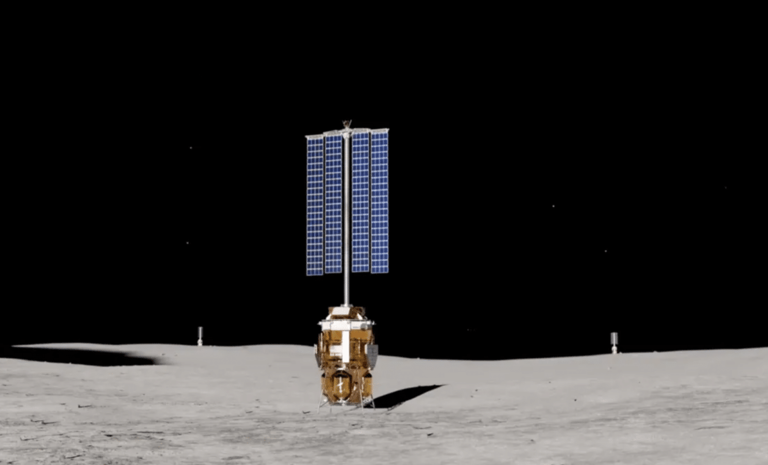
I would modify the Japan plan for many of these. Supersized perhaps, and at higher latitudes. But also useable at the equator as well.
At the equator, rather than noon maximum power, you could have East and West maximum power.
So I suggest this sort of solar robot with "2 degrees" of rotational movement: 
So, the ground might be packed or sintered so that the roller can tilt to the sun. But a collection of these may act in a similar manner as the Japan concept.
This allows a more contestant power between sunup and sundown.
But the Japan plan is a good one by itself.
With that much power, beamed power might help to power spacecraft.
Ending
Last edited by Void (2026-10-07 11:06:43)
Be careful what you wish for.
Offline
Like button can go here