New Mars Forums
You are not logged in.
- Topics: Active | Unanswered
Announcement
#101 Re: Terraformation » Minimal Martian Terraformed Atmospheres » 2008-04-27 17:02:19
So warming to the point of allowing liquid water for any significant period should set off a nice positive feedback that liberates, say, at least 200 mbar of CO2?
Zent et al. used a ~100m regolith depth for their adsorption estimate to get 30-40mbar, and adding in the effect for 2-5 wt% carbonates gives you an additional 50-160mbar. So once things thaw to a depth of 100 m, yes, 200mbar is not impossible through natural feedback consequences. It's on the upper end of the the plausible range. Some synergetic solution mining of hydrothermal veins could improve things of course.
Ironically, we seem to have already demonstrated this simple carbonate release process on Mars! During the infamous Viking Labeled Release Experiment when water was added to the soil sample an initial acidity of around 4 or 5 pH was recorded. However, it then dropped asymptotically to between 6 and 7 pH (i.e. it was partially neutralized by something basic in the soil that dissolved slowly). The fact that CO2 was indeed released from the experiment and that the amount was consistent with the decomposition of a few weight percent of carbonate is very exciting. Similar results have been found for soil from the driest parts of the Atacama desert, one of the best terrestrial Martian analogs.
Oh, I just wanted to make sure you'd seen the idea of using the carbon of Phobos to make ice deposit impactors. I hadn't seen it before, and I think it might be a way of getting things going relatively inexpensively.
Ah, okay. Yes, it does look like a good idea. A similar but somewhat reversed proposal I've heard is to clear or compress the existing Martian dust to improve the surface's thermal properties and make temperatures more stable. This is probably more relevant for the local level, but moving dirt is a nice low tech process. (:
The great thing about CO2 feedback is that most of work boils down to getting it to rain at Mars' equator (that being the easiest location to initiate liquid precipitation). Once carbonates begin decomposing there, things spread to higher latitudes naturally. So even "local" warming tactics could help kick off a global transformation if judiciously applied to the right areas.
References:
Spectroscopic Identification of Carbonate Minerals in the Martian Dust
Bandfield et al., Science 22 August 2003: V 301, N 5636, pp. 1084 - 1087
Dry Acid Deposition and Accumulation on the Surface of Mars and in the Atacama Desert, Chile
Quinn et al., Lunar and Planetary Science XXXVI, 2005
#102 Re: Terraformation » Minimal Martian Terraformed Atmospheres » 2008-04-27 05:57:47
This analysis ...
http://chapters.marssociety.org/winnipeg/soil.html
... seems to suggest that adding water to Martian regolith will get you a base, not an acid.
As a related aside, you might want to put this idea in the back of your mind ...
Ah yes, I've seen that analysis. I did similar calculations on the new MERs data and got similar results, which really puzzled me because the "official" conclusions were going on about how acid it was...
...then I realized you have to take solubilities into account. While Na2O and K2O (which exist in lesser quantities than SO3 for most of the surface), are reasonably soluble, the bulk of the bases are CaO and MgO, which are slightly soluble and insoluble respectively. On the other hand, SO3 is "miscible" in water when it becomes the acid H2SO4, i.e. it's "completely soluble" and will probably be the first thing to go into solution.
Redoing the calculations you get a very acid solution for small amounts of water which becomes neutral and then basic as you add enough water for all the bases to completely dissolve. At that point you need 68 cm^3 of water for every 1 cm^3 of soil, which is a lot of liquid. Given a regolith depth of 100m you'd need 6.8 km of water globally to get all the base to dissolve...I don't think Mars ever had that much water on the surface by any estimates (that's significantly deeper than Earth's oceans).
As for your second link, I apologize, but I'm not sure I get the connection...?
#103 Re: Terraformation » Minimal Martian Terraformed Atmospheres » 2008-04-26 23:00:19
I just had a brainstorm. My apologies if anyone has already had this idea.
It started when I was trying to come up with a fast and easy way of producing an atmosphere with sufficient pressure for surface activity without a pressure suit. Yes, yes, I know we're talking about transforming an entire world, but we're also an impatient species with a short attention span in geologic terms.
I began by being depressed over the estimate of (Zent et al. 1995) that in all likelyhood only 30-40 mbar CO2 could be outgassed by warming the Martian regolith. I know they put a tantalizing 190 mbar upper limit on things, but they in no way seriously believe that this is realistic. And even if there is that much, warming things to high enough temperatures and deeply enough to get most of the gas out requires a serious amount of time and engineering, no matter what warming process you use (mirrors, supergreenhouse gases, albedo darkening, etc.).
This reminded me of the discovery in recent years that there is actually very little CO2 ice at the Martian poles. This puts a huge hole in the archetypical "give it a nudge and let the atmosphere run away into a thick, stable state" that so often gets people hooked on the idea of terraformation. Easily released forms of CO2 are apparently drying up as we learn more about the Red Planet.
So my next line of thought was the route of thermal carbonate decomposition. But again, in realistically looking at the amount of mining required, not to mention building furnaces (be they solar, geothermal, nuclear, etc.) or bombs to liberate the CO2, it is a truly phenomenal task taking either millenia or efforts orders of magnitude above current terrestrial mining endeavors. There just aren't any shortcuts around the amount of material that needs to be physically handled.
Then I got to thinking about where the carbonate is on Mars. The 2-5 wt% we see mixed into the surface dust probably formed via CO2 and water vapor after the carbonate destroying acidic oceans had receded. This represents a CO2 reservoir at least 2-4 times as large as the estimate for adsorbed gas. Any subterranean deposits are almost certainly in hydrothermal veins, like the estimated 2.5 mbar locked up in Iceland on Earth (and that's only been from the past 16 million years). Based on extrapolations from Iceland and Martian meteorites, there could be several bar of CO2 locked up as carbonates in areas of Mars with evidence of volcanism.
Suddenly I realized that the reason any of these deposits formed at all was because they never had contact with the acidic oceans, either because they formed afterward or formed underground in alkaline conditions. But the thing is, all the sulfuric acid is still on the Martian surface in the SO3 anhydrous form. Just add water to the regolith, and...
BAM! As the water allows aqueous reactions to occur for the first time in billions of years the carbonates will be stripped of their metals by sulfuric acid and booted out of the regolith as CO2. An added benefit is that the acidity of the regolith is reduced as the sulfuric acid is neutralized to salts, allowing a better medium for plants to grow in.
If you want to accelerate things with a little engineering, you could tap hydrothermal carbonate veins and pump your acidic solution in and back out. Sulphates are more soluble than carbonates, so the solution would eat its way along the veins as it converted them, resulting in a reduced need for traditional mining through the surrounding rock.
I really like this tactic for two reasons: first, it could be started simply by getting Mars to the point where it can rain (maybe increase pressure a few mbar and get things consistently a bit above 0°C in the tropics?), and second it kills two birds with one stone by deacidifying the regolith.
Comments, constructive criticism?
#104 Re: Terraformation » Minimal Martian Terraformed Atmospheres » 2008-04-26 12:27:31
As an addendum to my previous post, I've found a body of research on trees in the area surrounding Mammoth Mountain, a dormant volcano in California. Some CO2 vents here have become especially active in the past few decades, producing soil concentrations high enough to kill swaths of forest in some locations. These tree-kill zones were found to occur when soil air was above 30% CO2 (300 mbar), though many trees began exhibiting problems above 20% CO2 (200mbar). At these levels death was determined to be due to CO2 "overdose", not lack of O2. The trees were primarily pines and firs, which is especially relevant for early Mars terraformation because of their tolerance of cold and aridity. It is thought that the trees might have been able to handle even higher CO2 soil levels if their exposure had been more gradual.
Reference:
Forest-killing diffuse CO2 emission at Mammoth Mountain as a sign of magmatic unrest
Farrar et al., Nature, Vol. 376, No. 6542. (Aug 1995), pp. 675-678.
#105 Re: Interplanetary transportation » Space metal » 2008-04-21 10:32:32
It's probably going to come down to various iron and aluminum based alloys in the end. Aluminum would be preferable for transport craft due to its fuel-saving high strength/weight ratio. It's also a better radiation shield than iron due to its low atomic number (less secondary radiation). Not that I'm suggesting it would be the only radiation safety measure.
#106 Re: Terraformation » Terraforming the Moon - Your opinion, please » 2008-04-19 10:54:51
Intriguing idea, Spaniard. I'd like to run some numbers.
First let's assume we have a 1 gigawatt (thermal power) reactor, the size of a typical large powerplant. Since D-D fusion produces 12.5 MeV and 2 neutrons per reaction on average, our reactor produces 1e21 neutrons/second.
Now let's say that we shield the reactor entirely with I-127, the only bulk available form of iodine. We'll assume that all neutrons are absorbed and turn I-127 into I-128. This isn't a terrible assumption, and it provides us with optimistic results.
I-128 is unstable with a half-life of 25 minutes. It can decay into either Xe-128 or Te-128 (both stable isotopes), but prefers Xe-128 about 93% of the time. So, approximating that every neutron produces one Xe-128 atom, we are producing 1e21 xenon atoms a second.
Every millibar of xenon on the Moon requires about 1e40 atoms. That means it would take 1e19 seconds or 300 billion years for a 1 gigawatt D-D fusion reactor to produce a 1 mbar lunar atmosphere. Of course, we'd probably have more reactors than that. As an upper estimate, let's say we have one reactor per square kilometer; that's a power density comparable to the light received from the sun at Earth's orbit (!!!) and a total of about 40 million reactors. With that it would take about 8000 years to produce 1 millibar of lunar atmosphere.
Let's look at this from another angle. For 1 millibar of xenon we would need 2e15 kg of iodine. That's about 10% of all the iodine in Earth's crust. I don't know how much iodine the Moon has, but I'm guessing less than Earth.
#107 Re: Pictures of Mars » Real images of Mars » 2008-04-18 09:36:58
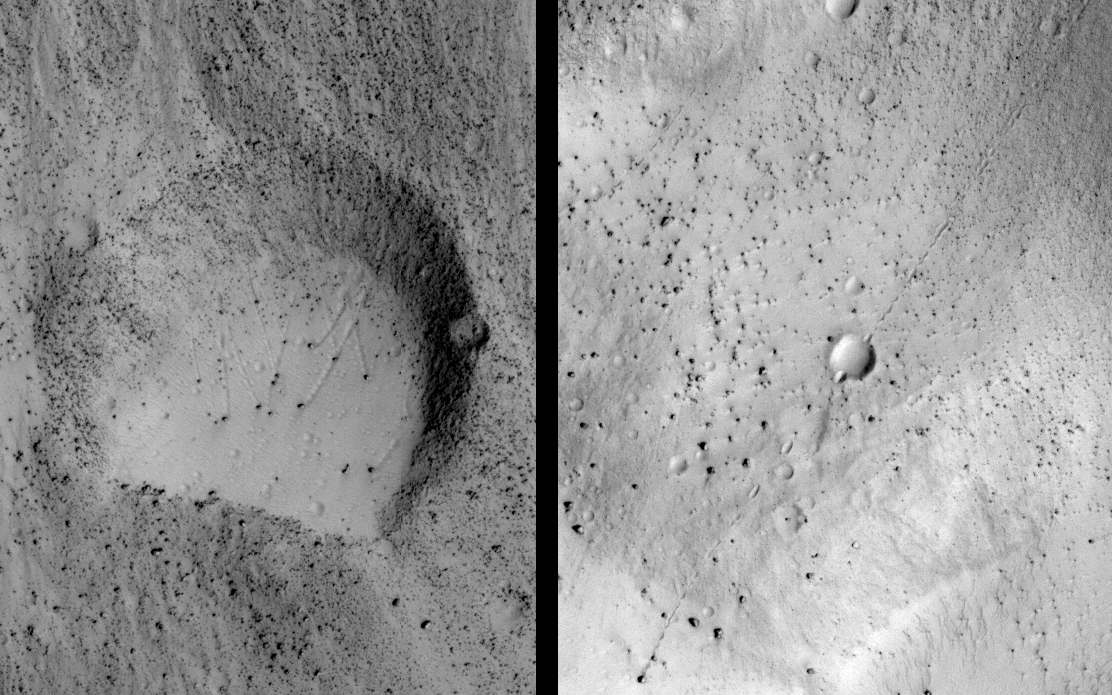
Rocks Rolling (PSP_007547_1895), aquired 06 March 2008
I happened to find this image perusing online news articles about Mars and thought it warranted posting in here. Too bad there are so many possibilities for how the boulders were sent rolling; I was hoping it might be used as an indirect seismometer. Guess we'll still have to wait for the Exomars mission.
This image covers where the southern branch of Shalbatana Vallis opens into Chryse Planitia, showing a variety of boulders that have moved down slope leaving tracks on the surface. These boulders may have been thrown out from low-energy secondary craters, or simply eroded out of the above rocky cliff.
In the subimage [the one posted], the left frame shows boulders moving in two directions, indicating that they had different sources. The right frame shows a boulder about 4 meters in diameter in the bottom left, having left a track that begins in the upper right. This boulder rolled down the hill, appears to have jumped the crater, bounced a few times, and then rolled to a halt.
#108 Re: Terraformation » Venus » 2008-04-15 17:14:18
The Venusian homopause occurs at 130-140 km. Species begin to differentiate by molecular mass above this. The atmosphere is extremely thin, much less than a millibar.
Above 56 km vaporous sulfuric acid is virtually non-existent, having completely condensed out. Sulfur dioxide levels also drop within safety margins around that altitude. That would suggest that you'd "only" have to deal with droplets of liquid sulfuric acid (as if that's easy).
Perhaps inert mesh sails around a colony could reduce local acid levels by collecting droplets and raining them out.
#109 Re: Terraformation » Hints for atmospheric retention... » 2008-04-05 13:21:42
It's been recently calculated by Ong & Asphaug that for 1 km asteroid impactors travelling at 45 km/s (something that happens every couple million years or so) a Martian atmosphere of 150 mbar would be thick enough to completely quelch atmospheric impact erosion.
At 150 mbar the Martian surface would enjoy x-ray and cosmic ray protection comparable to that at Everest base camp (quite tolerable). As long as at least 1 mbar of this is O2 you can form an ozone layer about as thick as Earth's.
#110 Re: Terraformation » Antimater core deposition - - re-heating the martian guts » 2008-04-01 21:39:52
It is unfortunate that the sulfur content of Mars' core is at best constrained to be within about 10-16 wt% S. If we're lucky it's on the low end and Mars' core is already on the verge of crystallizing. If this is the case a core temperature drop of a few K or tens of K would be sufficient to reactivate convection. Unfortunately, some studies suggest ~14 wt% S, which puts Mars' core at the Fe-S eutectic composition and means that a cooling of something like 700 K would be required.
To put things in perspective, cooling the Martian core by 1 K requires the dissipation of ~1e26 joules. This is equivalent to the solar energy that Mars intercepts over 150 years. You could thermally liberate 6 bars of CO2 from carbonates with this energy, or 1.4 bar of N2 and 3.4 bar O2 from nitrates. This is far more than what would be needed to terraform Mars. In fact, Mars probably only has a couple tenths that much carbonate and nitrate in deposits.
As far as engineering, I would advocate either building heat pipes or injecting water through the insulating lithosphere and near the top of the mantle. This interface is only a few km deep in some parts of Mars (Hellas, Isidis, Utopian basins) and would make temperatures of ~650°C available, which is perfect for steam generation and dissociating both carbonates and nitrates. Such technology (for injected steam at least) is currently being fielded in Iceland.
#111 Re: Terraformation » New ideas for terraforming mars » 2008-04-01 20:38:21
One simplifying aspect of biosphere construction on Mars during terraformation is the synergetic progression that James Graham has likened to 'ecological succession'. Early in terraformation we are presented with climate conditions similar to Earth's arctic or alpine biomes, which have very low species variety and relatively simple ecological structure. As Mars becomes more clement, we can gradually progress from hardy, simple ecosystems to richer, more complex ones. This not only allows for but encourages a natural learning process in application for biosphere construction and maintainence. The data obtained and lessons learned could be invaluable in understanding Earth's ecology (and possibly that of alien worlds), as well as in constructing other extraterrestrial ecosystems. Sometimes I wonder if the knowledge gained by this process alone would make Mars worth terraforming.
#112 Re: Terraformation » Antimater core deposition - - re-heating the martian guts » 2008-03-15 18:33:01
Many people here seem to be under the impression that Mars' core/mantle is too cold to support convection. Actually, according to observations and models the opposite is true; the Martian core is too hot to support convection.
On Earth the core is made of mostly iron and nickel. Due to the right combination of temperature and pressure, there exists a solid inner core and a liquid outer core. The solid core is constantly growing due to crystallization of liquid. This releases a huge amount of heat, which escapes by convecting through the liquid outer core and into the mantle. The convection gives us a magnetic field and the heat flux helps allow the mantle to be fluid enough to support plat tectonics on the surface.
On Mars the core is made of mostly iron and nickel like the Earth, but it also contains a lot of sulfur. This is important because sulfur interferes with the crystallization of iron and nickel, giving Mars a completely liquid core. With no crystallization, Mars lacks a central heat source to drive core convection, and thus couldn't sustain its magnetic field very long after formation. It also probably wasn't able to produce long term tectonic plate activity due to this lack of a crystallization energy source.
So why do I say the Martian core is too hot? Well, sulfur doesn't completely inhibit the crystallization of iron and nickel; it just lowers the solidification temperature somewhat. That means that once the temperature of Mars' core drops sufficiently for crystallization to begin, it could form a solid inner core that releases massive amounts of energy. This could conceivably begin driving a magnetic dynamo and plate tectonics like on Earth.
#113 Re: Terraformation » Antimater core deposition - - re-heating the martian guts » 2008-03-12 00:40:06
I have doubts that we need to heat, stir up, or otherwise "reactivate" the Martian core. The evidence is mounting that Mars is still quite volcanically active. Many lava flows are so young that they cannot be accurately dated with conventional "crater counting" methods, i.e. <1 million years old.
(Mitchell & Wilson 2005) have an interesting and reasonably supported theory that Mars is currently operating on a cycle with periods of ~1 million years of volcanic activity separated by ~100 million years of dormancy. During periods of activity they estimate that any given volcano would erupt every couple hundred years, meaning that in our 30 years of closely observing the Red Planet we've had at best a 1 in 9 chance of observing a serious eruption. These eruptions would be pretty big, lasting roughly a Martian year.
That said, the last well dated set of volcanic activity was ~100 million years ago and, as I said before, there seems to have been activity within the last 1 million years. That would put us in the middle of one of Mars' active periods. And there is very new evidence that this is true. (Roberts et al. 2007) have made a plausible case for dark particle dustings around Cerberus Fossae (a set of giant cracks in the Martian surface) being deposits expelled by volcanic activity within the past few years. A very exciting thought!
References:
Recent and Future Volcanism on Dormant Mars (Mitchell & Wilson 2005)
Possible evidence for on-going volcanism on Mars as suggested by thin, elliptical sheets of low-albedo particulate material around pits and fissures close to Cerberus Fossae (Roberts et al. 2007)
#114 Re: Terraformation » History Channel: Mars Terraformation » 2008-03-11 15:47:15
I usually don't watch the History Channel, but I noticed that there's a new episode in their series "The Universe" on tonight at 9pm EST that examines the pros and cons of space colonization along with technology for making Mars more habitable. Just thought I'd give the forum a heads-up, and maybe we could discuss any thoughts on the show here after it airs.
#115 Re: Terraformation » Minimal Martian Terraformed Atmospheres » 2008-03-09 01:41:23
Plants cannot survive in a partial pressure CO2 level greater than 0.2 kPa.
That's a lot lower than the sources I've seen:
(Chagvardieff et al. 1997) grew wheat, tomatoes, potatoes, and peas at 0.37 kPa (3.7 mbar) CO2 from seedlings to harvest. They did find that wheat suffered at these levels, but response was extremely variable between species: one variety suffered a 50% reduction in edible mass while another suffered only a 9% drop. The main thrust of the paper, however, was the tremendous benefits for all the other vegetation grown: tomatoes increased edible output by 46-59%, potatoes a modest 6-16%, and peas an incredible 245%. A further experiment raising potatoes in 2 kPa (20 mbar) CO2 found the only effect to be that the tubers grew much faster.
(Tikhomirov et al. 2007) grew radishes, beets, carrots, and cabbage at 0.7-0.9 kPa (7-9 mbar) CO2 and found significant enhancement in edible biomass (~20%) over the previously assumed optimal range of 0.15-0.3 kPa (1.5-3 mbar) CO2.
(Wheeler et al. 1994) found that while 1 kPa (10 mbar) CO2 was not optimal for the growth of soybeans and potatoes, neither was it injurious: the plants were in all respects either comparable to or far more productive than those grown under normal CO2 levels.
(Wheeler et al. 1997) successfully grew tomatoes at 1 kPa (10 mbar) CO2 and found that there was no significant effect on mineral and nutritional composition of the fruit.
(Grotenhuis et al. 1997) studied wheat and (Bugbee et al. 1994) studied wheat and rice at up to 1 kPa (10 mbar) CO2. Like many other studies, they both found that while not optimal, such CO2 levels were not lethal or even seriously detrimental to the plants. It should be noted that a drop in seed productivity associated with CO2 interference with ethylene was observed. This is one of the major problems with high CO2 among plants. CO2 stimulates ethylene production at a few kPa, but then begins inhibiting it above ~5 kPa (50 mbar). While plants can still survive above these levels, ethylene is an important plant hormone, and modification of reproductivity begins to be experienced.
I would also like to reference the series of papers by Kidd in the first half of the 20th century. He remarks upon many studies that found pea growth to be stimulated by a few percent CO2, and then inhibited by higher levels. The level at which growth was constrained below normal levels was consistently 7% CO2 (7 kPa, 70 mbar). Kidd himself also did extensive research into the effects of very high CO2 on germination and respiration in a wide variety of plants. He found that sensitivity in germination varied significantly between species, with white mustard being totally intolerable of >18% CO2, while peas were still capable of germinating at 100% CO2, albeit at greatly reduced rates.
But what takes the cake in my experience is the study of (Pfanz et al. 2007) on timothy grass around mofettes, i.e. natural CO2 springs. The researchers found plants growing with air in the soil being 26% CO2; that's 26 kPa or 260 mbar. Described in the paper as living "a life on the verge of death", these plants experienced CO2 levels 800 times normal as well as permanent hypoxia and even transient anoxia in the soil. Understandably, this grass was extremely stunted in height and had nitrogen, phosphorous, zinc, and sulfur nutrition absorption deficiencies. But they were alive, reproducing, and persisting in a natural microecosystem. In a similar study with reeds, Pfanz et al. found that photosynthetic inhibition occured at 20-98% CO2 (20-98 kPa, 200-980 mbar) in both mofette and control plants, but that the mofette acclimated plants were far more robust. They were even able to maintain 20% normal photosynthetic electron flow for several hours at 98% CO2; by comparison the control plants were totally shut-down.
References:
Effects of Modified Atmosphere on Crop Productivity and Mineral Content (Chagvardieff et al. 1997)
Effect of Increased CO2 Concentrations on Gas Exchange and Productivity of Cultivated Vegetables Contributing to the Phototrophic Component of Biological Regeneration Life-Support Systems (Tikhomirov et al. 2007)
Growth of Soybean and Potato at High CO2 Partial Pressures (Wheeler et al. 1994)
Effect of Elevated Carbon Dioxide on Nutritional Quality of Tomato (Wheeler et al. 1997)
The Controlling Influence of Carbon Dioxide in the Maturation, Dormancy, and Germination of Seeds.--Part I (Kidd 1914)
The Controlling Influence of Carbon Dioxide in the Maturation, Dormancy and Germination of Seeds.--Part II. (Kidd 1914)
The Controlling Influence of Carbon Dioxide. Part III.--The Retarding Effect of Carbon Dioxide on Respiration (Kidd 1916)
Photosynthetic performance of timothy grass is affected by elevated CO2 in post-volcanic mofette areas (Pfanz et al. 2007)
Physiological Reactions Of Reed Growing Under Co2 Extremes Within a Co2 Emitting Mofette Field (Pfanz et al.)
#116 Re: Terraformation » Minimal Martian Terraformed Atmospheres » 2008-03-05 12:35:05
As another Idea, could N2O also be made by bacteria? Would it be a drain on valuable nitrogen.
NO and N2O are produced in tiny amounts as side-effects of both nitrification (NH4+ -> NO3) and denitrification (NO3 -> N2). I understand that they are produced more often when more O2 is available to the bacteria. However, witness that NO and N2O are just trace gases in our atmosphere (<1ppm); they are unimportant as a biological sink of nitrogen.
For everyone's edification, here's an inventory of nitrogen on Earth:
Earth
Atmosphere........3.87e18 kg
Sediment............1.00e18 kg
Ocean.................2.00e16 kg
Soil.....................9.50e13 kg
Biomass..............4.00e12 kg (the vast majority is on land)
Let's say as an extreme case we terraform Mars into having 1/3 of its surface covered by ocean. We're left with a land area 65% that of Earth. Now, if we scale the soil and biomass from Earth:
Mars
Soil.....................6.20e13 kg
Biomass..............2.60e12 kg
This mass of nitrogen, 6.46e13 kg, amounts to just 0.016 mbars on Mars. The red planet currently has over 10 times this amount in it's atmosphere alone, and there is probably of order 1e17 kg fixed nitrogen in sediment and soil on Mars (several tens of mbar).
One could also scale Earth's ocean nitrogen content to a (extreme case) 3km Martian ocean covering 1/3 the surface to obtain an estimate of 2e15 kg, which is well within Mars putative inventory. On the other hand, you get into trouble when you scale for sediment, getting 3e17 kg. In fact, neither of these values are realistic for Mars because the amount of nitrogen deposited in the ocean and as sediment will depend on many factors (including biological) and are not directly scalable from Earth.
References:
Where is the nitrogen on Mars? (Mancinelli et al. 2003)
Isotopic Composition of Nitrogen: Implications for the Past History of Mars' Atmosphere (McElroy et al. 1976)
#117 Re: Terraformation » Minimal Martian Terraformed Atmospheres » 2008-03-03 20:17:28
It was mentioned earlier in the thread that subsurface hydrothermal carbonate deposits are postulated to exist on Mars. I just wanted to note that the terrestrial analogs of such deposits typically contain significant amounts of fluorite (CaF2, calcium fluoride). Concentrated sulfur rich minerals are also common in these deposits on Earth, and would probably be even more so on Mars.
#118 Re: Terraformation » Minimal Martian Terraformed Atmospheres » 2008-03-03 16:55:22
Ok, here's that promised post about lagoons.
High volatile flux anaerobic lagoons emit 10 tons/hectare/year NH3 and 20 tons/hectare/year CH4, give or take a factor of 2. In order to sustain 0.1 microbar NH3 on Mars you'd need to cover at least 4% of the surface with lagoons in order to counterbalance the absorption by plants (assuming they cover the rest of the surface). This neglects NH3 destruction by UV and atmospheric hydroxyl radicals, which are comparatively unimportant. At this lagoon coverage you would also get at least 30 microbar CH4, and perhaps 10 times that if the hydroxyl concentration on Mars was low compared to Earth.
Now there are a lot of holes in this calculation, some lethal. I don't know what the ammonia deposition rate over desert is (probably lower than over vegetation), so that could lower the required lagoon surface coverage. On the other hand, this model just takes into account "dry deposition" (when NH3 molecules directly deposit on surfaces), assuming it dominates over "wet deposition" (when ammonia dissolves into water vapor and is then deposited by rain). On Earth the deposit rates of the two processes are roughly the same magnitude. However, with the extremely high concentrations we're talking about, far more NH3 will dissolve into rain and be removed from the atmosphere. We're talking deposition rates 100-1000 times higher than on Earth, assuming similar rainfall on Mars. This means that 0.1 microbars is unreasonably large: you'd need the Martian surface to be one giant, smelly lagoon. This conclusion is reinforced by NH3 measurements on the order of 0.1 microbars in the atmospheres over lagoons (Goorahoo 2005).
With jumpboy11j I was hoping that NH3 might be a good greenhouse gas for Mars. Unfortunately, it appears to be far too reactive/soluble a species to be gaseous in the amounts required for more than a degree or so of warming. ):
References:
Measurement and estimation of ammonia emissions from lagoon–atmosphere interface using a coupled mass transfer and chemical reactions model, and an equilibrium model
KS Bajwa, VP Aneja, S Pal Arya, Atmospheric Environment 40 (2006)
Ammonia Emissions from Swine Waste Lagoons in the Utah Great Basin
LA Harper, KH Weaver, and RA Dotson, J Environ Qual 35:224-230 (2006)
Reduction of Ammonia Emissions from Swine Lagoons Using Alternative Wastewater Treatment Technologies
A Szogi & M Vanotti, Proceedings of the Workshop on Agricultural Air Quality: State of the Science, June 5-8, 2006, Washington, DC. p. 1155-1160
http://genes.pp.ksu.edu/research/public … 115=192837
Use of Laser Technology to Monitor Ammonia Emissions from Dairy Lagoons
D Goorahoo, C Krauter, B Goodrich and M Beene, 14th International Emission Inventory Conference, Las Vegas, Nevada, April 11 - 14, 2005
http://www.epa.gov/ttn/chief/conference … o_pres.pdf
#119 Re: Terraformation » Minimal Martian Terraformed Atmospheres » 2008-03-03 13:51:26
At 100 mb of C02 in this 400mb atmosphere we have a total of 25% C02.
In a 400mb atmosphere, i think around 5% would be the maximum amount of C02 we could expect life to endure at 400mb.
That seems awfully low to me. Many plants do take some sort of productivity/germination rate hit at >50 mbar CO2 (i.e. >5% CO2 on Earth) due to interference with the plant hormone ethylene, but that doesn't mean they can't survive at those levels. For example, (Ostaplyuk et al. 1974) found that wheat germinates totally normally at 20% CO2 on Earth; that's 200 mbar CO2, well over the 100 mbar that's being suggested.
Reference:
Germination of winter wheat seeds depending on oxygen and carbon dioxide concentrations
ED Ostaplyuke, OF Cherkauskii, and LL kurochkina, Fiziol. Biokhim. Kul'turnykh Rastenii 6:401-405, 1974
#120 Re: Terraformation » Minimal Martian Terraformed Atmospheres » 2008-03-03 00:23:41
Final Atmosphere:
20 kPa (200 mb) O2
10 kPa (100 mb) CO2
8.8 kPa (88 mb) N2
1 kPa (10 mb) H2O
0.2 kPa (2 mb) NH3Total: 40 kPa (400 mb)
Oh my goodness, at 2 mbar of NH3 our eyes and lungs would immediately begin corroding upon contact with such an atmosphere. That won't do at all.
While a tolerance for acute exposure to 100 microbar NH3 levels may be developed in humans, true chronic acclimation in animals does not seem to be possible at +10 microbars. One might be able to get away with 1 microbar of NH3, but even that is really pushing it. Levels in the 0.1 microbar range are much more realistic if you want to avoid chronic respiratory problems. And while it might slightly accelerate adaption of first generation animals to acidosis, atmospheric NH3 would do nothing to prevent CO2 neural interference, which is the real limiting factor with CO2 breathing levels.
Unfortunately, even in the 0.1 microbar NH3 range many plants will die due to nitrogen overdosing. Above just 0.01 microbars NH3 most lichens, mosses and confiers (all key plants in early terraformation due to their climatic hardiness) will kick the bucket. This is because these plants are used to harsh climates with low nutrient input; the ammonia goes straight into their leaves and overwhelms them. There are a few lichen and moss species that have evolved to tolerate higher nitrogen inputs, but the limits of this are not well defined. A critical load of 0.1 microbars is a generous upper estimate.
However, there is a more serious problem: it is very difficult to get anywhere near this amount of ammonia into the air completely naturally. This is due to the fact that ammonia is so water soluble and such an easy nitrogen source to assimilate that after emission (from, say, bacteria) it gets reabsorbed into the biosphere almost immediately. Perhaps the only way to do it would be to have micro-ecosystems like the "lagoons" that farmers use to get bacteria to digest manure and dead plant matter into methane, ammonia, nitrous oxide, and many other gases, as well as to produce clean fertilizer (actually the farmers don't want the ammonia to volatilize because it removes nitrogen from the resulting fertilizer, but we would want it to leave for greenhouse effect purposes).
I've done some calculations on the plausability of the lagoon idea in the past, but I don't recall them at the moment. I'll elaborate on it in another post soon.
References
Ammonia Regulations and Advisories
http://www.atsdr.cdc.gov/toxprofiles/tp126-c8.pdf
Chronic Toxicity Summary: Ammonia
http://www.oehha.ca.gov/air/chronic_rel … 664417.pdf
#121 Re: Terraformation » Minimal Martian Terraformed Atmospheres » 2008-03-01 13:50:49
Going just on memory here because i can't find the original posts.
I believe 70mb of C02 just warms Mars enough to keep Mars at 0c or just at melt point as an average temperature.
The only way 70 mbar of CO2 could get the average Mars temperature into the 0°C range is if you have ~1/2 bar of other gases (like N2 and O2) to broaden CO2's spectral lines through pressure. That's even including the greenhouse forcing due to more water vapor being in the warmer air. I'm sure you'd be the first to admit that amount of gas is unrealistic, nickname.
By way of comparison, the 100 mbar CO2/160 mbar O2 atmosphere I suggested before would just get you an average of -11°C at Mars' equator. Since Mars' orbit is fairly elliptic you'd get seasons even at the equator, and the climate would be wind up being comparable to the Canadian or Siberian tundra.
Just to be thorough, I want to mention that the existance of ozone would boost temperatures a bit. So would the low levels of methane, nitrous oxide, and ammonia produced by organisms introduced to Mars.
I know it's been linked to before on these forums, but I thought I'd remind people that a nice tool for such calculations is the Terraforming Calculator by Martyn Fogg.
#122 Re: Terraformation » Minimal Martian Terraformed Atmospheres » 2008-02-27 18:51:18
Cool idea with the stromatolites, dunwich. I hadn't thought about their existence on a terraformed Mars before.
The vast majority of the iron on Mars is already heavily oxidized; that's why it's rusty colored. If anything, the soil will give up excess oxygen during terraformation, not absorb it from photosynthetic sources.
As far as nitrogen is concerned, denitrifying bacteria would indeed remove nitrogen from soil, but it would be ok because nitrogen fixing bacteria would put it back, just like they do on Earth.
#123 Re: Terraformation » Minimal Martian Terraformed Atmospheres » 2008-02-23 16:07:22
You know, I've been wondering about this nitrogen thing for a while now. I'm not so sure atmospheric nitrogen is a prerequisite for a stable ecosystem. It would seem that once there is "fixed" nitrogen in a biological system (e.g. ammonia, nitrates, nitrites) there can exist a nitrogen cycle entirely decoupled from the atmosphere. See the EPA image below:

Through plant and animal decomposition and assimilation, the nitrogen can make a complete cycle and sustain a happy ecosystem. The only rub is that "denitrifying" bacteria, who live in anoxic conditions such as the soil and stagnant water, like to use nitrate instead of oxygen as their metabolic electron acceptor. This turns the fixed nitrogen into atmospheric N2, which is useless to all life except nitrogen fixing bacteria, who help return it to a biologically accessible form. There are also abiotic ways nitrogen is fixed, such as UV radiation, lightning, and volcanic activity.
In some sense the question comes down to this: Are we setting up our terraformed ecosystem using gaseous N2 or a fixed form like nitrates? Either will work. If we use gaseous N2 we need to make sure we have >5 mbar, and it will take a while for fixing bacteria to build up enough fixed nitrogen from this for an ecosystem to operate. On the other hand, if we initially introduce nitrates higher plants will be able to immediately use it as a nutritive resource. Again, we have the requirement that we have >5 mbar worth of nitrates so that when denitrifying bacteria start bleeding nitrogen off to the atmosphere there will be enough pressure for nitrogen fixing bacteria to reabsorb it.
There is a second reason nitrates are attractive: they probably already exist on Mars. Many people claim that this is speculation since we haven't observed any nitrates on Mars, but this is uncompelling. The truth is that: 1) nitrates are extremely hard to detect using spectrographic techniques, and 2) there is every reason to believe that nitrates would only exist in substantial quantities at depths of ~1 meter. An excellent paper by (Sutter et al. 2007) demonstrates this by using soil from the Atacama Desert, an oft used terrestrial Martian analog. The Atacama is hyperarid (50 times less water than Califronia's Death Valley), with heavy saline deposits, nearby volcanos, and has thin air and high UV due to its elevation. It also boasts the world's most incredible nitrate deposits: in many regions >7% of the soil is nitrate by weight (Prellwitz et al. 2006). However, as (Sutter et al. 2007) show, even in the areas with the most concentrated nitrate deposits we cannot discern them via spectrometry until they occupy ~1% of the soil by weight, and that doesn't happen until a depth of ~1 meter has been reached. Below this depth the nitrate fraction can quickly explode up to 30% of the soil's weight.
So the Atacama has huge nitrate deposits; why think that Mars does too? It is thought that Atacama's deposits are due largely to the volcanism of the surrounding area, which is estimated to have fixed 2800 megatons of nitrogen from the air (Oyarzun & Oyarzun 2007). Extrapolating this to the global volcanism of Mars using (Geeley & Schneid 1991), we would expect 180 million megatons, or 45 mbar worth of nitrogen to be fixed as nitrates and nitrites. In addition it has been experimentally demonstrated by (Segura et al. 2005) that UV radiation could have fixed almost 2 megatons of nitrogen every year on early Mars. Between the time of Mars formation 4.6 Gyr ago and the beginning of the Late Heavy Bombardment 4.0 Gyr ago, this mechanism could have fixed 250 mbar of nitrogen in the soil before impactors blew off much of Mars' atmosphere. This would also be before the Martian global magnetic field decayed and solar wind erosion began.
But did Mars even have this much nitrogen to start with? By analogy with Earth a planet of Mars' mass could have accumulated 120 mbar of N2 during formation, and by analogy with Venus it might have begun with 560 mbar. Even if Mars began with an extremely pessimistic 1 bar CO2, the ratio of C/N = 20 in comets and terrestrial planet atmospheres means it should have begun with at least 25 mbar N2. And since (Phillips et al. 2001) estimate a magmatic outgasing of 1.5 bar of CO2 during the formation of Tharsis, anywhere from 38 to 250 mbar N2 could have been added to the atmosphere later, based on possible magma N2 contents from (Segura et al. 2005).
Ok, Mars had the ability to fix large amounts of nitrogen in the past, as well as a significant inventory from which to fix it. So where is it? Well, nitrates are extremely soluble, meaning that during Mars' wet period(s) most of it would have quickly dissolved and been transported to the northern plains. As the water froze/evaporated the nitrates would have been deposited primarily in the Utopian basin, which seems to have originally been an impact crater the size of Hellas that's been filled in with sediment due to its watershed containing over 2/3 of the Martian surface (Bandert 2004). Other locations of heavy nitrate deposits might be the Acidalia, Amazonis, Argyre, Chryse, Echus, Hellas, and Isidis plains.
Interestingly, the crustal thickness at these locations is very thin, on the order of that found at Iceland or thinner, suggesting that the geothermal gradient there may be sufficient to support liquid water at relatively shallow depths. According to (Halevy et al. 2007) such sites could experience large carbonate deposit formation after the recession of Mars' acidic seas. I find it intriguing that large deposits of both nitrates and carbonates might be located in the same places, along with the geothermal means to decompose them directly into CO2, N2, and O2. Just drill down to ~650°C, pipe down your carbonates and nitrates with some sand, and you get all those nice atmospheric gases boiling out plus a "slag" of useful building materials like sodium silicate (water glass) and calcium silicate (the prime component of Portland cement). If you don't throw in the sand you can get sodium hydroxide (lye) and calcium oxide (lime), both of which are also very useful. This is all currently within our technological reach, and perhaps could be used to provide raw materials for early research facilities and colonies.
However, even if you could magically use all the geothermal heat flux of Mars (~4 terawatts) to decompose nitrates for 1000 years, you still wouldn't have 5 mbar N2. One could conceivably use nuclear or solar furnaces to decompose nitrates, but I'm not sure it's worth it when you can just spread the nitrates around like fertilizer, which is all it really is. Just let the ecosystem absorb it and redistribute it naturally.
References
Terrestrial analogs for interpretation of infrared spectra from the Martian surface and subsurface: Sulfate, nitrate, carbonate, and phyllosilicate-bearing Atacama Desert soils
B Sutter, JB Dalton, SA Ewing, R Amundson, and CP McKay, Journal of Geophysical Research, Vol. 112, G04S10
Nitrate Concentrations in Atacama Desert soils and Their Implications for the Antiquity of the Atacama Desert.
J Prellwitz, J Rech, G Michalski, B Buck, MS Howell, and A Brock, 18th World Conference of Soil Science, July 15, 2006
http://a-c-s.confex.com/crops/wc2006/te … P18247.HTM
Massive Volcanism in the Altiplano-Puna Volcanic Plateau and Formation of the Huge Atacama Desert Nitrate Deposits: A Case for Thermal and Electric Fixation of Atmospheric Nitrogen
J Oyarzun & R Oyarzun, International Geology Review, Volume 49, Number 10 / October 2007
Magma Generation on Mars: Amounts, Rates, and Comparisons with Earth, Moon, and Venus
R Geeley & BD Schneid, Science 15 November 1991: Vol. 254. no. 5034, pp. 996-998
Ancient Geodynamics and Global-Scale Hydrology on Mars
RJ Phillips, MT Zuber, SC Solomon, MP Golombek, BM Jakosky, WB Banerdt, DE Smith, RME Williams, BM Hynek, O Aharonson, and SA Hauck II, Science, Vol 291, 30 March 2001
Implications of the Utopia gravity anomaly for the resurfacing of the northern plains of Mars
WB Banerdt, Second Conference on Early Mars (2004)
A Sulfur Dioxide Climate Feedback on Early Mars
I Halevy, MT Zuber, and DP Schrag, Science Vol 318, 1903, 21 December 2007
#124 Re: Terraformation » Minimal Martian Terraformed Atmospheres » 2008-02-23 02:34:02
nickname, thanks for your input
Plants honestly don't care what percentage of their atmosphere is O2. Like us, all they care about is the partial pressure inside their stomata (our alveoli). So a plant in Rick's example will actually "see" slightly less than the amount of oxygen it would at sea-level on Earth. Hardly overwhelming.
Now for a stab at the old question of flammability. Rick is correct that CO2 is a more effective buffer gas per molecule because of its increased internal energy capacity, i.e. specific heat. Its ability to absorb and emit infrared also allows it to radiate heat away from the core of a fire in a way that nitrogen cannot.
Unfortunately, though not through lack of investigation, there is no simple equation to determine the flammability of an atmosphere. The best I can offer are the following two resources.
************************************************************
Java Applet for Downward Flame Spread Over Solid Fuels
This link leads to an applet that allows you to enter various parameters such as oxygen fraction, atmospheric pressure, and gravity to find flame spread rate on either PMMA (acrylic glass) or cellulose. The applet assumes an N2 diluent, so any results for Mars will be pessimistic with regard to a CO2 diluent. Nevertheless, the results are encouraging:
Take cellulose under current Earth conditions. A flame spread velocity (V_f0) of 0.83 mm/s is calculated. Now try 35% O2 at 1.2 bar, which approximates the Carboniferous Period on Earth. You should get something like 2.6 mm/s for the flame velocity. Now try Rick's 61% O2 at 0.326 bar and 3.7 m/s^2 gravity. I got 2.2 mm/s, which is comfortably lower than the flame velocity for the Carboniferous.
Now wouldn't it be nice if we had some numbers on N2 vs CO2?
************************************************************
Effect of Ambient Atmosphere on Flame Spread at Microgravity
This link goes to a study experimentally comparing the diluent effects of N2, Ar, He, CO2, and SF6 in both 1g and microgravity.
The paper contains a good survey of the all effects that need to be taken into account when considering a diluent's effects on flammability. But if you're interested in results just skip down to the Figure 5 images of "Flame Spread Rate versus O2 Mole Fraction" for N2 and CO2. You can see that 50% O2 in CO2 has a similar flame spread velocity to 35% O2 in N2 at 1 atm and 1g. This suggests that in order to obtain a more accurate flame spread velocity calculation in the applet we should use 43% instead of 61% O2 to model Rick's example since that would be the flammably equivalent percentage for N2. This produces a flame spread rate of 1.2 mm/s, about the same as a 25% O2 atmosphere on Earth and much lower than the 2.2 mm/s calculated by assuming CO2 was equivalent to N2. In reality the flame velocity would probably be somewhere between these two numbers due to the fact that the diluent abilities of N2 and CO2 converge as gravity is reduced and Mars' gravity is less than Earth's. It would be much closer to 1.2 mm/s though.
Another useful graph from the paper is Figure 8, the last image. It shows the relative flame spread velocities for the various gases at fixed O2 fractions and illustrates pretty clearly how CO2 is a much better diluent than N2 at 1g and about the same in microgravity. It also shows how pressure effects flammability.
#125 Re: Terraformation » Minimal Martian Terraformed Atmospheres » 2008-02-22 18:45:29
In order to colonize a terraformed planet it is not enough for adult organisms to function, they must also be able to produce healthy offspring. This fact, combined with the knowledge that newborn animals generally have lower tolerance thresholds than their mature counterparts, has been bugging me on the issue of atmospheric breathability for a while now.
Luckily, the use of therapeutically elevated CO2 on infants for lung protection is currently of interest and quite a few studies have focused on collecting data from neonatal rats and mice, and even human infants. Here are summaries of some of those studies:
*************************************************************
Investigating the prenatal and neonatal effects of CO2, (Dean et al. 2001) exposed pregnant mother rats for 1 week pre and post delivery. They found that 7% CO2 slightly slowed the early growth of newborns, but that they caught up with control about 2 weeks after birth. Those exposed to 10% CO2, however, experienced more severe growth retardation and did not seem to recover; much of the litter was sacrificed at birth.
Studying neonatal rats, (Rezzonico & Mortola 1989) found no significant difference in weight between control and subjects exposed to 7% CO2 during the first week of life.
(Kantores et al. 2006) examined the combined effects of hypoxia and hypercapnia on neonatal rats, finding that elevated CO2 levels helped relieve many of the effects of breathing low O2. The most extreme gas mixture used, 10.5% O2, 10% CO2, caused excessive mortality. However, mixtures of 13% O2 and between 5.5-10% CO2 allowed newborns to maintain normal (i.e. 21% O2) blood O2 pressure and red blood cell levels.
In an extremely interesting study by (Li et al. 2006) the gene expression in neonatal mice exposed to 8% CO2 and 12% CO2 for 2 weeks was compared with control to see if there were any differences. The 8% CO2 mice experienced upregulation of 365 genes and the downregulation of 342 out of a total genome of 24,878. These alterations acted to improve lung function and offered increased protection to extreme oxygen levels. In contrast 12% CO2 cause a significant expression change in only 2 genes. The authors point out that at high enough levels CO2 acts as a depressant on biological function, and invoke this as an explaination.
Another fascinating experiment was done by (Gu et al. 2007) on mice beginning at 2 days old which sought to examine the effects of elevated CO2 on neuron activity in the hippocampus. They found that after 2 weeks of exposure, the mice on 8% CO2 has nearly identical neuron operation with control, while neuron excitability in mice on 12% CO2 was significantly inhibited.
In study of premature human infants by (Mariani et al. 1999) it was demonstrated that newborns on assisted respiration required significantly less time on the respirator when given a hypercapnic air mixture than when not (2.5 days vs 9.5 days, on average). Blood CO2 pressure was raised by ~10 mm Hg, so I'd guess they used ~5% CO2.
*************************************************************
These results are fairly consistent with the previous estimates of CO2 toxicity presented in this thread, and indicate that for optimal newborn growth a biological threshold of 50-64 mm Hg inspired CO2 (7-9% CO2 at 1 atm) should be followed rather than the adult tolerance threshold of 86 mm Hg inspired CO2 (12% CO2 @ 1 atm).
In terms of O2 requirements, (Xu & LaManna 2006) identify PaO2 ~ 50 mm Hg as the limit of chronic mild hypoxia, i.e. the point below which degradation of biological functions begins over long periods. They also suggest PaO2 ~ 35 mm Hg as the limit of consciousness for long term exposure. These values are consistent with previous estimates in this thread as well as this one.
So using the theory of "normal adult function threshold" as the safe limit for infants, should we take PaO2 = 50 mm Hg as an acceptable limit? Well, the city of Potosi says "Yes!" Having over 130,000 people, and existing since 1546 A.D. at an elevation 4000 m, adults and infants alike in Potosi inspire O2 at PIO2 ~ 90 mm Hg, which corresponds to a PaO2 ~ 50 mm Hg. While (de Meer et al. 1995) do find a moderate reduction of children's stature at such an altitude, in part attributible to the mild hypoxia, severe growth retardation is not observed. If you want to read more about the adaptation of animals, including humans, to high altitudes (Monge and Leon-Velarde 1991) is a wealth of information.
My gut says that the respiration stimulation by CO2 should not be relied on when thinking of how much O2 is in the blood. I think the effect of CO2 should be used as relief for already bearable hypoxia, not a tool that allows us to drive the atmospheric O2 below normally untolerable levels. The fact that all the rat newborns on 10.5% O2, 10% CO2 in (Kantores et al. 2006) died supports this. Though one might have expected sufficent PaO2 from (Eq 3) in my previous post, the actual PaO2 was much lower, suggesting some limit had been reached and the linear relationships involved failed. I suspect the hypoxia was too much and the effect of CO2 couldn't cope.
My suggestion is that an inspired O2 of PIO2 = 90 mm Hg (13% O2 @ 1 atm) be used as the minimum limit for oxygen.
A simple atmosphere of just O2 & CO2 at PIO2 = 90 mm Hg and PICO2 = 57 mm Hg (equivalent to breathing 13% O2, 8% CO2 @ 1 atm), would look like this:
O2:.......160 mbar
CO2:.....100 mbar
You can add any inert gas (N2, H2O, Ar, etc.) within reason and this will still be breathable. In fact, its breathability will be slightly enhanced by adding other gases due to the increase in total pressure.
From (Eq 3) in my previous post, one would expect to have a blood O2 pressure circa 68 mm Hg, which is comparable to the oxygenation experienced at ~9000 ft on earth. Substantial inhabited portions of Colorado are above this elevation.
References:
Developmental changes of the response of in vivo ventilation to acute and chronic hypercapnia in rats
JB Dean, PB Douglas, JA Filosa, AJ Garcia, RW Putnam and CE Stunden, Respiratory Research 2001, 2(Suppl 1):P13
http://respiratory-research.com/content/2/S1/P13
Respiratory adaptation to chronic hypercapnia in newborn rats
R Rezzonico & JP Mortola, J. Appl. Physiol. 67(1): 311-315, 1989
Therapeutic hypercapnia prevents chronic hypoxia-induced pulmonary hypertension in the newborn rat
C Kantores, PJ McNamara, L Teixeira, D Engelberts, P Murthy, BP Kavanagh, and RP Jankov, Am J Physiol Lung Cell Mol Physiol 291: L912–L922, 2006.
Effect of carbon dioxide on neonatal mouse lung: a genomic approach
G Li, D Zhou, AG Vicencio, J Ryu, J Xue, A Kanaan, O Gavrialov, and GG Haddad, J Appl Physiol 101: 1556–1564, 2006.
Chronic High-Inspired CO2 Decreases Excitability of Mouse Hippocampal Neurons
XQ Gu, A Kanaan, H Yao, GG Haddad, J Neurophysiol 97: 1833–1838, 2007.
Randomized trial of permissive hypercapnia in preterm infants.
G Mariani, J Cifuentes, and W A Carlo, Pediatrics. 1999 Nov; 104 (5 Pt 1):1082-8
Chronic hypoxia and the cerebral circulation
K Xu & J C LaManna, J Appl Physiol 100: 725-730, 2006
Physical adaptation of children to life at high altitude
K. de Meer, HSA Heymans, and WG Zijlstra, Euro J of Ped, V 154; 4, 1995
Physiological Adaptation to High Altitude: Oxygen Transport in Mammals and Birds
C Monge & F Leon-Velarde, Physiological Reviews, V 71; 4, October 1991