You are not logged in.
- Topics: Active | Unanswered
Announcement
#1151 Re: Interplanetary transportation » Multi-Ship Expeditions, Starboat & Starship, Other. » 2025-05-13 12:17:57
Here then is evidence of the emergence of Artificial Labor as required in the materials of the previous post: https://www.msn.com/en-us/autos/news/me … r-AA1Ek22H Quote:
Meet Atlas: The Robot That’s Replacing Humans on Hyundai’s Assembly Line
Story by Autopost • 6d •
2 min read
Quote:
Hyundai Motor Group will automate 40% of assembly at Metaplant America in Savannah using its humanoid robot, Atlas. The move seeks to boost local output, uphold price competitiveness, and expand its North American market share.
Hyundai plans to deploy Atlas, its self-developed humanoid robot, to handle tasks like lifting parts and attaching vehicle doors. Additional specialized robots will support parts assembly, transport, line monitoring, and body inspection to boost manufacturing efficiency.
Hyundai expects to automate nearly half of its assembly processes, including stamping and welding, which will cut costs and enhance quality.
Metaplant America forms part of Hyundai’s 21 billion USD U.S. investment plan over four years. The plant will start with an annual capacity of 100,000 EVs and hybrids, expandable to 500,000. Hyundai also plans to expand its Alabama plant, targeting a 70% increase in U.S. production—from 700,000 units in 2024 to 1.2 million.
It can be noticed that America does not have to do all the heavy lifting, actually maybe only some of the heavy lifting to make these things real in realty.
https://www.bing.com/videos/riverview/r … ORM=VRDGAR
And they are rather expensive robots.
Optimus will likely do other types of tasks. This Atlas looks like it is pretty rugged for industrial needs.
Ending Pending 
#1152 Re: Interplanetary transportation » Multi-Ship Expeditions, Starboat & Starship, Other. » 2025-05-13 11:31:59
I have been thinking of substances that could be exported to the Moon, from a place like Mars, and also from places further out in the solar system. With the discovery that plants might in part grow from Acetate and Oxygen, the idea of growing an export crop on Mars, and other places comes to mind.
Bamboo has come up, but it has a lot of void spaces inside of it.
Hay Bales are compact, but then you have to grow hay.
I am now thinking Hydrilla, once again.
https://en.wikipedia.org/wiki/Hydrilla
Image Quote: 
Quote:
Hydrilla (waterthyme) is a genus of aquatic plant, usually treated as containing just one species, Hydrilla verticillata, though some botanists divide it into several species. It is native to the cool and warm waters of the Old World in Asia, Africa and Australia, with a sparse, scattered distribution; in Australia from Northern Territory, Queensland, and New South Wales.[2][3][4]
The stems grow up to 1–2 m long. The leaves are arranged in whorls of two to eight around the stem, each leaf 5–20 mm long and 0.7–2 mm broad, with serrations or small spines along the leaf margins; the leaf midrib is often reddish when fresh. It is monoecious (sometimes dioecious), with male and female flowers produced separately on a single plant; the flowers are small, with three sepals and three petals, the petals 3–5 mm long, transparent with red streaks. It reproduces primarily vegetatively by fragmentation and by rhizomes and turions (overwintering), and flowers are rarely seen.[3][5][6][7] They have air spaces to keep them upright.
Hydrilla has a high resistance to salinity compared to many other freshwater aquatic plants.
It is a vascular plant, I believe a land plant that adapted to be in water.
This material might be dried, baled, and shipped from Mars to other locations. It most likely will contain some Carbon, some Hydrogen, some Oxygen, and I hope a bit of Nitrogen.
It is edible, so on Mars, it could be stored, freeze dried in vaults of some kind against the dangers of starvation.
And you could grow mushrooms on it, so in your starvation prevention you would have that option as well, provided you had Oxygen for it.
A hydrilla farm on Mars, avoids much of the effort to make things like Plastics and Paraffin. But Hydrilla will be harder convert to propellants. But that may not matter.

https://en.wikipedia.org/wiki/Henry%27s_law
This may seem silly to some but don't forget that we may be approaching an almost infinite Artificial Labor pool, that could tap energy sources, and that the moons Phobos and Deimos might provide propellants for things like Magdrive or Neumann Drive.
In shipping Hydrilla Bales, it would just be a matter of extended time that humans would not do well with, but an electric driven ship, might take a few years to travel from Mars/Phobos/Deimos orbits, to Earth/Lunar orbits.
If you have well directed labor of almost infinite amount with relatively small needs, it is not as ridiculous as it might seem.
If you could invent a Rotavator to drop Hydrilla Bales onto the Moon that might work, or you might make a rocket that runs on propellants derived from Hydrilla, and drop the bales from it into a Shadowed Crater. It is possible that some of the exhaust from the rocket would be captured in such a cold crater.
But I prefer the rotavator idea. Then if you could also use the rotavator to bring Lunar materials to orbit you would have much you could build things from in the Earth/Moon subsystem.
Ending Pending
#1153 Re: Interplanetary transportation » Multi-Ship Expeditions, Starboat & Starship, Other. » 2025-05-13 09:42:15
So, many have dismissed the Moon as useless or a distraction.
However if you look at the Earth/Luna as a binary world if not Planet, at least, we know that resources like what we call intelligent communication can be shared between the two. So, due to a more favorable latency, the Moon is not a dry barren rock but a rock with useful interconnection to the Earth in regards communications. Computers and humans can communicate with the same from the Earth and on the Moon as well.
So, the Moon has this resource much more than any other world except Earth itself.
On the question of local volatile resources, it is rather questionable why such Lunar resources should be consumed for a one-time use. The Notion of post Apollo is you are going to get water so that you can make rocket fuel and go other places. That is fine, should Oxygen be considered, but not so fine as concerns Hydrogen.
Other possible uses are to sustain living things on the Moon. The ISS recycles water at a 98% efficiency, I believe, but I think SpaceX is going to try to tighten that up even more.
Water as a coolant is a possibility, either expendable or recycled. But it is subject to expansion on freezing and is too precious to just expend in a one time use in most cases.
The import of Carbon to make steel, has been considered by some. That is sort of a one-time use, but probably worthwhile to some extent. Also, though CO2 may be a very useful coolant, so might be worth importing, although their may be some to be had on the Moon.
It has been said that their is some small amount of Nitrogen embedded in Lunar Regolith, and that that might be retrieved to support agriculture. I suppose maybe.
Estimates for amounts of water on the Moon, are variable. We have to be careful, the fungus among us, seems to always seek to distort information, envy driven mob behaviors, would rather see us consumed and held down. They either want our existence to expire, or they want us subordinated under them.
I think though that without too much in imports, the Moon could probably support a vast robot civilization with a few humans on the Moon, provided humans can be heathy there.
In the concept of imports to the Moon, of course Earth comes first, and https://www.youtube.com/@Anthrofuturism has suggested Carbon imports for Steel.
I have described ideas as well about tapping the Asteroid Belt to get imports to the Moon, to make it more fertile. This is not any more wrong than to think you could irrigate crops with melt water from mountain ice on Earth. But it does require a much greater reach of technology.
Until the network I have suggested is set up, if ever, can we hope to import stuff from Mars/Phobos/Deimos, to our Moon and also to Earth/Moon orbits?
I think it might be a reasonable precursor to tapping the Asteroid Belt. Phobos and Deimos resemble asteroids, and have at least Iron, Aluminum, Silicon, and Oxygen to offer. Useful transfer substances can be Wood, Plastics, Paraffin, and water, I think.
This is an optimistic view of the two moons: https://science.nasa.gov/mars/moons/facts/
Quote:
Like Earth's Moon, Phobos and Deimos always present the same face to their planet. Both are lumpy, heavily-cratered and covered in dust and loose rocks. They are among the darker objects in the solar system. The moons appear to be made of carbon-rich rock mixed with ice and may be captured asteroids.
Less optimistic views are that they are simply Mars rock flung up into orbit by a object colliding with Mars. There is some tiny suspicion that those who seek to keep us captive may not have provided a totally accurate story on this.
But, I am willing to be disappointed, or we might be delighted. We need to know.
I have just given the opinion in the prior post: https://newmars.com/forums/viewtopic.ph … 92#p231592 that robot housing may be quite inexpensive on Mars. So, if you can have almost infinite Artificial Labor on Mars, you should be able to make the substances that are wanted on the Moon, from volatiles existing on Mars.
And unlike Earth SSTO from Mars should be practical.
Once in orbit, materials from Phobos and Deimos should be useful to propel robot ships to deliver these substances to Earth/Moon orbits.
The methods to lower those substances to the Moons surface could involve rockets and maybe even Rotavators.
So, with almost infinite Robot Artificial Labor, the Moon can be "Irrigated" with materials from Earth, then Mars/Phobos/Deimos, and finally the Main Asteroid Belt. And maybe eventually from deeper space such as Callisto.
If we are able to learn how to use a Rotavator to lower materials onto the Moons surface, then it should be possible to learn how to use the device to lift materials off of the Moon.
A Rotavator would be better than a Mass Driver as it will have a materials lowering function possible.
So, the Moon could become extremely valuable to a solar system civilization.
Ending Pending
#1154 Re: Not So Free Chat » Peter Zeihan again: and also other thinkers: » 2025-05-13 03:25:02
I think this might be one of the best condensed source of understanding how civilizations function.
https://www.bing.com/videos/riverview/r … &FORM=VIRE Quote:
The 7 Emotions that Push Civilization
YouTube
Whatifalthist
454.3K views
I think that this material may deserve its own topic. Maybe I will do that.
I found some of this understandable especially for cultures resembling what I am embedded in.
I found that one of the 7 Emotions, "Envy" is mentioned for Marxism and such, and is deadly to itself, as it is not able to value productive people but to envy them and the seek to harm them even if it damages the culture. Really amazing.
Also the video sort of explains woke culture also.
Ending Pending
It is like being given a mirror to see myself, or eyes to see ways of life that are not mine. I don't seem to be very self aware on these things. Some of them are just in me.
Ending Pending
#1155 Re: Interplanetary transportation » Multi-Ship Expeditions, Starboat & Starship, Other. » 2025-05-12 17:32:35
So, if a civilization dominantly robots and as a minority humans can exist on Mars, will there be a "Robot Room Temperature"?
Our room temperature a bit below 20 C, or 68 F, working well for humans, is not necessarily the best for robots and for robots on Mars.
I might nominate -10 C, but we don't know yet. But it has to be compatible with things like battery chemistry.
Another thing about robots is that they could hibernate when conditions made it a merit.
While Humans can reduce consumption of some things in adverse conditions robots could do so much more in the case where energy was restricted. So, when robots were operational, resources to keep human alive during hibernation, would have to have been stockpiled.
Tunneling in the ice slabs is a way to both gain water, and upgraded space. It would also be a way to get access to minerals.
Of course there would be various kinds of upgraded spaces. I think that perhaps most robot spaces will only be marginally pressurized. Such pressurization might be just enough to allow some amount of liquid water phase. But this would depend on the industrial processes you were working with. And the pressurization would probably be with raw Martian atmosphere.
So, if you dug a tunnel on the grounding line, could you plaster it with a freezable mix with fibers mixed in. Then if that froze would it have some of the strength of Pykrete?
Warmer spaces might most easily be built in two different ways. You might burry a dome in ice and then build buildings inside of that. In that case you might have a pressure like 2/3 bar.
But you could also have vaults in the stone under the ice. Particularly if it was created from Volcanic Ash.
Cappadocia comes to mind: https://sometimes-interesting.com/derin … appadocia/
So, volcanic Ash or sandstone covered in an ice slab of fair thickness (Quote:  )
)
I am sure we could finish those spaces much more nicely than was done in history.
Here we are then: 
The cone vault might reject excess heat into the stone under it, for the case of a sand storm, so that heat would keep flowing into the habitat.
The ice tunnel is slightly pressurized, and hosts a tent that protects a gutter that water can flow though as a liquid.
The ice tunnels can reject heat from themselves either to habitat space, or to some of the surface buildings that will double as radiators. You might use air compression and decompression to do a refrigeration.
This pressure calculator can help to determine what pressures are needed or desired: https://endmemo.com/chem/vaporpressurewater.php
According to it, to have water in the gutter at 10 degrees C, you need a pressure of 12.2118 mbar. But probably your water will be much closer to freezing.
So, gutters would be a way to transport water from new tunnel building.
Inside of the vaults in stone you could use Acetate and Oxygen to grow food, perhaps with just a little lighting.
Some surface buildings could be proper greenhouses/sky observatories where humans could have sunlight on their faces.
But in the Mars of my imagination humans will be wealthy enough that they could live in habitats orbiting Mars part of the time. So, maybe you would skip a Mars winter to go live in the sky for a number of months.
Ending Pending
This particular ice slab is the size of Texas and California: https://www.space.com/30502-mars-giant- … y-mro.html Quote:
A giant slab of ice as big as California and Texas combined lurks just beneath the surface of Mars between its equator and north pole, researchers say.
Quote:
The ice the scientists found measures 130 feet (40 m) thick and lies just beneath the dirt, or regolith, or Mars.
"It extends down to latitudes of 38 degrees. This would be like someone in Kansas digging in their backyard and finding ice as thick as a 13-story building that covers an area the size of Texas and California combined," Bramson said.
So that slab is a little thinner but still plenty thick.
Ending Pending
#1156 Re: Interplanetary transportation » Multi-Ship Expeditions, Starboat & Starship, Other. » 2025-05-12 14:35:09
So, now if we have Mars embedded in this travel structure involving Earth/Moon and the Asteroid Belt, it is in the Middle more or less.
I have significant interest in trying to work in harmony with what Mars wants to be. It is an icy world and a freeze dried surface.
Enormous sub-surface ice slabs and Robots............
These ice slabs are supposed to be all over Mars, I suppose mid latitudes and upper latitudes more so.
https://www.sciencealert.com/new-resear … ter-liquid Quote:
Vast, Thick Ice Sheets Have Been Found Buried All Over Mars
Space
11 January 2018
ByBen Guarino, Washington Post
Image Quote: 
Quote:
The slope rises as high as London's Big Ben tower. Beneath its ruddy layer of dirt is a sheet of ice 300 feet (90 metres) thick that gives the landscape a blue-black hue. If such a scene sounds otherworldly, it is. To visit it, you'll have to travel to Mars.
Planetary scientists located eight of these geological features, called scarps, on the Red Planet. An analysis of the scarps revealed that thick ice hides just below the surface.
Of course I am interested in an expanding tunnel system in the ice for Robots to "Live" in and "Work" in. And buildings on the surface to host solar power and to serve as radiators to keep the tunnel systems cool.
The tunnels and buildings on the surface will only be partly pressurized.
Gutters, rivers, streams, sewers can be on the grounding line under some sort of thermal insulating flooring.
And yes this could be connected to shelters suitable for humans.
More later perhaps.............
Ending Pending
#1157 Re: Science, Technology, and Astronomy » Genetics » 2025-05-12 11:04:02
https://www.bing.com/videos/riverview/r … c9d2368d92 Quote:
Neanderthal Studies DECIMATED by New Discovery in East Asia
YouTube
Highly Compelling
73 views
So, once again what was said as being expert, ain't so after all.
Ending Pending
#1158 Re: Not So Free Chat » Peter Zeihan again: and also other thinkers: » 2025-05-12 10:03:48
Promethium Update again: https://www.youtube.com/watch?v=PDT-83y … eanUpdates Quote:
Trump's Global Peace Offensive ROCKS Globalists, OUTFLANKS New World Order - May 12, 2025
Promethean Updates
In realty, I think the "World is going my way now". It was not before. Before it was "Hell on Earth".
Prussian Authoritarianism is not my cup of tea. People can to America to escape from a system where unqualified rulers were installed above the farm animals. The world wars sucked us into the Deamon world for some time unfortunately. But I think now that is over. I think there are magic people making changes to get us repaired, but the truth is the old order was worn out and tearing at the edges. This is not to say that at some future date, say 80 years or so from now we will not want to reexamine the methods of the 20th century. Or rather the 4 parts of the last Saeculum.
https://en.wikipedia.org/wiki/Prussian_education_system
America had imported lots of immigrants, and also the descendants of the former slaves, had been raised poorly, so a social system with strong guard rails was of some importance. This was convenient to the government, and also convenient to a ruling class. Stifle, domesticate, and tame.
Old money always resents new money. Letting common people develop skills of invention are a potential rupture of the order.
We who are at least in part of European Descent, are mostly farm animals, domesticated and tamed, by Greeks, Romans, and the post Roman rulers. We are despised for not being Stone age heroic in nature of body, and not appreciated for talents.
College can identify true talent and get it harnessed to the ruling classes as a utility. The actually not talented, can be brainwashed, and turned into a subordinate crew of slave-masters. Or at least given the promise of dominion over other less worthy people.
The sex drive of young people is exploited and perverted to toy with reality. The young male desire to be worthy, is paired with the female desire to capture a winner. Or perhaps more so to be captured by a winner.
This I think is why they enjoy bringing in new violent men from overseas to disrupt things on campuses. Probablly those who foster this think they are clever and that it is funny.
You have to remember that the ruling classes or those who think they are think that their are lots of unworthy people, "Useless Eaters", and girls like anyone else prefer to win rather than to lose.
So I am quite suspicious of our culture when the females decide that it would be good to send the boys off to a war, so that they can get "Hero" back and (Silent thought: Get rid of the weaklings).
The people who are meddling with human sexuality on the campus locations, need vast amounts of ass-kicking, and to be removed from such positions of power.
But as I have said, I feel that things are going our way. Due to the internet and probably due to things like Optimus, our access to knowledge that was previously hoarded by those evil librarians, we have means to compete in the struggles of life.
Ending Pending
#1159 Re: Not So Free Chat » Oil, Peak Oil, etc. » 2025-05-12 09:28:28
I appreciate your input kdb512.
Geothermal + Solar can be a good marriage. If you so completely dislike Photovoltaic, then think Solar Thermal with your loved CO2 as the working fluid. When Solar is working, then you can draw less on the Geothermal, and the Geothermal will recover more heat into the rock nearer then fluids of the well. So, if you like it you can run 24/7.
As the Next Step, you pull water from the air and also CO2 at the same time. Then you split some of the water and obtain Hydrogen. Then you feed CO2 and H2 to microbes in a vat to grow biomass.
Now, since you have Solar Thermal, you may process the biomass using Pyrolysis, to yield Hydrocarbons. Many waste gasses might be routed back to the microbe growth if it is compatible with the microbes.
In the Pyrolysis, process we might obtain Biochar, which could be a useful product. (I suspect that gaining various products from biochar may be possible).
So, we could get Methane, Oils, and Solids.
As for Robots, I expect some Elon Time in those. Starter tasks will be rather simple. But most places on Earth will be experimenting with it. Trade secrets will flow regardless of rules. So, skill levels will rise.
As for Robots lasting 10 years, it is more likely that parts of Robots will last various time intervals. If the Synthetic Labor drops the cost of hardware, then maintenance of robots could also be low cost. Possibly the robots repairing each other with low cost parts.
The number offered for the cost to make an Optimus is currently $10,000 per unit.
The first robots will be used inside of Tesla.
Probably the first robots sold or rented will be for a cost far above $10,000, as the labor one robot could provide might justify $50,000 for a sale, maybe even more.
In the use of robots, over time the number of tasks that such robots could do, will increase. Tasks that might be done will become more and more complex.
But if robots can build more robots in factories, then eventually an Optimus may cost $20,000, maybe even less.
But many categories of goods will experience severe deflation, so over time for many products people with low incomes will have better ability to own things for a lower cost.
I think this is going to be so disruptive, that it is really hard at this point to predict the rate of the change, and precisely the direction of changes.
Ending Pending
From post #34:
The idea of synthetic fuels is a good one. Geothermal comes to mind: https://www.technologyreview.com/2021/1 … ture-bill/
Quote:Generally thinking the best is in the West. But not where the people are.
If a process could suck water and CO2 out of the air, that might work rather well in the Great Basin.
Then to make Hydrocarbon fuels. Those could be shipped by various methods.
Ending Pending
#1160 Re: Interplanetary transportation » Multi-Ship Expeditions, Starboat & Starship, Other. » 2025-05-11 20:03:34
I am interested more in the Moon and the Asteroids, but that is not to abandon Mars/Phobos/Deimos. Rather to put Mars in the center of it.
But now the Moon. I have some notions of what more could be done with Deep Space Starship, the Lunar Version.
It has occurred to me that you could lash 3 Starships together, and to the Moon. There could be some advantages/options.
The big disadvantage would be that you had to fill 3 Starships before your mission started. Perhaps it would be an annoyance.
OK here is one concept: 
OK the "Shade Ship" and the "Depot Ship" are each stripped down Starships of the Lunar variety. They might not have engines or perhaps not fairings. They will not have landing legs. Like the Lunar Starship they will fly to LEO once but never land anywhere again.
The Lander Ship will be outfitted with one time landing legs including as much Carbon and/or plastics as is practical.
Probably the Lander Ship will have the only engines, but maybe the two others could have some small engines for emergency, perhaps some small Metha-lox engines from another vendor.
Then there is the question of Cargo. It could be in the fairings of the Lander Ship or attached to the Leg assembly of the lander Ship.
So, now there is a more favorable "Dry Mass" relative to Propellants possible to load, and Cargo.
When burning the engines to go to the Moon, the balance has to be trimmed by moving propellants appropriately between the 3 ships.
But during cruse, to the Moon, the Shade Ship will be emptied of liquids. Possibly its Ullage Gas will be burned in a special engine along the way to not waste it.
The shade ship will be postured to give shade to the two other ships during the mission as much as is practical.
In order to acquire orbit of the Moon, at the appropriate time, the three ships have to be rebalanced as per fluids, and the engine burn can occur.
The Lander Ship is prepped for landing and leaves the two side ships in Lunar Orbit. (The Depot Ship has extra Methane, to facilitate a return to a Lower Earth Orbit.)
If this is to land a lot of Cargo, then we hope it has a landing pad made on the surface of the Moon, so that Raptor engines can be used.
The Ship lands and cargo is unloaded.
If Oxygen production on the Moon exists then the ship is filled to the top with Oxygen. And we hope it has enough Methane to reach to orbit and get to the two other ships. (The Depot Ship has extra Methane, to facilitate a return to a Lower Earth Orbit.)
Ideally the three ships are reassembled in orbit of the Moon, and the propellant resources are sufficient to return to a refilling orbit much closer to Earth.
Ending Pending
#1161 Re: Not So Free Chat » Oil, Peak Oil, etc. » 2025-05-11 18:31:58
The idea of synthetic fuels is a good one. Geothermal comes to mind: https://www.technologyreview.com/2021/1 … ture-bill/
Quote: 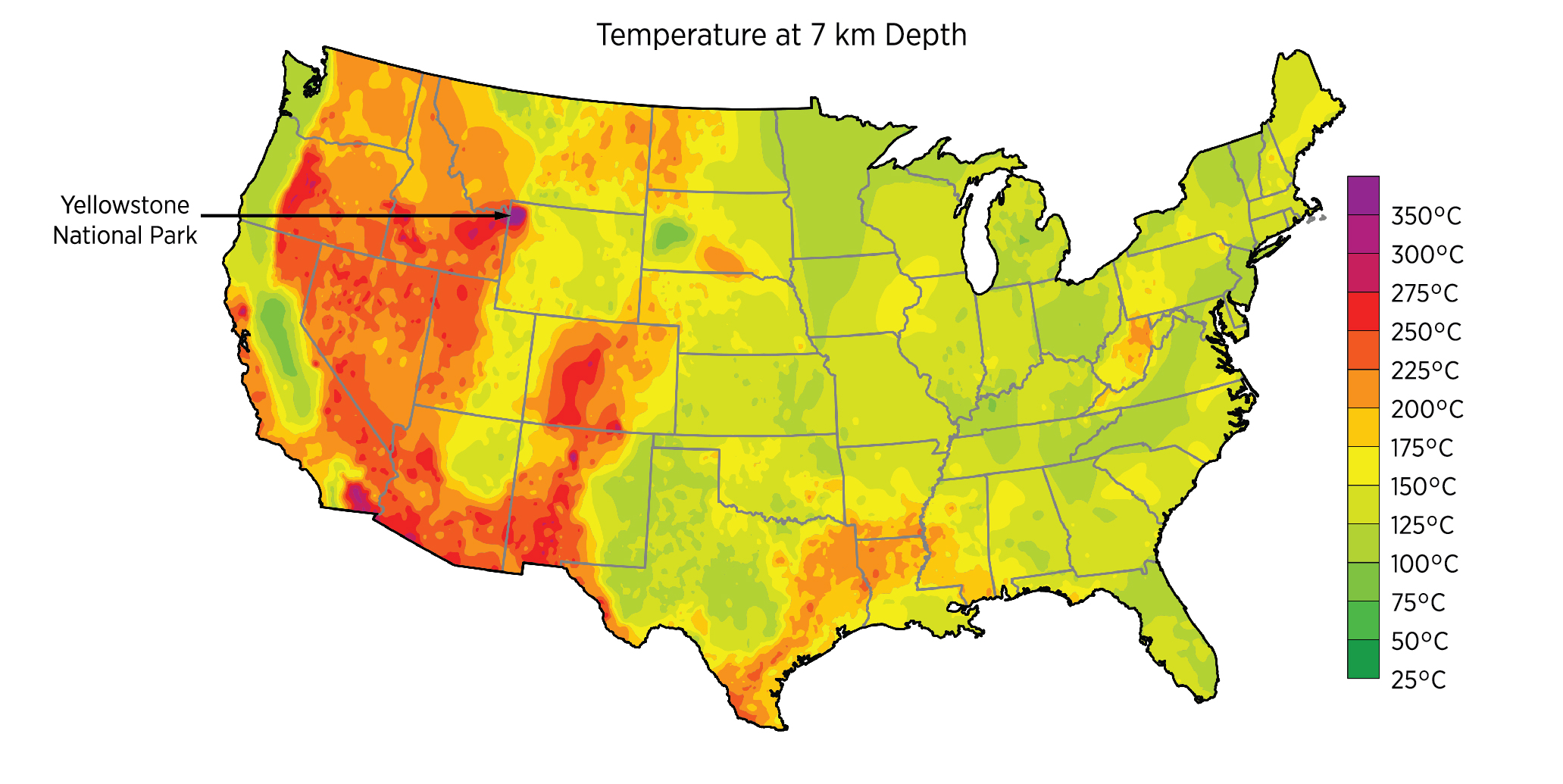
Generally thinking the best is in the West. But not where the people are.
If a process could suck water and CO2 out of the air, that might work rather well in the Great Basin.
Then to make Hydrocarbon fuels. Those could be shipped by various methods.
If geothermal tricks begin to work better, and if Synthetic Labor reduces the cost of the hardware for fuel creation, possibly the cost of the fuel may come down enough to be competitive.
It might be that some sort of solar would also fit into this.
So, there is some hope.
Ending Pending
#1162 Re: Interplanetary transportation » Multi-Ship Expeditions, Starboat & Starship, Other. » 2025-05-11 15:59:18
Vesta may have stored water ice after all, it seems. Not only have they seen evidence of very temporary mud flows from impactors, about 12 years ago it was determined that parts of the little world could have retained ice for billions of years under its soil.
https://scitechdaily.com/scientists-bel … -on-vesta/
Quote:
Scientists Believe Water Ice May Exist on the Giant Asteroid Vesta
By Elizabeth Zubritsky, Goddard Space Flight Center; Jia-Rui Cook, Jet Propulsion LaboratoryJanuary 26, 2012No Comments7 Mins Read
And the surface is partially covered in Carbonaceous materials as well. And there should be asteroids with water and Carbon passing by on a regular basis.
So, Vesta as a "Build-Shop" for Parent and other Stations seems very good for a plan.
I am estimating that Vesta will get maybe 20% of the sunlight of Earth?
At 2 AU the sunlight should be 25% Luminosity I believe.
No matter, in microgravity which can be obtained near Vesta, thin mirrors should be able to concentrate sunlight to provide plenty of power to beam down to Vesta, probably around the clock.
Vesta has been slammed so hard that minerals of value may have been exposed, maybe even Mantle materials almost.
I expect that it will be possible to build synthetic gravity machines on Vesta due to it's low gravity.
Vesta being near to much in the way of Carbonaceous materials, and also the Parent Stations it may build similarly near to the Carbonaceous materials, may be able to synthesize things like Plastics, Paraffin, Carbon, and Water.
These could be shipped to the inner solar system, and in my view a desire would be to deliver them to our Moon.
Crafting methods to deliver such materials to the Moon on the cheap would be desirable. Perhaps delivery to Earth/Moon orbit could be by way of Magdrive, or Neumann Drive.
I favor a Rotavator Skyhook to drop the materials to a near surface situation and then to drop the materials.
This will give lift to the Skyhook.
I am hoping that such a Skyhook could also be impacted by electron beams from the Moons surface to further give it lift. And then I am hoping that the Skyhook can have electron emitters, that will further allow it to propel itself, by ejecting electrons. It might also modify its spin by ejecting electrons.
I am basing this on the work of futuristic thinking for interstellar probes: https://www.iflscience.com/we-could-sen … gest-77525 Quote:
space-iconSpace and Physics
space-iconphysics
PUBLISHED
January 7, 2025
We Could Send A Spacecraft To Our Closest Stars With Electron Beams, Physicists Suggest
Using this method, the probe could potentially reach the star system in decades.James Felton headshot
James Felton
Senior Staff Writer
I don't know if this can be adapted to my desires or not.
It seems that an electron has a tiny rest mass. I am thinking that if you accelerate them to relativistic speeds their mass will increase?
https://en.wikipedia.org/wiki/Electron_mass
I may be over my head though on this.
Ending Pending
#1163 Re: Not So Free Chat » Oil, Peak Oil, etc. » 2025-05-11 15:27:31
kdb512,
I do not so much recommend what China does per Coal and Citizens = Solar Panels, I simply indicate that the process exists, and to some extent is in competition with OPEC and other energy producers. An example is Pakistan, which of course is doing other things just now. But where allowed 3rd world people in the Sun Belt are likely to opt for such solar panels, especially if China can produce useful Synthetic Labor (Robots + AI). For those people large grids may not even be useful, or maybe only partially useful. Of course their current wants and needs are not so high maintenance as for 1st world brat children.
The cost of solar and wind has been going down, and the idea of Synthetic Labor to assist in making those hardware products seems reasonable to me, and I expect that if the robots can do human equivalent labor for $1.00/hour, $0.10/hour or less, the cost of such hardware will go down.
I cannot say other than trends. The idea of practice makes more perfect, also may apply. Probably the Iberian grid problem will be mastered better now, as they should be able to improve it or avoid making it worse.
It is already known that Hydrocarbons will run out so there is some great value in rehearsing solutions for that before "The horse dies". But we have time, if the oceans don't boil. I do think that a lot of the "Green" move was to rebalance reality, in a manner that the elites wanted. The rich were never very fond of industrial people inventors and new money. I think the elites have found a way to manipulate the more ignorant parts of leftist movement from the have nots, to attempt to usurp power from those who are involved in industrial level productivity.
So, as I understand it, you need the "Flywheel" effects of rotating machines such as turbines, to give the fast response?
Perhaps it could be considered to create a Super-Conducting MG SET. (Motor-Generator).
Feed the power from the generator Back to the Motor. Of course I am not proposing a perpetual motion machine, you would have to get make-up power externally for the waste heat generated. Ideally the waste heat could be put to some use. (Maybe this would not be superconductive).
But I believe that with the power you could ramp up the generator or stimulate the generator to pull power spinning down the turbine. Perhaps the Motor would be DC and run off of batteries. Then the Generator would be AC, and could be manipulated as required to fill in a few critical seconds of grid wobble. Of course it is not free, but it might do things that other energy storage devices are poor at or cannot do at all.
Ideally you could pull the waste heat off of this process to heat something. Perhaps some kind of an industrial process.
No guarantees, I'm not Daddy or Moma, but I did try.
Ending Pending
Further thoughts on a MG SET with a Heat Pump>Industrial Heat.
The MG SET could be allowed to heat up to some limit where it would not be damaged. Then it is possible it might tolerate having heat drawn from it down to some safe limit by the Heat Pump. Obviously thermal cycling like that may have some detriment to the lifetime of the equipment, even if kept within reasonable limits. But it is interesting, the Stator Materials and the Rotors, can serve not only as inertial flywheels, but as thermal storage.
I am trying to consider if "Off-Peak-Power" methods could also be incorporated into this. But that gets a bit weird. Sort of like OK your heat pump heats a drum of water to industrial heat, using off peak power if possible, drawing heat from the MG-SET.
In colder parts of the world, perhaps a MG-SET would be better for converting DC Solar to AC, and heating someone's house much of the year or heating their hot water tank perhaps.
Pretty complex, though, costs of hardware may need a lot of synthetic labor to get to a low enough price.
Ending Pending
Here is an example of Synthetic Labor to lower the cost of Solar Installations: https://www.msn.com/en-us/money/other/c … r-AA1EwBfp Quote:
Company makes leap in solar installation efficiency with simple solution: 'We see this as a force amplifier'
Story by Jon Turi • 1d •
3 min read
A heavy lift robot to use in nasty climate situations.
Ending Pending
#1164 Re: Interplanetary transportation » Multi-Ship Expeditions, Starboat & Starship, Other. » 2025-05-11 09:11:14
Asteroid Rings, Active Orbits, Forever Spaceships.
Previously I was starting from a planet and trying to align a network of stations both Circular Sun Orbiting and Elliptical Sun Orbiting.
But now I would like to start in the opposite direction. Making "Anchor Rings", in the Asteroid Belt and seeing if Elliptical Partners of them in "Active Orbits", could facilitate movements of people to and from worlds more inward than the asteroid belt.
I am working with somewhat obvious things, things that have some background in human thoughts before.
Although it is obvious that we will start from Earth, I am anchoring these materials on the idea that it starts from within the Asteroid Belt.
The Asteroid Belt as a collection of materials, probably has everything needed in raw materials, but may be a bit short on some Gases such as Nitrogen, or Noble Gasses.
So, let's do a distributed https://en.wikipedia.org/wiki/Gerard_K._O%27Neill and friends concepts.
Let's make 365 "Parent Stations" (Gender Neutral), in a ring within the Asteroid belt. This is just a number, which may allow labeling each station a unique identity in the ring based on count or the days of the year for Earth. Arbitrary, but a nomination to start with.
Post #50 has some reference materials: https://newmars.com/forums/viewtopic.ph … 31#p231531
Quote:
How far out is the asteroid belt? https://nineplanets.org/asteroid-belt/
Image Quote:
Quote:The asteroid belt is located between the planets Mars and Jupiter, and is about 2.2 to 3.2 Astronomical Units (AU) from the Sun. This is somewhere between 329-478 million km away from the Sun. The space between each of the asteroids is over 600,000 miles.
The Nine Planets
+1So that does not look too bad for what I have in mind.
-Earth/Moon cyclers would have a cycle of 2 Earth years, and if I understand, could almost reach the Asteroid Belt and pass by the Earth Moon. (Unlike a Earth/Moon<>Mars cycler they would not normally pass by Mars.
-Mars/Phobos/Deimos cyclers would have a cycle two times that of a Mars year and would probably penetrate fairly well into the asteroid belt. So, 687 days * 2 = 1,374 days. (1.88 Earth Years to 3.76 Earth Years)
https://www.timeanddate.com/astronomy/p … stice.html
So, a planet with its moons will serve as the perihelion station and there would be two aphelion stations, near or in the asteroid belt for each excentric cycler.
Ceres orbit is 4.6 Earth years
Vesta orbit is 3.63 Earth years
So, if we choose an AU distance that has a year twice that of Mars, then the ring will orbit just outside of the orbit of Vesta. That might be pretty good as over time Vesta would be rotating slowly around the ring of Parent Stations slightly outside of its solar orbit.
What is the distance of Vesta from the sun?
https://www.spacereference.org/asteroid/4-vesta-a807-fa
Quote:
179,738,054 kilometers
Vesta is an asteroid that orbits the sun every 1,330 days (3.64 years), coming as close as 2.15 AU and reaching as far as 2.57 AU from the sun. It is about 525.4 kilometers in diameter and is one of the largest objects, comparable in size to Great Britain. The distance of Asteroid 4 Vesta from Earth is currently 179,738,054 kilometers, equivalent to 1.201475 Astronomical Units. Light takes 9 minutes and 59.5416
So, not a completely circular orbit, at times it may approach or cross the ring of "Parent Stations".
Vesta is thought to be Terrestrial in nature and experienced volcanism. It has Carbonaceous dust on its surface, and some evidence of very temporary liquid water on its surface: https://www.space.com/28352-huge-astero … flows.html
Vesta might be a good place to construct the "Parent Stations" initially and other asteroids passing by may make contributions. It may be possible to have a setup to construct large chunks of "Parent Station" on Vesta and then to put them into orbit but various methods.
And Elliptical Stations might originate in a similar manner, but then go into "Active Orbits", sort of doing a Repeated Active Boomerang inward towards a more sunward Perihelion.
Solid Propellants such as Iron, Aluminum, and Silicon, might be delivered to them by electric propelled robot freighters from the Asteroid Belt.
Also Sunlight and the Solar wind could allow for active orbits, or orbits that can continually shift. Gravitational slingshots might also be a means of active propulsion, but collision hazards may make not as desired for Earth/Moon.
Being able to modify a repeating orbit, Aphelion alignments with "Parent Stations" could be shifted. Also, Flyby of certain planet/moons at Perihelion might be shifted to make better near passes.
Of course, the number of "Parent Stations" and "Elliptical Stations" could be increased a great deal, so for Earth there could be multiple stations passing by each day.
So, you could hook a ride on one of them to go out to the "Parent Stations". If wanting to depart from an Elliptical Station, you would have had to plan ahead to be on one which was planned to pass by the Earth/Moon.
And I suppose Mars could be Shoehorned into this setup with Elliptical Stations that would not go so far inward towards the sun.
The Asteroid Belt could probably supply water, Carbon, and some Nitrogen to the Parent Stations. It is said that even in the inner Asteroid Belt, 40% or so of the objects are Carbonaceous.
https://en.wikipedia.org/wiki/C-type_asteroid
Quote:
C-type (carbonaceous /ˌkɑːrbəˈneɪʃəs/) asteroids are the most common variety, forming around 75% of known asteroids.[1] They are volatile-rich and distinguished by a very low albedo because their composition includes a large amount of carbon, in addition to rocks and minerals. They have an average density of about 1.7 g/cm3.
They lie most often at the outer edge of the asteroid belt, 3.5 au (520 million km; 330 million mi) from the Sun, where 80% of the asteroids are of this type, whereas only 40% of asteroids at 2 au (300 million km; 190 million mi) from the Sun are C-type.[2] The proportion of C-types may actually be greater than this, since C-types are much darker (and hence less detectable) than most other asteroid types, except for D-types and others that lie mostly at the extreme outer edge of the asteroid belt.
"Parent Stations" may "Kiss", that is they may be in two parts and may split apart from time to time to have each section mate with a section from another "Parent Station". Of course, then propulsion is needed. This would be to reduce the forming of "Teams", where they fall into primitive motivations of identity conflict from isolation from each other.
Also, it should be reasonably possible to have solar powered ships that could travel from one Parent Station to another.
-Solar Photon
-Solar Wind
-Solar Electric Reaction, expelling propellant materials.
How such an asteroid belt civilization might link with the planets culturally and economically, is requiring more consideration.
Ending Pending
#1165 Re: Interplanetary transportation » Multi-Ship Expeditions, Starboat & Starship, Other. » 2025-05-10 14:23:07
With a network for Earth/Moon and Mars/Phobos/Deimos, and with electric powered freighters all around there would be some hope of dealing with a human occupied ship which missed its transfer from one cycler to another, or to a home planet/moons.
There might be means of getting to another station and also that a freighter might be able to give assistance.
So, a malfunction on a passenger ship trying to get from one station/world to another would have greater hopes of rescue for passengers.
And so freighters might not have humans on board, but might have included into them methods to help humans with life support and propulsion options.
Ending Pending
#1166 Re: Interplanetary transportation » Multi-Ship Expeditions, Starboat & Starship, Other. » 2025-05-10 13:51:23
A bit of correction for the previous post.
I have the notion that stations where asteroid ores can be processed might exist near the asteroid belt with a 2 Earth years circular orbit, and similarly inside the asteroid belt with 2 Mars years circular orbit.
Cyclers and Semi-Cyclers, with elliptical orbits would then link the plant to its 2X's ring. As propulsive methods would exist, these linking elliptical Cyclers and Sime-Cyclers, would be able to make maneuvers by gravitational passes of there "Parent" planet. Other means of propulsion could come from sunlight or the solar wind. Also, if robot tugs power by electric propulsion could bring materials to these elliptical Cyclers and Semi-Cyclers, then they could have electric propulsions to modify orbits.
So, if you had 365 Stations for the Earth at the 2-year circular orbit, you could give a date name to each one. Say 01-01. Month/Day or Day/Month if you like. If an elliptical Cycler or Semi-Cycler were Phase Tuned to have an aphelion at 01-01, it might propulsively be able to Phase Tune to another one, perhaps an adjacent one by using various means of propulsion.
So, a network of Circular Cyclers, and Elliptical Cyclers and Semi-Cyclers.
The Circular Cyclers could bulk up on materials from small objects from the Asteroid belt and would likely keep a lot of "Tailings" to make their structures from and pass on to the solar exchange system materials of value for sale.
If I have this wrong as a possibility, I would appreciate being corrected.
As I have said as this would be a network of cyclers, humans and some supplies could be exchanged across the network with high propulsion ships. And bulk materials would be exchanged by slow moving electric ships.
This then might weave the Earth/Moon, Mars/Phobos/Deimos in a network involving asteroids of the Maine Belts, and also even terrestrial crossing asteroids.
Materials from terrestrial crossing asteroids may be major contributors to Earth/Moon & Mars/Phobos/Deimos orbits.
While the Terrestrials may receive needed scarce materials, and produce bulk materials like Iron, Aluminum, and Silicon as propellants and for building structure.
Ending Pending
#1167 Re: Not So Free Chat » Oil, Peak Oil, etc. » 2025-05-10 12:07:08
Lots of interesting information unknown to me in your post kdb512. Even so, sometimes we converge.
I think that there is a real chance that with advanced synthetic labor (Robots + AI), the cost of solar and maybe wind will continue down, and that over time the need for hydrocarbons as a portion of energy used will go down. But the desire for more energy will go up at the same time.
I think that the green movement of the West is doing it wrong. You do not kill your horse and walk somewhere to go get a car. You perhaps ride your horse to get a car, and you keep the horse around in case you need it.
China is not the stupid. Use the coal and make solar. Eventually if you keep working with solar you might master it to become a thing of value. If it does, then you can put your coal into retirement if it may be needed later. If it does not and you kill your coal, then someone is likely to conquer you because, you would not have the means to maintain a modern method of existence. In that case whoever conquers you is likely to burn the coal anyway then.
I thought it was amusing to suggest Solar + Natural Gas + Coal to make heavy oil, or to suggest Nuclear + Natural Gas + Coal.
Of course there is no strong reason not to use each separately, unless you want to export Oil to people, we like and want to defend. Internal to the USA it would make sense to use Nuclear, Solar, Natural Gas, and Coal, separately if we would use them.
But since I believe that it is likely that eventually Solar and Wind and Batteries will become more economic in the future because of synthetic labor, it makes sense to me to use our Hydrocarbons to protect the people we like from the "Alien Money" from the people we like less. (Usually those are a variety of anti-USA types).
In conversations prior you have indicated that Global Warming from greenhouse gasses is real, but not to be an intolerable menace to continuation of civilization. I tend to agree.
It appears that the vegetation on the planet is expanding and that the vegetation is better able to sequester CO2 than was thought.
Also, it appears that East Antarctica has begun to accumulate more ice due to increased snowfall, perhaps from global warming.
So, the planet has coping mechanisms in action.
Apparently from calculations, we are next scheduled for an ice age, so a bit of global warming might be useful anyway.
And I think that with synthetic labor in large quantities, extracting CO2 from the atmosphere to make things with such as Hydrocarbons, will become within reach, probably using a variety of energies.
The Green plan is becoming obvious as an AXIS of evil. While its promotion of solar, wind, and batteries was useful, the real intent of it was to be used to destroy industrial societies such as those in the west, as that would suit most other anti-western entities of Authoritarianism. I need not name each one but the resemble the AXIS between Germany, Italy, and Japan, who had a mutual interest in destroying the established structures. I need to say though that I do not hate any of those three. It was just how things worked. They were in transition from the old world to the new world and they faltered because that is a very hard place to operate.
In our country, it is becoming more obvious over time that the Verbal and Violent Elites (Of social movements) have no good intentions towards our kind. They are obviously just a hateful people where previously they were promoted as the "In Crowd".
So really, I think that the USA has a lot going for it now that we can see who they really are. Basically, people who don't belong to the heart of America at all.
I feel sorry for Canada, as it does apparently not emerge yet from the enslavement that the last period of time allowed the enemies to hold America in.
I think we should plan that somehow Eastern Canada will be able to stifle the Tar Sands, so we should be prepared to have things go either way. We can import Tar Sand Oil or not have the option.
Better to be less reliant on things we cannot have sufficient influence on.
Ending Pending
#1168 Re: Interplanetary transportation » Multi-Ship Expeditions, Starboat & Starship, Other. » 2025-05-09 20:25:00
There are other places that volatiles could be brought into the Earth/Moon system from.
-Mercury seems to have thick ice in some of its craters. It also has abundant Carbon. Extremely hard to set up a base on, but once you did, solar power would be very powerful, and to solar effects could also push a loaded freighter out to the Earth/Moon.
-Venus has the Carbon, Nitrogen, and even the Hydrogen. But tricky business to get it up to orbit.
-Mars might be a source, but a deeper gravity well, than Ceres, and a tricky atmosphere situation. Carbon, Hydrogen, Nitrogen available.
-Ceres is the next world, and likely has it all.
-Callisto is a giant source and probably has it all.
But Ceres is at ~3.0 AU. Its gravity well is small but exists.
The Inner Asteroid Belt has about 40% Carbonaceous objects, I understand: https://en.wikipedia.org/wiki/Carbonaceous
https://en.wikipedia.org/wiki/Carbonaceous_chondrite
Quote:
General description
C chondrites contain a relatively high proportion of carbon (up to 3%), which is in the form of graphite, carbonates and organic compounds, including amino acids. In addition, they contain water and minerals that have been modified by the influence of water.[2]
Tiny Asteroids in the asteroid belt: https://www.nasa.gov/solar-system/aster … %20Jupiter. Quote:
NASA’s powerful James Webb Space Telescope includes asteroids on its list of objects studied and secrets revealed.
A team led by researchers at the Massachusetts Institute of Technology (MIT) in Cambridge repurposed Webb’s observations of a distant star to reveal a population of small asteroids — smaller than astronomers had ever detected orbiting the Sun in the main asteroid belt between Mars and Jupiter.
The 138 new asteroids range from the size of a bus to the size of a stadium — a size range in the main belt that has not been observable with ground-based telescopes. Knowing how many main belt asteroids are in different size ranges can tell us something about how asteroids have been changed over time by collisions. That process is related to how some of them have escaped the main belt over the solar system’s history, and even how meteorites end up on Earth.
So these may be boulders in some cases or maybe rubble piles like Bennu or Ryugu, but they are seeming to be "Bite Sized".
https://en.wikipedia.org/wiki/101955_Bennu
Quote:
Water
According to Dante Lauretta,[53] OSIRIS-REx Principal Investigator, "Bennu appears to be a very water-rich target, and water is the most interesting and perhaps the most lucrative commodity that you would mine from an asteroid".[54][55]Predicted beforehand,[56] Dante Lauretta (University of Arizona) reiterates that Bennu is water-rich- already detectable while OSIRIS-REx was still technically in approach.[57]
Preliminary spectroscopic surveys of the asteroid's surface by OSIRIS-REx confirmed magnetite and the meteorite-asteroid linkage,[58][59][60] dominated by phyllosilicates.[61][62][63] Phyllosilicates, among others, hold water.[64][65][66] Bennu's water spectra were detectable on approach,[59][67] reviewed by outside scientists,[68][44] then confirmed from orbit.[41][69][70][71]
OSIRIS-REx observations have resulted in a (self-styled) conservative estimate of about 7 x 10⁸ kg water in one form alone, neglecting additional forms. This is a water content of ~1 wt.%, and potentially much more. In turn this suggests transient pockets of water beneath Bennu's regolith. The surficial water may be lost from the collected samples. However, if the sample return capsule maintains low temperatures, the largest (centimeter-scale) fragments may contain measurable quantities of adsorbed water, and some fraction of Bennu's ammonium compounds.[71] A separate estimate, including other forms of water storage, is 6.2 wt%.[72]
NASA and university sample facilities are preparing to secure, study, and curate the sample, predicted to be rich in water and organic compounds.[73][74][75]
The German SAL (Sample Analysis Laboratory) is preparing to receive cosmochemical water from Ryugu, Bennu, and other airless bodies.[76]
So, water and ammonium.
Also: https://www.nasa.gov/news-release/nasas … bon-water/
Carbon.
Ryugu: https://en.wikipedia.org/wiki/162173_Ryugu
Quote:
Sample analysis results
After the initial description (phase-1), part of the sample was distributed to the Hayabusa2 Initial Analysis Team, consisting of six sub-teams, and two Phase-2 curation institutes at Okayama University and JAMSTEC Kochi Institute for Core Sample Research.[37]In September 2022 the Hayabusa 2 initial Analysis Stone Team announced the results of their study, which includes:[38]
Ryugu samples contain grains that were formed at high temperatures above 1000 °C, which formed close to the Sun and were later transported towards the outer Solar System.
The samples are soft enough to be cut with a knife and the samples preserve the magnetic field like a hard disk.
A simulation of the formation was performed, which showed that the parent body of Ryugu accumulated 2 million years after the formation of the Solar System. It heated up to 50 °C over the next 3 million years, resulting in reactions of rocky material with water. In these reactions anhydrous silicates became hydrous silicates and iron became magnetite. The 100 km large parent body was then destroyed by a <10 km large impactor, with an impact speed of about 5 km/s. Ryugu then formed from material far from the impact.
So, somewhat similar.
How far out is the asteroid belt? https://nineplanets.org/asteroid-belt/
Image Quote: 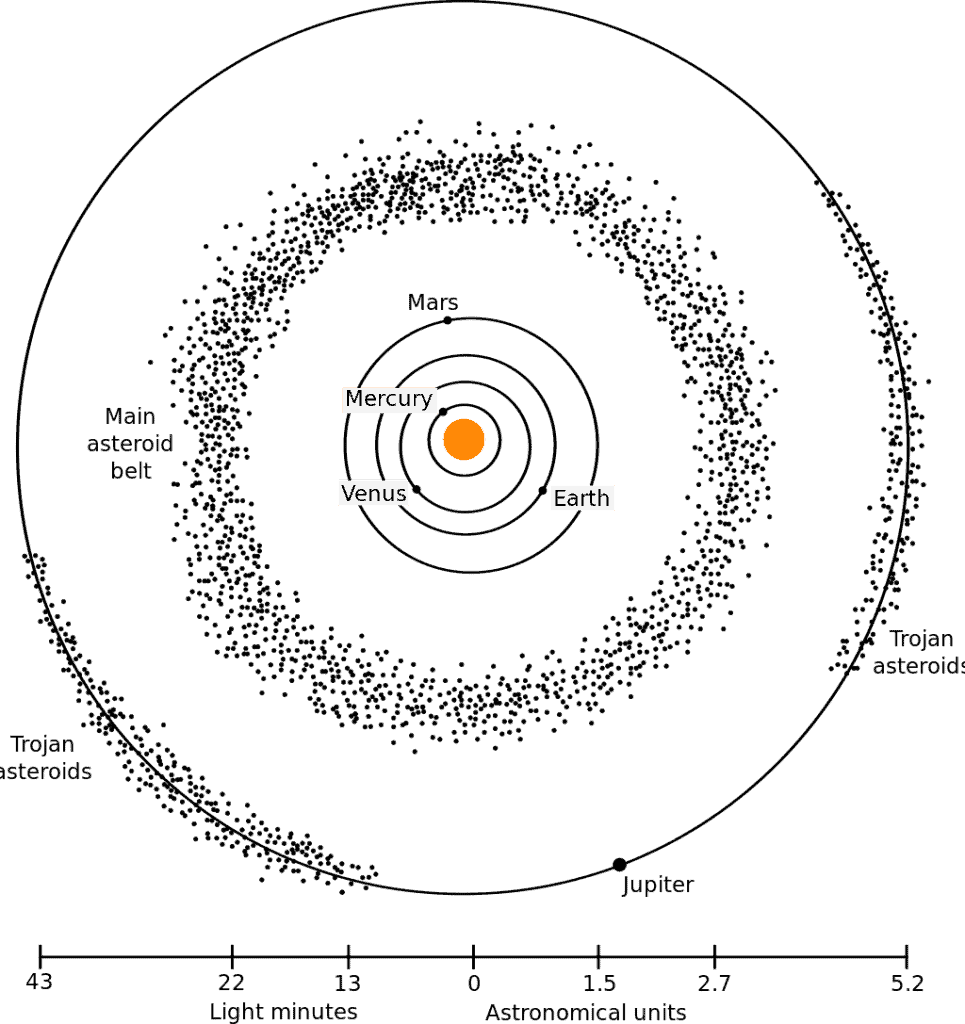
Quote:
The asteroid belt is located between the planets Mars and Jupiter, and is about 2.2 to 3.2 Astronomical Units (AU) from the Sun. This is somewhere between 329-478 million km away from the Sun. The space between each of the asteroids is over 600,000 miles.
The Nine Planets
+1
So that does not look too bad for what I have in mind.
-Earth/Moon cyclers would have a cycle of 2 Earth years, and if I understand, could almost reach the Asteroid Belt and pass by the Earth Moon. (Unlike a Earth/Moon<>Mars cycler they would not normally pass by Mars.
-Mars/Phobos/Deimos cyclers would have a cycle two times that of a Mars year and would probably penetrate fairly well into the asteroid belt. So, 687 days * 2 = 1,374 days. (1.88 Earth Years to 3.76 Earth Years)
https://www.timeanddate.com/astronomy/p … stice.html
So, a planet with its moons will serve as the perihelion station and there would be two aphelion stations, near or in the asteroid belt for each excentric cycler.
And their could be an excentric cycler for every day in a year, or more that that
In the asteroid belt you could have collectors to grab the tiny asteroids and move them to a mother ship. One form could resemble a "Pack Man". The collectors could move these to the mother ship, and when it was full, it might travel to and Aphelion Station for processing.
If you were transferring humans then you would use powerful transfer ships for that. But to transfer cargo, you would likely use electric propulsion devices like Magdrive or Neumann Drive. The ore would have been processed at the Aphelion Stations, and made into things like Iron, Aluminum, Plastics, Paraffin, and Water. The Station would keep some of that to build itself bigger or to make another station. Also, the "Tailing" would be used to build the station(s).
So, a Electric Rocket Barge departing from an Aphelion Station could choose options. It could match up with a Cycler or go directly to a planet. Direct to a planet removes the need for aerobraking.
But it the product was delivered to a Cycler, then when that passed by Earth or Mars, it might release a package to air-brake into orbit.
So, if the Moon and Mars are not sufficient to supply needs for materials then this scheme would possibly work before going out to Ceres and Callisto.
Another function of such barges is that they could travel to a stony terrestrial crossing asteroid in the inner solar system and foster industrial activities and settlement construction at those locations.
Ending Pending
#1169 Re: Science, Technology, and Astronomy » Helium » 2025-05-09 20:14:23
You might also be interested in this: https://www.sciencealert.com/earths-cor … ial-helium Quote:
Earth's Core Could Be Hiding a Vast Reservoir of Primordial Helium
Physics
04 March 2025
ByMichelle Starr
The surprise discovery that one of the lightest elements in the Universe can bind to iron under high pressure to form iron helide means we may have misunderstood the chemistry making up the profoundest depths of our planet.
That's because it means helium could be mixed up in the core, where iron is in its most highly pressurized state in or on Earth. In fact, according to a team led by physicist Haruki Takezawa of the University of Tokyo, our planet's dense heart of iron could harbor a large reservoir of primordial helium.
So, if during formation, the Earth had entrained some Helium that that got buried deep, then it could possibly be bound to Iron in the core.
If true, then Helium percolating up from the core may collect in fractures in rocks. It would not be dependent on the rocks being sedimentary.
Ending Pending
#1170 Re: Not So Free Chat » Oil, Peak Oil, etc. » 2025-05-09 15:39:46
An idea has come to me. Could you combine Coal and Natural Gas, using Solar or Nuclear energy to make heavy oil?
This might provide efficiency as you could run a Natural Gas area and use a Solar or Nuclear power source to combine the Natural Gas the Coal to make heavy oil. Then the heavy oil is easy to transport by pipeline and then to put into a ship bound for Europe or Britain for instance.
If China can burn coal to make solar, I think it should be OK for us to use Nuclear or Solar to combine Coal and Natural Gas.
It would stretch America's energy reserves, and if Canada closes down the Canadian/Alberta Tar Sands, we would be OK.
But Canada going total green? Quite an experiment. Would their talented workers immigrate to the USA?
Ending Pending
#1171 Re: Interplanetary transportation » Multi-Ship Expeditions, Starboat & Starship, Other. » 2025-05-09 13:49:37
Scott Manley delivered here, lots of interesting ideas: https://www.bing.com/videos/riverview/r … &FORM=VIRE Quote:
Launching From The Moon With Silicon Based Rocket Fuel And Other Ideas - Deep Space Questions
YouTube
Scott Manley
240.6K views
I will probably comment on this more later, but....
-Silane mixed with Aluminum powder, could be a slurry, he did not mention that. I don't know if that is to be chemically stable.
-He mentions a Lunar Space Elevator. But I would go for a Rotavator.
-Lets say it drops down to near the surface of the Moon. Building large structures on the Moon, all you would need is a onetime engine, which good control, that could fly up just a short distance and hook onto the space elevator.
If the payload lifted included Iron and Aluminum, then the Space Elevator could have the ability to maintain its orbit using Magdrive or Neumann Drive.
We also have the possibility that Electrons shot from the Moons surface could be used to push the Rotavator.
I don't know if this could be adapted to push a Rotavator or not: https://www.sciencenewstoday.org/relati … lar-travel Quote:
Relativistic Electrons for Interstellar Travel
Muhammad TuhinJanuary 7, 2025
If these things could be done, then large structure could be partially filled with propellants from the Moon and lifted to Moon orbit.
I think that would be rather good.
Ending Pending
#1172 Re: Science, Technology, and Astronomy » Helium » 2025-05-09 12:31:30
Here is a non-petroleum source from the Canadian Shield: https://www.livescience.com/planet-eart … -minnesota
Quote:
Scientists just discovered a massive reservoir of helium beneath Minnesota
News
By Sascha Pare published March 7, 2024
Researchers have discovered a large gas reservoir boasting extremely high concentrations of helium that could boost a dwindling global supply in Minnesota's Iron Range.
So, Helium reservoirs, may exist in rock formations that are different than for petroleum.
Ending Pending
#1173 Re: Interplanetary transportation » Multi-Ship Expeditions, Starboat & Starship, Other. » 2025-05-09 12:16:08
So, from the last post, I am encouraged with the idea that Falcon 9 2nd stages could have value, in use with Starship.
He for a game suggests taping two Falcon 9 2nd stages together as part of a Moon mission.
I would note that if you had an alligator jaw Starship in LEO, and had a collection of Falcon 9 2nd Stages, to put in there, presuming a 300-Ton Cargo in expendable mode for Starship, you might refill several Falcon 9 2nd Stages???
Immediate use would be easier to send something off. But prolonged use may have problems with the LOX freezing the Kerosene so modifications might be required.
But I will note that Kerosene will have less boil-off trouble than other fuels.
https://space.stackexchange.com/questio … 2C400%20kg.
Quote:
The 2nd stage, with the payload attached, has a dry mass of 26,800 kg and a wet mass of 134,300 kg, and a vacuum specific impulse of 348s. This gives it a delta-v of 5,502 m/s.
The 1st stage, including the 2nd stage and payload, has a dry mass of 156,500 kg and a wet mass of 567,400 kg.
But Starship not expendable might lift 100-200 tons to orbit.
So, you might use a Falcon 9 2nd stage as a 3rd stage in a stack perhaps, with a bit of payload being propelled by the Falcon 9 2nd Stage from LEO, if you have a 200 ton payload ability.
However, if you had a Falcon 9 2nd stage fetched from orbit to a reuse, then one Starship launch might have better chances of refilling it and attaching a payload to it.
I know SpaceX is not interested.
But I do have the NEUTRON, Terran-R, and NOVA(Stoke Space) in mind to use with Starship refilling.
Who knows.
Ending Pending
#1174 Re: Interplanetary transportation » Multi-Ship Expeditions, Starboat & Starship, Other. » 2025-05-09 11:35:09
I enjoyed this: https://www.youtube.com/watch?v=gkmOiyS … cottManley
Quote:
Could We Land On The Moon Using Only A Single Starship Launch? Building Apollo With Modern Rockets.
Scott Manley
I like that he came up with a partial solution which would involve two Falcon 9 2nd stages.
He admits that the solution is somewhat perfected.
But I really wonder if an Argon-Electric Rocket could go and get expended 2nd stages and put them to reuse for the Moon? If the get Starship functional to LEO, then that could support a Argon-Electric Rocket that could go and get used space junk which normally is disposed of in the atmosphere.
Ending Pending
His approximate solution achieves a mission to the Moon simulating Apollo, does not expend the Superheavy, but leaves the Upper Stage in orbit somewhere. If you could harvest the Upper Stage Starship to another purpose it might have value.
My hope would be to harvest the metals for Neumann Drive, or Magdrive propellants.
So, better than Apollo on at least two counts. But I admit that he says that this was a approximation of a solution.
Some fun.
Ending Pending
#1175 Re: Not So Free Chat » Oil, Peak Oil, etc. » 2025-05-09 11:07:26
I agree fairly well with what you say. I was just surprised with how competitive economically Tar Sands are.
I think that unlike other administrations, this one would protect the shale industry from a "Kill-Shot" from OPEC, if they tried to drop prices to knock competition from shale out.
If the USA is going to bring industry back into the USA, as they say they will and I believe they will, then I think that America can run on a higher priced oil than its non-continental competitors. That would be because we have a convergence of market, production, and energy sources.
So, for East Asia or Europe to sell into the American market, there are additional shipping costs perhaps? Hard to be sure as much of American population is on the coasts. But yes, I suspect that having production here on the continent reduces shipping cost, so you might not need quite as cheap of an oil source to make a profit as offshore will need. And of course we have natural gas as a substitute for oil which is practical here for reasons that Peter Zeihan has indicated.
So, with any sensible administration, Shale and Canadas Tar Sands would be worth us making an effort to protect from OPEC.
Even without economic protections, Shale benefits from being local, if the production to satisfy our market is here on the continent.
I am not sure what plans are for tariffs for bad actors who produce oil overseas.
My impression is that our Shale Gas will greatly outlast Shale Oil. And then we have Oil Shale in very large quantity, but I am guessing it will never be brought to market if Green and or Nuclear(Fission/Fusion) eventually become viable.
In a video, "The Electric Viking", has indicated the people in Pakistan are tilting strongly towards solar. This may be in part because China offers Coal made solar at a low price, and also because people in such a situation as Pakistan, have lower expectations for what constitute an upgrade in living situations. As 90% of the people in the world live in such sunny places, I would expect that (Coal + China) = cheap solar, which in those parts of the world are likely to become competitive with oil producers. But perhaps not so competitive with North American internal oil.
So, that is another slap in the face for OPEC, it seems.
Ending Pending