You are not logged in.
- Topics: Active | Unanswered
Announcement
#1051 Re: Interplanetary transportation » Multi-Ship Expeditions, Starboat & Starship, Other. » 2025-06-15 14:14:02
If a Magdrive or Neumann Drive process can be matured and expanded sufficiently then it might be possible to use tank materials to go and clean up large chunks of Space Junk.
I even wonder if we could take the ISS to a higher orbit and decommission it instead of dumping it back to Earth.
If the materials could be put to salvage/reuse, then perhaps it has value for that. At the very least it might be converted to radiation shielding, maybe propellants for Magdrive or Neumann Drive.
Inverted thinking again. So much was spent to get it into orbit, maybe it could have value if lifted to a higher orbit by efficient Magdrive or Neumann Drive.
Ending Pending 
#1052 Re: Interplanetary transportation » Multi-Ship Expeditions, Starboat & Starship, Other. » 2025-06-15 13:36:23
The first time I saw an inversion was the Blue Origins Moon lander, with propellant tanks on top, engines and crew below.
So, this inversion might be somewhat similar.
As the cylindrical bottom part does not all have to be pressurized, extendable landing legs could be contained in the cylinder shell along with Header Tanks, Avionics, and maybe a smaller crew/cargo compartment.
This could allow for a tower catch and yet the legs could be in there to extend out of the bottom skirt in the event that was desired.
The cylinder reduced of the dry mass of the main tanks, might be lighter, so that the landing legs don't need to be as substantial.
While sub-orbital for the cylinder and small engines for the Main Tanks is an option, going full orbital with the Main Tanks might be an option as well in which case the Main Tanks will not need any substantial form of propulsion.
The Main Tanks also will likely need subdividing as when you disconnect the Main Tanks from the cylinder, the propellants in the tanks feeding the raptors, needs protection or it would be lost to space.
So, this would add complexity. Even so, extra structure would simply be more metal to orbit.
There would be multiple options to transfer propellants between chambers to prepare for separation. Or you would simply burn the main chambers until near empty, and separate. Other chambers could hold various fluids/propellants.
If Magdrive is able to run on an Aluminum/Lithium Alloy, then it might be able to come down into sub-orbital and take charge of the Main tanks. But it would have to be very powerful engines to do that.
There would only be the trip time from the launch from Florida for instance to the reentry half way around the world.
It is a fun set of Puzzles at least though.
Ending Pending
#1053 Re: Interplanetary transportation » Multi-Ship Expeditions, Starboat & Starship, Other. » 2025-06-15 12:35:05
Then what if for the cylinder bottom half that might do a sub-orbit or full orbit, a heat shield was something that you put on it as if armor on a knight?
The real shell of the cylinder would have the ablative heat shield which is the emergency back-up. The Active Cooling Shield would be slipped over that and clamped down.
So, when the cylinder returned from a mission, you would do primary service to it by exchanging the outer heat shield component.
Upon an exchange with a new Active Cooling Shield, then the Cylinder could be stacked again on a Superheavy, and have a new Main Tanks assembly put on top of it.
If the emergency ablative heat shield had been burned from an Active Heat Shield failure, then of course greater repairs would be mandated.
After a Active Cooling Heat shield had been used once it would require complete analysis and refurbishment or scrapping depending on the results of the analysis.
But if you had more Active Cooling Shields, then this would minimize down time for the 6-9 raptor engines and header tanks, etc. of the Cylinder bottom half of the 2nd Stage.
Ending Pending
#1054 Re: Terraformation » Para Terra formation of worlds with Nuclear and Water, and TARS » 2025-06-15 11:19:34
Thanks for the contribution Caliban.
Here is another concept from my bag of tricks from the past in this case.
The Diagram is not the greatest but....
If you create a reservoir of ice blocks in a basin, then....
Cover it with a Poly sheet, then....
Melt the ice below leaving a ice layer above, then...
Fill "Poly-Pollows with water or an oil, then.....
Lay them like tiles over the poly which is over the ice, then....
Let the fluid in the Poly-Pillows cool/freeze, then....
You have a repairable surface which will protect the ice from sublimation.
The Poly Pillows are weights with envelops to keep the interior materials from sublimation. They will hold down the main poly underlayment sheet so that sunlight will not cause it to billow upward. The Poly Pillow "Tiles" also will have thermal inertia, which will keep the heat of the day away from the ice under the main poly underlayment from rising to sublimation temperatures. They will store the cold of the night.
The pillows can be lifted up for replacement/repairs, and the paysheet underlayment can be patched/replaced.
As the poly or other transparent/translucent plastic ages/yellows you can repair replace, and recycle the yellowed/aged plastic into something else.
For the underwater "Cone-Home" you would need to have something to make a shell out of and then heap dredged soil over the cone, then fill it with air: 
In these things, an attempt is to make as good as is possible with relatively simple and abundant materials.
Ending Pending
So, these can be added to potential "Para Tera Forming" tricks.
Ending Pending
#1055 Re: Interplanetary transportation » Multi-Ship Expeditions, Starboat & Starship, Other. » 2025-06-14 21:50:33
I watch too much utube, I expect.
But I have noticed a trend in things that just started. The panic screamers are now projecting obsessive dread about. Starship being made of Stainless Steel being a mistake. I don't think so. Stainless Steel reduces the dry mass for heat shielding.
The doomsters are trying to say that it can only lift 50 tons to orbit. But I am hearing that eventually it will be 300 tons to orbit reusable.
Now they are going to have an additional launch pad in Florida with 4 launch towers on it. The are going to crank out lots of Super heavies and Starships.
Well, I am going to enjoy watching what they are going to do. I bet there will be some new tricks.
When I suggested a 2 part 2nd Stage where the bottom half could be Stainless Steel, and the top half perhaps something like Aluminum/Lithium Alloy as in Falcon 9 I was not dumping on Stainless Steel. It is just that with a philosophy of changing Starship from a 2 to essentially a 2 1/2 stage device, I think that the top part would never be intended to do air braking or landing on Earth. You could make it of Stainless Steel, but might use something lighter and easier to cut and melt into parts in orbit.
From post #94:
The Starship 2nd Stage, being broken into 2 parts, it would still be able to stay together and go to the Moon. Or you could take it apart suborbital and send only the top part to full orbit. Or you could send the whole thing to orbit and break it apart and send the upper or lower parts to the Moon separately.
I like that flexibility.
The lower part being a cylinder, I am hoping that it could be set up well for active cooling. As I have said before the lower part would have the Raptor Engines, the Header Tanks and the Active Cooling Tank, and Avionics, and Flaps with motors. It might have legs but more likely be caught in a tower.
That is one way to do things, but I bet that SpaceX will make the Starship they are working on work eventually, but in the beginning it seems to be being said that due to ceramic heat shields, they will have to make lots of Starships so that when they return from space they can be Serviced over a period of weeks each.
The desire is a rapidly reusable heat shield, but I see notions that they will settle for lesser accomplishments until that can be created as actual.
Ending Pending
#1056 Re: Terraformation » Para Terra formation of worlds with Nuclear and Water, and TARS » 2025-06-14 14:10:49
One thing I have noticed over time is that the Mars polar areas are regarded as too cold, but for Europa, some people imagine putting settlements in its ice, and artificial lighting in it's oceans.
Mars polar ice caps surely have more solar energy than Europa. It is rather seasonal of course.
But it is a wonderful thing that large masses of ice exist under the soil in the temperate zones, and even near the tropical zone.
Some people now consider that limited melt water is thought to be possible by some in temperate zones where, ice is exposed, and has perhaps just a little maybe 1% dust in it. Exposed ice at the poles is too cold at those high latitudes.
At very low latitudes, exposed ice is likely to evaporate too fast for significant water pockets in the ice.
One way to create an actual biosphere just under the surface of Mars would be to add additional energy into exposed ice.
But if you shine more visible light onto the ice you may heat the surface too much, and it may tend to evaporate. But if you were to microwave the ice from the surface or from orbit, you may leave the surface ice more protected, and yet promote melting deeper in the ice. And natural sunlight might pass though the ice into the melted water.
We might create a photo-aquifer such as may exist at times in the ice mass of Greenland: https://science.nasa.gov/earth/water-on … nland-ice/
Quote:
4 min read
Enormous aquifer found beneath Greenland ice
The headshot image of NASA Science Editorial Team
NASA Science Editorial Team
Jan 06, 2014
Article
A huge lake of liquid water has been discovered under the Greenland ice sheet. The find - a complete surprise given the subzero temperatures at the ice surface - is turning our understanding of Greenland on its head.
Rivers of water can run on the Mars of today. They would be covered in ice, and would suffer fairly high evaporation losses, but they could exist if you had the melt water to make them.
And artificial aquifer in the ice caps of Mars could provide such rivers. Things like ice dams could form, so perhaps also lakes.
Keep in mind that any water evaporated into the atmosphere would return to the poles for the most part. So the polar ice mass would not particularly diminish by this activity.
The result of this would likely be lakes and even seas at the perimeter of the ice caps.
Keep in mind that microwaves that push heat into the ice would also tend to unsettle frozen CO2.
And with the use of other terraform methods, it could be that the air pressure over the Mars ice caps might double or more. This would make liquid water just a little more possible.
So, anyway, down the line it might be possible to partially liquify the ice caps of Mars using microwaves, and to form significant pockets of water around them.
Of course if nuclear fusion becomes possible, then the nuclear fuel will be in the water, and at a proportion much larger than for Earth.
https://www.science.org/doi/10.1126/sciadv.adm7499
Quote:
The D/H ratio in martian water today is roughly four to eight times larger (D/H ~ 0.001) than at Earth (10, 12–14), consistent with the loss of a substantial amount of water from Mars early in its history based on models of the loss processes (9, 10, 15).
When American science insists that this ratio shows that the bulk of water has evaporated into space, they may be correct for the water that has been on the surface of Mars for billions of years. But they may not be talking about the huge oceans of water that are now thought to be deep in cracks in the crust of Mars.
But it does not so much matter anyway. The fuel is already concentrated to higher than Earth levels for the water that would be easy to reach.
But there is a huge mass of ice burried deep in the Mars equator: https://www.space.com/mars-water-ice-eq … ozen-ocean Quote:
A European Space Agency (ESA) probe has found enough water to cover Mars in an ocean between 4.9 and 8.9 feet (1.5 and 2.7 meters) deep, buried in the form of dusty ice beneath the planet's equator.
Image Quote: 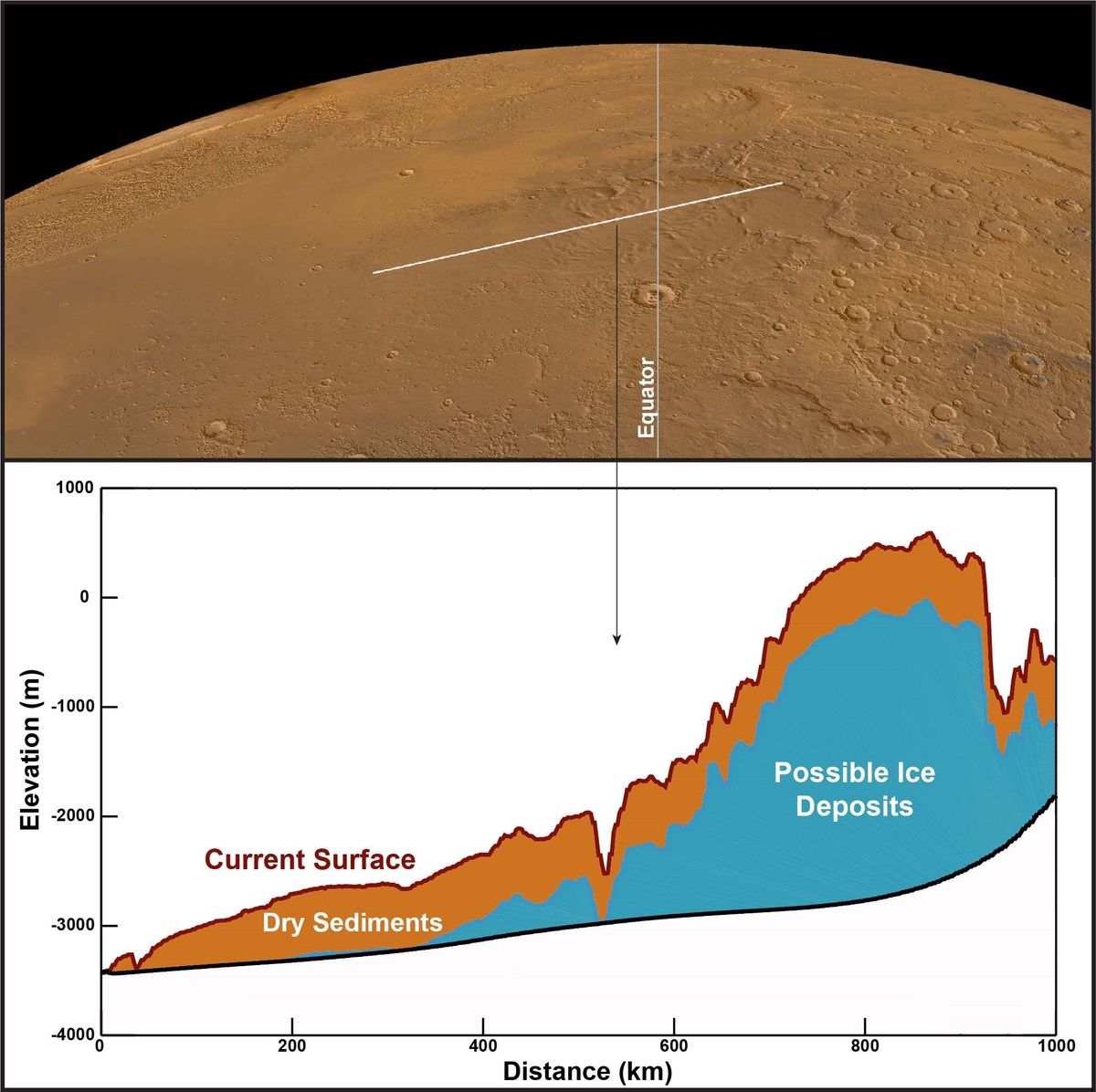
If heat could be projected into it the ice may melt and you would get an artesian eruption of water creating a lake.
If you covered the created ice with domes, you could reduce evaporation rates and collect more heat to inject into the ice. It might be somewhat unstable, so it needs some work.
I have thought that perhaps you could run an electric current into the ice from two or more grounding posts.
But of course I do not favor melting all ice, as I think it can be useful as Structure.
For instance I have various notions of such methods of structure: https://newmars.com/forums/viewtopic.ph … 69#p232069 Image Quote: 
But ice structure and water structure are a bit incompatible, so they might be joined by tunnels and vaults in the bedrock of Mars.
So then "The Boring Company".
Ending Pending
#1057 Re: Human missions » Starship is Go... » 2025-06-13 21:44:04
Here is some interesting blab: https://www.msn.com/en-us/news/technolo … i-AA1AGkg7
Raptor 3 and Vast as topics, Rocket Lab also.
Ending Pending
#1058 Re: Terraformation » Para Terra formation of worlds with Nuclear and Water, and TARS » 2025-06-13 21:13:49
Here is a basic diagram of the concept: 
By keeping O2 at a minimum over the ice and over the dome, it is thought that the damage to the dome will be kept minimized.
The average Mars air pressure being 7 millibar, ice will be stable if the dome prevents the winds from snatching the moisture from the surface of the ice. Inside of the dome even a pressure of 20 millibars would further stabilize the ice.
Here again are the resources I have collected over time: https://newmars.com/forums/viewtopic.ph … 13#p190313
Here is the pressure calculator: https://endmemo.com/chem/vaporpressurewater.php
If we keep the water or ice on the surface of the pond below 17.5 degrees C, the water will not boil.
So, according to the video in post #1 of this topic, ice can block some UV, based on the dust in it, and on the size of the ice crystals.
Normally it would be preferred to keep ice on top of the pond. But periodically it would be possible to melt the ice and reform it, perhaps overnight. You could add sunblock to the ice even, perhaps.
Metal Oxides might help: https://www.mcgill.ca/oss/article/healt … tal-oxides
While Antarctica has natural lakes that allow photosynthesis under ice, the conditions for Mars will be less favorable.
Lake Vanda of Antarctica: https://en.wikipedia.org/wiki/Lake_Vanda
For Mars, the light is more attenuated, and dust wants to cover the dome or ice exposed, and not only that but global dust storms will also block light. It is less likely that direct sunlight though the ice could keep the lake thawed. But that is OK, we can use the lake to store heat from any heat source we have such as concentrating mirrors, or extra power from solar panels, or from nuclear. Nuclear fission is the one that is real at this time, but I am anticipating that some company will get a practical fusion energy method within the next 10 or maybe even 50 years.
Similarly filtered sunlight might drive life in underwater greenhouses, but I anticipate artificial chemosynthesis to be supplemental to growing the crops. The production of extra Oxygen, Acetate, Methane, and Hydrogen would likely be possible from power sources such as photovoltaic, solar-thermal, or nuclear.
But I think that a combination of sunlight and chemicals would provide the broadest possibility for various types of "Crops" to be cultivated.
Where Algae, and Cyanobacteria are simple options, I have also often proposed Hydrilla for various reasons.
https://en.wikipedia.org/wiki/Hydrilla
Quote:
Hydrilla (waterthyme) is a genus of aquatic plant, usually treated as containing just one species, Hydrilla verticillata, though some botanists divide it into several species. It is native to the cool and warm waters of the Old World in Asia, Africa and Australia, with a sparse, scattered distribution; in Australia from Northern Territory, Queensland, and New South Wales.[2][3][4]
The stems grow up to 1–2 m long. The leaves are arranged in whorls of two to eight around the stem, each leaf 5–20 mm long and 0.7–2 mm broad, with serrations or small spines along the leaf margins; the leaf midrib is often reddish when fresh. It is monoecious (sometimes dioecious), with male and female flowers produced separately on a single plant; the flowers are small, with three sepals and three petals, the petals 3–5 mm long, transparent with red streaks. It reproduces primarily vegetatively by fragmentation and by rhizomes and turions (overwintering), and flowers are rarely seen.[3][5][6][7] They have air spaces to keep them upright.
Hydrilla has a high resistance to salinity compared to many other freshwater aquatic plant
But it could be possible to put an air filled farm container in the pond that could grow things like Hemp:
https://en.wikipedia.org/wiki/Hemp
Quote:
Hemp, or industrial hemp, is a plant in the botanical class of Cannabis sativa cultivars grown specifically for industrial and consumable use. It can be used to make a wide range of products.[1] Along with bamboo, hemp is among the fastest growing plants on Earth.[2] It was also one of the first plants to be spun into usable fiber 50,000 years ago.[3] It can be refined into a variety of commercial items, including paper, rope, textiles, clothing, biodegradable plastics, paint, insulation, biofuel, food, and animal feed.[4][5]
Although chemotype I cannabis and hemp (types II, III, IV, V) are both Cannabis sativa and contain the psychoactive component tetrahydrocannabinol (THC), they represent distinct cultivar groups, typically with unique phytochemical compositions and uses.[6] Hemp typically has lower concentrations of total THC and may have higher concentrations of cannabidiol (CBD), which potentially mitigates the psychoactive effects of THC.[7] The legality of hemp varies widely among countries. Some governments regulate the concentration of THC and permit only hemp that is bred with an especially low THC content into commercial production.[8][9]
If you could grow hemp, then it is likely you could grow garden vegetables.
Ending Pending
#1059 Re: Science, Technology, and Astronomy » Humanoid and other robots. » 2025-06-13 20:51:14
It is nice to have something that is not Optimus. I am quite interested in Optimus, but other flavors may have a value of their own: https://www.youtube.com/watch?v=cPBvUxKrLoQ&t=1529s Quote:
The Greatest Bot DEMO Ever w/ Figure CEO Brett Adcock
Brighter with Herbert
121K subscribers
Quite long, but interesting.
Ending Pending
#1060 Re: Science, Technology, and Astronomy » Rotating Detonation Engine » 2025-06-13 17:41:49
A reasonable caution (th). Still, kdb512's broad picture provides a canvas onto which we might hope to apply a Rotating Detonation Engine in time.
Both the engine, and the lightweight materials rebel against the stipulation that the Earth is almost too massive for chemical rockets to get to orbit. We tend to dismiss the Earth as a source of cost appropriate materials for activities in space.
No blame to you (th) to express such a concern, it is appropriate, but I am trying to find a loophole in reality to get just a bit better in the game.
Now, if I bring this material into this topic: https://newmars.com/forums/viewtopic.ph … 54#p232154
Quote: OK I will try to go a bit further with this: 
So, possibly SpaceX could make a propellent transporter like this.
Blue Origin might try to make a "Jarvis" like this.
Relatively Space who has abandoned a reusable 2nd stage, might eventually try something like this.
If something like the Starship system were cut into three stages:
1) The Superheavy would be very close to what is being developed.
2) The Starship would be cut into a base part that would be a cylinder and have almost all of everything except for:
3) The Main Tanks, and perhaps a Rotating Detonation Engine.
Perhaps someday RDE's would replace the Raptors on Starship, but for now a small engine would be a good early method to explore the new technology.
The scheme is a bit different than the standard reuse or expend options for Starship. Section #3 would be mass produced at a low cost, and put into orbit, the liquid propellants could go to a depot above LEO, and the materials of the tank may be reused in orbit to build structures or to provide propellants. I had thought that the #3 main tanks might be made of an Aluminum/Lithium Alloy, but kdb512's option might have merit.
There have been imposed a form of logic that main tanks are of low value. The Space Shuttle abandoned its main tank to destruction although far out ideas existed to bring it to orbit as an option and use it for something.
Vulcan has a similar logic where the 1st stage main tanks are to be discarded and the engines and avionics are to be saved, (Eventually in future versions), by an expandable one-time heat shield.
I want to put is backwards. The main tanks for the 2nd stage still contain some of the liquid propellants, and in my opinion the tank walls if for instance of Aluminum/Lithium, may be useful to reform into orbital structure and/or to be made into propellants for Magdrive or Neumann Drive. Having been lifted to such an altitude with so much cost and effort, the sensible thing is to bring them fully to orbit, perhaps with a small very efficient engine.
Perhaps with a "Rotary Detonation Engine".
In doing this we turn the wet and dry mass of the Main 2nd Stage tanks into value in and above LEO.
We also get rid of the task of bringing the main tanks back though reentry with heat shielding.
And I should explain my intentions for the portion of the 2nd Stage which would not be the Main Tanks or the Rotatating Detonation Engine.
The Cylinder Section of the 2nd Stage as shown in the drawing would need to come down though the air braking, using flaps just like a Starship but not having a pointed nose. The Starship doe not so much glide as to do a sky-dive, so this may not be impossible.
I anticipate that the heat shield method could be active cooling with the Methane Tank having extra capacity to provide the coolant needed.
While this is a significant cost, even so we avoided having to use active cooling for the Main 2nd Stage Tanks, because we left them in orbit.
This version would be created specifically as it might efficiently provide both liquid propellants such as Methane, Oxygen, Argon, Hydrogen, but it's Aluminum/Lithium Structure may be relatively easy to cut into pieces and even melted and used in things like 3D print processes.
So, yes much more than the Rotating Detonation Engine are discussed, but it would be an important part of the whole process.
Ending Pending
#1061 Re: Terraformation » Para Terra formation of worlds with Nuclear and Water, and TARS » 2025-06-13 09:41:15
So, environmental modifications of specific places on Mars may facilitate intentional growing of some "Crops".
I am not so sure that this plant could actually make it on its own on Mars but some have suggested that it could: https://www.newsweek.com/desert-moss-su … nt-1918887
Quote:
A type of moss found in the desert—named Syntrichia caninervis—may be able to survive and grow in the harsh environment of Mars, according to a new paper in the journal The Innovation.
This moss can grow in freezing temperatures as cold as -320.8 degrees Fahrenheit, and can survive levels of gamma radiation that would kill most other plants and life forms.
The plant can also withstand incredibly dry conditions, as well as a combination of dryness, heavy radiation, and cold weather in a simulation of the conditions on the Red Planet.
"Our study shows that the environmental resilience of S. caninervis is superior to that of some of highly stress-tolerant microorganisms and tardigrades," the researchers wrote in the paper. "S. caninervis is a promising candidate pioneer plant for colonizing extraterrestrial environments, laying the foundation for building biologically sustainable human habitats beyond Earth."
Tests in Germany have suggested that Cyanobacteria, Algae, and some Lichen might be able to live in protected cracks on Mars, and even grow. That may be optimistic, but it suggests that the surface of Mars in protected cracks, is on the edge of be habitable by extreme organisms.
So, I would think that if the CO2 reservoirs in the polar caps could be kept evaporated, to the atmosphere, the planet might improve enough for some very hardy life to make it.
Para Terraforming specific locations though might move things closer to productive agriculture.
So, we might try inflatable domes of some kind. Information resources on that can appear here: https://newmars.com/forums/viewtopic.ph … 13#p190313
Post #1 of "Index» Terraformation» Worlds, and World Engine type terraform stuff."
Many useful things are in that post#1. As for the structure of the inflatable domes, the now dormant member SeaDragon had useful things to say. His useful quote is in here: https://newmars.com/forums/viewtopic.ph … 08#p218208 Quote:
Re: Human missions » Construction technology for Mars? » 2020-08-01 09:13:40
SeaDragon
louis,Casey Handmer is amazing but I'd like to add a technical fix to that fluorine access problem for ETFE.
The call for ETFE is based on the impression that UV damage would destroy other types of plastic which is not necessarily true - it's mostly the production of oxygen based free radicals that causes the issue (for quick reading: https://en.wikipedia.org/wiki/UV_degradation ). If you can stop oxygen from inside diffusing into the plastic then UV degradation is greatly reduced and the inclusion of hindered amine light stabilisers (HALS) as copolymers, even making up as little as 0.25% of the total plastic, this can be greatly reduced yet further.
So:
- With a thin layer of something like poly(ethyl vinyl alcohol), usually written EVOH, the majority of oxygen transmission into a plastic habitat skin can be stopped
- A small amount of HALS copolymers stops initial free radical compounds made just after UV absorption in the plastic from propagating and leads to spectacular decreases in corrosion rates before any oxygen that does get through can make things worse.With these fixes we can just use PET or a similarly cheap and easily produced plastic with no crazy elements like fluorine needed at all.
If we reinforce with basalt fibre (very nearly as good as Keflar but far far cheaper than Keflar) instead of Keflar or equivalent we'd be able to build this sort of thing at an industrial scale using only the resources we have on hand + a few low mass imported extras like HALS copolymers, accounting for perhaps 400 tonnes of plastic per 1 tonne of HALS or something.
So, this suggests that even in the UV flux of Mars surface, some means can be employed to limit damage to inflatable or other domes. First of all by adding materials to combat oxidation, and also I think, then that limiting exposure of the dome to Oxygen may help.
So, a minimal method of agriculture might include a dome with only a small amount of relative pressurization and very shallow water might be sufficient to grow a crop of Algae or Cyanobacteria. Methods to limit damage to the dome from the Oxygen that these microbes may produce could include removal of Oxygen from the air by some means, and a layer of ice over the shallow water, with removal of dissolved Oxygen from the water by some means.
As it happens several sources indicate that ice and possibly ice with dust in it may reduce the input of UV though the ice into the water below. So, some sunscreen like value in ice may exist. In post #1 of this topic the video attached discusses that, and also indicates that the size of the ice crystals in the ice may affect the blocking of UV light.
So, shallow pool farming may be possible on Mars.
Of course then I will want to go deeper.
Ending Pending
#1062 Re: Science, Technology, and Astronomy » Rotating Detonation Engine » 2025-06-13 09:31:40
So, that implies to me that over the next 50 years, the method of Starship will eventually be considered outdated. But that does not mean that it is inappropriate now.
I imagine that it will be similar to how we may look at technology made 50 years ago.
But for now Stainless Steel and Raptors are likely to be competitive. But as the other competition emerges, they will all have to try to improve their edge little by little.
With robotic labor hardware costs may go down, in which case building with lighter materials may become the sensible thing to do.
I am glad that there is room for better engines and lighter materials over time.
Ending Pending
#1063 Terraformation » Para Terra formation of worlds with Nuclear and Water, and TARS » 2025-06-12 19:58:24
- Void
- Replies: 37
Due to recent materials available, I think I can justify this topic.
1) https://newmars.com/forums/viewtopic.php?id=11114
Quote:
his video is unique, I think as it has thinking from an actual Scientist, as to how liquid water may naturally exist on Mars near the surface.
https://www.bing.com/videos/riverview/r … 9cdbbc2f11
Quote:How Liquid Water Can Hide on Mars
YouTube
Fraser Cain
94 viewsAmong useful information is how pockets of water could form in exposed ice, and how dust and the size of ice crystals in the ice may protect the water from UV light.
So, I have tried in the past to make devices involving ice and water to grow things on Mars like as to farm.
So, this is quite a resource for me.
Ending Pending
There are several valuable things in the video, among them is that 1/3rd of Mars is covered with ice, usually under soil, except the poles for the most part.
We also believe that Mars has enough water to cover all the surface with 100 feet of water. (30.48 Meters).
This information is important, but what really has me going is that Helion has contracts to sell electricity from fusion, already. Can that fail? Of course, but just imagine the solar system that will exist once some form of fusion is made real and economic in nature.
Here is an article about it: https://www.helionenergy.com/articles/h … microsoft/ Quote:
Helion announces world’s first fusion energy purchase agreement with Microsoft
New facility aims to deliver at least 50 MW and begin producing electricity by 2028, dramatically shortening the projected timeline for commercially viable fusion energy
Could there be some Elon Time? (Not Elon's fault if so). Well likely, but these people have something more than a fusion steam kettle.
And of course many members here will not be surprised if I suggest mass agriculture on Mars using low pressure domes and ice covered lakes.
Taken to an extreme, the entire Hellas Basin and the Northern Basins could become such farms.
And similar technology would be useful on Titan, and eventually perhaps Pluto and Eris.
And so on.
While some may see it as unlikely, I think maybe we should keep such a possible solar system in our basket of possibility.
Ending Pending
#1064 Re: Interplanetary transportation » Multi-Ship Expeditions, Starboat & Starship, Other. » 2025-06-12 12:21:09
Thanks for the post GW Johnson.
I very much think you are correct.
It is nice to know that the tower catch is possible, but what I think SpaceX needs two things just now ASAP,
1) Make the Starship system economically competitive with all other launchers.
2) Learn how to incorporate landing legs on their devices, as needed for Mars and the Moon.
I think they are looking hard at active cooling, so that might protect legs on the windward side.
They know their way around barges and such for Falcon 9. So, probably they can do that and then go to tower catches if there are cases where it makes sense.
Should they want to spread their launch and landing systems around the planet, a "Ship", has some better control properties. If they had a pad on some other nations soil, then there is always the danger of seizure, and ransom. Probably a place like Australia would be relatively safe, but even certain parts of the Anglosphere, have been cuddling up with leftist countries and Archaic Cultures.
Archaic in the sense of not having developed the concept of the one existing with the plural, balanced against each other.
The distribution of power.
So, a landing barge being essentially a ship, could be serviced by a nearby nation commercially, but could in theory be in association with American and SpaceX powers.
Even if such a ship entered the coastal waters of a nation, I think that in peacetime circumstances, a nation could not legally lay possession of it.
And for economics, as mentioned Starship simply has to be a competitive system. The idea of flying Superheavy 3 times a day is interesting, but it might be easier to simply make more Super heavies and fly them less often each.
Ending Pending
#1065 Re: Interplanetary transportation » Multi-Ship Expeditions, Starboat & Starship, Other. » 2025-06-12 09:21:45
A lot of talk here, some of it ambiguous, but interesting:
https://www.bing.com/videos/riverview/r … ajaxserp=0
Quote:
Future Space, SpaceX Drops Big News: Ocean Landings Coming Soon...NASA Is Stunned!
So, we will see.
Ending Pending
#1066 Re: Science, Technology, and Astronomy » Rotating Detonation Engine » 2025-06-11 20:21:08
As it happens, I stumbled upon this today: https://www.msn.com/en-us/news/technolo … r-AA1Gs1WK Quote:
Texas startup making history with revolutionary rocket engine
Story by Brian Spencer • 1d •
4 min read
Quote:
"Detonation engines have been theorized for many, many decades," Duggleby said. "To really frame this in the right perspective - the SpaceX rocket engine is only about 2% better than the Apollo engines that took astronauts to the moon. And that 2% was fought over for decades.
"This technology is a 10 to 30% jump. So it's just, just massive."
Video: https://www.bing.com/videos/riverview/r … ORM=VRDGAR Quote:
Texas startup making history with revolutionary rocket engine
YouTube
Straight Arrow News
1 day ago
Seems like it could change things in space as well.
Ending Pending
#1067 Re: Terraformation » Saturn Space Elevator » 2025-06-11 11:55:01
Tom's imagination and efforts were helpful in broadening the conversation.
But if we go for Helium-3, what might be the economic competition?
On Titan, if you had a form of Fusion, a Deuterium-Deuterium type of fusion, this is radioactive and eventually damages the reactor, but it creates Tritium.
If you made big vaults underground to store the Tritium, then over time it converts to Helium-3.
Titan does not have a water-based biosphere, so you could have dumping grounds for old damaged reactor parts to let them "Cool-Down". Maybe in sealed vaults under the ice.
Using robot labor, it might be possible to recycle the old reactor materials, to make new ones. They would not have to be completely safe for humans as robots would build and run them.
Where the original materials for reactors on Titan would come from, I am not sure. Some people think that the equatorial dunes on Titan are comet dust. Well maybe.
So, the point I am making is that a space elevator to get Helium-3 may be less productive than manufacturing it.
I base my understand on this on what I have read about the Helion reactor concepts.
https://www.helionenergy.com/articles/e … ce-d-he-3/
Quote:
Explaining Helion’s fusion fuel: D-He-3
Dr. David Kirtley, CEO
Quote:
Helion Energy uses a unique fusion fuel called Deuterium-Helium-3 (D-He-3). Helium-3 is a rare form of helium, extracted from natural gas fields in trace amounts and formed from tritium β-decay. Helium-3 atoms become a superfluid at the temperature of 2.491 mK. Helion Energy's project aims to achieve commercial nuclear fusion using Magneto-Inertial Fusion.
Helion
+3
So, a world like Titan might specialize in making Helium-3, and exporting it. The fusion involving Helium-3 is valued as it produces much less harmful radiation.
A Helion D-D fusion will produce harmful radiation but Titan has lots of shielding materials, and liquid water phase is not normal on the surface, so if you put old radiated reactor parts into a place of isolation, such as an ice cave below the surface, it might be that the radioactive decay would drop enough that new reactors could be made from those materials.
Particularly if robots are to build and run the somewhat radioactive reactors.
Of course some other reactor may turn out to be better, or not.
But then the problem of a space elevator for Saturn, where the rings are regularly bombarding the planet with debris, may not have as good a payoff for cost of effort.
Ending Pending
But perhaps Calliban can give us better guidance in this.
Ending Pending
#1068 Re: Interplanetary transportation » Multi-Ship Expeditions, Starboat & Starship, Other. » 2025-06-11 04:38:55
In posts #93 & #94, where a Starship like device were divided into 3 parts, my notion is that the 1st Stage and the lower part of the 2nd stage would benefit from the use of Stainless Steel.
The upper part of the 2nd stage could also be Stainless Steel, but I would think that it might be alternately possible to use the Aluminum/Lithium Alloy or Carbon as a lighter alternative.
Of the three, Stainless Steel, Aluminum/Lithium, and Carbon, the Aluminum/Lithium alloy may be the easiest to cut an melt, to make parts out of in orbit, and also perhaps to make propellant out of for a Magdrive, Neumann Drive, and for rare cases a ship drive using a small mass driver.
As for Fluids to be brought to orbit in the tankage, of course Hydrocarbon Fuels and Oxidizers, and Inert Gas propellants might be suitable.
If Oxygen could be moved from the Moon to LEO, then Hydrocarbons and Ingert Gas propellants would dominate and Oxidizers would be far less worth the trouble to lift from the surface of the Earth.
Ending Pending
#1069 Re: Science, Technology, and Astronomy » Rotating Detonation Engine » 2025-06-11 04:30:42
Thanks, I think that is helpful. A small Rotating Detonation Engine might have value in a mission once your mission is above the atmosphere, is some part of what you posted, I believe.
Ending Pending
#1070 Re: Interplanetary transportation » Multi-Ship Expeditions, Starboat & Starship, Other. » 2025-06-10 20:41:25
OK I will try to go a bit further with this:
So, possibly SpaceX could make a propellent transporter like this.
Blue Origin might try to make a "Jarvis" like this.
Relatively Space who has abandoned a reusable 2nd stage, might eventually try something like this.
The Superheavy of SpaceX, is a cylinder that reenters the atmosphere deeper, and now doing it more sideways.
So, I argue that a Cylinder Reentry might work from Sub-Orbital or maybe even Full-Orbital.
It is starting to look like SpaceX is going to go to metal active cooling for a heat shield.
So, I understand they will want full Starships for various uses, even going to the Moon or Mars. But if you are working with propellant launching, and if the skin of the tanks is valuable in space, then I argue that rather than to heat shield the main tanks and the cargo tanks and to use propulsion to bring the main tanks down, I suggest that it may pay off better to leave the tanks and what is left in them for propellants in orbit.
The Cylinder would be minus the main tanks dry mass, and would be used to bring the engines down, 6-9 of them for Starship, and the Avionics, and the Header Tanks.
As this would be lighter-the main tanks, then landing legs will not need to be as large, and if a catch tower used, then less stress on the catch tower.
Since the main tanks do not have to be actively cooled though the re-entry, then less fluid is used for active cooling.
If the Main Tanks have a small rocket motor to finish them to orbit, then the Cylinder might only do a half orbit and land half way around the planet where there might be a new spaceport with everything to launch it back again on a new stack to again do a sub-orbit.
If the main tanks have engines or not, a orbital tug can go and get the main tanks and bring it to a depot and a rendering platform where the tanks can be converted to other uses.
Ending Pending
#1071 Water on Mars » How Liquid Water Can Hide on Mars » 2025-06-10 20:15:25
- Void
- Replies: 1
This video is unique, I think as it has thinking from an actual Scientist, as to how liquid water may naturally exist on Mars near the surface.
https://www.bing.com/videos/riverview/r … 9cdbbc2f11
Quote:
How Liquid Water Can Hide on Mars
YouTube
Fraser Cain
94 views
Among useful information is how pockets of water could form in exposed ice, and how dust and the size of ice crystals in the ice may protect the water from UV light.
So, I have tried in the past to make devices involving ice and water to grow things on Mars like as to farm.
So, this is quite a resource for me.
Ending Pending
#1072 Re: Interplanetary transportation » Multi-Ship Expeditions, Starboat & Starship, Other. » 2025-06-10 15:57:16
I have some notions I want to try out.
Heat shielding of a 2nd stage appears to be a really nasty problem to solve. I think it will be plenty of trouble to make a Starship with successful heatshield, to go to Mars and land and then come back to Earth and land. I will not try to solve that.
But what I would like to work on is method to get payload to LEO, with optimal results and reduced cost.
For this I propose to cut Starship 2nd stage into two parts, one upper part as payload without heat shield, and the lower part with heat shield and entering the atmosphere with 2 skirts, as a cylinder. The upper skirt to mate with the main propellant tanks and payloads, and the lower skirt as now to shelter the engines during re-entry.
The question will be can a cylinder enter the atmosphere and be protected like the Starship, and land like the Starship.
Pause.............
The upper part of the structure then could be having no heat shield provision as heat shielding is costly, and the upper structure may have it's own value in orbit.
But we would probably like to have a means to bring the engines and some other parts back to the surface of the Earth.
This has parallels to many other attempts at spacecraft.
-The Space Shuttle abandoned it's main tank prior to reaching full orbit. And the tank was not of a very desirable material anyway.
-Vulcan intends to abandon it's propellant tanks to the atmosphere, and then save the 1st stage engines.
-The Blue Origins Moon lander will have propellant tanks on top, which will not be abandoned, but is similar to what I propose.

So, for this version the emphasis is in lifting things to orbit, not in bringing things back from orbit except the upper stage propulsion unit.
This would have the most merit in the case for the part left in orbit having greater value in orbit than to retrieve it to the surface of the Earth.
You could of course put some kind of engine on the part left in orbit and you would then have a 3 stage starship.
Ending Pending
#1073 Re: Terraformation » The Moon » 2025-06-09 21:14:29
I wonder if some form of Starship could carry Dragon tech to the Moon and if it could land in some of those craters, and have robotic equipment to seek useful substances.
I believe that Crew Dragon is reviving the ability to land without parachutes.
That could be more bang for the buck than a human base at the poles. Not that I am against bases at the poles, rather it would harness the will of many people to the Lunar endeavors if useful substances could be found. A better plan than going to the Moon to do DEI, not that I am against people of virtually all types participating if they are useful contributors to good works.
Ending Pending
#1074 Re: Terraformation » The Moon » 2025-06-09 09:31:51
Platnum from the Moon, it seems: https://www.msn.com/en-us/science/astro … r-AA1GjeS8 Quote:
Scientists Say There's Over a Trillion Dollars of Platinum Waiting to Be Extracted From the Moon's Craters
Story by Victor Tangermann • 1d •
2 min read
Quote:
As detailed in a paper published in the journal Planetary and Space Science, independent researcher Jayanth Chennamangalam and his team determined that out of around 1.3 million craters lining the Moon's surface with diameters greater than 0.6 miles across, almost 6,500 were created by asteroids that contain commercial quantities of platinum, among other valuable ores like palladium or iridium.
Well, that is a thing that the public might grasp as worth an effort. And then the other things about the Moon can ride along.
Ending Pending
#1075 Re: Interplanetary transportation » Multi-Ship Expeditions, Starboat & Starship, Other. » 2025-06-09 08:50:34
The information you have supplied may have some merit. It more defines the possibility for things that do not yet exist. From what you say, the liquid Uranium concept is far off if ever.
However, there is some hope for a Nuclear Thermal and Nuclear Electric revival. Even so it would take time for these to become available to commercial ventures like SpaceX and Blue Origin. But when they do, from what you have said, Nuclear Electric can be good from LEO to Geosynchronous, to carry Hydrogen from LEO to Geosynchronous. Having that then Nuclear Thermal may be fairly outside of the Earth's magnetic field. (Maybe it has to be a bit beyond Geosynchronous). Then Nuclear Thermal could serve as a reusable booster.
But these are things that can be incorporated into a transportation network in the future.
For now Solar Electric and Chemical propulsions will have to do the work without the nuclear components.
And in my previous post, I have attempted to seek efficiencies and capabilities that might result by combining different ways that ships could be used each with a specialized role but with a combination perhaps doing more than a generic Starship might.
In this video, an accomplishment from Blue Origin is provided later in the conversation: https://www.bing.com/videos/riverview/r … ORM=VAMGZC
It mentions an item in this article: https://www.space.com/astronomy/moon/lu … r-the-moon Image Quote: 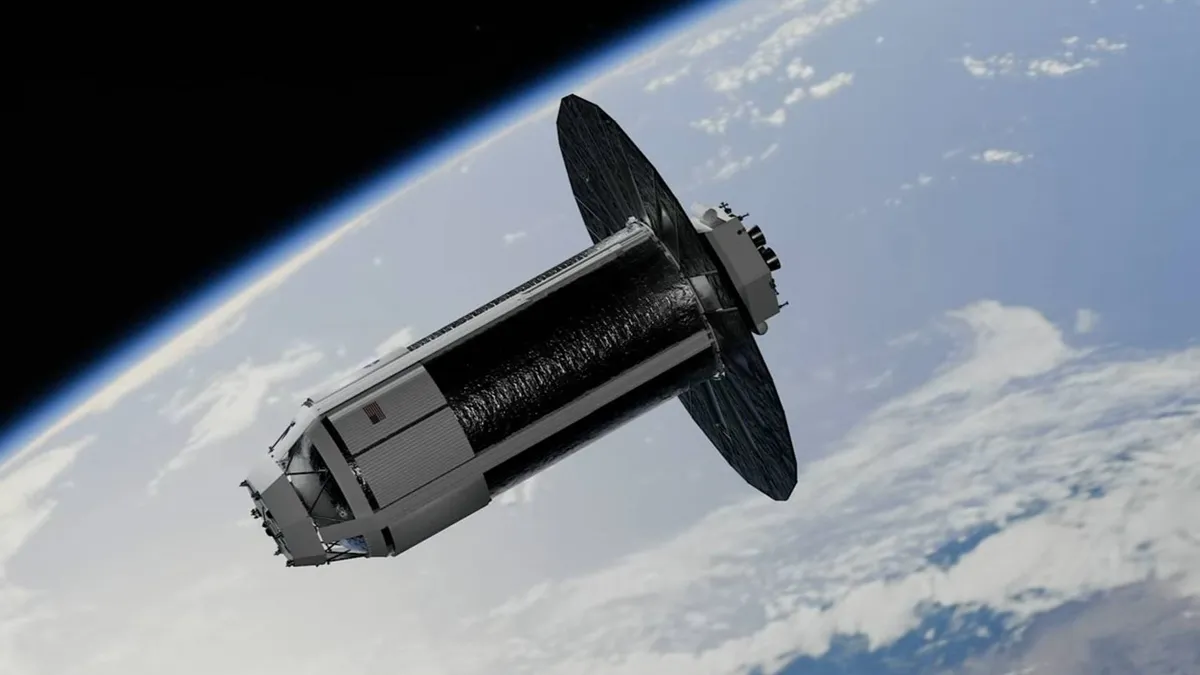
Quote:
Blue Origin's Transporter vehicle is designed to haul hydrogen and oxygen into lunar orbit. (Image credit: Blue Origin)
I consider it to be rather a big item. If you can then send that to the Moon or Mars using electric propulsion, and if it can indeed maintain propellants immune to boil off, it would be even better. It is exciting because, it does not rely on ice water from the Moons poles. This may open up parts of the Moon where polar water is not practical to use.
It I expect that a modified version could carry Methane only. Then if Oxygen from the Moons regolith became available ships could be refueled that use Metha lox.
In my post #90, I suggested this:
Not a fantastic drawing and a drawing of a half-baked idea. But if you want to bake something you have to bake it half way before you can complete the baking:

The "Split" ship could be very basic (Or not), and you would leave behind the fairings section near LEO. Space Stations could in part be constructed from the Fairing section. (Cargo/Crew Compartments). Also, some parts of metals could be converted to propellants for Magdrive or Neumann Drive electric propulsion, to move the Lunar or Mars Depots to and from the Moon or Mars.
The "Locomotive" (Propellant tanks & Engines), could be dropped off in Lunar orbit, and be used to move Oxygen and Oxidized metals/silicates up from the Lunar surface. The Blue Origin Depot could refuel fuel in Lunar Orbit, and the Surface of the Moon could provide Oxygen and Oxidized Solids.
When the "Locomotives" either crash or become derelict in orbit, the metals can be used for various purposes, including Moon bases, Lunar Space Stations, and as propellant for Magdrive or Neumann Drive propulsion methods to send the Blue Origin Depot back to a lower Earth orbit.
Before doing service at the Moon, I hope to see the "Locomotive" be used to boost a combination of a Shortie and Maximum Starship on a flyby of the Moon, where I hope an Oberth burn would have a propulsion payoff.
So, I hope that this scheme could be useful without nuclear, and eventually that nuclear could be integrated into it.
Ending Pending
https://en.wikipedia.org/wiki/Oberth_effect
Quote:
Using an Oberth maneuver around the Moon
The Oberth maneuver around the Moon is a concept in astronautics that involves a spacecraft falling into a gravitational well and then using its engines to further accelerate as it is falling. This maneuver is more efficient than applying the same impulse outside of a gravitational well, as the use of a reaction engine at higher
Ending Pending
So, the hope is to give Starship boosting of various kinds, and to also provide the "Shorty Starship" which may be easier to refill on Mars for being smaller lighter and yet capable of life support for crew to return to Earth/Moon.
The two problems that some people often mention is that when it arrives at Mars it is running on Fumes. Also that the Starship is so big that the task of refilling it on Mars is very hard.
Dr. Robert Zubrin likes the idea of a Mini-Starship, but I think that SpaceX does not want a diversion from the main task of getting Starship ready to service a commercial market. A Shorty might just be a Starship that has gone to a "Chop-Shop" to become smaller in length and so lighter also. Maybe only with 4 engines I sort of hope, two sea levels and two Vacuum. Otherwise using smaller engines from another vendor such as Rocket Lab.
So, trying to extend capabilities by mixing variations and vendors.
Ending Pending