You are not logged in.
- Topics: Active | Unanswered
Announcement
#1026 Re: Human missions » Blue Origin » 2025-06-21 16:59:20
I listened to an interesting video about Blue Origin while I was traveling. Unfortunately, I lost track of it. It indicated that Blue Origin is not looking to compete with SpaceX, but interested in the Asteroids, the Moon, and Mars.
I like that.
It might work if Daddy Jeff can keep money in the bin until they can get some stuff like platinum family metals from the Moon.
That might work nice.
Ending Pending 
#1027 Re: Human missions » Starship is Go... » 2025-06-21 16:33:11
Well, I will buy into that. I have always felt that I am glad that Crew Dragon still exists, and that maybe Dream chaser is moving up the ladder towards eventual crew capability.
We have had a rather good run of luck as far as I am concerned.
If Starship is late in being Moon ready, I guess I have to ask if Blue Origin is Moon ready yet. Not that I have anything at all against them. In fact, I am hearing some encouraging things about them.
But the game is cold and brutal.
Beatings are free and often.
Ending Pending
#1028 Re: Human missions » Starship is Go... » 2025-06-21 10:15:43
I am not trying to gloss over reality: https://www.bing.com/videos/riverview/r … ajaxserp=0 Quote:
Elon Musk just declared: 42-Engine Solution Will DESTROY Competition...
YouTube
Future Space
12 views
45
The item I am most interested in is the claim that with 42 engines, Starship will only need 3 trips to LEO to go to Mars, not 10. I don't know if that is 3 refilling's and 1 Starship, or 2 refilling's and 1 Starship. Most likely the total of 4, at best, I think.
I remain optimistic over the long term for Starship like spacecraft. Knowing one instance where the ship has a fault, is a good thing, this early in the program but at a rather high cost.
A guess I am going to make is that they may have been trying to improve auxiliary thruster method, maybe to deal with the problem of Ullage Gas Method failure in the last flight.
The video try's to be an excessive downer later in its play. It is not as if we burned 3 people to death as happened in Apollo. What is the thing to do? Give up?
Of course not. China and others will not give up and they know how close SpaceX is.
Ending Pending
#1029 Re: Terraformation » Para Terra formation of worlds with Nuclear and Water, and TARS » 2025-06-21 09:31:44
So, while Mars could have a preliminary form of terraforming, perhaps within the next 100 years, I can't imagine that with Fusion the humans and robots would not expand outwards, including asteroids.
Where this could really shine though is in synthetic gravity habitats in orbits. So, in that case Phobos and Deimos are rather convenient, and if Mars can to some extent be a mining planet, that could make a large contribution to such an effort.
In the next 100 years robots could have been solved very well, and in addition at the same time spacecraft from the surface of Mars to lift materials, Mass Drivers? And then Fusion.
So, the idea of digging caves on Mars, or building domes on Mars, es a weakling's reach. Much more should be expected, I feel.
And then you might more often live in orbit of Mars than on the surface of Mars. But anytime you wanted to simulate walking on Mars you could, with telepresence in a robotic device.
And as I said expanding to Titan, may be similar. Living in orbit might be preferred to living on Titan itself.
And then perhaps similar for Pluto and Eris.
https://en.wikipedia.org/wiki/Eris_(dwarf_planet)
It is uncertain if Eris could support a Nitrogen based atmosphere, if given heat from fusion, and also perhaps an artificial magnetic field.
Eris may be less icy than Pluto, which is OK, most likely as I fell that Pluto has much more ices than is needed.
Ending Pending
#1030 Re: Science, Technology, and Astronomy » Humanoid and other robots. » 2025-06-20 11:06:53
I think that this is kind of a good find: https://www.bing.com/videos/riverview/r … 70d50110a0 Quote:
Inside America’s First Fully Robotic Burger Shop w/ Scott Walter
YouTube
FutureAzA
12 views
I do think that this moves in the direction of having a more healthy population. Both the avoid the spread of things like Covid-19, and if done correctly to provide improved nutrition.
And with the possibility of lower prices, ultimately.
Although eating can often be a social event, even so, "Makers" that create food items may use a humanoid robot and a robo-taxi to deliver food to people's homes.
So, people who do not value cooking much, might not even need a kitchen, or not much of one.
I seem to recall that Romans, generally did not do their own cooking but would go and get something. Not sure.
But rather than TV dinners, people might have delivery, which could be healthier, provided that good standards were maintained.
So, could this cut the cost of food in half? Well maybe if you are having the food made for you. But if you are fixing the food yourself then there is a cost of your time and labor.
But this is an interesting "Other" robot sort of thing.
Ending Pending
#1031 Re: Terraformation » Para Terra formation of worlds with Nuclear and Water, and TARS » 2025-06-20 10:10:12
Continuing with the last post, putting the device higher in the sky would help to radiate heat away from Titan. I hope it would not cause the upper atmosphere of Titan shed molecules.
If the dispensing of heat were done lower in the atmosphere of Titan, overheating and the swelling of the atmosphere of Titan.
This would allow more fusion to occur within the environment of Titan, and so more energy for useful work, perhaps from Robots.
Ending Pending
#1032 Re: Terraformation » Para Terra formation of worlds with Nuclear and Water, and TARS » 2025-06-20 09:11:23
Obviously, if fusion of any kind appears, then this would be helpful for a Mars settlement.
I think that possibly terraforming will go relatively fast for Mars, at first. An atmospheric pressure of 2 to 2 1/2 that of the now, and perhaps even some human assisted biospheres possible.
So, of course if Fusion becomes real then the more outer solar system becomes in reach.
Accessing Ceres and Vesta with Space Elevators would be attractive: https://www.msn.com/en-us/news/technolo … r-AA1H1h2x
And I suppose Callisto is worth looking at.
But Titan, if it has no life, with fusion, I expect that Helium would be a byproduct.
Titan with Fusion, would really be valuable. Floating Cities? Helium and Heat. Or at least aircraft that would allow passengers to view Saturn and to get above the Tholen's, perhaps to see the sunlight.
I wonder if we could devise synthetic gravity machines that could operate in the atmosphere of Titan. I will make a basic attempt.
Here is my first try: 
Spheres spinning within spheres, within a box, and with a cone in the center. A sort of Onion Habitat.
I am supposing that Helium from Fusion will be available. So, then by complex methods of mixes of gasses, N2/Helium more on the outside, and then getting to N2/O2 in the cone.
The reason for so many layers is to divide the speed differential of the box to cone, between multiple "Onion" shells. I am supposing that an air bearing effect could work. I am hoping that by dividing the task between layers, none will exceed the sound barrier.
I am also hoping that the dunes at the equator are comet dust as some have suggested.
Multiple layers may also allow the conservation of heat internally. So using Helium and Heat the device might hover high in the atmosphere and the top of the cube would all the viewing of Saturn.
Anyway I am open to criticism.
But with this device losing air pressure to the vacuum of space would not be a problem.
Ending Pending
If Pluto and Triton could somehow be caused to retain a N2 dominated atmosphere, then this might be done there as well. Also, maybe Eris and some other Dwarf Planets.
Fusion Required, however.
Ending Pending
#1033 Re: Terraformation » Para Terra formation of worlds with Nuclear and Water, and TARS » 2025-06-20 08:11:55
The dogma of atmospheric loss to space as the indicator of lack of atmosphere has a challenger now.
https://scienceillustrated.com/space/ma … re-it-went Quote:
Mars' atmosphere mysteriously disappeared - now astronomers know where it went
By looking into chemical processes on Earth, scientists have learned more about where the Martian atmosphere may have gone. The answer could have been right under their noses all along.
But my interest is not in a silly binary conflict. Whatever it turns out is, then is. It will be the discovered reality.
Quote:
In their study, they conclude that the clay on Mars has absorbed the equivalent of 80 % of the planet's initial, early atmosphere, according to a press release.
I am not sure how much this works for Nitrogen, but it seems to work for CO2.
But CLAY is the target of my attention. So, CLAY may be a useful raw material that is in bulk. So, we could hope to do useful things with CLAY.
Products from CLAY: https://www.britannica.com/art/green-architecture
Quote:
structural clay products
So, one thing you could do with clay is to line a pond/canal bottom. I have already suggested that icy permafrost could line a canal bottom on Mars as it allows tundra ponds on Earth, but clay may be helpful as well.
https://www.weekand.com/home-garden/art … 025535.php
While I have suggested that water canals could allow very large canoe like water craft to float on water, even so if sled runners were included then such craft could run on ice. Mars being cold, ice can be a useful material. If it covers a canal, it reduces heat loss, and also evaporation. So, while canal ice might be a way to sled about on Mars, also ramps glazed with ice could be a substitute for water locks. You would only need mechanical portage equipment to pull a "Sled/Boat" up or down an ice ramp.
A primary energy source could be Hydrogen/CO2, it is not forbidden to have artificial lighting. I just might be relatively expensive.
Again from post #12:
So, I suggest an arch of solar panels to cover these canals and to some extent isolate the interior of them from the outside Mars environment.
My expectation is that the organic path in these canals could provide things like Tar or Resins, to make things like Tar Paper and Fiberglass.
Ending Pending
#1034 Re: Human missions » Starship is Go... » 2025-06-19 20:32:16
We should have a concern for bad actors in all of this, as the Starships started to blow up when the Musk Hate showed up.
Ending Pending
#1035 Re: Terraformation » Para Terra formation of worlds with Nuclear and Water, and TARS » 2025-06-19 20:11:38
An article about natural Hydrogen on Earth, possibly could apply to Mars as well.
https://www.msn.com/en-us/weather/topst … p_prftch=2 Quote:
An inexhaustible source of hydrogen hidden beneath our feet? ?
Story by Adrien BERNARD • 1mo •
2 min read
This quote is particularly interesting:
The hydrogen produced can then migrate to the surface or be trapped in geological reservoirs. The presence of impermeable rocks, such as clays, is essential for forming exploitable accumulations.
Another article: https://www.msn.com/en-us/news/technolo … p_prftch=2 Quote:
Vast white hydrogen reserve discovered hidden beneath the Earth's surface
Story by Joseph Shavit • 2h •
5 min read
As for clay on Mars: https://www.msn.com/en-us/news/technolo … r-AA1GTZnq Quote:
The planet Mars is home to thick layers of clay that can span hundreds of feet. Since they need water to form, these outcrops have long been of interest to scientists looking for signs of past life on the red planet.
So, if canals such as I have suggested were built, the Hydrogen and Mars Atmosphere may be the only energy that microbe farming may need, other than to keep water from freezing.
https://www.susupport.com/knowledge/man … -explained Quote:
Precision fermentation process explained
The main distinction between precision fermentation and fermentation is that the microorganisms used in precision fermentation are designed to create a particular end product. Precision fermentation is a more advanced kind of metabolic fermentation, where living organisms convert organic chemicals from the feedstock into usable components.
Of course also to be done would be to grow the organisms themselves.
And I believe that water not much different that polar water from our north and south poles could be sustained inside of the canals that I suggest be built. And polar waters tend to be rather fertile in spite of the cold.
https://www.sciencedirect.com/science/a … 692400020X
Quote:
Precision fermentation involves the rewiring of metabolic pathways in generally recognized as safe microorganisms, fermentation scale-up, and downstream processing to produce food ingredients from abundant and inexpensive substrates24. In agricultural feedstock, microbes use hydrogen or menthol (made with renewable energy) mixed with water, carbon dioxide, and fertilizer135. When bred for specific proteins and fats, these microbes can create meat and dairy alternatives
I expect that a byproduct of this would be Methane, which might be piped around on Mars.
So, we probably have a base for a food chain to make things like more complex hydrocarbons as well.
Ending Pending
#1036 Re: Not So Free Chat » Time Cycles that may influence Humans, other. » 2025-06-19 17:41:53
I thought I might look for evidence of some of what I said in the previous post: https://www.sciencing.com/do-ocean-tide … s-5535690/ Quote:
How Do Ocean Tides Affect Humans?
By Tyler Lacoma Updated Mar 24, 2022Read More: https://www.sciencing.com/do-ocean-tide … s-5535690/
https://www.ojp.gov/ncjrs/virtual-libra … n-emotions
Quote:
LUNAR EFFECT - BIOLOGICAL TIDES AND HUMAN EMOTIONS
NCJ Number 63700
Author(s)
A L Lieber
Date Published 1978
Length 183 pages
Annotation
THE EFFECTS OF LUNAR PERIODICITY ON HUMAN EMOTIONS, AGGRESSIVE BEHAVIOR, AND CRIME RATES ARE DESCRIBED IN THIS POPULARIZED STUDY OF SOCIAL AND ASTRONOMICAL PHENOMENA.
https://shunspirit.com/article/do-new-m … full-moons
Quote:
Influence on human biology Recent research suggests the lunar cycle may have a subtle influence on biological processes, including sleep, the female menstrual cycle, and mood swings in people with bipolar disorder.
I have had a somewhat silly theory that periodically the fertile women in a village get crabby on the same cycle and then the men that are able leave the village to go kill things because of it. Thus, procuring animal food for the females to eat.
But of course I am wondering if a Lunar Tide could produce timing of relative abundance of food and other resource procurement that may be convenient for a womans first month of pregnancy.
Well I have something. I was looking for low tides and high tides: https://astrobackyard.com/how-the-moon- … the-tides/ But there are two of each during one Moon orbit.
OK, due to the Sun and Moon together, this is much more complex than I had yet considered. However I was looking for the Low Tides, and the High Tides. At low tide people could collect food that is stranded in tidal pools, and apparently that would happen most strongly two times a month.
High tides are interesting as they might wash some things up, but I don't think quality food would come that way. Although I recently read an article that indicated that Neanderthals may have eaten magots. But that is disgusting but maybe a very hungry person could do that. I don't know if that could be made safe. Maybe somehow with fire?
https://www.science.org/content/article … their-diet
Quote:
Neanderthals may have eaten maggots as part of their diet
High nitrogen in Neanderthal bones doesn’t mean they were uber-carnivores
19 Mar 202511:10 AM ETByAnn Gibbons
So, then maybe dead fish as lures for insects and for magots? Yum-Yum!
But in much later era's perhaps high tides would affect the ability to run fishing boats, although I am not educated in the details of that technology.
So, I have another sort of, maybe thing.
Ending Pending
OK, dead fish as a lure:
https://fishyfeatures.com/the-shocking- … -revealed/
Quote:
The Shocking Truth About What Eats Dead Fish – Revealed!
Kurt Roberts
Unfortunately, I don't seem to be able to scroll the article.
Quote:
The ocean is a mysterious place, filled with wonders both beautiful and terrifying. One of its greatest mysteries is the question of what happens to dead fish. With so many creatures swimming around, it’s easy to imagine that there are countless scavengers ready to feast on the remains of a fallen fish. But the truth is more complicated than that.
From deep-sea worms to opportunistic gulls, a wide range of creatures play a role in consuming dead fish. But the circle of life doesn’t end there. Bacteria, fungi, and other microorganisms are essential to the process of decomposition, breaking down the fish and returning its nutrients to the ecosystem.
In this article, we’ll explore the fascinating world of dead fish and the creatures that feast on them. We’ll examine the top predators and opportunistic scavengers, as well as the microscopic organisms that break down the remains. And along the way, we’ll discover the surprising ways in which dead fish can actually be beneficial to the ecosystem.
Get ready to dive deep into the world of what eats dead fish, and prepare to be amazed by the strange and wondrous creatures that call the ocean their home.
So, for instance if you could have a throwing stick you might injure a bird that came to feed and capture it. Similarly, perhaps other animals such as crabs? perhaps?
So, I don't really know if a high tide would provide relatively new dead fish, but maybe.
And I do not have a great deal of understanding of any kind of timing that the tides would give. Although some types of fish traps might work better with certain types of tides.
Ending Pending
#1037 Re: Terraformation » Para Terra formation of worlds with Nuclear and Water, and TARS » 2025-06-19 17:30:06
And to continue with the last post, I think that pipelines could run parallel to these canals. Pipelines that could carry Methane, and perhaps manufactured Air, a mix of Nitrogen, Argon, and Oxygen.
And where you did not want to invest in a canal but still wanted the resources, you could build spur pipelines that would bring both of these to a location such as a mineral deposit. By burning these then you would get water, and of course the burning process could involve an Internal Combustion Engine, or turbine.
It occurs to me also that you could condense CO2 by simply compressing it into a pipeline depending on temperature, and so produce both Liquid CO2 and a gas mix of Argon and Nitrogen.
And as my notion of a source for makeup water for this system would involve first temperate latitude ice slabs and then eventually the ice caps, then many ice caves/tunnels/vaults could be carved into the ice.
And as the water you would lose would tend to go back to the poles you would have a means of recovering most of the water ultimately, except for a small amount that might go into space.
As I have said however, I am not against Nuclear and I have high hopes that both Teapot Nuclear Fusion and Helion Nuclear Fusion are likely to emerge in time.
Ending Pending
#1038 Re: Terraformation » The Moon » 2025-06-19 12:40:30
Some fun stuff for the Moon:
https://www.msn.com/en-us/news/technolo … i-AA1G4LRG Quote:
United States shows off how it will mine the Moon
NASA has begun testing the RASSOR (Regolith Advanced Surface Systems Operations Robot),
And this other item: https://www.msn.com/en-us/news/technolo … r-AA1GDRA0 Quote:
Lunar Nets and Rolling Landers Promise a Radical Shift in Moon Cargo and Habitat Engineering
I will look into these more later as I might have time.
Ending Pending
#1039 Re: Terraformation » Para Terra formation of worlds with Nuclear and Water, and TARS » 2025-06-19 11:28:44
Because of the history of "Canals" as a thing on Mars, it will be hard to gain acceptance for canals being of use on Mars.
But I will push it anyway.
I anticipate that Mars will have a power supply partially solar and partially nuclear fission/fusion. It is not that hard to suppose that sort of thing.
Although I don't hold it against them, the associates of NASA have almost a doctrine dogma, that Mars is as it is primarily because of a magnetic field failure and the atmosphere scattered into the vacuum of space by various means.
But there is now evidence that some atmosphere has been trapped in massive amounts of clay, and that the bulk of water on Mars has settled down into cracks in the crust.
Earth does not have that issue, it seems to me because of the recycling of tectonic plates, and also more heat in the crust and also a greater gravity to squeeze the water upwards. Greater gravity gives more vigorous convection. If a planet had zero gravity then water and rock could be mixed together without them separating out.
It appears that Mars has "Fracked" itself, and it's majority of water has settled into the crust well away from the surface.
Although Mars has vast amounts of permafrost, and much of that may be icy deeper down, I have a fear that if we created large bodies of water, the permafrost would eventually thaw, and the water might disappear down this Martian Rabit hole.
So, in water management on Mars, I suggest that a massive number of canals may be recommended, because the cold penetrating the ground at the sides of a canal may permeate under the canal maintaining a permafrost state which would allow the continued pooling of water in such canals.
So, for Mars cold can be considered a resource.
While it may be picturesque to imagine transparent coverings over such canals, I think that recent developments suggest that other notions will serve better on average. For instance, it appears that microbial life like Yeasts, Algae, Cyanobacteria, can grow if we supply them with Oxygen, Acetate, Methane, Hydrogen and nutrients. And they may be more efficient than normal agriculture.
So, I suggest an arch of solar panels to cover these canals and to some extent isolate the interior of them from the outside Mars environment.

While I hope to see various nuclear types available to power Mars, solar could have value anyway, particularly if they can become self-healing and maybe last for 100 years or so.
These canal enclosures could be sealed to some extent against water losses, but the water inside may also be cold and salty.
This again: https://endmemo.com/chem/vaporpressurewater.php
So, for -2 degrees C we have a vapor pressure of 5.2256 millibar.
If we want to be extreme, we might reference Lake Vida in Antarctica: https://en.wikipedia.org/wiki/Lake_Vida
Quote:
Introduction
Lake Vida is one of the largest lakes in the McMurdo Dry Valley region and is a closed-basin endorheic lake. The permanent surface ice on the lake is the thickest non-glacial ice on earth, reaching a depth of at least 21 metres (69 ft). The ice at depth is saturated with brine that is seven times as saline as seawater.[1] The high salinity allows the brine to remain liquid at an average yearly water temperature of −13 °C (9 °F). The ice cap has sealed the saline brine from external air and water for thousands of years, creating a time capsule for ancient DNA. This combination of lake features makes Lake Vida a unique lacustrine ecosystem on Earth.[2]
Quote:
Life
Scientists have found life in an Antarctic Lake Vida that was sealed off from the outside world by a thick sheet of ice several thousands of years ago.[15][16] The discovery of the ecosystem pushes the boundaries of what life can endure, and may inform the search for alien microbes on other planets, such as Mars, or on icy moons, for instance, Jupiter's moon Europa.Species lists
The following eukaryote species have been catalogued within 1 degree[17] of Lake Vida:Kingdom Animalia
Phylum Arthropoda : Alloptes stercorarii (arachnida, mite), Tydeus setsukoae (arachnida, mite)
Phylum Rotifera : Philodina spp.
Phylum Tardigrada : Unknown sp.
Kingdom FungiDivision Ascomycota : Lepraria sp.
Kingdom PlantaeDivision Bryophyta : Bryum argenteum, Bryum pseudotriquetrum, Bryum subrotundifolium, Ceratodon purpureus, Didymodon gelidus, Grimmia antarctici, Grimmia sp., Pottia heimii, Sarconeurum glaciale,
Division Marchantiophyta : Cephaloziella exiliflora
Kingdom ProtistaPhylum Ciliophora : Chilodonella sp., Epistylis sp., Euplotes sp., Halteria sp., Homalozoon sp., Nassula sp., Oxytricha sp., Pleuronema sp., Podophrya sp., Pyxidium sp., Saprophilus sp., Spathidium sp., Sphaerophrya sp., Vorticella sp.
Phylum Sarcomastigophora : Acanthocystis sp., Actinophyrys sp.,
Phylum Euglenozoa : Bodo sp. (kinetoplastid)
So, as unbelievable as it is, it may be possible to domesticate some of these organisms for farming in water at -13 degrees C and with a salt level 7 times that of sea water.
Success in that is not guaranteed but might be possible.
The Vapor Pressure at -13 degrees c would be 2.2128 millibar.
So, in an ideal Mars I would see nuclear as for large cities/settlements, and solar more so for some sort of farming of this kind.
If the cold is too harsh it is always possible to build warmer enclosures for other "Crops", that might grow in Acetate/Oxygen.
As long as you could get water from the canal and energy from the solar panels that may be possible either under water or above water.
We need to keep in mind the possibility that in initial terraform processes for Mars, the CO2 of the permanent ice caps will have been mobilized into the atmosphere and so the atmospheric pressure would be 2 to 2 1/2 times as thick as it is now. So, if an area at this time had a pressure of 7 millibar then it might be 14 to 17.5 millibars, which will make it more practical to maintain a liquid state for a cold brine. But I intend that the canal coverings will have vapor barriers and might even have a slight relative pressurization in them.
My intention is that the canals will be kept hydrated by evaporating tunnel systems into ice masses such as ice slabs and eventually even the polar ice caps.
While these canals might foster a form of farming and may also redistribute water to cities, I also see them as transport corridors.
https://en.wikipedia.org/wiki/Voyageurs
Image Quote: 
We will not have people paddling these though certainly not though rapids.
But if the device were also be double as a sled, then we have a means of transportation either on water or ice, depending on the situation of such a canal. We avoid the wheel for the most part.
This is Mars and the weight of the device will be about 1/3 what it would weigh on Earth. So, I don't thing locks are needed either. I think mechanized lifts and skids over created ice would do very well.
And this would be almost entirely run by robots/machines with AI to control and monitor.
So, this might be a low friction transportation system.
Ending Pending
#1040 Re: Not So Free Chat » Time Cycles that may influence Humans, other. » 2025-06-19 10:15:56
Very good "Kondratiev Cycle"(th). I will take a look at it.
One that has rumors around it is the Moon cycle.
This might have mattered for night-time activities such as hunting or procreation.
I have been told that females cycle together if they are in a building, so going from irritable and unhappy to exuberant, perhaps.
Some have said that this is due to the Moon, which never made sense to me, but a full moon, might be an opportunity to do hanky-panky which might be suppressed socially during the day. In centuries ago, times, it was common for people to sleep in two sessions, they would get up in the night and do something. Although this could be prayers, it might also be things that a social rigor imposed during the day would not allow.
But then the tides. Many people have lived and do live near the tides. This might affect nutrition, and then would be very important to time female fertility. For instance, the first month of a pregnancy could be very important in that regard, to have a successful pregnancy.
I feel it is better to try to understand and to "See", than to bump your head on objects in the dark.
Ending Pending
#1041 Not So Free Chat » Time Cycles that may influence Humans, other. » 2025-06-19 09:38:47
- Void
- Replies: 4
https://www.bing.com/videos/riverview/r … 56de93c124 Quote:
The Surprising Link Between the Sun and Social Revolutions ✊ The Solar Light Spectrum ☀️
YouTube
Stefan Burns
The ideas of this video prompt me to create this topic. If we have better awareness of what might influence human behaviors, then we may hope to ride the cycles and not as much be dragged around by them.
11 years is the average time of a solar cycle, it is said: https://svs.gsfc.nasa.gov/10804
Quote:
Approximately 11-year
The sunspot cycle is a regular, approximately 11-year cycle, during which the number of sunspots increases and decreases over time. The exact length of the cycle can vary, and it has been as short as eight years and as long as fourteen years. However, the length of the cycle is, on average, around eleven years.
4
I would be very interested in the fluctuation of red light / infrared light with the solar cycle.
Now though people do artificial Red Light /Infared Light. Also, now in "Modernized" countries, most people do not work manually in farm fields, under sunlight. Therapy with light is an actual thing. So, if our sun has 11 or 12 year variations that could be important. https://en.wikipedia.org/wiki/Light_therapy
So, I am sort of viewing this as potentially a sort of clock function that you might have in a computer. Minimum might be the 0 and Maximum the 1. So, for periods of time things would get put into the "Todo" bin, but maybe at the Maximum, a clock pulse occurs, and actions are taken on the To Do's.
I would also wonder how this could fit into the claimed "Fourth Turning" cycles.
While it is sensible to understand that where most people inside the agricultural revolution had to work in the fields, in the times of a year where the crops could grow, in so called "Modern" times, this is much less true, except for the relatively undeveloped world.
Now, with the opportunity to be rational, we can ponder the human feature of skin pigment, individual or collective time in the sun, and the wearing of clothing. We often think of short waves such as UV light in this regard, but how do skin tones affect the body response to red and Infared light?
Although I have every reason to believe that I sort of belong to the "White" type, at one point a police officer did ask me if I considered myself to be white. A curious question. Given some sunlight I will tend to have a sort of orange tone. This may be from "Pict" ancestry. The concept of "White" has changed over time anyway. I am definitely not typewriter paper white.
I am not trying to open a door for victim cash-in's though.
A thing I have become aware of concerning the skin tone is the question, "Why did Europeans turn white?". The answer, I believe is "Because they could".
Why do most cave animals turn white? Well, if they have the genes for it, and they do not need protection from sunlight then the process of turning white is in not paying the biological expense to have pigment.
I think it would be good for people to regard it that way rather then to think in terms of racial "Teams" and tribal warfare.
But a useful point is to inquire if different skin tones lead to different reactions to solar minimum and solar maximum.
If so, is it a particular part of the spectrum of light that is the cause?
Ending Pending
https://discoverwildscience.com/deep-in … -1-322888/ Quote:
Lack pigment
Cave animals are often white or translucent because they lack pigment and have no need for camouflage or coloration to attract mates. They also have no eyes or eyes that are poorly developed12
So, there may be a cosmetic issue with pigment. If you spend more time in a low light or blue light circumstance (Indoors), your attractiveness may be perceived differently. And in different lighting conditions the semaphore function of the face may be affected as per communicativeness.
Lots of material to consider.
I believe that the Innuit did not turn white simply because they never inter-mated with people with the genes for pale skin. Some people have thought it was the vitamin D issue as they supposedly got enough from their food, but I don't think vitamin D is the whole story. Even if the pressure was there to become pale, if the genes were not available because of a lack of migration from possessors of such genes and also a lack of a mutation, they could not become pale.
Ending Pending
#1042 Re: Terraformation » Will Mars be terraformed » 2025-06-18 10:00:53
SpaceX seems to think that they can ramp up to produce 1000 Starships a year. That does not quite mention Superheavies.
So, some form of Aquisition of Mars seems possible.
The sub-part of the human population that we have sometimes called European divides primarily into Farmer dominant in the south, Yamnaya in the north, and remnant of hunter gatherer in the Atlantic coast. But in reality, there has been a lot of mixing.
As a opinion of mine, I will say that I think that the Farmer weight in the north of club med, has a tendency to try to organize humans into farm animals. And this is a sort of genocide attempt from above. The Yamnaya, remnant has a tendency to mutual exterminations sideways. The Hunter Gatherers I suppose just happened to leave some traces between being exterminated by these two forces. I will not proclaim the Hunter Gatherers as "Hero Victims" nor will I look down on them either.
I mention this as because we have to deal with the mass phycology of these various groups. This model can be expanded to the whole world, with similar classifications, I believe. If you lived where agriculture was rewarding, then you got into vertical enslavements, as there would be those to rule and those to serve.
If you came from a more north location your existence would have to depend on the development of technology, that was not as dependent on agriculture related technologies. But as soon as you could develop the correct technologies, you very likely would migrate to less cruel habitat. Perhaps obliterating peoples you conquered, or taking them in like herds of livestock.
So, visions of Mars, may depend on the mentality of the group thinks that come out of these populations.
America is to some extent an extension and an expansion of this process. Many of us resent being seen as potential farm hands for the high and mighty, or to be Cattle/Chatel for resentful groups to demand tribute from.
Where I am going to is to see Mars as a portion of a Solar System wide expansion of the human race, and seeing it from American eyes, I am not wanting to cuddle with either the High Elites Vertical Oppression, or the Tribal Horizontal Wars of conquest and exterminations/subjugations.
So, for me Mars is a steppingstone to release a portion of the human race from the power and control of either of the oppressors.
And so the urge to make Mars into a second green Earth does not push on me as much as it might on the Gentlemen Farmer classes, who simply want to meter goods to the serfs and to do the minimal amount of useful work possible.
A means to make Mars more useful to the purpose of keeping the human race from eating its brains seems desirable to me.
The urge to become ever more efficient, is also a pathway to the loss of capability. But you must be sufficiently efficient and competitively efficient and yet competitively capable.
Due to concerns about energy needs, many new sources of energy are on the threshold of appearance to become real. At least it looks that way to me. Among those are fusion.
Fusion will unlock the solar system out to the Oort Cloud and perhaps beyond over a long period of time.
So, Mars modified might be considered a pathway out to that future. And a hope of stopping the human brain from shrinking, and the human race becoming a dim-witted superorganism of specialists who exist to support a population of "Baby-Kings" above, and Mass Murderers horizontally.
So, I prefer to see Mars as not a second Earth, but its own possibly useful thing.
Heating the planet by any method, too much may be counter to that utility of Mars. But what you have suggested, the thickening of the atmosphere, may be useful.
However, we are going to have to evaluate the situation of permafrost. Is permafrost keeping the near surface water from sinking down into the deep cracks of the planets crust?
Mars seems to have a crack problem. Most of the water is down there many Kilometers. I do not know if it is saturated or not. Could more water go down there? If we melted large seas, would the permafrost under them eventually melt and allow the water to drain down there? If so, then we would want to manage the water to keep it from doing that. Small basins such as canals and lakes might be able to maintain a relatively impermeable permafrost bottom. But this would require intricate methods of water management.
But we are somewhat in luck because even a planet Mars with Earth's atmosphere, would be a glacial planet. Without clever tricks such as particles, you mention Calliban, or without an alternate trick, Mars would need an atmosphere of 2 bar to be as warm as Earth on average.
We would be lucky with the particles to get 2 to 2 1/2 times the current amount of atmosphere of Mars.
As you have said this would improve the radiation concern, and from my point of view assist in making things like canals and lakes. Those likely covered in ice and/or covered in artificial enclosures.
So, such a Mars would allow for forms of agriculture, but there would be a technological demand if it is to be done. This may help to prevent "Verbal-Violent" dumb-dumbs from ruling and breeding the human race to stupidity.
In space, where technology is required, "Verbal-Violent" dumb-dumbs will tend to damage the technological infrastructure that their lives depend on, so a sort of self-extermination.
There is some hope there.
I do favor terraforming Mars, but it may be that rather than trying to make it a second Earth, we would be better off making it into a better Mars, from the point of the human need to not loose it's intelligence and ability to co-operate.
Ending Pending
#1043 Re: Terraformation » The Moon » 2025-06-17 22:39:45
Some blab about the Moon: https://www.bing.com/videos/riverview/r … ORM=VRDGAR Quote:
The Apollo Moon Samples Just Changed Everything We Know About the Moon
YouTube
Spacialize
24 views
Maybe deep down the Moon may be different.
Ending Pending
#1044 Re: Interplanetary transportation » Multi-Ship Expeditions, Starboat & Starship, Other. » 2025-06-17 20:29:45
I would like to transfer a concept from another topic to this one: https://newmars.com/forums/viewtopic.ph … 62#p232262
I am going to look at this for the Moon, and express opinions about adaptation of the Starship line of technology to it.
3 Ship Interplanetary travel configuration: 
But I will make some changes. The configuration does not have to be that way.
The primary idea would be to make a Starboat or a Starship-Shortie, and mate it will what basically would be considered to be a depot with Electric rocket engines. If for the moment we ignore the idea that Magdrive or Neumann Drive can be sized up, then this version would perhaps have Argon as its propellant. As it would not travel to Mars, solar power may be acceptable and nuclear may not be, in proximity of Earth.
So, you make some kind of a small ship, Mini or Shorty. You give it a depot to carry with it all the way to the Moon. The small ship will not have enough propellants to travel to the Moon and land and then fly back to the Earth, unless it has the Depot.
So, the small ship and at least one depot ship will couple and it will be possible to transfer Methane and Oxygen to the small ship. The will proceed at a rapid rate to the Moon to orbit it, avoiding the major harms of the Van Allen Belt. The Depot will remain in orbit, and the small ship will land.
Then when it's business on the surface of the Moon is done, the small ship will ascend, and link up to the Depot and get refilled.
The two ships will part, and the small ship will head back rapidly to Earth. The Depot will use electric propulsion to return over a longer period of time, using solar electric power and Argon.
The small ship might airbrake one major event, to acquire the surface of the Earth and land. Or it might attempt to achieve an orbit of Earth. It also might do more than one Air Braking event, but of course the Van Allen Balts are a concern for that.
Eventually it could be true that the small ship could acquire Oxygen from the surface of the Moon. And so then not need so much of it from the Depot.
It is claimed that there is a lot of Platinum family metals available in some craters of the Moon, so the focus on the polar areas might want a modification.
https://www.newscientist.com/podcasts/1 … hyperworm/
I would speculate that with modern Robotic Labor on the Moon, the small ship I have suggested could bring some of it back to the Earth to pay for a Lunar and other space programs.
While the side braking method of Starship looks good, I want to explore another possible option.
This is not high art, but might convey some notions: 
The "Shorty" would have landing legs for the Moon, that are not shown.
The triangle that says Earth Assent Cone, would be taken off from the Ship in LEO, perhaps repurposed.
In a more ideal future reality a one-time heat shield made on the Moon would be placed on it when it landed on the Moon. As you can see, it can have a "Footprint" larger than the diameter of the ship.
If that cannot be created then perhaps and expandable heat Sheid that has been considered for the Vulcan Engine recovery might be used: https://spaceexplored.com/2022/10/27/vu … ield-test/
Maybe something like this: https://www.nasa.gov/missions/tech-demo … -the-test/ Image Quote: 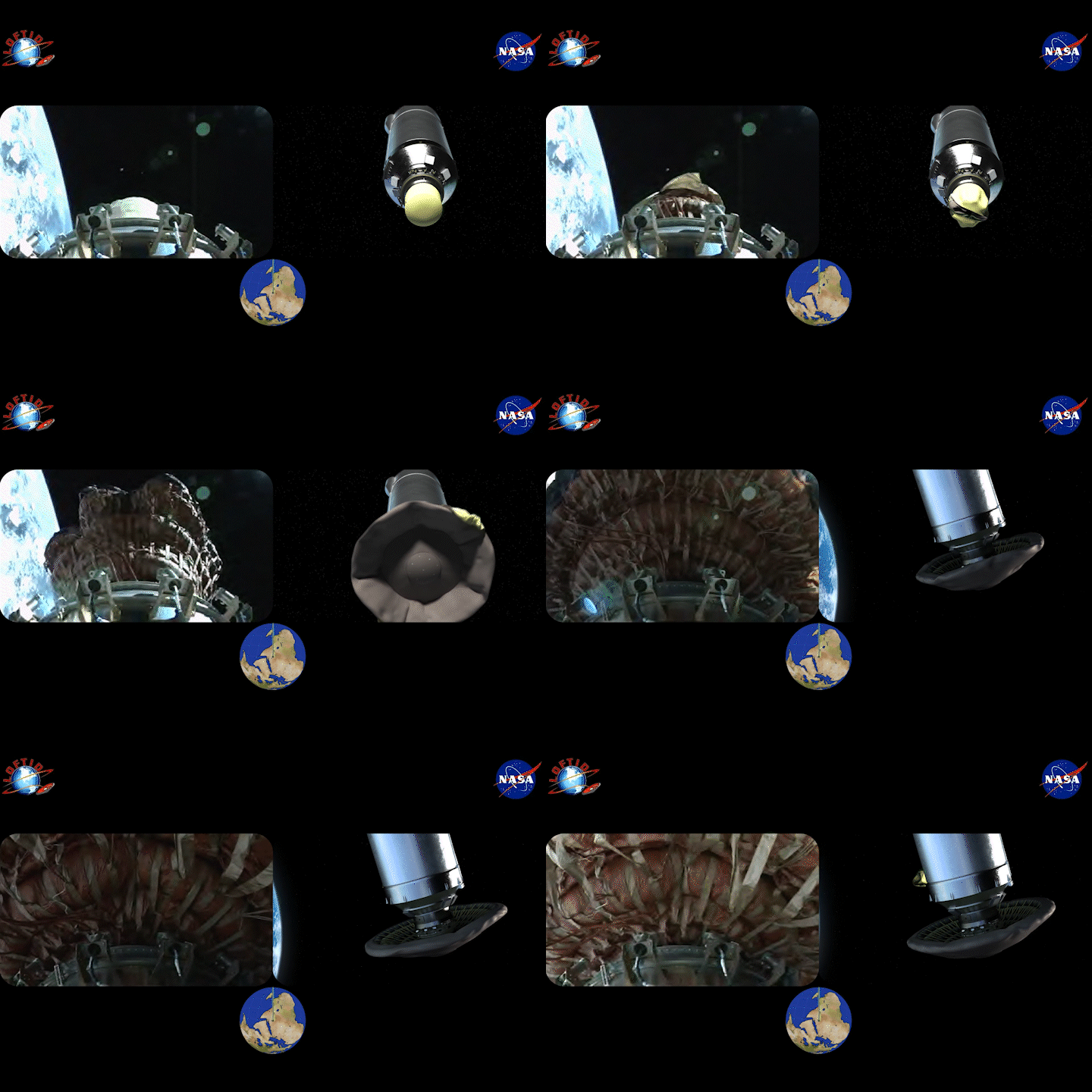
So, they have the right idea. Eventually though a heat shield from Lunar Materials and also Oxygen from the Moon.
And in my drawing I have pirated the idea for the cabin/cargo above the engines and under the propellant tanks.
You can see that concept from Blue Origin here: https://www.blueorigin.com/blue-moon
Here it is again: https://spacenews.com/nasa-selects-blue … ar-lander/
Image Quote: 
I don't think that there needs to be that much human traffic to and from the Moon. Most work on the Moon might be performed by robots of various sorts.
It would be a "Blue-Sky-Day" if all of these components could be joined into a good machine with acknowledgment to those who created the various parts.
Starship Superheavy is the big lifter though!
Ending Pending
The ship if it intends to land on Earth could go heat shield first into the atmosphere, and when appropriate might be able to drop the heat shield, or not, depending on what would be below.
The rest of the trip down it might fall sideways like Starship with Flaps and Moters.
Then finally and engine landing like Starship.
#1045 Re: Terraformation » Para Terra formation of worlds with Nuclear and Water, and TARS » 2025-06-17 15:08:59
Having options is a good thing;
(th): https://newmars.com/forums/viewtopic.ph … 65#p232265
Calliban: https://newmars.com/forums/viewtopic.ph … 67#p232267
So, what is our building site like?
In order to have enough water, we most likely are on or near a very large ice slab.
If we build on the ice slab, then we have to have all the concerns and perhaps more for building on permafrost in the arctic on Earth.
An external shell of rock seems like a good idea, if you can afford it.
Otherwise, if we can find a "Rock Island" in the ice we can dispense with those concerns.
Otherwise, if we extract the ice from the area and have so then exposed firm bedrock we can build in a hole in the ice we created.
I would also suggest an internal ring(s) of cut rock or bricks to serve as ribs so that you can pile something on the starship, perhaps regolith.
The overburden over the ice slabs seems to be a mix of rocks and airborne materials, I am guessing, maybe volcanic or impact debris.
Underneath the ice slab, we have unknown rock, perhaps Basalt, maybe a sort of Sandstone. If it can be Sandstone, then you may carve a sub-ice cave and bring the blocks up to build whatever stone structure is desired.
But it could be that at least in the beginning, a water filled frozen arch of an inflatable could be a more easily and quickly created protection.
Ending Pending
#1046 Re: Exploration to Settlement Creation » Cob, Adobe, Rammed Soil and Dry Stone as Construction Materials. » 2025-06-17 09:17:45
I am sort of working backwards on this due to (th).
I would suggest that if you had a thick Aluminum Foil Liner you might finish the interior of your stone domes. Sounds flimsy, but if the Stone Buildings are weighted down enough then a liner of that sort might be OK. I am presuming you could weld and/or glue this Aluminum Foil into a complete covering able to be air tight. And you probably would want something like a fire extinguisher, that could spray a sealant to plug an accidental leak.
Anyway a liner of some sort also might be of poly perhaps. Of course, Poly might burn.
The LEM, as I recall had walls that were very thick Aluminum Foil in thickness.
Ending Pending
#1047 Re: Terraformation » Para Terra formation of worlds with Nuclear and Water, and TARS » 2025-06-17 09:05:20
(th) has asked an interesting question: https://newmars.com/forums/viewtopic.ph … 55#p232255
Which involves a concept that Calliban is working on: https://newmars.com/forums/viewtopic.ph … 57#p232257
This would relate to building a Stone Arch over a horizontal Starship, instead of a Air/Water/Ice inflatable arch I have suggested.
I agree that the stone arch may be superior. And when it can be implemented it would be of good use.
I feel that a horizontal Starship would not have to have all of its surfaces covered by an arch, Ice or Stone. And of course it you wanted to access the surface of Mars you could not cover it all.
So, basically I am suggesting a "Storm Shelter" about radiation protection, where the greater amount of human activity might occur, such as a bedroom, and a telepresence station to interact with robots from. And then whatever else you needed.
Much of the rest of the ship might have compressed regolith bricks laid on it, to an extent to protect from thermal fluctuations. But not so much weight that the walls of the ship might collapse if the ship decompressed.
Some people have already suggested building with plastic and ice on Mars, at higher latitudes, so the ice arch is not necessarily a silly idea. https://www.marsicehouse.com/
https://www.bing.com/images/search?view … ajaxserp=0 Image Quote: 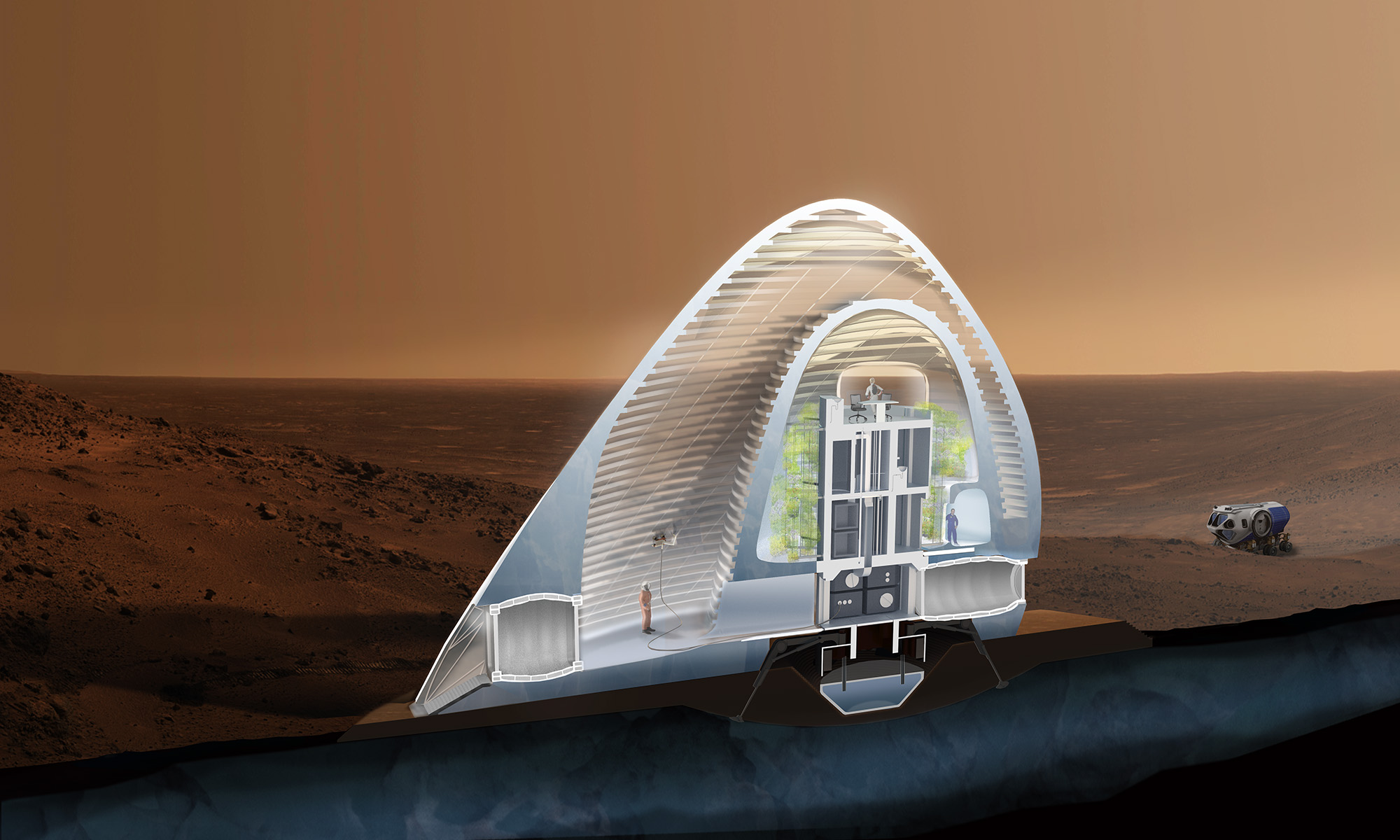

I suppose you might use both horizontal Starships and Ice Houses in the early days of Mars habitation.
I have made the assumption that the ship might land entirely horizontally. However, another option would be that it do a tail landing with a planned topple. You might have only two peg-leg landing legs on the tail end, touch down on them and then intentionally topple the ship with small engines and use small engines to drop the ship horizontal without breaking it. Since the ship wants to tip. Then make it tip as is desired, not as a ship-wrecker.
The other alternative is to land the ship and use some heavy equipment to tip it horizontal.
>>>>>>>>>>>>>>>>>>>>>>>>>>>>>>>>>>>>>>>>>>>>>>>>>>>>>>>>>
The question of how to get a Horizontal Starship to Mars, that is one specifically built up to tolerate the treatment, would be helped by either a Starboat (Mini-Starship) or a Starship Shortie.
Elon Musk does not want to create the Starboat, as he wants to put all focus possible on the current Starship System.
Dr. Robert Zubrin has wanted the Starboat, but it might not come for some time.
So, I have suggested the Starship Shortie. That would be a Starship with as reduced size of length that can actually be a machine that can fly and fly to Mars.
In any case a smaller ship can have value, many people think. But a Shorty may not have enough capacity for propellants to go from LEO to Mars and Land.
If we were to mate a Starboat, or Shorty with a Horizontal Starship, that problem might be solved.
The Shorty or Starboat would have the raptors and the Horizontal ship would have most of the propellants.
We would presume that Freighters would have been landed at the build sites that the small ship and Horizontal ship would target to land at.
3 Ship Interplanetary travel configuration:
The "Horizontal" ships are basically propellant depots for the small ship. The Small Ship might have 4, 6, or 9 raptor engines. I leave it open as to if the horizontal ships would retain raptors after ascending to LEO.
Obviously you would not want to run too much thrust for what I show in the picture.
Depending on resources of propellants, these may all land separately upon arrival to Mars, or if a means to achieve orbit of Mars were possible, maybe one horizontal ship would remain in orbit for return to Earth with?
I don't want to press the matter too much, I am already in a deep pool of speculation. Lets say we don't yet solve for return to Earth, but try to solve for base building.
A Starboat is suggested by Dr. Robert Zubrin to be able to return to Earth from Mars. Perhaps a Shortie could as well.
Ending Pending
#1048 Re: Terraformation » Para Terra formation of worlds with Nuclear and Water, and TARS » 2025-06-16 18:04:38
I have notions for protecting Starships which have been made to be horizontal on the ground.
They are only ideas. Perhaps useful or not. I don't feel comfortable with the notion of piling regolith on top of a Starship. I fear that without braces, if the ship depressurizes the tin can may collapse under the weight of the regolith.
Maybe I am wrong.

Here I do suggest heaping regolith around the lower portions. However, as it is going to be necessary to have lots of water ice to extract water from, I suggest the above.
It would be inflatable with compressed air, and then water would be poured into it from the top and allowed for freeze into ice starting with the bottom. The inflatable would likely be reflective and also the dust that would probably collect on it would protect it from UV light damage.
It is only an option and would be an additional expense to import the inflatable from Earth.
Once the ice was frozen, the arch might not collapse if the Starship is depressurized. Of course, probably a depressurization is a bad thing, but if it happens and you can patch it, you might recover its former value if it has not been crushed.
Here is a revision with "Flanges" to reduce terminal velocity: 
Here again I may be wrong.
Still, I will suggest the above again.
The upper side as shown would have a used one time heat shield on it, the bottom would have had thrusters to allow horizontal landing.
The Lunar Starship is supposed to have special engines to finish the landing.
https://en.wikipedia.org/wiki/Starship_HLS
Global web icon
Wikipedia
https://en.wikipedia.org › wiki › Starship_HLS
Starship HLS - Wikipedia
When within 100 meters of the lunar surface, the HLS variant is planned to use high‑thrust landing engines located in the mid‑body section of the spacecraft to avoid plume impingement with the lunar regolith, [7] though these engines may not be needed. [8]
So, in my notion above, such engines would finish the landing to horizontal using similar engines.
SpaceX has a under shield which is to protect a Starship if the primary heat shield fails. I suggest using just that on this ship. I am also presuming that the ship with flanges could ascend though the atmosphere of Earth with the flanges on, or they would need to be added in LEO.
The flanges are intended to spread the heat load, reducing the peak temperature in a specific place. The Ship would be two faced. The one side with the heat shield would be used to enter the atmosphere of Mars. The other side would have the horizontal landing engines and any landing gear needed. While motorized flaps could be an option, also the landing thrusters could be used to keep the proper orientation of the ship during atmospheric heating. After the burn during entry the thing would have to roll 180 degrees to present its landing engines and landing gear to the surface of Mars.
Gyroscopes are also a possible way to orient the ship during the entry and landing process.
It is possible that this ship may not need raptor engines once it reached LEO. They could be reduced in number or perhaps deleted. You might want to partner it with a Starship with raptors to push it. It would have propellants in it's tanks, that it would share with the "Pusher Ship".
I realize the limits of my ability, but you never know, the blind pig and the acorn thing.
At least I provided the notion.
It can certainly be rejected.
One other thing I like about this is if you refilled the ship, its horizontal engines may be able to levitate it off the surface, so before you embedded it in soil and ice you could move it horizontally. The flanges might allow it to act a bit like a hovercraft.
Ending Pending
#1049 Re: Interplanetary transportation » Multi-Ship Expeditions, Starboat & Starship, Other. » 2025-06-16 09:47:51
So, Blue Origin has in my opinion suggested the first inverted ship, with the propellants "Above" the cabin and landing engines.
https://www.blueorigin.com/blue-moon
I suppose adapting that to a two-part Starship 2nd stage would be somewhat complicated by the downcomers you would need to pass the propellants from main tanks on top, though the lower portion to the raptors.
So, the lower part might be like a torus or doughnut, perhaps the downcomers could disconnect and travel to orbit with the Main Tanks.
Something like this again: 
If it is possible to enter the cylinder/torus/doughnut sideways into the atmosphere, then the cylinder can have a one time emergency ablative heat shield as Starship already now has, and then for primary heat shield a literal primarily metal shield that can be strapped onto the cylinder. The heat shield would be actively cooled probably with Methane evaporation.
I now want to try to borrow thinking from Stoke Space. It's upper stage has engines that overhang the 1st Stage. They could fire from the ground up, and so do work all the way from the surface to orbit.
I don't know how well that could work for the imaginary spacecraft I am thinking about. Of course you don't want to melt the 1st stage by having engines firing too close to its tank walls.
https://www.stokespace.com/nova/
Image Quote: 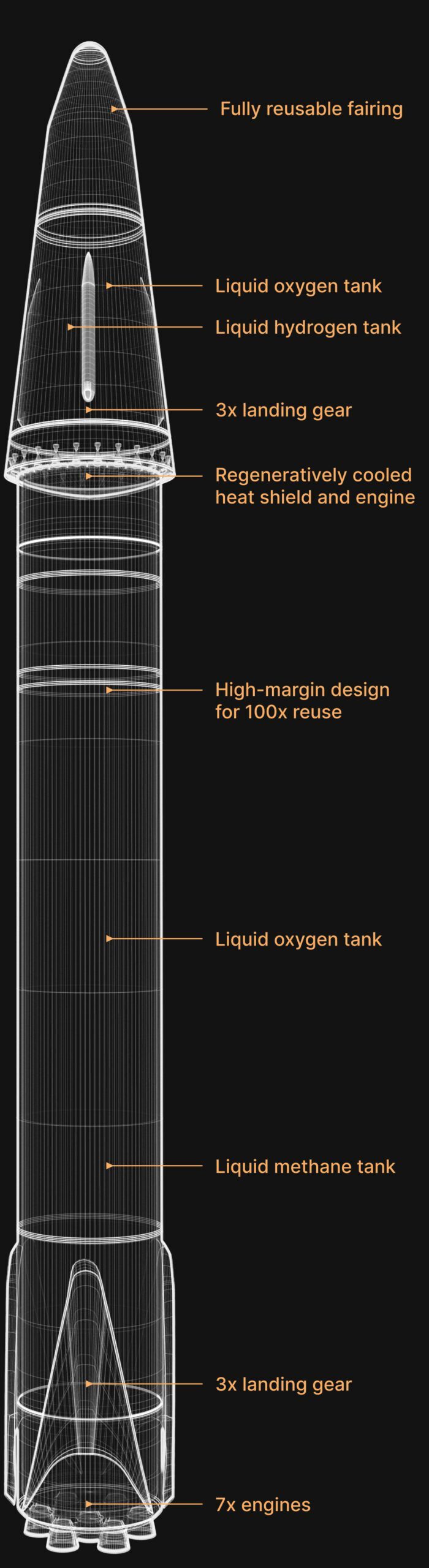
OK, that is a bit of a long shot, I don't think that raptors could be used overhanging the expanded perimeter as they would probably be too violent.
Perhaps some smaller engines in a pattern resembling what Stoke Space is doing.
In any case if you could expand the diameter of Starship larger than Superheavy, then if you are able to do a sideways entry with a strap on Heat Shield, you have a larger surface area which may allow for slightly lower reentry temperatures on the Heat Shield.
Of course it would also cause greater atmospheric losses during launch, but if you could fire perimeter engines, maybe that could be helpful against gravity losses????
One thing I like about strap on Heat Shields, is it may be possible to manufacture them on the Moon. Either Actively Cooled or completely Ablative. If they were substantial enough, they might even allow the ship to survive entry from the Moon at much greater speed than LEO. That and the possibility that Oxygen might come from the Moon even to LEO, would make settling the Moon a useful endeavor.
One version of the ship would have it retain its main tanks and be refilled to travel to the Moon.
Yes, I know these are wild ideas, but just maybe some of it or a cousin to such ideas may be useful in the future.
Ending Pending
.
#1050 Re: Terraformation » Para Terra formation of worlds with Nuclear and Water, and TARS » 2025-06-16 09:19:41
If you have liquid water, nutrients, and an energy source then productivity seem achievable.
The various options for water/ice reservoirs with protective cover probably can limit water losses, but not completely so.
For the temperate ice slabs then I advocate tunnels in the ice to provide ice caves and to provide make-up water.
This may apply to the Equatorial ice masses in some cases. There seems to be one near the surface around Candor-Chaos, but we do not have much certainty of it's nature except that it shows Hydrogen near the surface for an area about the size of Holland.
These things could be done prior to large scale terraform attempts.
To create a starter biome that would be semi-natural, I think the best bet is to melt the polar ice caps to produce ice covered bodies of water. Earth's Antarctica has various of those, some which support Photosynthesis though the ice even.
So, in all cases we want to associate properly measured levels of energy with available ground ice.
Solar is a good one, but I think it needs a boost with nuclear fission and nuclear fusion when possible.
Also existing is the possibility of Orbital Solar with microwave energy beamed down to the surface.
In the case of an artificial body of water like this: 
My thinking is that microwaves from orbit would tend to pass through the ice and would be absorbed in the water, if it can be like a microwave oven.
The characteristic of the Mars atmosphere will be important. It may be desirable to thicken it by adding heat to the polar areas.
This has been considered before, and greenhouse gasses, and special particles are in consideration for that.
This is not to say that you could not put a rectenna on top of the ice to also receive some of the energy.
It has been suggested to melt the poles by various means such as mirrors or even nuclear bombs.
I might think to avoid surface heating. I think that if you could send microwaves though the CO2 layer of the south pole and melt some of the water ice under it, this may conserve the heat to do the maximum evaporation of CO2, rather than for much of the added energy to simply reflect off into space.
A thickened atmosphere would likely improve the radiation problem quite a bit, I understand. But we might not want to go so far as to not be able to use mass drivers from the mountain tops of Mars.
A thicker atmosphere would, I think, make the terminal velocity for a spacecraft landing a lower speed.
So, this would be a level of Para Tera Forming and Terraforming that could be first achievable, and later if the Martians decided they wanted to warm things up more, I guess that would be their decision.
Ending Pending