You are not logged in.
- Topics: Active | Unanswered
Announcement
#9101 Re: Terraformation » Venus » 2014-01-09 17:21:54
I did not find the reference to getting water from H2S04, but I believe you.
Biologically and Thermally processing H2SO4
I recall seeing some type of science program once where they had a fish breathing a very diluted solution of Sulpheric Acid. I am sure the fish did not benefit long term from it, but apparently it could do it short term and use it as an Oxydizer. At least that was what was suggested.
H2S04 could be split into S02 and H20 and 0 I would think the "O" being converted to O2.
Where I am going is that if you had a biosphere, and introduced small amounts of Sulpheric Acid into it, (Perhaps a micro organism soup in a tank), it might might in a natural
way assimilate the H2SO4 and convert it into the biomass and O2. Of course I am including photosynthesis as a part of the process.
Then to earn it's keep it could feed fish. From their fish droppings could be distructively distilled to drive off hydrocarbons, and I hope Sulphur Dioxide.
Burn the Hydrocarbons in Oxygen, and you would be likely to get some CO2 to dump overboard, and also some H20.
As for the Sulphur, I would hope you could generate Sulphur Dioxide and dump it overboard, and hope to create high altitude clouds with it.
http://en.wikipedia.org/wiki/Sulfur_dioxide
Sulfur dioxide emissions are also a precursor to particulates in the atmosphere.
As for the 1 out of 4 Oxygen atoms you would capture, I presume that your floating cities would be expanding and the empty spaces could be filled with it.
Curriously SO2 has a reverse process to convert back to H2SO4, so the cities would have to convert H2SO4 to desired chemicals faster than nature could convert it back to unwanted chemicals.
Another possiblity would be to extract the Sulphur and use it for your shade in the vacuum of space, but then you have to get it off of the planet somehow, and to L1.
I recall reading that Sulphur is a strong metal in the vacuum of space.
#9102 Re: Interplanetary transportation » Atmospheric Grazing » 2014-01-09 14:51:05
My part in this would be the atmosphere grazer to move materials to low orbit.
It was apparently considered worthwhile to move orbital probes this way, but the question would be if it could
also translate into useful resources delivered in an improved fashion in a landing event.
Aerocapture to orbit is an option for a ship delivered to an eliptical orbit. Other methods can deliver a
ship to an eliptical orbit.
So being told of the value of an eliptical orbit I have suggested a Taxi/Assent vehicle.
If a grazer were used perhaps it could have several landers, which would be left behind on the ground, and
the Taxi/Assent Vehicle might be used more than once.
But I might suggest that if a grazer were to have actuators on it's solar panels to change angles, then
a grazer might be able to compensate to a degree for variable atmosphric densities, to achieve the results
desired.
However I am not assured that an ion engine fired during the high part of the orbits can be enough to maintain
a safe or useful graze. That could be hoped, but when it gets to a more circular orbit it may require chemical
thrusters as well.
I am attracted to the notion of landing from a circular orbit, because I presume that more molecules of
atmosphere would be impacted before reaching the ground. A shallower entry angle. And of course the lander
would be moving at a lower speed during the beginning of entry, and perhaps further into it. I am presuming
that it might allow more liberty on the type of heat shield.
#9103 Re: Interplanetary transportation » Atmospheric Grazing » 2014-01-09 11:17:28
Perhaps both can happen. The people carrier in eliptical, the grazer in circular, with some taxi method for the people. But the taxi accumulates costs also. Maybe if the return to orbit craft was the taxi, and the landing craft was with the grazer?
But then you have to join the two in the circular orbit before landing on the surface. This would be a one use method for at least the lander stage.
#9104 Re: Interplanetary transportation » Atmospheric Grazing » 2014-01-09 06:54:29
I did have some arguments about eliptical vs low circular orbit.
True, for one architecture not involving a grazer, eliptical leaves a setup favorable to exiting the Martian orbit to go back to Earth.
However, if you have a highly efficient supply ship then getting out of the Martian gravity well is favored by resources made available at low circular orbit by the grazer.
I have been watching conversations about landers, and how hard it is to deal with the atmosphere of Mars during a landing. How hard it is to have a larger lander.
I would think that being in a lower energy orbit, a low circular orbit might make it just a bit easier, also getting back up the the orbital ship of course should be easier for a launch from the surface of Mars.
But I will see what you have to say.
#9105 Re: Interplanetary transportation » Atmospheric Grazing » 2014-01-08 19:00:11
Thats fine, I understand I am surely a lightweight in this area. I just wanted to get some answers. Nothing Marsshaking in what I presented, I will think about what you have replied with. I am still curious if aerobraking with the solar pannels of an ion rocket could earn their keep.
#9106 Re: Interplanetary transportation » Atmospheric Grazing » 2014-01-08 17:33:29
I hear that and accept it as good thinking.
I am just thinking that some people want to get the crew down to the surface for radiation protection, so this would be a deviation, but I am thinking that with a supply ship grazed in to low orbit, and then a true Aerobraking crew capture, then might it take a few days to refit for landing with what the two ships had, then go down if all is good, from a low circular orbit. Less energy to shed with a heat shield on the lander.
I would wish that the heat shield from the crew insertion ship could be used in the landing, but I suppose it has to an ablation type heat shield, so would be used up.
I wonder if aerocapture experiments could be done with Earths atmosphere first. Get up into high Earth orbit, and then fire the engines on the experiment ship to direct the device to aerocapture into the Earths atmosphere at a high speed. That would then perhaps provide some understanding of how to do it with Mars? Or are they already confident that they know what they are doing?
Also there is a possible for an abort back to Earth, if all is not good with the equipment inventory.
#9107 Re: Interplanetary transportation » Atmospheric Grazing » 2014-01-08 14:52:44
So could true aerocapture be used with a personed mission, and have a Ion Drive with grazing place some suppies in Mars orbit before it arrives?
#9108 Re: Life support systems » Crops » 2014-01-08 11:31:34
In the case of the polar ice caps, I am thinking of them as condensers for a solar concentrating power generating system, with a fluid such as Ammonia
or Ammonia/Water mix.
If the top of the ice layer is at some very cold temperature, just a guess, 100 degrees below (Pick your units), it is not likely to vaporize, but a layer of ice of sufficient thickness, transparent or translucent could insulate the ocean, holding in the heat. Even if the ice surface slowly vaporized, it has no where to go ultimately but back to the poles under the current tilt of the planet.
Ideally, I would prefer to just boil water, and quench it directly into ice water, but of course the sea water would be of poor quality for that, and the above surface piping would be subject to freezing during down time. However a massive seasonal energy source that also provides a biosphere in the current Martian or improved Martian conditions has to be of interest.
Further, just generating Oxygen and Methane and injecting them into the ocean should generate biological activity, and any Methane and Oxygen leaked to the atmosphere will simply make Mars more habitable. It stands to reason that if such a process were running leakage would occur.
It might be that Ammonia and Ammonia/Water would freeze, but perhaps there is another suitable fluid to drive the turbines.
I would also mention that I believe that Mars gets more solar energy at it's poles than the Earth, because of the tilt.
#9109 Interplanetary transportation » Atmospheric Grazing » 2014-01-08 09:10:22
- Void
- Replies: 17
I wonder if the process of atmospheric grazing could support delivery of materials to Mars?
http://mars.jpl.nasa.gov/mro/news/index … NewsID=142
It has been done to help deliver automated missions to Mars already.
I guess I am thinking of an electric rocket system with solar panels. The objective would be to reduce the required propulsion mass for the delivery, by
using the solar panels as aerobraking devices after the electric rocket gets into Martian orbit. Grazing is a possiblity, and perhaps it could even be investigated if such solar panels could also serve as high altitude wings, but that makes it more complicated. I don't think active surfaces would work well at high altitudes such as flaps, but still it is an interesting thought.
The method if used could help to move payloads to low orbit. Perhaps consumables, fuel, and Oxydizers, or perhaps a lander.
Of course this would be in support of a following human mission to Mars.
It might also be involved in collecting samples from Phobos and Demos prior to achieving the low orbit.
#9110 Re: Life support systems » Crops » 2014-01-07 11:23:15
While I fully support the ideas pesented so far, there can also be this type of thing.
http://en.wikipedia.org/wiki/Inuit_diet
Inuit diet
From Wikipedia, the free encyclopedia
Jump to: navigation, search
Inuit elders eating Maktaaq.Inuit consume a diet of foods that are fished, hunted, and gathered locally. This may include walrus, Ringed Seal, Bearded Seal, beluga whale, caribou, polar bear, muskoxen, birds (including their eggs) and fish. While it is not possible to cultivate native plants for food in the Arctic, the Inuit have traditionally gathered those that are naturally available. Grasses, tubers, roots, stems, berries, fireweed and seaweed (kuanniq or edible seaweed) were collected and preserved depending on the season and the location.[1][2][3][4][5][6][7]According to Edmund Searles in his article "Food and the Making of Modern Inuit Identities," they consume this type of diet because a mostly meat diet is "effective in keeping the body warm, making the body strong, keeping the body fit, and even making that body healthy".[6]
Of course the sea mamals are not an option, and the tundra plants are iffy, but the fish and seaweed might be possible.
Enclosures could be ice covered or made of manufactured materials, or both. In early days water would likely come from lower lattitude glaciers, but later when Mars is more developed, I see no reason not to liquify the polar caps into ice covered bodies of water, once the atmosphere becomes thick enough for stable ice, and then later after that there could be open water.
Energy for life could be though Ice or water (Depending on the thickness of the atmosphere), and also artificial lighting underwater, and also chemicals could be manufactured to drive living things like fish and shell fish ecologies. Such exist on Earth today.
#9111 Re: Terraformation » Methods of terraforming - How to go from bone dry & lifeless » 2013-12-23 11:18:07
I decided not to start a new topic, maybe this is an OK place.
Calalyst
http://arpa-e.energy.gov/?q=arpa-e-proj … water-fuel
I am wondering if it might be possible to find a catalyst that would operate with U.V. energy, that could be dropped as a dust onto certain locations of the Martian polar ice caps, to produce greenhouse gasses. The "Dust" perhaps would need to be hollow so as to be likely to "float" on the surface of the ice cap when it evaporates, and not to sink into it.
If such could be created, it might persist at the location deposited, and work multiple times before degrading.
I am not compentent in chemestry, but I know what I would like, a cheep pathway actually to terraformation. I am thinking Methane from CO2 and evaporated water, with the catalyst actived by U.V. light.
The application would not require a soft landing, but rather entry to the atmosphere without damage to the cargo, and then an atmospheric dispersal to the icy surfaces.
#9112 Re: Human missions » Scatology on Mars » 2013-12-23 09:47:19
I would make a poo heater with a solar concentrating mirror. Sterilize it that way, maybe recover some hydrocarbon fuels. Then add the ashes to soil to grow food, or pack the ashes away in a burried bag as previously suggested for future gardening. Destructive distillation.
#9113 Re: Life on Mars » Ice Worms » 2013-12-23 06:55:42
I have nothing to add on Iron. (Don't know).
But, I have been considering why life from Earth may not be surviving long term on Mars. For instance my favorite traveler now would be a piece of sandstone from Earth that would have organisms that live a quarter of an inch or so inside the rock. Maybe capable of photosynthisis.
I have thought that if such a rock landed on sandstone where there was a regular depositing of water ice, in the darkness, and then a warming in the day, there is the potential
of morning and sunset dews (Frosts). Lichen can absorb mosisture directly from unmelted frost or snow. Plus, it is possible for liquid water to exist long enough in each thaw for lichen (Or other life) to get a drink. Then there is the possibility of a glaze of ice melting from the bottom up as mentioned in a previous post.
So I have wondered why Mars may not host such organisms. Josh said the methane if missing, and I actually buy into that. However, if the amount of life was very small, perhaps it could be there.
It seems that there could be small habitats that get watered even now, and it appears that when Mars has a greater tilt of axis, the Equator may be both watered, and warm enough for daily melts, cold enough for nightly snows and frosts.
That seems the best situation for life to me.
But what is Mars like if it has a Zero degree axis? (If it ever does).
http://en.wikipedia.org/wiki/Axial_tilt
Mars' obliquity is currently in a chaotic state; it varies as much as 0° to 60° over some millions of years, depending on perturbations of the planets.[16][26] The obliquities of the outer planets are considered relatively stable. Some authors dispute that Mars' obliquity is chaotic, and show that tidal dissipation and viscous core-mantle coupling are adequate for it to have reached a fully damped state, similar to Mercury and Venus.[2][27]
I am thinking that the water gets locked up in the poles, and does not experience enough warmth for thawing. So the high lattitudes are watered (Ice) but cold, and the lower lattitudes are arid but warm.
This could be very unfavorable to surface life, if it persists for a very long time.
And as Josh has suggested the aquifers below may be very salty and unfavorable to life as well.
So, this could be a sterilization process.
Perhaps Earth life was established on the surface of Mars (Or more likely a fraction of an inch inside of sandstone) several times, only to be made extinct during such an unfavorable event as lack of axis tilt.
Aside from that I have wondered if at zero degrees axis it might be possible that the CO2 component of the atmosphere could collapse into the poles, dropping the air pressure even more than now. Making Mars even more aggressively hostile to life. Don't know about that. Maybe. It would be for the same reason the Moon is thought to have water ice in shaded spots at the poles.
#9114 Re: Life on Mars » Ice Worms » 2013-12-19 09:01:14
I will resort to lichen as the example life form that could benefit,
and agree that ice worms would require even more favor than the lichen.
Lichens have been shown to be able to survive and even like Mars like conditions in cracks in rocks, getting water,
from the dawn and dusk dews, not even needing water in ice.
But some Lichens like to grow inside of rocks in Antarctica.
Is there a condensation process that can lay clear or translucent water ice over sandstone or other rock that
lichen could grown in?
Perhaps in some climatic locations on Mars???
If so then I suggest that it can bottle pressure inside wet bubbles in the ice (Until they rupture).
This could be a repetitive watering process where ice is deposited, the sun comes up and heats the rock through
the ice, and a short period of wet occurs on the rock surface where pressurization is maintained by the ice
deposited on the rock, and then very likely a rupture. But such a period of wetness might be all that is needed.
I do not expect life in assocation with CO2 Ice eruptions, but it's model can suggest a similar one for water ice
on a less noticible scale.
Much like the dry bubbles created with clear CO2 ice as mentioned here:
CO2 (The only reason you can see the spider-Trees is that these ruptured).
http://en.wikipedia.org/wiki/Martian_geyser
From the above reference (Strangely), an interesting idea, I suppose water column or container pressurization are possible.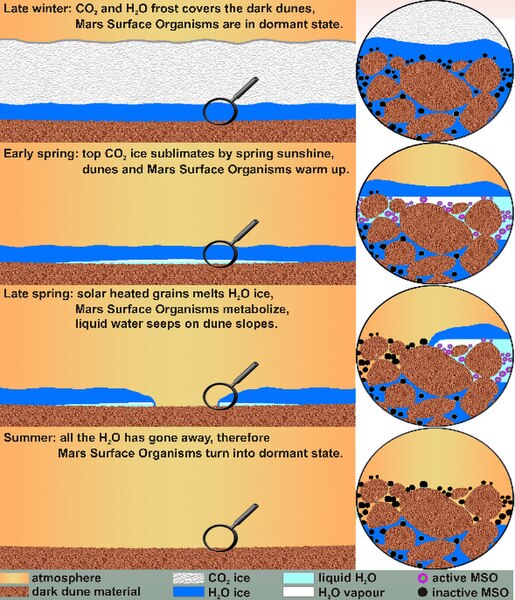
But this is all speculation.
I think the point is that it is very likely that there are temporary improvements of certain locations on Mars to the degree that it could favor life
more than normal. How that life could be established in those locations? Spores in the wind?
#9115 Re: Life on Mars » Ice Worms » 2013-12-18 16:22:34
Well, here I finally found something related to what I was referencing. It seems that some persons believe that a rock falling into an ice field, can create a pocket of water, in this case while it does not hurt to have a water column, for instance on Mars, I estimate that 1 foot of water is worth about
10 mb pressurization. The water in question if fresh would be 0 degrees C, and not much pressurized above the Martian ambient, and in fact in some locations, that air pressure approaches 12 mb at times?
But, I think they may also speculate on a bottling effect, where the ice holds temporary pressuization during high noon by it's strength, and a thin film of liquid water may form around or even inside of a rock.
http://mpainesyd.com/filechute/paine_am … permia.pdf
One is where solar radiation heats
subsurface ice which melts and the pocket of melt-water retains sufficient pressure to
avoid sublimation. This could be quite common where ice is present and is exposed to
partial sunlight.
3 Finding
Using Antarctica as an analogy, it is estimated that 12% of the ice on Mars would
be exposed to sufficient sunlight to melt sub-surface ice in summer each year
(speculative). Assuming three months of sufficient sunlight per year then, on average,
2% of all of the surface ice could be expected to have liquid water near the surface.
This means that, on average, 0.015% (2% x 0.73%) of the Mars surface has liquid
water near the surface.
This is another interesting article I encounted during the search. It points out that the Mars climate is variable, as to pressure and tilt (Therefore location of snowfall) and that could also make ice melts more likely during variations.
http://www.planetary.org/blogs/emily-la … hesis.html
But we agree that the Methane is missing.
And please note, none of the above orignates from me (Obiously), so, I am mearly parroting things I read, no innovation being attempted here.
#9116 Re: Life on Mars » Ice Worms » 2013-12-18 15:07:54
Quote:
•Cells require liquid water to function. On Mars, this means massive amounts of salt that would necessarily inhibit the enzymes and vital biological functions of a cell, not even to mention a more complex, megamulticellular organism
I almost entirely agree with you but on this point, water ice can be liquid without salt. Exposed ice can serve as a greenhouse window, and articles I have read indicate that this is widly true. Don't know how acid the ice and it's melt water would be.
With that favor I pretty much agree with you. The lack of Methane is a killer.
Further, it is hard to see how tiny plants and worms could migrate from one isolated pocket of water to another.
I recall that this was put forward however as a means for panspermia from Earth to Mars. An Earth rock impacting a temperate ice field could expose clear ice, be embeded in it and for a time period have melted water around it. So entering the Martian undergrounds.
No evidence of it though.
#9117 Terraformation » Manufactured Planet Rings » 2013-12-13 09:14:31
- Void
- Replies: 2
I had a notion this morning, that it might be possible to treat Saturns ring as a machine. Much is unknown about the rings, but I do know that it has mass, gravitational, and electrical properties and is composed of a multitude of pieces which seem to work together with Saturn to maintain a form.
That form must interact with the space environment, the solar wind, and the solar flux.
Actually I would not want to damage those rings, so I am now thinking that nearer objects could be an interesting target. Mars and Jupiter for instance.
I really don't know if manufacured rings could be created. For Mars, it could not be of ice, but for Jupiter perhaps it could.
Dumb rings would be mostly composed of rock or ice objects.
Smart rings could be as in the often mentioned hall machine, a multitude of tiny machines.
I do not know if a ring can deflect and concentrate solar wind, but solar wind can be tapped for energy, so that is an interesting possibility.
Also rings seem to have electrical properties, so perhaps that could be tapped.
Then there is the possibility to shade or brighten parts of the environment of Mars at times.
For Jupiter, it might be possible that rings could reduce the number of dangerous particles in its radiation belts. (Or make it worse).
But anyway trying to think of how to manufacture a planet ring might also lead to insights on how they work.
#9118 Re: Water on Mars » mars-water-discovery-curiosity-rover » 2013-12-05 15:21:23
I have no certainty that what I will suggest next can actually work on Mars, but it is worth the risk of being wrong.
http://skullsinthestars.com/2011/05/27/ … ctrifying/
http://www.asknature.org/strategy/0635d … 5947962fee
http://books.google.com/books?id=bAwVvO … nt&f=false
I a military establishment used electric currents in the ground to dry out wet ground, so that tanks could pass over it.
So, if Mars soil does have a quantity of moisture, and it is associated with salt, perhaps it is essentially a very cold brine in some cases. If so, then two electrodes deployed might cause it to concentrate on one electrode, which could be inside of a solar still. This would then result in steam, and that could be captured with a vacuum system (Fan/Compressor and a condenser).
Each day the soil should be replenished from the atmosphere to a degree, if the salt remains present.
Of course the salt toxic charactistic would need to be handled, if it traveled with the water vapor some how.
#9119 Re: Life support systems » Extra Oxygen? » 2013-12-04 09:24:24
As water seems to have been found even in "Dry" soils, I would suggest for the early term, making tanks or reserviors (Covered), filled with water, would allow extra oxygen to be stored in a disolved state in the water, available for emergency extraction if necessary.
Here is an article on extracting disolved oxygen:
http://en.wikipedia.org/wiki/Artificial_gills_(human)
Also such reservoirs would most likely be cold, but it might be possible to include some animal life that consumes Oxygen and Methane Seeps. This would allow such a disolved air tank to earn it's keep when it was not serving as an emergency Oxygen supply.
I choose Methane, as the food for the animals, because if Methane were to be manufactured for fuel and as feedstock for industrial purposes, it would always be desirable to be able to manufacture more than can be stored. In that case if excess Methane is also available it can be injected into a water tank/reservoir as discribed above to help activate a chemically driven biology.
Here is a not very related article I will connect to here. I found it while searching for the artificial gills. It is kind in the line of thinking anyway:
http://downloadsquad.switched.com/2007/ … ed-oxygen/
#9120 Re: Interplanetary transportation » Elastic Launch Loop (Space Elevator) » 2013-11-26 11:24:19
You guys have started talking skyhooks. You seem to be talking about an above atmosphere skyhook process.
I have a question. If you are going to have a loop or elivator, or spinning tether (My preference) with a hook to grab hardware, why could you not also grab atmosphere?
When hooking hardware, I presume that the hardware and hook must have a point in time of virtual zero differential speed.
When grabbing atmosphere a small amount of differential speed could be tollerated.
In order to keep your grabber from burning up, you either do not dip too deep into the atmosphere, or you maintain a small enough differential speed by spinning the grabber appropriatly.
What good is grabbed atmosphere? Oxygen, Nitrogen, maybe some Argon, and other trace gasses? To be used in chemestry, or life support, or propulsion, Chemical propulsion or condensed to liquid or ice and expelled with a linear magnetic device.
Maybe you will show me that this is not a good application, but I am inclined to think that it could be quite useful. Sorry for the diversion from the hardware hook though.
#9121 Re: Interplanetary transportation » Paraffin, propulsion and other uses, crash-landing it. » 2013-11-21 14:55:32
I guess I could put this here as an update of notions:
So, I have the following references on Paraffin Wax, and Nitrous Oxide.
http://www.space.com/23648-new-rocket-e … video.html
http://www.youtube.com/watch?v=DMVgAB_dau4
http://en.wikipedia.org/wiki/Paraffin_wax
http://en.wikipedia.org/wiki/Nitrous_ox … _reactions
http://en.wikipedia.org/wiki/Neutron_radiation
Rocket fuel and Oxydizer (With the option to hard land Paraffin Wax with minimal protection and still have it be useful and retrievable).
Internal engine fuel and Oxydizer (Cars, Tractors, MG Sets (Motor Generator Sets)).
Parafin Wax, other uses:
Radiation Shielding in the case of Paraffin Wax.
Candles a strange thougt, but in a lighting outage for emergencies, perhaps candles could be used in a limited fashion.
Electrical insulator for potted electrical and electronic devices.
Thermostats for process control systems.
Nitrous Oxide:
Medical use for the Nitrous Oxide
Another feature is that it can be solid or liquid form at temperatures reasonably sustainable in the Martian environment (With technological tricks
employed). More managible than Liquid Oxygen for instance.
So, I guess the people that built this:
http://www.space.com/23648-new-rocket-e … video.html
Probablly have all those notions.
As for spacecraft shielding, I would say that your fuel tank for the Paraffin could be a tin can with a flexible bag inside. As you use up the fuel,
you loose some of your shielding, but you create more interior space (Inside the flexible bag) that people can use. The wax would be held between the tin
can walls and the bag.
So a mission could start with a capsule, and a totally filled Paraffin Wax tank, and then on your first burn, that would hollow out, and you could put
your sleeping quarters in it, and move some of your controlls into it. Thereby having more space to use.
Then the insertion burn, would consume much of the balance, and you would either land the capsule to the surface of Mars and have protection there, or
if you had enough fuel you would land the whole thing, depleating your on board supply of Paraffin.
If staying in orbit, you could refill the Paraffin tank from Paraffin blocks put in orbit by a previous supply mission (Such as an electric rocket),
or could refill them from Parraffin blocks hard landed at your intended landing site.
Could you have sent a robot to manufacture Nitrous Oxide from the Martian atmosphere also? I am inclide to think paraffin wax would require a developed industrial base, and could not be done automatically by robot lander.
#9122 Re: Martian Chronicles » Developing Saturn » 2013-11-20 12:57:52
I think it is supposed to be a percentage of the planets size if it is formed from the planets disk. 1%???? Couldn't find the reference, any query for moon brings up our Moon. So the bigger the planet, the bigger the moon mass. However if Jupiter had one big moon instead of Io, Europa, Ganeymede, and Callisto, maybe that would be getting substantial.
But a planet many times bigger than Jupiter might do much better.
Then there is our moon which did not form that way apparently. I have my own rogue notion of how it formed, I think it was condensed from the Earths spare material first as a wet object, and then was added to by rubble from impacts with the Earth. I think that is why there is evidence of magmatic water. I will not duke it out on that speculation however.
Then there is Triton, where it is thought it was captured. Most likely method, was that it was a binary object, and it's partner was either ejected, or impacted Neptune. So, maybe if you have a chaotic system forming with binary objects changing orbit, you could get a more substantial moon than if it
was a condensed moon, but it appears that that is not a common occurance.
#9123 Re: Interplanetary transportation » Beamed Propulsion Trajectory » 2013-11-18 14:55:36
GW I like it also. Also perhaps even more if explosive materials could come from the Moon for some space activities.
Yes Josh, your arguments have merrit, but look what happened. GW did a good one.
We do have bad natural chemestry togeather, so small doses maybe. I am vacating this thread. Have fun.
#9124 Re: Interplanetary transportation » Beamed Propulsion Trajectory » 2013-11-18 11:13:37
Why?
As a laboratory for the development of instrumentation. Just because it is not good enough now does not necessarily stop it from being improved.
First you perfect your instrumentation, your laser point system.
FYI (Strike GPS, substitute, Local Postioning Systems/Instrumentation/A camera on the rocket looking at Eor, owl, Christifer Robin, and Poo Bear waving flags on the ground.)
Then bring back GPS, because it may still be useful at some point bring it back as a future better GPS.
And if you tell me that it is impossible to point a laser at a machine, then of course it is impossible to
communicate with a spacecraft orbiting the Moon.
http://www.space.com/23308-nasa-moon-la … ecord.html
Then the chemical rocket as a laboratory to study the transmission of power by energy beam to a moving object.
Laser, use the more generic “energy beam” phrase, which also allows lasers).
A chemical rocket is a moving object and moves similar to how a moving object projected by an energy beam might move.
Therefore you can build a very small scale version (Laser pointer) to test the process and define it's potential. If the results seem positive, you can scale it up by increments as far as the reality of physics and economics will allow.
It is possible that you would eventually eliminate the chemical rocket characteristic and then have an energy beam only method, but as far as I am concerned "Why would you want to do that?". An energy beam to project a machine upwards still needs working mass, which you must either carry with the machine, or draw from the atmosphere. Drawing from the atmosphere comes to fault where it gets too thin.
So, if you are carrying mass in the machine for the beam to heat up, and you have a choice for that mass to carry chemical energy with it. Such machines have already been made (Chemical Rockets). So you have this mass which can be burned to produce thrust, and you can also project more energy into it.
As for engines not being tolerant of this, I said "I don't think existing engines could put up with this very well". Then you told me that "A space shuttle engine would not put up with it very well".
I say again true, that is my expectation as well. But of course do the experiment on a very small engine. One that can be throttled back.
Throttle it back, but try to bring the thrust level back up by adding energy from a power beam. Is the engine going to perform well? No it is an existing engine which was designed for a specific purpose. However, you might learn something about designing an engine that could operate in both modes.
Mode 1: 100% chemical energy for situations where the power beam failed or was not convienient to use.
Mode 2: 50% chemical energy + 50% power beam for situations where the power beam was on line and functional. I have previously stated a limit of 5,000 to 10,000 feet, but that was arbitrary, maybe it works 5,000 to 10,000 feet and you want to attempt to expand it upwards.
Why is this worth doing? Because you might conserve propulsion mass if Mode2 is functioning well, and be able to bring it up to orbit along with your other payload. It might be worth a buck or two, should it be possible to apply it to a value added service.
And finally it has been stated by that guy that owns space X, that the hardware is more valuable than the fuel. And so they are trying to figure out how to recover booster stages.
The scheme listed above also has the potential to recover the hardware by either getting it up to orbit, or landing it on the surface of a world.
If it is power beam alone, I have a hard time figuring out what the abort modes exist that could recover the hardware.
As for economics, it seems that I have to jump through that hoop more than anyone else (Or maybe that's just my perception).
Could you get your fuel from the Moon cheaper? Maybe, but then you could also use a hybrid system to get it to Earth orbits, conserving the finite amount of such fuels that can be gotten from the Moon.
Is it the only and best plan? That is not proven at all. I did use the word laboratory, which implies testing. It would have to pass quite a few tests, to displace other methods.
But keep in mind that my objective was to transfer an idea to other minds, and I have done that so, it really does not matter what further reply I get on this.
I expect I will vacate this thread, at least for a while, and so keep the peace, even so, thank you for your time and input, and I really and truly hope that you outdo lasers with your power beam concept.
#9125 Re: Interplanetary transportation » Beamed Propulsion Trajectory » 2013-11-15 11:23:00
Here is a reference to that GW:
http://en.wikipedia.org/wiki/Beam-power … ed_systems
http://upload.wikimedia.org/wikipedia/c … tcraft.jpg
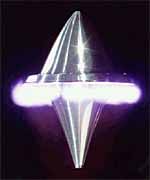
I guess I will continue even though it is above my level
For a pulsed laser;
1) Have the rocket communicate it's position per gps on a continuing basis. Also send other information such as how atmospheric conditions (wind) are affecting the path and future predicted location of the rocket.
2) Analyze the atmosphere for twinkle per a low powered signal laser as is done for astronomy
3) Alternate pulses. First a signal pulse to confirm pointing is good, followed by a power pulse, if the results are confirmed as good.
In the case of delivery to a non-chemical engine, it might be possible to fine tune the reciever with actuators, to displace it an inch or two.
By this method successful delivery of power pulses would be facilitated. As it would be a chemical rocket intended to go to orbit if necessary without any successfully delivered power pulses, missing out on some would not be a problem.
Also, if the duration of a pulse were short, the actual delivery of a power pulse to a unintended part of the rocket might be survived, because actual damage might require a long set of power pulses being delivered to the wrong spot over a short period of time.
Of course the higher in the sky you got, the longer the communication time lag, which would make it harder, so for this reason (And others) there would be an altitude and distance limitation to it.