You are not logged in.
- Topics: Active | Unanswered
Announcement
#8651 Re: Interplanetary transportation » DSCOVR Launch » 2015-02-14 13:05:52
That was polite 
void wrote:
I was really pleased when Tom pointed out that the Falcon Heavy would use 3 ea. Falcon 9's. That is not what I expected at all. It means the heavy lift is likely not all that far off, if they manage to land a Falcon 9 some time.
I suspect that a triple core heavy will have its own set of problems with useability from the fact that it will look like a wing once it starts a return path and that is due to the larger width shape of being 3 barrels wide. That said now on reentry each unit will seperate from the other now needing seperate glide paths and landing platforms to allow for recoverability.
I guess I will leave it to SpaceX to figure out how they are going to land two at a time and then shortly after the third one. However with the advances in artificial intelligence, I have to suppose that these things will be rather smart, above what we have experienced so far.
I will respond to your other post soon, after I check so facts, so as to reduce the possibility of wasting your time.
#8652 Re: Interplanetary transportation » DSCOVR Launch » 2015-02-14 10:19:06
So what if;
-Send a person transporter to Mars, composed of;
-Lander without;
-Parachute.
-Heat Shield.
-Canted Engines.
-But including;
-A booster capable entering the atmosphere of Mars and landing if emergency requires.
-Extra strap on tanks.
In my mind the ideal action would be that the booster with external tanks would;
-Use the fuel in the external tanks to put speed and trajectory to a situation where the booster could enter the
atmosphere;
-The tanks would be ejected prior to atmospheric entry.
-The booster with the lander on top of it would do the atmospheric entry, and would help get the lander situated
on the correct path.
-After the atmospheric entry was achieved, the lander would separate, and complete the landing on it's own.
-Ideally the booster would push to Mars orbit, and be parked there, but it could be disposed of to crash.
-The lander not burdened by parachute, heat shield, or canted engines would land at a location with supplies already
in position on the ground.
Several abort modes might be available;
-If a lander problem was discovered prior to atmospheric entry, then the booster could abort itself and the lander to
orbit.
-If a lander problem was discovered during entry, then I would hope they could try to land the whole stack using the
booster.
-I would think it would be tipsy with no landing pad, so I don't like that and also it might not be possible to use the
lander as habitat.
-In such a situation, I suppose you could hope to repair the lander, and either hop it off of the booster and onto
the ground or abort to orbit.
In orbit should be a supply ship which used SEP, and gravity assists, and magnetic aerocapture, to achieve the orbit of Mars. Of course it would be robotic. It would have landed supplies on the ground which the person lander would intend to land near enough to.
And that brings up another possible abort situation where, if during descent it was discovered that landing in the proper location was not possible, then an abort to orbit using the booster or the lander only should be entertained to the level of what can be possible.
I would think that this could also satisfy the desire of some to visit multiple sites. The lander I presume with direct and not canted engines and with positioned supplies might be able to hop through the atmosphere to multiple locations for checking on the best possibilities.
Of course it it not prohibited to have more than one (Except by cost).
The above notion might also satisfy the problem of the size of a lander which some here have been puzzling about quite a bit.
Anyway I was happy to read about the raptor engine which may be developed.
Go ahead and let me know what the flaws are in the above. I would rather know than not know. But politeness does not hurt. Keep in mind that if a nerve only ever delivers pain, sometimes the body will eliminate it.
Fun is much better than pain.
#8653 Re: Interplanetary transportation » DSCOVR Launch » 2015-02-14 10:07:38
He was certainly a genius. Someone like him with life extension would have to potential to be an asset to the human race more than was the case.
You have prompted me to look into the Raptor Engine. 6 times as powerful as the Merlin 1D, and Methane/Oxygen.
I wondered why Methane. The reason I wondered, is I think Elon Musks plans are more for sending things to Mars than bringing things back.
The Raptor Engine was originally going to use Hydrogen, but it seems that around 2007 NASA tested a Methane engine, and those results were apparently good. So the Raptor will use Methane.
The advantages of Methane are a reduction of tank insulation weight penalty, and due to a more compact fuel, a reduction in tank size weight penalty. And of course Methane could be manufactured on Mars, but as I said, I don't think their primary objective is to leave Mars.
The above indicates why it is important to keep NASA as it is. It is like a coarse adjustment in a calibration. They get you into the ball park of something that has potential, and then other more specific and focused organizations can do a finer calibration on the process. Further even though NASA is necessarily pork barrel, it also causes the formation of industrial processes that can be used by entities like SpaceX.
#8654 Re: Interplanetary transportation » DSCOVR Launch » 2015-02-13 16:27:17
It's odd, but North America seems to have virtually the ideal setup.
Texas to launch for fuel efficiency, fly over the gulf? Land in Florida? Then can the inter coastal canal system allow movement of the boosters back to Texas?
Then again launch from Florida, and fly back may have a fuel penalty, but I think that will be addressed in time.
I recall reading that Elon Musk seemed to say that the hardware was much more valuable to recover than the cost of fuel.
I also see the notion that if these boosters have a life cycle and that gets measured, then at some point they could be sacrificed to lift heavier loads to orbit.
Florida and Texas are linked to the whole North American (NAFTA) infrastructure, so cost of machine items should be cheaper than for some place such as French Guyana. Trucks, Canals, Trains, and Planes to get stuff to a focus point. Pretty much the best deal on the planet I think.
#8655 Re: Space Policy » The Outer Space Treaty » 2015-02-13 11:11:19
I am wondering what the parallels are between international ocean waters, and outer space?
Economic entities tied to nations, are allowed to extract fish from the international ocean.
Factory Ships are allowed to manufacture sales items offshore from North America.
Typically, the space one ship occupies is not demanded to be occupied by another at the same time.
Laws of salvage do not allow nationally supported piracy of property used to extract resources and manufacture, except if it is clearly abandoned?
If two or more entities wanted to mine the same ore body and had demonstrated capabilities to do so, they would have to negotiate an arrangement I suppose.
The story of "The Little Red Hen" tells me that in history humans have considered the morality of those who do not work to obtain a gain, demanding or even requesting payment for a no value added contribution of nothing.
http://en.wikipedia.org/wiki/The_Little_Red_Hen
I think the "For the benefit of all" clause can be satisfied just by the fact that a value added service has been created. Metals returned to Earth could be bought on the market at a presumed reduced price, particularly after that metal has become unavailable from local sources. Habitat expanded beyond the Earth, is also potentially a benefit to all. Expansion of the human pool of knowledge, and capability is also a benefit to all.
We don't demand payments from nations that fish in international waters, so why should never-do-goods have a claims to the gains that other nations and economic entities might achieve? However nations that have a commodity, can sell their commodities, and then buy fish extracted by another entity in international waters. So they do get a benefit. In space, any nation or person will likely be able to hook onto such activities, as international entities, or as person stock holders. So they have every opportunity to benefit.
So, as far as I am concerned the point is moot, everyone will have an opportunity to invest in and obtain gains, unless their own national governments interfere with it.
#8656 Re: Interplanetary transportation » DSCOVR Launch » 2015-02-13 10:14:59
I buy into everything you say GW, but I have found this:
http://spacenews.com/spacex-leases-cape … -landings/
So I would say that the intentions are very plain, and I am sure every part of our space industry including defense wants them to make it work.
The barge thing is a calibration process I think. Extracting boosters from such a barge would be very costly I think.
As you have said a reversal to launch site would be energy costly, I expect they intend to launch from a more western location when the process is calibrated and proven.
It seems to me that California, New Mexico, and Texas would be good launching sites, Is that west enough?
It is really exciting. Like the dawn of the space age I think.
I am sure part of the calculation is to first prove that the boosters can be targeted to a site where they can crash without incurring massive damage costs, and then of course to actually be able to recover the majority of them in a state for reuse.
Not really any more risky than landing a space shuttle.
But maybe I don't understand can these boosters do one orbit of Earth? In that case they can launch from Florida, and land in Florida. Maybe some time in the future other boosters would do it that way. A sub-orbital once around the Earth.
I was really pleased when Tom pointed out that the Falcon Heavy would use 3 ea. Falcon 9's. That is not what I expected at all. It means the heavy lift is likely not all that far off, if they manage to land a Falcon 9 some time.
I think I would bother to go see a landing, if that is allowed in the future.
#8657 Re: Human missions » Overview of Mission Design » 2015-02-08 13:21:58
I have my own ideas about obtaining water.
I have seen;
-Glaciers (Dig)
-Bake soil (Dig and bake soil)
-Get it out of the atmosphere. (Small amounts, lots of effort)
I suggest looking at salt pans, and salt domes.
Some of the salt pans in the southern low latitudes are calculated to at times have enough moisture in them, and sufficient elevation of temperature that they could support life. So, to investigate them would be supported by both the people who want to settle Mars, and those who wish to investigate the chances of life on Mars.
The machine I propose to extract water from the salt flats, or maybe a salt dome, would use;
-Solar Heat
-An electrostatic capacitor
-A flowing electrical circuit
-Vacuum.
-The salt pan itself and the moisture in it.
-A bag of water placed on the salt pan (For now I will ignore the problems of corrosion of salt on the plastic. I think that could be solved).
-Electrons extracted from the ambient environment. Either from the air (Preferred) or from an electrode placed some distance from the water bag.
-Electrons injected into the water of the bag, forming a capacitor, where the water within has a charge of electrons (-) greater than the environment outside the water bag.
-The outside skin of the bag will develop a skin of condensed positive ions (+) and will be relatively pressurized.
-If electrons are extracted from the atmosphere, it will release a plume of positive ions that will travel downwind.
-Additionally, under the bag, an electrode charged negative (-).
-While electrons will try to travel towards the positively charged contact point of the plume, and also in all directions away from the underside of the bag, Positive ions of various sorts will try to travel towards the underside of the bag. Among these should be positive ions of water.
So, I am presuming that ion collection is favored by the electrical circuit of the (-) electrode under the bag, and the downwind (+) plume, and conductance of both electrons (-) and the downwind plume ions (+) pushing (+) H20 ions though the salt pan or salt dome. Something like this was done by the Germans during WWII, to dry up wet ground so that they could drive tanks over it.
The water bag can also serve as a solar collector. The bag will have to be able to tolerate internal pressures for 0 degrees Centigrade and up.
The underside will also be heated up by heat conducted from the bag to the area below it. So, you then have a situation similar to a solar still which is demonstrated on Earth by pulling moisture from dry sand, and condensing it on a film of plastic above it.
The dielectric pressure of the thin film on the outside of the bag, might even allow for liquid phase water, if it is not too warm, but that is not the method of extraction I contemplate.
Instead I propose a vacuum line with a collection nozzle under the bag near the (-) electrode. The bag pressing against the ground with the weight of the water in it is intended to resist the flow of atmospheric air under the bag to the vacuum nozzle. The intention is to create a vacuum chamber under the bag, to promote evaporation of water bound to salt, and any which might be bound in any phase to the underside of the bag.
The materials vacuumed from under the bag should include water vapor. A machine to pressurize the mix and extract the water as a liquid should be possible. Then the liquid can be injected into the bag for storage, up to the point that the bag has maximized it's volume. Presumably it would then be tapped for human use.
Interestingly bushmen use a vacuum method to extract water from soil at times, but I don't think it is quite the same process.
It would not be prohibited to grow simple life forms in the water in the bag at the same time if that was considered to be of value.
Problems:
-Perchlorate Salts may be attracted. However, maybe this could be turned around as a method to extract value from them.
-Corrosion of the underside of the bag. I guess this has to be figured out.
-Freeze up of the bag. This may or may not damage it. By applying insulation in places that do not collect solar energy, this might be improved.
During dust storms, it is very possible the bag would freeze up. One fix would be to drain it before freeze up.
-U.V. Deterioration of the bag. (I suggest a simple tarp with U.V. protection on its top side, that can be replaced as needed to be put over the bag).
I have specified salt pans and salt domes, but I also observe that the soils of Mars and particularly the crust above are rather salty. Perhaps this can be less location specific. Maybe it could be done near the equator, which could be nice.
The areas dried by this process would be primed to collect more water from the atmosphere, during instances of higher humidity, caused by seasonal changes, and by nighttime atmospheric processes. So, this is after all an atmospheric condenser, but it uses the existing winds, and the existing humidity in the salt to make it more practical than a small machine which must pump air though it and has to use exotic materials to absorb moisture from the atmosphere.
The value of this method could be that except for construction and normal maintenance, humans in suits, and expensive mobile machinery would not be required. Those activities are both dangerous to humans, and costly.
Done
#8658 Re: Unmanned probes » Dawn - Vesta & Ceres orbiter » 2015-02-08 00:08:32
I guess I will wait for the crew running it to tell what is what. It does look like the craters have faded in a lot of places, but still it was or is a very slow process.
This could be an introduction to the outer solar system? Sort of maybe.
#8659 Re: Interplanetary transportation » SpaceX Falcon 9R launch » 2015-02-07 13:25:11
The article says they will try again.
http://www.space.com/28484-spacex-rocke … llite.html
SpaceX will attempt to land the first stage of its 14-story Falcon 9 rocket after launching the Deep Space Climate Observatory (DSCOVR for short) from Cape Canaveral Air Force Base in Florida. Liftoff is set for Sunday, Feb. 8, at 6:10 p.m. EST (2310 GMT) and will be webcast live by NASA TV.
#8660 Re: Interplanetary transportation » Bombardier Beetle natural pulse detonation rocket » 2015-02-07 13:18:01
With apologies in advance (I am aware of my lack of qualifications in this manner). I would be interested in:
-How they plan to synthesize their chemicals.
-If Photo Organisms that could be grown in bags of water at the freezing point could be crafted to synthesize those chemicals.
A lot of good things came from observing nature.
#8661 Re: Interplanetary transportation » Mission to Venus » 2015-02-06 21:24:15
I think that any effort needs to keep an eye on being of service to the human race. If possible. That does not prohibit side ventures. Reality might, but not that.
I think I see a potential progression that makes sense to me at least, but before I go to that, some comments about Venus.
As I see it either you focus on Terraforming Venus, or you focus on inhabiting it. I have not seen any suggestions about terraforming Venus that will not take a long time, and that will pay the bills while the terraforming is being done. So for me inhabiting Venus is the major option for something that might pay it's own way, and be a contribution to our so called future civilization.
Just jumping into the clouds requires hardware, lots of it, and the clouds are unfriendly to both Humans and Machines at this time. Getting the materials means donations from other rocky objects in orbit of the sun, and the cloud people it seems to me will have little ability to pay for those materials. So, I think that ultimately the answer is to use machines to build a civilization from the surface up, where eventually machines on the surface provide materials to the clouds, and of course I want to get rid of the acid nature of the clouds. Machines on the surface will have to be very tolerant and adapted to the conditions. To progress to the ability to create those machines I call on a progression.
Several entities such as Nasa and SpaceX seem to be aimed at Mars as a preferred goal. I think that given time, and a continuation of a technological branch of humanity, they will settle Mars. I think that during that effort the Moon will also be accessed as a spill over effect.
Those two environments will give lessons on how to deal with the asteroid belt and Mercury.
If humans ever settle Mercury it looks as though they might prefer to start by settling at the poles. But most of the other planet has a very hot environment during the day, and lunar cold at night. (More or less)
They should be able to travel about during the night or twilight, and do constructions, and maintenance on machines.
But I expect that they could eventually build robots with "Stirling Engines" which would have a lot of on board power during the day. I could be wrong, but I would think that a solar heat collector could be on top, and a infrared deflector on their bottoms. In between, I am supposing (I hope I am correct), that due to the vacuum, they could radiate heat to the non solar sky. So, mobile equipment with a very large temperature span to power them. Such machines may be able to have protected cooled parts, but will also have parts that will have to tolerate the very high heat. That will be useful technology for eventually attempting to work in the surface heat of Venus.
I was happy to see that there are those who actually have plans for further probes to work in the surface environment of Venus, but still, I think the progression will be a good way to get there.
In the meantime, I would like to think that if ions can be harvested from the tail of Venus, then that could be traded for metals from elsewhere, and so long before an attempt to inhabit the clouds of Venus occurred, a community of people would already live in the orbit of Venus.
So with all that a great deal of support would be available to do whatever it is they might do with Venus.
This thread began with an article about dumping some people in lighter than air ships into the atmosphere of Venus. They would take a return rocket with them. I don't see what they could do that machines could not.
Rather, I guess I could justify it if it were a proof of technology mission. But before doing that I would think that efforts would be made to make simulation chambers on Earth, and to expose materials and models to that simulated environment. If they proved the technology, then perhaps an actual test. But before a actual human test, I would think you would do it at least one time without people. That is enter the atmosphere, and deploy, and do an endurance test, and see if you could get the return vehicle to get back to orbit OK.
That would be a lot of effort that could be expended on easier targets instead, with better pay back, as I think others have suggested.
#8662 Re: Interplanetary transportation » Mission to Venus » 2015-02-06 13:37:21
I pretty much a ditto on that from both of you.
I would choose Venus last of the terrestrial planets, with the exception of some of it's potential orbital properties. That is perhaps something can be harvested from the tail. Also maybe because of that orbital habitats.
I would think that;
Mars first;
the Moon will happen in spite of the directive to focus on Mars (And capture a little asteroid);
At that point some rare minerals might be running out so the Asteroids and/or Mercury (Mercury with knowledge from Mars and the Moon);
Finally something with Venus:
-Terraform it with metals, maybe from Mercury or
-Learn to make robots that can take the heat, and build a infrastructure that can deliver goods to the Clouds, then perhaps humans.
So Venus last.
#8663 Re: Unmanned probes » Dawn - Vesta & Ceres orbiter » 2015-02-06 09:34:27
A crater that exposes expels brighter ice.
A condensation point for frost.
Something that expels salt.
?
#8664 Re: Terraformation » Mercury » 2015-02-06 07:59:46
Thanks Quaoar
http://en.m.wikipedia.org/wiki/Exploration_of_Mercury
Some stuff on the exploration of, and problems of exploring Mercury.
Stable orbits of Mercury are a problem? I wonder about "L" locations? It sort of suggests you put all your stuff on Mercury itself, or you eject materials from the orbit of Mercury to construct facilities that orbit the Sun itself.
#8665 Re: Unmanned probes » Dawn - Vesta & Ceres orbiter » 2015-02-05 20:42:01
http://tucson.com/news/blogs/scientific … de206.html
Its crust is believed to be icy, but don’t imagine a bright, frozen surface, said David O’Brien, one of the Dawn team members from PSI. Think mud, both frozen and liquid.
One telltale sign the scientists seek is whether Ceres has large craters at mid-latitudes. If it doesn’t, that means the planet has reshaped itself, possibly with the flow of that liquid mud at a glacial, geologic pace, O’Brien said.
Perhaps they mean fluid muddy ice, not liquid mud? Maybe they mean liquid mud in the event of an impact.
http://abcnews.go.com/Technology/nasas- … d=28753587
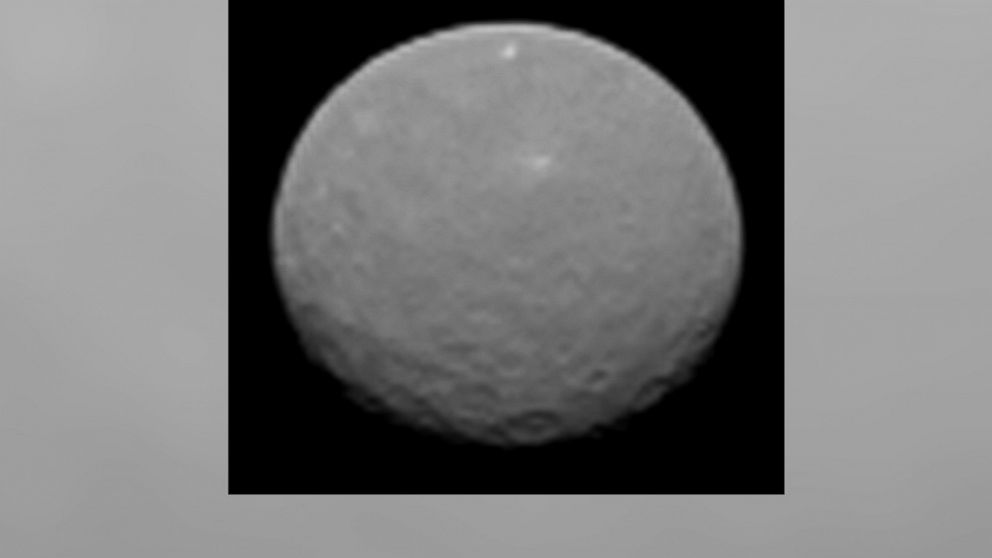
To me it looks like the lowest parts of the picture are much rougher than the rest. Certainly craters made a major contribution to that, but I am not totally convinced that it was craters only. The area above the rough area is bumpy, all the way to the top. But perhaps other views would reveal that my eyes/mind are not getting sufficient information on this. Alternately I wonder if it is a lopsided world. One half rugged, one half smoother. Mars is like that, Enceladus, is sort of like that where an ocean is on one side of the moon only. Tiger stripes also. It's odd that the bright spots are on the smother portion, but I suppose that could be random chance if they are impact marks.
The two obvious white dots? The lower one looks like it splashed bright stuff. Maybe a crater. But, shouldn't ice be evaporating? What I have read says the the places where they noticed water vapor were darker then average. The article above suggests muddy ice. The picture may not reveal the actual color of the "White" spots. Perhaps they are darker.
How do craters "Scab" over? I suppose if the hole then evaporated more of the ice, the walls dirt would cave in. Otherwise, could their be electrostatic levitation which might move the dust around the surface? Tom of course pointed out that dust will accumulate. I wonder if small impactors could put the surface soil particles in sub-orbital paths that would tend to re-distribute it over time.
Hope you don't mind that I am poodle jumping over this topic Spacenut. Fire away if you want.
#8666 Re: Terraformation » Mercury » 2015-02-05 15:12:21
Actually it has much more to offer than the Moon. The only property of the Moon, that would be more favorable to humans would be proximity to Earth.
I think the methods mentioned would have great potential to support a large number of humans at a high standard of living. Which is really what you want when you hunt for a place to set up shop.
All that's missing is the human transport method, and the proper tool set.
#8667 Re: Terraformation » Mercury » 2015-02-05 11:18:00
What attracts me to Mercury is:
Apparently it captures Hydrogen from the solar wind and perhaps comets. It also captures Helium, which could be useful.
It is about the same size as Mars, so some of what will have been done to access Mars will be usable for Mercury.
The energy supply and mineral supply of course.
I suppose I have not considered it as a direct habitat. I did some time ago read SciFi, that indicated a habitation of the Moon where the people simply decided to dig deep, and use the thermal differential to make energy. Not even bother with the surface. I am not thinking we have the energy technology for that at this time.
However as you pointed out, on Mercury, you could dig down many, many caverns. Lots of space. Lots of minerals, Water, Water that is replenished from the solar wind, and perhaps from comets. Lots of energy.
If synthetic gravity is not necessary for human health, then really, very excellent for an offshoot of our cultures, a hedge against the extinction of technological humans on Earth.
#8668 Re: Terraformation » Mercury » 2015-02-04 22:23:33
As long as the moderators do not object, I guess I will continue with the economic dialog, hoping to tie it to the topic of this thread eventually.
I see that you have emphasized your local and national Identity. I see value in the fact that Canada and other non-American (USA) peoples with Anglo/Quebecker/First Nations; Anglo imprints, can be able to do something different than what we do. That is the original notion of the States anyway, so that various people can try different things, and if it works, to some extent others may wish to try it as well.
Not very likely that we would try it here, as our Feds, not only seek to administer the states, but also have a major activity doing what ever it is various places. They want that money, and they want that control, and I am not stupid enough to think that their wishes can be ignored. Not at this time anyway.
There are some very exciting sciences that are being improved, because some of the activity can be moved to such locations where our somewhat irrational process cannot snuff them out easily.
I am all for America, (Since I am one, or so far I believe). But we are in a cultural winter, with culture wars, and there is a lot of nuttyness going around. It should be over by 2025, but until then, I think that their are too many nit-wits in positions of power who could damage such things for irrational reasons.
And of course I also look forward to what other places can contribute. Europe, China, Russia, etc.
As for importing minerals from Mercury to support solar power here, I guess I had not thought of that. OK then, fine, good stuff.
However, you can expect the Hydrocarbon industry to resist as long as they can. That will continue until the cartel people own the renewable energy methods, and can then impose a barrier between you and that, so that they can charge you for it.
The game is to find out what you need/want, take it away from you, and then sell it back to you.
I think that if the greenhouse effect is true, or if their is some other feature such as release of Methane from a source, the Earth could heat up, and it might be reasonable to consider if a large collection of habitats made from the materials of Mercury could be of use. I can say that if indeed it becomes possible to move large amounts of population from Earth to hollow solar orbiting habitats, that would then reduce the use of resources on Earth.
As for shading the Earth, I guess that would have to be a lot of habitats. But really whats wrong with that. If an economy that could build one were to come into being, and it built them without trying to tap the treasuries of nations of Earth, then why couldn't it make a million or more of them?
The only problem which comes with this might be that various entities that wish to sell things to humans on Earth, and wish to collect revenues from them might have a declining tax base. But then if the Earth is deteriorating in the manner that the Global Warming fanatics insist it will, then there will be a lot of unfortunate people who would not be able to generate wealth, so giving them a way out of poverty might be a reasonable plan.
And then I suppose the people that want to sell you things, and tax you will be out there anyway, so at that point that general group will not be so much in favor of keeping the human race as their money generating captives on Earth.
A further development will be life span extension. I actually believe that they are going to pull it off. I think it will be sooner than we think. In that case I am not so worried about overpopulation from it (I think that will be OK), but rather I think it will be good to give the human population an adventure, and resources to build advancement of the human race. I expect a materialistic wave in culture anyway.
And apparently you might approve, what else will be expected is a narrowing of the wealth difference between the economic classes in the USA at least. That would not occur because I might say it would, it is expected by those who believe in cycles (The fourth turning).
Anyway, I think that Mercury can be considered after Mars. After that if people really want to try to turn Venus into another Earth, then metals from Mercury could aid in that. I am not necessarily in favor of terraforming Venus in that way, but I am not a ruler of such things.
#8669 Re: Terraformation » Mercury » 2015-02-04 16:55:01
Well perhaps we can make peace if I state:
"RobertDyck and his Manitoba Like-Kind may set up whatever type of common purse they wish to, if they can fend off predators that want to exploit them". (There is really not much I can do about that).
I might throw a beer bottle at your deviant space habitat though.
I do make a note that if I had an income of $100,000.00/yr, and the feds took 20,000.00 of it and then the income tax was replaced by a corporate tax, I could live as well on a $80,000.00 job. I would compete in a job market with other people who did not need as much money, and eventually my job would pay $80,000.00 / year, and the corporation would pay $20,000.00 / year on my behalf.
Granted it might get rid of a lot of administrative costs. However the tax system also exists to collect information on what people are doing.
Very similar to buying an item with a "Rewards Card" in a drug store or gas station. They are collecting info there as well.
Along with the use of computers, this gives those empowered tools to outsmart the public. But that is a whole nother matter.
#8670 Re: Terraformation » Mercury » 2015-02-04 15:50:00
Well, if I were to live in a townhouse, I would have to pay an association fee. This is money to be paid into a common purse.
That money can be spent well or poorly depending on the administration.
I don't see how collective actions can be done by a collection of people, unless there is a common purse, and people put in charge of administering the spending of the money. Then you get into the issue, of what is my fair share to pay into the common purse?
Anyway, on a technical end, I would like to propose a method of construction, which might work well for the shadowed craters of Mercury.
I am just looking for feedback.
Igloo construction involves a method of stacking snow blocks into a dome structure.
I am wondering if such blocks could be made from metals. That is hollow metal blocks, and I presume a method to stack them into domes, and to weld the metal of course and use other means to join them into a common structure, and to create a vacuum barrier.
On Mercury you would already have the magnetic field, and the hollow of the crater on your side where radiation was concerned.
On the outside of the metal igloo, you could attach mineral wool or fiberglass insulation, to provide thermal stability. But of course this would also add a little radiation protection.
Blocks of metal or stone could be added appropriately to add radiation protection.
Finally, if the domes were trustworthy, and large enough, perhaps stone houses could be built inside them to give a final radiation protection part of the time.
Anyway, I am thinking that a large 3D printer, or perhaps automation could build several types of these metal blocks (Mass production if automation, sufficient production if 3D printer).
So essentially you get your robot/automation/3D printer crew to preform a very repetitive task, and build many of these blocks.
Then by object manipulation directed by human minds or the equivalent or better, construct these igloo structures, stacking one block at a time. Welding them together as needed and appropriate.
#8671 Re: Terraformation » Mercury » 2015-02-04 11:43:32
I liked your post where it concerned Mercury. I think Mercury is an undervalued planet.
#8672 Re: Terraformation » Mercury » 2015-02-04 11:38:24
Your thinking is sound. However, I simply don't get involved in anti tax politics. I figure it is easier.
Your plan does not consider that there is "Farmer" class, that regards us as farm animals, and they are not going to go away. It is part of a predatory ecology.
Wood was once a critical war material (You could forge weapons by burning it, make ships, etc). Peasants could not own trees. If they cut one down they would suffer a maiming the first time, death the second time.
After that the cartels owned the coal. Then the Oil.
Edison and Ford had a plan to build a rural based economy with electric cars and windmills. It required a battery which Edison created. When it was tested (The battery) it was purposely not charged up, and a vast news campaign was put in place to say it did not work.
Edison's labs mysteriously burned down. Ford withdrew from the deal. He must have gotten the hint.
You used to be able to take electric street cars from Minnesota to the east coast. That all got torn up and replaced with internal combustion engine busses.
Here in America we pioneered high speed electric trains. At the point where it was about to pay off, it was scrapped and a man was allowed to salvage the copper and sell it off. The trains could generate power when going down a mountain.
The point is they want us to burn the fuels that they own, and want to sell us. Period.
They like a free ride (Just for them).
Oil prices plunged? Get rid of that alternative energy.
They also like centralized control. Hence their attempts to turn the internet into television.
Do I care a lot? Not really. I have done OK. I just want to make sure that you don't spend your life tilting at windmills.
The social architecture is a real thing, just like mountains.
#8673 Re: Terraformation » Mercury » 2015-02-04 09:26:55
This part is surely for entertainment, and is Sci Fi.
Could you carve Mercury into a toroid doughnut, with an atmosphere where the doughnut hole is. Of course that does not seem like it would be stable, and also you would destroy the magnetic core.
But could you go partway in that direction? Actually cutting into the Mantle, and maybe even the outer core? Shape would matter. In such a non-spherical object, then local gravity vs total gravity/far gravity might determine if the shape could hold. Obviously no such thing could be done unless the excavated materials were of value, such as in building solar orbiting habitats. You could also combine this notion with partial shell domes to cover the tops of the holes. No more fantastic than the notion of a shell world.
#8674 Re: Terraformation » Mercury » 2015-02-04 08:53:39
So, I am currently infatuated with Mercury, and you see it as a pathway to "Gamma Crucis".
That's fine. Interstellar pathways are secondary to my purposes, but it is always good to have a "And then what?". It helps the now to be structured in a pattern which might be favorable to a speculated future. Avoids Cul-de-sac situations.
And then I would make the point that gravitation for Mars and Mercury is roughly similar. Therefore many lessons learned for Mars will be applicable to Mercury.
To further support the idea, the methods of SpaceX to land boosters on their tail ends, should be most suitable to Mercury. A lesser gravitation, and no real atmospheric breaking will make it different, but I am guessing that it would work well for Mercury.
In my previous post I mentioned manufacturing real estate. Of course this is an appeal to the human desire for property and domain. And it also calls to the instinct to nest and procreate. So, here I am attempting to manipulate our stone age interior architecture, which happens to actually be important, if you want a species that perpetuates it's kind. I wouldn't mind swinging on a star and carrying moonbeams home in a jar, and what's wrong with being better off than you are?
So, humans manipulate humans (And pets, and farm animals), and they manipulate objects. Above I have addressed a method to manipulate humans to cause them to see benefit, wealth, and purpose potential for Mercury.
Now the Object manipulation.
A rough estimate would be that if I had the material to build an object to manipulate a stream of energy, I might get 16 times more energy at Mercury than I would at Mars, in a given time period. This creates a bias, where I might prefer to do my manipulations of objects in the area of Mercury rather than Mars, since I might get more potential.
(Obviously Mars will come first though. Lessons learned from Mars will benefit a later effort for Mercury).
As far as the materials available at each location, they are approximately the same varieties, but of course Mercury is much more tilted towards metals. We typically incorporate a lot of metals into our machines, but of course Mars could do more with plastics which is also very important. But the environment of Mercury on average will be much less friendly to plastics than metals.
If all of Mercury were the same, where a long period of time under intense heat from the sun is followed by a long period of frigid dark, then I would not be so optimistic. However as with the Moon, but even better polar craters will offer protection from the heat, and materials other than metals. It should be possible to "Pipe" in energy from sunlit portions of Mercury into those locations, and those locations should be great places to seek shelter relative to the rest of Mercury.
I presume that an electromagnetic launch system will be possible but not necessarily easy. But it might be noted that cold shadowed locations might be a good place for the needed magnets to operate. Mastering that and being able to launch materials, I presume that Mercury has the 5 "L" locations, where perhaps assembly of "Real Estate" could occur. Those being finished, they could be pushed out into a solar orbit. I have presumed that it would be possible to build them in such a fashion that they would provide good dwelling space for humans, and that would be desired.
A fun question is "How deep could you dig the holes at the poles before they would collapse?". I don't know. Could you dig them deep enough that an atmosphere could be in them? Mercury already has a variable Exosphere, and of course a magnetic field. I don't think such polar atmospheres are much more than a whim, even if it could be done, but some people are much more comfortable with a conventional concept of a sky above, and running water, Etc. So, I mentioned it for the entertainment value, and also to manipulate you as well.
Protect the Earth from overheating, build lots of real estate, and build cities at the poles of Mercury, and the perhaps eventually to support interstellar travel. What's not to like?
#8675 Terraformation » Mercury » 2015-02-03 12:27:53
- Void
- Replies: 44
Mercury,
http://en.wikipedia.org/wiki/Mercury_(planet)
Advantages:
1) Magnetic field about the size of the planet Earth. Not a continuous and complete protection, but some protection.
2) Atmosphere
Surface pressure (trace)
Composition
42% molecular oxygen
29.0% sodium
22.0% hydrogen
6.0% helium
0.5% potassium
Trace amounts of argon, nitrogen, carbon dioxide, water vapor, xenon, krypton, and neon
Mercury is too small and hot for its gravity to retain any significant atmosphere over long periods of time; it does have a "tenuous surface-bounded exosphere"[58] containing hydrogen, helium, oxygen, sodium, calcium, potassium and others. This exosphere is not stable—atoms are continuously lost and replenished from a variety of sources. Hydrogen and helium atoms probably come from the solar wind, diffusing into Mercury's magnetosphere before later escaping back into space. Radioactive decay of elements within Mercury's crust is another source of helium, as well as sodium and potassium. MESSENGER found high proportions of calcium, helium, hydroxide, magnesium, oxygen, potassium, silicon and sodium. Water vapor is present, released by a combination of processes such as: comets striking its surface, sputtering creating water out of hydrogen from the solar wind and oxygen from rock, and sublimation from reservoirs of water ice in the permanently shadowed polar craters. The detection of high amounts of water-related ions like O+, OH−, and H2O+ was a surprise.[59][60] Because of the quantities of these ions that were detected in Mercury's space environment, scientists surmise that these molecules were blasted from the surface or exosphere by the solar wind.[61][62]
3) Polar areas have water ice.
4) Lots of metals.
Mercury consists of approximately 70% metallic and 30% silicate material
5) Lots of solar energy.
6) Natural shelter; Along with the magnetic field, there are the polar craters which contain ice, and obviously are cold. Some additional protection from radiation, particularly from the sun.
So, I speculate on an economy where head hunters find people on Earth who are reasonably promising. They would then be hired for a job, they could buy a home in a synthetic gravity world, and have a mortgage on it.
The base of the industrial activity would be to mine Mercury and build real estate for more settlers. The sponsoring organization would then collect income taxes, and of course mortgage payments.
The one way transport of a humans would be expensive, but I do believe that the costs for that are likely to continue going down over time.
The reason I think this is a good choice;
1) I think that at a time when Earth is running out of many minerals, Mercury and the Asteroid belt could provide them.
2) Automation/Robots will be very sophisticated during that same era.
3) As mentioned the cost of a human transfer will be lower and lower I expect.
4) A community of habitats in the approximate location of Mercury would be very able to use solar driven means to travel amongst themselves.
5) Something that many may hate is that if you had a ring of habitats approximately at the orbit of Mercury, you could support cycling spaceships to many outer locations.
6) It may be possible to harvest quite a few substances from the Exosphere of Mercury.
7) Human life span may be extended to 1000's of years (Useful for interstellar flight).
I wonder if you were to disassemble Mercury, if you could dig very large and deep holes at it's poles, and if that could be an advantage. It seems to me that it would also be reasonable to consider if habitats could be built on the surface or under the surface at such locations.
Not a real aggressive form of terraforming, but sort of.
Of course this could not happen without something also being done with Mars, but Mercury might be the real wealth maker.
And yes, I have an eye on interstellar travel. To supply energy to it.
It is notable that Alpha Centauri may have a very hot planet the size of Earth. Hotter than Mercury.
Who knows, with advanced machines/robots, even that might be the basis for a civilization, if humans/machines learn how to work with Mercury.