You are not logged in.
- Topics: Active | Unanswered
Announcement
#8551 Re: Terraformation » Asteroids & Shells » 2015-09-15 13:50:33
Ok, so I looked it up on the web, and it indicated 13,000 NEO's. I suppose those are significant objects.
https://en.wikipedia.org/wiki/Near-Earth_object
Near-Earth object
From Wikipedia, the free encyclopedia
Near-Earth asteroid 433 Eros visited by the space probe NEAR Shoemaker (December 2000)
A near-Earth object (NEO) is a small Solar System body whose orbit brings it into proximity with Earth. All NEOs have a closest approach to the Sun (perihelion) of less than 1.3 astronomical unit (AU).[2] They include about thirteen thousand near-Earth asteroids (NEAs), more than one hundred near-Earth comets (NECs), and a number of solar-orbiting spacecraft and meteoroids, large enough to be tracked in space before striking the Earth. It is now widely accepted that collisions in the past have had a significant role in shaping the geological and biological history of the planet.[3] NEOs have become of increased interest since the 1980s because of increased awareness of the potential danger some of the asteroids or comets pose to Earth, and active mitigations are being researched.[4]NEAs have orbits that lie partly between 0.983 and 1.3 AU away from the Sun.[5] When an NEA is detected it is submitted to the IAU's Minor Planet Center for cataloging. Some NEAs ' orbits intersect that of Earth's so they pose a collision danger.[6] The United States, European Union, and other nations are currently scanning for NEOs[7] in an effort called Spaceguard.
In the United States, NASA has a congressional mandate to catalogue all NEOs that are at least 1 kilometer wide, as the impact of such an object would be catastrophic. As of June 2015, there have been 872 NEAs larger than 1 km discovered, of which 153 are potentially hazardous.[8] It was estimated in 2006 that 20% of the mandated objects have not yet been found.[7] As a result of NEOWISE in 2011, it is estimated that 93% of the NEAs larger than 1 km have been found and that only about 70 remain to be discovered.[9] Our inventory is much less complete for smaller objects, which still have potential for large scale damage.
Mining
http://www.space.com/19368-asteroid-min … tries.html
"They can be like the Iron Range of Minnesota was for the Detroit car industry last century

So, I see that this is appearing to get ready to happen relatively soon. Some stories have it 10 years off for automated retrieval of water from small objects.
So, that could be the start of the game.
But what I see above, is that as an insurance policy to protect the property of Earth, and beyond the value of the materials of the 872 NEAs, there should be a possibility to talk sense into many Earth bound powerful persons, pointing out that a NEA that can be made to have navigation (To avoid the Earth), and which has a population which does not wish to die by crashing into the Earth, is an advantage, because not only would it protect the assets of Earth, which make life more comfortable for common and rich people, but the objects can provide many things, such as riches, and cultural diversity. In some cases providing havens for cultures which would be harassed by other populations on Earth, and also allowing new cultures to develop.
So an economic case both for material expansion, and for an insurance protection could be made. Obviously the smaller objects matter as well, but the big few, are quite an assortment of opportunities in themselves.
I am wondering about a "Construction assembly" which could be propelled by a pulsed method, maybe the one mentioned by Tom, so as to allow it to visit each object in turn, and "Light" it's fire, that is establish an infrastructure sufficient to allow them all to develop as you have suggested.
That would be a lot of "Worlds".
#8552 Re: Human missions » International Space Station (ISS / Alpha) » 2015-09-15 13:41:00
It appears that NASA is not interested in synthetic gravity yet. I think they are looking at taking space medicine as far as they can without it, for keeping a human healthy as long as possible.
This causes me to suspect along with other evidence that they see a future where a highly automated mining of NEO's brings significant resources into the Earth-Moon system. Water, then construction materials, then platinum group metals all the way to Earth.
Also, I think they are planning to pace themselves until several parallel developments occur.
-Private concerns taking over launches from Earth for the most part.
-Expandable space habs.
-Better space suits.
-Satellite that can be refueled/refurbished/repurposed. (An orbital customer for space services)
-Better interplanetary transfer propulsion systems.
-And for now characterizing the nature of Mars and other solar system objects which might be targets for industrial activities in the further future.
I think they have structured like they have, anticipating that there will be quite a few improved methods available by then time a mission to Mars would be considered for real.
For instance most of those things listed above are likely to be getting fairly real within 10-20 years.
#8553 Water on Mars » Gigantic Fossil ice deposites » 2015-09-13 15:17:21
- Void
- Replies: 6
I finally found the reference to the supposed very deep very old "Fossil" ice layer in the Valles Marineris.
Here is a Query phrase that fishes like articles out on the web:
One million cubic kilometeros of fossil ice in Valles Marineris: Relicts of a 3.5 Gy old glacial landsystem along the Martian Equator
I have started the subject with the word "Gigantic" because Tom has an article about a "Gigantic" ice slab, and I want the two topics to be pals.
http://www.sciencedirect.com/science/ar … 5X13004145
https://planetarygeomorphology.wordpres … eris-mars/
Abstract
Self-consistent landform assemblages suggest that Valles Marineris, the giant valley system that stretches along the Martian equator, was entirely glaciated during Late Noachian to Early Hesperian times and still contains huge volumes of fossil ice. Some of these glacial landform assemblages are illustrated here, with representative examples selected in three regions: Ius Chasma, Central Candor Chasma and the junction between Coprates Chasma and Capri Chasma. A morphological boundary separating an upper spur-and-gully morphology from a smooth basal escarpment has been spectacularly preserved along valley walls throughout Valles Marineris. The boundary winds around topographic obstacles and displays long-wavelength variations in elevation. It is associated with lateral benches, hanging valleys and truncated spurs. Comparisons with terrestrial analogs indicate that it is most reasonably interpreted as a glacial trimline. Chasma floors are covered by various kinds of terrains, including hummocky terrains, platy terrains, lateral banks, layered benches and a draping mantle. Landforms in these terrains and their spatial relationship with the interpreted trimline suggest that they correspond to various disintegration stages of an ancient glacial fill, currently protected by a superficial cover of ablation till. Altogether, these landforms and terrains compose a full glacial landsystem with wet-based glaciers that were able to flow and slide over their beds. It was most probably fed by ice accumulating at low elevations directly from the atmosphere onto valley floors and walls, with only minor contributions from tributary glaciers flowing down from higher elevations. Similar fossil glacial landsystems dating back from the early Martian history are to be expected in many other low-latitude troughs such as chasmata, chaos, valleys, impact craters and other basins
THIS IN PARTICULAR IS A VERY INTERESTING ARTICLE:
https://planetarygeomorphology.wordpres … eris-mars/
However, little morphological evidence of past glacial activity has been described in the equatorial regions of Mars. A reapraisal and cartographic compilation of landforms in Valles Marineris (Gourronc et al., 2014) has revealed that this giant valley system that stretches over 2000 km along the martian equator, was entirely covered by a wet-based glaciated valley system during Late Noachian to Early Hesperian times, 3.5 Gy ago, and still contains huge volumes of fossil ice inherited from this ancient glaciation (Image 1). This supports the idea that massive wet-based ice deposits have formed at the Martian equator during the Late Noachian or Early Hesperian and have been preserved for their larger part until the present day.
And then is this can be connected to the suspected ancient thick ice slab which may occupy most of the northern hemisphere of Mars, down to the Equator, a very different Mars may be emerging from the one we previously thought.
http://science.nasa.gov/science-news/sc … marswater/
Now Tom's article indicates a 130 foot thick layer of ice which may have emerged from the subsurface to the near surface by volcanism:
http://newmars.com/forums/viewtopic.php?id=7288
Now Roberts reference, also involving volcanism driving water from the deep subsurface to the near surface, just a few years ago:
http://newmars.com/forums/viewtopic.php?id=6826&p=8
RobertDyckMemberFrom: Winnipeg, CanadaRegistered: 2002-08-20Posts: 3,347Email Website
Re: Crops
h_mars_equator-ice-pic_02.jpg?1292263056
This is the "pack ice", in Elysium Planetia. It's the part of the ancient, dried-up ocean basin, where it crosses the equator. So low altitude (lots of atmosphere for radiation shielding), relatively flat and smooth (easy to land), and close to the equator (relatively warm, year round sunlight). This particular spot is 5° north. Also note "sploosh" craters. There at least was lots of water there. The MARSIS antenna on Mars Express has not been able to confirm water here, but that antenna is designed to look for formations kilometres thick, at least a good fraction of a kilometre. It isn't designed to look for ice only a few metres thick. From the article (click image for article):The ice exists in a block that resemble polar ice on Earth, according to the research team. It measures about 497 by 559 miles (800 by 900 kilometers) and averages up to 150 feet (45 meters) deep.
The underground iceberg is just 2 million to 5 million years old -- recent in geologic terms. It formed when early hominids were roaming Earth.
So there's a good chance there's still ice there. Scientists think the lake formed when volcanic activity melted permafrost. That melt water pooled, then froze. Build a base on the shores of a major frozen lake?
So;
Possibly a very ancient layer of ice which underlies the northern hemisphere, and includes the rift valley. How it got there is speculative. Some glacial actions for sure, possibly some ocean and sea actions. Volcanism pushing water up here and there occasionally.
I want to speculate on what might have happened to the bulk of the atmosphere of Mars in ancient times. It is a wild thought, but please give it consideration.
This reference to Lake Vida:
https://en.wikipedia.org/wiki/Lake_Vida
Composition[edit]
Lake Vida does not possess many factors attributed to the existence of life formations. Lake Vida contains high levels of nitrous oxide (N2O) and also molecular hydrogen (H2). The chemicals are believed to be released from chemical reactions between the brine and underlying sediments. The molecular hydrogen may be crucial as an energy source for life in the lake and aids in justifying the presence of life in an oxygen-deprived environment.[9]
CLATHRATES:
http://www.researchgate.net/publication … e_Hydrates
ABSTRACT In this communication, we report equilibrium pressures for nitrous oxide clathrate hydrates in the temperature range of (266.7 to 285.1) K and for clathrate hydrates of carbon dioxide in the temperature range of (264.5 to 271) K.
Equilibrium Data of Nitrous Oxide and Carbon Dioxide Clathrate Hydrates - ResearchGate. Available from: http://www.researchgate.net/publication … e_Hydrates [accessed Sep 13, 2015].
So, here is a possible "Sink" for Nitrogen, and maybe CO2, in the ancient ice layers. Lakes like Vida, with or without life, being able to form Nitrous Oxide, and presumed deep hypersaline lakes having the conditions to form Clathrates due to temperature, and pressure.
This new picture of Mars suggests a very great potential to change Mars to a much more Earth like planet in the very long run, but it also suggests that there will be instabilities created if it is not handled correctly. In other words, if the speculation is at all true, there may be a need for several intermediate terraform actions over a very long period of time. Questions will have to be answered.
Do you really want to cover Mars with that much ocean? Or would you rather try to work with it's cold nature, and keep is somewhat like it is.
For instance, I can see that one increment of "Improvement" would be to drive all the CO2 out of the southern ice cap, and raise the average pressure to 11 mb, allowing for snow, and temporary streams. This will be a great improvement for conditions for any settlers.
The next step would be to get the pressure up so that ice is stable relative to "make up water replacement" for any ice covered lakes you might want to manufacture. This would remove the requirement of a mechanical protection of ice coverings for lakes.
After that you might try for open air agriculture near the polar ice caps. That would require a lot of greenhouse actions, and sufficient pressure so that the plants could be healthy in the open air. This plan would rely on the "Midnight" sun effect at the poles to ward off frosts in a minimum period of about 90 days out of a Martian year, in the summer of each pole.
So all of these would make life on Mars very much more tolerable.
However, if you had a run away greenhouse process beyond that depending on what is buried under the presumed ice, you might have and unstable surface in the northern half of the planet for a very long time. Think sinkholes, and otherwise unstable ground.
So, choices would have to be made, if possible. It would be better to have planed results then to have the whole thing take off in a direction of it's own choosing.
#8554 Re: Terraformation » Lakes on Mars-Like Planets, Natural, Artificial » 2015-09-10 21:49:09
Lake Vida,
Hypersaline, very cold, but alive!
Index
» Life on Mars
» Lake VidaPages: 1
Post reply
#1 Today 22:21:05
VoidMemberRegistered: 2011-12-29Posts: 897Email
Lake Vida
Lake Vida in Antarctica.
-13 degC water (8 degF)
5-6 times saltier than the ocean
No Oxygen
1/10 as much bacteria as a fresh water lake, somehow.
Brine Channels.
It just looks rather interesting to me.
http://www.livescience.com/25032-ancien … found.html
http://www.daviddarling.info/encycloped … eVida.html
https://en.wikipedia.org/wiki/Lake_Vida
http://www.nature.com/news/life-abounds … ce-1.11884It is permanently covered by a massive cap of ice up to 27 metres thick, is six times saltier than normal sea water, and at −13 °C is one of the coldest aquatic environments on Earth — yet Lake Vida in Antarctica teems with life.
Exotic energy sources
The team has not yet worked out how the bacteria produce energy. They might emulate many known bacteria by living solely on dissolved organic carbon; or they might use more exotic forms of energy, as do some other microbes living in extreme environments. For example, bacteria in deep gold mines are known to survive on molecular hydrogen produced by chemical reactions in the rocks.
“For sure, there is a lot of energy in the brine,” says Murray. “Carbon may be the primary energy source, but hydrogen may be vital to sustain the lake’s microbial life in the long-term.”
The ice cap over the lake grows upwards as melt water from surrounding glaciers flows over the ice and refreezes. Isotope analysis of organic carbon particles in the ice suggests that the lake has been sealed for around 2,800 years, so any carbon in the brine must have been there for at least that long and there probably isn't very much of it — suggesting that the microbes may be using something else to produce energy.
Because they are isolated and there are no predators in the lake, says Murray, the cells might have switched to a biologically reduced ‘survival mode’ — without cell division and reproduction — that allows them to endure stress and harsh environments for a long time.
I will do some speculating. The brine should eat its way upwards through the fresh water ice, extending brine channels. Although the ice is very thick, and light may not get into the waters itself very much, the brine channels may extend upwards and who knows may encounter sufficient photons for photosynthesis.
I recently have read of an ancient form of photosynthesis which exists still, in a bay in a lake in Africa. It Oxidizes Iron, and produces Hydrogen, not Oxygen.
I could be quite wrong (easily), but I speculate that in the brine channels of the ice of this lake could be such organisms producing the Hydrogen found, driving the life system to some extent.
I reserve the right to be wrong sometimes, but we will see. This would be very exciting to me.
I have speculated on dry valley lakes of this kind, but of a very much larger size, such as the size of the Caspian sea, on alien planets. Cold alien planets. I have speculated that even without running fresh water, it might be possible for such bodies of water to be hydrated, by glaciers flowing into them, and encountering waters sufficiently salty and warm to melt fresh water. So, I say that by this method a photo driven biology could be sustained on worlds outside the outer limits of the traditional habitable zone. Maybe not that far out. A difference on such speculative worlds also is that such lakes in those cases could be on the equator of such worlds, and so sunlight/starlight, would come from overhead more and not as sideways as in the case of Lake Vida. This would of course allow for a deeper penetration of the ice, and the meeting of photons with liquid in brine channels in ice.
Also on those worlds where fresh water never melts, a coating of fresh water ice would not be deposited on the surface of the ice, and this would make it very likely that brine channels could rise in the ice perhaps nearly to the surface of the ice. Those brine channels could warm up periodically when the sun is at it's summer solstice.
More speculation, but I like it.
Great fun!
So even such a nasty lake, if you had special space suits, could have heated enclosures in it with habitats and "Greenhouses" in those, and
You could probably get in and out of the lake by having an open hole, with an unpressurized shed over it (To hold moisture in).
-13 degC / 8 degF water. Not much vapor pressure there, well below 5.5 mb Martian ambient.
Nasty cold though. I don't really think manufactured lakes will have to be that extreme to be functional havens for human habitats, but it is interesting information.
#8555 Life on Mars » Lake Vida » 2015-09-10 21:21:05
- Void
- Replies: 0
Lake Vida in Antarctica.
-13 degC water (8 degF)
5-6 times saltier than the ocean
No Oxygen
1/10 as much bacteria as a fresh water lake, somehow.
Brine Channels.
It just looks rather interesting to me.
http://www.livescience.com/25032-ancien … found.html
http://www.daviddarling.info/encycloped … eVida.html
https://en.wikipedia.org/wiki/Lake_Vida
http://www.nature.com/news/life-abounds … ce-1.11884
It is permanently covered by a massive cap of ice up to 27 metres thick, is six times saltier than normal sea water, and at −13 °C is one of the coldest aquatic environments on Earth — yet Lake Vida in Antarctica teems with life.
Exotic energy sources
The team has not yet worked out how the bacteria produce energy. They might emulate many known bacteria by living solely on dissolved organic carbon; or they might use more exotic forms of energy, as do some other microbes living in extreme environments. For example, bacteria in deep gold mines are known to survive on molecular hydrogen produced by chemical reactions in the rocks.
“For sure, there is a lot of energy in the brine,” says Murray. “Carbon may be the primary energy source, but hydrogen may be vital to sustain the lake’s microbial life in the long-term.”
The ice cap over the lake grows upwards as melt water from surrounding glaciers flows over the ice and refreezes. Isotope analysis of organic carbon particles in the ice suggests that the lake has been sealed for around 2,800 years, so any carbon in the brine must have been there for at least that long and there probably isn't very much of it — suggesting that the microbes may be using something else to produce energy.
Because they are isolated and there are no predators in the lake, says Murray, the cells might have switched to a biologically reduced ‘survival mode’ — without cell division and reproduction — that allows them to endure stress and harsh environments for a long time.
I will do some speculating. The brine should eat its way upwards through the fresh water ice, extending brine channels. Although the ice is very thick, and light may not get into the waters itself very much, the brine channels may extend upwards and who knows may encounter sufficient photons for photosynthesis.
I recently have read of an ancient form of photosynthesis which exists still, in a bay in a lake in Africa. It Oxidizes Iron, and produces Hydrogen, not Oxygen.
I could be quite wrong (easily), but I speculate that in the brine channels of the ice of this lake could be such organisms producing the Hydrogen found, driving the life system to some extent.
I reserve the right to be wrong sometimes, but we will see. This would be very exciting to me.
I have speculated on dry valley lakes of this kind, but of a very much larger size, such as the size of the Caspian sea, on alien planets. Cold alien planets. I have speculated that even without running fresh water, it might be possible for such bodies of water to be hydrated, by glaciers flowing into them, and encountering waters sufficiently salty and warm to melt fresh water. So, I say that by this method a photo driven biology could be sustained on worlds outside the outer limits of the traditional habitable zone. Maybe not that far out. A difference on such speculative worlds also is that such lakes in those cases could be on the equator of such worlds, and so sunlight/starlight, would come from overhead more and not as sideways as in the case of Lake Vida. This would of course allow for a deeper penetration of the ice, and the meeting of photons with liquid in brine channels in ice.
Also on those worlds where fresh water never melts, a coating of fresh water ice would not be deposited on the surface of the ice, and this would make it very likely that brine channels could rise in the ice perhaps nearly to the surface of the ice. Those brine channels could warm up periodically when the sun is at it's summer solstice.
More speculation, but I like it.
#8556 Re: Terraformation » Lakes on Mars-Like Planets, Natural, Artificial » 2015-09-10 13:49:36
Yeah, I will just copy a post from another thread, and mention that a lake on Mars for the most part is a terraformation of location of the planet, to keep this "On Topic". Further, lakes of the sort that have been proposed will facilitate a greater terraformation of the planet if that is later desired.
From "Water On Mars":
Really wonderful stuff Tom!
Here are some supplements:
https://en.wikipedia.org/wiki/Arcadia_Planitia
http://www.hou.usra.edu/meetings/lpsc2014/pdf/2120.pdfI agree that the proposed thickness of the ice 130 feet, looks as ideal as one could hope for in the notion of having submarine or ice embedded 1 bar N2/O2 human habitats on Mars.
In this case, I am going to defer to GW Johnson's ideas about a regolith covered ice. (Especially since it already is set up) My only reservations are about the ability of a residual ice sheet floating on a body of water, to hold up the regolith, and not fold over. (Ice cracking, sections tipping over). If necessary, perhaps a light weight substance could be mixed with the regolith, such as Styrofoam beads/"Packing Peanuts".
I will relent on the windows of ice thing, because they are hard to do, and because going down 100 feet or so, the light is going to be quite attenuated anyway. But maybe a few here and there, just to provide a minimum lighting to the water in the daytime.
For farming, I would propose artificially lighted gardens in the habitat, perhaps decorative trees the bear fruit, and maybe some tomatoes, and some herbs, or whatever, not the bulk diet for the people.
That is not to forbid putting light into the waters of the "Lake". Most easily, such lights could promote the growth of various Photo Feeding organisms. (Algae, etc.).
A bit harder would be pond weeds from the arctic, if there is no secondary enclosure inside the lake, because the bottom waters if the water is fresh will only be free from a spring turnover, type convection, if they do not rise above 39 degF. But with simple enclosures inside the lake, it should be very possible to elevate temperatures inside the enclosures, and promote vascular plants from temperate and even tropical waters of the Earth.
Now for some hardy vegetables, I am going to suggest a new variation of the water embedded terrariums method.
I am going to suggest a canal trench be dug in the form of a ring or if you like, in the form of a torus.
The width of the canal will be made ideal, for a covering which will be in the form of a torus "Arch". The lower half of the torus will be embedded in the soil/ice, and most likely it will be desirable that it will have walls/a liner, to isolate liquid water within from soil/ice without.
The glass covering mated to this and above this will finish the torus. So then if this can be pressurized to a minimum necessary pressure, you could maintain a liquid water circular canal within.
To maintain liquid conditions, of course the daytime sun will help. Further, during the day, it would be possible to fill a tank with hot water, or even hotter pressurized steam. That coming from solar concentrators. During the night, this steam could be vented into the torus, to keep it's interior at satisfactory temperatures for the vegetables intended to be within. The steam would most likely be "Quenched" into the cooling canal water, but perhaps other methods, such as some venting of steam into the air could be used as appropriate to the various options that are going to be available for growing plants. And for a larger installation, such a process might support the turning of an electric generating turbine at night.
This process could also double as a method to generate a sort of "Distilled water", but of course it will be contaminated a bit when it condenses into the torus canal.
A further purpose of the canal, is transportation. Although it is circular, there would be one point in the torus, where a observation "Deck" with windows would overlook a ring of barges. The ring of barges would be movable, so each barge could move under this deck in turn as desired. Robotic arms and camera's, and repetitive structures, would facilitate the gardening of vegetables in each barge.
If a very hardy vegetable could be grown in very low pressures, then well and good, you could have open barges with soil in the bottom. But that will require the torus to hold larger pressures. If the barges resembled the bottom half of a Styrofoam egg carton, then each "Cell" could have a cover. At times the covers would be opened, such as planting and harvesting. However, it might be possible to open them in between those events for some plants. They might not be harmed too badly, if the low pressure is brief.
Additionally, it may be possible that each barge will have an on board regulation system for all of its cells, for watering, and injecting nutrients.
Anyway, this is another way, that may facilitate factory level farming on Mars, while minimizing the danger to humans for decompression, and radiation. The "Observation deck" can be heavily shielded from radiation, and would have a means of egress to other locations through a tunnel(s). Obviously, there will need to be an airlock to bring produce into the human habitats, and a means to eliminate and reuse plant waste.
And yes, this includes ideas borrowed from GW Johnson and Antius, and others.
And yes, that crater Tom, it would be interesting to contemplate getting water into it from ice. You might want light to get in in that case, in which case I suggest the "Ice Pillows" method.
Good Deal, I think smile
#8557 Re: Water on Mars » Gigantic Ice Slab Found on Mars Just Below the Planet's Surface » 2015-09-10 13:05:00
Really wonderful stuff Tom!
Here are some supplements:
https://en.wikipedia.org/wiki/Arcadia_Planitia
http://www.hou.usra.edu/meetings/lpsc2014/pdf/2120.pdf
I agree that the proposed thickness of the ice 130 feet, looks as ideal as one could hope for in the notion of having submarine or ice embedded 1 bar N2/O2 human habitats on Mars.
In this case, I am going to defer to GW Johnson's ideas about a regolith covered ice. (Especially since it already is set up) My only reservations are about the ability of a residual ice sheet floating on a body of water, to hold up the regolith, and not fold over. (Ice cracking, sections tipping over). If necessary, perhaps a light weight substance could be mixed with the regolith, such as Styrofoam beads/"Packing Peanuts".
I will relent on the windows of ice thing, because they are hard to do, and because going down 100 feet or so, the light is going to be quite attenuated anyway. But maybe a few here and there, just to provide a minimum lighting to the water in the daytime.
For farming, I would propose artificially lighted gardens in the habitat, perhaps decorative trees the bear fruit, and maybe some tomatoes, and some herbs, or whatever, not the bulk diet for the people.
That is not to forbid putting light into the waters of the "Lake". Most easily, such lights could promote the growth of various Photo Feeding organisms. (Algae, etc.).
A bit harder would be pond weeds from the arctic, if there is no secondary enclosure inside the lake, because the bottom waters if the water is fresh will only be free from a spring turnover, type convection, if they do not rise above 39 degF. But with simple enclosures inside the lake, it should be very possible to elevate temperatures inside the enclosures, and promote vascular plants from temperate and even tropical waters of the Earth.
Now for some hardy vegetables, I am going to suggest a new variation of the water embedded terrariums method.
I am going to suggest a canal trench be dug in the form of a ring or if you like, in the form of a torus.
The width of the canal will be made ideal, for a covering which will be in the form of a torus "Arch". The lower half of the torus will be embedded in the soil/ice, and most likely it will be desirable that it will have walls/a liner, to isolate liquid water within from soil/ice without.
The glass covering mated to this and above this will finish the torus. So then if this can be pressurized to a minimum necessary pressure, you could maintain a liquid water circular canal within.
To maintain liquid conditions, of course the daytime sun will help. Further, during the day, it would be possible to fill a tank with hot water, or even hotter pressurized steam. That coming from solar concentrators. During the night, this steam could be vented into the torus, to keep it's interior at satisfactory temperatures for the vegetables intended to be within. The steam would most likely be "Quenched" into the cooling canal water, but perhaps other methods, such as some venting of steam into the air could be used as appropriate to the various options that are going to be available for growing plants. And for a larger installation, such a process might support the turning of an electric generating turbine at night.
This process could also double as a method to generate a sort of "Distilled water", but of course it will be contaminated a bit when it condenses into the torus canal.
A further purpose of the canal, is transportation. Although it is circular, there would be one point in the torus, where a observation "Deck" with windows would overlook a ring of barges. The ring of barges would be movable, so each barge could move under this deck in turn as desired. Robotic arms and camera's, and repetitive structures, would facilitate the gardening of vegetables in each barge.
If a very hardy vegetable could be grown in very low pressures, then well and good, you could have open barges with soil in the bottom. But that will require the torus to hold larger pressures. If the barges resembled the bottom half of a Styrofoam egg carton, then each "Cell" could have a cover. At times the covers would be opened, such as planting and harvesting. However, it might be possible to open them in between those events for some plants. They might not be harmed too badly, if the low pressure is brief.
Additionally, it may be possible that each barge will have an on board regulation system for all of its cells, for watering, and injecting nutrients.
Anyway, this is another way, that may facilitate factory level farming on Mars, while minimizing the danger to humans for decompression, and radiation. The "Observation deck" can be heavily shielded from radiation, and would have a means of egress to other locations through a tunnel(s). Obviously, there will need to be an airlock to bring produce into the human habitats, and a means to eliminate and reuse plant waste.
And yes, this includes ideas borrowed from GW Johnson and Antius, and others.
And yes, that crater Tom, it would be interesting to contemplate getting water into it from ice. You might want light to get in in that case, in which case I suggest the "Ice Pillows" method.
Good Deal, I think
#8558 Re: Life support systems » Crops » 2015-09-09 17:53:03
I seem to have found a supporting article for what you say.
https://en.wikipedia.org/wiki/Elysium_Planitia
A 2005 photo of a locale within Elysium Planitia at 5° N, 150° E by the Mars Express spacecraft shows what may be ash-covered water ice. The volume of ice is estimated to be 800 km (500 mi) by 900 km (560 mi) in size and 45 m (148 ft) deep, similar in size and depth to the North Sea.[2] The ice is thought to be the remains of water floods from the Cerberus Fossae fissures about 2 to 10 million years ago. The surface of the area is broken into 'plates' like broken ice floating on a lake. Impact crater counts show that the plates are up to 1 million years older than the gap material, showing that the area solidified much too slowly for the material to be basaltic lava.[3]
The InSight mission is expected to land on Elysium Planitia in September 2016.[4]
I am very pleased to read the above.
I was hoping to find information on "Splosh" (I just learned the correct word is "Yuty" craters on the "Pack Ice" but I struck out on that.
It is a young area they indicated. Maybe nothing big has hit it yet.
So, it is looking good for your vegetables.
Alright, so I looked at the picture you provided:
The upper one looks a bit "Sploshy". And is it my imagination, or aren't those craters unusually bowl like? Maybe?
I am glad I consulted you. I had bought the "Oh its lava story" some time back and gave up on that proposed frozen "Sea".
#8559 Re: Terraformation » Lakes on Mars-Like Planets, Natural, Artificial » 2015-09-09 11:46:58
Yes, I like that. I was off on a tangent, trying to build one with more or less water and plastics products, kind of get in your way about glass and structures that would be associated with it.
For a more mature industrial infrastructure, your plan would be really good.
And perhaps I could try to play within the scope of what I perceive to be your vision here, try to add to it.
GW Johnson and I had previous conversations about using solar concentrating mirrors to pump steam heat into a water reservoir. In this case, if I see what you are proposing, this is to occur at a higher air pressure Mars location where 0 degC water can exist at more than 6 mb pressure or so.
The Ice/water pillow over your greenhouse, then could serve as a condenser for a solar power system. (For large installations) Probably work fairly well, since the nights like to be very cold.
With one layer of "Pillow" over your greenhouse, if the water on top is not much more than 0 degC. a vapor bubble should not form at the top. You would also be limited to a 3.889 degC / 39 degF bottom temperature before the water would start to turn over. You could allow ice to form in the top of the bag, at night, and then you would be working with water phase change, for your condenser process. Or you could have multiple bag layers, but each layer will attenuate the amount of light you can get into your greenhouse.
Hope this does not disrupt your vision. If so, get me back on track.
I don't want to make another post at this time, so I am tucking a link to an interesting article into this one, I like this one a bit more that the one I posted previously. Just some semi-random bookmarks.
http://www.express.co.uk/news/nature/54 … -discovery
http://www.academia.edu/4198021/Chapter … is_of_Mars
#8560 Re: Life support systems » Crops » 2015-09-08 22:29:59
Hmmm! Indeed.
#8561 Re: Terraformation » Lakes on Mars-Like Planets, Natural, Artificial » 2015-09-08 17:46:00
Alright this might change everything (In the very long run), but the previous plan would likely be good for a few centuries I think.
I do seem to recall a recent entry from Spacenut. If I recall correctly he indicated that there was some evidence for a reservoir of ice under the surface of Mars that was had a different isotope character than the surface water/ice. Hope I remember that right Spacenut.
So, I did a search for that, and bingo, it seems:
http://www.lakeconews.com/index.php?opt … Itemid=197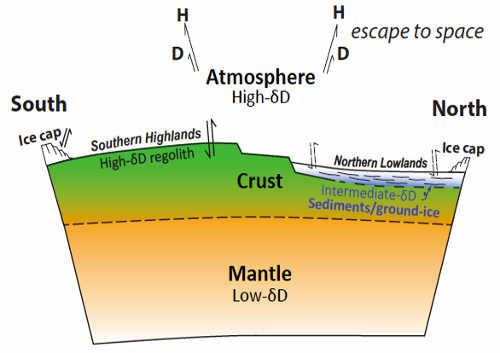
This illustration depicts Martian water reservoirs. Recent research provides evidence for the existence of a third reservoir that is intermediate in isotopic composition between the Red Planet’s mantle and its current atmosphere. These results support the hypothesis that a buried cryosphere accounts for a large part of the initial water budget of Mars. Image Credit: NASA.
And from NASA
So, am I the interpret the northern planes as being on top of an ancient frozen sea/glacier, dirty rubble?
#8562 Re: Life support systems » Crops » 2015-09-08 17:24:40
I think NASA is rather negative on the "Ice there idea". Europe not as much. Nasa thinks it's lava.
However I do recall a rather recent article which indicated opinions (And lots of evidence) that the Mariner Rift Valley has a layer of fossil ice buried deep in it's bottom, that is about 1 1/2 mile thick. I cannot find those articles now, no matter how I search the web.
Anyway the story was that this ice was deposited in an ancient era, the Amazonian or Noachian?
http://www.planetary.org/blogs/emily-la … onian.html
The idea is that when the atmosphere collapsed? A large bulk of water was deposited in various areas and buried deeply. Unless volcanism has melted it, supposedly much of it is still there due to the eternal cold temperatures of the upper crust. Well I didn't say it was true, I just say it was said.
So your notion may fit into that, ancient ice, volcanos.
But this article says 87% of original water is gone from Mars.
http://www.abc.net.au/science/articles/ … 213143.htm
Scientists suspect that the glaciers remained intact because they are protected under a thick layer of dust.
In addition to evidence of river beds, streams and hydrated minerals, scientists studying telltale molecules in the Martian atmosphere have concluded that the planet probably had an ocean more than a mile deep covering almost half of its northern hemisphere.
However, Mars has lost about 87 per cent of that water, scientists say. Currently, the planet's largest known water reservoir is in the polar caps.
But are they just making an estimate of polar caps and presumed glaciers?
Heavy water is concentrated by 5 times it appears, and that might suggest that 20% of the original water is present.
But that would be deceiving if there had been a massive burial of original ice some 1/2 to 1 1/2 billion years ago. (EDIT: 1/2 to 1 1/2 years after the birth of Mars).
I just don't know. It's above my level. It is good to know what your thinking is however, thanks.
I do seem to recall a recent entry from Spacenut. If I recall correctly he indicated that there was some evidence for a reservoir of ice under the surface of Mars that was had a different isotope character than the surface water/ice. Hope I remember that right Spacenut.
So, I did a search for that, and bingo, it seems:
http://www.lakeconews.com/index.php?opt … Itemid=197
This illustration depicts Martian water reservoirs. Recent research provides evidence for the existence of a third reservoir that is intermediate in isotopic composition between the Red Planet’s mantle and its current atmosphere. These results support the hypothesis that a buried cryosphere accounts for a large part of the initial water budget of Mars. Image Credit: NASA.
And from NASA
So, am I the interpret the northern planes as being on top of an ancient frozen sea/glacier, dirty rubble?
Alright, I am risking off topic. We just want to water some potatoes. Peace Spacenut.
#8563 Re: Terraformation » Lakes on Mars-Like Planets, Natural, Artificial » 2015-09-08 17:17:02
Glaciers on Mars, update:
http://www.abc.net.au/science/articles/ … 213143.htm
Scientists suspect that the glaciers remained intact because they are protected under a thick layer of dust.
In addition to evidence of river beds, streams and hydrated minerals, scientists studying telltale molecules in the Martian atmosphere have concluded that the planet probably had an ocean more than a mile deep covering almost half of its northern hemisphere.
However, Mars has lost about 87 per cent of that water, scientists say. Currently, the planet's largest known water reservoir is in the polar caps.
To me that 87 percent number validates the notion that perhaps a best way to deal with Mars is to start settling at as low a latitude as resources allow, and then use super greenhouse gasses, to make higher latitudes progressively more habitable with increased warming.
Since there is apparently not enough water for a return flow through oceans to the equator, the water evaporated will tend to stick to the high latitudes as ice or possibly in the future water. So, ultimately warming the polar caps enough that they melt for at least a few weeks in the year will turn them ultimately into a ice covered sea in the north, and a chain of ice covered lakes in the south hemisphere. Since the area covered by the seas will not be oceanic in extent, then there will be land that could be farmed for a few months each summer, just away from the polar seas / lakes.
If the atmosphere ultimately cannot be made thick enough to ward off night time frosts on the equator, then an Alaska-Tanana valley farming type situation (But amplified X2 more or less) will be possible for a few months at each pole each year. Since the mid summer nights will be so short, frosts should be inhibited.
http://www.akhistorycourse.org/articles … ?artID=182
So farming at such high latitudes is a bit different with the midnight sun.
Anyway, if you can get a thick atmosphere quick on Mars then don't worry about it. Otherwise if you want open air farming quick, then consider concentrating on warming up the poles. The lower latitudes will be dry desert for the most part I expect, but rivers will run downhill from the south polar ice cap, and pipelines and other transport for water to lower latitudes are an option.
#8564 Re: Life support systems » Crops » 2015-09-08 13:26:24
If I might break in temporarily.
I see you are most interested in the equator of Mars. I also note that the soil is supposed to hold a small percent of water, so could be a source of water. I cannot find out if that is hydrated minerals, or water bound to salt and soil grains (Easier to get out than hydrated minerals).
The point is I see enormous value in what you are planning here, it makes the most sense at the equator. I am wondering where you plan to get the water. I also am interested in sand dunes at the equator. Since they will have the average temperature and humidity of the equator (Daytime warmer and very dry, nighttime very cold and towards saturated RH). I wonder about drilling horizontally into a dune and hoping to aspirate out humidity from the drill hole. A dry well of sorts.
The Poles are much too challenging at this time. Glaciers in the mid latitudes are even quite a challenge because of long winters.
So, I am wondering how I might visualize starting a "Backpackers" settlement on the equator, and later linking it to a mid latitude settlement (Glacier) settlement later. And of course as I have said elsewhere I think the end game on Mars is to access massive amounts of water from the poles, but I don't think polar occupation can precede terraforming, and I don't think terraforming can be done without access to a mid latitude glacier.
Since the best glacier I can think of is in Hellas, how about a near equator starter colony just south of the equator, and some kind of a surface transport developed to that glacier location?
I can only make this post on topic, by tying it to your gardening, and of course that needs water, and this is what I am inquiring about, that and how would an equator settlement tie into a whole Mars settlement process?
#8565 Re: Terraformation » Lakes on Mars-Like Planets, Natural, Artificial » 2015-09-08 12:36:22
Antius,
Hopefully you will allow me to take some of the ideas you provided, and add them to some of the ideas worked out on this site previously. I think the results are going to be really good.
I have been after a practical farming method that does not require traditional air pressurized greenhouses, and I think there are enough pieces now to make it practical, as soon as a significant water supply such as a glacier can be accessed.
I will start with an East-West trench in the soil. One end will have a hab airlock terminating it. The human hab has to be burried for radiation reasons anyway. The airlock will normally operate at a pressure of 1/3rd to 1/4th a bar of O2. Your reflective liner will be used to provide water retention in the trench. Connecting that reflective liner to the airlock might be a bit tricky, and keeping the connection undamaged tricky as well.
I would want the liner to not only coat the trench, but to have edges that fold over 90 degrees or so at the top of the trench so as to form a flange, lying horrizontal on the ground outside of the trench. Then stretch a sheet of plastic transparent film over that using tensioners to make it somewhat flat. Glue it's edges to the flange of the trench liner.
Inflate with air, before the glue drys, so that the "Top Sheet" can be pulled to a relative flatness. Then when the glue is dried, do a pressure test with air. I don't know what degree of overpressure should be desired, but some tolerance to pressurization should be prefered.
Next, since you are at Hellas, and have a presure just above the tripple point of fresh water, it should be possible to fill the trench liner with 0 degC / 32 degF water. Let the top freeze, perhaps 4 inches of ice or 6. The ice should be pretty clear.
Next, get plastic film "Pillows", and place them over the surface of the ice (Which has a plastic film over it. Fill each pillow with clean water at 0 degC / 32 degF. Seal the port that you put the water in through. Allow the pillow to freeze to ice.
Place a scarifice sheet over the ice pillows. This sheet will do little except block the wheather from the liner and ice pillows. It will protect them from U.V. and the abrasiveness and dirtyness of wind blown dust. The sheet itself can simply be laid over the top of the assembly, and it's edges can be locked down by shoveling soil/rock over them, just above the glued flange, that was created by the liner sheet, and the "Top Sheet". This sheet will either have to be U.V. blocking, or have a U.V. blocking coating on it.
I have suggested here also that the trench be deeper than your specs. This will allow a greater safety and comfort margin. However, it will also make it harder for sunlight to get to the bottom of the assembly where you might hope to grow things. To compensate for that I again resort to your reflective film.
I suggest a fence behind this, which in Hellas, I would be south of the trench, since Hellas is in the southern hemisphere. The fence will be reflective, and will reflect light down into the trench. A simple vertical fence should be a minimum challenge. Doesn't have to be that substantial. Just a reflective sheet, and some minimal frame to hold relatively vertical against the gravity of Mars.
Should it be desired the fence could be made quit a bit more elaborate, such as moving horizontal blindes, where vanes are "Focused" on the trench below, but I myself would rather keep it simple if possible.
So, this assembly should function as follows. The ice pillows should cool down quite a bit at night, hopefully cold enough that the ice layer in the top of the trench liner should even freeze a bit more at night.
During the day, the ice pillows will hold a general pressure against the top of the trench liner membraine, but also should project stored cold downward, to gaurd against excessive thawing during the day.
The ice layer at the top of the trench liner, should provide a degree of energy moderation. If more sunlight enters the assembly and heat things up some of the bottom of the ice should melt, absorbing some of that heat. At night, the ice should thicken, and so store cold.
The liquid water will be about 0 degC / 32 degF directly under the ice, but the bottom water under say 10 feet (Sorry not metric), should be able to warm up to up to 3.889 degC / 39 degF.
Not that inviting, but perhaps workable for some type of vegetable in a terrarium, or some type of aquatic plant.
Of course as mentioned in a previous post, it would be possible to place another water filled envelope in the bottom of the water in the trench, surrounded by 3.889 degC / 39 degF water.
Perhaps by afternoon, the water in this envelope will have developed much more appealing temperatures, significantly higher than 3.889 degC / 39 degF. This would be more confortable for the humans, and also perhaps allow other varieties of plants to be cultivated.
So, the materials needed are;
-Transparent plastic films.
-Glue
-A trench, which must be dug.
-Reflective coatings for some of the plastic films.
-U.V. protective methods, either intrinsic to a sheet of plastic, or a coating of a sheet of plastic.
-A light weight fence frame.
-Means to interface the trench liner and the extra envelope to the air lock.
(Might want a second means of egress at the other end of the trench, but enough already for this post)
The airlock would serve as the temporary home of the diver, breathing relatively pure O2. The personal in the rest of the hab would be available to lend some assistance if necessary.
The diver might have all that is needed to pot/plant and harvest terrariums in the air lock.
And of course the diver would only do this duty for a number of days, or perhaps even weeks at a time.
AMENDMENT TO THIS POST:
I see a possible very advantageous method to add.
Should you wish to for an installation which has the trench liner and an additional bag at the bottom of the trench for the terrarium option, A solar concentrator could inject clean steam during the day to heat the water up in the secondary bag, so that indeed the diver should be able to work in comfortable water. Say 75 degF / 23.88 degC. This will of course cause the 39 degF water to overwarm and start to turn over, but the ice on top can absorb that heat for a while. At night a process would be used to extract heat from the one of the containers as wished to cool it, perhaps using the heat to distill water, relative to rather low temperature and pressure of condensation?
So in other words the device could put up with 24 hour swings in temperature particularly in the secondary water bag, but it would still be possible to maintain overall long term stability within operating limits.
#8566 Re: Terraformation » Lakes on Mars-Like Planets, Natural, Artificial » 2015-09-08 06:09:49
I am not against a nuclear reactor, it appears that they are likely to have a place in the schemes.
Antius,
Lots of options, once you have your containment for a cold water pond. The air terrariums notion in a cold water pond is what I think could be the minimum effort that might support the growth of a few special vegetables.
Going a bit further, you could have a transparent warm water bag at the bottom of your pond. That would be a transparent bag, that since you provided 180 mb water column pressure, would experience 180 mb pressure +/- ? mb.
The value of this is that for the air terrariums method you would be able to improve the temperatures, particularly the nighttime temperature. The air filled terrariums would be inside the warm water bag of course, and of course the bag has to be weighted down to keep it from floating.
For this plan it would be important that the cold water of the pond itself be relatively sterile, otherwise algae build up on the transparent surfaces will vex you. Similarly, you might have such a problem on the interior of the transparent bag, so you would need to keep the nutrients down in the water inside the bag, or inhibit algae some other way, or resort to an algae eating fish to clean it up, if one could survive. Fish might be pretty tricky, and might die off for whatever reasons. Removing dissolved gasses from the water inside the bag might render the water sterile to algae, since it would not be able to get Carbon.
Another variation would have aquatic plants inside the water bag, and forget the terrariums. In that case, you would insert dissolved gasses into the bag, and perhaps you would like algae. Or you would have to clean the algae off the surfaces, and then could have fresh water pond plants, for whatever value they might have to you. Pond plants have not really been established as much of a food source, havn't been farmed, so that is the weakest part of that notion.
But with Terrariums filled with air, if you could move your minimum nighttime air temp higher and your maximum daytime temp higher, then some other varieties of vegetable might work in this upgraded scheme.
Keeping your water sterile in that case would then allow the maximum amount of sunlight to arrive at your plants, through the water or ice & water.
#8567 Re: Human missions » Design Reference Mission 5.0 » 2015-09-07 17:10:29
That suggests to me that they have not been entertaining the notion of a chemical drive trip to asteroids or Mars, and might suggest why their hardware does not seem to be able to do anything useful. With a better propulsion unit, maybe it will make better sense.
#8568 Re: Water on Mars » mars-water-discovery-curiosity-rover » 2015-09-07 16:35:28
Well, that's a solution.
The way I see it just now in my awareness of what is possible, I think the natural "Wet Spots" on Mars are what you want the most. That is the polar ice caps and areas adjacent to them, particularly basins adjacent to the ice caps.
Now, they are not even inhabitable.
But if you throttled up your super greenhouse gasses to massive proportions, could you get them to start to melt?
However, that would be a bad plan, because there is an enormous thermal inertia, so while you would dry out the rest of the planet doing that and send it's surface water to the poles, it would be a long time before the polar ice caps would give up to you flowing rivers of water, or reservoirs of water not covered by hundreds of feet of ice.
Further you would not have enough humans and robots on the planet to generate an economy that could support such and intense build-up of super greenhouse gasses.
You could modify this by adding energy to the ice caps with fusion heat from fusion electric power plants, or putting power lines all over the planets lower latitudes, and exporting that electric power to the poles, where you would have underwater/under sea floor factories where your waste heat would be pushed into lakes/seas adjacent to the ice cap body. Another alternative would be to pipe or ship by train, etc. water and split it into O2 and Hydrogen, pipe the Hydrogen back to the poles (Liberate the excess O2 to the atmosphere). Pump Mars atmosphere into ice covered bodies of water adjacent to the ice caps, along with the Hydrogen. Allow microbes to digest CO2 and H2, they will produce heat just by doing that.
Anyway, those are interesting supplements to consider as well.
Back to the original:
If it turns out that Mars cannot muster even a 500 mb atmosphere, then it will seem likely that the nights on Mars on the equator will almost always risk serious frost every night, I speculate. The high latitudes might be better, but I think frost will be a problem.
For open field farm land your best hope in that case would be to go to the poles and heat them up enough so that during a 3 month out of 22.3 month year, the "Night" (Which will be very short in the summer) will be frost free.
That would also provide for a minimum 1 month out of 22.3 months where water can melt on the ice caps.
This uses Mars nature to an advantage, because it's year is much longer than Earths. You also have a favorable factor where if you have a minimum atmospheric pressure of 100 to 300 mb, (Just guessing) you can hope that since Mars has less distance from the equator to the poles, equatorial heat will tend to move to the poles during cold spells at the poles.
And then I think greenhouse gasses do the most good for polar areas anyway.
But any settlement of Mars will have to ease into such an arrangement in a timely fashion. If they do not, they will lock up most of the water into the polar ice caps, before those can be melted to provide water for the planet. And as I have said, it will be a long time before enough infrastructure exists on the planet to drive that much greenhouse gasses into the atmosphere, and even if they do, it is going to take a long time to get the regolith to warm up and give up its gasses to the atmosphere.
So, I think that what is needed is a set of metamorphic changes, where at first, yes your backpackers have to get there, they have to graft themselves into the planets system, but at first, the will be highly reliant on items they have brought with them. That will include air pressurized greenhouses all the time, but only that at first, and then perhaps, some dealings with larger and larger reservoirs of water can be included in the activities, if that turns out to be a productive thing to do.
As for when the ice caps are melted, I would think that most likely the north cap will be a ice covered sea, maybe it will melt around the edges now and then, here and there.
The south polar cap will be at a high elevation and should it melt, it will probably form rivers, and those will fill craters/basins (Mostly ice covered I would think), who knows, maybe even Hellas. The water could be directed with canals, and pipelines, but yes, if a train or tanker truck gets you what you want for a better price, then why not?
It is important to remember that with the poles pointed as they are now, most precipitation will occur at the poles, Frost, Snow, or Rain.
So, that is where to go to get control of all of the Mars water. (Which is of course one of it's greatly valuable resources).
#8569 Re: Life support systems » Crops » 2015-09-07 16:00:05
OK, good, I can comprehend that.
I am going to suppose that being overweight could get you some frowns on Mars in the early days
#8570 Re: Terraformation » Lakes on Mars-Like Planets, Natural, Artificial » 2015-09-07 13:05:31
I do want to think in that direction:
http://www.telegraph.co.uk/news/science … -Mars.html
Ice glaciers three times the size of Los Angeles discovered on Mars
Vast ice glaciers have been discovered near the equator of Mars.

I am not sure I agree with the "Near Equator" quote, but whatever.
http://www.telegraph.co.uk/news/picture … me=2909640
Photographer Franco Banfi from Cadro, Switzerland took this photo of a Russian freediver swimming beneath the frozen White Sea in Karelia, Northern Russia. This swimmer is one of many Russian freedivers who gather each year at the Arctic Circle Dive Centre.

But huge reservoirs will be an excessive burden to start with, and likely out of scope at first, but later, I think a great idea.
But:
So a big glacier in Hellas, and a dome suggestion from you at local ambient pressure.
I will try to work with that, I think there are ways.
Of course a reliable steady source of water, to start with, and the ability for humans to have all the forms of life support.
Some have suggested strip mining the ice, and of course at first you will need to dig a hole in the rock and soil overburden to get to the ice (Ore). However I think optimally, you would have a method to have pressurized ice caves which you would carve with heat. How much pressure you could employ is debatable. You would not need much for liquid water. You would then take the liquid water, and vaporize it, suctioning it through a partial vacuum pipeline/hose, to the entrance area, and it could be pressurized to a liquid on the outside with compression equipment, and put in "Tanks". (Plastic bags?) that could be on carts. Let it freeze into blocks of ice, and then transport it to your base I guess. Maybe later on you would have a vapor pipeline that would lead all the way to your base.
As things you might wish for perhaps you could find a largely intact lava tube under the glacier. Presumably filled with ice. Fairly unlikely, but maybe.
Otherwise, I would calculate just how much glacier overburden will allow you to maintain a stable ice tunnel with a pressurization of 'X', whatever you think you can get away with. I suggest that the tunnels will try to follow an interior perimeter inside of the glacier, where the bottom of the tunnel is on soil and rock. Depending on how stable and habitable the ice caves are themselves, it may be desired to burrow into the permafrost soil, or even rock, and create habitat, factory space ect.
Mars having a gravity of 0.38 the requirements for tunnel supports is reduced. How much could such an ice tunnel be pressurized, without a blowout? Well I just don't know. Hopefully at least to 30 mb, for melting water. Ideally to .25 bar at least. It would require a place in the glacier which was not "Flowing" very much. It is a help that this glacier should be very cold and slow moving.
If they are even possible, I would suggest that they could be pressurized with raw Martial atmosphere compressed, and the humidity inside should be kept elevated. The hope would be that for slow leaks, the leaking "Air" with humidity would deposit humidity to ice to plug the leaks.
But the ice tunnel thing is a side show. We first of all want a source of water, and a ways to have it contribute to life support, and in fact food production.
Obviously, the back packers who come first will bring greenhouse methods to grow potatoes, and other vegetables.
The move to expand to large reservoirs, will be intimidating. It will require a lot of effort before a profitable situation could be realized, but it is the most natural farm land that Mars could offer.
One solution is to build a reservoir and cover it's ice with soil and rock. GW Johnson has proposed that. In that case you would need to provide artificial lighting, in an underwater situation, and move solar or nuclear electric power into the devices in the water. For standard vegetables, you also need air filled "Greenhouses" under water.
An alternative to that would be the reservoir which would be the same, but instead of light, you could provide chemicals to drive an ecology.
Oxygen, and a Food/Fuel, such as Hydrogen. This should be very robust, but of course you have to convert solar electric/nuclear electric power to Oxygen and Food/Fuel. I am also not certain that the value of what grows will be great. Maybe you could grow fish food, but vegetables would be more efficient that fish. Impaler has a post about growing a microbe for food, and it is a good one. In that case you don't need the reservoir. That is, unless you want to grow things like clams and crustaceans that feed off of methane seeps in the ocean.
Antius;
You have suggested a ambient pressure greenhouse. Perhaps that can be done. High humidity maintained, and so on. In the region of Hellas, in a full Martian year, perhaps you could have a 3 month period of no hard frost inside the greenhouse. Then, perhaps somehow some type of Vascular plant could be grown, if not perhaps microbial mats.
I would suggest as a variation, a slightly pressurized dome, with a pool of water in it. The surface of the pool may or may not be covered with ice.
The surface water being at 0 degC / 32 degF, the water below able to reach 3.889 degC / 39 degF without the water "Turning over".
No frosts on your crops at the bottom of this pool of water.
Unfortunately your "Crops" will have to be high arctic or high alpine pond plants. That's going to take some work. If we had some of the pre Columbian peoples from the Andes, perhaps they could teach us how to domesticate such plants and make them useful. They seem to have had genius for that. But we don't have them, so we will have to use our own ways.
But what about a "Batch" method melded with the Dome/Pond plan?
Supposing that you could mass produce small terrariums, to grow vetetables in. Suppose that they had a loop on the bottom, so that you could "Hook" them to the bottom of the pond. Air filled. During the night internal temperatures should not drop below 3.889 degC / 39 degF. During the days sunlight, internal temperatures might reach satisfactory temperatures for some vegetables.
So, I think you see where I am going. Obviously I am presuming a plastics industry, and a 3D printer to mass produce the terrariums.
A problem with growing vegetables in this manner, is to make the environment inside chemically suitable for the plants. They need water and nutrients, CO2, etc, in a time released fashion. Perhaps a Carbon source could be incorporated into the soil, to be digested slowly by micro organisms and released into the terrarium "Atmospheres". And so on.
Now, an Apollo space suit will not do, for the "Farmer" who has to add and remove terrariums. I am thinking a Boat-Suit.
A boat, with a habitat for an individual to dwell in for a time, and arms down below, allowing manipulation of objects in the water. Perhaps it will be a cylinder actually, so it can spin on it's long axis, and perhaps it will be able to tip end for end somehow.
Anyway, there you go. A method, perhaps a starter for introducing reservoirs of water as useful to human habitation of Mars.
End of post.
#8571 Re: Life support systems » Crops » 2015-09-07 12:42:47
Well my people havn't been proper farmers for at least 2 maybe 3 generations. All I see is 2 to 4 times as long, and I can understand clean sand, and CO2, but the rest is blah..blah...blah to me, so I will from here defer to people with better common sense about it. I just though I would present it for review, since it was a reference I recalled from long ago, and there seems to be active use of it as spoken of on the net.
#8572 Re: Terraformation » Lakes on Mars-Like Planets, Natural, Artificial » 2015-09-07 08:11:12
This post, presumes that "Super Greenhouse Gasses" will not be permanently used on Mars in large amounts.
Granted, if that were done, you could melt all of Mars, but that will take time, and during the time it takes, there will be an era of Antarctic conditions on Mars, that it would need to be handled, for the purpose of inhabiting the cold Mars that will precede your "Super Greenhouse Gasses" later Mars.
I don't think that Earth will ever pay to terraform Mars, so that dictates that people will first inhabit it as it is now, and then will terraform it to Antarctic conditions, and then may choose to keep warming it up. While they are doing that, it will make sense to utilize ice covered reservoirs, since they will want to exist on an early terraformed Mars.
This model deals with a successful Mars model, not the stillborn Mars that we have. It relates in our real Mars, to the fact that even with "Super Greenhouse Gasses", it will take centuries for heat to penetrate the ground to release the locked up gasses, therefore for some time Mars will not have a 500 mb - CO2 atmosphere, that will come considerably later, and so Mars will remain much colder than the greenhouse factor provided by 500 mb - CO2 for quite some time.
OK, so I have had people tell me that they think that with Terraforming Mars could have anywhere from 300 mb to 1000 mb pressure, virtually all CO2.
If Earth were moved to a Mars orbit, it would be colder, unless it's atmosphere was almost entirely CO2. The 1000 mb estimate is at the optimistic end of the estimates. I will instead use 500 mb of mostly CO2, since it is an average between 0 and 1000. Conveniently as well, 500 mb of CO2 has about the same greenhouse effect as 1000 mb of N2/O2. Maybe we could say that if Mars had 500 mb CO2 and Earth had 1000 mb of N2/O2, they would each have a greenhouse effect of "1".
In this model, the size of the two planets is ignored. In reality, if each planet had a greenhouse effect of "1", and they both were at the current orbit of Mars, they would behave differently because since Mars is smaller, atmospheric winds would average the temperatures between it's equator and poles more than winds would do for Earth. But for this example I will hope to satisfy that difference by trying to deal with the mid latitudes of both planets, which should be similar.
Another difference is the amount of water, but I think that by dealing with the mid latitudes, and particularly staying away from Earth's large oceans, interior continual conditions might be rather similar concerning temperatures.
So then as models, I choose "The great salt lake", "The Mediterranean", "The Black Sea", "The Caspian Sea", and "The Aral Sea", and perhaps some other mid latitude medium and small bodies of water, tending to be salty.
I have read, that the Earth moved to the Orbit of Mars would still manage to have some open water on it's oceans, presumably at the Equator.
I presume that "The great salt lake", "The Mediterranean", "The Black Sea", "The Caspian Sea", and "The Aral Sea", and perhaps some other mid latitude medium and small bodies of water, at mid latitudes would be frozen over.
On Mars, with less water, the Oceans would be much more shallow, and in fact water might not make it down to the equator, but the oceans might end up being a set of relatively disconnected basins.
So, such a world, if capable of having an inflated astmosphere would consist of dried up sea basins at the equator, and polar ice caps, and perhaps mid latitude ice covered seas and lakes.
This is good, however, because it may reduce evaporation, inhibit the mixing of water by waves and allow these bodies of water to become natural solar collectors, as their waters can stratify between a warm saltier bottom layer and a colder less salty layer just under the ice.
If this world were to exist in reality, a sort of cross between the Earth and Mars, at the orbit of Mars, then Antarctica suggests what might happen naturally if it were provided life.
Here is some conversation related to it: https://books.google.com/books?id=fRJtB … es&f=false
It is fairly negative about the productive capacity of "Most" lakes. (Keep in mind that for artificial human manipulated lakes, nutrients can be added, ice thickness can be moderated, and perhaps something can be done with water temperatures).
Anyway most organisms are small, with a few small animals, and no fish.
I would be curious if a fish that ate plankton could live in the cold Oxygen layer. It can be very high in Oxygen I recall. Probably the reason there are no fish, is that these lakes are relatively temporary. They go through cycles of being displaced by glaciers, perhaps drying up, and so on. The biology has to be simple, it is most likely only organisms which can come in on the winds or the feet of birds, that would colonize the lakes.
So, I suggest that for the model I suggested where significant long lasting bodies of ice covered water could exist at the mid latitudes of the model planet, those seas could allow for a more continuous habitation of such bodies of water driven by photosynthesis, and so more complex forms of life, even fish type things could be resident.
So, I suggest that for alien planets this model can move the "Habitible zone" out a bit more, for photo driven ecologies.
Some will argue that the old outer limit for sun melted water holds. I will agree that in the atmosphere, that is true. However, if there can be snows in the mountains around such solar heated bodies of water, then there can be glaciers. If there are glaciers, and they flow into the bodies of water, and encounter the solar heated salty bottom water, then that glacier ice will melt, helping to keep the ice covered reservoirs hydrated. As a further assistance, the top of the ice layers of those seas would be colder, at orbits more remote from the sun, so the evaporation rate would be less.
Further, even if the amount of sunlight is not enough to melt glacier ice by itself, that would lead to positive a feedback mechanism where
the lakes do dehydrate, and become hypersaline. That cold very salty water might be able to melt the ice of a glacier feeding the lake.
Of course such cold and hypersaline lakes might not be that friendly to life, but never the less it would be water, and we don't know what presumed "Aliens" might adapt to.
And I am making the case, that this is likely what Mars wanted to be, before it died.
#8573 Re: Life support systems » Crops » 2015-09-07 07:56:30
Even thinking about gardening seems to make something inside satisfied. Must be some instinct for it.
I read your entries yesterday, and upon waking from a dream state (Where I had a key in my hand), I recalled a reference of memory, from long ago, where an article said Lettuce was stored in CO2, prolonging it's freshness.
So, I googled this: storing vegetables in carbon dioxide.
Got these references: https://www.google.com/?gws_rd=ssl#q=st … on+dioxide.
Selected this: http://www.van-amerongen.com/EN/Control … _34_6.html
Controlled Atmosphere (CA) is a storage technique whereby the level of oxygen is reduced and CO2 is increased. Quality and the freshness of fruit andvegetables are retained under Controlled Atmosphere conditions without the use of any chemicals. Under CA conditions, many products can be stored for 2 to 4 times longer than usual.
Don't know if this also will apply to potatoes, but with the extra long winters Mars offers, I would think this method goes into the "Wants" basket for inhabiting Mars.
Additionally....
While doing the above searching, I stumbled on this, which is likely a related method:
Google: storing vegetables in sand
https://www.google.com/?gws_rd=ssl#q=st … es+in+sand
http://www.gardeners.com/how-to/storing … /5021.html

A second technique is to store these crops in moist sand. Prepare the roots as above. Moisten clean sand in a large container or wheelbarrow. Pack the vegetables into a tub, wooden box, 5-gallon bucket, plastic-lined cardboard box, or a Root Storage Bin. Start by placing several inches of moist sand on the bottom of the storage container. Lay vegetables on the sand in a single layer, not touching each other. Cover them completely with sand and continue layering until box or bin is full. Top with a layer of moist sand. Container will be heavy when full, so plan accordingly. Remove the stored vegetables as needed
I imagine the sand limits Oxygen replacement, and retains CO2 coming from the vegetables. So, it is a method related to the first method I have found mentioned for CO2 storage of vegetables. I suppose it may hold humidity more stable as well.
#8574 Re: Water on Mars » mars-water-discovery-curiosity-rover » 2015-09-06 18:45:26
Tom asked:
I have a question Void, how harsh is the Martian Polar Climate to a suited astronaut?
The winters and darkness would be about twice as long, and those I believe are unbelievably cold, but as you have suggested, due to thin atmosphere, perhaps not as draining of heat as might be supposed. Actually if you were to work in such, I would think you might have a special suit with no cooling system, just a heating system if needed. But...
I think the poles are a rotten place to start, but a wonderful place to end.
It is reasonable that before the poles are used, methods would be developed at the locations of mid latitude glaciers of significance. For instance I believe that there is at least one the size of Los Angeles.
While some concepts involve strip mining water, I would like to investigate the "Grounding Line" of a glacier/Ice cap.
If an Entrance structure were put into the side of a glacier, where the ground under the ice could be reached, then it would be possible to dig tunnels with dirt/rock bottoms in the ice of the glacier, and extract water at the same time. Trenches could be dug in the dirt/rock, and perhaps tent like material used as a roof over them. The method of digging would be with heat. Either evaporate the ice and condense the vapor, or directly melt the ice into water, and pump it to the exit.
Of course I am presuming that an ice tunnel can be trusted to hold an air pressure.
This is one method of providing a great deal of pressurized space. However it may be sensible to re-enforce the ice somehow.
Ultimately however, I have said it before. I want both ice caps converted into bodies of water, covered with ice. Optimally allowing photosynthesis through the ice of these bodies of water during the summers. Entire cities built under the pressure of the water, if it turns out not possible to generate a dense enough atmosphere for human health.
The reason I want this is because what ever evaporates from the surfaces of Mars will always want to condense in the coldest spots, and for now that is the poles for the most part. If you have a method to inject heat into water under the condensed ice and snow, you can liberate water from the poles, and create a biosphere, and ideally each polar body of water will be a solar collector.
The excess melt water generated could be conveyed by canals and pipelines to lower latitudes, to feed more ice covered lakes, which would also be abodes for life, and solar collectors.
But you would have to be crazy to try to do the poles first.
#8575 Terraformation » Lakes on Mars-Like Planets, Natural, Artificial » 2015-09-04 16:31:14
- Void
- Replies: 43
Title:
LAKES ON MARS LIKE PLANETS, NATURAL, ARTIFICIAL
I intend to touch on the aspects of Teraforming, Para-Terraforming, Life Support (For Humans), Life and such related matters. How a Mars similar world around another star might behave.
Historically this section has been the one least troubled by the "Off Topic" teknique of stifling a conversation (Which can be valid).
This conversation got stranded in the following location, but I would like to continue it.
I have added quotes for myself, but don't think it is valid to speak for the intendions of others.
To the degree possible, I will try to associate any future content that I may add to these three quotes, but if necessary will go outside of them, to for instance illustrate on-going improvements.
History: I attempted to show some ideas similar to these to the Red Colony gang. And I do mean gang. For the most part I recieved harassment, and was so happy to see that they had new ideas about putting water in domes. An idea I had promoted myself previously.
Here in this site I have introduced these things again in a better form. This time I think the form approaches practacality for certain possible futures of a Mars with humans on it.
I must say that there has been at least one member here who has participated and had come up with some improvements to add, those improvements being appropriate for certain intentions. A variation that stands by itself.
PER: Index » Human missions » Space Station V
Quote 1
Void
Member
Registered: 2011-12-29
Posts: 876
Re: Space Station V
What you would hope for Tom would be something like this:
http://phys.org/news/2015-09-oxygen-oas … earth.html
They occur in Antarctica.
I am not going to say that there are none on Mars, but I don't think they could exist naturally in the present climate. Primarily, because of a lack of melted make up water. You have suggested ground water, but we don't have strong reason to suppose that exists from what we think the conditions are on Mars.
In Antarctica, for a few weeks in the summer, warmer temperatures, and constant sunlight can melt small rivers/streams. This flow ends up on top of existing lake ice (Often), and the weight of the water relative to the ice causes the ice to crack, and the water flows through the cracks into the water reservoir below the ice. This process must add enough water to replace water evaporated from the ice surface around the year.
The other factor that allows these lakes to exist is the solar pond effect. Salt accumulates in these lakes. However, the layer on top is colder, but less salty. This could be in part because fresh water gets added to it each summer, but also could be a factor of the ice thickening over the long winter, and expelling brine (To sink to the bottom of the lake), in the summer, I would presume that solar heat causes the bottom layer of ice to tend to melt, releasing a less salty water.
The upper less salty layer also supports photosynthesis, which produces oxygen.
The lower anoxic layers are saltier, and warmer, and can for instance be around or above room temperature. This is from solar heat.
I think that a Mars like world might just be able to support a similar lake, without the existence of summer running water.
In that method, a glacier would dump ice directly into the lake, to encounter the salty anoxic warm layer, and that method would add water to replace evaporated water. Just possibly this has occurred on Mars at the Equator, if the planets axis were extreme.
Artificial lakes:
If you are going to create a lake of this kind, it presumes that you will cause water to be added to it as needed. This is a problem because the evaporation rate would be very high.
A mechanical method is needed to protect the otherwise exposed ice surface. Several options are possible.
However I am going to suggest that in the end the lake be covered with "Blocks" of encapsulated ice, over the normal ice layer.
So, however you might start to have a lake, if you wanted to expand it, you would add water to its body, and the water would cause the ice to lift up. Then the edges of the lake would have exposed ice. You would bring a transparent plastic bag out to a bare patch, and place it over the bare patch. Then you would quickly fill it with fresh clear water, through a port. You would wait for the water added to freeze, and then seal the port. A bubble of air would remain in the plastic bag, but the bottom of the bag would be covered on the bottom with a layer of rather transparent ice as thick as desired. You would also put a epidermis layer over this whole assembly. That layer would be to protect from U.V. light, and like your outer skin would be replaced as it deteriorated from "Weathering". This will also tend to shed the heat of the U.V. radiating it away into the atmosphere, keeping the ice blocks below cooler.
The bag(s) would only have to hold a peak pressure of a few mb above local ambient, so during the Martian day, due to that pressure retention, and thermal inertia of the block of ice, I believe that stability would be maintained. In fact, I think that block of ice could be so cold from the nighttime temperatures, that very little pressurization would occur at all in the bag, from vaporization of water.
It would be important to build the encapsulated blocks of ice so that they do not absorb very much light, and so do not heat up from solar energy themselves.
Of course I am talking about a tile surface over the normal surface ice of the lake, a horizontal assembly of multiple blocks. The tiled surface would impose pressure over the lower "Normal" ice layer, and so greatly reduce evaporation from the lake. If necessary, the "Cracks" between the tiles could be caulked with something I suppose, but it may not be necessary. The cold of the ice in the bags would also transfer to the underlayment ice, and so discourage vaporization.
So, if you have this impoundment of water, a reservoir that is exposed to visible light, this might promote the habitation of Mars, even if the only life in the lake were microbes. However, using solar concentrators under the ice, I think it may be possible to grow more advanced plants. Easiest would be fully submerged pond weeds (Domestication will be a problem). By solar concentrators, I indicate that the light getting through the ice may be attenuated more than what is needed for the plants, so you would build a solar concentrator which would be in the water, under the ice, and which would shine concentrated light on your subject plant.
Such devices could be attached to cords, to the warm bottom below. Humans would be in a room temperature environment, and might pull those down temporarily to the bottom to plant and harvest them. Obviously they would want to harness Oxygen in the colder upper layer.
So, then the source of water. Glaciers perhaps, but how about the polar ice caps themselves? In fact it might be reasonable to have very large impoundments from such a large reservoir of water.
Another thing about considering living on the bottom of a lake/sea/ocean on Mars. If your building leaks, it leaks water in, and air bubbles out.
There should often be time to remedy the situation, or evacuate to another building, swimming in warm bottom water with just breathing assistance.
On the surface, at the air pressures currently existing, an equal sized leak would instead quickly lead to death producing conditions, and the chances of remedy or evacuation would be rather small.
Solar energy? Well, some studies indicate that even now there should be significant exposed ice, where sunlight melts small pockets of melt water (Contained by the strength of the surround ice, not a ice/water column). So, it is not that wild an idea.
However, I am going to bet that in about 100 years or less there will be fusion power, and indeed plenty of power to power a Martian colony, and it's waste heat could be dumped into the polar ice caps, to indeed build Lakes, Seas, and perhaps even Oceans, with an Oxygen layer long before the atmosphere will ever have significant Oxygen.
Last edited by Void (2015-09-02 15:04:43)
Quote 2
Void
Member
Registered: 2011-12-29
Posts: 876
Re: Space Station V
As a supplement to the last post I made, I can point out that any terraforming scheme involving greenhouse gasses would likely first release the CO2 deposits in the polar ice caps. Particularly the one in the South polar cap. According to my reading, that would elevate the average pressure on Mars to 11 mb, and reportedly that would be enough to allow for snowfalls, and melt water, and temporary streams, so it is likely that during any such terraforming scheme, an approximation of Antarctic conditions of the dry valleys would be achieved rather early, and very likely natural forces would begin to build such lakes.
However further human interventions to promote their formation would make a lot of sense at that point I would think. Methods such as ice block coverings, and diversion of temporary streams of melt water into the lakes, before they evaporate.
Last edited by Void (2015-09-02 14:20:06)
Offline
Quote 3
Void
Member
Registered: 2011-12-29
Posts: 876
Re: Space Station V
When setting a short term objective, I would prefer to look at the long term potentials. In the case of the Norse Greenland colony, strangely, even though that group of Norse, would sail the north sea, they would focus on finding sheltered fjords where they could farm.
https://en.wikipedia.org/wiki/Fjord
They liked it that way, and that is how they may have lived in Norway prior to Iceland.
However, if I have the story right, they did not seem to be interested in fishing, or catching sea mammals.
I would defer to more traditional "Greenhouse" methods for sure, as a start of a settlement, particularly if that is something that can be well rehearsed and simulated prior to a mission.
But I will say that most of the thinking I notice about Mars seems to indicate people have a mind set that it is going to be like the South West of the North American continent. It looks like it to a large degree, but in reality it is much more like the dry valleys of Antarctica.
To also rehearse what methods would be well suited to Mars as it really is, is not wrong.
The reality is that Mars at it's best will likely be a poor relative of our higher latitude areas even after terraforming. That is not to say that humans could not have a prosperous existence there, but the price for that will be mostly technical adaptation and the manipulation of large amounts of liquid water.
The lessons of those lands, especially at the highest latitudes are that life prospers more in bodies of water than on the land at the same temperatures.
So indeed the mission(s) have to be focused on what is possible, but if they do not lead to a solution to harmonize with what Mars actually would be willing to give to the human race, they will be a waste of time, except for scientific discovery, I suppose.
Further, I am more optimistic than is typical here.
I see NASA is focused on asteroids, since the inhibitors forbade them from actually doing anything else.
Private concerns are approaching the ability to launch items such as the Bigelow expandable modules into space.
It looks like there could be new propulsion systems started, and improved in the next 5-10 years. For instance perhaps the Vasimr.
So, as a mission to Mars is likely still fairly far off, I do not feel restricted to the present available hardware, or it's directly similar devices alone.
And honestly I would have preferred that you comment on the posts I made, instead of trying to bypass them.
Last edited by Void (2015-09-02 23:06:10)
I am going to take a very special pleasure of bringing this up repeatedly.