You are not logged in.
- Topics: Active | Unanswered
Announcement
#826 Re: Terraformation » Plutoids and Rogue Planets, Titanformation process, a cold treasure? » 2025-08-17 17:46:08
A Rogue Ice or Gas giant detected: https://www.msn.com/en-us/news/technolo … r-AA1JAZz3 Quote:
Einstein’s Theory Helps Astronomers Spot Mysterious Free-Floating Planet Using Hubble
Story by Lydia Amazouz • 2w •
4 min read
So, we have gone from not being able to detect rogues, to maybe once in a while detecting them.
I am wondering if it might eventually be possible to see a "Pinch" in the background radiation field from the Big Bang?
Certainly we don't have that yet, but I might think that if we could detect such "Pinches", eventually we might see them tracing a path across the view.
A closer rogue might be easier to see, I am guessing. But of course a rogue might be putting out Infared light, so maybe it is yet impossible.
Still it does not hurt to try. When you fail, sometimes that points to other possibilites.
Ending Pending 
#827 Re: Interplanetary transportation » Multi-Ship Expeditions, Starboat & Starship, Other. » 2025-08-17 10:36:09
To continue with the previous post, it might be possible to bring Paraffin Wax to orbit to react with Lunar Oxygen, if Lunar Oxygen were made available in LEO. To produce primarily the potential coolants CO2 and H20.
I have hopes that Neumann Drive and/or Magdrive may become assistive to bring Lunar Oxygen to LEO.
Ending Pending
It is possible that Liquid CO2 could be used somehow in the Main Tanks, but this would require a great deal of CO2 to get a high enough pressure for liquid CO2.
Ending Pending
#828 Re: Not So Free Chat » Void Postings » 2025-08-17 10:02:50
I think I am not doing so bad. Some uncomfortable realities are needed to be understood. But I am very, very careful usually.
Ending Pending
#829 Re: Interplanetary transportation » Multi-Ship Expeditions, Starboat & Starship, Other. » 2025-08-17 09:24:32
A factor I have been thinking about is propellant margins and cooling methods. I would expect that many notions about the rocket equation limit the amount of excess rocket propellant margins that can be allowed.
If you can predict perfect performance, then maybe you can calculate to almost the last drop, but if you have various mechanical failures, or variable payloads, you might need to keep greater margins of propellant in the main tanks. The Headers are likely calculated to provide almost the exact supply needed.
For a Propellants to Orbit Starship, this might not be such a problem, but for other Starships, including Expendable/ Not Really, it might be preferred to have extra margins at an additional cost. I would like to make those extra margins useful if possible.
Turning extra propellants into coolants would be the goal.
Where, extra Methane and Oxygen, offer the Methane as a coolant, I consider that the Oxygen as a coolant may be quite dangerous to attempt as it typically wants to Oxidize things.
So, I suggest reacting excess Methane and Oxygen while in orbit, and then cooling those products off in orbit, then perhaps using them as part of a reentry heat shield method.
Another possible source of such coolants could be packing materials, that become a part of a garbage stream, and perhaps Oxygen from the Moon.
So, I am imagining that there are four main types of surfaces to give heat shield protection to.
1) Cargo Holds.
2) Main Oxygen Tank.
3) Main Methane Tank.
4) Other, such as engine bay walls.
A Starship in orbit might have its belly coated inside with these materials. Possibly Dry Ice for the Main Oxygen and Methane Tanks. This then may have some ability to protect the metal from reentry heat.
For the Cargo Hold, I am thinking of a wicking material which would use capillary action to distribute liquid water to the inner walls of the Cargo Hold. You would need tanks of water that could give the water to be distributed. The internal air pressure could be regulated. A lower pressure would allow a lower temperature of vaporization.
This calculator can suggest things to consider: https://endmemo.com/chem/vaporpressurewater.php
100 degrees C steam might harm people or things exposed to it. A pressure of 1019.0135 millibars is calculated.
But with a little protection such as a protective suit, it might be tolerated.
75 degrees C would still have burn dangers, but less so, and would give a pressure of 384.6636 millibars, which would be enough that a human with protection might not die from vacuum exposure.
Regulating such a pressure would be a danger as well, as some Soviets died, I believe in a depressurization event.
My expectation would be that any humans on board would be hosted in another compartment that does not have a "Hot Wall" during atmospheric entry.
I don't know if a "Wick and Water" method could be adapted to the Main propellant tanks. It might provide a contamination that could not be tolerated.
I again mention the possibility that Lunar oxygen could be reacted with Organic Wastes to produce Coolants as well.
We also have the possibility that coolants such as Water and CO2 could be brought in from other worlds, at some point if the technology is proven to be suitable for it.
While then methods I have mentioned may have some value, I anticipate that some use of additional Ceramic or Active Cooled metals will be needed in the hotter places.
Ending Pending
#830 Re: Not So Free Chat » Peter Zeihan again: and also other thinkers: » 2025-08-17 09:14:20
I think a possible danger of the future will be expanded permissions.
How people will deal with expanded permissions, and dealing with dealing with excessive permissions.
A great problem is that now, I think that with wealth, children are imprinted on the wrong sort of subject for imprinted as per "X". They are regarded as having no such thing as "X", when in reality even babies have safer versions of that that they imprint on. I put myself in significant danger even mentioning it.
But the poor imprinting in my opinion is part of the problem of adults who do not successfully reproduce.
And a lack of reproduction will lead to a dying society.
I believe that many of the elites even understand that and trick the masses to embrace failure, as they have contempt for humans in general. We are not worthy.
And so, they can do these things from the shadows, while seeming to be incredibly moral.
That is one danger that expanded permissions of material goods can do.
Another is to not be regulated by needed social factors to conform to a successful pattern. In this coming age of abundance or social collapse. Internal self-regulation is going to be important, as you can more ealily damage yourself, as you feel no pain in doing unwise things.
Ending Pending
#831 Re: Not So Free Chat » Void Postings » 2025-08-17 09:09:52
Does it matter?
If I could unmask a fake now. The AI coming up will be even more sophisticated.
I fully expect that in a few years we will see new episodes of Gilligan's Island that will look authentic.
However the message was of significance. I think it is rather impolite to do Pavarotti type things. Stars are people too.
Ending Pending
#832 Re: Not So Free Chat » Peter Zeihan again: and also other thinkers: » 2025-08-16 21:22:54
I suppose this could be Elon Musk, it certainly sounds like that person. But I suppose it could be "Ani" or someone else.
Whoever it is has interesting things to say.
https://www.youtube.com/watch?v=Hx7BaOF … utureFocus
Quote:
Elon Musk Knows Something About Your Future You Don't
Future Focus
23.1K subscribers
Worth a listen, in my opinion.
Ending Pending
#833 Re: Interplanetary transportation » Multi-Ship Expeditions, Starboat & Starship, Other. » 2025-08-16 12:32:56
Some further thoughts about the two just prior posts.
So far, we have seen plans for a Starship with four active flaps. A quadruped with all around active flaps.
I have wondered if two of the flaps could be static. Not a requirement, but a possibility. Of course, less back-up control if you do that.
But I have also suggested a splitting ship. It would do the horrible burn though the upper atmosphere as a whole structure, but split, somewhere in the troposphere, to do separate landing methods. The "Locomotive" would land on a platform, and the "Cargo Capsule" do a somewhat aided landing in the sea, using airbags, maybe Dragon thrusters, and if necessary, parachutes. (Parachutes may be a nasty expense).
But for this scheme could we allow for more than 4 flaps? I suggest that 6 might be enough. The "Locomotive" to have 4 of them and the "Cargo Capsule" to have 2 of them.
In some scheme or another 2 flaps would be static.
The extra flaps would offer more drag, but be a drain on cost. But they may be worth it.
Let's say we do 6 Starships that stay in orbit, and 1 that is a return, a Hexapod return.
We have avoided 4 * 6 flaps, = 24 flaps being lifted from the Earth, plus the motors and their support.
For the return ship we have added 2 extra flaps, and they might be static, not needing motors and motor support.
For the return Starship, the extra flaps add drag on reentry, giving assistance to the shedding of heat from atmospheric impact.
On the way up, it is possible, at least in my mind to align the 6 flaps to produce the least amount of drag.
So, I would consider that to be a win.
Thanks,
Ending Pending
#834 Re: Interplanetary transportation » Multi-Ship Expeditions, Starboat & Starship, Other. » 2025-08-16 10:33:42
I regard to the previous post, perhaps you could have dragon thrusters on the perimeter of the "Butt" or "Foot" of the giant capsule, and then an airbag in the center, that might be able to cover most or all of the "Butt" or "Foot of the giant capsule. If so, then you might be less dependent on parachutes.
The "Locomotive" would land on a sea platform, and the giant capsule would do Dragon Retro propulsion and an air bag.
The "Locomotive" would be much less tall and much less top heavy, without the "Giant Capsule" on top of it.
The Raptor Engines would not get wetted by sea water, and it is hard to say. Perhaps the Giant Capsule would be a limited number of uses as it would be a sized-up Cargo Dragon more or less.
If the value of the things it brings back from orbit is high enough, do you have to care about just a few uses of the Giant Capsule?
Ending Pending
And yes, the Giant Capsule might be turned into a 3rd stage for Starship. But it might do an expedition and then reattach to the "Locomotive" to have the pair do the atmospheric burn together and then land separately.
Giant Capsule to the Moon and back?
Ending Pending
#835 Re: Terraformation » Plutoids and Rogue Planets, Titanformation process, a cold treasure? » 2025-08-16 09:11:26
This video states that if Earth were 10% heavier, then reusable would be impossible.
It also says that if Earth were 10% lighter, then reusable would be easy.
So, a Rogue 10% less than the mass of Earth would be a prize.
Smaller than that would be valuable also, but of course in my view, I want there to be geothermal energy available.
SpaceX Starship Expendable Mode SHOCKED Engineers: 250 Tons, Zero Recovery!
YouTube
Space Core
1 views
SpaceX Starship Expendable Mode SHOCKED Engineers: 250 Tons, Zero Recovery!
YouTube
Space Core
1 views
Ending Pending
#836 Re: Interplanetary transportation » Multi-Ship Expeditions, Starboat & Starship, Other. » 2025-08-16 09:07:18
I believe I see a potential for something new, but this first: https://www.bing.com/videos/riverview/r … d78a89f3b3
Quote:
SpaceX Starship Expendable Mode SHOCKED Engineers: 250 Tons, Zero Recovery!
YouTube
Space Core
1 views
Pause to listen again............
OK, expendable/not really, can make space stations in LEO. Such a station could host the ability to disassemble expendable/not really Starships.
So, let's make a guess and say that we will specialize Starships a bit more. One ship out of a collection is loaded with the parts from the expendable/not really Starships. The Engines for instance. Avionics and some other parts. Some parts to be processed into metal propellants.
So, I don't know the proper number of ships for it, but let's say each expendable/not really Starship can lift itself and 250 metric tons of propellants to LEO. So, 6 ships could lift 1500 metric tons of propellants or other cargo to LEO.
A 7th ship is used to return the valuable parts back to Earth. It then needs a reasonably good heat shield that will work at least 1 time.
Certain parts are valuable enough such as engines to return to the surface of the planet. So, these from the 6 expendable/not really Starships. The fairings from the expendable/not really Starships will be converted to other uses, perhaps as metal propellants for Neumann Drive or MagDrive propulsion systems.
So, I have proposed a 6 to 1 combination. I am not sure that is optimal. It could be 10 to 1 or 3 to 1.
So, we can call that 1 ship the "Return Ship".
If it had the characteristics that we are familiar with, then it would have a heat shield capable of at least 1 return through the atmosphere.
And it could, we hope land with retro propulsion.
But let's entertain a different way. Perhaps we can enter the ship though the burn, and then split it into 2 pieces, each one landing by its own means. For the "Return Ship", we split the ship into the "Locomotive Section" which includes the propellant tanks, and the raptors at least, and the other part to be the "Cargo Section", which will contain parts from various other expendable/not really Starships.
The "Locomotive Section" is relieved of the weight of the "Cargo Section" and so then might be able to land more easily with retro propulsion methods, on land or on a sea platform. It will be less top heavy, so the problem of topple will be strongly reduced.
The "Cargo Section" is now a capsule falling though the atmosphere. It does not need any further heat shielding at this point so you can put inflatable air bags, on its bottom. You can't do that with a Dragon as it has to have a heat shield on its bottom. But this can have parachutes like Dragon does, but they will really have to be big. And inflatable airbags to help it splash down more safely. And now I understand that Dragon is to have means to use thrusters to land if the parachutes do not do the job. So, you could put thrusters on this "Cargo Section". I think that the use of air bags on the butt end of the capsule for a water landing using parachutes and possibly thrusters, might do a good job.
But this system could also be used to bring back manufactured goods from the very large space platforms that can be created in LEO and elsewhere from the "expendable/not really Starships".
This does not say no to a very reusable Starship as has previously contemplated, but this system could be very complementary to it.
I understand that SpaceX is considering using air bags to allow the safe toppling of Starships on the Moon. These seem to be said to weigh about 200 grams and to be of kevlar?
So, to put some on the butt end of a massive capsule which the "Cargo Section" would be, and to do a water landing might have considerable value.
Ending Pending
#837 Re: Terraformation » Plutoids and Rogue Planets, Titanformation process, a cold treasure? » 2025-08-16 07:30:12
Now about worlds that are thought to be just large enough to perhaps become Steppenwolf planets, that might be Mars and Mercury, if ejected into space, could they collect a significant atmosphere of Hydrogen and Helium?
Ceres and most dwarf planets seem like they could not hold a atmosphere very well even in the spaces between stars. But I don't know that for sure.
Mars may still have geothermal hot spots that could be accessed. We are not aware that that is currently true on Mercury, but their gravity field are about 1/3rd that of Earth.
A world that is stratified, might conserve its heat, and not be able to collect radioactive dust from the universe and deliver it to its lower regions.
To have convection you need a gravity field, and also a mix of materials that will not stratify. If you don't have convection, then it is harder to see how ocean floor spreading hot spots can exist or those that are caused by plates diving under each other. But Hawaii on Earth does suggest something like a pimple as a method to erupt excess heat to the surface. Also, cryovolcanic, eruptions might be able to move heat to the surface.
It looks possible that Mars and Mercury need gravity, internal heat, and the proper mix of materials to foster convection.
On average Mercury has heavier materials than Earth, and Mars has lighter materials than Earth. At least that is my current notion of truth.
I presume that as was said to be the case of the Moon, first lavas were heavy, but over time the heavy materials condensed into crust and mantle, I guess, and the final lavas were of lighter materials.
In order for lavas to erupt to the surface, solid crust needs to fall, squeezing the lighter fluids up. Being lighter fluids, is due to type of materials and level of heating.
I suppose Ceres would not be likely to erupt to the surface with water, as water ice is lighter even than liquid water.
And an ejected Ceres would likely not have lost as much water if they got ejected early on their formation.
But so, water/ammonia eruptions might be useful with a rogue Ceres. Such an ocean of sea might allow access to core materials.
But Ceres is not thought to be large enough to collect a Hydrogen/Helium atmosphere.
I guess next I will think about Ice Giants, Gas Giants, and Brown Dwarfs, and their Satellites.
Ending Pending
#838 Re: Terraformation » Electrostatic atmospheric confinement » 2025-08-16 07:13:38
The pity is that Carl Sagan passed away. I believe that he would have continued to analyze reality with further input of information about reality. When he was alive, they tried to come up with some way to understand why Mars was the way it was. Atmospheric loss was understood to be a real thing. Earth had a Magnetic Field Mars did not so much have one.
It was a good guess. And I think atmospheric loss was indeed a factor. But now you indicate that magnetic fields do not have too much benefit, it seems.
But like a religion, verbalized science quickly locks into dogmas and protects them like a fortress. In order to communicate to a crowd and get affirmation from in a quest for validation of self, to be a pretty thing, they seek the correct things to say.
At least American School for commoners, is tilted to produce verbal people with common math capabilities as the white collars that the ruling class can use to keep the blue collars in verbal cages to serve the system.
But true science has a certain measure of the blue collar in it.
Lately the effort to keep the lid on has allowed a further extension of the apointocracy. Identifying "Minorities" such as females, the resentful sorts, to help further build up the white-collar lid.
But this is a bit cute, as it turns out that a bit of blue collar can get you some money now.
I am not hating on women except the self-ignorant ones. It is so easy for a person including myself to be given false pride, and to cling to it. They are not much different than I would be if given free white ruler status. (Not racial white, rather white collar).
But it seems that given enough time the lid placed on top of us erodes despite all efforts to make it impregnable.
I hope I will indeed see an increasingly valid description of how planets like Mars operate or operated.
Ending Pending
#839 Re: Science, Technology, and Astronomy » Utilizing Superpower (Per Rethink X, Tony Seba) » 2025-08-15 10:18:51
This video is a bit tedious but has lots of valuable information: https://www.bing.com/videos/riverview/r … &FORM=VIRE
Quote:
248: Big Perovskite Solar Panel Advances - Dr. Chris Case Interview
YouTube
Still TBD Podcast
5.5K views
I have doubts about climate change increasing hail damage. I expect that having more PV produces more hail damage.
They are offering solar panels that are 24.5% efficient, but say that by 2030, they expect to be at 30% efficiency.
These are "Tandem" solar panels.
https://scitechdaily.com/pushing-past-l … fficiency/
Quote:
Around 34.6%
The maximum efficiency that tandem solar cells could achieve is currently around 34.6%, achieved by the LONGi team with their silicon-perovskite tandem solar cell. This efficiency surpasses the Shockley-Queisser limit of single-junction solar cells, which is approximately 33%. Tandem solar cells can theoretically reach efficiencies up to 43% by utilizing multiple materials with different bandgaps to capture a broader spectrum of sunlight.
SciTechDaily
+1
Read more
He thinks that silicon only solar panels will never do better than 27% where the theory suggests 29% is possible.
The theoretical maximum for tandem is said to be 43%.
So, maybe they can get to 37% being optimistic.
I am imagining that the average installed solar panel gets less than 20%, but new ones if they could do 37%, that would be impressive.
Ending Pending
#840 Re: Science, Technology, and Astronomy » Organic-Pyrolysis Solar Energy Methods » 2025-08-15 08:52:48
A society might become less subjected to predatory factors if distributed more.
For instance, I suggest that Covid-19, of course like a subway, or a city bus. Greater distribution means that virus expelled by an infected human is mathematically less likely to find another host.
As for criminal behaviors of some of the personal types, up close, you force the criminal to travel more to find its victims. This consumes the criminals time, energy, and wealth more greatly. And in a world where electric vehicles are the primary method of travel with cameras on these vehicles, a criminal is going to leave a trail for correctors to follow. And correction will more often follow the criminal.
Ending Pending
#841 Re: Science, Technology, and Astronomy » Organic-Pyrolysis Solar Energy Methods » 2025-08-15 08:38:21
I can further argue that with Starlink and the expansion of useful robotic labor, the need for centralization is reduced.
Also, solar energy is distributed across the Earth, it is not centralized nearly as much as fossil fuels.
Ending Pending
#842 Science, Technology, and Astronomy » Organic-Pyrolysis Solar Energy Methods » 2025-08-15 08:07:28
- Void
- Replies: 2
If allowed I will start this.
It has occurred to me that while dry climates may favor PV or Solar Thermal energy, moist climates may do well with Organic-Pyrolysis Solar Energy Methods.
If we are to believe Tony Seba and RethinkX, then Precision Fermentation and Cellular Agriculture will replace the bulk of farm lands. Typically farm lands have higher moisture levels than deserts and so might be returned to forest in many situations. If left untended this would eventually lead to forest fires that would degrade air quality.
So, I suggest "Groomed Forest Lands", managed for the benefit of people. While such land may not be ideal for solar, it might support solar that is used in order to conduct pyrolysis of excessive brush undergrowth and other excess organic matter, to produce Hydrocarbons and Biochar. This would to some extent resemble what apparently was done in the Amazon some centuries ago.
The Biochar would be used in improve the soil and to sequester Carbon from the atmosphere if that was considered wise to do.
https://en.wikipedia.org/wiki/Biochar
A land which is not considered suitable for solar energy is Great Britan, but of course wind is a form of solar energy for the most part, and they do have wind of several types.
Based entirely and only on my opinion, the last fourth turning of America, was headed in the direction of greater urbanization and the destruction of high-quality family life. The creation of the "Urban Monoculture".
Here in this next turning, we may be able to reverse that, as if it is true that a lot of farmlands will go Ferrel, we can intend to groom it instead and create environments that are better for raising high quality citizens. And produce Hydrocarbons and some wood products as well.
This will help us to punish the slum lords and ghetto masters who have been working to ruin our worlds.
I chose GB as it is not a land that most people think of for solar energy. Of course, at least half of North America might be suitable to this sort of thing as well, and of course vast parts of the world.
Urban Monoculture is not my concept: https://www.bing.com/videos/riverview/r … &FORM=VIRE
I don't have a vendetta to change other people's "X" practices, but I don't think that the urban environment is good for children.
Ending Pending
#843 Re: Terraformation » Plutoids and Rogue Planets, Titanformation process, a cold treasure? » 2025-08-15 07:15:39
So, then Venus as a rogue planet is interesting. Some people think that Venus had an Earth-like period, but others say it had such a hot start that it never condensed a water ocean.
The reason for a hot start was the suns gravity well, adding much more energy to impactors than it did for Earth.
I will argue that an ejected Venus might come to resemble an ejected Earth to some extent over time due to the infall of Hydrogen, and dust. Venus eventually being similar to the description I gave in the previous post would have 90% of less gravity than Earth. I say that because the proto-Venus might have been ejected before it reached its current mass.
So, for instance a Venus the size of Mars would have a gravity field of 33% that of Earth but our Venus would be 90% the gravity of Earth.
Elon Musk has said that the Earth is almost too massive for rocket technology to send mass into space. So, a hotter sub-Earth sized world might be rather valuable as a Rogue Planet.
We don't know for sure what Venus was like as young. But if ejected now, we could expect a CO2 Ocean to cover much of the planet. That ocean would likely freeze, as I think unlike water ice CO2 ice will not float. (I think).
And then the Nitrogen would similarly condense and pool before freezing.
It is not known for sure if Venus has tectonic activity at this time. This article suggest that it might.
https://www.jpl.nasa.gov/news/nasas-mag … -on-venus/
It is my expectation that when the cold of the universe cools off the crust and overlying CO2 and N2 materials, some greater convection will occur. But any crust spreading may be under CO2 or N2 deposits or may be directly exposed uncovered rock on the surface.
Over time it is expected that Hydrogen, Helium, and dust will accumulate from clouds that the Rogue Venus might drift though. I would expect the Hydrogen to permeate into the CO2 layer and over time react with it to produce water and hydrocarbons. So, the crust would eventually become lubricated by the liquids produced that way. This would help plate tectonics to continue. The radioactive materials in the accumulating dust would be subducted into the interior to help keep Venus warm inside.
I believe that it thought by some that planets the size of Mars or larger could become Steppenwolf planets. So, Venus might begin to accumulate a Hydrogen and Helium atmosphere.
Some have even argued that such a world could host seas of water even maybe open water, as a think Hydrogen atmosphere might allow the geothermal heat to be held in.
In that case I would expect that the N2 would reinflate under the Hydrogen layer. Then what about the CO2?
I think a rogue that warm would be a problem for humans as the atmospheric pressure would be too high. But it would be relatively easy to expel much of the H2 with nuclear bombs in the upper atmosphere, I think. But it would be better to catch a Rogue Venus before it developed such a thick atmosphere. But an atmosphere of 1/4 to 10 bars might be useful and relatively easy to adapt to. Of course you would still need protective devices. At heavier pressures you might need submarine shells, and perhaps at times use Helium instead of N2 as the dilutant.
Obviously, a thin atmosphere would make it easier to use a rocket to go to orbit, and a thicker atmosphere would make landing easier.
So, it might be that a Rogue Venus with 50% gravity might be quite a find, if it had exposed rock of geothermal potential.
Ending Pending
I suppose I will look at Mars and Mercury next.
Ending Pending
#844 Re: Terraformation » Plutoids and Rogue Planets, Titanformation process, a cold treasure? » 2025-08-14 09:09:53
There are a few topics with the word Rogue in their name.
Here is the latest gift from Isaac Arthur: https://www.youtube.com/watch?v=rU7h53_ … saacArthur
Quote:
Colonizing Rogue Planets
Isaac Arthur
820K subscribers
I myself have pondered these things. One thing I have tried to imagine is what might happen if one of our planets were tossed out as a rogue planet. Most rogues are likely born early in a planet generating process either interstellar or stellar. But by thinking making one of our planets rogue, we at least have some anchor in that we know to some degree now what these worlds are like now.
I am going to make a case that I think that plate tectonics might emerge on the terrestrials, particularly Venus and of course it exists on Earth.
Since it already exists on Earth, then I will start with Earth cast out into the void. I will not dwell on the fate of humans who may have come into existence on this Earth-like world, rather I will be interested in seeing what it might be like to be on the outside looking in and then to settle the world.
It is not certain how much of a Hydrogen/Helium atmosphere could exist. I will say some. Ideally not too much. Lets be generous and say 1 bar.
I will then argue for uphill flowing tectonic glaciers which would be in opposition to downward flowing gravitational glaciers.
If we think of planets from type 1 Stars radioactive materials will have been distributed to the planets. Type 3 Stars early on would not have much of that to give.
OK, the Earth it tossed out. Its atmosphere freezes to Nitrogen, Oxygen, and Argon solids and liquids for the most part.
Since the Earth's atmosphere is 1 bar pressure, if it were water vapor instead of Nitrogen, Oxygen, and Argon, the depth would be about (very loosely), 32 feet thickness over the entire surface. But if Hydrogen and Helium flow from the void as a replacement atmosphere, it may be that electrostatic sparks will cause burns and explosions to burn the Oxygen to water.
On Pluto, I understand that Nitrogen might flow like Toothpaste. But we don't know if it will be as warm as Pluto is, probably over time it will get colder.
I am expecting plate tectonics to keep running on this world. In fact perhaps even faster, as the surface will be colder so the convective forces will be greater. So solid ices and pasty textured pseudo solids may be dragged uphill by ocean spreading. Gravitation will encourage the solids and pasty substances to flow downhill. So there would be a contest.
So, then this brings us to the oceans of salt water. Along the shorelines ice would be dragged uphill as it froze to the shoreline. But again gravity would encourage it to glaciate downhill.
We can expect that the exposed seafloor spreading such as Iceland will allow lava flows above any ice covered fluids and very likely above any glaciers. It would be very hard for ices and fluids to flow uphill onto Iceland, as the sea floor is going to drag them away from the splits, and gravity will encourage ices and fluids to flow downhill.
So, we can expect for this modified Earth that exposed geothermal energy will be available to settlers.
The Seafloor could be more and more exposed as ice is dragged upward onto the spreading seafloor. This would expose the geothermal spreading areas unless a fluid could cover them again. Nitrogen or Argon might do that. But there are limited amounts of them, and several basins might collect them and render the immobile. Also on the spreading area of the seafloor are many seamounts, and it would be very difficult for the Nitrogen, Argon, Water Ice, or Liquid Water to flow upwards against gravity. So, we can have hopes of exposed geothermal rock. This should be favorable for humans or aliens to utilize for simple energy, and protection from the cold of the Universe.
https://en.wikipedia.org/wiki/Plate_tectonics
Image Quote: 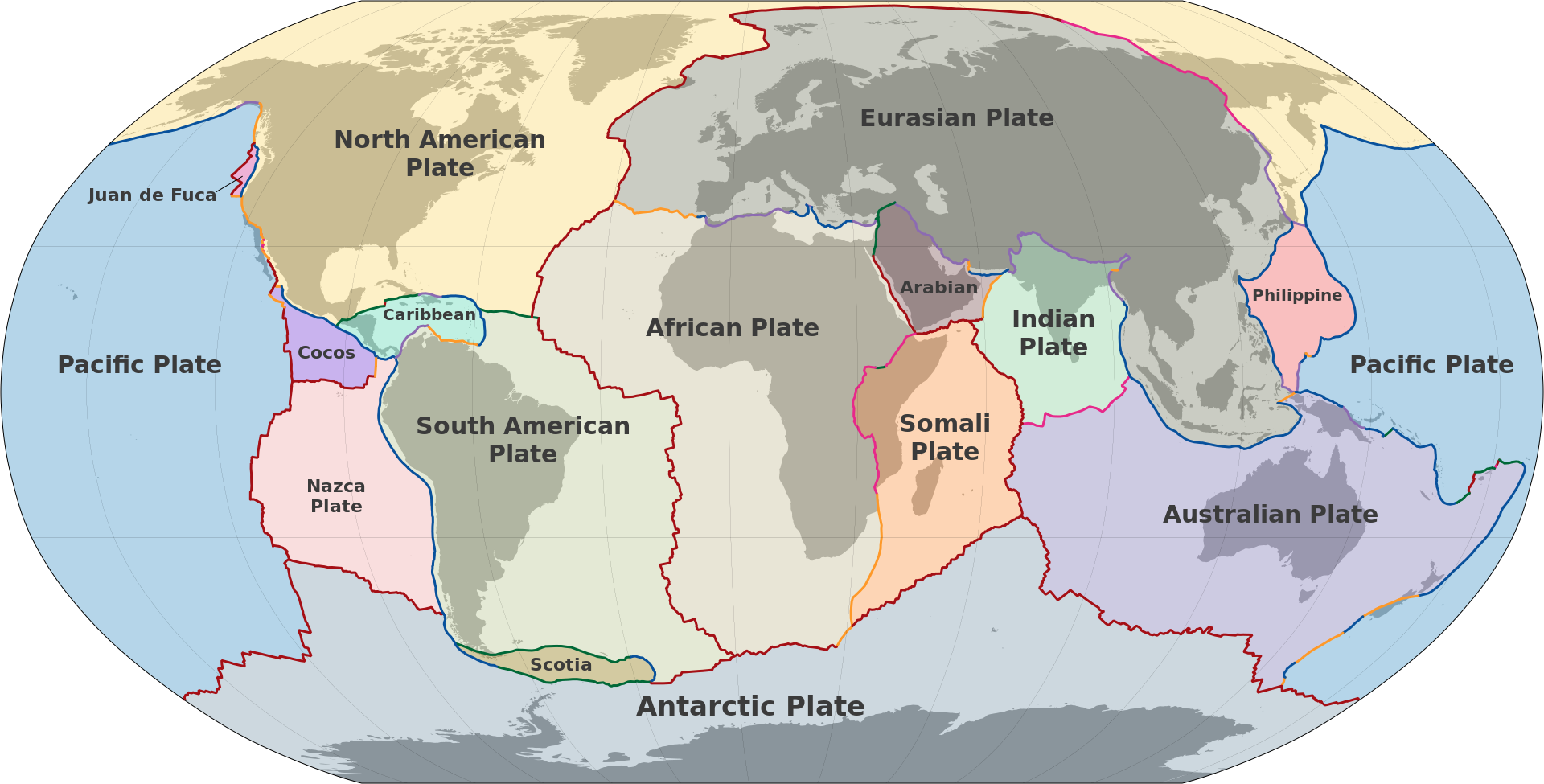
If I am not mistaken the Samali Plate would have an elevated area in Africa which would likely be exposed geothermal rock.
But on the other side of plate tectonics where one plate slides under the other, if ices behave like continental crust, then bodies of water warmed by geothermal heat should occur.
And this also could cause vast floods of water from time to time if an earthquake were to rupture an ice dam. So you might not want to build your settlements too low in an ocean bed as they might become suddenly flooded. A high location in Iceland or Africa might be most suitable.
It is my expectation that the radioactive decay engine of the Earth would be periodically refueled if it were a rogue planet: https://www.space.com/earth-dense-inter … ction-lost
Quote:
An interstellar cloud may have caused an ice age on Earth. Here's how
News
By Robert Lea published June 11, 2024
An encounter with a cold cloud of gas and dust could have caused our planet's "protective giant bubble" to draw back.
So, radioactive materials from dust clouds in interstellar space may rain down fresh materials which may be subducted into the insides of the Rogue Earth, refueling it's engines.
So, a Rogue Earth, might be very useful to a technological civilization, I feel.
And of course then there if Fusion. Probably any gasses that could remain as an atmosphere on such a world will have and collect more of fusion suitable fuels.
I will discuss Venus next I believe. I think Venus cast out into the void would become much like a Rogue Earth.
Ending Pending
#845 Re: Science, Technology, and Astronomy » 3I/ATLAS Comet Will Swing by Sol » 2025-08-13 12:14:27
I have been thinking about it some more. Actually I think the chances of Aliens is less than 1%. Very much.
But the assumption that an alien people want to talk to us is silly. Sometimes cultures don't want to be bothered. For instance at one time "Japen".
If Aliens knew that there is life on Earth, but don't want to be bothered, they could monitor us while hiding themselves, and yet not be sure that they would not be detected if we had become much more advanced than expected. So, basically checking up on us and showing a fist, might be what they might do.
This presumes a little on the thinking of Isaac Arthur, that Aliens in competition with other Aliens might fear punishment if they molest a baby culture too much. But showing a fist and saying don't make us use it could be allowable/tolerated by a community of quiet aliens, in a Dark Forest notion of reality.
Ending Pending
#846 Re: Interplanetary transportation » Multi-Ship Expeditions, Starboat & Starship, Other. » 2025-08-13 09:23:09
Looking at this again:
I offer this as suggestion: https://newmars.com/forums/viewtopic.ph … 45#p233445
Quote:I felt like giving a proposed elaboration of the "Xstation":

If sent from Earth/Mars, the green areas might be storm shelter areas. But most of the ship would have minimal protection, in transit,
But Deimos and Phobos and even Mars offer materials from shallow hill spheres, from which augmentation can be produced, to give various additional shielding. These materials do not have to be excessively sophisticated, but might in many cases be relatively simple to make.
Protection from radiation, impactors, and thermal fluctuations would allow the significant upgrading of the devices.
We don't know how much time an individual must spend in a 1 g situation to be healthy. It may be that a visit to a gym for a few hours a week would be enough in 1 g, and otherwise a person could spend time in more reduced synthetic gravity.
So, I argue that if that turns out to be true, orbital Mars may be healthier to occupy than the surface of Mars. We just don't know yet.
Ending Pending
#847 Re: Science, Technology, and Astronomy » Utilizing Superpower (Per Rethink X, Tony Seba) » 2025-08-13 08:56:03
So, if Tony Seba and RethinkX are correct, then considerable amounts of farmland may go feral.
But instead of abandoning, it I suggest farming a groomed forest, one that is kept as parkland for citizens to enjoy.
And this may allow sequestering Carbon as the greens hope cannot actually be done, without impoverishing the common people.
So, the grooming would be the removal of underbrush and overgrowth, and various excess organic materials, and doing a pyrolysis on it to produce Hydrocarbon fluids and Biochar. For places with proper soil the Biochar might be embedded into the soil. If the mixture is proper and generally is moist, it will not support something like a peat fire. But if necessary Biochar could be disposed of in lakes and seas, and indeed perhaps in peat bogs.
So, we may have a wealth generative way to sequester Carbon out of the atmosphere, where the wealth is the groomed land and the Hydrocarbons produced, and also presumably the correcting of the climate. I am not a total believer that CO2 is a poison in our world at this time, but now we have a tool to deal with it as if it is.
We can make the greens eat the hair shirts they wanted to force use to wear. Instead we can have good lives.
Ending Pending
#848 Re: Interplanetary transportation » Multi-Ship Expeditions, Starboat & Starship, Other. » 2025-08-13 08:05:48
Expanding on the previous post, over time a conveyor belt of Starship Bodies could be moved Earth/Moon>>>Deimos/Phobos/Mars.
While i suggest a special ship to move Flaps and Motors back to Mars orbit to be used to conduct another Starship Body down to the surface, similar might eventually be done for Raptor engines specialized for landing only.
And as for fluids, there will become no point of moving things like Methane and Oxygen from Earth/Moon>>>>>>Phobos Deimos/Mars, if you can manufacture these fluids local to Mars/Phobos/Deimos. So, this is another advantage of conducting Starship bodies to orbit Mars prior to landing them.
If an electric propulsion based on solids as the propellant, such as MagDrive or Neumann Drive could be utilized, then the characteristic of the Starship Bodies moved to Mars orbit should be determined by their ability to fly to Earth Orbit, and then do a one time landing on Mars, and then be pressure vessels to be habitats on Mars long term.
Of course you would not move humans in these ships, rather you would move them with mass produced, large ships, Earth/Moon>>>>>>>Deimos/Phobos/Mars and then by a Shuttle Ship like a Mini-Starship or NOVA (Per Stoke Space) type method to get to the surface of Mars, if that is the destination of the human.
Ending Pending
So in a conveyor system such as mentioned in this post and the one before it, you would not be lifting Starships off of the Earth with Flaps and Motors. You would be reusing Flaps and Motors on Mars, and lifting them back up to orbit for reuse in the 1/3 Mars gravity field with a thin atmosphere.
Similarly if raptor engines could be specialized, the ones to lift One-Time Starships to Earth Orbit, might be reused at Earth, if they were brought down to put onto another Starship Body.
And at Mars, engines specialized for landing could be cycled in a similar way.
So when an electric transport system brings One-Time Starships to Mars orbits, it can bring Flaps and Motors, and also landing raptors, but those will be used multiple times.
Ending Pending
#849 Re: Not So Free Chat » Oil, Peak Oil, etc. » 2025-08-13 07:00:33
I want th say that my objective is to get the truth, not to showboat, or win debate points for an audience.
I notice two things that you could explain intentions about for me Calliban. The document you presented apparently indicates Spain as the location and 2013 as they year of the study. Although there may have been an update in 2022?
Spain: https://globalsolaratlas.info/map?c=22. … 7.691398,3
The map indicates that Spain is approximately as good for solar energy as Colorado, I think. So, not the best place for solar energy per available sunlight, but perhaps a convenient place to have it per need.
I checked on the Efficiency of Solar Panels in 2013, and got the number 13% Today, the number seems to be 20% to 23%. Was the study in 2013 for panels made in 2013 or were they even older panels?
https://en.wikipedia.org/wiki/Energy_re … investment
Quote:
Photovoltaic
See also: Cadmium telluride photovoltaics
Global PV market by technology in 2013.[8]: 18, 19
multi-Si (54.9%)
mono-Si (36.0%)
CdTe (5.10%)
a-Si (2.00%)
CIGS (2.00%)
The issue is still the subject of numerous studies, prompting academic argument. That's mainly because the "energy invested" critically depends on technology, methodology, and system boundary assumptions, resulting in a range from a maximum of 2000 kWh/m2 of module area down to a minimum of 300 kWh/m2 with a median value of 585 kWh/m2 according to a meta-study from 2013.[9]Regarding output, it obviously depends on the local insolation, not just the system itself, so assumptions have to be made.
Some studies (see below) include in their analysis that photovoltaic cells produce electricity, while the invested energy may be lower grade primary energy.
A 2015 review in Renewable and Sustainable Energy Reviews assessed the energy payback time and EROI of a variety of PV module technologies. In this study, which uses an insolation of 1700 kWh/m2/yr and a system lifetime of 30 years, mean harmonised EROIs between 8.7 and 34.2 were found. Mean harmonised energy payback time varied from 1.0 to 4.1 years.[10][better source needed] In 2021, the Fraunhofer Institute for Solar Energy Systems calculated an energy payback time of around 1 year for European PV installations (0.9 years for Catania in Southern Italy, 1.1 years for Brussels) with wafer-based silicon PERC cells.[11]
#850 Re: Science, Technology, and Astronomy » Utilizing Superpower (Per Rethink X, Tony Seba) » 2025-08-12 09:45:43
I think I see a possible convergence of useful factors, in the future of the Midwest:
1) https://en.wikipedia.org/wiki/Natural_hydrogen
Image Quote: 
2) Wind: https://www.energy.gov/eere/wind/wind-r … terization
Image Quote: 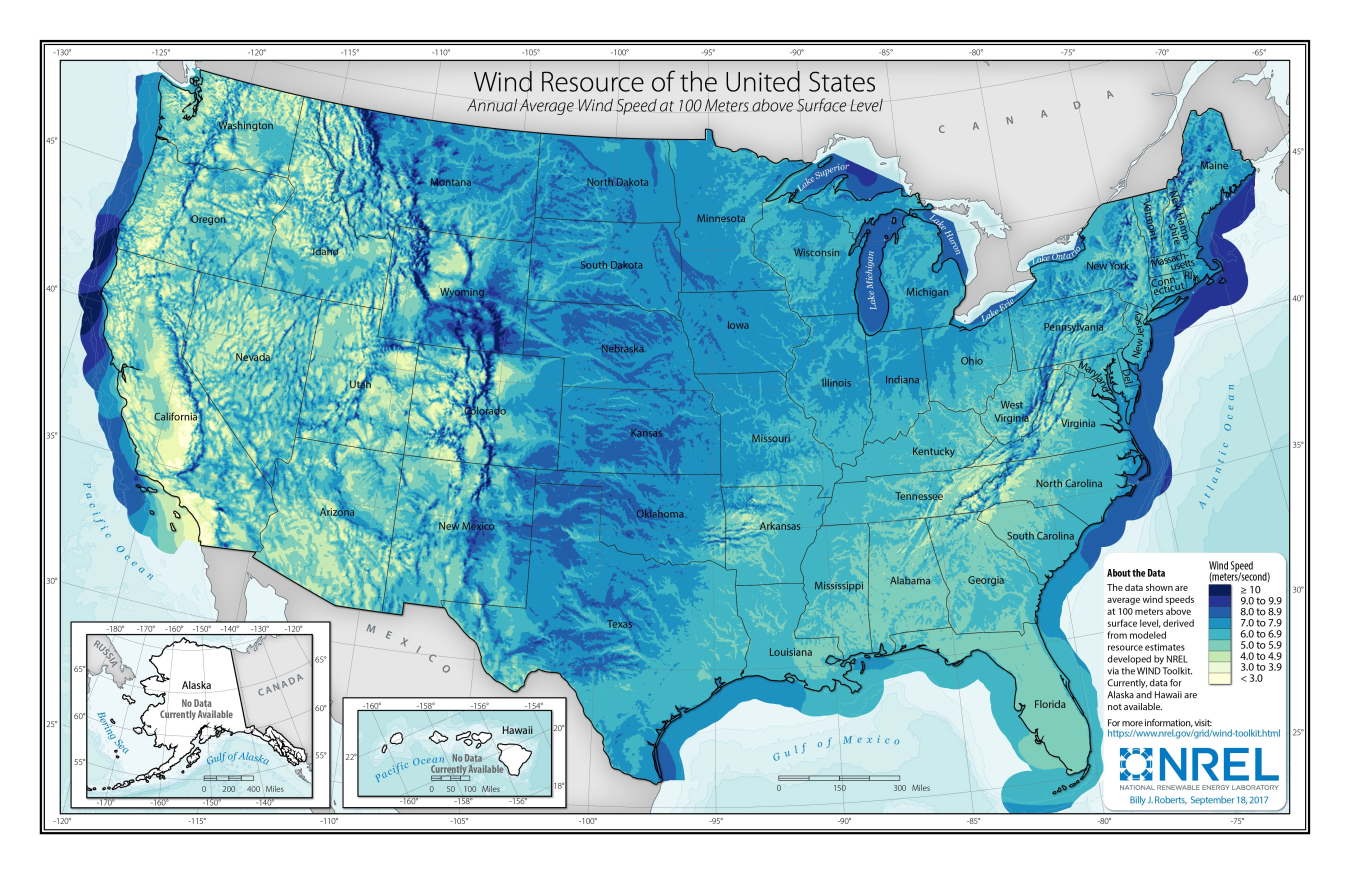
3) Solar: (Is interesting but not exceptional): https://www.nrel.gov/docs/libraries/gis … 855ad6e1_1 Image Quote: 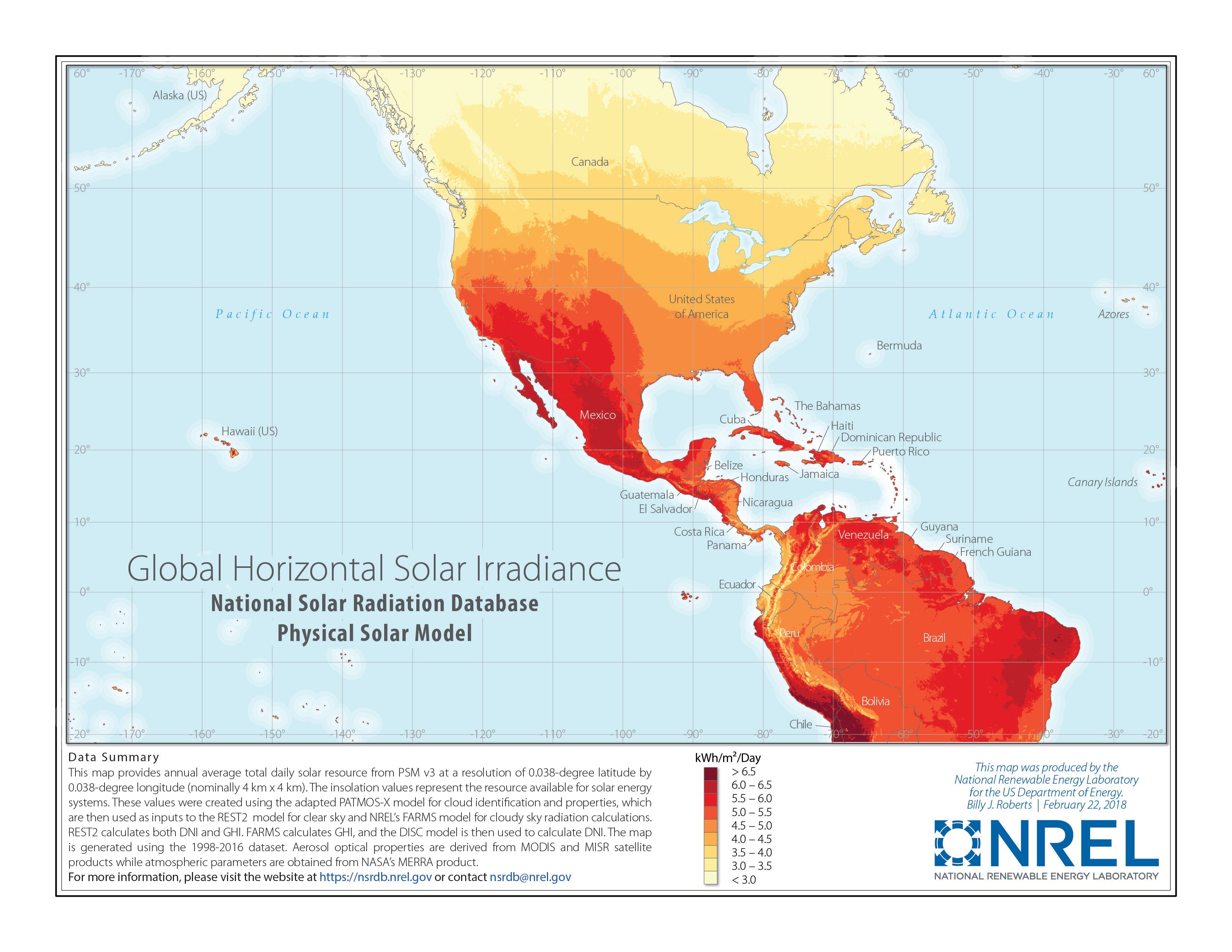
*But it can be argued that solar for heat could be very valuable in the wintertime.
4) High Quality Farmland: https://www.americafem.com/2019/05/08/u … mland-map/
Image Quote: 
A: If #1 large amounts of Natural Hydrogen are found;
B: It could be reacted with CO2 from the atmosphere in Precision Agriculture and Cellular Agriculture;
C: Producing a biomass byproduct;
D: A biochar process could produce Hydrocarbons and Biochar;
E: The Hydrocarbons could be used in various processes;
F: The biochar could be used to improve farm land and also sequester Carbon.
* The wind power could be backed up with battery systems but also solar power and also combustion of Hydrocarbons.
* If you were sequestering Carbon into improved soils as Biochar, then you could burn fossil Hydrocarbons or created Hydrocarbons without concern.
* Biochar: https://www.bing.com/videos/riverview/r … &FORM=VIRE
* I also suggest that underbrush overgrowth in forests should be subjected to pyrolysis to yield Hydrocarbons and Biochar. This would keep the northern woods from burning down all the time. Perhaps it will be practical to do so when robot labor is more established for that purpose.
Ending Pending
You might say "Well if Precision Fermentation and Cellular Agriculture are going to replace much of the farmland, why do this effort?". Well, if you let the farmland go back to woods, then you can have your robots harvest the underbrush and do pyrolysis on it, to create Hydrocarbons and to create Biochar to add to the woodlands.
It is also perhaps true that some marginal land suitable for some special agriculture might be upgraded with biochar.
Ending Pending
So, I think biochar farming will make a lot of sense for abandoned traditional farmland, and in that case you might as well create Suburban and Rural areas where the environment is maximized for healthy upbringing of human children.
Urban Areas suck for children, and especially for their parents.
Ending Pending