You are not logged in.
- Topics: Active | Unanswered
Announcement
#8376 Re: Life support systems » Regolith processing to create oxygen only » 2015-12-01 14:12:17
Yes, fair enough, that was fairly ungenerous of me. The best I can offer on the fly is that it seems possible that ancient Mars had a transitional phase where it might have been rather Oxidized, and even had Oxygen of significance in it's atmosphere, and so, rocks from that presumed era may have an excess of Oxygen.
What I have read about using bacterial to release some of the Oxygen suggests that if you give them Iron of a correct sort, and perhaps sugar, they might release Oxygen for you. Where to get the iron and sugar from however? That involves effort.
As in the Moon, there might be some rocks you could heat up with concentrated solar energy which might release Oxygen.
#8377 Re: Life support systems » Potential Resources of Mars » 2015-12-01 14:09:47
Spacenut thankyou for taking the trouble. I also have looked further into this particular restriction in the hoped method. It appears that we might hope to appeal to the use of an "ink" with Carbon in it, to produce conductivity on a surface which is not naturally disposed to be conductive. Graphite perhaps.
But for the Tin Salt, might we hope that it may be present in the nasty salts that are thought to exist in the liquid water flows of Mars. I think there are fair chances for that.
#8378 Re: Terraformation » Lakes on Mars-Like Planets, Natural, Artificial » 2015-12-01 14:01:38
That's a good thing, it indicates that I am not entirely without a logical purpose. (Pehaps) 
#8379 Re: Life support systems » Atmospheric Separations » 2015-12-01 13:55:28
You have excellent minds, really, I quack like a duck when I try to get down to some real world situations. Glad to have your generous collaboration on things that are very hard to make sensible with numbers and logic. I do try to find where the hopes are, but can quite close the deal on my own.
For me, getting chemical energy from the atmosphere such as CO, might pay for the expense in initial energy, as it might allow us to do chemical manipulations, which of course might be achieved in other ways, but by the time you tally up the whole ledger, perhaps you can afford to play this game. That is just a hopeful hunch.
#8380 Re: Life support systems » Regolith processing to create oxygen only » 2015-11-30 20:17:31
I would prefer to head in this direction. (Get it out of the Atmosphere on Mars).
http://newmars.com/forums/viewtopic.php … 80#p126780
As I recently read from another, it is much easier to deal with fluids (Air) or fluid like materials (Dunes), then to do a pick and shovel in the hardpans of Mars. But technically dunes and loose soils are Regolith, so you win too.
#8381 Re: Life support systems » Atmospheric Separations » 2015-11-30 20:14:17
So, NASA did this apparently, it is similar to what Antius and some others have proposed. If economical very exciting.
http://ntrs.nasa.gov/search.jsp?R=20040196381
A mechanical process was designed for direct extraction of molecular oxygen from the martian atmosphere based on liquefaction of the majority component, CO2, followed by separation of the lower-boiling components. The atmospheric gases are compressed from about 0.007 bar to 13 bar and then cooled to liquefy most of the CO2. The uncondensed gases are further compressed to 30 bar or more, and then cooled again to recover water as ice and to remove much of the remaining CO2. The final gaseous products consisting mostly of nitrogen, oxygen, and carbon monoxide are liquefied and purified by cryogenic distillation. The liquefied CO2 is expanded back to the low-pressure atmosphere with the addition of heat to recover a majority of the compression energy and to produce the needed mechanical work. Energy for the process is needed primarily as heat to drive the CO2-based expansion power system. When properly configured, the extraction process can be a net producer of electricity. The conceptual design, termed 'MARRS' for Mars Atmosphere Resource Recovery System, was based on the NASA/JSC Mars Reference Mission (MRM) requirement for oxygen. This mission requires both liquid oxygen for propellant, and gaseous oxygen as a component of air for the mission crew. With single redundancy both for propellant and crew air, the oxygen requirement for the MRM is estimated at 5.8 kg/hr. The process thermal power needed is about 120 kW, which can be provided at 300-500 C. A lower-cost nuclear reactor made largely of stainless steel could serve as the heat source. The chief development needed for MARRS is an efficient atmospheric compression technology, all other steps being derived from conventional chemical engineering separations. The conceptual design describes an exceptionally low-mass compression system that can be made from ultra-lightweight and deployable structures. This system adapts to the rapidly changing martian environment to supply the atmospheric resource to MARRS at constant conditions.
So, Antius should like this:
Liquid CO2, then;
Nitrogen, O2, and CO from the atmosphere.
#8382 Re: Life support systems » Mars Colony "Vacuum welding, Sintering". » 2015-11-30 20:08:30
Here we go, NASA, biological glued bricks from human waste. (Hopefully not me).
http://www.treehugger.com/clean-technol … -mars.html
NASA Is Engineering Microbes to Make Bricks on Mars
I also recently posted a very interesting heritage article which indicated that bricks can be baked from the Ubiquitous Martian dust. As I recall, a low temperature makes a brick which could be useful. A higher temperature makes a higher quality brick.
#8383 Re: Life support systems » Potential Resources of Mars » 2015-11-30 19:15:59
I have no bricks for this topic today, but I am thinking Basalt fabric, impregnated with metal. (Not as bricks).
I am desiring light weight but durable mirrors for Heliostats. (And other items after that).
From post #10 of this topic:
https://en.wikipedia.org/wiki/Ore_resources_on_Mars
Dark sand dunes are common on the surface of Mars. Their dark tone is due to the volcanic rock called basalt. The basalt dunes are believed to contain the minerals chromite, magnetite, and ilmenite.[38] Since the wind has gathered them together, they do not even have to be mined, merely scooped up.[39] These minerals could supply future colonists with chromium, iron, and titanium.
So, hoping to extract metal from the ores (If they actually exist).
https://en.wikipedia.org/wiki/Electrowinning
Electrowinning, also called electroextraction, is the electrodeposition of metals from their ores that have been put in solution via a process commonly referred to as leaching. Electrorefining uses a similar process to remove impurities from a metal. Both processes use electroplating on a large scale and are important techniques for the economical and straightforward purification of non-ferrous metals. The resulting metals are said to be electrowon.
In electrowinning, a current is passed from an inert anode through a liquid leach solution containing the metal so that the metal is extracted as it is deposited in an electroplating process onto the cathode. In electrorefining, the anodes consist of unrefined impure metal, and as the current passes through the acidic electrolyte the anodes are corroded into the solution so that the electroplating process deposits refined pure metal onto the cathodes.[1]
So, I am not sure, but most likely sulfide solutions would be used? That has to be created.
So I am supposing that if you can electroplate to glass, you might electroplate to a Basalt cloth mesh.
Electroplating to Glass:
http://scholarworks.rit.edu/cgi/viewcon … ext=theses
Iron Plating:
http://www.finishing.com/259/82.shtml
A. I am responding concerning Iron Plating. I am the General Manager of a chrome and iron plating facility in the Dallas, Texas area. Iron Plating is alive and well and we are successfully doing it on a large scale should this person still need answers to their iron plating problems.
Chromium:
https://en.wikipedia.org/wiki/Chrome_plating
Chrome plating (less commonly chromium plating), often referred to simply as chrome, is a technique of electroplating a thin layer of chromium onto a metal or plastic object. The chromed layer can be decorative, provide corrosion resistance, ease cleaning procedures, or increase surface hardness. Sometimes a less expensive imitator of chrome may be used for aesthetic purposes.
Titanium appears to not be that compatible with electroplating, but perhaps can be done:
http://www.finishing.com/250/24.shtml
A. Titanium can be electroplated from water based solutions and also from non-aqueous solutions.
Recipe 1:
70 gm sodium metatitanate
30 gm sodium acetate
30 gm sodium hydroxide
1 lit. water, 30-70 °C, 1-5 A/dm2Recipe 2:
100 gm Ti(OH)2
40 gm HCl
100 gm NH4Cl
water 1 lit.,pH 4-5,30-50 °C, 3-4 A/dm2Recipe 3.:
30 gm Ti( in form of TiCl3 or TiI3)
200 ml toluene 0,02 % pitch(?)
800 ml ethyl alcohol
18 °C, 21 A/dm2,graphite anodeAll from Russian book L.I.Kadaner:Galvanostegija (electroplating handbook), Kiev 1964.
Nickel (Not listed yet as being significant in dunes, but likely in some iron/nickel meteors, so I will also address this).
http://electroplatingpk.blogspot.com/20 … ating.html
Nickel Alloy Plating
Nickel alloys electroplated for engineering applications include nickel-iron, nickel-cobalt, nickel-manganese and zinc- nickel. Iron is an inexpensive metal and solutions for plating nickel-iron alloys were developed mainly to reduce costs
So what I am after Spacenut is a fabric of Basalt to be the cathode to electroplate to any metal possible, of course desiring preferred qualities.
For now I am desiring light weight but durable mirrors for Heliostats. But if that works, there should be other applications.
I am wondering if you can plate alternate coatings of Iron, Chromium, Nickel, etc on to a web of basalt fabric. Perhaps even making a steel like metal, but would settle for a curved light weight plate that can be polished and used in a heliostat as a mirror. Of course this is for energy and greenhouse purposes.
I am not trained in chemistry, so if you want to you can likely catch me stupid here. I recommend you help me solve the problem instead.
Just on a guess, a key problem is to get the Chromite out of the dune. Maybe you can try the other two ores, but Chromite is a good start, and unfortunately I don't know how to separate it from the other dune materials, since I think it is not magnetic.
https://en.wikipedia.org/wiki/Chromite
Chromite is an iron chromium oxide: FeCr2O4. It is an oxide mineral belonging to the spinel group. Magnesium can substitute for iron in variable amounts as it forms a solid solution with magnesiochromite (MgCr2O4);[5] substitution of aluminium occurs leading to hercynite (FeAl2O4).[6]
It is an industrially important mineral for the production of metallic chromium, used as an alloying ingredient in stainless and tool steels.
I guess first I would remove the magnetic materials, with will contain the Iron and Titanium, but apparently not the Chromium.
I would hate to have to soak the whole remainder, that would perhaps be wasteful, unless some other metals might come out of the Basalt.
Oh well, maybe someone will learn me how it is done.
You can't say I don't swing at the ball.
#8384 Re: Terraformation » Lakes on Mars-Like Planets, Natural, Artificial » 2015-11-29 12:11:32
A nice post Spacenut. A bit nutty , but actually helpful.
I would support using artificial lighting for planets to the limits. That is, if it proves to be more useful to build greenhouses on the surface, then by all means do so.
However we have a lot of free research going on here on Earth for the methods to use artificial lighting. I am also aware of RobertDyck's post, and that is a good one as well, where they are growing plants on the space station under artificial lights.
Here is one element of progress that could be taken to Mars:
http://www.npr.org/sections/thesalt/201 … an-farming
The future of vertical farming, Mitchell thinks, lies not in city skyscrapers, but rather in large warehouses located in the suburbs, where real estate and electricity are cheaper.
And oh, yeah, instead of being traditional greenhouses lit by fluorescent lamps, he says these plant factories will probably be "pinkhouses," glowing magenta from the mix of blue and red LEDs.

I am not sure that this type of building structure inside a lake is the best bet, but the light sources are something to have. My ideal efficiency for lake agriculture is diving bells with a rather thin air bubble at the top. Perhaps just enough for a human to poke their heads up into from the water to get a breath of air, and enough to shelter your LED/Power supplies. Aquatic plants are a best choice, except they are not very well domesticated. As per previous conversation, standard vegetables can be grown in diving bells.
Here is another element of progress that could be taken to Mars:
Solar power methods;
Solar to make electricity;
Solar to make chemicals;(Chemicals can be piped into the lake to power fuel cells).
https://en.wikipedia.org/wiki/Solar_chemical
Less likely to be solved but still having a chance is:
https://en.wikipedia.org/wiki/Superconductivity
You have just revived the topic:
Index
» Life support systems
» Constructing a larger settlement - One idea
A body of ice the size of the north sea converted to a lake could shelter quite a large city.
Artificial Light Farming, Solar Energy, and Superconductors are all topics receiving lots of focus and research money. We would have every reason to incorporate those anticipated advancements into a settlement on Mars.
In some ways Mars will be better. For instance;
-For Artificial Light Farming underwater, the waste heat will be stored in the surrounding waters, and may then be dumped on the surface to generate more power.
-Mars has powerful U.V. spectrum in it's light, which goes far beyond that of Earth. It may be that it will be very useful for Solar Thermal, and for Solar Chemical processes.
-Mars is colder, so maintaining liquid Nitrogen pipelines for superconductors, should be in many ways more practical.
So, this thinking stands Mars on it's head. Instead of trying to avoid the characteristics of Mars that we find hard to cope with using Earth historic Earth methods, we can ask "What could we do to use this characteristic of Mars to our benefit?". Some others have also been doing some of that.
The point is a super large city with a high margin of safety for it's inhabitants, and abundant resources, would go a long way towards turning Mars into a platform for the advancement of the whole human race.
This is quite different from trying to scratch a living on the surface only, trying to adapt historical Earth methods directly to the surface of Mars.
And lets be reminded of Airlocks in such a lake. 90% or more of the pressure differential would be taken care of by just moving up a column of liquid. The rest could be handled by a very lightweight mechanical airlock. Perhaps with clever design, maybe only 10 mb differential pressure handled by a mechanical air lock.
An on the surface, if you like you could still have greenhouses, and habs, it would not be forbidden.
#8385 Re: Terraformation » Lakes on Mars-Like Planets, Natural, Artificial » 2015-11-28 13:38:53
Alright, Louis and Spacenut seemed to go in the direction of LED illumination for plant growth in a topic;
http://www.newmars.com/forums/viewtopic.php?id=5324
I am interested. Louis also specified Roman Arch methods to build a growth chamber.
A article here appears to go into great details about the construction of Roman arch structures I think, on Mars!
http://themarspioneer.com/PioneerHouse.html
I would like to use those specifications to discuss a version of lake methods that would deviate from the use of the general use of transparent or translucent ice coverings. GW Johnson has historically had significant things to say along these lines where regolith might be placed on top of ice on an ice covered lake to inhibit the evaporation of the ice, therefore protecting the lake.
There is this which has been offered in the past by RobertDyck, about a potential frozen sea;
http://www.esa.int/Our_Activities/Space … frozen_sea
And it might be briny which I don't mind at all.
Tom K. has mentioned an apparent slab of ice which although at a higher latitude, is almost certainly there;
http://www.space.com/30502-mars-giant-i … y-mro.html
And then of course there are higher latitude ice and glaciers, which likely exist to a large enough extent to allow for lakes to be created, with deepness of 33 to 600 feet, which from my perspective will be just fine, although I prefer 33 to ~150 feet more or less. Sorry for the imperial units, I am short on time.
And now this offers power supplies from salt differentials, and temperature differentials. Power supplies that should be reliable through seasons and dust storms. Stored power, and thermal derived power, and solar power, and really also chemical power, the chemical power will be related to the collection of solar power most likely.
http://newmars.com/forums/viewtopic.php?id=6866
So I will try to quit fooling around. You could have plastic diving bells such as this: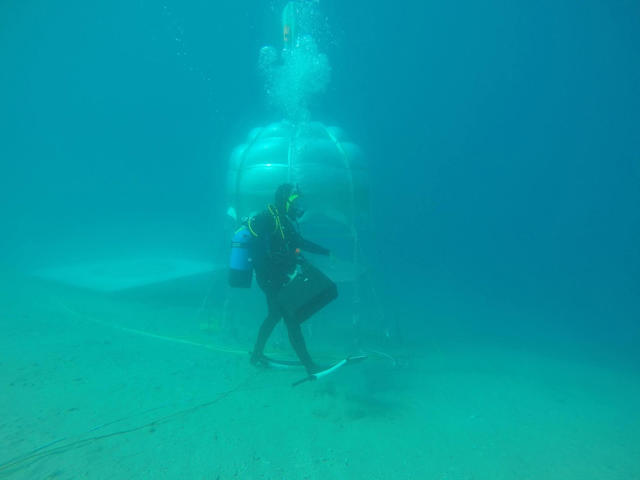
Only you would be lighting it up inside with LED's perhaps powered by fuel cells.
Or, you might build a Roman Arch on the bottom of a lake and just fill the top of it with air, the rest of it with water. In such greenhouses as that you might grow a variety of aquatic / semi-aquatic plants, including rice and wild rice I presume, and duck weed, which is marginally eatable.
And here is a reference to plants that are aquatic which might also be suitable:
http://newmars.com/forums/viewtopic.php?id=7327
As for power sources for this you can try either type of nuclear, or various types of solar.
My favorite hope is that with concentrating mirrors, and catalysts, you could split CO2 or H20 or both to generate fuels and Oxidizers.
These gases could be conducted to fuel cells under the lake, and the solar collectors could also be a source of heat and fresher water for the lake. The heat conducted to the more salty lower layers to keep them warm, and the fresher water conducted to the colder upper layers to keep them floating above the warmer salty layer.
In this case since you would not bring light in through the surface of the lake, you might even have ice 25 feet thick to 33 feet thick, and you could oxygenate all layers of water to the point where a diver could breath by this previously mentioned method.
http://www.livescience.com/3829-inventi … -fish.html
Your water would have sufficient Oxygen for life support (But you will need the apparatus functional), and your greenhouse diving bells and Roman Arch greenhouses will bubbles in them that a human could breath from, and also you could have "Dry Houses" where people could live.
Maybe they would be Roman Arch as well, but of course if you fill them completely with air, then you have to make sure they are properly counterweighted against the buoyancy of the air inside.
But doing all this you will be able to reduce your work with plastics and concentrate on Bricks, Ice, Water, and perhaps some Metal productions, and still perhaps have a thriving and happy way to live on Mars.
#8386 Re: Life support systems » What would be the best method of maintaining fertile fields? » 2015-11-28 09:32:24
I am very comfortable with your post Louis
So, perhaps you are Zubrinesque?
"It seems to me that you want to fly a match to Mars and light a fire, not fly to Mars and make a match to light a fire." This is an interesting way of putting it. My own view is it depends on the task. Essentially you look for the solution that involves least importation of mass and least effort/energy use on Mars by first colonists (but there is a trade off between the two, no doubt). So sometimes it does make sense to make the match on Mars.
As for lava tubes, I have never been a fan. How can you "scout" these tubes prior to humans landing? All might be quiet for 10 years and then - as we know can happen on Mars - you get a flash flood or the tube fills up with dust from a dust storm, or there's a roof collapse.
It is much safer in my view to land a habitat on an open area of (slightly elevated) flat ground. Then make your home in the regolith (trench and Roman brick arch as the roof with plenty of soil cover).
I would like to work "under" this structured provision, apparently having good credentials, provided by strong minds in the past. At least to see just how much it can do.
What do you think of this heritage reference for bricks? Do you have better ones?
http://resources.yesican-science.ca/sts … ding2.html
How will we build structures on Mars when we finally land on the Red Planet?
In the late 1980's an engineer named Bruce MacKenzie analyzed this problem in some detail. He came to the conclusion that the optimum material for building the first large structures on Mars is brick!
Of course we can't easily send much brick to Mars so it will have to be made from the native Martian soil.
This low-tech concept may seem somewhat surprising at first, but there's actually quite a lot of merit to the proposal. Making brick is quite simple and it is for exactly this reason that some of Earth's first cities were built of brick.
Mesa Verde, Colorado
Transparency Master
To manufacture brick:
1.take finely ground soil
2.wet it
3.put it in a mold under mild compression
4.dry it
5.and then (optional) bake it.
For example, adobe bricks which may be "sun-baked" produce a surprisingly good quality brick.High temperatures are not really required - in many parts of the world sun-baked bricks are still used. Although an oven temperature of 300oC would make some pretty good bricks, a 900oC kiln temperature would be needed to make first-rate bricks. This temperature could be reproduced on Mars using a solar reflector furnace.
Since we won't have taken a lot of extra water with us on our trip to Mars, we can recover almost all of the water we use in the making of our bricks during the drying process - if our oven is constructed correctly.On Mars, excellent raw material for brick manufacture is available nearly everywhere in the form of finely ground, iron-rich clay-like dust that covers most of the surface.
I can see the values offered, open spaces as you appear to suggest leaves freedom to select special mineral resources nearby, perhaps your hematite. The dust (You specify regolith), is stated as being nearly everywhere.
Am I far off track?
As for minerals, maybe there will be an ideal place to get a variety: (Not necessarily this one)
http://news.discovery.com/space/mars-ro … 151115.htm
Many of the veins contain rich deposits of calcium sulfate. Others are laced with magnesium sulfate or fluorine. Levels of iron vary.
Then finally the Perchlorate water would be nice to have:
http://www.raynedrops.com/water-news/wa … -to-drink/
Or cleaning it up with bacteria:
http://archives.microbeworld.org/news/a … magic.aspx
I have blabbed sideways a bit here as usual, but I really am interested in hearing more about your thinking pathway. You seem to understand a lot. For instance I was not aware that there apparently are small ice crystals in the Martian soil, which is something you had mentioned elsewhere.
#8387 Re: Life support systems » What would be the best method of maintaining fertile fields? » 2015-11-27 13:45:41
O.K. I hope you are not put off by my presence. That can make sense to me, as a starter.
It seems to me that you want to fly a match to Mars and light a fire, not fly to Mars and make a match to light a fire.
What about flying a premade unite into a lava tube that has been completely scouted out.
http://www.space.com/18519-mars-caves-l … hotos.html
http://www.bing.com/images/search?q=lav … &FORM=IGRE


It will be heavy, and will have to hover, and drop into the hole and get under a rooftop and set down. But then it will be radiation sheltered, and thermally sheltered as well. And in this case, if it is nuclear, you don't have to be as equator dependent. Also, you don't have to bury the thing, so that's less work to start with.
So the robotic thing flies into the cave, and a transponder allows it to communicate back it's health. If it is good, your people land, and have an instant in situ robot that helps them grow food, and extract Oxygen from the atmosphere, maybe makes rocket fuel. And then that leaves the people to do science, and get more water as a first task.
If there were ice deposits in the tube great, or maybe there will be ground ice nearby, or maybe water from soil.
Now I will just continue. My next preferred move if the lava tube had lots of room would be to see if CO and O2 can be harvested directly from the atmosphere efficiently. If so then you can run fuel cells from that, and import such fuel cells from Earth at first. Those fuel cells would have the diodes directly tied into them, so that you could put the light emitting units into new "Gardens" you would build primarily from native materials.
If you cannot get the gasses from the atmosphere directly, then perhaps you make some type of solar equipment which can. In any case you pipe a fuel and a Oxidizer to the fuel cells with LED's. The piping could be made of some type of low grade iron, and perhaps plastics, as your start of building materials.
From there you might try to get to the point where you can deal with some kind of transparent greenhouse glaze to promote gardens.
By the way diluted urine is a good fertilizer to start with.
Just a proposal. Do you have something else in mind?
#8388 Life support systems » Crops, Aquatic » 2015-11-26 19:29:12
- Void
- Replies: 30
Spacenut change this if you want to. I don't want to step on the Crops topic, because I think RobertDyck has a specific focus there in working with domesticated land plants that would go into a normal type greenhouse.
The reason I have opened this alternate topic, is that I feel that for Mars, for a number of reasons aquatic crops might work out rather well.
These typically fall into three categories. 1) Rooted and projecting above the surface of the water, necessary. 2) Floating. 3) Underwater.
So, my first plant is apparently marginally eatable, but a very robust plant that I think could do well in protected water impoundments on Mars. I suggest that it could be intentionally domesticated to make it more palatable.
http://www.eattheweeds.com/hydrilla/

Hydrilla
by Green Deane
in Miscellaneous, Plant Uses, Plants, Vegetable
I am often asked can we eat Hydrilla? The answer is no, and yes.
There is only one species of Hydrilla, verticillata. The Hydrilla you buy in the health food store is the same that clogs lakes around the world. Can you take it out of a lake, cook it up, and chomp it down? No… Well, I don’t know of anyone doing that. But you can buy it as a dried powder to add to soups and stews and smoothies. So what’s the difference?
Hydrilla is an Eurasian weed that entered the western hemisphere via Florida sometime in the 1950’s probably through one aquarium dealer who imported live Hydrilla from Sri Lanka. It was subsequently found in a Miami canal, and from there it spread. In fact, for more than a decade no one knew it was Hydrilla. It was mistakenly called Elodea canadensis. However, within 10 years of its discovery Hydrilla became the most troublesome aquatic weed in the state. (It can expand 1,000 percent a year grow an inch a day.) Florida currently spends about $30 million annually trying to control it. The strain that was found in Florida was female. Twenty years later male Hydrilla was first reported in Delaware in 1976.
Since that introduction some 60 years ago Hydrilla is now found in 19 states and Washington DC, from the endotrophic waters of Maine, west to wet Washington state. Called the perfect aquatic plant it adapts to a wide variety of climates and water conditions. Hydrilla can also reproduce four ways: rhizomes, tubers, turions (buds) and fragmentation. It, and Water Hyacinths, are the two most expensive weeds in the world. Because of the economic impact of the species there is a huge amount of information written about Hydrilla as a problem. Historical use of Hydrilla prior to it becoming a “noxious” weed is scant limited to a few references to how it was named and its use in making white sugar (more on that in a moment.)
A search of Chinese literature, for example, shows Hydrilla being cultivated for crab farming, and certain fish farming as well. They eat it. Duck like it, too, and snails. These are all foods the Chinese eat but no mentioning of eating Hydrilla directly. In the Philippines much is made of its nutritional qualities, but again no references found about eating it directly.
As for powdered hydrilla… in north Florida they raise Hydrilla in an isolated lake, sterilize it with pure water and ozone treatment, low-temperature dry it, powder it and sell it to you. The mild earthy-flavored powder is 13% calcium which some writers call the richest plant source of calcium on the planet. It’s also high in B-12 and iron. Further, Hydrilla has been investigated as possible animal fodder. It has 16 percent more available dry matter for fodder than cattails and no bad chemicals were found in it during the examination for cattle food. In fact in one study when fed Hydrilla cows gave 20% more milk and chickens 14% more eggs, probably related to the calcium content. But what about Hydrilla as food for people?
As you know I developed and use the I.T.E.M approach to wild foods. Identification, Time of Year, Environment. M is for Method of Preparation. Here’s where the Hydrilla information trail breaks down. I’ve never found any reference in English about consumption of Hydrilla prior to the powdered form. In theory there should be no problem with eating Hydrilla (beyond the possible problems associated with any aquatic plant such as environmental pollution and some algae.) No special processing is done to make it an edible powder. The entire plant is dried and only water removed. So why isn’t Hydrilla used as human food like a cooked green? Well… edible does not mean palatable. As Dick Deuerling used to say about wild food: “I only eat the good stuff.”
Here’s one possible reason: The plant is tough and prickly, not as bad as many land plants but noticeably so. In fact one quick and easy way to separate it from two similar looking plants (Elodea and Egeria) is to pull Hydrilla through your hand. Edodea and Egeria will feel smooth. Hydrilla will feel harsh and scratchy. It may simply be that texture kept the plant off the dinner table, that and the fact it can grow with just 1% of sunlight. That allows Hydrilla to inhabit cold dark deep areas of lakes one might not want to bother with if there are other edible plants around.
One tentative down side is when water condition are just right (or wrong depending on perspective) there can be a blue-green algae bloom which can grow on the top leaves of Hydrilla. That cyanobacteria can produce toxic chemicals. And while that is a warning about Hydrilla is should be looked out for on every aquatic plant that one might eat (and that includes seaweed as well.) Always avoid blue-green algae.
In English most pre-1960 references to Hydrilla refer to making sugar or naming it. In sugar making a mat of Hydrilla was placed over crystallized brown sugar. Over the next few days moisture from the Hydrilla would percolate through the sugar lightening its color towards white from brown. The whitened sugar would be scraped off and a new layer of Hydrilla added. As for naming the plant…
Hydrilla is fairly easy. It’s from the Greek ύδωρ (EE-dor) or “hydro” in English meaning water thus referring to its water habitat. Verticillata means whorls, as in the leaves. Linnaeus himself named it Serpicula verticillata. Over the centuries it has had many different names. Hottonia serrata, Hydrilla angustifolia, Hydrilla dentata, Hydrilla ovalifolia, Hydrilla wightii, Leptanthes verticillatus, Vallisneria verticillata, and Udora verticillata. One Claude Richard (probably Louis claude Marie Richard, 1754 – 1821) came up with the genus name Hydrilla. As it was a monotypic genus — only one species in it — Linnaeus’ species name verticillata stayed. Thus in time Hydrilla verticillata was dubbed. And while in English we say high-DRILL-ah its botanical pronunciation is: HID-ril-lah ver-ti-ki-LAH-tah.
No, I have not personally tried some. When I find some clean water I will. And special thanks to “Josey” for providing some historical data. To seen an older but good video by the state of Florida on Hydrilla click here.
Green Deane’s Itemized Plant Profile: Hydrilla
IDENTIFICATION: Hydrilla is a submersed plant that can form dense mats. Its stems stems are slender, branched and up to 25 feet long. The small leaves are strap-like and pointed. They grow in whorls of four to eight around the stem. The leaf margins are distinctly saw-toothed. Hydrilla often has one or more sharp teeth along the length of the leaf mid-rib. The midribs of the leaves are reddish in color. Hydrilla produces tiny white flowers on long stalks. It also produces 1/4 inch turions at the leaf axils and tubers attached to the roots in the mud. Tubers are yellowish, potato-like, 1/2 in. long, 1/2 inch broad. They can remain viable for four years. One tuber can produce more than 6,000 new tubers. There are two kinds of Hydrilla in North America, plants with just female blossom and those with male and female blossoms. The easiest way to tell them apart is female flowers consist of three whitish sepals and three translucent petals. Male flowers have three whitish to red petals and three red or brown sepals.
TIME OF YEAR: In North America southern populations overwinter as perennials; northern populations overwinter and regrow from tubers.
ENVIROMENT: Hydrilla can grow in almost any freshwater: springs, lakes, marshes, ditches, rivers, tidal zones with 7% salinity or less. It can grow in a few inches of water, or in water more than 20 feet deep. Hydrilla can grow in low nutrient to high nutrient conditions. It is somewhat winter-hardy though its optimum growth temperature is above 68 F. As mentioned it can grow in only 1% of full sunlight.
METHOD OF PREPARATION: Dried and powdered. Edibility of the tubers, if any, is totally unknown to me.
I have been looking into aquatic greenhouses as you know, and you raised the issue of light. This plant can grow on as little as 1% of full sunlight. Of course we would want much more.
Also I have been talking about the used of diving bell greenhouses in Italy filled with air where standard vegetables can be grown. To do that however the air filled greenhouses need to be counterweighted, and the plastic will be tensioned by the air bubble seeking to get out.
In this case diving bells filled with water, placed near the surface ice will easily get to the best sunlight, and we can hope the enclosure may be heated to the optimal 68 F or higher. (20 C or higher). It is not that easy, as you will have to have a 70 mb air film on the top, I think minimum, so the diving bell has to hold that much differential pressure.
Blue green algae blooms are mentioned as a risk where they can attach to the crop, and are toxic, but that only occurs under certain conditions that it should be possible to avoid.
But these diving bells not being over buoyant, it will be possible to pull them down, to the floor of the lake for harvesting.
#8389 Re: Terraformation » Lakes on Mars-Like Planets, Natural, Artificial » 2015-11-26 15:24:11
From:
Index
» Life support systems
» Salt, Water, Power, Crops.
Post #3; Quote:
OK, if that method is indeed valid, and since you mentioned lakes!!!!!
This link is interesting and has to do with U.V. in Antarctic Dry Valley Lakes.
http://aslo.org/lo/toc/vol_43/issue_4/0618.pdf
Since I am having trouble getting reference materials, I will just describe what I think I know about such lakes, how I think they might work out on Mars, and how this could relate to salt water power.
The lakes are each different I believe, however, the pattern is generally;
-An ice cover with little or no snow, where some sunlight can penetrate.
-A upper layer of less salty and colder water where O2 is concentrated. In fact if you drill a hole in the ice the water will bubble with Oxygen coming out.
-A lower layer which is anoxic and warm and very salty. Easily can approach or exceed room temperature.
-Small organisms live in the lakes like algae which produce the Oxygen.
-This is a natural salt pond solar collector.
http://adsabs.harvard.edu/abs/1980STIN...8110568V
-I believe that the salt inversion is due to brine that is expelled from freezing winter ice, and also the fresh water that flows to the tops of the lakes seasonally perhaps for about 2 weeks a summer.Creating analog lakes on Mars of this will require intentional manipulations.
On Mars we will be able to use both the cold or night and the solar heat of the day to generate both brine concentrates and fresh water.
The reservoir will hold cool water with less salt and warm water with more salt. So, energy wise it could be regarded as a giant battery, that you might be able to swim in, may grow vegetables in, and may have habitats in.
If this can be true:
http://news.stanford.edu/news/2011/marc … 32811.htmlStanford researchers use river water and salty ocean water to generate electricity
Stanford researchers have developed a rechargeable battery that uses freshwater and seawater to create electricity. Aided by nanotechnology, the battery employs the difference in salinity between fresh and saltwater to generate a current. A power station might be built wherever a river flows into the ocean.
Then the lake can provide energy, 24-7 around the year regardless of dust storms.
So for the cold side separation of water into greater and lesser salty components, a radiator may operate surface much of the time, where heat is extracted from the water, and that heat vented to the outside environment. (Turbine optional). Inside the lake you might hope to create a slush which will expel brine. The brine delivered to the bottom of the lake, the slush floating up.
So, for the hot side separation of water into greater and lesser salty components, I might propose that solar concentrators heat a suitable fluid, in the sunshine, which will include what the U.V. can offer, which is a lot. The hot fluid conveyed into the lake, may heat water to boiling, generating steam which of course will be your fresher water, and leaving behind a brine concentrate. (Turbine optional)
And so you recharge the battery. Internal to the lake, you may generate power from salt and or thermal differences.
The down side of this is your built materials inside the lake waters must tolerate salt. But that should be a problem which could be overcome.
http://www.swide.com/art-culture/nemos- … 2015/09/30
After all diving bells are being used near Italy to grow vegetables.
Now as for the lower warm layers of water being anoxic, that is not a requirement. It could be highly Oxygenated instead, and you could have diving gear that can extract Oxygen directly from the water. Therefore you might be on the bottom with just swim trunks, and that breather, and pick up rocks or whatever.
http://www.livescience.com/3829-inventi … -fish.html
Should this be an advantage over normal scuba gear it might be facilitated by charging the lower warmer saltier layers with more Oxygen. Oxygen could be added up to the level where it would "Fizz" out of the water due to lack of sufficient pressure per Henry's law.
I do not think that the colder upper water which would be under less pressure could hold enough Oxygen for a diver to breath from it with this apparatus.
And this method also requires that the water not turn over. Further I suspect that over time the charged Oxygen on the bottom will migrate upwards through dissolution, and will bubble out to form bubbles under the ice, so this then has to be managed the bubbles suctioned and compressed and returned to the lower layers.
As you can see, your lake, particularly it's lower layers can serve as an Oxygen reservoir. Handy to have during the winter, or during a dust storm.
But of course this topic primarily is about power from salt differentials.
Such a method suggests that the bottom of a lake might be a good place to assemble some large items. How you get them out when they are completed is another matter. (A huge water lock?)
#8390 Re: Life support systems » Salt, Water, Power, Crops. » 2015-11-26 13:24:25
OK, if that method is indeed valid, and since you mentioned lakes!!!!!
This link is interesting and has to do with U.V. in Antarctic Dry Valley Lakes.
http://aslo.org/lo/toc/vol_43/issue_4/0618.pdf
Since I am having trouble getting reference materials, I will just describe what I think I know about such lakes, how I think they might work out on Mars, and how this could relate to salt water power.
The lakes are each different I believe, however, the pattern is generally;
-An ice cover with little or no snow, where some sunlight can penetrate.
-A upper layer of less salty and colder water where O2 is concentrated. In fact if you drill a hole in the ice the water will bubble with Oxygen coming out.
-A lower layer which is anoxic and warm and very salty. Easily can approach or exceed room temperature.
-Small organisms live in the lakes like algae which produce the Oxygen.
-This is a natural salt pond solar collector.
http://adsabs.harvard.edu/abs/1980STIN...8110568V
-I believe that the salt inversion is due to brine that is expelled from freezing winter ice, and also the fresh water that flows to the tops of the lakes seasonally perhaps for about 2 weeks a summer.
Creating analog lakes on Mars of this will require intentional manipulations.
On Mars we will be able to use both the cold or night and the solar heat of the day to generate both brine concentrates and fresh water.
The reservoir will hold cool water with less salt and warm water with more salt. So, energy wise it could be regarded as a giant battery, that you might be able to swim in, may grow vegetables in, and may have habitats in.
If this can be true:
http://news.stanford.edu/news/2011/marc … 32811.html
Stanford researchers use river water and salty ocean water to generate electricity
Stanford researchers have developed a rechargeable battery that uses freshwater and seawater to create electricity. Aided by nanotechnology, the battery employs the difference in salinity between fresh and saltwater to generate a current. A power station might be built wherever a river flows into the ocean.
Then the lake can provide energy, 24-7 around the year regardless of dust storms.
So for the cold side separation of water into greater and lesser salty components, a radiator may operate surface much of the time, where heat is extracted from the water, and that heat vented to the outside environment. (Turbine optional). Inside the lake you might hope to create a slush which will expel brine. The brine delivered to the bottom of the lake, the slush floating up.
So, for the hot side separation of water into greater and lesser salty components, I might propose that solar concentrators heat a suitable fluid, in the sunshine, which will include what the U.V. can offer, which is a lot. The hot fluid conveyed into the lake, may heat water to boiling, generating steam which of course will be your fresher water, and leaving behind a brine concentrate. (Turbine optional)
And so you recharge the battery. Internal to the lake, you may generate power from salt and or thermal differences.
The down side of this is your built materials inside the lake waters must tolerate salt. But that should be a problem which could be overcome.
http://www.swide.com/art-culture/nemos- … 2015/09/30
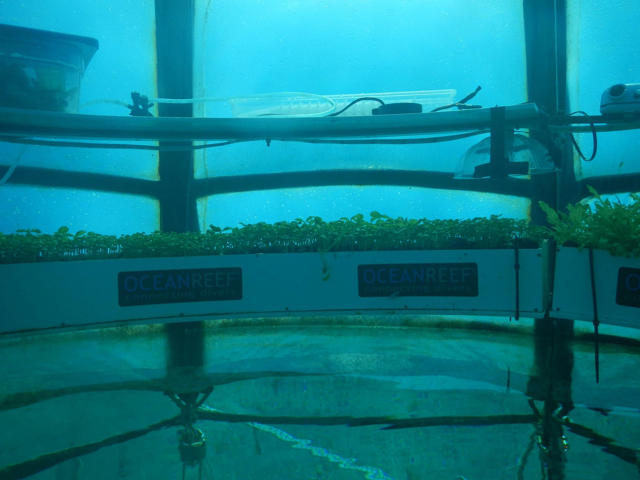
After all diving bells are being used near Italy to grow vegetables.
Now as for the lower warm layers of water being anoxic, that is not a requirement. It could be highly Oxygenated instead, and you could have diving gear that can extract Oxygen directly from the water. Therefore you might be on the bottom with just swim trunks, and that breather, and pick up rocks or whatever.
http://www.livescience.com/3829-inventi … -fish.html
Should this be an advantage over normal scuba gear it might be facilitated by charging the lower warmer saltier layers with more Oxygen. Oxygen could be added up to the level where it would "Fizz" out of the water due to lack of sufficient pressure per Henry's law.
I do not think that the colder upper water which would be under less pressure could hold enough Oxygen for a diver to breath from it with this apparatus.
And this method also requires that the water not turn over. Further I suspect that over time the charged Oxygen on the bottom will migrate upwards through dissolution, and will bubble out to form bubbles under the ice, so this then has to be managed the bubbles suctioned and compressed and returned to the lower layers.
As you can see, your lake, particularly it's lower layers can serve as an Oxygen reservoir. Handy to have during the winter, or during a dust storm.
But of course this topic primarily is about power from salt differentials.
#8391 Re: Life support systems » Material Choices for Mars » 2015-11-26 10:14:39
Thanks for the improvement for my understanding RobertDyck and Antius.
Louis, yes, ice is another option and of course how could I stand in the way of many alternate methods? It would be silly. You might want to look in this direction and consider if you want to try to integrate something like this to a lake. This item however must be built where it never gets above freezing:
http://www.gizmag.com/nasa-3d-printed-h … ers/39673/
It just happens that I am interested in three items at this time.
1) Lake habitats.
2) Abiotic synthesis of biochemical.
3) Plastic greenhouses receivers which use heliostats to increase the amount of lumens received. Even in this case, I anticipate using a underground cistern/lake as a escape route in the event of a receiver puncture.
All of these three will be related to the works mentioned in this topic, but #3, the Receiver will most likely just be a rip off of the work others have done, such as RobertDyck.
As for item #1, where I have three layers where;
-The outermost layer must endure the greatest temperature cycling.
-The middle layer of plastic will encapsulate ice pans, and perhaps have a more moderated temperature cycle.
-The greenhouses/diving bells will have a rather constant temperature.
So, I can mix plastics, perhaps the outer layer being PCTFE, the greenhouses for temperature purposes can be ETFE, and the ice pan encapsulation may be one or the other or perhaps something else.
As for U.V.:
I think fretting can safely be used either on the outer layer (If you can fret PCTFE), or on the greenhouses, to protect from U.V. spectrum which is counterproductive. My reasons are, that for the outer layer, you don't care that much about permeability. The differential pressure is slight at most. Further the literature about fretting on ETFE indicates that the plastic still blocks water vapor, which would be a major function of the outer layer. As for the greenhouses in the lake water, I anticipate that it will be rather practical to control what gasses are dissolved in the water, therefore permeability will be less of a concern.
My preference is to allow the U.V. in and to absorb it somewhere in the lake water and convert it to other spectrum, such as infrared or perhaps even to fluoresce it to visible. (That will be something to work on).
Should the rate (Over a period of time) of deterioration of the PCTFE or ETFE be too costly, then I will opt for blocking the U.V. from entering the lake at all, block it at the outer layer.
If using that conservative method, we still have the PCTFE deteriorating, then I would intend to replace it periodically, like the epidermis of the skin. The only thing that would stifle that would be cost. That will be unknown until later.
As for permeable webs, I actually think their might be opportunity to bend that to our use. No specific examples yet, but I think so.
#8392 Re: Life support systems » Material Choices for Mars » 2015-11-25 22:22:19
Relax buddy, you have the hard job.
Your greenhouse has to?
-Endure differential pressure.
-Deal with U.V.
-Tolerate incredible temperature shifts.
-Provide safety egress/rescue in the event of failure.
-Block the permeation of gasses.
Good luck with that. But actually, get it done! (If you possibly can)
I on the other hand ran away screaming from that, anticipating gross failure, and dead foaming bodies on the Martian ground after the balloon explodes. That is not to say that it cannot be done, but rather that I don't know how to do it.
When I meet cannot do, I set it aside and see if there might be something I might do, until if ever I can approach the cannot do again.
For now, I have two projects I am interested in.
1) Abiotic biochemical from sunlight, perhaps involving so called "Plastic films" (Although I can think of other methods of Abiotic that do not require plastic films.
2) Lake methods. I have vandalized this site with my manic nonsense about lakes for long enough for you to know what that is.
Abiotic, I will set aside for now.
Lakes, I rather hope to have your assistance on.
So, as a sissy, I have comprehended that layering might offer shelter from the nasty reality that Mars is not Earth.
I will briefly mention that GW has suggested regolith covered ice covered lakes, which is fine, if you are willing to provide methods for utility of the waters of the lake below the ice, such as artificial light or chemicals that might support life that will support human presence.
I of course for the entertainment value have continued to try to find a way to deliver photons into such an ice covered lake, and to provide support for a human presence that way.
Before I continue with my notions of such a lake, it is important that I will confess that for the scouts and very likely for the first settlements close to the equator of Mars, such lakes will be a luxury that cannot be supported. Therefore it will be abiotic and your methods that must offer the first direct solar driven biological processes that can support human life on Mars.
Lake notions are for a later phase of human occupation of Mars.
So, with all that blabery completed;
The lake method I currently most support for Mars involves a rather fresh water where a water turn over is not promoted, that is the water at the bottom is 39 degF, the water at the top is 32 degF, and above that is a protected ice layer. The ice layer is protected by so called "Plastic Films".
You can see what I intend under Terraforming:
http://newmars.com/forums/viewtopic.php?id=7284&p=2
You should understand this, few others will without their enlightenment which I am not likely to be capable to provide to them:
https://en.wikipedia.org/wiki/Matryoshka_doll
It might help illustrate what I am after.
At minimum I would have three "Plastic Films".
1) I want underwater pressure shells. They could also include fretting, which might filter out U.V. ETFE might work for this.
* In this case selective permeability might suit my purposes, where CO2 will pass, and O2 and H20 will not. Not sure yet.
2) Above that I want some kind of "Plastic Film" coating ice pans of an artificial ice cover covering an artificial rather fresh water lake.
Don't know if this could be ETFE.
3) Above the plastic coated ice layer, I want a air filled "Plastic Film" which will serve to isolate the atmosphere of Mars from the evaporation from between the cracks in the artificial ice pans of the ice layer. Such a vapor could then be collected.
My best want is for UV to penetrate into the lake, and to be stopped by Item #1. Other options can be considered.
I'm rather tired.
Hope you can digest this O.K.
Here is another annoying something from me. It seems to be optimistic about the temperature range of ETFE. As I said in my previous job, I understood what specsmanship was all about. Do you have comments?:
https://en.wikipedia.org/wiki/ETFE
Got some numbers problems. I do know what specsmanship is, and I understand that you are most likely standing on good ground from your perspective, but I am being given this contrary information from our beloved internet. I value your opinion.
ETFE film is self-cleaning (due to its nonstick surface) and recyclable. It is prone to punctures by sharp edges and therefore mostly used for roofs.[2] In sheet form as commonly employed for architecture, it is able to stretch to three times its length without loss of elasticity. Employing heat welding, tears can be repaired with a patch or multiple sheets assembled into larger panels.
ETFE has an approximate tensile strength of 42 N/mm² (6100 psi), with a working temperature range of 89 K to 423 K (−185 °C to +150 °C or −300 °F to +300 °F).[3]
ETFE resins are resistant to ultraviolet light. An accelerated weathering test (comparable to 30 years’ exposure) produced almost no signs of film deterioration.
Goodnight space nerd friends
#8393 Re: Life support systems » Material Choices for Mars » 2015-11-25 17:52:40
You should try it.
This link, suggests that ETFE would work on Mars. I am not questioning your authority on this but have they misnamed something else as ETFE? Are they just lost in the woods as well?
http://voitlab.com/courses/thermodynami … Greenhouse
I may be out of touch for a while, getting ready for tomorrow.
Thanks again.
#8394 Re: Life support systems » Material Choices for Mars » 2015-11-25 17:44:41
RobertDyck
Thanks for your corrections. My misdirection into ETFE may yield results for other purposes, later, but I can see that at the very least the outer barriers which must endure the cold of night and Mars level U.V. will have to be better than ETFE.
per you:
The one I gushed about is PolyChloroTriFluroEthylene (PCTFE). It's a simple polymer, made from one monomer. It's chemical formula is -CClF3-. It has one fluorine replaced with an atom of chlorine.
At least I am not lost in a snowstorm without winter cloths anyway now, so thanks again.
As you know I have two fantasies that I am currently babbling about. Neither on of them requires U.V. to penetrate through the plastic, but if it could as desired, that would be better.
ETFE is supposed to have that quality. That is why I went for it.
#8395 Re: Terraformation » Lakes on Mars-Like Planets, Natural, Artificial » 2015-11-25 14:12:50
The use of ETFE for an artificial lake
http://newmars.com/forums/viewtopic.php?id=7326
It turns out apparently H20, and O2 are not very permeable through ETFE, but CO2 is. So that is interesting.
And the ETFE can be modified to reject certain spectrums, such as U.V. I don't know what reject is though, is it does the ETFE reflect the U.V. or absorb it? I prefer that it would absorb it.
So going with the notion of ETFE water balloons where the content can freeze to become a "Ice Flow" surface for a lake, and over that a shroud of ETFE film which will hold an air pressure very similar to the outside air pressure, and will retain water vapor, a lake is possible.
So those ETFE elements would be preferred to allow U.V. through.
I have mentioned the Italian diving bell greenhouses, and also talked about pressurized tubes under 25 feet of water/ice.
I will not mutate that and try something else related to it.
I have talked about "Batch Bottle" vegetable gardening before, without much acceptance from others. Here I will mention it again.
But the bottles will be diving bells / Bottles.
A proposed shape would be that of a single honeycomb in a bee hive. The open side at the bottom. The window at the top, the six edges to the sides.
A likely maximum size being: with a top to bottom dimension of say 25 to 33 feet (Whatever is sufficient).
Smaller ones could be tried first.
If using a large size, then a permanent installation.
If using smaller, then moveable.
They will all have to have ballast in them. Perhaps ceramic parts sintered from sand dune materials
So, if you are working with small diving bells / Bottles, you can have a Sub-Fork-Lift bring them down to the bottom of the lake where they can be moved into a diving bell where a human can plant/harvest them.
If you are talking about big diving bells / bottles, you will leave them in place like a honeycomb, just under the ice pack. Each will have communion with the lake below with a hole large enough for humans in suits, and their equipment to pass. Should one spring a leak a means of escape will be available by simply swimming down. This should work, unless it would be a "Blow Out" where the whole window exploded.
So really, if these things were done, you would only have a few feet of ice and perhaps four layers of ETFE to have the light pass through.
#8396 Life support systems » Material Choices for Mars » 2015-11-25 13:37:34
- Void
- Replies: 79
I have had a lot of trouble understanding what may or may not work for Mars. RobertDyck has started my education on plastics, and I have recently been beating the drum for ETFE. Previous references indicate that it can be crafted to pass U.V. Light or Not. This is a valuable attribute. However I was concerned if perhaps I misunderstood it's ability to endure the Martian environment, so I did a query:
"Material Choices for Mars", and found a lot of references. I will mention these.
http://www.grantadesign.com/download/pdf/mars.pdf
http://voitlab.com/courses/thermodynami … Greenhouse
ETFE has optimum properties for use as a greenhouse on Mars. ETFE is an excellent thermal insulator, and thus, as the greenhouse effect occurs, the need for an additional heat system during the day will be reduced. Dust does not settle on ETFE so the transmittance of light into the greenhouse will not be affected during dust storms, and ETFE has excellent wear resistance so it will not be damaged by the external environment. Furthermore, ETFE has approximately 95% light transmittance which allows a wide range of wavelengths to pass through the material, however, ETFE can be fritted (patterned) to allow less solar transmittance.[3] Because Mars has high intensity infrared (IR) waves, ETFE in the ELSM Greenhouse will be fritted to minimize the transmission of IR waves so the plants are not damaged by these waves.[4]
The permeability properties of ETFE create an optimum environment for a greenhouse on Mars with a controlled gas exchange system. ETFE has a high permeability to carbon dioxide (CO2), which will allow for the transport of CO2 from the Martian atmosphere into the greenhouse for use by the plants.[5] Furthermore, ETFE has a low permeability to both oxygen and water vapor, which will prevent loss of oxygen and water vapor from the greenhouse to the Martian atmosphere.[5][6]
Permeability of gasses is a matter of interest I was not aware of:
http://www.plasticfilmbags.com/letters/ … lymers.pdf
#8397 Re: Terraformation » Lakes on Mars-Like Planets, Natural, Artificial » 2015-11-24 20:55:33
Your challenges are appropriate, I will try to argue to sufficiently address them.
Again:
http://www.swide.com/art-culture/nemos- … 2015/09/30
You said:
Light intensity drops with depth and with that the max useable depth will be.
They say:
Nowadays, Nemo’s garden includes more than 5 biospheres boasting underwater bubbles anchored to the sea floor and floating vertically at depth between 18 and 33 feet.
I am working with approximate estimations. Doing this I am satisfied at this point if an assertion can be considered reasonably plausible.
If the estimation errs outside practicality, there are some tools to calibrate the situation and bring it into practical limits.
The some of the tools include:
1) Improved water clarity, allowing sunlight to penetrate better.
2) Concentrating reflectors.
3) Franken Plants: http://www.natureworldnews.com/articles … d-idea.htm
(They would have improved photosynthesis)
Lin and his colleagues reportedly used recombinant DNA methods to connect the bacterial DNA to plant DNA sequences. The result allowed bacterial proteins to be produced in plant chloroplasts and successfully assemble into a functional Rubisco enzyme.
The study details how this altered enzyme - which is involved in the first major steps of photosynthesis - works significantly faster to convert CO2 into glucose (energy), compared to a plant's traditional Rubisco enzyme.
And faster energy conversion means greater production and yield.
All The Wheat You Can Eat
That's exactly what the researchers saw in their first crop of genetically enhanced tobacco plants - a proof-of-concept for further work on major crops like corn and wheat.
We have two underwater greenhouse designs to consider so far.
A) The diving bells they use, where an O2 low pressure atmosphere is required.
B) A 3D grid of pressurized tubes, where the highest horizontal tubes are to be transparent/translucent.
To bring as much light and heat into the lake as possible, it may be desired to discourage micro-organisms in the water itself, except for special isolated enclosures. This would help water clarity, and would reduce the amount of effort needed to be expended to clean transparent / translucent wet surfaces.
By way of Henry's law, the amount of dissolved gasses in the water will be low. The water temperatures will be cold in the case of this type of lake. There should be no intentional effort to fertilize the waters, if the water layers are static, where you have 32 degF on top and 39 degF on the bottom and no turn over, this should reduce the amount of nutrients available. Further, if necessary a poison might be employed to discourage microbes, but I would rather avoid it.
Without the poison option, it might be possible to strain out the free floating microbes (Algae), and therefore remove nutrients from the waters.
Should it prove necessary, these items:
A) The diving bells they use, where an O2 low pressure atmosphere is required.
B) A 3D grid of pressurized tubes, where the highest horizontal tubes are to be transparent/translucent.
Could be moved closer to the surface, but it would compromise other objectives. For "A" you would need a pressure suit to have a person gardener work in the diving bell. For "B", the counterpressure (Base Pressure) will fall below safety margins for emergencies where if a tube is ruptured a person might use an Oxygen mask to continue working, and might be fatal for depressurization.
So, I want to try for 25 feet (Base Pressure). 3.675 psi O2 for diving bells, and 9.8 psi O2/N2 mix for the pressurized tubes.
Concentrating reflectors:
Along side of and slightly below the horizontal tubes might be placed concentrating reflectors, to improve the amount of lumens in the horizontal tubes. (This could be done for the diving bells as well). This is easy enough to understand. Perhaps they will be fixed, perhaps sun following.
Then there is the "Franken Plant" improvement of photosynthesis, and also other modifications of plants to make them tolerate lower light conditions.
*It is my understanding that many plants will do rather well with 1000 lumens, where our daylight might supply 10,000.
So, I have reasonable hopes that this concept is technically feasible by utilizing necessary compensating mechanisms.
Hopefully it would be sufficiently profitable and comfortable to justify the effort.
Again;
I want to try for 25 feet (Base Pressure). 3.675 psi O2 for diving bells, and 9.8 psi O2/N2 mix for the pressurized tubes.
In the worst case for depressurization of the tubes, Oxygen masks will deploy as in an airliner (Or trained people will simply retrieve them).
Also they will have the option to exit the depressurizing tubes by moving down vertical tubes to the bottom of the lake.
*Note: I have specified a preference for relatively sterile water for the main lake, but this does not exclude the option to have a transparent water filled bag in the lake where the nutrients are purposely enhanced to promote microbe growth. (Waste treatment / Water recycling).
Done.
#8398 Re: Terraformation » Lakes on Mars-Like Planets, Natural, Artificial » 2015-11-23 12:16:55
Now here is a pretty little thing. What does it have to do with the topic?
Well, if you could add this to your transparent/tensile tubes, they should have a lot of tensile strength.
http://www.space.com/31180-diamond-nano … vator.html
Diamond Nanothreads Could Support Space Elevator

The team, led by chemistry professor John Badding, applied alternating cycles of pressure to isolated, liquid-state benzene molecules and were amazed to find that rings of carbon atoms assembled into neat and orderly chains.
While they were expecting the benzene molecules to react in a disorganized way, they instead created a neat thread 20,000 times smaller than a strand of human hair but perhaps the strongest material ever made.
The Penn State University researchers immediately had a hunch that these diamond nanothreads, which are remarkably light and strong at the same time — could prove to be an ideal material for a space elevator, a long cable anchored on Earth and reaching into space to attach to a satellite in orbit.
I recommend reading the whole article. Interesting.
Anyway, I think if it were possible to create a 3D printer to print/weld plastic webs, and to incorporate these diamond nano-threads into it you might have something. I speculate you might want it to have a mouth like a paper wasp, and to be able to weave these threads in. I don't know what deterioration the nano-threads might face being embedded this way. Chemical instability? U.V. damage?
So it has to be though out, but it's an interesting idea.
Of course if you succeed in making it for a lake, it could also be used outside of a lake.
#8399 Re: Terraformation » Lakes on Mars-Like Planets, Natural, Artificial » 2015-11-23 11:32:33
Spacenut, I have skimmed through the material and this post attracted me:
comstar03MemberFrom: AustraliaRegistered: 2004-07-20Posts: 329
Re: Earths Oceans Explored - but why not colonized
Grypd,
That comes down to design and new forms of technology, remember that europa is a liquid planet and what we can develop on earth will add the development in space bodies with liquid surfaces. Also the development of outer shell pressures and inner shell pressures need to be examined and new technologies are required. To maintain ground pressure at 5000 feet below the ocean without effecting the crew within, that will help space vessel design for venus probes, help with jupiter and saturn missions and europa missions as well.
We just don't look at the science and technological developments and also the new biological information we could examine and understand that would help humanity.
I will argue that for the purpose of human use, a water column can be sliced like an onion, with layers which each have a different potential for human use.
Go below 200 feet on the Earth, and ~600 feet on Mars, and standard diving methods will have to be replaced by more expensive and troublesome methods. So, I will consider this the normal lower limit for human activity in water. You would have to have a very large reason to compel you to try to work at higher pressures than that, so, from my point of view 5000 feet on Earth and 15000 feet on Mars are well out of any activity I would consider in any way rational.
In the gardens of Italy, also, I will argue that we have something new. Although we have to be concerned about efficiency, and productivity, the early results are promising, and it is a thing in it's infancy.
I have no proof, but I have a lot of reason to think now that an artificial ice pack where ice chunks are coated with ETFE plastic, and where a plastic layer overlies the ice pack as described in this thread will serve to:
-Limit evaporation, recapture evaporation.
-Reduce thermal losses.
-Allow the passage of visible and UV light into an impoundment.
To me this signifies the possibility to simulate or artificially create an analog to shallow high latitude fresh water lakes. And I anticipate that these bodies of water can be much more photo productive than such shallow high latitude fresh water lakes, because of the potential that they can be made to exist at lower latitudes, and also that snow will not cover them.
We have seen that in Italy they are employing diving bell type transparent/translucent structures. This is likely to evolve into other things I think.
For instance, we might ask if we could find a suitable height in the water column on Mars say for a minimum survivable pressurization, and to allow light transmission to plants. I think on Mars that might be about 25 feet of ice and water. For diving bell structures, this would require a atmosphere of almost pure O2. However, I am thinking that if you had a grid of tubes instead of diving bells, and that was laid out as a horizontal grid, then you could also have tubes that are pressurized. So your counter pressure would give you 250 mb, but your tensile pressure in the tube network might allow you to add a significant amount more. So, you might have a tube pressure of 10 lbs maybe, with an O2/N2 mix. These horizontal tubes would be transparent/translucent. But I would add opaque and insulated vertical (At a 45 degree angle actually) tubes, filled air. Those would be escape and access pathways.
So if your lake floor was 64 feet down, in the event of a leak, it would be obvious where it was. Adheasive tape most likely would effect a temporary repair. But if the damage were more serious, then you could either jump into a vertical tube and drop an elivation of 42 feet which on Mars would be like dropping 14 feet, and hitting water. (I can think of ways of making that safer. Or you might slide down 45 degree tubes. The point is you would get to the lake bottom, where you could further seek protection from depressurization, and cold water. You should be able to avoid the bends.
I think you get the picture. It is a method, and in this case the survival logic is significantly different than for that of the Earth.
The temperature of the water should be realtively constant for the tube structure, and as previously stated, a leak from the tube structure should be obvious since it will be visible, and also audable. Means to repair can come from the inside, and also with a diver from the outside. I suppose that under certain circumstances, you could say the same for domes, or such structures in Martian atmpsphere, but what if your emergency happens in the dead of night when it is very cold outside? Not as easy I think.
However, even though I have suggested this pressurized tube structure in a reservoir of water, I do not intend to be restricted to it. Indeed diving bells might be quite OK for some purposes.
In my mind this however is not an OR situation. It will be perfectly sensible to try many different things, and to see how practical they are.
Therefore sure other things. I do not intend to not think about biotowers with heliostats in the open air. You try lots of things, and you find out what works. I anticipate that a mixture of methods will be used. That's how things work on Earth.
#8400 Re: Terraformation » Lakes on Mars-Like Planets, Natural, Artificial » 2015-11-23 09:32:09
Terraformer said:
A meatshroom? I wonder if we could make one that would have the texture and flavour of chicken...
Perhaps. Although I might suggest that if it is pleasant to eat in any way, then the next generations raised on it would form their own happy associations with it whatever it is like, and it would then be their normal.
I should probably take a bit of time to self criticize what I have recently included in this topic.
"Potential Lethality" and "Relative Convenience" might be two phrases by which we might try to rate methods to manipulate matter on Mars to obtain a living.
Out on the surface in a space suit appears to me to have a greater Potential Lethality, than being in say a 33 foot water column of water where the water temperature is 0 degC / 32 degF to 3.89 degC / 39 degF. I don't have test data, but it seems to me you have greater chances of rescuing a cold water diver or for them to self rescue, then your chances of rescuing a person with a lethal suit failure on the surface. Further a column of water provides additional radiation protection.
For purposes of Relative Convenience, I think the contest will be less certain. If you develop good methods to inhabit cold water, and create a practical layout, I think the Relative Convenience will be better in the cold water than on the surface, for many activities, perhaps for agriculture in particular.
I think it would be great to improve on the cold water method and provide warmer water subsections using materials. Also there is the notion of brine inversion solar ponds, but corrosion might be a significant problem there.
I choose to honor all methods that appear to have chances of success, Aquatic, and not, I think that the end goal is to have a variety of methods that can eventually be integrated into a sensible way t make a living on Mars.