You are not logged in.
Well, I have suggested a rover like Mars Direct. Robert Zubrin included a rover with enough fuel for 1,000km one way in case the habitat lands that far from the Earth Return Vehicle. If they land correctly, then the rover can be used to explore. Furthermore, the nuclear reactor will have fuel for years, so could continue to produce extra propellant. That propellant could be used for the rover. That's a lot of exploring. And my plan included a reusable ITV, initially with expendable TMI stage, and expendable MAV that would act as TEI stage. But eventually that stage would be replaced with a reusable one. That would require refilling propellant in Mars orbit, either from Mars or one of its moons. And a way to ferry crew from orbit to surface and back. A reusable Mars shuttle would look like DC-XA; a land-on-your-tail rocket. Now SpaceX is building reusble rockets, so the Mars shuttle would be one of theirs. That shuttle would allow exploring the entire surface of Mars. Not from orbit, but a surface base.
What type of internal combustion engine would we use on Mars? We're likely to subject it to some fairly extreme thermal cycling and it would require a substantial radiator. If you're tied to a gas station, you have to continuously go back for refills. The internal combustion engines are preferable to electric motors here on Earth because there's a global infrastructure, built over many decades, to support their use and repair. On Mars? Not so much. It's doable, but at what cost?
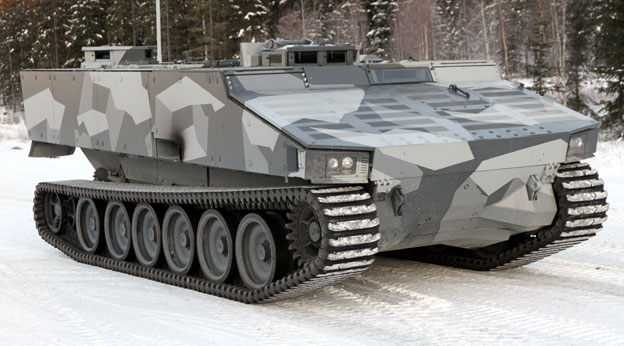
This is what I had in mind for Mars:
http://www.ointres.se/2010-11-30_sep-band1.JPG
Using all-electric versions of these vehicles figures heavily into my proposal for the use of micro capsules. The MTVL's are tele-robotically operated by crew members remaining with the MTV prior to EDL of the first and third astronauts. The second and fourth astronauts are picked up by the first and third crew members operating the MTVL's after they've reached the surface.
If supplies for only half the surface stay are packed into each vehicle, rather than for the entire duration, then the weight of each vehicle drops to less than 15t. Deployment of three such vehicles to the surface provides a spare, substantially lower per-vehicle mass resulting in better range, and an intermediate cargo mass for initial ADEPT use on Mars. This would do away with the immediate requirement to land a substantial 40t to 80t habitat module.
DC-XA on Mars? That thing had enough problems on Earth. Why would it fare better on Mars? Would the payload be nearer to the base of the rocket? How are you planning to get the payload to the surface after you land?
We're all struggling with ways to make a humans to Mars effort effective, not "flags and footprints", but at the same time affordable. Congress has already said "no" to the 90-Day report, and it's price tag. "Old Space" corporate executives keep trying to manipulate plans to be the 90-Day report, and it's full price tag. The rest of us keep trying to find ways to reduce cost, but at the same time ensure it isn't flags-and-footprints.
I've given quite a bit of thought to things that don't involve substantial risk to the entire crew. I think having all crew members in the same surface habitat or rover or descent/ascent vehicle is a substantial mission risk, which is why I split the four person crew into pairs for surface operations and land/launch them individually.
With the same line of reasoning, if at all possible I only want to use two of the five major EDL technologies (ADEPT, HIAD, parachutes, airbags, retro-propulsion) for any particular descent vehicle whether it's landing humans or cargo. Given state of development limitations, I went with HIAD + parachutes for humans and ADEPT + retro-propulsion for cargo.
Lets look at it another way. If you are on Mars, for what purpose would you try to reach orbit, if not to return to Earth?
If there was some other part of Mars you wanted to go to, wouldn't it make more sense to take a surface vehicle? Blasting off into orbit takes a lot of fuel, and most landers are designed to leave parts of themselves behind when they take off again, so they typically aren't reusable. If you want a second landing, you will have to bring a second lander, now it is possible but expensive to have two surface missions going at the same time on different parts of the planet.
You mean like a habitat failure or some kind or loss of supplies required for sustainment?
Even if your rover won't run or your habitat has a hole in it, you still need air, food, and water. If you can make it to an ascent vehicle, hopefully the MTV fared better than whatever caused you to cut your Martian travel plans short.
In my plans, there are two 20t pressurized rovers (electrically driven, solar powered M113 derivatives) and a habitat module that's more pressurized storage than a place I intend for the astronauts to live. My boys and girls are wild red rovers, not squatters. Martian cavalry, such as it were.
In any event, both the rovers travel convoy style for mutual protection. If either vehicle has a major malfunction, the other is immediately available to collect the astronauts from the stranded vehicle and either assist with repairs or return to the storage habitat for parts to fix the busted rover.
If a repair can't be effected, then absent a spare rover the surface exploration mission is largely over. They could either mill about their base site for the remainder of their time on Mars or return to an orbital station for a new dragon lander (no rovers if the rovers aren't close enough to drive themselves to the new site, but them's the breaks) and open a new base site.
More options means a far greater return for our efforts.
And criminals *need* to stop committing crimes. Just saying it doesn't make it happen.
You're absolutely correct. I like to write letters and make phone calls to my Congressmen and Senators and anyone else I think might listen who could actually do something about it. I have no idea what effect I have, if any, but it won't stop me from trying.
GW, another point. You said any government funded mission to Mars would most likely only happen once. That means no way to do the human scouting that you describe. Any human mission means one trip from Mars orbit to the surface and back. One. No mission will park in Mars orbit and send multiple excursions to the surface. We just don't have propellant for that. In fact, to make a single mission affordable, we have use ISPP for just one.
Think positively, Rob. Would anyone complain if NASA built an orbital station at Mars? Certainly not I. The longer we maintain a presence there, the better. For whatever reason, all space agencies love their space stations. Let's build the next space station at Mars.
Mars sample return can be done as a Scout class mission. That means a budget between $300 million and $485 million, including data analysis. Analyzing returned samples may cost more, in fact scientists would go nuts over samples. Keeping a sample return mission that low is possible, but only if you use ISPP, and don't use a large rover.
Could we analyze samples at a space station at Mars?
Actually, I'm uncomfortable with sending robotic probes to potential sites for human exploration. That's too many robotic probes. JPL sent a lot already. We should be able to select a location with data from existing robotic explorers: orbiters, landers and rovers.
You're probably right.
So build a permanent base with the first human mission. And park a reusable Interplanetary Transit Vehicle at ISS. Then if politicians cancel any further exploration, a commercial corporation could use that reusable vehicle to return to the permanent base.
Even though it's what we ultimately need to do, construction of a permanent base would take many years. A handful of F9H launches or two SLS launches and we could have an orbital station delivered. From there, we could stage Red Dragons for future or contingency use, cache spares and supplies, and use tele-robotic rovers to explore as much of the surface as we can before we send humans. If the MTV's use electric propulsion, we could refuel there, too.
Argon may not be as good as Xenon, but there's plenty of it in the Martian atmosphere. Seems like a shame to drag all that propellant from Earth just to get back there. Finally a socially acceptable use for Profac? Just a thought.
GW, I see what you're saying. But I still point out that Mars atmosphere blocks a lot of radiation. And completely eliminates micrometeoroids; they burn up 30km or higher above the surface, depending on size of meteoroid. And you have gravity. Yes, you keep arguing for artificial gravity for the transit vehicle, which means both have that so no difference. But NASA so far is absolutely afraid of artificial gravity. The bureaucrats are afraid of anything new, so someone is going to have to demonstrate it in space before they even consider it.
NASA needs to get over their fears of artificial gravity and use it for the benefit of their explorers. Humans don't fare well without it.
Robert Zubrin has argued strenuously for his plan. It was very valid in 1989 & 1990, but I argue some aspects are obsolete. For example, he said don't build a space station in Earth orbit. Well, we have it now, so let's use it. NASA wanted a life support system that could recycle 95% of water and oxygen, but he argued to go with what existed at that time. Robert Zubrin said if we wait for a 95% efficient life support system, it would be the 21st century before we're ready to go. Well, it is the 21st century now; we've pissed away so much time that the 21st century caught up with us. And ISS only needs a few additional specific pieces of equipment to make it 95% efficient. He argued for initial exploration by humans, not robotic explorers. Some who like robots would argue, but my point is this is now moot because robotic exploration is essentially complete. We should send a robotic lander to each potential site, specifically designed to evaluate for the human base. I waffle between a lander with tiny rover like Pathfinder, or MER rover. But definitely an MSL rover would be *way* overkill.
NASA's manned space program is still busily pissing away funding on things that won't ultimately permit them to explore our solar system. Obama gave them an opening and they didn't take it. It's time to start serious development of closed loop ECLSS, active radiation shielding, and ISRU. Our propulsion technology is near to where it must be to support sustainable exploration activities, but after three decades of throwing money at various high-risk, high-payoff technologies we still don't haven't CL-ECLSS, ARS, ISRU, or an affordable HLV. If we don't right the ship now, NASA is at substantial risk of having its manned space program shut down by short-sighted politicians.
And we need to test/demonstrate ISPP with a robotic Mars lander. Either a sample collection arm like Phoenix, or tiny rover like Sojourner. You definitely don't need an MSL size rover. And you don't need multiple Mars sample return missions, just one to demonstrate ISPP.
The sooner, the better.
The beauty of ISPP designed by Robert Zubrin and David Baker is that it uses Mars atmosphere. Not Mars permafrost. One reason is Mars atmosphere is already well characterized, so we don't need any further data. But the real beauty is the atmosphere is the same across the planet. So ISPP works the same anywhere on the planet.
Unfortunately, the Martian atmosphere isn't the same everywhere on the planet except in general composition. We still need ISPP, so we have to find a way to make it work.
Or are you talking about ISRU for construction material? That's tricky. You'll never find a single site that has all resources you would want. Have to pick which you want to focus on. Curiosity found hematite and cristobalite, the first is iron ore, the second can be melted to form glass. There's abundant plagioclase feldspar in Mars soil everywhere. The trick is to find plagioclase with more than 70% anorthite (calcium aluminum silicate). If it has too much albite (sodium aluminum silicate) it won't dissolve in acid. The Bayer process extracts aluminum from bauxite, you can reverse the pH to do it with plagioclase feldspar high in anorthite. So iron, glass, and aluminum all in one spot! And Curiosity hasn't found ice, but soil minerals that release water when baked; about 2 pints per cubic foot of soil. Great! Would be nice to get other metals as well, such as copper for electrical wiring, but as I said you aren't going to find everything at one spot.
We're many decades away from mining building materials on Mars. That shouldn't stop us from locating the resources and experimenting with the most efficient methods of obtaining them, but it'll be quite some time before we can actually use them.
Rob,
I would never suggest leaving any of the crew in orbit around Mars. My assumption has always been that they're all going to the surface. All other suggested approaches to landing humans involve vehicles that are many times the mass of what I've suggested and have a hard requirement for retro-propulsion. I understand that ADEPT, or something like it, is an absolute requirement for cargo and therefore the same tech would be available for crewed landers. However, there's virtually no chance that a lander that requires retro-propulsion would be less expensive or time consuming to develop.
NASA is either lying about the problem or overly concerned with radiation, but I think the MTV will have adequate radiation shielding or they won't go. I would think that any responsible planner would have to at least consider the possibility that once the crew arrives at Mars that they can't all land, or land at all, or are prevented from using the free return trajectory to abort. If there's no one aboard the MTV and something fails while the crew is on the surface, there are few possibilities for repair.
Any potential for stranding applies equally to any landing scheme. As previously stated, if a single multi-person lander with the entire crew aboard fails, then the entire crew is lost and the mission is lost. If each person has their own lander, loss of one lander doesn't cause instant loss of mission. I'm not overly concerned with a single or multi-person lander failure, but any honest assessment of what happens after a lander failure indicates the obvious.
Thanks for all the input on this. After consideration of all the potential problems, micro capsules are most definitely Plan B. However, if Plan A (development of a proper multi-person lander combined with a fully fueled ascent vehicle) is so expensive as to be unworkable, then I think Plan B should receive some consideration because it's still better than no plan at all, which is what we currently have.
Rob and GW, thank you for the criticism of this plan. Every plan needs a reality check. I still think Plan B is workable, but it would most definitely require further experimentation just to prove feasibility. It may only be workable under specific atmospheric conditions on Mars.
So far, I've come to the conclusion that any significant navigational error with a micro capsule is likely to result in the death of the astronaut inside, once you commit the inflatable aeroshell and parachute have to work perfectly because there's no abort-to-orbit capability as with a multi-person lander, and the density variability of the Martian atmosphere may make the size of the parachute required to guarantee a soft landing without airbags or retrorockets impractical. To my knowledge, a soft landing on Mars without airbagas and/or retrorockets has never been done, so this may be impractical. However, the payloads in question were also substantially heavier than the micro capsule would be, so if the payload is light enough and an inflatable aeroshell can bleed speed quickly enough, landing on a parachute alone may still be practical.
No matter how small, development and testing of altimeter triggered retrorockets that work perfectly, every time, on another planet is sure to be insanely expensive. If there's a simpler and less expensive option to successfully complete EDL for humans, then that's what we should work on until the Orion and SLS spending projects are over. Once we've blown enough cash on those two projects without meaningful result or someone at NASA grows a pair and says what needs to be said to the morons in Congress, then we can develop two stage multi-person landers that can return to the MTV if they land substantially off-course.
At no time have I thought that my solution was in any way optimal, but a $3B total outlay over six years is eminently reasonable compared to the alternatives. Any multi-person lander with contingency supplies that includes a fully fueled ascent vehicle is far, far preferable to my solution.
If we have reasonably priced and fully tested EDL solutions for humans (HIAD + Parachute) and cargo (ADEPT + retro-propulsion), I think we stand a far better chance of going to Mars than if there was no solution because we had to wait ten or more years for funding availability. ADEPT and retro-propulsion are a little further away than HIAD and parachutes; just far enough that I think two separate approaches to solving the problem is appropriate.
Even in the Martian atmosphere, I have a hard time believing that we would not achieve a substantial reduction in velocity before touchdown with a payload that's less than half the mass of Pathfinder, using the same size/type parachute, and an inflatable aeroshell capable of generating more lift than the rigid aeroshells used by Pathfinder and MSL. We may still need some sort of airbag to absorb the impact on touchdown, but if it's possible to only use HIAD and a parachute, that's the way to go.
I am submitting a request for MarsGRAM data to NASA so that I or someone else can determine what the feasibility of soft landing 150kg or less without retro-propulsion would be.
GW,
Is there any reason why it would be impossible to slow the capsule to subsonic velocity using lift from the inflatable heat shield, at which point a more effective parachute could be deployed?
I need to know the drag coefficient for the type of supersonic parachute that Pathfinder used and what the density of the atmosphere is between 15km and the surface if you have that information. You seem to have some goodies that JPL provided to you, so I thought I'd ask.
The velocity of Pathfinder was between 50m/s and 60m/s when it fired its retrorockets. Any idea what that velocity would have been if it used the same parachute and weighed half of what it did?
Heck, MSL's velocity was only ~80m/s at ~1.6km in altitude when it fired its retrorockets. Is there some reason why it's not possible to skirt around the requirement for retro-propulsion with more altitude and a lighter payload?
SpaceNut,
I'm trying to avoid using sky cranes, retrorockets, and even supersonic parachutes if it's possible to use inflatable heat shields and subsonic parachutes only. Steering control for the parachute is as fancy as I want to get. The goal here is to land the astronaut and a couple extra oxygen bottles a few hundred meters from the mobile habitats and that's it. Two mobile habitats will be in the landing area to collect the four astronauts.
I discussed updating Mars Direct. That means sticking with Robert Zubrin's mission architecture, not mine, but building it with current equipment. Robert Zubrin's ERV includes a capsule, and a 2-stage rocket to throw directly from Mars surface to trans-Earth trajectory. That 2-stage rocket would use LCH4/LOX engines, and would be a new rocket. One point I made is rather than develop a new capsule, use Dragon. However, to survive 6 months you would need a small, light-weight module attached to the nose with recycling life support. I suggested the same life support as ISS, and just barely enough room for one person to float in the centre to do repairs/maintenance. Base the hull of that module on Cygnus, but smaller. That module would be discarded before entering Earth's atmosphere.
Using a minimum mass ERV sounds expensive, difficult, and potentially far more hazardous than an off-course landing on Mars.
The capsule I proposed is for LMO to Mars and Mars to LMO only, rather than any type of interplanetary transfer.
And I argue that NASA has enough money to do all this right now. They don't need more money. It would require cancelling Orion and ARM, complete SLS, give up on the Moon and Constellation, focus exclusively on Mars.
I like the fact that the plan involves going to Mars instead of playing with space rocks, but I also think that what you're proposing would cost every bit as much as Orion's development and then some. Dragon, like Orion, is incapable of sustaining the astronauts for the period of time they're in deep space between Mars and Earth and docking a sustainment module to the front of the capsule doesn't make it a deep space habitat. If you're sending your explorers to Mars in a ITV/MTV anyway, why not bring them back in that vehicle? We now have reliable propulsion capable of doing that without blowing mass budgets and therefore breaking the bank.
Even if we complete SLS, what does SLS do for us except suck down a few billion in development and operations each year? It's entirely wrong for any type of sustainable Mars exploration campaign.
With NASA's current budget, it can't spend a few billion on ISS, a few billion on SLS, and a few billion on Orion every year and have funding remaining for closed loop ECLSS, deep space habitats, landers, and ISRU. Two of the three would need to be cancelled if we ever want to go to Mars. ISS has the potential to have real utility to assist with that goal, whereas an unaffordable rocket and an insanely heavy capsule don't.
And I said Dragon is appropriate to return crew to Earth. The heat shield material is appropriate for Mars. A custom lander is required for Mars. Dragon can be used either by Mars Direct as the ERV capsule, or as an emergency escape pod for a reusable ITV during aerocapture at Earth. Dragon is the not the Mars lander. I never said it is. You are obsessing about Red Dragon from the Mars One mission plan. I don't know anyone here who believes that's a good plan. MIT did an analysis, they believe settlers would survive 2 weeks after arriving on Mars. Yes, a multi-person capsule does have to be substantially redesigned to use ADEPT. One option is the Mars Direct habitat (hab). I came up with a mission plan to use Russia's Energia, so suggested a minimum size landing capsule and all-inflatable surface habitats. That plan was developed in 1999-2002 when Russia was behaving itself. The idea of using Energia was from Robert Zubrin's book "The Case For Mars". As Dr. Zubrin said in his book, using Energia requires splitting the mission into 3 parts instead of 2, because Energia has 2/3 the lift capacity of Saturn V / Ares / SLS. Doing it today with SLS might permit a hard wall habitat. But that's all custom landers. At no time did I ever claim that Dragon was the Mars lander. What I do say is Dragon can be used for return, and Dragon is overall a much better choice than Orion. That's because Dragon has a dry mass of 4.3 metric tonnes, with full fuel tanks (wet mass) is 8.0 metric tonnes. Orion is much heavier, with fairing and LES and full tanks it's 28 metric tonnes. I've said this many times. That doesn't mean I claim Dragon is the crew lander.
What is your proposal for this custom multi-person lander that we don't have money to develop, Rob? Please share your proposal. When do you think we'd have money for that? Around 2030, maybe?
Dragon's going to be an ERV? Got it. Now we just need to land a rocket big enough to launch it off the surface of Mars. What would be easier to design and test on Mars, rockets capable of lifting 1t to LMO or 8t to LMO?
I'm obsessing over Mars One? Find a post of mine, except this one, where I mention it. I've never seen any of their proposals, so I'll have to take your word for it.
As for MER, yes it is a fair comparison. Don't you think they would have landed with parachutes if that would have worked?
The retro rockets on MER brought the lander to a full stop 10M above the surface and then dropped the lander onto the surface. The peak deceleration that you referenced was the result of the lander slamming into the ground after it was dropped. MER weighed 533kg. Micro capsules will be significantly lighter.
Rob,
I'm tired of arguing the point with you. You keep using arguments that apply equally to any EDL solution or are demonstrably false. When that doesn't work, you propose something that I did not in order to construct something with weight/dimensions/reentry profile/etc that won't work on Mars without lots of expensive, complicated, and failure prone technology.
The micro capsule is an unpressurized aluminum trash can with a fabric seat bungee corded to the walls and a service module attached to its rear end with an inflatable or deployable heat shield (I don't care which) and reaction control system for de-orbit. Anyone with the desire and enough time on their hands can engineer it into a Rube Goldberg contraption that won't work reliably on Mars, but you have to work overtime to do it.
I wanted to keep EDL for humans on Mars spectacularly simple, which would be a first for anything designed by NASA, but some people apparently have complexity cravings that rival NASA's. Multi-person landers are an admirable goal, something I would love for us to build, but there's simply no funding to do that because Congress forced us to squander so much of our available funding on Orion and SLS rather than a spacecraft that could actually land on something other than Earth or a rocket that we could afford to operate. Unfortunately for us, funding hasn't been coming out the wazoo lately.
Rob,
Dragon's problem with reentry on Mars doesn't have anything to do with its heat shield material, it has everything to do with its weight and ballistic coefficient. It doesn't land enough mass to be anything more than a more expensive flying coffin than a micro capsule would be, if either land substantially off course.
Your second argument was that this thing will experience a higher peak deceleration force than a sitting astronaut can tolerate. That's been pretty thoroughly debunked by GW and the documentation by NASA regarding peak reentry deceleration forces encountered on Mars from actual missions. MSL encountered a greater peak declaration force for the reasons I already noted.
Your basic grade school education about area and volume ignores the fact that Red Dragon is already substantially more massive than 4 micro capsules would be because Red Dragon lands propulsively.
Regarding how inflatable heat shields are "different" from using deployable articulating heat shields for the entire crew, the only multi-person capsule that could potentially land on Mars would have to be substantially redesigned to use this novel new ADEPT technology. I don't care if NASA does that, and it would be my preference, but so far there's no talk of doing that.
Regarding MER, it's not a valid comparison. The lander weighed 533kg and it was dropped from a height of 10M onto the surface of Mars. The capsule plus astronaut won't be anywhere near 533kg and we're not dropping it from 10M with the astronaut in it.
In order to produce pressure vessels of substantial size, such as those required for attachment of Centaur like upper stages to planetary probes, satellites, and repurposing of space junk, an empty SLS tank should be utilized.
SLS can put 70t in LEO with no upper stage. If an orbital manufacturing facility could be attached to ISS, then we could have astronauts separate the interstage, LOX, and LH2 tanks. The expensive RS-25's could be de-orbited using HIAD or ADEPT instead of reactivated Space Shuttles (an earlier concept I wanted to employ that, thankfully, is no longer necessary because we have like-kind capability), captured mid-air by aircraft, and returned to KSC for reuse. $288M is too much cash to blow on RS-25's alone.
We still need SEP tugs for collecting space junk and a fuel depot, which should not be anywhere near ISS for obvious reasons. Satellites and upper stages would be refitted or refurbished at ISS. The SEP tugs transfer the remanufactured satellites and upper stages to the fuel depot for relaunch. Any SEP powered satellite or probe and the tugs could be refueled with Xenon/Argon/Krypton at ISS.
Rob,
Moreover, it wouldn't matter if an astronaut was flat on his or her back at 12.9 G's, he or she would be unconscious either way. Perhaps I'm oversimplifying things, but it seems as if JPL has two problems to solve here.
P1. In order to decelerate fast enough for supersonic parachutes or retro-propulsion to function properly, our reentry vehicle has to bleed away enough of its initial velocity at an altitude high enough above the surface of the planet to permit effective use of parachutes and/or retrorockets. This generally means a shallow entry angle that will increase peak heating.
S1: Develop lightweight materials capable of withstanding higher heating and reentry vehicle shapes or structures that lower the ballistic coefficient.
P2. In order to reduce peak deceleration force to levels tolerable by humans, a lower rate of descent is required. This generally means producing lift to counter gravity, thereby decreasing the rate of descent.
S2: Use the reentry vehicle's shape and center of gravity manipulation to produce lift.
MSL's reentry angle was around 20 degrees to reduce peak heating. The combination of the weight of the vehicle, relatively small lifting body, and poor lift generation created a plunging descent, increasing peak deceleration force. JPL and NASA favor plunging descents for unmanned reentry vehicles subject to substantial peak heating, as unmanned vehicles can readily be designed to survive deceleration forces that would injure or kill humans.
The micro capsules I proposed would reenter at shallow angles, have far lower ballistic coefficients than MSL, and generate more lift than MSL was capable of generating. You keep trying to invalidate this micro capsule concept using faulty logic that does not correlate with what NASA has published with regards to reentry. Even if what you stated applies to the micro capsule concept was true, which it is not, then it applies to an even greater degree to larger capsules with higher ballistic coefficients and lower lift generation capability.
A single person capsule can be made so light as to be capable of landing by parachute alone, especially if the service module and inflatable heat shield are discarded before landing. The same cannot be said for the multi-person capsules and heavier rovers or surface habitats.
SpaceNut,
Without an altitude at which peak G's are experienced, how can we determine that the reentry peak deceleration force on Venus would be the same as it is on Mars? Do you have an atmospheric density model for Venus? MSL reentry started around 125km at 5.9 km/s, experiencing a peak deceleration force of 12.9g, and it was ~127kg/m^2. One of the hypothetical sphere cone reentry vehicles in Fig 2 experienced 32g at an unspecified altitude and was 44kg/m^2. Between 200km and 75km in altitude, is the density of the atmosphere on Venus an analog for Mars? What am I missing?
The ARM is a total waste of time and money and I think NASA is paying lip service to the idea with the knowledge that this nonsense mission will be cancelled when Obama leaves office.
If this new space station has, artificial gravity, closed loop ECLSS, active radiation shielding, and a manufacturing facility, then I'm all for it. However, I see this as yet another potentially expensive distraction that prevents us from developing the technology to go to Mars.
NASA doesn't need any international cooperation to go to Mars, it just has to decide that that's the goal and then develop a coordinated plan to develop the technologies required to take us there. I would much prefer international cooperation and that all space faring nations coordinate their efforts to achieve the goal of becoming an interplanetary species, but politics always seem to interfere.
The existing budget is more than adequate to achieve the goal, but all the uncoordinated and expensive make-work projects need to end. SLS and Orion need to be cancelled ASAP. There's simply too much funding that has been funneled into these projects to justify the relatively meager returns and insane costs.
That may explain why you keep raising concern about coming out of hypesonics too low. What happens if you use something like ADEPT? That's a carbon fibre foldable heat shield. The goal is to catch more air when entering Mars thin atmosphere. Would that exit hypersonic flight high enough for a parachute to be useful? What G-load would that put on astronauts?
According to JPL, ADEPT would permit you to deploy a supersonic parachute at a high enough altitude on Mars to produce useful deceleration. However, the mass of the payloads we're talking about landing is so high that I think supersonic retro-propulsion is a better method for supersonic and subsonic deceleration and landing, even if it takes a little more propellant to do it. I like approach #3 in their infographics.
Peak G's for all proposed ADEPT control strategies is less than 4. ADEPT and HIAD shift the payload mass to "catch more air", as you put it.
The pages have just what we are looking for in ballistic angle and G force....
SpaceNut,
The document in your last post in this thread shows the peak deceleration force that the technology would likely produce if deployed at Venus with the specified area and loading parameters. How does that help us understand what the peak deceleration would be on Mars?
Let's have a look at the following document for more information about peak deceleration forces from actual Mars missions:
A micro capsule equipped with an inflatable heat shield with the same attitude control mechanism that IRVE uses would decrease rate of descent and the thin Martian atmosphere would decrease peak deceleration.
http://ntrs.nasa.gov/archive/nasa/casi. … 012170.pdf
The high deceleration forces imparted to the test articles has everything to do with deliberate use of plunging descents on suborbital flights to produce maximum heating and aerodynamic pressure on the shield for testing purposes.
http://solarsystem.nasa.gov/docs/p484.pdf
If I thought the micro capsule concept had no merit or posed significant technical challenges, I would not have proposed it.
It's a relatively simple solution to a complex problem. The primary disadvantage being that the micro capsule leaves nothing but a water ration and spare oxygen tank or two for the explorer to use to reach the habitat module (which is mobile and comes to him or her in my proposals).
To be clear, what I desire is a Mars EDL solution for humans that could be developed in 6 years time or less, at a cost of $3B or less. This is relatively inexpensive and therefore workable. All the realistic multi-person EDL solutions I've seen proposed aren't even in the same ballpark. Most involve a decade or more of development time and projected costs of around $10B or more. In other words, a human rated lander would be within NASA's budget using my proposal but a multi-person lander would take so long to develop or cost so much that it would most likely be cancelled.
If you disagree with my micro capsule proposal, then counter with a realistic multi-person lander with a development time of 6 years or less, costing $3B or less, that significantly improves the situation of our explorers if they happen to land off course. An all-propulsive EDL using Red Dragon would obviously function correctly, but it lands so little payload that the astronauts contend with the exact same surface survivability issues that astronauts landed with the micro capsule would have. Both solutions provide very little in the way of contingency supplies.
Apart from keeping the crew together, ensuring that they all die together if anything goes wrong (something that's obviously pretty high on the priority list of everyone but me), Red Dragon provides precious little advantage over my solution and would almost certainly cost more in terms of development and per unit purchase price. I like Red Dragon better than my proposal because I really want a cost effective multi-person lander, but it won't put the astronauts in any better a position if they land off course.
To complete the context of what I'm proposing, I would like two separate EDL solutions. I want to use a minimum mass and complexity solution like HIAD for humans and a somewhat more involved solution like ADEPT for heavy cargo.
If Red Dragon can be developed and properly tested for less money, then I would drop my proposal. My guess is that the weight and higher ballistic coefficient of the vehicle will make landings on Mars marginal at best.
You keep repeating the same error. Yes, I agree that defence (Canadian spelling) contractors want big spending. Yes, we need to keep cost down. Congress said "No!" to the 90-Day Report because it cost too much. The problem is you keep assuming that splitting a single, shared spacecraft into multiple single-person landers would actually reduce mass. I've explained why it won't.
Let me put it another way. Physics is real life. This isn't some Hollywood movie or TV show. The TV show "Stargate SG-1" showed aliens with technology that looked like ancient Egypt. It's based on the initial premise of the show. A couple episodes showed an escape pod that looked like an Egyptian sarcophagus. Some episodes showed a horizontal sarcophagus as some sort of medical device, other episodes showed a vertical sarcophagus in a Tel'Tak ship as an escape pod. Well, in real life a sarcophagus is a coffin. Just a box to hold a dead body. It isn't an escape pod. In real life an escape pod cannot be a form-fitting coffin-shape. In real life an entry vehicle must deal with high speed atmospheric entry.
Studies by NASA in the 1950s showed a blunt body works much better than a sharp, streamlined vehicle. A blunt body means a round heat shield, and an aeroshell behind it. Wind tunnel studies showed air flow behind the heat shield in a specific pattern. The reason a Mercury spacecraft has the shape it does, is that fits within the wake behind the heat shield. A cone of specific size, with specific angle to the side walls. At a specific distance behind the heat shield, the wake stops collapsing inward, forming a fairly straight cylinder of turbulent air. The nose bit of Mercury, fits within that. Mercury used that to store its parachute, flotation bags, and life raft. And above that was the antenna fairing. But you don't need to use that space. A spacecraft that docks to something, such as ISS, would have a rounded-off, domed top with a docking hatch rather than that nose piece.
Rob,
Get the whole MOOSE concept out of your head. NASA isn't doing space jumping stunts on Earth or Mars or anywhere else there is a potential alternative EDL method.
The only way you need a capsule the size of Mercury is if you insist on laying the astronaut flat on his back. The human doesn't have to be oriented that way in the capsule for a Mars landing because we're not executing a Mercury style landing on Mars.
Imagine for a second that we're using an inflatable heat shield, which is what I proposed, and that the capsule's seating arrangement is such that the astronaut is sitting in a fabric seat in a more vertical orientation, relative to the nose of the capsule, instead of laying on his or her back. If the capsule was designed with that seating arrangement, then it doesn't have to be as wide as mercury.
I never proposed using a Mercury capsule with a conventional heat shield because neither the capsule geometry nor its seating orientation are required for a Mars landing. As far as your physics lesson is concerned, in real life the IRVE payload container had a vertical orientation. In real life, an inflatable heat shield can be deployed from the base of the service module and would permit a much smaller diameter capsule and therefore lighter capsule. Most of the capsule's mass, even after expenditure of propellant, is in the base.
GW,
Nobody here wants to get anyone killed. Some other ugly little facts have to be faced, though. There isn't a good solution for every potential problem. In the same way that missing the runway normally results in death and destruction here on Earth, such is the case on Mars. You land where you're supposed to or your odds of survival are slim to none. We've launched over 100 Space Shuttle missions and never lost a single orbiter to pilot error. You get one and only one chance to get it right, which is why older men and women with thousands of hours of flight time in multiple airframes are the only ones permitted to fly it. To channel Chris Costa a little, if you're a professional pilot then you practice landing until you can't get it wrong.
Minimum mass missions don't necessarily make the missions more dangerous to the crew if you're intelligent about what you send to Mars. Even something as simple as the pressure vessel for landing clearly illustrates the problem with all the solutions I've seen from NASA. Nearly every concept attempts to use some novel technology or combination of novel technologies that demonstrate how clever their engineers are as opposed to designing something simple that works or adapting existing technologies for their purposes. Obviously it makes the problem more interesting, but is the goal behind the development work to make the solution intriguing to the engineers and scientists or to use simple and workable solutions that function in the real world where cost and complexity are real problems?
In simplest form, a lander (for humans) is a maneuverable pressure vessel with a thermal protection system. There's no requirement for landing everyone in the same capsule. That's just defense contractors who want big spending programs to collect as much money as possible from the tax payers. I don't care about the spending programs if there's unlimited funding available and we don't care how long the solution takes to develop and test. In the real world, there's no such thing as unlimited funding, so let's pretend for a moment that we have work within the constraints of a rather small budget for the undertaking that NASA says it wants to attempt.
We can make the human EDL solution for Mars as heavy and complicated as is pleasing to us, no doubt producing a whole range of other problems that require solutions of their own, or we can accept that smaller and simpler can and will function just as well as heavier and more complicated in actual operations.
But the habitat that can move is to heavy for current EDL systems to handle.....
In terms of the added mass if it means survival and death I would take it to and give up something else that is coming down with the crew member that can have a bit of mass trimmed from it.
I already proposed a minimum mass and development effort EDL solution to get humans to the surface of Mars in another thread. Nobody liked the solution, but the alternative is a multi-billion dollar project that will take NASA a decade or longer to develop and test. The funding saved would support development of HIAD and ADEPT along with habitat modules.
The habitat module, mobile or static, will be heavy. Use of the new EDL technologies JPL is developing is a requirement.
I think an electrically powered M113A4 (MTVL) with band tracks (presuming the tracks were made from a compound with a very low glass transition temperature) would be suitable for Mars exploration with modifications. The roof would have a giant solar panel on it. Top speed should be governed to about 30 kph. The vehicle would weigh about 20t fully loaded. Unlike the MTVL, the batteries would be on the floor and only electric motors would be utilized for propulsion. The walls and roof of the main compartment would contain a HDPE water bladder. There would be no hatches above the driver's compartment and the compartment would be heavily shielded. The M113's ramp would be replaced with an airlock or suitport. Each MTVL habitat would carry a crew of two.
I do not want to get this topic any further off as we have the past topic to dicuss this in with a greater level of reasonable detail.
I will post one one of them...
I think small powered vehicles are a total waste of mass, time, and effort. The habitat module should be mobile and come to you after you land.
The Montanara Volta weighs just 9 kg and uses an electric motor to assist the rider.
https://www.electricbike.com/lightest-bike/
In contrast, some of the lightest gas powered bikes weigh more than 59 kg.
Is the gas powered bike worth the extra 50 kg? It's certainly much faster than the pedal powered bike, until it runs out of fuel. Should astronauts travel around on Mars at 30+ km/h wearing thin pressure suits? Probably not smart.
For comparison purposes, a high performance electric bike like the BRD RedShift weighs 114 kg.
If you can't go to the habitat module on Mars by foot or pedaling, then perhaps the habitat should be mobile and come to you.