You are not logged in.
- Topics: Active | Unanswered
Announcement
#8151 Re: Human missions » Elon Musk wants to populate Mars with 1 million people to save humanit » 2016-10-04 11:37:53
Louis Said:
Will it aim to be an exporting economy, looking to earn revenue from Earth, so as to pay for imports? Will it be a research and space agency outpost, reliant of government and university grants? Or (most likely) some combination of the three?
So, far Louis, you make the most sense of anyone I have interacted with on how to bootstrap an economy on Mars, and typically doing much better than me. And I am not a kiss up, (Or my price is much higher than this place pays) 
Honestly on another thread, gold mining has been proposed. Things I think I know:
1) Earth likely would not have much gold on it's surface unless one asteroid with a lot of gold had hit it late in it's formation.
2) Mars may or may not be favored by gold on it's surface. Less tectonics, closer to the asteroid belt. Don't know.
3) In gold mining situations, it was the cook and the cloths washer that made the most consistent money. I think most miners struck out.
4) Then there are the asteroids:
https://news.ycombinator.com/item?id=358351
433 Eros, the asteroid NASA investigated contains more gold than ever extracted on Earth. The total amount of gold on Earth is calculated at $3,000,000,000,000 and this is excluding all the stuff held in private collections and any fabled Aztec lost city of gold. However, I think there's enough economic incentive in space if we actually put a little money in to begin with.
https://en.wikipedia.org/wiki/433_Eros
So, long term, perhaps Mars can be an exporter of materials which facilitate the extraction of materials from such asteroids, or not, too early to tell.
I think early on, it will be your:
Will it be a research and space agency outpost, reliant of government and university grants?
I think that calibration of reality will be worth it. That is information gathered from Mars, will increase accuracy of understanding, and that will translate into proficiency of effort on the Earth and elsewhere. It is a justifiable investment.
But some adventurers/marginal social types will attempt to make Mars their permanent home, and will have to problem solve to do so. Eventually they should get there.
...
As for Elon Musk himself, I have a few items which I have put into my hunter gatherer sack.
-He has mentioned domes with water in them.
-He thinks, that radiation protection in his BFS will be sufficiently provided by orientation of the BFS, and personal sheltering behind a water column during solar storms.
-He thinks that solar and geothermal might be good energy sources on Mars.
-He thinks that the undergrounds of Mars may in fact hold life that will likely be chemosynthetic in nature. He thinks that introducing Earth germs will not threaten such life, as the Earth germs will not have much hope of displacing the well adapted indigenous life forms.
...
Dook said:
Colonists are not going to create their own energy systems on Mars for a 100 years and probably more like 200 years.
Hmm.. Maybe small nuclear reactors imported from Earth would help.
My own personal favorites are:
1) Solar-Geothermal. Not that hard to speculate on. Since the ship requires massive water, solar power can liquefy a body of water with ice over it. In the cold, energy goes out of the reservoir. In the sunshine energy goes into the reservoir. Or;
Literally fracking the rock, in this case, a fluid such as liquid CO2 might be used. Similar to above.
2) I am wondering about a fuel cell that could directly work off of the CO and O2 in the atmosphere. No such machine exists, but I am wondering.
As for materials to accomplish this, I think that robotics and 3D printers will be able to make most of what is needed by the time it is needed.
100-200 years? Maybe, maybe less.
Don't care honestly, long dead by then, unless wonder science/medicine.
Done
#8152 Re: Terraformation » Moreover on interstellar planemos » 2016-10-04 11:32:43
OK, here is a much better description of black hole processes (In theory), than the spew I put out:
http://www.space.com/34281-do-black-holes-die.html
For one thing I should not prefer to speak of particles, but underlying fields, that makes it make more sense, at least to me.
#8153 Re: Human missions » Musk's plans for Mars » 2016-10-03 20:27:21
So could this ship make it at the location of the phonex lander?
I believe it is flat, and has ice. Can the ice support it's weight?
It needs lots of ice, so there are;
-The two polar deposits around the ice caps or;
-Mid-Latitude glaciers or;
-Speculated fossil ice in the Mariner Rift Valley or places like it around the equator.
I think they could get small nuclear reactors from the Russians, and perhaps others?
I am under the impression that spacesuits of today will not be sufficient for the polar areas even in the summer. Is that true?
#8154 Re: Terraformation » Moreover on interstellar planemos » 2016-10-03 20:03:14
Now, back to the planemos
Very, well, if we are to maintain a human type substantially and sufficiently like us, as you require, I therefore would have different plans for the different objects (If I were actually ever in that sphere of space-time).
OK, Terrestrials, (Whatever your definition), could be amusement parks, just to provide a "Natural Fossil Environment" for humans.
Other than that, if the objective is to provide habitat for a human type substantially and sufficiently like us, as you require, then I suggest, nested shells.
The outer mega shell, being substantially at a background vacuum.
Nebula materials could be sucked into it for processing, perhaps by magnetic fields.
The next shells could be bubbles interconnected with sufficient atmosphere, and then finally inside of each of those, spinning machines to provide synthetic gravity.
While the nebula or ordinary space dust and gasses might be collected, planemo's which are not "Terrestrial" in type would be disassembled (Mined), to provide the materials for the nested shells.
#8155 Re: Terraformation » Moreover on interstellar planemos » 2016-10-03 19:32:13
Karov,
I appreciate your position, and will relent on that.
I am concerned about black holes however. I don't think both energy and mass can be taken from them. Possibly either/or, but not both, ?
It seems I have problems grasping the true nature of black holes.
If you drop matter into them, we believe that before it gets sucked in, the matter radiates intense energy due to friction and collisions.
However, I am thinking that since a black hole is supposed to be very cold inside, it is like a fist squeezing the matter, and rejecting it's heat. So, it stores the mass without the heat? In what form is the mass? Particles of some kind?
If a laser beam were shined on a black hole, what would happen?
Light has no mass, but has momentum. So, with a fantastically giant laser, can you heat up a very cold black hole by adding vibration to the mass within it? I understand that light supposedly will stay in a black hole due to the curvature that it creates in space-time, but not due directly to gravity I presume.
If black holes are very cold, then they must have rejected vibration upon their formation, and shed it to the explosion which created them. Of course if there are primordial black holes which comprise much of dark matter, then I don't know how those formed.
I am tempted to think that a laser shined on a black hole might reflect off of it. Only because black holes being very cold, suggests that they naturally reject vibration.
Hawking Radiation:
https://en.wikipedia.org/wiki/Hawking_radiation
Hawking radiation is black-body radiation that is predicted to be released by black holes, due to quantum effects near the event horizon. It is named after the physicist Stephen Hawking, who provided a theoretical argument for its existence in 1974,[1] and sometimes also after Jacob Bekenstein, who predicted that black holes should have a finite, non-zero temperature and entropy.[2]
Hawking's work followed his visit to Moscow in 1973 where the Soviet scientists Yakov Zeldovich and Alexei Starobinsky showed him that, according to the quantum mechanical uncertainty principle, rotating black holes should create and emit particles.[3] Hawking radiation reduces the mass and energy of black holes and is therefore also known as black hole evaporation. Because of this, black holes that do not gain mass through other means are expected to shrink and ultimately vanish. Micro black holes are predicted to be larger net emitters of radiation than larger black holes and should shrink and dissipate faster.
In June 2008, NASA launched the Fermi space telescope, which is searching for the terminal gamma-ray flashes expected from evaporating primordial black holes. In the event that speculative large extra dimension theories are correct, CERN's Large Hadron Collider may be able to create micro black holes and observe their evaporation.[
And then time:
https://en.wikipedia.org/wiki/Black_Hol … Time_Warps
By introducing quantum behavior to curved spacetime, several physicists have suggested that black holes do not possess a true mathematical singularity, but rather a region of chaotic space, in which time does not exist. The behavior of this space and the material which approaches it are not well understood, with a complete marriage of relativity and quantum physics yet to be achieved.
So that's something perhaps. And time is supposed to slow down near a black hole.
My question on black holes and time, is "If there are primordial black holes, do they reach back in time to the big bang?"
Secondly, "If Hawking Radiation (Of particles) are created at the event horizon of black holes and this results in some evaporation of the interior(?) contents of the black hole, then in the case of primordial black holes, is this a leakage of "Substance" from the beginning of time to our space time?".
Yes, I don't pretend to understand, I am confused, and admit it. That's OK though, they don't have a unified theory yet, so how likely could it be that I would get this right?
Oh, just one more thing;
So, if virtual particles interacting with black holes creates Hawking Radiation, and the black holes evaporate, then OK, maybe you do get mass and energy, but it is moving particles, and I am not sure you can regulate or speed up the process. So, if black holes are very cold, then the particles created if they are hot, must be allowed to keep their mass and energy of creation, if a partner virtual particle is pulled into the black hole. And that process, then destroys a small part of the black hole. Perhaps a small part of the black hole becomes virtual, and so disappears, as payment?
#8156 Re: Terraformation » Moreover on interstellar planemos » 2016-10-01 21:20:53
Karov,
Not enough time to read the whole article just now, I did take a look.
I likely will annoy you, but I feel I should have further conversation on the trans human concern. I think it could become possible to deal with the low gravity, by changing the genome of humans, after they are born, but leaving the germ line unaltered. Using viruses this could prove to be possible. Experiments are actually currently on-going on that topic.
http://www.inspiredinsider.com/liz-parr … interview/
Bioviva: The Woman Who Wants to Genetically Engineer You
Others, have notions of medicines which could keep you lean and muscular even if you eat rich foods, and don't exercise. So, my point is that with the scale of fantastic technology being contemplated here, it is not against logic in my opinion to suppose that such alterations of adults could compensate for low gravity, while keeping the primary intentions of the population as very similar to humans now. The medicine then could be about as trivial as normal dental treatments. (Maybe)
Terraformer,
I am not nearly as enlightened about black holes as I want to be. What I think I know:
http://www.sciencefocus.com/qa/are-blac … ot-or-cold
*So, doing my best to understand, it seems this quote is to be trusted for now:
Black holes are freezing cold on the inside, but incredibly hot just outside. The internal temperature of a black hole with the mass of our Sun is around one-millionth of a degree above absolute zero. Just outside the hole, however, the material being pulled into the hole's gravity well is accelerated to near the speed of light. The molecules of the material collide with such vigour that it is heated up to a temperature of hundreds of millions of degrees.
So, interesting. It seems that barring new discovery of some kind, the insides of a black hole could be the most vibration free mass naturally occurring in our known universe, so it would seem to occupy a polarity opposite of light, I think. Is light then vibration with virtually no characteristics of matter, is it the opposite of a polarity involving it, and the interior of black holes?
This can evaporate black holes they say, over a long period of time:
https://en.wikipedia.org/wiki/Hawking_radiation
But inside the black hole, is time operating?
http://www.phys.vt.edu/~jhs/faq/blackholes.html#q2
They say time is much slowed down.
So the interior of a black hole is very cold, and time runs very slow there.
Quantum effects create virtual particles which split and one part drops into the black hole and diminishes its quantity, the other part is emitted to the universe as (Particles?) Highly energetic I would suppose. Vibrating much.
So, if energy is being released from the black hole by Hawkings radiation, and the black hole then shrinks in the process, what is actually going on? (Still pondering that).
And so I will flee to the shallow end of the pool, knuckles dragging
A black hole may be someplace, but it is also elsetime. Not sure it can be handled like a planet, star, or comet.
Then again, please if you can go further than I did.
#8157 Re: Water on Mars » Snow Melt Lakes On Mars 2-3 Billion Years Ago. » 2016-09-30 11:16:24
I will add some things, for speculation, since I am amateur in status, and quite often, what I propose is based on materials I have read.
I most prefer something as you propose, steam extraction. I don't like the notion of trying to break apart solids, and then move them to a process vessel. I think that it would be very hard to do or impossible. Maybe it might make sense for a particular short stay mission, for drinking water, but not for industrial scale settlement water.
But there is this possible option for the ice dispersed into regolith situation. Still it would in my opinion be best used as an early method on a substantial deposit of slab ice, before you set up your steam extraction method.
Microwaves:
http://www.space.com/24052-incredible-t … water.html
(I know "Mars One" is not likely to be a good reference).
I see your point about getting certainty, but that would have to come after you sorted through the many possibilities/options/necessities.
I was just hiking at an old mining site a few days ago. It was done about 110 years ago. The weird thing about it is they built a railroad to it from Canada, hauled 1 load of ore, and then abandoned it, because easier and better ore was found elsewhere not far away. I would think we should want to think with broad examination with a light brushing, and then go into deeper and deeper methods as a process of elimination is applied to sort down to just a small number of options. Having a fairly high certainty of success, if you finally send a crew, and a way to pull out if you are wrong.
The way to increase the certainty of ability to pull out would be to preposition supplies by a effective/efficient method.
I have had my eye on "Wax" as a substance that could be hard landed on Mars, and still perhaps have value.
Here is where I risk really annoying you G.W.
Wax Fuel Gives Hybrid Rockets More Oomph
Paraffin-based fuels could allow safer, hybrid designs to rival the best liquid-fueled rockets
http://spectrum.ieee.org/aerospace/spac … more-oomph
Here is a claim in the article:
How good could such hybrid rockets get? Russia’s kerosene-fueled RD-180, which powers the Atlas V launch vehicle, is the gold standard for heavy lifting today. With enough investment, hybrid motors could be developed that would approach that engine’s impressive specific impulse at a fraction of the cost.
The reasons I like wax, is perhaps it can be hard landed, and if you don't like to burn wax in your engines, I would think it would be possible to convert it in part to for instance Methane. Methane might be harder to store however. Also, I would think that if you burn wax in Oxygen, you can get water vapor out of the exhaust, and condense it out for human use. I expect that the Oxygen would be extracted directly from the atmosphere by some process to be proven first.
Anyway returning to the prospecting methods, I will speculate on what I would currently consider as a good progression.
1) Radar from orbit (Already partially done) + The advice of experts in glacial processes and geology.
2) Iron ball probes perhaps per elderflower.
3) I personally want to consider the inclusion of combustible metals in subsequent balls, with the intention of creating explosive combustion on impact. I am speculating that this may at least provide a minimum estimate for the thickness of the ice, If it can be reached. It might also suggest what the contaminants are as well.
4) Send several mobile robots that can work together to do 3D seismic surveys.
http://petrowiki.org/Designing_3D_seismic_surveys
5) Send human crews with prepositioned exit supplies to the most favorable site(s). (With or without using hard landed wax).
Done.
#8158 Re: Water on Mars » Snow Melt Lakes On Mars 2-3 Billion Years Ago. » 2016-09-29 21:31:24
Well, yes, I also like looking at all the options.
The equator is relatively gentile, as far as death traps go.
The Mid latitudes seem to offer ice under dirt in places, but really, then you have sacrificed the advantages of the equator.
If there really is fossil ice in the Mariner Rift Valley, and equatorial places like it, then it needs a really hard, hard look.
But to master the planet in the end you want to control the polar ice condensation points. (At least I think).
http://www.universetoday.com/23932/lots … orth-pole/
I have no problem supporting your impactor analysis of lower latitude suspected ice bodies, but I regard such as stepping stones to mastery of the polar ice caps. If humans cannot eventually master them, then it is pointless to think of them expanding into the colder zones of the solar system.
Other methods to analyze ice bodies after your method could include probes that melt their way downward into ice bodies to gain more information of what is included in such a structure. Similar to proposed probes to Europa, why not?
Easier actually perhaps, I presume.
Again:
http://www.universetoday.com/23932/lots … orth-pole/
Combined, the north and south polar ice caps are believed to hold the equivalent of two to three million cubic kilometers (0.47-0.72 million cu. miles) of ice, making it roughly 100 times more than the total volume of North America’s Great Lakes, which is 22,684 cu. kms (5,439 miles).
So, in actuality aren't we talking about the mother-load of water on Mars? Isn't that the heart of potential life on Mars, it could be mastered?
So, what if we embraced any form of power that could help us to "Master" that environment?
Granted, I think the first settlements on Mars have to be in as mild a climate as can be found. Temperature + Water, are the two major issues. But eventually, when the Martian branch of the human race grew up, mastery of the poles would yield great power on the planet Mars.
I don't much like the potential toxic consequences of the use of fission power on the poles of Mars, but I also recognize that it potentially provides a reasonable path to success in mastering the poles.
I also think that fusion power will eventually be in the grasp of humans. That will provide a far better mastery of the polar ice caps of Mars.
Imagine, two seas under ice at the poles of Mars, CO2 expelled from both into the atmosphere, ice covered canal/rivers being drawn/pumped from each to lower latitudes.
Yes, I like your exploration methods, but the ultimate purpose is to get to the mother-load. I think you have something very good to offer, towards that purpose Bud.
#8159 Re: Life on Mars » Past and Present life on Mars » 2016-09-26 10:12:02
Typical literature indicates a frozen near surface environment where eventually radiation would splinter the "DNA" of any hibernating organisms because the organisms never get a period where they can grow and repair themselves.
I am not sure I agree about the never of the presumption.
I have read that at any one time there are "Ice" windows of significance where solar heating could allow micro habitats suitable to life.
Also, dust devils are after all thought to be electric. I have previously speculated that they might discharge into the ground an cause a temporary melt of "Mud". On Earth lightning can melt sand. Why not permafrost in the subsurface of Mars?
Also, although it seems repugnant to life for there to be such a low atmospheric pressure, combined with low humidity, and saltiness, and massive temperature fluctuations, I believe that the combination provides an avenue for life in the near surface.
For instance a salt deposit under a thin rock, might attract moisture from the atmosphere, or from the grounds humidity. The cycling of day/solar and night/radiate might cause a freeze thaw under the rock. This in turn might separate the briny fluid into temporary parts, some very salty, and some less salty, and perhaps fresh enough for life to drink from it. The day might bring the temperature of the fresher fluid up to -10 or so, which is in the area where metabolism can be significant in Earth life forms.
Then there are salt pans, where in certain parts of the seasons, it is speculated that the temperature and humidity could support certain Earth life forms.
And then it seems that Mars exited an "Ice Age" it has been said 400, 000 years ago. In that era, the ice was held at the equator, and not the poles, I presume by the tilt of the planet. They do not say what happened to the CO2 which is currently held in the southern ice cap. My point is that I think that Mars on it's own, can and has had temporary elevations in surface pressure and temperatures, and also humidity, in the "Recent" past, which could have improved conditions for extreme life. It is said that the CO2 in the southern ice cap if evaporated could elevate the pressure to 11 mb, and this would allow actual snowfall, and that snow would be able to melt, and form temporary streams.
And finally it seems that they are now saying that Mars had cold lakes far beyond the wet period of it's early life. Those came from snow melts. This suggests a prolonged time where the Earth and Mars could have swapped life types.
So, in my opinion the hopes of a biosphere which could emerge back to surface are enhanced, as many below surface life forms might retain abilities to deal with surface life, if conditions waver just slightly to a better condition. I think there have been exceptions to the notion that the surface cannot support life, and I think they have been relatively frequent in geological/biological time.
#8160 Re: Terraformation » Moreover on interstellar planemos » 2016-09-26 09:46:46
Antius said to Karov:
Mastering nuclear fusion in compact reactors will be a precondition for colonising our outer solar system. We will need to master this technology before we even attempt to reach something like an interstellar planemo. This is not an unachievable goal for humanity, the things holding it back have more to do with capital investment and competitiveness against nuclear fission here on Earth, not technical achievability.
It is interesting that by "Mastering nuclear fusion in compact reactors", then the game changes, if indeed the interstellar and Oort cloud mediums may be filled with planemos.
It will no longer be attractive to dash off even to Proxima b (Or it's presumed sibling planemos), rather a chunky interstellar medium would presumably offer many more local options to set up house, and would discourage fast speeds as well by collision hazards.
For a speculated future human heritage holding "Species or type/kind organism/machine/cyborg", I will presume a similarity to typical "Now" human ambitions. Just because it is convenient for any projection speculation.
I suppose Ceres to Ganymede size might be presumed to be reasonable to try to eventually "Shell". I am not a natural lover of the concept, as I always pessimistically presume that the sky will eventually fall. But if the main residence of "Pseudo-Humans" would be a raft of Ice/Machine over a deep ocean of water, then not all the residents would perish in such a mishap, so it is possible to think of a "Civilization" with hopes of prolonged continuity, if such worlds are habituated by the means presumed by current speculation. Therefore an investment in the methods might be merited.
For larger sized objects, magma of rocks reaching the surface at the splits of tectonic plates just might occur. I am a bit worried that glaciation would cover those spots, but anyway, I have a certain entertainment thinking that it might be possible to set up camp on a mid-ocean ridge with hot lava seeping out, where glaciation is slower than the spreading of a dry and very cold sea floor.
While the larger objects just might offer such a starter method in some cases, I do indeed think that the smaller ones might be easier to bring to full "Bloom".
As I see it, eventually a network of artificial raft land floating on an ocean of water.
Above that a shell which helps to keep what is floating on the ocean at "Temperate" temperatures.
Above the shell ideally, a less pressurized and colder environment, perhaps polar in temperatures, where waste heat would be vented to the universe, but stars could be observed directly.
#8161 Re: Terraformation » Moreover on interstellar planemos » 2016-09-24 23:24:18
I don't know how displeased you might be Karov, but I am going to go beyond your guard rails, and ask why a somewhat different objective would not be desirable.
For a definition, perhaps one you will also accept, so then to have a common reference:
http://space.wikia.com/wiki/Planemo
We have three objects of a similar size, which are suspected of having an underground ocean. Europa, Ganymede, and now it would seem Pluto.
http://gizmodo.com/plutos-liquid-water- … 1787010446
But how much water, exactly, is needed to make Pluto’s heart heavy enough? That’s the question Johnson and his colleagues sought to answer, by running a series of collisional models. It turns out, in order to reproduce a feature that look like present-day Sputnik Planum, you need a subsurface ocean more than 100 kilometers thick, with salinity levels of approximately 30 percent. (Salinity increases the density of water, enhancing the positive mass anomaly.)
Thirty percent salinity is about as salty as the Dead Sea—extreme, but not outside our realm of Earthly experience. A 100 kilometer-deep ocean, on the other hand, is nothing short of astonishing. The deepest parts of our ocean are a little over 10 kilometers (7 miles). We’re talking about something ten times deeper, on a world too small to be classified as a planet, at the frozen edge of our solar system.
What catches my attention is the salt. I presume or Ass u me, (ed) that such an ocean if it existed, would have a type of ice below it, and that the planet would have few metal resources. But if the ocean is 30% salt, then metals available from those salts.
I have had my eyes on places like Europa, but have been fearful of places like Pluto.
I was afraid that Pluto had too much overburden of light ices, and would be metals poor, too poor.
I think the planet stores energy of impacts as sea water, and stores it very well.
I am still a bit spooked about what some references say Pluto would have to offer:
https://en.wikipedia.org/wiki/Pluto

In my previous (And continuing) ignorance, I presumed that Nitrogen and other overburden would make all substances even water ice not accessible, but this:
http://www.foxnews.com/science/2016/02/ … rogen.html
NASA notes that, because water ice is less dense than nitrogen-dominated ice, scientists believe the hills are floating in “a sea of frozen nitrogen” and move like icebergs in Earth’s Arctic Ocean.
So, I am starting to form an updated notion of what Pluto is behaving like from this partial information update.
It does seem that the frozen Nitrogen (Which flows like tooth paste), is heavier than water ice, but fresh water is ~10% heavier than fresh water ice.
However, a salty cold ocean of liquid water might be heavier than frozen Nitrogen.
So, I am guessing that frozen Nitrogen which is heavier than water ice, and flows like toothpaste, may slowly flow through fractures in the ice, and be heated by the salt water ocean far below. (Or I am wrong).
So, I am going to presume that the sources of Pluto's heat may be:
-Original condensation (Long ago, probably much gone).
-Radioactive
-Impactor. An asteroid or comet hitting such an object will generate a lot of liquid water.
-Serpentinization (Rusting, I think, more or less.)
http://www.ncbi.nlm.nih.gov/pubmed/20572872
-And of course, completely unproven and without evidence, the notion that the solar wind may impart energy to a planet, particularly with a salty ocean by magnetic interactions.
Anyway, with most of the above, we might speculate that the Planemo's you now present evidence for may in many cases have some resemblance to Pluto.
>>>>OK to get to the point finally:
The degree of manufactured structure you have proposed would be less than;
-Obtain metals from the underground sea.
-Use the crust of ice to host habitat for ~Humans.
-Perhaps create a shell of metal and inflate some of the Nitrogen, to provide a background atmospheric pressure of 1 bar.
-But also capture and use the interstellar materials as you suggest, but run fusion generators on the Planemo off of it. Also capture the Metals, and build stuff.
As for the Nitrogen ice overburden, push it to an artificial moon around the Planemo as is convenient.
When your Planemo was fully developed (According to this particular plan), you would have an ocean covered by an ice shell. The ice shell would include vast habitats as it would be somewhat 3 dimensional rather than more or less 2 dimensional.
Above that a shell, filled with Nitrogen gas, and eventually a partial 02 atmosphere.
Later, perhaps a open sky atmosphere above that, if you could generate enough power to keep an atmosphere inflated.
And then finally, if the accumulation of heat, was large, from the fusion process, the ice layer over the ocean would be replace with manufactured structure.
So, you would finally have an Ocean with a raft of manufactured materials, and then above that a shell of "Metals" covering a N2/O2 atmosphere, and above that a lesser pressure atmosphere, if you could generate enough heat.
Granted, to do this it might be necessary to move to the level of fusion where H2 itself could be fused. But, you are already talking fantastic technologies, so I don't feel too, stupid to mention it.
In this situation, then each significant Planemo could become a very excellent world, and of course by doing this you would have far more living space than if you combined Planemo's to make Earth sized objects.
If somehow reactors are eventually created that can handle H2, then as far as energy use, this would be better, I think than fusor stars.
Maybe some would be created anyway just for happiness. Maybe some very large ones would be made to make metals.
But is transmutation so much more out there than manufacturing stars, etc.?
As for gravity, the humans I am thinking could eventually be altered to be healthy in lower gravity such as a Planemo would have, but synthetic gravity in the shell of ice/manufactured materials, would be another pathway, if that proves impossible.
Oh, and lets use your H.W.M. to help keep the outer atmospheres inflated, if there is not enough waste heat to radiate out of it.
Done.
#8162 Re: Not So Free Chat » Politics » 2016-09-21 22:11:38
Do not wake the dead. Let them sleep in peace.
I actually mean it.
#8163 Re: Terraformation » Moreover on interstellar planemos » 2016-09-21 21:56:55
I enjoy your presentations Karov. But I struggle to harmonize. I will continue to try.
#8164 Re: Terraformation » Moreover on interstellar planemos » 2016-09-19 23:39:04
Karov,
I recalled a book "The Iron Sun".
It is from a long time ago, so I am not sure I recall it correctly, but I think it proposed to manufacture a black hole using a bussard Ram Jet.
https://en.wikipedia.org/wiki/Bussard_ramjet
Anyway here is a reference to it I think:
https://www.kirkusreviews.com/book-revi … taneous-t/
I don't particularly buy into the potential success of doing so, or that faster than light travel or time travel could be done with it, but the idea of creating/manipulating objects is in that idea.
While I was chasing that information around on the web, I stumbled onto this: (They propose that dark matter is primordial black holes)
http://www.businessinsider.com/dark-mat … les-2016-7
According to this there could be black holes all over the place, a lumpy universe indeed, if so.
So, if that were true, I wonder if dark energy could be:
https://en.wikipedia.org/wiki/Hawking_radiation
Hawking Radiation from all those primordial black holes that supposedly make up 80% of the matter of the universe?
If so, then black holes are also sort of like the theoretical white holes:
https://en.wikipedia.org/wiki/White_hole
So, is 80% of the universe still to pour out into space over distant time spans, if this proves true? If this were true, then we might still be in the "Big Bang", but it is a big black hole wind.
What does this have to do with your material?
Well it might seem that it is a lumpy universe, and if there are all those black holes, you better be careful when you construct your directed solar systems
In Sci Fi, sometimes black holes have been used as an energy source. Not a recommendation, just more speculative information.
I have been stumbling on a lot of weird stuff lately, some provided by you in this thread, so I am going to guess that at least some of it is going to prove "Trueish", and so, we may have a new notion of how things are/work in a few years.
#8165 Re: Terraformation » Moreover on interstellar planemos » 2016-09-19 13:00:12
Lots of material goods there!
#8166 Re: Not So Free Chat » Politics » 2016-09-19 12:59:00
What you say is what you say. What I think is what I think.
#8167 Re: Science, Technology, and Astronomy » What is the status today of O'Neill's vision today? » 2016-09-19 12:11:02
Nice.
I guess we want to segregate our eating, breathing, and emissions behaviors. In this case, it is a good thing to do.
Ceres if rehearsed with O'neill artificial hab methods, would reveal if Ceres itself could be successfully and prosperously habituated.
It could also contribute to the distribution of humans to Venus and Mars and Luna as well.
So, I am interested in a two level synthetic gravity for such artificial habs.
If it works out, then perhaps a great deal of the surface of Ceres could be simply habed, with some of it being natural Ceres gravitation, and some with multiple centrifuge rings, linked together, to allow a very flexible life style for the inhabitants.
Such a Ceres, if possible/practical, could become a hub for an early solar system civilization.
A place for human spiritual growth as well, I think if the material needs are satisfied.
#8168 Re: Not So Free Chat » Politics » 2016-09-19 12:09:32
I didn't intend to continue beyond what I provided, but I will say this. Borders are kind of an imposed method of understanding where you belong, and what is yours (Sort of, actually I think I am entitled to die, but not much else. What I get away with is another thing)
Don't minimize what we have inherited as firmware from the history of our "Creation", that is the origins of the pattern we replicate and continue.
Also, don't back someone in a corner, or take away their teddy bears, unless you have to for some moral reason.
#8169 Re: Not So Free Chat » Politics » 2016-09-19 11:01:50
Perhaps this will entertain or irritate you.
This site used to have a message board, but now is just more or less static.
http://www.unitednorthamerica.org/index.htm
Americalex took over the message board:
http://www.annexation.ca/
I used to be an active member of both UNA and annexation, but was never an advocate of union or specifically against it (Just some proposed forms of it).
They don't seem to have much excitement these days, but I think you can likely have more liberty for political discussions there, if that is what you want.
And they can probably furnish you with quite a lot of factual information about various conflicts which are obscured by tinted views on various sides.
Null
#8170 Re: Science, Technology, and Astronomy » What is the status today of O'Neill's vision today? » 2016-09-18 07:34:27
Well Tom, this will be a pointless argument if we go down that path.
We do not really know what A.I. will be like. Therefore your assertion that it will comprise a benovelent and competent protector of such a giant machine is not testable at this time and all we really could do is make tiresome counter assertions.
I will say that even now computers are hacked.
Also when multiple life forms interact, they always seem to split into groups, and eventually one group becomes the prey, and the other the predator.
But again we do not know what such A.I. will be like. If they are not like humans, then they might behave in an insane manner from our perspective, and that could be quite dangerous to the continuation of our patterns. If they are like humans, what have you gained?
I don't think I will talk on this subject anymore because the argument presented is untestable at this time. It would be an exasperating interaction. Already is.
Terraformer;
I suggest you start a new topic dealing with your question on the ideal work functional (Plumbing) synthetic gravity. Otherwise it will just die here.
#8171 Re: Science, Technology, and Astronomy » What is the status today of O'Neill's vision today? » 2016-09-17 22:13:08
And terraformer said before our B.S. Avalanche:
Before all that, I'd like to find out how much gravity is required for plumbing to function normally. Now *there's* something we can do using parabolic flights, without needing to go into space at all.
If it turns out 0.1g is sufficient to be make a lot of things significantly easier to do, even if it doesn't provide much health benefits, then we could look at sending some small, ~8m diameter centrifuges to whatever space station we're using at that time.
A very important question terraformer. That, and what is the need to maintain health benefits.
The ideal work place gravity field.
#8172 Re: Terraformation » Terraform Mars with a minimal snow and lake method as a starter. » 2016-09-17 20:56:06
I like your presentation and your cautions. I didn't think to go in that direction, but this is "Aggressive Terraforming" we are not wimps! We could do nuclear.
Which brings me to an interesting question. While I am sure you intend fission nuclear, eventually fusion nuclear would be able to replace it most likely, and Mars has quite a concentration of deuterium.
https://en.wikipedia.org/wiki/Deuterium
And I will honor the high master:
http://www.nss.org/settlement/mars/zubrin-colonize.html
But there is one commercial resource that is known to exist ubiquitously on Mars in large amount — deuterium. Deuterium, the heavy isotope of hydrogen, occurs as 166 out of every million hydrogen atoms on Earth, but comprises 833 out of every million hydrogen atoms on Mars. Deuterium is the key fuel not only for both first and second generation fusion reactors, but it is also an essential material needed by the nuclear power industry today. Even with cheap power, deuterium is very expensive; its current market value on Earth is about $10,000 per kilogram, roughly fifty times as valuable as silver or 70% as valuable as gold. This is in today's pre-fusion economy. Once fusion reactors go into widespread use deuterium prices will increase. All the in-situ chemical processes required to produce the fuel, oxygen, and plastics necessary to run a Mars settlement require water electrolysis as an intermediate step. As a by product of these operations, millions, perhaps billions, of dollars worth of deuterium will be produced.
As for fusion reactors, I think that I have read that such are coming along, the magnetic confinement type. Of course it will be some time yet.
But what about this?
http://www.space.com/23084-mars-explora … ocket.html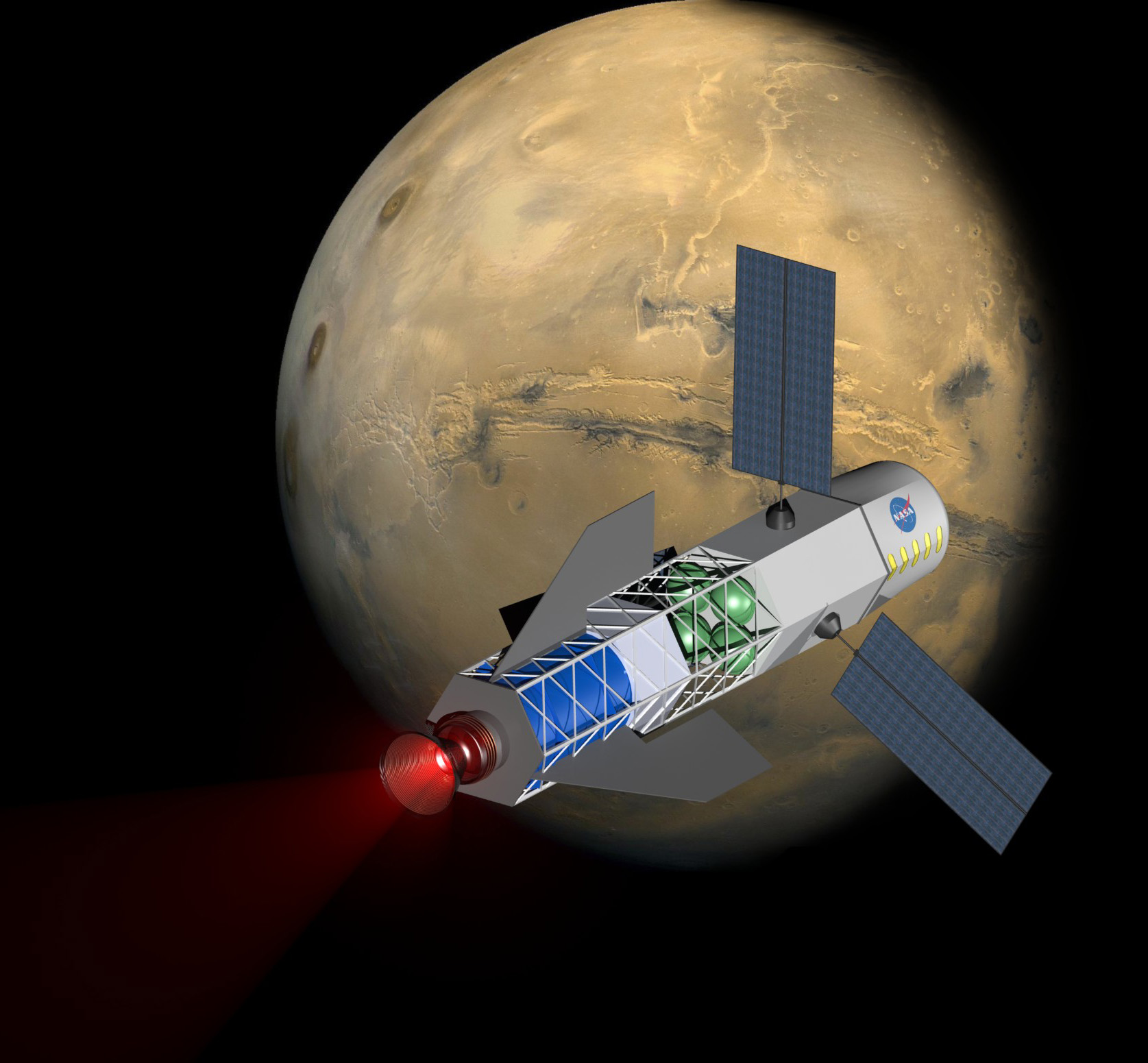
I had thought that the above rocket was still in development, but I am not sure it is. If it were to work, I would wonder why it could not be made into some sort of a ground based reactor on Mars. Of course you would need Lithium.
Anyway Fusion of any kind can wait to become practical. Fission might be just fine for some time. I wonder if Thorium from Earth could boot strap it into a startup until a local source could be developed?
Antius said:
Your lakes could serve multiple purposes: waste heat dumps, aquaculture ponds and centre of ecosystem.
So, sure polar ice cap lakes, nuclear energy as the key.
I tend to favor chemosynthesis for supporting aquaculture, but artificial lighting would be allowable as well.
If that structure were established, there is a next move I would want to consider, it is a variation on the "Dirt on the Ice Cap" idea.
Instead, I would like to manufacture tiny styrofoam beads with a blackened U.V. resistant coating.
My hope is that unlike dirt or carbon, they will tend to float on top of the ice as their specific gravity will be less. Of course if they get enveloped and a sufficient deposit of new ice goes on top of them, it will not work so well. However, I think that in most areas of the ice caps the CO2 ice evaporates off each summer, and there may not be that much of an additional water ice layer above these things in the spring/summer.
So to distribute these things, a gun of some kind would be wanted. Any ideas?
#8173 Re: Science, Technology, and Astronomy » What is the status today of O'Neill's vision today? » 2016-09-17 19:08:04
That is certainly a good dream, and so it would seem your heart has value.
Strange, you have New York +, and also wide spread farm fields as some of your re-occurring notions, your reference points.
My background has to do with figuring out how to run your life without extreme guidance from a hiearchy.
That in theory is how Americans are supposed to be. Some of our highest politicians seem to love to criticize people like me because we do not want to associate with predatory cultures such as the very old world. (Those cultures in my opinion only run on hierarchy). To me they are deadly poison. Like being forced to co-exist with rotting corpses of the living dead.
I suppose I had better get to a point.
In my mind there is no chance that the sort of people we are dealing with as enemies these days would leave such a machine unmolested. They are creatures that crave power and control. So, a wonderful dream, but only if somehow you can keep the demons out.
It is a wonderful aspiration however!
And that is why I prefer smaller work oriented machines, where a small community pulling together to accomplish a profitable living. Such communities are less likely to foster degenerates of the sort that crave control of large populations. Rather such an environment will favor people who manipulate physical objects for profit, not other people.
#8174 Re: Science, Technology, and Astronomy » What is the status today of O'Neill's vision today? » 2016-09-17 17:12:14
I guess that's why we communicate, because someone else may think of something more. Yes, ideas. But I will let you champion your own interests.
As for myself, I asked for the gravitation of Ceres, as an arbitrary selection originally. Might as well find out what is a tolerable or ideal gravitational environment for working, particularly with large objects. Yes indeed.
For my part now, however, I see that we have some options to support. Luna & Ceres, or Mars, or Venus.
One of these schemes is likely to be the winning ticket, if effort is applied to it.
For Mars, I have misgivings. I have long had a conspiracy suspicion that the reason that our space program was diverted from the Moon to Mars, was that the conspirators were worried that we were getting too close to success. With Mars, they have options to cut the process short, either by claiming the protection of life, or by cutting the budget, or arranging for a dead crew.
Of course that is the paranoid view. It would require a class of people who live by manipulating populations, and their objective in this case would be to capture the spinoffs of the process, but to cut short the process when it threatened to set their servant class free from their power.
And I am not totally paranoid, I just list it as a possible reality.
So, the cycling spaceship proposed with Ceres & Earth/Mars/Moon synthetic gravity, would be a purpose in itself, but could also be assistive in settling Mars itself, if that is allowed, or if Mars is said to have life, it could allow human access to the moons of Mars to study that life on Mars.
But it would also study how to use Luna & Ceres, if Mars is ruled off limits for humans.
Ceres itself appears to not be as I thought it would be.
Instead it is not completely differentiated, so the crust it seems may be 60% soil/rock & 40% ice.
And its materials include Nitrogen.
So, Ceres has a very large palate of the materials one would want in space.
Therefore, in considering O'neill machines, perhaps one should consider all possible understood future options, or as much as possible.
If you could do the Ceres & Earth/Mars/Moon gravity synthesis on such a cycling spaceship then you could also do it on Ceres, but you would not need synthetic gravity for Ceres itself, since it supplies that. You would instead want a network of double torus devices with Earth/Mars/Luna synthetic gravity, and greenhouses under Ceres ambient natural gravity.
It should not be forgotten how relatively easy it would be to export materials from Ceres, once humans were established there.
For instance Ice. I have no references, but I believe that you can crash a block of ice onto the Moon on the dark side at very high speed, and probably 60% of it will remain long enough to be collected.
Therefore if we are blocked from using Mars, Luna & Ceres would be quite a good objective. And cycling spaceships? Why not?
#8175 Terraformation » Terraform Mars with a minimal snow and lake method as a starter. » 2016-09-17 11:53:07
- Void
- Replies: 6
http://www.space.com/34095-mars-lakes-s … ought.html
Quote:
Huge Mars Lakes Formed Much More Recently Than Thought
Some Red Planet streams and lakes — including one bigger than several of North America's Great Lakes — formed just 2 billion to 3 billion years ago, a new study suggests. That's a surprise, because researchers think that, by that epoch, Mars had already lost most of its atmosphere, and therefore had likely become too cold to host liquid water on its surface.
http://www.dailymail.co.uk/sciencetech/ … l?ITO=1490
So, it appears that snow melt was able to fill these lakes even when the climate was unfavorable to liquid water.
It is unlikely that Mars will repeat this action now, but I wonder if by studying it, a short cut method could be produced to partially terraform Mars to that equivalent of habitability.
So two processes would be needed:
1) Create Snow.
2) Melt Snow.
And to get a useful result at a reasonable price of effort.
The methods to surface evaporate ice on the polar caps are of course:
1) Greenhouse Gasses.
2) Pigmentation. (Dirt)
3) Orbital Mirrors.
The three together might produce early usable results I would think.
For Deep Melting:
1) Microwaves.
2) Lasers.
With the above two, you might melt part of the South polar ice cap and might be able to induce and maintain an ice covered river, which might evaporate to produce snow elsewhere. (Just being through)
If Snow was produced at a suitable latitude, then to melt it I am thinking microwaves from orbit.
This might melt it from the bottom up, which is preferable because it is desired to produce running liquid water, and not to evaporate the snow back to the atmosphere.
https://www.bing.com/videos/search?q=me … &FORM=VIRE
http://www.space.com/24052-incredible-t … water.html
Anyway, this plan requires activity on the surface to produce greenhouse gasses, and activity in orbit as well, for dirt to the poles, mirrors, microwaves ect.
It is a more active plan than just using greenhouse gasses and waiting around for centuries for Mars to thaw out and become useful.
This more active plan might produce greater volumes of water for use earlier.
Anyway I am working on the Mars problem this time that should make some people happy.
Done.