You are not logged in.
- Topics: Active | Unanswered
Announcement
#8101 Re: Terraformation » Titan Terraformation - Is it possible? » 2016-10-20 21:46:26
And a tiny little voice asked "What ever could we do with brown dwarf's and their cold planets?".
What about fusion reactors in such floating robots?????????
#8102 Re: Terraformation » Titan Terraformation - Is it possible? » 2016-10-20 21:05:06
Tom, I feel the need for proficiency, efficiency, and harmony.
Harmony is a process that supposedly the Chinese are specially adapt to.
Western not so much.
Sometimes one is good sometimes another.
I see what your desires are, and do not criticize your desires, but note that continuation of pattern is all. If you only believe that pattern is of the flesh, baryonic matter traveling through time, or if you believe that a "Spiritual" aspect of pattern exists, or some other aspect of pattern, still pattern is all we are or will ever be. The memory of what we are, flowing through time and warping into variations of pattern.
Efficiency matters. Waste, is sometimes a shameful thing. Gluttony is related to waste.
Lets not demand too much from the universe, without seeking proficiency, and efficiency.
Still, you are needed, to try to expand the bubble of what we might hope to intend to do. You have stimulated very interesting conversations.
Karov provided: (In post #16 of this thread)
https://en.wikipedia.org/wiki/Cloud_Nin … ty_sphere)
Alright, I will suggest such activity on Titan, and in the atmosphere of Saturn itself.
I know that you are a fan of robots Tom, so how about floating robots in the atmosphere of Saturn, which harvest energy, from wind, and also the thermal differences in altitude in the atmosphere of Saturn. Robots, which then beam energy to Titan either Laser or Microwave.
In the case of Microwave energy in a case like this, tidal locked moons are quite good, as you can have your receivers on the Saturn facing side, and your habitats on the other side. This would yield safety and energy.
I am not saying that no humans could exist on or in these Saturn atmosphere robots, but that the preferred environment for humans would be orbital, and that Titan might be especially preferred because of it's atmosphere dominated by Nitrogen.
The primary anxiety I have about this plan, is the presumed loss of metals, and silicates over time. Could they be obtained from the atmospheric environment of Saturn somehow? Plastics of course would reduce the need for metals and silicates, but still it would be a concern. Mining Saturn to supply these robots with those substances would certainly be a desire, but I am not sure how to do it. Is the atmosphere of such gas giants / ice giants ever populated by dust?
And about Titan itself, I guess if you do this, eventually the Moon will heat up, with questionable results. Could you use Karovs weather machine to promote a precipitation cycle to help it cool itself?
What would be the precipitation? Methane? Or would the Moon be come so warm that it melts, puffing up the atmosphere massively.
If so, would humans capture that atmosphere for good use, before it is lost to space?
Doing all of that would you be dealing with an open water ocean moon, and water liquid as your precipitation?
Then cities floating in the sky of Titan, and world wide ocean below?
Then could you do this scheme for all the moons of Saturn, Jupiter, Uranus, Neptune?
Of course no atmospheres for those other moons, but ice covered oceans? Per recent works revolving around Antius?
Some worlds might get energy this way, if they orbit a gas giant or ice giant?
(Linked here):
http://newmars.com/forums/viewtopic.php?id=7508
And what about planet 9? If it is of a thick atmosphere of Hydrogen and Helium. It also?
A fair amount of fun with this I feel 
As for artificial suns, why not a directional panel of LED's? More efficient perhaps? Possibly providing a sufficient illusion of what you want, with much less waste heat.
#8103 Re: Terraformation » 2014-UZ224: New Dwarf planet » 2016-10-19 11:57:53
I'm not very worried about the fission thing.
It appears that the solar option will be sufficient for human reach for some time, and I anticipate that fusion will eventually become real, say within 100 years of time.
With mirrors, I see no reason why the moons of Jupiter, and the Trojans cannot be handled (Except for lethal radiations).
The realm of Jupiter is behind the "Snow Line", the asteroid belt further in, not in the snow belt anymore.
I am interested in a 2D chart, with the horizontal scale being the level of differentiation, and the vertical being the size of the objects.
I would exclude any object without sufficient ice/water for a water/ice column minimum of 1 bar. But I would make an exception for Earth and Mars polar areas, simply because I want to relate the mini worlds to terrestrials. In reality, I exclude Earth, because except on the very small scale to prove technologies, our polar ice caps should not be messed with as a rule. As I have already stated, I would include the polar areas of Mars, as part of the outer realm, as they more resemble the outer solar system than the inner. This is possible in part due to the meager atmosphere of Mars, and the coldness of the poles of Mars. I am not sure how much Ceres, and the asteroid comets, can be included, they used to be behind the snow line, but are not anymore. Therefore the technologies required to handle them are different than for the realm of Jupiter and outward.
Quadrant #1
So, on my chart, I would put the polar areas of Mars in a quadrant for differentiated objects that are large.
Quadrant #2
Enceladus being presumed to be a differentiated object of a smaller size.
Quadrant #3
Callisto being a more or less not differentiated object, at least in it's upper layers, and like Mars of a large size.
Quadrant #4:
The optimal non-differentiated small icy objects that you are most interested in.
There will be gradients of a continuum of these objects, and methods best suited, the preferred tools will be different.
I will speak of how I would handle Callisto, and Enceladus a bit, and see if you may be able to find applications for small undifferentiated worlds.
I previously spoke of canals (Covered of course) on Callisto, and that would be one way. However for a more dynamic method on Callisto, I would entertain, a honeycomb of cells of water with an ice topping, where each cell is a metallic canister. Parts of the moon's surface would have these, and in each cell would be an ice covered water cell, protected in part by a metal canister. Above the ice would be a minimal artificial atmosphere of a pressure required by the vaporization point of the ice. The vaporization point of the ice would be determined by the temperature of the ice, which could be rather cold. At the bottom of the cells habitats.
Other areas of Callisto would have ice covered lakes where sediments on the bottoms would be mined, and the metals recovered, and the tailings (Ice/rock) would be donated to "L" location construction sites, to create artificial world, where "Popcorn/Foam" cores would be manufactured, and ice/water would be made to surround them.
So, in this case for Callisto, a form of strip mining is employed, and from time to time the honeycombs (Cities/Habitats) will be recycled/moved, to allow strip mining to continue, until the entire moon is consumed? (Lots of habitats then).
Please note that I am staying outside of your range of worlds, and am dealing with world outside of your stated range. The purpose is to see if you can and will find anything of use for your range of worlds.
Enceladus:
https://en.wikipedia.org/wiki/Enceladus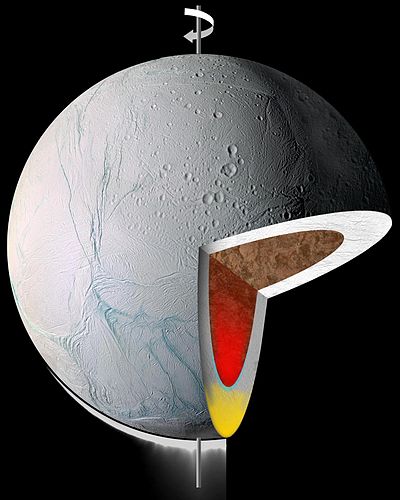

Well, here we have an example of what happens when heat is added to such worlds, in this case significantly larger than your optimum size, and the heat we think coming from part of the core.
According to some models, Enceladus has an ocean over part of it's core. This is probably an unusual situation I would think, for smaller outer solar system objects, but as a model, might help in your efforts.
The only other thing I can think of is if you have an "Oil" which has a similar specific gravity to that of melted water, then you could create a vertical tube, to pass through the ice down to the core to get core materials, early on. You would need a liner, the special oil, and robots that could survive and work in such an environment.
But of course you are looking at undifferentiated small worlds.
Done.
#8104 Re: Terraformation » 2014-UZ224: New Dwarf planet » 2016-10-18 21:09:03
I am very encouraged by your mention of the Trojan Asteroids, somewhat perplexed, that such a major body of objects, has been so little mentioned.
I decided to put these links, in not to detract, but to perhaps see where and what are the easy sized objects for adaptation to your suggested methods.
https://en.wikipedia.org/wiki/List_of_S … ts_by_size
From post #7 Antius said:
The concept could be taken all the way down to bodies perhaps 50km across. In that case a 1 bar pressure would be achieved at the sea bottom some 8km deep. The solid floor of the 'ocean' would have a 1 bar outside pressure but a gravity of only 1 thousandth of Earth's. Para terraforming would be relatively easy. With such low gravity, the membrane tension of water would prevent catastrophic floods for very small leaks and flowrate would be slow even for catastrophic leaks. At the ocean floor, habitats would need be little more than steel frames covered in a polyethylene liner. Due to buoyant forces, they would need to be tethered to the ocean floor, but at 10(-3) gees, buoyant forces would only be 1kg per cubic metre of water displaced.
So, then this:
https://en.wikipedia.org/wiki/List_of_S … _to_100_km
Of course only some will be icy as you want. I realize you didn't need this, but it has helped me get a better understanding.
I do have perhaps a few variations on your theme so far, one which is not too silly. The Antius Sub Dwarf Planet, with a popcorn core.
They are probably going to mine the core anyway, so why not utilize the "VOIDS", in the core as habitation? Curiously, in the center, will be a place of very close to microgravity. Some voids there would be useful for whatever you want. Spinning synthetic gravity machines. Strange large caves with some kind of plants connected to walls or trays.
Of course these spaces will be harder to cool, being more remote from the ocean.
Antius also said in post #1:
New dwarf planet discovered at the edge of the solar system. The new world is some 500km in diameter.
http://www.space.com/34358-new-dwarf-pl … uz224.html
This dwarf planet could be terraformed relatively easily by melting it using a nuclear heat source. The result would be a water ocean ~90km deep, overlying a silicate core. An icy shell would float on top of the ocean and would provide enough pressure at its base to prevent the water from boiling.
If the shell is 800m thick, pressure at the surface of the ocean would be 1 bar. About 300GW of heat would be required to keep the global ocean liquid, as heat flux through the shell would be about 0.5W/m2.
Pressure at the ocean bottom would be about 90bar. Mining of silicate materials would be carried out by dredging. An ocean ecosystem could be based upon algae and plankton in the global ocean. This would require some form of artificial lighting. Humans would live in floating habitats tethered beneath the ice shell. Maybe it would be possible to farm the ocean for a large proportion of food needs.
Such a terraformed world should be relatively easy to build, as aside from the provision of a nuclear heat source, no large-scale planetary engineering is required. Terraforming could presumably be carried out incrementally, with an initially small habitat and nuclear heat source, resulting in a localised ice covered sea. As colo isation proceeded the world would gradually transform into a global ocean. Ammonia dissolved within the water will provide fixed nitrogen needed to fertilise the ocean ecosystem.
Supposing you did establish your "Civilization" on this world, where the people lived under an ice shell 800 m thick, and that they could access the core as well, but would have to cope with an ocean pressure of 90 bar at the surface of the core.
What if the inhabitants later expanded their civilization by building "Popcorn/foam" core worlds with a water/ice ocean surround? Then they could eventually get the pressure at the bottom of their ocean down to 1 bar, and at that point they could tunnel their core, making it into a "Popcorn core".
The built worlds would start with a metal sphere, with compartments, many of the compartments would be filled with tailings, as you would want your artificial core to on average weigh a little more than water does, so that it would stay centered at the bottom of it's ocean.
They would then surround this "Foam" core with water and ice, to produce the ideal pressure at the bottom of it's ocean, on the surface of the core.
These built worlds would orbit the original parent, and since there would be many you could distribute your population to them and so keep the heat load down on the original parent.
I wonder, could the core be 50% voids?
Hope I haven't colored too far outside the lines.
#8105 Re: Water on Mars » hidden-glaciers-mars » 2016-10-17 11:58:55
That's also a good possibility, if the Hellas basin itself proves to be a good place to operate. 12.4 mb pressure in bottom.
http://m.esa.int/spaceinimages/Images/2 … in_context
https://www.google.com/mars/
Alright, I have no reason to conclude that Colles Nili is at a lower latitude than Hellas. I have been looking, but I have better things to do for now.
#8106 Water on Mars » hidden-glaciers-mars » 2016-10-16 23:04:54
- Void
- Replies: 29
Just trying to do something informational, will not speculate if I can possibly avoid it.
http://www.universetoday.com/131423/hid … ers-mars/#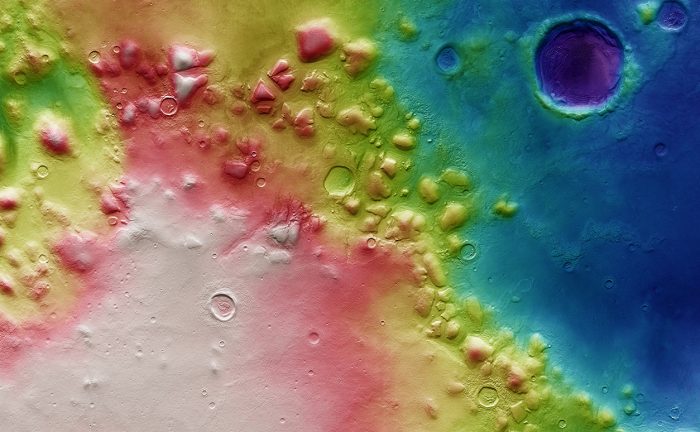
quote:
In the northern hemisphere of Mars, between the planet’s southern highlands and the northern lowlands, is a hilly region known as Colles Nilli. This boundary-marker is a very prominent feature on Mars, as it is several kilometers in height and surrounded by the remains of ancient glaciers.
I would have liked a global map also which pointed out it's location. Is it near the equator?
Another quote from the article:
Combined with this latest info taken from the northern hemisphere, it would appear that there is plenty of ice deposits all across the surface of Mars. The presence (and prevalence) of these icy remnants offer insight into Mars’ geological past, which – like Earth – involved some “ice ages”.
I don't care to speculate on what they intend when they say "plenty of ice deposits all across the surface of Mars".
Maybe someone else has greater information.
#8107 Re: Terraformation » 2014-UZ224: New Dwarf planet » 2016-10-16 22:47:05
I enjoy your work.
#8108 Re: Life support systems » Power Distribution by pipelines on Mars. » 2016-10-16 22:46:04
With respect:
One thing I forgot to mention about a pipeline, is that in a time of stress, it is possible it would serve as a reservoir of Hydrogen, which could be drawn down, even if the source temporarily shut down.
#8109 Re: Life support systems » Power Distribution by pipelines on Mars. » 2016-10-16 16:18:57
Spacenut said:
Oxygen and Hydrogen would then need to be transported in seperate tubes which just doubled the energy needed to make, the water to which they would come from would need more energy to electrolsis into there components to make use of this system and even more energy is need to gather it from the regolith surface just to get the water.....less energy required just to send the water from site to site for use in a single tube.
I am sorry, but it is apparent you missed the biggest points I made.
I am also afraid I must complain that this is yet another case of only this or only that. My proposal if you look at it did not preclude the use of conductive power transmission. It only made the case for an also method using pipelines.
This is something very bad that happens on this site, the attempts at summary dismissal without a reasonable discussion.
First of all I most championed a one pipe system where Hydrogen would be piped to a location, and local CO2 would be used to generate electricity, and provide water, and perhaps even biological activity. And please note that power lines require 2 lines for a circuit, this requires one pipe.
I did suggest as well Methane and Oxygen being piped, but those would perhaps be done only in the "Markets" where that made economic sense. I may return to that later, but for now, the single pipe model, vs electric power lines and water pipes.
OK, about materials:
For power lines; Copper, Aluminum, Insulators? (The Martian atmosphere is more conductive than the Earths, can't say for sure when that would be a problem).
-Can you mine copper and/or aluminum at a reasonable price? Unknown.
-Electrical circuits require a circuit loop, therefore this brings the question the criticism where two pipes are needed. Two conductors are needed.
Water pipes: Steel? Plastic? Other?
-I have suggested canals much later on, for really big flows of water, but here we are perhaps talking about providing a trickle to an outpost.
-Frozen pipes? Mars is not that great a place to be running water pipes, very cold most places, most times.
Alright, pipes to convey Hydrogen, and possibly Methane or Oxygen.
I mentioned basalt, steel, and plastic.
Of these I favor plastic. That is a pretty broad term. Many plastics do not hold up very well under the Mars surface environment, so I am going to stipulate that such pipes would be buried for the most part, probably not by digging a trench but by scraping a berm over them.
Where you have to mine copper and aluminum, the bulk of materials for plastics can come from atmosphere, and water ice deposits. Yes you may need Chlorine or Fluorine from salts, but salts are widely available.
And the manufacturing site therefore would most likely be facilitated by the source materials in bulk being available locally.
So, my sum point so far is it really is unfair to claim that we know what is the most economical, doable, and useful method at this point.
We won't fully know such answers until we try. In the mean time, it is perfectly reasonable to speculate on both methods, and hybrids of those methods. It is better that we don't just stick to things to invent that have already been invented. If it hasn't been invented, then you must surely take greater risks to hope to invent it.
Although I am in favor as well of using power lines when it is useful and possible to do so, I will mention a few problems I think may be experienced.
-Obviously obtaining and creating the parts for power lines will be a problem, but of course humans should do all that they can to do it.
-Day night temperature swings. A much harsher situation than Earth I would speculate. But to be fair, perhaps the lines could be buried under a berm, and that would help to buffer it.
-But then your lines would be laying on the ground. How high can you put the voltage, before arc over? Are you going to need insulation?
-The Martian atmosphere is 100 times more conducive than Earths, so that is another problem. Arc overs, line losses?
-What about global dust storms, if your lines are not buried.
-What about Dust Devils? The do have electrical characteristics. Maybe it can be engineered around.
-What about solar storms?
http://www.ineffableisland.com/2016/10/ … begin.html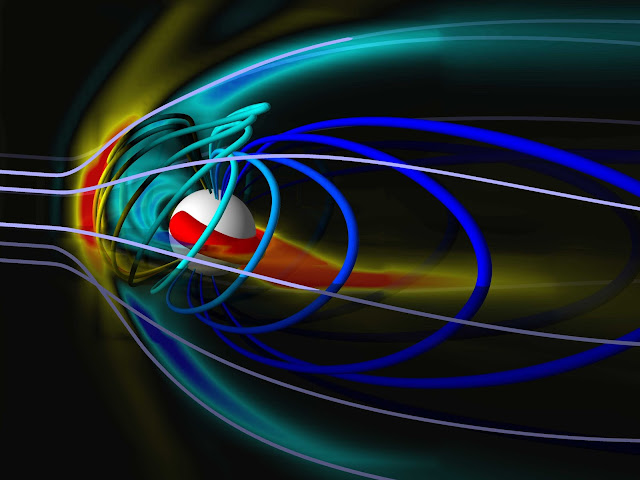
Not much magnetic protection on Mars, what if your grid goes down, your transformers burn up? With gas piping, you would still have electronics and electrical gear that would be affected however, so it's still a problem even with that.
And I also have a "Giant" project which is to melt the polar ice caps from below, and to make the resulting bodies of water have life in them. It a bit of a pipe dream isn't it?
If power lines alone were used, then you still would not have any chemical energy for the seas, and I might note also that if you had elevated power lines of course you are going to have ice problems at high latitudes in the winters.
Now on to Methane and Oxygen.
It could be that you would have a power facility solar or nuclear, which is centralized, an large, and you make your chemicals there with that power, because the ice deposits are there. Pipes make to make deliveries to consumers should make some sense in those cases. Oxygen is going to be a problem because of the potential for combustion. I can propose some potential solutions, but lets not go there.
Now you assumed electrolysis as the source of the chemicals from water ice and atmosphere, but photolysis is being researched here on Earth, and should those methods become practical, then you would not have an electrical process directly involved, it would be sunlight, water, atmosphere, and machinery.
So, no hard feelings at all Spacenut, I know your time budget is limited, and you have to just skim these materials, and you must sometimes get tired of it, but the above is my rebuttal.
#8110 Re: Life support systems » Power Distribution by pipelines on Mars. » 2016-10-15 20:53:16
https://www.sciencedaily.com/releases/2 … 191102.htm
Summary:
Researchers have engineered a strain of electricity-producing bacteria that can grow using hydrogen gas as its sole electron donor and carbon dioxide as its sole source of carbon.
Well, I have stepped into it now. Some big crickets! They tend to be cannibals, oops!
So, I apparently need giant cricket insurance. And I will have to be slippery and weaselly. You have me off balance, but I am going to push the issue anyway.
From my first post I said this:
It does then perhaps conserve conductive materials such as copper and aluminum, which may be rather important.
So, sir's there are quite a lot of variables, which could swing which way to do things.
I said this as well:
I think that the distribution of power, and water can be accomplished best by pipelines carrying vaporized materials, likely H2 and O2, possibly Methane.
So, dropping the O2 and Methane for now, and just proposing to transport H2, and H20, a method of life support involved is worth considering.
If you for instance can pipe H2 to a remote location, such as a copper mine
You can get electricity, water, and organic matter out of that process, if you react H2 with CO2. (Apparently).
Conversations with kbd512 have encouraged me to believe that even the dry soils of Mars contain redeemable amounts of water. However, some are better than others. Lets say a good water content is the contributor of Hydrogen to the pipes, and the pipes bring Hydrogen to a dry location which happens to have an item of economic interest you want to exploit (Oh, I am sorry for exploiting copper).
Expanding that, I consider the polar reservoirs of ice to be very valuable, and all that is likely to be needed to get value out of them is a stream of H2 to the poles, in pipelines. Food, melt, electricity.
And from the melt, rivers/canals to bring water towards the equator. That water to be split, the Oxygen generated used for breathing, or dumped to atmosphere, the Hydrogen piped to the polar caps.
What do you get? Biospheres, similar to the deep parts of our oceans in the poles, long before any other part of the planet supports a biosphere. It sounds like it would be a meager biosphere, but actually, that would depend on the amount of chemicals you dumped into the ice covered water.
That's the concept, I don't have an anti-copper/powerline fetish, I just like to explore the chemical alternatives. A network of every option is not out of the question at this point.
Your turn.
#8111 Re: Terraformation » 2014-UZ224: New Dwarf planet » 2016-10-15 18:03:03
Yes it is a bit off topic, but perhaps it points to how dwarf planets may be easier to inhabit with benefits, than worlds which resemble Earth to a degree, but missed the boat.
Where I have the misgivings Tom, is that one of the solutions for getting rid of the Venus atmosphere to hit it with a big impactor, so that the atmosphere swells very big, and is blown away.
But if you hit it with a seriously water bearing object, the atmosphere will also likely heat up to thousands of degrees due to the increased greenhouse effect, and it will take thousands of years to cool down. And by then it will likely have shed the extra water to the solar wind. Further the process will provide an upset that makes the climate of Venus unstable, and it will have to seek some new stability.
I just don't see who gets a payday out of this. Lots of materials shed to the solar wind.
I'm not saying no, maybe you want to swell up the atmosphere of Venus, and have floating cities that much higher in the sky. Maybe then you can harvest the atmosphere for some purpose. But if you are hoping to turn Venus into an Earthly Eden, I think you are barking up the wrong tree.
Where as, sub-dwarf-planets with oceans may provide a very secure and wealthy home for humans, and perhaps much sooner, per the ideas of Antius.
And the total volume of such worlds is enormous even without creating artificial sub-dwarf-ocean-worlds.
To me it is a very attractive idea.
#8112 Re: Terraformation » 2014-UZ224: New Dwarf planet » 2016-10-15 10:57:16
Tom,
First of all I want to nod to Antius, who said:
I would suggest that Jupiter's moon Pasiphae might be a good early candidate for ocean floor terraforming. It is close enough that it might be reached using the ITS architecture that Musk is working on. At 58km across, a 5GW heat source would be needed to keep the subsurface ocean liquid, with a 0.8km thick crust providing about 1KPa base pressure, which is enough to prevent the ocean from boiling. At 23million km average distance from Jupiter, tidal forces on the ice shell should be minimal.
If the entire sea floor were Para-terraformed there would likely be too much heat to allow the ice shell to be stable. Assuming the satellite is a 50/50 mix of ice and rock, the surface area of the silicate core would be 4700km2 and lighting it to Earth standard light levels would require about 500GW of electric power. This would melt the ice shell. To prevent the ocean from boiling into space a tensile shell would need to be built over the ocean to maintain a 1KPa pressure.
So that is one option which Antius has included as well as 2014-UZ224.
I suggested developing the technology on Mars, and I mentioned Calisto.
I do like pretty much what Antius has offered, but I see no reason to not apply it to Mars. Since we hope to establish humans there, I see no reason not to seek to master the entire water cycle of that planet to human advantage, and this could include very large bodies of water with an ice layer over them like Europa.
In fact if there were geological energy sources under the Martian polar ice caps, you would be looking at a Europa like Mars, only it's rocky surface would be only partially covered with ice covered water.
From there, if you wanted to access the Jupiter system, a first step could be exactly what Antius suggested for Jupiter's moon Pasiphae. And the nice thing about that is in the vicinity of Jupiter, you do not have to rely on nuclear heat (But you would use it if you could). Solar heat would still be effective in the vicinity of Jupiter with concentrating mirrors that are not ridiculously large.
So, then this would be a progression from solar to nuclear energy, as humans drifted further and further out in the solar system. Adapting/making these little ocean worlds.
Once Antius had done what he intended to with tiny moons around Jupiter, some effort could move on to Saturn and so on. But still around Jupiter are four very large chunks of matter. Io, Europa, Ganymede, Callisto.
You mentioned Europa.
I would choose Callisto instead, because:
-It appears to have a mixture of materials on it's surface, is perhaps not totally differentiated.
-It suffers much less from radiation from Jupiter's magnetic field.
-It is the least deep in the Jupiter gravity well. So, it is the most accessible, per space transport methods.
In addition, we do not want to damage any potential life which could exist in the oceans of Ganymede, or Europa. Io, is the absolute worst case for exploitation, but maybe someday.
So, I will explain my intentions for Callisto more.
First of all, I do believe that that moon does not have much of a polar axis tilt.
https://en.wikipedia.org/wiki/Callisto_(moon)
Callisto is composed of approximately equal amounts of rock and ices, with a density of about 1.83 g/cm3, the lowest density and surface gravity of Jupiter's major moons. Compounds detected spectroscopically on the surface include water ice,[13] carbon dioxide, silicates, and organic compounds. Investigation by the Galileo spacecraft revealed that Callisto may have a small silicate core and possibly a subsurface ocean of liquid water[13] at depths greater than 100 km.[14][4]

So, it looks likely good for chemistry, as it does mention organic compounds, which I may hope will include some Nitrogen.
Quote:
Like most other regular planetary moons, Callisto's rotation is locked to be synchronous with its orbit.[3] The length of Callisto's day, simultaneously its orbital period, is about 16.7 Earth days. Its orbit is very slightly eccentric and inclined to the Jovian equator, with the eccentricity and inclination changing quasi-periodically due to solar and planetary gravitational perturbations on a timescale of centuries. The ranges of change are 0.0072–0.0076 and 0.20–0.60°, respectively.[10] These orbital variations cause the axial tilt (the angle between rotational and orbital axes) to vary between 0.4 and 1.6°.[27]
As far as energy, we have already established that it get's enough solar energy, to use reasonably sized concentrating mirrors. The tilt of the sun in the sky will be much simpler than that of the Earth and Mars, and no wind loads, and most likely not much of a cleaning burden per dust.
You could concentrate sunlight onto photovoltaic cells, or use power towers, or a hybrid.
Fission power? Maybe if the ores are found.
Fusion power? Sure, if it is ever achieved (Which I expect it will be eventually).
So, Antius has built a little ocean city on Pasiphae, and I want to establish a mining process on Callisto.
On Callisto, we have a palate of materials and energy sources to work from. We can build canals, seas, and oceans on Callisto, with similar characteristics suggested for the Antius worlds.
An extra complication in this case, is your bodies of water could melt down bottomlessly, unless you purposely limited the deepness, with some insulator, lets say a thick layer of mining tailings. Probably canals are the best, so that the cold of space can seep down and under these bodies of water, and so, actually you can transport heavy things about in these canals (Covered canals).
So, if the people of Callisto exported mined materials, they would also have lots of tailings, which would include excess ice, and rock. It would get into the way, so why not shoot it to an "L" location and construct a world. An Antius ocean city world.
I don't think Venus has so much to offer. And I cant imagine the effort that would be required to crash an outer solar system object into it. Also the results would most likely unsatisfactory.
So, then if we presume automation/robots, "How many little ocean worlds could you make out of Callisto?". I am thinking it is a vast amount of living space.
#8113 Life support systems » Power Distribution by pipelines on Mars. » 2016-10-15 07:58:44
- Void
- Replies: 145
Plot0012 Insitu pipeline manufacturing and connectivity of plots
I think that the distribution of power, and water can be accomplished best by pipelines carrying vaporized materials, likely H2 and O2, possibly Methane.
Obtaining and building electric grids on Mars, would be much harder in my opinion than using pipes and fuel cells.
The potential piping could be made of Basalt, Plastic, and Steel for a starting proposal.
Here is a Home Fuel Cell method that helps to show the idea:
https://en.wikipedia.org/wiki/Home_fuel_cell
It is possible that piping the Oxygen will be a problem. Perhaps basalt pipes for that, perhaps local production from CO2, using solar power. That is an alternative to consider.
However, if you piped hydrogen from a major water source, you could have power from fuel cells, water at that location from the fuel cells, and you could also grow food with chemosynthesis.
It does then perhaps conserve conductive materials such as copper and aluminum, which may be rather important.
Going to the extreme with the notion, you could pipe Hydrogen to the Southern Ice cap, and inject it to promote a chemosynthetic biology in a small body of water. That should then heat the body of water and allow it to expand. Liquid water could be conveyed by special canals by gravity feed to lower latitudes, to provide feedstock for the process, to send Hydrogen from the water to the south polar ice cap. Of course water split at the low latitudes would provide Oxygen for consumption there.
Anyway the South polar ice cap is said to be partially dry ice, and I think this would be a great way to force that CO2 out.
I do believe that also, the output of the chemosynthetic biosystem under the ice would include Methane, a greenhouse gas.
Anyway have mentioned these things before, and as always, I expect to hear crickets about this. It seems to be taboo to talk about it for some reason here. Perhaps it is considered to be Heresy. Ha Ha!
What a strange place. A place of science which behaves like a religion. But it is an interesting experience.
#8114 Re: Terraformation » 2014-UZ224: New Dwarf planet » 2016-10-15 07:38:00
Tom, I don't think they are strongly entertaining a standard atmosphere held by gravity. But I can be corrected on that.
I think primarily they are moving in this direction.
Cold ice layer (Significantly thick)
Under that and above the water, an insulating manufactured layer. Something like Styrofoam.
I have also looked into such before. Let's say you have a liquid body of water covered with ice.
You could take a "Tile" of Styrofoam, and press it to the bottom of the ice surface. It should then freeze to the ice surface and could provide insulation. If you "Tiled" the entire interface between ice and water, then you could have water at comfortable temperatures, and Ice that is cold.
Should the ice then crack, then water at say 20 degC would likely squirt into the crack, but should be expected to freeze the crack shut, provided that indeed the ice was sufficiently cold. So if the thermal conditions were good, you would have a well protected warm ocean from top to bottom.
Now if you dimple the interface between ice and water, making a repetition of diving bell shapes, the ice/Styrofoam can still float on the water in say ~50% of the places, but could rise above the water in ~50% of the places, if the dimples/diving bells were filled with air.
In the case of a rupture/crack in the ice above a dimple, the air within would squirt out to vacuum, unless it contained enough moisture to seal the crack. As the air rushed out of the dimple, it would be displaced by liquid water which would then seal the crack once it was sucked into the crack.
In such a situation, I think that the survival potential for humans living in the dimple would be high, if they had good training and if another dimple they could go to was near.
Now as for walking from one dimple to another without compromising the safety of other dimples, think if your sink trap.
You could have an air filled tube that was in the shape of a "V" with a staircase going up and down the "V".
Should one dimple leak air, yes some would be pulled out of the other dimple connected by the "V" staircase, but the "V" staircase would rapidly be filled with water, and would seal the connection, stopping the leakage.
Obviously if you wanted to, you could have a road network under the water, connecting various dimples, where the final connection to a dimple involved a water trap to protect the whole system from depressurizing. In that case, the trap connecting the dimple to the underwater tube highway, would require some work to make sure that it can protect the highway from being totally filled with water, and the highways air from totally leaking out. But I think that would be do-able. Just would require some engineering.
Note: This could be pioneered on Mars as a method for habitat of great size, with significant safety and utility.
#8115 Re: Terraformation » 2014-UZ224: New Dwarf planet » 2016-10-14 18:10:57
Antius,
I like your minimum world, where 1 bar exists on top of core covered by an ocean of water covered by ice.
Of course for your first cases you would want to modify a small mass approximately off sizes you have previously mentioned. But after that since many solar system objects do not have atmospheres, and most likely outside of Pluto, few or no other Dwarf Planets will have natural atmospheres, then projection of mass to an appointed new location in space is a reasonable option presuming strong nuclear power and automation/robots.
What is most curious to me, is how many ideal sized could be created. Granted you have to start with Pluto as it is, but further out, even Nitrogen does not inflate to an atmosphere. On those worlds, how many ideal worlds where the bottom of the ocean/sea is 1 bar, can you make?
I am not very trusting of things like domes. rotating habitats, shell worlds(Per the specific definition), but I could trust the world you describe. I could imagine that the total number of them that could be constructed is just mind boggling.
I see them as eventually being powered by fusion, but not necessarily in the beginning. How many of them could be constructed from Calisto for instance? That's an interesting start.
#8116 Re: Terraformation » 2014-UZ224: New Dwarf planet » 2016-10-14 18:07:32
Robert, Isn't it curious the patterns. My best estimate is that we are not to be given too easy a path, or too hard a path. Many in this place cannot tolerate the thought. Do what you think best, but remember we are only and not more than human. Don't break yourself on a challenge which is too much for our kind. We already have too many broken people, we don't need any more.
#8117 Re: Terraformation » 2014-UZ224: New Dwarf planet » 2016-10-14 08:33:01
Antius:
http://www.universetoday.com/23932/lots … orth-pole/
Planum Boreum, Mar’s north polar cap contains water ice “of a very high degree of purity,” according to an international study. Using radar data from the SHARAD (SHAllow RADar) instrument on board the Mars Reconnaissance Orbiter (MRO), French researchers say the data point to 95 percent purity in the polar ice cap. The north polar cap is a dome of layered, icy materials, similar to the large ice caps in Greenland and Antarctica, consisting of layered deposits, with mostly ice and a small amount of dust. Combined, the north and south polar ice caps are believed to hold the equivalent of two to three million cubic kilometers (0.47-0.72 million cu. miles) of ice, making it roughly 100 times more than the total volume of North America’s Great Lakes, which is 22,684 cu. kms (5,439 miles).
So, the mother load of clean water on Mars. Should you melt these, winds could bring in salts. For the south cap, the solution is to let some water flow to lower latitudes, and bring excess salts out of the polar water system. Evaporation into a salt pan, the cycle then established, eventually winds bring salt back. For the North, that basin being very flat in general, a Diked polder would be a sufficient repository of excess salts.
And let us not forget that vacuum gives us excellent insulation opportunities, and that overall the solar energy received at the polar caps is similar to that received at the equator. (Not too different, that is). Collect it and inject it under an insulation of ice and artificial snow, or other insulators manufactured, over time liquid oceans should be a possibility. And that is if you only deal with the solar energy at the polar ice cap.
What if in addition you "Canal/Pipe" H20 to lower latitudes, and then use solar energy to split it to H2 and O2?
Pipe the H2 back to the polar ice cap / Oceans, and let biological organisms interact with the chemistry of CO2/CO and H2 injected into the waters. I think that like a moist hay stack, biological processes will generate heat. And of course Methane to be released to the atmosphere.
You see where I am going. Mars, can be done solar, but of course, Nuclear of both types also desired. It is quite a nursery for weaning the human race from solar energy, while still wet nursing them with solar energy. In time the proper tool box for the outer solar system would be put together.
It is a very good process, I think.
#8118 Re: Terraformation » 2014-UZ224: New Dwarf planet » 2016-10-13 21:19:29
Nice stuff Antius.
It seems to me that we could start with Greenland, then Antarctica, as the innermost examples, of places which could be terraformed by methods similar to what you mention. I think that it is reasonable not to do experiments of that kind on Earth, since it is where all of us live (As far as I know).
Going outward from the sun, we have two polar ice caps on Mars.
Ceres
Moons of outer planets
Minor planets.
To cut it short, the place where you should want to develop the necessary basket of skills is the polar ice caps of Mars. Two Oceans waiting. In reality of course the North and the South different. The North being low in a basin, would pancake out to cover much more area if melted. The South being high, would be made into a patchwork of basins if melted.
My point being that Mars provides the testing place for such methods, and includes solar, fission, and Fusion options (Should fusion becomes a reality).
It is the right place to start in my opinion. And upon starting, such methods could progress to the farthest parts of the galaxy, should the human race / (What follows) choose this pathway instead of extinction. Of course ages of time, required for a galactic presence, but that's not my problem.
I actually don't know why humans would be benefited by such a huge expansion. The polyneasian could be sufficient by some accounts. That is create enough worlds, so that when one dies, another is born.
Secretly I will tell you I am not that sure that I want even another world with humans on it. But what the heck, if we get the chance lets roll the dice and humans will see what they get. There is a chance of improvement.
From Mars to the stars perhaps.
Curious therefore, how would you turn Martian icecaps into ice covered oceans/seas? Seeing it will be the nursery for methods for the deeps of space.
#8119 Re: Human missions » NASA to go to Mars with private help » 2016-10-11 17:27:34
Manipulating people, and manipulating objects.
Nasa manipulates objects on a small scale to gather information which will go into "Books" (Records). Science is very good about getting general information and compiling it into records.
So the records can manipulate people. Thankfully, in our cultures, peoples heads are not cut off for having a divergent view of what records say. Not yet anyway, not very often.
Now some people examining the records, will try to go out and manipulate objects, because they think they have a good understanding of reality. This also will be a sorting process, and will likely force revisions of what the official records of postulation of the nature of reality. Hopefully no heads cut off in a literal sense.
Good deal, Nasa, and industry, it seems, but lets, keep the flexibility to update our understanding of reality, and also to accept new methods of technology, for manipulation of objects.
And watch out for bad vampires, who which to manipulate humans to loot treasure.
From the linked article:
Reaction to this plan was mixed: some space experts criticised the plan as unrealistic, while others praised Mr Musk for outlining a detailed - and audacious - architecture for getting to Mars.
#8120 Re: Science, Technology, and Astronomy » Blue Energy. » 2016-10-11 16:35:54
Louis,
Thanks for the reply.
It is possible that the expense will go down with further research & development, for Earth. Also, it is possible that Peter Zeihan will be correct that in time the North American market will maintain low hydrocarbon prices, while the rest of the world suffers from more market than supply. Time will tell.
In such a case as that I can see that Europe and it adjacent neighbors are very well poised for salt based flow battery energy. Perhaps the best occurring arrangement for it in the world. An arid and semi-arid south, and in north-west Europe a great abundance of fresh water. And unlike other alternative energy, salt flow battery power would be much more responsive to demand, and not as locked into sunshine and wind intermittency.
As for Mars, storing electricity in batteries, or as hydrocarbon and Oxygen, would be much harder I think than just storing tanks of brines, or (Ice covered pools of brines).
As for CO2, at one time I wanted to explore a turbine based on boiling CO2 out of a solution of water(Briny or fresh) and CO2. It seems the turbine is not required, just a flow battery or that capacitor method.
But yes, it is all generalized, and not mature yet.
As for solar power, I am in favor of having at least some part of it supplied by solar cells, but I am really tempted to find out what kinds of more simple technology could be implemented by for instance trying to make machine parts out of basalt.
And I know you have some type of interest in basalt, actually I think prior to my own. The moon I am howling at in this case, is I am hoping that the art of it will eventually become so good, that mirrors of basalt can be made. Probably with metalized surfaces. Still working on it. Machine parts from basalt. A ceramic type materials, currently not as strong as glass, but we shall seen in the future. NASA is working on 3D printing basalt, and I am speculating that eventually adding layers/fibers of other materials may increase it's strength.
Not there yet, but speculating on a machine where the Mirror is balanced on a semi-hemispheric "Foot". Maybe a bit like a rocking horse, but with the ability to pivot. An alternative would be such a ball foot on the mirror part, and a pedestal with a bowl that it sits in. A lubricant would likely be required in that case. It is all highly speculative.
And I am thinking that instead of each heliostat having a motor and pointing device, a robot would travel about rapidly on the ground, and repoint a multitude of these things.
If not, then a regular power tower with metal highly sophisticated heliostats, or also it is possible to do the freeze thaw thing per elderflower, and distilling water.
This is pretty much goof off and speculation, but you have to start with the coarse adjustments in the beginning, and the fine tuning later. Some have trouble with that.
Interesting. Even though these are expensive technologies, that is pretty irrelevant when it comes to a multi-billion dollar colonisation project - they won't be competing with pre-existing fossil fuels (at least, that seems unlikely). They may well have a role to play in the early colony.
#8121 Science, Technology, and Astronomy » Blue Energy. » 2016-10-11 12:30:54
- Void
- Replies: 2
This section states that it does not have to be about Mars. It is however, but is also is about Earth, so, fine.
This is a generalize post, about how to use several methods to use salt content variations in more than one water based brine, to store/extract energy. It also touches on CO2/H20 solutions for similar actions. I like it.
http://www.bbc.com/future/story/2015061 … lectricity
And here is a car that is said to run off of two different types of salt solution.
http://www.dailymail.co.uk/sciencetech/ … roads.html
I think it should be interesting information for two planets, Earth and Mars.
As for the Earth, it appears that while my continent will be hydrocarbon oriented for some time more, the Europeans, may have hit a big win for themselves. Necessity is the mother of invention.
As for Mars, I would think that dealing with brines and CO2/H20 solutions where you may store power and then extract it on time of desire would have to be attractive.
Enough, Done.
#8122 Re: Human missions » Elon Musk wants to populate Mars with 1 million people to save humanit » 2016-10-09 22:47:23
Thank you very much kbd512. For a long time I have been trying to understand how much energy was required. If I understand correctly, 60 degC might get quite a bit of moisture out of most regolith?
This is one of my favorite kinds of Regolith:
http://www.nasa.gov/feature/jpl/nasa-ma … and-dunes/
https://en.wikipedia.org/wiki/Ore_resources_on_Mars
Dark sand dunes are common on the surface of Mars. Their dark tone is due to the volcanic rock called basalt. The basalt dunes are believed to contain the minerals chromite, magnetite, and ilmenite.[39] Since the wind has gathered them together, they do not even have to be mined, merely scooped up.[40] These minerals could supply future colonists with chromium, iron, and titanium.
So, would I be wrong to suppose that in addition to;
Chromium
Iron
Titanium
Basalt
Perhaps processing could provide water of significance, and even salts which may have traces of other things needed.
???
The dune material will likely be much easier to process by a roving machine, then would be many other types of regolith, in my opinion.
I like sandstone as well, but of course that is more of a solid material. Not suitable to your intentions, of a rover.
#8123 Re: Human missions » Narrow gorges - a quick way to create an Earth like environment. » 2016-10-09 19:31:12
Louis, I apologize for taking over your thread so much.
Spacenut, I think that there are a lot of options, some are very exciting to me.
Antius said this previously:
Depending on the depth of the water table, the pit could be extended downward for at least a kilometre before crush strength of the rock became problematic.
I am going to presume that the ideal stone to carve into is sandstone/mudstone, and that it is available at the equator. I am also go with a modified gorge. It may or may not start as a natural gorge.
With what Antius has said for depth, I will add the speculation that the "Gorge" could be dug down expanding width, and length, as it was made deeper/higher from top to bottom. So, you could have a Cathedral type dome roof as seen from the inside.
http://www.atlasobscura.com/places/hole-rock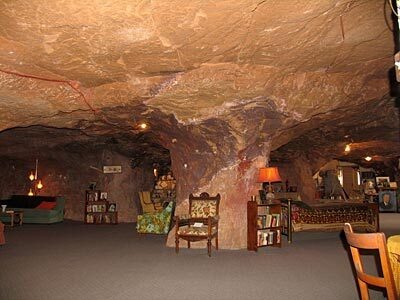
While a linear gorge may be perfectly fine, I would like to have a toroidal gorge that would start something like in this picture, but with an access roof of metal/glass/plastic/etc., and with the toroid expanding outward, but the central column staying the same width. Also, I would want that gorge/cave carved more evenly, like inside of a bell.
While a linear gorge that expands as it goes down, may work fine, I prefer the multiple curvatures of the toroidal model, because I believe it will minimize rock fall from the expanding outer wall.
Antius mentioned "Water Table". That would be something if it could be dug down to a water table.
But if not down to the water table, the interior of this toroidal bell would be a excellent spot to drill a well, down to any water table.
I would expect such water to be salty, and perhaps even toxic, cold, but wet. (Which is a nice thing to have at the equator.
I would also reference this thread for something one of the members has provided:
http://newmars.com/forums/viewtopic.php?id=7493&p=5
From it's post #104, kbd512 provided this:
A rover driving slowly, dragging a regolith collection bucket through the regolith, and then closing the regolith container after it is full of regolith is not any sort of miracle technology that requires years of development. From actual testing on Mars, the water content in the regolith ranges from 2% to 60%.
So, then this as another method by which water for such a "Home" (Giant Home) could be procured near the equator, lets say in rock like at Mount Sharp.
It might even turn out to be possible to simply keep digging the "Gorge" and bake the tailings to procure a continuous supply of make up water. (At least it would be one possible supply). Of course you have to get rid of the tailings, but what if you could in part make them into solar collecting equipment, and ceramic type structures, in some cases perhaps involving a 3D printer. Maybe sintering, or maybe just the sulfur glue others have been talking about. (I have not specified what kind of solar power equipment, it could be any and all of the types). Solar cells, mirrors, etc.
I would suppose that these caves could be lighted by LED's, since they seem to be becoming more efficient.
Spacenut said:
Simple construction as all it needs is 2 ends and a top to complete if there is no need for any sort of bottom liner to aid in sealing this newly created chamber.
Well, I think that there would be many options available, and you could make many different types of gorges to suit various needs.
I think that in the case of the bell/torus/gorge with outward expansion as you went downward, you could in fact use a liner, to attempt to achieve a purpose.
For instance you could have a breathable atmosphere inside the liner, but at times compress raw Martian air into the space between the outside of the liner and the gorge/cave wall.
The walls could be finely Knurled or alternately grooved.
https://en.wikipedia.org/wiki/Knurling
This would allow gas flow between the cave wall and the liner, even if the pressures inside the liner and that knurled gap were different.
Not proven as working may be the idea that if you compressed air into the knurled passageway, you might add electrons to it, electrons plucked from the outside environment, but maybe even to a degree from the inside of the liner itself.
So, one mode would be to have the interior of the liner at 650 to 1000 mb, and the knurled gap compressed above that of the outside atmosphere to lets say 12 or 70, or 300 mb, whatever is convenient.
The compression mode would be done when you supposed that the outside air was at a moisture content sufficiently above a desired cutoff point average.
So, doing this I am hoping that the knurled sandstone is acting like a sponge to absorb/adsorb moisture, and the electron input is encouraging it to stay near the liner.
Now, conversely, at some appointed time a vacuum can be drawn on the knurled sandstone surface, and the moisture content extracted into a containment to be compressed to condensation. Even though the inside of the liner was at 650 to 1000 mb, the knurled surface could be >6 mb, and the interior heat of the chamber presumably will be above 0 degC, so that implies that any water in the sandstone will be withdrawn as a vapor, to be compressed to a liquid.
So, this is yet another way to get moisture into a gorge dwelling near the equator.
Safety concerns:
1) Martian compressed atmosphere in the Knurled surface will at all times be at a pressure less than that of the interior of the liner. Therefore we would not expect it to penetrate into the living environment to poison it. However atmospheric monitoring of CO2 (Which you would want anyway), would reveal if your Martian air pumping system was somehow pushing Martian poison atmosphere into the living environment.
2) Explosive decompression of the gorge. While I do propose to have the knurled surface at a very low pressure often, that does not imply that I would in anyway allow a situation where a perforation of the liner would vent the entire atmosphere to the surface. Rather the flow of gasses and the application of vacuum would be carefully regulated by valves, check valves, and any other necessary safety methods. Still this would allow communion of the Martian atmosphere with the knurled surface by carefully regulated and relatively fail safe methods (If anyone of a responsible nature were to design the system).
Now, I did mention solar energy. Of course why not solar cells, if that if the most cost effective.
But a large chamber like this can also double as a thermal reservoir.
So, you could directly heat the air in it during the day, and disperse the heat at night. I would think that generation of electricity from that process is not out of the question. And since if vertical farms using artificial light were used, you would definitely want to vent a lot of heat, even with LED's. So cooling the chamber interior and rock down at night to fairly low temperatures would be fine I would think, to help keep the place cool during the day.
Other problems the liner causes:
With a simple gorge without a liner, you might attach electrical grids, LED's and Planters to the vertical walls. However the liner will complicate this. Perhaps in the case of the toroidal gorge I suggest, the central post would not have a vertical liner, but would be sprayed with a sealant every time any construction alteration was done, or to repair naturally occurring deteriorations. So, that central post could help to support and be re-enforced by a ring of vertical farms.
https://en.wikipedia.org/wiki/Vertical_farming
http://inhabitat.com/urban-produce-vert … d-indoors/
If a sufficiently moisturized method of mega dwellings in gorges can be implemented in this fashion, I do not feel that it should interfere with Elon Musks plans for the colonization of Mars, rather it should fit with it very well.
While I think that sufficient moisture may be obtainable at the equator, using tricky and thrifty methods, I do not think enough for his spaceships can be provided. However, each high latitude North and South should provide seasonal abundance for his purposes. Then all you need is a transport mode from his North and South spaceports, to these equatorial cities. I propose a "Hopper" method, but of course cars and trucks, and trains/hyperloops would be quite suitable as well.
I believe that Elon Musk believes that Hyperloops will not require pipes on Mars. However, if you did use tubes/pipes, then when you were not running a train, you could pipe water vapor to the equatorial cities from the polar deposits. You of course would have to deal with a potential for condensation of ice, but heat could protect from that.
So, later on that is yet another way to get moisture into a network of gorge cities.
And again linear gorge habitats will be nice as well. Maybe, if they are artificially manufactured, they could be in a star configuration. That is with a junction joining several, allowing a family to dwell in one particular one.
http://www.slate.com/blogs/bad_astronom … n_get.html
Quote:
That's not Utah. That's Mars.
Done.
#8124 Re: Human missions » Elon Musk wants to populate Mars with 1 million people to save humanit » 2016-10-09 19:29:20
kbd512,
At the 2% value, do we think that the water is bound to salts in the soil, or to minerals. I am interested in what level of heating it will take to get a reasonable amount of water from the soil, because even at the equator, I believe that there is at least the 2% you mentioned.
#8125 Re: Human missions » Narrow gorges - a quick way to create an Earth like environment. » 2016-10-08 16:41:53
In the quest for moisture at the equator again.
I think that maybe, if electrons were stripped from atmospheric molecules on the outside, and injected into the gorge enclosure, it may help to retain or even attract water ions into the enclosure.
https://www.scientificamerican.com/arti … ence-home/
What I had read a long time ago was about how it is possible to wet a plough blade even in apparently dry soil, by attaching a negative charge to the plough blade, and of course then you also have to have a conductor inserted into the soil somewhere else, to complete the circuit. This I think is hard to find, because it has some applications, that might be considered important to some entities.
Initially I believe that Louis was looking only at the idea of creating a pleasant habitat. That perhaps also needs to continue to be a very nice objective.
But if sandstone toroidal caves turn out to be easy to make, then some of them could simply contain compressed Martian atmosphere (Have to make a method to compress the air). If the compressed Martian air leaks out, so what just put more in. But while you are doing that, also charge the interior to a (-) charge, hoping to retain/attract water from the rock pores.
Previous reading I have done suggests that just compressing Martian air could release liquid water. Perhaps that is also true. But I of course need to apply caution just because you read it or think you read it does not guarantee that it is true.
Still if a method to collect water from the atmosphere involving sandstone enclosures could be created, I would facilitate habitation of the equator.
As for the gorges with compressed Martian air in them, there is some reason to suppose the plants need less water. At least for CO2 uptake (Less evaporation from the leaves, because the stomata are not opened as much). Of course roots have to be wetted still.
http://arstechnica.com/science/2016/04/ … -scarcity/
I am going to guess that many plants will not like to grow in compressed Martian air, but if you could find a few, that were useful, then you might have something.
Done.
Oops! not quite.
During the night circulate some of the enclosure air through a non permeable radiator, and then when it's moisture is condensed on the interior walls as frost, vent that air (CO2/N2/Argon mostly). Then in the day when the sunlight warms the radiator, suck that moisture back in with an outside air input.
There might be chances of a net gain to an interior humidity which is suitable for agriculture.