You are not logged in.
- Topics: Active | Unanswered
Announcement
#626 Re: Terraformation » Rubble Pile Sinter/Glass Jar/Double Cone, Ceres » 2025-10-07 10:53:38
It is not possible to continue posting as this site is operating extremely slow.
#627 Re: Terraformation » Rubble Pile Sinter/Glass Jar/Double Cone, Ceres » 2025-10-07 10:15:31
Thank You for stopping by and commenting (th).
I expect that for any rubble pile Iron bonded with Oxygen is a likelihood. Some magnetic Iron is also likely.
I appreciate that Starship is using ability to travel to Mars directly from LEO as a goal that helps specify its characteristics. Apparently, the nature of it that this creates is at least somewhat compatible with other solar system objectives.
But we can expect that various kinds of electric propulsions will be more emergent over time. This could lead to a situation where products shipped from Earth/Moon and elsewhere could be in collaboration with products that could be more completed on the moons of Mars.
As it happens also, products like Iron which might be produced on these moons may serve as propellants for electric driven processes such as On-Board rocket mass drivers, or MagDrive or Neumann Drive.
It also seems that at the same time power beaming methods will emerge where power plant which will largely not be changing its inertia can transmit power to a transportation device that will be changing its inertia.
So, an electric driven inertia and orbit change device could achieve capture to a temporary high Mars orbit using Ballistic Capture methods, and then immediately begin receiving energy transfers to it from power stations in orbit of Mars. Arriving to Deimos it could then take on more propellants such as Iron, and the by similar means drop orbit down to Phobos and take on more Iron and probably deliver products and receive products.
While Phobos is most likely to produce bulk items like Iron, maybe Aluminum, and Oxygen, minority items such as to make alloys, might be brought from Earth/Moon. The machinery to be used on Mars or Phobos and Deimos could be produced by various methods, perhaps including 3D printing.
The same electric propulsion, perhaps including the use of Iron as propellant, could lower a Starship refilled with LOX to a very low orbit so that it could begin air braking to land on Mars.
My computer is acting extremely slow, so I am not happy. It maybe I am being somehow impeded in my efforts to communicate.
#628 Terraformation » Rubble Pile Sinter/Glass Jar/Double Cone, Ceres » 2025-10-06 13:14:49
- Void
- Replies: 36
02-15-2026: Change title from "Rubble Pile Sinter/Glass Jar" to "Rubble Pile Sinter/Glass Jar/Double Cone Tent"
02-21-2026 Change title to "Rubble Pile Sinter/Glass Jar/Double Cone, Ceres"
I begin with Phobos and Deimos as the initial targets, but do not exclude other rubble piles.
Although the "Jar" could be smaller, I will begin with https://en.wikipedia.org/wiki/Bernal_sphere
Quote:
500 meters (1,600 feet)
The Island One space habitat, also known as the Bernal sphere, is designed to simulate artificial gravity. It has a diameter of 500 meters (1,600 feet) and is capable of supporting a population of approximately 10,000 people. This habitat is designed to provide living and recreational space, with a Crystal Palace habitat for agriculture and sunlight provided through external mirrors.
Wikipedia
Probably smaller synthetic gravity devices could be made from a collection of Starships though.
https://en.wikipedia.org/wiki/Phobos_(moon)
https://space.stackexchange.com/questio … -on-phobos
Quote:
Copilot Search Branding
1 meter deep
The dust layer on Phobos is estimated to be at least 1 meter deep, with some sources suggesting it could be as thick as 100 meters. This fine powder layer is primarily formed from impacts over millions of years, and it covers the entire surface of Phobos, which is one of the two moons of Mars.
Stack Exchange
+5
OK, so presuming that it will be radar mapped, and perhaps probed with a dip stick, a site will be selected, likely near a rotational pole.
Using a heating source like microwaves, an initial ring will be created in the surface materials.
https://interestingengineering.com/scie … g-the-moon
Quote:
Microwaving the moon may be best for landing spacecraft, propose scientists
Scientists analyze best ways to build spacecraft landing pads on the moon and propose melting lunar soil with microwaves as the most cost-effective method.Published: Dec 21, 2022 10:47 AM EST
Photo of the Author Paul Ratner
Paul Ratner
Since I am presumed to be a Dum Dum, I will use a calculator: https://www.omnicalculator.com/math/circumference
500 meters diameter>1570.796 Circumference. But we may want it a bit larger than that.
For Dum Dum's 5154.19948 feet it seems, so substantial.
So, to melt/sinter a ring of rock from surface regolith. So that will be rather a ceramic like substance I expect. It would be nice if we could put some kind of tensile band on top of it. Iron might be possible perhaps somehow anchored into the rock ring. It might be possible to use it as a rail to navigate a device around like a track.
The ring would be of a substantial weight, even in the feeble gravity of Phobos.
If this initial ring can be established, then I think to borrow from some of Calibans concepts and some of my own from a different topic.
This topic: https://newmars.com/forums/viewtopic.ph … 19#p234719
"Index» Terraformation» Space Habitat Networks"
Post #26 from that topic, Quote:
Calliban
Member
From: Northern England, UK
Registered: 2019-08-18
Posts: 4,196
I have occasionally wondered about the potential for a small asteroid mining vehicle. This would target NEAs <10m in diameter. Such bodies would be completely disassembled. Useful metals and volatiles would be extracted. The remaining slag would be a mixture of iron, magnesia and aluminosilicates. These could be used as propellant by heating them into plasma with radio frequency heating. Small vehicles equipped with solar electric propulsion working on this principle, could ship the valuable materials back to high Earth orbit. The same propulsion tech would then be used to shift the orbit of the asteroid mining vessel to intercept the next NEA.We have examined how we would mine such objects in previous work. One method would be to surround the body with a rotating ring. The ring would carry a set of arms equipped with enclosing shovels. These would grab chunks of surface material and drop it down chutes also mounted on the ring. The whole arrangement would be enclosed in a thin polymer bag to prevent loose material from escaping and contaminating the local space. The chutes would empty into ore processing. How we seperate recovered materials into useful elements needs more consideration.
Last edited by Calliban (Today 07:35:04)
So there are other tools mentioned in that topic also but let begin with the enclosing shovels. These and other tools can be dependent for anchoring on the rock ring that was created.
In this post from that topic more tools are on offer: https://newmars.com/forums/viewtopic.ph … 85#p234585
So with the collection of tools, we may extract Oxygen, Hydrogen (If present), Carbon (If present), Iron, and leave a remainder of a "Slag" that can be pasted on to the ring we already made.
Processing the materials inside of the ring we may dig a hole make these materials and extend the walls of the "Jar" downwards. We may also make a "Lid" on the jar, with doors.
I think that when the jar is sufficiently completed, we may find very thin amounts of Hydrogen and Helium in the interior of the "Jar".
The moon is apparently porous: https://en.wikipedia.org/wiki/Phobos_(moon)
Quote:
Global web icon
Wikipedia
https://en.wikipedia.org › wiki › Phobos_(moon)
Phobos (moon) - Wikipedia
Phobos's density is too low to be solid rock, and it is known to have significant porosity. [23][24][25] These results led to the suggestion that Phobos might contain a substantial reservoir of ice.
OK it would probably be wonderful if Phobos had ice in it but I am presuming that it does not. However, I speculate that it may be permeable to Hydrogen and Helium in the solar wind. (And Protons perhaps). While the solar wind moves fast, I speculate that these molecules will have been stilled to some extent.
If we release Oxygen while processing regolith in the Jar, and we provide a hot catalyst, it may be that water would be formed. If we then provide a cold trap, we might capture the water molecules. I do not expect a dense abundance of the molecules but rather a molecular flow environment.
By the time the "Jar" has a lid on it, doing any form of sintering inside the Jar, or Pyrolysis, will release some Oxygen, and we hope some Carbon. From Anthrofuturism, it seems that if we do repeated Pyrolysis, we will not lose Hydrogen but can reuse it repeatedly. In fact we may gain Hydrogen if the process captures it from solar wind products or if there was some Hydrogen in the rock.
At some point the "Jar" may become large enough that we can bring Starships in though doors in the lid and set up synthetic gravity inside of it.
Probably sintered trackways could extend from the "Jar" perhaps to all surfaces of the little world.
So, possibly this is approaching a method to work with rubble piles about the size of Phobos.
Ending Pending 
#629 Re: Terraformation » Space Habitat Networks » 2025-10-06 11:42:43
There are some things I would like to collect into this post.
I have my eye on the process that https://en.wikipedia.org/wiki/Quaise is using to drill.
Quote:
The system would repurpose existing gyrotron technology to drill 20 kilometers beneath the surface, where temperatures exceed 400 °C.
So, it is difficult to figure out how to grind rocks as we often do in mining here on Earth, but this process might take apart rocks and conduct pyrolysis at the same time.
NASA has been looking at building with glass on the Moon:
https://www.nasa.gov/directorates/stmd/ … w-gravity/ Image Quote: 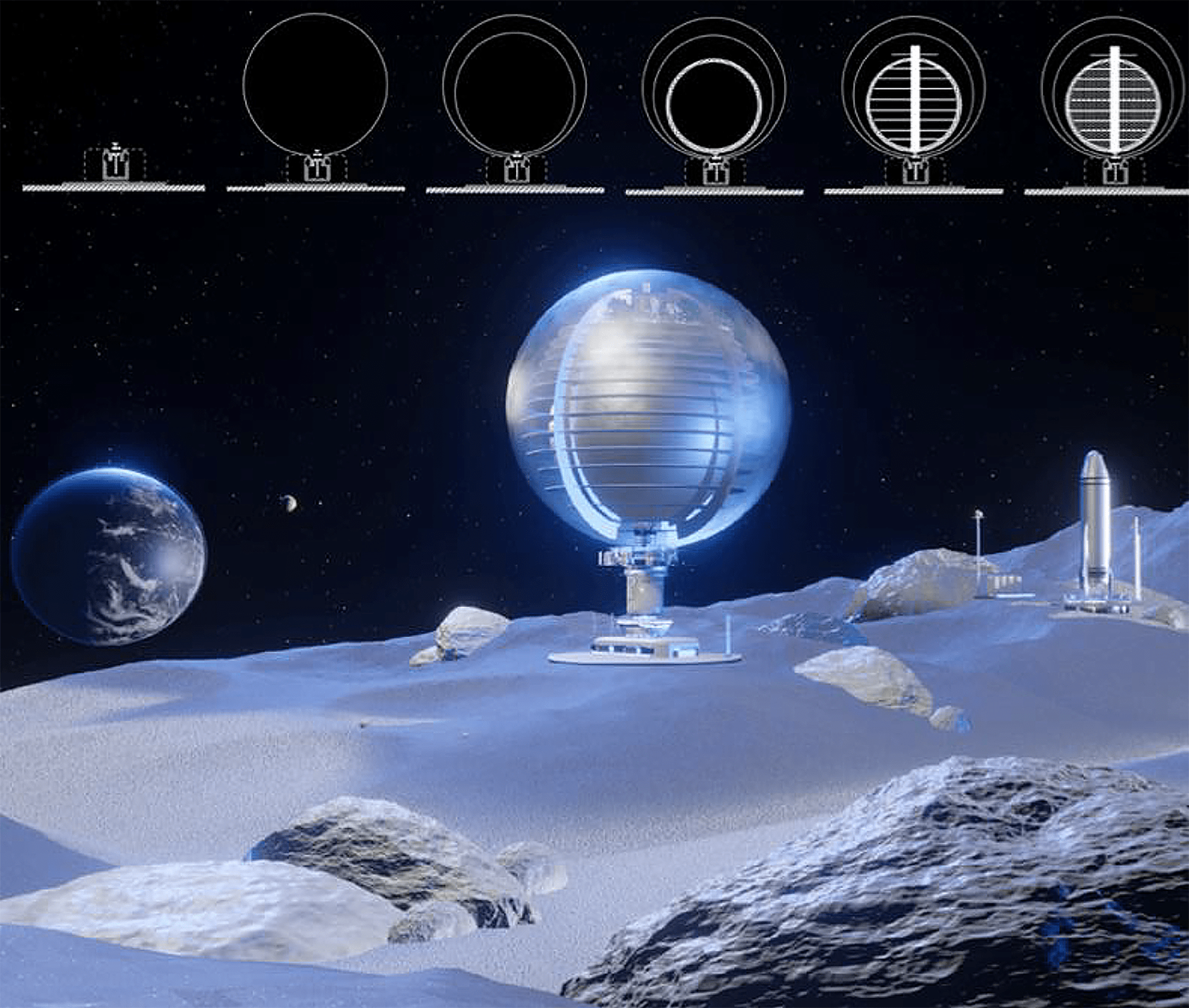
https://www.universetoday.com/articles/ … n-the-moon
So, sinter and glass could be two ways to treat "Slag" and make it useful.
The easy things to remove from the regolith seem to be Hydrogen and Iron. Carbon and other volatiles perhaps less so. Oxygen can relatively easily be removed from Iron oxides and from water.
If we can make glass parts for an enclosure can we put bands of tensile materials around it? Perhaps some type of simple steel?
Then can a balloon be inflated inside of it? Of Poly or even an Aluminum balloon?
According to Anthrofuturism, lasers could be used to "Distill" substances other than Iron, Hydrogen, and Oxygen.
Also though laser 3D printers may help to make structures from various materials.
Ending Pending
#630 Re: Terraformation » Space Habitat Networks » 2025-10-06 11:03:28
Yes, that is a useful tool kit. Calliban said:
We have examined how we would mine such objects in previous work. One method would be to surround the body with a rotating ring. The ring would carry a set of arms equipped with enclosing shovels. These would grab chunks of surface material and drop it down chutes also mounted on the ring. The whole arrangement would be enclosed in a thin polymer bag to prevent loose material from escaping and contaminating the local space. The chutes would empty into ore processing. How we seperate recovered materials into useful elements needs more consideration.
There will be various sized materials.
Big chunks, hard to process, but could be anchored to.
Dust and small pieces could be handled by various means.
Your method to "Grab Chunks" could involve various sized enclosing shovels, could be very desirable as a tool.
My additional interest is in Deimos and Phobos, and "Enclosing Shovels" will be a needed tool for that, when the finer materials removed may expose "Chunks" of various sizes.
Your ring inspired me with the idea of a lasso method. And of course, sometimes enclosures including bags seems like they would have uses.
Ending Pending
Itokawa is perhaps a bit larger than what you seem to be focused on, but there is something important about it.
https://en.wikipedia.org/wiki/25143_Itokawa
Image Quote: 
Although "Stony" it seems to have a bit of water in it: https://www.science.org/doi/10.1126/sciadv.aav8106
Water and a bit of graphite it seems: https://www.nature.com/articles/s41598-021-84517-x
From viewing a video by Antrofuturism, I have the idea that although Hydrogen levels may be low, by subjecting stony materials to pyrolysis, water can be made to emerge. The water can be split, and the Hydrogen be reused to conduct additional pyrolysis, pulling Oxygen away from Iron to reduce it. Apparently, this process should result in the gain of more Hydrogen and not the loss of it.
You may get Free Oxygen and possibly iron from this and the remainder could for the moment in process be a "Slag".
Oxygen might be considered a waste gas and perhaps could be ejected by some manner to provide propulsion.
So, this could be useful in the topic of "Space Habitat Networks"
It may also be true that Magdrive or Neumann Drive could use the produced Iron as a propellant.
It may be true that some "Stony" asteroids are rather dry, but I think that when you are dealing with a stony rubble pile, the stone is likely from the interior of a parent object that had water brine inside of it, before it was shattered.
So, some forms of water may still exist in the stone, which I consider to be a very good thing.
Ending Pending
#631 Re: Terraformation » Space Habitat Networks » 2025-10-05 18:00:25
Obviously once human activity is in proximity of ice worlds this plan could work well.
Exceptional Asteroids: https://en.wikipedia.org/wiki/List_of_e … _asteroids
Most of these are volatile, including water bearing. Being labeled G or C or B in type. But there is some evidence now that at least some stony asteroids will have water in them in some form.
Using concentrating mirrors to provide the hot side of Biocompatible Heat Engines should be rather easy in the asteroid belt.
In the Trojans and Greeks and the moons of Jupiter, mirrors could also work, but would need to be bigger.
Going to the Saturn system mirrors should even then work but of course they have to be big. Obviously, the Saturn system will have the advantage of the resources of it's moons including Titan which would include a lot of Nitrogen.
So, if it could be made to work then an enormous amount of electrical power generation and also biological productivity.
Adding the Laser power transfer methods of this post from elsewhere: https://newmars.com/forums/viewtopic.ph … 09#p234709
A network of space propulsion pathways among these should be practical.
Ending Pending
#632 Re: Terraformation » Space Habitat Networks » 2025-10-05 13:51:15
Here I have added extensions to the structure: 
Separate chambers that still will act as parts of the radiator. Refuges in case the sun section becomes uninhabitable for a time.
Where I am going with this is to blend habitats/farms, with power plants.
We will intercept the output of photons from a star, and make connection to the universes drainage system for heat.
Tapping into entropy, I guess, harnessing the waterfall or perhaps say "Thermal-Fall".
Which is where everything we have to live on comes from anyway.
Ending Pending
In general, instead of moist soil as a radiation protection I just want water, and outside of the "Cans" Aluminum fins in the form of Chevron.
If people want "Dry Land" they then need stilted platforms or rafts or boats.
This will be more useful in places in the solar system where water can be produced out of smaller gravity wells.
For instance for Mars the Hydrogen might come from Mars, and the Oxygen from Phobos and Deimos.
Ending Pending
#633 Re: Interplanetary transportation » Multi-Ship Expeditions, Starboat & Starship, Other. » 2025-10-05 11:39:25
It is my opinion that it could be that SpaceX, and others may end up lifting water and Carbon from Earth to space stations where it can be cooked into propellants.
The water can serve as radiation shielding and/or a method of aquiculture in orbit. The Carbon could also serve as radiation shielding.
It may be that eventually Oxygen will be brought to LEO from the moon, maybe from NEA's.
So, the water and Carbon could be "Cooked" into propellants at a "Just In Time Rate".
I think that most people don't comprehend how much in the way of space station mass Starship could establish in LEO and higher orbits.
The "Stubby Starship" makes sense.
The booster for Lunar Injection could be filled and put into a "Freezer" to avoid boiloff. Then the Stubby brought up to orbit and filled and then a crew could be installed into a "Stack".
To me this will make more sense than to do 6 to 7 refills to the Stubby of Methane and Oxygen. Both water and Carbon will be much easier to store than a bulk of Methane and Oxygen stored during filling.
Of course until the space stations for this are established, it would be directly Methane and Oxygen.
If electric propulsions were to prove effective it might be that eventually Water and Carbon might be obtained from other sources than Earth.
Anyway, it might drift in the direction I have suggested.
We also have the possibility of direct cooked propulsions from Water.
From post #182:
I believe that this is going to be massively important: https://www.youtube.com/watch?v=m0tMViyxxcw
Quote:At 18 He Took On Space Energy! Satellites, Lasers & the Next Frontier
Over The Horizon
The basic notion is power plants in orbit that send laser power to spacecraft.
To me this indicates that you could "Directly Cook" a propulsion method.
Steam is one possibility. While it is not the most efficient, it might reduce on board mass will allowing water to protect humans and machines.
Direct cooking of Hydrogen and Oxygen from water. You would have a big water tank and a small Hydro Lox engine. You could cook up your propellants in small quantities and burn them. You avoid boil off issues and have radiation shielding while water is on board.
So there would be a large number of solar power plants in orbits, that could send power to these vehicles with lasers. So, you are not dragging the large inertia of large solar panels to differing orbits. And your tanks may be just water tanks, so perhaps not as heavy as for Methane, Hydrogen, Oxygen, Etc.
As for "Electric Ion Rockets", Argon-Xenon are said to be good. Also, we may hope that Neumann Drive and Magdrive can run on things like metals and Carbon as propellants.
This apparently will probably work as a network for the Earth/Moon solar subsystem.
Ending Pending
#634 Re: Terraformation » Plutoids and Rogue Planets, Titanformation process, a cold treasure? » 2025-10-05 11:03:38
This aligns with my prior speculations: https://www.msn.com/en-us/news/technolo … r-AA1NParK Quote:
A Rogue Planet Is Devouring Six Billion Tons of Gas Every Second
Story by Tibi Puiu • 1d •
3 min read
So even small worlds such as Dwarf Planets that could be tossed out of a solar system probably can collect more mass over time and become larger. This would bring in radioactive materials as well, so it might develop internal heating even to the point of open water, if the world got as big as Earth or a Super Earth.
Eventually if they wander into a stellar nursery, they may become brown dwarfs or even stars, I speculate.
And intelligent species that came to inhabit such worlds, might want to keep them relatively small by pulling matter off of them with space elevators and driving off excess Hydrogen and Helium.
Power on such worlds could be geothermal and perhaps Fusion, maybe even fission.
Ending Pending
#635 Re: Terraformation » Space Habitat Networks » 2025-10-05 10:48:38
Here I have changed the idea of a biocompatible heat engine a bit: 
The "Light Splitting Window" allows more of the spectrum of the sunlight to impinge on the cone shaped "Boiler".
The window is a cylinder that will experience "Compression" as the "Outside" of the cylinder window is interior to the pressurized space, and the inside of the cylinder window is exposed to the "Greater Partial Vacuum" of the space environment.
The light is expected to come from a optical system of mirrors, or perhaps lenses, not shown in the drawing.
The window could be of two layers. A compressible layer of transparent ceramic/glass/Silica?, with a transparent film wrapped around it.
As this is a "Compression Window", the differential pressure does not threaten to push the window out of its window frame, but actually may tend to compress the joins between "Glass" panes so then more to seal it.
The window itself may get heated up so a method to extract that heat, perhaps with piping and a fluid might be desired.
The objective would be to get as much raw sunlight as is useful to heat the boiler, but to hopefully be able to reflect photons that can drive photosynthesis to be deflected/reflected into the radiator.
I have speculated that some types of extreme microbes might be able to function in a pressure as low as 10 millibars, but I do not know if that is true. I think that 50 millibars may do and certainly 100 millibars will do.
Certainly, the higher pressure used the more challenged the window will be, but the higher the life forms that could be sustained would be, up to humans perhaps.
Food for creative thought, I venture.
Ending Pending
It may be that at some point Starships might bring water and Dry Ice up from Earth or other worlds to be processed into Oxygen and Organic matter. Then the organic matter could be processed into other things, perhaps fuels.
Ending Pending
#636 Re: Human missions » Starship is Go... » 2025-10-04 19:51:59
Quote from #2212 (RGClark):
I had suggested it might be doable using a single Blue Moon Mk1 launched on a single New Glenn. This though would require New Glenn reaching its intended payload capacity of 45 tons reusable, 60+ tons expendable:
Should Lunar Starship be ready in time my dream would be that it be set up that it could land on the Moon and then in an emergency lift the humans up to the Orion. But the preference could be to have a minimal lander perhaps per Blue Origin that could take primary responsibility for Lunar Orbit(Orion)<>Lunar Surface.
So, then the Lunar Starship ready in Lunar Orbit, then to land it without crew.
If it lands successfully then the Blue Origins lander can also land by it.
The crew from the Blue Origins Lander can move to the Lunar Starship and begin setting up the starting of a base.
Then the Blue Origins Lander can move the humans to the Orion for a return trip.
If the Blue Origins Lander cannot launch back to orbit then ideally the crew can return to the Lunar Starship and launch it to the Orion. In that case the Lunar Starship is then expended.
It would be preferred not to expend the Lunar Starship but to leave it on the surface of the Moon. Of course boil off will be a concern if the crew does not leave soon enough.
If the Starship is left behind on the Lunar Surface then a process should consume the residual Methane and Oxygen in the tanks to produce H20 and CO2 which perhaps can be stored.
Certainly, the water will be a welcome resource, and the CO2 might be useful as well.
Ending Pending
#637 Re: Interplanetary transportation » Multi-Ship Expeditions, Starboat & Starship, Other. » 2025-10-04 13:30:47
In the prior post, it seems Europe is interested in a Mini-Starship.
They should think to contract with SpaceX to build a factory in Europe for the mass production of such.
Ending Pending
#638 Re: Interplanetary transportation » Multi-Ship Expeditions, Starboat & Starship, Other. » 2025-10-04 13:10:03
This is very good news!
https://orbitaltoday.com/2025/09/30/eur … -starship/
Quote:
Home > Space > Europe Bets on Reusable Rockets with $47M Deal for “Mini-Starship”
Europe Bets on Reusable Rockets with $47M Deal for “Mini-Starship”
Space
30 September 2025
I hope they make it so that it can ride to orbit in a SpaceX Starship as an alternative to their own 1st Stage.
I hope that they make it so that SpaceX can refill it.
Then it might make a good Moonship, maybe even a good Marsship.
Good stuff.
Ending Pending
#639 Re: Human missions » Starship is Go... » 2025-10-04 12:00:51
This is good. Put some of the responsibility onto Blue Origin.
Probably it would be good to have a minimized human lander as speculated on for MK-1?
It is actually somewhat idiotic to land the Lunar Starship and then use it to lift humans to Lunar orbit and then abandon it. It can be done but it is Totally Stupid!
Once it is on the Lunar Surface it can be made into a shelter using Lunar resources. So, if you have a heavy delivery of cargo with Lunar Starships, and have a minimized lander/launcher transport for humans, at that point the Orion Capsule has some good use.
But eventually an upgraded Dragon that could be used, can be launched to orbits by less costly means would make sense.
The Stubby Starship concept could have merit.
From my point of view, a Starship could be created where you leave the Cargo/Cabin in LEO, to become Space Station structure, and the "Locomotive" could have a small Dragon Based, cabin put on to it, then that could be used for transit directly from LEO to the Moons surface. Then that could be used to transfer humans back to Lunar Orbit.
This could strongly reduce the number of fills needed to access the Moon.
You just add more consumables. The attached Dragon might have a heat shield, but maybe better not to do that but to have a Dragon or Orion in Lunar orbit for the return to Earth.
It really is totally wrong for NASA and others to use SpaceX as their whipping boy, when much of the fault lies with them for hot thinking this though better before this. SpaceX is the one that is more on the ball than is Blue Origin. Not that I fault Blue Origin though. I bless them for their efforts as well.
Ending Pending
A Dragon-Starship Hybrid method: 
While in orbit during a solar flare it should be possible to point the Locomotive at the sun to try to protect the humans in the Dragon.
Ending Pending
#640 Re: Terraformation » Space Habitat Networks » 2025-10-04 10:32:37
I have modified the diagram for the "Biocompatible Heat Engine": 
I have added the "Cone Window" which surrounds the light cone.
If it were substantial enough, then a high temperature entrance window, (From the mirrored light source), might not be needed.
For lower pressure situations this might be desirable. Cyanobacteria might do OK with just 50 millibars pressure, so the cone window might be a plastic film. A method might be required to prevent the air pressure in the bio section from squeezing the cone window into the light cone area. Perhaps a metal cage that is also cone shaped.
If you could avoid freeze damage the temperature of the water could approach the freezing point of the fresh or salt water.
The cone window is to also help to keep Infared light from the boiler from entering into the biological area.
In this case it may be that the boiler temperature could be quite high. Well above 100 degrees C, maybe truly hot.
Keep in mind that this popped into my mind in a matter of a few hours of thinking.
I am hoping that over time descendant thoughts that will be more elegant, less complex, greater productive/useful, will emerge from my mind of the minds of others.
While I have in recent versions indicated synthetic gravity, it may be that for Cyanobacteria farming microgravity may be sufficient. The water needs to cling to the cylinder walls, and a means to collect the water though some modification of capillary effect would be needed.
This again could indirectly produce Oxygen for various needs, and organic matter which could be processed into various things including fuel perhaps.
It is unknown how much Carbon or Hydrogen Phobos and Deimos might hold. However, if it does have some then Carbon is more likely. In that case, processing the materials from Phobos and Deimos, may accumulate more Carbon for fuels, perhaps even Hydrogen.
The process of conducting pyrolysis on the regolith of Phobos and Deimos might produce Carbon or even Hydrogen based fuels.
A CO and O2 rocket propulsion in Mars orbit may be useful.
The processing of Phobos and Deimos regolith may generate propellants for Magdrive or Neumann Drive which are both electric.
So this may provide a refilling process in Mars orbit. That could be augmented by Hydrogen from Mars if necessary.
There are conflicting notions about the possible presence of Carbon or Hydrogen in the regolith of the moons of Mars. It is not really known where these materials came from and the amount of heating the materials experienced. The surface materials which is dusty might be different than possible large chunks of rock internal to the moons.
https://academic.oup.com/mnras/article/ … 65/6660653
Quote:
Phobos and Deimos surface composition: search for spectroscopic analogues Free
Giovanni Poggiali, M Matsuoka, M A Barucci, J R Brucato, P Beck, S Fornasier, A Doressoundiram, F Merlin, A Alberini
Monthly Notices of the Royal Astronomical Society, Volume 516, Issue 1, October 2022, Pages 465–476, https://doi.org/10.1093/mnras/stac2226
Published: 10 August 2022 Article history
This one is rather optimistic about Carbon: https://scisimple.com/en/articles/2025- … s--akyeqmz Quote:
# Physics
# Earth and Planetary Astrophysics
New Insights into Phobos' Composition and Origins
Research reveals key properties of Phobos and its simulants for future exploration.
Aug 3, 2025 ― 7 min read
But even if the moons of Mars have no Carbon or Hydrated Minerals, Methane manufactured on the surface of Mars, could be lifted by spacecraft, in order to conduct pyrolysis on regolith of the Mars moons.
Products then relatively easily produced then would be Oxygen, and Iron, and Slag blocks.
Here is a good resource for space processing of regolith: https://www.youtube.com/@Anthrofuturism
This one deals with pyrolysis of Moon regolith, but the techniques could be used for Phobos and Deimos: https://www.youtube.com/watch?v=SOUHUxVU04s
Quote:
Refining Moon Regolith With Lasers (Part 1)
ANTHROFUTURISM
31.6K subscribers
They deal with pyrolysis using Carbon and pyrolysis using Hydrogen, and then pyrolysis using lasers.
In the case of the regolith of Phobos and Deimos, we may first hope to extract Iron and Oxygen.
But if they are sufficiently available, we may hope to recover Carbon and maybe even Hydrogen.
If we want to leave it at that then we can treat the remainder as slag and make blocks of materials out of it. Then build large structures in the orbit of Mars.
It is likely that we could get more metals out of the regolith, but getting Iron, Oxygen, Carbon, Hydrogen, and slag blocks would be very valuable in Mar orbits.
In the future, electric rockets could bring bulk materials from Earth/Moon to Mars orbits. But then Starships might bring it down to the surface of Mars in some cases.
While I have been promoting a biological path to process, indeed electrolysis of CO2 and H20 could be used. But as I have said, habitat for humans might be desired in orbit.
Iron and Carbon can be used in Neumann Drive, and Iron can be used in Magdrive. (I don't know if Magdrive can use Carbon).
So, it might not be out of the question to move things from Mars Orbits to the Earth/Mars.
A multi-step shipping process of Earth/Moon>Mars Orbits>Mars Surface, allows for a less rugged heat shield for the Starships at Mars, as the speeds from low Mars orbit are less than for Earth/Moon>Mars.
And the Starships at Mars may be refilled in part from both Mars Orbits (Phobos and Demos materials), and from the surface of Mars.
After SpaceX may do initial landings on Mars, I promote the idea of setting up orbital facilities around Mars, to process regolith from Phobos and Deimos.
Ending Pending
Isaac Arthur has this video also: https://www.youtube.com/watch?v=P1eVwQTxYu0
Quote:
Lunar Mining, Processing & Refining
Isaac Arthur
These ideas also may be transferable to Phobos and Deimos.
Ending Pending
#641 Re: Terraformation » Space Habitat Networks » 2025-10-03 18:58:38
One reason I have gone into the idea of "Habitable Heat Engines", is that for orbits of Mars, the capacity to grow things with photosynthesis might be useful.
If you were to conduct pyrolysis of the materials of Phobos or Deimos using Carbon or Hydrogen, the results should be some mix of H20 and CO2. Then if you put that into a greenhouse, that can be converted to Oxygen and Organic Matter. Organic Matter then can be mixed with more regolith from Phobos and Deimos, and around you can go again.
I understand that you could use electrolysis to produce O2, CO and then make Methane by various processes, but with this machine, you can take this other route, and have places where humans might dwell as well.
The solar energy for the process is better in orbit than on the surface of Mars, but then if you are in orbit where will you house the processor, the robots, and the humans? How will you feed the humans.
The drawings I have provided suggest possibility but I do not think that they are yet proven or perfected.
I think that probably the hot side will end up being much hotter than 100 degrees C. But some care will be needed to have tricks that do not cause heat to migrate to the cooling water by way of Infared Radiation.
I do show a glaze over the hot side metal drum which will need a pigment set that mostly only reflects the light that plants want.
As I understand it that is some of the red and some of the blue and not the UV or Green or far Infared. The desire would be to block those from reflecting from the boiler to the cool water.
There are 2 layers of transparency and the color scheme of the boiler surface.
The air pressure in use will have some effect as the closer to a vacuum you get, the less heat is transferred by convection.
While higher pressure versions could be nice for people, lower pressure ones may be more productive and easier to keep inflated. Differential pressure on windows would be less.
It is a fairly tall order, but maybe it can be done reasonably well.
Pressures less than 1/3 bar would have very little Nitrogen, but for humans a 2/3 bar pressure would need some Nitrogen or maybe Argon.
Ending Pending
#642 Re: Terraformation » Space Habitat Networks » 2025-10-03 13:09:35
In post #18 I introduced this:
I made an attempt to formulate how to have a biocompatible heat engine in space:
I want to elaborate a bit more.
The outer walls of the cylinder would have Aluminum fins to radiate heat. I desire also that the fins will be in parallel chevron shape to help with impactors as a danger of puncture.
https://ar.inspiredpencil.com/pictures- … on-pattern
Image Quote: 
Where Calliban will seek perhaps 30 degrees C as heating from waste heat is desirable, I would prefer to go lower, perhaps 10, 15, 20 degrees C. This would allow for a bit more power generation, I believe.
Where in Calibans presentation 60-100 degrees C might be for the hot side, I think higher would be available in this machine. After all the concentration of solar energy should allow higher temperatures.
The solar collector pigments could reflect more the wavelengths of light that Photosynthesis would use, but absorb those wavelengths that are not suitable for photosynthesis.
The window though which the focused light would pass will need to be rather strong, to put up with the concentrated light which might shock the materials.
The interior pressure could be acceptable for humans, say 1/3 to 2/3 bar, which would be a reduced differential pressure.
But technically you could reduce it much lower than 1/3 bar, if you will not have shirt sleeve humans in it.
This calculator might be used to make a estimate: https://endmemo.com/chem/vaporpressurewater.php
At 20 degrees C, 0.0233 Bar or a bit higher pressure could hold the "Cold" water as a liquid. That is 23.3 millibars I believe.
So, you might be able to grow some sort of photo-microbe in that. Of course, then as cooling water, organic matter is likely to gum up the heat engine parts, so it is not to be quite that easy.
But doing this you could grow biomass and generate electricity.
You could have a pressure of the Armstrong Limit.
https://en.wikipedia.org/wiki/Armstrong_limit
Quote:
About 0.0618 atmospheres
The Armstrong limit is the altitude above which atmospheric pressure is so low that water boils at the normal temperature of the human body, which is 37 °C (99 °F). This phenomenon occurs at an altitude of approximately 60,000 to 62,000 feet (18,900 to 19,350 meters) above sea level. At this altitude, exposed body fluids such as saliva, tears, and the liquids wetting the alveoli within the lungs will boil away without a pressure suit, and no amount of breathable oxygen will sustain life for more than a few minutes. The pressure at this altitude is about 0.0618 atmospheres (6.3 kPa, 47 mmHg), which is one-sixteenth of the standard sea-level atmospheric pressure of 101.3 kilopascals (760 mmHg).
Wikipedia
+5
So, 1/16th Bar???
You would need a pressure suit, and if it leaked, then you would need attention. Assistance, but you could dive to the bottom of the water and get a bit more pressurization. Depends on the height of the water column, and the g forces of the spin gravity method.
It would be adult level work.
I recall Robert Dyck indicated that 1/10 bar is a limiting factor for at least most vascular plants on land.
But if you had 63 millibar pressure of air inside the enclosure, then water column might give you the extra 36 millibars, so some aquatic plants might make it in that environment.
I am just looking at minimizing the differential pressure on the window(s) where the light might shine though. You might very well grow vascular aquatic plants that way, or large type algae as well. (Maybe).
I would anticipate using an aquatic robot to manage the water environments. It might also be equipped to plug a leak is water is detected leaking out into space.
* Then ends of the cylinder would need appropriate radiation shielding of course, bags or tanks of water, or solid materials.
Ending Pending
#643 Re: Terraformation » Space Habitat Networks » 2025-10-03 11:27:04
In the previous post I introduced this:
I made an attempt to formulate how to have a biocompatible heat engine in space:
If a Biocompatible Heat Engine can be created, then I see the orbits of Mars/Phobos/Deimos as being an early place to attempt to create one.
I expect that for the most part things like Hydrogen and Nitrogen would need to come from Mars itself, unless the moons have water of some sort.
Phobos and Deimos, would supply most of the other materials.
And various versions of this might be possible many other locations in the solar system such as perhaps Bennu and Ryugu.
Ending Pending
Although not mandated, I imagine that the cylinder walls will have a sufficient body of water inside of them to give sufficient radiation shielding. Generally, soil would not be used, as the water is to also be cooled and to store the cold to use in the heat engine.
If humans were in this, they would likely be on platforms on stilts, or boats.
Aquatic vegetation would be more normal but land plants might also be in place.
Technically a platform on stilts of a boat could have addition radiation protection. So, the water would not have to provide full protection. In solar storms then of course, you would retreat to these radiation refuges.
This would allow people to move about in a boat and be well protected but access most locations inside of the cylinder walls.
Ending Pending
Such devices might also host data centers. And might beam power with lasers or microwaves to other locations.
Ending Pending
#644 Re: Science, Technology, and Astronomy » Permenance Movement » 2025-10-03 11:03:18
Calliban,
You stimulated me to attempt to imagine a Biocompatible Heat Engine in Space: https://newmars.com/forums/viewtopic.ph … 69#p234669
Might need further work, but I think it approaches being useful.
Ending Pending
#645 Re: Terraformation » Space Habitat Networks » 2025-10-03 10:59:19
Because of Callibans post elsewhere: https://newmars.com/forums/viewtopic.ph … 61#p234661
I made an attempt to formulate how to have a biocompatible heat engine in space: 
I think this might be approaching value for utility.
Thanks Calliban.
Ending Pending
#646 Re: Terraformation » Space Habitat Networks » 2025-10-03 08:39:35
Isaac Arthur put out a video I like: https://www.youtube.com/watch?v=dJG1iTgUuG8
Quote:
After Mars - Where should humanity go next?
Isaac Arthur
823K subscribers
Near Earth Asteroids as #1:
I agree that NEA/NEO asteroids, especially those that have rubble pile features, can be regarded as perhaps as important as the Moon and Mars/Phobos/Deimos, and perhaps the next thing after the Moon and Mars.
I was surprised at his other candidates, but perhaps they do make sense.
Pause............
Although he mentions that work with Near Earth Asteroids could develop technology for the main belts and Trojans and Greeks, he mentions Venus as #2, in the atmosphere. I guess if NEAs can supply some of desired materials it may be reasonable to go in this direction.
Mercury as #3, was a surprise to me. But it does have lots of Carbon and metals, and we think ice at the poles.
Synthetic gravity on Mercury would be easier than for worlds with atmospheres, he says.
#4: Lagrange points and Earth Orbits. This can be Lagrange points around the solar system.
L1 for Venus to shade the planet?
Jupiter's Trojans and Greeks.
#5 Four major moons of Jupiter.
#6 Titan.
#7 Main Asteroid Belt.
#8 Comets and Kuiper Belt objects.
I am in strong agreement with Near Earth Asteorids.
Mercury surprised me, but does have a massive potential, I think. Maybe better than Mars, but much harder to developed.
Ending Pending
#647 Re: Terraformation » Plutoids and Rogue Planets, Titanformation process, a cold treasure? » 2025-10-02 08:09:57
Yes payments of volatiles to Mars over time may improve it from out point of view.
But I suggest that we take out an "Water Loan".
https://news.uchicago.edu/story/icy-clo … tudy-finds
Quote:
Icy clouds could have kept early Mars warm enough for rivers and lakes, study finds
Simulation led by UChicago geoscientist finds missing piece to Martian climate puzzle
Quote:
Using a 3D model of the entire planet’s atmosphere, Kite and his team went to work. The missing piece, they found, was the amount of ice on the ground. If there was ice covering large portions of Mars, that would create surface humidity that favors low-altitude clouds, which aren’t thought to warm planets very much (or can even cool them, because clouds reflect sunlight away from the planet.)
But if there are only patches of ice, such as at the poles and at the tops of mountains, the air on the ground becomes much drier. Those conditions favor a high layer of clouds—clouds that tend to warm planets more easily.
The model results showed that scientists may have to discard some crucial assumptions based on our own particular planet.
“In the model, these clouds behave in a very un-Earth-like way,” said Kite. “Building models on Earth-based intuition just won’t work, because this is not at all similar to Earth’s water cycle, which moves water quickly between the atmosphere and the surface.”
Quote:
Copilot Search Branding
Images
Videos
The hypothesis that high-altitude clouds on Mars could have caused a greenhouse effect is supported by a computer model study led by University of Chicago planetary scientist Edwin Kite. The study suggests that a thin layer of icy, high-altitude clouds could have kept early Mars warm enough for rivers and lakes to exist. This theory contrasts with previous explanations that suggested a collision from an asteroid could have released enough energy to warm the planet, which would only last for a short time. The new model indicates that even a small amount of clouds in the atmosphere can significantly raise a planet's temperature, similar to the greenhouse effect caused by carbon dioxide in Earth's atmosphere. The study's findings suggest that Mars' climate could have been warmer than previously thought, providing a new perspective on the planet's history and potential for life.
The University of Chicago
+3
So, by taking a "Water Loan", we may anticipate that the economy of Mars and the Solar System may become wealthier, and so in the future be more able to afford the transfer of non-local resources to various places like Mars.
If we go in the other direction, make water payments for 700 years, we take a heavy burden with weaker economic power.
Mars has lots of ice, but in the contest between dirt and ice, dirt is currently winning.
The kind of volcanism on Mars may have affected its climate, I think. If you had mostly viscous Hawaii type volcanism with lava, perhaps then you place more CO2, Methane, and Hydrogen into the atmosp0here.
If you have explosive volcanism, then you place more dust onto the surface of Mars. Then the dust may cover the ice and keep it from an evaporation/snow cycle.
https://en.wikipedia.org/wiki/Cerberus_Fossae
So, emissions of water, lava, and volcanic ash might make alterations to the climate from time to time.
China thinks that liquid water may have been present on Mars within the last few million years.
https://blog.sciandnature.com/2025/03/b … finds.html
So, perhaps the climate of Mars may be a bit like a continuing game or "Rock-Paper-Scissors", sort of.
It its earlier days ground heat, and a larger amount of water may have allowed the snow process to hold against the dirt process more of the time.
But now without an unusual event like a large impact or volcanic eruption, dirt dominates.
If we could pull a bunch of ice from solid ice deposits on Mars, it might fall then as "Dry Snow Powder". This could blow in the wind like dust does.
You might get a temporary cycle of High-Altitude Clouds, and dry powdered snow, until the water vapor got incorporated again into solid ice masses that were either covered in dirt or at such a high latitude that it is reluctant to evaporate again.
So, if we could tweak that we might be able to bootstrap the snow cycle back into action again, which would likely evaporate all the CO2, I hope and make active high-altitude clouds again.
And then if a biosphere could be established, the process of life might keep some methane flowing into the atmosphere from then on.
Even a high Arctic type environment might be helpful in that regard.
One possible way to get the snow started again would be lasers and microwaves to evaporate ice from the polar ice caps. But other ways like greenhouse gasses and particles may be good as well.
But then with Mars made more economically valuable, the ice consumed could be repaid by moving volatiles from the more outer solar system to Mars as you have suggested.
Ending Pending
#648 Re: Interplanetary transportation » Multi-Ship Expeditions, Starboat & Starship, Other. » 2025-10-01 20:02:44
I believe that this is going to be massively important: https://www.youtube.com/watch?v=m0tMViyxxcw
Quote:
At 18 He Took On Space Energy! Satellites, Lasers & the Next Frontier
Over The Horizon
The basic notion is power plants in orbit that send laser power to spacecraft.
At first to satellites, but later for large ships. This then to power electric propulsions without having to carry the solar panels with.
The wavelength of the laser will apparently efficiently transport power to the spacecraft with rather good efficiency as it is a certain frequency that the solar cells are tuned for.
Obviously this is going to eventually allow the movement of freight Earth Orbit<>Moon Orbit.
Fantastic!
Ending Pending
#649 Re: Terraformation » Plutoids and Rogue Planets, Titanformation process, a cold treasure? » 2025-10-01 09:41:43
I wonder if you could exploit the: https://en.wikipedia.org/wiki/Yarkovsky_effect
Yarkovsky effect?
In the other solar system the Yarkovsky effect could exist from a method of beamed power, I suppose.
But where we could begin to build paper spheres would be in the Asteroid belt, I think.
So, in using an electron beam could we spin a sphere in such a manner to exploit the Yarkovsky effect for space propulsion?
Interesting notion. If the sunward side of the paper heats up and then rotates to the leeward side, then does the emission of photons give a propulsive push?
Of course the paper has to be of the correct thickness and other suitable qualities, such as pigment, and other things.
Ending Pending
No more coffee, I think!
Ending Pending
#650 Re: Terraformation » Plutoids and Rogue Planets, Titanformation process, a cold treasure? » 2025-10-01 09:19:27
But perhaps this could work better than lasers:
Quote:
Copilot Search Branding
Images
Videos
The concept of using relativistic electron beams for space propulsion presents a promising solution for interstellar travel. These beams, consisting of electrons accelerated close to the speed of light, could deliver sufficient kinetic energy to spacecraft, enabling them to reach significant speeds. The "relativistic pinch" effect, which stabilizes the beam's structure, allows the beam to remain focused over longer distances without significant scattering. This method could potentially transmit power over thousands of times the distance from Earth to the Sun, making interstellar travel feasible within a human lifetime. However, challenges remain, including the need for a beam-generating spacecraft powered by sunlight near the Sun and the efficient conversion of beam energy into propulsion without overheating the spacecraft.
Space.com
+5
https://www.space.com/space-exploration … ravel-tech
Quote:
Beam me to the stars: Scientists propose wild new interstellar travel tech
News
By Victoria Corless published January 22, 2025
"Chemical rockets that we use today, even with the extra speed boost from flying by planets, or from swinging by the sun for a boost, just don't have the ability to scale to useful interstellar speeds."
So, if you have a huge paper sphere, can you bombard it with such an electron beam without destroying it?
Is the electron beam an efficient way to transport energy from inner orbits to outer orbits?
Quote:
"If this all works right, we can hold the beam together in space a very long distance — thousands of times the distance from Earth to the sun — and that would provide the power to accelerate a spacecraft."
A paper sphere would allow for a very large target to hit, but would transfer the push to the entire sphere.
I wonder if you could power a TARS with this sort of beam?
Of course you know about TARS Calliban: https://sciencereader.com/a-new-interst … d-t-a-r-s/
So, I wonder about using electron beams to push it. From say the inner solar system.
A paper sphere might spin as well if you push on it with an electron beam.
But you could put an anchor tether on it, I think, to prevent spinning. As I recall tethers will tend to orient with one end lower in a gravity well than the other end.
If we could find ways to move materials around the solar system with electron beams that would be worth something.
Ending Pending