You are not logged in.
- Topics: Active | Unanswered
Announcement
#576 Re: Science, Technology, and Astronomy » Genetics » 2025-10-25 10:47:52
I will give comments to this later: https://www.msn.com/en-us/news/technolo … r-AA1NAVmh
Quote:
Archaeological evidence suggests that if Neanderthals were alive, they could outfight, outlift, and outlive everyone today.
Story by Peter Kinney • 3w •
5 min read
Pause..............
In my opinion the problem with the Neanderthals came from the egos of the discoverers of the bones, and that accident that the first discovery as of an individual in very poor health.
You need to understand that Industry was frowned on by the landed gentry. You either owned an estate, or you were a servant. People who worked with Coal and things related to it were dirty and worked with their hands, not their mouths.
In my opinion, ego told them that they had to be the flower of times flow, and what was before had to be inferior.
It also has helped to imagine that the human race originated in Africa but in Europe became much more evolved. So much better than the darkies. Neanderthals had to somehow be assigned to a lesser position. Asians have had this treatment as well historically.
Don't get me wrong I appreciate what Europeans are. They are well developed in some ways, but others are well developed in other ways.
Ending Pending 
#577 Re: Terraformation » Robot Worlds » 2025-10-25 10:17:59
To be honest I would prefer asteroids that reside between Mars and Earth for the first phases of such a system. But here is a list of asteroids that cross Earth and Mars: https://en.wikipedia.org/wiki/List_of_M … or_planets They might prove useful anyway and they suggest that there may be some with a more circular orbit that do not cross Earth or Mars.
Stony asteroids have previously been considered as trash. I think that needs reevaluation:
https://en.wikipedia.org/wiki/Asteroidal_water
Quote:
Copilot Search Branding
Yes
Yes, water has been found in stony asteroids. Recent discoveries have revealed water molecules on the surfaces of asteroids like Iris and Massalia, which were previously thought to be dry. This finding suggests that water can exist on asteroids, potentially providing a source of water for early Earth and supporting the idea that water may have been delivered to our planet through impacts with these celestial bodies.
Wikipedia
The craving for water for propellants, in my opinion is due to old concepts from the 60's and 70's where advancements in space flight existed, to a large extent based on Hydro Lox. Later, those who consult libraries, and do not encounter seeds of innovation saw this as the only option.
I regard the use of Hydrogen in fuel as sometimes necessary but a squandering even so, at least until we get to the asteroid belt.
Nuclear Hydrogen is not really such a great concept. Yes, it gives 2x the thrust it is said, but only with Hydrogen. (Nuclear Electric is another thing).
I believe that even Dr. Robert Zubrin has written of a council of another person that proper use of Nuclear Fission would be to cook up chemicals with it, perhaps on the surface of Mars. This only makes sense as the waste heat from it would be very useful, and Mars offers methods of heat sinking that could be valuable.
Nuclear Fission, if it uses water for a steam thrust is about as good as chemical rockets, I have read.
If you have read my prior posts then you know that I am interested in other means of propulsions, typically electric in nature, such as Ion, or Mass Drive, but if a Nuclear with some form of Fusion does show up then that is interesting also.
So, in general I support the avoidance of the use of Hydrogen in propulsion and the conservation of Hydrogen. Exceptions are where large amounts of water, (Earth), or Ice, (Mars, Ceres, 10 Hygeia, Callisto as examples) exists.
While it is speculated that the Solar wind may implant Hydrogen into the regolith of Stony Asteroids, I think that they could have Hydrogen as Hydrated minerals or even the encapsulation of bring droplets.
Rubble probably came from larger "Whole" objects that may have had cold or warm or hot brines in their interiors.
They would have heat from accretion and also from radioactive decay. Aluminum-26 as one possibility.
https://www.ucdavis.edu/blog/aluminum-i … lar-system
Quote:
Copilot Search Branding
Aluminum-26 plays a crucial role in the early solar system as it was found to be unevenly distributed, contrary to previous assumptions. Research on the meteorite Erg Chech 002 indicates that aluminum-26 was not evenly distributed throughout the protoplanetary disk, which is significant for understanding the formation of planets. This isotopic distribution suggests that aluminum-26 contributed to the heat necessary for the melting of early planetary materials, ultimately leading to the formation of the solar system.
UC Davis
+1
It seems likely that the Asteroids were much colder on the outside in the early solar system. So, they may have been more hydrated than they are now. In fact, some asteroids resemble comets.
But with heat on the insides, they may have had brines circulating in their interiors.
The sun apparently was only 70% as warm as it is now. So at least some stony asteroids may have water inside of them, not just on their surfaces from the solar wind.
The Carbonaceous Asteroids had water:
https://www.indy100.com/science-tech/ne … eans-earth
Quote:
Copilot Search Branding
Images
Videos
Japan's Hayabusa2 spacecraft, which landed on the asteroid Ryugu, returned samples that revealed the presence of liquid water inside the asteroid. This finding, published in 2020, challenges previous assumptions that water activity on asteroids only occurred in the early solar system. The discovery suggests that Ryugu's parent body held between 20 and 30 percent water by mass, and that carbonaceous asteroids like Ryugu may have supplied more water to Earth than previously thought. The isotopes lutetium and hafnium, which decay over time, were used to measure geological processes and the timing of water activity. The findings have implications for understanding the origins of Earth's water and the role of carbonaceous asteroids in the solar system's history.
https://en.wikipedia.org/wiki/Asteroidal_water
Quote:
Copilot Search Branding
The discovery of water in stony asteroids, such as Itokawa, has provided new insights into the distribution and history of water in the solar system. These asteroids, which are thought to have been born dry, contain a surprising amount of water, which could have been a significant source of water for the early Earth. The presence of water on these asteroids suggests that water may have been transferred to them from other sources, such as the solar nebula or other celestial bodies. This finding is significant for understanding the distribution of water in our solar system and the potential for extraterrestrial life.
Wikipedia
+3
So, my interest in water in stony asteroids is that in this case it is precious and should not be squandered. The Hydrogen in it can be used repeatedly with Pyrolysis, to extract Oxygen from regolith, and to so produce water which can be split into Oxygen and Hydrogen. This will also reduce Iron which might be extracted to be a propellant or for structure.
Both Iron and Oxygen have magnetic and paramagnetic properties, when solid. So, they may be suitable as propellants in a mass driver propulsion system.
Iron would be suitable for either Neumann Drive or MagDrive electric propulsion systems.
And I anticipate robotic mining methods to work with asteroids of various types to extract materials to use in "Way-Stations" in "Concentric Circle Way Stations". Those then to service visiting spacecraft.
Rather then to bring the propellants back to Earth/Moon exclusively, they may be deposited into "Way Stations" that are in "Higher" Orbits of the sun. In some cases, these locations will be easier to bring it to than to bring it to Earth/Moon.
Ending Pending
#578 Re: Terraformation » Robot Worlds » 2025-10-24 10:09:29
So, in bringing asteroids into the concentric rings system, we can choose the small crumbs nearer us or go all the way out to about 3.0 AU.
So having a look at Bennu, again, a crumb near us: https://svs.gsfc.nasa.gov/4857
Image Quote: 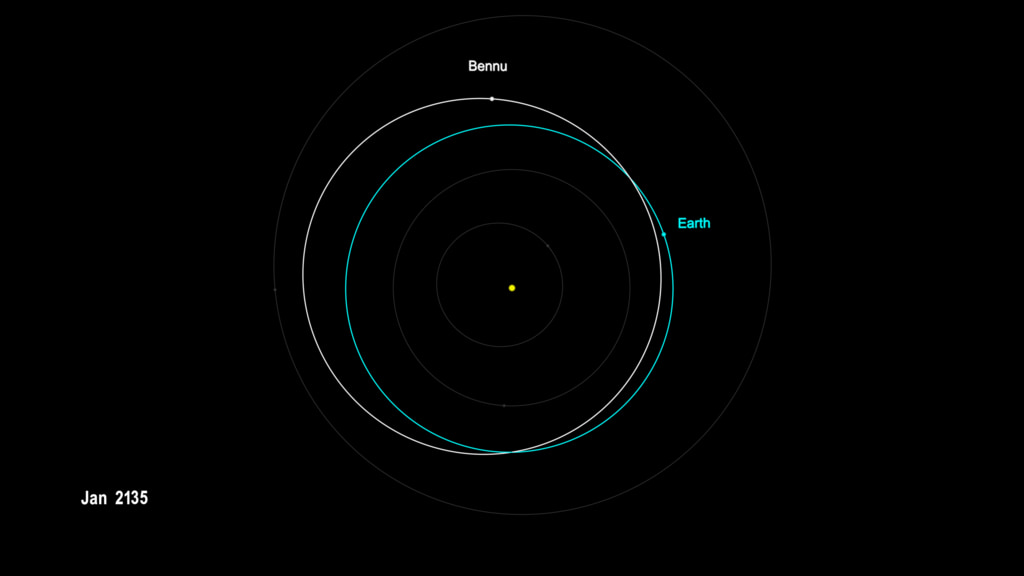
https://science.nasa.gov/solar-system/a … nnu/facts/
Quote:
The orbit of Bennu is characterized by the following details:
Bennu makes one orbit around the Sun approximately every 1.2 years (or 437 days).
2
Its orbital path is tilted about 5 degrees relative to Earth's orbit.
1
Bennu comes as close as 0.90 AU (about 84 million miles) and reaches as far as 1.36 AU from the Sun.
1
It makes a close approach to Earth every six years, coming within about 186,000 miles (299,000 kilometers) of our planet.
1These characteristics highlight Bennu's unique orbital dynamics in our solar system.
As a source of supply to a station in a concentric ring, it may have possibility.
It is considered to be a hazard, but what if it were simply consumed to provide useful materials, and to eliminate the danger?
Ryugu is a similar object to some extent: https://en.wikipedia.org/wiki/162173_Ryugu
It seems that there are lots of tiny asteroids that could not be detected before, so many like this may be available further out in the Asteroid Belt.
https://news.mit.edu/2024/mit-astronome … -belt-1209
Quote:
The detection of small asteroids in the main asteroid belt has been a significant advancement in the field of astronomy. Researchers have identified 138 asteroids ranging from bus-sized to stadium-sized, using advanced techniques like "shift and stack" and data from NASA's James Webb Space Telescope (JWST). This discovery is crucial for tracking potential asteroid impactors and understanding the origin of meteorites. The study's lead author, Artem Burdanov, from MIT, emphasizes the importance of precise orbital tracking for planetary defense. The findings fill a knowledge gap for tracing the source of meteorites and larger potentially hazardous asteroids in Earth's vicinity.
MIT - Massachusetts Institute of Technology
+4
So, perhaps 40% of the inner asteroid belt asteroids are thought to be Carbonaceous.
https://www.universetoday.com/articles/ … d-belt-sun
Quote:
Between 2.1 and 3.3 astronomical units
The asteroid belt is located between 2.1 and 3.3 astronomical units (AU) from the Sun, which translates to approximately 329 million to 478.7 million kilometers (204.43 million to 297.45 million miles). This region lies between the orbits of Mars and Jupiter.
Universe Today
+2
So, a concentric rings method might reach from Mars/Phobos/Deimos, and so then link Earth/Moon to a concentric ring's method.
Any small asteroids who cross paths, are possibly got places to get materials to a concentric rings station.
So, perhaps these will have enough materials along with those of Mars/Phobos/Deimos, to allow a concentric ring system to be resupplied effectively.
Ending Pending
#579 Re: Terraformation » Robot Worlds » 2025-10-23 18:43:16
So, then "Glass Bubbles" on Mars and "Glass Bubbles" in orbit are more or less Para-Terraforming. And they hold more promise of an Earth-Like existence than terraforming Mars as a whole.
And as SpaceShips can be SSTO on Mars, is it that wrong to suppose that you could make Liquid Methane on the surface of Mars, and bring it to orbit to react with the solid materials of Phobos and Deimos, to create H20 and CO2?
I feel that Martians may want to more be in orbit than on the surface of Mars, as their habitations can be part of a Spiral backbone of the solar system.
I have already mentioned this in another topic. Cycling Spaceships are interesting, but I want to explore Concentric Orbits with linking spirals.
Here I show 3 concentric orbits between Earth and Mars: 
Without being insulting, I want to say that this is different than 60's and 70's thinking. In the Apollo age the idea was chemical to the Moon and Nuclear to Mars. Using the Hohmann Transfer method. This is not that.
They were stuck on the fact that in their time Electric Ion propulsion was not emergent, I believe, not very much. And it was the Atomic Age and the Space Age. Each sound impressive.
Space has been stuck on the idea that the sunlight thins out as you travel away from the sun. But with properly sized mirrors this can become only a little trouble as you make 5 steps Earth>Mars, at each you take on a larger sized mirror and leave your smaller one behind.
This then sizes your mirror mass more appropriately to the power needs. The power system the mirrors would feed is either Solar Panels or perhaps CO2 Supercritical heat engine.
I know that most people here feel that the solar panels are effeminate. Powerful always sounds masculine. "The Big Greed" Even women have it. But practical is more the desire take your fetishes elsewhere.
I do realize that the proper alignment of stopping points will repeat only occasionally if there is only one orbital station in a ring, so there would be many. Many of them would be simple warehouses inhabited by robots. Over time though they might build up into full habitations for humans.
Being able to trade mirrors is helpful, but we may want to move humans and a minority of cargo fast, but the bulk of cargo slow.
So the slow ships would be used to stock the orbital stations with propellants and parts. The fast ships would take on enough propellants to get to the next station (+Margin), and could travel faster as to be lighter. And of course they would exchange mirrors also.
Each ring might have multiple stations in it set apart from each other. Instead of 3 rings there could be 10 or 100 or 1000. Is there a limit?
It may be possible to communicate cargo to an from asteroids to some of these stations.
While an Argon/Xenon mix might be considered for propellants, Neumann Drive and Magdrive are expected to be able to use most conductive materials as propellants. This includes Iron, Aluminum, Silicon, Carbon, and more.
We may also anticipate a mass driver on a ship that shoots out Dry Ice pellets with some magnetic Iron in them.
Is solid Oxygen Paramagnetic?
https://en.wikipedia.org/wiki/Paramagnetism
Quote:
Copilot Search Branding
Yes
Yes, solid oxygen is paramagnetic. This property arises from the presence of unpaired electrons in the oxygen molecule, which allows it to be attracted to an external magnetic field. In solid oxygen, the magnetic moments of the unpaired electrons align with the magnetic field, resulting in a net attraction.
Wikipedia
+2
More difficult than Dry Ice with Iron, perhaps, but if you can make Oxygen ice cubes of a correct size and shape you might be able to expell them from a ships mass driver to provide propulsion.
I would expect that between the orbits of Earth and Mars, both Dry Ice and Oxygen Ice Cubes when expelled from the ship will rapidly evaporate.
The point is you could get Oxygen from almost any asteroid or moon in the solar system.
So, a mining base at a NEA may be ablet to move materials to a convenient station in the circular concentric orbits.
Of course, if this works you would extend it towards and into the asteroid belts.
Ending Pending
#580 Re: Terraformation » Robot Worlds » 2025-10-23 17:26:44
And I suppose over time there could be developed something like "Glass Domes" on Mars. But if you can do that, why can't you build "Glass Domes" in orbit? So, I guess that could become a choice.
I tend to take a conservative view of the potential of Phobos and Deimos.
Some people seem to get excited by the notion of Single Stage to Surface Point with a suborbital starship.
But for Mars and other worlds, SSTO and SSSP are both in the cards.
The potential connection of Mars surface to Orbit is much better than the one for Earth surface to Orbit. The idea that people might be locked into some sort of underground bunkers will likely not be true for Mars.
So, people will be able to "Vote" with their feet. If they want to be on the surface of Mars for some reason, they could. But if they may choose to be in orbit of Mars that is also an option.
If there is a need for human on Mars itself, it could be. But it might be perfectly possible in the future for a human in orbit to be virtually on the surface of Mars using telepresence and a avatar robot.
So, then as far as "Glass Domes" go, or rather pleasant places to live, whichever is easiest to build will attract the people. At this time my guess is that orbits of Mars may be more attractive.
But Mars as a source of raw materials and resources, could include humans on the planet directly or remote presence may do.
At a minimum the moons of Mars can provide various silicate materials with Oxygen. By lifting Hydrogen from Mars, water can be created. I am a bit optimistic that the moons will have some Carbon. If not it and Nitrogen could be lifted to orbit.
But all of this is likely to interconnect to asteroids, where many raw materials and resources can be obtained in my opinion.
I do not like the idea that many have from the 60's and 70's that the asteroids are too remote.
Thin mirrors and robots with solar panels or heat engines should make connections to asteroids practical.
Ending Pending
It is likely that we will soon find out if NASA and the government will play "Depowering Mother" or not.
Quote:
Copilot Search Branding
Images
Videos
Overbearing, controlling, and manipulative towards her children
Devowering Mother
The Devouring Mother archetype is a psychological concept that describes a mother who is overbearing, controlling, and manipulative towards her children. This archetype is often associated with possessiveness and narcissism, and it can lead to a child's development being hampered and their autonomy being compromised. The Devouring Mother often treats independence as betrayal and sees her child not as an individual but as an extension of herself. This type of parenting can result in guilt, obligation, and emotional paralysis for the child.
Learning Mind
+1To overcome the toxicity of the Devouring Mother archetype, it is important to reflect on one's relationship with a mother resembling this archetype and to seek self-nurturing practices. Setting boundaries and fostering healthier relationships is also crucial.
At the moment there is some amount of shadow. I have seen it before. The desire to "Eat the Profits". The lack of ability to defer consumption.
I hope that NASA does not turn again to cannibalism.
Ending Pending
#581 Re: Terraformation » Robot Worlds » 2025-10-23 08:15:46
It is obvious that due to the nature of Mars and much of the solar systems reality that robots that can deal with cold, at least some cold are going to be wanted.
The zones between the poles and equator of Mars have many situations of thick slabs of ice under some layer of regolith overburden.
The scale of some of these slabs is rather large: https://www.usgs.gov/news/national-news … ion-images Image Quote: 
Quote:
For the first time, high-resolution images show the three-dimensional structure of massive ice deposits on Mars. According to an in-depth analysis led by the USGS, the images reveal never-before-observed details about the ice sheets, including that some begin just a few feet below the Martian surface and extend to depths greater than 300 feet.
Some of these ice slabs extend at least halfway to the Equator, so solar energy will be a bit like Kansas, I think. That is, there will be come solar energy year around barring serious dust storms.
This map give some idea of relatively shallow ice: https://www.nasa.gov/solar-system/nasas … e-on-mars/
Image Quote: 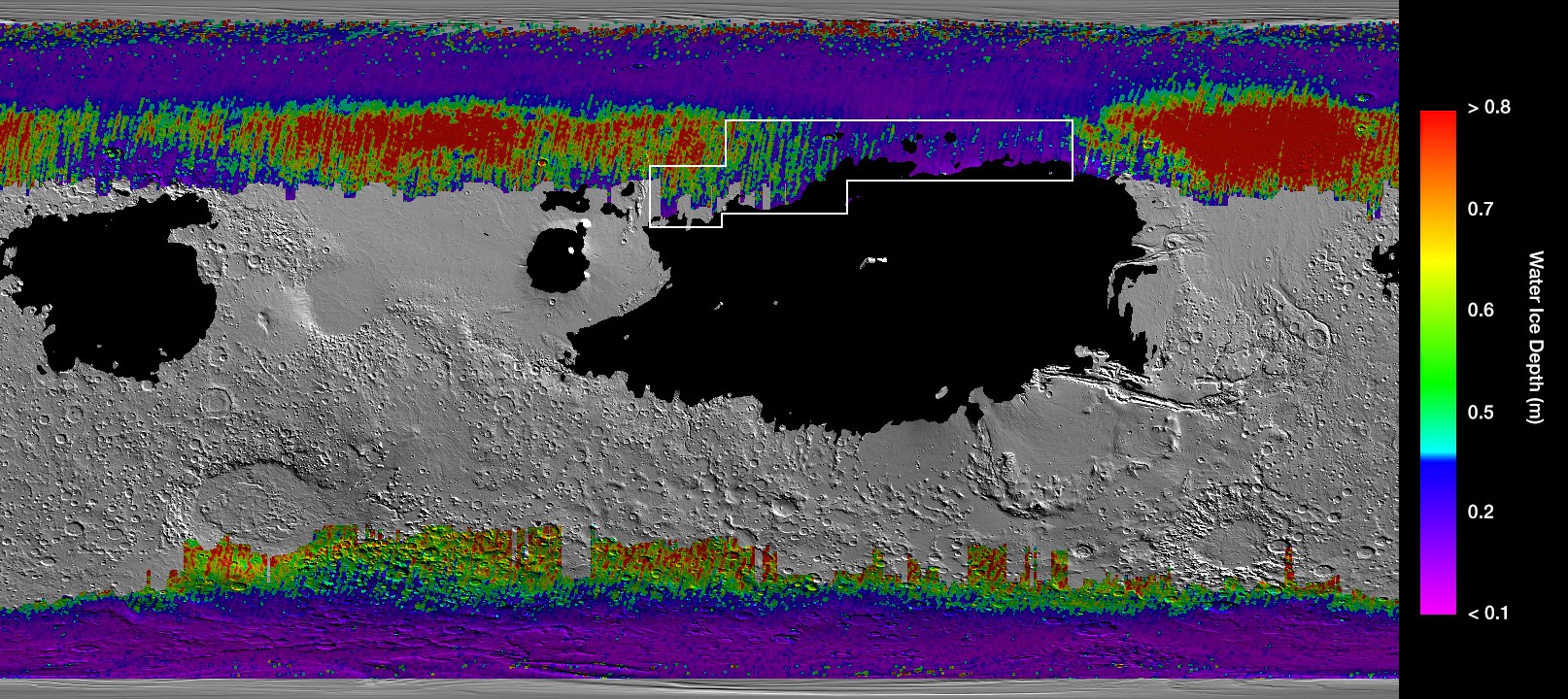
Quote:
This rainbow-colored map shows underground water ice on Mars. Cool colors are closer to the surface than warm colors; black zones indicate areas where a spacecraft would sink into fine dust; the outlined box represents the ideal region to send astronauts for them to dig up water ice.
Credits: NASA/JPL-Caltech/ASU
I think that it is notable that the deeper buried deposits extend into the southern edge of the Hellas Depression. (Towards the bottom left).
I believe that the map is for deposits that SpaceX could use to refill Starship. It does not show deposits that may be closer to the Equator and perhaps buried under more regolith.
It does not show the deposit in Candor Chaos of the Rift Valley: https://www.space.com/mars-water-below- … ris-canyon Quote:
Water ice may be lurking just a few feet below the Martian surface at one of the Red Planet's most dramatic sites.
That's according to new research based on data gathered by the Trace Gas Orbiter (TGO), part of the ExoMars mission operated by the European Space Agency (ESA) and its Russian counterpart, Roscosmos. ExoMars includes both TGO, which launched in 2016, and the Rosalind Franklin rover due to launch to Mars next year. Among the instruments aboard TGO is one called the Fine Resolution Epithermal Neutron Detector (FREND), which can detect hydrogen, one of the two elements that make up water. New analyses of FREND's data show high levels of hydrogen at a site called Candor Chaos, located near the heart of the massive canyon system dubbed Valles Marineris.
"We found a central part of Valles Marineris to be packed full of water — far more water than we expected," Alexey Malakhov, a senior scientist at the Space Research Institute of the Russian Academy of Sciences and a co-author of the new paper, said in an ESA statement. "This is very much like Earth's permafrost regions, where water ice permanently persists under dry soil because of the constant low temperatures."
The size of that deposit is about that of the Netherlands, I believe. For that reason, I suspect that Hellas may have more underground ice than is shown on the Map.
I think that there is a pattern of selective release of information. Authority prone types who we co-exist with in the USA, do for good or bad reasons, try to harness the energy of the population to make them servile. I believe that the legs of the space program are broken periodically to achieve this. Invention created by enthusiastic good intentions is then appropriated, and a government restart is done periodically. We may be experiencing such an event just now.
I am sure that there are quite a few who think that humans in space is of little or no value. And certainly, low level munchkins are not worthy. It is what we have to deal with though. Extreme specialists with limited awareness of the scope of realty seeking to enslave the generalists. Sometimes you catch the bus, and sometimes the bus catches you. (From a friend who has passed away).
Anyway a 300-foot-deep layer of ice will exert almost 1 bar of pressure on its base. Looking at the first picture in this post, we might speculate what lies below the ice? In some cases, is it Lava Flows, lose regolith, or sandstone?
We might want to find Sandstone.
So, if found then robots might exist in caves carved in ice. Humans and Robots might also exist in caves carved in sandstone deep below the ice.
Sandstone caves deep enough could be warm.
Sandstone blocks could be used for various purposes, such as floors for ice caves and supports for ice caves.
So, my hope is that this could be done in the Hellas Depression and perhaps in Candor Chaos in the rift valley.
This would be quite a lot of protection from the harsh reality of Mars.
Ending Pending
#582 Re: Interplanetary transportation » Multi-Ship Expeditions, Starboat & Starship, Other. » 2025-10-22 15:59:57
I am not sure they should be maybe they could bid to make Starboat for NASA, if NASA is disenchanted with Superheavy/Starship.
They already have the raptors and means to work with Stainless Steel.
The ship could be lofted with Falcon Heavy or maybe even Falcon 9.
They would not have to human rate Falcon Heavy as after the Starboat was lofted, a crew Dragon could accompany it to transfer the crew.
Dr. Robert Zubrin has lobbied for it: https://www.nextbigfuture.com/2025/03/z … rboat.html
I believe it would have 1 sea level raptor and 1 vacuum raptor.
They would not have to make its first editions suitable for Mars but make the proto-type suitable for the Moon, but potentially modifiable to become Mars ready later.
So, basically a Mini-Starship. If they sized it correctly it might be compatible with other 1st stages such as Vulcan, New Glen, and perhaps European launchers. So, SpaceX with permission from the US government might allow it to be licensed for use from other vendors/nations.
We can say, Oh-No! China will get a copy, but they will be able to copy pretty soon anyway.
So, the Lunar Starboat, might not be that hard to produce. And it is a bit of a joke, as if NASA puts out bids, maybe SpaceX should put a bid in. They have the Raptors and know how to work with Stainless Steel. Possibly it would not be too hard to make a factory for such a production.
In that case then an expedition to the Moon could be less demanding on refilling Starship. This does not interfere with deploying Starlink with Starship.
They then eventually may or may not upgrade the Starboat to a Mars version.
Once they got Starship refilling in LEO operational then they could have this little ship and also versions of the Lunar Starship. One for Cargo that stays on the Moon, and one that can support the Starboat from Lunar Orbit, and it may even be able to land on Earth if the progress with heat shields goes well enough.
I see this as both a good plan and a fun joke on NASA.
Ending Pending
#583 Re: Terraformation » Robot Worlds » 2025-10-22 15:40:30
From the just previous post:
So, if 10% of the ice caps were carved out (Melted/Evaporated), then that would be 160,000 cubic kilometers of void space.
Some large amount of that could be pressurized actually to hold reserves of Oxygen and Methane perhaps.
So, I suggested that these chambers would be mostly cold perhaps -20 degrees C, maybe a bit warmer.
But what if humans appropriated 1% of that for warmer quarters? So then 1,600 cubic kilometers of warm spaces.
That is a lot of space, even if the minority of ice cave structures.
Probably these could be something like skyscrapers inside of an ice cave, the ice cave being well reenforced against cave-ins. A heat pumping process could make sure that the heat in the ice cave were pulled back into the building as it leaked out.
If the heat built up to be too much it could be used to melt more ice cave space.
These places may seem dreary, but actually if we had several sources of energy, there could be green gardens in the buildings.
I feel that various spaces of Mars/Phobos/Deimos/Asteroids would be under development at similar times.
So energy for a polar cap could come from:
1) Nuclear Fission.
2) Summertime Surface Solar.
3) Orbital Space projected to the ice caps.
4) Perhaps Fusion power.
Some ice caves might be filled with Oxygen, some with Methane, robots could operate in either or in those that might be filled with Mars atmosphere. The storage of liquid forms would also be possible but maybe a bit more difficult.
So, what would become of the water that was meted or evaporated out of the ice caves?
Some would be used in the creation of Methane and Oxygen to fill the ice caves.
Some could be transported to fill a expanse of lakes and small seas.
If they had salts in them from the soils then perhaps Uranium would be in dissolved form in the water and could be extracted for energy.
Also some Methane would be exported from the Ice caps planetwide. And likely perhaps also Oxygen.
In orbit of Mars at the same time could be spin gravity habitats that could be from 1/6th to 1 g in force and would have very nice Earth simulations.
What Phobos and Deimos might lack for building these could be supplied from Asteroids or if necessary, from Mars itself.
So, this world would not be one where you spent your entire life underground or under-ice on in the Under-Mars, but also could at times live in the sky.
If the inhabitants later on wanted to melt the ice caps as many have expressed a desire for, I guess they will do so. That will be their business. However, I don't think that is needed or desired.
But that is just my tastes in the matter.
Ending Pending
#584 Re: Terraformation » Robot Worlds » 2025-10-22 09:12:41
while in the previous post I tried to establish some notion of a robot settlement in Hellas, now I want to try to do similar for the polar areas.
Eventually it might be possible to do the actual poles but perhaps at first the edges would make more sense. Somewhere where a significant ice layer exists where tunnels and vaults could be dug into the ice.
Quite often the polar ice caps of Mars are dismissed as impossible due to cold. But then people will talk about going to Ceres and Callisto. It really does not make sense.
https://marsed.asu.edu/mep/ice/polar-caps
Quote:
About 290 K (62 °F, 17 °C)
The summer temperatures at the polar ice caps of Mars can reach about 290 K (62 °F, 17 °C) during the daytime. However, the polar regions experience extreme cold, with temperatures dropping to around -150° C (about -238° F) during winter. The polar ice caps are primarily composed of water ice and carbon dioxide, which can change size and composition throughout the seasons.
https://exactlyhowlong.com/how-long-is- … s-and-why/
It needs to be remembered that the year on Mars is Quote:
Approximately 687 Earth days
A Mars year is approximately 687 Earth days long. This duration is nearly twice as long as a year on Earth, which is about 365 days.
ExactlyHowLong.com
+3
So, the span between the equinoxes is ~11.45 Earth Months, since the year is about 22.9 Earth Months.
So, my thinking is that for 1/4?, 1/3?, 1/2? of the year robots that are sufficiently hardened might work on the surface of Mars.
The rest of the year they will need to be underground/under-ice working or hibernating.
The case for Nuclear in that situation is very large actually.
I believe that batteries are being made that may work well at -20 degrees C, so ice tunnels may be perfectly good for robots in the winter.
Should they have nuclear power available they could be involved in creating products including Methane perhaps to pipe around the planet. In this case Methane leaks would be regarded as to some degree desirable.
The volume of the Martian ice caps:
https://en.wikipedia.org/wiki/Martian_polar_ice_caps
Quote:
Approximately 1.6 million cubic kilometers
The volume of the Martian ice caps is estimated to be approximately 1.6 million cubic kilometers for the northern polar cap and about 800,000 cubic kilometers for the southern polar cap. These ice caps consist primarily of water ice, with some dry ice present in the southern cap.
Wi
So, if 10% of the ice caps were carved out (Melted/Evaporated), then that would be 160,000 cubic kilometers of void space.
Some large amount of that could be pressurized actually to hold reserves of Oxygen and Methane perhaps.
Anyway, personal business, so I will continue later.
Pause......
The effort to figure out how to live inside of ice masses is going to be very important. Ice masses on Mars and even further out and even Mercury, if the deposits turn out to be "Slabs" of ice.
And it seems that there are very large "Slabs" of ice in the "Temperate" zones of Mars and even massive deposits buried near the Equator.
While it seems reasonable to me that robots might do well in sub-zero ice caves, humans of course would like to be warmer. But Nuclear and heat pumps should make both very possible.
The practice of having Methane pipelines to circulate Hydrogen on Mars will lead to leakage that will help to terraform the planet.
As far as the ~10% of the ice mass that might be converted to Voids, I suggest the making of lakes and seas with coverings to support biological activities.
Ending Pending
#585 Re: Terraformation » The Moon » 2025-10-21 19:18:21
Some won't like this video as there is some amount of propaganda gloating for China and a bit of put-down for the USA. But even so, the information is important.
https://www.bing.com/videos/riverview/r … ORM=VRDGAR Quote:
China Discovers a Staggering 270 Billion Tons of Liquid Water Hidden on the Moon!
YouTube
Tech Teller
17 views
I don't see the USA as earning that much put down, but it does explain why NASA has begun harassing SpaceX. They must be getting pressure from powerful politicians.
I was around when the space program was stifled. I know the mentality of the people who stifled it.
Unfortunately, the character of the USA is good much of the time, but sometimes it eats its own children rather than to promote them to greatness.
China and others are not without their own problems/faults. But they are entitled to be pleased that they disserve recognition for this.
As for the US and other countries like it, we are in our European parts, a combination of remnants of Hunter Gathers, Farmers, and the Steppe peoples. I consider that they each bring gifts and also problems.
The Steppe peoples somewhat may be more mobile and having the technology of that.
The Farmers though produce a problem which is the excessive building of Hierarchy built too much on verbal skills. If the Hierarchy can cause the skilled in violence to obey it, then the masses can be enslaved. A threat to this power pyramid is technology. Apollo produced to many technologically skilled people with them accumulating power. Of course, the priesthood of the farmer inheritance resented that and wanted to convert it to things they could command and extract power and wealth from. So, the kill Apollo and promote the military.
Don't get me wrong, I am still here and I do not speak Russian or Chinese. I am not dead (Yet). Unfortunately, in dealing with the Farmers as in dealing with the other two heritages, you have to take some bad with the good. And it is hard to tell from time to time which is which.
But Apollo sampled materials near the equator, I believe, and the Farmers wanted to emphasize that the Moon was a very dead and useless world. They come in various flavors.
-Want the money for violence/security.
-Want to keep the human race on the Earth so we will be here when the rapture comes.
-Are atheists anti-humanist scientists who value their ivory towers among the anointed. Want grant money. Do not think that common people should be allowed to breed, perhaps.
-Jealous.
Even if water was found they would be happy to say that the samples were contaminated being brought to Earth. They would be happy with a dead dry Moon.
Then they could say they were aiming at Mars, but never really mount a serious effort, just keep resetting the game, churning the money.
Again, although all of that frustrates me, I do have it rather good relative to average people on the planet, (Except for that bitter feeling of having my time wasted).
Still here we are and we have to work with what we have.
Ending Pending
#586 Re: Not So Free Chat » Politics » 2025-10-20 21:10:46
There is a place for mercy and also to help build the people to run our society up.
But what the left has done with Americans is like school yard bullies making false accusations of guilt, stealing our lunch money, and trying to hold us down and rape us.
We have had enough.
Ending Pending
#587 Re: Terraformation » Robot Worlds » 2025-10-20 20:25:51
I think it is reasonable to presume that the human race on Earth will be embedded in swarms of robots. This may be a blessing, or they may end up killing us off, or maybe some of both. It is likely that some humans will live to see whatever is going to happen.
Similarly for other worlds, swarms of robots seem likely to me to emerge. If it turns out that robot swarms are compatible with humans, then they may make it more possible for humans to prosper on other worlds like the Moon, Mars, or significant asteroids.
I would say that such robots have to become very robust to survive these environments, but I think it is in the area of possible to try to make such a collection/swarm of machines.
Keep in mind that in the case of Hellas, if you could also evaporate all of the CO2 that is solid, but not necessarily melt or evaporate all of the water ice, you could increase the air pressure of Hellas more than 2x or very optimistically 2.5x. So currently maximum pressure is ~11.5 millibars. So, >~23 millibars and very optimistically >~28.75 millibars. I use > because the air column will compress, so the ultimate maximum pressure could be > 2x or optimistically >2.5x.
I think that this would afford the robots a great deal more radiation protection than what is now available and the Hellas already offers the best conditions on the Mars surface.
The pressure being higher, then the temperatures will likely tend to be higher.
I have read that under those conditions real snowfalls might be possible, and even temporary melt water streams. If so, then the basin might be a suitable place to refill Starships and to land them. Otherwise, it may be that there may be aquifers with brine. There may also be convenient glacier deposits.
One thing that is nice about Methane on Mars, is that you could pipe it around, and get it to Starships that way, and you can also react it with Oxygen to get more water as well. Where piping water or Hydrogen would be inconvenient, Methane would be quite convenient, provided you have the infrastructure of robotics to build pipelines.
Power beamed from orbit may at times be helpful, and also it may be that power may be beamed up from Hellas to orbit. This is a good reason to want to control the dust.
As for the structure of the book shaped 90-degree solar collectors, I am hoping that the foundations can be made firm and the main structure be made of compressed blocks of Mars soil.
https://www.sciencealert.com/it-turns-o … n-concrete
Quote:
Martian Soil Can Be Compressed Into Bricks Stronger Than Concrete
Space
28 April 2017
ByPETER FARQUHAR, BUSINESS INSIDER
Quote:
Copilot Search Branding
Images
Videos
The ability to turn Martian soil into bricks without the need for traditional brick-making methods is a significant advancement for future Mars colonization. The process involves compressing Martian soil simulant under high pressure, which effectively binds the soil particles together, resulting in bricks that are stronger than steel-reinforced concrete. This method eliminates the need for additional ingredients or baking, making it a practical solution for constructing structures on Mars. The discovery of this technique is a testament to the innovative thinking of scientists and engineers who are working towards sustainable and efficient space exploration and settlement.
ScienceAlert
+5
While one function of these devices would be to serve as dust collecting wind fences, of course also the hope is to mount solar panels on them as well.
Further, if this device is to be considered a sort of stationary robot, the small amount of computer brains it needs can be hosted behind the "V" of the device in the shadow, where much solar radiation will be blocked, also some GCR would be somewhat blocked as well.
I will show the diagram again: 
By texturing the land in this manner, you greatly increase the surface area that sunlight touches and also expand the amount of surface that infrared can be emitted from into space. So, I anticipate that this may alter the way the Hellas Basin heats up in summer when global dust storms could be triggered. The solar "Books" may act like heat exchanger fins and change that relationship.
To some extent if we are converting some of the sunlight to electricity, we reduce the heating during the day. But the solar panels may tend to retain heat as well. But the brick walls will store heat during the day and release it throughout all the hours of the Mars Day/night cycle.
It maybe that this will reduce the trigger for a Global Dust Storm. But the wind fence effect will also help.
The stationary solar robots might be made very robust to survive the harsh winters. More sensitive robots might go underground where they might be protected. Perhaps part of the power grid would be nuclear fission and perhaps power could be beamed down from orbit in the winter.
Anyway, I see this as a possible contribution to a whole list of tools to terraform Mars with.
Ending Pending
#588 Re: Terraformation » Robot Worlds » 2025-10-20 09:07:55
What I have in mind as a possibility is a solar device that also shades a patch of soil behind it so that it will be colder than normal.
I had thought of a tetrahedron shape but now am thinking of a sort of "Open Book" structure. As if you had opened a book, perhaps to 90 degrees and set it on end on a flat surface.
I will try to show an illustration of my intentions:
The device may have to deal with dust accumulations and also seasonal CO2 frost accumulations. So, vertical has some advantages.
The Shadow provided behind it can be heavily salted so that the cold spot provided by the shade can, I hope accumulate moisture.
It is intended that a "Forest" of these devices will be attended by mobile robots that will dust them off and also collect dust accumulations and also have the ability to "Vacuum Microwave" the soil in the shade to collect water vapor to condense into collected water or ice.
The collected dust could be processed into useful objects using heating/pyrolysis in the presence of Hydrogen. This should allow the creation of water by reducing the Iron in the dust. The water can then be split again. As I understand it this process should accumulate more Hydrogen than what is placed into the process.
Possibly the Iron and other substances can be extracted. In the end the idea is to collect dust in Hellas and convert it into "Not Dust". This may help to change the climate of Mars.
A robot-based community would act like a Von Neuman Machine, expanding its reach.
The intention is to dispense with the severe global dust storms on Mars and to moderate them to be less of a problem.
https://en.wikipedia.org/wiki/Von_Neumann_machine
Quote:
Self-replicating machine, a class of machines that can replicate themselves
Universal constructor (disambiguation)
Von Neumann probes, hypothetical space probes capable of self-replication
Nanorobots, capable of self-replication
So, the machine would be more of a collection of robots, some of them stationary solar wind breaks and the others attending to them. And then there would need to be construction robots that would build more stationary and mobile robots.
This of course could be done in the Northern Hemisphere as well, but Hellas is where the global dust storms seem to start up.
Where Mars does not seem to have the ability to dispose of fine dust, we would provide a means for its elimination.
The shaded salt beds would be created by extracting salts from soils that are being processed into more robots.
The deeper thickness of atmosphere may help to protect the robots from radiation, but to some extent their "Brains" could also be shielded with regolith in some manner as well.
I am not certain, but I suspect that it may come to be that enough water might be collected that human life could be supported within the robot community.
Perhaps enough water would be available to support Starships to land and refill.
If not then I suggest trying to make a rocket engine that can run on CO and O2. My guess is that it will be possible to find a way to refuel with Methane though.
Hellas would be perhaps the best place to land Starships on Mars.
Ending Pending
#589 Re: Not So Free Chat » Politics » 2025-10-19 22:31:16
I will accept that in part. It was because of the rivalry of world powers and the distance of the Atlantic, that the USA could exist and was not subsequently reabsorbed (Yet).
I believe that various Europeans including some British did have aspirations for the greater rewards of merit rather than inherited short-cut minds.
As for your king, we still owe him some consideration in the way we suppose that consideration is given to us. (Not so sure anymore).
The remnants of the British Empire have been infiltrated by Orientalists, in my opinion, and I fear that some of them entertain the subjugation of some of us in America as was done to the Boers.
Yes, I know that is tricky. The British used non-Europeans at times, and were the ones who seem to have created the concentration camps for the Boers. I do not accuse the British Nation of treachery, but my spider sense tells me that there are some bad apples in the barrel.
The Boer reference is unfortunate as it implies a race issue as the dominant parallel. As is quite common the story of the Boers was that they settled in a place which was occupied by a non-Bantu people while the Bantu were colonizing from the North. The original inhabitants are to a large extent a small remnant, or in the mixed race people called Colored, I believe. I do not hold the Boers as angels nor do I hold the Bantu as angels. Only human.
But the concern now may some of the Europeans selling out to the type of people who have been pushed into your countries and Canada, in hopes of being on the ground floor of an imperial empire that does not respect historical European values, and are they hoping to come for us?
It is obvious that their was a campaign to guilt my people with blood libel and the strip us of our industrial capacity which might protect us in war?
The pattern seems to suggest a collaboration of Marxists and Islamists to disrupt our presence on this planet as a capable force. An Axis of evil I might call it.
It is a pattern which suggest bad intentions. It is not yet proof, but very suspicious.
Blood Libel is that my ancestors by reputation recorded did not participate in the slave trade, did not own slaves, and fought in the army opposed to the slavers. While they did not want slavery for various reasons, that did not mean that they would really want to cozy up to the freed slaves. That is thought of as racism, and I suppose it was in a sense. But so called "White" ethnic groups did not so much feel they wanted to quickly integrate with each other's nationalities. It took some considerable time.
But I can say that for any so-called black person they are likely descendant of a slave owner, and sometimes those slave owners were not so called "White".
In the end the freed slaves were adopted, grudgingly and sometimes resentfully.
But I do not accept that I inherit a special blame for slavery more than black Americans do.
The Kongo had slave empires that were a collaboration between the Portuguese and the local peoples (Africans). They were usually the slavers, and not so much people from the USA. (Or so much the British).
My point being that if you allow it and do not look it over and think it through these same people will try to enslave you with words of lies and distortions.
Ending Pending
#590 Re: Terraformation » Robot Worlds » 2025-10-19 09:54:40
For Mars, while I anticipate any number and kind of robot for use, I have wanted to work on the idea of a robot tree. It is not impossible that such could have legs, but for now I do not promote that, except where it may be useful.
Their are two specific locations I have in mind, the polar ice caps and the Hellas Basin.
Radiation being a problem for thinking machines as well as for Humans these locations offer some potential mercy. For the polar caps, water ice or even liquid water can be used for protection. As for Hellas the thickness of atmosphere may also offer some natural protection. I have discussed the Ice Caps in this manner before and though they have a harsh environment, the ability to manipulate albedo of the ice caps and to alter atmospheric chemistry make the idea attractive. There are water and CO2 locally available, and also in the summer, sunlight for energy.
For Hellas, I am hoping to do a similar thing but along with albedo and atmospheric chemistry, I want to add the potential for planetary dust control.
We can imagine whet the Earth would be like if it had no vegetation, at least on land. Raging rivers cutting the stone of continents, and dust and sand traveling and accumulating unless dropped into liquid water.
Mars might have been like that a long time ago even with open water, but now it does not have the open water. The accumulation of dust in the wind is not surprising.
Wind Fences:
https://en.wikipedia.org/wiki/Great_Plains_Shelterbelt
Quote:
Copilot Search Branding
The Great Plains Shelterbelt project, initiated by President Franklin D. Roosevelt in 1934, aimed to combat the severe dust storms of the Dust Bowl. This initiative involved planting trees along the perimeters of farms to reduce wind velocity and minimize soil erosion. By 1942, 220 million trees had been planted, covering 18,600 square miles in a 100-mile-wide zone from Canada to Texas. The project was a significant effort to address the environmental crisis caused by the Dust Bowl, representing the largest and most-focused government response to an environmental problem at the time.
WikipediaWindbreaks, also known as wind fences, were established as part of this initiative to protect the land from wind erosion. Native trees like red cedar and green ash were planted along fence rows, and farmers were compensated for planting and cultivating them. The project was estimated to cost $75 million over 12 years.
WikipediaWindbreaks have been a vital practice in the U.S. for soil conservation and agricultural protection since the 1930s. They have reduced soil erosion, protected crops and livestock, and improved farmsteads. Windbreaks can also serve as revenue-generating enterprises when planted with profitable crops.
USDA
Global Dust Storms on Mars seem to occur about every 3 years due to a differential temperature buildup between Hellas as warm and the poles as relatively cold, I speculate.
https://www.sciencealert.com/giant-dust … -heres-why
Quote:
Mars experiences global dust storms that can engulf the entire planet, significantly impacting its atmosphere and missions, with the most notable event occurring in 2018.
Overview of Global Dust Storms
Mars is known for its frequent and intense dust storms, which can occur every Martian year, particularly during the summer months in the southern hemisphere. These storms can start as smaller regional events but can grow to cover vast areas, sometimes enveloping the entire planet for weeks or even months. The storms are driven by complex atmospheric dynamics, including temperature differences between the Martian surface and its atmosphere.
ScienceAlert
+1
The 2018 Global Dust Storm
The 2018 Mars global dust storm was one of the most significant events in recent history. It began in late May 2018 and escalated rapidly, covering the entire planet by mid-June. The storm was notable for its intensity and the rapidity with which it developed, reaching peak conditions where the dust optical depth (a measure of dust concentration) exceeded τ=5, severely reducing sunlight on the surface.
Wikipedia
+1
Impact on Mars Missions: The storm had a profound effect on NASA's Opportunity rover, which had been operational since 2004. The dust blocked sunlight from reaching its solar panels, leading to a suspension of its scientific activities. Unfortunately, Opportunity ceased communication in June 2018, and efforts to re-establish contact were unsuccessful. Meanwhile, the Curiosity rover, which is nuclear-powered, continued its operations unaffected by the storm.
22 Sources
Recent Developments and Research
In addition to the 2018 event, Mars continues to experience dust storms, with a notable storm occurring in January 2022 that affected several NASA missions, including the InSight lander and the Ingenuity helicopter. Recent studies have focused on understanding the mechanisms behind these storms, linking them to the planet's energy dynamics and atmospheric conditions. Researchers have found that warm and sunny days can trigger these massive storms, which is crucial for future crewed missions to Mars.
NASA
+2
Conclusion
Mars' global dust storms are a significant aspect of its climate and have important implications for ongoing and future exploration. Understanding these storms helps scientists prepare for the challenges they pose to robotic missions and potential human exploration of the Red Planet.ScienceAlert
Giant Dust Storms on Mars Engulf The Planet For Months. Here's Why.SciTechDaily
Unlocking Mars’ Secrets: The Surprising Forces Behind Its Massive Dust ...View all
Global web icon
NASA
https://www.nasa.gov › solar-system › the-fact-and...
The Fact and Fiction of Martian Dust Storms - NASA
Sep 18, 2015 · Scientists have been tracking these global dust storms on Mars for more than a century, using both telescopes on Earth and spacecraft orbiting Mars. The storms have been …
News about Global Dust Storms On Mars
bing.com › news
Mars images uncover a world of dust devils and wild winds
Earth.com
Earth.com
· 5d
Mars images uncover a world of dust devils and wild winds
Scientists combined 20 years of Mars images to track over 1,000 dust devils, …Scientists Just Mapped 1,000 Dust Devils on Mars — Revealing the Red Planet’s Hidden Tornadoes
The Daily Galaxy on MSN
The Daily Galaxy on MSN
· 10d
Scientists Just Mapped 1,000 Dust Devils on Mars — Revealing the Red Planet’s Hidden Tornadoes
20 years of space images reveal the secrets of Mars dust devils
Knowridge Science Report
Knowridge Science Report
· 8d
20 years of space images reveal the secrets of Mars dust devils
Mars’ Weather Is Wilder Than We Thought: Dust Devils Show Whirlwinds Up to 158 km/h
ZME Science on MSN
ZME Science on MSN
· 10d
Mars’ Weather Is Wilder Than We Thought: Dust Devils Show Whirlwinds Up to 158 km/h
Scientists track ‘dust devils’ bouncing around on surface of Mars
Yahoo
· 10d · on MSN
Scientists track ‘dust devils’ bouncing around on surface of Mars
CNN on MSN
· 10d · on MSN
Dust devils reveal surprising raging winds on Mars
Phys.org on MSN
· 10d · on MSN
Dancing dust devils trace raging winds on Mars
Martian dust devils are faster and fiercer than we thought
Tech Explorist
Tech Explorist
· 8d
Martian dust devils are faster and fiercer than we thought
Winds On Mars Are Faster Than Thought, Analysis Of 1,039 Dust Devils Shows
IFLScience on MSN
IFLScience on MSN
· 10d
Winds On Mars Are Faster Than Thought, Analysis Of 1,039 Dust Devils ShowsSee all
See more news
Feedback
Global web icon
ScienceAlert
https://www.sciencealert.com › giant-dust-storms-on...
Giant Dust Storms on Mars Engulf The Planet For Months. Here's …
Jan 6, 2025 · Mars is well-known for its dust storms, which occur every Martian year during summer in the southern hemisphere. Every three Martian years (five and a half Earth years), …Global web icon
University of Colorado Boulder
https://www.colorado.edu › today › mars...
Mars’ infamous dust storms can engulf the entire planet. A new …
Dec 9, 2024 · In a new study, planetary scientists at CU Boulder have begun to unravel the factors that kick off major dust storms on Mars—weather events that sometimes engulf the entire …Videos of Global Dust Storms on Mars
Mega Dust Storms | MARS
1:44
Mega Dust Storms | MARS
Video source siteYouTubeNational Geographic
369.5K viewsDec 12, 2016
Mars' Massive Dust Storms: A Planetary Fury Unleashed
0:53
Mars' Massive Dust Storms: A Planetary Fury Unleashed
Video source siteYouTubeGalactic Thicc
118 views1 hour ago
Why Mars Has Intense Dust Storms – The Science Behind Martian Weather
0:18
Why Mars Has Intense Dust Storms – The Science Behind Martian Weather
Video source siteYouTubeFACTgenics
5.7K views6 months ago
Mars’s Dust Storms: The Largest in the Solar System.
0:41
Mars’s Dust Storms: The Largest in the Solar System.
Video source siteYouTubeInformation Hub!
561 views2 months ago
Global web icon
CNN
https://www.cnn.com › science › martian-dust-devils-orbital-images
Dust devils reveal surprising raging winds on Mars | CNN
Oct 8, 2025 · Whirling dust devils and winds on Mars can move at an unexpected 99 miles per hour. The dust they send into the atmosphere could affect future missions.Global web icon
ZME Science
https://www.zmescience.com › science › mars-weather-dust-devils
Mars' Weather Is Wilder Than We Thought: Dust Devils Show …
Oct 9, 2025 · Mars has global storms, seasonal shifts, ice clouds, and significant temperature swings from the poles to the equator. Dust devils on Mars resemble those on Earth, though …Images of Global Dust Storms on Mars
Mars Rover Dust Storm
NASA Mars Dust Storm
Mars during Dust Storm
Global Dust Storm
Surface of Mars Dust Storm
Planet Mars Dust Storms
Mars Red Dust Storms
Mars Dust Storm Hurricanes
Mars Dust Storms From Space
ESA - Global dust storm on Mars
Nasa Mars Dust Storms
Dust Storms On Planet Mars
Heat on Mars triggers global dust storms
Dust Storms On Planet Mars
Planet Mars Storms
The Global Impact Of Electricity In Dust Storms On Mars - SpaceRef
Study quantifies global impact of electricity in dust storms on Mars
Dust Storms On Mars Planet
NASA develops model to predict global dust storms on Mars | ExtremeTech
Scrolled 0%
See all
Global web icon
Live Science
https://www.livescience.com › space › mars › we-may...
We may finally know what causes Mars' gigantic, planet-wide dust …
Jan 27, 2025 · The most striking of these are the planet-engulfing dust storms that arise in Mars' southern hemisphere, some of which are powerful enough to imperil current and future …Global web icon
Astrobiology
https://astrobiology.com › mars-dust-storms...
Mars Dust Storms Can Engulf The Entire Planet. A New Study …
Dec 11, 2024 · To put dust storms under the magnifying glass, the researchers drew on real observations from NASA’s Mars Reconnaissance Orbiter satellite. So far, they have identified …Global web icon
marspedia.org
https://marspedia.org › Dust_storms
Dust storms - Marspedia
Dec 30, 2024 · Local and global dust storms happen fairly frequently on Mars. Planet wide encircling dust storms have a frequency of about once every three years. Practically all large …Global web icon
European Space Agency
https://www.esa.int › Science_Exploration › Space...
Dancing dust devils trace raging winds on Mars
Oct 8, 2025 · Combing through 20 years of images from the European Space Agency’s Mars Express and ExoMars Trace Gas Orbiter spacecraft, scientists have tracked 1039 tornado-like …Global web icon
The Mars Society of Canada
https://www.marssociety.ca › mars-mighty...
Mars’ Mighty Dust Storms: Origins and Impacts
Oct 18, 2024 · Each year, the atmosphere of Mars is observed to be engulfed in large dust storms. These dust storms, the largest type documented in our solar system, have been known to cover …Deep dive into Global Dust Storms on Mars
how strong is mars wind
are mars dust storms dangerous
is mars dust dangerous
why does mars have sandstorms
does mars have strong winds
what storms happen on mars
mars dust storm wind speed
mars dust storms facts
1
2
3
4
5
So, if robot trees could be built their first task would be to serve as windbreaks to cause the dust to accumulate under them or near them.
Then a second task for robots would be to turn the dust into useful product, perhaps used to in part build more robot trees.
Then there is the question of water. Hellas has some glaciers in rugged areas it seems but I would like to extract it from the atmosphere. Robots will not need that much water anyway.
The Saudi people may have come upon something for that:
https://renewableaffairs.com/news/saudi … y-over-12/
Quote:
Saudi Scientists Develop Cooling Gel That Boosts Solar Panel Efficiency by Over 12%
by Preeti Sharma | Jun 14, 2025 | News | 0 comments
Quote:
Copilot Search Branding
Images
Videos
Saudi Arabia's King Abdullah University of Science and Technology (KAUST) has developed a groundbreaking cooling technology for solar panels. This innovative system uses a hydrogel composite made of lithium chloride and sodium polyacrylate to absorb moisture from the air during the night and release it during the day for passive cooling. The technology not only boosts solar panel efficiency by 12.9% but also extends their lifespan by more than 200%. The cooling gel operates autonomously, requiring no electricity or maintenance, and has been tested in diverse environments, highlighting its global potential. This development is poised to make a significant impact on the solar energy sector, offering a glimpse into a more sustainable future.
renewableaffairs.com
+5
It captures water vapor from the air at night and evaporatively cools the panels during the day to increase efficiency and to prolong the life of the solar panels.
If a similar process could be included into the robot trees, then small amounts of water might be collected from the atmosphere by each robot tree.
It may also be possible to extract small amounts of water from the soils of Mars as well:
https://ntrs.nasa.gov/api/citations/201 … 010258.pdf
Quote:
Extraction and Capture of Water from Martian Regolith
Experimental Proof-of-Concept
Diane L. Linne1, Julie E. Kleinhenz2, Steven W. Bauman3, Kyle A. Johnson4
NASA Glenn Research Center, Cleveland, OH, 44135
Quote:
Water Extraction from Martian Soil
Extraction and Capture of Water from Ma…
Water Extraction from Martian Soil
Extracting Drinkable Water from the Mar…
How to Extract Water from Soils of Mars …
Copilot Search BrandingImages
Videos
Extracting water from Mars soil
NASA's exploration of Mars aims to utilize the planet's resources for human habitation. One of the key goals is to extract water from the Martian soil, which is crucial for sustaining life on Mars. The process involves several innovative methods and technologies, including:
Radiative Heating: This method uses the Mars atmosphere to heat the soil surface to around 60 °C, generating water vapor that can be collected in a condenser flow loop.
1
Microwave Energy: Teams like JFEET have developed a microwave-based system that efficiently extracts water from the Martian soil by using microwaves to free bound water molecules. The vaporized water condenses on the roof of the casing and is then transported to a storage unit.
1
PARSEC Robot: Northeastern University's PARSEC robot has been designed to extract, melt, and purify water from beneath the Martian surface. This robot operates in stages mounted on a turntable, drilling into the ice and using percussive motion to collect water.
1These methods represent the cutting-edge of technology in the quest to extract water from Mars soil, paving the way for future human exploration and settlement on the Red Planet. [^image1^]
Hellas on Mars may be more water friendly than our Moon is, I think.
As I have said as well, robot trees will not need that much water. If the robot system does have some water though, things can be done like pyrolysis of dust using Hydrogen extracted from water. This will create more water and leave some excess Oxygen which might be useful to humans.
Robot Trees could also create greenhouse gasses as they would have energy, CO2, and small amounts of water.
So, over time the collection of dust and the converting it to solid structure, may alter the climate of Mars. Adn the use of lasers to distribute power to and from orbit will be more and more possible. The transfer of power between trees might also be useful.
Keep in mind that these lasers would send with a particular frequency to solar cells that are efficient at collecting the energy.
https://exlumina.space/
Quote:
Powering the Final Frontier
Exlumina’s EVERLIGHT delivers wireless laser power to satellites and spacecraft, enabling longer missions, lower costs, and sustainable exploration in LEO, lunar, and deep-space environments.
Now, I said that only small amounts of water could be collected. But water recycling is very tight on the space station, and probably on Mars it can be tightened even more.
So, if you crack the water problem, then you have the Hellas Basin which has superior radiation protection and might afford landing of Starships better.
Granted, you might struggle to refill Starships from the water available, but if you are delivering Starships as shelters, then Hellas may be a very good place to do that.
There are some glaciers in Hellas, it seems and perhaps a Starship could be refilled enough to jump over to one after it delivered a cargo. Then it could be fully refilled from that glacier.
https://en.wikipedia.org/wiki/Hellas_Planitia
Quote:
Hellas Planitia /ˈhɛləs pləˈnɪʃiə/ is a plain located within the huge, roughly circular impact basin Hellas[a] located in the southern hemisphere of the planet Mars.[3] Hellas is the fourth- or fifth-largest known impact crater in the Solar System. The basin floor is about 7,152 m (23,465 ft) deep, 3,000 m (9,800 ft) deeper than the Moon's South Pole-Aitken basin, and extends about 2,300 km (1,400 mi) east to west.[4][5] It is centered at 42.4°S 70.5°E.[3] It features the lowest point on Mars,[6] serves as a known source of global dust storms, and may have contained lakes and glaciers.[7] Hellas Planitia spans the boundary between the Hellas quadrangle and the Noachis quadrangle.
Quote:
Copilot Search Branding
Images
Videos
Glaciers Tell A Story Of Ancient Mars
The Hellas basin on Mars is a complex region with a rich history of glacial activity. Recent research has revealed that glaciers and glacial runoff played a significant role in sculpting the landscape of Hellas over the last three billion years. The study, authored by PSI senior scientist Alan Howard and research scientist Alexander Morgan, highlights the dramatic features in the Hellas basin, particularly around Batson crater, which were previously thought to hint at a history of decaying glaciers. The research suggests that during warmer periods, meltwater may have carved the landscape instead of glaciers. The study underscores the complexity of Martian landscapes during the more recent cold, dry period, with large glaciers having a significant role in sculpting the terrain.
Wikipedia
+1
Ending Pending
Of course, human and robot activity would not be only in the Hellas area, but it could be a pressure point of importance in the effort to make Mars more suitable to human intentions.
Ending Pending
#591 Terraformation » Robot Worlds » 2025-10-19 09:47:28
- Void
- Replies: 11
Recently for the Moon, I have been contemplating a world with data centers and robots. This does not exclude humans, if we can maintain a friendly machine structure on such a world.
I think I would like to develop this concept for three initial worlds;
-Luna
-Mars
-Ceres
Ceres might be replaced by another such as 10 Hygea, or not.
There may as well be artificial worlds implemented in various intermediate locations such as Phobos/Demos/Inner belt asteroids.
I anticipate that these worlds will be connected by various means of cargo transfer, including electric propulsion methods and perhaps fusion propulsion methods and anything else that is worth the trouble.
The Moon will offer a world that is the complement of the Earth.
Mars will offer a world that can be made a bit more like Earth.
Ceres or 10 Hygea will offer many of the things that other worlds cannot as easily offer such as Ices.
To start with I want to imagine Mars as such a robot world.
Ending Pending
#592 Re: Interplanetary transportation » Multi-Ship Expeditions, Starboat & Starship, Other. » 2025-10-19 09:32:38
This may involve both the Moon and Mars and would perhaps use multiple Starships: https://www.youtube.com/watch?v=CATm10Q5p_E Quote:
SpaceX secretly revealed Something Big Happening with Starship Moon Landing and More...
Space Zone
28.6K subscribersSubscribe
Leaving one Starship in Lunar Orbit for a prolonged time offers some interesting potentials.
Ending Pending
#593 Re: Terraformation » The Moon » 2025-10-18 11:31:47
FYI, I have done two posts before this one, today, on this topic.
The 70's and 80's had a notion of extracting things from the Moon to build things in orbit.
But now it seems obvious that it will be rather easy to provide power to locations on the Moon, 24/7,
So, for I have avoided mass driver notions and their like and also tethers to snatch things to orbit. I do not oppose those, but think they are beyond my abilities to be expert in. I will welcome them if they can be done. It seems though that some chemical launch methods may be practical, or that asteroid materials can be brought in to make power plants to send power to the Moon, at least to start.
One thing I am interested in is if Neumann Drive or Magdrive could be a matter projector from the Moon? Could you vacuum weld projected matter to an orbiting target?
At I am somewhat lacking as much knowledge about MagDrive as for Neumann Drive. It turns out now that Magdrive apparently can use most metals for propellants. I do not know if it can use Silicon. But I believe that Neumann Drive can use Silicon and Aluminum which will each be important for solar power plants in orbit.
https://neumannspace.com/
Here is included a list of propellants for electric ion drives: https://neumannspace.com/metal-propellants/
I think if a substance is electrically conductive it can be used as a propellant. Most elements apparently have that capability.
Consider a magnetic Beard in a orbital cup: https://fineartamerica.com/featured/2-i … brary.html
https://www.istockphoto.com/photo/group … -299911407
Image Quote: 
Point the beard down towards the Moon.
Here is my attempt: 
Iron can be magnetized to provide the magnetic filings "Beard". But Hot Iron will not be magnetic until cooled down.
Aluminum can have some inductive reactance.
Silicon might be catchable.
My hope would be that suborbital particles projected from the surface of the Moon would intercept the beard and be entrained into it and even vacuum welt to the magnetic particles. I am hoping to accumulate and not to disintegrate the Beard cup.
The cup may be orbiting at a rather low altitude. Some method to propel the Beard-Cup is needed, perhaps Neumann Drive or Magdrive.
Perhaps it could be pushed with an electron beam from the surface of the Moon.
Thinking bigger you might eventually even build an orbiting ring around the Moon or a planet like Mercury, but that is even more of a fantasy.
I suppose rotavators might also be a more sensible plan for the Moon.
But the point is if you could get massive amounts of Mass into orbit you could build orbital power supplies for the Moon, to serve many purposes on the Moon such as the support of data centers.
Ending Pending
#594 Re: Terraformation » The Moon » 2025-10-18 10:10:23
Some interesting chatter about blending Orion with other launch systems than SLS, perhaps: https://www.bing.com/videos/riverview/r … ORM=VRDGAR Quote:
NASA & Lockheed Finding Brilliant Solutions To Launch Orion without SLS: SpaceX Starship!?
YouTube
Space Zone
27 views
Making Orion more reusable as well, and NASA contracting for it's services.
Possibly using Vulcan and/or Starship with it.
I would say launch Orion without crew to LEO, and pick up the crew from a space station or a Dragon. That way you don't have to modify the Starship launch tower as much. Also, Starship is not crew rated yet and is not likely to be crew rated for launch from Earth to LEO for some time.
Landing and launching from the Moon with crew is not likely to be nearly as dangerous, if you start with a healthy spacecraft.
Ending Pending
One thing I have an eye on for a lightweight Lunar Lander would be the upper stage of NOVA of Stoke Space. Modified of course.
And not to replace HLS or Cargo Starship for the Moon.
I don't know what its lift capacity for the Moon as only the upper stage would be, but I think you could dispose of the heat shield if it is for Lunar use only, and the that thrusters would distribute the landing burn better than conventional engines.
Could it carry 2 crew up and down? I don't know at all of course, I am more a dummy than not.
Anyway, it has a disadvantage as it is Hydrogen/Oxygen in nature, but if the Moon has water, then indeed that is also an advantage.
Going beyond NASAs current desires it may be wished to reuse a HLS or Cargo Starship, but in the case where you would want to establish a base using a Starship as shelter, landing the "Shelter Ship" and then a lightweight lander for Crew, could be done in such a way that if the lightweight lander was unable to relaunch the "Shelter Ship" could be an emergency backup, (That you would prefer not to use). The case where the "Shelter Ship" would remain on the surface of the Moon, would provide for the burning of the boiloff into water and CO2 which could be stored. The water could be split into propellants for the light weight lander to do repeated launches and landings.
For instance, if you thought a crater on the moon may have platinum family metals, then you might initiate a base using this type of preliminary landings. And then of course you would need access to water from the Moon or Earth to continue operations. But for Platinum family metals, it it might be worth importing water as ice, that you might dump out of a ship at low altitudes.
Ending Pending
Of course Blue Origins products may be good to partner with also for similar reasons.
Ice could be dumped off of a cargo carrier from low altitude at night, so that the cargo lander legs do not have to be as strong/heavy.
The ice could be chilled well below 0 degrees C before dropping. And retrieval might be arranged to be very quick.
Ending Pending
#595 Re: Terraformation » The Moon » 2025-10-17 15:08:57
This is pretty significant, I feel:
https://www.linkedin.com/posts/starclou … 95328-hPJN
Quote:
First AI Datacenters In Space! (EXCLUSIVE Starcloud Tour)
Pause.................
Here is yet, something more: https://www.youtube.com/watch?v=RrVONWVww6c
Quote:
Why Militaries Are Secretly Carving Up The Moon
Space Cluster
It could be that energy from 4 of the Lunar "L" spaces, might be beamed to the Moon. Or Power Satellites might orbit the Moon to beam it power. This then to run many things, including Data Centers made primarily of Lunar Materials perhaps.
On the Moon if you have massive energy supplies, you could run heat pumps to augment radiators. I have seen numbers of at least 200 degrees C as possible perhaps much more. Using this and large amounts of power you could power data centers and keep them cool.
If you used solar panels as sunshades and such heat pumped radiators, even at noon, the radiators should be able to reject heat to the Universe.
https://www.space.com/18175-moon-temperature.html
Quote:
The temperature on the Moon varies significantly:
During the lunar daytime, temperatures can reach up to 250°F (120°C) at the equator.
1
At night, temperatures can plummet to around -208°F (-130°C).
1
The average temperature ranges from -298°F (-183°C) at night to 224°F (106°C) during the day.
1
Surface temperatures can also exceed 260°F (127°C) when exposed to sunlight.
1These variations are due to the Moon's lack of atmosphere, which means it cannot retain heat.
The 106 degrees C, I think only occurs at the equator at noon time.
So, if you were higher latitude the ground would not radiate that much Infared as for the high temperature spot.
Of course, the Moon lacks some substances but perhaps invention can deal with that or actual import of small amounts special materials.
So, I would not write off the Moon as a major project. I also would be wondering if Mars/Phobos/Deimos/Asteroids could supply some of those special materials.
Ending Pending
#596 Re: Terraformation » The Moon » 2025-10-17 10:32:36
The utility of telepresence from Earth to remote and hostile locations needs to be understood in my opinion.
People wonder what jobs they might have in the age of AI and Robots. Well I think that managing remote assets might be one job. And for many people the most economical way to walk on another world would be though telepresence linking to a robot on the Moon.
While we will always want the ability to put people into space suits, I expect that almost all work in the hostile locations will be with robotic devices.
Ending Pending
#597 Re: Terraformation » The Moon » 2025-10-16 15:42:49
Continuing from the previous post, in an age of autonomous and directed robotics, and where new propulsion systems are emerging, time is the primary issue of moving product around in the solar system.
While I have a value assigned to Mars/Phobos/Deimos, occasionally I have wondered about a solar system where beyond Earth we would deal with our Moon and the Dwarf Planet Ceres. It is possible that other worlds such as 10 Hygea can be of interest as well, but we are pretty sure that Ceres has what is wanted on the Moon.
Often, I read articles about some new propulsion system that will get us to Mars in 10 days. Well, that would be interesting, but I would rather be able to get materials from Ceres to the Moon, in 3, 5, 10 years.
I suppose some method will be found to lift materials off of the Moon in bulk and that will be good if it happens, but we can probably get similar to Earth and Moon orbits from NEA's without a futuristic planetary mass driver system. We might even get them from Phobos and Deimos.
The sun shines so there is power from Ceres to the Moon. Propulsion systems like Neuman Drive, and Magdrive and spacecraft mass drive systems are likely to be useful in transporting bulk cargo. It just requires time.
A mirror built at Ceres could provide plenty of power to a transport, and as the transport got closer to the sun, the materials of the mirror could be converted to propulsion mass for any of the three devices I mentioned above.
Very likely we can get Iron and Dry Ice from Ceres, it has lots of Carbon, Oxygen, and Iron I expect. Iron impregnated dry ice pellets could be expelled from a spacecraft mass drive system to propel freight to the Earth/Moon (And Mars/Phobos/Deimos).
We could have 10,000 space stations with circular solar orbits staggered between Earth/Moon and Ceres.
And the Moon built up could be big in Data Centers and to export power to varoius locations in the Earth/Moon locations, also helping to power spacecraft.
Ending Pending
#598 Re: Terraformation » The Moon » 2025-10-16 13:30:44
I think that the thinking in my prior post is not too bad.
https://www.youtube.com/@Anthrofuturism
Did an analysis of the relative value of heat engines or solar cells on the Moon. They concluded that heat engines are not as good, as the Moon is radiating heat, so the cold side is not cold enough.
I think that if Data Centers are to be on the Moon, a radiation shelter with an air containment around it can make sense, where the air containment can be a radiator.
OK, I sort of have this in mind: 
An outer metal "Cylinder" holds an air pressure of 333 mb.
An inner tower made of Moon brick, sintered or cast makes a tower.
The brick tower has compressive strength, and can block radiation.
The outer metal "Cylinder" has tensile force to hold in air pressure.
Chevron: https://www.creativefabrica.com/product … line-icon/
Image Quote: 
Of course, they would be thinner than that, but would serve as external radiator fins that will also block damage to the cylinder wall from impactors.
I have imagined this to be in a shadowed crater, but a sunshade system also could be setup to do this at lower latitudes.
A method of beaming power in the vacuum of space from a solar power source to a spacecraft is suggested in this video: https://www.youtube.com/watch?v=m0tMViyxxcw
Quote:
Is Exlumina the Missing Link for Starlink’s Next Phase?
Over The Horizon
4.39K subscribers
So, if your data center were in a shadowed crater, then you could send power from peaks on the crater rim to this location of cold.
Of course orbital power stations or relays might also help.
If you have lots of compute and such on the Moon, then you could have almost an infinite number of robots.
So, you would have vast amounts of labor on the Moon, and energy, and compute.
Power stations on the Moon could beam power to spacecraft in orbit of the Moon, perhaps powered by;
-Neumann Drive
-MagDrive
-Mass Drivers expelling Oxygen Ice Cubes with magnetic dust inside of them.
We hope that the dark craters may have some water and CO2 in them, but I now wonder, about importing even more of it.
Imports would need to be justified by an increase in productivity of the Moon world.
Sources of these materials to import could be various. Let's say Asteroids though.
So, we may build robot systems that will fly out to suitable asteroids and extract substances from them such as water, CO2, and Iron perhaps.
Then we would have them bring it back perhaps using CO2, Oxygen, Iron as propellants.
Then you have to get the substances onto the surface of the Moon.
-Landing
-Crashing
-Venting
One method of venting would be to hover a cargo ship over a shadowed crater and burn all of its fuel with Oxygen.
Although the output is very hot, it expands rapidly and so cools off. If it hits the cold surface of a shadowed crater, will it condense into solids?
Well that is sort of how comets might deposit materials.
So, then the Moon being valuable would become even more valuable.
And here is another question. If you launch a rocket from the Moon, how much of what it expels is recaptured into the Crater?
Unknown, but desirable to know.
The Moon is likely to be the 2nd most valuable world in the solar system, I think, after the Earth, of course.
Ending Pending
#599 Re: Terraformation » The Moon » 2025-10-15 16:36:47
One thing that could facilitate the para-terraforming of a world money matters, of course.
And before terraforming a world you most likely para-terraform it.
I have been surprised to find that indeed some people are thinking about data centers on the Moon.
A gravity well will not prevent the export of data, or the export of energy.
Query: "Data Centers on the Moon"
Response: https://www.bing.com/search?q=Data+Cent … n-us&ocid=
Quote:
Copilot Search Branding
Futuristic Server Farm Glows on the Lunar Surface
The establishment of data centers on the moon is an emerging concept aimed at enhancing data security, disaster recovery, and supporting future space exploration.
Overview of Lunar Data Centers
Data centers on the moon are being developed to address the increasing need for secure and resilient data storage solutions. Companies like Lonestar Data Holdings are at the forefront of this initiative, planning to launch the first operational lunar data center, known as the Freedom Data Center, as part of a mission with Intuitive Machines. This facility aims to provide a secure environment for data storage, protecting it from natural disasters, cyber threats, and geopolitical conflicts that could jeopardize Earth-based data.
IEEE
+1
Motivations for Moon-Based Data Centers
Data Security: The moon offers a stable environment with minimal atmospheric interference, making it less susceptible to climate-related disruptions. This stability is appealing for safeguarding sensitive data.
2
Disaster Recovery: Storing data on the moon provides an additional layer of protection against disasters on Earth, such as wildfires, floods, and cyber-attacks. This concept is referred to as "resilience as a service".
2
Data Sovereignty: With various countries imposing restrictions on data storage locations, lunar data centers could offer a neutral ground for data processing, accommodating international clients without legal complications.
12 Sources
Technological Developments
Construction Methods: Companies like ICON are exploring 3D printing technologies to facilitate the construction of lunar facilities using materials found on the moon, such as anorthosite.
1
Energy Solutions: Future lunar data centers are expected to be powered by solar energy, utilizing the moon's unique geography to maintain efficient operations.
12 Sources
Challenges Ahead
While the concept of lunar data centers is promising, several challenges remain:
Latency Issues: The one-way latency for data transmission from the moon to Earth is approximately 1.4 seconds, which may not be suitable for real-time applications.
1
Maintenance Difficulties: The harsh lunar environment poses significant challenges for equipment maintenance and repair, making operational reliability a critical concern.
2
High Costs: The financial implications of launching and maintaining data centers in space are substantial, requiring careful planning and investment.
12 Sources
Conclusion
The development of data centers on the moon represents a significant step towards enhancing data security and supporting future space exploration. As technology advances and more companies invest in this area, we may see a new era of data management that extends beyond our planet. The ongoing projects and research indicate a growing interest in establishing a permanent data infrastructure in space, paving the way for innovative solutions to meet the demands of a rapidly evolving digital landscape.
So, if it becomes viable, eventually it would be desired to build mostly with materials available on the Moon. But before that, SpaceX may have a useful product.
https://www.reddit.com/r/SpaceXStarship … ted_may_6/
Image Quote: 
Of course, for the Moon, no flap assemblies to be included.
I have long wanted the idea of a Lunar Starship where the Cargo Section can be separated from the "Locomotive". The Locomotive being whatever feeds the raptor engines, including the main tanks of course.
The upper section, "Cargo Section" might make a place to put data centers into.

So, these upper half sections of Lunar type Starships if offloaded could be connected horizontally if provision was made for connectors to allow that.
Solar Radiation might be protected fairly well from with berms of regolith. But the GCR may need additional shielding. I think that is is often overlooked that the Moon itself will block perhaps 50% of GCR which would not be true for a Data Center in orbit, necessarily.
So, then the Locomotive would likely be refilled with Oxygen fully and have a remnant of Methane to launch beck to Lunar orbit and receive another upper part to bring down, and more Methane from a Depot.
The walls of the ship might radiate heat off fairly well, but perhaps some piping and heat exchangers will additionally be wanted.
If you had a heat pump you could reject heat into the main compartment from the processing unit. This should then increase the effectiveness of the starship hull to reject heat to the universe.
The radiator fins shown may increase heat rejection and also protect the shell from impactors. Perhaps they could be made of easily extracted metals from the Moons regolith?
A heat pump might be able to generate 180 degrees C or more.
Aluminum fins might be the best but Iron will be easier to get out the regolith along with some Oxygen.
It might be possible to make the Radiator fins attached to tiles that could be glued to the sides of the upper half of the ship. But then you need glue.
And that raises a question. Can the product produced justify the costs?
If we do not move data centers off of Earth then we have choices. Ban more data centers, or have our electric bills keep going up.
But if we were on the Moon, we might as well arrange to beam power into space, maybe even to Earth. Beamed power could power space Transporation.
So, at some point does it become economical to import glue, water and other things from places like Asteroids or Mars?
Ending Pending
#600 Re: Science, Technology, and Astronomy » SPS Mechanical Solar Power Satellite Steampunk Vision » 2025-10-14 09:43:20
I got tired of putting more fins: 
It seems quite reasonable to think to beam power with lasers from orbit or even better from mountain peaks next to shadowed craters.
Imaging a Aluminum Balloon with fins as high as a skyscraper, with fins that help protect from impactors. Oxygen at 333 mb should forma protective Oxide film as it always does so fire would not be a big problem.
In the basement a data center with radiation protection. Perhaps using a heat pump to heat the Oxygen and to provide coolant to the data center.
So, the shadowed craters might be very valuable for that.
Granted that there is time latency, but for some things that may not so much matter.
This could be modified for the Moon: https://newmars.com/forums/viewtopic.ph … 09#p234709
Quote:
From post #182:
I believe that this is going to be massively important: https://www.youtube.com/watch?v=m0tMViyxxcw
Quote:At 18 He Took On Space Energy! Satellites, Lasers & the Next Frontier
Over The Horizon
The basic notion is power plants in orbit that send laser power to spacecraft.
So solar power on the outside rims of these craters or in orbit of the Moon perhaps.
Beam power from several mountain peaks to the data centers.
Again time latency issues, but for the Moon the compute would be rather local, and for the Earth for some applications it would still be useful.
The Moon materials and structure can provide many protective potentials, and of course materials for the making of structures.
Ending Pending