You are not logged in.
- Topics: Active | Unanswered
Announcement
#76 Re: Terraformation » Terraforming putative Proxima Planet » 2016-09-14 07:55:34
Void,
https://en.wikipedia.org/wiki/Katabatic_wind#Impacts
but they are quite dry!
They blow snow like desert winds blow dust / sand.
I.e. in order to be snow for blowing out there must be constant snow replenishment, i.e. as you say the dayside deserts to not be so deserty after all.
Katabatic mechanism may in fact make sure that all the loose frozen water is quickly returned back into the daylight?
#78 Re: Terraformation » Terraforming putative Proxima Planet » 2016-09-12 03:21:19
Snow Ball Earth. "If it ever happens, we don't know how it gets out of it". Duh!
Red dwarf water world, "If they ever freeze over, we don't know how they would get out of it".
The answer in many cases is sublimation pits! Sublimation Pits!
...Done.
I'm a fan of partially terraformed habs ( shorthand of 'habitat' ) because one does not need all the 1G-ish equipotential surface to be consumed by human livable land.
Perhaps the reason to be fan of this is emotional and prejudicial -  cause simply we inhabit such place where REALLY INSIGNIFICANT part of the good-gravity space actually consists of good LAND. Most of it is either hanging in the air or above it, or is covered with miles and miles of rock or water or ice, or is non-solid surface in the best case. Even the solid grounds are mostly deserts - icy or dry, or high mountains etc. SO, 'partial' is 'natural'. The innate aesthetic criteria are met. We DO LOVE boundaries of our Lands.: be it rivers, cliffs, high peaked ranges, ocean water ( see Polinesia ), gasbag walls of a plate or strip Birchean supramundane habitat, the caps of a rotating space colony ... All-livable-land-around-only kinda hurts our territorial safety animal instincts
So, may be this is what makes appealing a livable terminator belt of a dry/hot eyeball dwarf planets, or a livable valley pit surrounded by ice cap ...
This is the reason why I suspect that the future owners of these realty dev sites ( and red dwarf planets are the most ubiquitous, easier to handle, longest living, correct-G habs ) will not tend to terraform them in their entirety, but will follow the mega-pattern.: a human hab is homes taking small part of the land, which on its own turn takes small part of the whole hab space available. We do not build over every square inch of our gardens / yards / plots. We do not cover with city all of our countries ... ( even Singapore and Vatican are not a single or merged buildings ... even if we go the arcology way - the indoors designed are so huge that they imitate outdoors ... )
We by heart, by instinct consider always the gradation .: indoors -> outdoors -> hinterland -> wilderness -> outback -> void ... where each consequitive 'layer' is exponentially larger.
SO, to come back to the point.:
Sublimation pits lands or spot lands onto icy eyeball planets won't be built outta kinda 'luminospheric' scarcity considerations.
There is PLENTY of star light to get rid of if fusor too close ( down to few fusor radii ), i.e. within the inner rim of goldilock zone or to put back together ( up to few light years! ) if light source too far, way out of external boundaries of classical HZ.
So considering 'concentric layers of homey-ness instinct" it shall be islander mentality designed. This is the design pattern drive, not resources of light etc.
AND there are LOTS of ways to build land.:
- floating sun-bathed islands on a icy eyeball planet 'bottomless' ice-free spot-ocean.
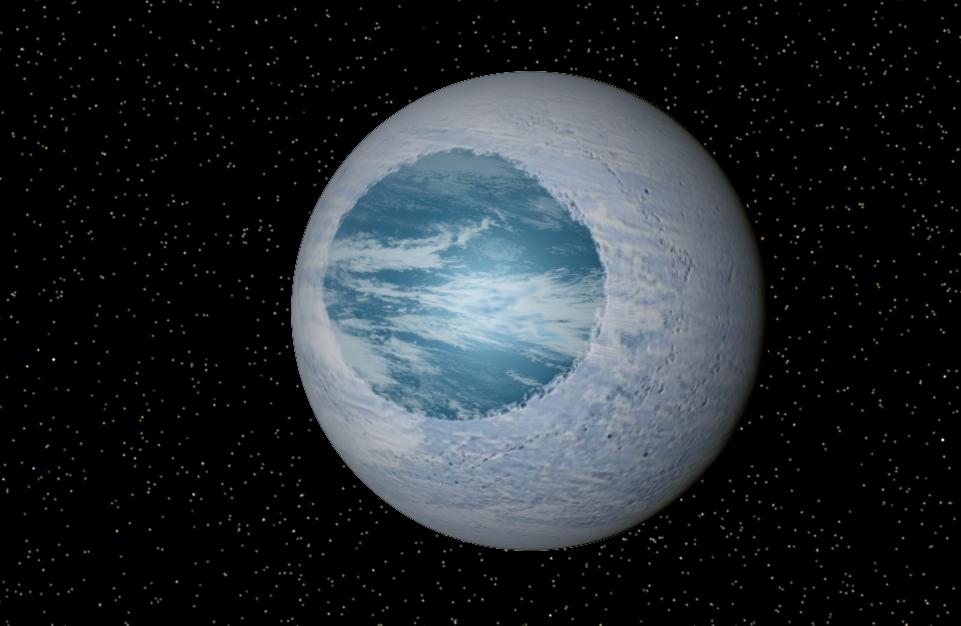
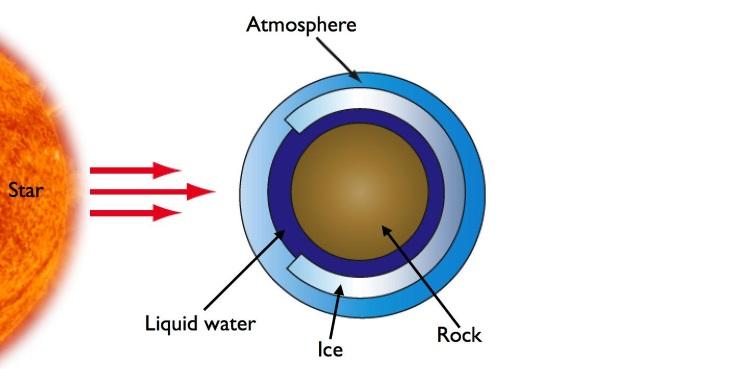
orrrr, without to melt down the ice - cover it with dirt, insulation layers, rocks ... it is not necessary a planet to get warmer with depth
like a raft on a frozen pond.
#79 Re: Terraformation » Terraforming putative Proxima Planet » 2016-09-12 02:45:04
I think that red dwarf terrestrials, in some cases maybe be more easy to manipulate than say a planet like our Earth around sol.
I absolutely AGREE. A short / incomplete list of advantages.:
- tidal locking makes easier to devise the optical systems ( aerostatic or statite ones ) to optimize the luminosphere, also cold trapped on night side volatiles easier to move to dayside then to import from off-planet. Optical distro planning and holographic management easier when the planet under does not move in respect with the primary lightsource...
- shorter in system distances. (!!!) for every purpose: to mine the star for all kind of materials, to import from beyond the frostline, to place orbital and statite structures, space elevators, kinetic structures ... even for shorter old fashion Hofmans - deeper into gravity well the better ... to place Optics again - parasols, difusing soleta lenses, L1 swarms... everything.
- 1G-ish ready and ubiquitous - no need to span orbital rings to decrease gravity by/on 'upper floors'.
- bigger number of compact placed 1g-ish planemos to work with and eventually to swap masses ( volatiles for metals & rocks etc.)
- long life. Proxima will shine as it is onto 'b' for 4 000 000 000 000 years! about 1000 TIMES longer then the Earth lifespan up to now. ( So long that the very planet will start 'spoiling' but geophysical refreshment quite achievable and handy indeed )....
... you add more
#80 Re: Terraformation » The Case for Jupiter: Which is more hospitable? Jupiter or Saturn? » 2016-09-07 13:51:21
#81 Re: Terraformation » Terraforming putative Proxima Planet » 2016-09-07 13:49:38
Void,
the deeper one looks - the more (details).
Trillions are the new billions, you know.
#82 Re: Terraformation » Terraforming putative Proxima Planet » 2016-09-06 15:02:34
Look at the way we do things here on Earth. We do not (or at least have not so far) attempted to change the climate of places like Norway or Canada to make them more tropical. Instead, we adapt ourselves to local conditions. It is always easier to add insulation to a building than to attempt to heat the entire atmosphere using orbital mirrors. In my opinion, this is how human beings will go on working, because it is always so much easier to adapt to the broad parameters of an environment than it is to change them to support you. Just a hunch, based upon the reality that human beings are inherently short term, lazy creatures.
If the proxima planet does turn out to be a solid world with an arid sun facing side and ice covered dark side, then the hot side will be used for such things as agriculture and solar power. The night side may be the place for industry, with lots of cheap land that isn't useful for much else. If the night side hosts an ice cap kilometres thick then melting it might not be a good idea. Without knowing anything about the place we really are shooting in the dark making any judgements at all when it comes to how we best use the environment.
Antius,
Agree. Our body size is quite compact. For multi-billion populations we need far-far less than a planet-wide terraformed-habitat.
Even Earth consists of mostly literally dead zone for humans.
A dry hot variety of red dwarf tidally locked "eyeball planet"
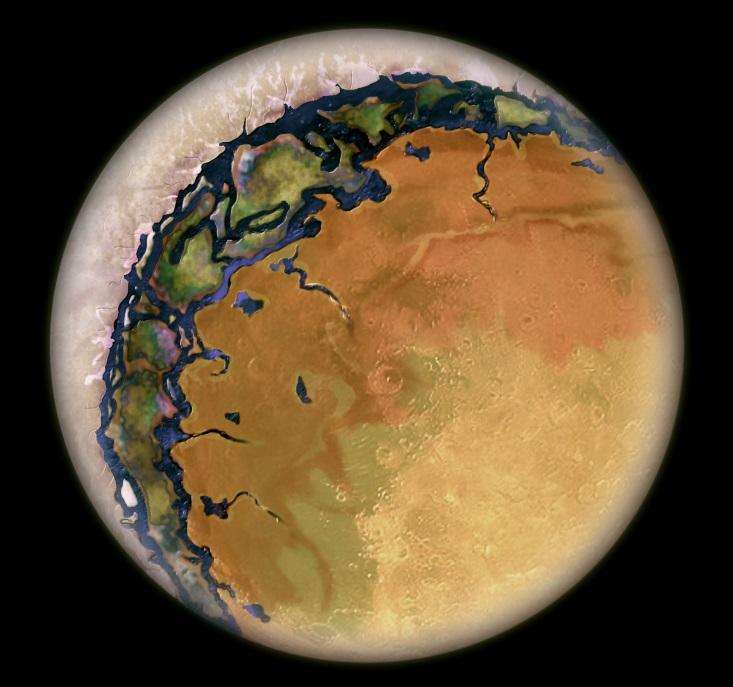
i.e. day-side hemisphetic scale 'Sahara' and night-side hemispheric wide 'Antarctica'
will give us a ring of Mediterranean size seas as glacial crust compression lakes
plus
DOZENS of ... Niles, Tigrises, Euphrates, Induses, Ganghes ... flowing nightsideway from the lakes to (as further into) dayside til complete evaporation... as eyeball veins.
http://nautil.us/blog/forget-earth_like … ll-planets
But the story doesn’t end there. When a layer of ice gets thick enough, its bottom layer melts from the pressure. This causes the ice to flow downhill, like glaciers do on Earth. So a hot eyeball planet’s thick night side ice cap spreads out and slowly flows toward the day side. There may be a trickle of water that flows into the light to be evaporated all over again. Our models project that there are characteristic wind patterns that pile clouds up in a specific region on the night side (gory details here). The planet’s non-uniform appearance can really look like an eyeball. Rivers that flow from the night side to eventually evaporate on the day side might even look like veins.
Where on a hot eyeball planet could you live? It’s a classic Goldilocks story. The day side is roasting and dry. The night side is frigid and icy. In between, it’s just right! The sweet spot—let’s call it the “ring of life”—is at the terminator, the boundary between night and day. The ring of life is bounded by deserts on one side and ice on the other. There is a constant flow of water from the night side to the day side—a series of rivers, all flowing in the same direction. The Sun is fixed in the sky right at the horizon, and the area is in permanent light. Conditions are pretty much the same all the way across the ring of life. One can imagine vegetation following the rivers onto the day side until they dry up, with different ecosystems interspersed along the way. There could be mountains at the edge of the ice sheets, since the ice-covered continents would be heavily weighed down.
Each of these river valleys maintaining many dozens to up to hundreds of millions of people.

or

Even on present day level of technology. And most developed nowadays nation's living standards
Imagine tens of nations* the size of Egypt, Pakistan, India, Indochina, Mesopotamia on such planet.
I mention *nations* cause various cultural traits people would still tend to live together and they usually do not need entire planet to territoriality-differentiate from each other.
As much or more than the total present day population of the Earth.
Linear habitable patches - ideal for transport purposes, square power more efficient then 2D grids.
The national borderlines will eventualy extend from day-pole / cis-stellar point , to night-pole / trans-stellar point.
Like the modern day Antarctic claims cake-cuts
Plenty of hydro-power, from nightside, plenty of agri- and solar from dayside.
Massive icy heat sinks into the nightside.
#83 Re: Terraformation » Terraforming putative Proxima Planet » 2016-09-06 03:57:03
btw, what comes to my mind.:
[1] this http://orbitsimulator.com/formulas/hillsphere.html , shows that the Hill sphere of Proxima b is with radius of 150 000 km.
Enough for a moon it seems? Or double mutually tidally locked planet - rearranging the inner system into planetary 'couples'?
[2] the shear IMPORTANCE, VALUE and UBIQUITY of |proxima b|'s as galactic real estate!
The more realistic and recent calculations of the mass of the Milky way imply that the number of stars ( https://en.wikipedia.org/wiki/Fusor_(astronomy) ) in it is in fact way-WAY into the TRILLIONS!
That means trillions of red dwarfs alone.
And as with the example of https://en.wikipedia.org/wiki/Gliese_58 … ary_system , they all have compact , neat , close, convenient , multiple planetary systems.
I.e. TRILLIONS of rocky planets with longevity of few trillions to hundreds of trillions of years.
Within radius of under 1 million light years from our home.
[3] As I many times insisted - terraformation is ALL about (surface) GRAVITY.
We are bottom crawlers. All we need is:
- solid surface to walk on,
- flooded into breathable atmosphere and
- illuminated properly.
water bodies come secondary for weather, climate, biospheric, aesthetic reasons.
Every other 'ingredient' in the land-making recipe is easy having the gravity.
You either use.: [1] natural one where available, within human hospitable limits around 1g, or [2] if excessive you decrease it via going up via orbital rings over the underbody , or [3] if lower or missing - you create it or amplify it via rotation.
Appropriate gravity is plentiful at red dwarfs. The smaller the stars due to the lesser mass and size of the initial formation proplyds = the smaller their planets, too.
Their giants are like our Neptune & Uranus, their mid-sized ones are of Earth-Venus caliber.
I.e. surface gravity-wise the red dwarfs planetary formation is like a natural attractor for making planets of the 1 G surface gravity range. ( See.: http://www.google.bg/url?sa=t&rct=j&q=g … MxYpwZulEw of Gerald Nordley's )
At least a FEW (!) 1G-ish planets comprising their inner systems per red dwarf.
( infra-system inter-planetary transport would be eased in a great degree due to deeper stellar gravity well - for faster trans-orbitals, closer distances ... the planets within a red dwarf system would be like the continents from this map -  - in travel times using even primitive solar sailing ships ... )
Biospheric construction materials are absolutely ubiquitous. Even if a Poxima b-like red dwarf planet is totally volatiles boiled off early in its making - the red dwarfs systems are small, the frostlines and cometary hallos are just a few AU away, so volatile import from their outer systems is easy and cheap if needed. The stars themselves are close, small and magnetic enough to be ram-scoop mined easier then the bigger sun-like stars. If necessary at all.
Moving masses up and down the stellar gravity well would provide also the torque and momentum to change orbits and axial rotations, although this is economically acceptable only if its a spin-off / by-product of ther necessary activity. I.e. acceptable ONLY if it separately brings added value on the table.
Changing orbits and rotation IS NOT necessary, though.
For proper illumination ( luminosphere ) - OPTICS is enough. The stellar source is near and plentiful.
SO, for strictly speaking terraformation, in the classical sense - i.e. turning natural rocky planets into earth-likes the red dwarfs are god's gift, a bounty.
#86 Re: Terraformation » Terraforming putative Proxima Planet » 2016-08-25 15:39:44
http://nautil.us/blog/forget-earth_like … ll-planets
The light over the whole surface could be easily distributed in an ideal illuminosphere.
So red dwarfs literally trillions of 'eyeball' planets make really prime real estate.
Their habitats can live literally for trillions of years!
Using in-space statites or hall weather machine.
#87 Re: Terraformation » Terraforming putative Proxima Planet » 2016-08-25 04:55:21
It is THERE!
We know orbit and size.
Lets dream on !
#88 Re: Terraformation » Terraforming putative Proxima Planet » 2016-08-20 03:16:28
A technical note, karov put tags in his post for a URL. He could have put "IMG" tags so the image displays in his post.
That is [img]before, and[/img] after. This is his image...
thanks, Bob - i know but i just forgot to...
by optics, be it more primitive orbiting mirror or mark#2 weather machine each and every dot of the planetary surface can be provided with precisely managed 'illuministics' , but purely aesthetically, we should leave some wilderness, right? and as in the case with Earth, the 'terraformed' areas comprise very tiny percent of the total area.
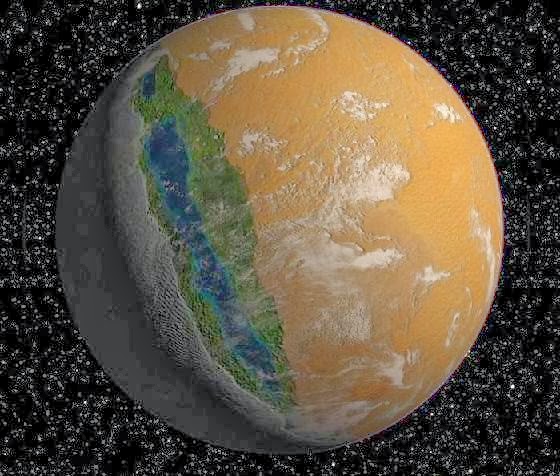
so, a 'retina' spot of few thousands of km wide on the back side of an 'eyeball' planet would provide quite a sizeable LAND, to place lotsa 'countries' onto.
#89 Re: Terraformation » Terraforming putative Proxima Planet » 2016-08-20 03:11:12
Tidally locked planet. You know if the orbit is not circular, there will still be places on the planet where the Sun will rise and set. The planet orbits faster as it pulls closer to the star but orbits slower as it pulls farther away, but the rate at which the planet rotates remains constant, there will be places where the planet is rotating faster than its orbiting the sun, and other places where is it rotating at an angular speed that is slower. The Sun will appear to rise, and then set at the same place, so that way you can have a local day and night. The red sun will dip below the horizon and them pop up again, giving us about 4 days of night and 4 days of daylight. A star that is already red will give off a "bloody sunset." The sky will appear to be a very dark blue. Probably leaves in native plants if there are any will be black.
or with axial tilt.
#90 Re: Terraformation » Terraforming putative Proxima Planet » 2016-08-20 03:06:29
The existence of this planet is not confirmed and as of yet we know nothing about it. So talking of terraforming is premature. But a few thoughts.
One thing does stand out looking at the Kepler planets found to date. Most of them are larger and more massive than the Earth. The Earth's solar system is relatively unusual both in the small size of its terrestrial planets and their relatively discrete distance from their host star. Both discoveries are very bad news for interstellar colonisation and bad news also for the prospect of finding other space faring species.
Look at the difficulties we have trying to escape the Earth's gravitational pull using rockets. The amount of technology and effort that it takes. Would we really want to deliberately trap ourselves in a gravity well 10 times as deep? It would be a one way trip. Once human beings landed on such a planet, they would never leave it again.
No.1 - observational bias due to tech limitations.
No.2 - gravity is the coolest. ( https://www.ocf.berkeley.edu/~fricke/dyson.html ). Rockets? - inefficient.
Visualize kinetic structures which work two way, dumping mass in to pull mass out.
Thus even the biggish planets are seamlessly interfaced with the flatter spaces.
#91 Re: Terraformation » Terraforming putative Proxima Planet » 2016-08-19 09:59:42
Tom,
Yeah. I like it.
A "Retina" habitat on the back of an "Eyeball" planet
#92 Re: Terraformation » Terraforming putative Proxima Planet » 2016-08-18 13:19:34
https://arxiv.org/pdf/1405.1025.pdf
... and plenty of other materials available.
Literally thousands in the last few decades.
It seems quicker rotation is a habitable zone contraction factor, so ...
#93 Re: Terraformation » Venus » 2016-08-18 13:16:12
Well whoever is in charge will likely do what they want with Titan. Maybe what you want.
Void,
Yeah, you're right.
Most probably will be a form of global Titanian authority, and because people tend to start loving their 'home nature', it is highly probable that almost all of it shall be retained as it is.
#94 Re: Terraformation » Venus » 2016-08-17 12:59:47
Void,
Unthawing this oustanding beauty? I mean Titan.
I think no need because it can provide literally thousands of terraformed pockets the size of small countries like Hong Kong, Singapore, Liechtenstein ... and still the marvelous cryonic Outback to be enjoyed...
===
I still accept / believe that 'terraforming' is about formation of LAND. I.e. the literal meaning / etymology of this compound word.
Human habitable land.
Be it.:
- orbital rings supported plate, strip, or full spheroid on top of a massive underbody
- inner surface of a rotating cylinder
- a raft floating on kinda liquid or gas etc. etc.
- microgravity bubble with spinning inside island-carousels ...
Sustaining land. I.e. humans to be able to live off-it.
That is, 'furnished' with gravity, illumination, flooded with breathable air...
That's all.
#95 Re: Terraformation » Venus » 2016-08-15 13:27:00
"The reason I call it a weather machine instead of a climate machine is that you could change the modulation on a regional or even local basis, and change it in minutes," says Hall, "You could cool Death Valley and warm the Yukon - at the same time." Because winds as well as water evaporation and rainout depend on temperature patterns, he adds, we could strongly affect the other components of weather as well.
Hall also believes that the weather machine could be used to make large portions of the Earth more human-friendly. "There is a huge portion of the Earth's surface that is only marginally habitable and could be made temperate with weather control," he says.
While we don't have all the technologies required to pull-off such a feat, Hall feels we should still get started right now and develop such things as control software, weather modeling, and anything along the pathway to nano-manufacturing capability.
Hall has also devised a second version of this machine that would still utilize balloons, but would instead contain an aerogel with switchable antenna units. This would allow for the transmission of radiation in any desired frequency or direction. By doing this, the entire stratosphere would be converted into an enormous hologram that could take light and change it into any desired wavelength and focus it in any desired direction. This would allow for the near complete control over local weather.
Such a system would be a planet-sized powered machine, powered by 100 petawatts of sunlight. With a transmitting area of 10,000 km in diameter, and violet light for a beam, it would be able to carve graffiti on Phobos by focusing a petawatt beam on a 2.7 mm spot. "In other words", says Hall, "it's one hell of a planetary defense against anything from wayward asteroids to invading aliens."
#96 Re: Terraformation » Venus » 2016-08-15 13:22:34
The Weather Machine, Mark II
The Mark I Weather Machine is something like nanomechanical rod logic—an gedanken experiment existence proof that a given level of technology will have a given capability. We can go a bit farther and talk about what the capability might be like given closer control of light and matter, bearing in mind this is somewhat more speculative.
Take the same aerostat, but inside put an aerogel composed of electronically switchable optical-frequency antennas—these are beginning to be looked at in the labs now under the name of nantennas. We can now tune the aerostat to be an absorber or transmitter of radiation in any desired frequency, in any desired direction (and if we’re really good, with any desired phase). It’s all solid state, with no need to control the aerostat’s physical attitude. Once we have that, the Weather Machine essentially becomes an enormous directional video screen, or with phase control, hologram.
Astronomers hated Weather Machine Mark I, but they love Mark II because it turns the entire earth into a telescope with an aperture of 8,000 miles. Mark I could zap Apophis as it flew by inside the Moon’s orbit; Mark II could zap asteroids at much greater distances, or power laser-propulsion spacecraft.
Mark II, with the ability to shift frequencies and directions independently, is powered at night. Mark I could cool the Earth by shading the sunlight on the dayside, or warm it by reflecting back the infrared that pours into the night sky. The total power going in and out is roughly the same (although more goes out from the dayside for a variety of reasons). Thus there’s plenty of power available for the nightside to do street-lighting, or show ads in the sky, or whatever you’d like. Remember that because it’s a hologram, it can have a completely different effect for each spot on the surface: my night sky can be a giant telescope, and my neighbor’s can be a giant video game.
#97 Re: Terraformation » Venus » 2016-08-10 06:01:46
The altitude that most people have recommended building floating settlement on Venus is the cloud layer. That altitude has clouds, so a source of water. That altitude also has reasonable temperatures, and 1 atmosphere pressure. At 1 atmosphere pressure, the settlement becomes relatively easy to build because there is no pressure stress. However, it means a vacuum balloon must keep out 1 atmosphere pressure. And since Venus has 90% of Earth's gravity, conditions are pretty much the same as Earth. We know how heavy a thermos bottle or Dewar flask must be. I worked with a large Dewar; it was a large bottle of liquid nitrogen used to chill an environmental chamber to test equipment that my employer manufactured. The Dewar certainly didn't float like a balloon. Of course it was a bottle to hold liquid nitrogen, and held air when empty. But still, a stainless steel flask requires substantial strength.
As for a hydrogen balloon, there are fluoropolymer films that can withstand the acid and temperatures of Venus cloud layer without corrosion. I believe some polyimide films could as well.
Of course I could argue for my vision for Venus. I've described it many times. It's quite different.
How thick a plastic bubble ( spherical 'dome') must be to withstant pressure gradient (exactly equal to external pressure due to being 'filled' with vacuum) on say 100+ km heigth over Venus?
What must be the diameter vs wall thickness for it to remain buoyant on such altitude...?
I ask these questions because Dewar vessel example is totally inconsistent and non sequitur at all...
#98 Re: Terraformation » Venus » 2016-08-09 15:19:34
Now the question: If you could accomplish vacuum bubbles as the multiple elements of a Hall weather machine, without Hydrogen infiltrating the interior of the bubbles at any harmful rate, could you then insulate any of those four planets sufficient to cause their atmospheres to swell large enough where their synchronous orbits would be inside their atmospheres? Additionally, could you also arrange favorable temperatures at that synchronous orbit (If an atmospheric synchronous orbit was possible)? Even could the luminosity of the lower layers of the planet "Shine" to the synchronous orbit, without over heating the synchronous orbit (Maybe another hall weather machine below which passes visible light, but insulates against the heat????
Well, I could only guestimate, but ... they must be thousands of Celsuis at 'surface' to swell so much.
Why we need this at all?
Gravitational binding energy ( https://en.wikipedia.org/wiki/Gravitati … ing_energy ) calculation will give you idea about how much solar radiation these bodies must retain in order to 'swell' so much...
Also the rotational energy to reach Roche limit, i.e. the planet to become flattened ...
You'll see the energy requirements would occur to be really massive - like MONTHS and MONTHS of Total Sun's Radiation Output!
---
Neptune and Uranus will need giant forced orbit 'lenses' to focus more light on their habitats.
Few times the planetary radii at least.
Land construction - onto orbital rings cage 'toposphere'.
Given the extensive lunar populations and the proximity of the Neptune trojans ( at least 20 times more massive then Jovian ones and/or the Main belt) - plenty of non-H/He masses to swap in and out for volatiles = the momentum and energy to lower the astronomical 'metals' to the shell habitat construction altitude/ orbit could be leveraged the planetary atmosphere to be mined for CHON etc.
btw, 'surface' gravity of Neptune and Uranus are of the Earth 1 gee-ish range so the LAND could be just interconected tessellae of floating onto the atmosphere aerostatic rafts. I.e. toposphere ( support structure for the land on top) is naturally provided en situ.
As well as = the same for Saturn.
In SolSys only Jupiter (and the Sun) deserve orbital rings structual support, indeed... (And eventual dark not yet discovered gas giant companions, drifting silently in the Sun's Hill radius of almost a parsec.)
#99 Re: Terraformation » Venus » 2016-08-09 15:06:21
karov wrote:Lifting gas ... what about the best - vacuum?
Requires a very heavy, strong pressure tank. Hydrogen would be better. Since Venus is shrouded in water clouds, that water can be harvested and used to make hydrogen. Atmosphere of Venus is 96.5% CO2, 3.5% N2. No oxygen, not even a trace amount. Mars has a trace amount of oxygen, Venus does not. Hydrogen will not burn without oxygen,
Yes, there is enough hydrogen in Venusian atmosphere, but ...
<<< Requires a very heavy, strong pressure tank. >>>
NO!

What are the forces - zero pressure from within, and from without (acting on perfect arch-like structure) -- depends on the altitude.
So, - soap bubble thin vacuum balloons - REALLY high up in the stratosphere.
The different combos of altitude/ambient pressure versus bubble wall thickness is comparatively easy to calculate.
#100 Re: Terraformation » Venus » 2016-08-08 15:24:40
Well, I like it.
I do think that Venus would be a fine laboratory to test it on because of proximity and because the flotation gas could at least initially be Nitrogen.
Proximity? It is dozens of solar radii away! It is just fine!
Lifting gas ... what about the best - vacuum?