New Mars Forums
You are not logged in.
- Topics: Active | Unanswered
Announcement
#9226 Re: Life support systems » Solar Enclosure Architecture On Mars » 2012-04-21 15:23:48
Louis said:
This isn't scientific, but the surface of Mars reminds me of the Mauritanian iron ore fields (See above image). Everything I have read suggests that iron ore is pretty ubiquitous on Mars. What we need is a sophisticated scaled down furnace that can handle low grade ore (because we don't want to spend time looking for high grade ore). It doesn't matter if it makes the most expensive iron and steel ever seen, it will still be cheap compared with shipping iron and steel goods to Mars.
The scaled down machine would need to smelt, remove all impurities and introduce carbon - then allow for pouring and pressing on a small scale. Could we use local basalt for casting rather than bring casting moulds with us?
Well it is not a case of having only hot water or only cold water, by all means, and every means.
However I do have a bias for the first few years towards Meteor Iron, unless what you propose fall into the laps of the settlers.
I am very excited about a printer which could print angle iron, plate, tube and rod. With those and some millwrite and blacksmith tools, you could make quite a few things, things that would be usefull when you were ready to do a real mine.
There is another issue as well, mining can be dangerous, and injuries costly. That is not a show stopper, but when choosing a technology that is part of the economic calculation as well. What do you do if someone cripples themselves? Now you have lost something of value.
If your ore were of a nature where you could shovel it up that is a plus. If you must blast it and then carry the rock to a facility to crush and grind it, that requires a lot of equipment and work and it is dangerous.
#9227 Re: Life support systems » Solar Enclosure Architecture On Mars » 2012-04-21 15:08:10
SpaceNut said:
The meteor Iron that you speak of is not all over the place and the rovers and orbiters circlying mars have only found these few...
But have an alternate argument:
http://www.colonyworlds.com/2008/09/iron-on-mars.html
The article explicitly states that I cannot quote from it.
However, the core argument is well enough known, if you have big meteors, and if little meteors have been falling for 4.5 Billion years, and if the atmosphere of Mars has been dry and devoid of Oxygen, then it is logical that a magnet would pick up such meteor iron, like iron filings. I am not really interested in the big pieces, except as science data. The small fragment iron should be everywhere and anywhere, except the polar ice caps, of course, those would be at the bottom of that.
I do know that fine iron/nickle particles could be ground down finer and some of the Nickle content could be removed.
Then with the printer, some first needed items, some tools, some angle iron, some tube, some rod, from those make a two wheel hand cart. And so on.
Yes in time move on to a ore body, when you are ready and have the diversity of tools needed for it.
#9228 Re: Life support systems » Solar Enclosure Architecture On Mars » 2012-04-20 22:14:59
Lewis and Spacenut,
I don't care where there Iron, or Iron equivalant comes from. All I know is that Meteor Iron should be distributed rather uniformly over the surface.
As I have mentioned, I worked in Red Iron (Hemitite) and Taconite mines. I played on the mine dumps. I swam on a pond on top of a mine dump that no longer exists! I swam in the lake in the deep pits. I know of these things more that I know of Meteor iron. I did not ever enter the Soudan mine, but I know of it. If you can get that and the other things, then forget Meteor Iron.
Needing other resources that are locaition specific, then I choose Meteor Iron because it then does not hobble the child with the burden of transit from one location of an essential material to another. In other words, if you find a resource something that is not iron, but you still want iron, meteor iron should be near the special something that you found. Meteor Iron is ubiqutous to the surface as I understand it.
Water it ubiquitous to the high lattitudes. Hellas should have higher air pressure, Meteor Iron, and some water at some locations. That is how I think.
Find a big Iron deposite, great, but now I am thinking how I might have iron in the first few years. Is your iron local to other essential resources? If yes, then fine we are really fortunate. 
When I was a little boy, I found extrodinary things on the mine dumps. Samples. I have none of them now, but I remember what they look like. Find a mine in a good location, and I will not resist that.
We have three ranges of ore in Minnesota. Vermillion Range, where the Soudan Mine is, Cayuna Range, where the ore is unfortunately adulterated with Manganese, and the Messabi Range, where I worked, where the Taconite is virgin, has very little contaminants, and of course, I have a side interest in that where I wonder if Taconite ore could be concentrated, Monded, and printed to Iron/Steel Metal parts. I have been away from those places for quite a time, but still a boy remembers his youth. I have to think in terms of Meteor Iron for the Mond process (More or less Mond), because I don't think that Hemmitite is directly responsive to it, but maybe I am wrong about that?
#9229 Life support systems » Solar Enclosure Architecture On Mars » 2012-04-20 15:06:30
- Void
- Replies: 63
This begins with material copied from a post on "Iron and Steel on Mars", 20-April-2012 (A new thread, instead of building on top of older works).
There are quite a few contibutions from other people on that thread to this conclusion that I was finally given about printing iron and steel. Actually I mean that for the most part I had a small if any part in it, but I like it.
Quote from that thread:
-------------------------------------------------------------------------------------------------------------------------------------------
I have this information to add:
http://en.wikipedia.org/wiki/Carbonyl_metallurgy
http://www.space-mining.com/IRONRECOVERY.htm
http://en.wikipedia.org/wiki/Alloy
Quote from the above:
History:
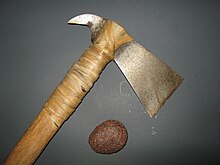
A meteorite is shown below a hatchet that was forged from meteoric iron.
Bronze axe 1100 BCThe use of alloys by humans started with the use of meteoric iron, a naturally occurring alloy of nickel and iron. As no metallurgic processes were used to separate iron from nickel, the alloy was used as it was.[7] Meteoric iron could be forged from a red heat to make objects such as tools, weapons, and nails. In many cultures it was shaped by cold hammering into knives and arrowheads. They were often used as anvils. Meteoric iron was very rare and valuable, and difficult for ancient people to work.[8]
More History: (Pattern Welding)
The first known smelting of iron began in Anatolia, around 1800 BC. Called the bloomery process, it produced very soft but ductile wrought iron and, by 800 BC, the technology had spread to Europe. Pig iron, a very hard but brittle alloy of iron and carbon, was being produced in China as early as 1200 BC, but did not arrive in Europe until the Middle Ages. These metals found little practical use until the introduction of crucible steel around 300 BC. These steels were of poor quality, and the introduction of pattern welding, around the 1st century AD, sought to balance the extreme properties of the alloys by laminating them, to create a tougher metal.[11]
Nickle has toxic problems as well I believe. However I did encounter the information that Nickle and Iron are best separated with magnets, which I presume means grinding the Meteor metal very fine, I would think there are limits to the amount of purity easliy achived.
So, I am convinced that you are on the right track for the 3D printer.
I found some more very intersting information concerning Plastics from C02, and a spray on glass with UV protective properties, so I am going to try to find an old thread about greenhouses and wake it up and talk about metals, plastics, and glass spray to make greenhouses and such, which in the end would after all be very valuable, and it appears they could be printed. I am glad I encountered you guys.
Oh an afterthought, maybe a flame with just a bit more oxygen than fuel, could be periodically be put to the surface of the object being printed, to remove a bit of excess carbon. I understand that CO is explosive, but if the Oxygen and pressure levels were kept low, and the CO removed from the area of manufacture reasonably well, perhaps each layer could have a different amount of Carbon and other additives, making a laminated structure, and not causing a explosion or fire. (See Pattern Welding Above).
3D Printers:
-------------------------------------------------------------------------------------------------------------------------------------------
Somebody here said 3D printer, and I converted to liking the idea (Old dog meets new tick and likes it).
http://en.wikipedia.org/wiki/3D_printing
http://www.cata.com/products/rapid-prot … Kgodvgo60A
The videos really impressed me, and made me understand.
Plastics from CO2?
-------------------------------------------------------------------------------------------------------------------------------------------
http://www.rsc.org/chemistryworld/News/ … 071001.asp
Or Plastics from other sources if practicle, why be restricted. But now you can print your structures with Iron and Steel alloys, and Plastics.
Spay on Glass:
-------------------------------------------------------------------------------------------------------------------------------------------
http://phys.org/news184310039.html
Quote from the above:
(PhysOrg.com) -- Spray-on liquid glass is transparent, non-toxic, and can protect virtually any surface against almost any damage from hazards such as water, UV radiation, dirt, heat, and bacterial infections. The coating is also flexible and breathable, which makes it suitable for use on an enormous array of products.
My Conslusion:
-------------------------------------------------------------------------------------------------------------------------------------------
This is what I have wanted, but did not exactly know I wanted.
Greenhouses (And I havn't even started there)
Ice covered lakes? Anchors in the ice, build metal and plastic bubbles connected to the anchors, spray with a thin coat of glass.
Wire? Print it. Iron is not that great, but as others here have said it could do until copper or aluminum are available.
Cover a sand dune with small greenhouse bubbles, and create a biosphere in Hellas? I think it might work. Collect oxygen and plant life from that? Could be.
Well, I think thats plenty.
#9230 Re: Exploration to Settlement Creation » Iron and Steel on Mars » 2012-04-20 14:41:13
I have this information to add:
http://en.wikipedia.org/wiki/Carbonyl_metallurgy
http://www.space-mining.com/IRONRECOVERY.htm
http://en.wikipedia.org/wiki/Alloy
Quote from the above:
History
A meteorite is shown below a hatchet that was forged from meteoric iron.
Bronze axe 1100 BCThe use of alloys by humans started with the use of meteoric iron, a naturally occurring alloy of nickel and iron. As no metallurgic processes were used to separate iron from nickel, the alloy was used as it was.[7] Meteoric iron could be forged from a red heat to make objects such as tools, weapons, and nails. In many cultures it was shaped by cold hammering into knives and arrowheads. They were often used as anvils. Meteoric iron was very rare and valuable, and difficult for ancient people to work.[8]
More History: (Pattern Welding)
The first known smelting of iron began in Anatolia, around 1800 BC. Called the bloomery process, it produced very soft but ductile wrought iron and, by 800 BC, the technology had spread to Europe. Pig iron, a very hard but brittle alloy of iron and carbon, was being produced in China as early as 1200 BC, but did not arrive in Europe until the Middle Ages. These metals found little practical use until the introduction of crucible steel around 300 BC. These steels were of poor quality, and the introduction of pattern welding, around the 1st century AD, sought to balance the extreme properties of the alloys by laminating them, to create a tougher metal.[11]
Nickle has toxic problems as well I believe. However I did encounter the information that Nickle and Iron are best separated with magnets, which I presume means grinding the Meteor metal very fine, I would think there are limits to the amount of purity easliy achived.
So, I am convinced that you are on the right track for the 3D printer.
I found some more very intersting information concerning Plastics from C02, and a spray on glass with UV protective properties, so I am going to try to find an old thread about greenhouses and wake it up and talk about metals, plastics, and glass spray to make greenhouses and such, which in the end would after all be very valuable, and it appears they could be printed. I am glad I encountered you guys.
Oh an afterthought, maybe a flame with just a bit more oxygen than fuel, could be periodically be put to the surface of the object being printed, to remove a bit of excess carbon. I understand that CO is explosive, but if the Oxygen and pressure levels were kept low, and the CO removed from the area of manufacture reasonably well, perhaps each layer could have a different amount of Carbon and other additives, making a laminated structure, and not causing a explosion or fire. (See Pattern Welding Above).
#9231 Re: Terraformation » Hybrid Worldhouse » 2012-04-20 14:33:42
Yes, thanks. That is still a lot of energy leaking into space, but I am sure at some point it could become childs play to do, persuming continuing advancements in technology.
#9232 Re: Exploration to Settlement Creation » Iron and Steel on Mars » 2012-04-19 19:09:55
With respect truely,
Could there be anyway to mineaturize the process to the head of a 3D printer? That is refine steel as you print? I don't care which process. It would then not require huge draws from the power source, but only power at the time of printing, a tiny hot spot, where the needed chemicals would be injected, and perhaps with an action to remove slag?
#9233 Re: Terraformation » Hybrid Worldhouse » 2012-04-19 19:06:23
Wow, I think I fell asleep last time.
Anyway, I know that your work is in progress, but how do you keep the Nitrogen from condensing on the hall bubbles? Don't they have to float on something?
#9234 Re: Terraformation » Vesta, modest ambitions. » 2012-04-19 19:03:13
Oh Oh, I think someone put a nickel in me.
I am going to poropose a collection of propulsion methods, to move teraforming supplies to a perfered location from a location of origin.
I am only partially serious, I am only trying to see if there are any combinations which could make sense. Go ahead and hammer this hard if you think something should be removed from the assembly.
I could have gone upstairs to the places where you guys normally hang out but why should I mess that up for you. You stoped by with nuclear propulsion, and I am going to use it eventually.
But for now.
1) Couple an Electric rocket with a culuster of solid rockets, and perhaps a "Barge" of equipment, and a small liquid thruster capability.
2) Use the electric rocket to do flyby gravity assists from targets useful, perhaps the Moon, I hope Venus, and perhaps the Earth.
3a) Gravity boost from Venus to go to Mars, fire off the solid rockets in sequence as needed, fine tune with electric, use liquid when needed.
3b) Gravity boost from Mars to Vesta, fire off solid rockets in sequence as needed, fine tune with electric, use liquid when needed.
*So, I am thinking that the Solar Electric would have it's best performance heading towards Venus, and perhaps back out towards the orbit of Earth.
After that it becomes more of a steering mechanism, but has some use. I am prefering that the device would arrive at Mars or Vesta with some of it's solid rockets unburned, for future use.
So, I have tied all this to Terraforming, Vesta, and Mars. Now I want to add Nuclear.
What if this assembly did in fact have a "Orion" type push also? I am thinking one blast, and instead of springs, two plates with crushable honeycomb between them to buffer the shock. I am not exact as to when this would be used. I just think that it could be integrated into the system to make a one time mega-boost. I would also like to speculate on the notion that the shock absorber plate would be used again for Aerocapture.
By then way as I see, it the solar electric thruster system would separate from the assembly and get to a distance before the blast, because it would most likely be too delicate for that event. The solar electric thruster system could then try to get back to the assembly after the blast.
Now it's all tied together, except the nuclear powered planes, but give me time.
Just some fun.
#9235 Re: Terraformation » Hybrid Worldhouse » 2012-04-18 22:15:37
Quote and also not ignoring Karov at all:
Hmmm. What happens if the system is left alone for a few decades, with no maintanence? What about a few centuries?
I don't like to discuss terraforming that we can't do with current technology and understanding, either...
Perhaps we could introduce a biofilm of plastic producing bacteria into the mix, to maintain but not repair the roof, perhaps using materials gathered from the outer atmosphere?
We might want to use several, or several dozen, layers. Say, we'll go from 300mb to 290mb and so on, all the way down to 50mb, increasing redundency and potentially allowing energy to be successively concentrated down to the surface - maybe the outer layer will fluoresce under X-rays to give UV, and the layer below that will give red etc.
Now, as for the oscillations of such a system...
I say what I will say not to reject what you concieve, but rather to make a compairison. I am actually interested in your ideas more than mine, but I guess if I come to the table I should try to offer something.
I see Titan as the first in a line of worlds that might employ something like a world-house. In the case of Titan, for my tastes I would modify it to be a bunch of very large bubbles on stilts. Titan is childs play compaired to things further out.
Pluto, should it be desired, could be warmed up some more, perhaps with some method, and so might end up with an atmposphere like Titan's (Somewhat).
Further out it gets harder.
I could imagine for instance a rogue planet with a Hydrogen/Helium upper atmosphere and a Nitrogen lower atmosphere, and then you could do a world house for that. But I am not sure that rarified Hydrogen/Helium would provide enough insulation for the upper Nitrogen to maintain a vapor state. Perhaps if it was helium and you had the Hall bubbles with Hydrogen in them? Karov?
I guess a culture with fusion might generate Helium or collect it from interstellar space.
Close to the sun at all, however, and it would
#9236 Re: Exploration to Settlement Creation » First settlements » 2012-04-17 20:11:11
Thank you Louis, I enjoyed the provisions on glass. Perhaps when I retire I will take a greater interest in glass as a hobby.
Void wrote:
So if that machine found a collection of attributes reasonably near a favored location and that prompted the first settlement to be established there what would that collection be?I have this list of probable materials in Hellas.
-Magnetic Meteor Iron.
-Glaciers, and probabbly other ice under the soil in places.
-Thicker atmosphere.
-Not a true polar location (Not as harsh as the poles).
One other thing I think is possible is Copper Sulphate?
http://spacefellowship.com/news/art2077 … lakes.html
http://en.wikipedia.org/wiki/Copper(II)_sulfate
I am presuming that if the last part of the wet period of Mars was acid as is said, copper in the soil and rocks would have been leached out, and would end up as disolved materials in lakes in Hellas, and that when those lakes dried up, there would have been salt pans. I don't know how to get copper out of copper sulphate, but I would imagine it can be done somehow.I might also what to find salt domes and perhaps even petroleum in association with those. But, I am not thinking that such a convenience is likely to be near the site which would be selected, but maybe.
I guess a really big need would be the resources to make good glass with, but I don't know what that is yet.
Lewis wrote:
Copper I have always understood to be pretty rare.
Here is a guide to glass constituents.
http://en.wikipedia.org/wiki/Glass#Glass_ingredients
The quartz sands/silica should not be a problem but we may struggle to fund calcium carbonate. In fact as the latter is useful/essential in steel production, we might have to think in terms of taking quite a lot of that material with us to begin with.
I can't really see why the denser atmosphere is an advantage. Some minimal protection against radiation? I don't think we should worry about atmopsheric pressure too much.
Petroleum seems pretty unlikely. We can make our own though, if you think it's important!
Iron ore should be pretty ubiquitous. Why is magnetic meteor iron required?
Copper may be rare, but with an acid rain or acid snow melt for tens or thousands or even hundreds of thousands of years, I would expect that little bits of native copper and other copper would have disolved into sulphides, and washed into the salt seas and lakes. I would expect to find the remnants of those in Hellas, perhaps under some significant amount of air borne sediments.
However salt domes are fluid, and will erupt to the surface, and carry copper sulphide and perhaps calcium salts with it.
Here are some links to sudy, and then I will continue my reply:
http://en.wikipedia.org/wiki/Calcium
http://www.jmcgowan.com/mars_reprint.PDF
I certainly hope this is not hoaxed: (Notice the petroleum seep, and remember that there are places on Mars where Methane replenishes into the atmosphere).
http://www.martinhovland.com/Mars%20and … 20Salt.htm
http://earth-pages.co.uk/2009/09/01/and … s-on-mars/
And here is my badge of shame:
http://outerspaceplace.blogspot.com/201 … -mars.html
As for Calcium Carbide, I reccomend a study of Methane seeps in the ocean and the creatures that inhabit them. Clams? Make methane, feed the clams, and I guess food and shells. If you could get the salts from a salt dome or salt pan, then calcium salts that could be added to the tank. No lights needed, and temperatures do not have to be that high. Just Oxygen, Methane and salt water I presume.
A thick atmosphere offers a better chance to get the starter materials from Earth down safely I would think. More time to get the parachutes to do their job.
The bottom of Hellas actually will allow temporary drops of water in the soil, provided the water were there, and also provided that it was heated. However it is arid, and evaporation would quickly take water on the surface away. However, a bag of icewater would do quite nicely. Just put it in a hole, put an A-Frame glass greenhouse over it to protect it from U.V. and to hold some heat in. At night it would develop ice, but during the day this would keep it from going above the tripple point. Just make sealed bags with water and nutrients. Put plants in them, and put them in the greenhouse. The bags could actually hold a bit more pressure, but why make things harder. Let plants grow, and then take the bags into your shelter and open them. I know that there are not a huge number of plants other than Algae which would love this, but I bet if the tundra were searched you might find some advanced plants that might deal with this. They might have food value or be altered to have food value. If greenhouse gasses were used to evaporate the CO2 on Mars, then the pressure at the bottom of Hellas could rise to at least 20 Millibars. This implies that the process I just described could become even more feasable. And of course their is the dream of having an Ozone layer. If you had 20 Millibars in the bottom of Hellas and an Ozone layer, then there is really a chance that some very tough crops could be gown out of doors with irrigation. That would have to be a plus. Putting the first settlement near this location might make some sense for such a reason as well. And yes there is a slight radiation improvement I presume.
Finally, if a glacier 1/2 mile thick max, and the size of Los Angeles were melted, then a dry valley lake could be created and sustained. The ice in this location would be more stable and would require less effort to protect it. I see this dry valley lake as having enormous significance for the generation of electric power.
Petrolium is commonly found in salt domes. We are continuously fed stories about how petroleum is only created from fossil life, but while that could be true also, consider what happens if a plate subducts deep into the Earth, drawing with it water. If it encounters non-oxidized rocks and metals at high heat, the oxygen is plucked off the water. Leaving Hydrogen, which is about as small as a molecule gets. This hydrogen has the best chances of working it's way up through the Mantle and crust and during such a passage can pick up carbon and become Methane. This alternate theory believes that actually Oil and Coal are mostly created by the contiunuation of that process where eventually the Methane gets trapped in a dome structure, and the Hydrogen eventually breaks free and leave behind a concentrate of Carbon/Oil/Coal. In that theory, fossils in coal are actually just indeed plant matter burried which created an ideal place for leaking oil/Methane to collect. Consider the Tar Sands in Canada.
And there is also very likely the notion that Hydrated materials would have been burried inside the planets even during their formation. Perhaps not water, but indeed this is even a possibility. In such a case as that Hydrogen, Methane, Carbon Monoxide, Carbon Dioxide are constantly working their way up from the core, both on Earth an Mars.
A book to consider is "The Deep Hot Biophere" by Thomas Gold. So then if true for Earth then very likely for Mars as well, but perhaps a bit different in nature.
Why Meteoric Iron? Because as someone on this site said, a robot cart with magnets could collect it for you while you were working on other problems like making glass. Eventualy regular iron mining, but why not take the easy stuff first. It is going to be hard enough getting humans established without taking advantage of an easy prise.
In fact every thing we do to survive depends upon things that Nature gives to us easily. The first settlement will be very weak, and will need all the advantages it can get.
As you might have guessed, I am not that proficient in language skills. Space Relations, Science, maybe some Math. Even so, I suggest that the word "Colony" be phased out. It suggests exploitation, and?carries much other unsuitable bagage, which are linked to social demands which have to do with a past on Earth, and places a confused burden on our dreams for the future of Mars. We don't need to set this "Child" up with a "Disinheritance" which "Social Engineers" might hope to tap for power and from their own narrow and misguided perceptions of realities which hides their selfishness even from themselves, where they become compelled to try to inhibit progress. I suggest other words such as "Settlement".
#9237 Re: Exploration to Settlement Creation » First settlements » 2012-04-17 14:59:33
So if that machine found a collection of attributes reasonably near a favored location and that prompted the first settlement to be established there what would that collection be?
I have this list of probable materials in Hellas.
-Magnetic Meteor Iron.
-Glaciers, and probabbly other ice under the soil in places.
-Thicker atmosphere.
-Not a true polar location (Not as harsh as the poles).
One other thing I think is possible is Copper Sulphate?
http://spacefellowship.com/news/art2077 … lakes.html
http://en.wikipedia.org/wiki/Copper(II)_sulfate
I am presuming that if the last part of the wet period of Mars was acid as is said, copper in the soil and rocks would have been leached out, and would end up as disolved materials in lakes in Hellas, and that when those lakes dried up, there would have been salt pans. I don't know how to get copper out of copper sulphate, but I would imagine it can be done somehow.
I might also what to find salt domes and perhaps even petroleum in association with those. But, I am not thinking that such a convenience is likely to be near the site which would be selected, but maybe.
I guess a really big need would be the resources to make good glass with, but I don't know what that is yet.
#9238 Re: Life support systems » Mars Colony "Vacuum welding, Sintering". » 2012-04-17 14:51:00
That was very generous and useful SpaceNut.
I have gone through a fair part of it and plan to look it all over.
I see that basalt sinter by itself has limited strength, so that is a bit dissapointing, but perhaps something will eventually be figured out to upgrade the product.
I am still curious about sintering magnetic Meteor Iron, and am wondering if putting a wire mesh into the formed item would help it have useful strength.
I am curious about the printing of metal powder, and wonder if that could be done like a microscopic steel making process, for instance adding carbon as was suggested in one of the other threads. Not sure about excluding enough slag though, I wonder how much silica a Nickle/Iron meteor has in it? I would think that a sinter of that material should at least be suitable to be a Permenant Magnet, or the core of a Solenoid, or perhaps bearing housings.
Thanks again.
#9239 Re: Exploration to Settlement Creation » First settlements » 2012-04-16 16:53:54
Good locations for early settlements...does anyone want to give some suggestions?
(There was this list at the old Red Colony site - http://www.redcolony.com/art.php?id=0008150 )
I think the prerequisites will be safe landing sites, access to water and iron ore and interesting objects of research.
Somewhere near the Valles Marineris has got to be a prime candidate in terms of object of research, but I am not sure how far it meets other criteria.
http://mars.jpl.nasa.gov/gallery/martia … 70820.html
Does anyone know the location of equatorial glaciers on Mars?
I choose Hellas.
Glaciers 1/2 mile thick?
Pressure maximum 1.89 * Mean
Not too far south.
http://www.space.com/11456-mars-dry-ice … water.html
http://www.telegraph.co.uk/science/scie … -Mars.html
http://geology.com/research/glaciers-on-mars.shtml
http://en.wikipedia.org/wiki/Hellas_Planetia
So, that means that if the dry ice that is known of can be evaporated, I supposed by greenhouse gasses, then the best pressure at the bottom of Hellas could be 20-21 Millibars.
Even now it is somewhat favorable to the existence of temporary liquid water.
The glaciers of course as a source of water, uphill, so that a gravity feed of melted water is possible. (In a covered canal or pipeline).
I have very great reservations about notions of greenhouses I see portraid on this web site or others.
It is my opinion that Glass would be best used in a unpressurzed "A-Frame" where the Panes could be changeable with metal fittings, and no siginificant pressurization would be employed. The A-Frame with glass would be to filter out U.V. and to hold heat in, and to keep some dust out.
I would say that I think that in that structure could be bags of water, where the bags could hold a reasonable pressure, and would support aquatic plant life.
In adition, bags re-enforced with "Hose" like counter pressure suits. Where the joins would occur between "Sausage Links", a metal frame which the "Hose/Net" would be anchored with lashings. Inside this perhaps a soil of styrafoam which your bamboo could grow, and upon which humans could walk. The styraform peices allowing digging to access leaks. Hydrophonic fluid to feed the bamboo or other crops.
I really like to imagine an "A-Frame" where also inside of it is an unpressurized vapor-barrier tent inside of that a capacitive device which has a wick attached to it.
I have seen chart recorders where a paper sheet could be held to it by electostatic force. It was rather strong. "Hewlett Packerd" made them I belive. Havn't seen them around lately. The same method could pressurize a root system for the plants where the wick could be wetted. The point being that at the low elevations of Hellas, this method might support a specially engineered crop where no strong effort is needed to make allow the plant to grow. Just a glass A-Frame, a vapor barrier tent, and a root system facitated by electostatic force.
If this works, then you have a hope of machines serving the needs of people, rather than people making unreasonable efforts to make anything grow.
A profit is a must.
Oh, and I didn't even mention how you could easily tunnel into the glacier to provide space for industrial activities, and natural "Freezers" for food.
Neither did I mention Antarctic Dry Valley Lakes. Or did I?
And then the extra layer of atmosphere, to assist parachutes for landing?
I see it as win, win, win.
#9240 Re: Life support systems » Mars Colony "Vacuum welding, Sintering". » 2012-04-16 15:46:23
In this case we are not talking about payload but a process, and a set of processes. Granted, fairly heavy machinery is required, but you have prompted me to think about it some more.
If you have to have an air lock which cycles between Martian ambient, and the habitation values, then that airlock can double as an vacuum chamber for processes that are favored by vacuum. At least until a dedicated chamber can be built out of local materials.
As for a heat source, if that is a show stopper, then there is no point of going to Mars with the intention of doing industrial activities.
Because of your post, I was very concerned that I was being needlessly redundant. However, I searched for "Vacuum", "Welding", "Sintering", and "Basalt".
Vacuum; Many hits naturally in a site dedicated to space.
But in particular;
"Iron and Steel on Mars" (GWJohnson, dealing with molten steel I think).
"This thread"
Welding; Four hits, only two for this section "Life support systems".
"Iron and Steel on Mars". (I havn't found the reference yet)
"This thread"
(This seems to indicate that the people here don't have much to do with industrial or construction activities).
Sintering; Two refereces.
"3D Printers"
"This Thread"
Basalt; Many references.
-"Iron and Steel on Mars" (I believe this refers to iron in basalt)
-"This thread".
Anyway my intentions are to learn and also to add if I can. I am quite interested in solar sinter of basalt. I am guessing you would want an Anealing oven to put the product into.
I beleive I saw it on TV once a long time ago were it was a demonstration of making a brick from simulated lunar materials. The brick did not look like much, but it was an accomplishment anyway.
I suppose a direct solar process could be resorted to at first, but as I said a air lock could also be a vacuum chamber.
I am also interested in how mineral wool and tar could be used to join such tiles/bricks together into larger blocks. These might also be used for foundations in place of cement. This is related to another thread about concrete, Cement, and Icecrete.
I am also interested if fibers of some kind could be embeded in a sinter. For instance could you plate a layer of metal over a mineral wool fiber, and then put those fibers into the basalt sinter, and so strengthen it?
And yes I have borrowed good ideas from other people such as the 3D printers. I am genuinely interested to know if Meteroite metal could be ground to a fine powder and that printed to make structural members, and tools. I can see where by alternating types of metals and alloys, unusual properties could be arrived at.
Really no disrespect intended, but I am interested in these conversations and the parallel conversations for Iron and Concrete. I want to contribute not compete.
I actually worked in a Hemitite processing facility, I worked in the pilot facility where Taconite tachonology was pioneered (Don't get me wrong, I was a Labor/Operator then, but I saw the equipment and operated it. The Crusher for instance. The Magnetic separation. The Agglomeration and so on. I am not much on the actual furnaces, we only made ceramic pellets. However that Hemitite plant did have a sinter experiment. I missed it, but I did have conversation about it.
Finally I worked at a Taconite Facility where I was involved with shoveling dirt, hosing dirt down drains, working in a electic motor shop and also was trained as an electrician, became an electronic repairman, and also was involved in process control, and worked on blue prints. Since then I have acquired many other skills at my new job.
I am just saying I am not eager to be dismissed lightly in these matters. I have actually been there.
Now as far as sintering Meteor particles which are largely metalic, I wonder if between bouts of vacuum, Hydrogen gas could be injected to be a getter for Oxygen clinging to the surface, and also to reduce Iron Oxde.
I also wonder if mineral wool fibers first coated with a layer of metal could be included to add some strength, similar to fiberglass. I guess it would be no good if the mineral wool melted, but perhaps the Vacuum Weld/Sinter temperatures could be lower than that.
Baring that then wires of some strong metal instead of the mineral wool.
#9241 Life support systems » Mars Colony "Vacuum welding, Sintering". » 2012-04-15 10:05:16
- Void
- Replies: 8
I made the subject name start similar to "Mars Colony Cement and Concrete". In fact I was considering putting this there and you can certainly move it if you want.
In this case I am hoping that forms would allow natural materials such as dune material to be "Vacuum welded/Sintered" into blocks by the material being exposed to a higher vacuum than is natural on the surface of Mars, and also with the application of heat.
Here are some links for reference:
http://en.wikipedia.org/wiki/Vacuum_cementing
http://en.wikipedia.org/wiki/Sintering
This would involve molds, a vacuum, and a heat source, and perhaps a Hydrolic Ram.
The mold itself could be evacuated, or I think more probabbly a building would be constructed where the pressure is evacuated, a large vacuum bell. This should be more practicle to do on Mars as it is now, than it is to do on the Earth (~6MB vs ~1000MB+).
I presume that people in counterpressure suits could work inside of that chamber, as easily as out on the surface of Mars.
Obviously I am attracted to the dunes because there may be a general similarity of the particles in a dune, and these might be cemented with ice, but otherwise it should be possible to shovel the stuff up.
This then would be a "Ceramic" material.
However, there has been a discussion of collecting magnetic iron from the surface of Mars. I wonder if that could be cleaned could it also be sintered? Not likely to be a high grade metal material, but maybe as good as Cast Iron? In such a sintering process, could fibers of a material with a equal or higher melt point be imbedded, to provide greater strength? Sintering occurs at a temperature below the melting point of the materials.
Another thought is could the magnetic iron collected be ground down in a "Balling Drum" to a powder, and that poweder also be used to print 3D objects inside of the vacuum bell, using Vacuum Welding/Sintering? If structured and with fiber additives, perhaps something quite strong could result, without the standard steel making process. I used to work in a place with "Balling Drums" used to grind Taconite Ore. It was a wet process.
#9242 Re: Terraformation » Impact Ejecta » 2012-04-15 09:15:58
Clark, I thank you for your guidance. I see that you have been here a long time, and I would never want to mess up what others have made.
However, Karov and Terraformer say a lot of interesting things, some times seeming very far out, and sometimes even impracticle, but that is only our preception. A new thing is usually poorly crafted at first. Hard work makes it into something that people take for granted.
I was attempting to establish a scaffold for connetion to Karovs thinking, which I have a hard time understanding sometimes. I did throw a bunch of leads out there. I wanted to see of Karov would reject them or not, that would help me understand what he is driving towards.
You are correct, this material is hard to place for a location here. I guess if you guys wanted to you could say that things must be only about Mars, but I will respectfully and weakly suggest that:
1) If pan spermia is in fact a natural process, then Mars likely was involved with it, and had life or has life, related to that of Earth and other places.
2) By contemplating expansion of humans to Mars, we are apparently taking the first baby steps towards a possible future which would involve interstellar civilization, and by speculating on what existing alien civilizations may have done, we can speculate better on the future of our "Kind?" and I guess how Mars might best fit into that progression.
In spite of my arguments, however, I respect your concerns and complaints.
#9243 Re: Terraformation » Impact Ejecta » 2012-04-14 09:12:38
What are E.T.'s motivations?
Let me know if I deviate too far from your notion of what this thread is about.
I really have a problem with the notion that robots would replace humans. I would be more inclined to think that a robot would want to aquire human properties, and a human aquire robot properties.
Some believe that electronics could evenutally emulate a brain exactly. I am not so sure. The substances must have different inherant properties. Especially if quantum effects are a part of the human mind. However I could certaily be shown wrong on that.
My next move into advanced alienhood, would be to have my skull bone replaced with a computer, or a computer cap you could put over your existing head. I am presuming that this would involve a computer with atomic level switches. This would be integrated into the brain, as the next layer.
So, as far as robots being more intellegent than humans, the big question is just how intellegent do you want a "Person" to be?
Compactness? I just read an article which suggested that the ability to 3D print physical objects is going to change the notions of business, and industry around the planet. These are the objects to be printed from plastics and metal powders.
For North America it is suggested that much less would be brought in from China, and that much would be produced locally, very locally.
You suggested that E.T. may not be all that interested in conquering endless expanses of space.
I think that whatever humans may turn into, E.T. could also turn into, so in the end the civilzations would produce similar beings.
I think that the polyneasian model is the one E.T. might choose. Settle a certain number of star systems, so that when one dies, another is in the process of a revival. This then gaurantees a continuing heritage.
But since there would be no boundries, until a rival E.T. group would be encountered, then there would be a certain amount of leakage where misfits and malcontents would go to the edges and move to unoccupied terratory.
As for compactification, I get the notion of large bee's nests? Full of E.T.'s?
For efficiency, humans could modify their human forms to be the size of hobits or smaller for efficiency, and yet be intellegent due to a skull cap computer agumentation?
The questions are; How many Cyborgs(Humans) are enough? How intellegent is intellegent enough? Won't they get bored if they have mental capacities which far exceed their challenge? Who is going to play on the playground?
In the end arn't we all just looking for a good time? By my judgement no sane being should say "I want to suffer in hell forever". No they usually want to go to heaven and be happy.
So isn't happiness what we want and also E.T.?
And to the original subject, common microbes, and perhaps in some cases parallel conditions, and so parallel evolution.
To far from us to mate with directly, but if each creature has RNA/DNA and two civilizations met, might they just decide to artificially build "Children" creatures, and populate some star systems with them, by grafting capabilities from both races into the "Children".
I don't see that it is necessary to have alien E.T.'s seeking the elimimination of those who do not resemble them.
Machines only? Why? If a machine species, then most likely it would seek to add cellular machinery to it's "Children".
I hope I did not get too far off track.
#9244 Re: Terraformation » Impact Ejecta » 2012-04-13 23:57:41
So then Ancient E.T. might choose to leave a legacy by messing with and inventing transmissable organisms?
Should Seti be looking for messages in the DNA of primitive organisms that don't evolve very fast?
Very Funny Ancient E.T.!
#9245 Re: Planetary transportation » Air breathing engines on Mars » 2012-04-13 23:50:12
I have more imagination than skill in these matters, but so far I have been stimulated to visualize:
1) A rocket with a propeller at the top, which has airplane wings for blades, and that that propeller would have intake holes where the pressure were the highest.
The propeller would be rotated with rotons. I'm sorry, I am stuck on rotons. The "Propeller" would be an "Air" compresser, and that compresser would feed the rotons, and also the main rocket stack with compressed Martian gas. The "Propeller" might give some lift, but actually it is to be an "Air" compressor primarily.
I was thinking solid rocket fuel, both for the rotons and the main stack. Although the fuel may not have any Oxydizer, it is not a law that it would not. So the Oxydation part could be partially Martian air and partially solid fuel. I was thinking also that Aluminum powder could be included.
I was thinking that the solid "Jet?" boosters could be "Printed" with metal powders.
So actually I have no notion of a useful device in this case, just maybe something that could go up, and if it had on board oxydizer for when the atmosphere runs out, maybe even to orbit.
2) Replace the propeller with a cage fan, a rotating nose cone, again propelled by rotons, and that having a greater circumference than the rocket body, so that the cage fan would feed both the rotons and the main engine. The rocket itself would operate in a greater vacuum, because it would travel through the vacuum bubble left by the rotating cage fan, so you could drop the atmospheric drag load. Maybe this would be a good one for Earth? I am more leaning towards solid fuels, Magnesium and Aluminum also. To do useful work these would be strapped on to a load, and there would be at least two of them.
If this is a polution, I appologize in advance for the intrusion.
#9246 Re: Terraformation » Vesta, modest ambitions. » 2012-04-10 15:19:17
Terraformer said:
"You couldn't tether an O'Neill colony - it *is* a planet after all - but having it in orbit isn't such a big deal, especially if you're using it as a space elevator counterweight. Ceres synchronous orbit is approx. 750km altitude; I suspect Vesta's will be much lower. Enough that working during the weeks and recuperating in orbit will be quite practical".
Actually, I would house spinning worlds inside of non spinning worlds.
Supposing that I had the credentials, the authority, and the resources to make a Dwarf/SubDwarf Planet (I coined a phrase "SubDwaf"!), into a place for a human civilization, I would rather than a space elivator, go for hollow cylinders with many floors, planted on Vesta's surface and going up to geosynch. If this is actually asking too much from the metals we have then I suppose space elivator.
Anyway, at geosynch, a stationary shell pressurized to < 10 mTorr. Inside of that another stationary shell pressurized to 250 Torr? The two shells interlocked with struts, the outershell strenth butressing that of the inner shell.
Inside of the dual stationary shell, Vacuum bells, large enough for a spinning world. At the axis of the spinning worlds, air locks, largely air tight seals, they doi't have to be perfect. A person leaving a 1 gee spinning world could pass into a tube at zero gee, and go to a different spinning world, perhaps one with .38 gee. A whole tree of these worlds. The interior of the tree having Earth normal pressure nominal. The spinning worlds would not have large scale agriculture, but instead, quarters, and small decorative parks, with artificial lighting. No windows.
The reason such a spinning world were to be in a vacuum bell, is to keep them under continuing pressure testing, and also to reduce air friction energy losses to a minimum.
Returning to the double shell which is like a body cavity to contain the tree of spinning worlds like intestines in the belly, windows might be an option, and zero gee agriculture, but I am even inclined to exclude them from this.
Air leaking from the inner shell into the gap between the two shells, would be pumped back into the inner shell.
As for agriculture, why not have attachments to the double shell, with transparancies. Perhaps s double or tripple shell arrangement. Then zero gee agriculture.
I suggest that rooted plants could be planted into pads, and those pads be wetted with hydrophonic liquids.
The farmer would need a device to fly her around, perhaps a fan with some power source and of course a protective gaurd.
A person with a house in one of the spinning worlds might work there, or might as you have suggested travel down through a pressurized tube to the surface, and then become involved with mining or solar power.
I don't know what the probability of drilling to the core would be, but I do know that in an underground Iron mine near where I was born, the iron content was so greate that it was said that you could weld to it.
If the core were like that using pure Oxygen to burn tunnels would be an option. I imagine a labrynth of chambers and tunnels. And of course the metal ores. Where would they go, those other than Iron and Nickle? Where would then settle out to during the formation of this world?
#9247 Re: Human missions » Bamboo shoots up the chart » 2012-04-07 11:11:21
OK, now I get to become public enemy #1.
Bamboo OK, fine, the pressurized gardens would be satisfying. The wood good. A sponge on a stick, ICK!
Have you considered Alergies? Runny noses. Well what if? What if a disease developes or is imported. And for clean up, paper products are valuable. And paper itself is not indespensible. Our paperless office where I write software for, is hardly so. I guess if you had to. But why limit yourselves.
I propose paper from Algae. Algae has no reason to manufacture cellulose, but could a type be created that would do so?
Pick one that is happy on cold brine like arctic sea water, one that likes about the solar flux that would exist in a greenhouse on Mars.
Make a nominally unpressurized greenhouse with a pool of cold brine in it. Maybe -2 degrees C or colder, up to the coldest temperature where that algae could be productive to it's maximum.
The point would be to generate Oxygen to be collected from the Greenhouse and Cellulose. From that paper, and fake wood as well. And the dried product could also be a fuel in a pinch, perhaps easily stored outside with minimal protection. Not a prefered fuel, just an option.
I know how responses occur here, bamboo is fine, but if this other thing could occur why not that as well.
#9248 Re: Terraformation » Vesta, modest ambitions. » 2012-04-07 10:55:23
Well what a surprise. I am not very wild about a space elivator myself, and would certainly hesitatate to try it on Earth or Mars until experimented with on a small scale.
Therfore Vesta or an alternate equivalant. If it turns out to be as messed up as it seems to me it might be, better to fail on Vesta than Earth or Mars. Or if it just pays off on Vesta then moving to Mars and Earth would not be contemplated.
Perhaps it should never be more than a thought experiment. But I am not the master of what others try to do.
But if it does not cause annoyance, I will not withdraw the suggestion that Vesta can be tought about. If it does cause discontent, and disharmony, then this thread can go dead, or even be removed if the higher powers would prefer.
#9249 Re: Terraformation » Vesta, modest ambitions. » 2012-04-06 12:46:52
Exactly!
I have been very careful not to place this type of post anywhere else, because I do not want to interfere with what they are trying to accomplish in those threads.
Any type of terraforming almost has to look pretty far into the future for a payoff though, so as you say. "This is where this belongs".
And after having other people talk about space elivators on Earth and Mars, and after all the book "The high Frontier", way long ago when I was a puppy, I think I havn't gotten that far out there.
Terraformer also has a notion, I leave room for that.
So, I will go further out.
A habitat assembled at a rocky asteroid and then moved to a wet one like Ceres to take up volitles, and then moved slowly to Jupiter or further out, that might be a way.
And as for small objects. What if Alpha Centauri has no major planets, just small dry ones and comets. Given that eventually humans might live to be thousands of year old before they die, and might cross to such a place at rather low speed over a number of centuries, maybe a little rehearsal in the mind of such a case is OK.
http://en.wikipedia.org/wiki/Alpha_Cent … of_planets
How about an amusement park?
If you are going to offer me a web site where I can be insulted and have free pokes in the eye, I might prefer one with a little fun.
#9250 Re: Terraformation » Planemo Hypervelocity Impactors » 2012-04-06 07:30:03
My objectives would be more consirvative.
Warm up an icy planet with an impactor prior to habitation.
A strange thing I encountered is this:
1) I can read all kinds of speculation on propelling a star ship across light years with lasers.
2) When I proposed deflecting potential impactors to an orbit which would cause a useful impact, I was told a laser would spread too much, there was no way it could work.
3) When I proposed using a laser to ping a distant object to gain information about it I was also told that a laser would spread too much.
So what is needed is focusing optics for the laser to work for case 1, and then presumable for case 2 and 3?
Although Ice is volitile, I might wonder if it could be turned into very large and precise and repairable lenses for such a purpose.