New Mars Forums
You are not logged in.
- Topics: Active | Unanswered
Announcement
#9151 Life support systems » Salt, Water, Power, Crops. » 2012-12-27 19:57:09
- Void
- Replies: 4
I think that the use of salt water and fresh water could aid in the habitation of Mars.
The following is a potential source of power, if salt and fresh water were available:
http://news.stanford.edu/news/2011/marc … 32811.html
A source of salt could be salt pans:
http://digital.csic.es/bitstream/10261/ … 264561.pdf
Typically it is expected that water would have to come from ice, but it can be noted that the salt pans may have a source of moisture in them. I would think that if no life exists in them then the salt pans can be used.
Here is someones invention where a salt water concentrate is generated, and fresh moisture from that process is utilized to irrigate fresh water crops:
http://en.wikipedia.org/wiki/Seawater_greenhouse
That sort of fits, but I actually want to see salt water enclosures on Mars where crops are grown, and the evaporation from the soil or plants or water surface if there is one is then condensed on the greenhouse walls.
Such greenhouses could be lower pressure to increase evaporation rates.
Here are some proposed crops:
Salicornia Europaea
Atriplex
Salt water is relative. It does not have to be as salty as the oceans of Earth.
Here are some links:
http://sciencefocus.com/qa/are-there-an … salt-water
http://blog.jove.com/2012/05/24/japanes … ccelerator
http://gigaom.com/cleantech/salt-loving … -jet-fuel/
http://en.wikipedia.org/wiki/Salicornia_europaea
http://en.wikipedia.org/wiki/Atriplex
http://news.google.com/newspapers?nid=1 … 22,7428244
So, a waterworks, an energy source and a food source. Not for free of course. Structures have to be built.
Anyway now I don't have to carry this one around anymore.
Oh, additionally it would be possible to have a dome with ambient pressures with a ice covered pool in it where in addition to the evaporation process, the freeze process of the day night cycle might help to push brine out of the ice layer during the night, and then during the day, the heat would sublimate the less salty ice into a vapor, which would then have to be compressed to condense into fresh water.
Not having to make the dome covers hold pressure might be a plus. They would still need to be vapor tight, which is not easy.
#9152 Re: Terraformation » Shell Worlds » 2012-12-27 15:21:12
Well why not. Lots of raw materials and energy, come up with a set of tools that benefits your productive process, and a means to not become dead from the space environment, and you are then the new Homo Galacticus.
Who am I to say what tools are the best. I can simply try to provide some.
#9153 Re: Life on Mars » Past and Present life on Mars » 2012-12-27 14:56:28
Well thanks for giving a reply.
supposition:
http://www.thefreedictionary.com/supposition
Noun 1. supposition - a message expressing an opinion based on incomplete evidence
guess, speculation, surmisal, surmise, conjecture, hypothesis
opinion, view - a message expressing a belief about something; the expression of a belief that is held with confidence but not substantiated by positive knowledge or proof; "his opinions appeared frequently on the editorial page"
Yes, I did. Aside from having all the complete set of information, trying to define what is the additional information you should be looking for can be supported with the use of "guess, speculation, surmisal, surmise, conjecture, hypothesis". It might even be used in science, I am suppositioning. 
Seriously, I am grateful that you have tried to improve my thinking process.
Quotes:
John Maynard Keynes: "That all things are possible is no excuse for talking foolishly."
Foolishness, the quality of having poor judgement or little intelligence
I would prefer being refered to as ignorant, but yes at times I use poor judgement.
"A man who calls his brother a fool is in danger of going to hell". Don't throw it about so freely. Call me ignorant please. I am ignorant. Thats what happens before you go to school.
I will try to rephrase what I was getting at:
Mars appears to have had the capacity to support life at times, and may still have it in certain locations such as aquifers, and perhaps in the near surface of cracks in rocks, and salt pans. Mars also has climatic periods even now (Last 200 Million years) where a stronger axial tilt could allow a ambient pressure of 11 mb, and snowfall/water ice from other condensation in the equatorial regions. Mix salt with ice with a somewhat below freezing temperature (Fresh Water Freezing), and you can likely get a salt water seep, puddle, or even a lake. If the environment were occasionally like that of the dry valleys of Antarctica (A big stretch), then solar heated salt water covered with less salty water, covered with transparent/translucent ice.
So, if panspermia/transpermia can work, it might have.
I agree that no conculsive evidence for life exists and certaintly not lichen. (Not completely ruling it out though).
The German experiment suggests that if lichen were transplanted to certain microenvironments on Mars it could persist for at least 30 days. The same for Cyanobacteria.
I like you would prefer that there were no life on Mars, especially now that I understand how close Mars is in capability to adopt certain Earth life forms.
I am deeply curious as to why it would not have life.
I have to supposition that there are reasons, and I would like to find them out or find life.
#9154 Re: Life on Mars » Past and Present life on Mars » 2012-12-27 04:05:48
I have always been very negitive on the notion of surface life on Mars, but have in the last 6 months had to open to the idea that near surface life is possible.
I consider the following to be "Near Surface":
-Cracks in rocks, exposed to the air and sunshine.
-Salt in salt pans.
-Ice exposed to sunlight by the impact of a Earth Rock.
CRACKS IN ROCKS:
Evidence suggesting the Lichen and Cyanobacteria can survive and motabolize for at least 1 Month under present Martian conditions:
http://www.planetary.org/blogs/guest-bl … -mars.html
I have read several of these articles, that indicated that Lichen motabolizes and is happy in a (Stated as full) simulation of current Martian conditions. I have also been studying Lichen and learned that it can draw mositure and saturate in 30? seconds. Apparently according to these articles, there is a very short duration between the day and night environments, perhaps twice a day at some locations where a tiny amount of dew can exist, long enough to water the lichens and I presume the Cyanobacteria. It seems that cracks in the rock or even soil can favor survival. I was skeptical that it can deal with the UV light, but they seem to indicate that it can. I have trouble with that still, because I was previously instructed by all writtings from the authorities previous, that the UV is totally lethal to all life. But these articles say the simulation included the radiation environment. (I hope by that they do indicate the UV was a full simulation).
If you have reason to think that I have been given a false understanding please let me know.
Anyway as I said, I have been reading up on lichen, and also have learned that in some cases it does not even need liquid water, but can absorb moisture directly from frost or in some cases directly from a high humidity. I do know that the Martian atmosphere saturates with humidity at night quite often.
Another feature is that lichen exhibits motabolism at rather low temperatures. It does better at above freezing temperatures.
http://www.researchgate.net/publication … s_below_0C
Quote:
Abstract
Laboratory measurements show that lichens are extremely tolerant of freezing stress and of low-temperature exposure. Metabolic activity recovered quickly after severe and extended cold treatment. Experimental results demonstrate also that CO2 exchange is already active at around −20°C. The psychrophilic character of polar lichen species is demonstrated by optimum temperatures for net photosynthesis between 0 and 15°C. In situ measurements show that lichens begin photosynthesizing below 0°C if the dry thalli receive fresh snow. The lowest temperature measured in active lichens was −17°C at a continental Antarctic site. The fine structure and the hydration state of photobiont and mycobiont cells were studied by low-temperature scanning electron microscopy (LTSEM) of frozen hydrated specimens. Water potentials of the frozen system are in the range of or even higher than those allowing dry lichens to start photosynthesis by water vapor uptake at +10°C. The great success of lichens in polar and high alpine regions gives evidence of their physiological adaptation to low temperatures. In general lichens are able to persist through glacial periods, but extended snow cover and glaciation are limiting factors.
SALT PANS:
I think that this article is very interesting:
http://digital.csic.es/bitstream/10261/ … 264561.pdf
For me, much of it is written in a Martian dialect, but I gather from it, that they assert that in certain circumstances salt can have sufficient moisture and high enough temperatures for Eart life to live in it. Certainly I think that the maps are interesting.
In this case because of the previous information about lichen and cyanobacteria being able to deal with UV, I would suppose UV will not prohibit life. But if it turned out that it does, I would suppose that deeper down in the salt pan the UV would be moderated or absent.
ICE EXPOSED TO SUNLIGHT BY AN EARTH IMPACTOR:
I have no reference for this on, but I recall that some notion exists that an impactor from Earth could punch through a soil layer into ice, exposing the ice to sunlight, and that liquid water could exist from solar energy for a period of time. (The liquid water would be contained by the physical strength of the surrounding ice. So, this would be a very great pathway for the innoculation of Mars by Earth organisms, over the duration of planetary existance.
So I guess I will finish by saying that it seems plausable to me that Earth life could be currently living on Mars, but I also have to note that we have not been shown any evidence of it. I presume that is because it has not been observed/detected.
I actually just want to hear any arguments you might have against my "Logic" : >
Do I have my head on strait on this one?
#9155 Re: Terraformation » Shell Worlds » 2012-12-26 23:51:58
I will offer what I have. These deviate from your original query to the others and yourself.
The only way I would ever think of a shell world surrounding a gravitational mass and supported against gravity by atmospheric pressure, would be if a collapse could be survived by the population, and if they could quickly rebuild it at a reasonable cost. I suppose if they had safety measures such as early warning and deep bunkers where they could survive the crash, or a means to depart to an orbital shelter, and if they had a vast army of robot servants to do the rebuilding, then it might be considered for small bodies as you have yourself restricted the idea to.
It is obvious that vacuum floats above air in a gravitational field, and that air floats above water, and that water floats above soil and rock. So far, we can only violate that using stiff tensile and/or compressive structures. We fill a tire with air, but from time to time we get a flat tire and in that case we can replace or patch it and refil it.
I would think that Vesta would be fun to try the idea on, it turns out that it's soil is impregnated with Hydrogen, and it is smaller than Ceres. I would make the "Supports" as verticle closed cylinders shaped like an elongated soup cans filled with air.
I would link each cylinder with pressurized passageway ducts running horizontally. Then I would cover the whole thing with a common enclosure, a roof to catch gasses leaking from the ducts, and cylinders and their airlocks. Artificial gravitation would be from a torroid spinning structure inside of the bottom (perhaps) of each cylinder, supported with magnatism or air pressure as in a hover craft like the method suggested in the saucer section of the imaginary starship enterprise of the sci-fi "Star Trek".
Deviating even further;
-Cover Ceres with a worldwide ocean protected by mechanical means, with ice sheets as floats and solar domes enclosing "Windows". In some cases the "Lakes" under the windows could be ice water, and in some cases with extra means they could be tropical. Ceres is close enough to the sun where this could be worthwhile. Going further out in the solar system, I suppose you would not bother with windows, but would rely on some unspecified energy source.
-Make a shell without a gravitational body. I think it would be quite worthwhile to have a hollow shell world built to orbit Ceres or some other such body. It may be only slightly pressurized (Near vacuum) to catch the leakage gasses from the artificial worlds it would enclose. Those artifical worlds could be like the clasic torroids that early on were suggested. They could be moved about within the parent body, repositioned, docked to a network of ducts. Smaller non spinning worlds could also be present, sufficient to hold a group of working persons for a period of weeks or months. I suppose I see this as each small world working with others to construct something, with robotic manipulator arms with hands. I suppose they would work with material objects, to provide goods. I think that this could be quite a good method for the Jupiter system. The outer shell could be a radiation barrier. Raw materials from Callisto, and later the other moons could be brought in. But this is quite deviated from your original query about shell worlds.
As for energy, such shell worlds might be able to capture energy from the solar wind, perhaps quite far out. Or in the case of the Jupiter system by entering a harmonic orbit with one of the moons and essentially converting the spin of Jupiter into energy. They would use the magnetic field of Jupiter to generate power, and the momentum of the moon they have a harmonic orbit with to maintain orbital position. The tides of Jupiter would replace the momentum taken from the moon with spin energy taken from Jupiter.
Such a scheme would work for otherwise uninhabitable star systems, such as small red dwarfs, brown dwarfs, and yellow stars without a reasonable "Earth", but with a significant planet with a significant moon.
So, by this method at least you could consider that solar systems inhabited would not have to be ideal ones. So this could be a method to achive what was desired.
Good for the imagination, but I do believe it will be a long time, if ever comming.
#9156 Re: Terraformation » Baxter mines and the nitrogen problem » 2012-12-26 20:05:12
Well I see that you are not strictly talking about Nitrogen, so perhaps you will not be angry if I type a some lines in the form of a related question about the possiblity that Carbon has been bound to Nickle and Iron in the Martian crust. I am at best an amateur and can run with speculation, as long as I don't overdo it and annoy you.
I am thinking of something like the Mond process, with Iron/Nickle impactors interacting with the low level of Carbon Monoxide in the Martian atmosphere, over billions of years.
I have been trying to understand what happens in the Exosphere of Mars, and it appears from my reading, that Oxygen is lost, but for the most part Carbon is not. Apparently water sublimated from ice bodies in the soil and poles replenishes the lost Oxygen as H20 is split into Hydrogen (Which floats away), and the Oxygen hangs around for a time, converting some Carbon Monoxide into CO2. At some point UV light splits Oxygen off, and this can cause "Hot Oxygen" molecules which can escape from the atmosphere.
So, this has caused me to wonder. The Carbon is not very enriched with Isotopes, (Unless I have the wrong information). 3%
So, if not so much Carbon has been lost to space, where did it go? Some is in Dry Ice in the polar caps, I understand.
Understanding the whole historical process of atmospheric components, could be related to figuring out where your Nitrogen is. I have no direct notion of that, but am a bit suspicious that after Hydrogen it would be the easiest to loose to space, because the Oxygen that is lost to space apparently must first be split from CO2 in the very upper atmophere.
Against what I suggest is that there is a greater amount of free Oxygen than Carbon Monoxide in the atmophere. However for it is the notion that Carbon Monoxide is much more strongly bonded to Hemoglobin than Oxygen. And am I wrong that that is involving Iron?
I have read some materials that suggest that in the early days of the solar system, Carbon could be ejected from the Martian atmosphere because of a different character of the sun, perhaps a much stronger solar wind and perhaps a different spectrum?
Initially I was going to run with the idea that Carbon could be sequestered in the Crust as Hydrocarbons, but of course I know that is sort of a no no, as the oil industry only considers that most oil comes from prehistoric life that has decayed inside the crust, and the little of it is abiotic. I have no answer for that.
However I remembered previous threads here about the Mond process, and wonder if the orginal atmosphere of Mars might have had more carbon in it, and if Carbon Monoxide bonding to reduced metals dropping in from space could have removed some Carbon from the atmosphere.
More of a set of questions, not as much a theory.
I know you have people here who might shed some light on it if they feel like it.
If you have to tell me that I am wrong, I will just consider that learning.
#9157 Science, Technology, and Astronomy » Dark Matter Wind? » 2012-07-04 23:51:30
- Void
- Replies: 2
I just felt like saying something about dark matter.
Particles passing through, I guess they think that as the Earth rotates, a person is alternately upwind or downwind from it's flow. It is in motion apparently, but scarcly interacts with matter. The big question for me is could there ever be a machine build that could somehow generate a "Field?" that could interact with dark matter? Then perhaps a huge energy source, since the dark matter is in motion.
If they really are getting close to understanding the Higgs Boson, then perhaps some star treky type things might eventually occur.
I guess my point is that if dark matter is moving through use here, it is likely moving through Pluto as well. Maybe we will never tap it as an energy source, but I have a feeling that if there were a way, then it would certaintly help to open up a path to the stars.
But of course I have nothing to offer as how to do that.
We don't really have a understanding of Mass and Gravitation yet, at least not one I have been told and can understand.
#9158 Re: Interplanetary transportation » Paraffin, propulsion and other uses, crash-landing it. » 2012-07-04 13:38:02
I hold your opinion in high regaurd. You did not dismiss the idea out of hand, that is nice.
Anyway, facts are facts, and I believe that you have them understood quite well, beyond my abilities.
Dumping something off the ship just prior to landing is actually the only loophole I have noticed, that could defy the existing plans that are well thought out.
It is nice that you have the patience to consider it.
#9159 Re: Terraformation » Titan, with modest efforts » 2012-07-04 12:28:40
Yes, perhaps you will.
#9160 Re: Terraformation » Titan, with modest efforts » 2012-07-02 18:45:52
Ya, Titan could be pretty Cool , but if you had a power source you could warm up nicely.
...What? I still don't understand why you want to use Helium and CO2, or have a spinning airship. Why not keep it simple and just have the disk spiining in an enclosure, using magnets to keep it from touching the sides? Design it right and you could pretty much eliminate friction.
You're talking about a spinning airship in an enclosure, right?
BTW, Titan has about 1/7 Terran gravity, not 1/10.
I stand corrected on the gravity.
I guess there are lots of good ideas. So you imply repulsive force from the sides, but perhaps I don't understand. Maybe an attractive force from the bottom, keeping it centered?
As for Helium and CO2 mix (Or other mixes). I am no chemist. I do understand that atmospheric gasses mix, and are to a degree disolved into each other. If an excess of one gas did exist, and if they had very unlike "Specific Gravites", I think a separation and stratification might occur even with spinning. CO2 is twice as heavy as air? Helium is very light in relation to Air.
I think some of the reason we don't have stratification in our atmosphere is due to Oxygen and Nitrogen having similar weight.
I am looking for a "Pond Surface effect", but not a sharp transition as it is between water and air, but a graduated differientation Temperature differential will also help.
I want a colder and heavier (CO2 dominated) layer overlayed by a lighter warmer (Helium dominated layer) Up however would be points away from the spiinning habitat as well as the gravitational "UP" that Titan would provide. It would after all be a centriguge, and fluids tend to separate, but the rotor action might also mix. So I am not certain. I don't know what the saturation level is between CO2 and Helium, and I will not bother to google for it, since I just don't think it is out there.
But such spinning mechanisms could also use actuated flaps and also "Ground Effects", as in hovercraft to repell from the floor and wall.
The options are rather large.
I might add that such a method might work OK on other worlds such as Mars. However, there you might want to have a chamber under a ice covered lake, a chamber in rock perhaps? Perhaps even such a chamber created by a nuclear blast, as was at one time speculated for the Moon.
Just don't make it too big or in 800 Million years too many Morlocks! (I saw that in a movie) Morlocks No!!
#9161 Re: Interplanetary transportation » Paraffin, propulsion and other uses, crash-landing it. » 2012-07-01 18:39:25
I respect all opinions on this, but if such engines are actually 5-10 times cheaper to use, it has to be attractive.
Oh, I don't plan to burn paraffin to heat the structure Louis. It is a fluid that retains heat well, and can be melted with solar heat, pumped into the tanks as warm, and retain heat overnight. Maybe the people would sleep on the tanks, with a blanket above them.
So after the humans arrive, they load up the pariffin tanks with the stuff strewn about outside, and start melting it with solar heat. Later when the mission is over, it is fuel, for the burn up to orbit.
And by the way the plastic bags that would hold the paraffin would then be recycled to 3D printers to make stuff.
Paraffin wax is an excellent material to store heat, having a specific heat capacity of 2.14–2.9 J g−1 K−1 (joule per gram kelvin) and a heat of fusion of 200–220 J g−1.[10] This property is exploited in modified drywall for home building material: a certain type (with the right melting point) of wax is infused in the drywall during manufacture so that, when installed, it melts during the day, absorbing heat, and solidifies again at night, releasing the heat.[11] Paraffin wax phase change cooling coupled with retractable radiators was used to cool the electronics of the Lunar Rover.[12] Wax expands considerably when it melts and this allows its use in wax thermostatic element thermostats for industrial, domestic and, particularly, automobile purposes.[13][14]
My concern is that I constantly hear how hard it is to land a big payload. Well, if you dump off "Ballast" in the form of useful materials, then you lighten the payload before the thump-down, allowing additional slowing with the engines. So, maybe you get to have your cake and eat it to. Not bad from my thinking.
I agree that getting stuff from the locality is a nice plan, but you won't be getting beef jerky right away. I wonder how hard a stick of beef jerky can hit the Martian surface and still be food?
Now, if your beef jerky were in the form of a chain, including plant fiber and also a digestable glue, you could go drag it back to the camp, cut pieces off, put them in a sealed pot of water, and dump that into a hot paraffin bath, and go out to work. I get the idea that you might want your people to eat something more basic, but still, for moral, heated food might be better some times. I might be a little concerned on how you do the dishes however. How do you prevent food poisioning? Maybe it can be solved.
As for Steel, yes you might collect iron, but before you do that you need tools, Steel slammed hard to the surface from a high drop may or may not survive as chain. Parts might be good and parts might be broken and mangled. Well join the good parts to make such an amount of chain as you need (Not that much I expect), and take the other pieces, and heat them in a solar focus, and shape it into tools you will need to gather ISRU materials and to process them. You cannot start with rocks and expect to make goods, you have to have some starter tools, and some raw materials you bring to make more tools with those tools. It is not necessary to soft land the processed materials such as chain and beef jerky (Or some other food with similar properties), it does make sense that they must be retrievable, so I think dropping them from one of the main delivery vehicles is the best, since that way they will not be miles away (I hope).
I see it as a cone of provision. Soft land the starter tools, hard drop the materials for the second wave of tools, gather local materials for the third wave of tools.
I also wonder if it would be possible to manufacture Paraffin from Phobos and Demos? Carbon, Hydrogen, Nitrogen? And then eventually manufacture it on Mars.
It does make sense to me that that material can be easily stockpiled. I am not sure about easily manufactured however.
I actually hope I am not exasperating you Rocket Man.
Some times I just have to do what I do, until an imovable object stops me, such as reality.
#9162 Re: Terraformation » Titan, with modest efforts » 2012-07-01 16:38:12
I agree at this point with GW Johnson, that leaving Titan more natural makes some sense. If waste heat alters it fine, don't worry about just adapt to what happens, but not another Earth. With such a low gravitation, it should be very possible to make very large building that go very high up, and have very spacious openings with green plants balconies, artifician lighting, birds and such, as might make you happy.
?
Quote:
Within a few kilomemeters of height, gases don't seperate out significantly. Though why do you want to have Helium? Air at Titan pressure and Terran temperature is less than 1/4 of the density of the atmosphere at the surface on Titan. In the cold environment, I imagine hot air airships will be very popular, being able to carry 3 times the cargo as Terran airships *without* using hydrogen, and having the entire envelope avaiable as habitable area.
Consider a disk shaped enclosure with a disk shaped airship spinning in it. It is not defined what amount of artificial gravitation is required for health. Titan supplies about 1/10 th.
If the disk were outside spinning, it would constantly shed turbulent atmosphere, draining power.
If it is in the enclosure, it will hopefully be possible to induce a laminar flow, where shells of CO2/Helium mix of differnt density due to variation in mix and temperature would spin. Ligher mixtures, those lighter than others due to content of Helium and elivated temperature would tend to float if no spin were occuring. If the ship were spinning then you have a centrifuge, and a vortex forming around the rotor which is the spinning airship. If laminar layers of circular flow can be induced, then the lighter warmer mix stays alongside and above the spinning airship. The colder heavier layers stay below and further out. The rings of spinniing gas spin at different rates. Near the spinning airship a faster spin, near the walls of the disk shaped enclosure. Therefore if you have a spin of 200 MPH, the gas touching the airship is only slighly slower. Conservation of spin energy hopefully, and also the avoidance of forces that might rip it. Also a centering force, since the airship would be in a single central vortex.
It is my hope that below the airship could be a connected tube, so that passengers could have continuous access to a system of tunnels below the whole assembly.
It is actually possible to dispense with the toxic CO2 and go with air, but then the airship must have large containments of Helium, and the centrifical stratification process then would have to depend more on thermal processes, since air has less of a displacement force.
#9163 Terraformation » Titan, with modest efforts » 2012-07-01 09:45:18
- Void
- Replies: 31
There has been some talk about habitation of the asteroid belt lately, and although that is very intersting to me, it also seems likely that when that ability occurs, it will be possible to also habitate Titan.
I am not one who thinks it can easlily be made like the Earth. At best with a sort of floating bubbles greanhouse, the Methane could all be vaporized, and the temperatures raised.
From there, I guess I would hope for fusion power, as a source of power, but also as a source of Helium.
What Titan has to offer is a atmosphere largely of Nitogen, resources suitable to make plastics. Whatever stony/metal meteors that may be in the upper layers of ice, and a 1/10th Gee field? So it might be a good place to launch rockets from, presuming the existance of the required infrastructure for that.
I am supposing that rocky/metal materials might be available from objects ejected to the neighborhood in the last 4.5 billion years not NEO, but NTO objects?
Otherwise a more expensive process of solar sailing such materials from the inner solar system.
I am thinking that Skyscrapers on Titan could be quite big, provided the materials for them were available. Big in a cold climate is generally good for the retention of heat.
I am thinking that inflatable domes could be held up not only by relative heat inside, but also a partial contentent of Helium. If the domes were very big and high, perhaps the helium would differentiate out and pool at the top.
I am thinking for gravitational issues on biology, one potential option is that eventually it will be possible to trick the body to think it is experiencing greater gravity. After all the bones must loose calcium because of a signal that says it is not needed. The muscles? Maybe the same thing.
Other than that, I support the notion of a pit in the crustal ice, covered with a dome filled with Helium and CO2, the CO2 and Helium should stratify to a degree. A lighter than air craft inside of that floating in the CO2, and spinning, to provide a centrifuge. Ideally coupled to a passageway to a set of tunnels under ice that lead to other facilities.
I think the the critical issue is fusion power, and with that and advancement in spaceflight Titan could be a very major habitat for humans, and a place from which to push further out into the solar system.
#9164 Interplanetary transportation » Paraffin, propulsion and other uses, crash-landing it. » 2012-07-01 08:19:51
- Void
- Replies: 19
I was at the www.space.com site to find this which I liked, and then did some related searching and thinking:
http://www.space.com/16378-hybrid-rocke … t-spg.html
Quote:
A new hybrid rocket motor fired up Friday (June 29), demonstrating technology that its builders say could lead to efficient, alternative-fuel launch vehicles down the road.
California-based Space Propulsion Group, Inc. (SPG) test-fired the 22-inch-wide (56-centimeter) liquid oxygen/paraffin motor for about 20 seconds Friday, blasting a streak of bright flame into the air at the company's testing facility in Butte, Mont.
The trial was the fifth for this particular motor, SPG officials said, and it demonstrated a flight-weight version of the design.
The company says future propulsion systems using the motor's hybrid technology have the potential to be five to 10 times cheaper than existing rockets. And the paraffin fuel has the added benefit of being non-toxic, officials said.
"We believe propulsion drives the cost of access to space and that complexity generally drives propulsion system cost," SPG president and chief technical officer Arif Karabeyoglu said in a statement after the test-fire. "By using a commercially available paraffin-based fuel, we have created an economically viable alternative that could significantly reduce the price of space accessibility, as well as help preserve the environment."
Hybrid rocket motors use propellants that are in two different states of matter, as opposed to purely liquid or solid rockets.
Proponents of hybrid technology claim that it combines the advantages of the other two types, offering the simplicity of solid systems and the safety of liquid rockets. (Solid rockets, such as the boosters that helped loft NASA's now-retired space shuttle, generally can't be shut off once they've been lit.)
Hybrid rockets are playing a large role in the burgeoning private spaceflight industry. Virgin Galactic's suborbital SpaceShipTwo vehicle employs hybrid motors, as does Sierra Nevada's Dream Chaser, a mini-shuttle that's in the running to transport NASA astronauts to and from the International Space Station.
Follow SPACE.com on Twitter @Spacedotcom. We're also on Facebook and Google+.
Quote Again specifically:
The company says future propulsion systems using the motor's hybrid technology have the potential to be five to 10 times cheaper than existing rockets. And the paraffin fuel has the added benefit of being non-toxic, officials said.
Paraffin
http://en.wikipedia.org/wiki/Paraffin
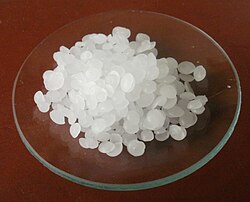
Quote:
Paraffin waxParaffin wax (or simply "paraffin", but see alternative name for kerosene, above) is mostly found as a white, odorless, tasteless, waxy solid, with a typical melting point between about 46 and 68 °C (115 and 154 °F),[4] and having a density of around 0.9 g/cm3.[5] It is insoluble in water, but soluble in ether, benzene, and certain esters. Paraffin is unaffected by most common chemical reagents but burns readily.[6]
Pure paraffin wax is an excellent electrical insulator, with an electrical resistivity of between 1013 and 1017 ohm metre.[7] This is better than nearly all other materials except some plastics (notably Teflon). It is an effective neutron moderator and was used in James Chadwick's 1932 experiments to identify the neutron.[8][9]
Paraffin wax is an excellent material to store heat, having a specific heat capacity of 2.14–2.9 J g−1 K−1 (joule per gram kelvin) and a heat of fusion of 200–220 J g−1.[10] This property is exploited in modified drywall for home building material: a certain type (with the right melting point) of wax is infused in the drywall during manufacture so that, when installed, it melts during the day, absorbing heat, and solidifies again at night, releasing the heat.[11] Paraffin wax phase change cooling coupled with retractable radiators was used to cool the electronics of the Lunar Rover.[12] Wax expands considerably when it melts and this allows its use in wax thermostatic element thermostats for industrial, domestic and, particularly, automobile purposes.[13][14]
In industrial applications, it is often useful to modify the crystal properties of the paraffin wax, typically by adding branching to the existing carbon backbone chain. The modification is usually done with additives, such as EVA copolymers, microcrystalline wax, or forms of polyethylene. The branched properties result in a modified paraffin with a higher viscosity, smaller crystalline structure, and modified functional properties. Pure paraffin wax is rarely used for carving original models for casting metal and other materials in the lost wax process, as it is relatively brittle at room temperature and presents the risks of chipping and breakage when worked. Soft and pliable waxes, like beeswax, may be preferred for such sculpture, but "investment casting waxes," often paraffin-based, are expressly formulated for the purpose
So, I can see making old fashoioned "Potted" electircal devices if necessary. (You never know what emergency might happen)
Or using the stuff to maintain comfortable/habitible conditions in a habitat, per temperature regulation. It apparently was already used on the Moon for a cooling fluid, how about a heating fluid on Mars?
As a Rocket fuel.
TwinBeam mentioned crash-landing raw materials on another thread, I mentioned a "chain method" also on that thread, but it has other traffic of another nature, and this would step on that so I am starting this thread.
It seems to me that it would be a good candidate for hard landing/crash landing.
If packets of it were strapped on to the sides of a lander, and the lander had a spin at the time of release, the the bags of paraffin would eject from the lander and reduce it's load. If there were air/Nitrogen bubbles in the plastic phase paraffin, then upon impact, the air bubbles would absorb some of the shock, and perhaps keep the bags from bursting. Even if they burst, I am inclinded to think that the paraffin would largely be usible for a reasonable period of time, with cleaning.
I am wondering if instead of bringing Hydrogen to Mars, and extracting Oxygen from the atmosphere from it, it would be better to use paraffin as the fuel, and then simply extract Oxygen from CO2 directly, and casting away the CO remnant?
Hydrogen would be hard to deliver to Mars as a liquid. Water would be expensive to deliver to Mars, since you are delivering a lot of Oxygen.
If Parafin can be eject-landed, and Oxygen pulled directly from the CO2, then the humans would simply pick up the solid pieces of bagged paraffin, and use it during the mission for what utility it had, and the reuse it as a fuel to get to orbit.
The following is not part of this topic, but it is interesting. Maybe later:
http://www.space.com/16367-private-moon … almaz.html
#9165 Re: Human missions » Landing on Mars » 2012-06-30 11:09:47
For your intentions, yes that is also an option.
However, I have no intention to susspend anything from the chain but chain.
The chain if it is metal or even perhaps plastic is a tool.
The chain if it is food, is a collection of food joined, so that it can be extracted from the dirt and dusted off. Perhaps it would a soluable so that it could be immersed in water to make a soup of some kind, and yet build with a bit of strength. Perhaps beef jerky and a glue of soup dried soup broth?
The chain if it is plastic can serve as a tool, but could be fed into a 3D printer to make items required and desired.
The Metal, if it were brass would be useful, a brass chain can be of use, otherwise it can be melted and processed into tools or construction materials.
Steel chain would be of some value, otherwise, perhaps it could be forged into tools, using solar concentrated focus, and blacksmith methods.
Cable is useful, but when it gets screwed up it is screwed up. Chain can be cut with a cutter, and can be joined with a new forged link, or a specially built one that will mechanically join together.
The point would be to slow it to a speed where impact would not render it useless or unrecoverable. That way less fuel used to deliver it. The rocket engines used to slow it are immediatly put to a new task as soon as the chain either is stopped from pulling the assembly down when it strikes the ground, or is simply released from the assembly to fall on it's own. The engines which previously were used to slow down the chain then are reused to soft land or hard land the engine assembly, to protect the engine assembly or a further cargo, or to just protect the cargo, such as an inflatable shelter.
If the engine assembly is protected, then while the mission is occuring refueling from Martian atmosphere could be occurring at the same time, so that it can deliver the people back up to orbit. So it gets used 3 times.
#9166 Re: Human missions » Landing on Mars » 2012-06-30 09:35:18
Asside from what I recently posted, and in line with what TwinBeam posted, I wonder if it would be possible to hard land a collection of bags or canisters of very cold frozen mixture of water and Hydrogen Peroixde, without it exploding? Say at 20K? If so then that could serve as an immediate Oxygen supply and also water. It a previously landed device can provide Oxygen and water, then not needed, but I think that getting water will be hard. Anyway, again, an option perhaps.
#9167 Re: Human missions » Landing on Mars » 2012-06-30 09:12:15
Actually I only said hover to indicate that after the chain load was expelled, the engines would have enough power to hover, povided they had fuel. Of course landing the engine assembly ASAP, before the fuel ran out would be the preference.
For example if the engines had enough power to hover a one ton assembly, and the total weight with chain was 5 tons, then without releasing the chain the speed of descent would be enormous. The timing of the disconnection of the upper end of the chain would be critical. It would have to happen soon enough that the "Lander" could overcome it's inertia, and also be close enough to the ground as to not linger in hover mode. Certainly not a "Personed" process, but an ultra high speed robotic process. And the chain materials would have to be of great utility or it would not be worth it.
It is a process somewhere between crash landing and a somewhat soft landing.
Again I am not proposing it as a defninte solution, but a thought experiment I have been working on.
I am not even sure why it would be needed to save the engine section from impact except to soft land a inflatable habitate, or some other sensitive machine or if that engine section was to be turned into an assent rocket for return to orbit.
There is much to challenge in this, I simply present it as thinking, not as an effort to overturn previous work, but as in the crash landing notions presented to suppliment other various previously considered options.
I actually want to avoid hovering, unlike that skycrane which is to deploy the next rover.
#9168 Re: Human missions » Landing on Mars » 2012-06-30 08:59:48
I am inclined to think what you mentioned should be considered.
I have tried to work though a "Similar" set of notions.
The following is a thought exercise for the most part but illustrates some advantages of alternate schemes:
Using a "SkyCrane" type landing system, after ejection from an aeroshell, and after having been slowed down sufficiently, a "Cargo" of "Chain" could be released, to depend below the "SkyCrane". The upper set of links would be of the strongest matrials, and below that progressively weaker materials.
Strong metals, weak metals, plastics, edible materials.
Strapped on to the skycrane could be an inflatable shelter, or not, something that needs a greater degree of protection.
As the assembly was deployed, the chain would be too heavy for the "SkyCrane" to have any hope of landing it gently, rather the decent would be very rapid.
At the last moments of landing, the first part of the chain, the edible structures would hit hard, and very likely shatter to some degree, but the load would be lessened. The "SkyCrane would fire special rockets to give an immediate additional reduction in speed. The whole assembly would be traveling sideways to some degree, so that the chain would not all fall on top of the previously deposited materials. At some point just before impact of the "SkyCrane" an explosive bolt would disconect the upper end of the chain from the "SkyCrane". The "SkyCraine" would then either softland, or hardcrash, or fly back into orbit. I favor softland. It would have released the majority of it's cargo, and so the engines would be capable of halting it's inertia, and also of allowing it to hover and land.
Concerns would be "Backlash" where the chain might rebound up and hit the "SkyCrane/Lander". A vigorous sideways motion might help to protect from that.
Alternately the chain would be released substantially above the point where it touched the ground, and with a sideways motion it shoud differentiate as it impacts.
I would think the speed of impact should be slow enough that some of the chain would be intact, and useful as chain.
In some cases, starting the deployment of the deposite of chain at the top of the sloping landform and ending at the bottom of a depression such as a crater might also help, but would require almost perfect precision.
As for humans landing I wonder if in the end they might dare to be in spacesuits only with a rocket pack? If so, they would need to have a reliable rocket pack, and again extreme precision as to land where the deployed resources are, or they would almost certainly die.
Crash landing some stuff first is also an additive option.
Presuming these people landed would have tools and a shelter and an energy source, they might build what else they needed with the depoyed materials, and local materials.
I choose chain because it has some of the attributes of a solid, and some attributes of a fluid, especially when it would be vibrating.
This should allow the dissapation of impact energy over an extended period of time compaired to an impact of a big solid lump of whatever.
#9169 Re: Interplanetary transportation » Airship to Orbit? » 2012-06-24 14:12:57
As I said, I find this entertaining, and if you did not criticise it I would, but since you are somewhat taking the con, I will attempt to give it a little pro.
Impaler said:
I'm a big fan of electric propulsion but it just wont work in the atmosphere, I've seen studies that show that current SEP systems can't even go below the altitude of the ISS without suffering drag greater then the thrust they can generate, the figure of merit is W/m^2. Contrary to popular belief their is still a lot of atmospheric drag up their at orbital altitude and a big low density balloon is going to get pulled down so fast it ain't funny.
http://en.wikipedia.org/wiki/Ionocraft
If I am not mixed up, I have seen video's of actual devicis "levitating" (Actually being thrusted by ion flow). As the article implies, short circuits are an issue, but perhaps that is more true when you use it in a sea level air pressure environment. Perhaps the voltages don't have to be so high at 140,000 to 200,000 feet. So, the confusion is totally understandable, but I think it is a different type of electrical propulsion than the ion rocket. I also recall a reference to yet another device to propell airships, that woud involve charging a volume of gass electrostatically, and then compressing that and venting it. So, perhaps I am still confused. I am sure that they have some notion that they can build a device to thrust with. Otherwise I wouldn't think they would mention it for fear of being discredited.
Teraformer said:
One of the more interesting aspects of Airship to Orbit is that it doesn't need a heat shield or landing system. That's a major mass saving right there, though likely to be eliminated due to the mass of the airship.
I thought that might be true. So, return at least could make sense, if lifting does not.
I wonder if the device could plane in the air like an airplane, to get to 200,000 feet, only going 50-100 mph faster than the spin of the air at that height, and with a burst of propulsion elivate (Perhaps a small chemical rocket), pointing the nose up, and then pointing horizontal (More or less) then being above the worst drag, begin propulsion to have an orbit? I am imagining that if you are going to use electrostatic thrust for most of it even in "Sub-Orbit to Orbit mode" you would need to be able to feed a propulsion gas to the "Ionic Propulsion" once you were very much above 200,000 feet. They do talk about sending it to other places in the solar system, so, it must need a plan for that propulsion.
While magic tricks and camera tricks could easily produce the following references, I do believe that the effect is real. I have seen these before. Some people like to say it is antigravity (But it is not), and some think UFO's might use it. (Aliens) I guess if they exist, and if they have assender vehicles, then yes they might use it for some methods of travel.
http://www.youtube.com/watch?v=fWJFQ3eF2HY
http://www.youtube.com/watch?v=jrfBrrDf … re=related
http://answers.yahoo.com/question/index … 239AAdGmat
Perhaps it could make sense, since if you can lift a mostly balsa wood model against the Earth gravitational field there could be a thrusting method which would work in the very dry ionosphere, where the lifter would actually "Plane" to a higher altitude than it's floatation characteristics would allow, so it would encounter increasingly thinner air as it increased velocity, and planed upwards. I don't know what would happen to molecules impinging on the leading edge. Would they be sucked into the thrust process? Of course if the impact released heat, then that heat would be at the expense of sub-orbital movement. It would have to be made up for just to stay at the same altitude, and more would have to be added to increase altitude.
Alright, I guess I will read the manual:
Quote:
The third part of the architecture is an airship/dynamic vehicle that flies directly to orbit. In order to utilize the few
molecules of gas at extreme altitudes, this craft is big. The initial test vehicle is 6,000 feet (over a mile) long. The
airship uses buoyancy to climb to 200,000 feet. From there it uses electric propulsion to slowly accelerate. As it
accelerate it dynamically climbs. Over several days it reaches orbital velocity.
So, OK then Ionic? propulsion from 200,000 feet, which is different from what I said, so I was a bit wrong, or a lot wrong. 
But I might be learning something new!
http://answers.yahoo.com/question/index … 706AAVxNJV
Nevertheless, several boundaries have been designated:
~ The Fédération Aéronautique Internationale has established the Kármán line at an altitude of 100 kilometers (62 mi) as a working definition for the boundary between aeronautics and astronautics. This is used because above an altitude of roughly 100 km, as Theodore von Kármán calculated, a vehicle would have to travel faster than orbital velocity in order to derive sufficient aerodynamic lift from the atmosphere to support itself.
~ The United States designates people who travel above an altitude of 50 miles (80 km) as astronauts.
~ NASA's mission control uses 76 miles (122 km) as their re-entry altitude, which roughly marks the boundary where atmospheric drag becomes noticeable, (depending on the ballistic coefficient of the vehicle), thus leading shuttles to switch from steering with thrusters to maneuvering with air surfaces.
This is a difficult question to answer because at some level, there is always stuff in space.
The space between our planets has some lingering dust and gas in it. So does the space between our sun and the next star. In fact, even the space between galaxies has SOME stuff in it.
I guess the best answer would be, at what point does the gas and dust cease to be gravitationally associated with the earth?
Well, that's actually closer than you think. At about 73 miles up most of the "stuff" that is zipping around in space is dominated by charged particles of solar wind and by gas/dust that is in a SOLAR orbit, not an earth-bound system.
So that's the best answer I can give. There really is no point at which there is NOTHING up there. However, the point at which the stuff up there is space stuff and not earth stuff is around 73 miles.
So, if you accept 62 miles, then the thing stops being a balloon at 200,000 feet, and must be a plane from there to 327,360 feet (127,360 feet higher), and then must be an orbital object above that. Since they say that the things are expected to be interplanetary, then I would think they would want to get to a higher altitude as fast as possible to reduce drag. Otherwise, I would think that having an orbital vehicle dock and take the load off their hands would make sense, ASAP, and then just drop back down.
I am interested in how such a system might be used on Mars. Slower oribital speeds needed, thinner atmoshere. And Venus, and Titan.
Oh and one more trick has occured to me. Could the wings that are actually balloons up to 200,000 feet be flattened as it transistions to a plane? Perhaps if it were filled with hydrogen, could you burn some of that off with Oxygen, and compress it into water? This might reduce drag, if the wings become thinner, and flatten out. Of course then they still have to be rigid. Then before return you would have to re-inflate the wings with Hydrogen.
#9170 Re: Interplanetary transportation » Airship to Orbit? » 2012-06-22 23:47:54
I looked it over now, rather entertaining if nothing else.
http://en.wikipedia.org/wiki/Orbital_airship
http://www.jpaerospace.com/atohandout.pdf
http://en.wikipedia.org/wiki/JP_Aerospace#Ascender
The PDF is nice to look at.
I guess the part I like the best is where if they do have the "Dark Sky Stations" at 140,000 feet then Oxygen could be collected to fuel the Orbital assender.
I wonder if those stations could also make a buck being communication relays, and also hotels? That might justify the stations and the ground to station airship.
The orbital assender is really outside of the box though.
I have plenty of reservations about how it could work, but I have thought of a few possible solutions for some problems.
I guess for the issue where space objects might puncture the orbital assender, I would speculate on small robots inside with patch kits, perhaps they would have Gecko feet to stick to the inside walls?
http://geckolab.lclark.edu/dept/geckostory.html
http://www.dailymail.co.uk/sciencetech/ … -mark.html
I am not sure but I am speculating that the "Electric" propulsion for the orbital assender might be a process of compressing electrostatically charged gas and venting it?
If the propulsion were electric, I would think that a powersat in orbit might be able to beam energy to it. If it were microwave, however I guess I don't know how the airship could convert that to electricity. If it were laser, and the skin was solar cells of a very thin type, then perhaps that could work.
I guess some time ago there was talk about super strong Nano Materials in the future. Perhaps that would be required, to make a very thin but strong structure.
It is entertaining however far off it is to our current grasp. I am glad that people are thinking so way far out.
#9171 Science, Technology, and Astronomy » The use of filler mass in propulsion. Could it help? » 2012-06-13 19:47:16
- Void
- Replies: 1
I am putting this here, because I think that there could be some who would resent it if I put something so wild into the transportation sections.
I have been wondering if any good can come from injecting non combutsible or non traditional substances into a cluster of rocket plumes.
I would start with the worst case notion, that of injecting just plain moon dust, from our Moon, or Phobos or Demos.
I had thought about injecting it into a rocket engine but intution told me that that is a no no.
I am thinking if you had a cluster of engines, at least 3, and you could inject a slury of dust and C02 for instance into the area between the exhaust plumes, could that serve any purpose?
Similarly of course is dry ice and water.
The thing Dust, Dry Ice and Water have in common is that they might be obtainable at far locations with less fuss, and they are rather storable. Turning dust into a slury for injection could be a problem.
I understand that for the solid rockets the space shuttle used, it was considered a good thing that it had soot and particles in the exhaust somehow it promoted thrust?
Ignorant wondering.
Of course it might be quite possible to obtain C02 and Reduced dust from an astoroid of certain types by subjecting the dust to concentrate solar heat. In that case the dust could actually be a fuel of sorts. (Think grain elivator explosions).
#9172 Re: Terraformation » Vesta, modest ambitions. » 2012-06-13 19:30:48
As for the spinning "Centrifuge" floating in a heavy gas, the axis would be vertical to the gravitational field. It is a possible option, not a necessity. Other methods are well worth considering.
As for Vesta a basalt Terraformer. True enough. However, I speculate on Vesta, only because we have data. I actually think we should look at NEO, and then the equivalant in Martian orbital proximity, and then perhaps something in the main belt smaller than Vesta, and with a clear signature of water being present.
If Phobos and Demos do show to have accessable water, then all the much better for everything. Go there before the main belt.
If Mars is sterile, then surely make something of it. If not, then figure out a plan, try to be moral towards the oganisms. We won't really know the options until we have some degree of certainty of the actual facts. We will not ever know for sure, sooner or later we will have to make a best guess, and live with our decision.
#9173 Re: Terraformation » Vesta, modest ambitions. » 2012-06-12 22:35:23
I do a lot of things by intuition. Love your calcs, but really beyond that not going to talk the language unless it need to. Have plenty of mind benders at work at this time and must rest my tiny little mind for that.
But interesting stuff.
I have in the past proposed an enclosure on the surface of low gravitational objects where that enclosure is filled with CO2, or Air.
Inside is a spinning "Balloon" contianing H2 or He2, or maybe air, if the esternal is CO2.
You get the notion, heavy gass with spinning baloon with gondola, where spinning baloon contains a lighter gass.
Further a "Mast" extending from the bottom of a floating boey, could An
(Note I could just scream, this site is one where a whole paragraph will misteriously dissapear, on a keystroke, therefore, I am wise to save and then edit. I have often had incidents where I have composed whole messages, and on a keystroke everything vanishes)
Anyway, if that is as bad as it gets, I will live.
Continuing;
A bottom thing floating on water. Think of an old fashion childs top, with a floatation gass inside, and a pool of water under it, and the apex of the bottom immersed in that pool of water.
So, maybe "Centrifuges" on Asteroids and Mars.
I like the geosynch stuff though, and for asteroids smaller than Vesta, perhaps a cavity created in the center with zero gee, where spinning worlds choudl be.
#9174 Re: Exploration to Settlement Creation » Domed habitats... - ...size, materials, and more. » 2012-06-10 08:41:36
Impaler,
I like your work. I think layering is a good notion. The idea that one wall does all is a starter, but when you look at the Martian environment your solution where layers handle different challenges, I like it.
I am not interested in playing topper, but I will just mention some of my thoughts, and you are certainly able to make of them what you will or will not.
-I have thought of glass "Scales" attached to a lizard skin, and the skin of fabric/film over a frame. However, I think this will be too labor intensive.
-I will suggest the addition of an expendable "Epidermis" for your shelter. As it appears that the shell-dome you would make will be rigid, it will have some of the properties of a tent frame. You could consider draping a expendable tent over it, and litterally using tent pegs to fasten the edges to the ground. I would suggest that this flexible film would be coated with a protective coating of glass spray. It would be change out and recycled periodically, perhaps ground up and used as filler for a new rigid dome, when it had deteriorated from the harsh outer Martial environment. It would also create yet another layer of themal insulation. I am merely offering the suggestion. Economics and technology would determine if this is a value added process, or simply a drag that you don't need.
-My enclosures with compression of air have typically been sausage links of netting holding in a bladder of compressed air. Some advantages, some liabilities. The links would need a method of connecting the ends as "Junctions".
I hope this does not annoy you that I jumped in with this stuff.
But I do like your method to construct a hard dome shell, that is not pressurized. It makes a lot of sense to me.
#9175 Re: Science, Technology, and Astronomy » Russians found water on the Moon. » 2012-06-05 23:42:55
I suppose the disk notion is more conventional, and perhaps more correct.
However, consider the desalination of water. I will mention two methods. 1) One is more familiar to logic, where you boil water with heat, and then condense it with cold. 2) Two is a method where you use a rotor (Actually two that have a cross-section like a peanut), and pull a vacuum on water which is briny, and then compress the vapors into a liquid.
So, I consider the formation of the Earth to be 2), and the formation of the Moon to be 1).
If a protoplanet has an extended atmosphere, then the zone of condensation is in two places. 1) The upper atmosphere, where the cold of space penetrates, and 2) The forming core, where pressure causes materials which might alternately in a vacuum become vapor, to become liquid, even at high temperatures.
It is to be understood that during the formation of such a binary world, there would be a continuous input of falling materials which would provide heat to the core, and a coninuous radiation of heat out of the atmosphere, which would provide the opportunity for very dirty, very large hail stones to form in a geosynchronous orbit inside of a temporary atmosphere surrounding a protoplanet. Further, the forming hail stones would tend to gravitate to each other, sticking together into one mass.
When the infall of small materials from the disk ceased, then the temporary extended atmosphere would dissipate, and the Moon would be left in a Vacuum, and would be gradually spiraled outwards into a more distant orbit by tidal interactions with the Earth.
Then afterwards if there were a heavy bombardment of Earth, by asteroids, some of that ejected material would pile up on the giant hailstone Moon.
I suggest a variation of this process for many other planets, and there moons.
Or yes perhaps many moons condense outside of a temporary planetary atmosphere from planetary disk materials.