New Mars Forums
You are not logged in.
- Topics: Active | Unanswered
Announcement
#851 Re: Human missions » The 5 places man could live in the solar system » 2016-06-28 17:05:54
Just what are you going to make these "tethers" from, and just exactly how?
GW
Well for one thing, Jupiter has rings, they are not as showy as those of Saturn's, but they are there, and in sufficient amounts to make tethers out of, and there are plenty of moons, 68 of them in fact, and there are most likely more! The small moons are easier to mine because of the low gravity.
#852 Re: Science, Technology, and Astronomy » What is the status today of O'Neill's vision today? » 2016-06-28 17:02:14
No one touting using asteroid mass as a source of materials has ever shown a way to convert those minerals into real engineering materials that have both tensile strength and resilience.
GW
Has anyone tried? Nope! How do you know something can't be done until its tried? You assume that because no one has tried it, it can't be done? Are the materials of asteroids any different than the materials found on Earth? Are their any new elements in the asteroids that are not found on Earth? The reason no one has tried, is that all the missions up to now have been scientific, and no one was looking for a way to build stuff in space. Scientists would rather just write their journals and say, "Oh this is fascinating!" and be awarded a Nobel prize, and that would be the end of it, as they went on to something else. Sometimes scientists are disconnected from the real world, they don't know why they are doing it other than to write a paper in a journal and pat themselves on the back for good science. Scientists want to know how this asteroid formed, what it tells about the early solar system and what conditions are like, but they never get to the subject of commercial applications or what it could be used for! That has got to change, we need some prospecting! We need some more experimentation rather than just observation! We need to experiment on how to do things how to process materials, and not let the fact that we haven't prevent us from doing so!
#853 Re: Science, Technology, and Astronomy » What is the status today of O'Neill's vision today? » 2016-06-28 15:38:49
Who said anything about the government doing it? Obviously O'Neill's projections were a bit optimistic about our being able to accomplish these things. What About mine at the bottom?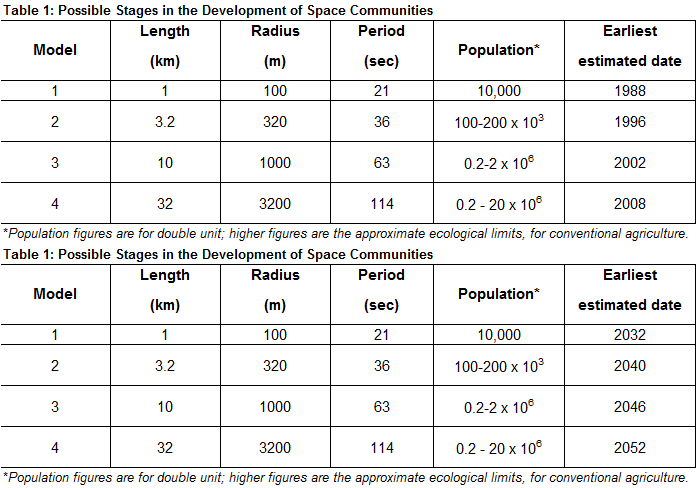
I've adjusted the dates basically too the dates from the top, subtracted 1972 and added 2016 to them. Are we closer to building these colonies now than in 1972? 2032 is the date I listed for construction of a model 1 colony with 10,000 people, about equivalent to a Bernal Sphere. We have this newly discovered Moon/Asteroid, which is about the right mass for building one of these. We don't need a base on the Moon. We probably need some manufacturing in space in the vicinity of the asteroid. See Earth has captured a second moon, says NASA.
http://newmars.com/forums/viewtopic.php?id=7449
O'Neill originally planned on building it out of lunar material, and having a mass driver to fling it off the Moon's surface, but here is an asteroid ready to be worked on. Much of the work in getting it there is already done. What would we need to bring to that asteroid to convert it to the equivalent of a Model 1 Space colony.
The 90-day report only talks about sending a few astronauts to Mars, not 10,000 people to a habitat in space! I'd say O'Neill's vision has more ambitious goals that the 90-day report. With 10,000 people in space, you can do a lot more. A Bernal Sphere would be large enough to be the habitat sphere for a manned mission to Saturn!
#854 Re: Human missions » Earth has captured a second moon, says NASA » 2016-06-28 15:22:06
Mass drivers are still a science lab project, not an actual deployable technology. Needs a lot of development work. The closest item is the rail gun. I notice that it is not yet deployed yet with the navies of the world, except as an experimental item here and there. That should tell you something.
GW
Would you like to stand in front of one as it flings its payload? Do you have that much confidence in it not working, would you stake your life on it? I notice that SSI build a few in the 1980s, did we forget how to build one since?
I think NASA is just afraid to try new technologies, they like rockets and ion drives, they don't like rock throwers, that is just too crude!
#855 Re: Human missions » Musk's plans for Mars » 2016-06-28 12:35:07
I get that from a lot of folks, nearly all of whom have never, ever done any sort of rigging with ropes, cables, or chains (I actually have). The universe is not uncaring, it is malevolent. Cables, ropes, and chains always tangle. They always have and they always will. They will find a way to screw up no matter how carefully we try to rig.
Things don't just happen to us in the trite little scenarios we imagine (which exception is exactly what happened to Gemini-8 and to Apollo-13, by the way). Very complicated ugly stuff is what gets thrown at us. It is better not to add to our vulnerabilities, if at all forseeable.
Tangled and broken cables are quite forseeable, based on the experiences of all sorts of marine and construction riggers here on Earth. That doesn't stop us from rigging, but we expect trouble when we do it, and we are prepared to deal with it, knowing it might be disastrous, even if unlikely.
For example, imagine a little frayed spot on one of your 4 cables (there for any reason at all, including a micrometeroid strike). Now some mischance causes a twisting action, and the 4 cables twist together. The frayed wires trap the adjacent lines so that they are prevented from untwisting when you fire opposite thruster. Now what do you do? Good question.
When the cables unexpectedly jam during the untwist spin, the resulting off-center unexpected force tumbles one or both capsules, which then flip over between adjacent cables, perhaps multiple times, effectively braiding them. Now what do you do? Even better question.
None of that ever can happen, with a rigid or semi-rigid structure. Prevention is 99% of cure.
GW
What if you place spacer rings in between the cables at various lengths to keep the parallel? Elevators seem to function okay when suspended by cables. and two capsules held at a fixed distance by spin a cables are a lot like elevator cars, except they don't go up and down.
You know suspension bridges are held up by cables as well, have you ever seen any of those cables get twisted? I haven't.
#856 Re: Human missions » Earth has captured a second moon, says NASA » 2016-06-28 12:30:22
https://en.wikipedia.org/wiki/Mass_driver
Spacecraft-based mass drivers[edit]
A spacecraft could carry a mass driver as its primary engine. With a suitable source of electrical power (probably a nuclear reactor) the spaceship could then use the mass driver to accelerate pieces of matter of almost any sort, boosting itself in the opposite direction. At the smallest scale of reaction mass, this type of drive is called an ion drive.
No absolute theoretical limit is known for the size, acceleration or muzzle energy of linear motors. However, practical engineering constraints apply for such as the power to mass ratio, waste heat dissipation, and the energy intake able to be supplied and handled. Exhaust velocity is best neither too low nor too high.[17]
There is a mission-dependent limited optimal exhaust velocity and specific impulse for any thruster constrained by a limited amount of onboard spacecraft power. Thrust and momentum from exhaust, per unit mass expelled, scales up linearly with its velocity (momentum = mv), yet kinetic energy and energy input requirements scale up faster with velocity squared (kinetic energy = 1⁄2 mv2). Too low exhaust velocity would excessively increase propellant mass needed under the rocket equation, with too high a fraction of energy going into accelerating propellant not used yet. Higher exhaust velocity has both benefit and tradeoff, increasing propellant usage efficiency (more momentum per unit mass of propellant expelled) but decreasing thrust and the current rate of spacecraft acceleration if available input power is constant (less momentum per unit of energy given to propellant).[17]
Electric propulsion methods like mass drivers are systems where energy does not come from the propellant itself. (Such contrasts to chemical rockets where propulsive efficiency varies with the ratio of exhaust velocity to vehicle velocity at the time, but near maximum obtainable specific impulse tends to be a design goal when corresponding to the most energy released from reacting propellants). Although the specific impulse of an electric thruster itself optionally could range up to where mass drivers merge into particle accelerators with fractional-lightspeed exhaust velocity for tiny particles, trying to use extreme exhaust velocity to accelerate a far slower spacecraft could be suboptimally low thrust when the energy available from a spacecraft's reactor or power source is limited (a lesser analogue of feeding onboard power to a row of spotlights, photons being an example of an extremely low momentum to energy ratio).[17]
For instance, if limited onboard power fed to its engine was the dominant limitation on how much payload a hypothetical spacecraft could shuttle (such as if intrinsic propellant economic cost was minor from usage of extraterrestrial soil or ice), ideal exhaust velocity would rather be around 62.75% of total mission delta v if operating at constant specific impulse, except greater optimization could come from varying exhaust velocity during the mission profile (as possible with some thruster types, including mass drivers and variable specific impulse magnetoplasma rockets).[17]
Since a mass driver could use any type of mass for reaction mass to move the spacecraft, a mass driver or some variation seems ideal for deep-space vehicles that scavenge reaction mass from found resources.
One possible drawback of the mass driver is that it has the potential to send solid reaction mass travelling at dangerously high relative speeds into useful orbits and traffic lanes. To overcome this problem, most schemes plan to throw finely-divided dust. Alternatively, liquid oxygen could be used as reaction mass, which upon release would boil down to its molecular state. Propelling the reaction mass to solar escape velocity is another way to ensure that it will not remain a hazard.
It seems like this is something NASA has not tried
#857 Re: Human missions » The 5 places man could live in the solar system » 2016-06-28 12:20:29
Tom Kalbfus wrote:Another place that is relatively radiation free is right above Jupiter's atmosphere, the trace gases above the atmosphere sweeps the orbital space in that region free of charged particles, since they can't build up to lethal concentrations, much as our low orbital space where the ISS orbits is also relatively free of radiation. Humans could settle that region, with the requirement that they expend propellants every now and then to stay in orbit and not fall into Jupiter's atmosphere. A typical orbit in this low region takes about 3 hours. The hard part about settling this region would be getting humans through the intense radiation bands. Fortunately Jupiter provides a lot of rocks which could be used as shielding on the way down. If you can put enough water ice between yourself and the radiation, then you could be protected. Once inside you get out, and use the fringes of the atmosphere to slow down into a nearly circular orbit, the massive rock-ice shield you used to get here becomes a meteorite burning up in Jupiter's atmosphere. Once in that low orbit region, Jupiter's magnetic field protects you from the most powerful solar storms the Sun can throw at you.
Jupiter's atmosphere would be an awful place to live.
Did I say in Jupiter's atmosphere? 
This is a diagram of Earth's atmosphere layers, technically the area where are low earth orbiting satellites orbit is called the Thermosphere, Jupiter has one too.
Just above the stratosphere in this diagram is Jupiter's thermosphere, now this thermosphere is not thick enough to stop objects from orbiting it, over the long haul, objects at this altitude will slowly decay in its orbit, and like skylab will plummet down into the atmosphere, but that can be years. What the thermosphere does do is prevent radiation bands from building up here, because it takes a long time for Jupiter's magnetic field to collect these charged particles at this distance from the sun, the hydrogen atoms in this near vacuum are thick enough to prevent such radiation build up, so it is safe for astronauts in their space suits here! As you can see in the diagram of Jupiter's atmosphere, it does have a habitable region, if humans can tolerate air pressures of around 7 bars, and I think they can.
The gravity would be over 2.5 times Earth surface.
Astronauts and fighter pilots have endured greater G-loads, and the military is working on exoskeletons, and it already has counter-pressure suits for its fighter pilots. So a human to survive in Jupiter's lower atmosphere would need these things, and also would need to breath a mixture of helium, nitrogen and oxygen, which deep divers do all the time. The temperature as you can see at the water cloud region isn't too bad. If you could just deal with the gravity, the rest isn't that much of an obstacle. Also in Low Jupiter orbit, you wouldn't feel those 2.5-Gs, you would feel weightless just like you do in low Earth orbit, except in the case of Jupiter, it would take 3 hours to complete each orbit instead of 90 minutes. Building structures in Low Jupiter orbit would be the same as in low Earth orbit, you need to hold in air, no need to worry about the radiation, as the magnetic field around Jupiter and the Thermosphere takes care of that.
The lift provided by a hot hydrogen balloon would be poor, even at large temperature differences.
It is basically a hot air balloon, you just need an energy source to keep the "air" meaning hydrogen, hot relative to the surrounding "air". If hydrogen leaks out, you just pump it back in and heat it..jpg)
You need something like this, the heat source instead of a flame would likely be a nuclear reactor
The delta-v needed to get out again is prohibitive. Quite literally a death trap. Why would you go there is the first place?
It would be a good place to set up a penal colony. Jupiter would make an excellent prison planet, no one is going to escape from it, but they could be kept alive there. From Low Jupiter Orbit its easier, you still need radiation protection to survive on the journey out however.
As for traversing the radiation belts, magnetic fields provide a better mass-ratio than solid ice. Ultimately, magnetic shielding both static and on spacecraft, may make the inner moons of the Jovian system reachable by human beings. Iron solenoids on Amalthea and Io, could shield selected portions of their surface and colonies could be built under their protective umbrellas. It doesn't matter if the electromagnets weigh thousands of tonnes as they won't have to move. In truth, these worlds are so deep in Jupiter's gravity well that they will always be at a strong disadvantage to worlds further out. People make money through commerce and a deep gravity well is a barrier to trade.
One can use a system of tethers to lower oneself towards Jupiter and to also climb out of its gravity well. Lots of materials in the Jupiter system to build things out of too, and they are in relatively close proximity to each other, while the asteroid belt is more spread out and diffuse.
#858 Re: Human missions » Musk's plans for Mars » 2016-06-28 10:20:49
There was no cable on Gemini 8. That capsule was docked to an Agena target vehicle. A stuck thruster spun them up so fast it nearly tore the Gemini apart before Armstrong got it under control. They undocked and came home immediately, since virtually all their thruster propellant was depleted, and they used the last of it during reentry.
Many propose cable-connected spin gravity. There is a very serious dynamical complication with cable systems: "you cannot push on a string". It severely limits what you can do to spin up and spin down, and it even more severely limits what disturbances you can handle. Unless you use multiple cables (an entanglement risk) then you automatically incur the single point failure mode of a broken cable killing your crew.
I'm not a fan of cable-connected spin systems.
Wheels are just too big and expensive. Truss-connected things have enormous inert weight fractions. I'm not a fan of those ideas, either.
The only thing that makes sense to me is the baton shape spun end-over-end, made up of modules you have to have anyway. Being at least a semi-rigid object, there's easier start-stop dynamics (you can use flywheels instead of thrusters!), and you are far more tolerant of disturbing forces.
GW
How can cables get tangled. Lets say there are four cables, much like a swing set you might have played with as a child. The swing would go back and forth, and sometimes some devious kid would twist the swing just to make things interesting. What would the swing do after you twisted it? It would unwind. Since the four points up top would be lined up with the four points on the bottom, if you twisted this swing, the tendency would be for the swing to unwind until the original state was restored. I think the same would happen between to capsules held together by four cables. The get twisted, they would unwind. Thrusters would spin it up. with four or more cables you would have some stability.
#859 Science, Technology, and Astronomy » What is the status today of O'Neill's vision today? » 2016-06-28 10:01:52
- Tom Kalbfus
- Replies: 129
Found this article on the NSS website:
http://www.nss.org/settlement/physicstoday.htm

I redid table 1 including my own dates that are just as remote in the future as the original ones were in 1972.
What do you think, is it closer today than it was then? Perhaps with things like robotics and automation such a space development would be more possible.
In the long run, space-colony construction is ideally suited to automation. A colony's structure consists mainly of cables, fittings and window panels of standard modular form in a pattern repeated thousands of times. The assembly takes place in a zerogravity environment free of the vagaries of weather. By the time that the colonies are evolving to low population density, therefore, I suspect that very few people will be involved in their construction. Most of the workforce will probably be occupied in architecture, landscaping, forestry, zoological planning, botany and other activities that are nonrepetitive and require a sense of art and beauty.
What did O'Neill get right and what did he get wrong? Perhaps we're waiting on automation. 2032 is 16 years from now, what do you think the status of automation would be then? Would we have self-driving cars? How about SpaceX reusing its rockets? The Space Shuttle was just plans on paper, by the time this 1974 article was written, as envisioned it was to be a reusable "airplane" to outer space. Maybe SpaceX would have better luck with that. to get 10,000 people into orbit by 2032, when would we have to start? I'm thinking maybe 2028 perhaps, that is 14 years from now! We would have to have some amazing and disrupting technological innovations between then and now to make this a reality. Computer advancement can proceed rapidly after all, it has done so in the past. What jobs would be left for humans if it does? Would these space colonies end up as vacation resorts?
#860 Re: Human missions » Earth has captured a second moon, says NASA » 2016-06-28 09:28:22
It requires automation. This is one small asteroid that's out there, there are others, but for this one small asteroid, the best use may be to make something useful out of it, that we can boot strap to do greater things. this asteroid is well placed. Maybe we can work with it where it is. Moving it significantly may be beyond our capacity until we learn to build things like mass drivers in space.
#861 Re: Human missions » Musk's plans for Mars » 2016-06-28 09:25:06
What of you get two capsules tethered together by a cable and rotate them. What's so hard about that? I hear a Gemini mission with Neil Armstrong aboard once did that accidentally, but with a much shorter spin radius.
https://en.wikipedia.org/wiki/Gemini_8
#862 Re: Human missions » The 5 places man could live in the solar system » 2016-06-28 08:40:52
Another place that is relatively radiation free is right above Jupiter's atmosphere, the trace gases above the atmosphere sweeps the orbital space in that region free of charged particles, since they can't build up to lethal concentrations, much as our low orbital space where the ISS orbits is also relatively free of radiation. Humans could settle that region, with the requirement that they expend propellants every now and then to stay in orbit and not fall into Jupiter's atmosphere. A typical orbit in this low region takes about 3 hours. The hard part about settling this region would be getting humans through the intense radiation bands. Fortunately Jupiter provides a lot of rocks which could be used as shielding on the way down. If you can put enough water ice between yourself and the radiation, then you could be protected. Once inside you get out, and use the fringes of the atmosphere to slow down into a nearly circular orbit, the massive rock-ice shield you used to get here becomes a meteorite burning up in Jupiter's atmosphere. Once in that low orbit region, Jupiter's magnetic field protects you from the most powerful solar storms the Sun can throw at you.
#863 Re: Human missions » Earth has captured a second moon, says NASA » 2016-06-27 22:01:03
There is as yet no identifiable market at all. Flooding the market here on Earth with asteroid platinum just makes that very platinum worthless down here.
Platinum has industrial uses, among them are in hydrogen fuel cells, if we could make platinum cheaper, then fuel cells would be cheaper. Also platinum does not corrode, it is one of the least reactive metals, even less reactive than gold. You could drop in in a vat of sulfuric acid, and it would stay shiny. Platinum would be great for "silverware" it would never tarnish, it has a high melting point, and it is very dense, denser than mercury, it would sink to the bottom while lead would float on top.
This in-space mining thing is done as an article of faith, same as it was 500 years ago. The markets for things are unimaginable, before you go. But they have always eventually proved to be there.
Face up to that. You'll be better off, if you do.
GW
#864 Re: Human missions » The 5 places man could live in the solar system » 2016-06-27 21:55:09
Yes we could go to the moon if we should chose to do so. The next is a tossup as to what we are ready to do on the short timeline not being multiple decades as Mars is about the same as Venus if we do not land and the only benifit for mars is its moons to explore that makes it edge ahead of venus for the number 2 spot if we can not land.
Titan and calisto are just not in the realm of probable and if anything we shoud focus next on the asteriod belt as there happens to be lots of useable materials and science to explore at each of the pieces of rock.
Actually Jupiter's moon system has more mass than the entire asteroid belt. (excluding Jupiter)
There are 67 known moons of Jupiter, most of them are the size of asteroids, of particular interest are Callisto 4820.6 km diameter, Leda 16 km diameter, Himalia 170 km diameter, Lysithea 36 km diameter, Elara 86 km diameter, Anake 28 km diameter, Carme 46 km diameter, Pasiphae 60 km diameter, and Sinope 38 km diameter.
These outer moons are outside Jupiter's radiation belts, and they are quite close together compared to the asteroid belt, and remain so. It would be possible to have commerce between them, and even the small ones are quite massive compared to many of the asteroids.
#865 Re: Human missions » The 5 places man could live in the solar system » 2016-06-27 09:27:46
Well, I'm glad they didn't mention by would-be adoptive homeworld of Ceres, because I don't want competition, though I think it would be in the top 5. Abundant water ice, no radiation belts, close enough that you can still use solar power, they've discovered ammonia there so you can fertilise crops, the gravity is low enough that a space elevator isn't particularly difficult to engineer... the gravity is low, but you can construct rotating habitats for that. I'd put Ceres in 2nd or 3rd place, with Mars in top position (well, after Earth, obviously).
Well Ceres is a dwarf planet 945 kilometers (587 miles) in diameter. What if we built a ring around its equator? Lets make the ring 100 meters wide, and if we rotate it at 2152.589632280152 meters per second or 22.986306145880191858179839941061 minutes for a rotation, we'd have 1 gravity on its inner surface. Normally it would be quite challenging to build a Stamford Torus that big, but we have Ceres to anchor the ring against. We just build a track, anchor it firmly to the crust. This would be equal to 4813.886901 miles per hour! Ceres at its worst is 2.9773 AU from the Sun which means we need almost 9 times the collecting area for Solar energy, we should double that and make it 20 because Ceres rotates once every 9 hours. We would power he settlement with Fuel cells in the dark and rely on Solar energy to make the fuel and power the settlement during the short 4.5 hour day. The living space would be 100 meters times 2968.8050576423546103471979971991 kilometers, that would be 296880505.76423546103471979971991 square meters, that would be 73,360.48 US acres of real estate We could house 4 times as many if we distribute one quarter acre per person, that would be 293,440 people!
acres
#866 Re: Human missions » The 5 places man could live in the solar system » 2016-06-27 09:08:42
I would quibble with the methane of Titan being an endless reservoir of energy because you need oxygen to burn the methane, and Titan has no free oxygen. We could always crack water to get oxygen, but then we have hydrogen, too. It is possibly Titan has geothermal and wind power, though.
I'm not sure how easy it is to deal with the extreme cold, either. People don't go outside at all at the South Pole in the winter, except for very short times, and Titan is a lot colder.
We may need nuclear fusion to get there, so we use it to heat the place once there as well. I think a fission rocket might work as well, but we'd have to bring our own nuclear fuel. We could use liquid oxygen to power our vehicles and other portable devices on Titan. Liquid oxygen wouldn't need much insulation, or it could simply be held under pressure to be kept from boiling off at normal outside temperatures.
The average temperature on Titan is 93.7 K (−179.5 °C)
The boiling point of liquid oxygen is at 90.19 K (−182.96 °C; −297.33 °F) at 101.325 kPa (760 mmHg).
But the surface pressure of Titan's atmosphere is at 146.7 kPa (1.45 atm).
I think liquid oxygen could exist on Titan's surface in an open container! We could fill the gas tanks of our Titan vehicles with liquid oxygen the same way we fill our cars with gasoline!
Liquid methane has a boiling point of 111.66 K and a freezing point at 90.7 K
Titan's gravity is at 1.352 m/s2 (0.14 g) (0.85 Moons), so if we had a bi-propellant fuel, it would still weigh less than on Earth. The dangerous nuclear reactor would stay on one place and manufacture fuel to be distributed throughout the colony and to fuel vehicles and space suits no doubt. I think those would need to be actively heated, not just insulated!
#867 Re: Human missions » The 5 places man could live in the solar system » 2016-06-27 08:53:44
When I was a child, I read a science fiction novel by Robert A. Heinlein: "Farmer in the Sky". Written 1950. It talks about a homestead on Ganymede. I keep thinking Ganymede is suitable. It's the largest moon in our solar system. Larger than Mercury, although not as large as Mars. Surface gravity 1/7 Earth; Callisto is only 1/8 Earth. When I read about Ganymede in the high school library, I expected greater surface gravity. However, gravity was measured by the Galileo orbiter. It has lower density than other planets or Earth's Moon. Lower mass means lower surface gravity.
Ganymede has a magnetic field.
Astro Bob, 13 March 2016: Lucky Friday The 13th For Auroras? / Ganymede Auroras Hint At Hidden Ocean
The following image is aurora of Ganymede, taken in UV by Hubble Space Telescope, superimposed over image of Ganymede taken by Galileo...
http://i2.wp.com/astrobob.areavoices.co … =400%2C382Ganymede has to deal with radiation belts around Jupiter, but it has a magnetosphere to protect it. Is it enough? We don't know.
Ganymede has a stony surface, with hundreds of kilometres of ice beneath. Probably dirty ice. Analysis of the aurora indicates there's a liquid water layer deep down. First estimate is 100km deep, which is roughly 10 times the depth of Earth's ocean. They estimate a salt water ocean, to be able to produce a strong enough magnetic field to produce aurora like that. And they estimate the ocean is 150km beneath the surface.

Water ice makes a great radiation shield as well, and we could probably melt tunnels beneath Ganymede's surface, and the "dirt" in the ice probably contains a lot of useful materials we can build stuff out of. Solar panels would still be of some use, the first settlers on Ganymede will have lots of real estate to lay those solar panels down on, we would need to make or bring 25 times as many solar panels as we would on Earth, but at those cold temperatures, the solar panels would convert the sunlight they do receive to electricity with maximum efficiency. One could also manufacture mirrors locally, you could use mirrors to concentrate sunlight onto solar cells. You could also concentrate sunlight on habitable domes. Water ice is nice and transparent, would make a nice radiation shield but would also let through sunlight, have some insulating glass or plastic underneath to keep the warm temperatures produced by the sunlight within the dome.
Lets for example assume a dome is 100 meters wide, about the size of two football fields, how many mirrors would we need to light it up? An array 500 meters wide would do the trick. Ganymede rotates once every 7.15 days, not as bad as the Moon so we might need twice the collection area as that, a 700 meter wide array would collect twice as much solar energy as a 500 meter wide array. I figure lets do a whole kilometer to take care of any inefficiencies related to converting solar energy into electricity., that would bring in 4 times as much energy as needed to keep the dome warm and illuminated. So what do you think? can we bring a square kilometer of solar cells to Ganymede, or how about just an array 250 meters by 250 meters surrounded by mirrors to concentrate sunlight on them, and maybe a small 100 meter dome in the center to receive natural sunlight when its available, use electricity to produce that sunlight artificially when its not. I think the obvious way to store energy would be with hydrogen fuel cells. Use the excess electricity to crack water ice into its components, and then run fuel cells on them to power the settlement in the dark.
#868 Re: Human missions » Earth has captured a second moon, says NASA » 2016-06-27 08:29:36
You probably don't need the gold and platinum to build a space settlement anyway, they can be sent down to Earth to pay for it perhaps.
#869 Re: Science, Technology, and Astronomy » We need a new RLV - Moving beyond the shuttle » 2016-06-26 11:02:02
They are much easier to make for Mars than for Earth.
#870 Re: Human missions » International Space Station (ISS / Alpha) » 2016-06-26 10:58:04
Waste water is not a big problem, you simply evaporate it and re-condense it. In space you have access to a vacuum, expose the water to a vacuum and it boils away, leaving the solid contaminants behind. You capture the water vapor and re-condense it to distilled water. What could be simpler?
#871 Re: Science, Technology, and Astronomy » We need a new RLV - Moving beyond the shuttle » 2016-06-26 09:10:43
Tom Kalbfus you recycle the junkyard and make recycled rockets from the parts to be refueled from insitu resources with tanks being used for water, oxygen and fuel for later as excess is create of any of these if not used to make a rocket....
Every time you exchange crews at the Mars base, you have more lander legs and bottom stages of vehicles left over, eventually there will be hundreds if this does not stop, the Mars base will be in the middle of a junkyard of used bottom stages of landers, and there will probably be a garbage dump nearby as well, all the cans and bottles imported from Earth.
#872 Re: Science, Technology, and Astronomy » We need a new RLV - Moving beyond the shuttle » 2016-06-25 15:20:05
I think its easier to bring stuff into Mars orbit from Earth, than to its surface. reusable stuff needs to be repaired and maintained, and the complex replacement parts will for a while have to come from Earth, as that is the only place they can be manufactured. You can refuel a reusable lander using a fuel plant to convert the atmosphere into fuel, but to maintain that fuel plant and the rocket engines, would probably be best done from orbit, if you want maximum use of that reusable equipment. Perhaps the interplanetary spaceship can be maintained in Low Earth orbit with stuff brought up from Earth. Complex technology is hard to produce locally after all.
#873 Re: Human missions » Musk's plans for Mars » 2016-06-25 15:13:06
Musk will need to do more than provide a cheap ride for crew or cargo as its going to need a ship for the deep space trek to mars, the ability to get better than ISS closed loop effiency and a low mass power source for the base after a good indepth investigation of the perfect site....
You mean a low mass that is brought over from Earth, those structures that are made of Mars itself are an exception. One way to collect solar energy, for instance is with large mirrors that track the Sun. So could mirrors be made out of local materials? How about photovoltaics, could those be made locally? even if they are inefficient, if they are made on Mars, we can make more of them to make up the difference. I think 3-d printers are the key, if they are low mass and we can bring them to Mars, and then use them to make things out of Mars that are useful, then we don't have to bring those things from Earth.
#874 Re: Human missions » International Space Station (ISS / Alpha) » 2016-06-25 15:08:09
NASA should have a plan for what happens next if people die in space. Death is a part of live, and if people go in space, then people will die in space, it is inevitable. The fact that someone may die in space due to a mission shouldn't threaten it. There are a lot of reason why people may die in space, they could die of a heart attack. The Pilgrims did not return to England when half their number died that first year due to starvation disease and cold, their colony succeeded and became Massachusetts.
#875 Re: Science, Technology, and Astronomy » We need a new RLV - Moving beyond the shuttle » 2016-06-25 07:21:36
Actually just cheaper prices to get bodies to there destination, reuseability is just one method to get a cheaper price.....
Imagine what a junkyard a Mars base would be if we used expendable landers to exchange crews there! That is the bottom stages of each MAV get left behind every time a crew returns to Earth. What's to be done with all that junk?