New Mars Forums
You are not logged in.
- Topics: Active | Unanswered
Announcement
#826 Terraformation » Mercury » 2016-07-17 22:47:15
- Tom Kalbfus
- Replies: 18
In some respects terraforming Mercury would be easier than terraforming Venus.
Here is an elevation map of Mercury, the blue areas are where the water would be.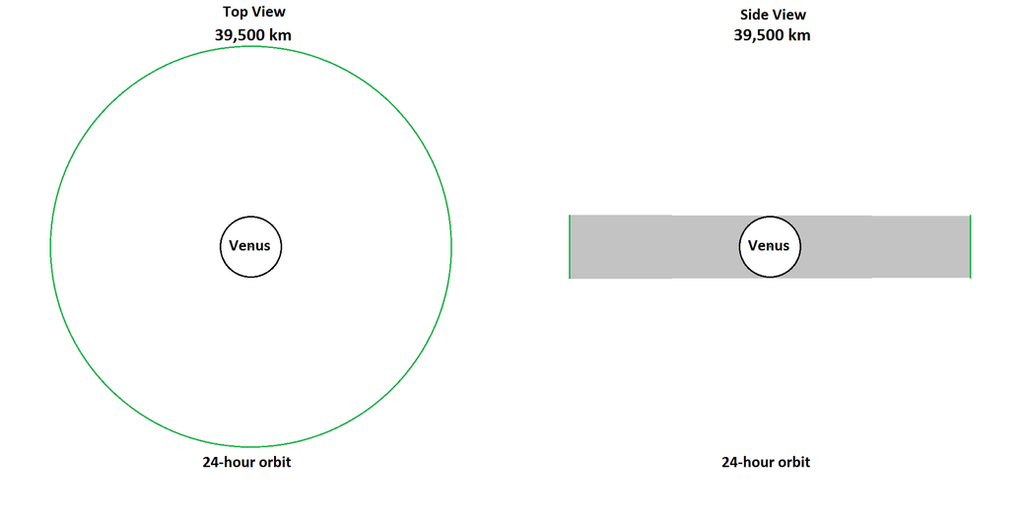
And of course we would have to build a shade around Mercury, like this one I proposed for Venus. One advantage here is we can build it out of the materials of Mercury itself. Mercury is a vacuum world, we just build some mass drivers on its surface, fling rocks into orbit and we build this circular shade around it to protect its surface from the Sun. The next task is we have to import some atmosphere, the most likely spot to get an atmosphere would seem to be Saturn's Moon Titan, it is of similar size to Mercury, so if we dumped this atmosphere on Mercury, we'd have just about what we'd need. and of course water as well to fill all these craters.
Here is a view of a terraformed Mercury.
#827 Re: Terraformation » Venus » 2016-07-16 08:22:31
http://www.worlddreambank.org/V/VENUS.HTM
see this. And the whole PLANETOCOPIA of Chris Wayan. Terraforming natural talent to level if ingeniousness!
The topic for less-then-Earth's water habitable planet very well developed.
btw, Question.:
Is a terraformed / habitable planet a habitat? or it contains habitats?
This is important in line with terraforming in general definitions.
Isn't it terraforming in general - production of ... land?
In the old sense of the word - human habitable land.
I read the site, very interesting, and it incorporates some of my ideas.
This one blocks all the natural sunlight reaching Venus, the outside is covered with Solar Collectors, the inside is covered with laser hologram projectors, The outer surface of this ring has more surface area than the planet below, it also has radiators on the outside to dump excess heat. In the inside are banks of lasers in seven different colors, red, orange, yellow, green blue, indigo, and violet, if you shine them into a prism with their beams converging at a certain angle, the prism will combine those beams, bending each wavelength by a different amount so that all seven beams exit the prism following the same path producing white light similar to sunlight, adjust the angles of these outgoing beams of light and they form an image of a white disk in the skies of Venus, it is a black featureless disk. (no sunspots) But who cares, it produces Earth day like levels of light, the only way you can tell it from natural sunlight is if you spit it with a prism, or wait for it to rain on a sunny day, the rainbow it produces would have 7 discreet colors instead of a continuous spectrum of colors as seen on Earth. You could add more lasers of course and there would be more colors in that rainbow, human eyes don't care when that light is combined, it is seen as white light, plants don't care much either. My shade idea is a temporary solution, it has to be maintained, if we want a more permanent solution we have to move Venus in its orbit and spin it up. I think the greater cost in energy would be to move Venus into an orbit that is further from the Sun. My preferred orbit is at 92,072,400 miles from the center of the Sun, since we are determining its orbit, we should make sure it is a very circular orbit at it stays at approximately this distance from the Sun, this would give Venus a 360 day year, advancing 1 degree in its orbit per day, and since we are doing this, spinning Venus up and giving it Earthlike seasons is a much smaller task than changing its orbit, as is importing all the hydrogen from Uranus to make oceans with. By the time Venus sits in its 360 day orbit, it should already have a 24-hour day, 90-day seasons, an ocean, and an oxygen-nitrogen atmosphere.
You would want to hurl the asteroids outside this 24-hour ring, it would still pull on the planet below and on the ring itself. the center of mass for the ring is also the center of mass for the planet since the ring is centered on the planet, the ring and planet's gravity will pull on each asteroid as it passes in front of both in their orbit around the Sun, the gravity will bend the path of each asteroid, and the planet and rings will get accelerated slightly, and move into a slightly further out orbit from the Sun. if we keep on doing this with enough asteroids, then Venus and its occlusion ring will spiral outward into a wide orbit until it eventually reaches its 360 day orbit at 92,072,400 miles. We can do the same with Earth at the same time, giving our planet a 372 day year with months that are all 31 days long, and by the way help fight global warming as well! This keeps the minimum distance between planets are around 2,000,000 miles. If Earth were to be seen from Venus, its disk would appear as half the size as our Moon does in our skies, during this conjunction, the tidal influence it would have on Venus during this close pass would be similar to our own Moon at high tide, and no more, and this only during a conjection which would occur rarely. In fact lets calculate it. If Venus takes 360 days to go around the Sun and Earth takes 372 days, the difference is 12 days. 360 degrees divided by 12 days equals 30 years So every 30 Earth years, there would be a conjunction between Earth and Venus and both planets would experience high tides, Earth a little more since it has a Moon. Venus might have what's left over from Mercury after we use its reaction mass to move both planets. I figure we can create a moon sized body with the left over rubble and put it in orbit around Venus to give it a 30-day cycled of lunar phases just like the Earth has.
#828 Re: Terraformation » Venus » 2016-07-15 23:24:59
What if we moved Venus using thousands of gravitational tugs cut out of Mercury?
Mercury's mass is 3.3011×10^23 kg
The Moon's mass is 7.342×10^22 kg
The difference is our reaction mass which comes to 256,690,000,000,000,000,000,000 kg
Mercury is a vacuum world, perhaps we could break it up into 1000 pieces each one of which has a mass of 3.3.11x10^20 kg and use 256,690,000,000,000,000,000 kg or each as reaction mass. We turn each piece into a giant solar powered spaceship each uses a mass driver, throwing material out the back to move forward and each passes in front of Venus. If we have these 1000 chunks pass in front of Venus every year, that means 2 to 3 pass in front every day, lets say 1 passes in front every 8 hours , generating an almost constant gravitational pull forward on Venus in tits orbit, these chunks cycle around and a round with Venus gravity flinging each chunk backwards with each pass, eventually after doing this long enough, we get down to the mass of Earth's Moon. If the reaction mass is expelled with the right velocity, the material left over is then assembled back together into a Moon for Venus. Venus ends up in a 360 day orbit around the Sun. If we set the radius at 92,072,400 miles, the orbital period would be 360 days with 30 day months.
We can use half of this material to push Earth further out, setting its radius to 94,107,300 miles for a year of 372 days (31 day months all), the difference in radii is 2,100,000 miles.
#829 Re: Human missions » A private sector Lunar Mining colony - Getting the money » 2016-07-09 06:58:18
What about sending a tele-presence robot to the surface of the Moon? The robots at this level of technology can stand up and walk on the moon, without direct input from remote human operators. the controller simply tells the robot where to go, and the robot goes there as best as it can. The Moon varies in distance from 356,500 km to 406,700 km, the speed of light is 299,792,458 meters per second. Divide the lunar distance by the speed of light and you get 1.19 light seconds to 1.36 light seconds. The time delay that occurs when you send a command to a lunar robot and the time you see results is from 2.38 seconds to 2.72 seconds. My idea is you have a bipedal robot on the Moon, the operator on Earth is wearing a suit. The robot sends a 3-d picture of its surroundings, and the operator in his suit moves around in the virtual 3-d landscape, and indicates where he wants to go and what he wants to do, followed 2.38 to 2.72 seconds later by the actual robot, If the human operator moves in a certain direction and virtually picks up a rock, the robot interprets that as a command to move in that direction and pick up that particular rock, and it will use its own judgment on how to navigate the landscape and how to grip and pick up the rock the operator tried to pick up. The operator will always pause between actions to see how the robot does.
#830 Re: Large ships » What we need to go to Mars - short term projects » 2016-07-04 05:30:40
Colonizing Mars is at least a decade off, that is not short term, the longer we wait, other technologies will develop, including artificial intelligence and nanotechnology which opens up other possibilities. Zubrin had other ideas, but what if the tide of nanotech and AI robotics over takes us before we get to Mars? Politically, as its a government decision right now, our government keeps putting it off. Do you think the developers of nanotech and AI will say, "Wait, we haven't gone to Mars yet, we have to stop what were doing until after we've sent humans to Mars." Zubrin's vision if it were to occur as he envisioned was to take place in the early 2000s, that decade has come and gone, technology has advanced, the window for sending humans to Mars is closing, I think if we wait long enough, machines will do it for us, they will be just as intelligent as humans, and be rapidly getting more so.
I think our strategy thus far has been to wait for a tidal wave of nanotechnology and AI to flood the Solar System if it doesn't destroy us first! I notice the people trying to develop those technologies aren't waiting. Computer technology isn't a slow technology laden with pork barrel projects designed to give people jobs, it is profitable and unregulated, if we try to regulate it, other countries won't, they will move ahead of us and we'll be at their mercy! Space technology, unfortunately is a slow technology, the government has made it that way, as the only way to advance is with nuclear rocketry, and governments won't permit that, there has been some tinkering at the other end, ion and plasma drives, those are nice, but they only work after achieving orbit, and achieving orbit with chemical rockets is the most expensive thing. If we can't go half the distance to the planets, we don't get to employ those other technologies to go the other half, as there is no money left after launching those chemical rockets. SpaceX is trying to correct this, relying on computer technology to precisely land rockets on pads, ironically its the computer that makes this work with the same old clunky rocket technology.
Space Travel has been a spectator experience for all of the Space Age, as it has remained forbiddingly expensive. Perhaps nanotechnology developments can build a space elevator, they say in 20 years, we may have materials strong enough to do the job, so maybe we're waiting on that, hopefully runaway nanotech devices of another sort don't destroy us first, or maybe artificial intelligence will breakout first and accelerate things on the space elevator front. Who knows?
Meanwhile a manned Mars Mission before that will cost billions of dollars, hopefully in the low billions. It will be something to watch and read about, a nice change of pace from the Space Station. Regarding its importance to humanity, that depends on whether we survive the Singularity or not, I think a post-Singularity Mars colony or a colony anywhere else in the Solar System will be easy, assuming we survive it, before the singularity its going to be a lot of hard work and money spent, but seeing how we don't know whether we'll survive the singularity, we might as well enjoy life until then.
#831 Re: Large ships » What we need to go to Mars - short term projects » 2016-07-03 20:44:23
YouTube video from 2010: Raytheon XOS 2 exoskeleton
https://i.ytimg.com/vi/-UpxsrlLbpU/hqdefault.jpg?custom=true&w=320&h=180&stc=true&jpg444=true&jpgq=90&sp=68&sigh=fqSEgG9rx-6BXvTrHlAHDaO__uoBut this is the Mars Society. And I could give you a long diatribe why Mars is far better than Jupiter.
Mars is a symbol, it is a destination among many, it is low hanging fruit, it has characteristics similar to Earth in its day length which makes some adjustments easier.
Jupiter looks harder than it is, because of its high gravity. I believe an exoskeleton could be made which could give humans the freedom of movement they need in a Jovian environment, the "habitable" zone of Jupiter is around 3 atmospheres of pressure, I think I heard, where the temperature is around room temperature among the water clouds.
https://en.wikipedia.org/wiki/Atmosphere_of_Jupiter
Jupiter's troposphere contains a complicated cloud structure.[18] The upper clouds, located in the pressure range 0.6–0.9 bar, are made of ammonia ice.[19] Below these ammonia ice clouds, denser clouds made of ammonium hydrosulfide or ammonium sulfide (between 1–2 bar) and water (3–7 bar) are thought to exist
3 to 7 bars of atmosphere isn't too bad, divers have survived that by breathing a mixture of helium, nitrogen, and oxygen. We would want to be at the water cloud level where the temperature is close to comfortable to minimize climate control requirements.
So imagine an existence where you have to wear an exoskeleton all the time, I think a person can lie down on a contoured couch, one could also immerse oneself in a bathtub and the water would distribute the weight. Things would fall faster under this high gravity, humans would have to get used to that!
#832 Re: Science, Technology, and Astronomy » What is the status today of O'Neill's vision today? » 2016-07-03 20:19:42
What was envisioned in the 1970's simply didn't happen, and for a variety of reasons that would be futile to argue with.
Like I said above, think small. But plan for later expansion. If you do, the odds are far more likely you will actually get something done.
GW
Did not happen yet, O'Neill's timeline was too optimistic obviously, so the task then becomes to make it happen, eventually what was predicted will happen, its just a matter of when. So why the big slow down after the dawn of the space age? It didn't happen like the dawn of powered flight, starting with the Wright Flyer and cumulating with the Jumbo Jet. The Wright Brothers used to put on shows and the public sat in stands watching him fly his little airplane around., shortly after that was the flying circus, then World War I aviators, then mail carriers, crop dusters, then were those sea planes, the Pan Am clipper, then World War II, the B17, the B29, then intercontinental passenger service, and finally the Jumbo Jets, all within a single human lifetime.
With the Space Age, we had Mercury, Gemini, Apollo, Skylab, and then a pause, and then the Shuttle from 1981 to 2011 (30 years), and then the space station, and what do all these programs have in common? Space Travel remains a show for spectators, most people aren't affected by the space age except for communication devices and weather reports, we have GPS navigation, but they are all secondary effects, practically no one travels in space. Not even millionaires, and very rarely a billionaire, and when they do go, it is a stunt. We have pretty much made close to no progress in space travel over the last 50 years. Oh there has been some progress, we have sent probes to all the major planets plus Pluto, mostly do to persistent use of the same old technology that never changes, same old chemical rockets slightly improved, of course electronics and miniaturization did most of the heavy lifting for space travel.
I think I'll probably see a human walk on Mars in my lifetime, on a video screen, maybe in 3-d perhaps, maybe with VR goggles, that human and his companions would be very famous, meet with the President, sign autographs. We have not progressed in sending people to Mars without making them famous, that would be the real advancement. I would like to see 3000 people on Mars, about the population of that O'Neill habitat. Even 3000 is a tiny amount of people, hardly amounts to a village. Most people even after that happens would still be stuck on Earth, fighting those wars against fanatics that think we life in Bible-Land. I am waiting for a revolution, some tipping point where progress will be radical and exponential rather than glacial and almost nonexistent. I care very little about Mars for its own sake, it is a possible future place for humans to live, but so is space and the Moon. Mars is more like a benchmark, it represents what can be accomplished. Low Earth Orbit is halfway to anywhere in the Solar System, and it appears to be the more difficult half to achieve.
What would a humans on Mars new story mean for most people? It would be something to watch, like a sporting event, and then it would be back to the same old grind, it is not exactly a Lewis and Clark Expedition until we actually open up the frontier to the common man, and so far that has not happened.
#833 Re: Large ships » What we need to go to Mars - short term projects » 2016-07-03 08:04:13
Partial gravity was supposed to be tested in the centrifuge on ISS. The Centrifuge Accommodation Module was cancelled. When NASA cancelled it the first time, Italy paid for it, and Japan built it. It was sitting in the staging building at KSC waiting for Shuttle to launch it. But President Obama cancelled Shuttle before it could be launched. Some people at NASA campaigned to launch it, and there was one more external tank available, but president Obama did not authorize it. That module is not sitting out doors as a display in Japan. After exposure to the elements, it may not be in any condition to fly.
https://upload.wikimedia.org/wikipedia/commons/thumb/a/a8/Centrifuge_%28ISS%29_in_TKSC-01.jpg/220px-Centrifuge_%28ISS%29_in_TKSC-01.jpgHere on Earth we can test hypergravity with a centrifuge. But 1G will always be the minimum. We can produce partial gravity for a couple minutes with an aircraft flying parabolic arcs. It's 25 to 30 seconds for zero-G, longer for Moon gravity, more yet for Mars gravity. But you won't get any data about bone decalcification from just a couple minutes. ISS has microgravity, technically the station is so big there's a tiny difference between the portion closed to Earth vs the portion farthest away. Engineers have to worry about that, but to astronauts it feels like zero-G. A centrifuge can add acceleration, so starting with zero allows reduced gravity.
Apollo astronauts did walk on the Moon. But I talked to a NASA flight surgeon who told me the data is useless because it's contaminated. Those astronauts experienced high-G during launch, then zero-G during the flight to the Moon, zero-G again on return, and very high-G during atmospheric re-entry. That makes an difference in astronaut bodies before and after flight completely useless.
So the reason you haven't been able to find data on partial gravity is there isn't any.
Well you know, we can send astronauts back to the Moon and have them stay there for months at a time, and on the Moon's surface, we can simulate Martian gravity with a centrifuge. I think a centrifuge on Earth can simulate Jovian gravity, it would be a long time before we have any prospects of sending humans into Jupiter's atmosphere, much less of bringing them back, but perhaps we can test out an exoskeleton that would help such a person move about under Jovian gravity. I think 2.51-G is tolerable for people sitting in acceleration couches, but not for much else.
#834 Re: Science, Technology, and Astronomy » Servicing Earth Satelites » 2016-07-02 21:07:29
May be. I dunno.
Sometimes I do think that if our robots were not quite as capable as they have turned out to be, that men might have gone further and done more in space.
GW
All you really need is robots that can be tele-operated like puppets, the intelligence in question is that of the operators, rather than a flesh and blood hand within a suited glove.
#835 Re: Science, Technology, and Astronomy » What is the status today of O'Neill's vision today? » 2016-07-02 17:06:59
Well I see the threat from the other as motivation to go into space in order to survive, get off this "big blue marble." I often wondered what our political world would have looked like had Gerard O'Neill been right. What if there was a constellation of O'Neill habitats and solar power satellites.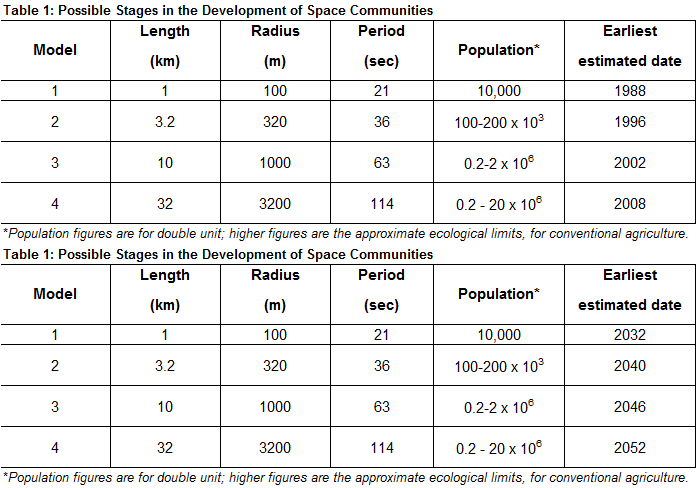
See the dates up top? 200,000 to 20,000,000 people living in space! Still that is a small percentage of humanity. Probably there would have been a great deal of SPS construction going on during the last 8 years with the high price of oil and all. Perhaps a better shuttle design would have helped, something which actually would have revolutionized space travel. The trouble is space travel is still a big deal, it is a news item. SpaceX is moving in the right direction, I am hoping that in another 20 years space colonization becomes a reality rather than science fiction. I'm getting tired of living in the "extended 20th century!" A century should have only 100 years in it, not 116!
#836 Re: Science, Technology, and Astronomy » Servicing Earth Satelites » 2016-07-02 09:45:36
I think robots would be better to do this.
#837 Re: Science, Technology, and Astronomy » What is the status today of O'Neill's vision today? » 2016-07-01 23:33:47
Financially and technologically, we as a species are just not yet ready to do anything on a scale like you illustrated. I doubt we could even build the 1000 ft diameter wheel of the "2001" movie.
We're talking about a species and a civilization that cannot yet behave itself and quit waging wars. Or keep parts of itself from starving.
Well the problem is the Human race consists of around seven billions individuals, some of whom choose good and some of whom choose evil, and get evil results! I am not about to let the excuse that some of us are evil prevent us from colonizing space, that is a ridiculous argument! Are we going to let every barbarian on the planet hold us hostage and prevent us from colonizing space, to get away from these monsters!
There is ISIS, there is Iran, and there is North Korea and other uncivilized places and peoples, I think our civilization, the United States is quite advanced compared to the others, we are civilized, do not start wars like the others do. I don't see why we should wait on the rest of the Human race, particularly the Third World to catch up to us, before we can consider ourselves ready to colonize space, that just doesn't make sense to me. the Human Race isn't a collective, it isn't a "bee hive", we are all individuals making individual decisions for good and for ill, if that ever changes, we won't be human anymore! I would think developing a collective conscious, where everyone is "good" and no one is "evil" would be a giant step backwards for the human race. The Human race is all o one planet, and that is what's got to change! People like you saying we're all in this together as one collective whole! Well I don't want to be part of one collective whole. I want for one, to get away from certain members of the human race, such as terrorists and the like, that is why I want to travel in space, always have since I was a child. Little did I know back then that the Space Age was to be a non-participatory one, unlike previous technological revolutions, we all don't get to participate in this one. We can drive a car, we can fly in an airplane, but we don't get to fly in a spaceship, at least most of us don't! Even if we build that O'Neill colony of 3000 still most of us wouldn't, we need to build much more than that! I'm not in this to watch a television program from my nursing home in 2053, watching distant astronauts collecting rock samples from the Martian surface for the first time, something we should have been doing in the 1980s. We need to develop the economics of space travel.
The B330 is a solid core about 15 m long with a 6 m diameter inflatable wrapped upon it. It'll be a while yet before there's anything any bigger. Variations on the same basic small item could be available far sooner. What can you build with tinkertoys like that?
You and I just differ on what potential there is to assist us in "AI", which I think is an oxymoron. There are some awfully sophisticated programs that emulate human behaviors out there, but that's all that's going on inside the robot: execution of a program upon whatever data the machine is presented with.
What is the difference between the emulation of human intelligence and human intelligence. Suppose we created within a computer an emulation of a human being, lets say is a simulation of a human in a simulated house. Within that simulated house is a simulated video screen, and a real camera takes an image of us, and real microphones pick up sounds, and reproduce that image and sound in the simulated house so that the simulated person can hear in, so you can talk to him or her and she can talk to you. You can interact with one another through this interface. the only difference is the simulated person doesn't have a physical body, but she is quite intelligent, she can figure things out, can help you with your work, since her brain is being simulated in the computer, that simulated has that sim brain do things that real brains can do, and since thinking is a physical process that can be simulated by mathematics, as any other physical process can, such as weather, or stars going supernova, I think by the time we can do that, we'll have machines that can think, invent, and do science!
Not one computer has ever had what we humans (and a lot of other animals) would call a thought, nor can they, not as long as we build only the programmable version of Von Neumann adding machines. And that's all we currently know how to build. I don't think that will change very quickly. When it does, the technology and architecture will come from biology, not Silicon Valley.
Biology is a physical process that can be simulated in a computer, once we capture and understand the biology that occurs in our brains, we can abstract it out, and get computers to simulate the thinking and learning that goes on in the brain, without the need to simulate every neuron. Right now the only barrier is that computers are too slow, but that won't remain the case for very long! As for the problem of colonizing space, I think the only reason we aren't doing it now, is because we aren't smart enough to figure out how to transport millions of human beings into space and keep them alive there cheaply. There is nothing about the Universe which suggests that it is impossible. This is a solvable problem, we just aren't clever enough to figure it out yet, so lets build something that is cleverer that we are, maybe a superhuman intelligence that we create can build these space colonies for is. As the progress in space travel is slow compared to the progress in computing speeds by computers!
I know NSS has been (and still is) pushing for the construction of a large solar power satellite. Most of the designs I have seen are very much larger than the ISS which we were just barely able to build, and then only funded by multiple nations. I don't think projects that large will come within humanity's reach during our lifetimes.
Unless we can figure out a way to extend those lifetimes substantially, this in turn requires a more complete understanding of our biology and of what makes us age. if we can reverse that, we can live longer, there is nothing in the laws of physics that says this is impossible, so we either figure out how to establish perpetual youth or we build machines that can figure out how to do that.
Especially not with a fair fraction of our population waging terrorism on the rest, who in turn still wage wars on each other. It's just unrealistic to expect otherwise. Those difficulties will Trump (please excuse my choice of words there, ha, ha!) any large space projects for as long as we continue to suffer those difficulties.
You think the terrorists can stop us? I do not consider myself a part of the same human race as those terrorists!
I am not responsible for their behavior, they choose to be evil, I don't think we should let those miserable creatures prevent us from colonizing space, but I do know one thing, they aren't us!
You have to think much smaller, or else be forever frustrated by nothing at all ever getting done.
How can I ever be satisfied with less than space travel for the whole human race, and not just a handful of us, who happen to have the "Right Stuff" to be selected for our government's elite astronaut program, whenever the taxpayer is feeling generous enough to fund it! So long as there is life, there is hope, and I'm still alive, and hopefully expect to live another couple decades or more!
On the other hand, the growing awareness of asteroid defense presents an opportunity to go out there and do some real things, as long as the scale and costs are of a size where we can handle them. It provides a real reason to have a government space program outside of competition with other nations. And it presents the possibility of doing this as the public-private partnerships that were so successful 500 years ago, since we now have some private entities interested in mining those same asteroids.
GW
You know why the Europeans colonized the New World, and not China, nor the Muslims to the South? China was united under one stupid Emperor that decided to burn all of his ships, the Muslims were more concerned about the hereafter rather than the here and now, but the Europeans, a factitious bunch compete against each other to settle the New World, not all the nations of Europe held hands and participated together to combine resources to colonize the New World, it was instead the Spanish competing against the Portuguese, and the French, the Dutch and the English that settled colonies in the New World. Europe as a collective whole did not! These little countries ran circles around the big Empires like China, and even managed to colonize the continent next door, Australia, right under their noses. o what do you think, do we follow the Chinese Model or the European one for colonization? Which one worked better?
#838 Re: Science, Technology, and Astronomy » What is the status today of O'Neill's vision today? » 2016-07-01 10:16:45
Financially and technologically, we as a species are just not yet ready to do anything on a scale like you illustrated. I doubt we could even build the 1000 ft diameter wheel of the "2001" movie.
I hope you are wrong! I think watching a couple astronauts walking on Mars after a hundred billion dollars is spent to get them there is a pretty pathetic accomplishment for the 21st century, if you ask me! If that's all we're going, to do, then frankly, we might as well send robots. 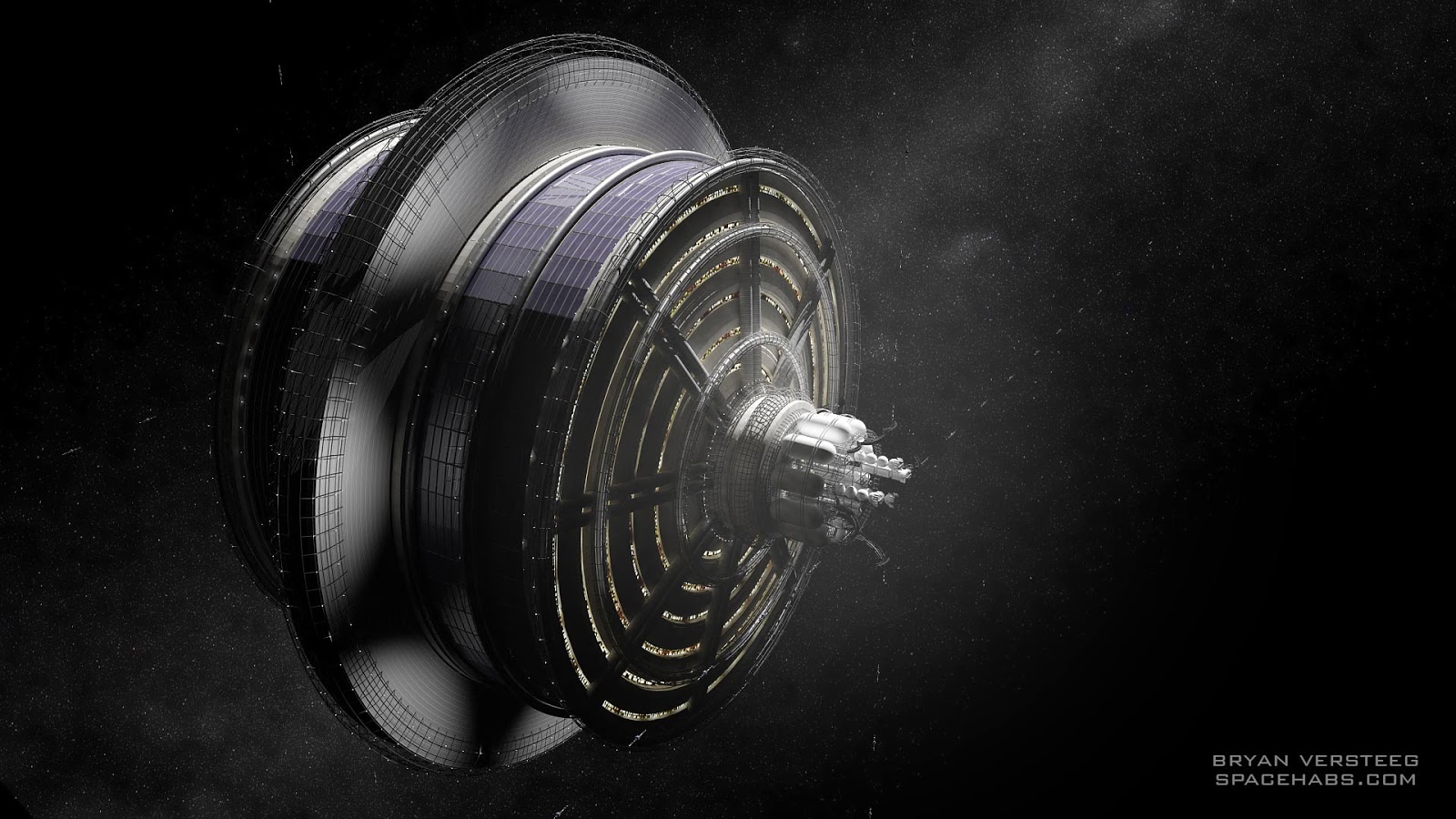
Now this space colony is the smallest of the O'Neill's, unlike the others, this one can be located in low Earth orbit, at the same altitude as the ISS, and it houses a modest 3000 people.
Kalpana One is intended to improve on the free space settlement designs of the mid-1970s: the Bernal Sphere, Stanford Torus, and O'Neill cylinders, as well as on Lewis One, designed at NASA Ames Research Center in the early 1990s. These systems are intended to provide permanent homes for communities of thousands of people. The Kalpana One structure is a cylinder with a radius of 250m and a length of 325m. The population target is 3,000 residents.
http://www.nss.org/settlement/nasa/Kalpana/index.html
Kalpana is a small community in space, a space village really, unlike the others, this one doesn't have a mirror geometry, it produces its own artificial illumination within. Which is why if can be located in Low Earth orbit, it doesn't matter if it orbits the Earth every 90 minutes or so. Being located this close to Earth puts it under the Van Allen belts and provides natural radiation protection from solar flares and the like. Now what can Kalpana be used for? Judging from the pictures, it could be used as a destination for space tourists. If launch costs get low enough, it might be profitable to build one. Being able to reuse parts or rockets is a step on the way towards building this, I think that asteroid, I previously mentioned could provide enough raw materials for building this. And naturally we'd want to locate this as close to Earth as possible while still being in space. I think the Mars Colonial Transporter would be a good vehicle for getting to this space station, as it is said to be able to transport 100 people to Mars. Kalpana with some shielding and engines could also be used to settle the outer solar system, a Trip to Titan might be one in a vehicle which incorporates the Kalpana design as part of its crew quarters. It looks big enough to grow food crops inside, possibly the crew would be smaller to make room for food storage and supplies, and nuclear reactor would substitute for the SPS.
#839 Re: Science, Technology, and Astronomy » What is the status today of O'Neill's vision today? » 2016-07-01 07:47:12
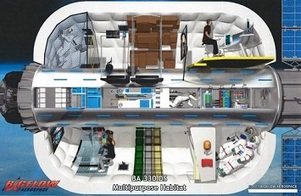
Well they are cylindrical. Maybe if we had a B330 that was 100 meters in radius, we could spin it once every 20 seconds to create 1-G at the outer wall.
Probably would look a bit like this, except smaller. this is the Kalpana Cylinder, it is smaller that the Bernal Sphere, I think it houses about 3000 people, it is designed to be built in low Earth orbit unlike some of the others.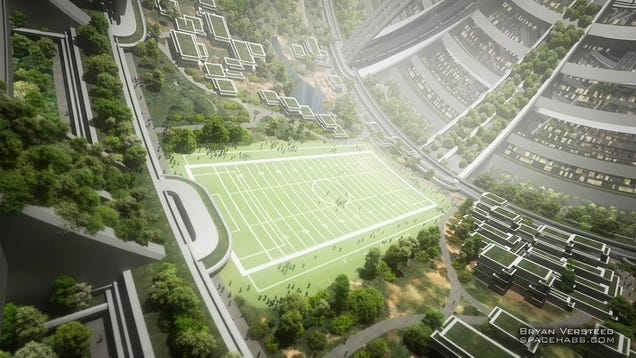
This is a view of the interior, as you can see the soccer/football field to give you a size comparison.
Here is another view.
A view of a patio.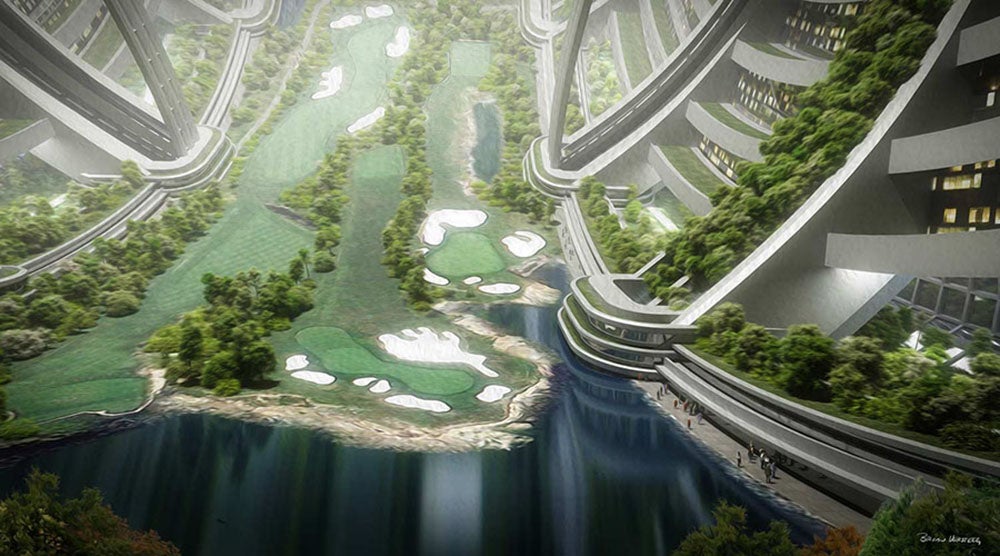
A view of a lake and golf course. I think playing golf in this environment would be tricky.
Here's a view from one of the side ledges.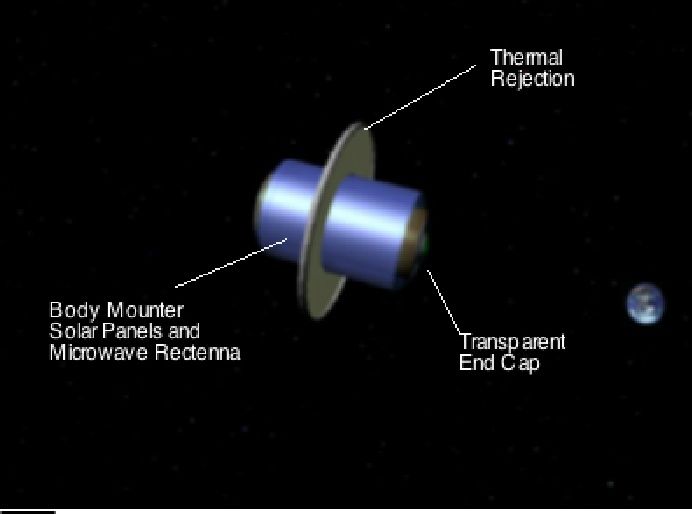
Here is a diagram of the various parts, it has power beamed to it from a separate Solar Power Satellite, since this one houses only 3000 people, the power requirements are smaller than for a big city such as New York. The sides are covered with a microwave rectenna, and there is a single radiator fin projecting out to regulate heat.
#840 Re: Science, Technology, and Astronomy » What is the status today of O'Neill's vision today? » 2016-06-30 09:52:28
What's required to build it, I think is automation. We tell the automatons what to build, and they figure out how many of themselves they need to make and how much raw material they will need to do this job, and then they build it! I think the way we would build the ring, would be to erect multiple space elevators are points along the equator, then attach rings to each space elevator. The space elevators would come in pairs, one slightly north of the equator and the other slightly south, and between them we put spacers to keep them parallel. At Geosynchronous orbit we place a ring between the pair of space elevators. (One handles traffic up, the other one handles traffic down to avoid collisions) Within the ring between the space elevators we place the cylinder, within the ring is an electric motor and a track which keeps the cylinder spinning. Part of the cylinder is inhabited, and the rest beyond the pressure wall is a continuous construction project, where we elongate the cylinder in the direction of the orbit in both directions. As the cylinder gets longer, we will need to build another space elevator to hold it parallel to the surface of the Earth and keep it lined up in the direction of its orbit. Or maybe a better way is to run a cable around the complete circumference of the orbit threading the ring of each space elevator. If we need to keep the cable taut, then we spin it around the Earth in its orbit at slightly faster than orbital velocity, just enough to keep the cable rigid. then we build the cylinder around the cable, extending it further and further to the right and left of each space elevator, until the ends of all the cylinders from each space elevator meet to form a continuous ring completely around the Earth.
This would all be done with robots of course, and AI computers, electric motors would keep the ring spinning, and they would push against the tension of the space elevators which would be held in a vertical position due to gravity.
Is this a near term thing? depends on how rapidly artificial intelligence develops. Some people think machines will reach human parity intelligence in 10 to 20 years, they point to exponential growth in computer processing power as their evidence. Once you get that, we will have machines that can build more of themselves out of raw materials, and can create a work force of any size we need within the limits of material resources, and the limits of the Solar System is huge, but its hard to wrap our brains around that.
The question is, will there be any time before the onset of human parity artificial intelligence, for us to colonize and settle space ourselves, or will we let the smarter-than-us machines of the future build it for us?
#841 Re: Science, Technology, and Astronomy » What is the status today of O'Neill's vision today? » 2016-06-30 06:55:29
Perhaps it would be best instead to adopt more of a "Virga" set up, with the space habitat being non-rotating and having smaller, more manageable centrifuges within it. There's no point rotating your radiation shielding, at least, and if you can use magnetic bearings to have a (comparatively!) lightweight centrifuge supported by a heavier, stationary structure...
Of course, you'd have to dispense with the window floors. Perhaps using light tubes down the centre instead, with mirrors to direct light into them?

Why not rotate the radiation shielding? If a colony rotates as a piece, it is less complicated and requires less maintenance, and in this case the shielding is the floor.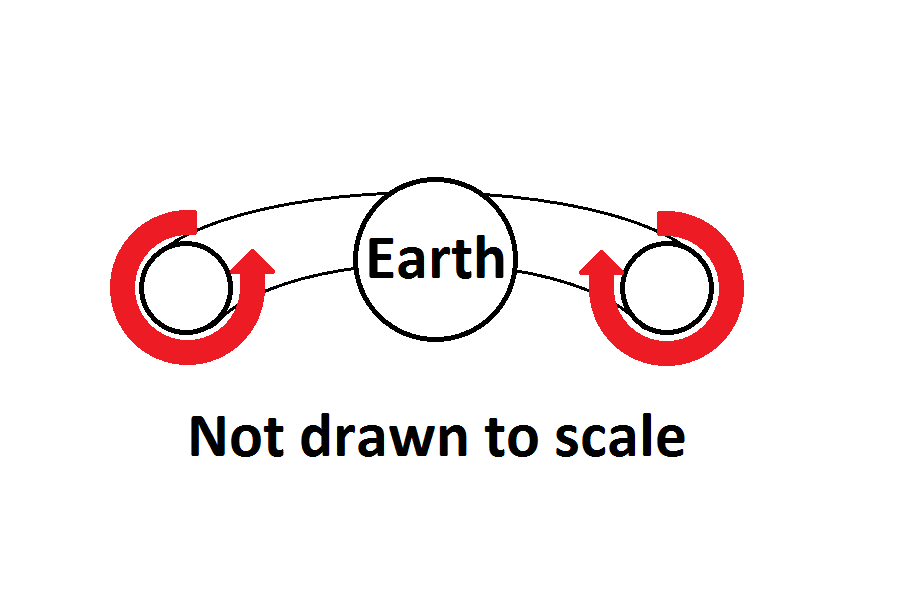
However, you could rotate a colony this way. This drawing is not to scale, it is drawn this way only to show how the cylinder rotates. If we could build this in Geosynchronous Orbit, and connect it to Earth's surface with space elevators, the curvature at Geosynchronous orbit is only slight when compared to the width of this cylinder. The surface of the inside of this torus is for all practical purposes the same radius as the outside of this torus if it were drawn to scale with the Earth and the orbital distance. The length of the inside is only slightly shorter than the outside, and normal materials can stretch and compress to accommodate a "smoke ring" rotation inside and out as this diagram demonstrates. One can build a cylindrical space colony completely around the Earth with no end caps and rotate it as the red arrows indicate. Since there are no end caps, there can be no O'Neill mirror geometry to reflect sunlight within. The best alternative would be to place linear solar power satellites to either side of this cylinder as it rotates or perhaps cover the outside with solar panels, though I think you would need more surface area than is available on the outside of this ring cylinder to provide enough energy to reproduce sunlight artificially within, due to the inefficiencies of converting electricity to light. I think covering the outside with microwave receivers and of course attaching radiators on the outside to control temperature would be how this would be done.
I would suggest using holographic light panels in place of the Solars between the valleys, preferably a holographic image of the Sun produced at normal solar intensity. I wouldn't want to put a florescence tube in the center of the cylinder as it would get to hot as you got too close. With a holographic light panel, one could walk across the surface of it without getting burned by the light intensity. One could look down and the Sun would appear just as far away as if you were standing on the opposite valley and looking up at it.
On the other hand you could just attach the solar panels to the radiators on the outside of the cylinder. the panels can stick out and rotate with the cylinder, if they are strong enough to withstand several gravities of centrifugal force, that should be enough surface area to power the artificial sunlight holograms, and since the curvature is slight at that radius, the panels should grate against one another when they are on the inside of the torus.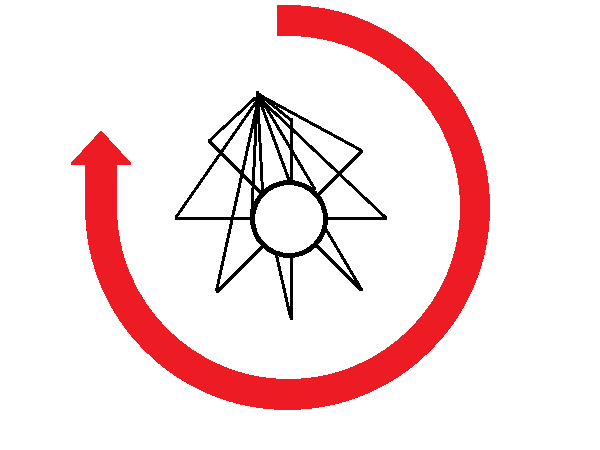
This is a more to scale drawing of that same cylinder, the solar panels are also radiators and hang downward from the curved floor of this cylinder. This cylinder wraps all the way around the Earth at this orbital distance and so do the solar panels, some are always exposed to the sun and collecting energy even while others are in shadow.
Of course it would take a long time to build, I'm not disputing that, but we can start with a short segment and elongate.
#842 Re: Science, Technology, and Astronomy » We need a new RLV - Moving beyond the shuttle » 2016-06-29 11:41:01
OK, there are ways to make methane and oxygen on Mars from local CO2, and from LH2 delivered from Earth, without any ice resource. Interesting indeed. Sounds like sufficient electricity will be the production rate-limiting factor. And liquifying them will not be cheap, either. Both are mild cryogens, subject to boiloff losses.
Too bad we don't yet have enough ground truth to evaluate ice as a resource. Ultimately, water electrolysis for in situ hydrogen and oxygen is probably (just my hunch) the right way to go in a longer-term scenario. The salt issue is the tough one. Apparently things got very salty and acidic billions of years ago as the planet dessicated.
My one-stage reusable lander for Mars sized out at 90.7 tons with NTO-MMH, versus 68.5 tons with LOX-LCH4, carrying the same 3.2 ton down-payload. The higher performance does help. Heat shield diameter is about the same, though, near 10 m.
GW
Take a gallon of salty seawater and open up the container on Mars, what comes out of it?
Fresh water as it boils away.
What gets left behind?
Salt and other soluble that don't boil away.
I don't see what the problem is with salt water. Get a cold surface and put it right next to the boiling saltwater, and guess what condenses on it? Fresh water frost!, take that back inside your hab and it melts into fresh water! Desalinization is simple on Mars!
#843 Re: Human missions » The 5 places man could live in the solar system » 2016-06-29 10:50:16
Yeah, probably. I was thinking of the longer term, and the Juno probe is coming up, so Jupiter is on the mind of many people at this moment. One idea is to build a hab around an orbital tether, or a space elevator. Build enough space elevators and connect them with a planetary ring at geosynchronous orbit. Which is at 35,786 km. At this distance, you could wrap an extended Model 1 Space colony along this orbit, lets use a radius of 100 meters in this example. If it rotates 3 times per minute, it will produce 1-G of spin gravity. The circumference of this orbit is 224,850 km so we bend this cylinder into a circle and make it 224,850 km long and rotate it inside out through the ring it forms. Now at 35,786 km radius, this bending is barely noticeable. The surface of the rotating cylinder would have to stretch and compress with every rotation, but the amount of stretching and compression needed to make this happen is very small, and the momentum of the rotation would be greater than the energy needed to compress and stretch these surfaces every 20 seconds. I use the radius of 100 meters because this minimizes the differences in orbit radii, keeping it to 200 meters. So the surface furthest away from Earth is at 35,786,100 meters, and the surface closest is at 35,785,900 meters and the difference between these two radii and circumferences is 1.0000055887933515714289706280965, this is the number you get if you divide the larger radius by the smaller. this is a 0.00055887933515714289706280965% difference, I think even steel can stretch this much, but if your really concerned about it, we can segment it and include rubber expansion joints.
The amount of real estate this represents is 141,277,421,632 square meters,
or 34,910,271.52 US acres.
The inside of this hollow cylinder would seem fairly straight, one football field above ones head would be the center of the axis of rotation, look in either direction along the cylinder and it will seem to "diminish to infinity", the slight curvature of this orbit would not be apparent.
Now where would the space elevators go? You can have a counter-rotating segment which slides past the rotating cylinder surface, and use a plasma window to cover the gap to prevent too much air from leaking out into space, this air can always be replaced anyway by more air brought up from Earth.
#844 Re: Human missions » The 5 places man could live in the solar system » 2016-06-29 09:26:16
Fair enough, but you probably meant for this post to go to the O'Neill thread. But we can build O'Neill colonies in orbit around Jupiter as well. Not sure what the radiation environment is around Metis, but it is embedded in a ring, that might help. s for mining Jupiter, it would require carbon nanotube space elevators, and would use the moons orbital energies to lift these gases out of Jupiter's gravitational well. That is we would slowly draw the moons closer to Jupiter in exchange for lifting gases up. Helium-3 is on gas, there is also plain old hydrogen, which we could send to Venus to make an ocean with, and supply floating habitats in Venus' atmosphere with water. Place a hydrogen gas bag around a breathable envelope of air, feed the hydrogen through fuel cells and combine with excess oxygen to make water. The water is used to grow plants which make oxygen, human colonists consume the plants for food, drink, bath and wash in the water, and use some water for flushing their toilets, and the waste water is dumped into Venus' atmosphere and Venus does the rest. Over time this dilutes Venus' acid clouds, Venus gets even hotter down below, making it easier to free oxygen for carbon-dioxide, and so we slowly build up the water content of Venus.
#845 Re: Human missions » The 5 places man could live in the solar system » 2016-06-29 06:51:14
Jupiter has Helium-3, it is probably the largest source of it besides the sun. Jupiter also rotates quite fast. It has an almost 10 hour day, and the orbital period for a low orbit is only three hours! At higher altitude it is 10 hours.
At Jupiter's radius (71,492 km) its 2.9641440306301296 hours for 1 orbit. At 160,000 km in radius, the orbit period is 9.924145125788737 hours. Jupiter rotates once every 9.925 hours, so the 160,000 km level is Jupiter's synchronous orbit. If one were to build a standard space elevator for Jupiter, one would start from there. But considering that there are two known moons orbiting within that distance the logical place to build a space elevator from would be from its innermost Moon Metis. Metis has an orbital period of 7 hours and 4.5 minutes, about 3 hours shorter than Jupiter's rotation which is 9.925 hours The end of the space elevator would be hanging in the atmosphere. Jupiter spins at its equator at 45,259 km/hour The end of the elevator within the atmosphere would be moving at 64,171 km/hour, the difference between the two velocities is 18,912 km/hour or 5.25 km/sec. At the end of the tether, you'd weigh only 2.075 times your Earth weight because of that rotation. To use the tether, a rocketship would first have to accelerate to 5.25 km/sec and then leap out of the atmosphere and catch onto the end of this tether, then it would climb the tether up to Jupiter's Moon Metis, and then continue up another tether extending from Metis's far side and use centrifugal force to fling to a higher orbit around Jupiter.
#846 Re: Science, Technology, and Astronomy » What is the status today of O'Neill's vision today? » 2016-06-29 06:06:23
Your drawing of a cross-section shows "Mountain profile". Why? Here on Earth the crust is moved and squeezed and stretched, resulting in rough textures to the crust. It's not required, it's just a natural result of tectonic activity. Why would you want to install huge mass of rock just to create artificial mountains? Those who live in mountainous states may have gotten used to it, but I live in a plain. In fact Winnipeg is built on the bottom of an ancient dried-up glacial lake: Lake Agissiz. It's one of the flattest places on Earth. I don't have a problem with flat ground. If you're going to build-up the interior of a space colony, do so for a reason. Is this a raised floor with a story beneath? Green grass and trees and flowers and food crops above, and factories beneath? That would make sense. 250 metre thick solid rock would not.
I didn't make that Illustration, it came from the NSS website, just click on the link I provided, you'll find it.
Here it is again:
http://www.nss.org/settlement/physicstoday.htm
As for what I'd do, the whole idea of this space colony is to provide a "natural landscape" in space, the Mountain profile is part of that. as for what's inside, I would suggest storage, it would be a great place to store water for instance, a reservoir of water, to provide water pressure for all the homes and buildings in the valleys, this is so when they turn on their water faucets a steady stream of water comes out. So that's what I put there, water, those mountain profiles would make great water towers. They'd make great water collection areas too, some fans could draw in some air, wring the water out of it, water would condense on the mountain surfaces, also when the air is pushed up, it would rain there a lot, and various crags would collect water in tanks, the tops of which would be lakes, excess water would tumble over the sides to form waterfalls and streams. Make nice natural landscapes, people can climb them and go hiking. There would be plants and trees growing on the sides. It is only 8000 feet up, probably equivalent to 4000 feet up on Earth, as the gravity diminishes proportional to distance from the center, there wouldn't be glaciers there of course. The mirrors would reflect Sun there for part of the day.
#847 Re: Science, Technology, and Astronomy » What is the status today of O'Neill's vision today? » 2016-06-28 20:39:59
You could always heat the rocks to high temperatures using concentrated sunlight to break their chemical bonds.
#848 Re: Human missions » Earth has captured a second moon, says NASA » 2016-06-28 20:36:20
Tom, you idiot, learn to read! I never said one word about putting naval guns in space! YOU DID! NOT ME.
Most ships today use missiles not guns anyway, so your understanding of that technology is fatally flawed from the word "go".
What I said was "mass drivers are not yet a deployable technology". That is ALL I said! Nothing more.
GW
You lack a sense of humor. Missiles by the way would work, if you could turn asteroid material into missiles. Most missiles use chemical fuel however, that would still require manufacturing fuel for those missiles, there is some intermediate step before you could use the chemical fuel of those missiles, that would be manufacturing the fuel, you would need to expend energy to create the fuel for those chemical rockets out of asteroid material, it would be much simpler just to use the energy to accelerate the material in one direction to push the asteroid in the opposite direction.
#849 Re: Human missions » The 5 places man could live in the solar system » 2016-06-28 20:30:48
Usually most materials are manufactured by chemical synthesis, just ask an appropriate engineer how its done, I am not one. the strongest material is carbon, and I'm pretty sure Jupiter's ring materials has carbon in it.
#850 Re: Human missions » Earth has captured a second moon, says NASA » 2016-06-28 17:13:42
None of the world's navies is yet betting command of the seas on the mass driver technology embodied as the rail gun. So, would you like to bet your country's continued existence on it? Not me. Not yet. It ain't ready. Simple as that.
GW
Naval guns rely on specialized materials, mass drivers do not. I don't think it would be practical to mount a naval gun on an asteroid, and make smokeless powder and cast shells and fire them for propulsion. You see out in space, we don't have munitions factories, and we don't want to rely on chemicals to provide the energy for propulsion. Mass drivers rely on electricity to hurl rocks and dirt to push the asteroid in the opposite direction, they don't need to be good at targeting either. Everything NASA has used for propulsion has relied on specific materials as reaction mass ion drives rely on mercury or some other material to be ionized, if that asteroid isn't made up mostly of that stuff, it is useless. Chemical rockets require a plant to make the chemicals. Its possible to mount a hydrogen-Oxygen rocket on an asteroid and then mine the asteroid for water, split it into its components with electricity then burn it, but why? An Asteroid in Earth's vicinity isn't likely to contain a lot of water. Hurling rocks doesn't depend on our finding certain materials within the asteroid, we can fling any material that has mass.