New Mars Forums
You are not logged in.
- Topics: Active | Unanswered
Announcement
#801 Re: Interplanetary transportation » solar express futuristic train travel concept » 2016-08-25 00:21:56
Yeah it works. I have another version of the Solar Express which uses two main rings.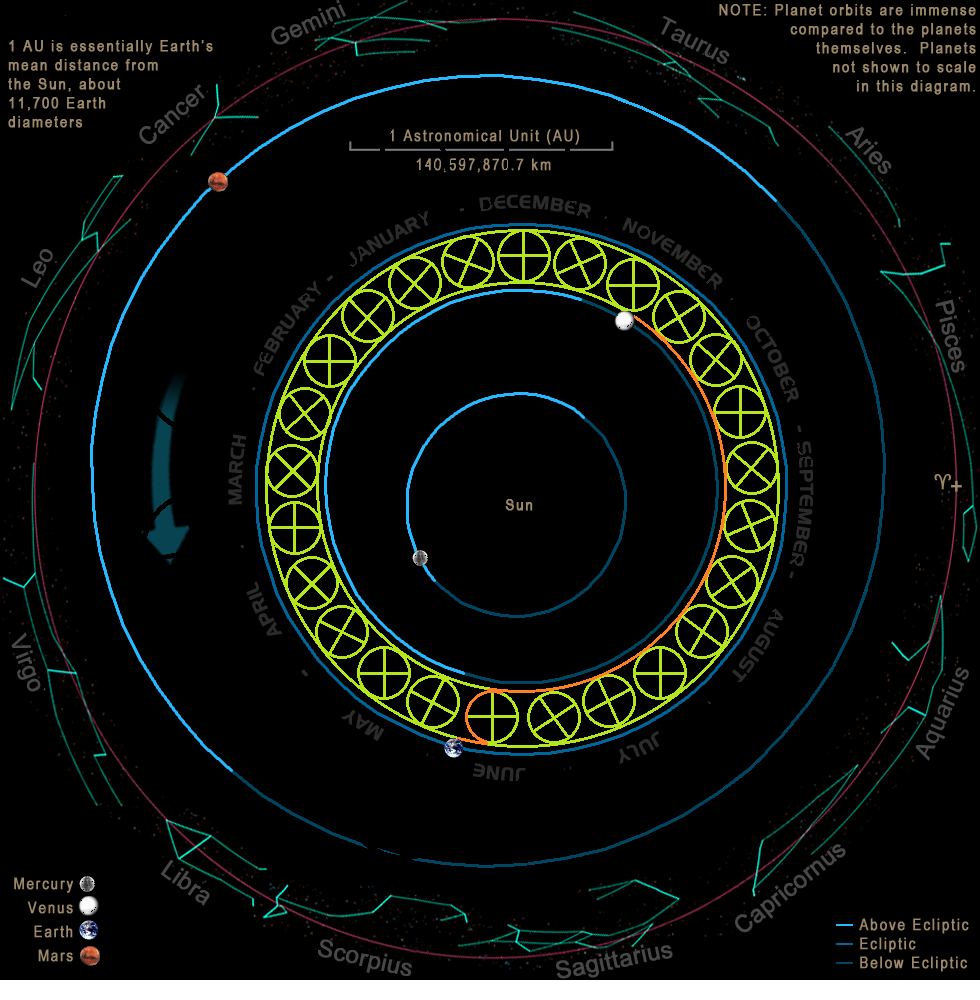
This works best between the orbits of Venus and Earth, since both are nearly circular.
Distances from the Sun:
Venus: 108,934,900 km Maximum; 108,200,000 km Average; 107,463,300 km Minimum
Earth: 152,104,980 km Maximum; 149,597,870 km Average; 147,085,800 km Minimum
Inner Ring: 111,000,000 km; Orbital Period 0.639031 years; Circumference 697,433,569 km; Velocity 34.59 km/sec
Outer Ring: 145,000,000 km; Orbital Period 0.954090 years; Circumference 911,061,870 km; Velocity 30.26 km/sec
Difference in orbital motion: 4.33 km/sec; Diameter of loop: 34,000,000 km, Velocity relative to Center: 2.165 km/sec
Circumference of Loop: 106,814,150 km; Period of rotation: 1.56 years.
Autarky was presented to me so that I could understand it. That was perhaps a half of a year ago or more. It was presented by another member here.
It would be a mistake to project current perceived trends too far in the future, and judging by the scale of this thing, I would suspect it would be far in the future. It is not something NASA is going to do in the next 10 years, I'm sure of that. I don't know why it was in Forbes, I wouldn't be the sucker that invests is such a scheme right now, too far in the future. Maybe with nanotechnology. If I see nanotechnology working, then all bets are off! If I see strong AI, then all bets are off.
#802 Re: Interplanetary transportation » solar express futuristic train travel concept » 2016-08-24 10:32:24
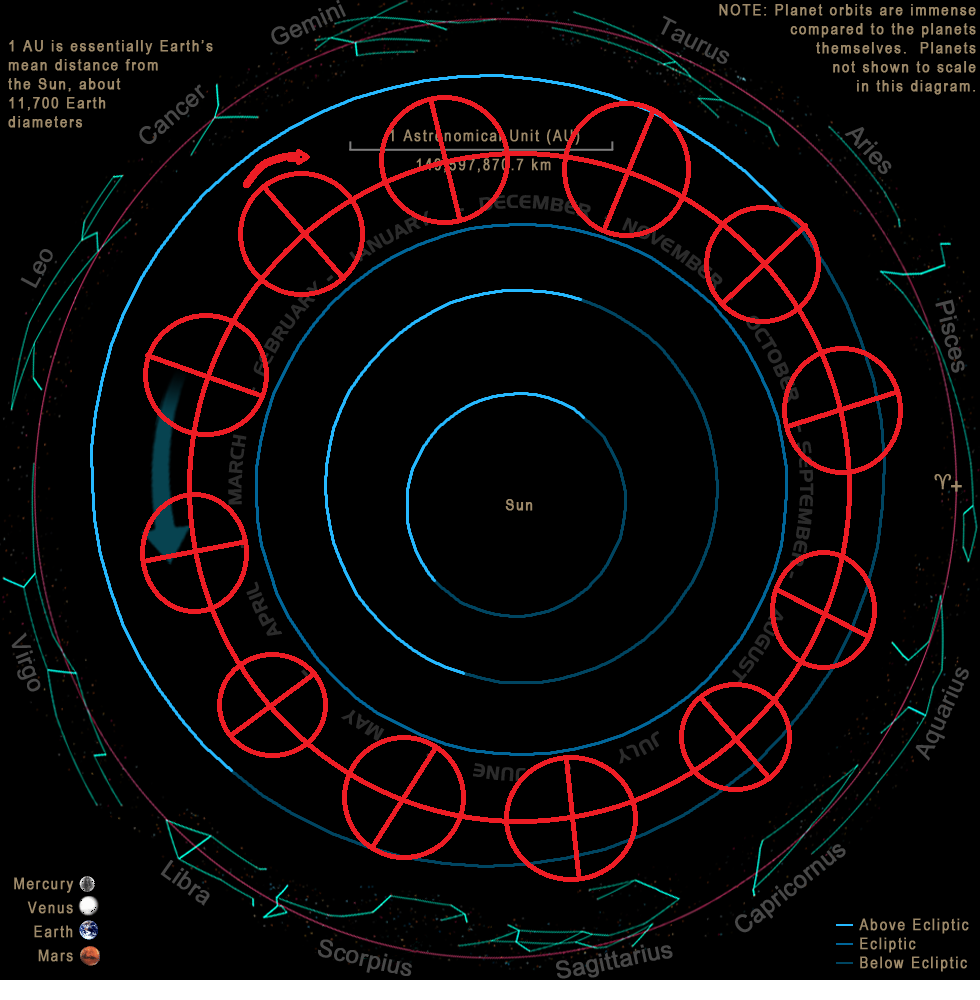
Here is my improved version of the Solar Express, think of it as a train tracks in space You see the loops around each tether, they rotate in the opposite direction of the orbit, this means a spaceship can more easily match velocity with the loop and ride it around or travel along it, using electro-magnetic propulsion, it can even travel up the radial tether to the main ring, and then travel along the main ring until the loop that I closest to Mars is reached, then it travels outward along the radial tether until the loop that most closely matches the orbital velocity of Mars is reached and then the spaceship detaches, and uses rocket motors to fine tune the trajectory so that it intercepts Mars. I don't know when we'll be able to build a thing like this, any guesses?
#803 Re: Interplanetary transportation » solar express futuristic train travel concept » 2016-08-24 08:53:18
Just fun, lets check how far you would travel if you accelerated at 1-G for 1 days, and decelerated at 1-G for the next day.
There are 86400 seconds in a say, if you were to accelerate at 10 meters per second for 1 day you would achieve a velocity of 864 km/sec, your average velocity for that day would be 432 km/sec, now over 86400 seconds you would travel 37,324,800 km and over the next day while decelerating you would cover the same distance for a total of 74,649,600 km The average distance of Mars from the Sun is 228,000,000 km, subtract 150,000,000 km from that and you get 78,000,000 km. These are average orbital distances of the two planets, and the planets would have to be lined up in order to make this journey in 2 days, even is we accelerated and decelerated at 1-G the entire time. If we were willing to make our passengers uncomfortable and strap them into acceleration couches, we could probably have consistent travel times of 2 days between the planets, I don't know how a Solar Express would do this. I wonder what it was she was writing about, I assume there was something she was reporting on, what was its real capabilities? I know you could have an interplanetary space elevator, for instance you could deploy one at Earth's L2 point and another one at Mars' L1 point, and when the planets are lined up right, you can ascend the L2 space elevator and release at the right spot and be on course for Mars, an you could do the opposite for the Mars L1 Space Elevator. If we build a ring around the Sun at 189,000,000 km, such a ring would orbit the Sun every 1.41981 years. What if we deployed a series of rotavators on that ring, it would rotate backwards in relation to its orbit, that means it would rotate clockwise while it orbits around he Sun counterclockwise, the Sunward end would move at Earth's average orbital velocity, while the Marsward end would move at MArs's orbital velocity. If you could get enough of these rotovators, there would always be on conveniently located. You travel up the elevator to the ring, then you travel along the ring until you are in the right position in relation to Mars, then you travel up the space elevator towards Mars and you let go, you just need to spend a little rocket fuel to land on Mars from there, and you will have arrived.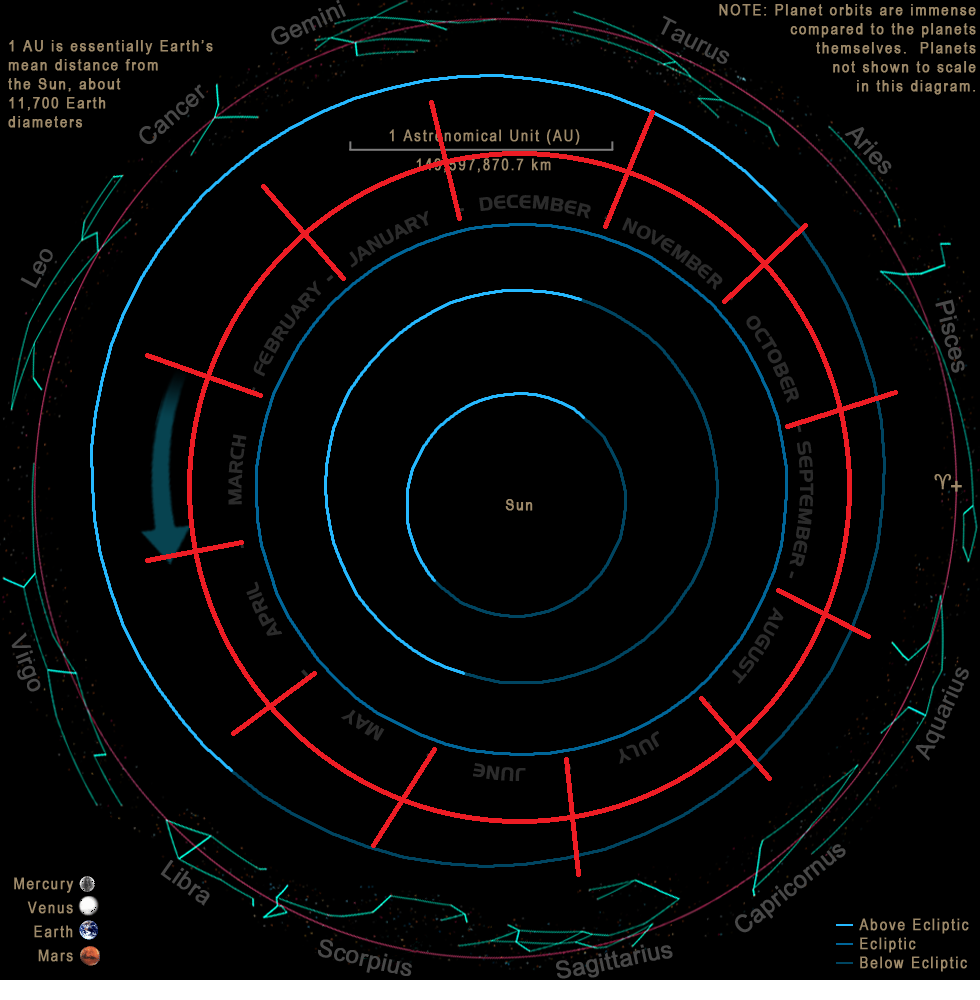
#804 Interplanetary transportation » solar express futuristic train travel concept » 2016-08-23 20:04:47
- Tom Kalbfus
- Replies: 9
http://www.forbes.com/sites/kristintabl … 8e6eb148c1
I read this article, But I still don't get how this concept would work. Mars in 2 days? Mars is constantly changing its position relative to Earth. The article doesn't explain how you could have a ski lift like operation between Mars and Earth. A payload would still need to accelerate and decelerate to get to Mars from Earth. A "ski lift" like operation implies a continuous loop, how do you have a continuous loop between two objects that are not in fixed positions relative to each other?
#805 Re: Human missions » Colonizing the Proxima Planet » 2016-08-22 00:07:22
How do you know its not long enough? We have never froze anything for 212.5 years! The thing is, freezing them is just a means of storing information in molecules. Interstellar space is colder than liquid nitrogen, one need look no further than the planet Pluto to see that!
#806 Re: Human missions » Colonizing the Proxima Planet » 2016-08-21 11:36:49
I guess the main problem is you are asking humans to sacrifice their lives to the endless void of space, they would be going on a journey that they would never see the end of. At 2% of the speed of light, it would take 212.5 years to make the journey to Proxima Centauri, if you bring frozen embryos, they can wait, send actual humans, and they will die on the spaceship before they get there, maybe their great great great great great grandchildren will live to see planetfall, but they won't. You are asking generations of humans to live in a confined spaceship for their entire lives, and I don't think their descendants will be well adapted to exploring a planet once they finally arrive. An Artificial Intelligence can hibernate, there is not much for them to do over most of the ship's travel time anyway other than just exist. We don't need humans that live onboard a spaceship just so they can produce children and grandchildren that also live onboard the spaceship. I think what we need are AIs that can act human and who know how to raise human children. For an AI, they don't have to necessarily perceive all 212.5 years of travel time, they can go dormant for most of that time, "waking up" only to do periodic checks of the ship, and then going dormant again. Their real job begins when planetfall draws near, it is then that they raise children, teach them, educate them, and then they can land on the planet and colonize it. For the AIs, who's software is modeled after a human brain, they can shut down, and not perceive the 212.5 years of travel time nor have to adapt to it. For the human children, they grow up on a starship, and the starship is timed to arrive at the planet on their 18th birthday, so they have their whole lives ahead of them, they get to have families and expand across the planet's surface.
#807 Re: Human missions » Colonizing the Proxima Planet » 2016-08-21 09:58:03
The bloat comes from having to keep people alive through the journey, I would say it would make more sense to have the ship operated by AIs, and when it arrives it can gestate frozen human embryos and raise actual humans to settle the planet. The main problem with generation ships is that the population tends to expand during the journey so you have to plan to population expansion or enforce strict population controls so that the resources of the ship are no used up! Now remember when I said, for a Generation ship, I'd pick a Bernal Sphere that was a mile wide? The standard Bernal Sphere is 500 meters wide, a mile wide Bernal Sphere is 3 times larger! so it has 10 times the living space.
The standard Bernal can house a population of 10,000 people, mine has living space for 100,000 people, but I would send only 10,000 people in it to make allowances for population growth over two and a half centuries, during that journey there is no additional material to build stuff out of except what you brought with you. Once we arrive in the system, there is material we could build new habitats out of an we can accommodate population growth once we are there. That is why I would suggest a starship that is crewed by AIs, they could be built like the Terminator robot, artificial parts on the inside and human organs on the outside, including a womb. If fact the exterior human body parts could have the DNA of the future humans to be born, We might not even have to freeze them. Just have the robots wear one human body after another until they get there, then they can mate and produce real human children or they can clone themselves to produce humans. Basically you have human bodies minus the brain - a computer with resident AI takes over the functions of the human brain, the electronic brain does not age, new parts for it can be fabricated if necessary, and the software can be downloaded into a new computer if necessary, so the AIs can survive the long journey through space, and they can hibernate, go into automatic mode and do whatever to avoid getting bored. The starship need not be that big.
The robots human bodies would need food, they would age, the robots then get new human bodies to replace them as needed and they go on. The food gets recycle, the air and the water too. The AIs can live in a virtual world when they are not moving their organic bodies about or performing bodily functions. This can all be automatic as opposed to involving higher brain functions. Once there, humans are raised and they populate the planet.
#808 Re: Human missions » Colonizing the Proxima Planet » 2016-08-20 17:34:03
The Oort cloud is thought to go almost 25% of the way to Proxima Centauri, and is estimated to have around 2 Trillion objects in it. So set up housekeeping on a selected suitable one as far out as you can go, and you then have a better starting point. Of course getting laser propulsion to push you might be much harder, but of course to even think about setting up out there, you would have to have a plentiful power source at location anyway. Plus, if you master the Oort cloud, out of the 2 Trillion objects of the Oort cloud, you would perhaps have .1% (Just a guess) that were worth also bothering with. Starting at the edge of the Oort cloud may also reduce your chances of collisions with objects at a high speed with your starship.
If there is any descendent of humans that is partly organic in nature, it would likely be a cyborg. I am a cyborg already. I have fillings in my teeth!
But if we are talking about advanced cyborgs, we would also be talking about advanced cybernetic add-ons to the brain. In that case, you can reduce the size of the organic brain (Perhaps). If you do that you can reduce the size of the whole body, and still have it resemble homo saps. That's short for homo sapiens.

I was just thinking of the opposite of a Cyborg, and inorganic brain with an organic body. You see the inorganic brain doesn't age, it can turn itself off, as human brains can't, but it can grow one organic body after another, and maybe it will look human from the outside, and may prove to be indistinguishable from humans, its brain might be programmed to act like a human brain sending all the necessary signals to the various parts of its organic body. The organic body would consist of all the organs in a human body except the brain, it would have the DNA of a particular person, upon arrival the organic robot would then clone its tissue to produce a human child.
#809 Re: Terraformation » Terraforming putative Proxima Planet » 2016-08-20 17:28:29
It is much closer to its primary than Venus, a closer approximation would be to one of the larger moons of Jupiter, such as Ganymede for example. Ganymede is tidally locked to Jupiter. Ganymede has a very circular orbit, the only reason its not completely circular is that other moons tug on it.
#810 Re: Human missions » Colonizing the Proxima Planet » 2016-08-20 17:23:29
It takes much less energy to grow an embryo than to travel at 10% of the speed of light. Now perhaps the AIs need bodies, no reason we can't house a computer with an AI in an organic body that is capable of giving birth, that would be your "artificial womb". The AIs can grow a series of bodies, one after another until they arrive at their destination and then they can give birth to a live human and be its parent.
#811 Re: Human missions » Colonizing the Proxima Planet » 2016-08-20 08:53:54
If you look at that video, he has a point. I think nuclear propulsion is closer than laser arrays thousands of miles wide. We do have frozen embyos, all we need is nuclear fusion propulsion and artificial intelligence, and as he said we have real examples in the Universe to go by, stars, and us! Anyway a laser array requires sustained effort on the home front, and more importantly, it needs the laser array to slow it down, beam power across light years, hit a reflector and then hit the ship to slow it down, that sounds like mighty fancy shooting if you ask me, hitting a target you can't even see, a target who's light would be 4.25 years out of date, such an unprecedented degrees of precision and anticipation, it is much easier to build a fusion powered starship. AI is around the corner, we already have frozen embryos, we just need someone to raise them to adulthood upon reaching the destination.
#812 Re: Human missions » Colonizing the Proxima Planet » 2016-08-20 07:00:56
For a Generation ship, I'd pick a Bernal Sphere that is a mile in diameter it rotates once per minute, and has an initial population of 10,000.
#813 Re: Terraformation » Terraforming putative Proxima Planet » 2016-08-19 23:36:19
Tidally locked planet. You know if the orbit is not circular, there will still be places on the planet where the Sun will rise and set. The planet orbits faster as it pulls closer to the star but orbits slower as it pulls farther away, but the rate at which the planet rotates remains constant, there will be places where the planet is rotating faster than its orbiting the sun, and other places where is it rotating at an angular speed that is slower. The Sun will appear to rise, and then set at the same place, so that way you can have a local day and night. The red sun will dip below the horizon and them pop up again, giving us about 4 days of night and 4 days of daylight. A star that is already red will give off a "bloody sunset." The sky will appear to be a very dark blue. Probably leaves in native plants if there are any will be black.
#814 Re: Human missions » Colonizing the Proxima Planet » 2016-08-19 23:27:22
Here is the video I meant to show you in the previous post:
https://www.youtube.com/watch?v=3WtgmT5CYU8
It has some interesting ideas, here is what you need:
1) Nuclear Fusion spaceship capable of reaching 1% of the speed of light (3,000 km/sec) and then slowing down again with a total delta-V of 6,000 km/sec.
2) Strong artificial intelligence
3) The ability to freeze human embryos and then revive them, and gestate them in an artificial womb.
We then send out 10 of these starships, one of them can reach Proxima Centauri in 425 years traveling at 1% of the speed of light. The ship arrives, lands on the planet, and from local materials it begins to construct robots, which then build a habitat for humans, and then the human embryos are revived, implanted in artificial wombs, are brought to full term and are born, they are raised by AI parents, disguised as humans, the humans reach adulthood and then have children of their own. The AI ship then constructs 10 copies of itself and send them to 10 other nearby star systems to repeat this action.
#815 Re: Science, Technology, and Astronomy » Earth Like planet around Proxima Centauri? » 2016-08-18 21:06:06
A swarm of micro sails that can communicate across light years with power beamed across light years is a big assumption! At 20% of the speed of light it would take 21 years plus 4.25 years for the signal to get back to us, and how many pictures would we get? The swarm would be in and out of the Proxima system very quickly as it passes through at 20% of the speed of light.
#816 Re: Terraformation » Terraforming putative Proxima Planet » 2016-08-18 20:52:11
Depends on atmospheric conditions. Venus rotates backwards and so slowly that one "day" is longer than one orbital period. There doesn't appear to be significant surface differences between day and night sides. That's due to a very thick atmosphere (92 bar!), high velocity high altitude winds that exchange heat between day and nigh, and clouds that shade the the day and keep radiant heat in a night. Actually, it's believed primordial Earth had an atmosphere similar to Venus today, but then cooled just enough for an ocean. CO2 dissolved in the ocean forming carbonic acid, a very mild acid. Soda pop is carbonic acid, so it's obviously safe to drink. But the acid sped decomposition of rock, magnesium and calcium dissolved, then dissolved CO2 combined with magnesium and calcium to form dolomite and calcite. Those minerals precipitated out to form limestone. Venus never had an ocean, so it's think atmosphere is still there.
So, what will conditions be like on Proxima Prime? Will it be Venus-like? Or will it be hot enough to melt lead on the day side, and frozen on the night side? Or will it have a thick atmosphere with lots of clouds, and high velocity high altitude winds? Vigorous ocean currents between day and night? Perpetual arctic on the night side, tropical rain forest on the day side?
Perpetual arctic might be a good thing for us. A planet that is too "Earthlike" is liable to have its own established ecosystem, and would that ecosystem be compatible with us? On the night side, you would have ice sheets, very little of the life on the day side would get to the night side, so we could establish out own ecosystem on the night side. One would place a mirror in a 24-hour orbit around the planet, that mirror would filter out the excess red light and concentrate the remaining blue, green, and yellow light to create an Earthlike day over part of the far side of the planet, leave some ice sheets at the rim to create a natural barrier between the alien ecosystem and the imported Earth life on the far side. We would probably want the far side because the planet would provide a natural barrier to stellar flares, the mirrors would have to adjust and not reflect so much light when Proxima is flaring.
#817 Terraformation » Terraforming putative Proxima Planet » 2016-08-18 11:48:56
- Tom Kalbfus
- Replies: 67
Lets say there is an "Earthlike" planet orbiting Proxima Centauri as advertised, let is say it is about the size of the Earth, has a magnetic field, has a rocky crust and would be 70% covered with water. the planet is tidally locked with its star, the Sun appears 3.7 times as large as our Sun does on Earth, and it glows a ruddy color.
Now the question is, given that Proxima is older than our Sun, does Proxima probably have life? would it be life we care about? Could we just move onto the planet's surface, or would we have to terraform it?
There are a number of things about this situation that humans might not find satisfying, how about that big bloated orb in the sky that does not seem to move, could human beings live with that? Could we grow crops under that. Could Earth life be adapted to that, or would you anticipate problems? The great thing is you could bask underneath that red sun, and not worry too much about getting a sunburn, unless there was a solar flare, and then maybe you would catch on fire!
Could we make this planet more Earthlike? One possibility is we could live on the farside of the planet and not worry about the bloated red orb?
#818 Human missions » Colonizing the Proxima Planet » 2016-08-18 10:49:24
- Tom Kalbfus
- Replies: 37
There is rumors of an Earthlike planet orbing Proxima Centauri, much like this fictional treatment by Stephen Baxter:
http://www.fantasybookreview.co.uk/Step … oxima.html
Proxima by Stephen Baxter
Rating
9.2/10Ambitious science fiction, both intriguing and thought provoking.
A Recommended Book of the Month
"The very far future: The Galaxy is a drifting wreck of black holes, neutron stars, chill white dwarfs. The age of star formation is long past. Yet there is life here, feeding off the energies of the stellar remnants, and there is mind, a tremendous Galaxy-spanning intelligence each of whose thoughts lasts a hundred thousand years. And this mind cradles memories of a long-gone age when a more compact universe was full of light...
The 27th century: Proxima Centauri, an undistinguished red dwarf star, is the nearest star to our sun - and (in this fiction), the nearest to host a world, Proxima IV, habitable by humans. But Proxima IV is unlike Earth in many ways. Huddling close to the warmth, orbiting in weeks, it keeps one face to its parent star at all times. The 'substellar point', with the star forever overhead, is a blasted desert, and the 'antistellar point' on the far side is under an ice cap in perpetual darkness. How would it be to live on such a world?
Needle ships fall from Proxima IV's sky. Yuri Jones, with 1000 others, is about to find out...
Proxima tells the amazing tale of how we colonise a harsh new Eden, and the secret we find there that will change our role in the Universe for ever."
I found this an ambitious science fiction novel which was both intriguing and thought provoking. With its strong opinionated characters, exotic planet, and healthy helping of mystery, this had me hooked.
Yuri in particular was an enjoyable anti-hero, the archetypal fish out of water, who nonetheless manages to cope in very trying circumstances.
What makes this all enjoyable, is the way author Stephen Baxter manages to contrast the human flaws and concerns against the backdrop of technology and science. He makes the reader understand how small and insignificant we all are.
He also contrasts the densely populated colonies of Mars and Mercury and an array of space stations with the desolate, remote natural world of Proxima.
Underlying everything is the very primal struggle for survival. The colonists stranded on the planet go through a terrific ordeal which Baxter never trivializes or glosses over. This is a group with very human needs and opinions on how they cope. The ensuing debates and internal conflicts all convince.
This is a riveting novel, and for all its many dramatic plot strands, it holds up well, achieving a high level of gravitas. The future Cold War between the super powers of the UN and China resonate, as does the territorialism and competitiveness. Baxter has managed to create a plausible future, in fact, like a lot of great sci-fi writers, he could in fact be talking about our current world as much as his imagined future one.
New Eden sounds like a nice name for a planet, if it turns out to be real, it would be a nice motivation to get a project going. What if NASA sends out a probe to the opposite side of the Solar System from Proxima, to use the Sun as a gravitational lens at 1000 AU? I think the SLS would be helpful in this, we could launch a nuclear reactor into space and send it to 1000 AU, then use the Sun's gravitational lens to focus the light of this planet onto a digital camera and then send the image back to Earth 5.9 days later. At 300 km/sec it would take 16 years to get there. this is roughly 20 times the velocity of Voyager 1 as it is heading away from the Solar System. There are probably easier ways to image this planet, but if we find something that looks interesting, we might want to build a probe that can send us more detailed images of it, the same velocity will get us to Proxima Centauri in 4,250 years! We might want to improve upon this just a bit.
I saw this video:
http://www.fantasybookreview.co.uk/Step … oxima.html
#819 Re: Science, Technology, and Astronomy » Earth Like planet around Proxima Centauri? » 2016-08-18 08:39:29
Such a planet would lie within the habitable zone of Proxima Centauri, about 0.023–0.054 AU from the star, and would have an orbital period of 3.6–14 days.
https://en.wikipedia.org/wiki/Proxima_Centauri
A planet as warm as Earth of the same size and characteristics could be 0.041 AU from Proxima, which is about 6.2 million kilometers or 3.8 million miles. Proxima is 0.141 times the size of our Sun. Proxima would appear 3.4 times the size of our Sun in the sky of this hypothetical planet, its disk would be 1.82 degrees wide. Humans living on this planet would need to have a flare shelter handy if they live on the lit side of this planet. The orbit period I get using the orbit calculator,
http://orbitsimulator.com/gravity/artic … ator2.html
is 8.8 days.
An interesting question is if we sent humans to this planet, what would they do once they got there? Maybe we could colonize the dark side. If there is plant life on the planet, it would create molecular oxygen, doesn't matter what type of biology it is, or whether it is compatible with humans, just so long as it creates oxygen so that humans could breathe it. Now this planet is likely to be tidally locked, on the dark side there is likely to be an ice cap, and temperatures would be quite cold, but not enough to freeze or liquefy oxygen, if we warmed that air, we could breathe it, we could melt some water ice. A Proxima Power Satellite could provide us with energy, beaming microwaves down to the planet's surface. Conditions would be like Antarctica during the winter or worse!
#820 Re: Terraformation » Mercury » 2016-07-22 08:59:15
Sure a sun shide but once you enclose the planet with a shell you will need to make a second one in order to stop heat transference from the first through to the seconds contact with any atmosphere as the heat will propagate through via conduction from shell to shell unless there is a complete vaccum between them...
I believe there is being readied a solar probe for the suns atmosphere but I would need to look for its name ans data to add to the topic....
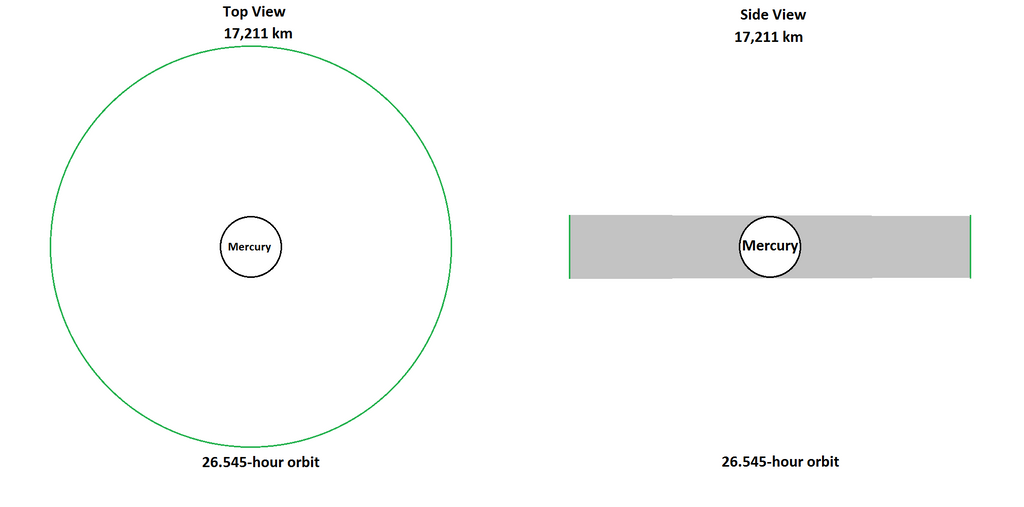
Look at this Sun shield I have drawn. As you can see Mercury is not enclosed, nor does it have to be. The radius of this sun shield is about 7 times the radius of the planet. One possibility is to use the Sun shield as a solar collector and export the energy as a by product of shading this planet, it has many times the surface area as Mercury, only a small portion of it is needed to illuminate half of Mercury at normal Earth daylight levels, the rest can be exported and sold. Maybe it could be used to propel light sails to distant stars or to the outer reaches of the Solar System.
#821 Re: Terraformation » Mercury » 2016-07-19 18:13:28
I suppose we can envisage whatever we want. None of us will live to see most of the ideas on this board come to fruition. So if we want to fantasize about terraforming Mercury and enjoy doing so, we can imagine whatever world we want and whatever god like powers needed to bring it about. It hardly matters how practical or fantastic those ideas are, we will never see them happen in either case. What matters is that we enjoy it - the process is an intellectual diversion for bored engineers and scientists.
I suppose we would need to go through a technological singularity first, some people are predicting that one will occur within 20 years, which basically means we build machines that are smarter than we are. When we build such machines, we need to set goals for them. One possibility is what planets to terraform. I am not sure we will ever need to break up Mercury, and use it to build millions of free floating space habitats, I figure we might as well terraform Mercury, as we will probably be able to travel outside of our solar system long before we use up all the material within it. I think Mercury is easier to terraform than the Moon because of its stronger gravity. As a society, we need to decide what we want to do with Mercury, Venus, the Moon, and Mars, and the asteroid belt.
#822 Re: Terraformation » Mercury » 2016-07-19 11:28:54
Up to a trillion tonnes (1000 cubic km) of water may be stored at Mercury's extreme latitudes.
https://www.rt.com/news/scientists-merc … claim-965/
The MESSENGER probe also discovered evidence of pyroclastic flows triggered by volatile release in parts of the planet's surface, some no more than a billion years old. This suggests that substantial volatiles may be trapped within the planet's interior and slowly outgassing.
That is a lot of water for individual humans, not enough to make oceans, or in the case of Mercury, lots of crater lakes. I envision a terrformed Mercury as largely covered in forests and lakes, the planet does not seem to have continents.
#823 Re: Terraformation » Mercury » 2016-07-19 11:22:53
Are you still going on about this? It would be a bad idea to terraform Mercury, even if you did find a way to do it. Mercury is high in metals, a larger proportion of those metals are on the surface than on Earth, there's extremely high intensity sunlight to provide energy to smelt. Furthermore, the 88-day sunlight followed by 88-day night means those metals are probably concentrated into veins. All this makes Mercury an ideal place to mine. Terraforming would interfere with mining. The most economic means of using Mercury is treat it as an airless mining world. Build settlements underground.
I've said before, ideal is to leave Luna (Earth's moon) as well as Mercury and Io airless. Luna is close to Earth, so can be used for various industrial purposes that require vacuum. Terraform Mars, Venus, Ganymede, and Callisto. Data from Juno shows radiation around Ganymede and Callisto is worse than we thought, making terraforming difficult if not impossible. But just a few decades ago terraforming anything was thought to be impossible. There are people who still think it is, and won't believe it until at least one planet is terraformed.

Sunlight even intense sunlight at Mercury's distance is relatively easy to block. Only a small proportion of Mercury's materials would need to be used to construct the wrap-around Sunshade I diagrammed. the shade need not be thick to block all the sunlight from reaching Mercury. This particular sunshade is 7 times the radius of Mercury itself. the only conflict is whether to use Mercury as building materials for an artificial world or terraform its surface. If we go for terraforming, the first step would be to block all sunlight, then use solar collectors on the outside to power artificial sunlight to provide a 24-hour day on the surface of Mercury, then we have to add atmosphere. It seems easier to bring the atmosphere from Titan than to terraform Titan by adding the energy that it lacks. Mercury has too much energy, it can sell the surplus energy to finance the terraforming of Mercury and people can live on its surface. Mercury has the same surface gravity as Mars, the escape velocity for Mercury is 4.25 km/sec compared to 5.02 km/sec for Mars. I think a terraformed atmosphere of Mercury would be much as proposed for Mars, once we shade the entire planet and provide artificial sunlight for it! the landscape on Mercury is much different from Mars, it is older and consists largely of craters and upthrust mountains caused by impact craters. I think terraforming Mercury would be harder than terraforming Mars, but easier than terraforming Venus, as you basically just have to add atmosphere to it, and get rid of all that excess sunlight!
#824 Re: Terraformation » Mercury » 2016-07-19 10:18:17
One is much smaller scale than the other. Only a few people can live with local volatiles, since Mercury has so few of those. If you want Mercury to be a habitat for billions of people, you need to do something a little more dramatic. Admittedly terraforming Mercury comes in conflict with using Mercury as a source of construction materials. Mercury as a vaccum world makes it easy to mine with lots of freely available solar energy and no atmosphere to get in the way of mining its surface. Blocking sunlight is easy, you just have to place something in between Mercury and the Sun. That is only the first step in terraforming Venus. If we can block sunlight from Mercury, the Mercury becomes more like the Moon, it is a place we can mine materials from.
Here is a Mercury Version of the Venus shade. We can construct this out of the material of Mercury itself, using solar powered mass drivers to fling rock to a bunch of rock catchers placed at 17,211 km. Notice that at this orbit, the proportions are the same as for Venus, only in the case of Mercury this is a 26.545 hour orbit. A 24-hour orbit is actually inside this radius. I did this many because I didn't feel like redrawing it, just changed the labels that's all. Probably the shade would have to be wider because the disk of the Sun appears larger when seen from Mercury, but the poles don't need much shading anyway. What can we do with this? Mercury exists in a vacuum, that means orbits are possible right down to its surface. Mercury is 2439.7 km in radius, it would make a great anchor point for a hollow cylinder, lets say we made this cylinder 2500 km in radius and anchored it to the crust of Mercury, the Solar shade would keep the Sun off of it, so things can get very cold for surfaces that need to be superconducting for instance in a maglev. It would rotate once every 52.874 minutes to produce 1 g of gravity at its surface, it would actually be around 0.62 g near the planet's equator because of the effects of gravity, as you moved away from the equator, spin gravity would feel stronger as you got further away from the surface of the planet. If you wanted 1 g above the equator, it would rotate once every 45 minutes to counteract Mercury's gravity. With Mercury being a ball this would be a less than perfect solution. You could have a series of rings spinning at different rates for different latitudes and radii for example. This would minimize the tensile strength requirements for your tethers, instead relying on the bulk of the planet to hold the thing together.
#825 Re: Terraformation » Mercury » 2016-07-19 04:34:23
Open sky terraforming would be difficult on a planet with little water or nitrogen and a solar constant 10 times greater than Earth’s. Also, being so deep in the Sun’s gravity well makes it relatively difficult to import or export anything.
On the plus side: there is plenty of solar power, very large day-night temperature variations making solar thermal power efficient, and no atmosphere, making space launch a lot easier. Colonists can escape high temperatures and radiation by retreating underground and colonising high latitudes. Mercury has only a slight axial tilt, so large parts of its surface are temperate, despite it being much closer to the sun. Even equatorial regions could be rendered habitable by covering them with reflective aluminium sheeting. The lack of atmosphere is an asset, as it allows large amounts of heat to be dumped into space during the cold of night. The equatorial crust has an average temperature >100C, so plenty of geothermal power is available to sustain colonists during the long night. Assuming the volatile inventories are similar to those of the moon, the planet probably has sufficient volatiles to support a billion people living in compact subsurface habitats (basically, O’Neill colonies that don’t have to spin), but not enough to provide open sky and oceans.
In summary, keep the surface of the planet as it is. Adapt to a sub-surface way of living, exploit the inherent advantages of the planet and live within the limitations that its resource set allows.
All you have to do is block the Sunlight and add some atmosphere. You don't have to get rid of an atmosphere, because its already gotten rid of. As for it being deep within a gravity well, that is important for taking something off Mercury and moving it to another part of the Solar System, but what about transporting an atmosphere from Titan to Mercury, Titan and Mercury are about the same size. You just basically have to lift atmosphere off Titan, reach the escape velocity of Titan, and the local escape velocity from orbit around Saturn, and then lose most of Saturn's 9.67 km/sec orbital velocity, and aim it just right to hit Mercury. Make sure Mercury is completely shaded when this collision occurs. Lets say we drop a series of balloons full of nitrogen, water, and carbon dioxide onto the planet. Will all of it escape into space? I think a lot of it will cool upon contact with Mercury's cold surface. We could build up this atmosphere over time, as we drop more and more atmospheric balloons on top of Mercury. No need to slow them down, Mercury will do that, all you need to do is hit Mercury with them.