New Mars Forums
You are not logged in.
- Topics: Active | Unanswered
Announcement
#776 Re: Science, Technology, and Astronomy » Earth Like planet around Proxima Centauri? » 2016-08-31 12:43:40
A nuclear pulse starship can still b used to colonize Mars, before we develop Artificial Intelligence and womb technology. the problem is even with womb technology, a seeder ship is a no go unless we have the AI to be the parents of the human children we want to grow upon reaching the destination. I have every reason to believe, that parenting requires the full capability of human intelligence, nothing less will ever do, as human babies are quite helpless upon birth, not set of preprogrammed instructions can work to parent a child. But we should develop the nuclear pulse technology as soon as possible and colonize Mars, Calisto, Venus, Mercury, the Asteroids and Titan with those. We also need to hold at bay those who want to live within Earth's ecological limits within perfect balance with nature while we wait to destroy ourselves with the latest wave of programmable religio-robots, (ie religiously brain-washed humans) Iran and other nations in the Middle East are hard t wrk to develop those, they have been successfully field-tested in the battlefields of the Iran-Iraq war and are now being deployed to use against the West. I think its perfectly feasible that a religion could develop who's ideology is the complete extermination of mankind! I've seen enough fanatics willing to do away with themselves in order to kill other people, that religious meme is certainly possible, which is why we need to act as soon as possible.
#777 Interplanetary transportation » Looking Back at Orion » 2016-08-31 09:12:20
- Tom Kalbfus
- Replies: 2


Looking Back at Orion
by Paul Gilster on September 23, 2006
Whenever I think about Project Orion, I recall the ‘putt-putt’ experiments that tested the propulsion concept back in 1959. It was hardly an atomic spaceship, but the little putt-putt called ‘Hot Rod’ is as far as Orion ever got operationally. Using chemical explosives, Hot Rod rose 100 meters, a brief flight that nonetheless validated the idea that a spacecraft built around nuclear bombs, propellant and a pusher plate could be made to take stable flight.
An atomic spaceship. There was a time when the idea seemed to have interstellar possibilities. Freeman Dyson, a key figure in Orion, envisioned one version that used a copper pusher plate twenty kilometers in diameter. Driving the ship would be a nuclear arsenal of staggering proportions: 30 million nuclear bombs, each of which would explode 120 kilometers behind the vehicle at intervals of 1,000 seconds.
With a total acceleration time of five hundred years—and a comparable time for deceleration—this mammoth super-Orion would carry a colony of 20,000 Earth people to Alpha Centauri. Flight time: 1,800 years, making it a true multi-generation ship, where the distant descendants of the initial crew arrive at the target to make a new start for humanity. Later Dyson would ponder a pared down version that used 300,000 bombs to reach a final velocity of 10,000 kilometers per second, with arrival at Alpha Centauri in 130 years.
These days Project Orion’s interstellar capabilities seem vastly over-rated, even though its potential for travel to the outer Solar System was very real. Dyson himself now considers nuclear options unviable for missions to another star. When I was researching my book, I asked him his current views about Orion as a way to reach Alpha Centauri. Here’s a bit of what he said:
The Orion idea was exciting, but as far as interstellar trips are concerned, nuclear energy just doesn’t cut it… Youre using less than one percent of the mass with any kind of nuclear reaction whether it’s fission or fusion. The velocities you get are limited to much less than a tenth of lightspeed. Nuclear methods are great inside the solar system but not outside; in interstellar terms, they are not very interesting.
But what a story, and if you haven’t read George Dyson’s book about his father’s work, you’re missing out on a great experience. It’s Project Orion: The True Story of the Atomic Spaceship (New York: Henry Holt & Co., 2002). Online, the ever-reliable Anthony Kendall offers up a fine account of Orion. Here Kendall describes the vehicle, which would have dwarfed any rocket ever made:
A full-size Orion vehicle would have had a mass of 4,000 tons – about 40 times that of the Space Shuttle – and would include a “pusher plate” about 1-meter thick at the center. This solid mass of metal served to reflect the Orion craft away from the nuclear explosions, while at the same time protecting the passengers from the neutron radiation. The enormous shock absorbers between the pusher plate and the crew module would then distribute the 10,000 G’s of each nuclear blast to something much more comfortable for Orion’s passengers. In fact, an Orion launch would probably be much more comfortable than a conventional chemical rocket because of the sheer mass of the vehicle.
So vast were some Orion concepts that Ted Taylor, a weapons designer who became a guiding force behind the project, once considered installing a 4000-lb barber’s chair on the ship, thumbing his nose at the piddling chemical rocket designs that measured out payload in teaspoons. But of course, those chemical payloads got larger even as political currents made the nuclear option less realistic. The nuclear test ban treaty was but one of many blows that put an end to the program. Dyson talks about all this in Disturbing the Universe (New York: Harper and Row, 1979).
Be sure to read Kendall’s account for the overview, then George Dyson’s book, a volume I could hardly put down. And if you want to follow some of the interstellar references, start with Freeman Dyson’s paper “Interstellar Transport,” in Physics Today (October, 1968), pp. 41-45. The drama of Orion’s demise is told in Dyson’s “Death of a Project: Research Is Stopped on a System of Space Propulsion Which Broke All the Rules of the Political Game,” Science 149, No. 3680 (July 9, 1965), p. 141. And keep an eye on an Orion descendant called External Pulsed Plasma Propulsion, which may have much to teach us still.
http://www.centauri-dreams.org/?p=831
This could be of use in setting up Mars colonies, and on Missions to the Proxima Planet. I think it could establish a high enough velocity to plant a seeder colony on the Proxima planet with further development of Artificial Intelligence and Artificial Womb technology. if 0.1% of the speed of light can be achieved, and I believe that it can be with Orion nuclear pulse technology, then a mission to the Proxima Planet could be launched. Perhaps with some preliminaries to establish the nature of the planet. Humans can be raised on the planet with AI parents perhaps, eliminating the need to bring an O'Neill colony along, perhaps they can be raised on the planet's surface. If the planet's orbit takes it in front of Proxima, then that would establish its mass towards the more lower limit of 1.3 Earth masses, which means gravity would be just a shade higher than on Earth's surface. Hopefully there are some more Earthlike planets orbiting the other two stars in the Alpha Centauri System.
#778 Re: Science, Technology, and Astronomy » Earth Like planet around Proxima Centauri? » 2016-08-31 07:13:12
There is another article on the Em-Drive, if this works out, we might not need linear accelerators or light sails.
https://www.yahoo.com/news/paper-nasa-g … 02200.html.
It is surprising that this has lasted longer than cold fusion, but if this is a hoax perpetrated by the media to sell copy, what about global warming?
The fastest probe to exit the inner planets to Pluto was the new Horizon on board the Atlas V family...
https://en.wikipedia.org/wiki/New_HorizonsOn January 19, 2006, New Horizons was launched from Cape Canaveral Air Force Station directly into an Earth-and-solar escape trajectory with a speed of about 16.26 kilometers per second (58,536 km/h; 36,373 mph). On July 14, 2015, at 11:49 UTC, it flew 12,500 km (7,800 mi) above the surface of Pluto
So 9 yrs plus now if we place this same probe on the SLS what would we be able to achieve?
I would think that the antenna would need to be larger, a larger RTG and bigger power amps for transmission of data would as well be needed I would think.
Another thing we would need would be artificial intelligence. Any probe that we send today would not be good for returning data, it might be good enough as a seeder ship however. Lets go down the list of technologies required.
1) A ship capable of reaching 1% of the speed of light
We can relax that somewhat a build a ship capable of reaching 0.1% of the speed of light, it would take 4,240 years to arrive at Proxima Centauri, and we would use an Orion nuclear pulse starship.
2) We would need artificial intelligence, something Marvin Minski is projecting to occur in the next 20 years
3) We would need frozen embryos, something we have already in use
4) And we would need to prefect artificial womb technology, the womb is an organ, once we've perfected the science of stem cell technology, we can grow human organs including wombs, we need an artificial brain that can interact with these organs (AI technology) and we'd then be all set to launch our first expedition to Alpha Centauri. Later technology might catch up with it or it might not! This mission architecture is a kind of insurance policy for the human race, the technologies employed to put it together might also be misused to destroy the human race, particularly atomic bombs, and artificial intelligence!
#779 Re: Science, Technology, and Astronomy » Earth Like planet around Proxima Centauri? » 2016-08-30 16:35:42
Tom-
I don't know why you're using that "4 cubic light years between Earth and Proxima Centauri" number, but seeing as you've repeated it twice I think it bears mentioning that it's not correct.
Space in our part of the galaxy is more-or-less flat, which means that the shortest distance between any two points is the straight line drawn between them. In the case of Proxima Centauri this line is 4.3 light years long. This line is the only thing that could definitively be said to be "between" Sol and Prox. This line, like all other lines, has a volume of 0.
In order to get a volume, you would need to specify some kind of allowable range of deviation from this line. If your range of deviation is "any path from Sol to Prox" then the space "between" them is comparable to the size of the observable universe.
You seemed to have assumed an acceptable range of "within sqrt(1/pi) light years" [cylinder with a cross-sectional area of 1 square light year] without justifying such a value or even mentioning that you had done so.
Seeing as you surely do not intend for your linac to be a physical structure, what's going to keep it in place as it exerts a force on a craft moving through it?
I'd also like to point out that there's a huge difference between a particle accelerator and your proposed linac. Specifically, the difference is about 35 orders of magnitude in the mass you're accelerating.
We could always use antimatter, something the size of what I'm talking about could produce an appreciable amount of antimatter which could power some starships, but what I'm talking about is mass transit to the stars, this won't be the first generation of starships, the first generation will likely be capable of traveling at 1% of the speed of light, the second generation can travel at 10% of the speed of light, the third can go up to 95% of the speed of light. Antimatter is dangerous, it might not be for the masses, a tiny bit can destroy a city, it is 100 times as destructive as a thermonuclear bomb, and you need that kind of energy if you do it with rockets. With lasers you need a fantastic degree of precision, and you need to trust in the effort back home, you have no means of communicating back with the people running the beam projector, especially if you need that beam to slow down. If you don't use antimatter, you need an absurd amount of physical infrastructure to get you close to the speed of light, I figure the best sort of infrastructure is the kind that can benefit the most number of people for a given effort, not just for a one off mission or for exploration, I'm talking about colonization. We need to capacity to send billions of people across interstellar distances.
#780 Re: Science, Technology, and Astronomy » Earth Like planet around Proxima Centauri? » 2016-08-30 08:13:18
Tom Kalbfus wrote:Proxima gives off very little UV except when it flares I suppose. So what do you think? Is there life already there, or do we have something we can terraform? Proxima is an energy source. So if Proxima b doesn't have an ozone layer, but Proxima doesn't give off much UV anyway, perhaps it doesn't matter much. Seems to me that traveling 4.25 light years to live on the frozen dark side of a tidally locked planet doesn't make sense. Seems like we would have to device some economical means for crossing interstellar distances. A linear accelerator that is 4.25 light years long with one end matching the velocity of our Solar System and the other end matching the velocity of Proxima, there would be 4 tunnels each one 100 meters wide, to accommodate a Subjective travel time of 3.54 years for accelerating at 1-g for half the distance and 1-g for the other half. The linear accelerator would recover the energy put into the craft's acceleration, when it decelerates, two tunnels would be for traveling, the other two would be for construction and maintenance. Probably would start with one accelerator at Sol and the other at Proxima. Probably it would be build out of Oort cloud material between the stars. You would robots that could construct copies of themselves out or native cometary material, you would need starships that can accelerate to 1% of the speed of light.
Tom, as always interesting. But why do your ideas always involve unfathomably large mega-structures? Do you honestly believe that a 4 light-year (16,000 billion mile) long mass driver is the most practical means of reaching the nearest star? Are there even enough materials in our entire solar system?
We are not limited to just our Solar System to find the materials to build it, there are rogue planets between the stars, judging by the occurrence of low mass stars compared with high mass stars, one can project that rogue planets are even more common than main sequence red dwarf stars like Proxima Centauri, and since I don't want to disfigure star systems by mining out orbiting planets, we can use interstellar planets instead, and I'm pretty sure that with a billion star probes capable of reaching 1% of the speed of light and then slowing down again, we can search an entire cubic light year of space and detect rogue planets within that space above a certain mass. A star such as Proxima Centauri has 127 times the mass of Jupiter, so how many rogue planets of Jupiter mass and less are floating around in Interstellar space? I'm pretty sure there are quite a few.
The first step would be to build 4 billion star probes using local material in our Solar System, send them out to the four cubic light years between Sol and Alpha Centauri, and search out those spaces for rogue planets, after we find some, we mine them for the material for building a linear accelerator, and once one is constructed, we can travel to Alpha Centauri by accelerating all the way.
#781 Re: Interplanetary transportation » Proxima Express » 2016-08-30 08:02:27
We have no examples in nature of anything traveling faster than the speed of light, we do have examples of things coming close to the speed of light, such as cosmic rays, and things accelerated by our particle accelerators, the linear accelerators I'm talking about are simply larger versions of that. Now if we live in a universe where travelling faster than the speed of light is impossible, we just have to make the best of things as they are, living within the physics as we know them today, if a sudden discovery should occur, fine, then what we did prior to that point may have been a waste or resources, but we don't know that until it happens.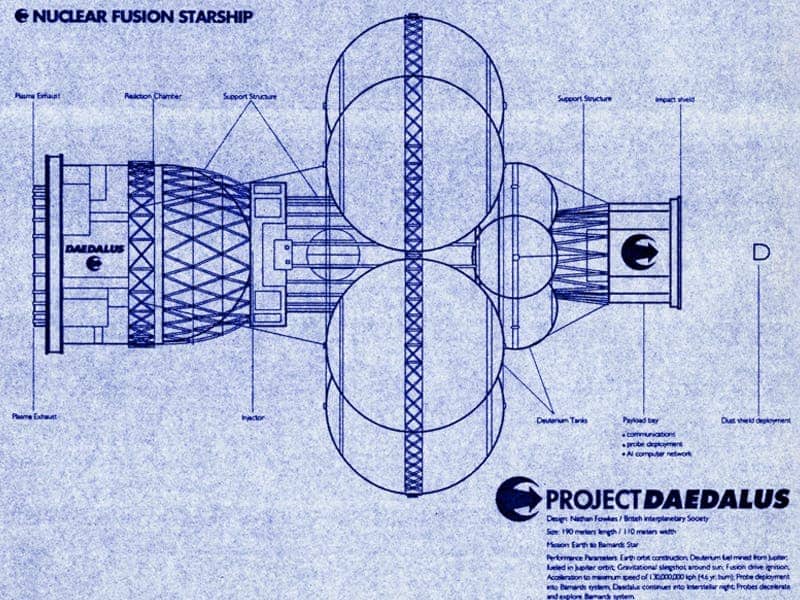
Funny thing happened when I was looking up diagrams and specs for this starship.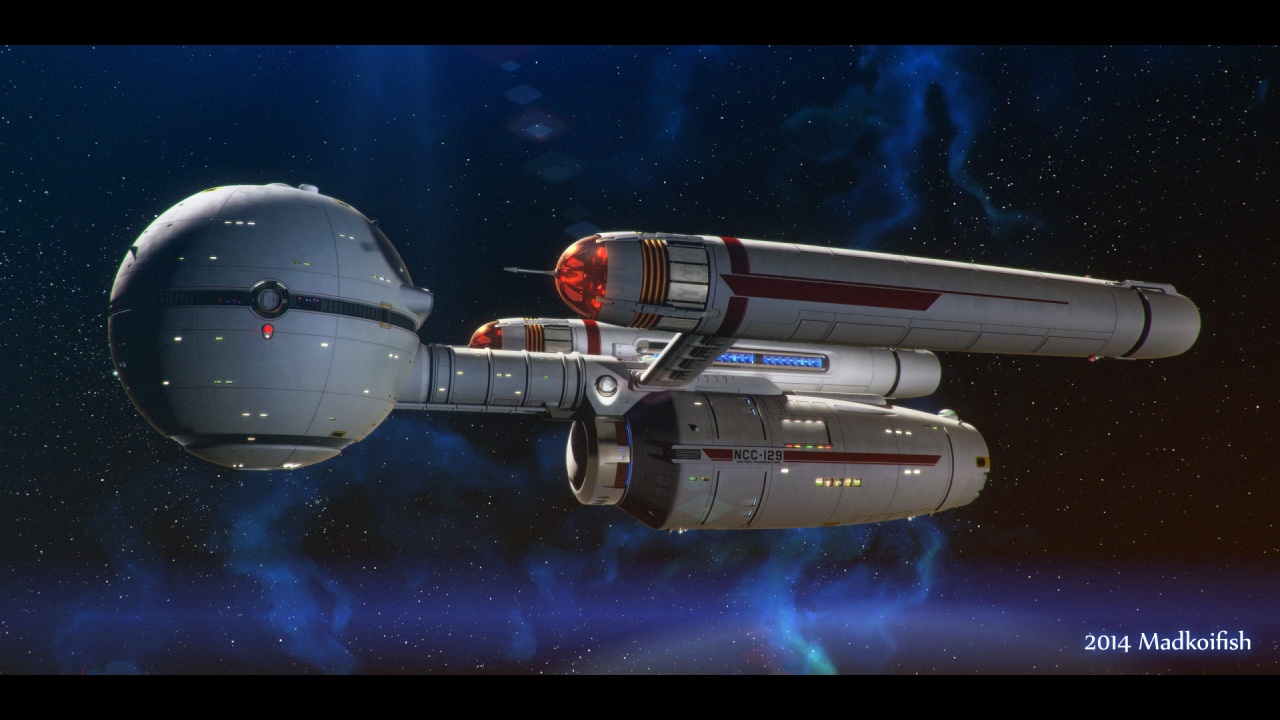
I kept on getting this one, and in fact there were more images of this one, than the one of Project Daedalus of a real starship proposed by the British Interplanetary Society. Now the thing is, Star Trek's starships aren't going to get us anywhere because they are not based on real science.
Eventually we may have a network of linear accelerators spanning across the galaxy. Maybe use antimatter ships to establish the beach heads in other systems, begin constructing each link and open up new systems to mankind. For the cost in matter though, we just find sunlike stars and build our own planets where there isn't one already.
#782 Re: Mars Analogue Research Stations » Hawaii Space Exploration Analog and Simulation station » 2016-08-29 20:15:01
So how does 1 year of isolation apply to a 2.5-3.3 year mission to Mars? You are still confined to either a habitat or a space suit, while you are there.
There are foods that last decades, most of which are frozen. But you cannot use them unless you can do water-based free-surface cooking. Which requires artificial gravity.
GW
on Mars????
#783 Re: Interplanetary transportation » Proxima Express » 2016-08-29 20:12:15
There are also rogue planets, and with self-replicating probes, we can detect them, in fact we could probably detect a good many of them with telescopes. There are the planets within our Solar System, but I wouldn't want to use those. There are also rogue planets out between the stars, chances are they are more numerous than red dwarf stars. We can search the 4 cubic light years of space between Sol and Alpha Centauri for some, send out 4 billion replicating probes, and space them out each one thousandth of a light year from one another in a cubic rectilinear arrangement and have them shine lasers on each other to measure their distances from one another precisely, if there is a rogue gas giant somewhere in those 4 cubic light years, it will be detected, then the spaceships will close in on that gas giant, self-replicate from its material and its moons and tear it apart to build the accelerator, the hydrogen would be used to fuel the fusion reactors and so forth.
My idea is to make interstellar travel cheap and commonplace, not something for an elite core of astronauts supported by a vast army at the homebase. We would probably need artificial intelligence to do most of the heavy lifting in this, but that is how it always would have been.
#784 Re: Interplanetary transportation » Proxima Express » 2016-08-29 10:35:42
We might want to consider building this thing from other star systems, Not sure I'd want to sacrifice Uranus and Neptune, but what about some other system that we don't care about, one that is not likely to yield life bearing planets, How about Sirius?
https://en.wikipedia.org/wiki/Sirius
It is about twice as far as Alpha Centauri, the inconvenient orbit of Sirius b just about rules out life bearing planets, but these are massive stars, I wonder how many gas giant could be orbiting this system. When Sirius b blew out its outer layers, there might hae been some material left behind to form planets, some of which could be quite massive. There could be some stable orbits close in to Sirius A, too hot for life, but an abundant source of construction material. So we can build a bridge to Sirius, import some of the material there and use that to build a bridge to Alpha Centauri. There might be some material in the Alpha Centauri system as well.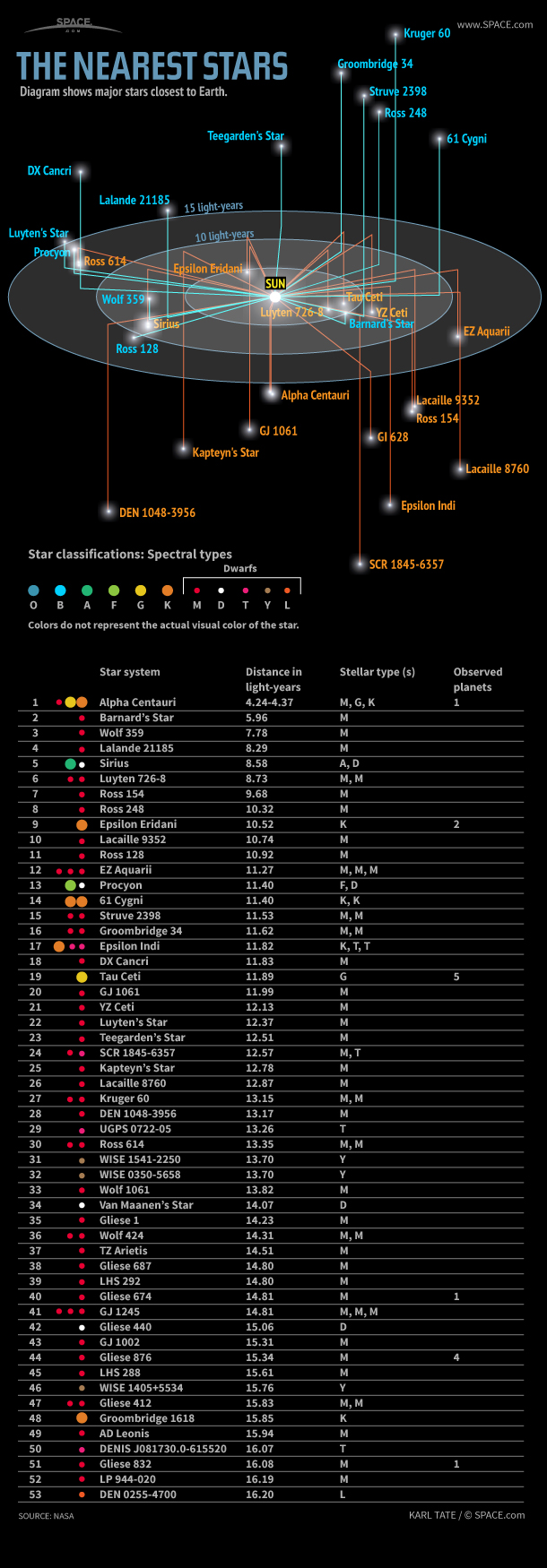
The Procyon system is another system we might obtain building materials from
https://en.wikipedia.org/wiki/Procyon
It is 11.46 light years away. One thing we might consider when transporting material from these systems is that material is less fragile than people. We could simply accelerate mass towards the Sol System and from there we can build a bridge to Alpha Centauri and other systems we may want to visit or colonize. We could build short stubby accelerators an decelerators economizing on materials used. Procyon like Sirius has no stable orbits in its habitable zone, it is also nearing the end of its life, we might as well use its materials for something that is useful to us.
It seems rather obscene the waste of matter or energy We can use light, and waste energy using only the momentum of photons or we can waste matter and build giant physical objects that mass greater than many planets to get us from one star system to another. Another idea is an elongated beam of light, something that is 10,000 km thick, 150,000,000 km wide, and 4.24 light years long. A light sail then moves outwards and diagonally starting at one end of the beam accelerating away from the Sun and moving sideways while doing so, then another light sail is pushed away and it moves diagonally away, at the mid point the light sails separate in two, the greater part reflects the light beam back at the smaller part that was formerly in the center slowing it down and continuing towards Proxima Centauri, by the time each sail has reached its destination it has moved 1 AU sideways. Assume it takes 3.54 years subjectively to make this trip and it moves sideways 1 AU so it moves at a rate of 4837 km/hour, lets call it 5000 km/hour, each sail is 5000 km wide, and each hour a new sail is launched, over the course of a year 8760 light ships are launched.
#785 Re: Interplanetary transportation » solar express futuristic train travel concept » 2016-08-29 10:02:15
Here is something from Next Big Future:
http://www.nextbigfuture.com/2016/08/co … train.html
Says its not workable either. I don't think any transportation system where the speed is 1% of the speed of light can stay within the Solar System by any combination of gravitational flybys.
#786 Re: Interplanetary transportation » Proxima Express » 2016-08-29 09:05:36
What you need is self-replicating machines.. I think all the parts of a 4.24 light year accelerator could be built and fit within this Solar System. So lets see, a light second is 300,000 kilometers, and there are 60 seconds in a minute, 60 minutes in an hour, 24 hours in a day, 365 days in a year, and 4.24 light years between Sol and Proxima Centauri, this comes to about 300,000 * 60 * 60 * 24 *365 *4.24 = 40,113.792,000,000 kilometers so if each one of my 4 trillion ships is 10 km long, that ought to do it! Each 1 meter cross-section of each ship is 202,500 tons before we add the fuel, 10 km is 10,000 meters so each one of those ships would weigh 2,025,000,000 tons.
1 becomes 2, 2 becomes 4, 4 becomes 8, 8 becomes 16, 16 becomes 32, 32 becomes 64, 64 becomes 128, 128 becomes 256...
2^45 = 35,184.372.088,832,
2^45.2 = 40,416,230,340,044
So 45.2 replications of that starship should bring you to the correct number, and 40 trillion times 2 billion tones equals 80,000,000,000,000,000,000,000,000 kg 8 * 10^25 is 13.3 Earth masses, this is just under the mass of Uranus, if we consume one or two of the outer gas giants, that might be enough t build this linear accelerator, There also might be some planets in the Alpha Centauri system, but if we were to do this, we might as well build our own planets. Your point well taken, The question is, would it be worth sacrificing two gas giants to build this thing? Maybe if it was only to the Alpha Centauri system it wouldn't be, but there are planets in the Centauri System as well, some of those could be disassembled to lead to other systems. Over time we could create a transportation network, one could flit from system to system, and could there be a safer way to travel up to 95% of the speed of light than within a tube? The tube keeps all things the ship may hit out of the path of the starship. The trip would still take years, but really it would be the safest way to do interstellar travel, baring new physics such a wormholes and other such stuff.
#787 Re: Science, Technology, and Astronomy » Earth Like planet around Proxima Centauri? » 2016-08-28 23:23:19
If Proxima b is a water world, it need not be tidally locked. All we really know about it is its mass, it could be an Earth mass of mostly water for all we know.
#788 Re: Interplanetary transportation » Proxima Express » 2016-08-28 23:19:59
As I said in the previous thread, I think lightsails are the way to go when it comes to interstellar transit. Assuming a reflective lightsail and a 10,000 tonne ship, accelerating at 0.1 m/s^2 (This will get you from 0 to 0.1 c in 10 years), total intercepted power needs to be 1.5e14 W (150 terawatts). This is a whole lot of energy, but the sun burns brightly. At 0.2 AU, the solar constant is about 34 kW/m^2.
I'm going to assume that only 10% of the light intercepted by this mirror actually makes its way to the interstellar craft. Therefore the primary mirror needs to intercept 1.5e15 W or 1.5 Petawatts. At 34 kW/m^2, the primary mirror will need to have an area of 4.4e10 square meters. This corresponds to a square with a side length of 210 km.
This mirror would not be in orbit. Instead, it would use light and solar wind pressure to counterbalance the effects of the Sun's gravity. A perfectly reflective mirror pointing straight back into the Sun should mass 1.5 g/m^2 to maintain its position. This is true no matter how far from the Sun it is because both insolation and gravitational acceleration fall off with the inverse square of distance.
Light that is being concentrated cannot be used to hold position. If 50% of the mirror surface is used to hold position and another 50% is used to concentrate, the sail can only mass .75 g/m^2. This is about an order of magnitude lower than what we have now but should be achievable short-to-medium term if we really wanted to.
Rather than building one giant concentrating mirror, I would create an array of separate mirrors operating together. This would make it possible to gradually expand capacity. It would also reduce the structural stresses inherent to megastructures.
The secondary mirror would be mounted on a relatively large body out at the solar focus. It will use the Sun's gravitational field to focus the light it receives onto a small area where the ship is. Depending on the accuracy and stability of the primary mirror array, a series of concentrators might help to narrow down the beam area.
To accelerate multiple objects at once, you need a very wide laser beam, so instead of having a very long linear accelerator, you have a very wide laser aperture, plus the fact that it takes 10 years, whereas it takes 3,000,000 seconds (34.7 days) to accelerate something to 0.1 c at 1-g acceleration. Linear accelerators can also be improved to cover the entire trip between Sol and Proxima with constant acceleration/deceleration for a trip 3.541 years subjectively and 5.866 years objectively. Of course you would need 8914.176 times the mass and 4 trillion starships capable of 1% of the speed of light, and it would take 424 years to get them all into position. Of course we can begin mining an sending construction material to the constructors at once, so when they arrive at their prearranged positions, they can begin construction at once, and it would take another 10 years to build it for total of 434 years to construct, and it probably would take another 4.24 years for the light to reach sol so we can verify that he accelerator is complete and we can begin using it.
There is also the little detail that Proxima Centauri is moving closer to us, that means the accelerator needs to be able to shrink in length so that one end can match the velocity of Proxima while the other matches the velocity of Sol!
#789 Re: Interplanetary transportation » Proxima Express » 2016-08-28 22:37:55
(1) just how do we build structures measured in AU and of what? (2) just how do we take ices and minerals and turn them into real engineering materials that we can actually use? (3) just how do you propose to move all this mass where it needs to go?
Near-term, this is a fallacious and unrealistic fantasy, precisely because there exist no answers to my three questions.
"Near term" is the next several decades. This applies to space habitats made from asteroid materials, space elevators, etc. Until there are answers to my three questions, these things cannot be done.
Far term, all bets are off. Far term is centuries hence.
GW
Near term you stick to 1% of the speed of light or less, and you build seeder ships cheaply, and it turns out, when it comes to interstellar travel, "Near Term" is also Far Term, because technologically the kinds of starships we can build in the near term would take thousands of years to reach the nearest star. I so happen to think that artificial intelligence is a near term technology, that is it will be developed in the next several decades. The first thing we can do with AIs is send them out on seeder ships, AIs can more easily get past the time barrier, that is they can wait a long time and complete the mission, growing humans in artificial wombs and acting as their parents upon arrival at the stars. If you are in a hurry however, its going to take more energy and materials, whether its giant lasers in space or linear accelerators.
To build the accelerator, we need AI which can replicate itself as many times as needed to build this accelerator in parallel, we need to get the constructor robots in position along the 30 AU where the linear accelerator is going to be built. We probably need to build shorter versions of this accelerator to move materials into position. We can build 31 linear accelerators our of cometary material each one is 0.03 AU long and accelerates material at 1000-gs Human cargo requires a long accelerator, but rocks and dirt do not!. So you build one accelerator near Charon, where you get your material, and you accelerate the rock and dirt to 10% of the speed of light to 30 difference locations along the construction site of the accelerator, at each of those positions an accelerator slows the incoming material down, the material from there is transported by freighter to the locatipns where they are needed, and the locations parts and pieces of the main accelerator are manufactured, and then the parts are assembled into the linear accelerator at 450 million different locations along the construction site. That should answer questions 1 and 3 as for 2, there is enough material in the Solar System, and even the outer solar system bodies are not all ice, the ice by the way can go to fuel the fusion reactors that power the manufacturing process and the linear accelerators. Eventually we can extend the accelerator or build another one that is 4.25 light years long. to do that we need about 90 times the mass and 90 times the spaceships and robots, and it would take 424 years to get all the robots into position along the route to begin assembling this longer accelerator, which would allow us to make the trip to Proxima in 3.54 years subjectively for the passenger and 5.87 years for the rest of us.
#790 Interplanetary transportation » Proxima Express » 2016-08-28 10:33:27
- Tom Kalbfus
- Replies: 21
After doing a comparison between terraforming Mars and interstellar Travel, this has got me to thinking, what can we do, that is on a similar scale to terraforming Mars that would make Proxima b more accessible, and the idea hit how about a linear accelerator. One that is 300 AU long which can accelerate a starship up to 10% of the speed of light, and then another and another and another! The problem with beamed propulsion, such as a laser sail for instance, is you can accelerate 1 light sail within a laser beam, but if you accelerate another light sail with that same beam, it may shadow the first one. There is only so much area within the beam for accelerating light sails. A linear accelerator however can accelerate multiple objects at once, in different parts of the accelerator. The other part is how do you slow down? We may use a Daedalus space probe to do that, it is said to be capable of reaching 12.5% of the speed of light, so it can slow down from 10% of the speed of light and have 6750 km/sec of delta-v for maneuvering around the system to do some explorations. The other problem is how do we build something that is 300 AU long? If we are capable of building a Daedalus, we are certainly capable of building a more modest spaceship, say one that can go up to 1% of the speed of light and then slow down again.
This blueprint states that the Daedalus probe is 190 meters long by 110 meters wide so we need an accelerator with a tunnel that at least 120 meters wide to accommodate the Daedalus spaceship. We probably would want multiple tubes, we'll give each one an external diameter of 150 meters, with a total of 8 linear accelerators in parallel and in the center we have the power conduit and fusion reactors. You see part of the tunnel's functionality it s to deliver fuel to the various fusion reactors along the length of the accelerator to power it, the accelerator acts as the transportation system to keep those reactors fueled, probably from a source such as the planet Neptune.
The whole apparatus would be 450 meters wide and 30 AU long! How much mass are we talking here? Lets say a cubic meter weighs a ton. A cross section which is 450 meters by 450 meters by 1 meter would weigh 202,500 tons before we cut out the holes for the tubes. There are 8 holes we are cutting out. The area of a circle 120 meters wide is 11,309.73 square meters, since this cross section is 1 meter wide, it is also 11,309.73 cubic meters and 11,309.73 tons. We cut out 8 of these circles for a total of 90,477.84 tons, subtracting that from 202,500 tons we get 112,022.16 tons. Now an AU is about 150,000,000,000 meters and 30 A is 4,500,000,000,000 meters multiply that by 112,022.16 tons and we arrive at the mass of this accelerator which is 504,099,720,000,000,000 tons or 5.04*10^20 kg.
Tethys has a mass of 6.22*10^20 kg. Charon would be more convenient, with a mass of 1.7*10^21 kg, this is more than 3 times the amount of mass that we need, and it also is far away from he Sun, just the sort of place we would want to build our linear accelerator. how how to we build it. We would obviously need a fleet of spaceships deployed along the length of the accelerator we propose to build. The orbital velocity of Pluto is around 4.74 km/sec. If we had 450,000,000 spaceships about the size of Daedalus we could put each one in charge of constructing 100 kilometers of accelerator at 1% of the speed of light it would take 1,500,000 seconds to travel the length of the accelerator or about 17.361 days excluding time to accelerate and decelerate. So each on of those ships gets into position and starts building its part of the accelerator. Lets say it takes a decade for each one to build 100 km of track.
So now we have a track capable of accelerating a Daedalus probe, both stages to 10% of the speed of light, and each probe expends 1 stage to slow down, and uses most of its remaining fuel to slow down into the Proxima system, and using material in that system, another linear accelerator can be constructing using another 450,000,000 spaceships to build another accelerator that is 30 AU long, and some guidance probes guides incoming spaceships precisely so they enter the decelerator and can slow down t match the velocity of the Proxima system, and then we can open up public access to Proxima b. The journey should take 42.5 years. the 110 meter wide spaceships can be rotated to provide gravity, or they can be attached together to form a larger wheel, 30 of them would make a wheel 1050 meters in diameter. The wheel would then rotate 1.305 times per minute to produce 1-g of centripedal acceleration. These wheels then break up on approach to the Proxima linear accelerator for precise positioning to decelerate within.
#791 Re: Science, Technology, and Astronomy » Earth Like planet around Proxima Centauri? » 2016-08-27 09:23:05
Proxima gives off very little UV except when it flares I suppose. So what do you think? Is there life already there, or do we have something we can terraform? Proxima is an energy source. So if Proxima b doesn't have an ozone layer, but Proxima doesn't give off much UV anyway, perhaps it doesn't matter much. Seems to me that traveling 4.25 light years to live on the frozen dark side of a tidally locked planet doesn't make sense. Seems like we would have to device some economical means for crossing interstellar distances. A linear accelerator that is 4.25 light years long with one end matching the velocity of our Solar System and the other end matching the velocity of Proxima, there would be 4 tunnels each one 100 meters wide, to accommodate a Subjective travel time of 3.54 years for accelerating at 1-g for half the distance and 1-g for the other half. The linear accelerator would recover the energy put into the craft's acceleration, when it decelerates, two tunnels would be for traveling, the other two would be for construction and maintenance. Probably would start with one accelerator at Sol and the other at Proxima. Probably it would be build out of Oort cloud material between the stars. You would robots that could construct copies of themselves out or native cometary material, you would need starships that can accelerate to 1% of the speed of light.
#792 Terraformation » Terraforming Mars vs Plan Proxima b » 2016-08-27 00:48:15
- Tom Kalbfus
- Replies: 2
In this discussion we are assuming molecular oxygen and water vapor is detected in the atmosphere of Proxima b. Its the dawn of the 22nd century there have been some settlements on Mars by this time, but otherwise Mars is as it is today. And some planners are thinking, they could terraform Mars or send a one-way colonization mission to the planet Proxima b, seen from a distance Proxima b seems to have an atmosphere similar to Earth, or at least as much as telescopes can tell. They are thinking about creating a second home for humanity, a home where humans can walk the surface without need of a spacesuit. One idea is to terraform Mars, a process that will take centuries, the other idea is to build colony ships which can achieve 1% of the speed of light and take centuries to get to Proxima b, but these ships are massive, about on the scale of O'Neill colonies. Suppose the planners decided to split the difference, and allocated 50% of their resources to terraforming Mars and 50% of their resources towards building worldships, and seeder ships to send towards Proxima b, at a cruising speed of 1% of the speed of light. Which one of these methods do you think is more likely to achieve positive results first?
#793 Re: Science, Technology, and Astronomy » Earth Like planet around Proxima Centauri? » 2016-08-27 00:34:10
Why wouldn't the world have an ozone layer?
I know of no reason that ozone couldn't form. Ozone freezes at -192.5 C and liquefies at 119.5 C.
I don't know if it would have an ice cap that was miles high unless it was on dry land.
#794 Re: Science, Technology, and Astronomy » Earth Like planet around Proxima Centauri? » 2016-08-26 11:20:11
So there are two scenarios. one where Proxima is largely barren, maybe has microbial life in its oceans, the other is a Proxima with a riot of life on its surface, multicellular plants and animals. What happens if humans try to colonize a planet if the second scenario is realized. Lets say that after a journey of several decades a spaceship sets down amidst a forest? Would native life be useful to human colonists?
#795 Re: Terraformation » Terraforming putative Proxima Planet » 2016-08-26 09:07:05
I calculate that if the orbital period is 11 days, then its distance from Proxima is 7,150,000 km or 0.048 AU. Luminoscity is 0.0017 Sol so the amount of radiation Proxima b receives fro Proxima is 0.0017 / 0.048^2 = 0.738 of what the Earth receives from its Sun, this might be good news. Proxima b it appears would be cooler than Earth but warmer than Mars before we add in the greenhouse effect. The nearside receives constant sunshine because the planet it tidally locked, the darkside has a frozen ice sheet, I'm assuming there is liquid water underneath even on the dark side, assuming the atmosphere isn't so thick as to completely distribute the heat from the dayside to the night side. There should never the less be a zone on the dayside which would have the maximum habitability for humans. It appears the updated the Wikipedia entry for Proxima Centauri
https://en.wikipedia.org/wiki/Proxima_Centauri
They have data for Proxima b, my estimate of its orbital radii is not far off.
Proxima Centauri b is an Earth-sized planet orbiting the star at a distance of roughly 0.05 AU (7,500,000 km) and an orbital period of approximately 11.2 Earth days. Its estimated mass is at least 1.3 times that of the Earth. Moreover, the equilibrium temperature of Proxima b is estimated to be within the range where water could exist as liquid on its surface; thus, placing it within the habitable zone of Proxima Centauri.[23][27][28]
Plant life may exist on the day side of the planet, one way it protects itself from solar flares would be if it is the alien equivalent to blue-green algae, it produces oxygen for the atmosphere and floats in the oceans, and then there is a flare, a lot of water evaporates, this produces a cloud layer on he day side that rains out when the Proxima flare ends. Aquatic life is thus prevented from burning, and the ocean depth prevents the water from boiling. Whether there is a huge ice cap on the darkside depends on whether there are any continents there, otherwise the ice cap will just be a frozen ocean surface with a liquid mantle underneath, much like Europa, but with an ice sheet that is likely thinner, water will flow under the ice sheet from the night side to the day side of the planet, and at a certain distance from the terminator, the ice sheet breaks up into ice bergs and then we have open ocean. It might be a good idea for humans to live near this ocean. The Ocean might offer some Solar Flare protection.
#796 Re: Human missions » Colonizing the Proxima Planet » 2016-08-26 08:35:29
Your kinematics are correct but building a 30 billion mile long mass driver by dismantling a moon is hardly a practical solution to anything.
You can reduce the mass by increasing the acceleration to 100-G, the mass then becomes 4.5*10^14 kg, the length of it drops down to 3 AU, and instead of accelerating humans, you accelerate drones, the drones home in on a target and then explode at a certain distance away, turning into a plasma, this interacts with the target's magnetic shield transferring the momentum from the drone to the ship, and since the ship has 100 times the mass of each drone, it accelerates at 1-G, a shock absorber smooth's out the acceleration so the ship enjoys a steady 10 meters per second squared of acceleration. If the drones can withstand 1000-G then you can reduce the mass to 4.5*10^13 kg, (45 billion tons) and the length to 0.3 AU or 45,000,000 km.
#797 Re: Human missions » Colonizing the Proxima Planet » 2016-08-26 01:36:41
Let's say we want to send a probe or ship to this planet within a relatively reasonable amount of time. Let's say we want it to travel at 10% the speed of light, for a travel time of about 45 years. Let's say we also want to slow down and stop when we get there.
10% of c is 3e7 m/s (30,000 km/s), so total mission delta-V is 60,000 km/s. Let's say we're okay with a mass ratio of 200. That means that the engine's exhaust velocity should be 5 times less than this, or 12,000 km/s (1,200,000 s). This is a kinetic energy of 7.2e13 J/kg. Call it 1e14 J/kg with inefficiencies. For comparison, chemical fuels max out around 1e7 J/kg and fission is about 8e13. Fusion (D-He3) is 3.5e14 J/kg. Fusion (4H->He) is about 6e14. Alternatively, this corresponds to a gas at a temperature of 12 billion degrees Kelvin.We've been working on fusion for a long time and we haven't yet built a reactor that's demonstrated the ability to generate power for a utility. The power density of these engines would have to be enormous too. If the engines are 5% of the total mass of each stage and you want to accelerate to .1c over 10 years, the total acceleration will have to be 0.095 m/s^2. The engines will have a T/W of 1.9 N/kg, which at a Vex of 12,000 km/s corresponds to a power density of 11.4 MW/kg. For comparison, nuclear fission reactors for space use have typically been designed for power densities below 50 W/kg.
It's not impossible, but it is extraordinarily difficult. I think beamed propulsion of some kind or another is the way to go on this one.
To reach 10% of the speed of light at 1-G acceleration, I'll say that's 30,000,000 meters per second, and 1-G I'll put 10 meters per second squared, it would require 3,000,000 seconds of 1-G acceleration to reach 30,000,000 meters per second or about 10% of the speed of light. The acceleration distance would be about 3,000,000 seconds times the average velocity of 15,000 km/sec which equals 45,000,000,000 km which is equal to 300 AU, about ten times the orbital radius of Neptune from the Sun.
One way to get up to 10% of the speed of light is to build a mass driver that is 300 AU long, and accelerate a crew capsule within it for 3,000,000 seconds, which is 34.72 days. Lets allocate 1 ton or 1000 kg for every meter of track, the total mass of the accelerator would then be 1000 kg * 45,000,000,000,000 meters = 45,000,000,000,000,000 kg in scientific notation its 4.5*10^16 kg, Triton has a mass of 2.147*10^22 kg, that is 477,111 times as much mass as we need.
So lets say we build a mass driver at the orbit of Neptune, which is 30 AU from the Sun, and it points to Proxima Centauri which is -62 degrees and 40 minutes declination, and we use the material from Triton to build it with, using hydrogen from Neptune to fuel the fusion reactor to power it. At 10% of the speed of light it would take 42.5 years to reach Proxima Centauri, and it takes 34.72 days to accelerate each payload, in the span of 42.5 years we can accelerate 447 such payloads, in 4.25 years we can accelerate 45 such payloads, rounding off to the nearest whole number. If each payload is 1*10^15 kg, then over a period of 4.25 years we can accelerate a mass driver in 45 segments up to 10% of the speed of light, The mass driver which does this has a mass of 4.5*10^19 kg. The segments are separated by 89,994,240,000 km, The pieces would have to converge in 42.5 years, that means each piece would need to be accelerated 67 km/sec faster than the previous one. the velocity difference between the first and the last is 3020 km/sec. Towards the end of the journey, we assemble a mass driver and decelerate a capsule to match the velocity of Proxima b, this takes another 34.72 days, the residual velocity carries the capsule over to the planet, and it enter the atmosphere and a parachute is deployed for a landing.
#798 Re: Human missions » Colonizing the Proxima Planet » 2016-08-25 08:26:51
I would say, Proxima b would get its tides from Proxima and neighboring planets. You have to remember that at this scale, neighboring planets will probably be much closer than in our Solar System, their gravitational effects on Proxima will likely be quite significant, for one thing they will tug on Proxima b and pull it out of its other wise circular orbit, as Proxima b pulls away from its primary, he tides will decrease, Proxima b will get rounder, as it falls closer, Proxima b will be stretched into more of an egg shape, same with its oceans. Much the same thing happens with Io and Europa. We were pretty lucky, not only is this an Earth like planet, it also is a planet that someday, humans might inhabit. 1.09-G isn't too bad. Proxima is older than out Sun, which might mean this planet might be less dense if there were less metals formed in this earlier stage of the Universe. Being larger probably means it started wit a thicker atmosphere than Earth, and if its further away, then the greenhouse effect probably compensates for the increased distance. An interesting experiment is to find out if Earth plants will grow under simulated Proxima Sunlight, since we have a distance from the star and we know its brightness, we can begin experiments with Proxima b agriculture. What do you think the results would be?
#799 Re: Interplanetary transportation » solar express futuristic train travel concept » 2016-08-25 08:10:34
I checked the reference, the details are quite scant as to how the system would actually work. Is it some kind of momentum exchange system (i.e. skyhook)? What else could be meant by 'space train'? Gravitational assist is already used to propel space craft. But it won't propel a vehicle to 1% C. Solar powered mass drivers (coil guns) would work economically in the inner solar system, but they won't get you to Mars in 2 days, or even 2 months for that matter.
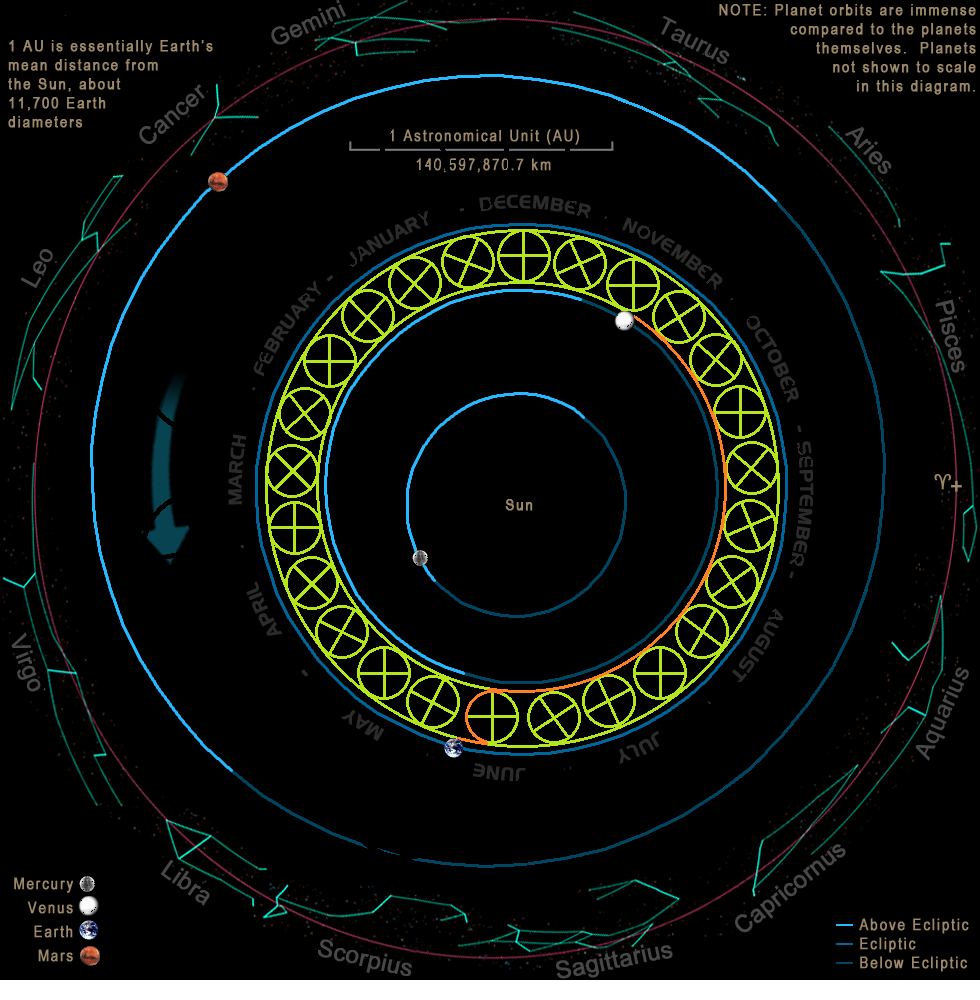
The system I devised would work, if you assume magnetic levitation. Basically you fly your spaceship to the outer ring, attach it to the maglev system, then accelerate-decelerate it to the first loop, detach from the outer ring, attach to the loop, and accelerate-decelerate along the loop until you reach the inner ring, detach from the loop, and accelerate-decelerate till you get near Venus, you detach from the inner ring, and use your rocket motors to go the rest of the way towards Venus. To go to 1% of the speed of light, you need this system of rings and loops to extend towards the outer solar system, that way you can accelerate to 1% of he speed of light without building up an intolerable amount of centrifugal force.
#800 Re: Human missions » Colonizing the Proxima Planet » 2016-08-25 00:46:13
Here's the article I found:
http://www.digitaltrends.com/cool-tech/ … ri-planet/
1.3 times the mass of Earth means, that the planet probably has crustal plates, it has an active geology, with an orbital period of 11 days, it probably has a rotation rate of the same, thus is has a magnetic field, if it has the same density as the Earth, its diameter would be 1.09 times our own and its gravity would also be 1.09 times our own. A human could walk on this planet without too much discomfort. Even if solar flares have blasted away its atmosphere, it would still make an attractive terraforming target, as it is tidally locked, and probably has a massive ice cap on its dark side, which means lots of volatiles to terraform the planet with. I think chances are good it has an atmosphere of some sort, it ia 1.3 times our planet's mass, and it is a little further out from its star than it would have to be to get the equivalent radiation that Earth get from it Sun. It likely recycles its crust, so I would expect continents on its surface, and perhaps oceans too.