New Mars Forums
You are not logged in.
- Topics: Active | Unanswered
Announcement
#751 Re: Science, Technology, and Astronomy » What is the status today of O'Neill's vision today? » 2016-09-05 09:39:53

You know how we got our idea for airplanes.
Humans are just another example of something we can build artificially, you would just like to place that development far in the future for your own comfort, because of the change it would represent to society, but sticking your head in the ground and pretending its not going to happen, won't prevent it from happening. Go to a car factory, and as fast as a car is produced is as fast as a robot can be produced, now imagine what would happen if all the humans working in that robot factory were replaced by the robots that were being made in that factory, and imagine those robots building more of those factories, that is how I imagine this O'Neill cylinder being produced. Now I admit there would be dangers to humans. Humans need to do work or else their skills would atrophy, yes I agree with that. We will have to do something to set aside work for humans to do. But if we have those robots and while we control them, we can get them to do fantastic things, like creating whole new worlds for us to inhabit, they could terraform Mars and Venus as well, its just a matter of labor ultimately, and resources and energy. The Sun provides plenty of energy, the Solar System has plenty of resources, we just need to figure a way to get that labor done. Jobs are being automated even as we speak, and I hope that AI is developed quickly rather than slowly, because the disruptions caused by people losing their jobs to machines would be pretty devastating, so I'm hopping it happens all at once rather that gradually, thus prolonging the pain of transition. Afterwards, we can do things we could not do before, feed and shelter the poor for instance. There would no longer be poor, and there would no longer be rich, a person's talent would not matter, so there would be no point in having haves and have nots. he AIs would be competing with each other to serve us, Capitalism would still be operating, but the competitors would be machines, we would then tap into that, and with that we can rearrange the Solar System to our liking and even travel to the stars.
#752 Re: Human missions » Project Orion Mars Colony » 2016-09-04 22:40:07
How do you know the Mars Colonial Transporter won't be nuclear? Elon Musk hasn't shown it yet, maybe a nuclear Orion Spacecraft is what he has in mind, his company could probably build an Orion, he just needs permission from the government to get those nukes to propel such a spacecraft.
#753 Re: Terraformation » Terraforming putative Proxima Planet » 2016-09-04 22:36:50
I think by the 22nd or 23rd centuries, when we visit this planet, humans aren't likely to be the only intelligent inhabitants of Earth and the Solar System. We will create another "race" of intelligent artificial life forms, and the will have a lot to do with getting us to Proxima b.
#754 Re: Science, Technology, and Astronomy » Cartography of M-star tidally locked planets » 2016-09-04 22:33:10
As I said before on another thread, a while back, even before Proxima b was discovered, Alpha Centauri is the "New Mars", back in the late 19th century when we thought Mars might have had canals and there might have been life, perhaps even an ancient civilization of canal builders, Proxima Centauri b is that planet for us now, early in the 21st century, I'll bet there will be a whole bunch of science fiction novels written about it, now that we know it exists. And for a time, we can imagine all sorts of things about it, like we once did about Mars, and maybe Proxima b is just as unreachable as Mars was back in the late 1890s. I'm sure we can find a way to get there, that we can't even imagine now, probably by the 22nd or 23rd centuries, humans will make their first footsteps on that planet's surface.
#755 Re: Interplanetary transportation » The Impossible Propulsion Drive Is Heading to Space » 2016-09-04 20:08:00
Right now, all they are doing is seeing if it can be used to maintain a satellite's orbit against atmospheric drag in low Earth orbit. the thrust its said to produce is very weak. I think some sleight of hand may be at work here. It might be worth while to send it into space to see if it works, it would be better if they could use it to send something to Mars, rather than just maintain its orbit against atmospheric drag. After all one can always overestimate atmospheric drag and say it works. What we really need to do is to accelerate an object with the em-drive, that would once and for all prove that it works. If a satellite could go into a higher orbit using the Em-drive, that would prove it beyond question!
#756 Re: Science, Technology, and Astronomy » Earth Like planet around Proxima Centauri? » 2016-09-04 17:52:15
One science fiction book talked about space aliens arriving to our solar system. That book had large ships, each with a giant light sail. In the book, astronomers noticed a new star in the sky, then noticed the spectrum was an exact match of our own Sun. It was reflection from a giant mirror. The ships slowed for a number of days, then got dramatically brighter when the sail became energized with an electro-static field to reflect and accelerate solar wind. Would that work? Would that be enough to act as an interstellar parachute to slow the spacecraft enough that it could enter orbit about the star?
Proxima is a small star, about the size of Jupiter, its solar winds would diminish a lot more quickly by the inverse square law from Proxima than it would with our Sun. I think the other two stars in the trinary system, would be better targets for slowing down. I am hoping that we find some more Earthlike planets in the Alpha Centauri system, particularly one orbiting Alpha Centauri A would be good, it is the most Sunlike star.
#757 Re: Science, Technology, and Astronomy » What is the status today of O'Neill's vision today? » 2016-09-04 17:47:42
Well you would need a work force in the trillions at least, that work force would be mostly robots, they would outnumber humans at least 1000 to 1 and they would do our bidding. I am basically thinking of projects for them to do before they get out of our control. Having once space colony circling the sun has advantages over millions of them, for one it can't collide with itself, while many millions of smaller habitats can. This habitat would have 160 times Earth's surface area of living space, one can even live underneath the illumination strips, because unlike the giant windows of O'Neill's standard design, the illumination strips don't have to be part of the hull. One can live under them and they can provide illumination both to the opposing valley and to what's under them, so we really are utilizing all of the cylinder's floor space. Also the rotation diameter is only 20 miles, we know of materials that can handle that stress, the really long part is its length, but that just requires a lot o building. We need von Neumann machines to do this work, once that replicate enough times to bring the work force up to the right number to construct this thing. Once constructed the discard the excess von Neumann machines and leave some behind for routine maintenance and upkeep of the structure and we're all set to inhabit it.
#758 Re: Human missions » Project Orion Mars Colony » 2016-09-04 17:35:48
All we need is the prospect of a planetary disaster. Or an impending alien invasion. Or maybe a president that doesn't care too much about international outrage. Maybe a man like Trump?
We got that. Nuclear weapons provide their own prospect for planetary disaster, whether we use them in spaceships or not. Not using them does not reduce the threat to our cities. I think Trump could be persuadable if one can make the right arguments. He is a real estate man after all. Mars has plenty of real estate. I think with an Orion, we basically build a prefab colony on Earth, and then launch it into space and land it on Mars. Since nukes are a strategic asset, we probably would need the government' permission to use them, but that doesn't mean that a private entity could not use them. As I said before, the nukes become private property when they explode, before that, they belong to the government. I think the nukes would probably be made specifically for the spaceship, the private user would pay for their manufacture and take possession of them when they explode underneath the spaceship.
#759 Re: Science, Technology, and Astronomy » Earth Like planet around Proxima Centauri? » 2016-09-04 15:03:40
The British Interplanetary Society designed Daedalus. A similar technology is the interstellar ramjet, proposed in 1960 by the physicist Robert W. Bussard. It would use a magnetic field called a Bussard collector to collect "solar wind" from interstellar space, and use that as fuel for a nuclear fusion engine. Modern studies have shown the interstellar medium is not sufficiently dense for that to work. However, would solar wind within the heliosphere of the destination star be sufficient to provide enough fuel for a nuclear engine to slow the craft? Starting with the bow shock, then heliopause, then termination shock. "Heliosheath" is space between the heliopause and termination shock. Don't know the density of each region, and don't know how space around a red dwarf would be different from our solar system. But could this work?
Use Daedalus to accelerate to full speed, with the Bussard collector augmenting stored propellant until it leaves the heliosphere of our solar system. Could it achieve 20% the speed of light? Then use the Bussard collector alone to provide propellant to the fusion engine to slow at the destination star system. Coming in at high speed would aid the Bussard collector, so I'm expecting it would work more efficiently for slowing than accelerating.
I suspect that the solar wind around Proxima would not be a great area in which a slow down could occur. I think it would be easier to slow down in the broader solar winds of Alpha Centauri A and B. I think if we were in a hurry to build a spaceship, an Orion would be the thing we could build without having to develop too many radical new technologies. Anyway our enemies are not as deterred by nuclear weapons as they once were, how else do you explain the 9/11 attack? Maybe if we were to explode a few nuclear weapons to launch an Orion, that would have a healthy effect on our potential enemies, that they'd better not mess with us. In any case, we could send a bunch of people to Mars with that.
#760 Re: Science, Technology, and Astronomy » Earth Like planet around Proxima Centauri? » 2016-09-04 14:58:31
The animated GIF is a clip from the movie "Dr Strangelove". It was a spoof. It obviously shows actor Slim Pickens riding a prop in a studio, with a background superimposed with 1960s technology. Then cut to real film of a nuclear test. The ground is completely different. Who could think this was anything other than a scene from a silly comedy movie? Actually the movie did have a serious message about dangers of war.
The roads do look similar, I think they took an aerial film of a site where an atomic explosion took place, for a film of an atomic explosion which they already had, then they superimposed they guy riding the missile prop in front of it. The ground below looks blasted, so something did occur there!
#761 Human missions » Project Orion Mars Colony » 2016-09-04 14:38:46
- Tom Kalbfus
- Replies: 43
Suppose the US Government green lighted the construction of an Orion Spaceship and supplied the nuclear warheads for a Mars Colony. Lets say SpaceX wanted to build it, and they also purchased the atomic bomb explosions from the Energy Department, that is the nuclear warheads remain the property of the government until the explode, and when they explode SpaceX then owns the explosions.
So imagine this sitting on a launch pad, the launch director calls up the President of the United States, and he supplies the launch code, and the launch code is good for detonating each atomic bomb within a certain time frame to propel the spaceship into orbit. First a chemical rocket lifts this thing off the launch pad, and when the ship reaches a certain height, spectators at a certain distance see an eerie violet light casting long shadows as the view the spectacle through protective glasses, then another bright light and another, while they watch this spectacle, the blast wave from the first atomic bomb explosion catches up with them, and then another and another, each blast grows fainted as the ship ascends higher and higher, past a certain height, they only see the bright light, as the ship ascends into space.
The lunch site is most likely an island in the South Pacific, the EMP radiation would tend to fry electronics that aren't protected, so we launch his thing where hardly anyone lives. Once in orbit, the Orion uses a low thrust, high specific impulse ion or plasma drive to pull away from Earth, to a safe distance where atomic bombs can once again be used to insert the ship into a trans-Mars injection.
So what do you think can one such spaceship establish one colony on Mars? say with 100 people in it?
I think that it wouldn't need atomic bombs for landing on Mars. Since we're setting up a Mars colony, it would have heat shields and chemical landing rockets to make a soft touchdown. inside would be a bunch of inflatable greenhouses and habs for the colonists to live in.
#762 Re: Science, Technology, and Astronomy » Earth Like planet around Proxima Centauri? » 2016-09-04 14:26:44
Interesting looking at that site. You can see that the atomic explosion occurred before the man riding the missile, as you can see evidence of an atomic bomb blast in the background! So they must have filmed it above the site where an actual atomic bomb explosion took place, that is the explosion shown in the film.
But seriously, you know chemical rockets will never get us to the stars, antimatter is too theoretical right now, I don't see lasers thousands of miles wide in space happening any time soon. If we wanted to build a starship in a hurry, then the only one we could build would be the Orion design, we know atomic bombs after all, and more and more people are getting them, most are mostly interested in blowing up cities and causing megadeath with them, so I would suggest that we use them to get off this planet before someone does! Probably the most obvious destination for an atomic bomb spaceship would be Mars, which makes me think of starting another thread on that.
#763 Interplanetary transportation » The Impossible Propulsion Drive Is Heading to Space » 2016-09-04 14:13:18
- Tom Kalbfus
- Replies: 5
The EmDrive, a hypothetical miracle propulsion system for outer space, has been sparking heated arguments for years. Now, Guido Fetta plans to settle the argument about reactionless space drives for once and for all by sending one into space to prove that it really generates thrust without exhaust.
Even if mainstream scientists say this is impossible.
Fetta is CEO of Cannae Inc, and inventor of the Cannae Drive. His creation is related to the EmDrive first demonstrated by British engineer Roger Shawyer in 2003. Both are closed systems filled with microwaves with no exhaust, yet which the inventors claim do produce thrust. There is no accepted theory of how this might work. Shawyer claims that relativistic effects produce different radiation pressures at the two ends of the drive, leading to a net force. Fetta pursues a similar idea involving Lorentz (electromagnetic) forces. NASA researchers have suggested that the drive is actually pushing against "quantum vacuum virtual plasma" of particles that shift in and out of existence.
#764 Re: Terraformation » Terraforming putative Proxima Planet » 2016-09-04 12:40:15
I think the greatest danger of solar flares is that the worst ones are speculated to be damaging to any ozone layer, and after that, life on the day side would be at risk of U.V. So, if that is so, the danger would be after the flare. And that presumes that you would have a ozone layer in the first place. On the other hand it is supposed that Mars had Oxygen in it's atmosphere when it was younger, that from the splitting of water molecules by U.V. light. Oxygen in the atmosphere might promote the formation of an Ozone layer then. So, a flare might destroy ozone which would facilitate the formation of more Oxygen, and the more Oxygen would facilitate the formation of ozone, so, it's possibly a double edge sword. Maybe you could have a N2/O2 atmosphere without life.
...
Sectioning off the dark side ice cap, I then ponder the Katabatic winds.
https://en.wikipedia.org/wiki/Katabatic_wind
https://en.wikipedia.org/wiki/Katabatic … ind_hg.pngThe Katabatic winds would be periodic, and could sweep very fine cold snow into lower areas, such as open water, and if the ice cap margins were grounded against a lowland area suitable it might even sweep the snow into those, and some of those might even be on the day side near the terminator. I suppose to a limited extent, snow might even travel uphill like sand dunes to the day side, provided the winds were fierce enough, and until the dunes reached a location where they would melt.
This and direct evaporation from open water or ice, and the possibility of an Earth model ocean spillage/circulation would provide moisture to the atmosphere, and in the case of snow pushed by winds, a direct source of melt water for rivers and streams.
...
Troposphere:
https://en.wikipedia.org/wiki/TroposphereThe average depths of the troposphere are 20 km (12 mi) in the tropics, 17 km (11 mi) in the mid latitudes, and 7 km (4.3 mi) in the polar regions in winter. The lowest part of the troposphere, where friction with the Earth's surface influences air flow, is the planetary boundary layer. This layer is typically a few hundred meters to 2 km (1.2 mi) deep depending on the landform and time of day.
So based on this, how high can an ice cap be on Proxima b?
The planet will have greater gravity, so the ice will flow more like a pancake, glaciers flowing faster I presume, if other conditions are similar to Earth. Total amount of water. For now I presume that the amount is proportionally similar to Earth. However many thinkers think that such planets will have a relatively reduced amount of water. I think that water may be conserved well on such planets if it were there in the first place.So the next question is how high can water vapor go as a rule. For Earth we might think 7 km (4.3 mi) per the article linked to. So, the higher the ice cap, the more limited it is in receiving water vapor for snow on it's plateau.
And then there is the continental base. For the Earth model, Antarctica would help to isolate part of the ice cap from the presumed oceans.
For the Mars model, grounded ice would have no continent under it. It is possible that liquid water would exist under all portions of the ice cap, so it would be on banana peals so it really might pancake out over the ocean basin, and not be as high.

So how would we go about terraforming this planet so humans could more easily live on it?
Would a tidally locked planet with a red sun be a problem for human inhabitants?
Should we try to fix that?
What about shielding from Solar flares?
Maybe we could put a large physical object at the planet's L1 point that selectively blocks solar flares.
Also what could se do about the night side. Maybe we could place giant mirrors in polar orbits around the planet, maybe by using light sails that got us to this system in the first place. Just some ideas I'm throwing out there. If we blocked off direct light to Proxima b and set up mirror satellites in 24-hour polar orbits we could have Earth like days. But of course those polar orbits would either have to change their orbital planes rapidly, or we need multiple mirrors that are selectively reflective and non-reflective, since the year is only 11.2 days long.
#765 Re: Science, Technology, and Astronomy » Cartography of M-star tidally locked planets » 2016-09-04 12:29:48
I think the Jupiter system is the best model we have for Proxima Proxima has the mass of 127 Jupiters if I recall correctly, what would be the masses of the Galliean satellites if we increased their masses 127 times?
Satellite Mass 127 times
Io 8.93×10^22 kg --> 1.134*10^25 kg
Europa 4.8×10^22 kg --> 6.096*10^24 kg
Ganymede 1.48×10^23 kg --> 1.88*10^25 kg
Callisto 1.08×10^23 kg --> 1.08*10^23 kg
Earth mass is M⊕ = (5.9722±0.0006)×10^24 kg
I guess Europa would come closest to Earth mass if scaled up to the same proportion as Proxima.
Seems the Galilean satellites are tidally locked, why wouldn't the planets around proxima be?
Distances could be multiplied by 11.269 times to get new orbits of
Io 421,800km -->4,753,264.2 km
Europa 671100km -->7,562,625.9 km
Ganymede 1,070,400km-->12,062,337.6 km
Callisto 1,882,700km-->21,216,146.3 km
Seems like Europa becomes an earthlike planet if you scale up its mass in proportion to Proxima, and you increase its distance by the square root of Proxima's mass in Jupiter masses. So maybe the Proxima system resembles Jupiter's.
https://en.m.wikipedia.org/wiki/Galilean_moons
#766 Re: Science, Technology, and Astronomy » Earth Like planet around Proxima Centauri? » 2016-09-04 12:04:40
It is the closest system, and it has three stars with three habitable zones, knowing that their is at least one Earthlike planet should stimulate development of interstellar travel. I tend to think slow boats are more realistic, we might be able to send small ultralight craft on a beam of microwaves, but what comes after that would be slow boats. I think the most practical way to get there at 10% of the speed of light would be a staged fusion rocket like the Daedalus. The Daedalus can reach 12% of the speed of light, so if it were on a colonization mission with a slow down, it could reach 6% of the speed of light. A Daedalus would take 70 years to reach Proxima if it were to reserve fuel for slowing down. Some of the ideas I had are a bit ridiculous, and for a later time, if ever! Antimatter is a bit hard to handle or even manufacture! Fusion, I think we'll have that this century, and if we really wanted to, we could use nuclear bombs to propel a spaceship, that should do much better than our current chemical weapons can.
#767 Re: Science, Technology, and Astronomy » What is the status today of O'Neill's vision today? » 2016-09-04 06:01:06
The "egg" in Artificial Intelligence, the "caterpillar" is "nanotechnology," This structure isn't something that would be built by "humans in hard hats," it is something built by machines for humans, the structural materials would come out of the backside of the Moon, the volatiles would come out of the asteroid belt. I pick an orbit between Venus and Earth because that space is mostly empty, has more available solar energy, and there would be a ring of solar collectors on the Sunward side of the cylinder. This solar collector ring beams microwaves to the cylinder, and the efficiency of conversion from light to electricity to microwaves to electricity is not 100%, so having more available solar energy than at Earth is a bonus.
The inward turning cylinder ring around the Sun is in the shadow of the Solar Collector ring, it radiates the waste heat into space from this inefficient conversion process. The electricity it receives from the Solar Collector ring it used to generate artificial sunshine in hologram form from the light strips. The light strips are arranged in the same trilateral pattern on the inside of the cylinder as the window-solars are in the standard O'Neill cylinder design, and since this cylinder doesn't have end caps, mirrors are structurally impossible anyway. The only way to approach this cylinder that's bent into a ring around the Sun, is from the side. This cylinder rotates in and out once every 6 minutes for gravity. If you are close enough to see the cylinder, it appears to be straight, you can't see the curve at all, if you pulled out far enough so you could see the entire ring around the Sun, it would appear so thin as to be invisible, you would need a telescope to see parts of it, but the telescope would prevent you from seeing the whole thing at once.
If you stood inside the cylinder, you would see the landscape curve around you, there would be an illumination strip above you with a holographic image of the Sun providing light. The image of the Sun would over time appear to rise in one direction, starting off very red, and becoming brighter an whiter as it climbed in the sky, then it would set, becoming redder until it fades into darkness providing night. If you look in the direction of the cylinder's length, the cylinder appears as a tunnel that seems to diminish into infinity, no apparent curvature is evident, because even at this closer orbit, this curvature is very slight, and imperceptible before the cylinder diameter seems to diminish to nothing with distance. If you looked up in the sky once more, you would see two strips of land above you, to the right and left of the illumination strip above you, both the illuminator and the land strips would run the entire length of the cylinder, which is to say, like the cylinder itself, they go completely around the Sun. To the right and left of the land strip you would be standing on, are two more illuminator strips, that illuminate the two opposite land strips above you. The distance to the center axis of this cylinder is 10 miles, if you were to ascend to that height, the atmosphere would equivalent to that experienced at the top of Mount Everest, in the "Death Zone" in other words, you could acclimatize yourself to it and breath that air without added oxygen for a time, but not for long. There is no landscape that reaches that high in any case. Some mountains may get as high as 5 miles, you would breath the equivalent of the 2.5 mile altitude on Earth, and you would experience one half gravity at the summit of such a peak. So 10 miles is pretty much as wide as such a cylinder can get while remaining inhabitable throughout. (as inhabitable as the summit of Mount Everest ever gets!)
A double shell might be a good idea, but I still need the radiators to regulate the internal temperature, so it doesn't get too hot inside, and we might also want seasons in certain places. There is a lot of land here, might want some places to be the Arctic and over a distance, transitioning into subarctic, temperate, subtropical, and finally tropical, with different day lengths over a seasonal cycle to match. Not all parts of the cylinder would experience daylight at the same time, I'd say at any given moment equal lengths of the cylinder would experience day and night at he same time. During night in a particular section of this cylinder, the illumination strip would either show the stars, or an image of the moon, which could be at various phases depending on the time of the month. the diurnal cycle would be 24 hours long and vary with the seasons over a 365.24 day year just as on Earth. As for the unpredictability of humans, that is why you have police and jails if they misbehave.
#768 Re: Science, Technology, and Astronomy » What is the status today of O'Neill's vision today? » 2016-09-03 21:03:58
Just an errata correction. I forgot to convert the diameter from miles to kilometers in making the calculation of surface area. the surface area is actually equal to 160.9 Earth's worth of surface area, this is more than on Saturn. As for where we get the construction material to build it, the closest convenient object is Earth's Moon. So lets see how much mass we are talking about for this calculation, I'll assume 2.5 tons per cubic meter. the cross section is 32,216.88 meters, the interior cut out is 20 meters less to allow for a 10 meter thick hull making it 32,196.88. The outer circle is 815,141,707 m^2, the inner circle area is 814,129,926 m^2 subtracting the inner from the outer we get 1,011,781 m^2 multiply this by 2500 kg for a 1 meter cross section and we get 2,529,452,500 We'll call this 2.5 billion kilograms. Multiply this by 804,354,533,000 meters and we get a mass of 2,034,576,584,383,182,500,000 kg 2*10^21 kg. the Mass of the Moon is 7.342×10^22 kg. So this would require 0.0277 of the mass of the Moon, much less than one of my proposed linear accelerators to Alpha Centauri, and what to we get for this small contribution of mass from the Moon? About 160.9 Earths worth of living space, that's what, all conveniently located at the half-way orbit between Venus and Earth. Of course we'll also need volatiles from the asteroid belt and Jupiter's moons to make an atmosphere and soil for plants to grow in.
#769 Re: Science, Technology, and Astronomy » Cartography of M-star tidally locked planets » 2016-09-03 08:19:20
In Stephen Baxter's novel Proxima, he used the terms Substellar point for the point where the Sun is directly over head, and the opposite point was called the Antistellar point, on the dark side of the planet. Would you want to use those terms? Since on Earth the Sun rises in the East, why not call the Substellar point the East Pole, while the Antistellar point would be called the West Pole. When you are facing east, North is to your left, so in this case North if clockwise around the planet and South is counterclockwise. But Baxter used the conventional North, South, East, and West Directions. His planet still had a North Pole, the planet still rotated, it just rotated at the same speed that it orbited the star, but relative to other planets and stars, they still were seen to rise in the East and set in the West. The Proxima b planet will still need communications satellites, there are four possible places where they could be put, the most useful ones would be Proxima b L1 and L2. L3 is on the opposite side of Proxima, L4 is 60 degrees ahead of Proxima b in its orbit and L5 is 60 degrees behind., and they are each about 7,500,000 km away, not terribly useful if you want telephone like communications. Proxima power would be useful, just set up your solar panels on the ground and orient them towards Proxima, no need to tract the star, you could even use Solar concentrators if you like.
#770 Re: Science, Technology, and Astronomy » What is the status today of O'Neill's vision today? » 2016-09-03 00:20:31
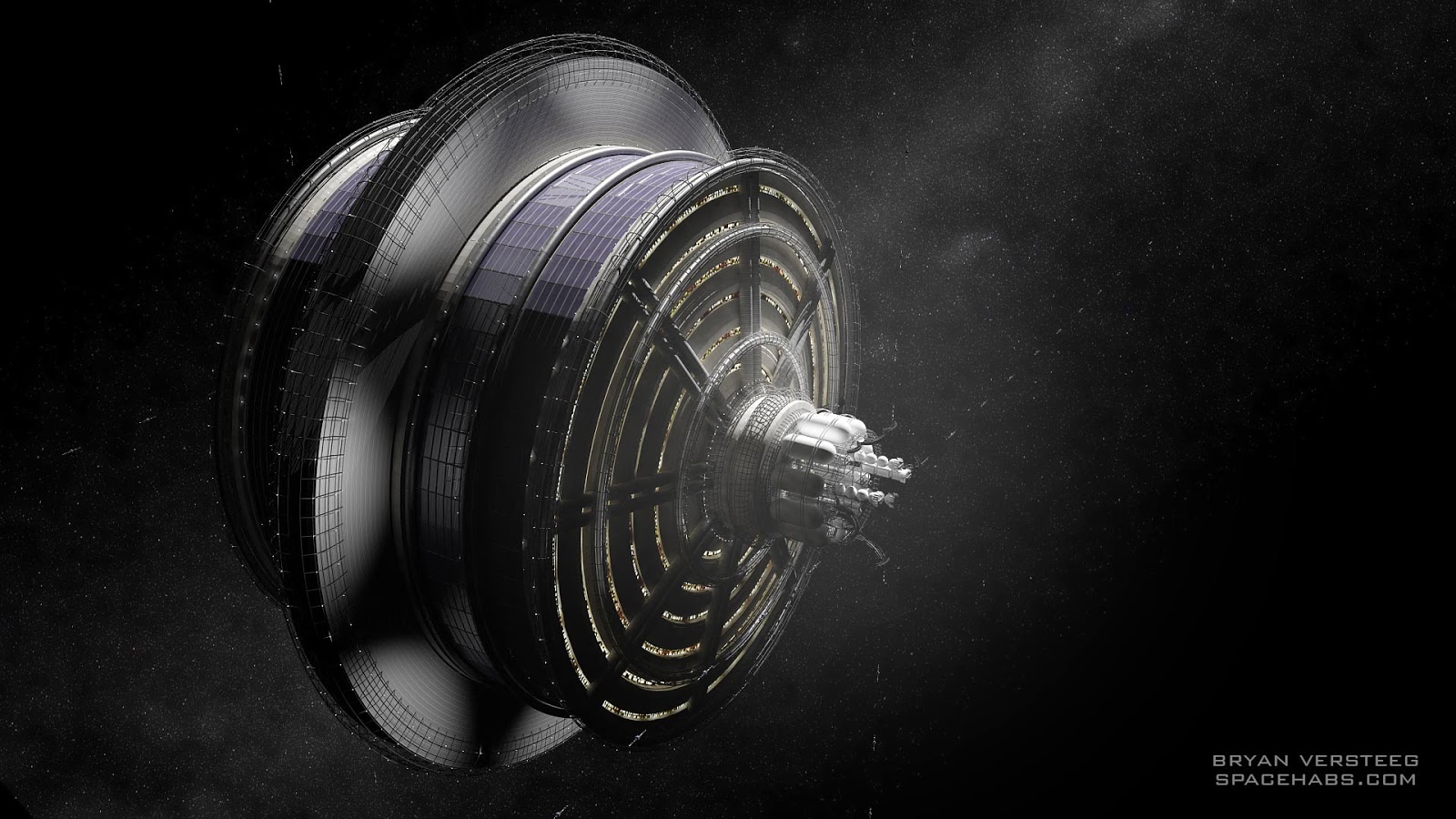
Suppose we stretched the Kalpana space colony, or combined this idea with an O'Neill cylinder.
We could build one of these around the sun half-way between the orbits of Venus and Earth, as both have fairly circular orbits. Venus has an Aphelion of 108,939,000 km, and Earth has a Perihelion of 147,095,000 km, Averaging these two numbers together we get 128,017,000 km.
The orbital period at that radius is 289.092 days. Since we are operating on such a large scale, lets make the cylinder 20 miles in diameter, about as thick as a standard O'Neill cylinder is long. It would spin at 561.8233412310315 meters per second and rotate once every 6 minutes to produce 1-G of centrifugal force. Since we have no means to hang a light tube in the center since there are no end caps, we use the same trilateral geometry, using have the floor space with illumination panels. There is a solar collector which beams power to the rotating cylinder, and radiator panels to dump excess heat an regulate internal temperature. the entire length is equal to the circumference around the Sun or 804,354,533 km The surface area of the Earth is 510,072,000 km^2. The surface area of this cylinder is 50,539,085,864 km^2 or 99 times the Surface Area of Earth.
#771 Re: Science, Technology, and Astronomy » Earth Like planet around Proxima Centauri? » 2016-09-03 00:03:22
Personally, I think it is practical to consider that other star system as something to observe, both because we have a lot to do just to get a better sense of what it is, and because it is such a different kind of star system. Personally, even if Proxima b is habitable, and not yet inhabited, I would not consider it to be prime real estate because of the mass of it. Very hard to get on to and off of. And it most likely at best is marginally suitable to humans.
Anybody who can travel across the void between the stars is not going to have trouble getting off an Earth sized planet, as we will have to get off an Earth sized planet just to start the journey to the stars in the first place. If your talking about traveling faster than 10% of the speed of light you start getting ridiculous or gigantic ideas, myself included. I have the idea of light years long linear accelerators, and that is one way to accelerate an decelerate at 1-g for the entire journey without using antimatter, There are those giant lasers that are thousands miles wide pushing thin light sails, and there are microwave beams and star wisps, and that pretty much exhausts the realistic possibilities for interstellar travel. if one wishes to use fusion, you have to plan on a trip that will take generations, either a generatin ship, a sleeper ship, or most likely a seeder ship. An AI would have to pilot and crew it. Unfortunately humans don't hatch out of eggs, and need to be raised and educated. Humans are clever and will tend to do things in a generation ship that are no anticipated. I don't feel comfortable with sending a space colony on a one thousand year journey to Alpha Centauri, its hard to predict what humans will do during the 1,000 year transit, and such a starship will be huge, just to suppose a colony of sufficient size. Sleeper ships crewed by AIs are a different story.
#772 Re: Science, Technology, and Astronomy » Earth Like planet around Proxima Centauri? » 2016-09-02 23:50:51
Tom Kalbfus wrote:Past 20 years the future is simply the future, I won't be part of it most likely, I am nearing 50 now.
And I'm 54. My grandparents passed away in their early 90s. Why would 20 years not be part of our experience?
My Uncle died when he was 69, my maternal grandfather died in his 70s, my paternal grandfather died in his 80s as did my paternal grandmother. My maternal grandmother lived to be 94 after witnessing the death of her two children, one was my mother who died in 1995, she was born in 1943, so she died at age 52, and my 49th birthday is coming up on September 15th of this year, the aforementioned uncle was her twin brother. So my maternal grandmother watched her husband die at 70, her daughter die at 52 and her son die at 69. My father is still alive, and he was born in 1942 so that makes him 74 years old, he is a healthy 74, so I'm hoping I take more after my father than my mother, who was a smoker by the way. I suppose if I'm careful, I could live another 20 to 30 years. My time horizon goes out to 2047 that is when I reach my 80th birthday. Any Terraforming, I'm probably not going to see. I guess I may see astronauts return to the Moon, and maybe humans on Mars in my old age, and I am hoping that medical advances will allow me to live longer than 80, they have 31 years to happen. Will I ever see a picture of the Proxima planet? I don't know, at best it might be a fuzzy dot.
I am hoping for AI, that is probably my only chance to live past 100, we need minds that are way smarter than human in order to figure out how to arrest aging, maybe even reverse it. We need powerful minds to figure out how to set up human colonies on other planets, the problem of space travel has been such a hard nut to crack, I sometimes wonder if its going to take superhuman intelligence to figure out how to do it! Maybe human minds aren't smart enough to figure out how to colonize space or make nuclear fusion work, o how to grow nerve cells. I still see people in wheel chairs, I still see blind people, I see people who are missing limbs and cannot grow new ones, there are a lot of things we still have not figured how to do, despite decades of study and research.
#773 Re: Science, Technology, and Astronomy » Earth Like planet around Proxima Centauri? » 2016-09-02 12:44:34
Past 20 years the future is simply the future, I won't be part of it most likely, I am nearing 50 now.
#774 Re: Interplanetary transportation » Space X - If at first you don't succeed... » 2016-09-02 08:24:30
The satellite was most likely insured, it was an Israeli communication's satellite, so the insurance company will pay to build a replacement.
#775 Re: Science, Technology, and Astronomy » SETI Is Investigating a Possible Extraterrestrial Signal » 2016-09-01 01:32:03
I think it was just radio leakage, their signals weren't meant to travel over interstellar distances at all, it is after all, not very practical to send a signal 95 light years and expect an answer. One question is, if we are receiving their radios signals, are they receiving ours? Right now they should be receiving our radio signals from 1921.